Visual overview
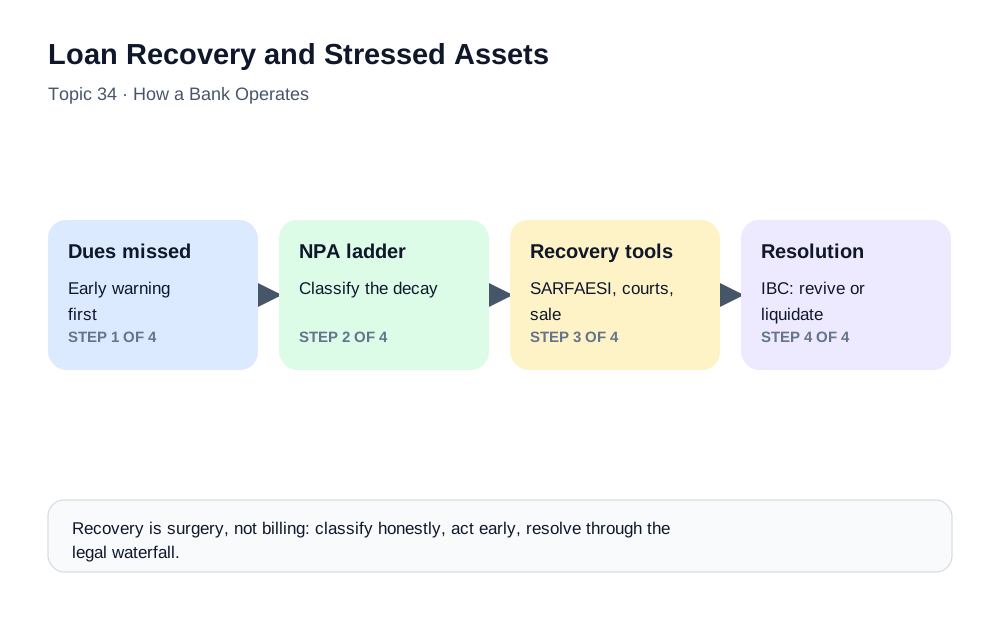
Loan Recovery and Stressed Assets at a glance — NPAs, asset classification, SARFAESI, IBC.
1. Introduction: Where Lending's Bill Comes Due
When borrowers cease to repay their loans, banks face one of their most critical challenges. The management of stressed assets, those loans showing signs of difficulty or already in default, can determine a bank's survival or failure. How effectively a bank identifies problem loans, navigates recovery options, and minimizes losses separates well-managed institutions from those that spiral into crisis. Understanding this process illuminates the realities of credit risk and the mechanisms that protect the banking system.
Topic 32 traced the healthy lifecycle of a loan; this chapter is about its pathology — the stages, strategies, and systems for when repayment stops. It connects backward to the provisioning machinery of Topic 30 (every classification here has an accounting consequence there) and forward to the treasury and liquidity questions of Topic 35 (a bank drowning in bad loans soon runs short of cash and confidence alike).
Learning objectives. By the end of this chapter you should be able to:
- Describe the asset-classification ladder from standard to loss, and the provisioning each rung triggers
- Explain the NPA vicious cycle and how stressed assets threaten bank solvency
- Evaluate the recovery toolkit: restructuring, settlement, ARC sales, and legal enforcement
- Map the resolution waterfall banks follow from first missed payment to write-off
- Explain how early-warning systems prevent defaults — and why prevention beats recovery
- Navigate distress from the borrower's side: rights, options, and the cost of silence
2. Asset Classification: The Ladder of Deterioration
The first stage in managing stressed assets is accurate classification. Banks categorize loans based on repayment performance, with each category triggering different regulatory requirements and provisioning levels. Asset-classification rules are jurisdiction- and product-specific. Under the RBI framework for many Indian bank advances, incipient stress is tracked through Special Mention Account categories beginning immediately on default: SMA-0 covers amounts overdue up to 30 days, SMA-1 more than 30 and up to 60 days, and SMA-2 more than 60 and up to 90 days. For a term loan under the applicable Indian IRAC framework, the account becomes non-performing when interest or principal remains overdue for more than 90 days, subject to the detailed regulatory rules and exceptions for particular exposure types. Other countries use different definitions, so the Indian ladder should not be treated as a universal global rule.
Under Indian regulatory terminology, an NPA can progress through substandard, doubtful and loss classifications according to the applicable IRAC rules. Provisioning is not captured accurately by saying every doubtful asset requires 'near-complete' provisioning: required amounts depend on factors such as how long the exposure has remained doubtful, the secured and unsecured portions, collateral realisability and the specific regulatory category. A loss asset is one identified by the bank, auditors or supervisors as uncollectible or of such little value that it should not continue to be carried as a bankable asset, even though some salvage or recovery may still occur.
The ladder at a glance (Indian regulatory terminology, widely mirrored elsewhere):
| Classification | Trigger | Provisioning consequence | What it means |
|---|---|---|---|
| Standard | Payments current | Minimal (standard-asset provisioning) | Healthy loan |
| Special mention (SMA) | 30–90 days overdue | Watch-list; intensified monitoring | Early warning — the last cheap exit |
| Substandard (NPA) | 90+ days overdue, under 12 months as NPA | Substantial provisions begin | Default recognized; recovery likely partial |
| Doubtful | NPA for 12+ months | Near-complete provisioning | Recovery uncertain; collateral decides |
| Loss | Deemed unrecoverable | 100% provision or write-off | The bank admits the loss; pursuit may continue |
Two design features deserve attention. First, the ladder is time-based: classification follows days overdue rather than judgment alone, which makes it hard to hide deterioration — the 90-day line is bright, mechanical, and audited. Second, provisioning climbs with each rung, so the passage of time automatically converts hope into accounting realism. A bank cannot keep a dead loan 'alive' on its books indefinitely; the ladder drags it toward the truth.
The regulatory classification ladder and IFRS 9 impairment stages are related but they do not map one-for-one. An SMA indicator can contribute to a Significant Increase in Credit Risk assessment, but Stage 2 depends on the IFRS 9 SICR analysis relative to initial recognition rather than an automatic regulatory label. Likewise, an NPA may overlap with credit-impaired or default concepts, but accounting Stage 3 follows the applicable credit-impaired assessment and the bank's governed definitions. Banks therefore reconcile prudential classification and accounting impairment rather than mechanically translating one label into the other.
3. The Anatomy of Non-Performing Assets
A non-performing asset represents more than a statistical entry on a balance sheet. It signals that a borrower's circumstances have changed dramatically, whether through business failure, personal distress, or broader economic conditions. For the bank, each NPA consumes capital, reduces profitability, and demands management attention that could otherwise focus on growing the business.
The impact of rising NPAs creates a vicious cycle that can threaten bank solvency. As non-performing loans increase, banks must set aside more provisions, reducing reported profits. Lower profits constrain capital growth, limiting the bank's capacity to extend new credit. Reduced lending slows business activity, potentially causing more borrowers to default. Meanwhile, the bank's credit rating may decline, increasing its own borrowing costs and further squeezing margins. This dynamic explains why banking crises often accelerate rapidly once NPA ratios begin climbing.
The arithmetic of one NPA shows why the cycle bites so hard. Take a $10 million loan that goes non-performing. First, the income stops: at 9% interest, $900,000 of annual revenue vanishes from the P&L. Second, provisions arrive: at even 40% coverage, $4 million charges against profit. Third, the loan still consumes capital — regulatory capital must be held against it, often at higher risk weights — while generating nothing. Fourth, management time, legal costs, and monitoring overhead accumulate. A single mid-sized default can therefore swing a small bank's annual result from profit to loss; a portfolio of them, arriving together in a downturn, is what turns lending mistakes into solvency events.
India's banking system experienced a major asset-quality cycle in the second half of the 2010s, intensified by the Asset Quality Review and more rigorous recognition of stressed exposures. RBI data show the scheduled commercial bank gross NPA ratio peaked around 11.2% of gross advances at end-March 2018 before declining in subsequent years. The episode drove provisioning, recapitalisation, recoveries, insolvency proceedings and changes in credit and monitoring practices. It is a useful illustration of how delayed recognition can make a credit cycle appear suddenly worse when the underlying stress is finally measured more honestly.
4. Recovery Strategies and Methods
Banks employ multiple strategies to recover from defaulted loans, choosing approaches based on the borrower's circumstances, collateral availability, and the size of the exposure.
Restructuring modifies loan terms to give viable borrowers breathing room to recover. Extensions lengthen the repayment period, reducing installment amounts to match diminished cash flows. Interest rate reductions lower the cost of debt service. Principal moratoria allow payment holidays during which borrowers can stabilize their operations. In some cases, banks convert debt to equity, becoming shareholders in the business rather than creditors. Restructuring succeeds only when the borrower's fundamental business remains sound, temporary difficulties rather than structural failure caused the default.
One-time settlements offer a pragmatic resolution when full recovery seems unlikely. Their negotiation logic is worth understanding from both sides. The bank compares the settlement offer against the discounted, uncertain proceeds of years of enforcement — and should accept whenever the certain present offer exceeds that figure. The borrower's countervailing power is precisely the bank's enforcement cost and delay: a well-prepared settlement proposal quantifies what litigation would yield the bank and offers somewhat more, today. Done properly, settlement is not surrender but the market pricing of time and uncertainty — and both sides walk away better off than the legal path would have left them. The bank accepts a reduced amount, often a significant discount to the outstanding balance, in exchange for immediate payment or a committed repayment plan. This approach acknowledges economic reality, partial recovery today may exceed the uncertain proceeds of prolonged legal action. Settlements are common for retail loans and small business exposures where legal recovery costs would consume much of any potential recovery.
Asset reconstruction companies specialize in acquiring and recovering bad loans. Banks sell non-performing assets to these specialized firms at deep discounts, receiving immediate cash rather than uncertain future recoveries. The ARCs then deploy their expertise in workout and recovery to extract value from the distressed assets. This separation allows banks to focus on their core business while specialists handle the complexities of recovery. The economics of an ARC sale deserve a sketch. A bank holds a defaulted exposure of $100 million, realistically worth perhaps $45 million in prolonged recovery. An ARC offers $40 million in a mix of cash and security receipts — instruments paying out as recovery proceeds. The bank books the loss immediately, converts an illiquid, management-hungry asset into cash and a tradeable claim, and frees capital for new lending. The ARC profits if its workout skill extracts more than $40 million plus costs. Both sides trade honestly around the same uncertainty — and the discount is the price of transferring time, expertise, and risk to whoever bears them best.
Legal remedies provide enforcement mechanisms when cooperative approaches fail. In India, the SARFAESI Act, 2002 provides qualifying secured creditors with statutory mechanisms to enforce eligible security interests after following the Act and the Security Interest (Enforcement) Rules; the process is not accurately described as a universal right to seize any collateral immediately or without legal safeguards. The Insolvency and Bankruptcy Code, 2016 and the regulations made under it provide a formal, time-bound framework for corporate insolvency resolution and, where resolution does not succeed or another statutory trigger applies, liquidation. The Code and IBBI regulations have been amended repeatedly, including in 2026, so exact timelines and procedural requirements must be checked against the current law rather than reduced to a blanket 'one year or mandatory liquidation' rule. The broader economic point remains important: more credible enforcement and insolvency processes can reduce expected loss severity and improve credit pricing, but lenders must follow the exact statutory process and borrower protections that apply to each case.
5. The Resolution Waterfall
Banks typically follow a structured sequence when addressing defaults, escalating intensity as earlier approaches fail. The waterfall is shaped by a single economic fact: each descending step costs more and recovers less. A phone call costs rupees and may cure the default; restructuring costs analysis and some concession; enforcement costs lawyers, auctions, and years; insolvency costs a share of the estate to the process itself. The bank's interest is to resolve as high up the waterfall as possible — and the borrower's interest is identical, which is why early engagement is the rare true win-win in all of credit.
The process begins with internal recovery efforts. Relationship managers contact borrowers, seeking to understand the reasons for default and explore possible solutions. Demand notices formalize the bank's position. Personal visits demonstrate seriousness and assess the borrower's genuine circumstances. Many defaults resolve at this stage, borrowers facing temporary difficulties resume payments once initial problems pass.
If internal efforts fail, formal restructuring may be attempted for borrowers whose businesses remain viable. This requires detailed analysis of cash flow projections, collateral values, and the likelihood of successful turnaround. Restructuring is not generosity, it is a business decision that sometimes yields better recoveries than immediate enforcement.
For secured loans, foreclosure and asset seizure follow when restructuring is impractical. Banks invoke legal powers to take possession of collateral, sell it through auction or private treaty, and apply proceeds to the outstanding debt. The difference between loan amounts and recovery values represents the bank's loss, absorbed through provisions and capital.
A retail-scale illustration grounds the waterfall. A small trader misses three EMIs on a secured business loan. Stage one: the relationship manager visits, learns a major buyer failed, and the account gets a two-month moratorium plus rescheduling — cost to the bank: some interest timing. Suppose instead the trader stops answering. Stage two: formal notices, then SARFAESI-style possession of the pledged shop; auction eight months later recovers 65% of the outstanding; the remainder is written off against provisions already built. Same loan, same collateral — the difference between the two endings is not the asset but the borrower's engagement, and the months of decay that silence purchased.
Corporate defaults may proceed to insolvency proceedings under bankruptcy codes. These processes bring together all creditors to evaluate resolution proposals, with approved plans binding all parties. If no viable resolution emerges, liquidation follows, with assets sold and proceeds distributed according to statutory priority. The time-bound nature of modern insolvency codes prevents the endless delays that previously plagued corporate recovery.
When all recovery efforts are exhausted, remaining balances are written off. This accounting recognition of loss does not necessarily end recovery efforts, banks may continue pursuing borrowers or guarantors even after write-off. However, the financial impact is recognized, clearing the way for the bank to focus resources on productive activities rather than chasing irrecoverable amounts.
6. Prevention Through Early Warning
The most effective approach to stressed assets is preventing loans from becoming non-performing in the first place. Modern banks deploy sophisticated early warning systems that identify deterioration before it becomes default.
Cash flow monitoring tracks business account activity, flagging declining balances, delayed customer payments, or unusual transaction patterns. Behavioral scoring analyzes spending patterns, credit utilization trends, and payment discipline to identify retail borrowers showing stress. Industry monitoring tracks sector-specific risks that might affect multiple borrowers simultaneously. Network analysis identifies distress at related companies that might spill over to the borrower.
Artificial intelligence and machine learning have enhanced these capabilities, enabling banks to process vast data sets and identify subtle patterns that predict default. Social media sentiment, news analysis, and alternative data sources supplement traditional financial information. The goal is intervention before default, working with borrowers to address emerging problems while solutions remain possible. The economics are compelling: an early-warning intervention — a rescheduled installment, a temporary limit reduction, a bridge facility — costs the bank almost nothing and saves the borrower from the default machinery entirely. Compare the alternative: enforcement at the doubtful stage involves lawyers, auctions, collateral decay, and recovery rates that rarely cover the costs of achieving them. Every rupee spent on early warning is worth many in workout, which is why the function has migrated from a back-office report to a front-line credit discipline with its own analytics teams.
There is a governance discipline attached: early-warning signals are only valuable if someone is obliged to act on them. Mature banks wire their EWS outputs to mandatory workflows — a flagged account must be reviewed within days, the review documented, and the decision (cure, restructure, tighten, exit) recorded. Flags without forced action become wallpaper; the history of every banking crisis includes warning reports that somebody filed and nobody read.
The management of stressed assets reveals banking's fundamental tension between risk and reward. Banks must extend credit to earn returns, yet every loan carries the possibility of default. How banks identify, price, monitor, and recover from these defaults determines their long-term viability. For bankers, skills in credit assessment and recovery are not merely technical specialties, they are essential competencies that separate successful institutions from failed ones.
7. The Borrower's Side: Rights, Options, and the Cost of Silence
Stressed-asset management looks different from the borrower's chair, and knowing the terrain changes outcomes.
Your leverage declines with every stage. At special-mention (30–90 days), the bank's cheapest option is often helping you: a rescheduled installment, a brief moratorium, a working-capital bridge. At substandard, restructuring is still possible but terms harden. At doubtful and beyond, the conversation is run by workout specialists whose mandate is recovery, not relationship. The single most valuable action available to a struggling borrower is early, documented, honest engagement — approaching the bank with a plan before its systems approach you with a notice.
Know the protections you hold. Recovery is regulated: lenders and their agents must follow conduct rules on contact, hours, and harassment; forced possession follows legal process with notice and redemption rights; settlements and restructuring are negotiable, and the terms matter (a 'settled' status on your credit record is better than 'default' but worse than 'closed'). Insolvency frameworks in many jurisdictions now include personal bankruptcy or fresh-start provisions — painful, but a structured way back rather than a life sentence.
Guarantors are real targets. Recovery does not stop at the borrower: guarantors' assets are in play, which is why guaranteeing a loan is underwriting it. Families and business partners should treat guarantee requests with the seriousness of borrowing the money themselves.
The credit-record shadow is long. Default, settlement, and restructuring entries persist for years, raising the price and reducing the availability of all future credit. Protecting the record — by engaging early, performing on restructured terms, and closing matters cleanly — is protecting your future financial options, often worth more than any single dispute won.
8. Systemic Stress: When Whole Sectors Go Bad
Individual NPAs are banking's weather; systemic stress is its climate. When defaults concentrate — a real-estate bubble, a commodity collapse, a pandemic — the problem outgrows any single bank's workout department, and the response climbs from the institution to the state.
The toolkit has recognizable pieces, visible across crises from the 1990s Asian financial crisis to 2008 to India's 2015–2020 clean-up. Asset-quality reviews force honest classification — regulators audit loan books to end the 'evergreening' of dead loans through cosmetic restructuring. Bad-bank structures (national ARCs and asset-management companies) quarantine toxic assets system-wide, letting cleaned banks relend. Recapitalization refills the capital that provisions consumed — with public money, and therefore with conditions on governance, bonuses, and lending practices. Insolvency reform fixes the legal plumbing so the next cycle resolves faster than the last.
The recurring lesson of every systemic episode is the one Topic 30 encoded into accounting: losses recognized early are painful; losses denied are catastrophic. Systems that force classification truth — through time-based ladders, supervisory audits, and forward-looking provisioning — suffer sharp, recoverable crises. Systems that permit denial suffer long ones.
9. Common Misconceptions About Recovery and NPAs
"An NPA means the money is lost." It means payments have stopped — recovery rates on defaulted loans vary widely by collateral, sector, and legal system, and a large share of NPAs eventually yield substantial recovery. The classification marks delinquency, not death; that is why the workout profession exists.
"If my collateral covers the loan, the bank will never pursue me personally." Secured recovery proceeds against the collateral first — but shortfalls after sale can still be claimed from the borrower and guarantors, depending on the agreement and jurisdiction. Collateral caps the bank's expected loss; it does not necessarily cap your obligation. Read the recourse clauses before assuming the asset is the whole story.
"Settlement scars your credit record forever." It scars it for years, not forever — bureau entries age off, and a settled loan followed by clean, small-scale credit performance rebuilds borrowing capacity steadily. The permanent damage is not the settlement but the pattern: repeated distress markers tell every future lender a story that one resolved episode, honestly closed, does not.
"Write-off means the borrower is free." Write-off is the bank's accounting admission, not legal forgiveness. The debt survives, collection continues, and the borrower's credit record carries the damage for years. Nobody is 'free' whose liability is being pursued by specialists.
"Restructuring is the bank doing the borrower a favor." It is arithmetic, not charity: banks restructure when expected recovery through rescheduling beats expected recovery through enforcement — and they enforce when the comparison flips. Borrowers who understand this negotiate with cash-flow evidence, not appeals to sympathy.
"Selling bad loans to ARCs means banks profit from defaults." Banks sell at deep discounts — crystallizing losses, not profits. The sale converts uncertain future recovery into certain present cash and releases capital and management attention. The ARC's profit comes from recovery skill, not from the bank's gain.
"High NPAs are always management's fault." Lending into an economy means sharing its cycles: commodity crashes, pandemics, and rate shocks sour even well-underwritten books. The fair test of management is not whether NPAs rose but whether underwriting was disciplined at origination, classification was honest, and recovery was decisive — competence shows in the handling, not in immunity from the cycle.
"Early-warning systems are surveillance overkill." They are the cheapest humanitarian and commercial tool in credit: intervening at the first wobble — a rescheduled installment, a bridge facility — saves borrowers from the default machinery and saves banks from losses that enforcement would never recover. Prevention is the one stage where everyone's interests align.
10. Frequently Asked Questions
How much can a bank recover from a defaulted loan? It depends chiefly on collateral quality and legal speed: well-secured loans in strong legal systems can recover the large majority of value; unsecured retail loans recover small fractions, which is why they carry higher rates from the start (Topic 33's pricing stack). Recovery percentages — LGD's mirror image — are the workout department's scoreboard and a key input into every loan's original price.
What exactly happens when my loan becomes an NPA? The account leaves normal servicing for recovery management: penal interest may apply, the default is reported to credit bureaus, provisions rise on the bank's side, and the escalation ladder of Topic 32 — reminders, demands, negotiation, enforcement — runs its course. Your credit record changes immediately; your options narrow with each passing month.
What is 'strategic default' and how do banks handle it? When a borrower who can pay chooses not to — calculating that enforcement is slow or collateral is worth less than the debt — the dynamic shifts from distress to game theory. Banks respond with speed (fast enforcement changes the calculation), guarantor recourse, and bureau consequences that make default costlier than performance. Strong legal frameworks exist precisely to shrink the space where strategic default is rational.
Can a defaulted borrower ever borrow again? Yes, but the road is long: resolve the default (repayment or settlement), rebuild with small, perfectly serviced credit, and wait out the record's aging. 'Settled' and 'restructured' markers weigh on future pricing for years; a clean closure after demonstrated cure is the fastest genuine rehabilitation.
Why do banks restructure some loans and seize others? The viability test: restructuring pays when the borrower's core cash-generation survives — a good business in a bad patch. Enforcement pays when the business is structurally broken, the borrower is uncooperative, or delay is destroying collateral value. The decision is expected-recovery arithmetic, applied honestly or paid for later.
What should I do the moment I realize I will miss a payment? Three steps, in order: contact the bank before the due date with the cause and a concrete proposal; put the request and any agreed arrangement in writing; then perform on the new terms without exception. Pre-default engagement is treated as a borrower in difficulty; post-default silence is treated as a borrower in denial — and the two are handled by entirely different playbooks.
What is 'evergreening' and why is it dangerous? Lending a distressed borrower new money to make payments on the old loan — manufacturing 'performing' status while the hole deepens. It hides NPAs, postpones provisions, and converts manageable losses into systemic ones; supervisors hunt it specifically because it is how loan books lie.
What does an asset reconstruction company actually do? Buys distressed loans at discounts, then works them out with specialist tools — restructuring, settlement, collateral sales, business turnaround — profiting when recoveries exceed the purchase price plus costs. It is the workout function outsourced to firms for whom recovery is the core business.
Can I negotiate directly, or do I need a lawyer or debt counsellor? Early stages — rescheduling, settlement exploration — are designed for direct negotiation and are usually better handled personally, with documents in hand. Formal insolvency, disputed enforcement, or guarantor exposure justify professional help. Be wary of 'debt settlement agents' who charge upfront fees to do what the bank's own restructuring desk and the ombudsman (Topic 28) do free.
How does the insolvency code differ from ordinary recovery? Ordinary recovery is bilateral — one lender against one borrower. Insolvency is collective: all creditors, a court- or tribunal-supervised process, a binding resolution plan or liquidation, and a statutory priority waterfall for distributing value. It exists because multi-creditor defaults are coordination problems that bilateral enforcement cannot solve.
Who gets paid first in a liquidation? The statutory waterfall: typically insolvency process costs first, then secured creditors (to the extent of their security) and employee claims, then unsecured creditors, then subordinated lenders, and shareholders last — usually with nothing. Priority is why 'position in the queue' matters as much as the size of the claim.
What is the human cost side of aggressive recovery? Real — and regulated for that reason. Conduct rules govern collection practices, ombudsman channels (Topic 28) hear harassment complaints, and courts scrutinize enforcement. The system's design goal is firm recovery within dignified process; lenders who cross the line face regulatory and reputational consequences that increasingly outweigh the recovery.
Why did India's NPA crisis take years to resolve? Because the losses had been denied before they were addressed: years of evergreening and loose classification hid the scale, so the clean-up required first an honest count (the asset-quality review), then provisioning that consumed capital, then recapitalization, then insolvency reform to process the volume. Each phase depended on the previous — a sequence that cannot be shortcut.
Do provisions mean the bank has cash set aside in a box? No — provisions are accounting entries reducing the loan's book value and the bank's profit, not segregated cash. What stands behind losses in cash terms is the bank's capital and liquidity (Topic 35). The provision ensures the accounts have absorbed the loss; capital ensures the institution can.
What is a 'bad bank' and does it work? A state-backed vehicle that buys toxic assets from many banks, quarantining them so cleaned banks can relend. It works when assets are transferred at realistic values and the bad bank is managed for resolution rather than storage; it fails when it becomes a warehouse that moves denial off-balance-sheet. The design detail is everything.
11. Key Terms in This Chapter
- Stressed asset — a loan showing repayment difficulty, from early warning to default.
- Special mention account (SMA) — the 30–90 day watch category; the last cheap exit.
- Non-performing asset (NPA) — a loan 90+ days overdue; default formally recognized.
- Substandard / doubtful / loss — the NPA aging ladder, with rising provisions per rung.
- Provisioning — charges against profit recognizing expected loss on stressed loans.
- Restructuring — term modification to carry a viable borrower through distress.
- One-time settlement (OTS) — negotiated partial payment in full discharge.
- Asset reconstruction company (ARC) — a specialist buyer and recoverer of bad loans.
- Security receipts — instruments paying banks from ARC recovery proceeds.
- SARFAESI-style enforcement — out-of-court seizure and sale of collateral by secured creditors.
- Insolvency code — collective, time-bound resolution or liquidation for corporate default.
- Evergreening — lending new money to disguise old defaults; how loan books lie.
- Write-off — accounting removal of an unrecoverable loan; the debt survives.
- Recovery rate — the share of exposure ultimately recovered; workout's scoreboard.
- Bad bank — a systemic vehicle quarantining toxic assets from cleaned lenders.
- Priority waterfall — the statutory order of payment in liquidation.
- Strategic default — non-payment by a borrower who could pay; game theory, not distress.
- Asset quality review (AQR) — regulator-forced honest reclassification of loan books.
- Recapitalization — refilling capital consumed by provisions, often with public conditions attached.
- One-time settlement (OTS) — negotiated partial payment in full discharge.
12. Interview Insights: How This Topic Appears in Banking Interviews
"What is an NPA and why does it matter beyond one loan?" Define it (90+ days), then the vicious cycle: income stops, provisions hit profit, capital is consumed, ratings and funding costs suffer, lending contracts, more defaults follow. NPAs matter systemically because the cycle feeds itself — which is why supervisors treat rising ratios as solvency questions, not bookkeeping.
"Restructure or enforce — how do you decide?" The viability answer: compare expected recovery under rescheduling versus enforcement, using cash-flow evidence, collateral values, and time-decay. Restructure the viable-but-temporary; enforce the structurally broken. Add the discipline: the enemy is hope-based delay, and every month of it transfers value from the bank to entropy.
"Walk me through India's NPA crisis and resolution." The arc: years of hidden stress (evergreening, loose classification) → forced honesty (asset-quality review) → provisions consuming capital → recapitalization → SARFAESI and the insolvency code transforming enforcement → ratios declining. The transferable lesson: the sequence honesty → provisioning → capital → legal plumbing cannot be reordered or shortcut.
"What role do early-warning systems play in credit cost?" The economics-of-prevention answer: intervention at the SMA stage costs a rescheduled installment; recovery at the doubtful stage costs lawyers, time, and collateral decay. EWS is therefore the highest-ROI function in credit — and its data (cash flows, behavior, networks) is the same data feeding IFRS 9 stage migration, linking operations to accounting.
"Do strong recovery laws matter for borrowers who never default?" Profoundly — the counterintuitive insight: enforcement strength lowers LGD, lower LGD lowers risk premia, and every performing borrower's rate falls. Weak creditor rights are a tax on every honest borrower in the economy. Recovery law is credit pricing by other means.
Summary and Key Takeaways
Stressed-asset management is where lending's promises meet reality — and where banking skill is most severely tested. The essential points:
- Classification is forced honesty: the time-based ladder from standard to loss drags every deteriorating loan toward accounting truth.
- One NPA attacks four ways: lost income, provisions, trapped capital, and management attention — which is why portfolios of them become solvency events.
- The vicious cycle is the systemic threat: provisions → weaker capital → less lending → more defaults — the engine of every banking crisis.
- Recovery is a toolkit, not a hammer: restructuring, settlement, ARC sales, and legal enforcement each fit specific situations — and the skill is matching tool to case.
- The waterfall runs on escalating realism: internal contact, restructuring, enforcement, insolvency, write-off — each step more costly than the last, for both sides.
- Enforcement law is credit pricing: strong creditor rights lower LGD and therefore every borrower's rate; weak ones tax the whole economy.
- Prevention is the highest-return stage: early warning and SMA-stage intervention save borrowers from machinery and banks from losses — the one point where interests align.
- Borrowers hold leverage only early: engage before the systems engage you, know your conduct protections, and treat your credit record as a long-lived asset.
- Systemic stress follows a fixed sequence: honest count, provisioning, recapitalization, legal reform — denial delays it and always increases the bill.
- Time is the enemy of recovery: collateral decays, costs compound, and hope-based delay is the cardinal sin of workout management.
- The cycle forgives no one, but rewards preparation: downturns sour every book — honest classification, disciplined origination, and decisive workout decide whose bank emerges able to lend again.
In the next topic, we move from the asset side's crises to the whole balance sheet's daily survival — treasury and liquidity management: how banks ensure they can always pay, whatever the assets are doing.
Next: Topic 35 — Treasury and Liquidity Management →
<!-- MBA-DEEP-DIVE-START -->Deep Dive: Stressed Assets — Diagnosis, Resolution Strategy, Recovery Economics, and Control
A stressed loan is not one problem. It is a sequence of changing problems. Early in deterioration, the question is whether the borrower can recover. Later, the question becomes how much value the bank can preserve. If insolvency begins, the bank may become one creditor among many whose rights depend on security, voting, statutory priority, and the formal resolution process.
The most important skill in recovery is therefore diagnosis before action. A temporary liquidity problem should not automatically be treated like a failed business. A failed business should not be kept alive through endless restructuring simply because recognising the loss is painful. Fraud, wilful diversion, operational error, cyclical stress, and structural insolvency require different responses.
Distress begins before delinquency
A borrower can be stressed while every scheduled payment is still current.
Early indicators include declining account turnover, stretched receivables, rising inventory, repeated requests for temporary limits, covenant pressure, management departures, delayed financial statements, rating downgrades, tax arrears, legal disputes, supplier complaints, declining collateral values, and unexpected use of short-term borrowing for long-term needs.
These signals matter because the bank has the widest range of options before formal default.
Once payments stop and legal rights become contested, value begins to decay through operating disruption, asset deterioration, employee departures, litigation cost, and loss of customer confidence.
Separate liquidity stress from solvency stress
A viable borrower can experience a temporary cash mismatch. A fundamentally insolvent borrower has liabilities or debt-service requirements that its sustainable cash generation cannot support.
The distinction is crucial.
Imagine a manufacturer with strong orders and profitable products whose largest customer pays ninety days late because of a temporary dispute. The borrower may need short-term liquidity but remain economically viable.
Now imagine another manufacturer whose product has lost market demand, margins are negative, debt is high, and every new loan is used to pay old interest. Additional time or debt may not solve the structural problem.
A restructuring is valuable only if it bridges the first type of problem or creates a credible transformation of the second. Otherwise it becomes evergreening — using new terms or new money to conceal an exposure that has not regained sustainable repayment capacity.
A recovery strategy should start with enterprise value
For a business borrower, the bank should compare the value of the company as a going concern with the value obtainable from breaking up and selling assets.
A viable operating company can be worth far more than the liquidation value of its machinery, inventory, licences, contracts, brand, workforce, and customer relationships separately.
Suppose a distressed company could generate an enterprise value of ₹200 crore if operations continue under a credible restructuring, but its assets would realise only ₹120 crore in liquidation after costs. Creditors may rationally support a resolution even if they accept revised terms or partial debt reduction because the alternative destroys more value.
The opposite can also occur. A chronically loss-making company with obsolete assets may consume cash every month it remains open. In that case, delay can reduce recovery.
Recovery is therefore a value comparison, not a moral judgement about whether the borrower deserves more time.
The bank needs a recovery waterfall for each case
A case strategy can include:
- normalisation or cure;
- short-term forbearance;
- formal restructuring;
- additional collateral or sponsor support;
- asset sale;
- compromise settlement;
- sale or transfer of the exposure;
- enforcement of security;
- insolvency proceedings;
- liquidation or other legal recovery;
- write-off with or without continued collection.
The sequence is not universal. A fraudulent borrower may move quickly toward enforcement. A viable corporate affected by a temporary shock may justify a complex restructuring. An unsecured consumer exposure may follow a very different collections path.
The bank should choose the route with the best expected net present recovery, adjusted for probability, time, legal cost, operational cost, and execution risk.
Time value matters in settlements
Suppose the bank is owed ₹10 crore.
Option A is a negotiated settlement of ₹7 crore payable now.
Option B is litigation expected to recover ₹9 crore after five years, with ₹1 crore of legal and enforcement cost and material uncertainty.
The headline recovery in Option B looks higher, but after cost, discounting, and probability it may be economically worse.
This is why compromise settlement can be rational without implying that the bank has ‘given away’ money. The correct comparison is not settlement amount versus contractual outstanding. It is settlement amount versus the risk-adjusted value of realistic alternatives.
Governance matters because settlements can also create corruption and favouritism risk. Independent valuation, authority limits, documentation, borrower-group exposure, recovery estimates and conflict controls should support the decision.
Restructuring must rebuild debt service
A serious restructuring begins with revised cash flow, not with a desired instalment amount.
The bank needs to understand:
- sustainable revenue;
- operating margin;
- essential capital expenditure;
- working-capital needs;
- tax;
- minimum liquidity;
- available asset sales;
- sponsor contribution;
- priority obligations;
- realistic debt-service capacity.
The debt structure is then built around that capacity.
Possible tools include maturity extension, amortisation reset, temporary moratorium, interest change, debt-to-equity conversion where appropriate, sale of non-core assets, new investor equity, revised covenants, additional security, or changes to repayment priority.
If the resulting plan assumes heroic revenue growth merely to make the spreadsheet balance, it is not a restructuring; it is a delay.
New money needs priority logic
A distressed but viable business may need new funding to survive and complete a turnaround. Existing lenders face a dilemma: without new money, enterprise value may collapse; with new money, they are increasing exposure to a stressed borrower.
The solution may require priority arrangements, additional security, tightly controlled use of proceeds, cash-flow monitoring, milestones, and intercreditor agreement.
The credit committee should ask whether new funding increases expected recovery of the existing exposure enough to justify the additional risk.
Throwing good money after bad is dangerous; refusing economically necessary rescue funding can be equally destructive.
Collateral recovery is a process, not a valuation number
A collateral value in the credit file does not equal cash recovery.
To estimate real recovery, the bank should consider:
Current market value. What is the asset worth today?
Forced-sale discount. What price is achievable under time pressure?
Priority. Does another creditor rank ahead?
Perfection. Is the security legally enforceable?
Possession. Can the bank actually control the asset?
Costs. Taxes, maintenance, security, auction, legal and broker costs reduce proceeds.
Time. Recovery years later has a lower present value.
Condition. Machinery deteriorates and inventory can become obsolete.
Title disputes. Litigation can delay or defeat enforcement.
A ₹100 crore valuation can therefore produce far less than ₹100 crore of recoverable cash.
Guarantees should be enforced economically, not assumed automatically valuable
Personal, corporate, or sovereign guarantees can improve recovery, but their value depends on the guarantor’s capacity, legal enforceability, competing obligations, and willingness or requirement to pay.
A parent company that guaranteed a subsidiary may itself be distressed. Several companies in one group may cross-guarantee one another while depending on the same cash flow. That structure can look like multiple protections but represent one economic risk.
Recovery teams should maintain a guarantor balance-sheet view and coordinate action across connected exposures.
India: prudential classification and early stress recognition
For Indian bank advances, RBI’s prudential framework includes Special Mention Account categories that identify incipient stress before an account becomes non-performing under the relevant rules. This gives banks a regulatory reason to recognise deterioration early rather than wait for a full NPA classification.
The key learning point is not the label itself. It is that days past due are a control trigger, while credit judgement remains necessary to understand cause and remedy.
A bank should never wait for the regulatory NPA threshold before beginning serious risk management if borrower information already shows deterioration.
Accounting impairment and regulatory NPA are separate views
Prudential asset classification, IFRS 9 or other accounting impairment, internal default definitions, and collections statuses may overlap but are not identical.
One exposure can therefore have several governed labels at once:
- internal risk rating;
- watchlist status;
- days past due;
- SMA or local prudential category;
- accounting stage;
- default flag;
- legal recovery status;
- write-off status.
Systems need a data model that preserves these distinctions.
If one generic field called loan_status tries to represent them all, reporting and decision logic eventually break.
SARFAESI is a secured-creditor enforcement framework, not a universal shortcut
India’s SARFAESI Act provides qualifying secured creditors with statutory enforcement mechanisms for eligible security interests after the prescribed legal steps are followed. It is powerful precisely because it can allow enforcement outside an ordinary civil suit in applicable cases, but it is not a right to take any customer asset instantly.
The bank must verify whether the creditor, exposure, security, default status, notice, possession process, valuation, sale process and borrower rights satisfy the law and rules.
Recovery systems should therefore track legal milestones, notice dates, service evidence, security descriptions, valuations, possession, auction events, reserve price, bids, sale proceeds and challenge or tribunal proceedings where relevant.
A recovery process can fail because the original credit file was weak years earlier — for example, security was never properly registered.
Insolvency changes the decision from bilateral to collective
In corporate insolvency, the lender is no longer negotiating only with the borrower. Other financial creditors, operational creditors, employees, government claims, shareholders, insolvency professionals, resolution applicants and adjudicating authorities can become part of the process.
The Insolvency and Bankruptcy Code and IBBI regulations establish the governing framework in India, and the regime continues to evolve through amendments and updated regulations. Exact procedural timelines, voting requirements and treatment of claims should therefore always be checked against the current law.
The economic transformation is the important learning point: the question becomes what resolution of the corporate debtor maximises lawful value for the creditor body, not simply what one bank wants.
Banks need accurate proof of claim, security and guarantee records, voting governance, valuation analysis, resolution-plan modelling, and accounting for recoveries and haircuts.
The haircut is not the only measure of insolvency success
Public discussion often compares the admitted claim with the amount recovered and calls the difference a ‘haircut’. This is useful but incomplete.
The contractual claim may include amounts that were already economically unrecoverable before insolvency began. Recovery should also be compared with liquidation value, going-concern alternatives, timing, and the expected recovery available without a resolution process.
A 50% recovery can be excellent if liquidation would have produced 10%. A 90% recovery can be poor if the process consumed years and the collateral was worth close to 100% from the start.
Time and counterfactual value matter.
Asset reconstruction transfers work, not necessarily all risk
Banks can transfer stressed exposures to asset reconstruction companies or other eligible investors under the applicable framework. This can accelerate clean-up and place assets with specialists.
But the accounting and economic effect depends on transaction terms.
If the bank receives cash, the risk transfer is clearer. If consideration includes security receipts or other claims whose value depends on future recovery, the bank can retain economic exposure.
The decision should therefore measure:
- cash realised today;
- carrying value and provisions;
- retained interest;
- capital effect;
- future servicing burden;
- expected alternative recovery;
- accounting derecognition requirements.
‘Selling an NPA’ does not automatically mean the bank has no remaining risk.
Technical write-off and compromise settlement are different
A technical write-off is an accounting treatment under which an exposure can be written off at the head-office or accounting level while recovery rights and collection continue, subject to applicable regulatory and accounting rules.
A compromise settlement is an agreement with the borrower to resolve dues for an amount or on terms different from the original contractual claim.
The two should not be confused.
One changes accounting recognition while preserving recovery rights; the other changes the legal or commercial resolution of the debt according to the settlement terms.
Strong data systems preserve both events distinctly.
Collections conduct is a risk category
Recovery pressure can create serious customer harm if agents harass, threaten, publicly shame, misuse personal data or contact people improperly.
A bank remains responsible for the conduct of authorised recovery agents within the applicable framework.
Control should include:
- agent due diligence;
- training;
- approved communication practices;
- permitted contact channels and times;
- call recording where lawful;
- complaint monitoring;
- field-visit evidence;
- data-access restrictions;
- escalation for vulnerable customers;
- disciplinary and termination processes.
A high recovery rate achieved through abusive conduct is not strong banking.
Retail collections should segment customers by cause and capacity
Retail portfolios contain millions of small accounts, so collections is highly data driven.
Customers can be segmented into groups such as:
- temporary timing issue;
- first-time delinquency;
- recurring delinquency;
- affordability stress;
- unemployment or medical hardship;
- fraud or first-party misuse;
- contactability problem;
- deceased or incapacitated borrower;
- strategic refusal.
The intervention should fit the cause.
A customer who forgot one payment needs a reminder. A customer who lost employment may need hardship support. A fraud case may require investigation. A persistent non-cooperative borrower may require stronger recovery.
Treating every missed EMI identically is both inefficient and unfair.
Early-warning systems need action governance
An early-warning model is useful only if alerts lead to decisions.
Each alert should have an owner, due date, evidence, disposition and escalation path. Management should track not only how many alerts were generated but:
- how quickly they were reviewed;
- what percentage resulted in action;
- which alerts predicted actual deterioration;
- false-positive rates;
- exposures where default occurred without prior warning.
This allows the bank to improve the warning framework.
A dashboard with thousands of unread red flags creates no risk reduction.
Recovery data should support loss models
Workout experience is valuable input for credit modelling.
Banks should capture:
- default date;
- exposure at default;
- collateral value and type;
- legal action dates;
- cash recoveries;
- costs;
- restructuring outcomes;
- time to recovery;
- guarantee proceeds;
- write-offs;
- settlement amounts.
These data help calibrate loss-given-default models and improve future pricing and ECL estimates.
A bank that does not learn from recoveries will repeatedly misprice new lending.
A complete corporate distress example
A construction company owes a bank ₹300 crore. It is current today, but cash flow is weakening because a major project is delayed. The bank’s early-warning system flags declining account credits and repeated requests for limit excesses.
Credit review shows that the underlying order book remains valuable, but the company faces a twelve-month liquidity gap. The bank places the exposure on watchlist and updates accounting and risk assessments.
A restructuring proposal requires the promoters to inject ₹40 crore, sell a non-core property, provide enhanced reporting, and extend repayment by two years. Independent forecasts show that the core business can service the revised debt under conservative assumptions.
The borrower accepts and performs for six months. Then another project is cancelled and the promoter fails to provide the promised equity.
The bank reassesses. The revised going-concern value has fallen below secured creditor recovery under an insolvency or asset-sale scenario. The case moves from rehabilitation to formal recovery.
This transition is the heart of workout judgement. The right strategy can change as facts change. Loyalty to the original restructuring after its assumptions have failed only destroys more value.
What excellence looks like
A world-class recovery function recognises stress before delinquency, separates liquidity from solvency, compares going-concern and liquidation value, chooses strategies by risk-adjusted net present recovery, and documents why. It restructures viable businesses but avoids evergreening. It knows collateral priority and enforceability. It distinguishes prudential classification, accounting impairment and legal status. It uses SARFAESI, insolvency, settlement, sale and write-off only within the applicable legal and governance framework. It controls agent conduct. It captures recovery data to improve future underwriting.
The deepest lesson is that loan recovery begins on the day the loan is originated. Accurate documentation, realistic collateral, strong covenants, reliable customer data and early monitoring determine the options available years later when something goes wrong.
<!-- MBA-DEEP-DIVE-END -->