Visual overview
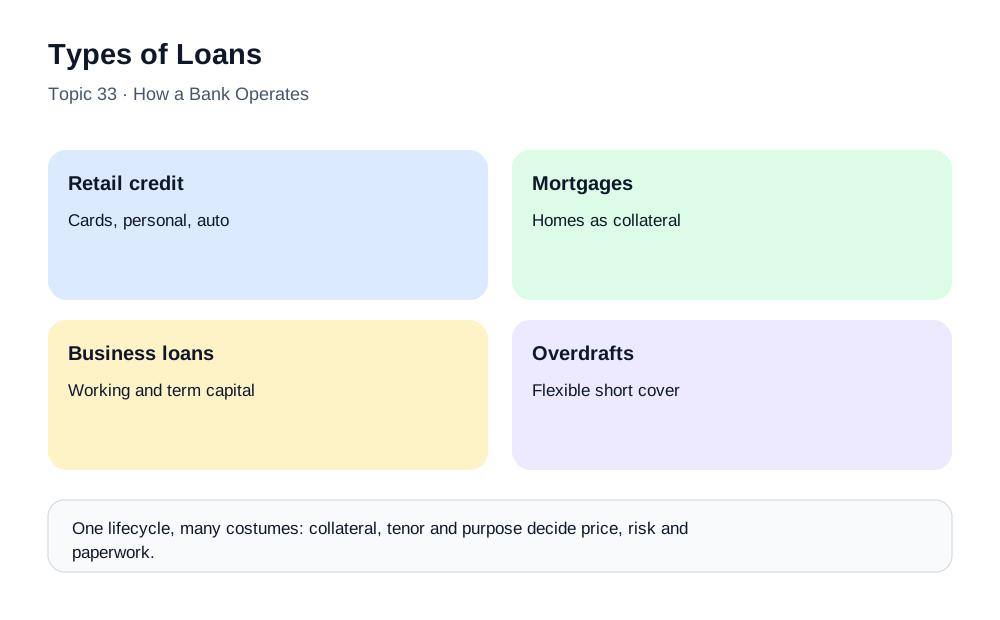
Types of Loans at a glance — Mortgages, personal loans, business loans, overdrafts.
1. Introduction: One Lifecycle, Many Costumes
Banking has developed an extensive repertoire of loan products to meet the varied needs of individuals, businesses, and governments. Each product is designed around the purpose of the borrowing, the characteristics of the borrower, and the economics of the transaction. Understanding this landscape of credit products reveals how banks serve different market segments while managing their own risk and profitability.
The fundamental distinction in lending separates retail loans to individuals from commercial loans to businesses. Within each category, products vary by tenure, security, repayment structure, and pricing. These variations are not arbitrary; they reflect the underlying economics of each borrowing purpose and the risk profiles of different borrower types.
Topic 32 traced the single lifecycle every loan follows — origination, structuring, documentation, servicing, workout. This chapter surveys what that lifecycle produces: the product shelf. Each product below is the same seven-stage journey adapted to a specific need — different collateral, tenor, repayment rhythm, and pricing, but always the same three questions underneath: can they repay, will they repay, and what can be recovered if they do not.
Learning objectives. By the end of this chapter you should be able to:
- Map the major retail products — mortgages, personal, auto, education, gold, cards — to their design logic
- Map the major commercial products — working capital, term loans, trade finance, project finance, equipment, invoice finance — likewise
- Explain the specialized segments: microfinance, agriculture, SME, syndication
- Explain loan pricing: base rate, risk spread, relationship pricing, competitive constraint
- Choose products sensibly from the borrower's side and read their true costs
- Connect product design back to the risk mechanics of Topics 26–32
2. Retail Lending: Credit for Individuals
Retail banking serves individual consumers with products designed for specific life needs and financial circumstances. The scale of retail lending is enormous, with billions of consumers worldwide relying on bank credit to manage their finances.
Home loans, also called mortgages or housing loans, finance the purchase or construction of residential property. A worked example shows why their structure matters so much. On a $300,000, 25-year mortgage at 7%, the monthly installment is roughly $2,120 — and over the full term the borrower repays about $636,000: more than twice the amount borrowed. Shorten the tenure to 15 years and the installment rises to about $2,696, but total interest falls by some $150,000. Every mortgage decision is this three-way trade among monthly affordability, total interest paid, and years of obligation — and the amortization schedule means early payments are mostly interest, which is why extra principal payments in the first years are disproportionately powerful. They are typically the largest debt individuals ever take on, with tenures extending twenty to thirty years to keep monthly payments affordable relative to income. Home loans are secured by the property itself, giving the bank collateral that can be sold if the borrower defaults. Loan-to-value ratios typically range from seventy-five to ninety percent, requiring borrowers to contribute equity that aligns their interests with the bank's. Interest rates may be fixed for the full term, providing payment certainty, or floating, adjusting with market rates. Prepayment options allow borrowers to reduce principal ahead of schedule, though some loans charge penalties for early repayment to protect the bank's interest income.
Personal loans provide unsecured credit for general purposes such as medical expenses, travel, or debt consolidation. Without collateral, these loans rely entirely on the borrower's income and credit history for security. Tenures are shorter than home loans, typically one to five years, and interest rates are higher to compensate for the lack of collateral and greater risk. The application process is streamlined, with approvals often granted within hours for existing customers with established credit histories. Personal loans have grown rapidly with digital lending platforms that use alternative data sources to assess creditworthiness beyond traditional credit scores.
Auto loans finance vehicle purchases, secured by the vehicle itself. Their distinctive risk is depreciation asymmetry: the car loses perhaps a fifth of its value the day it leaves the showroom, while the loan amortizes slowly — so early in the tenure the debt typically exceeds the collateral's worth. This 'underwater' window explains both the higher rates relative to mortgages and the gap-insurance market that grew up to cover it. Because vehicles depreciate rapidly, these loans carry higher rates than home loans and shorter tenures, typically three to seven years. The collateral is mobile and can be hidden or damaged, making repossession more challenging than foreclosing on real estate. Gap insurance protects both borrower and lender if the vehicle is totaled while the loan balance exceeds its value.
Education loans fund tuition and living expenses for students pursuing higher education. These loans recognize that students have limited current income but higher expected future earnings. Repayment often begins after graduation, with grace periods allowing time to secure employment. Interest rates are subsidized in many countries to promote educational access, with government guarantee programs supporting bank lending to students who lack credit histories or collateral.
Gold loans use jewelry or bullion as collateral, providing quick access to funds for borrowers who own gold but may lack formal income documentation. Because gold is highly liquid and its value is transparent, these loans can be disbursed within hours with minimal documentation. Loan-to-value ratios are typically seventy-five percent or lower, providing cushions against gold price volatility. Gold loans are particularly important in countries like India where households hold significant gold wealth.
Credit cards deserve one worked warning, because their convenience conceals the most expensive debt on the retail shelf. Carry a $5,000 balance at a 36% annualized card rate, paying only the minimum each month, and the debt can take over a decade to clear, with interest exceeding the original purchases. The card industry calls customers who pay in full 'transactors' — unprofitable, interest-free riders — and those who carry balances 'revolvers,' whose interest funds the rewards programs everyone enjoys. The customer's strategy follows directly: be a transactor, always, and let the revolvers subsidize your convenience. Cardholders who pay their full balance monthly avoid interest charges entirely, effectively receiving an interest-free loan for the billing period plus grace period. Those who carry balances pay interest rates that are typically the highest of any consumer loan product, reflecting the unsecured, undrawn nature of the commitment. Card economics depend heavily on interchange fees paid by merchants and the profitability of revolvers who maintain balances month to month.
The retail shelf at a glance:
| Product | Security | Typical tenure | Rate level | The design trade |
|---|---|---|---|---|
| Home loan / mortgage | The property | 20–30 years | Lowest | Long tenor for affordability; house as collateral |
| Personal loan | None | 1–5 years | High | Speed and flexibility for price |
| Auto loan | The vehicle | 3–7 years | Moderate | Depreciating, mobile collateral |
| Education loan | Usually none; sometimes guarantees | 5–15 years, deferred start | Subsidized in many markets | Lending against future earnings |
| Gold loan | Jewelry / bullion | Months to 3 years | Moderate | Liquid collateral for instant credit |
| Credit card | None; revolving | Continuous | Highest if carried | Convenience; interest-free if paid in full |
The pattern to carry away: rate follows recoverability. The mortgage is cheapest because the collateral is immovable, durable, and registered; the credit card is dearest because nothing stands behind it but a promise. Every product's price is, at bottom, the market's opinion of what default would cost.
3. Commercial Lending: Credit for Businesses
Business borrowing serves purposes ranging from daily operations to major expansions. Commercial loans are larger, more complex, and require more intensive analysis than retail lending.
Working capital loans finance the operating cycle of businesses, covering inventory purchases, accounts receivable, and operating expenses until sales generate cash. These are short-term facilities, often renewed annually, with borrowing fluctuating with seasonal business patterns. Security typically includes inventory and receivables, with borrowing bases calculated as percentages of eligible collateral. Because working capital needs are recurring, these loans build deep relationships between banks and business customers.
Term loans provide medium to long-term financing for capital expenditures, business expansion, or acquisitions. Unlike working capital loans, term loans are fully drawn at inception and repaid over time through scheduled installments. Tenures range from three to fifteen years depending on the asset life and repayment capacity. Covenants require borrowers to maintain financial health, with breach triggering renegotiation or acceleration. Term loans are often syndicated among multiple banks when amounts exceed what individual lenders can commit.
Trade finance facilitates international and domestic commerce by bridging the timing gap between shipment and payment. Letters of credit substitute bank credit for buyer credit, assuring sellers they will be paid if they ship conforming goods. Export financing provides working capital to exporters while they await payment from foreign buyers. Import loans finance the purchase of goods from abroad. These products manage the risks of cross-border transactions, including currency fluctuation, political instability, and the difficulty of pursuing legal remedies across jurisdictions.
Project finance structures loans around the cash flows of specific ventures rather than the general credit of sponsors. Used for infrastructure, energy, and industrial projects, these loans are non-recourse or limited-recourse, meaning lenders cannot pursue sponsors beyond the project assets if the venture fails. The complexity of project finance requires extensive due diligence on technical feasibility, market demand, and construction risk. Debt tenures match project lives, often fifteen to twenty-five years for infrastructure, with repayment from project revenues once operations begin.
Equipment financing allows businesses to acquire machinery, vehicles, and technology without full upfront payment. The equipment serves as collateral, with loan terms matched to the equipment's useful life. Leasing structures provide similar benefits with different accounting and tax implications. Equipment finance specialists develop deep knowledge of collateral values and resale markets, enabling them to lend against specialized assets that generalist lenders would not accept.
Invoice financing, also called factoring or receivables finance, advances funds against outstanding customer invoices. Businesses receive immediate cash rather than waiting thirty to ninety days for customer payment. The finance provider may purchase the receivable outright, assuming credit risk, or lend against it with recourse to the borrower if the customer does not pay. This accelerates cash conversion cycles and provides financing to businesses that lack sufficient credit for unsecured loans. A brief example: a manufacturer ships $500,000 of goods on 90-day terms and factors the invoices at a 2% discount — receiving roughly $490,000 immediately instead of $500,000 in three months. The annualized cost is real but modest; the benefit is converting a paper claim into working capital now, funding the next production cycle without waiting for the last one to pay.
The commercial shelf at a glance:
| Product | Purpose | Tenor | Typical security |
|---|---|---|---|
| Working capital | The operating cycle: inventory, receivables | Short; revolving, renewed annually | Inventory and receivables |
| Term loan | Expansion, capex, acquisitions | 3–15 years | Fixed assets, covenants |
| Trade finance | Shipment-to-payment gap, cross-border risk | Weeks to months | Goods, documents, letters of credit |
| Project finance | Infrastructure and industrial ventures | 15–25 years | The project's own cash flows |
| Equipment finance | Machinery, vehicles, technology | Matched to asset life | The equipment itself |
| Invoice finance / factoring | Accelerating receivables | 30–90 days | The invoices themselves |
Notice the unity beneath the variety: each commercial product is a machine for bridging a specific timing gap — between buying and selling, building and earning, shipping and getting paid. Business credit exists because business cash flows arrive at the wrong times; every product is a different clock-adjustment.
4. Specialized Lending Segments
Beyond standard retail and commercial products, banks serve specialized market segments with tailored offerings.
Microfinance provides small loans to entrepreneurs excluded from traditional banking by low income, lack of collateral, or informal employment. Group lending models use social pressure and mutual guarantee rather than physical collateral to ensure repayment. Interest rates are higher than conventional loans to cover the administrative costs of small transactions, though often lower than the informal moneylenders these borrowers would otherwise use. Microfinance has enabled millions of small businesses worldwide to access capital for the first time. Its design innovations are worth naming precisely, because they solved underwriting without data: group lending substitutes social collateral for physical collateral (members guarantee each other and select each other carefully, since the group bears joint liability); frequent small installments match the daily cash rhythms of informal businesses; and progressive lending — larger loans unlocked by clean repayment — builds a credit history where no bureau record exists. The same innovations later scaled into the small finance banks of Topic 22, which is why the two topics read as chapters of one story.
Agricultural lending addresses the unique risks of farming, where output depends on weather, commodity prices, and biological cycles. Seasonal patterns require repayment schedules aligned with harvest timing rather than monthly installments. Government programs often support agricultural lending through interest subsidies, crop insurance, or loan guarantees that make serving this challenging segment viable for banks.
SME lending bridges the gap between retail and corporate banking, serving businesses too large for consumer products but too small for dedicated corporate bankers. The diversity of small businesses makes standardized credit scoring difficult, requiring more judgmental assessment than retail lending but less intensive analysis than large corporate deals. Technology platforms are emerging that aggregate SME data from accounting systems, payment processors, and tax records to enable faster, more accurate credit decisions. The change matters because SME lending was historically the shelf's awkward middle: too heterogeneous for scorecards, too small for corporate-style analysis, and therefore chronically underserved — the famous 'missing middle' of credit. Cash-flow-based underwriting, reading the business's actual transaction streams, is the first genuine answer: it prices what the business does rather than what it can document, and it is quietly redrawing the boundary between bankable and unbankable small enterprise.
Syndicated loans spread large credit exposures across multiple banks, enabling financing that exceeds individual bank capacity. A lead arranger structures the loan and recruits participant banks, earning fees for this service. Syndication distributes risk and allows banks to maintain relationships with major borrowers without concentrating exposure. The syndicated loan market has grown into a major source of corporate finance, particularly for acquisitions and large capital projects.
5. How Loans Are Priced
The pricing of loans reflects risk, cost, competition, and relationship considerations. Understanding loan pricing reveals how banks balance profitability with the need to win and retain customers.
A pricing build-up makes the stack concrete. Suppose the bank's blended cost of funds is 5.0% (Topic 31's territory). Add operating cost allocation of 1.5%, expected credit loss for this borrower's risk tier of 1.0% (Topic 30's ECL logic), a capital charge — the return shareholders require on the equity the loan consumes — of 1.5%, and a profit margin of 1.0%. The loan prices at 10.0%. Now improve the borrower's credit tier so expected loss falls to 0.3%: the same machine prices at 9.3%. This is why borrowers experience credit improvement as real money, and why the five Cs of Topic 32 have a direct exchange rate into basis points.
The base rate represents the bank's cost of funds, including deposit interest and wholesale borrowing costs. To this base, banks add spreads that compensate for credit risk, with higher-risk borrowers paying wider spreads. The spread must cover expected losses from default, capital costs for the risk taken, and a profit margin for the bank.
Risk-based pricing uses credit scores and other risk indicators to assign borrowers to pricing tiers. Low-risk borrowers with strong credit histories receive preferential rates, while higher-risk borrowers pay more. This aligns pricing with expected loss and encourages good credit behavior, though it can also raise concerns about fair lending if risk factors correlate with protected characteristics.
Relationship pricing considers the total profitability of the customer across all products. A borrower who maintains substantial deposits may receive loan rate discounts that recognize the overall relationship value. Conversely, single-product borrowers with no other bank business may pay standard or premium rates. This approach maximizes customer lifetime value rather than optimizing individual transaction profitability.
Market competition constrains pricing latitude. When competitors aggressively price to gain market share, banks must match or lose volume. In concentrated markets, leading banks may have more pricing power. Interest rate transparency, through comparison websites and regulatory disclosures, has intensified price competition and compressed margins in many markets.
The diversity of loan products reflects the diversity of human and business needs that banking serves. Each product represents a solution to a specific financing challenge, refined over decades of market experience and regulatory evolution. For borrowers, understanding these options enables selection of the most appropriate and cost-effective financing. For banks, product innovation and pricing sophistication are key competitive battlegrounds that determine market share and profitability.
6. The Borrower's Guide: Choosing and Using Credit Products
For the individual or business facing this shelf, a few principles convert this chapter into practice.
Match the product to the purpose — never the reverse. A mortgage's long tenor and low rate exist for a durable, appreciating asset; funding a vacation on a 20-year secured loan is category error, and so is funding a factory on a credit card. The product's design logic (its tenor, repayment rhythm, and rate) encodes the sensible use; fighting the design costs money every month.
Compare total cost, not the installment. Low monthly payments achieved by stretching tenure multiply total interest — Section 2's mortgage arithmetic. The honest comparison metric is total repayable over the life, plus fees, insurance bundling, and prepayment penalties.
Secured beats unsecured when you can genuinely offer security. Pledging collateral cuts rates dramatically because it cuts the lender's expected loss. But pledge only what you can afford to lose: the same collateral that cheapens the loan is what the bank takes if it goes wrong.
Use revolving credit as a tool, never as income. Cards and overdrafts bridge timing gaps brilliantly and destroy wealth quietly when carried. The transactor discipline — full payment, every cycle — is the single most valuable habit in consumer credit.
Sequence your credit life. Bureau history is cumulative (Topic 32): small loans performed well build the record that earns mortgage-scale trust later. The cheapest credit you will ever get is the credit you qualified for by boring punctuality years earlier.
7. Common Misconceptions About Loan Products
"The lowest EMI is the best loan." Usually the opposite: low installments are manufactured by long tenures, which multiply total interest. Compare total repayable, always.
"Credit cards are free money." Only for transactors who pay in full every cycle. Carry a balance and the card becomes the most expensive loan on the shelf — funding, via revolver interest, the very rewards that attract new users.
"Collateral makes the loan safe for the borrower." It makes the loan cheaper, not safer: the collateral is precisely what you forfeit on default. Gold loans and mortgages are excellent products — for borrowers whose repayment capacity, not just their assets, supports them.
"Fixed rates are always safer than floating rates." Fixed buys payment certainty at a premium; floating is usually cheaper initially but reprices with the cycle. The honest answer is situational: tight household budgets benefit from certainty; borrowers with cushion and falling-rate outlooks benefit from floating. 'Safer' depends on whose budget absorbs the rate risk — yours or the bank's.
"Working capital loans are permanent funding." They are bridges for the operating cycle, renewed annually at the bank's review. Businesses that treat overdrafts as permanent capital build their foundations on a facility designed to be reassessed — and periodically not renewed.
"Risk-based pricing is unfair to risky borrowers." It is the mechanism that lets them borrow at all: without price variation by risk, lenders would simply decline higher-risk applicants. The genuine policy debate is about which factors may legitimately drive pricing — not whether risk should carry a price.
8. Frequently Asked Questions
Why are mortgage rates the lowest of all consumer loans? Recoverability: the collateral is immovable, durable, registered, and usually appreciates — plus the borrower's own equity (the LTV cushion) absorbs first losses. Low expected loss, priced per Section 5, produces the cheapest credit on the shelf.
What is the real cost of a credit card if I pay in full? Potentially zero — even negative once rewards count. The interest-free window (billing cycle plus grace period) is a genuine free loan; the costs live in annual fees, cash advances, foreign transaction charges, and above all the revolving rate that punishes carrying balances.
Should I prepay my home loan or invest the surplus? Compare your loan's after-tax interest rate with the realistic after-tax return of the alternative. Prepaying is a guaranteed, risk-free 'return' equal to the loan rate; investing may beat it but carries risk. A hybrid — partial prepayments that shorten tenor — captures much of both. And remember Section 2: early principal payments punch far above their size.
Can I negotiate my loan's interest rate? More often than borrowers think — especially with a strong bureau record, competing offers in hand, relationship depth (deposits, salary account), or a willingness to offer security. The pricing stack of Section 5 has margins at the top, and relationship pricing exists precisely to be flexed. Banks rarely volunteer discounts; they routinely grant them to customers who ask credibly.
What is the difference between a loan and an overdraft? A loan disburses a fixed sum repaid on a schedule. An overdraft is a standing permission to go negative up to a limit, paying interest only on what you use, when you use it — designed for fluctuating working capital, priced for flexibility, and reviewed (and potentially reduced) at renewal.
What is a letter of credit, in plain terms? The bank's promise replacing the buyer's: ship conforming goods, present conforming documents, and the bank pays — regardless of the buyer's fortunes. It transforms a stranger's credit risk into a bank's, which is what makes trade between unknown parties across borders possible.
What is the difference between leasing and equipment finance? With an equipment loan, you own the asset (the bank holds a security interest) and repay principal plus interest; with a lease, the lessor owns the asset and you pay for its use — often with an option to buy at the end. The choice turns on accounting treatment, tax, cash flow, and how long you actually need the asset; both put the equipment to work without full upfront payment.
Why is project finance 'non-recourse,' and why would a bank accept that? Because a $2 billion power plant cannot be carried by any sponsor's balance sheet, lenders accept claim only on the project's own cash flows and assets — and compensate with ferocious due diligence, contracts allocating every risk (construction, fuel, demand, political), and rates reflecting the residual risk they keep. The discipline is the collateral.
What is the difference between factoring with and without recourse? With recourse, you buy back the invoice if the customer does not pay — you keep the credit risk and pay less. Without recourse, the factor keeps the risk — and charges more. The choice is insurance pricing: how much is protection from your customers' default worth?
What should I check before signing any loan agreement? Six lines: the total repayable amount; the rate and whether it is fixed, floating, or 'introductory'; the prepayment and foreclosure charges; every bundled fee and insurance premium; the default and acceleration clauses; and the covenant or security terms that survive signing. The headline rate is marketing; these six lines are the contract.
Why do education loans start repayment after graduation? Because the product lends against future earnings (capacity that does not yet exist), the structure defers repayment until the capacity materializes — the clearest example on the shelf of a product's design logic following its risk logic.
What determines which pricing tier I fall into? Your bureau score and history, verified income and obligations, the product and its security, and your relationship depth with the bank (Section 5). Two of these — history and relationship — you can deliberately improve before the borrowing that matters most.
Are gold loans a good idea? For short, genuine liquidity needs against idle gold, they are among the fastest, cheapest secured options — liquid collateral, transparent value, minimal documentation. The discipline is tenure: borrow briefly, redeem promptly, and never use a gold loan to fund long-term needs at short-term rates.
Why do banks push bundled insurance with loans? Because distribution commissions are among the most profitable fee lines in banking (Topic 29's non-interest income). Some bundles genuinely protect the borrower; others mostly protect the margin. You are usually entitled to decline or shop the cover separately — ask, compare, and read the premium line before signing.
9. Key Terms in This Chapter
- Retail / commercial lending — credit to individuals vs to businesses; the shelf's first division.
- Mortgage / home loan — long-tenor, property-secured housing finance; the cheapest consumer credit.
- Amortization — repayment blending declining interest with rising principal over the tenure.
- Personal loan — unsecured, general-purpose credit priced for its lack of collateral.
- Revolving credit — draw, repay, redraw within a limit: cards and overdrafts.
- Transactor / revolver — the cardholder who pays in full (free ride) vs the one who carries balances (funds the system).
- Working capital — short-term finance bridging the operating cycle.
- Letter of credit — a bank's payment undertaking substituting its credit for the buyer's.
- Project finance — lending against a venture's own cash flows, non- or limited-recourse to sponsors.
- Factoring / invoice finance — advancing cash against receivables, with or without recourse.
- Loan-to-value (LTV) — loan size against collateral value; the equity cushion.
- Syndication — sharing a large loan across banks, led by an arranger.
- Risk-based pricing — rates tiered by borrower risk; the five Cs converted to basis points.
- Relationship pricing — rates reflecting total customer profitability, not the single loan.
- Base rate / cost of funds — the funding-cost floor beneath every loan price.
- Borrowing base — the eligible-collateral formula limiting working-capital drawings.
- Group lending — joint-liability microfinance borrowing; social collateral replacing physical collateral.
- Non-recourse / limited recourse — lending where claims stop at the project, not the sponsor.
- Gap insurance — cover for the difference between a totaled vehicle's value and the loan balance.
10. Interview Insights: How This Topic Appears in Banking Interviews
"Why are secured loans cheaper than unsecured?" Expected-loss arithmetic: collateral cuts LGD (Topic 30), lower LGD cuts the risk premium in the pricing stack, and the borrower's equity aligns incentives on top. Then the nuance that distinguishes candidates: secured credit is cheaper but riskier for the borrower — the collateral is what is forfeited — so product advice must weigh both sides of the security.
"Compare a credit card with a personal loan." Structure (revolving vs amortizing), price (highest vs high), purpose (convenience and timing gaps vs defined needs), and behavior (transactor discipline vs forced amortization). The punchline: the card is the better product for the disciplined and the worse for everyone else — a suitability story, not a product ranking.
"How would you price a loan for a mid-sized business?" Build the stack live: cost of funds, plus operating cost, plus expected loss (PD × LGD × EAD from Topic 30), plus capital charge, plus margin — then adjust for relationship value and competitive constraint. Candidates who can walk the stack, and explain each floor's origin, demonstrate they understand lending as economics rather than procedure.
"What makes working capital lending different from term lending?" The operating cycle versus the asset life: fluctuating, self-liquidating, annually reviewed borrowing bases versus fully drawn, scheduled, covenant-watched installments. Risk differs accordingly — working capital dies by business stoppage, term loans by cash-flow shortfall — and monitoring follows the difference.
"Where does product innovation in lending come from?" From the timing gaps and risk shapes of real economies: every successful product is a machine for bridging a specific mismatch — harvest cycles, shipment-to-payment, construction-to-operation. Innovation fails when it starts from the bank's desire to sell rather than the customer's cash-flow problem. Cite BNPL or supply-chain finance as the current generation of the same ancient pattern.
Summary and Key Takeaways
The product shelf is the credit lifecycle wearing many costumes — one logic, dozens of designs. The essential points:
- Design follows purpose: every product's tenor, security, and repayment rhythm encodes the cash-flow problem it was built to solve.
- Rate follows recoverability: mortgages are cheapest and cards dearest because expected loss, not generosity, sets the price.
- Retail products map life needs: housing, vehicles, education, emergencies, convenience — each with a design trade the borrower should understand before signing.
- Commercial products bridge timing gaps: working capital, trade, projects, equipment, invoices — business credit exists because business cash arrives at the wrong times.
- Specialized segments extend the frontier: microfinance, agriculture, SME, and syndication adapt the same machinery to borrowers and deals the standard shelf cannot hold.
- Pricing is a stack, not a number: funding cost, operating cost, expected loss, capital charge, margin — adjustable by risk tier, relationship, and competition.
- Amortization makes time the hidden variable: total repayable, not the installment, is the honest cost of every loan.
- Revolving credit is a tool or a trap: transactors ride free; revolvers fund the system. Discipline decides which you are.
- The borrower's playbook mirrors the bank's design logic: match product to purpose, compare total cost, pledge wisely, build the bureau record early.
- Innovation is eternal and patterned: from letters of credit to BNPL, every new product is an old machine — bridging a timing gap — rebuilt for its era's technology.
- Suitability beats ranking: the right product is the one whose design logic matches your cash-flow reality — the cheapest money is the money structured to be repayable by you.
A thread ties this shelf back to the institutions of earlier topics: the NBFCs of Topic 21 dominate vehicle and gold lending precisely because their specialization beats generalist banks at these risk shapes; the small finance banks of Topic 22 carry microfinance's group-lending DNA; and the agricultural lenders of Topic 24 exist because farming's cash-flow clock fits no standard product. Product diversity and institutional diversity are two views of the same adaptation.
In the next topic, we follow loans past their planned endings — loan recovery and stressed assets: what happens when credit goes wrong, and how banks, borrowers, and entire banking systems deal with it.
Next: Topic 34 — Loan Recovery and Stressed Assets →
<!-- MBA-DEEP-DIVE-START -->Deep Dive: Loan Product Design — Matching Cash Flow, Security, Tenor, and Risk
The easiest way to understand loan products is to stop thinking of them as labels and start thinking of them as risk structures. Every loan product answers the same design questions: what is being financed, what cash flow repays it, how long should the exposure remain outstanding, what security or guarantee supports it, how can the borrower draw and repay, and what happens when assumptions fail?
The right product is therefore the one whose repayment pattern matches the economic activity being financed. Product misuse is often a hidden source of credit stress.
Amortising loans versus bullet loans
An amortising loan repays principal gradually over the life of the facility. Mortgages, personal loans, auto loans, and many term loans follow this pattern. The outstanding exposure falls as scheduled payments are made.
A bullet loan leaves most or all principal due at maturity, with interest paid periodically or capitalised according to the contract. Bullet structures reduce interim cash burden but create refinancing or exit risk at the end.
The choice should match the cash flow.
A household mortgage is usually suited to amortisation because salary income arrives regularly. A bridge loan tied to a known asset sale may reasonably have a bullet maturity. A business with no credible source for the bullet repayment is simply postponing the repayment problem.
Revolving facilities versus term facilities
A term loan is generally drawn for a defined purpose and repaid over an agreed schedule. A revolving credit facility allows repeated drawings and repayments up to a limit during the availability period, subject to terms and conditions.
Revolvers are well suited to fluctuating working-capital needs. A seasonal business can draw before its peak season and repay after receivables are collected.
The danger is permanent utilisation. If a revolving line sits fully drawn for years and never cleans down, the bank should ask whether the borrower is funding a long-term structural deficit with short-term credit.
Product monitoring should therefore look at utilisation behaviour, not merely whether interest is being paid.
Fixed-rate versus floating-rate lending
A fixed-rate loan gives payment certainty but transfers more interest-rate risk to the lender unless hedged. A floating-rate loan resets using an agreed benchmark or reference mechanism plus a spread, transferring more rate variability to the borrower.
Neither is universally better.
A household with little spare cash may value payment certainty. A corporate borrower with floating-rate revenues or an active hedging programme may prefer floating debt. The bank should consider affordability under rate stress, not only the initial payment.
The customer should understand the reset mechanism precisely: benchmark, spread, reset frequency, floor or cap if any, fallback provisions, and how changes affect instalments or tenure.
Secured lending is only as strong as the security
Calling a loan ‘secured’ says little about actual recovery quality.
The bank needs to know:
- what asset is pledged;
- who owns it;
- whether the bank’s security is legally valid and perfected;
- where the bank ranks relative to other creditors;
- how volatile the asset value is;
- how easily it can be sold;
- how long enforcement may take;
- what costs reduce recovery.
A first-ranking mortgage over a completed property is very different from a second charge over partially built property in a weak market. A pledge over listed government securities differs from a charge over specialised machinery with few buyers.
Collateral should therefore be described by quality, priority, liquidity and enforceability, not only market value.
Mortgages: long tenor creates rate and life-event risk
Mortgages have low loss severity relative to many unsecured products when underwriting, title, collateral and legal enforcement are strong, but their long lives create unique risks.
Over twenty or thirty years, borrowers change jobs, marry, divorce, relocate, retire, become ill, inherit money, or refinance. Property values and interest rates move. Insurance requirements change. The servicing system must survive the whole period.
Mortgage underwriting should test not only current affordability but the sensitivity of payments to rate changes where applicable. Loan-to-value matters, but debt-to-income or affordability measures are equally important because the property does not make the monthly payment.
Prepayment is another risk. When rates fall, borrowers may refinance early, shortening the bank’s expected asset duration. When rates rise, prepayments may slow, extending duration. This negative convexity matters to treasury and asset-liability management even though the customer experiences it simply as the option to repay early.
Personal loans: speed increases fraud and adverse selection risk
Unsecured personal loans can be approved quickly because there is no collateral to value or register. That same speed creates risk.
Digital originators must control identity fraud, synthetic identities, manipulated income evidence, loan stacking across lenders, device fraud, and customers borrowing immediately before financial distress becomes visible in traditional data.
Credit-bureau data, verified income, bank-statement behaviour, affordability and fraud analytics should work together. A high credit score should not override clear evidence that the borrower’s current debt burden is unsustainable.
Pricing is usually higher because expected loss severity is higher when there is no designated collateral.
Auto finance: collateral depreciates faster than many borrowers realise
Vehicle finance is secured, but vehicles are depreciating and mobile assets. Recovery depends on repossession rights, asset condition, used-market liquidity, fraud controls and documentation.
The bank should model the relationship between outstanding principal and expected vehicle value over time. High initial LTV and slow amortisation can create a period where the borrower owes more than the recoverable value of the vehicle.
Dealer relationships are important too. Fraud can arise through inflated invoices, nonexistent vehicles, duplicate financing, dealer collusion or falsified registration.
A strong auto-finance platform therefore links origination to dealer controls, vehicle identification, registration, insurance and collateral tracking.
Education finance: repayment depends on future human capital
Education loans finance an asset that cannot be repossessed: the borrower’s future earning capacity.
Underwriting therefore considers institution quality, course, expected employment prospects, borrower and co-borrower finances, country or currency risk for overseas study, and the timing of repayment after education.
Grace or moratorium periods recognise that income may begin only after study. But they can also increase accrued interest and total debt. Customers should understand whether interest accrues during the study period and whether unpaid interest capitalises.
For the bank, education finance combines long horizon, limited collateral and uncertain future earnings, which is why government guarantees or support programmes can be important in some markets.
Gold and securities-backed lending: liquid collateral changes the control model
Loans against gold or marketable securities can be disbursed quickly because collateral can be valued and liquidated more readily than many physical assets.
But rapid price movement creates margin risk.
Suppose securities worth ₹1 crore support a ₹60 lakh loan. A severe market fall reduces collateral to ₹75 lakh. The LTV rises sharply even though the borrower made no new draw.
The bank needs daily or frequent valuation, eligible-collateral rules, concentration limits, haircut logic, margin-call procedures and liquidation rights.
For gold loans, purity verification, custody, insurance, auction controls and fraud prevention are central. The collateral may be liquid, but operational control determines whether the bank really possesses what it thinks it possesses.
Credit cards are both payment instruments and revolving credit
A credit card is unusual because it combines a payment credential, an unsecured revolving facility, fraud exposure, merchant disputes, authorisation, clearing, settlement and lending economics.
The customer receives a credit limit rather than a one-time loan. Each purchase draws part of the limit. Repayment restores availability.
If the customer pays the statement balance in full within the applicable terms, purchase interest may be avoided. If the customer revolves balances, interest can be high. Cash advances and other transaction types may follow different rules.
The bank must manage both transaction risk and credit risk. A borrower can be perfectly creditworthy yet suffer card fraud. A legitimate transaction can later become a credit loss if the customer cannot repay.
Card product design should therefore integrate limit management, fraud monitoring, delinquency, minimum payments, fees, disputes, chargebacks and collections.
Overdrafts: convenience can conceal structural borrowing
An overdraft allows an account to become negative up to an approved limit. For households, it can cover short timing gaps. For businesses, it can provide flexible working capital.
The risk is that temporary borrowing becomes permanent.
A business that remains continuously overdrawn may be using the facility as long-term finance without a formal repayment plan. A household relying on the overdraft every month may have a persistent affordability problem.
Monitoring should examine days in credit, peak utilisation, excesses, returned items and dependency, not only whether the account remains within limit.
Working-capital facilities should revolve with the operating cycle
Working-capital products include overdrafts, revolving lines, receivables finance, inventory finance and borrowing-base facilities.
The design should follow the borrower’s cash conversion cycle.
If a company buys inventory today, sells in sixty days and receives payment thirty days later, the financing need exists for roughly that operating gap, adjusted for supplier credit and other cash flows.
Borrowing bases can limit availability to a percentage of eligible receivables or inventory. Eligibility rules exclude old receivables, related-party balances, disputed invoices, slow-moving stock or other weak collateral.
The bank must verify that the collateral data is real. Borrowing-base fraud can involve fake invoices, duplicate receivables or manipulated inventory reports.
Invoice finance and factoring allocate credit risk differently
Receivables finance can take several forms.
In a loan against receivables, the borrower remains responsible for repayment and receivables are collateral.
In factoring, the receivable may be sold to the financier. Depending on recourse terms, the seller may retain or transfer customer default risk.
The bank therefore needs to know who bears the risk if the invoice debtor does not pay.
Operationally, invoice finance requires verification that goods or services were delivered, invoices are genuine, debtors are creditworthy, payments are directed correctly and the same receivable is not financed elsewhere.
Equipment finance and leasing depend on residual value
Equipment loans and leases match funding to machinery, vehicles or technology.
The lender should understand useful life and resale value. Financing a specialised machine for ten years makes little sense if it becomes obsolete in four.
Lease structures add residual-value risk because the lessor may own the asset at the end and depend on its resale or re-lease value.
Maintenance, insurance, usage and asset tracking can therefore be credit controls, not merely customer-service details.
Trade finance is not only credit — it is performance and document risk
Trade products such as letters of credit, guarantees, import loans, export finance and supply-chain finance solve different commercial risks.
A letter of credit can substitute the issuing bank’s payment undertaking for the buyer’s credit when compliant documents are presented under the applicable rules. A guarantee supports performance or payment obligations. Supply-chain finance may finance approved invoices of suppliers based on the buyer relationship.
Trade finance also carries sanctions, fraud, documentary, country, bank and operational risk. Financing a shipment requires understanding whether the underlying trade is genuine.
The product’s short tenor does not make it simple.
Project finance: cash flow is ring-fenced around the project
Project finance is commonly used for infrastructure and large assets where lenders rely primarily on project cash flows and security over project rights and assets, with limited or structured recourse to sponsors.
The bank analyses construction risk, contractor strength, completion tests, operating costs, demand, tariffs or offtake contracts, permits, environmental issues, insurance and political risk.
Repayment usually begins after the project generates cash. The loan can have a long tenor, but the structure should include debt-service coverage and reserve mechanisms appropriate to the project.
The central difference from ordinary corporate lending is that the lender cannot assume the sponsor’s whole balance sheet will rescue the project unless support is contractually available.
Syndicated loans solve concentration and capacity problems
Very large borrowers may need facilities bigger than one bank wants to hold. A syndicated loan distributes exposure among multiple lenders under common documentation.
The arranger structures and markets the facility. An agent bank administers notices, payments and lender communications. Security may be held by a security trustee or equivalent structure where applicable.
Participants still need their own credit judgement. Joining a syndicate does not transfer underwriting responsibility to the arranger.
The syndicate structure also creates operational complexity around voting thresholds, amendments, transfers, drawdowns and payment allocation.
Revolving versus non-revolving commitments affect liquidity differently
A term loan already drawn has known funded exposure. An undrawn revolving commitment can become funded suddenly.
During market stress, companies often draw committed bank lines to secure cash. This means a bank’s liquidity need can rise at the same time wholesale markets become difficult.
Pricing should therefore compensate not only for drawn credit risk but also for the availability of committed liquidity.
Commitment fees and capital treatment help reflect this economic cost.
Currency mismatch can turn a good loan into a bad one
A borrower earning rupees but borrowing dollars may enjoy a lower nominal interest rate, yet depreciation of the rupee increases the local-currency cost of debt service.
Foreign-currency loans should therefore be supported by natural foreign-currency cash flows or an appropriate hedge where required by policy.
The credit team should stress exchange rates and hedge effectiveness rather than assuming today’s FX rate persists for the loan’s life.
Loan pricing is a stack, not one spread
A disciplined pricing framework can include:
Funding cost + liquidity cost + expected credit loss + operating cost + capital charge + optionality + target return, adjusted for relationship economics and competition.
The resulting customer price should be tested against affordability and conduct requirements.
A bank that wins every loan because it is always cheapest may be underpricing risk. A bank that loses every good borrower may be overpricing or operating inefficiently.
Pricing quality is revealed over the full credit cycle, not at origination.
Product profitability must include lifetime behaviour
A mortgage customer may appear unprofitable in year one because acquisition and underwriting costs are front-loaded. Over years, the relationship can generate interest, deposits, payments and other products.
A high-yield personal loan may appear profitable immediately but become unattractive after fraud, early default and collections cost.
Banks therefore use cohort or vintage economics to understand lifetime value rather than judging only first-month margin.
A product-selection example
Consider a profitable manufacturer that needs ₹20 crore.
If the need is to buy raw materials that convert into receivables within ninety days, a revolving working-capital facility may fit.
If the money will purchase machinery productive for seven years, a term loan aligned to asset life is more appropriate.
If the company has already shipped goods and is waiting for strong customers to pay invoices, receivables finance may be efficient.
If the company needs ₹20 crore for two weeks until a known asset sale closes, a bridge facility may fit — but only if the exit is credible.
The borrower’s ‘need for ₹20 crore’ is not enough information to choose a product. Purpose and repayment timing choose the product.
What excellence looks like
A world-class loan catalogue does not exist to maximise the number of products on a website. Each product has a clear economic purpose, target market, underwriting logic, repayment source, risk appetite, pricing method, accounting treatment, servicing model and failure path. Systems enforce the differences between revolving and term, secured and unsecured, fixed and floating, amortising and bullet.
The deepest lesson is that every loan product is a deliberate allocation of risk through time. Tenor determines how long the bank is exposed. Amortisation determines when principal returns. Security determines secondary recovery. Rate structure allocates interest-rate risk. Covenants create early decision rights. Drawdown rules control how quickly contingent exposure becomes funded.
Once those mechanics are understood, product names become secondary. You can look at almost any credit structure and understand what problem it solves — and where it can break.
<!-- MBA-DEEP-DIVE-END -->