Visual overview
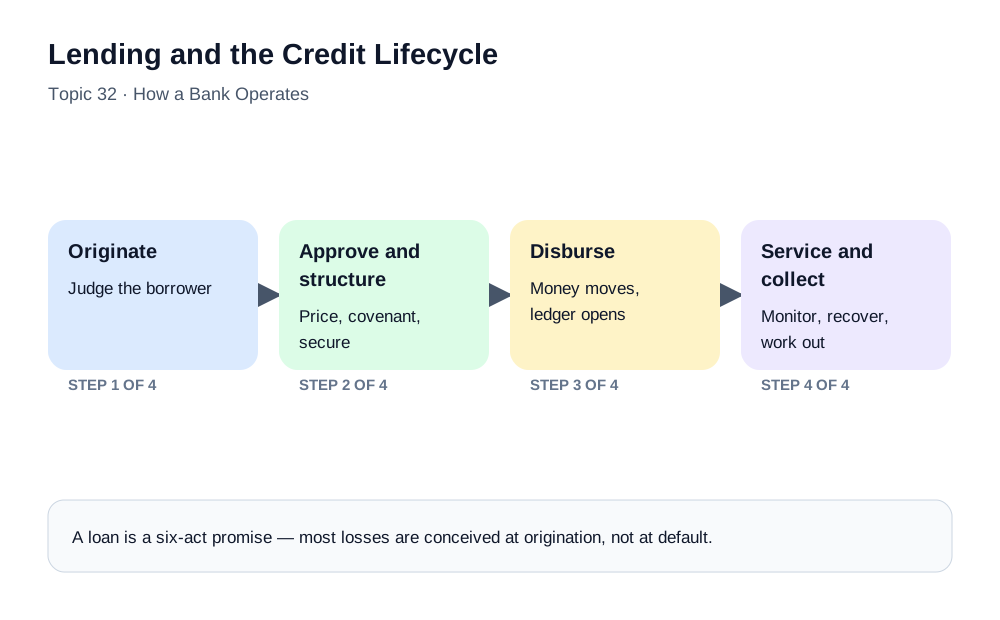
Lending and the Credit Lifecycle at a glance — Origination, assessment, disbursement, collections.
1. Introduction: The Life of a Loan
Every loan tells a story that extends far beyond the moment funds are disbursed. From the initial application through final repayment, loans pass through multiple stages of assessment, documentation, monitoring, and closure. Understanding this credit lifecycle is essential for bankers managing portfolios, borrowers seeking financing, and analysts evaluating bank performance. Each stage presents distinct risks, requires specific expertise, and contributes to the ultimate profitability or loss of the lending relationship.
The credit lifecycle begins when a customer approaches a bank seeking financing. This initial contact, whether through a branch visit, online application, or relationship manager outreach, triggers a process that has been refined over centuries of banking practice. Modern technology has accelerated and standardized many aspects of this process, but the fundamental questions remain unchanged: Can this borrower repay? Will they repay? And if they do not, can the bank recover its funds?
Learning objectives. By the end of this chapter you should be able to:
- Trace a loan through every lifecycle stage from inquiry to closure
- Apply the five Cs of credit to a real borrowing situation
- Explain how approval, structuring, and collateral logic translate risk into terms
- Describe the documentation and conditions-precedent machinery that makes loans enforceable
- Explain servicing, covenant monitoring, and early-warning systems — and how they connect to IFRS 9's stages (Topic 30)
- Evaluate restructuring versus workout choices when borrowers struggle
- Navigate the lifecycle from the borrower's side: what to prepare, what to negotiate, what to watch
2. Origination: Evaluating the Borrower
Loan origination encompasses everything from initial inquiry through credit assessment and preliminary approval. This stage determines whether a loan is made at all, and on what terms.
The first step is information collection. The bank gathers data about the borrower's identity, income, existing obligations, and the purpose of the loan. For individuals, this means employment details, salary slips, tax returns, and bank statements. For businesses, it requires financial statements, business plans, management backgrounds, and industry analyses. The quality of information collected at this stage directly affects every subsequent decision.
Credit assessment applies the five Cs of credit to evaluate the application. Character assesses the borrower's willingness to repay, examined through credit history, payment patterns, and references. A borrower with a history of late payments or defaults presents higher risk regardless of current financial capacity. Capacity evaluates the borrower's ability to generate sufficient cash flow to service the debt. Lenders analyze debt-to-income ratios, coverage ratios, and cash flow projections to determine whether proposed repayments are sustainable. Capital examines the borrower's own investment in the venture, as those with significant capital at risk have stronger incentives to succeed and survive setbacks. Collateral identifies assets that can secure the loan and provide recovery if the borrower defaults. Conditions assess external factors including economic environment, industry trends, and regulatory changes that might affect repayment ability.
The five Cs at a glance:
| C | The question | What the bank examines | Red flags |
|---|---|---|---|
| Character | Will they repay? | Credit history, payment patterns, references | Past defaults, disputes, evasive answers |
| Capacity | Can they repay? | Income, cash flow, debt-service coverage | Thin margins, volatile income, heavy existing debt |
| Capital | Do they share the risk? | Borrower's own stake in the venture | No skin in the game, 100% financing requests |
| Collateral | What backs the loan? | Asset quality, value, liquidity, title | Overvalued, illiquid, or disputed security |
| Conditions | Will the world cooperate? | Industry trends, economy, regulation | Declining sectors, policy headwinds, single-customer dependence |
Notice the division of labour among them: character and capacity decide most approvals; capital and collateral decide how much the bank can lose if it is wrong; conditions decide whether this is the right moment at all. A weakness in one C can sometimes be compensated by strength in another — modest collateral against excellent cash flow, for instance — but a failure of character is usually fatal, because no contract can make an unwilling borrower willing.
A note on information asymmetry completes the origination picture — it is the reason this stage exists at all. The borrower knows their true circumstances better than the bank ever can, and has every incentive to present the flattering version. Origination is therefore designed as a verification game: claims are cross-checked against independent sources (bureau records, employer confirmation, bank statement flows, site visits), and inconsistencies are themselves data — a salary slip that disagrees with the account credits tells its own story. Seasoned credit officers say the purpose of documentation is not to believe the borrower but to make belief unnecessary.
Risk scoring models have transformed credit assessment, particularly for retail lending. These statistical models analyze thousands of historical loans to identify which borrower characteristics predict default. They generate scores that rank applicants by risk, allowing banks to automate approvals for low-risk applications and focus human expertise on borderline cases. While powerful, these models require careful calibration and regular validation to ensure they do not discriminate unfairly or become outdated as economic conditions change.
3. Approval and Structuring
Once assessment is complete, the loan moves to approval. The level of authority required depends on the loan size, with larger loans requiring committee review or executive sign-off.
The approval decision considers not only the borrower's creditworthiness but also the bank's portfolio objectives and risk appetite. A borrower who is creditworthy individually might be declined if the bank has already reached its exposure limit for that industry or geography. Conversely, a marginal borrower might be approved to support a broader relationship or to meet portfolio diversification goals.
Loan structuring transforms the approval into specific terms and conditions. The interest rate reflects the borrower's risk profile, with higher rates for riskier borrowers. The tenure must match the purpose, with short-term loans for working capital and longer terms for assets with extended useful lives. Repayment schedules may be equated monthly installments for personal loans, bullet repayments for trade finance, or customized structures for project finance. Covenants impose ongoing obligations that the borrower must meet, providing early warning of deterioration and protecting the bank's interests.
Portfolio logic deserves equal billing with borrower logic at this stage. Banks set exposure limits by industry, geography, and borrower group precisely because individually sound loans can be collectively lethal — a hundred excellent loans to one sector is one sector-sized bet. This is why a strong applicant can still be declined ('we are full on hospitality exposure this year'), and why banks sell or syndicate pieces of large loans (Topic 27's case study): approval is never only about the borrower; it is about what the borrower's loan does to the shape of the whole book.
Secured loans are supported by collateral or another enforceable security interest that can improve recovery if the borrower defaults, subject to the contract, legal perfection, valuation, priority and enforcement rules. The loan-to-value ratio compares the exposure with eligible collateral value, and lower ratios generally create a larger cushion against price declines. Actual advance rates vary widely by jurisdiction, borrower, product, asset liquidity, valuation volatility and regulatory policy; there is no universal LTV range that applies to all real estate, inventory or receivables. Unsecured lending relies primarily on borrower repayment capacity and contractual recourse rather than designated collateral, so pricing and limits normally reflect the higher expected loss severity.
A worked example grounds the structuring logic. Consider a $200,000, five-year business term loan at 10% with equated monthly installments. The EMI formula produces a payment of about $4,249 per month — sixty identical payments blending declining interest with rising principal. In month one, roughly $1,667 of the payment is interest and $2,582 principal; by the final year, the proportions have inverted. Now vary the structure and watch risk shift: stretch the tenure to ten years and the EMI falls to about $2,643 — easier on the borrower's monthly cash flow, but the bank's money is exposed twice as long and total interest paid nearly doubles. Switch to a bullet structure (interest only, principal at the end) and monthly outflow collapses, but the bank now faces the full $200,000 coming due on one day, against a business that must generate or refinance it. Every structuring choice is a deliberate placement of risk — on the borrower's monthly cash flow, on the bank's exposure timeline, or on a future refinancing nobody can guarantee.
4. Documentation and Disbursement
Approved loans must be documented before funds are released. This stage transforms the agreed terms into legally binding obligations.
Loan agreements specify all terms in detail: principal amount, interest rate, repayment schedule, events of default, and remedies available to the bank. Security documents create and perfect the bank's interest in collateral, requiring registration with relevant authorities to ensure priority over other claimants. Guarantee documents bind third parties to repay if the primary borrower defaults, extending the bank's recourse beyond the original borrower.
Documentation must anticipate potential disputes and enforce the bank's rights clearly. Ambiguities in loan agreements can lead to prolonged litigation and uncertain recovery. Banks employ specialized legal staff or external counsel to ensure documents are comprehensive and enforceable under applicable law.
The machinery of perfection — making the bank's collateral claim legally effective against the world — deserves a moment, because it is where recoveries are won or lost years before any default. A mortgage must be registered in the land registry; a charge over machinery or receivables must be filed in the relevant security registry; a pledge requires actual or constructive possession. Skip the filing, and the bank discovers at enforcement that its 'secured' loan ranks behind everyone who bothered to register. Operations teams treat perfection checklists as sacred for exactly this reason: the paperwork is the security.
Disbursement occurs only after all conditions precedent are satisfied. These may include verification that collateral is in place, that representations remain true, and that no default has occurred between approval and funding. For project finance, disbursement is often staged, with funds released as project milestones are achieved. This protects the bank from funding projects that stall or fail to progress as planned.
5. Servicing and Monitoring
Once disbursed, loans enter the servicing phase where payments are collected and the relationship is managed. This stage continues until the loan is fully repaid or charged off.
Collections usually escalate from early reminders and diagnostic contact toward specialist recovery, restructuring or legal action as delinquency persists, but the exact day buckets, bureau-reporting points and default or non-performing classifications are product- and jurisdiction-specific. Some frameworks use 30-, 60- or 90-day indicators for particular purposes; these should not be treated as universal legal thresholds. The enduring design principle is proportionality: identify the cause early, distinguish temporary hardship from structural default or fraud, and increase intervention as risk becomes clearer while following the applicable customer-treatment and regulatory rules.
Payment collection involves processing installments as they come due, applying payments to interest and principal according to the loan terms. Modern systems automate most of this processing, though exceptions require manual intervention. When payments are missed, collection procedures escalate from gentle reminders through formal demand notices to legal action if necessary.
Portfolio monitoring tracks loan performance and identifies emerging problems. Early warning systems flag loans showing signs of distress, such as missed payments, covenant breaches, or deterioration in collateral values. Relationship managers conduct periodic reviews of significant exposures, updating risk ratings and assessing whether original assumptions remain valid. Industry and macroeconomic monitoring identifies systemic risks that might affect multiple borrowers simultaneously.
The monitoring layer connects directly to the accounting machinery of Topic 30: the early-warning signals described here are precisely the inputs that move loans between IFRS 9 stages. A covenant breach, a missed payment, a sector downgrade — each is a potential 'significant increase in credit risk' that migrates the loan from Stage 1 to Stage 2 and multiplies its provision. This gives monitoring a double importance: it protects the individual loan, and it feeds the honest accounting of the whole portfolio. Banks whose monitoring is slow do not merely recover less — they report less truthfully.
Covenant monitoring ensures borrowers remain in compliance with their ongoing obligations. Financial covenants might require maintenance of minimum net worth, maximum leverage ratios, or minimum debt service coverage. Affirmative covenants might require maintenance of insurance, submission of financial statements, or restrictions on additional borrowing. Covenant breaches trigger discussions with borrowers and may require waivers, amendments, or acceleration of the loan.
6. Restructuring and Workout
Not all loans perform as expected. When borrowers encounter difficulties, banks must decide whether to work with them toward recovery or to enforce security and minimize losses.
Restructuring modifies loan terms to help viable borrowers through temporary difficulties. Extensions lengthen the repayment period, reducing installment amounts. Moratoria allow payment holidays during which no installments are due. Interest rate reductions lower the cost of borrowing to improve cash flow. Principal forgiveness, while rare, may be necessary when debt levels are clearly unsustainable. Each restructuring involves trade-offs between giving the borrower breathing room and protecting the bank's recovery prospects.
Recovery economics explain the workout specialist's urgency. A secured business loan in default might recover 70% if enforcement begins immediately — collateral sold near market value while the business still operates. Delay two years and the picture darkens: machinery degrades, receivables evaporate, legal costs compound, and the same collateral yields perhaps 30–40%. Every workout professional knows the decay curve by heart, which is why 'paralysis by hope' — endlessly extending a dead borrower — is treated as the cardinal sin of credit management. Time is not neutral in distressed lending; it is the enemy of recovery.
Workout management handles seriously distressed loans where restructuring is unlikely to succeed. Workout specialists negotiate with borrowers, enforce security, and manage recovery processes. Their objective shifts from preserving the relationship to maximizing recovery value, which may involve selling collateral, bringing in new management, or liquidating assets. The longer a loan remains in workout, the lower the recovery typically is, as asset values decline and legal costs accumulate.
7. Closure and Recovery
The credit lifecycle concludes when the loan is fully repaid, restructured to resolution, or charged off as unrecoverable.
Successful loans close when the final payment is made, releasing any remaining security and ending the bank's claim. The customer relationship may continue with new borrowing needs, now supported by a demonstrated payment history.
Loans or portions of loans may be written off under the applicable accounting policy when there is no reasonable expectation of recovery, while legal recovery activity can continue where permitted. A write-off reduces the recognised asset, but its immediate effect on profit and capital depends on how much impairment allowance or provision has already been recognised: if the loss was substantially provided earlier, the write-off is largely the accounting consumption of that allowance rather than a fresh capital hit on the write-off date. Persistent credit losses still erode earnings and capital over time and can threaten solvency if they exceed the bank's loss-absorbing capacity.
The credit lifecycle reflects the fundamental economics of lending. Banks earn interest for taking risk, but that risk must be managed through rigorous assessment, careful structuring, diligent monitoring, and decisive action when problems emerge. Each stage of the lifecycle requires distinct skills and systems, and weakness at any stage can undermine portfolio quality. For banks, mastering the credit lifecycle is not merely operational efficiency, it is the essence of their business.
8. The Borrower's Journey: The Lifecycle from the Other Side
Everything in this chapter has a mirror image on the customer's side of the desk, and borrowers who understand the bank's process navigate it far better.
Before applying, assemble what the five Cs demand: two to three years of financial records, evidence of income stability, a clear statement of purpose, and — for business loans — a credible projection showing the repayment source. The borrower's homework is the bank's information-collection stage done in advance; applications that arrive pre-organized move faster and negotiate from strength.
At structuring, negotiate the terms that match your cash flow, not merely the rate. A slightly higher rate with a tenure that fits your income cycle beats a cheap rate with installments that strangle you every month. Ask specifically about prepayment charges, reset clauses on floating rates, and covenant obligations — the clauses that matter are rarely the ones in the headline.
During servicing, protect your credit record as an asset: pay on time, communicate early if trouble approaches, and never let the bank discover your difficulties from its own monitoring before it hears them from you. Banks restructure for borrowers they trust; they enforce against borrowers who surprise them.
If trouble comes, the sequence of this chapter is your map: early engagement gets restructuring; silence gets workout; workout gets enforcement. The borrower's leverage is highest in the first conversation and lowest in the last.
9. Digital Lending: The Lifecycle at Machine Speed
Technology has compressed every stage of this chapter — without repealing its logic.
A concrete contrast shows the magnitude of the change. A small merchant seeking working capital in 2005: gather three years of paper statements, wait weeks for a committee, pledge property, and receive funds a month after applying — if approved at all. The same merchant in 2025: consent to transaction-data access, receive an algorithmic decision in minutes against observed cash flows, and draw funds the same day. The loan, the risk question, and the lifecycle stages are identical; only the evidence and the clock changed.
Origination now runs on alternative data: account transactions, GST or tax filings, utility payments, and device footprints feed automated scorecards that approve small loans in minutes. The five Cs survive as model features — capacity read from cash-flow data, character inferred from payment histories — but the assessor is increasingly an algorithm, with all the governance questions that raises (model bias, explainability, and the fairness obligations of Topic 22's digital-lending discussion).
Approval and structuring became rules engines: risk-based pricing grids, automated limit setting, instant term sheets. Speed improved enormously; the risk is that edge cases — the creditworthy borrower the model has never seen — get declined by default rather than rescued by judgment.
Documentation and disbursement went electronic: e-signed agreements, digital lien registration, same-day funding. Servicing became app-based self-service with automated collections cascades. Monitoring gained superpowers — transaction data reveals distress months before a missed payment — and new failure modes, as models trained in good years meet their first downturn untested.
The summary for both sides: the lifecycle's questions are eternal, but its timetable is now measured in minutes, and its weakest point has moved from information scarcity to model quality.
10. Common Misconceptions About the Credit Lifecycle
"Getting the loan approved is the hard part." Approval is the midpoint, not the summit. Structuring, documentation, and covenant compliance determine whether the loan serves or strangles you — and for the bank, monitoring and workout skill decide whether approvals translate into returns.
"Collateral means the bank can't lose." Collateral is a recovery cushion, not a guarantee: values fall, titles get disputed, enforcement takes years, and fire-sale recoveries often return a fraction of appraised value. This is why capacity — cash flow — remains the first C that matters; collateral protects against loss, it does not create repayment.
"More documentation is just bureaucracy." Every document in the file answers a question a future dispute will ask: what was agreed, what was pledged, what was verified. Banks that run lean files discover at enforcement — years later — that the paperwork was the security. Bureaucracy that proves rights is not overhead; it is the loan's second half.
"A high credit score guarantees approval." Scores rank risk; they do not set policy. Portfolio limits, sector caps, income verification, and conditions can all sink a high-scored application — and borderline scores are routinely rescued by strong compensating factors when human judgment is allowed to operate.
"Missing one payment is a catastrophe." It is a signal, not a sentence — but it triggers machinery: late fees, monitoring flags, credit-bureau reporting, and potential stage migration. The catastrophe is the pattern, and especially the silence; a borrower who calls before the due date finds options that vanish after it.
"Restructuring means the bank lost." Often the opposite: restructuring a viable borrower through a rough patch typically recovers far more than enforcement, preserves the relationship, and reflects the bank doing exactly what the lifecycle's sixth stage is designed for. The failure is restructuring the unviable — delaying the inevitable at compounding cost.
11. Frequently Asked Questions
What is a credit bureau, and what role does it play? A central registry collecting repayment histories from all lenders, so that character — the hardest C — becomes verifiable data rather than reputation. Your bureau record follows you across banks: every loan, every late payment, every default. It is the infrastructure that makes unsecured lending possible at scale, and the reason protecting your payment history is protecting your future borrowing power.
How long does loan approval actually take? From minutes for score-driven retail products to months for large corporate or project facilities requiring committee layers, legal documentation, and collateral perfection. The timeline is a function of information completeness more than bank speed — complete files move; incomplete ones circulate.
Why do banks verify everything even for long-standing customers? Because origination is a verification game, not a trust exercise: circumstances change, and the bank's duty — to depositors and regulators — is to lend against evidence, not familiarity. The paradox of good banking relationships is that history earns you speed and consideration, but never exemption from verification; a bank that stops verifying is a bank accumulating tomorrow's workout portfolio.
What is the single biggest reason loans are declined? Capacity failure — the numbers do not show repayment ability — closely followed by character concerns from credit history. Collateral shortfalls are negotiable; cash-flow shortfalls usually are not.
What is the difference between a covenant and a condition? Conditions precedent must be satisfied before money moves — documents, registrations, verifications. Covenants are ongoing promises during the loan's life — maintain ratios, submit statements, restrict new borrowing. Breaching the first blocks disbursement; breaching the second can accelerate repayment.
Why does the bank ask for a guarantor? To extend recourse beyond the borrower: if the borrower defaults, the guarantor's assets and income stand behind the obligation. Guarantees substitute for weak borrower strength — thin capital, short history — and they concentrate minds: few things motivate repayment like a parent's or partner's signature on the line.
What is loan-to-value and why does it matter to me? The loan as a percentage of the collateral's value — your borrowing ceiling and the bank's cushion in one number. A 70% LTV means the bank can absorb a 30% value decline before its principal is exposed; for you, it means the equity you must supply and the buffer protecting you from negative equity if prices fall.
What happens the first time I miss an EMI? Typically: a late fee, automated reminders, and — after a threshold (commonly 30 days) — a report to the credit bureau that lowers your score for years. Continued misses escalate through collections, demand notices, and eventually default classification and recovery action. Early, honest communication at the first miss changes this entire trajectory.
Can I renegotiate my loan after disbursement? Yes — restructuring exists precisely for this, from tenure extensions to moratoria, and works best when sought early with evidence that the difficulty is temporary. Prepayment and refinancing are the healthier borrower's equivalents: replacing expensive debt with cheaper debt as your credit profile improves.
What is the difference between restructuring and refinancing? Restructuring modifies your existing loan with your existing lender because you are struggling — a relief mechanism that appears on credit records as distress. Refinancing replaces your loan with a new, cheaper one — usually because your profile has improved — and is a sign of strength. One is surgery; the other is an upgrade.
What does 'charge-off' mean for a borrower — is the debt gone? No. Charge-off is the bank's accounting recognition that recovery is unlikely; the borrower's legal obligation survives, and collection continues through agencies, legal action, or sale to debt purchasers. A charge-off on your credit record is among the most damaging entries possible — the bank has stopped expecting, but the system has not forgotten.
Can a restructured loan ever return to 'standard' status? Yes — most frameworks allow reclassification after a demonstrated cure period: sustained on-time payments under the new terms, typically a year or more. The record of the restructuring may remain visible to lenders, but the loan itself can fully recover its standing, which is why engaging early and performing on restructured terms is the distressed borrower's path back to normal credit.
Why do banks sell bad loans? To convert long, uncertain recovery processes into immediate, certain cash — accepting a discount for speed and finality, and freeing management attention and capital for lending. Buyers specialize in recovery and price the loans accordingly; the borrower's obligation transfers to the buyer unchanged.
How do banks monitor thousands of small loans? Statistically, not individually: bureau score refreshes, payment-pattern analytics, portfolio-level early-warning indicators, and exception queues that surface only the loans showing distress signals. The relationship manager's periodic review is reserved for larger exposures — small-loan monitoring is a data system with humans at the exceptions.
12. Key Terms in This Chapter
- Credit lifecycle — a loan's full arc: origination, approval, structuring, documentation, disbursement, servicing, monitoring, workout, closure.
- The five Cs — character, capacity, capital, collateral, conditions: credit judgment's enduring framework.
- Credit scoring — statistical risk ranking of applicants from historical default patterns.
- EMI (equated monthly installment) — a level payment blending declining interest with rising principal.
- Bullet repayment — interest periodically, principal in one final sum; refinancing risk concentrated at maturity.
- Loan-to-value (LTV) — loan amount against collateral value; the bank's cushion and the borrower's equity.
- Covenant — an ongoing borrower obligation (financial, affirmative, negative) inside the loan agreement.
- Conditions precedent — requirements that must be satisfied before disbursement.
- Early warning system — monitoring machinery flagging distress before default; the feedstock of IFRS 9 stage migration.
- Restructuring — modifying terms to carry a viable borrower through temporary difficulty.
- Workout — managing seriously distressed loans toward maximum recovery.
- Acceleration — declaring the full loan immediately due upon default or covenant breach.
- Moratorium — an approved payment holiday; interest typically continues to accrue.
- Charge-off — accounting removal of a loan deemed unrecoverable; the debt survives it.
- Debt service coverage ratio (DSCR) — cash flow available for debt payments divided by debt payments due.
- Perfection — the registration and filing steps that make a security interest legally effective against other claimants.
- Exposure limit — a cap on lending to a single name, sector, or geography; portfolio-level risk control.
- Recovery rate — the share of a defaulted exposure ultimately recovered; the workout stage's scoreboard.
- Credit bureau — the central repayment-history registry that makes character verifiable across lenders.
13. Interview Insights: How This Topic Appears in Banking Interviews
"Walk me through the life of a loan." Seven stages in order — origination, approval and structuring, documentation and disbursement, servicing and monitoring, restructuring and workout, closure — with one risk and one control named at each. Close with the thesis: lending skill is lifecycle skill; weakness at any stage undermines all the others.
"Rank the five Cs." Capacity first — repayment comes from cash flow, not collateral — with character as the veto (an unwilling borrower defeats every contract). Collateral last among the borrower-specific factors: it limits loss but creates nothing. Then show nuance: ranking shifts by product — asset finance leans on collateral, unsecured retail leans on score-based character and capacity.
"A good borrower asks to skip three payments. What do you do?" Diagnose before deciding: temporary shock or structural decline? For the viable-but-temporary case, a moratorium or tenure extension with clear conditions — restructuring is a recovery strategy, not a favor. For structural decline, restructuring merely postpones and enlarges the loss; workout begins. The question tests whether you restructure hope or arithmetic.
"How does the credit lifecycle connect to provisions and IFRS 9?" Monitoring's early-warning signals are the SICR triggers of Topic 30: covenant breaches and missed payments migrate loans Stage 1→2, multiplying provisions; default lands them in Stage 3. The operational lifecycle and the accounting lifecycle are the same loan seen by two departments — strong candidates make that connection unprompted.
"What has digital lending genuinely changed?" Speed and data, not fundamentals: origination compressed to minutes on alternative data, monitoring armed with transaction-level foresight — but also model risk, bias, and untested-in-downturn scorecards. The five Cs survived as model features; the new weakest point is model governance, not information scarcity.
Summary and Key Takeaways
The credit lifecycle is banking's core production process — the disciplined journey from 'can they repay?' to 'the loan is closed.' The essential points:
- Three questions govern everything: Can they repay? Will they repay? If not, can we recover? Every stage is machinery for one of them.
- Origination is information warfare: the quality of what is collected at inquiry decides the quality of every later decision.
- The five Cs divide the labor: capacity and character decide approvals; capital and collateral cap losses; conditions judge timing.
- Structuring places risk deliberately: rate, tenure, repayment shape, covenants, and LTV allocate risk between the borrower's cash flow and the bank's timeline.
- Documentation is enforceability: conditions precedent, perfected security, and unambiguous agreements are what make recovery possible rather than theoretical.
- Monitoring is accounting's early-warning feed: the same signals that protect individual loans drive IFRS 9 stage migration across the portfolio.
- Restructure the viable, work out the unviable: the discipline is telling temporary trouble from terminal decline — and acting on the answer early.
- Charge-off is not forgiveness: the bank stops expecting; the borrower keeps owing.
- Digital compressed the timetable, not the logic: minutes replace weeks, models replace judgment at the margin — and model governance becomes the new frontier of credit risk.
- Borrowers who know the lifecycle use it: prepare the five Cs, negotiate structure not just rate, communicate before the due date — and trouble, when it comes, is met with options instead of enforcement.
- Time is the enemy of recovery: every month of delay in distressed lending erodes collateral value and compound costs — decisiveness is the workout stage's core virtue.
Master this lifecycle and the rest of retail and corporate banking becomes a set of variations: every product in the next chapter is this same journey wearing a different costume — different collateral, different tenors, different monitoring rhythms, but the same three questions and the same seven stages underneath.
In the next topic, we survey what all this lifecycle machinery produces — the diverse world of loans and credit products: mortgages, auto loans, personal credit, overdrafts, and the business lending that funds the real economy.
Next: Topic 33 — The Diverse World of Loans and Credit Products →
<!-- MBA-DEEP-DIVE-START -->Deep Dive: Credit as an End-to-End Controlled Process
A loan is not created at approval and then handed to operations. Credit is an end-to-end controlled process whose quality is determined by every stage: sourcing, KYC, underwriting, approval, documentation, collateral perfection, disbursement, servicing, monitoring, covenant management, accounting, collections, restructuring, recovery, and closure. A bank with excellent underwriters but weak servicing can still lose money. A bank with strong collections but poor origination can spend its life recovering loans it should never have made.
The most useful mental model is therefore one credit decision with a long operational tail. Every assumption made at origination should have a corresponding monitoring mechanism later. If approval depends on a minimum debt-service coverage ratio, the bank needs updated financials to recalculate it. If the deal depends on collateral, the bank must preserve legal perfection, insurance, and valuation. If repayment depends on one customer contract, relationship teams should know when that contract expires or is lost.
Origination begins with purpose, not documents
A credit application should answer a simple economic question: what is the borrower using the money for, and what cash flow will repay it?
Documents are evidence for that story. Salary slips support household income. Business financial statements show historic operating capacity. Bank statements reveal actual cash movement. Tax filings provide an independent data point. Purchase orders, invoices, contracts, property documents, and project budgets support the stated purpose.
When the purpose and repayment source are unclear, adding more documents does not solve the problem.
For a home loan, repayment typically comes from household income rather than from selling the house. For a working-capital facility, repayment comes from conversion of inventory and receivables into cash. For project finance, repayment comes from project cash flows after construction. For acquisition finance, repayment depends on the acquired or combined business generating enough cash and remaining within leverage assumptions.
The structure should match that source.
KYC and credit risk overlap but solve different questions
KYC asks whether the bank knows the customer, beneficial owners, controllers, expected activity, and relevant financial-crime risks. Credit asks whether the borrower is likely and able to repay.
A customer can be perfectly creditworthy and still unacceptable for financial-crime reasons. Another can be low AML risk and still be a poor borrower.
The processes share data but should not be collapsed into one score.
For corporate lending, ownership structure is especially important. The legal borrower may be a subsidiary whose repayment depends on a parent company, operating group, guarantor, or cash-pooling arrangement. Credit analysis should identify which entities generate cash, which hold assets, where debt sits, and whether funds can legally move across the group when needed.
Creditworthiness is forward looking
Historic financial statements are evidence, not destiny.
A company can have three years of strong earnings and still be a poor new credit if its main product is becoming obsolete, a major customer has left, regulation is changing, or debt has risen sharply. Conversely, a young company with limited history may still have a credible contract-backed cash flow.
Good underwriting therefore separates:
Historic performance: what actually happened.
Current position: what the business looks like today.
Forecast: what management believes will happen.
Downside: what happens if important assumptions fail.
The downside case is often more informative than the base case because borrowers naturally present optimistic plans.
Cash flow should lead collateral
Collateral can improve recovery, but it should not be the primary reason to make most ordinary loans.
Suppose a business needs ₹5 crore and owns property worth ₹10 crore. If the business produces no sustainable cash flow, the bank is effectively making a property-liquidation decision rather than a lending decision. Enforcement can be slow, costly, contested, and subject to price changes.
A stronger loan has two sources of protection:
- primary repayment from operating cash flow; and
- secondary recovery from enforceable collateral or guarantees.
When the primary source is weak, the bank should recognise that it is taking a fundamentally different risk.
Debt-service capacity must use the right cash flow
A common mistake is comparing scheduled debt payments with an earnings measure that is too far from cash.
Corporate analysis can consider EBITDA, operating cash flow, free cash flow, debt-service coverage, fixed-charge coverage, interest coverage, working-capital requirements, tax, maintenance capital expenditure, and distributions depending on the business.
For example, a company may report EBITDA of ₹20 crore and annual debt service of ₹10 crore, apparently giving comfortable coverage. But if it requires ₹8 crore of maintenance capital expenditure and ₹5 crore of additional working capital each year, the actual cash available for debt is much smaller.
Credit analysis should therefore ask where accounting profit converts into cash and where cash can leak away.
Working-capital lending requires understanding the operating cycle
A working-capital facility should be connected to the borrower’s cash-conversion cycle.
A manufacturer buys raw materials, holds inventory, sells goods, creates receivables, and eventually collects cash. The bank may finance part of the period between cash outflow and collection.
If inventory days and receivable days increase, borrowing needs rise. That can be normal growth, but it can also signal slow-moving inventory or customers not paying.
Monitoring should therefore track ageing and turnover rather than only the total utilisation of the facility.
An overdraft permanently at its maximum with no seasonal reduction may indicate that ‘working capital’ has become long-term funding.
Approval authority should follow risk, not organisational rank alone
Banks use delegated credit authorities based on exposure size, risk rating, product, collateral, country, industry, and sometimes exceptions.
A senior executive should not be able to approve any loan simply because of hierarchy if the governance framework requires independent credit authority. Likewise, a small but unusual or high-risk exposure may deserve escalation even if its amount falls within a junior limit.
Credit committees work best when they focus on the unresolved risk questions rather than rereading the entire proposal. The paper should make clear:
- borrower and group exposure;
- purpose and repayment source;
- key financial metrics;
- risk rating;
- collateral and guarantees;
- downside case;
- policy exceptions;
- concentration impact;
- proposed covenants;
- returns relative to capital and risk.
A decision should be auditable months or years later.
Policy exceptions need explicit ownership
Real borrowers do not always fit policy perfectly. A bank may decide to approve a loan outside a standard parameter because compensating factors are strong.
The danger is allowing exceptions to become invisible.
A good exception process records the rule being exceeded, the rationale, the approving authority, compensating controls, expiry or review date, and portfolio-level exception statistics.
If 5% of loans are exceptions, the policy may be functioning normally. If 60% are exceptions, the bank may have a policy that describes a business it no longer operates.
Pricing should cover more than expected credit loss
The customer rate should reflect several economic components:
- funding cost;
- expected credit loss;
- operating and servicing cost;
- liquidity cost;
- capital consumption;
- optionality such as prepayment or undrawn commitments;
- product and relationship economics;
- required return.
A low-risk corporate loan can still be unattractive if it consumes significant balance sheet for little return. Conversely, a higher-yield loan can be destructive if the pricing does not compensate for default and capital risk.
Risk-adjusted return disciplines help prevent ‘growth’ from being measured only as assets booked.
Documentation translates credit assumptions into enforceable obligations
The approval memo describes what the bank intends to do. The legal documents determine what it can actually enforce.
If approval requires a parent guarantee, the guarantee must be validly executed by an entity with authority to give it. If a covenant limits leverage, the agreement must define leverage precisely enough to calculate it. If collateral is essential, security must be created and perfected correctly.
Documentation mismatches are a classic source of loss. The credit committee may believe it approved secured lending while the executed documents create weaker security than expected.
A pre-disbursement checklist should therefore reconcile approval conditions to legal and operational evidence.
Conditions precedent prevent premature funding
Conditions precedent are requirements that must be met before initial or subsequent drawdown.
Examples can include:
- executed facility documents;
- perfected security;
- insurance evidence;
- equity contribution by the borrower;
- regulatory approvals;
- board resolutions;
- legal opinions;
- financial information;
- confirmation that no default exists.
The operational principle is binary: a condition is either satisfied, formally waived by authorised parties, or outstanding. ‘Almost complete’ should not become a hidden third status when money is about to be released.
Waivers should carry the same governance discipline as the original condition.
Disbursement controls purpose risk
Some credit is advanced directly to the borrower; other facilities are paid to suppliers, escrow accounts, project contractors, or sellers to reduce diversion risk.
A property loan may be disbursed to the seller or developer. A project facility may release funds against engineer-certified milestones. Trade finance may pay against defined documents.
The disbursement route should reflect the approved purpose.
If a facility approved to purchase machinery is simply transferred to an unrestricted operating account, the bank may lose control over whether the financed asset ever exists.
Unused commitments are still risk
A revolving credit line of ₹100 crore may have only ₹20 crore drawn today, but the customer may have the right to draw the remaining ₹80 crore if conditions are met.
The bank therefore has both funded and contingent exposure.
This matters for credit limits, liquidity planning, capital, stress testing, and pricing. Borrowers often draw committed facilities during market stress, exactly when banks prefer to conserve liquidity.
A facility fee can compensate the bank partly for keeping that capacity available.
Monitoring should test the original thesis
Every material loan should have a ‘credit thesis’: why the borrower can repay and what would cause the bank to be wrong.
Monitoring should test that thesis.
For a retailer, key indicators might include same-store sales, inventory, leverage, cash generation, and lease obligations. For a property company, occupancy, rents, interest coverage, valuations, and refinancing needs matter. For a commodity producer, price and cost assumptions are critical.
Generic annual review checklists can miss the actual driver.
The best early-warning indicators are specific to the borrower and sector.
Covenant breaches are information events
A financial covenant is not valuable because it automatically causes default. Its main purpose is often to force an early conversation when risk deteriorates.
Suppose a borrower breaches a leverage covenant but remains current on all payments. The bank can investigate before liquidity becomes critical. It may waive the breach, tighten reporting, require additional equity, adjust pricing, reduce limits, or restructure.
An automatic waiver without analysis destroys the covenant’s information value.
Equally, mechanical enforcement against a fundamentally healthy borrower can destroy a valuable relationship.
Covenants work when they create timely decision rights.
Annual review is not enough for volatile exposures
A bank may perform a full formal review annually, but monitoring frequency should match risk.
Large or deteriorating borrowers may need monthly or quarterly information. Market indicators can be monitored daily. Payment behaviour is continuous. Covenant tests may follow financial reporting periods. Collateral revaluation depends on asset volatility.
The monitoring framework should become more intensive as risk increases.
This is analogous to medicine: a healthy patient needs periodic checks; an unstable patient needs continuous observation.
Watchlists should be early, not a graveyard
A watchlist should identify borrowers needing heightened attention before they become defaulted.
Common triggers include:
- weakening cash flow;
- missed forecasts;
- covenant pressure;
- adverse industry events;
- management turnover;
- delayed financial statements;
- repeated overdraft excesses;
- returned payments;
- declining collateral values;
- auditor qualification;
- legal disputes;
- rating downgrade.
If every watchlist borrower is already seriously delinquent, the process is too late.
Watchlists also help IFRS 9 governance because qualitative deterioration may contribute to significant-increase-in-credit-risk assessment.
Collections should diagnose before demanding
The first missed payment is a signal, not a diagnosis.
The cause may be operational error, timing mismatch, temporary hardship, customer dispute, fraud, business deterioration, or strategic unwillingness to pay.
The bank should confirm whether the payment instruction failed, whether funds were available, whether the borrower has contacted the bank, and whether other exposures show similar behaviour.
Early-stage collections is most effective when it resolves solvable problems quickly while identifying serious cases for specialist treatment.
Forbearance should restore viability, not hide arrears
Restructuring is appropriate where the borrower is viable but the original terms are no longer sustainable.
Possible changes include maturity extension, temporary payment reduction, covenant reset, interest adjustment, additional collateral, debt-equity restructuring, or repayment linked to asset sale.
The key test is whether the new structure produces a credible sustainable repayment profile.
If the borrower cannot repay even under the restructured terms, the bank may simply be postponing recognition of loss.
Governance should distinguish commercial renegotiation for a healthy borrower from concession granted because of financial difficulty.
Workout is a value-maximisation discipline
When recovery becomes the primary objective, the bank needs a clear strategy: restructure, enforce, sell the exposure, appoint specialists, realise collateral, support a business sale, or participate in formal insolvency proceedings depending on law and economics.
The decision should compare expected recovery under different paths, timing, cost, legal certainty, and operational complexity.
A higher nominal recovery after six years may be worse than a lower cash recovery today once time value and legal cost are considered.
Workout therefore uses net present recovery value, not emotion about recovering every rupee.
Collateral values are scenario-dependent
A property valued at ₹100 crore in normal conditions may not realise ₹100 crore in a forced sale during a downturn.
Credit teams should distinguish:
- market value;
- eligible collateral value;
- lending value;
- stressed value;
- forced-sale or liquidation assumptions where relevant.
Haircuts and LGD models exist because collateral value and recovery timing are uncertain.
The bank should also know whether it actually has first-priority enforceable security. A valuation report cannot compensate for defective legal perfection.
Guarantees need guarantor capacity
A guarantee is only as strong as the guarantor.
If a parent company guarantees a subsidiary loan, credit analysis should assess the parent’s own debt, contingent liabilities, legal capacity, and willingness to support the borrower.
Multiple group companies may guarantee one another, creating the appearance of diversification while all depend on the same underlying business.
Credit risk should therefore consolidate connected exposures and avoid counting circular guarantees as independent protection.
Credit data quality is cumulative
Every lifecycle stage creates data needed later:
- origination rating;
- approval authority;
- facility limit;
- collateral details;
- covenant terms;
- disbursement date;
- payment schedule;
- arrears history;
- modifications;
- watchlist status;
- default date;
- recovery cash flows;
- write-off amounts.
A bank may need these data for accounting, regulatory reporting, models, audit, collections, and litigation years after origination.
This is why credit platforms need a durable event history rather than only the current state.
Model risk in automated lending
Digital credit can approve millions of small loans using scorecards and machine-learning models. Speed can improve customer experience and consistency, but the bank must know where the model works and where it does not.
A model trained on stable employment data may perform poorly when applied to gig workers. A model trained in one region may not transfer safely to another. A model trained during benign economic conditions may underestimate recession losses.
Governance should include validation, monitoring, fairness assessment, override rules, drift detection, challenger models where appropriate, and clear human escalation for cases outside the model’s intended population.
Automation should reduce manual inconsistency, not automate ignorance.
A full corporate credit example
A manufacturing company requests a ₹50 crore revolving working-capital line.
Origination confirms the customer, group ownership, purpose, existing debt, and expected transaction flows. Credit analyses financial statements, cash conversion, customer concentration, leverage, interest coverage, and downside scenarios. The bank identifies that receivables from three large buyers are the primary repayment source.
Approval sets a ₹50 crore limit, leverage covenant, borrowing-base conditions, reporting requirements, security over eligible receivables, and a parent guarantee. Pricing includes funding, expected loss, capital, liquidity, and relationship value.
Legal perfects the security and guarantee. Operations confirms conditions precedent. The customer initially draws ₹20 crore.
Monthly monitoring shows receivable days rising. One major buyer delays payment. Utilisation climbs to ₹45 crore. The relationship manager places the borrower on watchlist before any payment is missed.
Credit requests a revised forecast and learns that the buyer dispute may last six months. The bank tightens the borrowing base, increases information frequency, and negotiates temporary covenant relief in exchange for additional sponsor equity.
The buyer eventually pays. Utilisation falls and the account returns to normal monitoring after sustained improvement.
This is a successful credit lifecycle not because the loan never became risky, but because the bank detected and managed risk before default.
What excellence looks like
A world-class credit process can trace every loan from purpose to repayment source, approval rationale, legal terms, disbursement evidence, monitoring triggers, accounting stage, collections activity, and final recovery. Policy exceptions are visible. Connected exposures are aggregated. Unused commitments are measured. Collateral is enforceable, not merely valued. Watchlists are early. Restructuring restores viability rather than hides loss. Models are validated. Data history survives system migration.
The deepest lesson is that credit quality is manufactured over time. Origination determines what risk enters the bank; monitoring determines when the bank notices change; operations determine whether contractual protection remains real; and workout determines how much value survives when the original thesis fails.
<!-- MBA-DEEP-DIVE-END -->