Visual overview
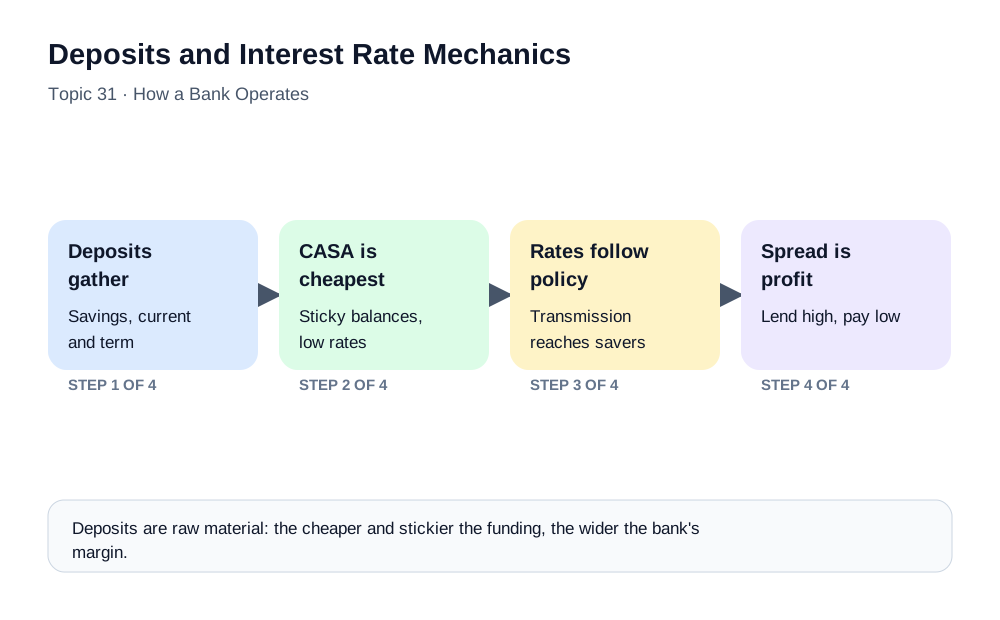
Deposits and Interest Rate Mechanics at a glance — How banks price money, yield curves, benchmark rates.
1. Introduction: Banking's Foundation
Deposits form the foundation of banking. They are a bank's primary source of funds, cheaper than borrowing from markets and more stable than wholesale funding. How banks attract, retain, and price deposits determines their profitability, their resilience during stress, and their capacity to extend credit to the economy. Understanding deposits and the interest rate mechanics that govern them is essential for comprehending how banking actually works.
When a customer deposits money in a bank, they are not simply storing it in a vault. They are lending their money to the bank, receiving in return a promise of repayment plus, in most cases, interest. This lending relationship, though it feels like a simple account to the depositor, creates the liabilities that fund the assets on a bank's balance sheet. The composition of these deposits, their cost, and their stability are among the most critical factors in bank management.
Learning objectives. By the end of this chapter you should be able to:
- Describe the major deposit types and what each offers the customer and the bank
- Explain the CASA ratio and why deposit mix drives bank profitability
- Calculate simple and compound interest and compare compounding frequencies
- Analyse the forces that set deposit rates: policy rates, inflation, competition, liquidity needs
- Explain the net interest spread and how it connects to Topic 29's profitability ratios
- Evaluate deposit insurance's role in stability — and its limits, tested in 2023
- Choose deposit products sensibly from the customer's side of the counter
2. The Types of Bank Deposits
Banks offer several types of deposit accounts, each designed to meet different customer needs while serving different funding purposes for the bank. These deposit types vary in their liquidity, interest rates, and the obligations they impose on both depositor and bank.
Current accounts, known as checking accounts in some countries, are designed for frequent transactions. They allow unlimited withdrawals, provide cheque-writing facilities, and typically offer overdraft options for qualified customers. For depositors, current accounts provide maximum liquidity and convenience. For banks, they represent the cheapest source of funds because they typically pay no interest or very low interest. The balance in a current account can fluctuate dramatically as customers conduct their daily business, but the core balances that persist provide banks with zero-cost funding that improves their net interest margins.
Savings accounts serve customers who wish to set aside money while maintaining access to it. These accounts pay interest, typically ranging from two to six percent depending on the country, central bank policy, and competitive conditions. Savings accounts may have withdrawal limits in some jurisdictions, designed to encourage longer-term balances while providing necessary liquidity. For banks, savings accounts represent low-cost, relatively stable funding. While they pay more than current accounts, the rates are still well below what banks would pay to borrow in wholesale markets.
Term deposits, also called fixed deposits or certificates of deposit, commit depositors to leaving their money with the bank for a specified period. In exchange for this commitment, banks pay higher interest rates than on savings accounts. Tenures can range from seven days to ten years, with longer terms typically earning higher rates. The penalty for early withdrawal, usually a reduction in the interest rate, discourages premature access and gives banks greater certainty about their funding. For banks, term deposits are more expensive but highly predictable, allowing them to match fund duration with loan maturities.
Recurring deposits combine elements of savings and term deposits. Customers commit to making regular monthly contributions for a fixed period, earning interest similar to term deposits. These products encourage savings discipline among customers while providing banks with predictable inflows of funds. They are particularly popular in markets where customers are saving toward specific goals like education expenses or large purchases.
The four types compared at a glance:
| Deposit type | Liquidity | Typical cost to bank | Stability for bank | Customer's use |
|---|---|---|---|---|
| Current / checking | Instant, unlimited | Near zero | Moderate — core balances persist | Daily transactions, business operations |
| Savings | High, some limits | Low | High — sticky household balances | Emergency funds, short-term saving |
| Term / fixed | Locked until maturity | Highest | Highest — contractual certainty | Goals with known dates, surplus parking |
| Recurring | Locked, built monthly | Similar to term | High — predictable inflows | Disciplined goal saving |
Notice the pattern every product embodies: the customer trades liquidity for return, and the bank trades interest cost for funding certainty. Each deposit type is a different point on that single exchange. There is no 'best' deposit — there is only the right matching of your liquidity needs to the compensation you receive for surrendering liquidity.
3. CASA and the Cost of Funds
The composition of a bank's deposits matters enormously for its profitability. Banks closely monitor their CASA ratio, which measures the proportion of deposits in Current Accounts and Savings Accounts relative to total deposits.
A high CASA ratio indicates a low cost of funds. Current accounts pay little or no interest, while savings accounts pay modest rates. Term deposits, by contrast, pay significantly more. A bank with fifty percent of its deposits in CASA accounts paying an average of three percent, and fifty percent in term deposits paying seven percent, has a blended cost of funds of five percent. A competitor with only twenty-five percent CASA pays closer to six percent on its overall deposit base. This one percentage point difference in funding cost translates into a significant competitive advantage in lending markets, where both banks might charge similar rates to borrowers.
Why do customers leave money in low-yield CASA accounts at all? Convenience and habit, mostly: salary credits, bill payments, card links, and the sheer friction of moving make the operational account sticky long after better rates beckon elsewhere. Banks invest heavily to deepen exactly these hooks — every bill you auto-pay from an account is another thread tying your deposits in place. The customer's inertia is the bank's margin, which is why the single most profitable banking innovation of the digital age is not a product but a default: the salary account you never got around to leaving.
A higher share of low-cost transaction and savings balances can improve funding economics, but there is no universal CASA threshold that makes a bank 'excellent' or 'weak'. The appropriate comparison depends on the country, product definitions, customer mix, rate environment, business model, and peer group. A high CASA ratio can still hide concentration or run risk, while a lower ratio can be perfectly sustainable if term funding is stable and correctly priced. The more useful analysis combines deposit mix, average cost, concentration, behavioural stability, insurance profile, and repricing sensitivity.
4. How Interest Is Calculated
Interest calculation methods affect both what depositors earn and what banks pay. Understanding these mechanics is essential for comparing deposit products and assessing bank profitability.
Simple interest calculates returns based only on the principal amount. The formula multiplies principal by rate by time, giving a straightforward calculation of what the deposit will earn. Simple interest is straightforward but does not account for the time value of money or the compounding effect of earning interest on interest.
Compound interest, the standard for most banking products, calculates interest on both principal and accumulated interest. The frequency of compounding affects the effective return significantly. Interest compounded annually yields less than the same nominal rate compounded quarterly, which yields less than monthly compounding. For depositors, more frequent compounding means higher effective returns. For banks, the difference between nominal and effective rates must be carefully tracked for accurate pricing and reporting.
Consider ten thousand dollars at ten percent annual interest for one year. With annual compounding, the final amount is eleven thousand dollars. With monthly compounding, the amount is slightly higher because interest earned each month begins earning additional interest immediately. While the differences seem small over short periods, they compound over longer horizons into meaningful variations in returns.
The mechanics in numbers, for $10,000 at a nominal 10% held one year:
| Compounding frequency | Final amount | Effective annual yield |
|---|---|---|
| Annual | $11,000.00 | 10.00% |
| Quarterly | $11,038.13 | 10.38% |
| Monthly | $11,047.13 | 10.47% |
| Daily | $11,051.56 | 10.52% |
Two practical lessons follow. First, when comparing deposit offers, compare effective annual yields, not nominal rates — a 9.8% rate compounded monthly can beat a 10% rate compounded annually. Second, banks also differ in what balance they pay on: daily-balance methods credit you for every day your money is present, while older minimum-monthly-balance methods effectively denied interest on money withdrawn mid-month. Interest-calculation conventions are product- and jurisdiction-specific. Many modern savings products use daily closing balances, but the applicable law, regulatory rules, and account terms determine the actual method. The customer and the bank therefore need to understand the precise balance basis, compounding frequency, value-date rules, and crediting schedule rather than assuming one universal convention.
A third calculation matters more than either: the real return. Subtract inflation from the nominal rate and you have what your deposit truly earns in purchasing power. A 6% deposit in a 4% inflation economy earns roughly 2% in real terms; the same 6% when inflation runs at 7% is a slow loss dressed as a gain. Depositors who track only the nominal number are reading the label, not the contents.
5. How Banks Set Deposit Rates
Deposit pricing involves balancing multiple factors that vary with market conditions, competitive dynamics, and bank strategy.
Central-bank policy rates anchor short-term monetary conditions and strongly influence market funding costs, but they do not create a universal floor for every deposit or lending rate. Deposit pricing responds to the policy stance together with liquidity conditions, market yields, competition, product design, customer behaviour, and each bank's own funding needs. When policy rates move, different deposit products can reprice at different speeds and by different amounts — the relationship is influential, not mechanical.
Inflation must be considered to ensure deposits offer real returns. If inflation runs at five percent and deposits pay only three percent, depositors are losing purchasing power. Over time, such negative real rates may cause depositors to seek alternative stores of value, threatening the bank's funding base. Banks must monitor inflation expectations and adjust rates to maintain the attractiveness of deposits relative to other assets.
Competitive pressure from rival banks heavily influences deposit pricing. When competitors raise rates to attract deposits, banks must match or exceed those rates to retain their own depositors. Price wars for deposits can erode industry profitability, while collusive restraint may invite regulatory scrutiny. Each bank must assess its own funding needs, franchise strength, and strategic priorities in setting competitive rates.
Liquidity needs drive tactical deposit pricing. Banks facing deposit outflows or anticipating heavy loan demand may temporarily raise rates to attract funds. Conversely, banks with ample liquidity may reduce rates to improve margins. This tactical flexibility is constrained by the need to maintain long-term customer relationships and avoid reputational damage from rate volatility.
Asset-liability matching requires that deposit rates be sustainable given the rates banks earn on their loans and investments. If a bank pays six percent on deposits while earning only seven percent on loans, the one percent spread must cover operating costs, credit losses, and profit margins. Mismatches between deposit costs and asset yields can quickly erode profitability.
Professionals summarise a bank's rate behaviour with a single concept: the deposit beta — the fraction of a policy-rate change that a bank passes through to deposit rates. If the central bank raises rates by one percentage point and a bank raises deposit rates by 0.4 points, its beta is 0.4. Betas are where franchise strength becomes visible: banks with captive, convenience-focused depositors keep betas low and pocket the widening margin; banks dependent on rate-shopping wholesale money face betas near 1.0 and gain nothing. In every rate-hiking cycle, analysts rank banks by their betas — it is the quickest measure of who actually benefits from rising rates.
Regulatory requirements in some jurisdictions mandate minimum savings rates or restrict how banks structure their deposit products. These regulations, intended to protect consumers, constrain pricing flexibility and must be factored into deposit strategy.
6. The Spread: Banking's Core Profitability
The difference between what banks earn on loans and what they pay on deposits is the net interest margin, the fundamental source of bank profitability. If a bank's average lending rate is ten percent and its average deposit rate is six percent, the four percent spread must cover operating expenses, provisions for loan losses, taxes, and still leave profit for shareholders.
A concrete illustration ties the spread to the topics around this one. Take the miniature bank from Topic 29's tables: $62B of loans at 8%, $25B of securities at 4%, funded by $78B of deposits at 3% and $14B of borrowings at 5%. Interest income is about $5.96B; interest expense about $3.04B; the spread engine yields roughly $2.9B of net interest income. Now let competition force deposit rates up one point while asset yields stay fixed: NII falls by nearly $0.8B — more than a quarter of the engine's output, gone without a single loan defaulting. That sensitivity is why treasury teams watch funding costs daily and why the deposit franchise, not the loan book, is often the truest measure of a bank's durability.
Managing this spread requires careful attention to both sides of the balance sheet. On the asset side, banks seek higher-yielding loans while managing credit risk. On the liability side, they minimize funding costs while ensuring adequate liquidity. The spread compresses when competition drives down loan rates or pushes up deposit rates, when credit losses rise, or when yield curves flatten. Banks with stronger deposit franchises, higher CASA ratios, and better customer relationships can maintain wider spreads through market cycles.
7. Deposit Insurance and Financial Stability
Most countries protect depositors through insurance schemes that guarantee repayment up to specified limits if a bank fails. These schemes prevent bank runs by assuring depositors that their money is safe even if their bank encounters difficulties.
Deposit-protection limits are jurisdiction-specific and can change, so they should always be checked against the current official scheme. As of 2026, the US FDIC standard maximum is $250,000 per depositor, per insured bank, per ownership category; India's DICGC insures eligible principal and interest up to ₹5,00,000 per depositor in the same right and capacity at an insured bank; and the UK FSCS deposit protection limit is £120,000 per eligible depositor per PRA-authorised institution, increased from £85,000 on 1 December 2025. European Union deposit-guarantee frameworks generally protect eligible deposits up to €100,000 per depositor per bank, subject to the applicable national scheme. Learners should treat all numeric limits as date-sensitive rather than permanent product features.
These limits are designed to protect retail depositors while leaving larger depositors with incentives to monitor bank health. When deposits exceed insurance limits, depositors may split funds across multiple banks or shift to government securities for additional safety.
The 2023 US regional bank failures stress-tested this architecture in public. The March 2023 failures of Silicon Valley Bank and Signature Bank showed how quickly large uninsured deposits can leave through digital channels. US authorities invoked the systemic-risk exception so that depositors of those two failed banks were made whole beyond the normal insurance limit; this did not permanently raise the statutory FDIC limit for all banks. The episode renewed debate about uninsured deposit concentration, digital run speed, liquidity preparedness, and the design of deposit insurance. For depositors, the practical lesson remains to understand the applicable coverage rules and how ownership categories and bank charters affect protection.
Deposit insurance is funded by premiums paid by participating banks, typically based on their deposit levels and risk profiles. This funding structure creates moral hazard, as banks may take greater risks knowing that depositors are protected. Regulators address this through risk-based premiums, capital requirements, and supervisory oversight that constrain excessive risk-taking.
The interplay of deposit types, interest rate mechanics, and insurance frameworks shapes how banks fund themselves and how depositors choose where to place their money. For banks, building a stable, low-cost deposit base is a strategic imperative that determines their competitiveness and resilience. For depositors, understanding these mechanics helps optimize returns while maintaining the liquidity and safety they require.
8. Deposit Stability: The Quality That Only Stress Reveals
Cost is the visible dimension of deposits; stability is the decisive one. A deposit base is stable when its owners have reasons to stay that survive panic: insured balances, payroll relationships, bill-payment habits, business operating needs. It is fragile when its owners are rate-chasing, uninsured, concentrated, or one app-tap from exit.
Bankers and regulators classify deposits accordingly. Core deposits — the portion expected to remain through stress — are what a bank can genuinely lend long against; the rest is hot money wearing a deposit's clothes. Post-2008 liquidity regulation (the LCR of Topic 27) formalised this: insured retail deposits are assumed to run off slowly in a crisis, uninsured and wholesale deposits quickly, and banks must hold liquid assets against the difference. Topic 23's lesson applies inside the bank as well: it is the funding's behaviour under stress, not its label in calm times, that determines survival.
For depositors the same logic inverts: your deposit is safest at a bank whose other depositors are sticky. Concentrated, jumpy funding is the prelude to every run — which is why the composition of a bank's deposit base, not merely its size, belongs in any serious assessment of its safety.
9. The Digital Era: Deposits at the Speed of an App
Digital banking has rewritten the mechanics of deposit competition and deposit flight.
Rate transparency exploded. When comparing deposit rates required visiting branches, franchises were protected by inconvenience. Rate-comparison sites and digital banks collapsed that friction: a saver can now find and open the best-paying account in minutes. The result is rising deposit betas everywhere, rate competition from branchless banks with low cost structures, and steady pressure on the lazy deposits that traditional banks long took for granted.
Deposit flight accelerated beyond anything history prepared for. The 2023 US regional bank runs demonstrated the new physics: fearful depositors moved tens of billions in hours, by phone, on a weekday afternoon — no queues, no weekend pause, no natural speed limit. A bank run that once took days now fits between lunch and the close of business. Regulators and banks are still adapting: faster monitoring of outflows, pre-positioned collateral at central bank facilities, and crisis playbooks measured in hours rather than days.
The franchise response is engagement. Banks now compete for deposits with bundles — salary accounts, fee waivers, integrated investing, ecosystem rewards — designed to make leaving inconvenient in ways that transcend rate. The deepest defence against app-speed flight is not a better rate; it is a customer for whom the account is woven into daily financial life.
10. The Customer's Playbook: Using Deposit Mechanics Well
The same mechanics that drive bank strategy can work for the depositor who understands them.
Match the product to the purpose. Money for daily life belongs in current/savings; money with a known date belongs in term deposits matched to that date; money being accumulated belongs in recurring deposits that enforce the discipline. Holding long-term money in a savings account is donating interest to the bank; locking emergency money in term deposits invites penalties.
Ladder term deposits. Instead of one large five-year deposit, split into deposits maturing each year. Laddering preserves periodic access, smooths reinvestment across rate cycles, and removes the gamble of locking everything at a single rate — the classic answer to 'but what if rates rise after I lock in?'
Respect insurance limits. Keep balances per depositor per bank within insured limits, spreading larger sums across institutions. Insurance limits apply per bank, per depositor — splitting across banks multiplies protection at zero cost.
Read the effective yield and the fine print. Compounding frequency, the balance basis, premature-withdrawal penalties, and whether the attractive rate is introductory all change the real return. The advertised number is the beginning of the comparison, not the end.
Chase rate only at the margin. Moving operational, habit-bound accounts for a small rate gain usually costs more in friction than it earns; moving idle surplus is nearly free. Sophisticated depositors are rate-sensitive with their surplus and rate-indifferent with their operating money — which is, of course, exactly the behaviour banks' pricing models assume.
11. Common Misconceptions About Deposits and Interest
"The bank keeps my deposit safe in its vault." Deposits are the bank's property and its funding — lent out, invested, and only fractionally held as reserves (Topic 12). Your safety comes from the legal claim, capital, liquidity regulation, and deposit insurance, not from a pile of notes with your name on it.
"Higher deposit rates always mean a better bank." Often the opposite: the bank paying well above market is frequently the bank that needs deposits urgently. Rate is a signal about the bank's funding position as much as an offer to you — which is why deposit insurance limits matter most exactly where rates are most tempting.
"Term deposits are always better because they pay more." Only if you can genuinely surrender the liquidity. Breaking a term deposit early typically costs a rate penalty that can erase the advantage over savings — the higher rate compensates you for a real sacrifice, not a free upgrade.
"Compound interest only matters for long horizons." The frequency effect is real within a single year (Section 4's table), and the habit of comparing effective yields rather than nominal rates pays off on every product at every horizon — including, in reverse, the loans where compounding works against you.
"Deposit insurance means banks can't lose my money." Insurance has limits, coverage boundaries (per depositor, per bank), and in most systems pays out over a defined period rather than instantly. Within limits it is robust; beyond them, you are an unsecured creditor relying on the bank's health — the distinction the 2023 uninsured-deposit runs illustrated brutally.
12. Frequently Asked Questions
Can banks change my savings rate whenever they like? Generally yes — savings and current account rates are variable, set by the bank and adjustable with notice; only term deposits lock a rate contractually. This asymmetry is worth remembering in both directions: falling-rate cycles quietly cut savings returns, and rising-rate cycles make it worth checking whether your bank actually passed the increase on.
Why do current accounts pay no interest? Because you are not compensating the bank for holding money — it is compensating you with free payment services: cheques, transfers, cards, cash handling. The zero rate is the price of unlimited, instant liquidity on balances the bank must stand ready to return at any moment.
Is a savings account really safe if the bank lends my money out? Within insured limits, yes — your claim is protected by deposit insurance even if the bank fails. Beyond limits, safety rests on the bank's capital, asset quality, and funding structure (Topics 26 and 29), which is why large balances deserve either spreading across banks or a look at the institution's ratios.
Why do fixed deposit rates rise with tenure? The bank is buying certainty: a five-year deposit can fund five-year loans without rollover risk, and the premium compensates you for surrendering access and accepting the risk that market rates rise while you are locked.
What is the CASA ratio and why do analysts obsess over it? Current and savings accounts as a share of total deposits — the cheap, sticky end of the funding base. High CASA means low funding costs and, usually, a loyal customer franchise; it flows directly into net interest margin (Topic 29), which is why it is one of the first numbers bank analysts check.
How is savings account interest actually credited? Typically calculated on the daily closing balance and credited monthly or quarterly, depending on the market and product. The daily-balance method means deposits earn from the day they arrive and stop earning the day they leave — the fairest basis, now mandated in most jurisdictions.
Why did my bank raise loan rates faster than deposit rates? Deposit betas are below one by design: banks pass through only part of policy-rate increases to depositors, especially those with sticky CASA bases, while loan rates reprice faster. The asymmetry widens margins in hiking cycles — and is why rate-shopping your surplus deposits is most worthwhile exactly when rates are rising.
What happens to my fixed deposit if I need money urgently? Most banks allow premature withdrawal with a penalty — commonly a rate reduction (often around one percentage point below the rate for the period actually held) — or offer a loan against the deposit at a small spread over its rate. The loan route preserves the deposit and is frequently cheaper than breaking it.
Are digital-only banks' higher deposit rates safe? Check two things: whether the institution is a licensed bank covered by the deposit insurance scheme (Topic 22's payment banks and Topic 21's NBFCs show why the licence matters), and whether your balance stays within insured limits. A licensed digital bank's deposit is as protected as a traditional bank's; a non-bank app's 'deposit-like' product may carry no insurance at all.
Why do deposit rates differ so much between banks? Funding need and franchise strength. A bank growing loans fast or losing deposits must pay up for money; a deposit-rich franchise can price below market and still grow. Rate dispersion across banks is a live map of who is hungry for funding and who is not.
Does inflation change the best deposit strategy? Yes: in high-inflation regimes, shorter tenures preserve the ability to reprice upward, real returns matter more than nominal ones, and the penalty for leaving money in zero-interest current accounts grows — inflation taxes idle deposits hardest.
What is a sweep-in or auto-sweep account? A hybrid that automatically moves surplus savings balances into term deposits and back when needed — giving savings liquidity with term-deposit yield on the idle portion. It is the bank's own productised version of Section 10's matching logic, worth considering where offered on fair terms.
13. Key Terms in This Chapter
- Current account / checking — zero- or low-interest, unlimited-transaction deposit for daily operations.
- Savings account — interest-bearing, highly liquid household deposit.
- Term / fixed deposit (CD) — time-committed deposit paying a premium for certainty.
- Recurring deposit — fixed monthly contributions accumulating at term-deposit rates.
- CASA ratio — current and savings deposits as a share of total deposits; the franchise metric.
- Cost of funds — the blended rate a bank pays for its funding.
- Simple / compound interest — interest on principal alone vs on principal plus accumulated interest.
- Effective annual yield — the true annual return after compounding frequency; the correct comparison metric.
- Real interest rate — nominal rate minus inflation; the purchasing-power return.
- Deposit beta — the share of a policy-rate change passed through to deposit rates.
- Core deposits — the stable portion of the deposit base expected to survive stress.
- Net interest spread / margin — the gap between asset yields and funding costs; banking's core profit.
- Deposit insurance — the scheme guaranteeing deposits up to a limit per depositor per bank.
- Moral hazard — the risk-taking incentive created when protection removes consequences.
- Deposit laddering — staggering term-deposit maturities to balance yield, access, and rate risk.
- Sweep account — automatic movement of surplus balances into higher-yield deposits.
14. Interview Insights: How This Topic Appears in Banking Interviews
"Why are deposits called the foundation of banking?" Three reasons in order: cost — deposits are the cheapest funding a bank can raise; stability — insured retail deposits are the stickiest money in finance; and franchise — the deposit relationship is the gateway to every other product. Close with the balance-sheet identity from Topic 26: deposits fund the assets, so their composition shapes everything the bank can do.
"What is deposit beta and why does it matter?" The pass-through fraction of policy-rate changes to deposit rates. Low-beta banks — strong CASA franchises — capture margin in hiking cycles; high-beta banks gain nothing. In 2022–24 rate cycles it was the single most watched funding metric. Add the strategic point: beta is not fate, it is franchise strength made measurable.
"How do you attract deposits without overpaying?" The franchise answer: transaction banking that embeds the bank in customers' operations, branch and service quality, ecosystem bundles, and salary-account pipelines — convenience that raises the customer's cost of switching. Rate is the weapon of banks without franchises; the question is designed to find candidates who know the difference.
"What did the 2023 bank runs change about deposit management?" Speed and concentration became the new watchwords: uninsured, concentrated deposits can now exit in hours by phone, so monitoring, liquidity pre-positioning, and funding diversification moved from quarterly concerns to intraday ones. The candidates who mention that a run now fits in an afternoon — and that deposit composition is therefore a survival variable — show current understanding.
"How would you explain deposit pricing to a customer complaining about rates?" Honestly and structurally: the bank's deposit rate reflects the policy rate, what it earns on assets, competition, and its own funding needs — and the customer's alternatives (term tenure, sweep products, laddering) often matter more than the headline savings rate. Turning a complaint into a structuring conversation is the relationship-manager skill the question tests.
Summary and Key Takeaways
Deposits are banking's raw material, and their mechanics — type, cost, stability, pricing — determine what every bank can be. The essential points:
- A deposit is a loan to the bank: the customer trades ownership for a liquid, insured claim — the transaction on which the entire system is built.
- Every product is a liquidity-for-return exchange: current, savings, term, and recurring deposits are four points on one trade-off; matching purpose to product is the whole of deposit strategy on both sides.
- CASA is the franchise metric: cheap, sticky current and savings deposits fund margins that rate-dependent rivals cannot match.
- Effective yield beats nominal rate: compounding frequency and balance basis change real returns, and inflation defines the real return that actually matters.
- Deposit rates are set by five forces: the policy rate, inflation, competition, liquidity needs, and asset-liability matching — with deposit beta measuring how much of the first reaches the customer.
- The spread is the business: the gap between loan yields and deposit costs must cover costs, losses, tax, and profit — everything in bank strategy defends it.
- Stability reveals itself only in stress: core deposit quality, concentration, and insurance coverage decide whose funding survives a panic.
- Digital banking changed the physics: rate transparency raised betas, app-speed flight compressed runs into hours, and engagement became the franchise's defence.
- Insurance protects within limits, not beyond: per-depositor, per-bank caps make balance-spreading the free insurance upgrade — and the 2023 runs showed how fast the uninsured exit.
- The customer's playbook mirrors the bank's: match, ladder, respect limits, read effective yields — the mechanics reward whoever understands them, on either side of the counter.
In the next topic, we follow the deposits to their destination — the lending and credit lifecycle: how a bank turns pooled funding into loans, and how a loan lives from application to repayment.
Next: Topic 32 — The Lending and Credit Lifecycle →
<!-- MBA-DEEP-DIVE-START -->Deep Dive: Deposit Pricing, Behaviour, Transfer Pricing, and Interest-Rate Risk
Deposits look simple because the customer sees a balance and perhaps an interest rate. For the bank, however, a deposit is simultaneously a funding instrument, a customer relationship, a liquidity assumption, an interest-rate exposure, an operational account, and sometimes an insured liability. The value of a deposit franchise therefore cannot be understood from the advertised rate alone.
A useful way to analyse deposits is to separate contractual maturity from behavioural maturity. A current or savings account may be contractually withdrawable on demand, yet a large portion of customers may leave stable balances for years because the account receives salary, pays bills, connects to cards, or supports business operations. A term deposit has a defined contractual maturity but may still be withdrawn early if the product permits it, usually with a pricing consequence.
Banks therefore model how deposits actually behave rather than assuming every balance leaves at the first legal opportunity.
Deposit stability is an economic characteristic, not a product label
Two savings accounts with identical terms can behave very differently.
Bank A may have millions of small household accounts, most within deposit-insurance limits, used for salaries and everyday payments. Bank B may have a smaller number of large corporate or institutional depositors whose balances exceed insurance limits and are actively managed by treasury teams seeking the best yield.
Both balances are legally ‘deposits’, but their stress behaviour differs sharply. Large, sophisticated, uninsured depositors can move funds quickly when confidence weakens. Retail operational balances may be much stickier.
For asset-liability management, the bank therefore analyses deposit segmentation by customer type, concentration, insurance status, account purpose, rate sensitivity, historical runoff, digital access, and relationship depth.
Non-maturity deposits create modelling risk
Current and many savings accounts are often called non-maturity deposits because they have no contractual end date. The bank must decide how much of these balances is stable enough to support longer-term assets and how quickly rates on the accounts will reprice when market rates move.
Suppose a bank has ₹10,000 crore of savings deposits. Contractually, customers can withdraw most of the money quickly. Behavioural analysis may suggest that a substantial core balance persists even during rate cycles.
Treasury might therefore model part of the balance as having a longer behavioural life. That assumption affects liquidity, interest-rate risk, hedge strategy, funds transfer pricing, and sometimes valuation.
If the model is too optimistic, the bank can be exposed twice: customers may leave faster than expected and the remaining deposits may demand higher rates faster than expected.
The 2023 US bank failures reinforced the need to reconsider historical assumptions where depositors are concentrated, digitally connected, and able to transfer very large balances instantly.
Deposit beta is only one part of repricing behaviour
Deposit beta measures how much deposit rates move relative to a benchmark or policy-rate move over a specified period. If a reference rate rises 200 basis points and a bank raises the average rate paid on a deposit portfolio by 80 basis points, the simple beta is 40% for that period.
But beta alone does not tell the whole story.
Lag matters. Deposits may reprice slowly at first and catch up later.
Mix matters. Customers may move from low-rate savings accounts into term deposits without leaving the bank. The average funding cost rises even if individual product rates barely change.
Customer segmentation matters. Rate-sensitive affluent customers can reprice differently from payroll customers.
Competition matters. A new digital bank offering aggressive rates can change behaviour independently of central-bank policy.
For this reason, sophisticated deposit pricing models track both rate paid and balance migration.
Deposit migration can compress margin without an external outflow
Imagine a customer keeps ₹10 lakh in a savings account earning 3%. Market rates rise and the bank offers a one-year deposit at 7%. The customer moves the full ₹10 lakh into the term deposit.
From a liquidity perspective, the bank did not lose funding. From a net-interest perspective, however, the funding cost more than doubled.
At scale, this deposit mix shift can materially reduce net interest income.
A bank with a strong franchise therefore needs to forecast not only ‘Will deposits leave?’ but also ‘Which product will customers choose inside the bank?’
This is why treasury and retail product teams need a shared view of deposit behaviour.
Pricing should reflect the value of the whole relationship
A deposit account can be worth more to the bank than the interest margin on the balance itself. A payroll customer may use cards, payments, investments, loans, insurance, or wealth products. A corporate operating account may generate transaction fees, FX flows, trade finance, and credit opportunities.
Pricing therefore often considers relationship value, not one product in isolation.
This does not justify opaque or unfair pricing. The bank still needs clear customer disclosures and product governance. But internally, a bank may rationally pay more to retain a strategically valuable deposit relationship than it would pay for anonymous wholesale funding.
Funds transfer pricing makes deposit value visible internally
Deposits provide funding to the bank. To avoid treating this benefit as free, banks use funds transfer pricing (FTP) to assign internal credits and charges.
Suppose a retail business gathers ₹1,000 crore of stable savings deposits at an average customer rate of 3%. Treasury determines that comparable behavioural funding has an internal value of 5%. The retail business may receive an FTP credit reflecting the 2% funding benefit before operating costs and other adjustments.
A lending business receives the opposite treatment. If it books a five-year fixed-rate loan, it is charged an internal funding rate that reflects the tenor and risk characteristics of the funding it consumes.
FTP helps answer an important question: which business actually created the margin?
Without FTP, the lending unit could claim all the spread even though the deposit franchise supplied the low-cost funding.
FTP also controls interest-rate risk transfer
A well-designed FTP framework transfers much of structural interest-rate risk from individual product businesses to central treasury or ALM.
A branch relationship manager should not decide whether the bank should fund a five-year fixed-rate loan with overnight deposits. The lending business prices the customer using an internal five-year funding curve. Treasury then manages the resulting balance-sheet risk centrally through deposits, securities, wholesale funding, and hedges.
This separation allows business units to focus on customer pricing while specialised treasury teams manage structural risk.
The yield curve matters more than one policy rate
Deposit and loan pricing are influenced by the yield curve, not only the overnight policy rate. The curve reflects market expectations for future rates, inflation, liquidity, term premia, and credit conditions.
A one-year term deposit should not automatically be priced by adding a fixed margin to today’s overnight rate. The bank considers what one-year market funding costs, how future rates are expected to move, how valuable customer stability is, and what assets the funding will support.
The shape of the curve also affects customer behaviour.
If long-term deposit rates are much higher than short-term rates, customers may lock funds for longer. If the curve is inverted and short-term rates are high, customers may prefer shorter maturities to preserve flexibility.
Product pricing therefore changes the maturity profile of the bank’s liabilities.
Interest calculation needs precise conventions
The formula ‘principal × rate × time’ is useful for intuition but real products require exact conventions.
A bank must specify:
- whether interest is simple or compounded;
- the balance on which interest is calculated;
- the day-count basis;
- whether rate changes are applied immediately or from a defined date;
- how leap years and holidays are handled;
- when interest accrues versus when it is credited;
- what happens on early withdrawal;
- whether withholding tax applies;
- how rounding is performed.
Small differences can create customer disputes at scale.
For example, a term deposit may accrue interest daily but pay it monthly. Accrual and payment are not the same event. Finance records expense as it is earned by the depositor even if cash is paid later.
Accrued interest is a liability before it is paid
Suppose a bank promises 6% annual interest on a ₹1 lakh one-year deposit, with interest payable at maturity. Ignoring compounding and detailed day-count conventions, the bank economically incurs approximately ₹6,000 of interest expense over the year.
It should not wait until maturity to recognise the entire expense if accounting requires accrual over time. Each period, the bank recognises interest expense and a corresponding accrued liability or increase in the carrying amount under the product’s accounting treatment.
This illustrates a general banking principle: cash movement and income or expense recognition can occur at different times.
Breakage behaviour matters for term deposits
Term deposits provide contractual funding certainty only if customers actually hold them to maturity. Many products permit early withdrawal with reduced interest or a penalty.
Banks model breakage rates: how often customers terminate deposits early, under what conditions, and how sensitive behaviour is to rate movements.
If market rates rise sharply, customers may be willing to pay the early-withdrawal penalty to reinvest at a much higher rate. A supposedly fixed one-year funding profile can shorten unexpectedly.
Product design should therefore consider whether early-withdrawal terms are sufficient to protect the bank without unfairly trapping customers.
Callable and structured deposits add optionality
Some markets offer deposits with embedded options or returns linked to market variables. These can create more complex valuation, suitability, and hedging requirements.
A customer may receive an enhanced rate in exchange for giving the bank an option to repay early, or a return may depend on an equity index or currency outcome. Such products should not be explained as ordinary fixed deposits merely because principal may have some protection.
Optionality changes both customer risk and bank risk. The accounting classification, disclosure, fair value, and hedging treatment can differ materially from a plain deposit.
Deposit insurance changes behaviour but does not eliminate liquidity risk
Deposit insurance is designed primarily to protect eligible depositors and support confidence. It can make smaller insured balances more stable because customers have less reason to run purely from fear of losing principal.
But several qualifications matter.
Coverage is subject to jurisdiction, institution, ownership category or legal capacity, eligibility, and limits. Multiple brands can sometimes share one banking licence. Temporary high balances may receive separate treatment in some schemes. Certain investment products sold by a bank are not deposits and may not be covered by deposit insurance at all.
Banks therefore need customer-master and account-ownership data accurate enough to support depositor-protection reporting and resolution planning.
Customers likewise need to understand that ‘held at a bank’ does not mean ‘insured as a deposit’.
Concentration can matter more than average coverage
Suppose Bank A has one million depositors each holding ₹1 lakh. Bank B has 1,000 corporate depositors each holding ₹100 crore.
Even if total deposits are similar, Bank B’s funding can move much faster because a small number of treasury teams can make large decisions simultaneously.
Concentration analysis should therefore examine:
- top depositors;
- top groups of connected depositors;
- uninsured or uncovered balances;
- sector concentration;
- geographic concentration;
- operational versus investment balances;
- maturity buckets;
- brokered or rate-sensitive funding.
The average deposit size alone can hide the true run risk.
Digital withdrawals changed the speed assumption
Historically, a bank run involved queues, branch opening hours, cheques, and manual transfers. Modern corporate customers can move very large balances through digital channels almost instantly.
Liquidity risk management must therefore consider velocity, not merely total potential runoff.
A bank may have enough high-quality assets in theory but still face operational constraints converting them into settlement liquidity quickly enough. Collateral may need to be pre-positioned. Central-bank facilities may require operational readiness. Payment limits and cut-off times matter.
The key question is not only ‘Do we have liquidity?’ but ‘Can we mobilise it within the timeframe of the outflow?’
Deposit pricing and liquidity can conflict
A bank facing outflows may raise deposit rates aggressively to retain funding. This can stabilise liquidity but damage profitability.
If it pays 8% to retain deposits while its loan portfolio yields 7%, the immediate liquidity problem may improve while the business model becomes economically unsustainable.
Banks therefore need a hierarchy of responses: use liquidity buffers, access diversified funding, adjust asset growth, price deposits rationally, and communicate confidence where appropriate. Rate is only one tool.
A weak bank cannot always ‘buy’ its way out of a confidence crisis because depositors may interpret an unusually high rate as evidence of desperation.
Deposit campaigns need capacity planning
A successful deposit promotion can itself create operational problems.
Imagine a digital bank launches a market-leading term deposit and receives ten times the expected inflow in two days. Onboarding queues grow. KYC systems hit capacity. Customer-service calls spike. Treasury suddenly receives far more liquidity than planned. The bank may need to invest the cash at lower yields until loans or securities can absorb it.
Growth is not free. Product, operations, treasury, technology, fraud, AML, and finance should agree on expected volumes and stop or reprice the campaign if economics change.
Dormancy and unclaimed deposits are distinct operational states
An account with no customer-initiated activity for a long period may become dormant or inactive under product and regulatory rules. Dormancy is a fraud-control and customer-protection issue because old accounts can be targeted for unauthorised reactivation.
Unclaimed deposits create additional obligations under applicable law. The bank may need to transfer balances or report them to a designated authority after specified periods while retaining customer recovery processes.
Systems should not confuse ‘inactive’, ‘dormant’, ‘frozen’, ‘closed’, and ‘unclaimed’. Each status can have different rights and transaction rules.
Rate changes require end-to-end change control
Changing a savings rate sounds like a treasury or product decision. Operationally, it can affect:
- pricing tables;
- interest accrual engines;
- disclosures and customer notifications;
- websites and apps;
- statements;
- tax calculations;
- profitability forecasts;
- FTP;
- ALM models;
- complaint scripts;
- regulatory reporting.
The effective date must be consistent everywhere.
If the mobile app shows 5% while the core system accrues 4.75%, the bank has both a conduct problem and an accounting problem.
A full deposit pricing example
Suppose a bank wants to attract ₹5,000 crore of one-year deposits to fund strong mortgage growth.
Treasury observes the one-year market funding curve, expected policy-rate path, existing liquidity, wholesale funding alternatives, and asset yields. Product analyses competitor rates and expected customer response. Finance models interest expense. ALM tests the effect on interest-rate risk. Marketing estimates acquisition cost. Operations and technology assess onboarding capacity. Risk checks concentration and large-depositor dependency.
The bank chooses a 6.5% rate.
If the deposits arrive mostly from millions of retail customers and renew at maturity, the funding may be attractive. If the inflow instead comes from twenty institutional customers that will leave immediately for a 10-basis-point improvement elsewhere, the same 6.5% rate created a very different liability.
That is why the quality of funding cannot be priced from rate alone.
What excellence looks like
A world-class deposit franchise understands rate, behaviour, and relationship together. It knows which balances are operational, insured, concentrated, rate-sensitive, or likely to migrate. It models non-maturity deposits conservatively, validates assumptions against stress, prices term deposits against the relevant funding curve, and transfers funding value through FTP. Interest engines apply exact conventions. Rate changes are controlled end to end. Deposit-insurance data is accurate. Dormant and unclaimed balances are protected. Treasury can mobilise liquidity fast enough for digital outflows.
The deepest insight is that deposits are not merely cheap money. They are behavioural liabilities. Their true value is revealed not when customers are calm, but when rates move, competitors reprice, markets become stressed, and customers suddenly have reasons to reconsider where their money sits.
<!-- MBA-DEEP-DIVE-END -->