Visual overview
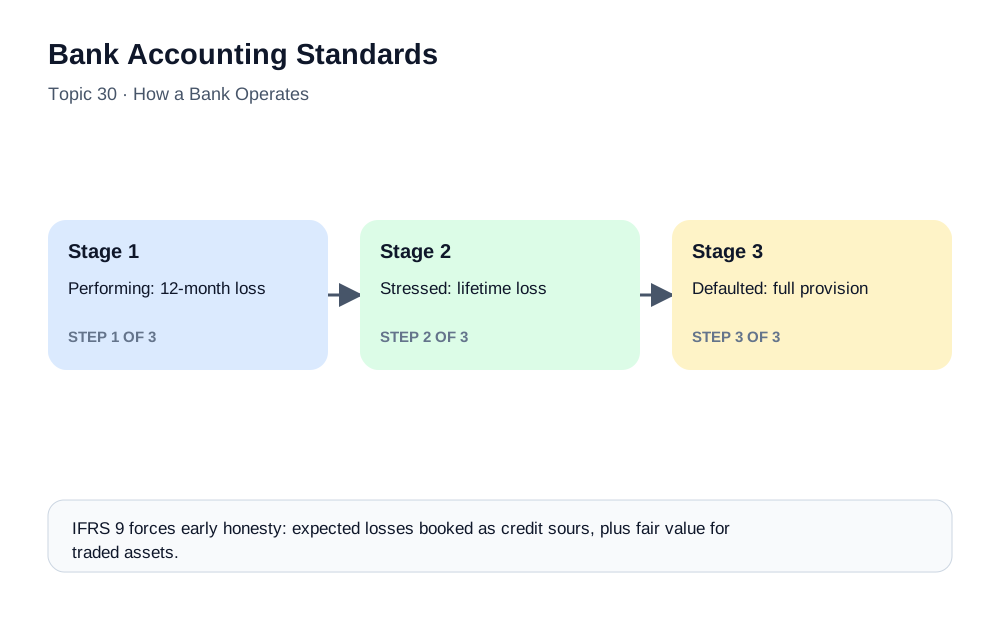
Bank Accounting Standards at a glance — IFRS 9, expected credit loss, fair value accounting.
1. Introduction: The Rules That Decide What the Numbers May Say
Accounting standards determine how banks measure and report their financial health. The shift from incurred loss models to expected credit loss models under IFRS 9 fundamentally changed how banks recognize loan losses — and reshaped the entire banking industry's approach to credit risk.
Topic 29 taught you to read bank financial statements. This chapter goes one level down, into the rules that produce those statements. These rules might sound like a technicality for accountants. They are not. Accounting standards decide when a bank must admit that a loan is going bad, how much loss it must recognize, and what value it may put on the bonds it holds. In banking, where the entire business is promises about the future, the rules for recognizing bad news are the rules for recognizing reality. Change those rules, and you change what banks report, how they lend, how much capital they need, and — as the 2008 crisis proved — how early the system sees its own failures coming.
Learning objectives. By the end of this chapter you should be able to:
- Explain why the incurred loss model failed and what expected credit loss (ECL) replaced it with
- Apply the IFRS 9 three-stage model to real loans and compute provisions for each stage
- Calculate ECL using PD × LGD × EAD and interpret each component
- Distinguish amortized cost, FVOCI, and FVTPL measurement and their consequences
- Compare the major global standards: IFRS 9, US CECL, and Ind AS 109
- Analyze the procyclicality debate and the model-governance challenges ECL created
2. Why Standards Matter: The Politics of Recognizing Bad News
Banks hold assets (loans) that might never be repaid. The accounting question is: when should a bank recognize that a loan might go bad?
- Old approach (IAS 39): Only recognize losses when they actually happen — "incurred loss"
- New approach (IFRS 9): Recognize expected future losses from day one — "expected credit loss" (ECL)
The 2008 financial crisis exposed the flaw in the old approach: banks were holding bad loans on their books at full value until it was too late.
The failure deserves a precise telling, because it was not a flaw of execution but of design. Under incurred loss, a bank could provision only when there was objective evidence of impairment — a missed payment, a default event. But credit deterioration is a slope, not a cliff. Through 2006 and 2007, everyone in the market knew US mortgage credit was deteriorating; under IAS 39, much of that foreseeable loss was not yet "incurred," so it sat unrecognized. Banks reported record profits on loan books the market already doubted. When the losses finally qualified for recognition, they arrived all at once, in a crisis, at the worst possible moment — the famous "too little, too late" verdict delivered by the G20 and the Financial Stability Board, which then ordered the standard-setters to build something forward-looking.
That something is ECL, and its philosophical inversion is total: instead of asking "has this loan gone bad?", the bank must ask, from the day the loan is born, "what losses should I expect over this loan's life?" Bad news is no longer an event to be recorded but a forecast to be maintained. Every number that follows in this chapter is machinery for that single idea.
3. IFRS 9 — The Three-Stage Model
IFRS 9 classifies every financial asset into one of three stages:
Stage 1: Performing
- Loans with no significant increase in credit risk since origination
- Provision: 12-month expected credit losses
- Example: A new home loan to a borrower with excellent credit
Stage 2: Underperforming
- Significant increase in credit risk but no actual default
- Provision: Lifetime expected credit losses
- Example: A borrower who missed one payment or whose employer announced layoffs
Stage 3: Non-Performing
- Actual default (typically 90+ days past due)
- Provision: Lifetime expected credit losses
- Interest income recognized on the net amount (after provisions)
- Example: A borrower who stopped paying 4 months ago
Movement Between Stages
Stage 1 → Stage 2: Credit risk significantly increases
Stage 2 → Stage 3: Borrower actually defaults
Stage 3 → Stage 2: Borrower cures the default
Stage 2 → Stage 1: Credit risk returns to origination level
The model's genius — and its cost — is the cliff built between Stage 1 and Stage 2. A Stage 1 loan carries provisions for losses expected only over the next twelve months. The moment credit risk increases significantly — not default, merely significant deterioration — the loan jumps to Stage 2 and the bank must suddenly provide for losses expected over the loan's entire remaining life. For a twenty-year mortgage, that can multiply the provision many times over on a single classification change.
This design makes the phrase "significant increase in credit risk" (SICR) the most consequential judgment in bank accounting. Banks define it through a mix of quantitative triggers (days past due, downgrades in internal ratings, movements in default probabilities) and qualitative indicators (sector distress, restructuring watchlists). The definition is audited, supervised, and model-governed — because the temptation to define SICR narrowly, and thereby keep loans in the cheap Stage 1, is permanent and obvious.
A walkthrough makes the ladder concrete. Take a five-year, $200,000 business loan with an estimated 1.5% one-year PD, 5% lifetime PD, and 45% LGD. At origination — Stage 1 — the provision is 1.5% × 45% × $200,000 ≈ $1,350. Two years in, the borrower's industry enters a downturn and the loan is re-rated: it has not missed a payment, but the SICR trigger fires and it migrates to Stage 2. The provision now runs on the lifetime horizon at the revised PD of, say, 8%: 8% × 45% × the remaining balance — roughly $5,000+, booked as a charge in a single quarter, though not one rupee has been missed. If the borrower then defaults outright, the slide into Stage 3 changes the interest accounting rather than the provision basis. And if the borrower cures and the sector recovers, the loan can climb back up the ladder — the arrows run both ways, which is why provisions can release and boost profit in recoveries.
Note also the asymmetry the stage ladder creates: Stage 3 differs from Stage 2 not in provision size (both use lifetime ECL) but in interest recognition. In Stages 1 and 2 the bank books interest on the gross loan; in Stage 3, only on the net, post-provision amount — the accounting system formally admitting that some of the "interest" on a defaulted loan will never be collected.
4. Calculating Expected Credit Losses
The ECL formula has three components:
ECL = PD × LGD × EAD
| Component | Meaning | Example |
|---|---|---|
| PD | Probability of Default | 2% chance the borrower defaults |
| LGD | Loss Given Default | 40% of the loan is lost if default occurs |
| EAD | Exposure at Default | $100,000 loan balance at default |
In this example: ECL = 2% × 40% × $100,000 = $800
The bank must set aside $800 from day one, even though the loan is currently performing.
Each component rewards a closer look, because each is a modeling discipline of its own:
PD — Probability of Default is a forecast, not a fact. Banks estimate it from internal rating models built on decades of default history, segmented by borrower type, and — critically for ECL — adjusted for the economic outlook. A 2% PD in a growth forecast might become 3.5% in a recession scenario. This is where macroeconomic forecasting enters the accounts: IFRS 9 requires multiple probability-weighted scenarios, so the provision literally embeds the bank's view of the future economy.
LGD — Loss Given Default captures what recovery actually looks like: collateral values, repossession costs, legal timelines, cure rates. A mortgage might carry 25% LGD because the house covers most of the debt; an unsecured personal loan might carry 60–70%. LGD is why two loans with identical PDs can need wildly different provisions — and why falling collateral values (a housing downturn) raise provisions even before defaults rise.
EAD — Exposure at Default answers "how much will be outstanding when default happens?" For a term loan, roughly the scheduled balance; for credit cards and credit lines, more than today's balance, because borrowers tend to draw down available credit as distress approaches. EAD models exist because defaulting borrowers rarely default on a static number.
One subtlety separates competent ECL analysis from mechanical multiplication: the three components are correlated, especially in downturns. When a housing market falls, PDs rise (more borrowers default), LGD rises (the collateral is worth less), and EAD can rise (distressed borrowers draw remaining credit). Multiplying three rising numbers compounds the provision faster than intuition suggests — one reason downturn provisions surprise even experienced observers, and why regulators demand stress scenarios that move all three together rather than one at a time.
Scale the worked example into a portfolio and the machinery becomes tangible. A $1 billion portfolio of similar loans at 2% PD, 40% LGD carries an $8 million Stage 1 provision — booked against profit on day one. Now let the economy sour: PDs rise to 4% and, more importantly, the loans migrate to Stage 2, where the lifetime horizon applies. The provision does not double — it can multiply five- or ten-fold, flowing straight through the income statement. That is ECL doing exactly what it was designed to do: forcing tomorrow's bad news into today's accounts.
5. Fair Value Accounting: What Is an Asset Worth Today?
Some bank assets are marked to market (fair value), others are held at amortized cost:
| Classification | Measurement | Examples |
|---|---|---|
| Amortized Cost | Historical cost minus ECL | Traditional loans held to maturity |
| FVOCI (Fair Value through Other Comprehensive Income) | Fair value, changes in equity | Bonds held for liquidity |
| FVTPL (Fair Value through Profit & Loss) | Fair value, changes in P&L | Trading securities, derivatives |
How does a bank choose? IFRS 9 ties the answer to the business model for the asset and the nature of its cash flows. Assets held to collect contractual payments, whose cash flows are purely principal and interest, qualify for amortized cost; assets held both to collect and to sell land at FVOCI; everything else — trading books, derivatives, anything whose cash flows are not simple lending — falls into FVTPL. The design intention is that accounting should follow the bank's actual intent with the asset, which is why reclassification is rare, restricted, and scrutinized: allowing free reclassification would let banks shop for whichever treatment hides the current embarrassment.
The classification decides where value changes go, and the differences are strategically enormous.
Amortized cost is the steady-state choice: the asset sits at historical cost (adjusted for repayments and ECL), and interest accrues smoothly through the P&L. Market value swings are irrelevant — if the bank genuinely holds the asset to maturity and collects. This is how most loan books are measured, and its stability is precisely why banks love it.
FVOCI marks the asset to market on the balance sheet but parks the value changes in equity, keeping them out of profit. It fits assets the bank might sell — the liquidity portfolio — and it creates the important discipline that equity visibly shrinks when bond prices fall, even without a sale.
FVTPL marks to market straight through profit: every tick of the market moves reported earnings. Correct for trading books, intolerable for anything a bank holds for stability — which is why the classification decision at purchase is strategic, supervised, and largely irrevocable.
The 2023 US regional bank failures made this taxonomy dinner-table knowledge. Banks had loaded up on long-dated government bonds at near-zero rates and classified them as held-to-maturity — the US analogue of amortized cost. As rates rose, the bonds' market values collapsed, but the losses stayed invisible in the accounts: no default was coming (the bonds were government-guaranteed), so nothing forced recognition. When deposit flight forced actual sales, the hidden losses became real all at once, wiping out capital and triggering the runs. The lesson is not that amortized cost is dishonest — it is that accounting classification determines which risks are visible, and analysts who read only the face of the statements miss what the notes were disclosing all along.
6. Global Standards Landscape
| Standard | Jurisdiction | Key Feature |
|---|---|---|
| IFRS 9 | 140+ countries | Expected credit loss model |
| US GAAP (ASC 326 / CECL) | United States | Current expected credit losses from Day 1 |
| Indian GAAP (Ind AS 109) | India | Aligned with IFRS 9 with local modifications |
The two great systems agree on philosophy — provision for expected losses, not incurred ones — and differ in architecture. CECL (Current Expected Credit Losses, effective in the US from 2020) abolishes the staging: every loan carries lifetime ECL from day one. Simpler in one sense — no SICR judgment, no stage cliff — but heavier at origination, since a brand-new performing loan immediately carries a lifetime-loss provision. IFRS 9's twelve-month Stage 1 is gentler on new lending; CECL's uniform lifetime approach removes the classification gaming that staging invites. Analysts comparing a US bank with a European one must remember that identical loan books produce differently shaped provisions under the two systems.
Ind AS 109 shows the other global pattern: convergence with local adaptation. India's standards mirror IFRS 9's architecture while the regulator overlays its own provisioning floors and classification rules — a reminder that in most countries, bank provisioning lives at the intersection of accounting standards and prudential regulation, and the stricter of the two governs in practice.
7. Impact on Banks: The System ECL Built
The shift to ECL models means:
- Banks must hold more provisions upfront, reducing reported profits
- Procyclicality: During downturns, provisions spike as PDs increase across all stages
- Banks need sophisticated models — statistical, economic forecasting, scenario analysis
- Greater data requirements — banks must track credit risk changes for every loan
The procyclicality debate is the deepest consequence. ECL was designed to make banks honest earlier — but "earlier" means provisions surge precisely when the economic outlook darkens, which is also when banks can least afford profit hits and when credit is most needed. Critics warned ECL would amplify cycles: darkening forecasts → rising PDs → provision spikes → weaker capital → tightened lending → a darker economy still. Defenders answer that recognizing reality early, however painful, beats the 2008 alternative of denying it until collapse. Both are right, and the tension is permanent: ECL trades earlier pain for smaller catastrophe.
The COVID-19 stress test made the design's behavior visible. In early 2020, economic forecasts collapsed overnight; PDs and stage migrations surged mechanically, and banks booked enormous provisions — before almost any borrower had actually defaulted. The old system would have waited for the defaults. Instead, the loss recognition arrived with the forecast, and when massive government support prevented the default wave, some of those provisions later released. Provision volatility of that kind — soaring and partially reversing without matching defaults — is ECL working as designed, however uncomfortable it looks.
Bank strategy itself adapted. Because provisions hit at origination and spike on deterioration, ECL changed commercial behavior: lenders now price loans to cover their day-one ECL, not just expected defaults; portfolios are steered toward segments whose PDs are stable across scenarios; and early intervention with struggling borrowers — before the SICR trigger fires — became a credit-department priority, since curing a loan in Stage 1 costs a fraction of provisioning it in Stage 2. The standard quietly rewired how banks lend, monitor, and work out trouble — which was precisely the G20's hope.
Model risk became accounting risk. ECL provisions are outputs of statistical models: PD curves, macroeconomic scenarios, scenario weights, SICR thresholds. A bank's reported profit now depends materially on modeling choices — which is why model validation, scenario governance, and supervisory review of ECL models have become core regulatory activities, and why two banks with identical portfolios can report meaningfully different provisions while both following the standard faithfully.
ECL also changed the auditor's chair. Under incurred loss, auditors verified events that had happened; under ECL, they must evaluate forecasts — scenario weights, PD curves, management's economic assumptions — none of which can be proven, only challenged. Audit teams grew credit-modeling and economics specialists; audit reports gained 'key audit matter' sections dissecting ECL judgments. When you read a modern bank's audit opinion, the ECL discussion is usually the longest and most contested section — a direct measure of how much of the balance sheet now runs on forecast rather than fact.
The data burden is permanent. Lifetime PDs require decades of default history; SICR monitoring requires loan-level tracking of risk changes; scenario weighting requires documented economic governance. ECL quietly forced banks to build the credit-data infrastructure that regulators had wanted for decades — an unadvertised benefit larger than the standard itself.
8. Common Misconceptions About Bank Accounting Standards
"Provisioning is just an accounting technicality with no real-world effect." Provisions flow through profit into capital; capital constrains lending; lending shapes economies. The day-one charge changed loan pricing, the stage cliff changed credit monitoring, and the scenario machinery put economists inside the accounting close. Few 'technicalities' have ever rewired an industry's behavior so completely.
"ECL predicts defaults." No — it provides for statistically expected losses across a portfolio. Any individual loan's fate is unknowable; the provision is an actuarial estimate over thousands of loans. Judging ECL by whether a specific loan defaulted misunderstands what actuarial numbers mean.
"A big provision means the bank lost money." A provision is an expectation, charged against profit before the loss — if it ever comes. When the feared losses do not materialize, provisions release back into profit. The P&L swings are the price of forward-looking honesty, not evidence of realized disaster.
"Amortized cost means the asset is worth that much." It means the asset is carried at that much. Market value may differ substantially — the entire 2023 lesson. The carrying value is an accounting convention, not a valuation opinion.
"US and international banks' provisions are directly comparable." Different architectures — staged IFRS 9 versus day-one-lifetime CECL — produce differently shaped provisions on identical books. Comparisons across the Atlantic require knowing which system's logic you are reading, or you will mistake design differences for prudence differences.
"Fair value is always more truthful." For trading books, yes. For a loan the bank will hold for twenty years, daily market prices are noisy, sometimes nonexistent, and arguably less informative than steady amortized cost with honest provisioning. Truth in accounting depends on the asset's purpose, not on one measurement ideology.
"Standards eliminate manipulation." Standards define the game; they cannot remove judgment from it. SICR thresholds, scenario weights, PD curves — ECL moved discretion from "whether to provision" into "how to model," and supervision followed it there. Honest accounting remains a governance achievement, not a formula.
9. Frequently Asked Questions
Who writes these standards? IFRS standards come from the International Accounting Standards Board (IASB), an independent body whose standards are adopted (with local endorsement) by 140+ countries; US GAAP comes from the Financial Accounting Standards Board (FASB). Neither regulates banks directly — prudential regulators layer capital and provisioning rules on top — which is why bank accounting is always a two-system conversation: accounting standards for reporting, Basel rules for capital.
What was wrong with incurred loss, in one sentence? It let banks recognize credit losses only after impairment was objectively evident — so foreseeable bad news stayed off the books until it arrived all at once, in the crisis, "too little, too late."
What is the practical difference between Stage 1 and Stage 2? Horizon. Stage 1 provisions cover expected losses over the next twelve months; Stage 2, over the loan's entire remaining life. The stage boundary — the SICR judgment — is therefore where the big provision jumps happen.
Can a provision ever be reversed? Yes — releases are built into the design. When forecasts improve, PDs fall, or loans cure back up the stage ladder, the excess provision flows back into profit. Post-2020 recoveries produced exactly this pattern, which is why analysts track net provisions (charges minus releases) and treat big releases with the same skepticism as big charges.
Does Stage 3 mean the loan is written off? No. Stage 3 means default has occurred and interest is recognized only on the net amount — but the loan remains on the books with lifetime ECL provisions while recovery efforts continue. Write-off is a later, separate step when recovery is genuinely exhausted.
Does ECL apply to everything on the balance sheet? It applies to financial assets measured at amortized cost and FVOCI — loans, most debt securities, plus loan commitments and financial guarantees (recognizing that undrawn promises can also sour). FVTPL assets are excluded by logic: their value changes already flow through profit daily, so no separate loss provision is needed. Equity investments sit outside the ECL framework entirely.
Why does ECL use multiple economic scenarios? Because provisions embed the future, and the future is uncertain. IFRS 9 requires probability-weighted scenarios — base, upside, downside — so the provision reflects a range of plausible economies rather than a single optimistic forecast. In crises, the weights assigned to downside scenarios move provisions as much as the scenarios themselves.
How is US CECL different from IFRS 9? CECL skips the staging: every loan carries lifetime expected losses from day one. No SICR judgment, no stage cliff — but a heavier provision on new lending. IFRS 9 is gentler at origination and more judgment-dependent at the Stage 1/2 boundary.
Why did banks' profits swing so wildly in 2020? ECL responding to forecasts: collapsing economic scenarios raised PDs and triggered stage migrations before defaults happened, spiking provisions; unprecedented government support then prevented the defaults, and provisions partially released. Wild swings with few realized losses — the design working, uncomfortably.
Who checks a bank's ECL models? Layers: internal model validation teams independent of the modelers, internal audit, external auditors, and supervisors who review SICR definitions, scenario governance, and back-testing. ECL made model governance a first-class regulatory topic because profit now flows through models.
How did banks implement ECL in practice — what did it actually take? Multi-year programs: building PD/LGD/EAD models per portfolio, assembling decades of default and recovery data, standing up economic-scenario governance committees, rewriting credit policies around SICR triggers, and parallel-running old and new numbers before cutover. The implementation programs were among the largest finance-IT projects banks had run — one reason the standard's effective date was deferred more than once.
What is the connection between fair value classification and the 2023 bank failures? Held-to-maturity classification let banks carry government bonds at cost while market values collapsed as rates rose — losses invisible until forced sales crystallized them and triggered runs. The classification determined what was visible, and invisibility is what turned rate losses into solvency panic.
Do accounting standards differ from regulatory capital rules? Yes, and the distinction matters: accounting standards determine reported financial statements; prudential rules (Basel) determine capital requirements. They interact — provisions affect accounting equity, which feeds capital — but a bank can be accounting-profitable and capital-deficient, or the reverse. Regulators often impose provisioning floors on top of accounting outcomes.
Why did ECL increase data demands so much? Because lifetime, forward-looking provisions need what incurred loss never did: decades of default history per segment, loan-level risk tracking over time, macroeconomic scenario infrastructure, and documented governance over every assumption. ECL is as much a data regulation as an accounting one.
10. Key Terms in This Chapter
- Incurred loss (IAS 39) — the pre-2008 model recognizing credit losses only upon objective impairment evidence.
- Expected credit loss (ECL) — provisioning for forecast losses from day one; IFRS 9's core.
- Stage 1 / 2 / 3 — performing / significantly deteriorated / defaulted classifications under IFRS 9.
- SICR — significant increase in credit risk: the judgment triggering the Stage 1→2 jump and its provision cliff.
- PD / LGD / EAD — probability of default, loss given default, exposure at default: ECL's three multiplicands.
- 12-month vs lifetime ECL — the provision horizons distinguishing Stage 1 from Stages 2–3.
- Amortized cost — measurement at historical cost less ECL, for hold-to-collect assets.
- FVOCI — fair value with changes parked in equity, for hold-to-collect-and-sell assets.
- FVTPL — fair value with changes through profit, for trading assets.
- CECL (ASC 326) — the US expected-loss standard: lifetime ECL from day one, no staging.
- Ind AS 109 — India's IFRS 9-converged standard with local regulatory overlays.
- Procyclicality — the tendency of forward-looking provisioning to amplify economic swings.
- Scenario weighting — probability-assigning across economic forecasts, a key ECL governance lever.
- Model risk — the exposure of reported results to modeling choices and errors.
- Held-to-maturity (HTM) — the US classification analogous to amortized cost at the center of the 2023 failures.
- Provision release — the return of excess provisions to profit when expectations improve.
- IASB / FASB — the international and US standard-setters for financial reporting.
- Write-off — removing an unrecoverable loan from the books after recovery is exhausted.
- Key audit matter — the audit-report section where ECL judgments are now publicly dissected.
- Transitional arrangements — regulatory phase-ins softening ECL's immediate impact on capital.
11. Interview Insights: How This Topic Appears in Banking Interviews
"Why did the world move from incurred loss to expected loss?" The 2008 answer: incurred loss recognized bad news only when impairment was objectively evident, so deteriorating books reported record profits until losses detonated at once — "too little, too late." ECL inverts the question from "has it gone bad?" to "what do we expect?" — trading earlier pain for smaller catastrophe. Name the G20/FSB mandate and you have the full arc.
"How would you explain PD, LGD, and EAD to the board?" Three questions, three numbers: how likely is default (PD), how much do we lose if it happens (LGD), how much will be outstanding when it happens (EAD). Multiply them and you have the expected loss the provision must cover. Then the board-level nuance: all three worsen together in downturns — correlated, not independent — which is why scenario design and weighting, not just model mechanics, belongs on the board's agenda.
"Explain the three stages to a non-accountant." One sentence each: Stage 1 — healthy loan, provide for next year's expected losses; Stage 2 — risk has risen significantly, provide for the whole life's; Stage 3 — defaulted, lifetime losses plus interest only on the net amount. Then the insight: the Stage 1→2 boundary (SICR) is where the provision cliff and the management temptation both live.
"Does ECL make the system safer or more fragile?" Both, deliberately — that is the sophisticated answer. Safer: losses recognized early, capital eroded while there is time to react. More fragile: procyclical provision spikes can tighten credit exactly when the economy needs it. Cite 2020 as the live demonstration — provision surge without matching defaults — and conclude the trade was consciously chosen after 2008.
"What happens to ECL in a severe crisis — can it overwhelm capital?" That is the designed stress path: provision spikes flow through profit into equity, thinning capital ratios precisely in downturns. Regulators manage the collision deliberately — transitional arrangements phased ECL's capital impact in over years, and crisis-era guidance has urged banks to use buffers rather than slash lending. The deeper answer: ECL surfaces the capital shortfall early, while it can still be raised or repaired, instead of revealing it at the funeral. Early pain is the point, not the bug.
"How can two identical banks report different provisions?" Judgment inside the standard: SICR thresholds, PD models, scenario design and weights, LGD assumptions. ECL moved discretion from whether to provision into how to model — which is why model governance and supervisory model review are now central, and why analysts read provision methodology disclosures, not just numbers.
"What did the 2023 US bank failures teach about accounting?" That classification determines visibility: held-to-maturity bonds carried at cost hid enormous rate-driven losses until forced sales crystallized them. Accounting was technically followed throughout; the risk was disclosed in notes few read. The enduring lesson: understand what each measurement basis reveals and conceals — and always read the fair-value disclosures.
Summary and Key Takeaways
Accounting standards are the rules that decide when banks must face reality — and after 2008, the world decided reality must be faced early. The essential points:
- Incurred loss failed by design: recognizing losses only upon evident impairment let foreseeable disaster accumulate invisibly — "too little, too late."
- ECL inverted the question: from "has it gone bad?" to "what do we expect?" — provisioning from day one of every loan.
- The three stages operationalize deterioration: 12-month ECL for the healthy, lifetime ECL for the deteriorated and defaulted, with the SICR judgment as the system's most consequential trigger.
- ECL = PD × LGD × EAD turns credit risk into arithmetic — but each multiplicand is a model, and models carry judgment.
- Fair value classification decides what is visible: amortized cost, FVOCI, and FVTPL route value changes to different places — and the 2023 failures showed what hidden routes can conceal.
- Global systems converged in philosophy, diverged in architecture: IFRS 9 stages; CECL provisions lifetime losses from day one; local standards adapt both.
- Procyclicality is the chosen trade: earlier, sharper provision spikes in exchange for never again denying losses until collapse — demonstrated live in 2020.
- Model risk became accounting risk: profit now flows through PD curves and scenario weights, making model governance a supervisory obsession.
- Standards define the game, governance keeps it honest: judgment moved into modeling, and the quality of a bank's ECL governance is now part of its creditworthiness.
- The standard rewired banking itself: day-one provisions now shape loan pricing, portfolio steering, and early intervention — ECL is an accounting rule that quietly became a credit-policy rule.
A closing thought links this chapter back to Topic 29 and forward to the rest of the series. Reading statements is a skill; understanding the standards is what makes the skill honest. When you know that provisions are forecasts, that classifications route visibility, and that every ratio descends from rules about recognition, you stop reading bank financials as facts and start reading them as arguments — arguments a bank makes, under rules, about its own condition. Evaluating arguments, rather than absorbing facts, is the analyst's final form.
In the next topic, we return from the accounting engine room to the customer's world — deposits and interest rate mechanics: how the products at the heart of banking actually work, and how the rates on them are really set.
Next: Topic 31 — Deposits and Interest Rate Mechanics →
<!-- MBA-DEEP-DIVE-START -->Deep Dive: Bank Accounting Standards — IFRS 9, Expected Credit Loss, Fair Value, and the Control Architecture Behind the Numbers
Bank accounting is not merely the recording layer that comes after banking activity. It is the measurement system through which loans, securities, derivatives, fees, impairment, profit, capital, and risk become visible in financial statements. For a bank, accounting choices are especially important because so much of the balance sheet consists of financial instruments whose value and credit quality can change long before cash is actually received or lost.
The central modern framework for many banks reporting under International Financial Reporting Standards is IFRS 9 Financial Instruments. IFRS 9 became effective for annual periods beginning on or after 1 January 2018. It addresses classification and measurement of financial assets and liabilities, impairment through a forward-looking expected-credit-loss model, and hedge accounting. Exact regulatory and statutory requirements still vary by jurisdiction, so a bank must always reconcile accounting standards with local law, prudential regulation, tax rules, and supervisory reporting.
The most useful way to understand bank accounting is to connect four questions:
- How should the financial instrument be classified and measured?
- How much credit loss should be recognised before default actually happens?
- Where do changes in value flow — profit and loss, other comprehensive income, or the balance sheet?
- Can the bank prove that the calculation, data, model, journal entry, and disclosure are complete and controlled?
These questions turn accounting from a set of definitions into an operating discipline.
Classification begins with the business model and the contractual cash flows
Under IFRS 9, classification of financial assets is driven principally by the entity’s business model for managing the assets and the contractual cash-flow characteristics of the instrument. This is a major conceptual shift from simply asking what an instrument is called.
A bank may hold a bond because it intends primarily to collect contractual cash flows. Another portfolio of similar bonds may be managed both to collect cash flows and to sell assets as part of liquidity or interest-rate management. A trading portfolio is managed on a different basis again. The accounting treatment follows the economic management model and the characteristics of the contractual payments.
For debt instruments, one important test is commonly described as SPPI — solely payments of principal and interest on the principal amount outstanding. The term ‘interest’ in this accounting context reflects compensation for elements such as time value of money, credit risk, basic lending risks, costs, and a profit margin rather than every possible return structure.
If contractual cash flows contain exposure inconsistent with a basic lending arrangement — for example, a return linked in a non-basic way to equity or commodity prices — the asset may not satisfy the SPPI condition even if it is legally called a loan or note.
The practical lesson for banking teams is that classification cannot be guessed from a product name. Product design, legal documentation, accounting policy, and system configuration must agree on what cash flows the contract actually creates.
Amortised cost, FVOCI, and FVTPL describe different measurement outcomes
At a high level, financial assets under IFRS 9 may be measured at amortised cost, fair value through other comprehensive income (FVOCI), or fair value through profit or loss (FVTPL) depending on the relevant classification criteria and elections.
Amortised-cost accounting is common for many traditional loans where the business model is to collect contractual cash flows and the contractual terms satisfy the applicable test. The carrying amount evolves through the effective-interest method, repayments, impairment, modifications, and write-offs.
FVOCI can apply to qualifying debt instruments managed in a model whose objective is achieved by both collecting contractual cash flows and selling financial assets. Fair-value movements are reflected in other comprehensive income subject to the detailed standard, while interest and impairment effects follow the relevant accounting requirements.
FVTPL captures instruments that do not qualify for another measurement category or are designated there where permitted. Fair-value changes then flow through profit or loss.
For learners, the most important insight is not to memorise journal entries in isolation. Ask why the bank holds the instrument and what economic risks are embedded in the contractual cash flows. Those questions drive the measurement model.
The effective interest rate converts contractual cash flows into accounting yield
For instruments measured using amortised-cost concepts, the effective interest rate (EIR) is fundamental. It is the rate that discounts estimated future contractual cash flows over the expected life of the instrument to the relevant gross carrying amount at initial recognition, subject to the detailed rules.
This means the accounting yield can differ from the headline coupon or customer interest rate. Certain fees, transaction costs, premiums, and discounts that are integral to the effective yield can be recognised over the expected life rather than immediately as revenue.
Suppose a bank originates a three-year loan of ₹10 lakh and charges an origination fee that is integral to the lending arrangement. Simply recording the entire fee as day-one profit may misrepresent the economics if the accounting framework requires it to be incorporated into the effective yield. The accounting engine therefore needs the contract, cash-flow schedule, fee classification, expected life, and EIR calculation to work together.
This is a good example of how product configuration can create accounting risk. A fee code is not merely a pricing parameter. Its accounting treatment may depend on what economic service the fee represents.
IFRS 9 replaced an incurred-loss mindset with expected credit loss
One of the most important features of IFRS 9 is the expected credit loss (ECL) approach. Instead of waiting for an observable loss event before recognising impairment, the framework requires entities to recognise expected credit losses using reasonable and supportable information, including historical experience, current conditions, and forward-looking information.
This makes impairment explicitly forward looking.
The principle is important because credit risk often deteriorates before a borrower misses a payment. A company can lose a major customer, become highly leveraged, or operate in a sector entering severe stress while still paying today. A purely incurred-loss model can recognise deterioration too late. ECL attempts to bring the accounting loss estimate closer to the evolving economic risk.
Expected credit loss is not a single deterministic forecast. IFRS 9 requires an unbiased, probability-weighted estimate that reflects the time value of money and reasonable and supportable information available without undue cost or effort. Banks therefore use multiple scenarios, economic forecasts, credit models, and management judgement rather than one ‘most likely’ default outcome alone.
The three-stage model is an implementation lens for credit deterioration
Banks commonly explain IFRS 9 impairment through Stage 1, Stage 2, and Stage 3.
Stage 1 generally contains financial instruments that have not experienced a significant increase in credit risk since initial recognition. A 12-month expected credit loss is recognised.
Stage 2 generally contains instruments for which credit risk has increased significantly since initial recognition but which are not yet credit-impaired. Lifetime expected credit losses are recognised.
Stage 3 contains credit-impaired assets. Lifetime expected credit losses continue to apply, with the detailed interest-recognition treatment changing for credit-impaired assets under the standard.
The stage labels are useful, but they should not create a false belief that credit risk moves in neat jumps. The underlying risk is continuous. Staging is the accounting framework’s way of determining when the loss horizon changes from 12-month to lifetime ECL and when credit-impaired treatment applies.
Twelve-month ECL is not the loss expected in the next twelve months
This is a common misunderstanding.
A 12-month expected credit loss is not simply ‘all cash losses expected during the next year’. Conceptually, it represents the portion of lifetime expected credit losses associated with default events that are possible within the next twelve months, subject to the standard’s detailed definition.
That distinction matters for model design. A loan with five years remaining can generate a 12-month ECL that includes the lifetime shortfall resulting from a default that occurs within the next twelve months.
Learners should therefore avoid describing Stage 1 as a one-year loss estimate in the ordinary sense.
PD, LGD, and EAD are common model building blocks, not the accounting standard itself
Banks frequently estimate expected loss using concepts such as:
Probability of Default (PD): likelihood that the borrower defaults over a defined horizon.
Loss Given Default (LGD): proportion of exposure expected to be lost if default occurs after considering recoveries, collateral, costs, and timing.
Exposure at Default (EAD): expected amount outstanding when default occurs, including relevant future drawings for commitments where applicable.
A simplified implementation might resemble expected loss as a probability-weighted combination of PD, LGD, and EAD discounted appropriately. But IFRS 9 does not reduce the accounting requirement to one universal PD × LGD × EAD formula. Banks use different models depending on product, portfolio, data, and risk characteristics, provided the accounting requirements are met.
This boundary is important. The model is a way to implement the principle; it is not the principle itself.
A simple ECL example
Assume a performing corporate exposure has an EAD of ₹10 crore. A simplified Stage 1 calculation estimates a 12-month probability of default of 1.5% and an expected loss given default of 35%, with discounting ignored here only to keep the illustration simple.
A rough expected-loss amount would be:
₹10 crore × 1.5% × 35% = ₹5.25 lakh.
Now imagine the borrower’s credit risk increases significantly because leverage rises sharply and cash flow weakens. The exposure moves to Stage 2. The bank must estimate lifetime ECL rather than merely applying the same one-year parameters. The result could rise materially even though the borrower has never missed a payment.
That is exactly what the framework is designed to capture: credit deterioration before default.
Significant Increase in Credit Risk is one of the hardest judgements
Determining Significant Increase in Credit Risk (SICR) is central because it controls movement from 12-month to lifetime ECL.
The analysis should compare credit risk at the reporting date with credit risk at initial recognition, using reasonable and supportable information. Banks can use changes in internal ratings, probability of default, watchlist status, arrears, covenant breaches, restructuring indicators, sector stress, or other qualitative and quantitative factors.
A mechanically designed SICR rule creates model risk. If the bank waits only for a fixed number of days past due, it may recognise deterioration too late. If thresholds are too sensitive, temporary noise may push large healthy portfolios into Stage 2 and create unnecessary volatility.
A sound framework combines quantitative signals, qualitative credit judgement, backstops, and governance.
Initial recognition matters because SICR is relative
SICR is assessed relative to the credit risk when the instrument was originated or initially recognised. That creates a data challenge for long-lived books.
The bank needs enough historical information to reconstruct the origination risk of a loan written years earlier. If old systems never stored the original internal rating or PD, staging can become difficult after migration.
This is why data migration in lending systems cannot focus only on current balances and repayment schedules. Origination credit-risk attributes can remain accounting-critical years later.
A system migration that loses those attributes can create an IFRS 9 control problem even if every customer balance migrates correctly.
Forward-looking scenarios convert macroeconomics into accounting estimates
Expected credit loss should reflect forward-looking information when relevant. Banks therefore develop macroeconomic scenarios such as baseline, upside, and downside cases and assign probability weights.
Variables can include GDP growth, unemployment, interest rates, house prices, commercial property prices, inflation, commodity prices, or exchange rates depending on the portfolio.
A mortgage portfolio may be particularly sensitive to unemployment and property values. An oil-services portfolio may be sensitive to energy prices. A consumer book may respond strongly to income and interest rates.
The model should link macroeconomic variables to credit outcomes based on evidence rather than convenience.
Scenario weights also matter. If the bank uses a severe downside scenario but assigns it almost zero probability despite credible emerging risks, the model can understate ECL. Governance should therefore challenge both the scenarios and their probabilities.
Management overlays are judgement, not a substitute for fixing models
No model captures every event immediately. Banks may use post-model adjustments or management overlays when material risks are not adequately reflected in model outputs — for example, a new geopolitical shock, pandemic effect, data limitation, or emerging sector problem.
Overlays can be legitimate, but they need governance. The bank should document the risk being addressed, methodology, amount, affected portfolios, evidence, approval, review frequency, and exit criteria.
An overlay that remains permanently because ‘the model is not good enough’ becomes a hidden parallel model. The long-term solution should be to improve data or modelling where possible.
Management judgement should be explainable and reversible, not an unexplained plug used to achieve a desired earnings number.
Model governance is an accounting control
ECL models influence reported profit and asset values, so model governance is part of financial control.
A mature framework includes model development standards, independent validation, data-quality testing, calibration, back-testing, performance monitoring, change control, documentation, user acceptance, access restrictions, and approval by appropriate governance.
Back-testing asks whether prior estimates were reasonably aligned with actual outcomes. If Stage 1 portfolios repeatedly default at much higher rates than expected, PD calibration may be weak. If recoveries are consistently lower than forecast, LGD assumptions may be optimistic.
Models should be challenged by evidence, not defended because they are complex.
Credit risk and accounting impairment are related but not identical
The credit-risk department may use internal default definitions, regulatory capital models, early-warning ratings, stress tests, and risk-appetite metrics. Accounting ECL uses overlapping data but serves a different purpose under accounting standards.
Regulatory expected loss, accounting ECL, loan-loss provisions, capital deductions, and prudential asset classification can therefore differ.
This is not automatically an error. The frameworks may have different objectives and definitions.
The danger comes when teams assume the same number can be copied everywhere without understanding the rule set. A strong bank maintains clear mapping between accounting, risk, regulatory reporting, and management views and reconciles differences.
Modification and restructuring require more than changing the schedule
When a borrower is in difficulty, the bank may extend maturity, reduce payments, change interest terms, grant a temporary holiday, or modify covenants. Accounting must determine whether the change results in modification of the existing asset or derecognition and recognition of a new asset under the applicable rules.
Even where the original asset remains recognised, the modification can affect the carrying amount and impairment estimate.
Operations therefore cannot treat restructuring as a simple edit to the repayment schedule. The event may affect staging, ECL, effective interest, disclosures, regulatory classification, customer communication, and the GL.
A restructuring workflow should capture why the terms changed. A commercial repricing for a strong customer is not the same as forbearance granted because the borrower cannot pay.
Cure does not mean instant return to Stage 1
A borrower that recovers from stress may eventually return from Stage 2 or Stage 3 to a healthier classification, but good frameworks generally require evidence that credit improvement is sustained according to applicable policies and standards.
If an account was seriously delinquent yesterday and becomes current today because of one payment, immediately treating it as fully restored may understate risk.
Cure criteria should be governed, evidence-based, and consistently implemented across risk, accounting, collections, and reporting systems.
Write-off is not the same as waiving the customer’s debt
A write-off is an accounting action reducing the carrying amount when there is no reasonable expectation of recovery, subject to the accounting policy and circumstances. It does not necessarily mean the bank has legally forgiven the borrower or stopped recovery efforts.
The bank may continue collections after an accounting write-off where legally permitted and economically sensible. Later recoveries are then accounted for according to the applicable policy.
This distinction matters operationally. A system status of ‘written off’ should not automatically close every legal recovery workflow.
Fair value measures market-based value, not management preference
Banks hold instruments measured at fair value, including many securities and derivatives. IFRS 13 Fair Value Measurement provides the broader fair-value framework for IFRS reporters.
Fair-value measurements are commonly discussed through a hierarchy based on the observability of inputs:
- Level 1 uses quoted prices in active markets for identical assets or liabilities.
- Level 2 uses other observable inputs, directly or indirectly.
- Level 3 relies more significantly on unobservable inputs.
The higher the reliance on unobservable inputs, the greater the valuation judgement and model risk.
A Level 3 valuation is not automatically wrong or unsafe. It simply requires stronger governance, model validation, independent price verification, documentation, and disclosure because the market provides less direct evidence.
Independent price verification protects against valuation bias
Trading desks may produce daily valuations, but the same desk should not have uncontrolled authority to determine the official accounting value of positions whose profit affects its compensation.
Independent valuation control compares trader marks with market data, broker quotes, model outputs, and valuation adjustments. Material differences are investigated and approved.
This is the valuation equivalent of maker-checker: revenue-generating functions should not be the sole judge of the value they report.
Day-one profit requires caution
Complex transactions can be priced using models where some inputs are not directly observable. Recognising a large accounting gain immediately at inception can be problematic if the valuation relies significantly on unobservable assumptions.
Banks therefore need policies consistent with applicable accounting rules for when gains can be recognised and when differences should be deferred or treated differently.
The deeper lesson is that a model price is not automatically equivalent to independently observable fair value.
Securities accounting can hide no economic risk
A bond’s accounting category affects where fair-value changes appear, but classification does not change the underlying economics.
If interest rates rise, the market value of a fixed-rate bond can fall. If the bank never needs to sell and the issuer pays in full, the outcome differs from a bank forced to sell the bond during a liquidity crisis.
Accounting, liquidity risk, and treasury management therefore need to be read together. A security that does not create current P&L volatility can still create real economic value sensitivity and liquidity risk.
This is why accounting labels should never be used as substitutes for risk analysis.
Derecognition determines whether an asset has really left the balance sheet
Banks frequently sell loans, securitise assets, transfer receivables, or enter arrangements that move cash flows to another party. Accounting must determine whether the financial asset has been derecognised or whether the bank has retained sufficient risks, rewards, or control that recognition continues under the applicable standard.
Legal sale alone does not always answer the accounting question.
If a bank sells a loan portfolio but retains substantial exposure to losses or control through the transaction structure, the accounting outcome may differ from a simple outright sale.
This is why securitisation involves close coordination between product, treasury, legal, risk, accounting, and external auditors.
Hedge accounting aligns accounting with risk management — subject to discipline
Banks use derivatives to manage interest-rate, foreign-exchange, and other risks. Without hedge accounting, accounting volatility on the derivative and the hedged item can arise in different places or periods even when the economic hedge works well.
IFRS 9’s hedge-accounting model is designed to align accounting more closely with risk-management activity when qualifying criteria are met.
But hedge accounting is not automatic. The relationship must be appropriately documented and meet the requirements for eligible hedging instruments, hedged items, risk components, and the economic relationship.
Treasury may economically hedge a risk while finance concludes that the relationship does not qualify for hedge accounting. The economic hedge can still be useful; the accounting presentation simply differs.
Accounting needs data lineage from source transaction to disclosure
A bank’s financial statements can only be as reliable as the data chain behind them.
For one loan, the source data may include customer identity, product type, currency, principal, interest rate, origination date, maturity, collateral, internal rating, delinquency, modification status, cash flows, and ECL model inputs.
Those data feed the loan sub-ledger, impairment engine, finance data warehouse, general ledger, regulatory reports, management reports, and financial-statement disclosures.
A data lineage control should answer:
Where did this number originate? What transformations occurred? Which rule or model changed it? Which journal posted it? Which report consumed it?
If the bank cannot trace a material number back to source, external audit and management assurance become much harder.
Reconciliation between sub-ledger, impairment engine, and GL is essential
Suppose the loan system reports gross loans of ₹100,000 crore. The ECL engine calculates allowances of ₹3,500 crore. The GL should reflect the appropriate gross asset and allowance or impairment entries under the accounting design.
If a batch failure causes the impairment engine to calculate correctly but the journal does not post, the risk system and financial statements disagree.
Daily or period-end reconciliations should therefore connect source balances, impairment outputs, accounting journals, GL control accounts, and disclosure totals.
A model can be statistically excellent and still produce wrong financial statements if the integration fails.
Accounting close is a controlled production process
Month-end, quarter-end, and year-end close involve far more than pressing a button. Banks process accruals, valuations, impairment, fees, FX revaluation, reconciliations, manual journals, consolidation, tax adjustments, intercompany eliminations, and disclosures.
Close calendars define when source systems must complete, when late transactions are cut off, who reviews reconciliations, and when ledgers are locked.
Late manual adjustments deserve scrutiny because they can indicate broken upstream processes or create management-override risk.
A strong close process minimises unexplained top-side journals and maintains evidence for every material adjustment.
Accounting estimates require governance against management bias
Expected losses, fair values, useful lives, provisions, and certain other accounting amounts require judgement. Management may have incentives to make profit look smoother, stronger, or weaker depending on circumstances.
Governance therefore matters as much as technical calculation.
Model outputs should be independently challenged. Overlays should have evidence. Assumptions should be consistent with external information where relevant. Changes should be explained. Audit committees and external auditors should be able to understand why material estimates moved.
Accounting judgement is legitimate; opaque earnings management is not.
A complete loan accounting lifecycle
Consider a five-year corporate loan of ₹50 crore.
At origination, finance determines the applicable classification and measurement basis. The loan is initially recognised, and the effective-interest calculation incorporates relevant contractual cash flows and qualifying fees or transaction costs according to policy.
The borrower begins in Stage 1, so 12-month ECL is recognised. Each reporting date, the impairment engine reassesses credit risk using payment behaviour, internal rating, sector outlook, macroeconomic scenarios, and other relevant information.
After two years, the borrower loses a major contract and leverage rises. It remains current but experiences a significant increase in credit risk. The loan moves to Stage 2 and lifetime ECL is recognised.
Later, the borrower misses payments and becomes credit-impaired. The exposure moves to Stage 3 under the bank’s framework, lifetime ECL is updated, and interest recognition follows the applicable credit-impaired requirements.
The bank restructures the facility. Accounting assesses the modification and whether derecognition applies. Credit risk reassesses future cash flows and collateral. ECL is recalculated.
Eventually part of the exposure is determined to have no reasonable expectation of recovery and is written off according to policy. Legal recovery may continue. Any later cash recovery is accounted for appropriately.
At every stage, the loan system, ECL engine, GL, regulatory reports, and financial-statement notes should tell a consistent story.
A systems change can become an accounting incident
Imagine a lending platform upgrade changes the field that stores origination credit rating. Current rating migrates successfully, but historical origination rating is lost.
Customer balances and payment schedules are correct, so initial testing appears successful. Months later, the IFRS 9 engine cannot compare current credit risk with origination credit risk accurately for SICR assessment.
The migration has therefore created a financial-reporting control deficiency even though no customer transaction failed.
This example is vital for business analysts and architects: accounting data has long memory. Fields that look historical can remain critical for years because standards require comparisons over the life of an instrument.
What excellence looks like
A world-class bank does not treat IFRS 9 as a finance-only calculation. Product teams understand contractual cash-flow implications. Credit teams understand staging and forward-looking deterioration. Model teams validate PD, LGD, EAD, and scenario logic appropriately. Data teams preserve origination and history. Operations distinguish modification, default, cure, write-off, and recovery events. Treasury understands fair-value and hedge-accounting consequences. Finance reconciles impairment engines to the GL. Internal audit and external audit can trace material estimates to evidence.
The deepest lesson is that modern bank accounting is a controlled interpretation of economic risk through data, models, contracts, and journals. A bank can have perfect double-entry bookkeeping and still report misleading numbers if credit deterioration, fair value, or contractual economics are measured poorly. Equally, it can have excellent risk models and still report incorrect statements if data lineage and accounting integration fail.
Accounting quality therefore sits at the intersection of finance, risk, technology, operations, governance, and judgement — exactly where the most important banking controls usually live.
<!-- MBA-DEEP-DIVE-END -->