Visual overview
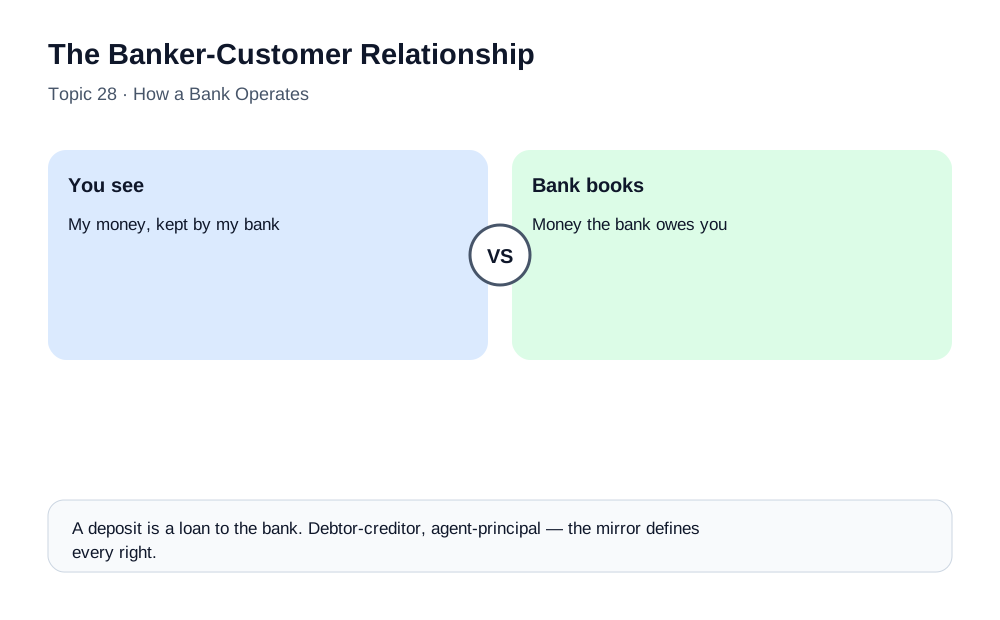
The Banker-Customer Relationship at a glance — Debtor-creditor, agent-principal, legal framework.
1. Introduction: More Than a Commercial Arrangement
The relationship between a bank and its customer is not just commercial — it is a legally defined relationship with specific rights, obligations, and protections for both parties. Understanding this legal framework is essential for anyone working in banking or using banking services.
Most people who hold a bank account have only a vague sense of what, legally, the account is. They speak of "my money in the bank," imagine a vault with their notes stacked inside, and assume the bank is a kind of warehouse for cash. Almost every element of that picture is legally wrong — and the corrections matter. They determine who bears the loss when a bank fails, who is liable when a fraudster strikes, when a bank may freeze your account, and what you can demand when things go wrong. Entire court systems have spent two centuries refining the answers.
This chapter lays out the legal architecture of the banker-customer relationship from first principles: the surprising nature of a deposit, the several distinct legal roles a bank can occupy, the duties each side owes the other, the special rules that govern payments, and the remedies available when the relationship breaks down — ending with how digital banking is reshaping all of it.
Learning objectives. By the end of this chapter you should be able to:
- Explain why a bank deposit legally creates a debtor-creditor relationship, not custody of your money
- Distinguish the bank's four legal roles: debtor, agent, bailee, and trustee
- Describe the bank's core obligations — honouring payments, secrecy, good faith, care — and their limits
- Describe the customer's obligations and the consequences of neglecting them
- Explain wrongful dishonour, set-off, and the allocation of fraud losses
- Navigate the grievance hierarchy from internal complaint to ombudsman to court
2. First Principles: The Deposit Is a Loan to the Bank
Start with the fact that surprises everyone: when you deposit money, the money becomes the bank's. Not metaphorically — legally. The cash you hand over the counter becomes the bank's property, to lend, invest, or hold as it sees fit, and what you receive in return is not custody but a promise: the bank's obligation to repay you an equivalent amount on demand or at the agreed time.
The landmark authority is a nineteenth-century English case, Foley v Hill (1848), which settled the question decisively: money paid into a bank is money lent to the bank; the banker may use it as his own; the relationship is that of debtor and creditor, nothing more. Every modern banking system descends from this holding.
Why did the law choose this seemingly customer-unfriendly design? Because the alternative makes banking impossible. If deposits remained the customer's property held in custody (a bailment, like goods in a warehouse), the bank could not lawfully lend them — every loan would be conversion of someone else's property. The entire business of banking, and the money-creation mechanics of Topics 12 and 26, rests on deposits being the bank's own funds to deploy. The customer trades ownership for something more useful: an unconditional, liquid claim that can be spent by cheque, card, or transfer as though it were cash.
Why do customers accept this trade, generation after generation? Because the alternative — holding wealth as physical cash — is worse on every axis that matters: cash is stolen, burns, earns nothing, and cannot be sent. The deposit converts a vulnerable physical object into a liquid legal claim, spendable worldwide and (within insurance limits) protected against even the bank's failure. The entire edifice of Topic 14's safety nets exists to keep that claim credible; when the credibility holds, nobody thinks about the legal nature of the deposit at all, which is exactly the design goal.
The trade has a price, and honesty requires naming it: as a creditor, you rank among the bank's unsecured claimants if it fails. This is precisely the gap deposit insurance (Topic 14) was created to fill — converting an ordinary credit claim into a protected one, up to the insured limit. The legal nature of the deposit explains why such insurance was necessary in the first place.
3. The Core Legal Relationships
Banking law recognizes that "the banker-customer relationship" is actually several relationships, depending on the transaction. Each carries its own duties.
1. Debtor-Creditor
When you deposit money in a bank:
- The bank becomes a debtor (it owes you money)
- You become a creditor (the bank owes you)
- The money becomes the bank's property — you have a right to demand it back, but it is no longer "your money" in a physical sense
- This is fundamentally different from leaving goods with a warehouse (which is a bailment)
When the bank lends you money:
- The relationship reverses — you become the debtor, the bank the creditor
Note the practical consequences that flow from creditor status. The bank owes you a debt, not the identical notes you deposited — you cannot demand "your" currency back. The debt is repayable according to the account's terms: on demand for a current or savings account, at maturity for a fixed deposit. And because it is a debt, the bank's obligation is generally triggered by your demand — a point with surprising legal bite, since limitation periods for suing on a deposit typically run from demand, not from deposit.
2. Agent-Principal
In some transactions, the bank acts as your agent:
- Collecting cheques on your behalf
- Executing standing instructions or direct debits
- Managing investments under discretionary authority
- Buying or selling foreign currency per your instructions
As agent, the bank acts for you and must follow your instructions with care, loyalty, and skill. The collecting-banker example shows why the distinction matters: when you pay in a cheque drawn on another bank, your bank does not owe you the money yet — it acts as your agent to collect it, which is why a deposited cheque can be returned unpaid days later. Agency law, not debtor-creditor law, governs what happens in between.
3. Bailee-Bailor
When you use a bank's safe deposit locker:
- The bank is the bailee (custodian of your property)
- You are the bailor (owner of the goods)
- The bank must exercise reasonable care but the contents remain yours
Here the warehouse intuition is correct: the locker contents remain your property, the bank never owns them, and its duty is the bailee's duty of reasonable care over the custody arrangement. Two practical notes: the bank generally does not know — and does not insure — the contents, so high-value items may need separate insurance; and access regimes (dual keys, nomination, death of the holder) are governed by the custody agreement and local law, not by account terms.
A fifth arrangement deserves mention because it is so common: the joint account and the mandate. When two or more people hold an account, the mandate — the document specifying who may sign, singly or jointly — becomes the bank's rulebook for whose instructions it must obey. Most household and business disputes that reach complaint desks trace to mandates: a spouse assuming either may sign alone when both must, a company's resolution never updated after a director departs. The lesson for customers and bankers alike is that the mandate is not paperwork; it is the operating system of the relationship.
4. Trustee-Beneficiary
In some cases, the bank holds assets in trust:
- Trust accounts for minors
- Escrow accounts where funds are held for a specific purpose
- The bank must act in the beneficiary's interest
Trusteeship is the most demanding role: the trustee must act loyally in the beneficiary's interest, keep trust property separate, and may not profit from the position. Escrow accounts — funds held against a defined event, like a property purchase or a court order — are the everyday example: the bank may release the money only on the agreed conditions, to the agreed party. When a bank acts as trustee, its normal freedom as a debtor disappears; the funds are not its own to use.
4. Special Rules of the Debtor-Creditor Relationship
Because the deposit relationship dominates retail banking, law and practice have evolved special rules around it. Four are worth knowing.
The bank's duty to honour payment instructions is bounded. The bank must honour your cheques and payment orders — but only while sufficient cleared funds (or an agreed overdraft) cover them, only within banking hours and channel rules, and only when no legal restraint (a court order, a freeze, a garnishee order) intervenes. A court order attaching your account overrides your instruction entirely; the bank must obey the court, not you.
Set-off: the bank's right to net your accounts. If you hold a savings account in credit and a loan in arrears at the same bank, the bank may in many jurisdictions combine the accounts — applying your credit balance against your debt. This right of set-off (or "combination of accounts") is a powerful, often contractual, remedy that customers discover with surprise. Its mirror image: you generally cannot insist the bank treat your accounts as one when it suits you and separate when it suits the bank.
Appropriation of payments. When a customer owes several debts and makes a payment, who decides which debt it reduces? The default rule, descending from the old common-law rule in Clayton's case, lets the payer appropriate the payment; failing that, the payee may; failing both, debts are discharged in chronological order. The rule sounds arcane until an overdraft dispute or a fraud claim turns on exactly which debit a deposit covered.
The passbook and statement are evidence, not conclusive proof. Statements create a record both sides rely on, and customers who ignore them for years may face practical difficulty contesting old errors — another reason the customer's duty of prompt notification, below, has real teeth.
5. Bank's Obligations to the Customer
| Obligation | Description |
|---|---|
| Honor cheques | Pay when sufficient funds are available |
| Maintain secrecy | Not disclose customer information without consent or legal requirement |
| Act in good faith | Fair dealing in all transactions |
| Follow instructions | Execute customer commands accurately |
| Provide statements | Regular account statements showing all transactions |
| Reasonable care | Protect customer assets and information |
The duty to honour cheques and instructions deserves one clarification: it is a duty to honour valid instructions within the account's terms. The bank must pay your properly drawn cheque when funds suffice — and must refuse instructions that exceed the mandate, breach legal restraints, or fail its verification. Both the honour and the refusal are the same duty: faithful execution of the bargain as legally defined.
The Duty of Secrecy
Banks must keep customer information confidential. Exceptions include:
- Court orders or legal compulsion
- Statutory requirements (tax reporting, AML regulations)
- Customer consent
- Bank's own interest (e.g., to recover a debt through legal action)
- Public duty (e.g., reporting suspected criminal activity)
The secrecy duty has a celebrated legal pedigree — the English case Tournier v National Provincial and Union Bank (1924) articulated it and its exceptions — and a modern tension. On one side stands the customer's legitimate expectation of financial privacy, once so absolute in some jurisdictions that it defined private banking. On the other stands the modern state's demand that banks act as surveillance partners: reporting cross-border tax information under automatic-exchange regimes, filing suspicious transaction reports under anti-money-laundering law, and freezing funds on sanctions lists — often without telling the customer, since tipping off is itself an offence.
The resolution, in law, is that the exceptions have swallowed much of the rule: secrecy protects the customer from gossip, casual disclosure, and commercial exploitation of their data, but not from lawful compulsion. For banking professionals the operational lesson is strict: disclose customer information only within the four corners of a recognized exception, document the basis, and never let convenience masquerade as consent. Data-protection law now layers a second, independent regime on top — governing how banks collect, use, retain, and secure personal data even where traditional banking secrecy does not apply.
6. Customer's Obligations to the Bank
- Act with reasonable care — Protect cheque books, passwords, PINs
- Notify promptly — Report unauthorized transactions, lost cards, or address changes
- Repay debts — Honor loan agreements and credit obligations
- Provide accurate information — KYC documents, income declarations
Each obligation corresponds to a risk the customer is best placed to control, and each has teeth.
Reasonable care is the customer's contribution to fraud prevention. A customer who writes a PIN on a card, shares one-time passwords, or signs blank cheques has weakened the very controls whose failure they would later blame on the bank — and as Section 8 shows, negligence is the pivot on which fraud liability turns.
Prompt notification protects both sides: the sooner a lost card or a rogue transaction is reported, the smaller the loss and the clearer the evidence. Delay is not just risky; in many jurisdictions it shifts loss allocation against the customer after notice should have been given.
Accurate information underpins the entire KYC edifice of Topic 27's middle office: false identity, income, or address information does not merely breach the contract — it can make the customer a party to money-laundering offences.
Repayment needs no elaboration, but one nuance does: loan agreements impose obligations beyond paying on time — maintaining insurance on collateral, notifying financial deterioration, not disposing of secured assets. "I paid every instalment" is not always "I honoured the agreement."
7. The Relationship in the Digital Age
Digital banking has not rewritten the legal relationships — your app balance is still a debt the bank owes you — but it has transformed how duties are performed and where disputes arise.
Instructions now arrive as data. A tap, an OTP, a biometric: these are your mandate to the bank, legally equivalent to a signed instruction. The consequence is that credential security is now signature security — the duty of reasonable care has migrated from the cheque book to the phone.
Fraud liability is the new frontier. When a fraudster drains an account, who pays? The emerging global pattern, though details vary by jurisdiction, allocates losses by fault: the bank bears losses from system failures and transactions the customer did not authorize and could not have prevented; the customer bears losses flowing from their own negligence — sharing OTPs, ignoring warnings, falling for social engineering that the rules say they should have resisted. Zero-liability policies for promptly reported card fraud, and their limits, are now standard consumer protection fare. The hardest cases — the customer tricked into personally authorizing a payment to a fraudster — are the current battleground of regulation, with several jurisdictions moving toward mandatory reimbursement regimes.
Always-on service meets always-on duty. Instant payments execute in seconds and are often irrevocable; the bank's duty to follow instructions collides with its duty of care when the instruction is insane-but-authorized. Expect "confirmation of payee" checks, cooling-off friction for first-time payees, and scam warnings to grow: they are the law's attempt to restore, in milliseconds, the judgment a human teller once supplied.
The grievance chain is digital too — but its legal structure, below, is unchanged.
8. When Things Go Wrong
Wrongful Dishonor
If a bank refuses to pay a valid cheque when sufficient funds exist, the customer can claim damages — including damage to reputation and credit standing.
The law treats wrongful dishonour seriously because a bounced cheque is not merely an inconvenience: it announces to the world that the customer's credit is bad. For business customers especially, courts have traditionally presumed reputational damage without requiring detailed proof — the dishonour is the injury. The bank's defences are the boundaries of Section 4: insufficient cleared funds, a legal restraint on the account, a stale or irregular instrument, or a payment that would breach its compliance duties.
Unauthorized Transactions
Banks are generally liable for unauthorized transactions unless the customer was negligent (e.g., sharing their PIN). Digital banking regulations increasingly protect consumers from fraudulent transactions.
The operative word is unauthorized: a transaction the customer did not mandate at all. Here the bank must prove its systems were sound and typically bears the loss, subject to the customer's prompt reporting. Where the customer authorized the transaction — even under a fraudster's deception — the older rule left the loss with the customer; newer consumer-protection regimes are progressively softening that outcome. Two duties of the customer decide most real cases: how carefully they guarded their credentials, and how fast they reported.
A brief illustration shows how the doctrines interact in real disputes. A small business discovers its account debited for a cheque it never signed. The bank invokes the customer's duty of care; the customer points to a signature verification failure — the bank's duty of care. The resolution turns on evidence each side's obligations required them to keep: the customer's prompt-reporting timeline, the bank's verification logs. Months later the same business, now in arrears on a term loan, watches the bank apply set-off against the recovered funds. Every doctrine in this chapter — care, notification, unauthorized transactions, set-off — appeared in one ordinary commercial life.
Garnishee and Freezing Orders
A special "things going wrong" that is nobody's fault at the bank: a creditor of the customer obtains a court order attaching the account balance (a garnishee order in many common-law systems), or authorities freeze the account in an investigation. The bank must comply with the order over the customer's instructions — and usually may not tip the customer off in advance in investigative cases. From the customer's side, the lesson is that the account is a claim against the bank that the law can reach; from the banker's side, that court orders outrank mandates, always.
Grievance Redressal
Modern banking systems provide multiple layers of complaint resolution:
- Bank's internal complaint mechanism
- Banking ombudsman — An independent authority that resolves disputes
- Courts — Legal action as a last resort
The architecture is deliberate. The internal mechanism resolves most issues fastest and is usually a mandatory first step — regulators require banks to maintain complaint desks with defined turnaround times and escalation paths. The ombudsman provides free, informal, binding-or-nearly-binding adjudication for retail customers — no lawyers needed, no court fees — with jurisdiction typically capped by claim size. The courts remain for large, complex, or precedent-setting disputes. The practical wisdom: document everything, escalate in writing, observe each tier's timelines, and treat the ombudsman as the designed destination for ordinary grievances — that is what it exists for.
9. Common Misconceptions About the Banker-Customer Relationship
"The money in my account is stored for me." It is owed to you, not stored — the bank owns the funds and owes you a debt. This single correction re-frames deposit insurance, bank failure, and set-off correctly.
"A deposited cheque is my money immediately." Until it clears, your bank is your collecting agent, not your debtor for that amount — which is why cheques bounce back out of your account days after deposit.
"Bank secrecy is absolute." It was never absolute (the exceptions are a century old) and is now heavily qualified by tax-transparency and AML law. Secrecy protects you from the bank's indiscretion, not from lawful compulsion.
"If I'm scammed, the bank always pays." Liability follows authorization and fault. Fraud you neither authorized nor enabled is generally the bank's loss; fraud you authorized under deception, or enabled by sharing credentials, is increasingly shared or yours — though consumer-protection rules are shifting this frontier steadily toward reimbursement.
"Verbal instructions are enough at my branch." Familiarity is not a mandate. Banks act on documented, verifiable authority — signatures, registered mandates, authenticated digital credentials — precisely because the duty to follow instructions includes the duty to refuse unverified ones. The branch that 'knows you' and bends the rules is not being friendly; it is failing both its duties at once.
"The bank can't touch my savings for my other debts." Set-off rights often say otherwise: credit balances can be applied against your arrears at the same institution, sometimes without prior notice, depending on the account terms and local law.
"Complaining is pointless." The ombudsman tier exists precisely because it works: free, fast relative to courts, and designed for exactly the disputes retail customers actually have.
10. Frequently Asked Questions
Is my bank deposit really a loan to the bank? Yes — that is the legal core of banking, settled since Foley v Hill (1848). You are the bank's creditor; the funds are the bank's property to use. Deposit insurance exists precisely because creditors can lose money when debtors fail.
Does the debtor-creditor rule differ between account types? The core is constant — every account balance is a debt the bank owes you — but the terms of the debt differ: current and savings balances are repayable on demand; fixed deposits at maturity (early withdrawal by concession, at a penalty); recurring deposits as a schedule of small loans repaid in one sum at the end. When comparing accounts, you are comparing the terms on which the bank borrows from you.
Can a bank refuse to let me withdraw my own money? Within account terms and law, yes: fixed deposits lock funds until maturity; large cash withdrawals may require notice; court orders and freezes override everything; and compliance holds can delay transactions. A demand deposit is repayable on demand — but "demand" operates through channels, limits, and law.
What is the difference between the bank as debtor and as agent? As debtor, the bank owes you money and acts for itself. As agent — collecting a cheque, executing a standing instruction, managing investments — it acts for you, owing duties of care and loyalty, and the assets or claims involved are not its own debts to you.
When may a bank legally disclose my information? Under legal compulsion (court orders, statutory tax and AML reporting), with your consent, in its own legitimate interest (such as suing to recover your debt), and in the public duty of reporting suspected crime. Anything outside these requires strict justification.
The bank bounced my cheque even though I had funds — what can I do? That is wrongful dishonour: demand correction and an explanation in writing, and you may claim damages — including for injury to credit and reputation, which law presumes rather than requiring you to prove in detail. Escalate through the complaint tiers if unresolved.
What happens to the banker-customer relationship when the customer dies? The mandate ends with the customer: the bank may no longer honour their instructions, and the balance becomes payable to the estate — through the nominee where nomination exists, or through succession documents (probate, succession certificate, or their local equivalents) where it does not. Nomination is a payment convenience, not ownership: the nominee receives funds as a trustee-like conduit for the legal heirs. Families spare themselves months of friction by keeping nominations current.
A fraudster took money from my account — who bears the loss? If you neither authorized nor enabled it, generally the bank — provided you report promptly. If you shared credentials or authorized the payment under deception, allocation depends on your jurisdiction's rules, which are moving toward greater customer protection but still penalize clear negligence. Report immediately; speed shifts outcomes.
Can the bank use my savings to pay my overdue loan? Often yes, through set-off or combination of accounts, where the account terms and local law allow it. It is one of the least-known and most-feared rights in retail banking — read your account agreement's set-off clause before you need it.
What is an escrow account, legally? Trust territory: the bank holds funds as a neutral custodian, releasable only on defined conditions to defined parties. Unlike your ordinary balance, escrowed funds are not the bank's to use and not simply yours to withdraw — the conditions rule.
Do I need a lawyer to use the banking ombudsman? No — that is the point. The ombudsman is free, informal, and designed for unrepresented retail customers, typically after the bank's internal complaint process has run its course. Bring documents, not counsel.
Does the bank have to tell me if my account is frozen? For court attachment orders, generally yes at or after the event. For AML investigations and suspicious-transaction reporting, usually no — "tipping off" prohibitions legally bar the bank from revealing the report or investigation. Silence, frustratingly, can be legally compelled.
11. Key Terms in This Chapter
- Debtor-creditor relationship — the deposit as a loan to the bank; the foundation of banking law (Foley v Hill).
- Bailment / bailee-bailor — custody of goods without transfer of ownership; the safe deposit locker relationship.
- Agency — the bank acting for the customer: collections, standing instructions, discretionary management.
- Trustee-beneficiary — the bank holding assets loyally for another's benefit: trusts and escrow.
- Wrongful dishonour — refusing a valid payment instruction despite sufficient funds; damages include reputation.
- Duty of secrecy — the bank's confidentiality obligation and its five recognized exceptions (Tournier).
- Set-off / combination of accounts — the bank's right to net a customer's credit balances against their debts.
- Appropriation of payments — the rules deciding which debt a payment discharges (the Clayton's case lineage).
- Garnishee order — a court order attaching the customer's balance at the bank to satisfy the customer's creditor.
- Tipping off — the prohibited act of revealing an AML report or investigation to the customer.
- Banking ombudsman — the independent, free dispute-resolution authority between the bank and the courts.
- Negligence (customer) — careless credential or instrument handling that shifts fraud losses toward the customer.
- Escrow — conditional, purpose-bound custody of funds by a neutral holder.
- Mandate — the customer's authorization defining how the bank may act on the account.
- Nomination — a deposit-account facility directing payment at death to a named person as conduit for the heirs.
- Authorized push payment (APP) fraud — loss where the customer personally authorizes a payment to a fraudster; the regulatory frontier of liability.
12. Interview Insights: How This Topic Appears in Banking Interviews
"Explain the legal nature of a bank deposit." The Foley v Hill answer: a loan to the bank creating debtor-creditor relations — the bank owns the funds and owes a repayable debt. Then show you understand the stakes: this is why deposit insurance exists, why customers rank as creditors in a failure, and why lending is lawful at all.
"A customer's cheque was wrongly dishonoured. What follows?" Damages — and crucially, reputational damage is presumed for traders and businesses without elaborate proof, because dishonour is a public statement of bad credit. Add the bank's valid defences (insufficient cleared funds, legal restraint, irregular instrument, compliance duty) to show both sides.
"When can a bank break customer confidentiality?" Recite the Tournier exceptions cleanly — compulsion of law, public duty, bank's own interest, customer consent — then modernize: automatic tax information exchange, suspicious-transaction reporting with tipping-off prohibitions, and data-protection law as a second regime. The arc from absolute secrecy to regulated transparency is the impressive answer.
"Who bears the loss in digital fraud?" Show the fault-based framework: unauthorized transactions the customer couldn't prevent — the bank; transactions enabled by the customer's negligence — the customer, subject to jurisdiction; authorized-but-deceived payments — the contested frontier where reimbursement regimes are emerging. Note prompt reporting as the customer's decisive duty.
"What practical rights does a customer have when service fails?" Sequence them: the contractual right to accurate execution and correction; the regulatory right to complaint handling within defined timelines; the ombudsman's free adjudication; and the court's remedies for breach — damages for wrongful dishonour being the classic case. The answer that names the tiers in order, and notes that each tier's existence disciplines the one below, shows institutional understanding rather than grievance.
"How is a locker different from an account?" Bailment versus debt: locker contents remain the customer's property in the bank's custody (duty of reasonable care, contents unknown and uninsured by the bank), while an account balance is the bank's property-equivalent — a debt owed. One relationship is custody; the other is credit. Candidates who conflate them reveal they never learned the first principle.
Summary and Key Takeaways
The banker-customer relationship is a bundle of precise legal roles, not a vague commercial tie. The essential points:
- A deposit is a loan to the bank: debtor-creditor since Foley v Hill — the bank owns the funds and owes you a repayable debt. Deposit insurance exists because of this, not despite it.
- The bank wears four legal hats: debtor on deposits, agent on collections and instructions, bailee on lockers, trustee on escrow and trust accounts — each with different duties.
- The bank's core obligations are honouring valid instructions, secrecy, good faith, accurate execution, statements, and reasonable care — each bounded by law and account terms.
- Secrecy is real but qualified: the Tournier exceptions plus modern tax and AML transparency mean privacy protects against indiscretion, not lawful compulsion.
- The customer owes duties too: care with credentials, prompt notification, accurate information, and honouring obligations — and neglecting them shifts losses and weakens claims.
- Wrongful dishonour is a serious wrong: damages include presumed reputational injury; the bank's defences are the legal boundaries of its payment duty.
- Fraud liability follows authorization and fault: the digital age has moved the battlefield to credential care, reporting speed, and the authorized-push-payment frontier.
- Court orders outrank customer mandates: garnishee and freezing orders bind the bank first — and tipping-off rules may legally silence it.
- Redress is tiered by design: internal complaints, then the free ombudsman, then the courts — escalating in writing, with documents, is the winning practice.
- The mandate is the operating system: whose instructions the bank must obey — on joint, business, and digital accounts alike — is set by the mandate and verification rules; most real disputes are mandate disputes in disguise.
A closing perspective ties the chapter together. Every banking product in the rest of this series — every account, loan, locker, and payment — is, in law, a particular configuration of the relationships you now know: debtor-creditor here, agency there, bailment or trust when custody calls for it. Read the product brochures through this legal lens and the fine print stops being fine print: it becomes the visible machinery of duties running both ways.
In the next topic, we turn from the customer's legal position to the bank's own report card — reading bank financial statements: how to interpret the income statement, balance sheet, and ratios through which a bank's health becomes visible to outsiders.
Next: Topic 29 — Reading Bank Financial Statements →
<!-- MBA-DEEP-DIVE-START -->Deep Dive: The Banker-Customer Relationship as a Network of Legal and Operational Duties
The banker-customer relationship is often introduced as debtor and creditor: when a customer deposits money, the bank owes the customer that amount. This is fundamental, but real banking relationships contain several legal roles at the same time. A bank can be debtor, creditor, agent, bailee, trustee or fiduciary in limited contexts, payment-service provider, custodian, lender, data controller or processor, and contractual counterparty depending on the product and jurisdiction.
The most important practical principle is that the legal relationship changes with the service being performed. A current account is not governed by exactly the same duties as a safe-deposit facility, investment mandate, loan, card, trust service, or securities custody arrangement. Bankers and analysts therefore need to identify the legal character of each product rather than applying one generic ‘bank-customer relationship’ rule to everything.
Because banking law varies across countries, the exact rights discussed here must always be read with the applicable contract, statute, regulation, case law, payment-scheme rules, and consumer-protection framework. The concepts are broadly useful; the legal outcome can be jurisdiction-specific.
Deposits create a debt owed by the bank
When money is deposited into an ordinary bank account, the specific banknotes do not remain the customer’s property in a labelled vault. The bank becomes owner of the funds and owes the customer an equivalent amount under the account contract, subject to applicable withdrawal, payment, hold, legal-order, and product rules.
This explains why an account balance appears as a liability of the bank. The bank is the debtor; the customer is the creditor.
The position reverses when the bank lends to the customer. The loan is an asset of the bank and a liability of the customer. A customer can therefore be both creditor and debtor of the same bank at the same time: holding a deposit while owing a mortgage or overdraft.
The bank as payment agent
When a customer instructs the bank to make a payment, the bank acts under the authority created by the account contract and applicable payment law. The instruction may authorise the bank to debit the account and transmit value through a payment system or correspondent chain.
The bank’s duty is not simply to ‘send money’. It must validate authority, account status, funds or credit availability, mandatory data, limits, fraud indicators, and legal restrictions. It must then execute according to the agreed service and scheme rules.
A payment can be delayed or refused for legitimate reasons: insufficient funds, invalid data, fraud suspicion, sanctions obligations, legal restraint, account restriction, expired mandate, or a scheme-specific rule. The bank should be able to explain the reason where law and security permit.
Authority to operate an account
One of the most important operational duties is knowing who is authorised to give instructions.
For an individual account, authority may rest with the account holder, an authorised attorney, guardian, executor, or another legally recognised representative. For a corporate account, authority may derive from board resolutions, mandates, powers of attorney, signing rules, or digital-entitlement structures.
A corporate mandate might require any two directors to sign, or one treasury user to create a payment and another to approve it. The bank must convert legal authority into operational entitlements accurately.
A system error that gives one user unilateral authority when the mandate requires dual approval is not merely a technical defect; it changes who can legally move the customer’s money.
Mandates must stay current
Authority changes over time. Employees leave. Directors change. A power of attorney is revoked. A person loses capacity. A company restructures. A joint account holder dies.
Banks therefore need processes for mandate maintenance, effective dating, verification, and audit. Static data that was correct at onboarding can become wrong later.
High-risk changes should receive enhanced verification. A fraudster who compromises email may ask the bank to change authorised signers or beneficiary details before initiating a payment. The bank should not treat a mandate change as routine data maintenance when it changes control over funds.
Joint accounts are contractual relationships, not just shared balances
Joint accounts can operate under different mandates: either-to-sign, both-to-sign, survivor arrangements, or other permitted combinations. The precise terms matter when one holder dies, becomes incapacitated, disputes a transaction, or instructs the bank to stop operation.
If one joint holder reports a dispute, continuing to process instructions under the normal mandate may expose the bank to risk. Many institutions have procedures to restrict operations until the dispute is resolved or all required parties agree.
The lesson for system design is that ‘joint account’ cannot be one boolean field. The product needs explicit operating rules, signature conditions, survivorship treatment, and exception handling.
Duty of confidentiality and its limits
Banks hold exceptionally sensitive information: balances, payments, debts, income, investments, counterparties, addresses, identity records, and family details. Confidentiality is therefore central to trust.
But confidentiality is not absolute. Banks may be required or permitted to disclose information under law, court orders, tax-reporting frameworks, AML obligations, regulatory supervision, credit reporting, or customer consent. The exact grounds vary by jurisdiction.
A strong bank follows the principle of purpose and minimum necessary disclosure. Information should be shared only with authorised recipients and only to the extent required.
Operationally, this means access controls matter inside the bank too. An employee does not gain legitimate access to a celebrity’s or colleague’s account merely because they work for the bank. ‘Need to know’ is a control principle, not a courtesy.
Data privacy in digital banking
Modern banking expands confidentiality into data-governance questions. Apps collect device information, behavioural signals, cookies, location data, transaction patterns, and sometimes data from external sources.
Banks should know which data they collect, why they collect it, the legal basis, how long it is retained, who receives it, and whether customers have rights to access, correction, deletion, objection, or portability under applicable law.
Consent should not be used as a universal substitute for proper legal analysis. Some processing is necessary to perform a contract or meet legal obligations. Other processing may require consent. The design should distinguish them.
The bank’s right of set-off
In many legal systems and subject to contract and law, a bank may have rights to combine or set off certain balances owed between bank and customer. The exact conditions matter: accounts may need to be held in the same legal capacity, debts may need to be due, and specific products or protected funds may be excluded.
A bank should never automate set-off based only on matching customer IDs without legal rules.
For example, a company may hold one account as trustee for another party and owe a separate corporate loan. The beneficial ownership and capacity differ. Treating both balances as freely interchangeable could be unlawful.
Set-off logic therefore requires legal-entity, ownership, capacity, currency, product, and jurisdictional data, not merely arithmetic.
Banker's lien and security interests
Banks may have contractual or legal rights over certain property or securities held in connection with obligations, but the nature and extent of a banker’s lien or similar right varies by jurisdiction and product.
This should be distinguished from a specific security interest created by contract: mortgage, pledge, charge, assignment, or collateral arrangement. Security is enforceable only if properly created and perfected according to law.
Operational teams must know what assets are actually pledged. A customer holding securities in custody does not automatically mean the bank can liquidate them against an unrelated debt.
Legal orders and account restrictions
Courts, tax authorities, enforcement agencies, or other authorised bodies may issue orders requiring the bank to freeze, attach, garnish, disclose, or transfer funds, depending on local law.
These events require precise handling. The bank must identify the correct customer and account, interpret the scope and amount, apply the restriction at the right time, preserve an audit trail, and avoid tipping off the customer where prohibited.
Over-freezing can harm a customer. Under-freezing can breach law. Systems should therefore support partial holds, legal case references, start and end dates, reason codes, and controlled release.
Death and incapacity
When an individual customer dies, the bank’s normal authority framework changes. Existing powers of attorney may cease or change effect depending on law. Executors, administrators, nominees, survivors, trustees, or heirs may have different rights.
The bank should not simply hand money to the person who presents a death certificate first.
Operational processes need to verify death, identify legal authority, review account type, loans, securities, safe custody, standing instructions, joint holders, nominations, and liabilities. Payments scheduled before death may require different treatment from new instructions afterward.
Incapacity raises related questions. A customer may lose the ability to manage finances while still alive. Valid guardianship, power-of-attorney, or court-appointed arrangements need to be recognised without exposing the customer to abuse.
Vulnerable customers and undue influence
Banks increasingly need to identify customers who may be vulnerable because of age, disability, illness, language difficulty, cognitive decline, bereavement, financial distress, or dependence on another person.
Vulnerability does not remove autonomy. The objective is to provide additional support and detect exploitation without treating the customer as incapable merely because they need assistance.
Warning signs can include an elderly customer suddenly adding a new joint holder, large transfers to a caregiver, repeated unexplained cash withdrawals, or a relative speaking for the customer and preventing direct communication.
Staff need escalation paths for suspected financial abuse while respecting privacy and applicable law.
Unauthorised transactions
Digital banking has made the allocation of responsibility for unauthorised transactions a major issue. A customer may claim a transfer was not authorised. The bank must investigate authentication evidence, device history, login behaviour, beneficiary creation, transaction timing, fraud alerts, customer communications, and any applicable liability rules.
A transaction authenticated with the correct OTP is not automatically proof that the customer knowingly authorised it. Social engineering can cause customers to reveal credentials or approve transactions they misunderstand.
Fraud investigation therefore needs both technical evidence and behavioural context.
The outcome may depend on whether the bank followed required authentication and fraud controls, whether the customer acted fraudulently or with gross negligence where that concept exists, and what consumer-protection rules prescribe.
Errors versus fraud
Not every disputed transaction is fraud. A bank can post the same debit twice, apply the wrong exchange rate, fail to reverse a card hold, send a transfer to the wrong beneficiary because of internal data corruption, or miscalculate interest.
Operational error should be handled as such. Labeling every dispute ‘fraud’ can send the customer into the wrong process and delay correction.
Banks need clear classification between customer-authorised transaction disputes, merchant disputes, payment execution errors, fraud claims, fee complaints, and data errors.
Terms and conditions are part of the product
Banking product design often focuses on screens and workflows while legal teams receive terms at the end. This is backwards. Terms and conditions define account operation, fees, interest, notice periods, rights of closure, liability, dispute handling, governing law, communication, and other core behaviour.
A digital interface should reflect the contract accurately. If the contract requires thirty days’ notice for a change, the release process must respect it. If a product permits only certain withdrawals, the channel should enforce those rules rather than relying on customers to read them.
The contract and system should describe the same product.
Fair treatment and product governance
A bank may be legally entitled to charge a fee yet still create conduct risk if the fee is hidden, confusing, or applied in circumstances customers could not reasonably understand.
Product governance should ask who the target customer is, what need the product solves, what risks it creates, how pricing works, what disclosures are necessary, what customers might misunderstand, and how complaints will be monitored.
Complaint data is a valuable control signal. Repeated complaints about the same fee or process can reveal poor design even when every individual case was handled according to policy.
Account closure
Customers may close accounts voluntarily, or the bank may decide to exit a relationship subject to contract and law. Closure is more complex than setting a status to ‘closed’.
The bank must settle outstanding fees, interest, cheques, card transactions, pending payments, holds, loans, safe-custody items, and legal restrictions. It must return remaining funds appropriately and retain required records.
For financial-crime exits, communication may be restricted to avoid prohibited disclosure. Operations therefore need specific reason-code handling and scripts approved by legal and compliance.
Customer versus beneficial owner
The named account holder is not always the person who ultimately owns or controls the money.
A company account is held by a legal entity but controlled by individuals. A trust account may be operated by trustees for beneficiaries. An intermediary may hold client money. A partnership has partners and authorised signers.
KYC and mandate data must distinguish customer, beneficial owner, controller, authorised user, beneficiary, and related party. Collapsing these roles into one ‘party’ field creates major compliance and legal risk.
Digital channels change evidence, not legal principles
Historically, banks relied on signatures and paper instructions. Digital banking uses passwords, biometrics, cryptographic keys, device binding, multi-factor authentication, and electronic consent.
The legal question remains the same: did the person have authority, and can the bank prove that the instruction was validly authenticated according to the applicable framework?
Audit evidence therefore becomes critical. The bank should be able to reconstruct who logged in, from which device, what data they saw, what they approved, what authentication was used, and what system response was returned.
A corporate payment mandate example
A company instructs its bank that payments above ₹50 lakh require two authorised users from different roles. User A creates a ₹75 lakh supplier payment. User B approves it.
The bank’s system should validate both users against the current mandate, ensure neither approval is expired or revoked, apply transaction limits, screen the payment as required, and retain evidence of both actions.
If User B leaves the company and the bank receives a valid mandate change removing them, future approvals should fail immediately from the effective date. If an old cached entitlement still works, the bank has breached the customer’s authority model.
This example shows why banker-customer law translates directly into identity and access management.
A customer death example
An individual customer dies with a savings account, fixed deposit, mortgage, and standing instruction paying insurance premiums. The bank receives formal notification.
The process needs to flag the customer record, restrict or review transactions according to applicable law and account terms, identify joint holders or nominees, calculate deposit and loan positions, determine whether insurance or mortgage protection exists, preserve records, and communicate with the legally authorised representative.
The bank must avoid two opposite failures: allowing unauthorised post-death transactions and unnecessarily blocking legitimate survivor or estate rights.
What excellence looks like
A world-class bank knows exactly who its customer is, who owns the funds, who can instruct, what legal capacity each party holds, and how those rights change over time. Its digital entitlements reflect legal mandates. Its confidentiality controls restrict internal as well as external disclosure. Its legal-order processes are precise. Its vulnerable-customer controls support without patronising. Its dispute process distinguishes fraud from operational error. Its terms, systems, and customer communications describe the same reality.
The banker-customer relationship is therefore not an abstract legal chapter. It is encoded every day in account status, entitlements, holds, disclosures, privacy permissions, complaint handling, transaction authentication, and the evidence a bank keeps when something goes wrong.
<!-- MBA-DEEP-DIVE-END -->