A modern commercial bank is one of the most complex organizational structures in global commerce. Far from being a simple intermediary that collects deposits and lends them out, a bank is a highly integrated, technology-driven machine operating under strict regulatory oversight. To understand a bank is to understand how its internal functional silos—the Front Office, Middle Office, and Back Office—collaborate across complex systems architectures to manufacture liquidity, manage risks, and settle billions of dollars in daily transactions with absolute precision.
This module explores the organizational architecture of modern banking. We will dissect the functional responsibilities of each division, map the end-to-end operational lifecycle of a commercial banking product, evaluate the underlying enterprise technology stack, analyze the matrix of risks and controls, and walk through a sophisticated real-world institutional transaction scenario.
Learning objectives. By the end of this module you should be able to:
- Explain why banks are organized into Front, Middle, and Back Offices — and why regulation demands it
- Map the governance hierarchy from the Board's Risk Appetite Statement to the C-suite's independent control functions
- Trace a corporate loan end-to-end through CRM, LOS, LMS, and the General Ledger, including the accounting entries and payment messages it triggers
- Apply the Three Lines of Defense model and the enterprise risk matrix to concrete situations
- Follow a complex syndicated transaction through funding, settlement, and a live sanctions-compliance incident
- See how the same anatomy looks from the retail customer's side of the counter
One clarification before we begin: this module deliberately uses the lens of a large, internationally active commercial bank, because that is where the anatomy is most fully developed. Smaller institutions — a community bank, a cooperative, a payment bank — run the same logic with fewer layers: one person may wear several of these hats, but the duties being separated are identical. Learn the full anatomy and every smaller variant becomes an exercise in compression rather than a different species.
Visual overview
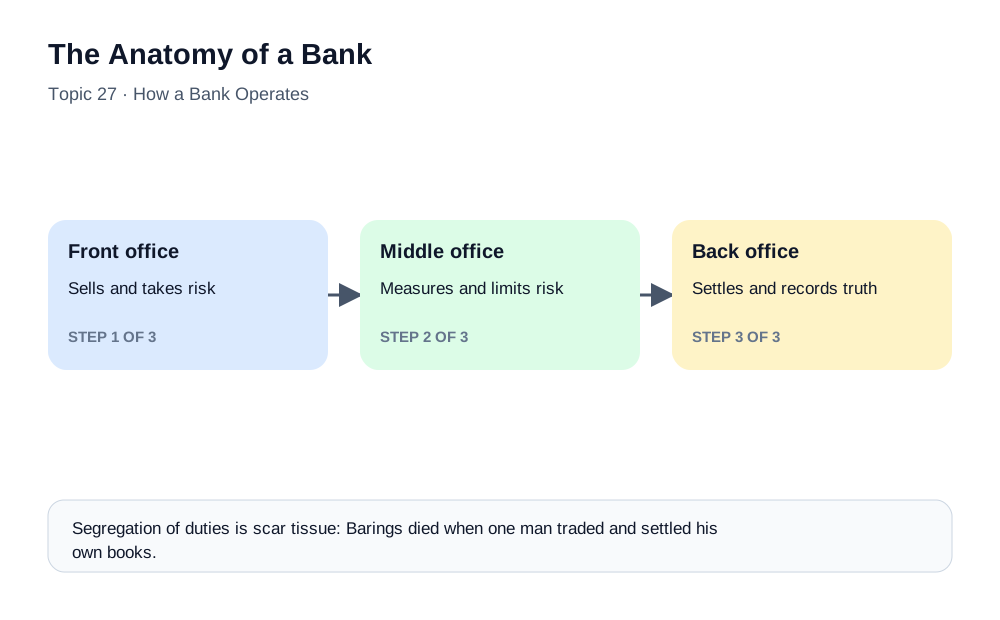
The Anatomy of a Bank at a glance — Front office, middle office, back office.
1. Why Banks Split Into Three Offices: Utility, Duty and Segregation
The structural layout of a bank is defined by its economic utility, fiduciary duties, and the systemic risks it poses to the wider economy. The division of a bank into Front, Middle, and Back offices is not merely an administrative choice; it is a regulatory and structural imperative designed to prevent fraud, ensure accurate valuation, and maintain systemic stability.
The Economic Utility of the Bank
At its core, a bank exists to resolve market frictions:
- Information Asymmetry: Borrowers know more about their financial health than lenders. The bank's credit risk underwriting acts as a specialized screening mechanism to bridge this information gap.
- Maturity Transformation: Depositors require instant liquidity (short-term liabilities), while borrowers require long-term capital (long-term assets). The bank bridges this gap by pooling assets, though this leaves the bank inherently vulnerable to liquidity shocks.
- Liquidity Provision and Settlement: By facilitating payment clearing across domestic and international networks, banks act as the trusted settlement nodes of the global economy.
Structural Segregation of Duties (SoD)
The fundamental organizational principle of a bank is the Segregation of Duties (SoD), rooted in historical lessons of financial collapses and rogue trading (e.g., Barings Bank in 1995, where a single trader controlled both front-office trading and back-office clearing).
The Barings lesson is worth pausing on, because it is the founding parable of the modern bank's structure. A 233-year-old institution — banker to monarchs — was destroyed not by a brilliant fraud but by a simple structural omission: one employee in Singapore was allowed both to execute trades and to confirm and settle them. Able to hide losses in an account he himself controlled, he doubled losing positions until they exceeded the bank's entire capital. Every control in this module — the office split, maker-checker verification, independent reconciliation — exists because some bank, somewhere, learned its necessity the catastrophic way. Organizational structure in banking is scar tissue, codified.
To prevent conflicts of interest and unauthorized risk-taking, global regulations dictate that:
- The Risk-Taking Unit (Front Office) must remain completely separate from the Risk-Measuring Unit (Middle Office).
- The Booking/Verification Unit (Middle/Back Office) must be independent of the Settlement/Execution Unit (Back Office).
- This creates a tripartite structure of checks and balances, ensuring that no single individual can initiate, verify, settle, and account for a financial transaction.
Corporate Governance Hierarchy
The governance of a bank is structured to enforce accountability from the highest fiduciary levels down to the front-line units:
                  ┌───────────────────────────────┐
                  │      Board of Directors       │
                  │  (Audit, Risk, Risk Gov, etc) │
                  └───────────────┬───────────────┘
                                  │ Fiduciary Oversight
                  ┌───────────────▼───────────────┐
                  │    Chief Executive Officer    │
                  │             (CEO)             │
                  └───────────────┬───────────────┘
                                  │ Executive Leadership
       ┌──────────────────────────┼──────────────────────────┐
┌──────▼──────┐            ┌──────▼──────┐            ┌──────▼──────┐
│Front Office │            │Middle Office│            │ Back Office │
│  (Business) │            │ (Control/Risk)           │ (Operations)│
└─────────────┘            └─────────────┘            └─────────────┘
- The Board of Directors: Represents shareholders and depositors. It establishes the bank's Risk Appetite Statement (RAS)—the maximum level of credit, market, and operational risk the bank is willing to assume.
- The Audit Committee: Composed entirely of independent, non-executive directors. It oversees financial reporting accuracy and the internal audit function.
- The Risk Committee: Oversees the implementation of the enterprise risk management (ERM) framework and monitors compliance with capital and liquidity targets.
- The Executive Committee (C-Suite):
- Chief Executive Officer (CEO): Directs overall business strategy and growth.
- Chief Risk Officer (CRO): Manages credit, market, operational, and liquidity risk. The CRO has a direct reporting line to the Board's Risk Committee, bypassing the CEO if necessary, to preserve independence.
- Chief Financial Officer (CFO): Responsible for capital management, financial reporting, corporate tax, and Treasury (Asset-Liability Management).
- Chief Operating Officer (COO) / Chief Information Officer (CIO): Directs the operations, back-office clearing engines, database clusters, and technology infrastructure.
- Chief Compliance Officer (CCO): Manages regulatory relations, anti-money laundering (AML), and financial crime compliance.
2. A $50M Corporate Loan's Journey Through the Bank's Systems
To illustrate how a bank operates as a unified machine, let us trace the lifecycle of a $50,000,000 Corporate Term Loan extended to a multinational enterprise. This operational journey highlights the precise handoffs, messaging standards, and accounting entries triggered at each phase.
Enterprise Systems Architecture Overview
Before examining the workflow, we must define the core systems involved:
- CRM (Customer Relationship Management): Front-office system for client onboarding and pipeline management.
- LOS (Loan Origination System): Middle-office platform for credit analysis, financial spreading, and workflow approval.
- LMS (Loan Management System / Core Banking Core): The core back-office engine that stores the master credit ledger, calculates interest accruals, and holds account balances.
- ALM (Asset-Liability Management) Engine: Middle-office/Treasury system used to monitor interest rate risk and liquidity metrics.
- ERP / General Ledger (GL): The bank's central double-entry bookkeeping ledger.
- RTGS/SWIFT Gateway: The external communication infrastructure for processing high-value interbank wire transfers (utilizing ISO 20022 and SWIFT messaging formats).
End-to-End Operational Workflow
   [FRONT OFFICE]           [MIDDLE OFFICE]            [BACK OFFICE]

   ┌────────────┐           ┌────────────┐            ┌─────────────┐
   │ Client     ├──────────►│ Credit &   ├───────────►│  Operations │
   │ Discovery  │           │ Risk Under-│            │  & Booking  │
   │ & CRM      │           │ writing    │            └──────┬──────┘
   └────────────┘           └────────────┘                   │
                                                             ▼
   ┌────────────┐           ┌────────────┐            ┌─────────────┐
   │ Funds      │◄──────────┤ Compliance │◄───────────┤ Disbursement│
   │ Transferred│           │ & AML/KYC  │            │  & Ledger   │
   └────────────┘           └────────────┘            └─────────────┘
Phase 1: Origination & Relationship Management (Front Office)
- Action: A Relationship Manager (RM) in the Corporate Banking Division identifies a financing opportunity with a blue-chip corporate client requiring a $50M credit facility.
- System Input: The RM registers the deal in the CRM, establishing the indicative terms (interest rate, maturity, covenants, and collateral structure).
- Handoff: The transaction details are pushed from CRM to the Loan Origination System (LOS).
Phase 2: Underwriting, Credit Risk & Compliance (Middle Office)
- Credit Analysis: Credit Underwriters retrieve the client's audited financial statements, perform financial spreading, and calculate key performance indicators (debt service coverage ratio, leverage ratios, and probability of default).
- Compliance & Sanctions Screening: Compliance systems execute automated searches against global watchlists (OFAC, EU, UN, etc.) and perform Know Your Customer (KYC) / Anti-Money Laundering (AML) checks.
- Pricing & Risk-Adjusted Return: Product Controllers evaluate the Risk-Adjusted Return on Capital (RAROC) using the formula below. The logic deserves attention: the numerator is the deal's profit after deducting the losses statistically expected from loans like it, and the denominator is the capital the bank must hold against those risks. RAROC therefore answers the only question that makes loan pricing rational — does this deal pay enough for the capital it consumes and the risk it adds? A deal with a fat interest margin can still destroy value if its expected losses and capital charge are fatter:
$ \text{RAROC} = \frac{\text{Revenues} - \text{Operating Costs} - \text{Expected Loss}}{\text{Economic Capital}} $
- Credit Committee Approval: The Credit Committee reviews the risk profile and formalizes credit approval, generating an immutable approval token within the LOS.
- Handoff: The approved credit file is passed to the Legal Department to draft the Loan Agreement and Collateral Covenants. Once executed, the file is handed to Back Office Operations.
Phase 3: Booking, Verification, & Loan Setup (Back Office)
- Verification: Loan Operations officers verify that the executed loan agreement matches the credit approval parameters in the LOS (maker-checker verification).
- Collateral Registration: Operations registers the bank's lien on the corporate collateral in the central registry system.
- Booking: The loan is booked in the Loan Management System (LMS), setting up the repayment schedules, amortization tables, and interest-accrual frequencies (e.g., SOFR + 150 basis points).
- Handoff: Back Office triggers the disbursement instructions to the central Treasury desk.
Phase 4: Disbursement & Settlement (Back Office / Treasury)
- Funding Strategy: Treasury matches the funding requirements, drawing down $50M from the bank's wholesale funding pool or deposit reserves.
- Payment Initiation: Payment Operations initiates an RTGS transfer to the client's designated bank.
- Messaging Standards:
- The bank uses the ISO 20022 message standard for this transaction.
- It triggers a
pacs.008.001.10(FICreditTransfer) message to move the funds directly to the customer's clearing bank. - It generates a
camt.053.001.10(BankToCustomerStatement) message to update the internal cash accounting structures.
- Accounting Ledger Entries: At the moment of disbursement, the Core Banking General Ledger records the following double-entry bookkeeping impacts:
$\text{Debit: } \text{Corporate Loan Assets (Principal Receivable)} \quad $50,000,000$ $\text{Credit: } \text{Clearing / Nostro Account (Cash Outflow)} \quad $50,000,000$
Phase 5: Servicing & Amortization (Back Office)
- Accrual Generation: Daily, the LMS automatically accrues interest based on the active loan interest rate.
- Accounting Accrual Entry:
$\text{Debit: } \text{Interest Receivable (Asset)} \quad \text{Interest Amount}$ $\text{Credit: } \text{Interest Income (Revenue/P&L)} \quad \text{Interest Amount}$
- Payment Settlement: On payment due dates, the borrower sends a payment. Upon receipt via a incoming
pacs.008message, the Back Office processes the payment:
$\text{Debit: } \text{Clearing / Nostro Account (Cash Inflow)} \quad \text{Payment Amount}$ $\text{Credit: } \text{Interest Receivable (Asset)} \quad \text{Interest Accrued}$ $\text{Credit: } \text{Corporate Loan Assets (Principal Receivable)} \quad \text{Principal Repayment}$
3. The Three Lines of Defence: Controlling Risk Together
Managing a bank is an exercise in risk optimization. The Front, Middle, and Back offices must coordinate to build a robust Three Lines of Defense model that keeps risk exposures within the bank's approved risk appetite.
                  ┌─────────────────────────────────────────┐
                  │           Board / Risk Committee        │
                  └────────────────────┬────────────────────┘
                                       │
         ┌─────────────────────────────┼─────────────────────────────┐
┌────────▼────────┐           ┌────────▼────────┐           ┌────────▼────────┐
│ 1st Line: Biz   │           │ 2nd Line: Risk  │           │ 3rd Line: Audit │
│ Front Office    │           │ Middle Office   │           │ Back Office / IA│
│ Underwriting    │           │ Controls & CRO  │           │ Indep Assurance │
└─────────────────┘           └─────────────────┘           └─────────────────┘
The Three Lines of Defense
- First Line of Defense (Front Office / Business Operations): Owns and directly manages the risk. RMs and branch staff are responsible for identifying risks at source and complying with policies during client onboarding and transaction initiation.
- Second Line of Defense (Middle Office / Risk & Compliance): Establishes risk management frameworks, policies, and limits. They monitor the first line's compliance with limits, perform stress tests, and challenge front-office assumptions.
- Third Line of Defense (Internal Audit): Provides independent, objective assurance to the Board of Directors on the effectiveness of the first and second lines of defense.
Two properties make the model work in practice. First, independence is architectural, not personal: the second line's pay, promotion, and reporting lines must not depend on the business it polices — which is why the CRO reports to the Board's Risk Committee rather than solely to the CEO. Second, the first line owns the risk: a common failure pattern is business units treating Risk as the department responsible for risk. The model's point is the opposite — the RM who sells the loan owns its consequences; the second line challenges and constrains, the third line assures, but neither can substitute for judgment at the source.
Advanced Enterprise Risk Matrix
The table below maps out the primary risk vectors faced by a bank, their operational sources, and the precise internal controls utilized to mitigate them.
| Risk Category | Specific Risk Vector | Enterprise Operational Source | Advanced Internal Control Mitigation |
|---|---|---|---|
| Credit Risk | Borrower default; credit quality deterioration. | Front Office underwriting; aggressive loan growth. | - Independent credit committees separate from client coverage.<br>- Maker-Checker verification on all covenant metrics.<br>- Automated credit rating models with continuous monitoring. |
| Market Risk | Unfavorable moves in interest rates, FX rates, or asset prices. | Treasury / Trading desk proprietary positions. | - Daily Value-at-Risk (VaR) calculations with hard stop-loss limits.<br>- Stress testing and scenario analysis.<br>- Direct hedging with interest rate and FX swaps. |
| Liquidity Risk | Inability to meet deposit withdrawals or funding obligations. | Maturity transformation; rapid run on retail deposits. | - Strict adherence to the Basel III Liquidity Coverage Ratio (LCR) ($\ge 100%$) and Net Stable Funding Ratio (NSFR) ($\ge 100%$).<br>- Maintenance of High-Quality Liquid Assets (HQLA) buffers. |
| Operational Risk | Losses from internal failures, human errors, or rogue trading. | Inadequate separation of duties; system processing errors. | - Segregation of Duties (SoD): complete system firewall between trading and settlement.<br>- Continuous reconciliation of clearing accounts.<br>- Standard operating procedures with automated alerts. |
| Cyber & Fraud Risk | Data breaches, ransomware attacks, and payment interception. | Legacy infrastructure; unencrypted API endpoints; phishing. | - Multi-factor authentication (MFA).<br>- End-to-end encryption for message flows.<br>- Zero-trust security model inside networks.<br>- Automated transaction anomaly monitoring. |
| Regulatory Risk | Heavy penalties for non-compliance with global rules. | Insufficient KYC, weak AML controls, or reporting errors. | - Real-time Sanctions & PEP screening integrations.<br>- Transaction monitoring engines checking for structural patterns. |
Global Regulatory Guardrails
To prevent bank failures and protect the wider financial system, global regulatory bodies enforce strict compliance guardrails:
- Basel III / IV Capital Adequacy Framework: Banks must maintain a minimum Common Equity Tier 1 (CET1) capital ratio of $4.5%$ (plus capital buffers) against their risk-weighted assets (RWA) to absorb unexpected credit losses.
- Liquidity Coverage Ratio (LCR): Requires banks to hold an amount of High-Quality Liquid Assets (HQLA) equal to or greater than their projected net cash outflows over a 30-day severe stress scenario:
$ \text{LCR} = \frac{\text{Stock of HQLA}}{\text{Total Net Cash Outflows over 30 Days}} \ge 100% $
- Dodd-Frank Wall Street Reform Act (US): Mandates the Volcker Rule, which strictly prohibits commercial banks from engaging in proprietary trading or owning hedge funds and private equity funds, protecting depositor funds from speculative activities.
- IFRS 9 / Expected Credit Loss (ECL): Mandates that banks recognize credit losses not just when a default occurs, but progressively based on expected future default probabilities (Stage 1, Stage 2, and Stage 3 assets), requiring forward-looking provisions.
4. Case Study: A $150M Syndicated Infrastructure Loan
To observe the operational mechanics and internal systems of a bank under stress, let us analyze a detailed operational scenario involving a high-value commercial transaction.
Scenario: The Sovereign Wealth Infrastructure Financing
- The Bank: Global Zenith Bank (GZB), a Tier-1 financial institution.
- The Client: Apex Infrastructure Corp (AIC).
- The Deal: GZB's Front Office structures a $150,000,000 Syndicated Term Loan for a major green energy infrastructure project. GZB is the Lead Arranger, committing $100,000,000 of its own balance sheet and syndicating the remaining $50,000,000 to two participant banks ($25M each).
- Transaction Parameters: Interest is priced at Daily Compounded SOFR + 200 bps, payable quarterly. The principal is amortized over 10 years.
   [Global Zenith Bank]  ─── $100M ───►  [Apex Infrastructure Corp]
   [Participant Bank A]  ─── $25M  ───►  [Green Energy Project]
   [Participant Bank B]  ─── $25M  ───►
Phase-by-Phase Execution Lifecycle
Phase 1: Underwriting and Syndication Setup
- Front Office: The GZB Syndicated Finance Desk structures the underwriting.
- Middle Office (Risk & Compliance):
- Financial modeling indicates a Project Debt Service Coverage Ratio (DSCR) of $1.45\times$.
- Credit Risk authorizes the $100M balance-sheet commitment.
- Compliance reviews the corporate structure, verifying that the Ultimate Beneficial Owners (UBOs) do not appear on any global OFAC sanctions watchlists.
- Back Office: Sets up the syndicated loan structure in the LMS, designating GZB as the Administrative Agent responsible for collecting payments and distributing them to the participant banks.
Phase 2: Funding and Settlement Execution
- On the closing date, GZB coordinates the funding.
- Participant Banks: Transmit their $25M shares to GZB's Nostro clearing account via
pacs.008wire transfers. - Accounting Entry (GZB as Agent):
$\text{Debit: } \text{Clearing / Nostro Account} \quad $50,000,000$ $\text{Credit: } \text{Participant Clearing Accounts Payable} \quad $50,000,000$
- GZB draws its own $100M commit from Treasury reserves.
- Back Office: Initiates the disbursement of the full $150,000,000 to Apex Infrastructure Corp’s account at its clearing bank via a Fedwire / RTGS network using an ISO 20022
pacs.008.001.10message. - Accounting Entry (Disbursement):
$\text{Debit: } \text{Loan Receivable (GZB Portion)} \quad $100,000,000$ $\text{Debit: } \text{Participant Clearing Accounts Payable} \quad $50,000,000$ $\text{Credit: } \text{Clearing / Nostro Account (Cash Outflow)} \quad $150,000,000$
The Operational Exception: A High-Value Sanctions Red Flag
The Trigger
Two hours after the $150,000,000 disbursement is initiated via the RTGS queue, the Middle Office's Automated Transaction Monitoring and Compliance Engine (ATMCE) flags an active alert.
A retrospective watchlist update received from OFAC at 10:30 AM contains a newly listed entity, "Hyperion Holdings Ltd", which is identified by GZB's database as a $12%$ shareholder in Apex Infrastructure Corp. Under the OFAC "50-Percent Rule", any entity owned $50%$ or more by blocked persons is blocked; however, internal GZB compliance policy mandates an immediate freeze and investigation for any entity with a sanctioned shareholder holding
gt;10%$ ownership.GZB's Incident Resolution Workflow
   ┌────────────────────────────────────────────────────────┐
   │ 1. Alert Triggered: Newly sanctioned 12% shareholder    │
   └───────────────────────────┬────────────────────────────┘
                               │
                               ▼
   ┌────────────────────────────────────────────────────────┐
   │ 2. Middle Office Compliance immediately halts RTGS      │
   │    settlement queue before external release            │
   └───────────────────────────┬────────────────────────────┘
                               │
                               ▼
   ┌────────────────────────────────────────────────────────┐
   │ 3. Back Office redirects $150M to Blocked Escrow       │
   │    Ledger Account inside GZB                           │
   └───────────────────────────┬────────────────────────────┘
                               │
                               ▼
   ┌────────────────────────────────────────────────────────┐
   │ 4. Executive Legal counsel submits formal disclosure   │
   │    filing to OFAC / regulatory authorities             │
   └────────────────────────────────────────────────────────┘
- Immediate Queue Suspension: The CCO (Middle Office Compliance) executes an override command, immediately halting the RTGS settlement queue. The outbound
pacs.008message, currently resting in the central payment queue awaiting net settlement, is intercepted and suspended. - Funds Interception & Segregation: GZB's Back Office Operations cancels the outgoing payment. To prevent a compliance breach, the funds must not return to the general treasury pool. They are redirected to a restricted Blocked Escrow Ledger Account inside GZB.
- Accounting Corrections:
$\text{Debit: } \text{Clearing / Nostro Account} \quad $150,000,000$ $\text{Credit: } \text{Suspended Sanctions Escrow Liability Account} \quad $150,000,000$
- Detailed Compliance Investigation:
- The Compliance Team performs a deep-dive audit of Apex Infrastructure Corp's ownership registry.
- They confirm that Hyperion Holdings Ltd does indeed own $12%$ of AIC, but has no voting control or management seats.
- Regulatory Disclosure & Legal Resolution:
- GZB’s General Counsel submits a formal disclosure report to OFAC detailing the transaction and the freezing action.
- GZB requests that AIC force Hyperion Holdings to divest its $12%$ stake into an independent blind trust or a non-sanctioned buyer before the credit facility can be legally unfrozen and disbursed.
- The participant banks are formally notified of the regulatory block via secure correspondence, ensuring complete transparency.
- Final Settlement: Five business days later, upon verification of Hyperion's complete divestment to an approved buyer, the CCO issues a formal compliance clearance token. The Back Office releases the funds from the escrow account, reinstates the original general ledger bookings, and successfully executes the RTGS transfer to AIC, settling the transaction with perfect compliance.
5. The Front Office in Depth: Where Revenue Is Born
The Front Office is everything that faces the customer and the market. Its major tribes:
- Relationship and coverage banking — RMs who own client relationships, originate loans, and coordinate the bank's products for corporate and institutional clients.
- Branch and retail banking — the network serving households and small businesses: accounts, deposits, consumer credit, and the human face of the institution (Topics 30+ cover these products in depth).
- Treasury and markets — the trading and funding desks: managing the bank's own liquidity and investment book, executing foreign exchange, money market, and derivatives transactions.
- Product and transaction banking — payments, cash management, trade finance, and custody: high-volume, fee-driven businesses built on operational excellence.
What unites them: they take risk and generate revenue — and therefore must never mark their own homework. Every control in the Middle and Back Offices is, ultimately, a constraint on Front Office enthusiasm, and the tension is by design: a Front Office with no appetite starves the bank; a Front Office without constraint destroys it.
6. The Middle Office in Depth: The Independent Measurers
The Middle Office converts the Board's risk appetite into daily, enforceable reality:
- Credit risk — independent analysis, rating models, approval committees, and portfolio monitoring, separate from the RMs who originate.
- Market and liquidity risk — daily VaR, stress tests, and limit monitoring over Treasury and trading positions, plus the ALM discipline that watches the balance sheet's rate and funding mismatches (Topic 26's arithmetic made structural).
- Compliance and financial crime — KYC/AML, sanctions screening, transaction monitoring, and regulatory relations: the function that halted the RTGS queue in this module's case study.
- Legal and product control — documentation, covenant drafting, and independent valuation of positions so that the prices on the books are not the traders' own opinions.
The Middle Office's defining feature is its reporting line: independence from the revenue units it measures. When that independence erodes — when risk officers report to the desks they rate — the failure pattern of every major trading scandal repeats.
7. The Back Office in Depth: The Plumbing That Never Sleeps
The Back Office converts approved deals into settled, recorded, reconciled fact:
- Payments and settlement — the engines that move money through RTGS, ACH, card networks, and SWIFT, with the nostro reconciliation discipline of Topic 26.
- Loan and account operations — booking, disbursement, collateral registration, servicing, and the daily accruals the LMS generates automatically.
- Reconciliation and investigations — proving, every night, that internal accounts, suspense items, and correspondent balances all tie out.
- Technology and data — the core banking platform, the channels built on it, cybersecurity, and the endless modernization agenda.
Back Office work is invisible when perfect and existential when not: customers forgive a declined loan application far faster than a missing salary credit. Its cultural signature is the maker-checker rule — no transaction is executed by the person who keyed it — the atomic unit of operational control.
8. The Retail Mirror: Two Anatomies, One Logic
The module's examples are wholesale — syndicated loans, RTGS queues, trading desks — because that is where the anatomy is most visible. But the same tripartite logic runs through a humble branch transaction. A small-business loan application: the branch manager (front office) originates and knows the customer; the regional credit team (middle office) scores and approves independently; central operations (back office) disburses, books, and services. A retail customer never sees the split — but it is why the teller who takes your deposit cannot approve your loan, why the officer who approves your loan cannot disburse it, and why the error in your statement is corrected by a department you never met. The anatomy is not bureaucracy for its own sake; it is the institutional form of the double-entry principle from Topic 26: no event is complete, or safe, until at least two independent hands have touched it.
9. Common Misconceptions About Bank Organization
"The front office is the important part; the rest is overhead." The control functions are not a tax on the business — they are what make the business licensable. A bank without credible risk, compliance, and operations is not a leaner bank; it is a bank regulators will not permit to exist and counterparties will not trust.
"Risk management means avoiding risk." Banks exist to take risk profitably. The Middle Office's job is to make risk-taking deliberate: measured, priced, limited, and visible — not to eliminate it. A bank that took no risk would earn nothing; a bank that cannot see its risks will eventually be destroyed by one.
"Compliance is just box-ticking." The case study in this module shows compliance as an operational kill-switch with nine-figure consequences. AML and sanctions failures are among the few risks that can end a bank's licence outright, regardless of how profitable or well-capitalized it is.
"Technology is a support function." In a modern bank, technology is the product surface, the ledger, the control system, and the settlement network simultaneously. The COO/CIO's domain is not the bank's plumbing alone — increasingly, it is the bank.
"Three lines of defense means three separate problems." The model is one problem — institutional self-control — viewed from three distances: own it (first line), constrain it (second line), assure it (third line). Failures usually occur in the gaps and blurred boundaries between the lines, not within them.
10. Frequently Asked Questions
Why can't one person just handle a whole transaction? Because every catastrophe that built this structure — Barings being the canonical case — traces to exactly that arrangement. Segregation of duties ensures that initiating, approving, settling, and recording a transaction each require a different hand, so that hiding an error or a fraud requires collusion rather than merely opportunity.
What is the difference between Middle Office and Back Office? Measurement versus movement. The Middle Office measures and constrains risk before and during the deal — credit approval, limits, compliance screening. The Back Office executes and records it after approval — settlement, booking, reconciliation, servicing. One guards the decision; the other guarantees the plumbing.
Who does the Chief Risk Officer work for? Administratively the CEO; functionally the Board's Risk Committee, with an explicit right — and duty — to escalate past the CEO. That dual line is deliberate: risk judgment must survive the displeasure of the executive whose growth plans it constrains.
What is a Risk Appetite Statement in plain terms? The Board's written answer to "how much of each kind of risk will we accept, in pursuit of what return?" It cascades down as limits — maximum exposures, VaR caps, sector concentrations — so that a trader's daily limit is, ultimately, the Board's philosophy expressed in numbers.
Is the Three Lines model used outside banking? Increasingly yes — it originated in financial services but now appears across regulated industries. Banking remains its fullest expression because banks are the institutions whose failure can damage people who never chose to do business with them.
What does "maker-checker" mean? One person (maker) enters or initiates; a second, independent person (checker) verifies and releases. It is the smallest possible segregation of duties — two eyes on every consequential action — and it scales from a branch payment to a $150 million disbursement.
How do small banks manage all these functions? By compression, not omission. A community bank's CRO may also oversee compliance; one operations team may run payments and loans. Regulators accept consolidated roles in small institutions but not consolidated duties: even there, the person who books a trade cannot be the person who settles it.
What is syndication, and why do banks do it? Splitting a large loan among several banks, with one as lead arranger and administrative agent. It lets banks serve clients' largest needs without breaching single-name exposure limits, shares risk across the system, and earns arrangement fees — the wholesale market's answer to "this deal is too big for one balance sheet."
Where do regulators fit into this anatomy? Outside it, looking in — but with hooks into every layer. Supervisors examine the Board's risk appetite, the second line's models and independence, the third line's audit findings, and the Back Office's reconciliation discipline. The regulatory guardrails of Section 3 — Basel capital, liquidity ratios, conduct rules — are each aimed at a specific anatomical weak point.
11. Key Terms in This Module
- Front Office — customer- and market-facing revenue units: coverage, branches, treasury, trading.
- Middle Office — independent risk measurement and control: credit risk, market risk, compliance, legal.
- Back Office — execution, settlement, booking, reconciliation, and technology operations.
- Segregation of Duties (SoD) — the structural rule that no one person initiates, approves, settles, and records a transaction.
- Three Lines of Defense — business owns risk; risk/compliance constrain it; internal audit assures the Board.
- Risk Appetite Statement (RAS) — the Board's quantified tolerance for each risk type, cascaded into limits.
- RAROC — risk-adjusted return on capital: profit after expected loss, divided by capital consumed.
- Maker-checker — the two-person verification rule for consequential actions.
- LOS / LMS — loan origination system (analysis and approval) and loan management system (booking and servicing).
- CRM — customer relationship management platform for pipeline and onboarding.
- ALM — asset-liability management: controlling interest-rate and liquidity mismatches.
- Nostro / nostro reconciliation — a bank's account with a correspondent, and the daily proving of its balance.
- RTGS — real-time gross settlement of high-value payments, central bank money moved individually and instantly.
- ISO 20022 / pacs.008 / camt.053 — the global payment messaging standard and its credit-transfer and statement message types.
- VaR (Value-at-Risk) — a statistical bound on trading losses over a horizon at a confidence level.
- LCR / NSFR — Basel III liquidity ratios: 30-day survival coverage and long-term stable funding.
- CET1 — common equity tier 1: the highest-quality capital, measured against risk-weighted assets.
- IFRS 9 / ECL — forward-looking, staged provisioning for expected credit losses.
- Syndicated loan / administrative agent — a loan shared among banks, with one coordinating payments and records.
- Blocked / escrow account — a restricted ledger account quarantining funds pending legal or compliance resolution.
12. Interview Insights: How This Topic Appears in Banking Interviews
"Explain the front, middle, and back office — why the split?" Functional answer first (revenue, control, execution), then the structural reason: segregation of duties born of failure cases like Barings. Close with the tension being by design — appetite balanced by constraint — and note that the split is what makes a bank supervisable.
"What are the three lines of defense?" Own, constrain, assure — first line owns risk in the business, second line sets frameworks and challenges, third line gives the Board independent assurance. Add the two failure patterns: business units outsourcing risk ownership to Risk, and independence eroding when control functions report to the desks they police.
"Walk a corporate loan through the bank." Origination in CRM → independent underwriting and compliance screening in LOS → committee approval → legal documentation → back-office verification and booking in LMS → treasury funding and RTGS disbursement → daily accrual and servicing. Mention the GL entries at disbursement and repayment — the answer that shows you see the machine, not just the brochure.
"How does compliance stop a payment in practice?" The case-study answer: automated screening against watchlists, an alert, a queue suspension before settlement release, funds quarantined to a blocked escrow account with correcting ledger entries, regulatory disclosure, resolution, then release with a clearance token. Compliance is an operational kill-switch, not a memo.
"What is RAROC and why does it matter?" Profit after expected losses over capital consumed — the discipline that forces loan pricing to pay for risk and capital, and the tool that lets management compare a mortgage, a corporate loan, and a trading desk on one rational scale.
Conclusion
A bank’s survival depends on the orchestration of its front, middle, and back offices. The front office creates the opportunities, the middle office establishes the safety parameters and risk boundaries, and the back office provides the transactional plumbing and systems integrity. When these offices coordinate seamlessly across robust enterprise systems, a bank can absorb severe operational shocks, adapt to real-time compliance events, and safely power the flow of capital throughout the global financial system.
Summary and Key Takeaways
A bank is not a room where money is kept; it is an organism built around a ledger, engineered so that no single hand can move value alone. The essential points:
- The anatomy exists to resolve frictions: information asymmetry, maturity transformation, and settlement are the economic jobs; the organizational chart is how they get done safely.
- Structure is scar tissue, codified: the Front/Middle/Back split and segregation of duties were purchased with failures like Barings — every control commemorates a catastrophe.
- Governance cascades from the Board: the Risk Appetite Statement becomes limits; independent reporting lines for risk and audit are what make the cascade honest.
- Every deal is a relay: CRM to LOS to LMS to GL to RTGS — with independent hands at each exchange and balancing ledger entries at each stage.
- Three lines, one purpose: the business owns risk, the control functions constrain it, internal audit assures the Board — and failures live in the blurred boundaries.
- Risk management is calibration, not avoidance: RAROC and limits exist to make risk-taking deliberate, measured, and priced — not to eliminate it.
- Compliance is operational, not clerical: as the sanctions case study shows, it is a real-time kill-switch with account-level, ledger-level consequences.
- The logic scales down unchanged: from syndicated mega-loans to a branch overdraft, the same separation of initiating, approving, settling, and recording applies.
- Technology is the anatomy's nervous system: the core ledger, messaging standards, and monitoring engines are not support for the structure — they are how the structure exists at all.
In the next topic, we narrow from the whole institution to its most fundamental relationship — the legal and practical bond between the banker and the customer, which defines the duties, rights, and expectations on which every account, loan, and payment ultimately rests.
Next: Topic 28 — The Banker-Customer Relationship →
<!-- MBA-DEEP-DIVE-START -->Deep Dive: The Bank as an Operating Model — Front Office, Middle Office, Back Office, Risk, Finance, and Technology
A bank is often drawn as three boxes: front office, middle office, and back office. That model is useful, but only if we understand what the boxes actually mean. The front office creates and manages customer or market activity. The middle office measures, challenges, and controls risk. The back office confirms, settles, books, reconciles, services, and reports the activity. Around all three sit finance, compliance, legal, treasury, data, technology, operations, internal audit, and governance.
The key principle is separation of incentives and responsibilities. The team that wants to win business should not be the only team deciding whether the risk is acceptable. The team that books a trade should not be the only team confirming it. The team that designs a control should not be the only team auditing whether it works. Banking organisations are deliberately structured so that different functions challenge one another.
Front office: where economic activity begins
The front office includes roles closest to customers, markets, or revenue generation. In retail banking this can include branch sales, relationship managers, digital product teams, mortgage specialists, and customer acquisition. In corporate banking it includes relationship managers, transaction-banking specialists, credit originators, and product sales. In investment banking it includes advisory, origination, sales, and trading.
Front office should understand the customer need, structure the solution, explain pricing, collect required information, and remain accountable for the quality of the relationship. It is not merely a sales function.
A strong relationship manager, for example, should recognise when a corporate customer’s payment volumes have changed materially, when liquidity is becoming stressed, or when ownership has changed. Those observations may matter to credit, fraud, AML, product, and operations teams.
The weakness of poorly governed front offices is revenue bias. Targets can encourage staff to understate risk, oversell products, bypass onboarding friction, or push transactions through before documentation is complete. Governance therefore needs to make revenue conditional on acceptable risk and conduct.
Product specialists and relationship ownership
Modern banks often separate the relationship from the product. A corporate relationship manager may own the client relationship while specialist teams sell cash management, trade finance, FX, cards, lending, or securities services.
This model improves expertise but creates coordination risk. The customer should not need five different internal teams to understand the bank. Relationship governance needs a complete view of products, exposures, profitability, complaints, KYC status, credit limits, and strategic priorities.
A customer can be low risk in one product and high risk in another. A company may have a modest deposit balance but a large derivatives exposure. Another may use payments heavily but have no credit. Relationship management should therefore be based on total economic and operational exposure, not one account.
Middle office: independent challenge
The middle office is not one universal department. It usually refers to functions that independently measure and control risks generated by business activity.
In trading businesses, the middle office may monitor market risk, profit and loss, limits, valuations, collateral, and trade controls. In lending, independent credit risk functions challenge underwriting and approve within delegated authority. In enterprise risk, teams manage operational, liquidity, model, concentration, and other risks.
The central value is independence. A trader should not be able to decide their own market-risk limit. A relationship manager should not approve a large loan alone. A model developer should not be the only person validating the model.
Independent challenge does not mean blocking the business. Good risk functions help the bank take risk consciously, with enough return and within the institution’s risk appetite.
Back office: where promises become records and settlement
The back office executes the operational obligations created by the front office. Depending on the product, this includes account maintenance, payment processing, trade confirmation, loan servicing, document custody, settlement, corporate actions, reconciliations, collateral operations, customer reporting, and accounting feeds.
Back-office quality is often invisible until something fails. A perfectly priced FX trade can still create loss if settlement instructions are wrong. A well-underwritten loan can still generate customer harm if repayments are allocated incorrectly. A valid payment can still become an operational incident if the receiving bank is credited but the customer ledger is not updated.
The back office therefore converts commercial intent into controlled execution.
Operations should not be treated as clerical work
Bank operations is a risk-management function performed through process. Operations teams control legal and financial finality, customer balances, cash, collateral, documents, deadlines, and external settlement.
A manual process can involve substantial risk even if no trading judgment is involved. Changing a beneficiary’s settlement instruction, releasing collateral, posting a manual journal, or overriding an account restriction can each move large amounts of value.
Operations design should therefore include segregation of duties, maker-checker approval, entitlements, audit logs, exception queues, ageing, service-level targets, and escalation rules.
The three lines model
A useful governance framework separates responsibility into lines.
First line: business and operations own the risks arising from their activities and operate day-to-day controls.
Second line: risk and compliance functions set frameworks, challenge first-line decisions, monitor adherence, and provide independent oversight.
Third line: internal audit independently assesses whether governance, risk management, and controls are designed and operating effectively.
This model is conceptually powerful because it avoids a common mistake: assuming the risk department ‘owns’ all risk. It does not. The business that creates the risk remains responsible for managing it.
Internal audit is different from compliance
Compliance asks whether activities follow applicable laws, regulations, standards, and internal policies. Risk asks whether exposures are understood and within appetite. Internal audit asks whether the governance and control framework is actually working.
An internal auditor may review whether KYC controls are designed properly, whether compliance monitoring is effective, whether management closes findings on time, and whether evidence supports the claimed control performance.
Audit should be independent enough to challenge senior management and report to appropriate board-level governance.
Finance: translating activity into the bank’s economic story
Finance is not only about producing annual accounts. It connects business activity to profitability, capital, planning, taxation, management reporting, cost allocation, and financial control.
The finance function needs trustworthy data from every product system. It reconciles sub-ledgers to the GL, validates accounting classifications, manages period close, analyses revenue and expenses, and supports capital and balance-sheet planning.
Product profitability can be deceptive without finance. A loan with an attractive interest rate may consume significant capital and incur high expected credit losses. A transaction account with low fees may be valuable because it provides stable deposits and payment relationships. Finance helps translate product activity into risk-adjusted economics.
Treasury: managing the bank’s own balance sheet
Treasury is often confused with trading, but bank treasury has a broader responsibility: funding, liquidity, interest-rate risk, foreign-currency liquidity, capital markets issuance, high-quality liquid assets, collateral, and sometimes transfer pricing.
If the lending business originates long-term mortgages, treasury must ensure the bank can fund them safely. If customers hold large corporate deposits that can leave quickly, treasury must understand the liquidity effect. If the bank has foreign-currency obligations, treasury must manage access to that currency.
Treasury is therefore the internal function that keeps the bank itself financed.
Funds transfer pricing connects treasury to products
Banks use funds transfer pricing (FTP) to assign an internal funding cost or benefit to businesses.
Suppose a corporate team books a five-year fixed-rate loan. The interest received from the customer is not pure profit because the bank must fund that asset and bear liquidity and interest-rate costs. Treasury can assign an internal transfer price reflecting the funding profile.
Conversely, a retail deposit business provides stable funding to the bank and may receive an internal credit even if customer fees are low.
FTP prevents businesses from appearing profitable simply because they ignore the cost of the balance sheet they consume.
Legal: turning products into enforceable rights
Legal teams help ensure contracts, security, guarantees, terms and conditions, disclosures, outsourcing agreements, data arrangements, and transaction documents are enforceable and consistent with law.
Legal risk becomes visible when a transaction defaults. A security interest that was never perfected, a guarantee signed by the wrong authority, or a customer term that is unenforceable may turn a financially sensible deal into a loss.
Good legal involvement begins before the transaction, not after failure.
Compliance and financial crime
Compliance functions interpret regulatory obligations and design oversight around conduct, AML, sanctions, market abuse, conflicts, privacy, product governance, and other areas depending on the institution.
Financial-crime controls are embedded across the operating model. Front office collects customer information and understands the relationship. Operations monitors transaction anomalies. Dedicated teams investigate alerts. Technology maintains screening engines. Compliance defines frameworks and escalations.
A bank cannot outsource all financial-crime responsibility to one central team. The control is only as good as the customer and transaction data created by the first line.
Technology is part of the bank, not a support service outside it
Modern banks are software-intensive financial institutions. Core banking, payments, cards, lending, treasury, risk, finance, data, cybersecurity, regulatory reporting, and customer channels all depend on technology.
This means technology decisions create business risk directly. A failed release can block customer access. A data mapping defect can misstate capital. A queue backlog can delay payments. A permissions error can expose confidential data.
Technology governance therefore belongs inside the bank’s risk model. Change management, architecture, testing, resilience, cyber controls, capacity, observability, and vendor management are banking disciplines.
Product owner, business analyst, architect, developer, tester: how responsibilities fit
Digital banking work often cuts across functions that use different languages.
A product owner should define the customer or business outcome and prioritise value.
A business analyst translates policy, process, data, business rules, exceptions, and stakeholder needs into testable requirements and clarifies the end-to-end operating impact.
An architect decides how capabilities, systems, interfaces, data, security, and non-functional requirements fit together.
A developer implements the behaviour in code and configuration.
A tester proves that the solution works in normal, boundary, negative, failure, and integration scenarios.
Operations, compliance, risk, finance, security, and other control functions validate the process from their perspectives.
Problems arise when one role tries to substitute for all others. A developer should not have to invent the regulatory rule. A business analyst should not prescribe technical architecture without evidence. A product owner should not treat operational exceptions as someone else’s problem.
Change governance in a bank
Bank changes can affect money, customer rights, accounting, risk, and regulation. A small field change can therefore have a large downstream impact.
A change to customer address capture can affect KYC, sanctions screening, tax reporting, statements, and payment-message population. A new fee can affect disclosures, tax, accounting, customer service, and complaints. A new payment status can affect channel messaging, reconciliation, investigations, and reporting.
Good change governance begins with impact analysis across the whole operating model rather than only the application being edited.
Static data is a major risk source
Many banking failures come not from complex algorithms but from wrong reference data: settlement instructions, bank identifiers, interest rates, holiday calendars, product parameters, country codes, credit limits, accounting mappings, or sanctions lists.
Static data should therefore have ownership, versioning, effective dates, approvals, validation, and audit trails.
A wrong holiday calendar can send payments on the wrong date. A wrong GL mapping can misstate financial statements. A wrong interest rate can affect thousands of customers.
Service management and incidents
Operational resilience depends on detecting and managing incidents quickly. A bank needs clear severity criteria, ownership, customer-impact assessment, regulatory escalation where required, communication, workaround procedures, root-cause analysis, and remediation.
The incident team should ask more than ‘Is the system up?’ A payment service can be technically available while transactions are queuing and customers are not receiving funds. Operational health must be measured by the business service.
An end-to-end corporate loan example
A corporate relationship manager identifies a customer’s need for a ₹100 crore working-capital facility. Credit analysts assess cash flow, leverage, industry risk, collateral, and limits. Independent credit authority approves subject to conditions.
Legal prepares and validates facility and security documents. Operations checks conditions precedent and sets up the facility in the loan system. Finance confirms accounting mapping. Treasury considers funding and FTP. The customer draws ₹20 crore.
The loan system records the asset and customer obligation. Payment or account systems release funds. Risk systems update exposure. The GL receives accounting entries. Interest accrues. Covenant monitoring tracks the borrower. Payments operations process repayments. Reconciliation confirms cash received. If arrears occur, collections and credit teams intervene. Regulatory reporting reflects the exposure. Internal audit may later test whether the process and controls worked.
No single department ‘made the loan’. The bank as an operating model made the loan.
A payment incident shows the same anatomy
Suppose outbound payments begin failing after a software release.
Customer channels report errors. Operations sees growing queues. Technology identifies a message-format defect. Product assesses affected journeys. Risk and compliance determine whether any regulatory obligations are breached. Treasury checks whether settlement or liquidity positions are affected. Customer service prepares communication. Finance monitors potential compensation or accounting impact. Incident management coordinates recovery. Internal audit may review the event later if material.
The anatomy of the bank becomes visible in crisis because every function’s role is suddenly needed at once.
What excellence looks like
A world-class bank has clear ownership without creating silos. Front office understands risk, not only revenue. Risk and compliance challenge independently without becoming detached from business reality. Operations treats settlement and customer money as controlled processes. Finance trusts its reconciliations. Treasury understands the funding consequences of growth. Legal protects enforceability. Technology treats resilience and data integrity as financial controls. Internal audit can challenge everyone.
The organisational chart itself does not create safety. Safety comes from how the functions interact, challenge, hand off, evidence, and escalate. A bank becomes resilient when no important decision depends on one person or one system seeing only one part of the truth.
<!-- MBA-DEEP-DIVE-END -->