1. Introduction: The Machine Behind the Counter
Behind the ATMs, apps, and branch counters, every bank runs on a remarkably simple principle: every transaction has two sides. This is double-entry bookkeeping, and it has been the backbone of banking since Renaissance Italy. Understanding how banks record, track, and report their activities is the foundation for understanding everything else in banking.
This claim is not rhetorical. Strip away the marble lobbies, the trading floors, the mobile apps, and what remains of a bank is a ledger — a vast, continuously updated record of who owes what to whom. Deposits, loans, reserves, capital, profit: all of these are, at bottom, entries in that ledger. The banker who understands the ledger understands the institution; the one who treats accounting as a back-office detail will perpetually be surprised by how banks actually behave, make money, and fail.
This chapter builds the machine from its simplest part. We start with double-entry bookkeeping — what it is, why it was invented, and why it has survived five centuries unchanged. We then follow transactions into the general ledger, through the nightly end-of-day process, and out onto the balance sheet — the single page that summarises an entire bank. Finally we connect the accounting to the economics: how the balance sheet embodies the risks banks run and the returns they earn.
Learning objectives. By the end of this chapter you should be able to:
- Explain double-entry bookkeeping from first principles and why every bank depends on it
- Read and construct basic bank journal entries for deposits, loans, and repayments
- Describe the general ledger, subsidiary ledgers, and the role of internal accounts
- Explain what end-of-day processing does and why it matters
- Read a bank balance sheet and understand how it differs from a company's
- Connect the accounting structure to the four great banking risks
Visual overview
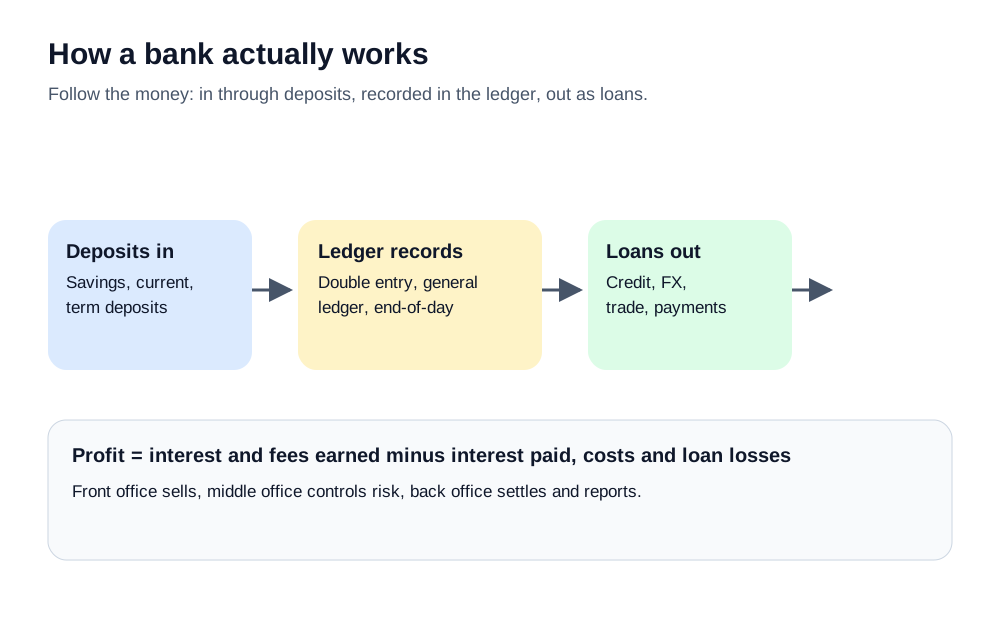
Phase 4 map: deposits in → ledger records → loans out. Profit is the margin left after interest, costs and loan losses.
2. Double-Entry Bookkeeping: The Five-Hundred-Year-Old Error Detector
Every bank transaction is recorded with at least two entries — a debit and a credit — that must always balance.
The Golden Rule
- Assets = Liabilities + Equity (always)
- Every transaction changes at least two items on this equation
- If it doesn't balance, something is wrong
The need arose from scale. A medieval moneylender could track affairs in memory; the Italian merchant banks of the fourteenth and fifteenth centuries — running branches across Europe, extending credit to kings, settling bills of exchange between cities — could not. They needed records that dozens of partners and agents, separated by months of travel, could trust and verify independently. Double entry supplied that trust: a self-consistent record in which every claim had a matching obligation, auditable by anyone who knew the rules. The system was codified in 1494 by the Venetian mathematician Luca Pacioli, describing practices already used by Italian merchants — which is why banking and bookkeeping share an Italian birthplace. Its endurance is not tradition but engineering: double entry is a self-checking machine.
Why two entries? Because every real transaction is an exchange. Money never simply appears; it comes from somewhere and goes somewhere. A customer deposits cash: the bank has more cash and owes more to the customer — one event, two facts. Recording only one fact would lose half the truth. Double entry forces the system to capture the whole of every event.
Why must it balance? Because the equation Assets = Liabilities + Equity is not a convention but a tautology: everything a bank has (assets) is claimed by someone — either outsiders (liabilities) or its owners (equity). Since every transaction preserves this identity, the books of a correctly kept bank must always balance. The moment they do not, the imbalance itself is proof of error or fraud. This is the property that made modern finance possible: not that mistakes never happen, but that they cannot hide.
Debits and credits, demystified. These words intimidate beginners unnecessarily. Forget everyday meanings ("credit" as praise or a card). In bookkeeping:
- A debit increases an asset or expense; decreases a liability, equity, or income.
- A credit increases a liability, equity, or income; decreases an asset.
Accountants visualise each account as a T-account: the account name atop a T, debits on the left, credits on the right. Every journal entry touches at least two T-accounts, and the sum of all left sides must equal the sum of all right sides. When students learn to "do the T-accounts," they are learning to think exactly the way the bank's core system posts.
Notice the elegant consequence: one person's debit is another's credit, which is exactly why your bank statement seems "backwards." When your balance rises, the bank credits your account — because to the bank, your deposit is a liability it owes you, and credits increase liabilities. You and your bank keep mirror-image books of the same relationship.
3. The Ledger in Action: Worked Examples
Example: Customer Deposits $1,000
| Account | Debit | Credit |
|---|---|---|
| Cash (Asset) | $1,000 | |
| Customer Deposit (Liability) | $1,000 |
The bank's cash increases (asset goes up), and its obligation to the customer increases (liability goes up). Both sides balance.
Example: Bank Makes a $5,000 Loan
| Account | Debit | Credit |
|---|---|---|
| Loan Receivable (Asset) | $5,000 | |
| Customer Account (Liability) | $5,000 |
The bank creates a new asset (the loan) and simultaneously creates a new deposit for the borrower. Money has been created.
Pause on the second example, because it is the most consequential journal entry in economics. No vault cash moved. No existing depositor's balance fell. The bank typed two balancing entries, and $5,000 of purchasing power that did not exist before now does. This is the ledger-level truth behind Topic 12's account of money creation: bank money is the liability side of the bank's balance sheet, and lending is the act of writing new matched entries on both sides at once.
Example: The Borrower Repays $2,000 with Interest
Suppose the borrower pays $2,000 of principal plus $100 of interest:
| Account | Debit | Credit |
|---|---|---|
| Customer Account (Liability) | $2,100 | |
| Loan Receivable (Asset) | $2,000 | |
| Interest Income (Equity/Income) | $100 |
The deposit falls by $2,100, the loan asset falls by $2,000, and the difference is income — which belongs to the bank's owners, increasing equity. Every repayment thus shrinks the money supply slightly (principal) while transferring a little wealth to the bank's shareholders (interest). Multiply by millions of loans and you have the entire economics of commercial banking expressed in three lines.
Example: The Bank Pays $50 Interest on a Savings Account
| Account | Debit | Credit |
|---|---|---|
| Interest Expense (Expense) | $50 | |
| Customer Deposit (Liability) | $50 |
The customer's balance rises; the cost comes out of the bank's income. The spread between the interest earned on loans and the interest paid on deposits — visible directly on the ledger — is the net interest margin, banking's oldest profit engine.
4. The General Ledger: A Bank's Single Source of Truth
The general ledger is the master record of all bank transactions. It contains every account — assets, liabilities, equity, income, and expenses.
Modern banks maintain millions of individual accounts, all feeding into the general ledger:
- Customer accounts (savings, current, loan, fixed deposit)
- Internal accounts (suspense, profit & loss, reserves)
- Correspondent bank accounts (Nostro/Vostro)
The architecture is hierarchical. At the bottom sit subsidiary ledgers: the record of each individual customer's savings account, each individual loan, each ATM's cash. These roll up into control accounts, which roll up into the general ledger, which rolls up into the financial statements. A trillion-dollar bank and a village cooperative share this same structure; only the number of zeros differs.
The organising scheme is the chart of accounts — the bank's complete, coded list of every account the GL recognises. Account numbers are not arbitrary: leading digits typically encode the class (assets, liabilities, equity, income, expense), and subsequent digits drill down (deposits → savings deposits → a specific product code → a branch). A well-designed chart lets management answer questions instantly — total deposits by product, by branch, by currency — because the ledger's structure is the bank's management information system. This is why core banking migrations, which must map every legacy account onto a new chart, are among the riskiest projects a bank can undertake.
Three account families deserve special mention:
Customer accounts are the subsidiary ledger you know personally — your balance is one row in a table with millions of rows, but every row must reconcile to the control total in the GL.
Internal accounts are the bank's plumbing. The most interesting is the suspense account — a temporary parking place for transactions whose destination is not yet known: an ATM dispensed cash but the customer record is unclear, a transfer arrived with a wrong account number. Suspense accounts should empty quickly; a large or ageing suspense balance is a classic red flag for auditors and fraud examiners, because hiding entries in suspense is one of the oldest tricks in bank fraud.
Nostro and Vostro accounts record a bank's money held with other banks — the machinery of correspondent banking and international payments. Nostro ("ours") is our account with you; Vostro ("yours") is your account with us: the same balance seen from two ledgers, another instance of the mirror-image principle.
5. End-of-Day Processing: The Bank's Nightly Reckoning
Every night, banks run a massive batch process that:
- Posts all pending transactions
- Calculates interest accruals
- Updates account balances
- Generates regulatory reports
- Reconciles internal accounts
Each step carries real weight.
Posting pending transactions clears the day's queue: cheques deposited in the morning, transfers initiated in the afternoon, card payments authorised in the evening. Only after posting does the ledger show the day as it truly was.
Interest accrual is where the ledger earns its keep as a profit engine. Interest on millions of loans and deposits accrues daily — a borrower owes a little more each midnight, a depositor earns a little more. The EOD process computes each accrual and posts it, so that balances and financial statements always reflect interest earned but not yet paid.
Balance updates propagate every posting through the subsidiary-to-GL hierarchy, producing the official closing position — the number that defines "today" for statements, limits, and regulation.
Regulatory reports draw on that closing position: reserve requirement calculations, liquidity positions, large-exposure returns. The regulator's view of the bank is, literally, an EOD output.
Reconciliation closes the loop: internal accounts are matched, suspense movements reviewed, and the books proven to balance — the five-hundred-year-old error detector run nightly at industrial scale.
To feel the rhythm, follow one ordinary day. At 09:05 a salary credit batch posts to two hundred thousand accounts. At 11:30 a corporate customer draws a working-capital loan — the money-creation entry from Section 3. At 14:20 a card transaction from a merchant abroad arrives through the card network for settlement. At 17:45 a branch discovers a misposted transfer and parks it in suspense pending correction. All day the subsidiary ledgers churn; all day the GL control totals absorb the flow. Then the branches close, the batch window opens, and the five-step reckoning runs. By morning, every balance is official, every accrual posted, every suspense item a day older on the exception report that a human must review.
EOD is also a risk surface. When a bank's systems fail at night, the symptoms are oddly public: balances that do not update, salaries that arrive "late," apps showing yesterday's numbers. Major banks plan EOD windows with the seriousness of aviation schedules, because a failed close contaminates everything downstream — and because, in the era of instant payments, the assumption of a quiet nightly window is itself under pressure, one reason core banking modernisation is among the industry's hardest projects.
6. The Bank Balance Sheet: One Page That Is a Whole Bank
A bank's balance sheet shows its financial position at a point in time:
Assets (What the bank owns or is owed)
- Cash and reserves — Money held at the central bank and in vaults
- Loans — The largest asset for most banks (60-70% of total)
- Investments — Government bonds, corporate bonds, securities
- Fixed assets — Branches, ATMs, technology infrastructure
Liabilities (What the bank owes)
- Customer deposits — The largest liability (70-80% of total)
- Borrowings — Money borrowed from other banks or the central bank
- Bonds issued — Debt securities the bank has sold to investors
Equity (The bank's own money)
- Share capital — Money invested by shareholders
- Retained earnings — Accumulated profits not paid out as dividends
- Reserves — Set aside for specific purposes (loan losses, regulatory requirements)
A miniature example fixes the proportions. Imagine a small bank with, in billions:
| Assets | Liabilities & Equity | ||
|---|---|---|---|
| Cash & central bank reserves | 8 | Customer deposits | 78 |
| Loans to customers | 62 | Wholesale borrowings | 10 |
| Investment securities | 25 | Bonds issued | 4 |
| Fixed & other assets | 5 | Equity | 8 |
| Total | 100 | Total | 100 |
Read it the way an analyst does. Loans are 62% of assets — a classic commercial bank. Deposits fund 78% of everything — a strong, stable funding base. Equity is 8: the cushion. Now stress it mentally: if 9% of the loans prove worthless, equity is wiped out and the bank is insolvent — even though 91% of borrowers paid. If instead depositors demand 15 of their 78 at once, the 8 in cash is gone instantly and the bank must sell securities or borrow from the central bank to survive the week. Both failure modes live inside this innocent table; reading them out of it is the core skill of bank analysis.
Three observations turn this list into understanding.
A bank's balance sheet is inverted compared to a company's. For a manufacturer, deposits from others barely exist and the big assets are factories and inventory. For a bank, the raw material is other people's money: deposits — money that is not the bank's at all — dominate the liabilities, and loans — promises from borrowers — dominate the assets. A bank is, structurally, a transformer of obligations: it issues one kind of promise (safe, liquid, on-demand deposits) to hold another kind (risky, illiquid, long-term loans).
Equity is a thin cushion. In a typical bank, equity might be 6–10% of assets; the other 90%+ is someone else's money. This is leverage far beyond what any industrial company could sustain, and it is why small losses matter enormously: a mere 8% fall in asset values can erase the entire equity cushion and render the bank insolvent. Capital regulation — the requirement to hold minimum equity against risk-weighted assets — exists precisely because this cushion is the only thing standing between loan losses and depositors. (Topic 29 develops bank financial statements in full; here the structure suffices.)
Liquidity is the balance sheet's hidden dimension. Two banks with identical balance sheet totals can be utterly different in survival terms: one funded by sticky insured deposits, holding saleable government bonds; the other funded by jumpy wholesale money, holding illiquid loans. The balance sheet shows what; survival depends on how fast each side can move. Topic 23's shadow banking discussion showed what happens when the liability side moves faster than the asset side can follow.
7. How Banks Balance Risk and Return
Banks earn money by taking calculated risks:
- Credit risk — The borrower might not repay
- Interest rate risk — Rates might move against the bank's positions
- Liquidity risk — Too many depositors might withdraw at once
- Operational risk — Systems might fail or fraud might occur
The accounting lens makes each risk concrete:
Credit risk is the risk that the loan assets on the balance sheet are worth less than their recorded value. Its accounting expression is the provision: when a loan sours, the bank charges income and creates a reserve against the asset — equity absorbs the blow, which is exactly what equity is for.
The profit arithmetic deserves one worked sketch. Suppose our miniature bank earns 6% on its 62 of loans and 4% on its 25 of securities, while paying 2% on its 78 of deposits and 3% on its 14 of other borrowings. Interest income is about 4.7; interest expense about 2.0; net interest income about 2.7 — against which the bank must fund branches, technology, salaries, and provisions for bad loans before any profit reaches the 8 of equity. The entire drama of bank profitability plays out in that narrow gap between 4.7 and 2.0, which is why a one-percentage-point shift in rates can double or halve a bank's earnings without a single loan defaulting.
Interest rate risk lives in the mismatch between what the bank earns on assets and pays on liabilities as rates move. A bank funded by floating-rate deposits but holding fixed-rate loans sees its margin squeezed when rates rise — the failure mode behind the US savings-and-loan crisis and, in modern form, the bond-portfolio losses that felled several banks in 2023.
Liquidity risk is the liability side arriving faster than the asset side can pay — the bank run. Solvent on paper, dead in practice: the balance sheet balances, yet the bank cannot meet today's withdrawals. Central bank lender-of-last-resort facilities exist for precisely this gap between solvency and liquidity.
Operational risk is the ledger itself going wrong — failed systems, fraud, error. The EOD process, the suspense account, and the nightly reconciliation are its front-line controls.
The entire regulatory framework for banking — capital requirements, reserve ratios, stress testing — exists to ensure banks manage these risks prudently. Seen from the ledger, regulation is simply society insisting that the two sides of the equation remain honest: that assets are valued truthfully (capital and provisioning rules) and that liabilities can actually be met (liquidity and reserve rules).
8. Common Misconceptions About How Banks Work
"Banks lend out depositors' money." The ledger says otherwise: lending creates new deposits rather than transferring old ones (Section 3). Deposits constrain lending through liquidity and capital rules, but no depositor's balance falls when a loan is made. The misconception survives because it feels intuitive — and because it was true of pre-modern deposit banks. It has not described actual banking for centuries.
"Balanced books mean a healthy bank." Balance is guaranteed by construction; health is not. Every failed bank in history balanced on its last day. Solvency is about the value of assets, liquidity about the timing of obligations — neither appears in the requirement that debits equal credits.
"The vault is where the money is." Vault cash is a rounding error — a few percent of assets, held for ATM and counter needs. The bank's real resources are claims: loans and securities. And most customer money exists only as ledger entries, which is precisely what makes bank runs about confidence rather than cash.
"Accounting is the back office, not the business." In banking, accounting is the business: the product (deposits), the raw material (funding), and the output (loans) are all ledger entries. A trader's profit, a teller's error, and a regulator's capital test are all, ultimately, movements in the same books.
9. Frequently Asked Questions
Why does my bank statement show deposits as "credit"? Because the statement is the bank's ledger view, not yours. To the bank, your deposit is money it owes you — a liability — and credits increase liabilities. Your personal books would record the same event as a debit to your cash asset. Mirror images of one relationship.
Is double entry still relevant in the age of digital banking? More than ever. Every UPI transfer, card swipe, and app payment ends as balanced postings in a core ledger — the interface changed, the accounting did not. If anything, instant volumes make the balancing discipline more critical: errors now compound at machine speed, so reconciliation must run at machine speed too.
Does double entry mean errors are impossible? No — it means unbalanced errors are impossible to hide. Balanced errors (the same wrong amount on both sides) can still occur, which is why banks add reconciliation, suspense monitoring, and audit on top of the basic discipline.
Do banks really create money with a journal entry? Yes — the loan example in Section 3 is not a simplification but the literal mechanism: a new loan asset and a new deposit liability appear together, expanding purchasing power. Topic 12 develops the economics and the constraints (capital, reserves, borrower demand) that keep this power bounded.
Who checks that a bank's books are honest? Layers of assurance: internal reconciliation daily; internal audit continuously; external auditors annually, opining on the financial statements; supervisors who inspect not just the statements but the systems and controls producing them. Fraud survives only by defeating several layers at once — which is why major banking frauds are usually governance failures, not arithmetic failures.
What is the difference between the general ledger and my account statement? Scale and hierarchy. Your statement is one row's history in a subsidiary ledger; the general ledger is the master control that all subsidiary ledgers — yours included — must reconcile to every night.
What is a suspense account, and why do auditors care? A temporary parking account for transactions whose proper destination is unclear. Legitimate suspense clears in days; ageing or large suspense balances suggest operational failure — or fraud being parked out of sight.
Why is bank leverage so much higher than other companies'? Because the business model is leverage: borrowing short (deposits) to lend long (loans) is what banks are for. Society permits — and regulates — this leverage because deposit-taking banks perform the economy's payments and credit functions; capital requirements set how thin the equity cushion may legally become.
What is the difference between solvency and liquidity? Solvency: are assets worth more than liabilities (equity positive)? Liquidity: can you pay obligations as they fall due? A bank can be solvent and still die from a run — assets good, but not saleable fast enough. Central banks exist to bridge exactly that gap.
Can two banks' ledgers disagree about the same money? Temporarily, yes — that is what nostro/vostro reconciliation exists to catch. When Bank A sends funds through Bank B, both record the movement in their own books; timing gaps and errors create differences that daily reconciliation statements must resolve to zero. Persistent unexplained differences are an operational emergency, not an accounting footnote.
What happens if a bank posts the wrong entry? Correction is itself double-entry: a reversing entry cancels the mistake and a correct entry replaces it, leaving a visible audit trail. Deleting entries is precisely what controls exist to prevent — in banking, even errors must balance.
Why do banks process at night instead of continuously? Historically, batch was the only affordable way to compute millions of interest accruals and reconciliations. Instant-payment rails are forcing continuous processing, but replacing EOD in a core banking system is like replacing an aircraft's engine mid-flight — which is why the industry migrates slowly and carefully.
What should I look at first in a bank's balance sheet? Four numbers, in order: total equity relative to assets (the cushion), loans relative to deposits (the intermediation intensity), the split of funding between deposits and wholesale borrowing (run-proneness), and the size of loss reserves against loans (asset honesty). These four sketch the bank's risk character before any ratio analysis begins.
10. Key Terms in This Chapter
- Double-entry bookkeeping — recording every transaction as matched debits and credits that must balance.
- Debit / credit — the two sides of every entry; debits increase assets and expenses, credits increase liabilities, equity, and income.
- Accounting equation — Assets = Liabilities + Equity, the identity every ledger must preserve.
- General ledger (GL) — the master record of all accounts, fed by subsidiary ledgers.
- Subsidiary ledger — detailed records (each customer's account, each loan) rolling up to GL control totals.
- Suspense account — temporary parking for unresolved transactions; an audit red flag when it ages.
- Nostro / Vostro — "our account with you" / "your account with us": correspondent balances in mirror ledgers.
- End-of-day (EOD) processing — the nightly batch that posts, accrues, updates, reports, and reconciles.
- Accrual — recognising interest earned or owed daily, before cash moves.
- Balance sheet — the point-in-time statement of assets, liabilities, and equity.
- Net interest margin — the spread between interest earned on assets and paid on liabilities.
- Provision — a charge against income to reserve for expected loan losses.
- Leverage — assets per unit of equity; banking's defining structural feature.
- Solvency vs liquidity — worth more than you owe vs being able to pay on time.
- T-account — the visual form of a ledger account: debits left, credits right.
- Chart of accounts — the coded master list structuring every account in the GL.
- Core banking system — the central platform hosting the ledger, posting engine, and EOD batch.
11. Interview Insights: How This Topic Appears in Banking Interviews
"What is the role of the core banking system?" The GL's modern embodiment: the central platform that holds every account, posts every transaction, computes every accrual, and runs the nightly close — with channels (branches, apps, ATMs) as mere windows onto it. Emphasise the consequence: when the core is down, the bank does not slow down — it stops. And when a bank replaces its core, it is performing open-heart surgery on the institution, which is why such migrations are measured in years and careers.
"Walk me through what happens on the ledger when a bank makes a loan." The two-entry answer — debit loan receivable, credit the borrower's deposit — then the significance: no cash moved, no depositor lost funds, new purchasing power exists. Close with the constraints (capital, liquidity, credit standards) that bound the process. Candidates who reach for vault cash have not understood banking.
"Where exactly does a bank's profit come from?" Trace it on the ledger: the spread between asset yields and funding costs (net interest income), plus fees for payments, cards, and advisory services, minus operating costs, minus provisions for bad loans. What remains accrues to the thin equity base — which is why return on equity, not absolute profit, is the industry's yardstick. A bank earning modest margins on enormous leverage can still deliver strong returns to shareholders; the same leverage is why its losses, when they come, arrive at terrifying speed.
"Why is a bank's balance sheet different from a manufacturing company's?" Inversion and leverage: the bank's raw material is liabilities (deposits), its product is assets (loans), and its equity is a single-digit cushion — which is why valuation, regulation, and failure modes all differ from industrial firms. Mention that bank analysis starts with funding structure, not revenue growth.
"Why do banks hold reserves at the central bank?" Two ledger-level reasons: settlement — interbank obligations clear through central bank accounts, so reserves are the oil of the payments machine — and regulation — reserve or liquidity requirements mandate minimum holdings as a buffer. On the balance sheet, central bank reserves sit at the very top of the asset side precisely because they are the most liquid, safest asset a bank can hold: the asset of last resort for a liability that can leave at a moment's notice.
"How does a bank fail if its books always balance?" Balancing is arithmetic, not health. Assets can be overvalued (credit risk), liabilities can flee faster than assets can sell (liquidity risk), and margins can invert (rate risk) — all with the equation perfectly intact. The books must balance; the bank must also be solvent and liquid, which is a claim about values and timing, not arithmetic.
"What is EOD and why does it matter?" The nightly close: post, accrue, update, report, reconcile — producing the official position for customers and regulators. Add the modern tension: instant payments are eroding the nightly window, making core modernisation one of the industry's defining engineering challenges.
"Explain the link between bookkeeping and financial stability." Double entry is the micro-foundation of trust: it makes errors and fraud detectable, which makes audited statements possible, which makes depositors, investors, and regulators willing to rely on banks at all. Five hundred years old and still the load-bearing wall.
Summary and Key Takeaways
A bank is a ledger with a licence. Everything else — branches, apps, traders — is decoration on the core machine. The essential points:
- Double entry is banking's foundation: every transaction has two sides, and the requirement that they balance makes errors and fraud detectable — the error detector that made modern finance possible.
- Debits and credits are positional, not moral: debits grow assets and expenses; credits grow liabilities, equity, and income — and your statement looks backwards because it is kept from the bank's side.
- Loans are born as journal entries: a new loan asset and a new deposit liability appear together — the literal mechanics of money creation.
- The general ledger is the single source of truth: millions of customer accounts roll up through subsidiary ledgers into the GL, which must reconcile nightly.
- EOD is the bank's nightly reckoning: posting, accrual, balance updates, regulatory reporting, and reconciliation — and a process under pressure from the 24/7 payments era.
- The bank balance sheet is inverted and leveraged: deposits fund loans on a thin equity cushion, which is why small asset losses can threaten the whole institution.
- The four great risks all live on the ledger: credit risk attacks asset values, rate risk attacks the margin, liquidity risk attacks funding, and operational risk attacks the records themselves.
- Regulation is equation-keeping: capital rules keep assets honestly valued and the cushion real; liquidity and reserve rules keep liabilities meetable — society enforcing that both sides of the identity stay true.
- Accounting is the business, not the back office: deposits, loans, margins, and capital are all ledger entries — to read the books is to read the bank.
A last thought to carry forward: this chapter's machine is universal. The cooperative society of Topic 24, the payment bank of Topic 22, and the global giant all run the same equation, the same double-entry discipline, the same nightly reckoning — differing only in scale and product mix. Master the ledger and every institution in this series becomes legible; skip it, and banking remains a collection of mysterious products.
In the next topic, we zoom out from the ledger to the institution around it — the anatomy of a bank: the departments, functions, and lines of defence that turn this accounting machine into a working organisation.
Next: Topic 27 — The Anatomy of a Bank →
<!-- MBA-DEEP-DIVE-START -->Deep Dive: From Customer Event to Ledger, General Ledger, Settlement, and Control
A bank does not really ‘move money’ as one single action. It records a sequence of legally and economically meaningful events across several ledgers and systems. The customer sees a balance change. Behind that change, the bank may update a product ledger, create accounting entries, reserve funds, send a payment instruction, settle through an external system, reconcile a correspondent or central-bank account, calculate fees, run fraud and sanctions controls, and produce regulatory and financial reporting.
Understanding this chain is one of the most useful foundations for anyone working in banking technology or operations. The central idea is simple: every customer transaction is both a business event and an accounting event, and many transactions are also settlement events.
The bank’s books are not one database
Modern banks often have multiple systems of record. A current-account platform may maintain customer balances. A loan system maintains principal, interest, fees, arrears, and repayment schedules. A card platform maintains authorisations and clearing items. A treasury system records securities and derivatives. A payment hub manages payment states. A general ledger records the accounting view of the institution.
These systems are linked, but they are not interchangeable.
A customer ledger answers questions such as: what is the customer’s available balance, booked balance, overdraft limit, or loan outstanding? The general ledger (GL) answers a different question: what are the bank’s total assets, liabilities, income, expenses, and equity by accounting category?
A bank can therefore have a customer transaction correctly displayed in an app while still having an accounting break if the GL posting failed. Conversely, an accounting entry can exist while the customer-facing posting is missing. Reconciliation exists precisely because distributed systems can disagree.
Double-entry bookkeeping at the heart of banking
Every accounting event keeps the equation balanced:
Assets = Liabilities + Equity.
When a customer deposits ₹10,000 in cash, the bank receives cash, increasing an asset, and owes the customer ₹10,000 more, increasing a deposit liability.
A simplified entry is:
- Debit cash asset ₹10,000
- Credit customer deposit liability ₹10,000
When the bank makes a ₹5 lakh loan and credits the borrower’s account, the bank creates a loan asset and a matching deposit liability:
- Debit loan asset ₹5,00,000
- Credit customer deposit liability ₹5,00,000
The balance sheet grows on both sides.
When the borrower later pays ₹20,000 of principal from an account at the same bank, the deposit liability falls and the loan asset falls:
- Debit customer deposit liability ₹20,000
- Credit loan asset ₹20,000
Interest is different because it affects income. If ₹5,000 of a repayment is interest, the accounting includes interest income rather than reducing principal by the full amount.
These simple entries become millions or billions of events at scale, but the logic never changes.
Available balance versus ledger balance
Customers often assume their account has one balance. Operationally, banks can maintain several.
The booked or ledger balance reflects transactions that have been posted to the account. The available balance reflects what the customer can use right now after considering holds, card authorisations, uncleared items, overdraft limits, earmarks, or pending debits.
Suppose a customer has ₹50,000 booked. A hotel places a ₹10,000 card authorisation hold. The booked balance may still show ₹50,000 while the available balance becomes ₹40,000. When clearing arrives later for ₹8,500, the hold is released and the final debit is posted.
This distinction is crucial in banking systems. If a payment engine validates only the booked balance and ignores existing holds, the customer may overspend. If a hold is never released after a failed card transaction, the customer may lose access to funds temporarily even though no final debit exists.
Authorisation is not settlement
Many financial transactions have at least two stages: authorisation and settlement.
A card purchase illustrates this clearly. At checkout, the issuer may authorise the transaction, reserving funds or credit limit. That does not necessarily mean the merchant has received final money. Later, clearing data arrives, the issuer and acquirer calculate obligations, and settlement moves funds through the card-network arrangements.
Payments can have analogous distinctions. A bank can accept a payment instruction from the customer, pass fraud checks, reserve funds, and mark it ‘accepted’ before interbank settlement has completed. Whether the payment is final at each step depends on the specific scheme and legal framework.
The state model matters. Systems should not use one vague status such as ‘processed’ for every stage. Useful states can distinguish received, validated, authorised, booked, released, sent, accepted by external infrastructure, settled, rejected, returned, reversed, and reconciled where appropriate.
Intrabank versus interbank transfers
If two customers use the same bank, a transfer may be settled entirely on the bank’s own books. One deposit liability decreases and another increases. The bank’s total deposit liability remains unchanged.
Suppose Customer A transfers ₹1,000 to Customer B, both at the same bank:
- Debit A’s deposit liability ₹1,000
- Credit B’s deposit liability ₹1,000
No external settlement asset needs to move.
If Customer B is at another bank, the transaction becomes different. The sending bank reduces its liability to A and must transfer settlement value to the receiving bank through the relevant payment or correspondent arrangement. The banks’ settlement accounts or correspondent balances change.
This distinction explains why ‘money movement’ inside one bank can be operationally simpler than money movement between banks even if the customer experience looks identical.
Interbank settlement and settlement assets
Banks settle obligations using assets accepted by the relevant system. Domestic high-value payment systems commonly settle in central-bank money. Cross-border payments may settle through correspondent accounts denominated in the relevant currency.
Imagine Bank A owes Bank B ₹1 crore after a payment. Bank A cannot settle by merely telling Bank B that its customer balance fell. Bank B needs an asset it can rely on. In a central-bank settlement system, Bank A’s reserve or settlement account is debited and Bank B’s is credited.
This creates an important operational separation:
Customer booking answers whether the payer and beneficiary accounts changed.
Interbank settlement answers whether value moved between financial institutions.
A bank can temporarily have one without the other, which is why settlement risk, suspense accounts, and reconciliation are necessary.
Suspense accounts are temporary, not hiding places
When a transaction cannot be posted to its final accounting destination, banks may use suspense or transit accounts. These are legitimate control tools if they are temporary, well defined, and actively reconciled.
Suppose an inbound transfer arrives but the beneficiary account number is invalid. The bank may receive settlement value while being unable to credit a customer. The amount may sit temporarily in a controlled suspense account while the transaction is investigated or returned.
The danger is aged suspense. If unexplained balances accumulate, the bank loses confidence in its books. Every suspense account should have clear ownership, ageing rules, escalation, reason codes, and resolution procedures.
A good operations team can answer: why is each item here, how old is it, who owns it, and what event will clear it?
Reconciliation closes the control loop
Reconciliation compares independent records that should agree.
A payment system may say 10,000 transactions worth ₹25 crore were sent. The settlement statement may show ₹25 crore debited. The customer ledger may show the same total debits. The GL control account should reconcile to those movements.
If the totals differ, the bank has a break.
The best reconciliation does not simply compare end-of-day totals. It can match transactions by identifiers, amount, date, account, or other attributes and classify differences such as timing, duplicate, missing posting, value mismatch, or external rejection.
A timing difference can be legitimate. A permanent unexplained difference is not.
The GL control-account model
Large banks generally do not post every customer account directly as a separate line in the central GL. Product systems maintain detailed sub-ledgers, while the GL contains control accounts representing aggregated balances.
For example, a current-account platform may contain five million customer accounts whose total credit balance is ₹20,000 crore. The GL may have one or several deposit control accounts whose aggregate should equal the sub-ledger total.
Daily reconciliation between sub-ledger and GL is therefore fundamental. If the sub-ledger says ₹20,000 crore and the GL says ₹20,010 crore, the bank must explain the ₹10 crore difference before trusting financial statements.
Fees and interest are their own event engines
A customer transaction often creates secondary accounting events. A cross-border transfer may generate a customer fee. An overdraft creates interest. A loan accrues interest daily. A card transaction may generate interchange-related accounting. A foreign-currency transaction creates FX income or exposure.
The fee engine must know the pricing rule, customer segment, currency, tax treatment, waiver rules, and accounting destination. Interest engines must know rate basis, day-count convention, reset dates, compounding, holidays, overdue treatment, and effective date.
Small parameter errors can become large at scale. A one-basis-point error on a very large book can materially affect customer balances and bank income.
This is why product configuration should be governed like code: controlled change, testing, approval, effective dating, and audit trail.
End-of-day processing is not dead
Real-time banking has reduced dependence on overnight batch processing, but end-of-day remains important. Banks still need to close accounting periods, calculate accruals, revalue positions, generate statements, age arrears, process standing instructions, update risk measures, reconcile external statements, and produce regulatory or management reports.
The modern challenge is hybrid: customer transactions may be real time while accounting and reporting contain both real-time and batch processes.
The business date therefore matters. A transaction executed at 11:58 PM can have different accounting treatment from one executed just after midnight even if only minutes apart. Systems need consistent rules for value date, booking date, processing date, and settlement date.
Value date versus booking date
The booking date is when an entry is recorded. The value date is the date from which the transaction economically affects interest or balance calculations under the product rules. The settlement date is when interparty value moves.
These dates can differ.
In foreign exchange and securities, settlement commonly occurs after trade date. In deposits, back-valued or forward-valued transactions may affect interest. In payments, the customer may initiate today for execution tomorrow.
Confusing these dates creates interest errors, liquidity misforecasting, and reconciliation problems.
Idempotency: a banking technology control
Modern APIs introduce a technical concept with direct financial importance: idempotency. If the same payment request is retried because the customer’s app did not receive a response, the bank should not debit the customer twice.
A robust payment API uses a unique request or idempotency key so repeated submission of the same business event returns the original result rather than creating a new transaction.
This is not merely elegant software design. It is a financial-control requirement. Network timeouts are normal; duplicate money movement must not be.
Event ordering matters
Distributed systems can process events asynchronously. A payment may be authorised in one service, booked in another, sent by a third, and notified by a fourth. If messages arrive out of order, the customer could receive a ‘payment completed’ notification before booking actually succeeds.
Systems therefore need sequence controls, state machines, durable event logs, and compensating actions.
A compensating action is not the same as deleting history. If a debit must be reversed, the bank should normally create a reversing entry with its own audit trail rather than erase the original event. Financial systems must preserve history because auditability is part of correctness.
Four-eyes and segregation of duties
Banking operations should not depend on one person being able to create, approve, and conceal a sensitive transaction.
The maker-checker or four-eyes principle separates initiation from approval for high-risk actions: manual payments, static-data changes, fee overrides, account closures, large adjustments, or GL journals.
Segregation also applies to technology. A developer should not normally be able to change production code and edit production transaction data without independent control. A database administrator should not be able to modify balances invisibly.
Strong systems combine access control, approvals, immutable logs, monitoring, and periodic entitlement review.
Manual journals are powerful and dangerous
Banks sometimes need manual accounting adjustments. A manual journal can correct an error or allocate an amount that automation cannot handle. But because journals can change the financial statements directly, they require strict control.
Good journal governance includes authorised account combinations, amount thresholds, business justification, evidence, maker-checker approval, period controls, and review of unusual entries.
Repeated manual journals correcting the same product flow are a warning sign. Operations may be compensating for a broken system rather than solving the root cause.
A complete payment example
Consider a customer sending ₹50,000 to another bank.
The channel receives the instruction and authenticates the customer. The payment service validates account status, limits, balance, beneficiary data, and duplicate risk. Fraud and compliance controls run as applicable. The bank may reserve or debit the customer funds. A payment record is created with a unique identifier.
The instruction is routed to the domestic payment infrastructure. The external system accepts it and creates an interbank obligation. Settlement value moves between the banks according to the scheme design. The receiving bank credits the beneficiary. Both banks receive status and settlement information.
The sending bank posts or finalises customer accounting, updates GL control accounts, records any fee, releases unused holds, and sends customer notification. Reconciliation later compares payment records, customer postings, settlement statements, and GL balances.
If the receiving side rejects the transaction, a return or reversal process creates new events. The original event remains in history.
That is what a ‘simple transfer’ actually means inside a bank.
Operational resilience: correctness must survive failure
A bank is not well designed if it works only when every component is healthy. Payment networks fail, databases become unavailable, messages are delayed, vendors suffer outages, and data centres can be lost.
Critical services therefore need defined recovery objectives, duplicate protection, replay capability, queue persistence, alternate connectivity, backup procedures, and clear operational runbooks.
Recovery must preserve financial integrity. Restoring a system from backup is not enough if transactions processed after the backup are then lost or duplicated. Recovery design must know which events are authoritative and how to reconcile the restored state with external systems.
What excellence looks like
A world-class bank can trace any material transaction from customer instruction to product ledger, accounting entry, external settlement, fee or interest event, reconciliation, and final reporting. Every state has a defined meaning. Every manual intervention has ownership and audit history. Sub-ledgers reconcile to GL. External settlement accounts reconcile to internal records. Duplicate requests do not create duplicate money. Reversals preserve history. Suspense is aged and cleared. End-of-day and real-time processes agree on business date and value date.
Once you can follow that chain, banking stops looking like a collection of products and starts looking like what it really is: a controlled system of promises, records, settlement assets, and accounting events that must remain internally consistent every second of the day.
<!-- MBA-DEEP-DIVE-END -->