Visual overview
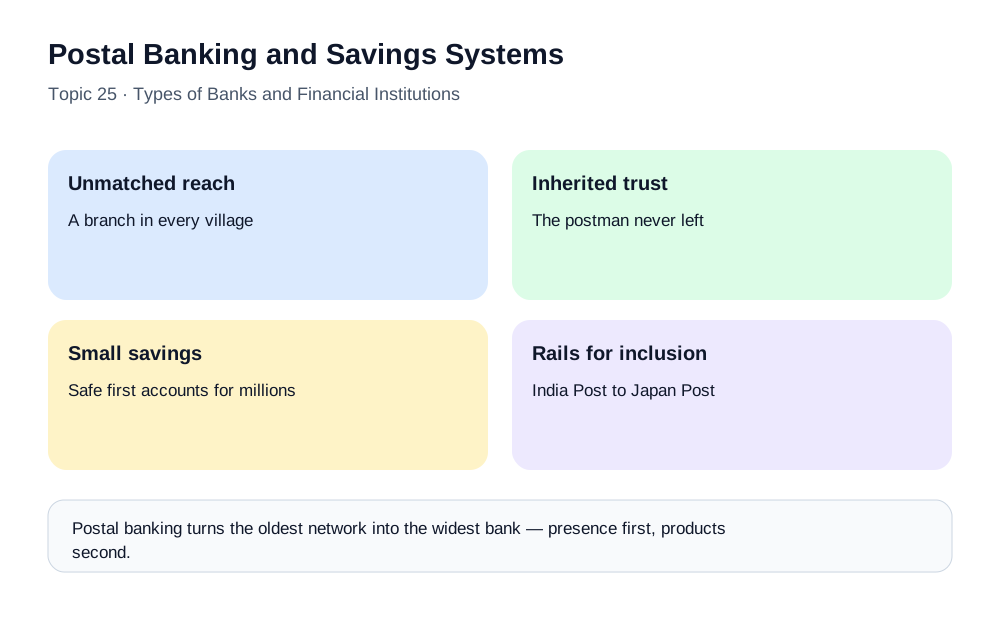
Postal Banking and Savings Systems at a glance — Post office savings and financial inclusion networks.
1. Introduction: The Bank That Was Already There
Long before mobile banking apps and neobanks, there was a financial institution with branches in virtually every town and village: the post office. Postal savings systems have served billions of people worldwide, providing safe, accessible savings for those whom commercial banks overlooked. They remain a powerful force for financial inclusion.
The idea is so natural that it seems obvious in hindsight. A national postal service already maintains what every bank struggles to build: a physical presence in every community, staff known to local residents, secure handling of valuable items, and — above all — public trust. Attaching a savings counter to that infrastructure costs a fraction of building a bank branch network, and it reaches precisely the people commercial banks find unprofitable: the poor, the rural, the elderly, the small saver.
This chapter examines postal banking from first principles to modern practice: why governments created postal savings systems, how they work mechanically, the great national systems from India to Japan, what they do well and badly, and why the model is being rediscovered in the digital age.
Learning objectives. By the end of this chapter you should be able to:
- Explain why postal networks became financial institutions, from first principles
- Describe the products and mechanics of postal savings systems
- Compare the major national models: India, Japan, the UK, Germany, and the US
- Analyse postal banking's distinctive strengths — reach, trust, simplicity, cost — and its structural limits
- Evaluate the challenges: technology lag, sustainability, and digital competition
- Understand how postal networks are being reinvented as digital and agent banking platforms
2. First Principles: Why the Post Office Became a Bank
Three economic logics made postal banking nearly inevitable.
The small-saver problem. Commercial banking earns from balances; a savings account holding the equivalent of a few dollars costs more to administer than it can ever generate. Left to markets, small savers are unbanked savers — and their money sits in cash, vulnerable to theft, fire, and impulse. A state that wants its citizens to build even modest financial resilience must provide somewhere safe for tiny balances. The postal network, already paid for by mail, offers that somewhere at near-zero marginal cost.
The trust problem. Banking runs on confidence, and confidence is exactly what poor and rural populations historically lacked in commercial banks — distant institutions run by strangers, with a record of failures that wiped out small depositors. The post office, by contrast, was the one institution of the state that ordinary people met weekly and that had never lost their money. Postal savings converted that accumulated social trust into financial access.
The fiscal logic. Postal savings systems were never purely altruistic. Deposits gathered at millions of village counters flowed into government securities — giving the state a cheap, stable, domestic funding source and giving savers a government guarantee in return. The system intermediates directly between the smallest savers and the sovereign itself: a design of elegant symmetry, and one that explains both its safety and its politics.
The pioneer was Britain, which launched the world's first national postal savings bank in 1861 explicitly to give working people a safe place for small savings. The context was a series of failures at private savings banks that had destroyed working-class deposits; the state's answer was to offer its own guarantee through the one network that already reached everyone. The design was deliberately austere — small maximum deposits, plain passbooks, investment only in government securities — because the purpose was protection, not profit. The model spread across Europe, its colonies, and Japan within decades — one of the fastest-diffusing financial innovations in history, carried by colonial administrations, reformers, and finance ministers who all recognised the same small-saver gap at home. The model spread across Europe, its colonies, and Japan within decades — one of the fastest-diffusing financial innovations in history.
3. How Postal Banking Works
Post offices offer basic financial services alongside their mail delivery operations:
- Savings accounts — Simple deposit accounts with government guarantee
- Fixed deposits — Term deposits with competitive interest rates
- Recurring deposits — Small monthly savings plans
- Money transfers — Domestic and international remittances
- Insurance — Basic life insurance products
- Government payments — Pension disbursement, subsidy distribution
The operational mechanics are distinctive in three ways.
The guarantee is sovereign, not institutional. A postal savings deposit is typically backed directly by the government rather than by a deposit insurance fund. For the customer this is the strongest promise available in the financial system — the same credit as the state itself.
The asset side is the state. Unlike a commercial bank, which lends deposits to businesses and households, a classic postal savings system invests its gathered balances predominantly in government securities. This makes the system extraordinarily safe — there is effectively no credit risk — but also means it performs no credit intermediation for the private economy. It is a savings and payments utility, not a lender. (Where postal institutions later moved into lending, as Japan Post Bank did, they entered a different risk world entirely.)
Distribution is the state's payment plumbing. Because the counters already reach every village, governments use them to deliver pensions, welfare payments, and subsidies — and recipients, paid through postal accounts, become savings customers almost automatically. This symbiosis between benefit delivery and savings access is the quiet engine of postal inclusion, and it foreshadows exactly the model later formalised by payment banks (Topic 22).
A typical transaction illustrates the plumbing. A pensioner in a remote district receives her monthly pension into her postal account — paid by the government directly through the same network. She withdraws part at the counter for household needs, leaves the rest, and the accumulated balance joins the pool invested in government securities. The state pays its pensioner through its own counters, borrows her savings through its own securities, and guarantees her deposit with its own credit: a closed, remarkably robust loop. The remittance counter next to hers runs the reverse flow — a migrant worker in the city sends earnings home, and the village post office pays out cash the same week, long before digital wallets made that instant.
Notice what the model omits: no credit risk, no complex products, no profit-maximising sales culture. Postal banking is banking reduced to its safest core — store value safely, move it reliably, serve everyone. That reduction is simultaneously its strength and its ceiling.
4. India: The World's Largest Financial Access Network
India Post
- 155,000+ post offices — the largest postal network in the world
- Post Office Savings Account — Over 430 million accounts
- Products include: National Savings Certificates, Public Provident Fund, Sukanya Samriddhi (girls' education savings)
- India Post Payments Bank — Digital banking overlay on the postal network
- Reaches villages where no bank has ever opened a branch
The scale deserves a pause. India's roughly 155,000 post offices outnumber all bank branches in the country combined, and the great majority are rural. For hundreds of millions of Indians, "the financial system" has never meant a bank; it has meant the post office counter where the family keeps its savings passbook, buys its savings certificates, and receives its pension.
The product set is tuned to the small saver's life: the basic savings account; recurring deposits that build the monthly-saving habit; National Savings Certificates as a simple fixed-income instrument; the Public Provident Fund, a long-horizon tax-advantaged savings vehicle that has anchored middle-class financial planning for generations; and Sukanya Samriddhi, a savings scheme specifically for girls' education and future, which channels household saving toward daughters' welfare.
Doorstep banking deserves special attention because it resolves the last obstacle digital inclusion always hits: the customer who cannot or will not operate a smartphone. Under the model, the local postal worker — a known, trusted figure — visits the home with a biometric device, authenticates the customer by fingerprint, and completes withdrawals, deposits, and transfers on the spot. For the elderly, the digitally hesitant, and the simply busy, the branch comes to them. It is the exact inverse of the industry's usual direction of travel, and it works because it builds on the postal worker's existing relationship rather than asking the customer to form a new one with an app.
The India Post Payments Bank (introduced in Topic 22's table of payment banks) is the system's modern transformation: a licensed payments bank layered onto the postal network, adding digital accounts, UPI-enabled transactions, and doorstep banking by postal workers equipped with smartphones and biometric devices. The postman who delivered the pension now delivers the bank itself — arguably the purest expression of postal banking's founding logic, rebuilt for the smartphone era.
5. Japan: The Quiet Giant
Japan Post Bank
- One of the world's largest deposit-taking institutions
- Over $1.6 trillion in deposits
- 233 million accounts in a country of 125 million people
- Privatized in 2007 but still government-related
Japan Post Bank is what happens when postal savings operates for a century and a half in a high-savings society: it became one of the largest pools of deposits on earth — more accounts than the country has people, and a balance sheet rivalling the biggest commercial banks.
The institution's history illustrates both halves of the postal bargain. For generations, Japan's postal savings system channelled household thrift into state-directed investment — the fiscal logic at full national scale, funding postwar reconstruction and industrial policy. Its sheer size eventually distorted competition with private banks, which is why a long political battle ended in privatisation beginning in 2007. The modern Japan Post Bank invests far beyond government bonds — in securities portfolios managed with commercial sophistication — while retaining its unmatched network and its role as the default financial institution for elderly and rural Japanese.
Japan's experience also carries a caution about demographic change: an institution built on face-to-face trust with an ageing customer base must somehow renew itself for generations that never visit a counter. Japan Post's response — digital channels, broader investment products, and use of its data and network for new services — is the same reinvention every postal system faces, merely arrived at first because Japan's society aged first.
The lesson generalises: postal savings works so well at gathering deposits that, at national scale, the question becomes what to do with the money — and that question is as much political as financial.
6. Other Models: Partnership, Merger, and the Road Not Taken
United Kingdom
- Post Office partners with major banks to provide counter services
- Over 11,500 branches — more than all UK bank branches combined
The British arrangement answers a question every digitalising economy eventually faces: when cash use falls but never reaches zero, who pays for the last cash infrastructure? Bank branch closures made it a political question, and the post office network — present, staffed, trusted — was the readiest answer. The result is a peculiar and instructive hybrid: a state-owned network delivering the counter services of its commercial competitors, funded by fees from those competitors. Neither pure postal banking nor pure commercial banking, it may be the most honest model of all: an admission that universal physical access is shared infrastructure, whoever's name is on the account.
Britain — the model's inventor — eventually chose a partnership architecture. As commercial banks closed rural and low-income branches, the Post Office became their shared front counter: customers of most major UK banks can withdraw, deposit, and check balances at any post office. The arrangement preserves universal cash access without any bank having to maintain the branch network — a pragmatic answer to the branch-closure politics of an ageing, digitalising banking market.
Germany: Deutsche Post / Postbank
- Postbank served as Germany's postal savings bank
- Merged with Deutsche Bank in 2010 but maintains extensive branch presence
Germany's Postbank grew from postal savings roots into a full retail bank — proof that the postal franchise can support genuine banking breadth — before being absorbed into the country's largest commercial bank. The postal counters remain, now as distribution for a conventional banking group.
United States
- The US had a Postal Savings System from 1911 to 1967
- Proposals to revive postal banking resurface regularly as a financial inclusion tool
- US Post Office processes billions in money orders annually
The American case is the great counterfactual. The US Postal Savings System operated for over half a century — swelling enormously during the Great Depression, when the government guarantee made it the safest haven available — before being wound down as commercial deposit insurance matured. Its ghost lingers: the Postal Service still sells money orders at scale to the underbanked, and serious proposals to restore postal banking reappear whenever financial exclusion returns to the policy agenda. The US debate shows postal banking's peculiar status: perpetually old-fashioned, perpetually relevant.
7. Why Postal Banking Matters for Financial Inclusion
| Advantage | Explanation |
|---|---|
| Reach | Post offices exist in remote areas where banks don't |
| Trust | Government-backed, familiar institution |
| Simplicity | Basic products with low minimum balances |
| Low cost | Shared infrastructure with mail services |
| Accessibility | No minimum income or complex documentation requirements |
Picture the customer these advantages serve. An elderly widow in a village collects her pension, keeps her small savings, and sends money to a grandson studying in town — all at one counter, with a clerk she has known for twenty years, using a passbook she understands. No commercial bank could profitably replicate that relationship; no app, however elegant, substitutes for it in her life. Multiply her by hundreds of millions and the postal system's social function becomes visible: it is not merely a cheaper bank, it is a different kind of institution — one whose design premise is that everyone is worth serving.
Each advantage is structural — built into the model rather than added to it.
Reach is the foundation: the network exists for mail, so financial access rides on infrastructure already justified and already staffed. No commercial decision ever has to be made about whether a village "deserves" a branch.
Trust compounds reach: a first-time saver's fear of financial institutions is real and rational, and the familiar post office dissolves it. For elderly customers in particular, the known counter and the human clerk are not a preference but a prerequisite.
Simplicity protects the vulnerable: a small menu of plain products — save, deposit monthly, transfer, insure basically — minimises both customer confusion and mis-selling risk. Nobody has ever been sold a complex derivative at a postal savings counter.
Low cost makes the whole thing viable: shared buildings, shared staff, shared logistics. The marginal cost of the savings counter is a fraction of a bank branch, which is precisely why the model serves the customers bank economics cannot.
Accessibility completes the design: minimal documentation, tiny opening balances, and no income tests. The system's door is deliberately the widest in finance.
8. Challenges: The Model's Structural Limits
- Limited products — Cannot offer the full range of banking services
- Technology lag — Postal systems can be slow to modernize
- Staff training — Postal workers need financial services training
- Competition — Mobile banking and digital wallets are reaching rural areas faster
- Sustainability — Low-value deposits may not cover operational costs
The product ceiling is the flip side of simplicity. A household that graduates from saving to borrowing — a crop loan, a business loan, a mortgage — usually must leave the postal system, because classic postal banking does not lend. The system captures customers at the base of the financial ladder and then hands its best graduates to competitors.
Technology lag follows from institutional culture: postal administrations are government departments, and their modernisation cycles are measured in decades. Yet the digital transition is existential — the customer who once needed the counter now carries a phone.
Staff capability is the human version of the same constraint: a counter clerk trained for stamps and parcels must become a trusted financial intermediary, and training tens of thousands of such staff is a national project in itself.
Digital competition is the sharpest threat: mobile money and payment apps now offer, on a handset, exactly the access that was postal banking's monopoly — and they do it without buildings. The postal answer, as India's payments bank shows, is to digitise the trusted network rather than defend the paper passbook.
Two further risks sit beneath these headline challenges. First, governance and fraud exposure: vast cash-handling networks staffed by tens of thousands of lightly supervised workers need controls as rigorous as any bank's — postal history includes its share of embezzlement scandals, and trust, once lost, is the one asset the model cannot rebuild cheaply. Second, interest-rate and policy dependence: postal deposit rates are often administered rather than market-set, so political decisions about what the schemes pay directly determine whether savers stay or drift to commercial alternatives — making the system's competitiveness partly a matter of fiscal policy, not banking strategy.
Sustainability is the permanent tension: the mission is to serve precisely the accounts that lose money. Postal banking survives on some mix of cross-subsidy from government business, float income on the gathered deposits, and explicit acceptance that inclusion is a public service, not a profit centre. Policymakers who demand full commercial viability are, whether they know it or not, demanding the end of universal access.
9. The Future: The Trusted Network, Digitised
Postal banking is evolving:
- India Post Payments Bank combines the postal network's reach with digital banking technology
- Japan Post Bank offers sophisticated investment products
- Digital integration — Many postal systems are adding mobile apps and online banking
- Partnership models — Post offices serve as agents for commercial banks and insurance companies
The emerging synthesis across these experiments is clearer than any single case: the durable asset is not the paper product but the trusted physical network, and the question of the digital age is who gets to use it. Three answers are competing.
First, the postal system digitises itself — India's path — becoming a licensed digital bank riding on the postal footprint, with the postman as a roaming, biometric-enabled branch.
Second, the network rents itself out — the British path — serving as shared counter infrastructure for banks, insurers, and government agencies that need physical reach they no longer possess.
Third, the institution climbs the product ladder — the Japanese path — parlaying the deposit franchise into full-scale asset management and investment services.
A fourth pressure will shape whichever path is chosen: central bank digital currencies and instant payment systems are giving governments themselves direct digital rails to citizens. If the state can pay pensions and accept savings digitally without any counters at all, what remains of the postal rationale? The probable answer — supported by every inclusion experience so far — is the human layer: onboarding the hesitant, handling cash during the long transition, and anchoring trust in a physical place. The network's role narrows but does not vanish; it becomes the physical front end of an increasingly digital state.
Most national systems will blend all three. What seems certain is that the pure paper passbook era is ending while the underlying logic — a trusted, universal, low-cost network as the on-ramp to formal finance — is, if anything, being validated by every digital inclusion effort that struggles to replace it.
10. Perspectives: Saver, State, and Banker
A closing synthesis: every era's financial inclusion technology — the 1861 savings counter, the 1960s cooperative, the 2010s mobile wallet, today's payment bank — has been an attempt to manufacture, at scale, what the village post office achieved naturally: a place where ordinary people meet their financial system without fear. Postal banking's deepest lesson is that access is built from trust, and trust is built from presence.
For the saver, postal banking offers the strongest guarantee in the system, the widest door, and the simplest products — at the price of modest returns and no credit. It is the right home for a first account, an emergency fund, and a pensioner's income; it is rarely the right home for a growing business's ambitions.
For the state, the system is simultaneously an inclusion instrument, a benefit-delivery channel, and a funding source. That triple role explains both its resilience — too useful to abolish — and its politics, since whoever controls the gathered deposits controls real fiscal power.
For regulators, postal institutions occupy an awkward but manageable position: deposit-takers without lending, often supervised by communications ministries rather than banking supervisors, with risks that are operational and fiscal rather than credit-driven. The supervisory craft is proportionality — applying real conduct, fraud, and consumer-protection standards to enormous, low-risk balance sheets without strangling the very simplicity that makes the model work.
For commercial banks, the postal network is competitor, complement, and cover: a rival for small deposits, a partner whose counters can carry their services into uneconomic territory, and a standing reminder that if banks abandon communities, the state has a ready alternative. The healthiest reading is complementarity — postal systems bank the base of the pyramid, commercial banks serve its climbers, and the customer's journey connects the two.
11. Frequently Asked Questions
Is postal banking real banking? It is banking's safest core — deposits, savings, transfers, and payments — typically without lending. The absence of credit is a design choice, not a deficiency: it removes credit risk entirely, which is what makes the government guarantee so cheap to offer.
What is a money order, and why does it still matter? A money order is a prepaid, guaranteed payment instrument bought at a post office counter and sent to a payee — in effect, paper-based remittance for people without bank accounts. That the US Postal Service still processes billions of dollars of them annually is quiet proof that a large population remains outside convenient digital payments, which is precisely the gap postal banking proposals aim at.
How do postal savings rates get set? Usually by the government, not the market. Because deposits fund the state and serve a policy mission, the interest on postal savings schemes is typically administered — reviewed and announced by the finance ministry or equivalent — balancing three goals: keeping small savers' returns fair, keeping the state's borrowing cost low, and not undercutting commercial banks so hard that it distorts the deposit market.
Is my money safer in a post office than in a bank? In most postal systems, deposits carry a direct sovereign guarantee — the same credit as government bonds — rather than deposit insurance up to a limit. For small savers the practical difference is negligible; in strict safety terms, the postal guarantee is the stronger promise.
Can postal banking work in countries without a strong postal network? The logic requires the network; where post offices are sparse or distrusted, the same inclusion goals are better pursued through agent banking, payment banks, or mobile money — the descendants this chapter keeps meeting. Postal banking is not a universal recipe; it is the optimal use of a particular asset where that asset exists.
Why would anyone use a post office account when banks pay more? Access, trust, and simplicity. Where no bank branch exists, where the customer distrusts or cannot navigate commercial banking, or where the goal is a plain safe place for small savings, the postal account wins. Banks win on yield and product breadth; the post office wins on presence.
How can a post office afford to serve unprofitable accounts? By sharing costs with mail operations, earning the yield on deposits invested in government securities, handling paid government business like pension delivery — and by accepting that universal access is a public mission rather than a profit line.
What happened to America's postal bank? It operated from 1911 to 1967, boomed during the Depression as the safest haven available, and was wound down as federal deposit insurance made commercial banks comparably safe. Revival proposals resurface whenever financial exclusion re-enters US politics.
Why does Japan Post Bank matter so much? Scale: over $1.6 trillion in deposits and more accounts than Japan has people. It is the extreme demonstration of postal savings' gathering power — and of the political questions that follow when a state-linked institution holds that much of a nation's savings.
Can I get a loan from a postal bank? Usually not from a classic postal savings system — credit is left to banks and specialised lenders. Exceptions exist where postal institutions became full banks (Postbank in Germany) or partnered with lenders, but the core model remains savings-and-payments only.
Is postal banking obsolete in the mobile era? The paper passbook is; the trusted universal network is not. Every serious digital inclusion effort converges on needing physical, trusted, human touchpoints for onboarding, cash, and the digitally hesitant — exactly what postal networks already own. Hence India's digitised payments bank, Britain's shared counters, and persistent revival proposals elsewhere.
What is the difference between a postal savings account and a payment bank account? Era and wrapper more than substance. Both offer safe, simple, small-scale savings and payments without lending. The payment bank (Topic 22) is the digital-age, licensed-bank reincarnation of the postal idea — and in India, one runs on the other's network.
12. Key Terms in This Chapter
- Postal savings system — state-backed savings and payments services delivered through the postal network.
- Sovereign guarantee — direct government backing of postal deposits, stronger than ordinary deposit insurance.
- Recurring deposit — a fixed small monthly savings plan building the saving habit.
- Public Provident Fund (PPF) — India's long-horizon, tax-advantaged small-savings vehicle.
- Sukanya Samriddhi — an Indian savings scheme dedicated to girls' education and welfare.
- India Post Payments Bank — the licensed digital bank layered onto India's postal network.
- Japan Post Bank — the privatised heir to Japan's postal savings giant, holding over $1.6 trillion in deposits.
- Partnership / agency model — post offices acting as shared counters for commercial banks and insurers.
- Fiscal channel — the flow of postal deposits into government securities, funding the state.
- Money order — a prepaid, guaranteed payment instrument serving the unbanked; remittance before the smartphone.
- Doorstep banking — financial service delivered at the home by equipped postal staff.
- Small-saver problem — the economics that make tiny balances unprofitable for commercial banks.
- Administered rates — government-set, rather than market-set, interest on postal savings schemes.
- Passbook — the paper record of a postal account; anachronistic to some, essential financial literacy to others.
13. Interview Insights: How This Topic Appears in Banking Interviews
"Why did governments create postal banks — and why do they persist?" Three logics: the small-saver problem (markets won't serve tiny balances), the trust problem (the post office is the one institution the poor already trust), and the fiscal logic (gathered deposits fund the state cheaply). They persist because all three remain true — and because benefit delivery through the network makes it doubly useful to government.
"What does postal banking teach about financial inclusion?" That inclusion is an infrastructure problem before it is a product problem. The postal model succeeded by reusing existing trusted infrastructure at near-zero marginal cost — the same insight behind agent banking, payment banks, and mobile money. The strongest candidates connect the 1861 invention to today's digital inclusion debates as one continuous idea.
"What are the model's structural limits?" No credit intermediation, so graduating customers leave; government-department technology cycles; sustainability dependent on cross-subsidy; and digital competition eroding the access monopoly. Balance with the counterpoint: the trusted physical network is precisely what digital finance still cannot replicate.
"Compare Japan Post Bank with a commercial bank." Similar balance-sheet scale, fundamentally different DNA: a savings-gathering machine born of the sovereign guarantee, historically investing in state-directed assets, now commercialising after privatisation. The comparison illuminates how ownership and mandate — not size — define an institution's behaviour.
"What role do postal networks play in government payments?" The plumbing answer: because the counters reach every community, states route pensions, welfare, and subsidies through them — converting benefit delivery into account ownership almost automatically. This symbiosis is postal inclusion's quiet engine, and the exact mechanism later formalised by direct-benefit-transfer systems and payment banks. Cite India's pension flows or any national benefit scheme as the concrete example.
"Should countries like the US revive postal banking?" Argue it properly: the case for — persistent underbanking, an existing trusted network, proven domestic precedent from 1911–1967. The case against — digital alternatives now deliver access without buildings, sustainability questions, and competitive distortion. A view with reasoning beats a verdict without one.
Summary and Key Takeaways
Postal banking is finance's oldest inclusion machine: the discovery that a trusted, universal delivery network could double as the savings system for everyone commercial banking overlooked. The essential points:
- Three logics built it: the small-saver problem, the trust problem, and the state's appetite for cheap, stable domestic funding.
- The model is banking's safest core: deposits, savings, transfers, and payments — sovereign-guaranteed and credit-free by design.
- India shows the access extreme: 155,000+ post offices and 430+ million accounts — the largest financial access network on earth, reaching villages banks never have.
- Japan shows the scale extreme: over $1.6 trillion in deposits — proof that postal savings, compounded over a century, becomes systemically enormous.
- Britain and Germany show the adaptation paths: shared counter partnerships and absorption into commercial banking respectively.
- America shows the counterfactual: a half-century postal bank, closed in 1967, whose revival is perennially proposed.
- The strengths are structural: reach, trust, simplicity, low cost, accessibility — built in, not added on.
- The limits are equally structural: no lending, slow technology, thin economics, and digital competition for the access franchise.
- The future is the digitised trusted network: whether as India's payments bank, Britain's shared counters, or Japan's investment giant — the durable asset is trust at universal reach.
- The continuous idea across 160 years: from 1861 passbooks to biometric postmen, inclusion succeeds by reusing infrastructure people already trust — the newest fintech and the oldest post office are solving the same problem.
This completes our survey of the banking system's many institutional forms — from central banks to shadow banks, from farm cooperatives to post office counters. Read together with the chapters around it, the postal story completes a pattern: NBFCs, payment banks, rural banks, and postal systems are all answers, in different regulatory dialects, to one question — how does finance reach everyone? The next question is how any of these institutions actually works on the inside.
In the next topic, we step inside a single bank and trace how a bank actually works: the machinery that turns deposits into loans, risk into return, and trust into the modern economy.
Next: Topic 26 — How a Bank Actually Works →
<!-- MBA-DEEP-DIVE-START -->Deep Dive: Postal Banking, Last-Mile Finance, and the Difference Between Savings Systems and Payments Banks
Postal banking exists because a postal network solves a problem that ordinary banking often struggles with: physical reach. Post offices already serve towns, villages, remote districts, pensioners, small savers, migrant families, and communities where building a conventional bank branch may be uneconomic. Once such a network exists, it can be used not only to move letters and parcels but also to distribute savings, payments, remittances, insurance, government benefits, and other financial services.
The first concept to understand is that ‘postal banking’ is not one universal legal model. In some countries the postal operator owns or historically owned a bank. In others, post offices distribute savings products backed by the government. In still others, the postal network partners with commercial banks or a separately licensed payments institution. The customer may see a postal counter in every case, but the balance sheet and legal responsibility can be completely different.
India illustrates this distinction particularly well because Post Office Savings Bank products and India Post Payments Bank are not the same thing. Post Office savings schemes are part of the government-backed small-savings ecosystem distributed through India Post. India Post Payments Bank is a separately structured Payments Bank operating under the differentiated banking framework. The postal network helps both reach customers, but the products, balance sheets, and regulatory logic differ.
The postal network as financial infrastructure
Traditional banking expansion requires branches, trained staff, vaults, cash logistics, connectivity, and enough local revenue to cover fixed cost. A postal system already has much of the physical distribution network.
This creates powerful economics. A village that cannot support a full bank branch may still have a post office or postal agent. Adding permitted financial services to that location can reduce the cost of inclusion because the network is shared across postal and financial functions.
The value is not only geographic. Post offices can have deep social familiarity and long-standing public trust. For customers uncomfortable with purely digital finance, an assisted physical channel can make formal saving and payments accessible.
But trust also raises the standard of control. Customers may assume that anything sold through a post office has the same guarantee, liquidity, and regulatory protection. The service provider must clearly distinguish a government small-savings product from a bank deposit, insurance policy, mutual fund, or third-party financial product.
Savings products versus transactional banking
Postal savings systems have historically been strong at small, long-term household savings. Recurring deposits, time deposits, public savings schemes, senior-citizen products, and other government-supported instruments can help households build disciplined savings even when they have limited access to capital markets.
Transactional banking solves a different problem: receiving money, holding day-to-day balances, transferring funds, paying merchants, and withdrawing cash. A Payments Bank model fits this use case more naturally.
The two can complement each other. A household may use a transaction account for wages and daily payments while moving surplus money into a longer-term postal savings instrument. Good product design makes the distinction clear rather than treating every balance as interchangeable.
Why small savings matter economically
A national small-savings network performs more than a retail service. It mobilises household financial savings into formal channels. Regular small deposits from millions of customers create a large pool of stable savings that can support government financing and household financial security, depending on the scheme architecture.
For the customer, the value comes from accessibility, disciplined saving, defined terms, and government backing where the product provides it. For the state, the network can broaden participation in formal savings beyond customers who actively use commercial banks or securities markets.
This is particularly important in economies where household wealth is otherwise concentrated in cash, gold, land, or informal savings arrangements.
Product suitability still matters
A government-backed product is not automatically suitable for every customer. A long-term savings instrument may be safe from credit loss but still unsuitable for someone who needs emergency liquidity. A product with lock-in restrictions should not be sold as if it were equivalent to an on-demand savings account.
Postal staff and assisted channels therefore need clear product explanations: maturity, withdrawal conditions, tax treatment, nomination, transfer rules, interest calculation, penalties where applicable, and what happens if the customer dies.
The strongest inclusion model is not ‘sell a product to everyone’. It is make appropriate products understandable to people who previously lacked access.
KYC and identity at large physical scale
A postal financial network may onboard customers across thousands of locations, which creates a huge identity-control challenge. KYC standards must be consistent even when customer circumstances differ widely.
Frontline staff need to verify identity and address using permitted documents, capture information accurately, identify beneficial ownership where relevant, and escalate unusual cases. Digitisation can reduce manual errors, but only if source documents, biometric or electronic verification where permitted, and data transmission are controlled securely.
Duplicate customer records are a common operational risk in large networks. A person may open accounts at different locations using variations of a name or address. Customer-master design should therefore support robust deduplication and a clear unique-customer model without wrongly merging two different people.
Cash-in and cash-out are operationally expensive
Postal finance remains important partly because customers need physical cash. Cash service, however, is one of the most operationally demanding banking activities.
Every cash transaction creates several control requirements: teller or agent authentication, customer verification, counterfeit detection, denomination management, vault or agent limits, physical security, insurance, end-of-day balancing, cash transport, and reconciliation to the digital ledger.
A rural postal outlet may receive large cash deposits on one day and face heavy withdrawals on another. Cash forecasting therefore matters. Too little cash creates service failure. Too much cash creates security risk and idle balances.
The physical network must connect cleanly to the electronic one. If ₹5,000 is accepted at the counter, the customer’s account should reflect exactly ₹5,000, the teller cash should increase by exactly ₹5,000, and the branch or agent settlement position should reconcile.
Doorstep and assisted banking
One of the strongest advantages of postal distribution is the ability to take services closer to customers, including assisted or doorstep models where permitted. This can be transformative for elderly customers, people with disabilities, remote households, and those who cannot travel easily.
But doorstep banking must be designed carefully. The employee or agent is outside the controlled branch environment. Device security, identity verification, transaction limits, cash custody, receipts, location tracking where appropriate and lawful, and immediate customer alerts become critical.
A safe principle is that the customer should retain control of authentication credentials. Assisted service should never require the customer to disclose a PIN or OTP merely because the representative is trusted locally.
Government benefit distribution
Postal and payments infrastructure can support government-to-person transfers because the network reaches beneficiaries far beyond major urban centres. Direct credit of benefits can reduce dependence on cash distribution chains and create a traceable transaction record.
The payment itself, however, is only one part of successful delivery. The system must correctly map beneficiary identity to account details, process incoming files or payment messages, handle rejected or dormant accounts, reconcile total amounts, manage reversals, and provide customers with a way to resolve missing credits.
A government file showing ‘success’ is not enough if the customer ledger did not post correctly. Reconciliation across the government sender, payment infrastructure, bank ledger, and cash-out channel is essential.
India Post Payments Bank and the postal edge
A Payments Bank operating through a postal ecosystem can use the postal network as its last-mile distribution layer while maintaining a regulated digital banking core. This separates two functions elegantly: local access at the edge and centralised ledger, payments, risk, and compliance in the banking platform.
The model is powerful because a customer can interact with a familiar local channel while transactions are processed through modern central systems. But it creates dependency between the bank and the postal network. Service quality depends on device connectivity, staff training, cash availability, identity systems, and backend uptime all working together.
The operating model therefore needs clear ownership. If a transaction fails at a postal counter, which system generated the error? Who can investigate it? Which entity owns the customer complaint? How is cash reconciled if the device was offline? Good design answers these questions before incidents occur.
Offline and low-connectivity risk
Remote regions may have unreliable connectivity. Financial services cannot simply assume continuous internet access.
Where offline or store-and-forward functionality is permitted, risk increases because the central ledger may not immediately know about the transaction. Double spending, duplicate submission, stale balances, and reconciliation breaks become possible.
Controls can include low offline limits, cryptographic transaction controls, sequence numbers, device-level logs, time limits, and mandatory synchronisation. The goal is to provide resilience without allowing an offline edge device to become an uncontrolled shadow ledger.
Fraud at the assisted channel
Postal banking faces several fraud patterns that differ from fully self-service digital banking. An agent may create fake accounts, misappropriate deposits, process unauthorised withdrawals, manipulate receipts, or collude with customers. A fraudster may impersonate a postal employee to obtain credentials or cash.
Strong control uses dual verification for sensitive activities, real-time customer alerts, transaction limits, employee and agent monitoring, surprise cash checks, device binding, geo-controls where justified, and accessible complaints.
The customer receipt is important. A paper or digital acknowledgement should contain enough information to prove that the transaction occurred without exposing sensitive credentials.
Dormant accounts, deceased customers, and nomination
A large savings network will inevitably contain dormant accounts and accounts whose holders have died. These are not edge cases; at national scale they are major operational processes.
Dormancy controls should prevent unauthorised reactivation. The bank or savings system should require appropriate verification before funds move again. Deceased-customer processes should validate death documentation, nomination or succession rights, and payment authority carefully.
Strong nomination processes reduce hardship for families but do not replace the applicable law of succession. Operations teams must distinguish what a nominee is entitled to do from the ultimate beneficial ownership determined by law.
Reconciliation across two worlds
Postal banking can involve several ledgers at once: postal counter systems, core savings systems, Payments Bank ledgers, settlement-bank accounts, cash books, government-scheme records, card or ATM networks, and payment-system reports.
A robust reconciliation framework identifies the authoritative source for each event and defines expected timing. Differences should be aged, categorised, assigned, and resolved.
For example, if a customer deposits ₹20,000 in cash for transfer to a savings product, operations may need to reconcile the physical receipt, the transaction account debit, the destination savings credit, and the inter-system settlement entry. A failure between any two stages can leave the customer out of pocket even though cash was accepted correctly.
Cybersecurity in a very large edge network
A distributed network of branches, handheld devices, agent terminals, and mobile applications expands the cyber attack surface. Security must cover not only the central data centre but every endpoint.
Device hardening, software patching, encryption, strong staff authentication, privileged-access management, transaction signing, logging, remote device disablement, and fraud analytics are essential. Training matters because social engineering often targets the human at the edge rather than the central system.
A compromised rural device can be as dangerous as a compromised urban branch if it has authority to initiate financial transactions.
Financial literacy as a control
Customer education is sometimes treated as corporate social responsibility. In inclusion-oriented banking it is also a fraud and conduct control.
Customers should understand that legitimate staff will not ask for passwords, PINs, or OTPs; that receiving money does not normally require approving a collect request; that a QR code can represent a payment direction; and that complaints should be raised through official channels.
A customer who understands the service model is harder to defraud and more likely to detect an error early.
A complete postal-banking journey
Consider an elderly pensioner in a remote village. A government pension is credited electronically to a transaction account. The customer wants part of the money in cash, part left for daily payments, and part moved into a recurring savings product.
The system must receive the pension correctly, identify the beneficiary account, post the credit, send an alert, allow secure assisted cash withdrawal, update cash and ledger positions, transfer the savings amount into the correct product, provide receipts, and reconcile every leg.
If the pension credit is rejected because of an account problem, an exception process must return or repair the transaction according to the applicable rules. If the customer cannot authenticate normally because of age or disability, the bank needs an approved alternative process rather than an informal shortcut.
This one journey connects inclusion, payments, cash, savings, identity, customer service, accessibility, and reconciliation.
What excellence looks like
A world-class postal financial system uses the network’s reach without allowing distribution scale to weaken control. It clearly distinguishes product types and legal protections. It performs consistent KYC across remote locations. It balances physical cash to electronic ledgers. It controls agents and doorstep service. It protects low-literacy customers from fraud. It designs for weak connectivity, reconciles across multiple systems, handles dormant and deceased accounts carefully, and keeps responsibility clear when postal and banking entities share the customer journey.
Postal banking is powerful because it converts an existing public network into financial infrastructure. Its deepest value is not nostalgia for the post office. It is the ability to connect households at the physical edge of the country to safe savings and modern money movement — provided the operational controls are as strong as the reach.
<!-- MBA-DEEP-DIVE-END -->