Visual overview
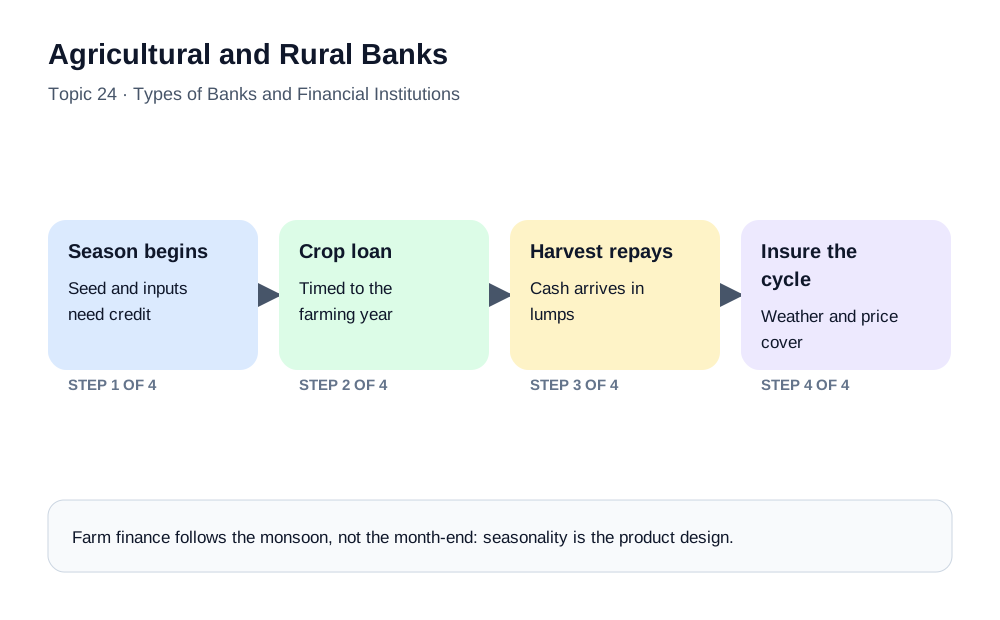
Agricultural and Rural Banks at a glance — Rural credit, land development banks, farm lending.
1. Introduction: Banking for the Oldest Industry
Agriculture employs over a billion people globally and remains the economic backbone of many developing nations. Yet farming is inherently risky — dependent on weather, market prices, and factors beyond any farmer's control. Agricultural banks and rural credit institutions exist to bridge this gap, providing finance that commercial banks often consider too risky.
This is not a niche topic. In much of the world, the question "can ordinary people get credit?" is largely the question "can farmers get credit?" Farm households dominate rural populations across Asia and Africa; their financing needs shaped some of the oldest banking institutions ever created — cooperative credit predates most commercial banking — and the failure or success of rural credit systems has decided elections, triggered crises, and determined whether hundreds of millions escape poverty.
This chapter explains agricultural banking from first principles: why standard lending logic breaks down on the farm, how specialized products and institutions were engineered around those breakdowns, how the lending actually works in practice, why the sector struggles with defaults and politics, and how technology is reshaping rural finance.
Learning objectives. By the end of this chapter you should be able to:
- Explain why conventional bank lending fails agricultural borrowers, from first principles
- Describe the main agricultural finance products — crop loans, term loans, revolving farm credit — and their design logic
- Map the major institutional models: cooperatives, rural banks, refinance institutions, and policy banks
- Analyse the sector's characteristic risks: covariate default, waiver politics, informal competition, climate
- Evaluate modern risk-management tools: crop insurance, satellite monitoring, warehouse receipts, digital lending
- Understand why governments everywhere intervene in farm credit — and the trade-offs of doing so
2. Why Farmers Need Specialized Banking
It is worth pausing on how old this problem is. Rural credit cooperatives were being organised in nineteenth-century Europe precisely because commercial banks of the era would not touch small farmers; government agricultural banks appeared across Asia in the twentieth century for the same reason. The institutions change names and technologies across centuries, but the underlying mismatch they were built to solve has remained remarkably constant.
Standard bank lending rests on assumptions that farming violates one by one. Understanding these violations is the key to understanding every institution in this chapter.
Unique Challenges
- Seasonal income — Revenue comes once or twice a year at harvest, but expenses are continuous
- Weather risk — A single drought or flood can destroy an entire year's income
- No collateral — Many small farmers don't own land or have formal documentation
- Remote locations — Far from bank branches and financial infrastructure
- Low financial literacy — Complex loan terms can be confusing
Each deserves a closer look, because each defeats a specific pillar of conventional lending.
Seasonality defeats cash-flow underwriting. A commercial lender wants steady monthly revenue against steady monthly repayments. A farmer's cash flow is a single spike at harvest — or two, in double-cropped regions — against eleven months of outgoings: seed, fertilizer, labour, school fees, food. Repayment schedules designed for salary earners are structurally wrong for agriculture. Farm credit must be designed around the crop calendar, not the calendar month.
Covariate risk defeats diversification. A bank protects itself by lending to many independent borrowers — one default does not sink the portfolio. Agricultural risk does not work that way. Drought, flood, pest outbreak, and price collapse strike every farmer in a region at once. A rural loan portfolio is not a thousand independent bets; it is one large bet on the local weather and the local crop price. This is why agricultural losses arrive in waves and why private lenders flee the sector precisely when farmers need it most.
Missing collateral defeats secured lending. Land is the obvious farm asset, yet vast numbers of tillers farm leased or informally held land, records are incomplete or contested, and foreclosure on a family's only livelihood is socially and legally fraught even where title is clear. The conventional banker's question — "what can I seize if you default?" — has no good answer.
Distance and documentation defeat onboarding. A borrower two hours from the nearest branch, without payslips, tax records, or formal accounts, is invisible to standard credit processes. The cost of reaching, verifying, and monitoring such borrowers exceeds what their small loans can commercially bear — the same last-mile economics Topic 22 examined for payments.
The result of all four: left purely to commercial logic, formal credit bypasses farmers, and the gap is filled by the oldest rural financier of all — the informal moneylender, whose rates and methods have trapped farming families in debt for generations. Every institution in this chapter exists because some society decided that outcome was unacceptable.
3. The Farmer's Financial Year: A Worked Example
Make the cash-flow problem concrete. Consider a smallholder with two hectares growing a single main crop:
- Months 1–2: Buys seed, fertilizer, and pesticide; hires labour for land preparation and sowing. Cash out, nothing in.
- Months 3–5: Crop grows. Weeding, irrigation, more labour. Household living expenses continue. Cash out, nothing in.
- Month 6: Harvest. The entire year's farm revenue arrives in a few weeks — minus the cost of harvesting and transport. If rain failed at a critical stage, or prices collapsed at harvest time when every neighbour is also selling, the spike is small or negative.
- Months 7–12: The harvest proceeds must cover loan repayment, household consumption, school fees, ceremonies, health shocks, and next season's first inputs.
Now run the arithmetic that breaks conventional lending. Suppose cultivation costs total ₹60,000 and a good harvest yields produce worth ₹95,000 — a healthy ₹35,000 surplus. But a poor monsoon can cut yields by a third, and a harvest-time price glut can cut prices by a quarter; either shock, alone, turns the surplus into a loss. The farmer borrows ₹60,000 hoping for the good case and knowing the bad cases are common. A lender pricing this honestly must charge for real risk — yet the farmer cannot bear genuinely risk-priced rates. This compression between honest risk pricing and bearable cost is the central dilemma of agricultural finance, and it explains both subsidies (the state absorbs part of the risk premium) and moneylenders (who price the risk exploitatively instead).
Notice, too, the timing trap embedded in the calendar: the farmer is cash-richest exactly when every local farmer is cash-richest — harvest — which is exactly when crop prices are lowest. Selling immediately repays the loan but accepts the worst price. This is the problem warehouse receipt financing, discussed later, was invented to solve.
4. Types of Agricultural Finance
Farm credit products are shaped by the crop cycle. Three families dominate.
Crop Loans (Short-term)
- Finance seeds, fertilizer, pesticides, and labor for a single growing season
- Repaid after harvest — typically 6-12 months
- Often subsidized with government interest rate support
The design follows Section 3 directly: disbursement at sowing, a single repayment after harvest, tenor matched to the crop's biological life rather than arbitrary months. In many countries the interest farmers pay on such loans is held below market rates through government subvention — the state paying part of the interest to the lender — with additional incentives for timely repayment. The subsidy logic is Section 2's dilemma: honest risk pricing would exclude the borrowers the policy exists to serve.
Term Loans (Medium/Long-term)
- Finance farm equipment, irrigation systems, land improvement
- Repayment over 3-15 years
- Secured against the asset purchased or farm land
Investment credit behaves more like conventional lending: a tractor or a well generates income over many years, so repayment is amortised, and the asset itself provides security. The agricultural twist is in the underwriting — projected farm income depends on yields and prices, not just the borrower's character — and in the grace periods, which defer repayment until the investment starts producing.
Kisan Credit Card (India)
- A revolving credit facility for farmers
- Provides flexible access to credit for cultivation, post-harvest, and personal needs
- Over 70 million cards issued in India
A note on animal husbandry and allied activities completes the product picture. Rural households rarely live on crops alone — dairy, poultry, fisheries, and goatery smooth income across the year, generating the weekly cash flow that crop farming lacks. Lenders increasingly treat these allied activities as credit-strengthening: a dairy animal producing daily milk is, in cash-flow terms, the closest thing a farm household has to a salary, and modern KCC-type limits explicitly extend to such activities.
The Kisan Credit Card (KCC), introduced in India in the late 1990s, solved a quiet operational problem: farmers were re-applying and re-documenting for every season's loan. The KCC converts the crop loan into a sanctioned, revolving limit — assessed once against landholding and cropping pattern, then drawn and repaid flexibly season after season, often through a card usable at input dealers and ATMs. It bundles working capital, a consumption margin, and increasingly links to insurance. Tens of millions of cards in force make it among the largest targeted credit instruments ever created, and its core idea — assess once, draw flexibly, renew annually — has been widely studied as a template for small-ticket rural credit.
5. Key Institutions: Four Architectural Models
Agricultural finance has been built four ways around the world, often in combination within one country.
Model 1: The Cooperative Pyramid
The oldest model, born in nineteenth-century Europe and exported worldwide, organises farmers themselves into member-owned credit institutions, tiered from village to apex:
- Primary Agricultural Credit Societies (PACS) — Village-level cooperative institutions; over 95,000 across India
- District-level cooperative banks federate the village societies
- A state-level apex bank completes the pyramid
- Land Development Banks — Provide long-term loans for land improvement and farm development, historically the cooperative system's long-term arm
A real-world glimpse of the pyramid at work: a farmer joins the village society with a small shareholding, applies for a crop loan assessed against land records and the district scale of finance, receives funds drawn down from the district cooperative bank — which itself is refinanced by the state apex and, behind that, by NABARD. Money raised at national scale flows through three local tiers to a single field. Each tier adds local knowledge and local accountability; each also adds cost and a point where politics can enter, which is why cooperative reform is a permanent agenda item rather than a completed task.
The cooperative insight is that farmers lending to farmers solves information and enforcement problems no outside bank can: members know each other's land, crops, and character, and social standing backs repayment. The weaknesses mirror the strengths: local capture by dominant families, weak professional management, and political interference have degraded many cooperative systems — yet their village-level reach remains unmatched.
Model 2: Government-Sponsored Rural Banks
- Regional Rural Banks (RRBs) — Government-sponsored banks serving rural areas; 43 RRBs across India
RRBs were created to combine commercial banking discipline with cooperative-style local presence: licensed, regulated banks, owned jointly by the central government, state governments, and sponsor commercial banks, mandated to serve small farmers and rural borrowers in defined territories. They represent the state's direct answer to the last-mile economics problem — institutions whose purpose makes rural lending the business, not the burden (compare the differentiated-licence logic of Topic 22).
Model 3: The Refinance Apex
- NABARD — Apex institution for rural and agricultural credit; refinances banks lending to farmers
Rather than lend to farmers directly, apex development banks lend to the lenders. NABARD refinances cooperative banks, RRBs, and commercial banks against their agricultural portfolios, sets refinancing terms that shape rural credit flows, supports rural infrastructure, and supervises the cooperative and RRB tiers. The model's elegance: one specialised institution carries agricultural credit expertise and policy direction, while distribution stays with thousands of local outlets that already exist.
Model 4: Government-Sponsored Enterprises and Policy Banks
- Farm Credit System — Government-sponsored network providing $380+ billion in loans to agriculture
- USDA Farm Service Agency — Direct government loans to farmers who cannot get commercial credit
- Agricultural Development Bank of China — One of China's policy banks, focused on rural areas
- Land Bank of the Philippines — Government bank for agricultural and rural development
The American Farm Credit System is a borrower-owned cooperative network — farmers ultimately own the associations that lend to them — created with government sponsorship to fund itself in bond markets at favourable rates and lend long to agriculture and rural America. The USDA's Farm Service Agency occupies the last-resort niche: direct and guaranteed loans for family farmers whom commercial lenders decline. China's policy-bank model channels state-directed rural funding at national scale; the Philippines' Land Bank combines development mandate with commercial operations. Different wrappers, one idea: agriculture's financing gaps are persistent enough that the state institutionalises itself into the credit chain.
6. How Agricultural Lending Works in Practice
The operational workflow of a crop loan shows how theory meets soil. The steps below describe a typical subsidised smallholder loan; details vary by country and institution, but the logic is general.
1. Eligibility and documentation. The lender establishes who farms what: land records where they exist, tenancy certificates or alternative proof where they do not, identity documents, and the cropping pattern. Documentation gaps are the first battleground — decades of land-record digitisation and farmer registries have been aimed precisely at this step.
2. The scale of finance. Rather than appraising each farmer's budget from scratch, rural systems use locally published per-hectare cost norms — the "scale of finance" — for each crop in each district: what agronomists and administrators judge a season's inputs should cost. The loan amount flows from land size × crop × norm. It is industrialised underwriting for borrowers who have no accounts to analyse.
3. Disbursement tied to the season. Funds are released at or before sowing, sometimes partly in kind or directly to input dealers to ensure the money buys seed and fertilizer rather than leaking to consumption — a design trade-off between control and farmer dignity.
4. Monitoring. Field visits, increasingly supplemented by satellite imagery and mobile reporting, track whether the crop exists and is progressing — verification that the loan funded agriculture rather than something else.
5. Repayment at harvest. A single post-harvest settlement, with timely-repayment incentives in subsidised schemes. Renewal for the next season follows automatically for good performers — the revolving logic the KCC formalised.
6. When it goes wrong. Restructuring after weather disasters, insurance claims where cover exists, and — the system's chronic disease — political intervention, examined next.
7. Challenges in Agricultural Banking
| Challenge | Impact |
|---|---|
| High default rates | Weather failures and price volatility cause widespread defaults |
| Loan waiver politics | Government debt forgiveness programs undermine credit discipline |
| Informal lending | Moneylenders still dominate in many rural areas at exploitative rates |
| Documentation gaps | Lack of land records and formal identification |
| Climate change | Increasing weather unpredictability raises systemic risk |
Covariate default is the structural problem from Section 2 arriving as balance-sheet reality: when the monsoon fails, a rural lender's portfolio does not deteriorate — it cliffs. Recovery infrastructure, collateral values (land aside), and legal remedies are all weakest exactly where defaults arrive in waves. This is why agricultural portfolios carry higher loss expectations and why governments absorb risk through subsidies, guarantees, and insurance rather than pretending the risk away.
Loan waiver politics is the sector's self-inflicted wound. Periodic government announcements forgiving farm debt deliver real relief to genuinely distressed households — and simultaneously teach the entire borrower population that repayment is optional if enough people wait. Each waiver degrades repayment culture, raises future loss rates, tightens future lending, and thus manufactures the next crisis that justifies the next waiver. Breaking this cycle is among the hardest governance problems in development finance; the least-bad answers — targeted relief through insurance and income support rather than blanket forgiveness — are known but politically expensive.
Informal moneylenders persist not from ignorance but from product design: they lend instantly, at any hour, against any purpose, with no paperwork, and enforce through proximity. Formal lenders beat them on price by an order of magnitude yet lose on convenience, speed, and dignity of process. Every successful rural finance innovation — the KCC's revolving limit, digital disbursement, doorstep banking — is best understood as closing the convenience gap that keeps the moneylender in business.
Documentation gaps and climate change complete the picture: the first keeps borrowers invisible to formal underwriting, the second raises the variance of every risk model built on historical weather. Portfolios priced on the climate of the past forty years are being asked to absorb the climate of the next forty.
8. Modern Solutions: Engineering Around the Risk
- Crop insurance — Government-backed schemes that protect farmer income (PM Fasal Bima Yojana in India)
- Satellite monitoring — Using satellite data to assess crop conditions and verify claims
- Digital lending — Mobile-based loan applications and disbursement
- Warehouse receipt financing — Loans against stored harvest, allowing farmers to wait for better prices
Each tool attacks a specific failure from Section 2.
Crop insurance attacks covariate risk at its source. If the state and premium pools absorb yield losses, the farmer's repayment capacity survives the drought and the lender's cliff flattens. Large national schemes — India's PMFBY is among the world's biggest — combine subsidised premiums with technology-based assessment. The honest difficulties: claim settlement speed, basis risk (the insured area's average is fine while your field failed), and coverage that rarely reaches the poorest.
Satellite monitoring attacks information asymmetry. Remote sensing verifies sowing, tracks crop health through the season, and estimates yield at district scale — cutting the cost of both loan monitoring and insurance claims adjustment, and making fraud (loans for phantom crops) harder. It does not replace field knowledge, but it makes rural portfolios legible to distant underwriters for the first time.
Digital lending attacks last-mile economics. Mobile applications, Aadhaar-class digital identity, and account-based disbursement collapse the cost of reaching the remote borrower — the same distribution revolution as Topic 22's payment banks, applied to farm credit. The caution is inherited from Topic 21's digital lending discussion: speed must not strip out suitability, and rural borrowers are the least equipped to contest digital mis-selling.
Two cautions temper the optimism. First, technology lowers the cost of lending but not the underlying risk — a drought defeats a digital loan as surely as a paper one, so insurance and state risk-sharing remain the foundation. Second, every digital channel that speeds disbursement also speeds over-indebtedness; rural borrowers juggling multiple app-based loans with no consolidated credit view is the emerging failure mode regulators are only beginning to map.
Warehouse receipt financing attacks the harvest-price trap. A farmer deposits the harvest in an accredited warehouse, receives a receipt certifying quantity and grade, and borrows against it immediately — repaying months later when the post-harvest glut has passed and prices recovered. The crop becomes collateral; distress selling becomes optional. Where warehouse infrastructure and receipt law are trustworthy, this single instrument measurably raises farmgate incomes.
9. Why Governments Always End Up Here
Step back and a pattern emerges: in virtually every country, rich or poor, farm credit carries state fingerprints — refinance apexes, interest subsidies, guarantee schemes, sponsored banks, insurance backstops. This is not sentimental. Three hard reasons compel it.
Food security is national security. A country that cannot finance its planting season does not eat reliably; no government leaves that to unassisted markets.
Covariate risk is uninsurable privately at scale. Private markets price correlated, catastrophe-like agricultural risk at levels no farmer can pay. Risk-sharing through the state is the only known way to keep formal credit in the sector through the bad years.
Rural political economy demands it. Farm households are numerous, organised, and electorally decisive in most democracies; visible rural distress forces a policy response. The craft — this chapter's recurring theme — is designing intervention that relieves distress without destroying credit discipline: subsidies for inputs and insurance rather than forgiveness of loans, refinance rather than direction, targeted income support rather than blanket waivers.
From the farmer's perspective, the entire architecture collapses into one question: when I need money at sowing, is there a fair, fast, dignified way to get it — and if the crop fails, do I lose my land or merely my season? From the bank's perspective, the same architecture answers a different question: how do we hold a mandated, high-variance portfolio without it consuming the institution — through refinance, guarantees, insurance, and pricing that political reality allows? Good agricultural banking policy is simply the art of making those two answers compatible.
For the banking system, agricultural mandates (such as priority-sector lending obligations, covered in Topic 22's context) convert this policy into portfolio reality: banks must either lend to agriculture or place the shortfall with apex institutions at low returns. Farm credit is not merely a market banks may enter; in many jurisdictions it is an obligation of the banking licence itself.
10. Frequently Asked Questions
What is a Regional Rural Bank and who owns it? An RRB is a licensed, regulated commercial bank confined to a defined rural territory and mandated to serve small farmers and rural borrowers. Ownership is shared between the central government, the state government, and a sponsor commercial bank — a structure designed to combine public purpose with professional banking management. India's 43 RRBs form one of the world's largest purpose-built rural banking networks.
Why do farmers pay more for credit than city borrowers — or get none at all? Because the honest risk is higher and the service cost is greater: covariate weather risk, thin or missing collateral, remote locations, and small loan sizes all raise the true cost of lending. Where governments do not absorb part of that cost, formal lenders withdraw and informal moneylenders fill the gap at far higher prices.
What is a crop loan, exactly? Short-term credit matching one growing season: disbursed at sowing to fund seed, fertilizer, pesticide, and labour; repaid in a single settlement after harvest, typically within 6–12 months. The tenor follows the crop's biology, not the calendar year.
How can a farmer with no land title borrow? Through the mechanisms this chapter described: tenancy or cultivation certificates, group guarantees, cooperative membership, KCC-style limits based on actual cropping rather than title, and lending against movable collateral such as stored produce or livestock. Documentation innovation, not charity, is what brings the landless into formal credit.
What is NABARD's role — does it lend to farmers? Almost never directly. It is a refinance and development apex: it funds the cooperative banks, RRBs, and commercial banks that lend to farmers, sets terms that steer rural credit, supports rural infrastructure, and supervises the rural cooperative tiers. Farmers meet the local institutions; NABARD stands behind them.
Why are farm loan waivers considered harmful by bankers? Because credit runs on expected repayment. A blanket waiver transfers real relief to distressed households but also signals to every borrower that waiting may be cheaper than paying — raising default rates, tightening future lending, and setting up the next crisis. Targeted insurance and income support relieve distress without poisoning the expectation that loans are repaid.
What is the Kisan Credit Card? A revolving farm credit limit — assessed once against land and cropping pattern, then drawn flexibly for cultivation, post-harvest, and household needs, renewed annually. With over 70 million cards issued, it is India's main instrument for delivering seasonal credit without repetitive paperwork.
Do farmers need a bank account to get a crop loan? Effectively yes, and increasingly by design: subsidised interest, insurance payouts, and government support payments are now routed through bank accounts so that benefits reach the farmer without leakage. Account ownership — itself transformed by the inclusion drives described in Topic 22 — has become the entry ticket to the entire rural credit stack described in this chapter.
How does crop insurance connect to farm loans? Tightly: insurance protects the harvest income from which the loan is repaid, so lenders favour insured borrowers, and many subsidised loan schemes bundle or require insurance. It converts the lender's covariate cliff into a payable claim — in theory. Settlement speed and basis risk are the practical battlegrounds.
What is warehouse receipt financing? The farmer stores the harvest in an accredited warehouse, receives a receipt proving quantity and grade, and borrows against it — repaying after prices recover from the post-harvest glut. It turns the crop itself into collateral and frees the farmer from forced sale at the year's worst price.
Is agricultural banking only a developing-country topic? No. The United States runs the Farm Credit System ($380+ billion in loans) and the USDA's Farm Service Agency; Europe's cooperative banks trace their roots to nineteenth-century farm credit. The risks — weather, prices, seasonality — are universal; only the institutional wrappers differ.
What does climate change do to farm lending? Raises the variance of everything: historical weather patterns underwrite today's loan pricing, insurance premiums, and refinancing terms. More volatile rainfall and more frequent extremes mean loss models built on the past understate the future — pushing up honest risk prices and increasing the state's share of risk absorption.
11. Key Terms in This Chapter
- Crop loan — short-term, season-matched credit for cultivation inputs, repaid after harvest.
- Term loan (agriculture) — medium/long-term credit for farm investment — equipment, irrigation, land improvement.
- Allied activities — dairy, poultry, fisheries, and other non-crop farm enterprises that give rural households weekly cash flow between harvests.
- Kisan Credit Card (KCC) — India's revolving farm credit facility; assess once, draw flexibly, renew annually.
- Scale of finance — locally fixed per-hectare cultivation cost norms used to size crop loans.
- Covariate risk — risk that strikes all borrowers in a region simultaneously (drought, flood, price collapse).
- PACS — Primary Agricultural Credit Societies, village-level cooperative lenders.
- RRB — Regional Rural Bank, a government-sponsored bank serving defined rural territories.
- NABARD — India's apex refinance and development institution for rural and agricultural credit.
- Land Development Bank — long-term cooperative lender for land improvement and farm development.
- Farm Credit System — the US borrower-owned, government-sponsored agricultural lending network.
- Interest subvention — government payment of part of the borrower's interest to make farm credit bearable.
- Loan waiver — political forgiveness of farm debt; relief today, credit-culture damage tomorrow.
- Warehouse receipt financing — loans against documented stored harvest, escaping distress sales.
- Basis risk — the gap between an insurance scheme's measured loss and an individual farmer's actual loss.
12. Interview Insights: How This Topic Appears in Banking Interviews
"Why is agricultural lending fundamentally different from ordinary lending?" Give the four violations: seasonal cash flow defeats monthly repayment logic; covariate risk defeats diversification; missing title defeats secured lending; distance and documentation defeat onboarding economics. Conclude that the entire institutional architecture — cooperatives, RRBs, refinance apexes, subsidies — is engineering around these four failures.
"If farm credit is so risky, why do governments force banks into it?" Food security, uninsurable-at-scale covariate risk, and rural political economy. Then show nuance: the design question is not whether the state intervenes but how — subvention and insurance preserve repayment culture; blanket waivers destroy it. That distinction is the mark of a strong answer.
"How would you fix chronic farm loan defaults?" Attack causes, not symptoms: insurance with fast, technology-verified settlement for weather shocks; warehouse receipts against price shocks; revolving KCC-style limits against paperwork friction; land-record digitisation against invisibility; and political commitment to relief-through-insurance rather than relief-through-forgiveness. Acknowledge honestly that the last item is the hardest.
"What is the role of technology in rural credit?" Frame by the failures it fixes: satellite monitoring fixes information asymmetry; digital identity and disbursement fix last-mile cost; warehouse receipts fix the harvest-price trap; data-driven insurance fixes claim settlement. Caution that technology accelerates both good and bad lending — speed without suitability repeats microfinance's worst chapters.
"Why do moneylenders still survive alongside subsidised farm credit?" Because they win on product, not price: instant disbursement, zero paperwork, any purpose, doorstep enforcement. Formal credit beats them on rate and loses on convenience. Every serious rural finance innovation is a convenience-gap closure strategy — a genuinely insightful answer most candidates miss.
Summary and Key Takeaways
Agricultural banking is the art of lending where banking's standard assumptions fail — and it matters because it determines credit access for a large share of humanity. The essential points:
- Farming violates lending's four pillars: seasonal cash flow, covariate weather risk, missing collateral, and remote undocumented borrowers each defeat a standard underwriting assumption.
- Products follow the crop, not the calendar: crop loans match the growing season, term loans fund multi-year investment, and revolving facilities like the KCC remove repetitive paperwork.
- Four institutional models carry the load: cooperative pyramids, government-sponsored rural banks, refinance apexes like NABARD, and policy or sponsored institutions like the Farm Credit System.
- Covariate risk is the sector's defining peril: when weather fails, portfolios cliff rather than deteriorate — which is why the state is always somewhere in the risk-sharing chain.
- Loan waivers relieve today and poison tomorrow: the waiver cycle is agricultural finance's chronic disease; insurance and income support are the known, politically costly cure.
- Moneylenders survive on convenience, not price: formal credit wins the rate war and loses the product war — closing that gap is the industry's real frontier.
- Technology is rewiring rural credit: satellite monitoring, digital lending, crop insurance, and warehouse receipts each target a specific structural failure.
- Government presence is structural, not accidental: food security, uninsurable risk, and rural politics guarantee it — the craft is intervening without destroying credit discipline.
- The two questions must reconcile: the farmer asks for fair, fast, dignified credit that survives a failed season; the bank asks how to hold a mandated, high-variance portfolio sustainably — good policy is making both answers yes.
One thread connects every section of this chapter: agricultural banking succeeds or fails on how honestly it prices time and weather. Products, institutions, subsidies, and satellites are all, in the end, different ways of giving the farmer's calendar and the farmer's sky a fair hearing inside a financial system built for monthly salaries and diversifiable risk. Where that hearing is fair, rural credit compounds into prosperity; where it is not, the moneylender is always waiting.
In the next topic, we look at an institution hiding in plain sight in towns and villages worldwide — the post office — and how postal banking and savings systems turned mail networks into one of history's great financial inclusion machines.
Next: Topic 25 — Postal Banking and Savings Systems →
<!-- MBA-DEEP-DIVE-START -->Deep Dive: Agricultural and Rural Banking as Cash-Flow Banking
Agricultural banking is often described as lending to farmers, but that definition is too small. Rural finance sits inside a complete economic system that includes crop production, livestock, fisheries, storage, transport, input dealers, traders, cooperatives, processors, rural households, self-help groups, microenterprises, and local infrastructure. A strong rural bank therefore finances cash-flow chains, not just individual farm loans.
The defining challenge is that rural cash flows are highly seasonal and exposed to risks outside the borrower’s control. A farmer may spend for months before earning anything. Rainfall, pests, disease, input prices, market prices, transport disruption, and policy changes can all affect repayment capacity. Traditional monthly-salary underwriting does not fit this reality.
The correct starting point is therefore cash-flow timing. Credit should be structured around when money is needed and when income is realistically generated.
Production credit and investment credit are different
A farmer may need short-term money to buy seeds, fertiliser, feed, labour, fuel, or crop protection. This is production or working-capital credit. Repayment should align with the production cycle and expected sale of output.
The same borrower may also need long-term finance for a tractor, irrigation system, dairy unit, greenhouse, orchard, cold-storage facility, or land improvement. This is investment credit. The asset is expected to produce benefits over several years, so the repayment profile should reflect that longer economic life.
Confusing these two creates poor lending. Funding a five-year irrigation investment with a six-month facility creates refinancing pressure. Giving a five-year term loan for seasonal seed purchases can encourage repeated borrowing without disciplined working-capital control.
Good rural banking matches the tenor of the loan to the cash-generating life of the activity.
Seasonal cash flow changes everything
Imagine a paddy farmer who spends ₹3 lakh over four months and receives almost all revenue only after harvest. A monthly EMI beginning immediately after disbursement does not reflect the business. The farmer may be forced to borrow elsewhere merely to service the first loan before the crop is sold.
A better structure may provide a seasonal repayment schedule after harvest, subject to the applicable product and regulatory framework. The underwriting should estimate realistic yield, expected sale price, input cost, household withdrawals, existing debt, and downside scenarios.
The same principle applies to dairy, poultry, fisheries, plantations, and horticulture, but the cash cycles differ. Dairy may generate frequent cash receipts. Orchards can take years before reaching productive maturity. Fisheries may depend on stocking and harvest cycles. A lender that treats all agriculture as one asset class is not truly underwriting agriculture.
Crop risk versus borrower risk
One of the hardest analytical distinctions is between borrower weakness and external production shock.
A borrower who diverted funds, falsified records, or repeatedly failed to manage the farm may present a genuine credit problem. A disciplined farmer hit by a severe flood or drought presents a different problem. The loan may be stressed even though the borrower’s character and operating capability remain strong.
This distinction matters for restructuring and collections. Temporary support to a fundamentally viable farmer can preserve both livelihood and lender value. Repeatedly restructuring an unviable operation without diagnosis only delays loss recognition.
Field intelligence is therefore important. Rural lenders need reliable data on weather events, crop damage, commodity prices, local market conditions, and borrower behaviour, not merely centralised delinquency reports.
Collateral has limits
Land is often viewed as the natural collateral for agricultural lending, but a rural lender should not assume that collateral alone solves credit risk. Legal title may be complex. Land may have family claims, tenancy arrangements, or restrictions. Enforcement can be socially and legally difficult. Market value can be uncertain or highly local.
More importantly, a borrower repays from cash flow, not from collateral. Collateral is a secondary protection if repayment fails. A loan secured on valuable land can still become a poor credit decision if the farm does not generate sufficient income.
This is why rural finance increasingly uses a wider evidence base: crop patterns, acreage, input purchases, sale receipts, bank transactions, milk collection records, warehouse receipts, satellite or weather data where reliable and lawful, and local business history.
Agricultural value-chain finance
A powerful way to reduce information gaps is to finance the value chain rather than isolated participants.
Consider a dairy cooperative. Farmers deliver milk daily. The cooperative records quantity and quality and pays members regularly. A bank financing those farmers can use verified milk-supply records as evidence of cash flow. Repayment may be linked to payment flows from the cooperative, subject to consent and legal structure.
Similarly, a bank financing crop production may also understand the input supplier, warehouse, processor, and off-taker. Contract farming arrangements can provide more predictable demand, although the lender must still assess contract enforceability and buyer concentration.
Value-chain finance can reduce risk because the bank sees how goods and money move from production to sale.
Warehouse receipts and post-harvest finance
Farmers often face pressure to sell immediately after harvest when market supply is high and prices may be weak. Storage finance can change that economics.
Where a credible warehouse system exists, a farmer or trader can deposit produce in an approved warehouse and receive evidence of quantity and quality. The bank can lend against the stored commodity, applying an appropriate margin or haircut.
This creates inventory-backed finance. But the bank must manage commodity price risk, quality deterioration, warehouse fraud, insurance, title, and the credibility of the receipt system. A warehouse receipt is valuable only if the underlying goods really exist and cannot be pledged twice.
Rural institutions form an ecosystem
India’s rural credit system includes commercial banks, Regional Rural Banks, cooperative banks, Small Finance Banks, microfinance institutions, NBFCs, and specialised development institutions. NABARD plays a central developmental and refinancing role in the rural financial architecture, including refinance support to eligible institutions for agriculture and allied activities.
The important learning point is that rural finance is multi-layered. The institution that ultimately provides credit to the farmer may itself be funded or supported by a larger bank or development institution. Policy, refinance, guarantee, and priority-sector frameworks can influence the final availability and pricing of rural credit.
For a business analyst, this means a ‘farm loan’ may involve more entities than the customer sees: originating branch, central credit system, refinance institution, insurance provider, subsidy or government scheme, credit bureau, payment system, and sometimes a cooperative or aggregator.
Priority-sector policy and credit allocation
India’s priority-sector framework is designed to ensure adequate bank credit reaches sectors considered important to socioeconomic development, including agriculture and specified underserved categories. The current framework is set through RBI directions and includes classification rules and targets for applicable regulated banks.
The practical lesson is not merely that agriculture is a priority sector. The bank must correctly classify, document, monitor, and report eligible exposures. A loan does not become priority sector just because the customer lives in a village. Eligibility depends on the purpose, borrower, amount or category, and applicable regulatory definitions.
Misclassification can create regulatory reporting errors even when the underlying loan is performing well.
Small and marginal farmers require different economics
Smaller borrowers often need small-ticket credit but can be expensive to serve through a traditional branch model. Travel, field verification, documentation, cash handling, and collections can cost nearly as much for a ₹50,000 loan as for a much larger facility.
Technology can reduce this cost through digital KYC where permitted, mobile applications, remote data collection, electronic payments, geotagging, and centralised processing. But digital efficiency should not remove the local context that makes rural underwriting accurate.
A useful model is centralised policy plus local evidence. Central systems define eligibility, limits, risk rules, and audit trails. Field teams verify land, crop, business activity, livestock, or local cash flows. Neither element is sufficient alone.
Self-help groups and group-based finance
Group-based models can extend credit to borrowers who lack conventional collateral or formal credit histories. Self-help groups can build savings discipline, peer support, and records of collective financial behaviour.
The value comes from repeated interaction and social capital, but lenders should avoid simplistic assumptions that group pressure guarantees repayment. Poorly designed group lending can create coercion, over-borrowing, or hidden multiple indebtedness.
Credit assessment should therefore include existing obligations, household cash flow, group performance, and the capacity of members to repay without taking new loans simply to service old ones.
Agricultural insurance and credit risk
Insurance can reduce the financial impact of weather or other covered events, but it does not eliminate credit risk. Claim eligibility, coverage limits, deductibles, basis risk, claim timing, and documentation all matter.
A lender should not assume that ‘insured’ means ‘fully protected’. If a crop fails and the claim takes months to settle, the borrower may still face immediate liquidity stress. If the insurance trigger does not perfectly match the farmer’s actual loss, the payout may be insufficient.
Credit and insurance should therefore be analysed together, especially for highly weather-sensitive activities.
Rural payments are part of rural banking
Credit is only one side of the relationship. Rural customers need reliable receipt and payment channels for wages, pensions, benefits, crop proceeds, input purchases, remittances, and household spending.
Digital payments can reduce cash handling and create useful transaction histories, but they also introduce new fraud risks. Social engineering, OTP theft, fake customer-support calls, agent fraud, and misuse of credentials can disproportionately affect customers with limited digital experience.
Financial inclusion is not achieved by opening an account if the customer cannot use it safely.
Banks should combine technology with customer education, transaction alerts, accessible complaint channels, agent controls, and clear recovery mechanisms for failed or disputed transactions.
Business correspondents and the last mile
Remote rural areas may not justify a full-service branch, so business correspondents can provide assisted banking services. This extends reach but creates a distributed operational network.
The bank must know who its agents are, what services each is authorised to perform, how cash is managed, how devices are secured, how customer identity is verified, and how daily transactions reconcile.
A recurring control principle is that the agent should assist the customer without becoming the customer. PINs, passwords, and OTPs should remain under customer control. Authentication should not be bypassed because the agent is familiar with the village.
Cash management and branch reality
Rural branches can face practical cash challenges that urban digital models rarely consider. Crop-sale periods, pension days, government transfers, festivals, or local market days can generate sudden cash demand. Poor roads or distance from currency chests can make replenishment slower.
The branch therefore needs cash forecasting, insurance, secure transport, dual control, vault limits, counterfeit detection, and contingency arrangements. Excess cash creates security and idle-fund risk; insufficient cash damages customer trust.
Cash operations are part of liquidity management at the physical edge of the banking system.
Climate risk is already credit risk
Agriculture is directly exposed to climate variability. Changes in rainfall patterns, heat, water availability, pests, and extreme weather can affect yield, livestock health, and land productivity.
A rural lender should therefore include climate considerations in portfolio risk. Are loans concentrated in water-intensive crops in a stressed basin? Does a region depend on one monsoon pattern? Are borrowers financing assets that remain productive under likely future conditions?
Climate risk need not be modelled perfectly to improve lending decisions. Even simple scenario analysis can reveal concentrations that ordinary credit scoring misses.
A complete crop-finance example
Suppose a farmer cultivates 20 acres of cotton. The bank estimates total seasonal cost at ₹12 lakh. The farmer contributes ₹2 lakh and seeks ₹10 lakh of working-capital finance.
Underwriting reviews land or tenancy evidence, previous yields, input purchases, irrigation, existing debt, past repayment, local pest history, expected crop price, and household cash needs. The bank does not use the best historical price; it uses a conservative assumption and tests a lower-yield scenario.
During the season, the branch monitors major weather or pest events. At harvest, the farmer sells through a market channel and receives proceeds into the account. The loan is repaid from the crop cash flow.
If a severe documented flood destroys much of the crop, the bank reassesses viability rather than treating the event exactly like strategic default. If the farmer diverted the loan to speculative trading instead, the risk response is different.
This is what cash-flow banking means: the lender understands why money is borrowed, how value is created, when cash returns, and what can interrupt the cycle.
How to judge a strong rural lender
A world-class agricultural or rural bank should understand seasonal cash flow, not force every borrower into generic monthly repayment. It should distinguish production credit from investment credit, use collateral as secondary protection, manage geographic and commodity concentration, integrate field evidence with data, control agents, reconcile rural payment flows, detect over-indebtedness, use insurance realistically, and monitor climate exposure.
The ultimate test is whether credit improves productive capacity without trapping borrowers in refinancing dependence. Rural banking succeeds when the lender’s repayment schedule fits the borrower’s real economy — seed to harvest, calf to milk, pond to fish, machine to production — rather than forcing the rural economy to imitate a salaried urban household.
<!-- MBA-DEEP-DIVE-END -->