Visual overview
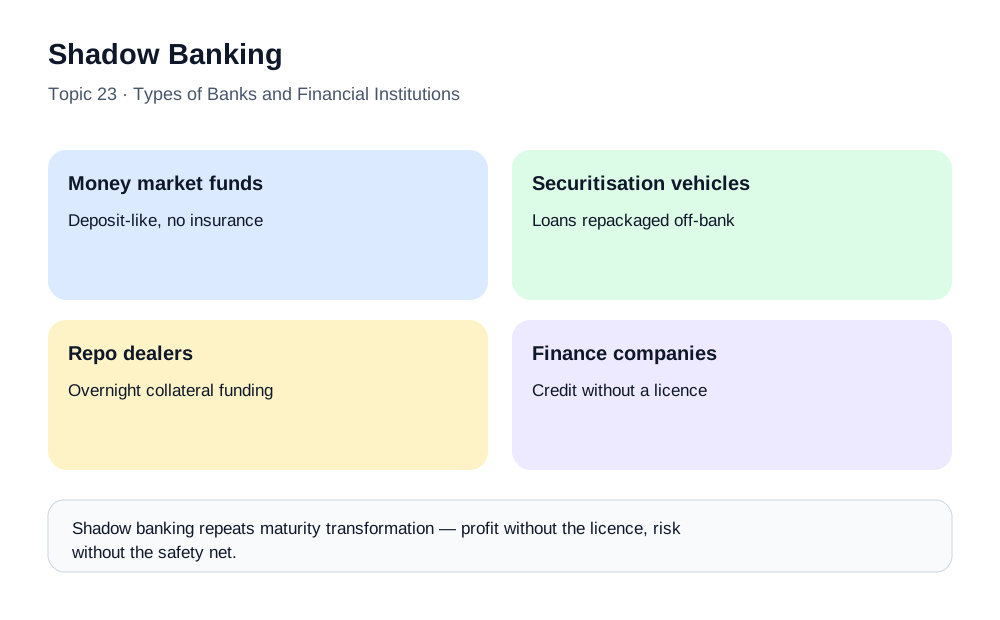
Shadow Banking at a glance — Non-bank intermediaries, money market funds, SIVs.
1. Introduction: Banking Without the Licence — or the Safety Net
The shadow banking system — more formally called non-bank financial intermediation — performs bank-like functions outside the traditional banking regulatory framework. It provides credit, liquidity, and maturity transformation without the safety nets (deposit insurance, central bank access) that protect traditional banks. It played a central role in the 2008 financial crisis.
The name is misleading in one important way. "Shadow" suggests something hidden or illicit. Most shadow banking is neither: it is legal, disclosed, and performed by some of the largest, most respectable institutions in finance — money market funds, asset managers, securitization vehicles. What makes it "shadow" is not secrecy but position: it stands outside the regulatory perimeter that defines banking, and therefore outside the protections — and constraints — that come with that perimeter.
This chapter builds the topic from first principles. We first establish what banks actually do — the three transformations at the heart of credit intermediation — then show how shadow banking performs the same transformations by different means. We examine the key entities, the system's enormous scale, and the mechanics of the 2008 crisis, in which shadow banking was not a sideshow but the main stage. Finally we review the reforms that followed and the forms shadow banking takes today.
Learning objectives. By the end of this chapter you should be able to:
- Define shadow banking precisely and distinguish it from both traditional banking and illegal finance
- Explain the three transformations — maturity, credit, liquidity — and how shadow banks perform each
- Describe the major entity types: money market funds, SIVs, conduits, repo markets, and others
- Explain why shadow banking is structurally fragile despite being legal and sophisticated
- Trace the shadow banking chain through the 2008 financial crisis step by step
- Evaluate post-crisis reforms and recognise the system's modern forms
2. What Is Shadow Banking?
Shadow banking refers to credit intermediation involving entities and activities outside the regular banking system. It includes:
- Money market funds
- Hedge funds
- Structured investment vehicles (SIVs)
- Securitization conduits
- Securities lending and repo markets
- Peer-to-peer lending platforms
The modern official term — non-bank financial intermediation (NBFI), used by the Financial Stability Board — captures the idea more neutrally: financial intermediation that happens somewhere other than inside a licensed bank.
The Boundary, Precisely Drawn
Earlier chapters established the perimeter from several directions. Topic 12 showed that banks uniquely create deposit money when they lend. Topic 21 examined NBFCs — licensed non-banks that lend but cannot take demand deposits. Topic 22 covered narrow licences designed for inclusion. Shadow banking lies beyond all of these: not merely non-bank, but substantially outside banking regulation altogether.
A practical test identifies the territory. Ask of any credit arrangement: if the funding runs, who absorbs the panic?
- For a bank deposit, the answer is the state: deposit insurance pays, and the central bank lends as last resort.
- For a money market fund share, a repo loan, or a securitized note, the answer is: nobody, automatically. The investor or lender bears the loss or the run.
That absence — credit intermediation without a public backstop — is the defining feature. Everything else in this chapter follows from it.
Why Does Shadow Banking Exist?
Three durable reasons explain why so much credit intermediation migrates outside the perimeter.
1. Regulation has a price, and arbitrage has a profit. Bank capital requirements, reserve rules, and supervision are deliberately costly — they are the price of the safety net. Where the same economic function can be performed outside the perimeter, the saving on regulatory cost is real money. Some of shadow banking is, frankly, regulatory arbitrage: moving activity to where it is cheapest rather than where it is safest.
2. Investors want what banks do not offer. Money market funds offer slightly higher yields than insured deposits with near-instant liquidity. Securitized products offer investors exposure to specific asset pools with specific risk-return shapes. These are genuine services meeting genuine demand, not mere loopholes.
3. Banks themselves built much of it. As we will see, the great pre-2008 shadow banking structures — SIVs, conduits — were sponsored by major banks precisely to move assets and risk off their regulated balance sheets while keeping the economics. The shadow system was not banking's competitor; in large part, it was banking's shadow in the literal sense — cast by the banks themselves.
3. The Three Transformations: What Shadow Banking Shares with Banking
To see why shadow banking is bank-like, recall what banking fundamentally does. Topic 12 covered this in the context of money creation; here the same three transformations define the functional core.
Maturity Transformation
- Borrowing short-term (overnight or monthly) and lending long-term
- This is exactly what banks do, but shadow banks do it without deposit insurance or central bank backstops
The mechanism deserves a closer look. A money market fund takes money that investors can withdraw daily and buys debt maturing in weeks or months. An SIV borrowed in markets measured in days and held securities maturing in years. In each case, the institution earns the spread between short-term funding costs and long-term asset yields — the oldest trade in finance. And in each case, it carries the oldest risk: if short-term funders demand their money back at once, long-term assets cannot be sold fast enough except at fire-sale prices.
Banks run the same mismatch, but their short-term funders (depositors) are sticky — insured, and protected by the knowledge that the central bank stands behind the system. Shadow banking's funders are the opposite: sophisticated, uninsured, and fast. This is why the maturity mismatch that banks have managed for centuries becomes, in the shadow system, a hair trigger.
Credit Intermediation
- Creating credit through chains of entities — originators, securitizers, distributors
- Mortgages are originated by a lender, packaged into securities (MBS), and sold to investors
Traditional banking intermediates credit inside one balance sheet: deposit in, loan out, the bank between. Shadow banking intermediates credit across a chain: an originator makes the loan, a securitizer packages it, rating agencies grade the pieces, distributors sell them, and investors hold the risk. The chain can stretch credit supply enormously — more savers' money can reach more borrowers than any single balance sheet allows. It can also stretch accountability until no single link feels responsible for loan quality — a theme the 2008 section develops fully.
Liquidity Transformation
- Converting illiquid assets (like mortgages) into liquid securities that can be traded
A thirty-year mortgage is about as illiquid as an asset gets. Sliced into securities, rated, and listed, it becomes something a pension fund can buy on Tuesday and sell on Thursday. This transformation creates real value — deeper markets, cheaper credit for borrowers. Its shadow side: the liquidity is fair-weather. In calm markets a mortgage-backed security trades like a bond; in a panic, when every holder tries to sell simultaneously, the underlying illiquidity reasserts itself violently. Liquidity transformation does not abolish illiquidity — it stores it for a rainy day.
4. Key Entities in the Shadow System
Money Market Funds
- Pool investor money and invest in short-term debt (commercial paper, Treasury bills)
- Offer returns higher than bank deposits with promised liquidity
- The Reserve Primary Fund "broke the buck" in September 2008, triggering panic
Money market funds are the shadow system's closest analogue to a bank. Investors treat their shares as cash-equivalent: stable value, same-day redemption, a yield slightly above deposits. For decades the fiction held that a share was always worth exactly one dollar.
That fiction is what makes them fragile. A bank depositor who doubts the bank is protected by insurance and therefore has little reason to run. A money market investor who doubts the fund has every reason to run first — redemption is at the promised stable value until the fund's losses force it to "break the buck," so the last redeemer bears the loss. The incentive structure guarantees that doubt becomes stampede. In September 2008, the Reserve Primary Fund — one of America's oldest — held debt of the failed Lehman Brothers, broke the buck, and within days hundreds of billions fled prime money funds. The run stopped only when the US government extended an extraordinary temporary guarantee to the entire industry: the shadow system, in its hour of crisis, had to be rescued with precisely the bank-style backstop it had operated without.
Structured Investment Vehicles (SIVs)
- Off-balance-sheet entities that borrowed short-term and invested in long-term securities
- Major banks like Citigroup sponsored billions in SIVs
- When funding dried up in 2007-2008, SIVs collapsed, forcing banks to take massive losses
The SIV was regulatory arbitrage made architectural. A bank would sponsor a legally separate vehicle, which issued short-term paper and bought long-term, higher-yielding securities — capturing the maturity-transformation spread. Because the SIV sat technically off the bank's balance sheet, the bank held little capital against its risks, even though the bank's sponsorship — and implicit promise of support — was what made the SIV's paper saleable at all.
The structure's fatal assumption was continuous refinancing. When short-term markets seized in 2007–2008, SIVs could not roll their paper, could not sell assets except into a collapsing market, and faced death by maturity mismatch. Their sponsoring banks then confronted a choice between reputational ruin and formal rescue — and chose rescue, taking tens of billions in SIV assets and losses back onto balance sheets that had never held capital against them. The "off-balance-sheet" risk proved, in the end, to be on-balance-sheet in every way that mattered.
Repo Markets
- Repurchase agreements are collateralized short-term loans between financial institutions
- A firm sells securities with an agreement to repurchase them the next day
- The repo market provides trillions in daily funding to the financial system
Repo is the shadow system's plumbing — and its most underestimated run risk. In substance a repo is a secured overnight loan: the borrower gets cash, the lender holds securities as collateral, and both unwind the next day. Because it is collateralized, it feels safe. But the safety has a catch: the collateral's value is marked to market, and lenders protect themselves with "haircuts" — lending less than the collateral's worth.
The run mechanics are subtle and brutal. In calm times, haircuts are small and every borrower is fully funded. When fear rises, lenders raise haircuts — from, say, 2% to 20% — and shorten maturities. Each individual lender is behaving prudently; collectively, they are withdrawing enormous funding from every borrower simultaneously. Borrowers must then sell assets into falling markets to repay, which pushes prices down further, which justifies still higher haircuts. This is a bank run translated into market language — no queues outside branches, just collateral terms tightening across the system in hours.
The Rest of the Ecosystem
Securitization conduits — close relatives of SIVs, typically bank-sponsored vehicles holding securitized assets funded by short-term commercial paper, often with explicit bank liquidity backstops that drew risk back onto bank balance sheets in a crisis.
Hedge funds — investment funds using leverage and derivatives to take concentrated risk; part of the credit chain as both borrowers (via repo and prime brokerage) and buyers of securitized risk.
Securities lending — the lending of shares and bonds against collateral, which lubricates markets but creates chains of re-used collateral whose opacity multiplies hidden leverage.
Peer-to-peer and platform lending — the digital-era member of the family, matching borrowers and investors directly; small before 2008, significant since, and a reminder that each generation rebuilds shadow banking in its own technology.
5. Scale: Half a Banking System in the Shadows
The Financial Stability Board estimates the global shadow banking sector at $63 trillion — roughly half the size of the traditional banking system.
Two points keep that figure honest. First, measurement is genuinely difficult: the FSB's broader aggregates of non-bank finance are far larger, and the narrower "shadow banking" measure counts only activities involving bank-like risk — credit intermediation with maturity or liquidity transformation and leverage. Different definitions yield different totals; the direction of all of them, however, has been the same: the non-bank share of global finance has grown persistently, and in several major economies non-banks now originate more credit than banks.
A brief historical arc completes the picture. Much of the shadow system's machinery was invented in the 1970s and 1980s for respectable reasons: money market funds arose when deposit interest was legally capped while market rates soared, giving savers a lawful escape; securitization arose to replenish mortgage funding that deposit-based lenders could not supply fast enough; repo markets grew to finance government and corporate bond inventories efficiently. Each innovation solved a real problem created by the interaction of regulation and markets — and each, over time, accumulated the runnable-funding fragility that 2008 exposed. Shadow banking is best understood as a series of sensible answers that quietly assembled into a systemic question.
Second, scale matters because of interconnection, not just size. Shadow banking is not a separate island. Banks lend to shadow entities, hold their paper, backstop their vehicles, and depend on the same funding markets. A system half the size of banking, woven through banking at every seam, cannot fail alone. That interconnection is the subject of the next two sections.
6. Why Shadow Banking Is Structurally Fragile
Assemble the pieces and the fragility is no accident — it is a design consequence:
- Bank-like promises, no bank-like backstop. Shadow liabilities (fund shares, repo loans, commercial paper) promise liquidity and stability, but no deposit insurance or lender of last resort stands behind them.
- Sophisticated, herd-prone funders. Shadow funding comes from institutions that watch risk constantly and move in size. Doubt converts to withdrawal at electronic speed.
- Mark-to-market everything. Where banks can hold loans at book value through a storm, shadow entities hold securities repriced continuously — falling prices force sales, forcing prices lower.
- Leverage hides in chains. Collateral re-use, off-balance-sheet sponsorship, and layered vehicles mean total system leverage is visible to no single participant — or regulator.
- Runs have no queue. A bank run is visible and slow enough to manage. A shadow run is a price: funding costs spike, haircuts jump, and the system can be functionally dead before breakfast.
None of this makes shadow banking useless — its credit, liquidity, and risk distribution are real services. It means the system's stability depends on confidence that has no institutional anchor, and confidence, as 2008 showed, is the fastest-vanishing asset in finance.
7. Shadow Banking and the 2008 Crisis
The shadow banking system was at the heart of the global financial crisis:
- Mortgage originators made risky loans (subprime mortgages)
- Securitization vehicles packaged these loans into mortgage-backed securities (MBS)
- Rating agencies gave them inflated AAA ratings
- SIVs and conduits bought these securities with short-term funding
- When housing prices fell, the securities lost value
- Short-term funding dried up (a "run" on shadow banks)
- The entire credit intermediation chain froze
Each step repays a closer look, because each represents a failure of a specific safeguard that traditional banking — for all its flaws — had evolved.
Step 1: originators without consequence. In traditional banking, the lender holds the loan and bears its default. In the chain model, originators sold loans immediately into securitization. Paid on volume, not performance, they rationally stopped caring about borrower quality. Lending standards did not merely slip; the incentive to have standards was engineered away.
Step 2: securitization as opacity machine. Packaging thousands of mortgages into securities, then slicing those into tranches, created products so complex that almost no buyer could independently value them. Risk was not eliminated by distribution — it was laundered into invisibility.
Step 3: ratings as substitutes for diligence. Investors who could not analyse the underlying loans outsourced judgment to rating agencies, whose top grades turned subprime-backed structures into apparently safe assets. The agencies were paid by the issuers they rated — a conflict of interest operating at the chain's most trusted link.
Step 4: maturity transformation at maximum leverage. SIVs and conduits bought these long, complex, illiquid securities with money borrowed for days. The system's most fragile funding was attached to its most opaque assets.
Steps 5–7: the cascade. When US housing prices fell, mortgage losses ate through the securities. No one could tell which structures were impaired, so all of them became suspect. Short-term funders — money market funds, repo lenders, commercial paper buyers — did what uninsured, sophisticated funders always do: they ran, all at once, by refusing to roll over funding. With funding gone, vehicles dumped assets into a market with no buyers; prices collapsed; more funders ran. The chain that had stretched credit supply in the boom now transmitted collapse at the speed of refusal.
The crisis's central irony deserves emphasis. The regulated banking system — capitalized, supervised, insured — bent but largely held its core. The shadow system, built precisely to escape that regulation, is where the machine broke. And when it broke, the rescues had to flow from the very public backstops the shadow system had been designed to do without.
8. Post-Crisis Reforms
| Reform | Purpose |
|---|---|
| Dodd-Frank Act | Brought some shadow banking activities under regulation |
| Money market fund reform | Required floating NAV for institutional prime funds |
| Basel III | Tightened bank capital rules for off-balance-sheet exposures |
| FSB monitoring | Annual global monitoring of non-bank financial intermediation |
The reform philosophy was not to abolish shadow banking — its credit and liquidity functions were too valuable — but to repair the specific failures 2008 exposed.
Ending the stable-value illusion. Money market reform forced institutional prime funds to let their share prices float, confronting investors with the daily truth that these are investments, not deposits — and adding redemption-fee and gate mechanisms so that in a panic, the cost of running falls on those who run.
Recapturing off-balance-sheet risk. Basel III's revisions made it far harder for banks to sponsor vehicles without holding capital against the risk — the direct answer to the SIV disaster. If a bank's name supports a structure, the bank's capital now largely follows.
Squeezing the run-prone funding. Rules on bank liquidity and stable funding pushed the core system away from dependence on short wholesale money, while minimum haircut and margining frameworks attacked the collateral-spiral mechanics of repo runs.
Watching the perimeter itself. The FSB's annual NBFI monitoring — the source of the $63 trillion figure — institutionalized the simplest lesson of 2008: risk does not respect regulatory categories, so surveillance cannot stop at the banking border.
The honest assessment: reforms made the known shadow system safer without shrinking the impulse that creates it. Credit intermediation still migrates toward wherever regulation is lightest. The forms change; the function persists.
9. Shadow Banking Today: New Forms, Old Function
The post-crisis generation of shadow banking looks different from the pre-2008 version, as it should — regulation closed the old doors, and intermediation found new ones.
- Private credit and direct lending — investment funds lending directly to companies, outside bank balance sheets and bank regulation, have grown into a major global credit channel. The function — maturity transformation with illiquid assets and leveraged structures — is familiar; the wrappers are new.
- Fintech and platform lending — digital origination, often funded by institutional investors rather than deposits, extends the chain model into consumer and small-business credit.
- Stablecoins and crypto-market credit — instruments promising stable value backed by reserves of varying quality echo the money market fund's oldest promise; the debate about their regulation is, in substance, the shadow banking debate in a new vocabulary.
- Non-bank mortgage and consumer finance — in several large markets, most mortgages are now originated by non-banks funded through securitization — the chain, rebuilt under new rules.
One modern episode illustrates the continuity. During the market stress of March 2020, it was not banks but non-bank corners — money market funds and parts of the bond fund universe — that seized first and required central bank facilities to stabilise. The names and instruments had changed since 2008; the anatomy — runnable promises against assets that could not be sold quickly — had not. Regulators drew the intended conclusion: resilience work now targets the non-bank system directly, not merely its links to banks.
The regulatory conversation has accordingly shifted from "shadow banking" to "non-bank financial intermediation" and from single entities to system-wide interconnection: how funds, dealers, and markets behave together under stress. The 2008 question — where is the run risk, and who backstops it — remains the right question. Only the answers keep changing.
10. Perspectives: Investor, Borrower, Banker, Regulator
For investors, shadow banking products offer yield and liquidity that deposits do not — at the price of protections deposits carry. The discipline is to treat the promise honestly: a money fund share is an investment, a securitized note is credit risk, and liquidity in a panic is a hope, not a right.
For borrowers, the shadow system widens access: securitization lowers mortgage costs, private credit serves companies banks decline, platforms lend to customers with thin files. The corresponding risk is that credit conditioned on continuous market funding can vanish exactly when borrowers need it most.
For banks, the shadow system is partner, competitor, and hazard at once: a buyer of their originated assets, a rival for lending business, and — through sponsorship, backstops, and funding links — a channel through which outside risk re-enters the regulated core.
For regulators, the permanent problem is the moving perimeter: every new rule teaches credit where the new boundary is. The craft is no longer drawing lines but watching flows — and keeping the public backstop from quietly underwriting risks nobody priced.
A single habit of mind serves all four perspectives: follow the funding. Assets get the headlines — subprime mortgages, complex securities — but every shadow banking failure in this chapter was ultimately a funding failure. Ask who supplies the short-term money, on what terms, with what incentive to withdraw, and the fragility of any structure, however novel its branding, becomes legible. The question never dates, because the trade it interrogates — borrowing short against lending long, outside a backstop — is as old as finance itself.
11. Frequently Asked Questions
How big is shadow banking compared with regular banking? By the Financial Stability Board's narrow, risk-focused measure, roughly half the size of the traditional banking system — tens of trillions of dollars — and growing as a share of global credit. Broader definitions of non-bank finance produce far larger totals; the key point is not the exact figure but the trend and the interconnection.
Is shadow banking illegal? No. The term describes position, not legality: credit intermediation outside the banking regulatory perimeter. Money market funds, repo markets, and securitization are legal, mainstream finance. The "shadow" refers to operating outside banking's rulebook and safety nets — which is precisely why its risks worried regulators.
How is shadow banking different from NBFCs? Licensing and supervision. NBFCs (Topic 21) are licensed, supervised financial institutions with defined permissions — the regulated perimeter's outer ring. Shadow banking covers credit intermediation that sits substantially outside banking regulation altogether. The categories overlap at the edges, and some entities wear both descriptions, but the supervising eye is what separates them.
Why doesn't the government just ban it? Because it provides real economic value — cheaper mortgages through securitization, cash management through money funds, credit to borrowers banks cannot serve — and because prohibition would push the activity into genuinely dark corners. Policy aims to make the risks visible, priced, and backstopped where necessary, not to wish the function away.
What exactly is "breaking the buck"? Money market funds traditionally promised a stable one-dollar share price. When losses force the value below that mark — the Reserve Primary Fund in 2008 is the canonical case — the fund "breaks the buck," shattering the stable-value promise and triggering the run it was designed to prevent.
Is a money market fund the same as a bank deposit? No, and the difference matters most in a crisis. Deposits are insured and backed by the central bank; fund shares are investments whose stability is a convention, not a guarantee. In calm times the two feel identical. In 2008 the difference required a government rescue to close.
What is a repo, in plain terms? A pawnshop loan for institutions: hand over securities, get cash, buy the securities back tomorrow at a slightly higher price. The difference between sale price and repurchase price is the interest. Trillions move this way daily, which is why trouble in repo markets is trouble everywhere.
Did reforms fix shadow banking? They repaired the specific mechanisms that failed in 2008 — stable-value fund promises, capital-free off-balance-sheet vehicles, run-prone funding. But credit intermediation keeps migrating toward lighter regulation, so the sector reinvents itself. Today's watchwords are private credit, fintech lending, and stablecoins; tomorrow's will be something else. The function outlives every form.
Why do banks sponsor shadow entities at all? Cheaper funding, capital efficiency, and fee income — moving assets off the regulated balance sheet while keeping the economics. The 2008 lesson, encoded in Basel III, is that sponsorship creates obligations whether or not the contract says so, so capital now follows the bank's name.
Could shadow banking cause another crisis? It is the consensus candidate for the source of the next one, in whatever form. That is why global monitoring now tracks non-bank intermediation annually and why stress episodes in non-bank markets draw immediate central bank attention. The honest answer: the specific 2008 machine is regulated; the underlying instability — runnable funding against illiquid assets without a backstop — is finance's permanent resident.
12. Key Terms in This Chapter
- Shadow banking / NBFI — credit intermediation involving entities and activities outside the regular banking system.
- Maturity transformation — funding long-term assets with short-term liabilities; banking's core trade and shadow banking's core fragility.
- Liquidity transformation — converting illiquid assets into tradable securities.
- Money market fund — a pooled fund in short-term debt offering deposit-like liquidity without deposit insurance.
- Breaking the buck — when a money fund's share value falls below its promised stable price.
- SIV (structured investment vehicle) — an off-balance-sheet vehicle funding long-term securities with short-term paper.
- Securitization conduit — a bank-sponsored vehicle holding securitized assets, funded by commercial paper.
- MBS (mortgage-backed security) — a security built from pooled mortgage loans.
- Repo (repurchase agreement) — a collateralized short-term loan structured as a sale and repurchase of securities.
- Haircut — the percentage by which collateral value exceeds the loan it secures; rising haircuts are how repo runs happen.
- Regulatory arbitrage — structuring activity to sit outside costly regulation while retaining the economics.
- Run — mass simultaneous withdrawal or refusal to roll over funding; in shadow banking, executed at market speed.
- FSB (Financial Stability Board) — the international body that monitors non-bank financial intermediation globally.
13. Interview Insights: How This Topic Appears in Banking Interviews
"What is shadow banking, in one minute?" Credit intermediation — maturity, credit, and liquidity transformation — performed outside banking regulation and without its safety nets. Name the entities (money funds, SIVs, conduits, repo), the scale ($63 trillion, roughly half of banking), and the punchline: it was the transmission mechanism, not the footnote, of 2008.
"Why did the 2008 crisis start in the shadow system rather than in regulated banks?" Because the chain model engineered away every safeguard banking had evolved: originators bore no default risk, complexity defeated buyer diligence, ratings were conflicted, and the most opaque assets were funded by the most runnable money. Regulated banks bent; the unregulated chain broke. Close with the rescue irony — the shadow system survived only because public backstops it had avoided were extended to it.
"Is shadow banking good or bad?" Refuse the binary. Functionally valuable: it lowers credit costs, widens access, and distributes risk to willing holders. Structurally fragile: runnable funding against illiquid assets with no backstop. The policy task — and a sophisticated interview answer — is making the risks visible and priced, not abolishing the function.
"How does a run on a shadow bank differ from a run on a bank?" Mechanism and speed. Bank runs are queues of insured depositors — visible, slow, and largely prevented by insurance. Shadow runs are refusals to roll over: repo haircuts jump, commercial paper goes unsold, fund redemptions cascade — system-wide, collateral-driven, and complete within hours. Same economics, different technology, far less time to respond.
"What is the next shadow banking risk?" Show the pattern rather than guessing products: credit migrates toward lighter regulation, so watch where intermediation is growing fastest outside the perimeter — private credit, fintech lending, stable-value crypto instruments — and ask the 2008 question of each: what is runnable here, what is illiquid, and who, if anyone, is the backstop?
Summary and Key Takeaways
Shadow banking is banking's function performed outside banking's perimeter — legal, valuable, enormous, and structurally fragile. The essential points:
- The definition is positional, not moral: credit intermediation outside the regular banking system, lacking deposit insurance and central bank access.
- It performs all three bank transformations — maturity, credit, and liquidity — through funds, vehicles, and markets rather than a single regulated balance sheet.
- Its existence is rational: regulatory cost arbitrage, genuine investor demand, and banks' own appetite for off-balance-sheet economics built it.
- The scale is systemic: roughly $63 trillion by the FSB's measure — about half the size of traditional banking, and deeply interwoven with it.
- Its fragility is designed in: runnable, uninsured funding against illiquid assets, marked to market, with no backstop — a bank run waiting for a trigger.
- 2008 was a shadow banking crisis at its core: the originate-to-distribute chain stripped away lending standards, and the rollover run froze global credit.
- Reforms repaired the known machine: floating fund values, capital for off-balance-sheet risk, liquidity rules, and permanent FSB monitoring of the perimeter.
- The function outlives every form: private credit, fintech lending, and stablecoins are the current chapters of the oldest story in finance — credit seeking the lightest regulation.
- The permanent question is the right one: wherever credit intermediation grows fastest outside the perimeter, ask what is runnable, what is illiquid, and who stands behind it.
- Follow the funding: assets make headlines, but shadow banking failures are funding failures — the surest early-warning habit in all of finance.
In the next topic, we return to banking's oldest purpose — serving the real economy — with the institutions built for its oldest industry: agricultural and rural banks.
Next: Topic 24 — Agricultural and Rural Banks →
<!-- MBA-DEEP-DIVE-START -->Deep Dive: Shadow Banking, Market-Based Finance, and the Risks Outside Traditional Bank Balance Sheets
The phrase shadow banking sounds like secret or illegal finance, but that is not what the term means. It refers broadly to credit intermediation that happens outside the traditional deposit-taking banking system. Money market funds, securitisation vehicles, finance companies, private credit funds, securities dealers, repo markets, mortgage conduits, and other non-bank structures can all perform bank-like economic functions without being banks in the legal sense.
The best way to understand shadow banking is not by memorising institutions but by following the financial functions. Does an entity borrow short and lend long? Does it transform risky assets into apparently safe claims? Does it provide liquidity on demand against less-liquid investments? Does it create leverage? Does it fund credit through capital markets rather than deposits? When the answer is yes, the system may be performing forms of maturity, liquidity, and credit transformation similar to banking.
Why shadow banking exists
Traditional banks are heavily regulated because they combine deposits, payments, credit creation, and maturity transformation. Regulation makes the banking system safer, but it also makes some activities expensive. Capital requirements, liquidity rules, leverage limits, deposit insurance premiums, and supervisory constraints influence which assets banks want to hold.
Market-based finance can perform some of the same economic tasks more flexibly. A company may issue commercial paper instead of taking a bank loan. A mortgage lender may originate loans and securitise them rather than keep them. An investment fund may buy corporate loans funded by institutional investors. A securities dealer may finance bond inventories through repo.
These activities can improve competition, diversify funding sources, and move certain risks to investors willing to bear them. The problem arises when the system creates bank-like fragility without bank-like safeguards.
The classic shadow-banking chain
A useful stylised example begins with mortgage lending.
A mortgage originator makes home loans. Instead of holding them to maturity, it sells the loans to a securitisation vehicle. The vehicle pools thousands of mortgages and issues securities backed by the loan cash flows. Investors buy different tranches with different priority of repayment. Money market funds or other cash investors may then hold short-term instruments linked directly or indirectly to this credit chain. Dealers finance positions through repo.
At first glance, risk has been distributed efficiently. The originator gets cash to make more loans. Investors choose the risk level they want. Borrowers gain access to credit. But several transformations have occurred simultaneously:
- illiquid mortgages have been turned into tradable securities;
- long-term credit has been funded through chains containing shorter-term liabilities;
- complex structuring may make senior claims appear much safer than the underlying assets;
- leverage can build at multiple points;
- responsibility for underwriting, servicing, funding, and investing has been split across institutions.
When every link works, the chain can be efficient. When confidence breaks, each link can amplify stress.
Securitisation: useful technology with dangerous incentives
Securitisation itself is not inherently unsafe. It can diversify risk and free lender balance sheets. The key question is whether incentives remain aligned.
In an originate-to-hold model, a lender expects to keep the loan and therefore bears most of the future credit loss. In an originate-to-distribute model, the lender expects to sell the loan quickly. If the originator earns fees at sale and retains little risk, underwriting discipline can weaken.
That does not mean every securitised loan is poorly underwritten. Strong structures use underwriting standards, representations and warranties, due diligence, risk retention where required, servicing controls, and transparent data. The danger appears when everyone assumes someone else has verified the asset.
A recurring failure pattern in finance is distributed responsibility without distributed accountability.
Tranching does not eliminate risk
Securitisations often divide cash flows into tranches. Senior investors are paid before mezzanine investors, who are paid before equity or first-loss investors. This can create genuinely safer senior claims because subordinate tranches absorb initial losses.
But the safety of the senior tranche depends on assumptions about default rates, recoveries, correlation, and the quality of the underlying pool. If losses become much worse than modelled, protection can disappear.
Correlation is particularly important. If thousands of mortgages are spread across unrelated borrowers, diversification works. If they are all exposed to the same national property collapse, unemployment shock, or lending standard failure, defaults can rise together. A model that treats these events as mostly independent will underestimate tail risk.
Repo: borrowing against securities
The repurchase agreement, or repo, is one of the most important mechanisms in market-based finance. Economically, one party borrows cash and provides securities as collateral, agreeing to reverse the transaction later.
Suppose a dealer owns ₹100 crore of high-quality bonds. It may obtain ₹98 crore of overnight cash against them, reflecting a 2% haircut. This allows the dealer to finance inventory cheaply.
Repo becomes fragile when several factors combine: high leverage, short maturities, volatile collateral, and falling confidence. If lenders increase the haircut from 2% to 10%, the dealer can suddenly borrow only ₹90 crore against the same securities. It must find another ₹8 crore immediately, sell assets, or reduce positions.
If many institutions do this simultaneously, asset sales push prices down. Lower prices trigger larger haircuts and margin calls. This is a liquidity spiral: falling prices cause tighter funding, which causes more selling, which causes further price declines.
Money market funds and run risk
Money market funds are designed to offer investors high liquidity while investing in short-term instruments. Depending on structure and jurisdiction, investors may come to treat fund shares almost like cash even though the underlying assets are market instruments rather than insured deposits.
The economic risk appears when investors believe early redemption is safer than waiting. If a fund holds less-liquid assets and faces heavy withdrawals, it may need to sell quickly. Falling prices can create losses for remaining investors, which strengthens the incentive to redeem early.
This is a familiar bank-run logic appearing outside a bank. The liability is redeemable quickly; the assets may not be equally liquid under stress. Deposit insurance and central-bank access may not apply in the same way.
The important insight is that runs are a balance-sheet phenomenon, not a building type. Any structure that promises liquid claims against less-liquid assets can become run-prone.
Asset-backed commercial paper and maturity transformation
Before the global financial crisis, certain vehicles funded long-term securitised assets with very short-term commercial paper. Investors repeatedly rolled over the paper because they trusted the collateral and supporting banks.
The structure worked as long as refinancing remained available. When investors refused to roll the paper, vehicles could not simply wait for thirty-year mortgages to mature. Liquidity support from sponsoring banks was suddenly needed at scale.
This exposed a crucial lesson: risk thought to be ‘off balance sheet’ can return to the banking system through contractual commitments, reputation, or systemic necessity. A bank may not legally own an asset and still be economically exposed to it.
Private credit: modern non-bank intermediation
Private credit has expanded the role of investment funds and specialist managers in lending directly to companies. This can be valuable. Borrowers gain alternatives to bank loans and public bond markets. Investors gain access to illiquid credit with potentially higher yields.
The risks are different from deposit-funded banking. Private credit funds may have locked-up investor capital, reducing classic run risk, but they can still face leverage, valuation opacity, covenant weakness, concentration, refinancing risk, and interconnectedness through bank credit lines or derivatives.
A private loan that is not traded daily may appear stable because its market price does not move visibly. That does not mean its economic value is stable. Illiquidity can delay price discovery.
This is a recurring shadow-banking theme: less frequent valuation is not the same as less risk.
Leverage can be hidden by structure
Traditional bank leverage is relatively visible in financial statements and prudential ratios. In market-based finance, leverage can appear through derivatives, repo, total-return swaps, fund-level borrowing, securitisation, and embedded contractual exposures.
An investor may appear to own ₹100 crore of securities but have economic exposure of ₹300 crore through financed positions and derivatives. Risk analysis must therefore measure gross and net exposure, collateral, margin requirements, and stress liquidity, not merely accounting assets.
The collapse of a leveraged family office or hedge fund can affect banks even when the fund itself is not systemically regulated, because prime brokers and counterparties may have extended financing. The risk sits in the network.
The regulatory perimeter
Financial regulation is partly a question of perimeter: which activities fall under which rules? If regulation applies only to institutions with ‘bank’ in their name, risky activity can migrate to entities outside the perimeter.
Modern frameworks therefore increasingly focus on activities and systemic functions as well as legal form. Securities regulators oversee funds and markets. Prudential regulators examine bank exposures to non-banks. Macroprudential authorities monitor leverage, liquidity mismatch, interconnectedness, and market functioning.
The objective is not to turn every fund into a bank. Different business models need different rules. The objective is to prevent equivalent risks from becoming invisible merely because they sit in a different legal wrapper.
Interconnectedness is the bridge back to banks
Shadow banking and traditional banking are not separate universes. Banks lend to non-banks, provide credit lines, act as derivatives counterparties, sponsor securitisations, provide custody, operate settlement accounts, and act as prime brokers.
A non-bank failure can therefore transmit through several channels:
Credit exposure. A bank may lose money on loans or derivatives.
Collateral channel. Forced selling by non-banks can reduce prices of assets held by banks.
Funding channel. Market stress can raise wholesale funding costs for everyone.
Liquidity channel. Banks may have committed backup facilities that are drawn during stress.
Confidence channel. Investors may generalise concerns from one institution or asset class to others.
The network matters more than the label.
Fire sales and feedback loops
Imagine several leveraged bond funds own the same corporate debt. A market shock causes outflows. The funds sell bonds to raise cash. Prices fall. Lower prices trigger risk limits and margin calls at other leveraged investors, forcing them to sell too.
Banks holding the same bonds mark down their portfolios. Dealers become unwilling to warehouse inventory, so market liquidity worsens. Credit spreads rise for companies trying to issue new debt. Borrowers delay investment because financing is more expensive.
A shock that began in investment funds can therefore reach corporate funding and the real economy without a single depositor queuing outside a bank.
Collateral quality and procyclicality
Market-based finance relies heavily on collateral. In good times, high asset prices and low volatility support generous borrowing terms. Haircuts are low, leverage rises, and funding appears abundant.
During stress, volatility rises and lenders demand more collateral. Haircuts increase exactly when borrowers are least able to provide additional assets. This procyclicality causes financial conditions to tighten faster than the underlying economic shock alone would justify.
Risk managers should therefore stress not only asset prices but financing terms. A portfolio that survives a 15% price fall with today’s haircut may fail if haircuts also double.
Liquidity illusion
A security may trade actively in normal markets and become difficult to sell during stress. Historical trading volume is therefore not a guarantee of stressed liquidity.
World-class liquidity risk asks several questions: How much can be sold without moving the price materially? How many buyers remain during stress? Is liquidity dependent on the same dealers who are also reducing balance-sheet risk? Are investors likely to sell the same asset at the same time?
The most dangerous portfolios are those whose liquidity assumptions are shared by everyone.
A complete stress example
Consider a hypothetical investment vehicle holding ₹5,000 crore of structured credit. It funds ₹3,500 crore with short-term repo and ₹1,500 crore with investor capital. The collateral is considered high quality, so haircuts are low.
A credit event causes asset prices to fall 8%. Repo lenders raise haircuts and demand additional collateral. Investors also request redemptions from related funds managed by the same group. The vehicle sells its easiest assets first, but this reduces the quality of the remaining pool. Dealers widen bid-ask spreads. Rating downgrades make some securities ineligible collateral.
The manager now faces several linked problems: lower asset values, higher collateral requirements, weaker market liquidity, and investor withdrawals. Forced sales depress prices further.
Banks exposed through repo and derivatives protect themselves by demanding more margin, which is individually rational but collectively intensifies the squeeze.
The example shows why systemic risk can emerge even when no traditional bank has made the original loans.
The benefits should not be forgotten
Shadow banking is not simply a list of dangers. Market-based finance can diversify the financial system. Companies can access funding when banks retrench. Pension funds and insurers can invest directly in long-term credit. Securitisation can connect borrowers with capital-market investors. Private funds can finance specialised or complex projects.
The policy challenge is therefore not to eliminate non-bank finance. It is to make leverage, liquidity mismatch, interconnectedness, and investor risk visible and manageable.
How to analyse a shadow-banking structure
A practical analyst should ask seven questions.
What are the underlying assets? How liquid are they under stress? What are the liabilities and how quickly can they run? Where is leverage created? What collateral and margin rules apply? Which banks or market infrastructures are connected? And who ultimately bears the loss if asset values fall?
Those questions work across securitisation vehicles, funds, repo-financed dealers, private credit, and many future structures.
What excellence looks like
A resilient market-based finance system has transparent exposures, credible valuations, sufficient liquidity for redemption promises, controlled leverage, robust collateral management, clear investor risk disclosure, and strong links between market and prudential supervision. Banks understand their exposures to non-banks. Funds understand stress liquidity rather than only normal trading conditions. Regulators monitor activities, not only institutional names.
The central lesson is that banking risk can migrate without disappearing. If credit is funded outside a bank, the financial system may gain efficiency and diversity — but maturity transformation, leverage, and run dynamics still obey the same economic laws.
<!-- MBA-DEEP-DIVE-END -->