Visual overview
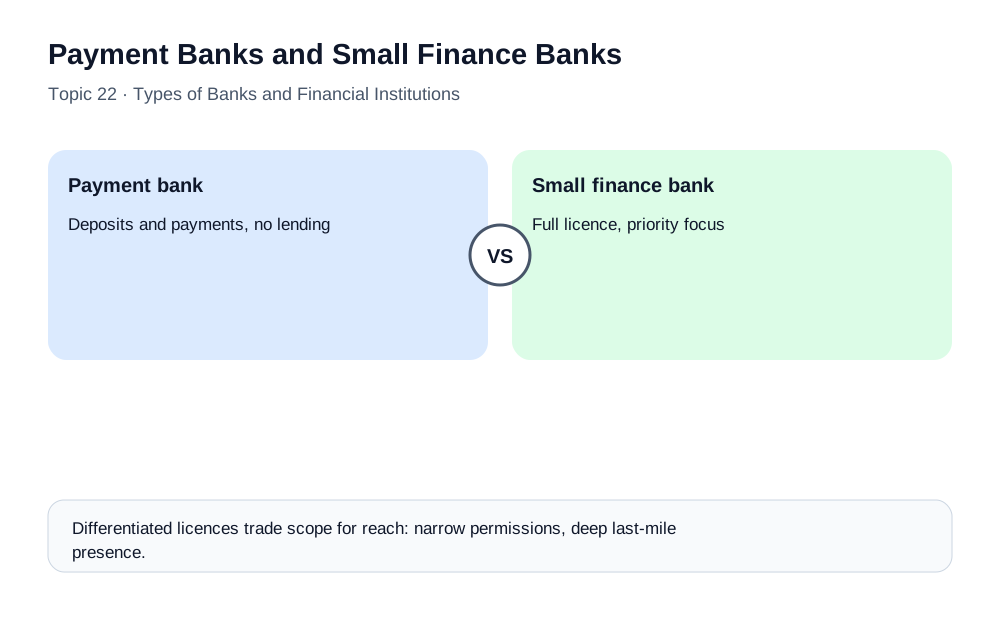
Payment Banks and Small Finance Banks at a glance — Differentiated banking licences and financial inclusion.
1. Introduction: Banking Licences Designed for Inclusion
In 2015, India introduced a groundbreaking concept: differentiated banking licences that created new types of banks specifically designed to bring financial services to the unbanked. Payment banks and small finance banks represent innovative approaches to financial inclusion that are being studied worldwide.
The idea challenged a centuries-old assumption — that a bank is a bank. For most of modern financial history, a banking licence was a single, uniform thing: take deposits, make loans, move money, accept the full weight of prudential regulation. Differentiated licensing asks a different question: what if some institutions were allowed to do part of what banks do, under rules tailored to that part? Could a licence for payments-only banking, or for small-ticket lending, reach people the full-service model never could?
India's experiment answers that question with real institutions, real customers, and real results. This chapter examines both licence types from first principles to operational reality: why they were created, what they may and may not do, how they actually work, how they make money, what has gone right, what has gone wrong, and what the rest of the world is learning from them.
Learning objectives. By the end of this chapter you should be able to:
- Explain why differentiated banking licences exist and what problem they solve
- Describe exactly what payment banks can and cannot do, and why each restriction matters
- Describe the permissions and obligations of small finance banks, including their priority-sector mandate
- Explain the business model and economics of each licence type
- Analyse the risks these institutions create and the controls regulators apply
- Place the model in global context and evaluate its record on financial inclusion
2. The Problem: Why Full-Service Banks Struggle at the Last Mile
To understand why new licence types were needed, start with the economics of serving poor and remote customers through conventional banking.
A traditional bank branch is an expensive machine: premises, staff, security, cash handling, connectivity, compliance overhead. That machine pays for itself when it intermediates meaningful balances and loan volumes. A rural customer who keeps a few thousand rupees in savings and borrows small, irregular amounts generates very little revenue against that fixed cost. The result, visible in every developing economy, is a geography of exclusion: branches concentrate where money concentrates, and hundreds of millions of people are left to cash, informal moneylenders, and exclusion from the payments system.
Consider the problem from one customer's side. A construction worker in a small town is paid in cash, saves by keeping cash at home — where it is stolen, spent, or inflated away — and sends money to family in a village through an informal courier who charges a percentage and takes days. When an emergency strikes, the only lender available is a moneylender whose rates turn a small loan into years of servitude. Nothing about this customer is unprofitable in principle; everything about the traditional branch model makes serving them unprofitable in practice.
India's numbers made the problem impossible to ignore. The country had over 190 million unbanked adults in 2014 — one of the largest financially excluded populations on earth. Traditional banks were too cost-heavy to serve remote areas profitably, and earlier inclusion drives, while valuable, had not closed the gap.
Policymakers faced three options. They could mandate full-service banks into unprofitable territory — an approach that breeds reluctant, minimal compliance. They could leave inclusion to non-bank players outside the prudential perimeter — giving up consumer protection. Or they could redesign the licence itself: create banking categories whose permitted activities match the economics of low-income service, so that serving the unbanked is the business model rather than a regulatory burden. India chose the third path.
This is the first-principles logic of differentiated licensing: match the shape of the licence to the economics of the segment you want served. A payments-led customer base needs a payments-led institution. A micro-borrower base needs an institution built for small-ticket credit. Neither needs — or could survive — the full-service rulebook.
3. The Design Logic: Narrow Permissions, Deep Reach
Differentiated licences sit between the two poles covered earlier in this series. Full-service banks (Topic 8 and Topic 10) carry every permission and every obligation. NBFCs (Topic 21) lend freely but cannot take demand deposits. Payment banks and small finance banks occupy the middle: each holds a genuine banking licence — with depositor protection, central bank supervision, and access to payment systems — but only for a deliberately narrowed set of activities.
The narrowing is not arbitrary. Each restriction is a risk control:
- Payment banks cannot lend. Lending is where banks die. Credit risk demands capital, underwriting skill, provisioning discipline, and resolution machinery. An institution built for high-volume, low-value payments has none of these — so the licence removes the risk entirely.
- Deposit caps limit the damage if one fails. Capping per-customer balances means no single failure can destroy large savings, and it keeps these institutions from competing with full banks for core deposits.
- Small finance banks carry lending obligations instead of lending prohibitions. Their permission to lend comes with mandated direction: most of the portfolio must flow to the segments the licence was created to serve.
The design bargain, familiar from Topic 21, runs in reverse here. NBFCs accept narrower permissions in exchange for lighter regulation. Payment banks and small finance banks accept narrower permissions and full prudential supervision — in exchange for the most valuable asset in finance: the trust and deposit franchise of a licensed bank.
4. Payment Banks: Permissions and Prohibitions
Payment banks are licensed to run payments and deposits at scale, using mobile technology and agent networks, without touching credit.
The licence design emerged from a deliberate policy process. A central bank committee on financial services for small businesses and low-income households had argued that inclusion required new institutional forms, not just new targets for old institutions. The central bank then issued differentiated licence guidelines, invited applications from telecoms, wallet providers, the postal system, and financial inclusion specialists, and granted the first licences in 2015. The category was engineered, not accidental — which is why its restrictions read like a coherent design rather than a list of compromises.
What They Can Do
- Accept deposits up to ₹2,00,000 per customer
- Issue debit cards and provide online banking
- Facilitate domestic money transfers and remittances
- Distribute simple financial products (mutual funds, insurance)
- Provide mobile-based banking services
What They Cannot Do
- Cannot make loans or issue credit cards
- Cannot accept NRI deposits
- Cannot establish subsidiaries
Each line deserves explanation.
The deposit cap — raised from the original ₹1,00,000 limit to ₹2,00,000 as the model matured — defines the customer: someone whose entire financial life fits in a modest balance. It also caps the institution's systemic importance.
The lending prohibition is the licence's foundation. Because payment banks hold no credit risk, their regulatory capital and provisioning burdens are minimal, and their failure mode is operational rather than financial.
The investment requirement — the less visible twin of the lending ban — requires payment banks to place the great bulk of customer deposits into safe, liquid government securities rather than anything risky. Deposits are effectively parked in sovereign assets; the institution earns the modest, stable yield on those securities. Customers' money is about as safe as the government itself.
The ban on NRI deposits and subsidiaries keeps the institution domestically focused and structurally simple — easy to supervise, hard to hide risk in.
Why They Were Created
Payment banks were designed to use mobile technology and existing distribution networks to reach the last mile. The insight behind the licence was that India's inclusion gap was no longer primarily a branch problem — it was a distribution problem. By the mid-2010s, cheap smartphones, near-universal mobile coverage, and the Aadhaar identity infrastructure meant that a customer in a remote village could be identified, onboarded, and served through a phone and a local agent. What was missing was a licensed institution whose entire economics assumed that channel.
5. How a Payment Bank Actually Works
Operationally, a payment bank looks less like a branch network and more like a logistics system for money.
Onboarding. A customer opens an account through a mobile app or at a neighbourhood agent — a kirana store, a telecom retailer, a post office counter — using digital identity verification. The process takes minutes and requires no branch visit.
Cash-in and cash-out. Physical money enters and leaves the system through the agent network. A worker paid in cash deposits it at the corner shop; the shop's own balance with the payment bank adjusts correspondingly. Agents are the human ATM and branch combined, paid per transaction.
Payments and transfers. Once money is in, it moves electronically: peer-to-peer transfers, bill payments, merchant payments, government benefit receipts. Integration with national payment rails — in India's case, the UPI ecosystem — gives payment bank accounts the same reach as any bank account.
The float. Customer balances, aggregated, form a large pool that the payment bank must hold in safe securities. The yield on this float is the core revenue line.
Distribution income. Because a payments-led float earns thin, capped returns, payment banks supplement it by acting as distribution channels: selling mutual funds, insurance, and other simple products to their enormous customer bases, earning commission rather than interest margin.
A simplified picture of the economics helps. Suppose a payment bank serves ten million active customers keeping an average balance of a few thousand rupees — an aggregate float in the tens of billions. Invested in short-term government securities, that float earns a safe, single-digit yield; the spread over what little interest is paid out is thin in absolute terms. Add modest fees and distribution commissions, subtract the heavy costs of agent commissions, technology, and compliance, and the margin depends entirely on volume. This is why scale is not a vanity metric for a payment bank — it is the whole business.
The model inverts traditional banking economics. A commercial bank monetises its customers primarily by lending their deposits back out at a spread. A payment bank monetises its customers primarily by moving their money and serving them — transaction fees where applicable, float yield, and distribution commissions.
6. The Payment Bank Business Model: Strengths and Strains
The strengths are real. With no credit risk, the balance sheet is simple and robust. With agent-led distribution, marginal cost per customer is a fraction of branch banking. With mobile-native design, the product reaches demographics no branch ever will.
The strains are equally real, and they explain much of the sector's history:
- Thin economics. Float yield is modest and partly regulated; payment margins in competitive digital markets are razor-thin. Profitability requires enormous scale.
- Scale is unevenly distributed. The promoters with pre-existing mass customer bases — telecom operators, digital wallet giants, the postal system — began with an advantage no newcomer could replicate.
- Dependence on adjacent revenue. Lending is banned, so the temptation is to monetise distribution aggressively — which creates conduct risk: mis-selling of insurance or investment products to financially unsophisticated customers. Regulators watch this closely.
- Compliance exposure. Mass-market, agent-led, digitally onboarded customer bases are fertile ground for KYC failures, fraud, and money-mule activity. As the Paytm case below shows, compliance failures — not credit losses — are the licence type's characteristic way of failing.
From the customer's side, the value proposition is concrete: an account that opens in minutes, money that moves instantly and cheaply, government benefits that arrive directly without intermediaries taking a cut, and cash access at a neighbourhood shop rather than a distant branch. Deposits carry deposit insurance up to the statutory limit, as with any licensed bank — a protection informal alternatives never offered.
The sober summary: payment banks solved the reach problem brilliantly and the profitability problem only partially. Several have thrived; others have struggled or exited. The licence works best as part of a larger ecosystem — telecom, e-commerce, postal — where banking deepens an existing customer relationship rather than standing alone.
7. Key Players
| Payment Bank | Parent/Promoter | Strength |
|---|---|---|
| Paytm Payments Bank | Paytm | Digital-native, huge user base |
| Airtel Payments Bank | Bharti Airtel | Telecom network reach |
| India Post Payments Bank | India Post | 155,000+ post office branches |
| Fino Payments Bank | Fino PayTech | Last-mile financial inclusion |
| Jio Payments Bank | Reliance Jio | Telecom + digital ecosystem |
The table reveals the design intent: every major promoter brought a pre-built distribution network. Airtel and Jio brought telecom subscriber bases measured in the hundreds of millions and retail touchpoints in every town. India Post brought the largest physical network in the country — more post offices than all bank branches combined — converting a trusted, centuries-old institution into a payments bank (the postal banking tradition itself is the subject of Topic 25). Paytm brought a digital wallet user base that had already normalised mobile money for a generation of Indians.
The lesson generalises: in payments-led inclusion, distribution is destiny. The licence gives permission; only an existing network gives reach.
8. Small Finance Banks: Full Banking, Narrowed Focus
Small finance banks (SFBs) are the lending sibling of the payment bank. Where payment banks removed credit entirely, small finance banks embraced it — under strict direction.
What They Can Do
- Accept all types of deposits (no upper limit)
- Make loans, including to underserved segments
- Provide complete banking services
- Issue credit cards and other products
Key Requirements
- 75% of loans must be to priority sector (agriculture, MSMEs, low-income housing)
- 50% of loan portfolio must be loans under ₹25 lakhs
- Must have at least 25% of branches in unbanked rural areas
Read the requirements together and the licence's architecture becomes clear. The 75% priority-sector rule — far above the obligation placed on ordinary banks — hard-wires the institution toward agriculture, micro and small enterprise, and low-income housing. The ₹25 lakh (₹2.5 million) ticket-size rule forces the portfolio to stay granular: half the book must consist of genuinely small loans, blocking drift toward large corporate credit. The branch rule anchors physical presence where exclusion was worst. An SFB is a full bank with a constitutional obligation to stay small, local, and inclusion-focused.
How an SFB Lends in Practice
The operational model descends directly from microfinance. Loan officers live in the communities they serve. Underwriting relies on household cash-flow assessment — observed income, local reputation, group vouching — rather than payslips and credit bureau scores that informal-economy borrowers do not have. Loans are small, tenors short to medium, instalments frequent, and collections often happen at the doorstep or the weekly market. Group lending, where members guarantee one another, still substitutes social collateral for physical collateral in parts of the book. This model is labour-intensive and therefore expensive to run — which is exactly why deposit funding, far cheaper than the wholesale money NBFC-MFIs relied on, transformed its economics.
Where SFBs Came From
Most of the first cohort of SFB licences went to institutions that already lived in this world: microfinance institutions and local financiers with years of small-ticket lending expertise. Conversion to a bank licence transformed their economics. As NBFC-MFIs, they had funded microloans with expensive wholesale borrowing; as banks, they could fund the same loans with far cheaper customer deposits — improving margins, lowering borrower rates, or both. In exchange, they accepted full prudential regulation: capital requirements, supervision, and the obligations listed above. It is the Topic 21 bargain run in reverse — the perimeter's best performers invited into the core, on the core's terms.
9. Key Small Finance Banks
- AU Small Finance Bank — Largest by assets, now offers full retail services
- Equitas Small Finance Bank — Strong in South India
- Ujjivan Small Finance Bank — Microfinance expertise
- Jana Small Finance Bank — Urban microfinance focus
The trajectory of the leaders shows the model working as designed: microfinance-grade underwriting expertise, funded by a growing deposit franchise, expanding gradually into adjacent retail products — vehicle finance, housing, gold loans — while remaining within the priority-sector and ticket-size mandates. AU's evolution from a vehicle financier to a broad retail institution illustrates the intended end-state: an inclusion-focused bank that grows up rather than out of its mandate.
A rough comparison makes the stakes concrete. An informal moneylender's rates, compounded without mercy, can exceed anything a formal institution would dare print. Microfinance loans, funded expensively at wholesale, historically carried rates far above mainstream bank credit. An SFB loan to the same borrower — deposit-funded, regulated, and capped by competitive and supervisory pressure — typically prices meaningfully lower still, and comes with documented terms, an amortisation schedule, and a grievance channel. For a vegetable vendor borrowing working capital, the difference between these rates is the difference between debt as a ladder and debt as a trap.
For borrowers, the practical difference is profound. A micro-entrepreneur who once faced a choice between an informal moneylender at punitive rates and a microfinance loan funded expensively at wholesale now borrows from a deposit-funded, fully regulated bank — with the consumer protections, grievance mechanisms, and recourse that status carries.
10. Risk, Control, and Compliance: What Can Go Wrong
Differentiated licences remove some risks and concentrate others.
For payment banks, the characteristic risks are operational and conduct-related:
- KYC and fraud risk. Mass digital onboarding through agents is exactly the channel identity fraudsters and money mules exploit. Weak verification at scale becomes a systemic vulnerability.
- Agent conduct. Thousands of lightly supervised intermediaries handling cash and customer data require monitoring infrastructure as serious as any branch audit programme.
- Mis-selling. Distribution-driven economics create incentives to push unsuitable products on unsophisticated customers.
- Concentration of trust. Customers at the bottom of the income ladder often hold their entire financial lives in one app; outages and failures hit them hardest.
The sector's defining cautionary episode came in early 2024, when the Reserve Bank of India barred Paytm Payments Bank — the largest player — from accepting fresh deposits and onboarding new customers after persistent supervisory findings involving KYC and compliance failures. The episode is instructive precisely because of what it was not: not a credit crisis, not a liquidity run, but a governance and compliance failure in an institution whose licence had removed credit risk entirely. The lesson travels: in payments-led banking, operational integrity is solvency.
For small finance banks, the risks look more traditionally banking-shaped, but with an inclusion twist:
- Concentrated credit risk. Portfolios mandated toward small borrowers, agriculture, and microenterprise are exposed to weather, commodity prices, local economic shocks, and political pressure for loan waivers.
- Unsecured lending cycles. Microfinance-derived books have historically shown sharp asset-quality swings when local conditions turn — the asset class rewards discipline and punishes growth-at-any-cost.
- Deposit franchise fragility. New institutions must build depositor trust from zero; a perception shock can trigger outflows faster than in established banks.
- Governance transitions. Promoters converting from founder-led NBFCs to regulated banks must professionalise boards, risk functions, and succession — a transition some manage better than others.
Both licence types also carry meaningful entry barriers: minimum capital requirements measured in hundreds of crores, fit-and-proper tests for promoters, and detailed business-plan scrutiny before a licence is granted. The capital bar alone filters for serious, well-resourced promoters — differentiated banking was never intended to be easy entry.
The regulatory toolkit mirrors the risks: full prudential supervision for SFBs; tight KYC, transaction-monitoring, and audit expectations for payment banks; and, for both, the willingness to act early — as the 2024 action demonstrated.
11. Impact on Financial Inclusion
The results have been significant:
- India's financial inclusion rate jumped from 53% in 2014 to over 78% in 2021
- Payment banks brought digital transactions to millions who had never had bank accounts
- Small finance banks channel formal credit to borrowers previously served only by informal moneylenders
These figures deserve honest framing. The inclusion surge of the period had multiple engines — a massive national account-opening drive, the Aadhaar identity system, the UPI payments infrastructure, and direct government benefit transfers all matured in the same years. Differentiated banks were one powerful instrument in a coordinated stack, not a solo act. Their specific contribution was structural: they gave the inclusion agenda permanent, licensed, commercially motivated institutions rather than time-limited campaigns.
The bank perspective matters too. Inclusion customers who begin as thin-margin payments users mature into savers, borrowers, and insurance buyers — a lifetime revenue curve that justifies today's investment in reach. This is why the large ecosystem players treat their payment banks not as profit centres but as the foundation of customer relationships monetised elsewhere.
The deepest impact is behavioural. A household that receives a government transfer into a payment bank account, pays a merchant digitally, and saves a small surplus has crossed the threshold that matters most: from cash to recorded, reusable financial identity. That identity — transaction history, savings behaviour — is what eventually makes the same household creditworthy to a small finance bank. The two licence types are complementary stages of a single ladder: payments first, then credit, then full banking citizenship.
12. The Global Context
India's differentiated licensing model has inspired similar approaches:
- Nigeria: Introduced payment service bank licences
- Philippines: Digital bank licences with lower capital requirements
- Kenya: M-Pesa demonstrated that mobile money operators can bank the unbanked
- Brazil: Fintech licences for payment institutions
Two design lessons emerge from the comparison. First, identity and payment infrastructure multiply the value of new licences — India's differentiated banks succeeded in part because digital identity and instant payment rails matured alongside them; licences alone, without rails, achieve less. Second, narrow licences need viable economics, not just noble purpose: models that depend entirely on regulatory protection rather than genuine customer value tend to stall, while those embedded in telecom, postal, or commerce ecosystems compound.
The common thread is that inclusion breakthroughs have come from rethinking the institution, not just subsidising the old one. Kenya's M-Pesa showed that mobile money could precede and prepare formal banking. Nigeria and the Philippines adapted the narrow-licence idea to their own regulatory traditions. Brazil's payment institution regime helped produce some of the world's most successful digital banks. The details differ, but the Indian experiment's core insight has travelled: when full-service economics exclude a population, design a licence whose economics include it.
13. Frequently Asked Questions
Is my money safe in a payment bank? Yes, within its design limits. Payment banks cannot lend your money out, must hold deposits in safe government securities, and deposits carry statutory deposit insurance up to the same per-customer limit as any licensed bank. The realistic risks are operational — outages, fraud, service failures — not the credit losses that threaten conventional banks.
Why can't payment banks give loans? Because lending is where banking risk lives. The licence was designed to bring payments and deposits to the underserved without importing credit risk, capital complexity, and provisioning burdens into an institution built for high-volume, low-margin transactions. Customers who need credit are served by the other half of the design: small finance banks.
What happens if a payment bank fails? Its assets are largely safe government securities, so the failure mode is orderly: deposits are insured up to the statutory limit, and the simple balance sheet makes resolution far easier than at a loan-heavy bank. The larger practical risk, as the sector's history shows, is regulatory restriction for compliance failures — disruptive to service, but not a loss of insured deposits.
What is the difference between a payment bank and a digital wallet? Licence and protection. A wallet is a prepaid instrument operated by a non-bank; a payment bank is a licensed bank whose deposits are insured and supervised by the central bank. Several wallet companies converted to payment banks precisely to gain that status.
What is the difference between a payment bank and a small finance bank? Payment banks take capped deposits and cannot lend; small finance banks take uncapped deposits and must lend — with 75% of lending directed to priority sectors and half the portfolio in small-ticket loans. One is banking without credit; the other is banking built around directed credit.
Who regulates these banks? The central bank, under the same prudential framework applied to all licensed banks — with licence-specific conditions layered on top: deposit caps and investment mandates for payment banks; priority-sector, ticket-size, and rural-branch mandates for small finance banks.
Can a small finance bank become a regular bank? The regulatory framework contemplates graduation: an SFB with a strong multi-year track record can apply for a universal banking licence, meeting the fuller requirements that come with it. The pathway reinforces the design idea — inclusion-focused licences as a proving ground, not a permanent ghetto.
Are payment banks only an Indian idea? The specific licence is Indian, but the underlying design — narrow permissions matched to inclusion economics — has analogues worldwide: Nigeria's payment service banks, Brazil's payment institutions, and the mobile-money operators of East Africa all reflect the same logic in different legal wrappers.
Do payment banks pay interest on deposits? Yes, though typically modestly — their safe-securities investment mandate caps what they can earn and therefore pay. Customers choose them for access and convenience more than yield; larger savings usually migrate to full-service banks or small finance banks paying competitive deposit rates.
Why do telecom companies run banks? Because the scarcest asset in inclusion banking is distribution, and telecoms already own it: hundreds of millions of verified customers, retail touchpoints everywhere, and daily digital engagement. The licence lets them convert that reach into financial services — and deepens customer loyalty to the parent ecosystem.
14. Key Terms in This Chapter
- Differentiated banking licence — a banking licence narrowed to specific activities, designed so the institution's economics match an underserved segment.
- Payment bank — a licensed bank that takes capped deposits and runs payments but cannot lend.
- Small finance bank (SFB) — a full-service bank with mandated focus on small-ticket, priority-sector lending.
- Priority sector — lending categories regulators designate as socially important: agriculture, MSMEs, low-income housing, and similar.
- Deposit cap — the per-customer balance limit (₹2,00,000) defining payment banks' scale and customer base.
- Float — the aggregate of customer balances, held by payment banks in safe government securities.
- Business correspondent / agent — a retail intermediary performing cash-in, cash-out, and onboarding on a bank's behalf.
- KYC (know your customer) — the identity verification obligations whose failure felled the sector's largest player.
- Financial inclusion — access to usable, affordable formal financial services; the licences' founding purpose.
- Narrow banking — the broader concept of banking without credit risk, of which payment banks are a licensed form.
15. Interview Insights: How This Topic Appears in Banking Interviews
"Why did India create payment banks when it already had banks and NBFCs?" Structure the answer around economics: full banks can't profitably serve low-balance customers, and NBFCs can't take deposits or run payment accounts. The gap was institutional, not technological. Differentiated licences match permitted activity to segment economics — reach without credit risk on one side, directed credit with deposit funding on the other.
"Payment banks can't lend — so how do they make money?" Three lines: yield on the float held in government securities, transaction and service economics, and distribution commissions on third-party products. Then add the insight that distinguishes strong candidates: this is why payment banks need enormous scale and why their characteristic failures are conduct- and compliance-driven rather than credit-driven.
"What does the Paytm Payments Bank episode teach about regulation?" That risk follows activity, not labels. Remove lending and you remove credit risk — but operational, KYC, and governance risk remain, and in a mass-market digital institution they are existential. Supervision acted on compliance failures before any customer lost money; that is regulation working as intended, and it shows the licence narrows financial risk, not regulatory obligation.
"Are differentiated banks a success?" A balanced answer: yes on reach — account ownership and digital payment adoption transformed within a decade — and partial on profitability, with the model working best inside larger ecosystems. Cite the complementarity: payment banks build financial identity; small finance banks monetise it through credit. Avoid both cheerleading and dismissal.
"Could this model work elsewhere?" Show judgment: it already has, in adapted forms — Nigeria's payment service banks, Philippine digital licences, Brazil's payment institutions. The transferable element is the design logic, not the rulebook: match licence shape to segment economics, anchor distribution in existing networks, and supervise conduct as seriously as solvency.
Summary and Key Takeaways
Differentiated banking licences are India's structural answer to financial exclusion — and one of the most influential banking policy innovations of the past decade. The essential points:
- The founding insight is economic: full-service banking cannot profitably serve low-balance, small-ticket customers — so India redesigned the licence rather than subsidising the failure.
- Payment banks remove credit risk entirely: capped deposits, payments, and distribution, with the float parked in government securities — banking as safe as the sovereign, as thin as a margin can be.
- Small finance banks embrace credit under direction: 75% priority-sector lending, half the portfolio in loans under ₹25 lakh, a quarter of branches in unbanked rural areas — full banking with an inclusion constitution.
- Distribution is destiny: every successful promoter brought a pre-built network — telecom subscribers, postal branches, digital wallet users.
- Risk follows activity: payment banks fail on compliance and conduct, not credit — as the 2024 regulatory action against the largest player demonstrated.
- The two licences form a ladder: payments build financial identity; small finance credit monetises it; full banking citizenship is the destination.
- The inclusion record is real but shared: account ownership surged from 53% to over 78%, with differentiated banks as one engine in a broader national stack.
- The model has travelled: Nigeria, the Philippines, Kenya, and Brazil each adapted the core idea — match the licence to the segment you want served.
- Institutional design is inclusion policy: who may take deposits, who must lend, and under what limits are not technical footnotes — they decide whether hundreds of millions of people get a first account, a first digital payment, and a first formal loan.
In the next topic, we move to the opposite end of the regulatory spectrum: institutions that perform bank-like functions while deliberately sitting outside banking's perimeter — the world of shadow banking.
Next: Topic 23 — Shadow Banking →
<!-- MBA-DEEP-DIVE-START -->Deep Dive: Payments Banks, Small Finance Banks, and the Logic of Differentiated Licensing
Payments Banks and Small Finance Banks are a useful lesson in regulatory design because they show that a banking licence does not have to be all-or-nothing. India introduced differentiated bank models to solve specific inclusion problems with different risk profiles. A Payments Bank is designed primarily around deposits, transactions, remittances, and access. A Small Finance Bank is designed around both deposits and credit, with a strong inclusion mandate. They may both look like digital retail banks to a customer, but their balance sheets and regulatory permissions are fundamentally different.
The first principle is licence before interface. A mobile app can make two institutions appear almost identical: both may let a customer complete KYC, see a balance, transfer money, pay bills, use a debit card, and receive alerts. Yet one institution may be legally prohibited from lending on its own balance sheet while the other is explicitly built to lend. Product design must therefore start with the regulated entity behind the screen rather than with visual similarity.
Why create a Payments Bank?
The financial-inclusion problem is not only lack of credit. Millions of customers need a safe place for small balances, a low-cost way to receive wages or benefits, remittance services, merchant payments, and a bridge between cash and digital money. Traditional bank branch economics can make very small accounts expensive to serve, especially in remote areas or among highly mobile workers.
A Payments Bank addresses this by focusing on transaction banking at scale. It can accept permitted deposits and provide payment and remittance services, but RBI’s licensing model restricts it from undertaking normal lending activity. Funds therefore cannot be deployed into a conventional retail loan book in the way a universal bank uses deposits to create credit.
That single restriction changes the business model dramatically. A conventional bank can earn a substantial part of its income from the spread between loan yields and deposit costs. A Payments Bank must rely more heavily on payments economics, distribution, fees, float management within permitted investments, partnerships, and adjacent services.
The Payments Bank balance sheet
Because lending is restricted, a Payments Bank’s asset side is designed around liquidity and low credit risk rather than a diversified loan book. The original RBI framework requires a large portion of demand-deposit balances to be held in short-maturity government securities or Treasury Bills, with a limited portion held as deposits with scheduled commercial banks for operational and liquidity purposes, in addition to applicable reserve requirements.
For a learner, the exact percentages are less important than the logic: customer transaction balances should not be transformed into a risky lending portfolio. The licence deliberately sacrifices lending income in exchange for a simpler credit-risk profile and strong liquidity orientation.
That does not make the institution risk-free. Credit risk may be lower, but operational, cyber, fraud, technology, liquidity, conduct, and third-party risks can be intense because the business depends on very high transaction volumes and digital availability.
Payments operations are the core product
A Payments Bank succeeds or fails on payments execution. Its architecture therefore needs reliable account ledgers, customer authentication, real-time balance management, payment routing, fraud monitoring, sanctions and regulatory screening where applicable, clearing and settlement connectivity, reconciliation, dispute handling, and high availability.
A ₹500 transaction matters operationally even if it is economically tiny to the bank. If millions of such transactions are processed daily, a small defect can become a material incident. An error affecting 0.1% of ten million transactions means ten thousand customer problems.
This is why reconciliation is central. The internal customer ledger, payment-switch records, settlement-bank statements, scheme files, card-network data, and external clearing positions must agree. Unreconciled differences are not just accounting noise; they may represent customer money posted twice, a transfer not credited, failed reversals, fraud, or settlement exposure.
The agent and distribution model
Financial inclusion often requires reaching customers beyond owned branches. Payments Banks may use business correspondents, merchant points, partner networks, post offices, or other permitted channels. This can create enormous distribution quickly, but it also creates operational risk at the edge.
Agents may handle cash-in and cash-out, onboarding assistance, account servicing, or customer education. The bank must control agent identity, cash limits, device security, customer authentication, receipts, complaints, and fraud. A customer should never have to surrender a PIN or OTP to an agent merely because the service is assisted.
The bank also needs to reconcile physical cash with electronic value. If an agent receives ₹10,000 of customer cash but the digital account is credited incorrectly, the issue sits at the intersection of cash operations, ledger integrity, fraud, and customer protection.
A Payments Bank can distribute credit without becoming the lender
The restriction on own-book lending does not mean customers can never see credit offers in a Payments Bank app. The bank may partner with appropriately regulated lenders, subject to the applicable framework. This creates an important distinction between distribution and credit ownership.
Suppose a customer applies for a small loan through the Payments Bank’s app. A partner Small Finance Bank or NBFC may perform or own the underwriting and book the loan. The app may provide the journey, but the credit exposure sits elsewhere.
That partnership must be transparent. The customer should know who the lender is, what the terms are, where repayments go, how complaints are handled, and which entity reports to credit bureaus. Internally, the partners need clear responsibility for KYC, consent, data sharing, underwriting, disbursement, servicing, collections, fraud, and reconciliation.
Why create a Small Finance Bank?
The Small Finance Bank solves a different inclusion problem: underserved customers need credit as well as deposits and payments. The model therefore has a genuine bank balance sheet with lending capability, but its business mandate emphasises smaller borrowers, micro and small enterprises, agriculture, low-income households, and other underserved segments.
Unlike a Payments Bank, an SFB earns from both sides of the balance sheet. It can mobilise deposits and deploy them into loans, subject to prudential and inclusion-oriented requirements. This creates a more traditional banking model but with a customer and portfolio focus that differs from many large universal banks.
The commercial challenge is significant. Small-ticket lending can have high operating cost per rupee lent. A ₹50,000 loan still requires onboarding, underwriting, documentation, servicing, collections, reporting, and compliance. Technology and efficient distribution are therefore essential to make small loans economically viable without compromising risk control.
The SFB credit engine
A strong Small Finance Bank needs underwriting methods suited to customers whose finances may not resemble those of salaried prime borrowers. Small merchants may have irregular cash flows. Farmers have seasonal income. Micro enterprises may keep limited formal accounts. First-time borrowers may have thin credit histories.
The solution is not weaker underwriting; it is better contextual underwriting. Bank statements, GST records, cash-flow patterns, verified invoices, merchant collections, agricultural cycles, bureau data, and field verification can all contribute. Models should be validated against actual repayment behaviour and reviewed when the bank enters new regions or products.
Because inclusion-focused portfolios can be geographically or sectorally concentrated, SFBs must watch concentration carefully. A strong rural franchise can still suffer if drought, flood, commodity-price decline, or local employment shock affects many borrowers at once.
Deposits change the risk profile
Once an institution accepts deposits and lends them onward, it performs maturity and liquidity transformation. The bank must manage withdrawals even though borrowers repay over time. This introduces the classic banking disciplines of capital adequacy, liquidity management, asset-liability management, interest-rate risk, credit provisioning, deposit concentration, and stress testing.
SFB growth can be especially demanding because a bank expanding from a microfinance or local-lending heritage may need to develop a full treasury, deposit franchise, payments infrastructure, cybersecurity capability, internal audit function, and regulatory reporting stack while still managing credit growth.
A transformation from specialist lender to bank is therefore not merely a licence upgrade. It is an operating-model transformation.
Payments Bank versus Small Finance Bank: a functional comparison
The clearest comparison is functional.
A Payments Bank is primarily a transaction and small-deposit institution. It is built for money movement, safe balances, remittances, merchant payments, and distribution, with own-book lending restricted.
A Small Finance Bank is a deposit-taking and lending bank with a financial-inclusion focus. It must manage a credit portfolio and the full balance-sheet risks that come with it.
Both require KYC, AML controls, fraud monitoring, cyber resilience, customer protection, accounting, audit, and regulatory reporting. Both may use digital-first channels. The difference is that one is deliberately constrained from becoming a normal lender, while the other is deliberately expected to provide credit.
Customer journeys can hide complex institutional chains
Consider a migrant worker who opens a digital account, receives salary, sends money home, pays a merchant, and later takes a small business loan.
The salary credit may enter the Payments Bank account through a domestic payment rail. The remittance may be processed by the bank’s payment stack. The merchant payment may pass through a QR or card ecosystem. The later credit offer might be originated in the same app but booked by a partner lender.
To the customer, this feels like one relationship. Operationally, several regulated and technical entities may be involved. The product team must design the journey so responsibility remains clear even when the experience is unified.
A failed loan repayment, for example, should not bounce between ‘the app company’, ‘the bank’, and ‘the lender’. Internal integration should absorb that complexity rather than exporting it to the customer.
Fraud patterns differ by model
Payments Banks face strong transaction fraud risk because of high digital activity and customer segments that may be new to formal banking. Account takeover, SIM-swap attacks, social engineering, mule accounts, QR fraud, OTP theft, and agent fraud can be significant.
Small Finance Banks face these risks plus lending fraud: synthetic identities, document manipulation, income inflation, collusion with field agents or dealers, loan stacking, and diversion of funds.
Fraud controls should therefore follow the business model. A transaction-risk engine alone is insufficient for an SFB, while a credit-fraud model alone is insufficient for a Payments Bank.
Unit economics matter
Financial inclusion is sustainable only if the operating model can support it. A Payments Bank handling millions of low-value transactions needs enough fee, partnership, and treasury income to cover technology, compliance, distribution, customer service, and fraud losses.
An SFB must earn enough lending spread and fee income to cover deposit cost, credit losses, collections, branches or agents, technology, and capital. Chasing growth by underpricing loans or paying unsustainably high deposit rates can produce apparent inclusion in the short term and instability later.
The strongest institutions treat inclusion and economics as complements. A bank that fails cannot serve underserved customers for long.
The path toward a broader banking model
RBI has provided a framework under which eligible Small Finance Banks may seek voluntary transition to Universal Banks after meeting specified track-record, financial, asset-quality, net-worth, and other conditions. The significance is conceptual: differentiated licensing can be a development path, not necessarily a permanent ceiling, for institutions that mature safely.
Transition should be earned through demonstrated governance and financial strength rather than treated as automatic. A larger licence increases strategic freedom but also expands complexity and expectations.
A systems view
For architects and business analysts, the differentiated bank model should be visible in system boundaries.
A Payments Bank architecture should strongly control prohibited or restricted asset creation. Product catalogues, loan modules, treasury investment rules, accounting mappings, and partner integrations must reflect the licence. A Small Finance Bank, by contrast, requires complete lending, deposit, payments, ALM, collections, provisioning, and capital-management capabilities.
Configuration must not accidentally turn a legal restriction into a mere policy choice. If a Payments Bank is not permitted to originate normal loans on its balance sheet, the system design should not leave that as an easily bypassed product flag.
What excellence looks like
A world-class Payments Bank can move money reliably at very large scale, protect customers from fraud, reconcile every settlement position, manage agents safely, keep funds within permitted investment and liquidity rules, and make partner products transparent.
A world-class Small Finance Bank can do all of that while also underwriting underserved borrowers responsibly, funding loans with a stable deposit franchise, maintaining capital and liquidity, controlling concentration, managing collections fairly, and proving that inclusion does not require weak credit discipline.
The deeper lesson from differentiated banking is that regulation can separate financial functions deliberately. Payments, deposits, and credit do not have to live inside the same risk model. Understanding which functions a licence permits is the starting point for understanding the institution’s balance sheet, technology, customer promise, and risk controls.
<!-- MBA-DEEP-DIVE-END -->