The financial landscape extends far beyond banks. Non-Bank Financial Companies, known as NBFCs, provide banking-like services without holding full banking licenses. They lend money, accept certain types of deposits, and offer investment products, yet they operate under different regulatory frameworks with different constraints and opportunities than traditional banks. These institutions fill critical gaps in the financial system, reaching customers and sectors that conventional banks overlook, specializing in niches where they develop deep expertise, and competing in ways that drive innovation across financial services.
NBFCs are particularly important in developing economies where traditional banking infrastructure remains limited. In India, for example, NBFCs account for roughly a quarter of total credit, serving millions of borrowers who might not qualify for bank loans or who live in areas without bank branches. Their role in financial inclusion, in specialized lending, and in providing competition to established banks makes them essential components of modern financial systems.
What you will learn in this topic:
- What NBFCs are, and the specific lines separating them from banks
- Why non-bank lenders exist — the economics of specialization and segmentation
- The major NBFC types: housing, microfinance, vehicle, infrastructure, gold, and consumer finance
- How NBFCs fund themselves — and why that funding model is their Achilles' heel
- The IL&FS crisis: what an NBFC collapse looks like
- The regulatory journey from light touch to near-bank supervision
- What NBFCs mean for customers, competitors, and the system's stability
This topic opens a new chapter of the series: the institutions at banking's perimeter. NBFCs do much of banking's work without a banking licence; Topic 22 examines payment banks (licences with deliberately narrow permissions), and Topic 23 surveys the wider shadow banking system. Together they answer a question the preceding twenty topics quietly raise: if banks are so privileged and so protected, why does so much finance happen outside them?
Visual overview
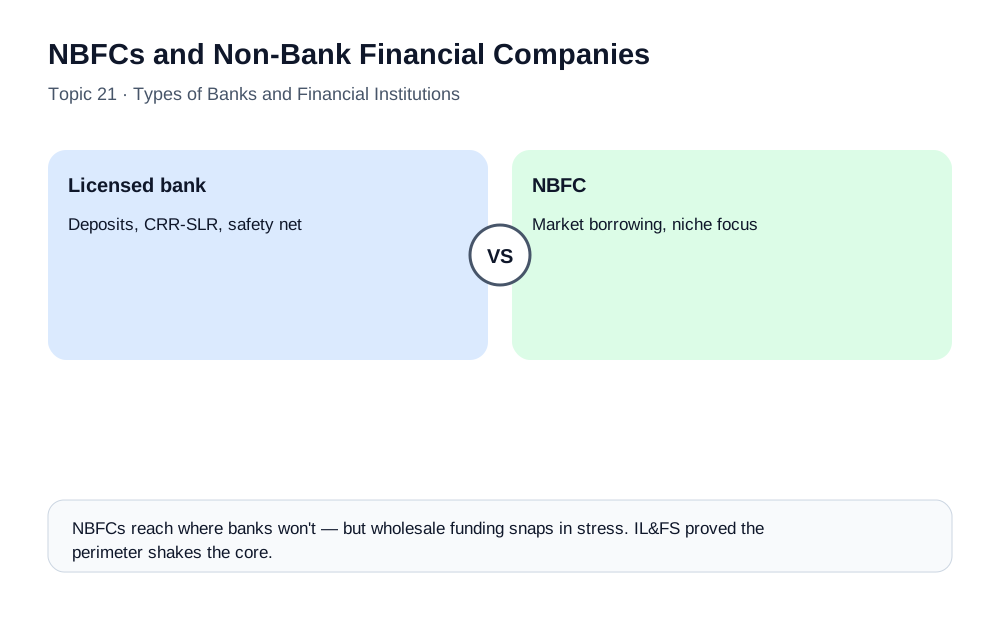
NBFCs and Non-Bank Financial Companies at a glance — Housing finance, microfinance, infrastructure finance.
1. What NBFCs Are and How They Differ from Banks
Non-bank financial companies are financial institutions that provide banking services without meeting the full legal definition of a bank. Regulatory boundaries vary by jurisdiction — India uses the NBFC label formally; the United States speaks of nonbank lenders and finance companies; Europe of credit institutions versus other financial intermediaries — but the distinguishing characteristics are consistent.
They can lend, but they cannot take demand deposits. NBFCs make loans and advances much as banks do, and some accept fixed-term deposits. But they cannot offer current accounts — money withdrawable on demand. This line is fundamental: demand deposits are the raw material of the payments system and the fractional reserve machine (Topics 11 and 12). Confining them to licensed banks keeps the NBFC outside the monetary core — and outside its protections.
They sit outside the payment system. NBFCs typically cannot offer cheque facilities or participate directly in central bank payment rails; their customers' payments flow through partner banks.
Reserve requirements do not apply. The cash reserve and statutory liquidity ratios imposed on banks (Topic 8) generally do not bind NBFCs — more deployment flexibility, but no central bank liquidity backstop in a crisis.
Deposits are uninsured. Where an NBFC accepts term deposits, they are generally not covered by the deposit insurance schemes of Topic 9. Customers bear failure risk directly — which makes NBFC funding confidence-sensitive in ways bank deposits are not.
Regulation is lighter — but converging. Historically, NBFC oversight was substantially lighter than banking regulation; since 2008, and especially after major NBFC failures, systemically important non-banks have been pulled steadily toward bank-like rules. Section 6 traces that journey.
| Dimension | Bank | NBFC |
|---|---|---|
| Demand deposits | Yes — core function | No |
| Term deposits | Yes, insured | Sometimes, usually uninsured |
| Payment services | Full (cheques, payment rails) | Limited or none |
| Reserve requirements | Yes | No |
| Central bank liquidity | Yes (lender of last resort) | Generally no |
| Deposit insurance | Yes | No |
| Primary funding | Customer deposits | Wholesale borrowing, bonds, equity |
| Regulatory intensity | High | Lower, but converging |
2. Why NBFCs Exist: The Economics of the Perimeter
Why would a financial system allow — indeed encourage — institutions doing banking's work without banking's privileges? Three economic logics explain it.
Specialization beats generalization in niches. A generalist bank must be adequate at everything; a specialist can be excellent at one thing. A vehicle financier that repossesses and resells thousands of trucks a year prices truck loans more accurately than any bank's credit department. A gold loan company with assayers and vaults in every district serves a product banks find operationally alien. Specialization converts into better risk assessment, faster processing, and sharper pricing — genuine economic value, not regulatory arbitrage.
Risk appetite fills the credit gap. Banks, holding insured deposits, are regulated toward conservatism: thin credit files, informal incomes, first-generation borrowers, and unusual collateral all score poorly under bank underwriting. NBFCs, funded by investors who knowingly bought higher-risk paper, can underwrite segments banks must decline. The perimeter exists partly so the core can stay safe without leaving whole populations unserved.
Innovation needs room to experiment. New credit models, alternative data underwriting, instant point-of-sale lending, digital-first delivery — these routinely debut at NBFCs, whose lighter regulation and focused scale permit experiments a heavily supervised universal bank cannot run. Successful innovations then migrate into mainstream banking; the perimeter functions as the system's laboratory.
The bargain underlying all three: society permits lighter regulation in exchange for narrower permissions (no demand deposits, no payments, no safety net) and accepts that NBFC failures will occasionally happen — provided they stay small enough not to threaten the core. The entire regulatory drama of this topic is what happens when the "small enough" assumption breaks.
There is a final, subtler reason the perimeter persists: NBFCs exist because banks are regulated. Every prudential rule that makes the banking core safe — capital floors, liquidity buffers, underwriting standards, deposit-insurance pricing — pushes some activity outward to where it is cheaper to perform. Regulation does not eliminate risk-taking; it relocates it. Policymakers accept this deliberately, preferring risk in supervised-but-uninsured institutions to risk in insured ones. But it means the perimeter's size is partly a mirror of the core's strictness: tighten banks, and non-banks grow. Watch NBFC growth and you are, in part, watching the shadow of banking regulation itself.
3. A Brief History of Non-Bank Finance
Non-bank lending is far older than the label. Understanding where these institutions came from explains why they look the way they do today.
The finance company era. Long before regulators coined "NBFC," specialised lenders served customers banks ignored. Nineteenth and early twentieth century commercial banks focused on businesses and the prosperous; workers needing small loans met pawnshops, moneylenders, and — from the late nineteenth century in the United States — licensed "industrial lenders" and consumer finance companies offering small instalment loans at regulated rates. When automobile mass production arrived, carmakers' captive finance arms (General Motors Acceptance Corporation founded 1919 among the pioneers) invented point-of-sale vehicle finance: lending at the dealership, against the vehicle, to customers banks would not score. The template — specialist asset, specialist customer, specialist process — has defined non-bank lending ever since.
The post-war diversification. Through the mid-twentieth century, housing finance specialists, equipment lessors, factoring companies, and hire-purchase financiers professionalised across the US, Europe, and the Commonwealth. Many operated at the edges of banking law deliberately: close enough to banking to earn banking margins, far enough to avoid banking regulation. Periodic failures kept demonstrating the funding fragility analysed in Section 5 — long before anyone said "shadow banking."
The developing-market explosion. In India and similar economies, NBFCs grew from the 1980s onward into a parallel credit system: vehicle financiers reaching truckers, gold loan companies reaching households, microfinance reaching the informal economy, and infrastructure financiers funding the build-out banks could not. Regulatory recognition followed the reality: formal NBFC registration, capital norms, and eventually the scale-based regime of Section 7.
The fintech mutation. From the 2010s, the perimeter went digital: online lenders, app-based microloans, BNPL instalments at checkout, and embedded finance inside platforms. The customer interface changed completely; the balance-sheet logic did not. Today's digital lender is the 1919 captive financier with better data and the same wholesale-funding vulnerability — history's clearest warning that innovation at the perimeter changes products faster than it changes risk.
4. Types of NBFCs and Their Specializations
NBFCs typically specialize in specific market segments, developing expertise that lets them serve particular customers more effectively than generalist banks.
Housing finance companies specialize in mortgages and property finance. Exclusive focus builds deep expertise in property valuation, title verification, and foreclosure — allowing them to price risks generalists might misprice and process loans with assembly-line efficiency. In markets like India, specialist housing financiers long dominated mortgage origination through exactly this edge.
Microfinance institutions (MFIs) provide small, often collateral-free loans — typically tens to a few thousand dollars — to low-income borrowers, enabling microenterprise, consumption smoothing, and emergency resilience. The movement descends from Grameen Bank's Bangladeshi innovation of group lending: borrowers form groups whose members effectively guarantee each other, substituting social collateral for physical collateral. MFIs serve populations banks consider unprofitable or unscoreable, at interest rates that reflect genuine cost-to-serve — and whose level remains one of the most serious ethical debates in finance: high rates fund inclusion, but at what point does inclusion become extraction?
Vehicle finance companies finance cars, trucks, and two-wheelers. Their expertise in vehicle valuation, depreciation forecasting, and repossession logistics lets them manage collateral risks banks handle less efficiently — and to lend against the earning potential of the vehicle itself (a truck driver's truck is both collateral and income source).
Infrastructure finance companies fund roads, power, and telecom on fifteen-to-twenty-five-year horizons that exceed most banks' comfort. Their project-finance expertise — cash flow structuring, construction risk, concession analysis — fills a gap between commercial banks and the development banks of Topic 19. It also, as Section 5 shows, concentrates the sector's most dangerous maturity mismatches.
Gold loan companies, prominent in India, lend against gold jewellery and bullion. Liquid, easily valued collateral means lower risk, rapid disbursement, and access for customers with gold but no credit history — formal finance built on a centuries-old household savings habit.
Consumer finance companies lend for durables, travel, and personal needs, often at the point of sale with instant decisions. Their underwriting leans on alternative data and behavioural models, and their modern descendants are the digital and "buy now, pay later" lenders that have pushed consumer credit into smartphone checkout flows worldwide.
5. The Funding Model: NBFCs' Strength and Achilles' Heel
Everything about NBFC risk traces to one structural fact: they lend long and fund in markets, not deposits.
A bank's funding is largely deposits — sticky, insured, behaviourally stable, and backstopped by the central bank. An NBFC's funding is wholesale: bank borrowings, bonds, debentures, commercial paper, securitisation of its own loan book, and equity. This funding is available in good times in impressive volume — it is how the sector grows so fast — but it has three decisive properties:
It must be rolled over. Commercial paper matures in months; bank credit lines in a year or two. An NBFC with a fifteen-year infrastructure book funded by one-year paper must refinance its entire liability side repeatedly, whatever the market weather.
It is confidence-priced. Wholesale investors are uninsured professionals: at the first whiff of trouble, they do not queue — they simply decline to roll over, instantly and by email. NBFC funding can vanish faster than any bank run of Topic 11, because there is no insurance to slow it and no branch queue to see.
It is expensive relative to deposits. Wholesale rates exceed deposit rates, so NBFCs earn their margins on the lending side — through segments and pricing banks avoid — rather than on cheap funding. When their loan yields compress, the model has no cushion.
A worked example shows the machine: an NBFC raises $100 million through two-year bonds at 9% and on-lends to vehicle buyers at 15% over four years. The 6-point spread funds operations, credit losses of perhaps 3%, and profit — a viable business as long as the 9% funding can be renewed. If, at rollover, markets demand 13% — or refuse at any price — the spread inverts or the institution must sell its loan book into a distressed market. Nothing about its borrowers changed; the funding model alone decided survival. That is the perimeter's bargain made concrete.
6. Case Study: IL&FS — When the Perimeter Shook the Core
The 2018 collapse of Infrastructure Leasing & Financial Services (IL&FS) in India is the defining modern lesson in NBFC risk — and a case study in nearly every section of this topic.
The institution. IL&FS was a giant infrastructure finance conglomerate: decades old, complex group structure, financing roads, power, and urban projects across India, with borrowings on a scale comparable to a mid-sized bank. It was, in form, an NBFC; in substance, it had become systemically important infrastructure for the infrastructure sector itself.
The mechanics of failure. The model was textbook maturity mismatch: long-gestation infrastructure assets funded substantially by short-term debt, compounded by aggressive accounting that masked stress and group complexity that obscured where the risk sat. In mid-2018, group entities began defaulting on obligations. Wholesale funding froze — not gradually, but immediately, in the manner of Section 4 — and the defaults cascaded through commercial paper and mutual fund holdings, transmitting the shock to investors who had never heard of IL&FS.
The systemic wake-up. The Indian government took the extraordinary step of superseding the board, and the central bank and markets regulator moved to contain contagion. The episode forced recognition that large NBFCs were not peripheral: banks lent to them, mutual funds held their paper, and their failure could cascade through the interconnections exactly like a bank failure — but without deposit insurance, without a lender of last resort, and without resolution machinery designed for them.
The regulatory consequence. IL&FS accelerated India's shift to scale-based NBFC regulation — bank-like capital, liquidity, and governance requirements tiered by size and risk — and globally it reinforced the post-2008 lesson: regulation must follow function and systemic footprint, not legal labels. If it lends like a bank, funds like a bank, and can crash the system like a bank, the perimeter will not protect anyone from it.
7. The Evolving Regulatory Landscape
NBFC regulation has tightened significantly since 2008 revealed the systemic importance of institutions once considered peripheral.
Scale-based and activity-based rules now dominate the direction of travel: the larger and more bank-like the institution, the more bank-like its capital, liquidity, and governance requirements. India's scale-based framework tiers NBFCs by size and risk; US and EU regimes capture large nonbank lenders through consumer protection, prudential, and resolution rules regardless of formal classification. The principle — same activity, same risk, same regulation — has broad acceptance.
Systemic designation pulls the biggest non-banks into closer supervision: stress tests, reporting, recovery planning. The IL&FS lesson, generalised. At the global level, the Financial Stability Board — the international body coordinating post-2008 reform — monitors non-bank financial intermediation as a standing priority, tracking the sector's share of global financial assets and pressing national regulators to map where leverage and liquidity mismatch hide outside the banking core.
Consumer protection converged fastest. Fair lending, disclosure, and conduct rules now bind NBFCs as they bind banks — a borrower's protections should not depend on which legal form their lender took. Digital lending apps, in particular, attracted swift regulatory response after waves of predatory practices in several markets.
The open frontier is the boundary with shadow banking — money market funds, securitisation vehicles, private credit funds, and other market-based finance that replicates banking functions at institutional scale. That is a large enough subject for its own treatment, and Topic 23 takes it up directly.
8. The Modern Perimeter: Partnerships, Co-Lending, and Digital Credit
The sharpest recent development is that the line between bank and NBFC has become a value chain rather than a wall. Three models define the modern perimeter.
Origination partnerships. NBFCs increasingly originate loans that banks fund or buy. The NBFC contributes what it is good at — distribution in segments banks cannot reach, alternative-data underwriting, collections on the ground — while the bank contributes what it is good at: cheap deposit funding. Structures range from direct assignment (selling loans to banks) to co-lending, where bank and NBFC fund the same loan in agreed shares (for example 80/20) and share yield and risk accordingly. For the customer, the experience is one lender; behind it, the perimeter and the core have split the job along comparative advantage. Regulators have generally blessed these models while insisting the customer's protections and the risk's location remain transparent.
Securitisation as the bridge. NBFCs package seasoned loan pools and sell them to banks and investors, recycling capital into new lending — market-based funding that both relieves and (as 2008 taught in Topic 13) can transmit risk. In the NBFC context, securitisation is primarily a funding and capital-management tool rather than the exotic engineering of the pre-crisis era, but the same discipline applies: the quality of what is pooled determines the resilience of the bridge.
Digital lending as the new frontier. App-based credit — instant personal loans, BNPL instalments, merchant cash advances, embedded credit inside e-commerce and payment platforms — has become the fastest-growing segment at the perimeter. Its genuine innovations are underwriting (cash-flow and behavioural data replacing credit files) and cost-to-serve (fully digital journeys making small loans economical). Its abuses are equally real: opaque pricing, aggressive collection, debt-stacking across apps, and outright illegal lending apps mimicking licensed players. Regulatory responses have converged on common themes across jurisdictions: mandatory disclosure of the actual lender and total cost, data-protection rules for underwriting data, conduct rules for collections, and registers distinguishing licensed lenders from frauds. For the industry, digital credit is the perimeter's future; for regulators, it is the perimeter's current exam.
Embedded finance completes the picture. When credit is offered inside a ride-hailing app, an e-commerce checkout, or an accounting package, the customer may never see a financial institution at all — yet somewhere behind the interface sits a licensed lender (bank or NBFC) carrying the loan. Open banking rails in markets like Europe and India accelerate this: third parties initiating payments and accessing account data with consent, letting NBFCs plug into customers' financial lives without owning a single account. The perimeter is no longer a place customers visit; increasingly, it is a layer inside the platforms they already use — which is precisely why disclosure of the actual lender has become the regulators' first rule of the digital era.
9. The Customer and System Perspectives
From your perspective as a customer:
- NBFCs exist to say yes where banks say no — but the yes is priced. Compare total cost (rate plus fees) against bank alternatives whenever you have them; the specialist's speed and flexibility are worth something, but not anything.
- Deposits with NBFCs are not insured. If you place term money with a non-bank, you are a creditor taking institutional risk — size, rating, and track record are your diligence, because no guarantee scheme stands behind you (Topic 9's protection ends at the banking perimeter).
- Regulation protects you across the perimeter. Fair lending and disclosure rules apply to NBFCs too; predatory practices are unlawful whoever the lender is.
- Speed is the product. Instant point-of-sale credit, one-hour gold loans, doorstep microfinance — the convenience premium is real; decide consciously whether you are paying it.
- Digital loans deserve digital-age caution. Before borrowing through an app, identify the licensed entity behind it, read the total cost disclosure, and check the regulator's register; the same convenience that makes app credit attractive makes fraudulent and predatory versions easy to spread.
From the system's perspective:
- NBFCs are the credit system's risk frontier. They hold loans the banking core cannot hold; supervision must watch the perimeter because that is where cycle excesses appear first.
- Interconnection is the transmission channel. Banks fund NBFCs, markets hold their paper, and NBFC distress arrives at the core through those pipes — IL&FS demonstrated each one.
- Competition from the perimeter disciplines the core. NBFC pressure on pricing, service, and innovation improves banking for everyone — one of the strongest arguments for keeping the perimeter open.
- Financial inclusion runs substantially through non-banks. In many economies, the first formal lender a poor household meets is an MFI or consumer financier, not a bank — making NBFC conduct standards a development issue, not just a prudential one.
10. Common Mistakes and Misconceptions
Misconception 1: "NBFCs are unregulated." They are differently regulated, not unregulated — licensed, supervised, and increasingly subject to bank-like rules at scale. The post-2008 and post-IL&FS eras ended the light-touch mythology.
Misconception 2: "NBFC deposits are as safe as bank deposits." NBFC term deposits are generally uninsured. The rate premium they offer is risk compensation, not generosity.
Misconception 3: "NBFCs are just loan sharks with licences." Licensed NBFCs operate under fair-lending law, disclosure rules, and supervision. Predatory illegal lending exists — outside the licensed perimeter, which is precisely why the licence distinction matters.
Misconception 4: "An NBFC failure can't hurt me if I don't use one." Interconnection says otherwise: your bank lends to NBFCs, your mutual fund may hold their paper, and credit contractions spread. IL&FS reached investors who never knew its name.
Misconception 5: "Microfinance interest rates prove exploitation." Small loans cost proportionally more to originate and service; cost-reflective pricing funds access. The legitimate debate is about caps, transparency, and over-indebtedness — not the existence of a spread over bank rates.
Misconception 6: "NBFCs exist only in developing countries." Finance companies, nonbank mortgage lenders, and consumer credit specialists are major forces in the US, Europe, and every advanced market — the label is Indian, the phenomenon is universal.
Misconception 7: "If a bank partners with an NBFC, the bank guarantees the loans." Partnership structures allocate risk contractually, not by brand association. In co-lending the bank typically funds most of the loan, but the NBFC's share, first-loss arrangements, and servicing obligations vary by deal — and none of it turns an uninsured NBFC obligation into an insured bank deposit.
11. Frequently Asked Questions
What is the single biggest difference between a bank and an NBFC? Demand deposits. Banks can hold your spendable, withdraw-anytime money; NBFCs cannot. Everything else — payments, insurance, reserve rules, safety nets — follows from that line.
Why would anyone deposit with an NBFC if it's uninsured? For the higher rate — which is precisely the risk premium for going without insurance. Informed depositors size and diversify such placements accordingly.
Do NBFCs create money like banks do? No. As Topic 12 established, money creation requires issuing deposit liabilities; NBFCs lend out funds they first raised. They expand credit, not money — an important systemic distinction.
What happened in the IL&FS crisis? A giant Indian infrastructure financier, funded short against long assets, defaulted in 2018; funding froze, contagion spread through debt markets, and the government replaced its board. It became the global textbook case for systemic NBFC risk and scale-based regulation.
Are fintech lenders NBFCs? Often in substance: digital lenders, BNPL providers, and app-based financiers typically operate under NBFC or equivalent nonbank licences (or in partnership with licensed entities). The perimeter is where credit innovation happens, so new forms cluster there.
Can an NBFC become a bank? Yes — several jurisdictions allow conversion or licensing of large, well-run NBFCs into banks, and prominent examples exist. Regulators weigh the trade: banking privileges bring the funding franchise, and banking regulation brings the constraints.
Who regulates NBFCs? Varies by country: central banks (as in India), financial conduct and consumer regulators (UK, US), or dedicated authorities — increasingly with bank-like prudential standards for the largest.
What is co-lending, and does it change my loan? Co-lending is a partnership where a bank and an NBFC fund the same loan in agreed shares — the NBFC typically originates and services it, the bank provides most of the money. For you as a borrower, the contract, rate, and obligations are unaffected by the split behind the scenes; your protections apply regardless of which entity holds what share.
How do I check whether a lending app is legitimate? Verify the entity behind the app against the financial regulator's public register of licensed lenders — legitimate apps disclose their licensed partner or entity prominently. Red flags: no named licensed lender, pressure for upfront "processing fees" before disbursement, demands for broad phone-permission access, and rates quoted without full cost disclosure.
Why do regulators allow NBFCs at all, given the risks? Because the alternative is worse: suppress formal non-bank lending and the demand does not disappear — it flows to illegal moneylenders and unregulated credit, where borrowers have no protections at all. A licensed, supervised perimeter prices and disciplines risk that would otherwise go underground, while extending inclusion the banking core cannot reach. The regulatory task is shaping the perimeter, not abolishing it.
12. Key Terms in This Chapter
- NBFC (non-banking financial company) — a licensed financial institution that lends and invests without full banking permissions, notably demand deposits.
- Demand deposit — money withdrawable on demand; the exclusive preserve of banks.
- Wholesale funding — market-based liabilities (bonds, commercial paper, bank lines) that NBFCs depend on.
- Maturity mismatch — borrowing short to lend long; the structural NBFC fragility.
- Rollover risk — the risk that maturing funding cannot be renewed on tolerable terms.
- Microfinance / MFI — small-scale lending to low-income borrowers, often via group guarantees.
- Group lending — joint-liability borrowing groups substituting social collateral for physical collateral.
- Housing / vehicle / gold / consumer / infrastructure finance companies — the major NBFC specialist types.
- IL&FS crisis (2018) — the landmark Indian NBFC collapse demonstrating systemic nonbank risk.
- Scale-based regulation — bank-like requirements tiered by institution size and risk.
- Co-lending — a bank–NBFC partnership funding the same loan in agreed shares, combining NBFC origination with bank funding.
- Direct assignment — the sale of NBFC-originated loan pools to banks or investors, recycling capital into new lending.
- Regulatory arbitrage — exploiting lighter rules at the perimeter to run risks prohibited in the core.
- Shadow banking — the wider universe of bank-like credit intermediation outside banking regulation (Topic 23).
- BNPL (buy now, pay later) — point-of-sale instalment credit, the digital descendant of consumer finance.
13. Interview Insights: How This Topic Appears in Banking Interviews
"Why do NBFCs exist if banks can do everything they do?" The three-logic answer: specialization beats generalization in niches (vehicle, gold, housing expertise), risk appetite fills credit gaps banks are regulated away from, and lighter rules make the perimeter the system's innovation laboratory. Close with the social bargain: narrower permissions in exchange for lighter regulation — and note that the bargain assumes failures stay small.
"What is the core vulnerability of the NBFC model?" One phrase — funding structure — then the mechanics: wholesale, uninsured, short-tenor funding against long assets creates rollover risk that materialises at market speed, without deposit insurance or a lender of last resort. IL&FS as the proof case. This answer shows you think in balance sheets, not brochures.
"Should NBFCs be regulated like banks?" The mature answer distinguishes: functionally similar, systemically large institutions — yes, converging rules are justified (same activity, same risk, same regulation); small specialists — proportional rules preserve the inclusion and innovation value that justifies the perimeter. Blanket answers in either direction signal unexamined thinking.
"How do NBFCs contribute to financial inclusion?" Mechanism, not sentiment: alternative-data underwriting for thin-file customers, collateral innovations (group lending, gold), distribution economics (doorstep, point-of-sale, apps) that make small-ticket lending viable, and willingness to serve informal-income segments. Connect to the pricing ethics debate to show judgment.
"Explain the difference between credit expansion and money creation." A precision question separating strong candidates: banks create deposit money when they lend (Topic 12); NBFCs recycle existing funds into credit. Both grow borrowing; only one grows the money supply — which is why NBFC booms and bank booms have different systemic signatures.
Summary and Key Takeaways
NBFCs are banking's perimeter: institutions that lend, invest, and include without holding the banking licence's privileges or protections. The essential points:
- The defining line is demand deposits. Everything — payments, insurance, reserves, safety nets — follows from that single exclusion.
- Three logics justify the perimeter: specialization in niches, risk appetite for excluded segments, and space for innovation the heavily regulated core cannot run.
- Specialists dominate real markets: housing, vehicle, gold, microfinance, consumer, and infrastructure finance are industries, not footnotes — a quarter of credit in some economies.
- The funding model is the fragility: wholesale, uninsured, short-tenor money against long assets means rollover risk at market speed, with no lender of last resort.
- IL&FS proved the perimeter can shake the core: interconnection through bank lending and market paper transmits NBFC failure system-wide, and regulation now follows systemic footprint, not legal labels.
- Regulation is converging: scale-based prudential rules, consumer protection parity, and systemic designation are closing — not eliminating — the gap with banks.
- NBFCs expand credit, not money: they recycle funds rather than create deposits, a distinction with real systemic meaning.
- For customers, the perimeter prices its advantages: speed, access, and yes-where-banks-say-no are real, and so are their costs — and NBFC deposits carry no insurance.
- The perimeter is permanent and productive: inclusion, competition, and innovation flow from it; the regulator's task is keeping its failures small, not wishing it away.
A final framing worth carrying through the rest of this series: the banking system is best understood not as a single uniform sector but as a set of concentric rings. At the core sit full-service banks, holding every privilege and every obligation. Around them run licensed specialists — the NBFCs of this topic — each trading some permissions for some freedom. Further out still lie market-based credit channels, the shadow banking territory of Topic 23. Each ring exists because the inner rings, however strong, cannot optimally serve every borrower, every asset, and every risk. The system's health depends not on any ring alone but on how well the connections between them are governed: who funds whom, who guarantees whom, and who is allowed to fail. NBFCs sit at the busiest of those junctions — funded by banks, competing with banks, partnering with banks — which is why understanding them is indispensable to understanding modern banking as a whole.
In the next topic, we examine a different kind of perimeter institution — one created by regulators on purpose: payment banks — narrow licences designed to bring payments and deposits to the underserved without full banking risk.
Next: Topic 22 — Payment Banks →
<!-- MBA-DEEP-DIVE-START -->Deep Dive: How NBFCs Work, Where They Differ From Banks, and Why Regulation Scales With Risk
Non-Bank Financial Companies are easiest to understand by starting with the problem they solve. A financial system needs more than deposit-taking banks. Housing finance, vehicle finance, consumer credit, infrastructure lending, microfinance, factoring, equipment leasing, investment activity, and specialised credit often require business models that do not fit neatly inside a universal bank. NBFCs fill these gaps by performing financial intermediation without having the full legal and operating model of a bank.
In India, the term NBFC has a specific regulatory meaning. It does not mean that the institution is unregulated or informal. RBI-regulated NBFCs operate under registration, prudential, governance, conduct, reporting, and supervisory requirements that depend on their activity, size, funding model, and systemic importance. The key distinction is therefore not ‘regulated bank versus unregulated non-bank’. It is different kinds of regulated financial intermediation with different permissions and risks.
The bank-versus-NBFC boundary
A commercial bank typically combines several functions at once: it accepts demand deposits, creates credit, provides payment accounts, participates directly or indirectly in payment systems, and operates within a banking licence that carries specific capital, liquidity, reserve, and depositor-protection obligations.
An NBFC can lend and invest but does not automatically have the same powers. It cannot simply present itself as a bank, and the ability to accept deposits is restricted to those entities specifically permitted under the regulatory framework. An NBFC also does not become part of the payment system merely because it offers a digital customer interface. A lending app can look bank-like on a phone while the legal institution behind it remains a non-bank lender.
This distinction matters to customers and technology teams alike. A digital journey might show account creation, loan approval, disbursement, repayment, and wallet-like experiences in one interface, but the underlying money may move through partner banks. The customer-facing experience and the regulated balance sheet are not always owned by the same entity.
Funding determines much of the risk
Because NBFCs generally do not rely on ordinary demand deposits in the same way as banks, they often fund themselves through a mixture of bank borrowing, bonds, commercial paper, securitisation, assignment of loan pools, institutional funding, equity, retained earnings, and, where permitted, specific forms of public deposits.
This creates a different liability profile. A bank with a broad retail deposit base may have millions of relatively small funding relationships. An NBFC can be more dependent on wholesale markets and a smaller number of lenders. That makes funding concentration and refinancing risk central.
Imagine an NBFC with ₹10,000 crore of loans, funded by ₹2,000 crore of equity, ₹3,000 crore of bank facilities, ₹3,000 crore of bonds, and ₹2,000 crore of short-term commercial paper. If markets suddenly refuse to roll over the commercial paper, the loan book may still be performing, yet the institution faces a liquidity problem. If it must sell assets quickly or stop new lending, stress can spread to borrowers and other lenders.
This is why NBFC crises can originate in the liability side of the balance sheet even before credit losses become extreme.
Asset-liability mismatch is the heart of NBFC liquidity risk
Many NBFC assets are long term. Housing loans can run for decades. Infrastructure loans can be even longer. Vehicle and equipment finance extend over years. Funding, however, may mature sooner.
The danger is maturity transformation without adequate liquidity protection. Funding a ten-year asset with repeated three-month borrowing is profitable while markets remain open but fragile when they close. An institution should therefore monitor contractual maturity gaps, behavioural cash flows, undrawn committed lines, liquid assets, collateral capacity, and stress scenarios.
A simple maturity table can reveal more than a headline liquidity ratio. If ₹1,500 crore of liabilities mature within six months but only ₹500 crore of contractual asset cash flows arrive in the same period, the NBFC needs ₹1,000 crore from cash reserves, asset sales, refinancing, or new borrowing. Management must know where that money will come from under normal conditions and under stress.
RBI’s scale-based regulatory architecture
India’s Scale Based Regulation framework classifies NBFCs into four layers based on size, activity, and perceived risk: Base Layer, Middle Layer, Upper Layer, and a Top Layer that is intended to remain empty unless RBI identifies exceptional systemic risk. This architecture reflects a simple supervisory principle: regulation should intensify as an NBFC becomes larger, more interconnected, or riskier.
The Base Layer includes smaller and certain activity-specific NBFCs. The Middle Layer captures, among other entities, deposit-taking NBFCs and larger non-deposit-taking institutions, with activity-based inclusion for important categories. The Upper Layer contains NBFCs identified by RBI as warranting enhanced regulatory requirements using size and supervisory parameters; the largest eligible institutions are structurally important to this layer. The Top Layer is a supervisory escalation mechanism rather than a routine category.
For learners, the important idea is not memorising a list. It is understanding proportional regulation. A small specialised lender does not pose the same systemic risk as a very large NBFC with millions of customers, capital-market funding, bank borrowings, and connections across the financial system. The framework tries to make requirements reflect that difference.
Credit underwriting is the engine of the model
NBFCs often compete by underwriting customers that banks serve less efficiently: self-employed borrowers, small enterprises, used-vehicle buyers, rural customers, first-time borrowers, infrastructure projects, or specialised asset classes.
This does not mean good NBFCs lend to bad borrowers. It means they may use different information and processes. A small-business lender may analyse bank statements, GST data, invoice flows, payment history, and daily cash collections rather than relying only on audited financial statements. A vehicle financier may understand resale values and local dealer networks deeply. A microfinance institution may specialise in small unsecured loans where conventional collateral analysis is irrelevant.
The competitive advantage is therefore often underwriting expertise plus distribution. But rapid growth can weaken both. When an NBFC expands into new regions or customer segments faster than its risk controls, historical loss data may no longer predict the new book. Sales incentives can overwhelm verification. Collections infrastructure may lag disbursement. A portfolio can look healthy simply because most loans are still young.
Vintage analysis: why new books can hide future losses
A useful risk technique is vintage analysis. Loans originated in the same period are tracked together to see how their delinquency develops over time.
Suppose loans originated in 2024 show 2% serious delinquency after eighteen months, while the 2025 vintage reaches 2% after only nine months. The total portfolio ratio may still appear stable because the newer book is large and many accounts have not seasoned, but the vintage curve is warning that underwriting quality has weakened.
This is particularly important in fast-growing consumer lenders. Growth can temporarily dilute reported delinquency ratios because new loans enter the denominator before they have had time to fail.
Collections are part of credit, not a separate back-office activity
The economics of an NBFC depend not only on approving good loans but on collecting them efficiently and fairly. Early-stage reminders, digital payment options, field collections, restructuring, repossession where legally permitted, legal recovery, settlement, and write-off policies all affect realised losses.
Conduct risk matters strongly here. A lender under pressure to recover cash can create abusive collection practices, privacy violations, harassment, or inappropriate use of third-party agents. Good credit risk cannot be built on bad conduct. The recovery strategy should distinguish forgetfulness, temporary hardship, fraud, unwillingness to pay, and permanent inability to repay.
Third-party collection agencies create another layer of risk. Outsourcing a visit does not outsource accountability. The NBFC needs agent due diligence, training, approved scripts and practices, complaint handling, monitoring, escalation, and evidence that customer-treatment standards are actually followed.
Securitisation and loan assignment
NBFCs can convert originated loans into funding by selling or securitising pools. This can recycle capital and liquidity, diversify funding, and allow banks or investors to gain exposure to asset classes originated by specialist lenders.
Consider an NBFC that originates ₹1,000 crore of vehicle loans. Instead of holding every loan to maturity, it may transfer a qualifying pool to investors or a bank under an eligible structure. The NBFC receives cash, which can support new lending. Depending on the transaction, it may continue servicing the loans and may retain defined exposure to align incentives.
This ‘originate and distribute’ model is useful, but it can create moral hazard if the originator expects to sell loans regardless of quality. Strong frameworks therefore focus on underwriting standards, true sale, risk retention where applicable, due diligence, servicing quality, data integrity, and transparency to investors.
Co-lending and partnership models
Modern non-bank lending increasingly uses partnership models in which a bank and NBFC jointly serve borrowers, or a digital platform originates customers while a regulated lender provides the balance sheet. These structures can combine bank funding with NBFC distribution and underwriting expertise.
The operational challenge is responsibility mapping. Who performs KYC? Who decides credit? Who owns the customer relationship? Who disburses? Who services the loan? Who handles complaints? How are repayments allocated? What happens when one partner’s system is unavailable? Which entity reports the exposure? Who stores consent and underwriting evidence?
A partnership becomes risky when commercial speed exceeds clarity of accountability. The customer should not be forced to understand the legal architecture simply to resolve a failed repayment or incorrect credit-bureau update.
Digital lending: the interface can hide the regulated entity
Digital lending can make an NBFC look like a technology company. Automated onboarding, API-based data collection, instant decisioning, electronic mandates, and app-based servicing reduce cost and expand reach. But every digital step carries regulated consequences.
A robust digital lending journey should make the actual lender clear, present the key loan terms transparently, collect and use data lawfully, prevent unauthorised access, maintain audit trails, and ensure disbursement and repayment paths follow applicable requirements. Algorithms must be monitored for model drift and unintended discrimination. Device data or behavioural data should not become a substitute for legitimate consent and purpose limitation.
The product team should also design for failure. What if bank-statement retrieval fails? What if a repayment mandate is debited twice? What if a loan is approved but disbursement fails? What if the customer pays but the servicing ledger does not update? Reconciliation and exception handling are fundamental to digital credit quality.
NBFC profitability: yield is only the beginning
A simple view of NBFC profit is lending yield minus funding cost. Real economics are richer.
A consumer lender may earn a high nominal yield but also incur high acquisition cost, credit losses, collections expense, servicing cost, technology expense, and capital consumption. A housing financier may have lower yield but lower losses and more stable duration. An infrastructure lender may generate attractive spreads but tie up capital for long periods.
A practical profitability bridge is:
Interest and fee income – funding cost – expected credit loss – operating cost – fraud and servicing losses – tax – cost of capital = sustainable economic return.
Growth that raises revenue while worsening loss rates, funding concentration, or capital adequacy is not necessarily value creation.
Capital connects growth to survival
NBFC capital absorbs losses and limits leverage. Every expansion decision should therefore ask how much capital the new assets consume and whether earnings or new equity can replenish it.
Riskier assets require greater loss-absorbing capacity. Concentrated exposures, weaker underwriting, or rapid growth can turn a superficially profitable book into a capital problem when the cycle turns. Capital planning should include stress losses, not only base-case forecasts.
Interconnectedness and systemic risk
Large NBFCs can transmit stress because they borrow from banks, issue securities to mutual funds and insurers, securitise assets, fund millions of borrowers, and transact with multiple financial institutions. A liquidity shock at one large lender can therefore affect market confidence and funding costs across the sector.
This is why the largest NBFCs receive enhanced scrutiny. Systemic importance is not determined only by whether an institution accepts deposits. Size, interconnectedness, substitutability, complexity, and funding structure all matter.
A stress scenario
Imagine a large vehicle-finance NBFC. Its loan book is performing reasonably well, but investors become concerned about the sector and stop buying its short-term debt. The NBFC responds by drawing bank lines and increasing cash. Funding costs rise. To conserve liquidity, it slows new loan disbursements.
Dealers who depended on the NBFC lose financing capacity. Vehicle sales weaken. Borrowers who expected refinancing cannot obtain it. Used-vehicle prices fall, reducing collateral recovery values. Delinquencies begin to rise. Banks that funded the NBFC tighten their own exposure. What began as a market-funding problem starts feeding into the real economy and then back into credit quality.
The lesson is important: for an NBFC, liquidity risk can become credit risk through the institution’s own reaction to stress.
How to judge a strong NBFC
A world-class NBFC should be able to explain its funding mix, maturity mismatches, liquidity buffers, asset quality by vintage, sector and geographic concentration, underwriting logic, collections performance, securitisation strategy, third-party dependencies, digital-lending controls, capital plan, and stress scenarios. It should know not only how fast it is growing but whether the newest cohorts are behaving as expected. It should reconcile customer cash accurately, treat borrowers fairly, and maintain clear responsibility across partner ecosystems.
The deepest distinction between a bank and an NBFC is therefore not that one is ‘safe’ and the other is ‘risky’. Both can be well or badly managed. The difference lies in licence, permitted activities, funding structure, and regulatory architecture. Understanding those structural differences explains why NBFCs can innovate and reach underserved markets — and why liquidity, refinancing, governance, and credit discipline must receive such close attention.
<!-- MBA-DEEP-DIVE-END -->