In the diverse landscape of global finance, Islamic banking stands apart as a system built on fundamentally different principles from conventional banking. Rooted in Sharia, Islamic law, this approach to finance prohibits interest, rejects excessive uncertainty, and insists that all transactions be backed by real economic activity. These constraints, far from limiting Islamic finance to a small niche, have helped it grow into a global industry measured in the trillions of dollars, serving Muslim and non-Muslim clients across more than eighty countries.
The principles of Islamic banking derive from the Quran and the Sunnah, interpreted by Islamic scholars who have developed a sophisticated body of financial jurisprudence. While the prohibition of interest, or riba, is the most widely known feature, Islamic finance encompasses broader ethical commitments including risk sharing, asset backing, and the exclusion of harmful activities. These principles create a distinctive financial system that offers genuine alternatives to conventional banking structures.
What you will learn in this topic:
- The religious and historical foundations of Islamic finance
- The five core principles: riba, risk sharing, asset backing, gharar, and ethical screening
- How Islamic banking products work — murabaha, musharakah, mudarabah, ijarah, and sukuk — with worked examples
- How Islamic banks earn money and how customer deposits are structured
- The governance system: Sharia boards and the bodies setting global standards
- The industry's scale, geography, and why it attracts non-Muslim clients
- The honest challenges: standardisation, benchmarking, liquidity, and scholarly capacity
- What Islamic banking teaches the wider industry about ethics, structure, and innovation
This topic continues our survey of banking's alternative institutional forms — cooperatives (Topic 18) organised by ownership, development banks (Topic 19) organised by purpose. Islamic banking is organised by principle: a complete financial system rebuilt from religious law. Whether or not you share the faith that produced it, the engineering achievement deserves attention: virtually every service of conventional banking has been re-created under constraints that prohibit its most basic mechanism — interest.
Visual overview
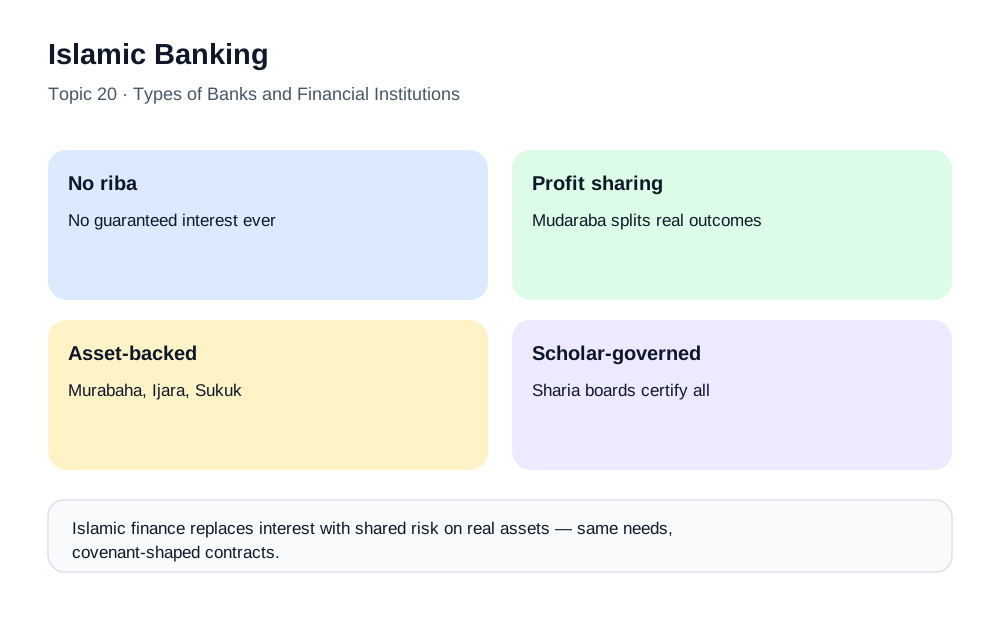
Islamic Banking at a glance — Sharia compliance, Murabaha, Sukuk, profit sharing.
1. Origins: From Doctrine to Modern Industry
Islamic financial principles are as old as Islam itself — the Quranic prohibition of riba dates to the seventh century, and medieval Muslim merchants ran sophisticated trade partnerships under Sharia rules centuries before modern banking existed. But Islamic banking as an industry is strikingly young.
The modern experiment began in 1963 in Mit Ghamr, Egypt, where a savings institution tested interest-free banking on profit-sharing principles with local depositors. The experiment demonstrated viability but remained isolated. The institutional era opened in 1975 with the founding of the Dubai Islamic Bank — the first modern commercial Islamic bank — and the Islamic Development Bank in Jeddah, a multilateral institution (in the family of Topic 19) dedicated to Sharia-compliant development finance.
Petrodollar wealth in the Gulf through the 1970s and 1980s supplied capital and demand; Malaysia then built the industry's most complete regulatory and educational infrastructure from the 1980s onward, deliberately cultivating Islamic finance as a national specialty. By the 2000s, global banks were opening Islamic windows, sovereigns were issuing sukuk (including non-Muslim-majority states such as the United Kingdom), and the industry had become a permanent feature of global finance. Growth since has consistently outpaced conventional banking in its core markets.
This history matters for a practical reason: Islamic banking is a living, engineered system, still being standardised and refined — not an ancient artefact. Many of its modern structures are decades, not centuries, old, and its rulemaking institutions (Section 6) are actively debating and revising standards today.
2. The Core Principles of Islamic Finance
Islamic banking operates on five foundational principles that distinguish it from conventional finance. Understanding these principles is essential to understanding how Islamic banks structure products and manage operations.
The prohibition of riba (interest) stands as the most distinctive principle. In Islamic jurisprudence, money is not a commodity that can generate returns simply by being lent; money is a medium of exchange and measure of value, not an asset that grows by itself. Charging interest on loans is forbidden, as is paying interest on deposits. Returns must come from productive economic activity — trade, investment, or leasing — rather than the mere passage of time. The prohibition applies regardless of rate: even low interest is usurious, and even high returns are permissible if they derive from legitimate economic activity. The moral logic targets exploitation and unearned gain: profit is justified by risk, effort, and ownership — not by money breeding money.
Risk sharing requires that provider and user of capital share in profits and losses. Conventional banking separates risk asymmetrically: depositors earn fixed interest regardless of bank performance, while borrowers bear full business risk alongside fixed interest obligations. Islamic jurisprudence holds this unjust and requires returns to reflect actual performance. If the venture succeeds, both parties share the gain; if it fails, both bear loss according to contribution.
Asset backing demands that every financial transaction link to a real, tangible asset or service. Pure monetary speculation — trading money for money without underlying economic purpose — is prohibited. This grounds financial activity in the real economy and provides a foundation of value beneath financial claims.
The prohibition of gharar (excessive uncertainty) requires contracts with clearly defined terms: subject matter, price, and delivery must be unambiguous. This protects parties from exploitation through deceptive or speculative structures. Islamic law distinguishes acceptable commercial risk (inevitable in business) from unacceptable contractual ambiguity — most conventional insurance and derivatives, built on uncertainty itself, require specially structured Islamic alternatives (takaful for insurance).
Ethical investment screening excludes financing for activities considered harmful: alcohol, gambling, pork products, weapons, adult entertainment, and conventional interest-based finance itself are haram. Financed activities must be halal — permissible and socially beneficial. The screening applies to the use of funds as well as their source, making Islamic banking a faith-based ancestor of today's ESG and ethical investing movements (Topic 17 noted the parallel demand from values-driven investors).
A comparison clarifies the structural difference:
| Dimension | Conventional Banking | Islamic Banking |
|---|---|---|
| Return mechanism | Interest on loans and deposits | Trade markup, rent, profit-sharing |
| Risk allocation | Fixed obligations; depositors insulated | Shared between capital provider and user |
| Underlying basis | Money as a lendable commodity | Real assets and services |
| Deposit nature | Guaranteed principal + interest | Investment accounts with performance-linked returns |
| Speculation | Permitted within regulation | Prohibited (gharar) |
| Ethical screen | Legal compliance only | Religious exclusion of haram sectors |
| Governance | Regulators and boards | Regulators, boards, and Sharia scholars |
3. Islamic Banking Products and Structures
Islamic banks have developed a sophisticated array of structures providing conventional banking's functionality while complying with Sharia. Each demonstrates how the industry engineers around constraints.
Murabaha (cost-plus financing) is the most widely used structure. The bank purchases an asset the customer wants and sells it to them at a marked-up price, payable over time. The markup is the bank's profit, replacing interest; because the transaction is a genuine sale of goods — the bank owns the asset briefly, bearing ownership risk — it is trade, not a loan. A worked example makes it concrete: a customer wants equipment costing $50,000. The bank buys it and sells it to the customer for $57,500, payable in 36 monthly instalments of roughly $1,597. The customer knows the full price on day one (fixed and certain — no rate resets); the bank earns $7,500 as trade profit. Economically the result resembles a fixed-rate loan; legally and religiously, the structure is entirely different: the bank was a merchant, owning and risking goods, never a lender charging for money.
Musharakah (joint venture) pools capital from bank and customer in a partnership, sharing profits by pre-agreed ratio and losses strictly in proportion to capital contributed. It embodies risk sharing most directly. Its diminishing variant dominates Islamic home finance: bank and customer co-own a house; the customer pays rent on the bank's share plus periodic amounts buying out that share, until the customer owns the property outright — rent and ownership transfer replacing principal and interest.
Mudarabah (trust financing) pairs the bank's capital with the customer's expertise and management. Profits split by pre-agreed ratio; financial losses fall on the capital provider alone, while the manager loses their effort. The structure resembles venture capital — and, crucially, it also underlies many Islamic savings accounts: depositors as capital providers, the bank as manager, returns variable rather than guaranteed. This is the deepest structural difference from conventional deposits (Topic 4): the Islamic "depositor" is an investor whose balance can, in principle, fall.
Ijarah (leasing) replicates leasing within Islamic parameters. The bank buys an asset and leases it to the customer for rent; ownership stays with the bank — which therefore also bears ownership responsibilities like major maintenance, unlike many conventional finance leases. Ownership may transfer at term end through separate sale or gift. Widely used for vehicles, equipment, and property.
Sukuk (Islamic bonds) provide the capital-markets answer to interest-bearing bonds. Rather than debt obligations paying coupons, sukuk certificates represent undivided ownership shares in tangible assets, projects, or businesses; returns flow from the underlying assets' performance. A government funding a toll road, for example, can sell sukuk backed by the road: investors own shares of the asset and receive distributions from toll revenues, with the government repurchasing the asset at maturity through a pre-agreed undertaking. The global sukuk market — measured in the hundreds of billions — now serves sovereigns, corporations, and financial institutions seeking Sharia-compliant funding, with structures evolving constantly under scholarly review.
4. How Islamic Banks Generate Returns
Islamic banks earn through mechanisms replacing interest with trade income, rent, profit shares, and fees:
- Trade markup through murabaha and similar structures — the merchant's margin on financed goods, compensating capital commitment and time.
- Rental income from ijarah — returns justified by genuine ownership and provision of usable assets.
- Profit shares from musharakah and mudarabah — returns fluctuating with real investment performance, requiring careful portfolio management to stabilise bank income.
- Agency fees (wakalah) — the bank invests client funds as agent, earning fees for expertise while clients bear investment risk.
The honest analytical point, which practitioners themselves acknowledge: many structures are economically equivalent to conventional equivalents in their cash flows — a murabaha's total cost often tracks a conventional loan's interest. The difference is not the arithmetic but the legal structure, the allocation of ownership and risk, and the religious compliance of the pathway. Critics call this legal engineering that replicates interest in disguise; defenders respond that form and substance both matter in law — in every legal system, including conventional finance — and that the structures genuinely reallocate risk and ownership in ways that constrain bank behaviour. Both perspectives are part of the industry's live internal debate, and understanding the debate is more valuable than resolving it.
5. Deposits, Risk, and the Customer Relationship
How does a bank that cannot pay interest attract deposits? Three account structures answer:
Qard (interest-free loan) accounts — current accounts where the deposit is a loan to the bank, repayable on demand with no return. The customer's return is the banking service itself: safekeeping and payments.
Wakalah (agency) accounts — the bank invests deposits as agent for a fee; returns depend on performance, with targets indicated but not guaranteed.
Mudarabah investment accounts — deposits pooled and invested under profit-sharing; returns distributed by pre-agreed ratios. These accounts carry genuine performance risk — smoothed in practice by reserve mechanisms that banks maintain to stabilise payouts (because customers flee volatile "deposits," whatever the contract says).
This creates distinctive risk dynamics. Investment account holders are, contractually, investors sharing business risk — yet they behave like depositors expecting stability. Islamic banks therefore manage displaced commercial risk: the pressure to forgo their own share of profits to protect account holders' returns. Regulators have developed specific capital treatment for this risk — a reminder that even principle-driven banking cannot escape the psychology of deposit safety we explored in Topic 11.
6. Governance: The Scholars Behind the System
No conventional banking topic has an equivalent to this section, because no conventional bank employs religious scholars to approve its products. Sharia governance is the industry's defining institutional innovation.
Every Islamic bank maintains a Sharia supervisory board: qualified scholars who review and approve products, contracts, and operations for compliance, issuing fatwas (scholarly rulings) that bind the institution. Their approval is the licence to call a product Islamic — and their interpretations differ across schools of jurisprudence and regions, which is why a structure accepted in Malaysia may face questions in the Gulf.
Above the banks stand standard-setting bodies:
- AAOIFI (Accounting and Auditing Organization for Islamic Financial Institutions, based in Bahrain) issues Sharia, accounting, and governance standards adopted wholly or partly by many jurisdictions.
- IFSB (Islamic Financial Services Board, based in Malaysia) develops prudential standards — capital adequacy, risk management — adapted to Islamic banking's distinct structures, playing roughly the Basel role for the industry.
National regulators license and supervise Islamic banks alongside conventional ones — Malaysia's dual system is the most developed, while countries like the UK have adjusted tax and regulatory rules (for instance, eliminating double stamp duty on murabaha property transfers) to level the playing field. Deposit protection varies: some jurisdictions extend conventional deposit insurance to Islamic accounts; others create parallel Sharia-compliant schemes.
The system's tension is structural: scholars must be independent to be credible, yet they are paid by the banks they certify — and the small pool of internationally recognised scholars sits on many boards simultaneously, creating capacity constraints and concentration concerns the industry openly debates.
7. The Global Scale of Islamic Finance
Islamic finance has grown from a theoretical construct to a major global industry. Total assets are measured in the trillions of dollars, with growth rates consistently outpacing conventional banking in core markets. Major centres include Malaysia (the regulatory and innovation leader), Saudi Arabia and the UAE (large domestic markets with international ambitions), Indonesia (the world's largest Muslim population), Bahrain and Qatar (specialist hubs), and Western centres including London — the leading Western sukuk and Islamic finance marketplace.
The customer base extends beyond Muslims seeking compliant banking. Ethical screens appeal to socially conscious investors of all backgrounds; asset-backing appeals to those wary of purely debt-based finance; risk sharing aligns bank and customer incentives in ways some prefer regardless of faith. Global systemically important banks maintain Islamic windows, offering Sharia-compliant products alongside conventional ones — the surest sign the industry is permanent.
A brief case study illustrates what national commitment achieves: Malaysia deliberately built Islamic finance as an industry — a dual banking system where Islamic and conventional banks compete under one central bank, deep domestic sukuk markets, standardised Sharia rulings at national level, and universities producing the scholars and practitioners the industry needs. The result: Islamic finance holds a substantial share of Malaysia's entire banking system, and Malaysian standards influence the industry worldwide. The lesson generalises: financial innovation scales when regulation, infrastructure, and talent are built together — the same pattern we saw with payment systems in Topic 14.
8. Challenges and Opportunities
Islamic banking faces challenges reflecting both its youth and the complexity of its foundations.
Standardisation remains incomplete. Scholarly interpretation varies across jurisdictions; what one Sharia board approves, another questions. AAOIFI and IFSB have made real progress, but cross-border consistency is unfinished — raising costs and uncertainty for international operations.
Benchmarking tension persists: when murabaha and sukuk pricing references conventional interest benchmarks (historically LIBOR, now its successors), critics ask whether the substance differs from riba. Alternative benchmarks based on real economic returns exist but have not displaced market rates — the industry's most philosophically charged practical problem.
Liquidity management is harder. Conventional money markets are interest-based and impermissible; Islamic banks need Sharia-compliant interbank instruments and lender-of-last-resort facilities, which are developing but thinner than conventional equivalents — a genuine fragility in stress scenarios (the Topic 11 problem re-engineered).
Sharia talent is scarce. Scholarly capacity, product engineers fluent in both finance and fiqh (jurisprudence), and governance depth all lag demand growth.
Opportunities are equally structural. Growing Muslim populations worldwide expand demand; the ethical finance movement draws non-Muslim interest; digital banking lowers the cost of serving dispersed customers; and Islamic social finance — zakat (obligatory almsgiving) and waqf (endowments) integrated with modern structures — offers development-finance potential the multilateral world of Topic 19 increasingly studies.
Islamic banking demonstrates that financial systems can be organized around different principles than conventional Western finance. Its growth and persistence show that religious constraints, far from obstructing modern finance, can inspire creative solutions serving genuine economic and social needs.
8. Worked Example: Buying a Home the Islamic Way
Home finance is where Islamic structures touch the most customers, so it repays a full walkthrough. Amina wants to buy a house priced at $300,000 and has $60,000 for a down payment. She needs $240,000 of financing. Here is how a diminishing musharakah delivers it.
Step 1 — partnership, not loan. Amina and the bank buy the house together: she contributes $60,000 (20%), the bank $240,000 (80%). They are co-owners from day one. There is no loan, no lender, no borrower — and therefore no interest.
Step 2 — the monthly payment has two parts. Amina lives in the whole house but owns only 20% of it, so she pays the bank rent on its 80% share — the bank's return, justified by its genuine ownership of an asset she uses. Alongside the rent, she makes scheduled payments buying units of the bank's share, gradually increasing her ownership.
Step 3 — the rent declines as ownership grows. Because rent is charged only on the bank's remaining share, each buy-out reduces next month's rent component while the buy-out component grows — the exact mirror of a conventional amortising mortgage, where interest falls and principal rises over time (Topic 14's EMI mechanics, re-engineered). Suppose initial monthly rent on the bank's share is about $1,000 and buy-out payments start around $800; fifteen years later the rent has fallen toward zero as her share approaches 100%.
Step 4 — completion. When Amina has purchased the bank's final unit, she owns 100% and the partnership dissolves. Total paid: her $60,000, the $240,000 of buy-outs, and cumulative rent comparable in scale to the total interest on an equivalent conventional mortgage.
What the structure genuinely changes. First, the bank owned real property throughout — its return was rent on an asset, not a charge on money. Second, risk is shared: if the house must be sold at a loss mid-term, partnership rules allocate that loss by ownership share — a striking contrast with conventional mortgages, where the borrower owes the full debt regardless of the property's value. Third, late-payment charges are capped and typically directed to charity rather than bank income, since profiting from delinquency itself raises riba concerns. The arithmetic resembles a mortgage; the legal and ethical architecture is something else entirely.
9. Beyond Banking: Takaful and Islamic Capital Markets
Islamic finance extends well beyond banking, and two neighbouring sectors complete the picture.
Takaful (Islamic insurance) answers a genuine doctrinal problem: conventional insurance involves gharar (the uncertain contract) and elements resembling gambling (paying premiums on events that may never occur). Takaful restructures insurance as mutual indemnification: participants contribute to a common pool as donations (tabarru'), agreeing to cover each other's losses; a takaful operator manages the pool for a fee or profit share, and surpluses belong to participants. The protection customers receive looks like insurance; the legal architecture is cooperation, not a bilateral wager — the cooperative logic of Topic 18 arriving at insurance from a different direction.
Islamic capital markets centre on sukuk but extend further: Sharia-screened equity funds (excluding haram sectors and applying financial-ratio screens that limit how much conventional debt a company may carry), Islamic ETFs, Islamic money-market instruments for treasury management, and a growing frontier of green sukuk financing renewable energy and sustainable infrastructure — where the ethical-screen tradition meets climate finance (Topic 19). These markets matter beyond their size: they give Islamic banks the liquidity instruments conventional banks take for granted, and they give issuers — including governments with no religious motivation — access to a deep, distinctive pool of global capital.
10. The Customer and Bank Perspectives
From the customer's perspective:
- Compare total cost, not terminology. A murabaha's markup versus a conventional loan's interest is an arithmetic comparison — structure differs, but your cash flows should still be shopped against alternatives.
- Understand what your deposit account actually is. Investment accounts are not guaranteed deposits; know whether your balance is principal-protected (qard) or performance-linked (mudarabah/wakalah), and what that means in a bad year.
- Check the protection scheme. Deposit insurance treatment of Islamic accounts varies by jurisdiction — verify before assuming equivalence with conventional coverage (Topic 9).
- Non-Muslims are welcome. Islamic banks serve all customers; the screens and structures may align with your own ethical preferences regardless of faith.
From the bank's perspective:
- Compliance is a product feature, not a constraint list. Sharia approval is the brand promise; governance failures destroy the franchise faster than credit losses.
- Liquidity is the hardest daily problem. Conventional tools are unavailable; treasury must run on commodity murabaha, sukuk, and central bank Islamic facilities — thinner markets demanding larger buffers.
- Displaced commercial risk is the hidden balance-sheet exposure. Expectations of stable investment-account returns pressure banks to smooth payouts at their own expense — capital planning must price it.
- Talent is the bottleneck. Scholars, structurers, and audit staff with dual fluency in finance and fiqh are the industry's scarcest input.
11. Common Mistakes and Misconceptions
Misconception 1: "Islamic banking is interest-free, so it's free." Islamic finance is not free money — banks earn markups, rent, and profit shares. "No interest" describes the structure of returns, not their absence. Customers pay for financing; they pay through trade and partnership rather than lending.
Misconception 2: "It's just conventional banking with relabeled products." Some products are economically close to conventional equivalents — a live internal debate — but the structures genuinely differ in ownership, risk allocation, and legal form, and risk-sharing products (musharakah, mudarabah) have no conventional deposit or loan counterpart at all.
Misconception 3: "Islamic banking is only for Muslims." Anyone may bank with Islamic institutions, and many non-Muslims do — attracted by ethical screening, asset-backing, or competitive pricing.
Misconception 4: "Islamic banks can't fail because they avoid speculation." Asset-backing constrains but does not eliminate risk: Islamic banks face credit, market, operational, and liquidity risks like any bank, plus distinctive ones (displaced commercial risk, thinner liquidity markets). Islamic financial institutions have failed and required resolution.
Misconception 5: "Sukuk are just bonds with a different name." Structurally they represent ownership in assets rather than pure debt — holders have claims on underlying asset performance, and scholars scrutinise whether specific structures genuinely transfer ownership risk. Some sukuk resemble bonds economically; the distinction between asset-backed and asset-based structures is a real and debated frontier.
Misconception 6: "The rules are ancient and frozen." Islamic finance is one of the most actively evolving areas of law and finance, with scholars, standard-setters, and banks continuously engineering and debating new structures — fintech, digital assets, and green sukuk among current frontiers.
Misconception 7: "All scholars agree on what's compliant." Interpretation varies across schools and regions; a product approved in one market may be questioned in another. Standardisation bodies exist precisely because consensus is a work in progress.
12. Frequently Asked Questions
If banks can't charge interest, how do they make money? Through trade markup (murabaha), rent (ijarah), profit sharing (musharakah, mudarabah), and agency fees (wakalah) — returns on real assets, services, and ventures rather than on money itself.
Is the markup in murabaha just interest renamed? Economically the customer's total cost often resembles a loan's interest; legally and religiously the bank sold goods it owned and risked, which is trade, not lending. Whether the economic similarity undermines the distinction is the industry's central internal debate.
What happens to my savings account in an Islamic bank? Depends on the structure: qard accounts guarantee principal with no return; wakalah and mudarabah accounts are investments whose returns vary with performance. Ask which type you hold — the risk profile is genuinely different from a guaranteed conventional deposit.
What is a sukuk and how is it different from a bond? A sukuk certificate represents ownership shares in underlying assets or ventures, with returns from asset performance rather than interest coupons. Holders own something real; bondholders are owed money.
Can non-Muslims use Islamic banks? Yes — fully. Products are available to all customers, and ethical screens attract many non-Muslim clients.
Who decides what is Sharia-compliant? Each institution's Sharia supervisory board, within frameworks from standard-setters (AAOIFI, IFSB) and national regulators. Rulings can vary by jurisdiction — standardisation is ongoing.
Are Islamic financial products available outside Muslim-majority countries? Yes — through Islamic banks, windows of global banks, and sukuk markets in financial centres like London, Luxembourg, Hong Kong, and Singapore. Several non-Muslim-majority governments have issued sovereign sukuk.
Does Islamic finance avoid all speculation? Gharar rules prohibit contracts with excessive uncertainty and gambling-like structures, but ordinary commercial risk — the kind every business takes — is not only permitted but required as the justification for profit.
What happens if I default on Islamic home finance? The partnership's asset — the home — is sold, and proceeds are divided by ownership share: the bank recovers only its remaining portion, not a debt insulated from the property's value. Late-payment penalties are capped and typically directed to charity rather than bank income. The exact process follows the contract and local law, which is why reviewing default terms before signing matters as much here as with any mortgage.
13. Key Terms in This Chapter
- Riba — interest/usury; the prohibition at the core of Islamic finance.
- Gharar — excessive contractual uncertainty; prohibited ambiguity in transactions.
- Halal / haram — permissible / forbidden activities under Islamic law, driving ethical screens.
- Murabaha — cost-plus sale financing: the bank buys and resells an asset at a disclosed markup.
- Musharakah — joint venture partnership sharing profits by agreement and losses by capital share.
- Diminishing musharakah — home-finance partnership where the customer gradually buys out the bank's share.
- Mudarabah — trust partnership: capital from one party, management from another; profits shared, financial loss on the capital provider.
- Ijarah — Islamic leasing, with ownership (and its responsibilities) retained by the bank.
- Sukuk — certificates representing ownership in underlying assets, yielding asset-linked returns.
- Wakalah — agency arrangement: the bank invests client funds for a fee.
- Qard — interest-free loan; the basis of principal-guaranteed current accounts.
- Takaful — Islamic insurance built on mutual contribution and risk sharing.
- Tabarru' — the donation principle underlying takaful: participants contribute to a mutual pool to indemnify each other.
- Sharia supervisory board — the scholars certifying an institution's compliance.
- AAOIFI / IFSB — the global Sharia/audit and prudential standard-setting bodies.
- Displaced commercial risk — the pressure on Islamic banks to smooth investment-account returns at their own expense.
- Fiqh — Islamic jurisprudence; the scholarly discipline behind financial rulings.
14. Interview Insights: How This Topic Appears in Banking Interviews
"How does Islamic banking work without interest?" Structure the answer in three beats: the principle (money cannot breed money; profit requires risk, ownership, or effort), the engineering (murabaha for lending-like financing, ijarah for leasing, musharakah/mudarabah for partnerships, sukuk for capital markets), and the economics (returns exist — structured as trade, rent, and shares). Candidates who explain the function each structure replaces demonstrate systems understanding rather than memorised definitions.
"Is murabaha just disguised interest?" The question tests whether you can hold a real debate. Present the economic-equivalence argument (cash flows often mirror loans), then the structural counter (genuine ownership, risk transfer, and legal form matter — in Islamic and conventional law alike), and close with the honest status: it's the industry's central internal controversy, and both standard-setters and critics are actively engaged with it. Balanced answers beat partisan ones.
"What makes Islamic deposits different from conventional deposits?" The technical answer that distinguishes strong candidates: investment accounts are performance-linked investments, not guaranteed liabilities — creating displaced commercial risk, profit-smoothing reserves, and distinct capital treatment under IFSB standards. This shows you understand where the system's real fragility lives.
"Why is Islamic finance growing, and will it continue?" Combine demographics (young, growing Muslim populations), policy (national strategies like Malaysia's dual system), product maturation (sukuk markets, standardisation), and crossover appeal (ethical investing). Acknowledge the constraints honestly — liquidity infrastructure and scholarly capacity — to show the growth case is analysis, not enthusiasm.
"What can conventional banking learn from Islamic finance?" The reflective question. Strong answers: asset-backing as a discipline on speculation, risk-sharing as an incentive alignment mechanism, ethical screening as a precursor of ESG, and governance by principle as a brand asset. The meta-point — constraints can drive innovation — applies far beyond this industry.
Summary and Key Takeaways
Islamic banking is a complete financial system rebuilt on religious principle — proof that banking's functions can be delivered through radically different structures. The essential points:
- The prohibition of riba is the organising constraint: money cannot earn merely by being lent; profit must flow from real assets, trade, or shared risk.
- Five principles define the system: no riba, mandatory risk sharing, asset backing, no excessive uncertainty (gharar), and ethical screening of financed activity.
- A full product toolkit delivers conventional functionality: murabaha (cost-plus sale), musharakah (joint venture), mudarabah (trust partnership), ijarah (leasing), and sukuk (asset-linked securities) — a remarkable engineering achievement under constraint.
- Returns exist and are real: Islamic banking is interest-free in structure, not cost — the customer's comparison remains arithmetic even when the contract is sacred.
- Deposits are often investments: performance-linked accounts create displaced commercial risk — the system's distinctive fragility, managed with specific regulation.
- Sharia governance is the defining institution: scholar boards, AAOIFI, and IFSB certify compliance — a second layer of governance no conventional bank carries, with independence and capacity questions attached.
- The industry is global, growing, and cross-faith: trillions in assets, hubs from Kuala Lumpur to London, and appeal extending to ethical investors of all backgrounds.
- The honest challenges are structural: standardisation gaps, benchmark dependence, thin liquidity markets, and scarce scholarly talent.
- The broader lesson: constraints drive innovation. A system that began from prohibition produced structures now studied by the entire financial world — for what they teach about risk sharing, asset-backing, and purpose-driven design.
In the next topic, we move to institutions that operate at the regulated perimeter of banking: non-banking financial companies (NBFCs) — the lenders, financiers, and shadow institutions that do much of banking's work without a banking licence.
Next: Topic 21 — Non-Banking Financial Companies →
<!-- MBA-DEEP-DIVE-START -->Deep Dive: How Islamic Banking Works in Practice
Islamic banking is sometimes reduced to the statement that interest is prohibited. That is far too narrow. The real system is built around a broader set of principles: financing should be linked to genuine economic activity, contractual uncertainty and speculative behaviour should be controlled, transactions should avoid prohibited activities, and the allocation of profit and risk should be consistent with the agreed structure. The result is not simply conventional banking with different terminology. It is a contract-based financial system in which legal form, economic substance, asset ownership, and Sharia governance all matter.
The most important practical lesson is that Islamic banking products are built from contracts. A conventional loan starts with money advanced today in exchange for principal plus interest later. An Islamic structure instead asks what underlying transaction is taking place: sale, lease, partnership, agency, investment, or service. The bank then earns profit through that permitted commercial relationship rather than charging interest on a pure loan of money.
This means operations are often more demanding. The bank may need evidence that an asset exists, that ownership passes in the correct sequence, that a purchase and resale are separate valid transactions, that rental begins only when the leased asset can be used, or that profit-sharing is calculated from actual results rather than disguised as guaranteed interest. Documentation is not an afterthought; it is part of whether the transaction is valid.
The Sharia governance framework
A mature Islamic bank normally operates with a formal Sharia governance framework. Exact structures differ by jurisdiction, but several functions are common. A Sharia board or committee reviews products and major contractual structures. Internal Sharia compliance teams translate rulings into procedures and documentation. Sharia review or audit functions test whether executed transactions actually followed the approved structure. Product, legal, risk, operations, treasury, and technology teams must then implement the requirements consistently.
This creates an important distinction between product approval and transaction compliance. A Murabaha product may be approved in principle, but an individual transaction can still be non-compliant if the bank sells an asset before owning it, if documents are executed in the wrong order, or if the underlying commodity or asset is not valid. Compliance therefore depends on process execution, not merely the label attached to the product.
Sharia governance also handles income that may be considered impermissible because of an operational error or incidental exposure. Depending on the applicable framework and scholarly determination, such amounts may need to be identified and purified, often by directing them away from bank profit. The practical implication is that finance, operations, and compliance systems must be able to trace the source of income at a more granular level than in some conventional models.
Murabaha: a sale, not an interest-bearing loan
Murabaha is one of the most widely used Islamic financing structures. The bank purchases an asset requested by the customer and then sells it to the customer at cost plus a disclosed profit margin, usually with deferred payment.
Suppose a business needs manufacturing equipment costing ₹1 crore. In a simplified Murabaha structure, the bank purchases the equipment for ₹1 crore and then sells it to the customer for ₹1.12 crore payable over an agreed period. The ₹12 lakh is trade profit from the resale, not interest charged on a cash loan.
The sequence is crucial. If the bank simply transfers ₹1 crore to the customer and demands ₹1.12 crore back, calling the difference ‘profit’, the economic transaction has not become Murabaha merely through wording. The bank must acquire ownership or the legally recognised exposure required by the structure before selling the asset onward.
This creates asset and operational risk, even if only briefly. During the ownership period, the bank is exposed to the asset according to the contract and applicable law. Documentation must establish purchase price, sale price, specifications, delivery, agency arrangements where used, and payment schedule.
Murabaha is common in trade finance and asset financing because its cash flows are predictable. Yet practitioners should recognise its limitation: it can produce an economic profile similar to fixed-rate financing, so strong Sharia governance is needed to ensure the transaction remains a genuine sale rather than a paper device with no meaningful asset linkage.
Ijarah: financing through lease
Ijarah is a lease structure. The bank acquires an asset and leases the right to use it to the customer in exchange for rent. Ownership remains with the lessor during the lease, while usage rights pass to the lessee.
This matters because ownership carries responsibilities. Structural or ownership-related risks generally cannot simply be pushed entirely onto the customer if doing so contradicts the nature of the lease. Routine operating expenses may belong to the lessee, while ownership responsibilities remain with the lessor according to the contractual framework.
In an Ijarah wa iqtina or lease-to-own style arrangement, ownership may transfer to the customer at the end through a separate sale or gift mechanism, subject to the approved structure. The transfer mechanism should not undermine the validity of the lease itself.
From a risk perspective, Ijarah combines credit risk with asset risk. If the customer defaults, the bank still owns the leased asset and must consider repossession, residual value, legal enforceability, insurance or takaful arrangements, and the ability to release or sell the asset.
Musharakah and Mudarabah: genuine risk sharing
Partnership structures demonstrate Islamic finance most clearly.
In Musharakah, two or more parties contribute capital to a venture. Profits are shared according to an agreed ratio, while losses are generally borne in proportion to capital contribution, subject to the governing rules. The bank is therefore an investor rather than a lender with a guaranteed return.
Diminishing Musharakah is commonly used for property financing. The bank and customer jointly own an asset. The customer gradually purchases the bank’s ownership units while also paying rent for use of the bank’s remaining share. Over time, the customer’s ownership rises and the bank’s share declines.
In Mudarabah, one party provides capital and another provides management or entrepreneurial effort. Profit is shared according to a pre-agreed ratio. Financial loss is generally borne by the capital provider unless it results from negligence, misconduct, or breach by the manager, depending on the contractual and legal framework.
These models create a different risk mentality from conventional secured lending. The bank must understand the underlying business, governance, accounting, and profit calculation because return cannot simply be fixed independently of performance where the contract requires genuine sharing.
Deposits are not all economically identical
Islamic-bank liabilities can also be structured differently. Some transaction accounts may be based on safekeeping or loan-like principles under the applicable legal and Sharia model, with principal available on demand but no contractual investment return. Investment accounts may use Mudarabah or agency structures in which the customer participates in investment performance.
This creates important disclosure obligations. A customer whose funds are legally and economically exposed to investment performance should understand that the account is not identical to a conventional guaranteed deposit. Jurisdictions differ in how deposit protection, capital, and accounting apply, so institutions must communicate the precise legal nature of each account rather than relying on broad marketing language.
The bank may also face displaced commercial risk. Even where investment-account holders technically bear investment performance, a bank may feel commercial pressure to smooth returns so customers do not move funds to competitors offering better outcomes. This tension between contractual risk sharing and competitive expectations is a distinctive feature of Islamic banking risk management.
Sukuk: asset-linked capital-market financing
Sukuk are often described as Islamic bonds, but that shorthand can be misleading. A conventional bond is fundamentally a debt instrument paying interest. Sukuk represent beneficial ownership or economic rights in assets, usufructs, services, projects, or investment activities structured to generate permissible returns.
The exact risk depends on the structure. In an asset-based Sukuk, investors may have contractual claims whose economic risk still depends heavily on the obligor. In a more genuinely asset-backed structure, investor recovery may depend more directly on the underlying assets and legal ownership rights. Learners should therefore look beyond the word ‘Sukuk’ and ask what investors actually own, who owes the cash flows, what happens on default, and whether assets can be enforced against.
A typical transaction may involve an issuing special-purpose vehicle that acquires assets or rights using investor proceeds and distributes income generated by those assets. Legal, tax, insolvency, and Sharia analysis all need to align. Cross-border Sukuk can become highly complex because a structure accepted in one jurisdiction must also work under securities, property, tax, and insolvency law elsewhere.
Treasury management is one of the hardest practical areas
Conventional banks manage liquidity using interbank deposits, interest-bearing money-market instruments, central-bank facilities, repos, and bonds. Islamic banks cannot automatically use every conventional instrument because the structure of return matters.
This makes Sharia-compliant liquidity management strategically important. Banks may use commodity Murabaha, Sukuk, Wakalah arrangements, Islamic interbank instruments, or central-bank facilities specifically designed for Islamic institutions, depending on the jurisdiction.
The challenge is not only earning a return. The bank must maintain enough highly liquid, Sharia-compliant assets to meet withdrawals, payment obligations, collateral needs, and prudential liquidity requirements. If the supply of eligible instruments is limited, Islamic banks can face concentration or liquidity costs that conventional peers do not.
Treasury also manages profit-rate risk. Even though Islamic products do not pay or charge interest in the conventional contractual sense, their pricing often competes in markets where benchmark rates influence customer expectations and funding costs. If market rates rise but returns on existing fixed-profit assets remain unchanged, margins can compress. Asset-liability management therefore remains essential.
Credit risk does not disappear under Islamic structures
A customer can default on a Murabaha receivable, fail to pay Ijarah rent, or breach obligations in a partnership financing. Islamic banking still requires underwriting, collateral management, expected-loss assessment, concentration limits, collections, and recovery.
The structure can change the recovery path. In Murabaha, the bank may hold a receivable after the sale is completed. In Ijarah, the bank owns the asset. In Musharakah, the bank may own an equity-like share. The legal rights, accounting treatment, and recovery options differ accordingly.
Late-payment treatment is particularly sensitive. A conventional lender may earn additional interest when payment is overdue. Islamic structures generally cannot turn delay into a source of profit in the same way. Contracts may include deterrent mechanisms or amounts directed to charity under approved rules, and actual recovery costs may be treated according to the applicable framework. Systems must therefore distinguish compensation, penalties, charity amounts, and bank income correctly.
Operational risk is unusually contract-sensitive
Islamic banking adds what can be called Sharia non-compliance risk to ordinary operational risk. A transaction may be financially sound but executed in a sequence that violates the approved structure. For example, a system might timestamp the resale of a commodity before recording the bank’s purchase. A manual workaround may skip an ownership step. An agency arrangement may be used outside approved conditions.
These issues can affect income recognition, customer rights, audit findings, reputational trust, and sometimes the validity of the transaction. Technology requirements therefore need to capture not only amounts and dates but the legal order of events.
A strong product implementation should translate the Sharia structure into explicit system states. For a Murabaha flow, these might include customer request, promise to purchase, bank acquisition, evidence of ownership, customer sale, payment schedule, settlement, and closure. Each state should have controls preventing an invalid next step.
Islamic trade finance
Trade finance is naturally suited to asset-linked Islamic structures because an underlying movement of goods already exists. Murabaha can finance imports, Wakalah can support agency arrangements, and guarantees may be structured subject to applicable Sharia rules.
Operationally, the bank still needs the familiar disciplines of trade finance: document checking, sanctions screening, counterparty risk, shipping evidence, title documents, fraud controls, foreign exchange, settlement, and reconciliation. Sharia compliance is an additional dimension, not a replacement for these controls.
A trade transaction can therefore be compliant in one sense and defective in another. The contract may satisfy Sharia requirements but still violate sanctions law. The shipping documents may be genuine but the bank may have failed to establish asset ownership correctly. World-class Islamic banking requires both conventional banking controls and Sharia controls to work together.
Payments remain payments
Customers of Islamic banks still need to send salaries, pay suppliers, receive international transfers, use cards, and access instant-payment systems. Payment infrastructure itself is generally not transformed simply because the account sits at an Islamic bank. Clearing, settlement, fraud monitoring, sanctions screening, reconciliation, operational resilience, and customer authentication remain core banking responsibilities.
The difference lies primarily in the underlying account and financing contracts, not in inventing a separate global payment rail. This is an important boundary for learners: Islamic banking should be integrated with payments only where the business model requires it, rather than forcing unrelated messaging standards or payment terminology into every explanation.
Takaful and the wider ecosystem
Islamic finance also includes Takaful, a cooperative risk-sharing model used as an alternative to conventional insurance in many markets. Participants contribute to a pool used to support members who suffer covered losses, while the operator manages the arrangement under an approved model.
Banks may use Takaful to protect financed assets or offer it to customers, subject to local regulation and product suitability. As with conventional insurance distribution, the bank should separate genuine customer need from sales incentives and disclose the contractual nature of the product clearly.
A practical home-finance example
Consider a customer buying a home worth ₹1 crore through diminishing Musharakah. The customer contributes ₹20 lakh and the bank contributes ₹80 lakh, giving the bank an 80% ownership share. The customer occupies the property and pays rent for use of the bank’s share. At agreed intervals, the customer purchases additional ownership units from the bank.
As the customer’s ownership rises, the bank’s share falls, so the rental component should reflect the declining bank ownership according to the structure. The payment experience may resemble a mortgage, but the legal building blocks are co-ownership, lease, and progressive purchase.
The bank must manage property title, valuation, insurance or Takaful requirements, payment collection, ownership records, taxes, default procedures, and eventual transfer of full title. Technology and accounting must keep the ownership and payment legs aligned throughout the life of the facility.
How to judge whether a product is genuinely understood
A learner should be able to ask six questions of any Islamic banking product. What is the underlying contract? What real asset, service, or investment activity supports it? At each stage, who owns what? What risk does the bank genuinely bear? How is profit earned, and is any amount effectively guaranteed contrary to the contract? What happens on default or early termination?
If those questions cannot be answered, memorising Arabic product names is not enough.
What excellence looks like
A world-class Islamic bank combines credible Sharia governance with ordinary banking discipline. It can demonstrate that approved contracts are executed correctly in systems and operations. It understands credit, market, liquidity, operational, legal, and concentration risk. It discloses the economic nature of investment accounts clearly. It manages treasury without compromising Sharia requirements. It prevents late-payment mechanisms from becoming hidden interest income. It audits transaction sequencing and income purification where required. And it integrates customer service, payments, fraud, sanctions, accounting, and technology without confusing Sharia compliance with immunity from normal banking risk.
The deepest lesson is simple: Islamic banking is not defined by replacing the word ‘interest’ with ‘profit’. It is defined by structuring finance around permissible commercial contracts whose rights, risks, ownership, and cash flows are real enough to survive legal, operational, financial, and Sharia scrutiny.
<!-- MBA-DEEP-DIVE-END -->