While commercial banks pursue profit and central banks focus on monetary stability, development banks pursue a different objective entirely: economic development. These specialized institutions exist to finance projects that build nations, transform economies, and improve lives. Roads that connect remote regions to markets, power plants that bring electricity to underserved areas, hospitals that provide healthcare, schools that educate future generations — all receive support from development banks that see their mission as broader than financial returns alone.
Development banks accept lower returns, assume greater risks, and extend longer time horizons than commercial banks would find acceptable. They finance projects that are too large, too risky, or too slow to mature for conventional financing. In doing so, they fill gaps that market mechanisms alone cannot bridge, channeling resources toward investments that generate social and economic benefits extending far beyond the immediate project returns.
What you will learn in this topic:
- What development banks are and the market failures they exist to correct
- The difference between multilateral, regional, and national development banks
- The World Bank Group, the regional development banks, and major national institutions like KfW and NABARD
- How development banks fund themselves: government capital, AAA bond issuance, donor contributions
- How concessional finance works — with a worked example of the subsidy inside a development loan
- The sectors development banks finance, from infrastructure to climate action
- The project cycle: how a development loan is designed, appraised, and supervised
- The honest criticisms: conditionality, debt sustainability, and project failures
- What development banking teaches about the boundary between state and market in finance
This topic completes our survey of banking's institutional forms. We have seen banks organised by customer (retail, corporate, private), by activity (investment), and by ownership (cooperative). Development banks are organised by purpose — institutions that exist to finance what markets underprovide. Understanding them means understanding one of the deepest questions in finance: where does the market's logic end, and where must public purpose begin?
Visual overview
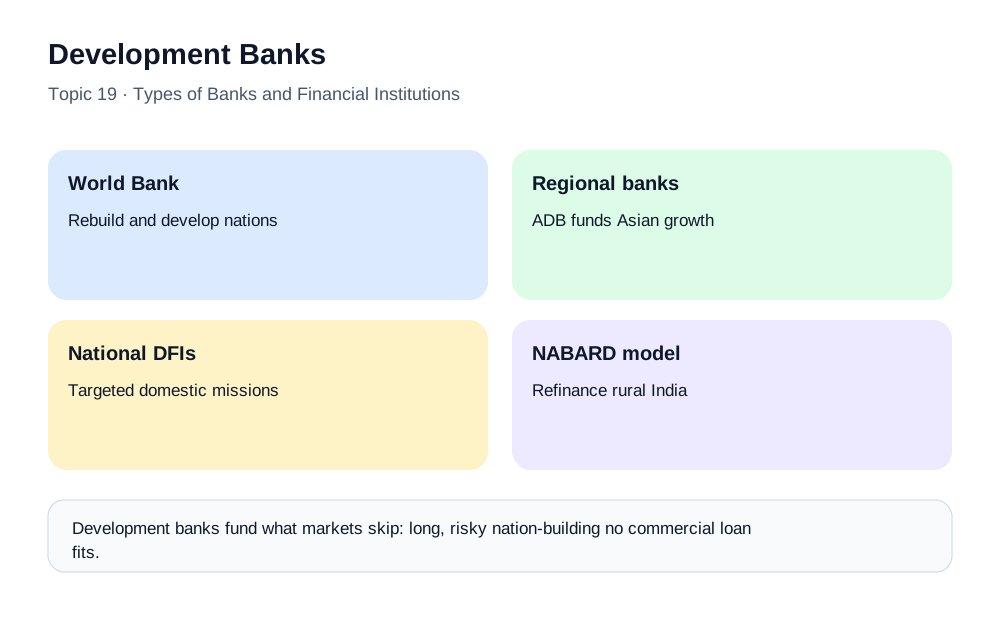
Development Banks at a glance — World Bank, ADB, NABARD, and nation building finance.
1. Why Development Banks Exist: The Market Failure Argument
Development banks did not arise from ideology but from a practical observation: market forces, left to themselves, systematically underinvest in certain categories of economically vital activity. Four distinct market failures explain why.
First, the time horizon problem. A power grid, railway, or education system may take a decade to build and three more to generate returns. Commercial lending operates on much shorter cycles (Topic 15), and shareholders demand returns within years, not generations. Investments whose benefits are real but distant are chronically underfunded.
Second, the externality problem. A rural road's value is not captured by its owner: it accrues to every farmer who reaches a market, every child who reaches a school, every business that gains customers. Because the investor cannot charge for most of the benefit created, private returns understate social returns — and projects with enormous social value fail private profitability tests.
Third, the risk-perception problem. Lending in poor or unstable countries commands risk premiums so high that viable projects become unviable at market rates. Perception often overshoots reality — but even accurate pricing can make essential investment impossible for exactly the countries that need it most.
Fourth, the coordination problem. Some investments only make sense together: a port without roads, power, and customs reform is a stranded asset. No single private investor can coordinate the whole, so each waits for others — and nothing happens.
Development banks exist to correct these failures: supplying patient capital (long horizons), priced below market (internalising externalities), in places markets fear (absorbing risk through public backing), and with the convening power to coordinate complementary investments. Every feature of the institutions described in this topic — their ownership, funding, lending terms, and governance — traces back to one of these four failures.
2. The Purpose of Development Banking
Development banks provide long-term finance for infrastructure and development projects that commercial banks avoid. They lend at below-market rates or with longer repayment periods that accommodate the cash flow realities of development investments. They accept risks private financiers find unacceptable, using government backing and patient capital to absorb uncertainties that would paralyze commercial decision-making.
This willingness to accept constrained returns reflects ownership and mission. Development banks are typically backed by governments or international organizations that prioritize development outcomes over financial maximization. Shareholders — national governments in multilateral institutions, public authorities in national development banks — accept that their investments serve public purposes beyond profit.
A key concept defines the sector's discipline: additionality. Development finance should fund what markets will not — adding to, not substituting for, private capital. A development bank that simply undercuts commercial lenders on commercially viable projects achieves nothing except distorting competition and misallocating public subsidy. The institution's legitimacy rests on financing the gap, and its evaluation frameworks exist to prove it stayed there. The counterpart concept is crowding in: by absorbing early risk, providing credibility, or co-financing, development banks aim to attract private capital into projects and markets it previously avoided — multiplying rather than displacing market finance.
3. Multilateral Development Banks
Multilateral development banks (MDBs) bring together multiple countries as shareholders to finance development across national boundaries, pooling resources from wealthy nations to support growth in developing countries.
The World Bank Group stands as the largest and most influential multilateral development institution. Founded in 1944 at the Bretton Woods Conference alongside the IMF (Topic 10 covered the monetary side of that settlement), its first loan financed French post-war reconstruction — the "R" in IBRD was literal before the mission pivoted to developing countries. Today the Group comprises complementary arms:
- IBRD (International Bank for Reconstruction and Development): loans at near-market rates to middle-income and creditworthy countries, funded by AAA-rated bond issuance.
- IDA (International Development Association): grants and near-zero-interest, ultra-long loans to the poorest countries that cannot sustain market borrowing — the concessional window, funded by donor replenishments every few years.
- IFC (International Finance Corporation): invests in and lends to private sector projects in developing countries, demonstrating that development objectives can align with commercial viability.
- MIGA (Multilateral Investment Guarantee Agency): insures private investors against political risks — expropriation, currency inconvertibility, war — in developing markets.
Together these institutions commit well over $100 billion annually, making the Group the anchor of global development finance.
The Asian Development Bank (established 1966, headquartered in Manila) focuses on poverty reduction and sustainable development across Asia and the Pacific, its membership spanning regional borrowers and external donors, with a portfolio measured in the hundreds of billions supporting infrastructure, education, health, and environmental projects.
The African Development Bank serves Africa's fifty-four nations with financing focused on infrastructure, agriculture, and governance — a crucial source of development finance for a continent with enormous infrastructure needs and limited alternative funding.
The Inter-American Development Bank is the largest source of development financing for Latin America and the Caribbean, supporting projects from transportation to social programmes.
The European Investment Bank, owned by EU member states, is by some measures the world's largest multilateral lender, financing European integration, innovation, and increasingly climate action worldwide. Newer entrants — notably the Asian Infrastructure Investment Bank (2016) and the New Development Bank of the BRICS countries — reflect emerging economies' demand for voice in the development finance architecture. Each institution adapts the multilateral model to its region's challenges and political relationships.
4. National Development Banks
While multilateral institutions operate internationally, national development banks (NDBs) focus on domestic priorities, often becoming significant forces in their countries' economic trajectories.
Germany's KfW ranks among the world's largest development banks, with a balance sheet exceeding €500 billion. Founded in 1948 to finance post-war reconstruction — partly with Marshall Plan counterpart funds — it now supports renewable energy, housing, SMEs, education, and international development. Its AAA standing, backed by the German state, lets it raise funds cheaply and channel them into public priorities at favorable terms. KfW is the standard proof that a development bank can operate at massive scale with commercial-grade discipline.
India's NABARD (National Bank for Agriculture and Rural Development) channels credit to the country's vast rural population, refinancing agriculture, rural infrastructure, and the cooperative institutions (Topic 18) that serve village communities — a central pillar of India's rural development architecture. The Small Industries Development Bank of India (SIDBI) complements it, focusing on the micro, small, and medium enterprises that employ millions.
Brazil's BNDES, Latin America's largest development bank, has financed infrastructure, industry, and innovation that shaped Brazil's development — though its scale and political importance have generated recurring controversy over allocation decisions and efficiency, a reminder that national development banks operate close to politics by design.
China Development Bank operates at a scale that dwarfs even the World Bank, with assets measured in the trillions of dollars, financing China's domestic infrastructure and industrial development while supporting Belt and Road Initiative investments globally. Its size reflects China's state-led development model — and raises questions about transparency and debt sustainability in borrowing countries that have become central to modern development finance debates.
Hundreds of smaller national development banks complete the picture; in many developing countries, the NDB is the only source of long-term domestic capital in existence.
5. How Development Banks Are Funded
Development banks fund themselves differently from commercial banks, reflecting their public purposes. Four sources dominate:
Government capital. Member governments provide paid-in capital (actual funds transferred, providing equity) and callable capital (commitments to provide funds if ever needed — contingent backing that supports credit ratings without immediate cash outlay). Callable capital is a remarkable financial device: it lets an institution borrow as if it held vast reserves while governments keep their money until a crisis that has, for the major MDBs, never come.
Bond issuance. Government backing earns the major development banks AAA credit ratings, letting them borrow at rates only slightly above the strongest sovereign governments. This cheap funding is then channeled to development projects below the rates those projects could obtain commercially — the spread representing a subsidy flowing from the bank's creditworthiness to the development objective.
Donor contributions fund concessional windows: grants or heavily subsidised loans for the poorest countries, replenished through periodic international negotiations (the IDA replenishments being the largest). These negotiations are where global development priorities are, in effect, priced and set.
Recycled returns. Development banks aim for financial sustainability: interest and principal repayments fund new lending, allowing decades of operation without continuous new donor funding.
A worked example: the subsidy inside a development loan
Consider how AAA funding converts into development impact. A development bank issues ten-year bonds at 4%. It lends the proceeds to a lower-middle-income country for a power transmission project at 4.5% over twenty-five years, with a five-year grace period. Compare the country's alternative: issuing its own bonds at 8% for ten years maximum — if markets would buy them at all.
The arithmetic reveals three layers of subsidy. Price: 4.5% versus 8% saves roughly $35 million per year on every $1 billion borrowed. Term: twenty-five years instead of ten aligns repayments with the asset's actual revenue life, transforming feasibility. Access: the project gets funded at all — the deepest subsidy, since unfunded infrastructure has an infinite cost in growth foregone. The bank covers its costs on the 0.5% spread; its AAA rating, cheap callable-capital-backed structure, and preferred creditor treatment (borrowing countries almost always repay MDBs first, preserving the rating) make the model self-sustaining. Public creditworthiness is converted, at industrial scale, into development finance.
6. Impact Across Sectors
Development banks finance across virtually every sector, concentrating where market failures bite hardest and development impact is largest.
Infrastructure is the largest category: roads, ports, railways, and airports that connect markets and cut transport costs; power generation, transmission, and renewables; water and sanitation protecting public health. These investments create the physical foundation on which growth is built.
Energy financing addresses access and sustainability together: grid expansion to unserved populations, renewable generation, and sector reform — with clean energy transition now a dominant focus measured in hundreds of billions.
Agriculture and rural development reflect farming's weight in developing economies: irrigation, storage, farm credit, and rural roads raising productivity and farmer incomes — the rural finance gap Raiffeisen identified (Topic 18) addressed at national scale.
Health and education build human capital: hospitals, disease prevention, pandemic preparedness, schools, and vocational training — investments whose returns arrive over generations, exactly the horizon commercial finance cannot price.
Financial inclusion extends services to the unbanked: microfinance, digital payments infrastructure, and branchless banking — connecting to the inclusion themes of Topics 14 and 18.
Climate action has become the sector's fastest-growing priority: green bonds, adaptation, and resilience, with MDBs committing to align portfolios with Paris Agreement goals and shift financing from fossil fuels toward sustainable alternatives — development banking's patient-capital logic applied to the longest-horizon problem of all.
7. The Project Cycle: How Development Lending Actually Works
Development loans are not written like commercial loans. A typical project passes through a disciplined cycle that can span years before money moves:
- Identification and preparation — the borrowing country and the bank identify priority projects aligned with national strategy and the bank's mandate; feasibility studies examine technical, economic, environmental, and social dimensions.
- Appraisal — the bank's specialists independently evaluate the project: Will it work? Is it the best option? Are the procurement, governance, and safeguard arrangements sound? Appraisal reports for large projects run to hundreds of pages.
- Negotiation and approval — terms, conditions, and covenants are agreed; the bank's board (representing shareholder governments) approves.
- Implementation and supervision — funds disburse against verified progress, not up front; the bank supervises procurement, milestones, and compliance with environmental and social safeguards — standards that have become a defining (and sometimes controversial) feature of MDB lending.
- Completion and evaluation — independent evaluation assesses whether objectives were achieved and what lessons apply; results feed public accountability and future design.
This machinery explains both the sector's strengths and its frustrations. Rigorous appraisal catches bad projects before they are funded; safeguards protect communities and ecosystems; evaluation creates institutional learning. The same machinery makes development lending slow — a genuine cost when needs are urgent, and a structural reason MDBs sometimes lose deals to faster, less scrupulous financiers.
8. Challenges and Criticisms
Development banking faces ongoing challenges that limit its effectiveness and generate legitimate criticism.
Project quality varies enormously. Some projects transform regions; others fail through poor design, weak supervision, or optimistic assumptions. White elephants — underused airports, half-empty dams — litter the sector's history alongside its triumphs. Rigorous evaluation and honest failure accounting remain works in progress.
Conditionality generates controversy. When lenders require policy reforms as loan conditions, they intrude on sovereignty in ways recipients may resent — and the record of imposed reform programmes (particularly in the structural adjustment era of the 1980s–90s) remains contested, with critics arguing conditions sometimes deepened hardship and defenders noting that lending into unreformed systems wastes both money and time.
Debt sustainability concerns have sharpened as developing-country indebtedness has risen. Even concessional lending adds to burdens that may become unsustainable; the sector's hardest judgment is distinguishing investment that grows a country's capacity to repay from lending that merely postpones reckoning. Recent debt crises and slow restructuring processes have made this the defining financial debate in development.
Additionality is hard to prove. Critics argue development banks sometimes fund projects private capital would have financed anyway, displacing rather than complementing markets; defenders respond that counterfactuals are unprovable and risk-absorption is real. The debate disciplines the sector's self-evaluation.
Coordination gaps persist: multiple institutions competing for the same bankable projects while neglecting harder, poorer markets. The development finance architecture — dozens of MDBs, hundreds of NDBs, countless funds — is powerful but fragmented.
Despite these challenges, development banks remain essential institutions in the global financial architecture. Their willingness to finance what markets will not, their patience with long horizons, and their focus on social returns fill gaps no other institution type is built to fill.
9. The Governance Question: Who Decides?
Development banks are owned by governments, which raises an unavoidable political question: whose priorities do they serve? The governance arrangements answer it with varying elegance.
Voting power in the major MDBs is weighted by capital contribution. The largest economies hold the largest shares — the United States is the biggest single World Bank shareholder, historically holding enough voting power to block major decisions requiring supermajorities. Informal but durable conventions have allotted leadership: an American has always led the World Bank, a European has always led the IMF, and Japan has effectively nominated the ADB presidency since 1966. Emerging economies — whose share of the world economy has long outgrown their share of MDB votes — press periodically for rebalancing, with slow, negotiated adjustments the result.
The critique is structural: the countries that borrow most have the least voice in setting the terms, while donor countries' commercial and foreign policy interests can shape lending priorities, conditionality, and procurement. Defenders respond that contributors of capital legitimately control its use, that borrower's interests are protected by the institutions' development mandates and professional staff, and that governance reform is genuinely if slowly advancing.
The response has also been architectural. Frustration with reform pace helped motivate the creation of new institutions — the Asian Infrastructure Investment Bank and the BRICS' New Development Bank — where emerging economies design governance from scratch. Whether these diversify or fragment the system is an open question; that they exist at all is a verdict on the old one's legitimacy gaps.
For students of banking, the lesson generalises: in every institution in this series, governance follows capital — commercial banks answer to shareholders, cooperatives to members, development banks to governments. Knowing who owns an institution tells you most of what you need to predict what it will do.
10. Case Study: KfW — The Development Bank That Rebuilt a Nation
Germany's KfW (Kreditanstalt für Wiederaufbau — "Credit Institute for Reconstruction") offers the most complete demonstration of what a development bank can become, because it has reinvented itself through three national eras without losing its core mechanics.
Era one: reconstruction (1948–1960s). Founded in 1948, KfW's first mission was literally in its name: rebuilding a destroyed economy. Using government backing and Marshall Plan counterpart funds, it financed the reconstruction of industry, housing, and infrastructure when private capital was scarce and risk intolerable — the four market failures of Section 1 in their purest historical form.
Era two: reunification (1990s). When Germany reunified in 1990, the former East Germany needed reconstruction all over again: decayed infrastructure, obsolete industry, housing stock decades behind. KfW channelled enormous long-term financing into the eastern states — the patient-capital function applied to a once-in-a-century national project, on terms commercial banks could not have offered to an economy in transition.
Era three: energy transition (2000s–present). KfW became a central financier of the Energiewende, Germany's shift to renewable energy: subsidised loan programmes for solar installations, energy-efficient housing, and industrial decarbonisation — using below-market lending to accelerate adoption of technologies whose social returns exceed early private returns. Simultaneously, its international arm (KfW Development Bank) finances projects across the developing world, making it both an NDB and a significant global development actor.
The mechanics that endured. Through all three eras, the model stayed constant: government backing delivers an AAA standing; capital markets provide vast cheap funding; below-market, long-tenor lending converts that advantage into public objectives; repayment recycling keeps the machine self-sustaining without continuous budget support. KfW's balance sheet exceeding €500 billion — built without taxpayer cash for its routine operations — is the standing answer to the question of whether development banking can scale responsibly.
The transferable lesson. KfW shows that a development bank is not a charity or a bailout fund but a financial technology: a way of converting sovereign creditworthiness into patient capital, decade after decade, era after era, for whatever the nation decides its future requires.
11. The Borrower and Institution Perspectives
From the borrowing country's perspective:
- The cheap loan is the easy part. Absorptive capacity — the ability to design, procure, execute, and maintain projects — determines whether financing becomes development or merely debt.
- Concessional terms have a hierarchy. Grants, IDA-style credits, near-market MDB loans, and market borrowing carry very different true costs; ministries of finance live by knowing the grant element of each offer.
- Conditions are negotiated, not received. Experienced borrower governments shape programmes they can actually implement; passive acceptance of unimplementable conditions serves no one.
- Safeguards are also protection. Environmental and social frameworks exist because infrastructure history is littered with displaced communities and destroyed ecosystems; borrowers who internalise them avoid the project failures that generate them.
From the institution's perspective:
- The rating is the franchise. AAA status — built on callable capital, preferred creditor treatment, and conservative finance — is what converts public backing into cheap money. Protecting it overrides almost everything else.
- Development impact is the product. Institutions compete on measured results (electrified households, financed kilometres, learning outcomes), and impact evaluation has become central to legitimacy and replenishment negotiations.
- Country relationships are long games. An MDB works with a borrowing country across decades, through governments of every stripe; institutional memory and continuity are comparative advantages over volatile private finance.
- The countercyclical role is defining. When crises hit and private capital flees, development banks expand lending — the mirror image of commercial behaviour, and one of their most valuable systemic functions.
12. Common Mistakes and Misconceptions
Misconception 1: "The World Bank is a world central bank or world government." It is neither: it is a cooperative lending institution owned by its member countries, financing development projects. It does not print money, set interest rates, or govern anyone — confusion with the IMF (macroeconomic stabilisation) is common but important to correct.
Misconception 2: "Development bank money is free aid." Most development finance is lending that must be repaid, albeit on generous terms. Only specific windows (IDA grants, technical assistance) are pure aid — the distinction between a cheap loan and a gift is precisely the debt sustainability issue.
Misconception 3: "Development banks lend to individuals and businesses directly." MDBs lend primarily to governments and (through arms like IFC) to companies; national development banks sometimes reach enterprises directly or through on-lending to local banks. They are wholesale institutions, not retail banks.
Misconception 4: "Development projects are slow because of bureaucracy alone." Delays often reflect safeguards doing their job — preventing displacement, corruption, and environmental damage. The genuine tension between speed and scruple deserves acknowledgment rather than caricature.
Misconception 5: "Development banks crowd out private investment." Their design objective is the opposite: financing what markets avoid and crowding private capital in through risk absorption and co-financing. Where crowding out occurs, it is a design failure, not the model's intent — and the sector's evaluation machinery exists to police the boundary.
Misconception 6: "All development banks are the same." Multilateral, regional, and national institutions differ fundamentally in ownership, mandate, funding, and political economy. KfW's AAA domestic powerhouse, IDA's donor-funded grant window, and CDB's state-directed trillion-dollar balance sheet are three different species sharing one name.
Misconception 7: "Development banks run on taxpayer money." Routine MDB and NDB operations are largely self-financing: bond markets provide the funds, repayments recycle them, and capital sits as backing rather than spending. Taxpayers fund mainly the concessional windows (donor replenishments) and, contingently, callable capital that major institutions have never had to call.
13. Frequently Asked Questions
What is the difference between the World Bank and the IMF? Both were founded at Bretton Woods in 1944, but with distinct mandates: the IMF safeguards monetary stability — lending to countries facing balance-of-payments crises with macroeconomic conditions; the World Bank finances long-term development projects. They cooperate but are separate institutions with separate toolkits.
How can development banks lend below market rates sustainably? Through the funding mechanics of Section 5: AAA borrowing costs, government capital, preferred creditor treatment, and donor-funded concessional windows. The subsidy is financed by public creditworthiness and donor contributions, not by losses.
What is concessional finance? Lending on terms significantly gentler than markets — lower interest, longer maturities, grace periods. The "grant element" measures how much of the loan is effectively a gift; IDA credits to the poorest countries carry the highest concessionality.
Who owns the World Bank? Its 180+ member countries, with voting power weighted by capital contributions — a structure that gives wealthy countries the largest voice and remains a perennial governance debate.
What happens if a country cannot repay a development bank? MDBs enjoy preferred creditor status — borrowers prioritise repaying them — so defaults are historically rare. When countries hit debt distress, restructuring involves the whole creditor landscape through processes like the Paris Club and the G20's Common Framework, with MDBs typically exempt from haircuts to protect their lending capacity.
Do development banks make a profit? They aim for financial sustainability — covering costs and building reserves — not profit maximisation. Surpluses recycle into new lending; no dividends flow to private shareholders because there are none.
What are safeguards in development lending? Environmental and social standards applied to financed projects: impact assessment, resettlement frameworks, labour and community protections. They distinguish MDB lending from less scrupulous finance and are among its most consequential (and contested) features.
How do the AIIB and New Development Bank differ from the World Bank? All are multilateral development banks, but the newer institutions (AIIB founded 2016, NDB 2015) were created by emerging economies seeking governance models without the traditional Western-led conventions. They emphasise infrastructure, promise leaner processes, and give their founding borrowers the dominant voice the old institutions' reform never fully delivered.
14. Key Terms in This Chapter
- Development bank — an institution financing long-term economic development, accepting below-market returns for public objectives.
- Multilateral development bank (MDB) — a development bank owned by multiple countries (World Bank, ADB, AfDB, IDB, EIB).
- National development bank (NDB) — a state-backed institution financing domestic development (KfW, NABARD, BNDES, CDB).
- Concessional finance — lending at below-market terms (low interest, long maturity, grace periods); measured by grant element.
- IBRD / IDA — the World Bank's near-market and highly concessional lending arms.
- IFC / MIGA — the World Bank Group's private-sector investment and political-risk insurance arms.
- Paid-in vs callable capital — government equity actually contributed versus committed contingently to support creditworthiness.
- Preferred creditor status — the convention that borrowers repay MDBs ahead of other creditors, protecting MDB ratings.
- Additionality — financing what markets would not; the legitimacy test for development finance.
- Crowding in / crowding out — attracting versus displacing private capital through public lending.
- Conditionality — policy requirements attached to development lending.
- Debt sustainability — a borrower's capacity to service obligations without distress; the sector's central financial judgment.
- Safeguards — environmental and social standards applied to financed projects.
- Replenishment — the periodic donor negotiations that refund concessional windows like IDA.
- Countercyclical lending — expanding finance when private capital retreats, a defining MDB crisis function.
- Grace period — the initial years of a loan during which no principal repayment is required, matching disbursement to a project's construction phase.
15. Interview Insights: How This Topic Appears in Banking Interviews
"Why do development banks exist? Why can't markets fund infrastructure?" Answer with the four market failures: time horizons beyond commercial patience, externalities investors cannot capture, risk premiums that make poor-country projects unviable, and coordination failures across complementary investments. Then define additionality — development banks fund the gap, not the market. This structure converts a descriptive question into an analytical one, which is what interviewers reward.
"How does a AAA-rated development bank turn its rating into development impact?" Walk the funding chain: callable capital and preferred creditor status support the rating; the rating delivers near-sovereign borrowing costs; the spread between that cost and project-level lending terms is the subsidy; sustainability comes from recycling repayments. Quantify with a simple example (the Section 5 arithmetic) to show applied understanding.
"Is conditionality justified?" Both-sides answers score: conditions can protect lending from unreformed systems and align finance with reform, but imposed programmes have a contested record and sovereignty costs are real. The mature conclusion: effective conditionality is negotiated, owned by the borrower, and focused on implementable reform — cite the structural adjustment debates as the historical lesson.
"What's the biggest challenge in development finance today?" Debt sustainability is the strongest current answer: high developing-country debt, slow restructuring frameworks, and the tension between financing development and avoiding debt traps. Climate finance scale or MDB governance reform (voting power versus contribution) are credible alternatives.
"How would you evaluate whether a development project succeeded?" Go beyond outputs (a road built) to outcomes (travel times, market access, incomes) and sustainability (maintenance funded, institutions strengthened). Mention counterfactual thinking — what would have happened without the project — which is the intellectual core of impact evaluation and separates serious answers from brochure answers.
Summary and Key Takeaways
Development banks are purpose-built institutions that finance what markets underprovide — patient, risk-tolerant, publicly backed capital for the projects that build nations and transform economies. The essential points:
- Four market failures justify their existence: time horizons, externalities, risk perception, and coordination — every institutional feature traces to one of them.
- Additionality is the legitimacy test: development finance must fund the gap and crowd private capital in, not displace it.
- The multilateral architecture — World Bank Group, ADB, AfDB, IDB, EIB, and newer entrants — pools global creditworthiness for development; national champions like KfW, NABARD, BNDES, and CDB adapt the model domestically at scales up to trillions.
- The funding model converts public credit into subsidy: government capital and AAA bond issuance deliver cheap, long-term money; donor replenishments power concessional windows for the poorest.
- The subsidy is real and measurable — price, term, and access advantages that can determine whether infrastructure exists at all.
- Impact spans every sector, from infrastructure and energy to health, education, inclusion, and the rapidly growing climate portfolio.
- The project cycle is the discipline: appraisal, safeguards, supervised disbursement, and independent evaluation — slower, but built to prevent the failures speed produces.
- The criticisms are structural and live: project failures, conditionality controversies, debt sustainability, and fragmentation demand honest accounting, not defensiveness.
- The countercyclical role makes them systemically valuable: when private capital flees crises, development banks lean in — the final proof that their institutional logic is genuinely different from the market's.
In the next topic, we examine an entirely different principle for organising banking: Islamic banking — a complete financial system built on religious law, operating without interest, and growing into a multi-trillion-dollar global industry.
Next: Topic 20 — Islamic Banking →
<!-- MBA-DEEP-DIVE-START -->Deep Dive: Development Banking, Additionality, and Long-Term Nation Building
Development banks exist because some economically valuable projects are too long-dated, too uncertain, too socially important, or too difficult for ordinary commercial finance to fund on acceptable terms. A new metro line, rural irrigation network, renewable-energy corridor, affordable housing programme, export cluster, or small-enterprise credit system may generate large benefits for society while still presenting risks that private lenders cannot comfortably absorb. Development banking sits in that gap between public purpose and commercial finance.
The essential concept is additionality. A development bank should not simply finance the same low-risk borrower that commercial banks were already eager to fund. Its strongest justification is that its participation makes a worthwhile project possible, larger, safer, cheaper, more inclusive, or more sustainable than it would otherwise have been. Additionality can come from longer maturities, patient capital, guarantees, technical expertise, risk sharing, local-currency financing, policy support, or the credibility that attracts other investors.
This principle is crucial because development finance can otherwise crowd out private capital. If a public development bank offers subsidised funding to a strong company that could easily borrow from the market, taxpayers or public shareholders may be taking risk without creating much new economic value. The right question is therefore not only, ‘Will this loan be repaid?’ but also, ‘What development outcome happens because we are here?’
Commercial viability and development impact must coexist
A development bank is not a grant-making charity. Most development institutions need to preserve capital so that money can be recycled into future projects. This means projects must usually satisfy two tests at the same time.
The first is financial viability: can the borrower or project generate enough cash to service debt or produce an acceptable investment return? The second is development impact: will the financing produce benefits aligned with the institution’s mandate, such as jobs, infrastructure, inclusion, climate resilience, productivity, exports, food security, or regional development?
The tension between these objectives defines the craft. A project with tremendous social benefit but no viable cash flow may require a government grant rather than a loan. A highly profitable luxury project may be creditworthy but contribute little to a development mandate. Good development banking identifies structures where public-purpose finance supports viable activity without pretending that every social need should become debt.
Project appraisal: more than analysing a borrower
Commercial lending often starts with the borrower’s balance sheet and cash flow. Development finance frequently requires project appraisal at a much deeper level. The institution must understand whether the project itself is technically, economically, legally, environmentally, and financially sound.
Technical appraisal asks whether the project can actually be built and operated: technology choice, engineering design, construction schedule, contractor capability, supply-chain dependencies, maintenance requirements, and operating assumptions.
Financial appraisal models capital expenditure, operating costs, revenues, taxes, working capital, debt service, and downside scenarios. The central metric is often whether cash flow remains sufficient to service debt under stress rather than only in the sponsor’s optimistic base case.
Economic appraisal goes beyond the project company’s profit. A road may reduce travel time and logistics costs for thousands of businesses. A water project may improve health outcomes. An electricity network may unlock industrial investment. These benefits may not appear as revenue to the project company, yet they matter to a public-development mandate.
Legal appraisal checks ownership, licences, land rights, concession agreements, contracts, security, environmental permissions, procurement obligations, and the enforceability of financing arrangements.
Environmental and social appraisal examines whether a project could harm communities, ecosystems, workers, or vulnerable groups and whether mitigation is adequate. This is not a decorative sustainability section. A project that displaces communities without proper process, damages protected land, or ignores worker safety can face litigation, protests, delay, reputational loss, and ultimately credit failure.
The financing structure follows the risk
Development banks use a wide toolkit because one product cannot solve every market failure. Senior loans suit projects with predictable repayment capacity. Subordinated debt can absorb more risk and strengthen a project’s capital structure. Equity can support early-stage or higher-risk businesses where fixed debt service would be unsuitable. Guarantees can encourage commercial banks to lend by absorbing part of the credit risk. Credit enhancement can improve the rating of bonds or project debt. Lines of credit to local financial institutions can reach thousands of smaller borrowers indirectly.
A development institution may also provide local-currency financing. This can be extremely important. Imagine a transport project whose fares are earned in rupees but whose debt is in US dollars. If the rupee depreciates sharply, debt service can rise even though passenger revenue has not changed. A long-term local-currency loan removes that currency mismatch and can make the project more resilient.
Blended finance and risk sharing
Some projects are valuable but initially too risky for private investors. Blended finance combines public, concessional, philanthropic, or development capital with commercial money so that risks are allocated to parties best able to bear them.
Suppose a renewable-energy project in an emerging market requires ₹1,000 crore. Private lenders are willing to provide only ₹500 crore because construction risk and weak transmission infrastructure make the project uncertain. A development bank might provide a ₹200 crore subordinated tranche and a partial guarantee on part of the senior debt. This reduces expected losses for commercial lenders and may unlock the remaining funding.
The development bank has not replaced private capital; it has used its risk capacity to mobilise it. Mobilisation is one of the most important measures of development-finance effectiveness. One rupee of development capital that attracts several rupees of private investment can produce far greater impact than one rupee financing a project alone.
But blended finance must be disciplined. Public or concessional capital should cover genuine market failures, not simply improve investor returns. The institution should ask whether the same deal would happen without the support and whether the amount of subsidy or risk absorption is the minimum needed to make it viable.
Sovereign versus non-sovereign operations
Multilateral and national development banks often finance both governments and private entities, but the risk frameworks differ.
Sovereign lending may fund national infrastructure, education, health, or policy reforms. Repayment depends on the government’s fiscal capacity and willingness to pay. Analysis therefore includes debt sustainability, foreign-exchange reserves, public finances, political institutions, and the macroeconomy.
Non-sovereign lending targets companies, banks, utilities, project-finance vehicles, or public-private partnerships without a full government guarantee. Credit risk rests on the borrower or project. The development institution must underwrite cash flows, sponsors, collateral, governance, and market conditions much like a commercial lender, while still measuring development impact.
A public-private partnership can combine both worlds. A private company may build and operate a road under a government concession, with revenue from tolls or availability payments. Credit risk then depends not only on traffic or project performance but also on the government’s contractual reliability.
Procurement and integrity risk
Large development projects spend significant amounts through contractors and suppliers. Procurement therefore becomes a financial-control issue as well as a policy issue. Weak procurement can lead to inflated costs, corruption, poor construction, delay, and political controversy.
Development banks commonly require transparent procurement processes, conflict-of-interest rules, documentation, competitive tendering where appropriate, and audit rights. Integrity teams may investigate allegations of bribery, collusion, fraud, coercion, or misuse of funds.
This matters directly to credit quality. If a contractor wins through corruption rather than capability, project execution risk increases. If costs are artificially inflated, debt service capacity deteriorates. Anti-corruption controls protect both public legitimacy and the balance sheet.
Disbursement is controlled, not automatic
Approval of a development loan does not normally mean the entire amount is transferred immediately. Disbursements can be linked to milestones, invoices, construction progress, equity contributions, permits, or other conditions precedent.
Consider a ₹2,000 crore infrastructure project funded 70% by debt and 30% by sponsor equity. The development bank may require the sponsor to inject a defined portion of equity before debt is drawn. Independent engineers may certify construction milestones. Legal teams confirm that security has been perfected. Environmental specialists verify compliance with agreed safeguards. Only then is the next tranche released.
This staged process reduces the risk that funds are drawn before the project is ready or used for unintended purposes. It also gives the lender leverage to correct problems early.
Monitoring after approval
Development banking does not end at sanction. Projects may run for ten, twenty, or thirty years. Monitoring therefore combines financial surveillance with physical and developmental monitoring.
Financial teams track debt-service coverage, leverage, liquidity, covenant compliance, arrears, and changes in sponsor strength. Technical teams track construction progress, cost overruns, performance tests, and operating reliability. Environmental and social teams monitor agreed safeguards. Development teams track outputs such as jobs created, people connected to electricity, kilometres of road completed, small businesses financed, emissions avoided, or women-owned enterprises supported.
The institution must distinguish outputs from outcomes. Financing a training centre is an output. Improving employment and income is an outcome. Building a water network is an output. Reliable access to safe water is an outcome. Serious impact measurement asks whether the financing changed economic reality rather than merely counting money disbursed.
Restructuring a development project
Long-dated projects inevitably encounter problems. Construction delays, regulatory changes, demand shocks, currency depreciation, political events, or commodity-price movements can weaken repayment capacity. A development bank may have more flexibility than a commercial lender to restructure, but flexibility must not become permanent evergreening.
A viable restructuring starts by diagnosing the cause. If the project remains economically sound but needs more time because construction was delayed, extending maturity or resetting repayment may preserve value. If the business model has permanently failed, merely postponing instalments hides loss and wastes further capital.
The development institution should ask four questions: Is the underlying project still viable? Are sponsors contributing fairly to the solution? Does the restructuring restore sustainable debt service rather than just temporary relief? And does continuing support still serve the development mandate?
Development banks and local financial institutions
One of the most scalable models is financial intermediation. Instead of making thousands of small loans directly, a development bank provides funding or guarantees to commercial banks, cooperative banks, microfinance institutions, housing-finance companies, or other qualified intermediaries. Those institutions then lend to targeted sectors such as agriculture, MSMEs, affordable housing, renewable energy, or women-led businesses.
This approach leverages local distribution and credit knowledge, but it introduces second-order risk. The development bank must assess not only the final borrowers but also the intermediary’s governance, underwriting, capital, liquidity, collections, data quality, consumer protection, and ability to report how funds were used.
A line of credit labelled ‘MSME finance’ is not automatically impactful. The development bank should verify that the intermediary genuinely expands credit to eligible enterprises rather than simply replacing its existing funding with cheaper public money.
Why long maturities matter
Infrastructure often produces benefits for decades but requires heavy spending upfront. Funding a thirty-year asset with a three-year loan creates refinancing risk. The project may be fundamentally sound yet fail if markets are closed when the short loan matures.
Development banks can supply longer tenors because their own funding model may include government capital, long-term bonds, multilateral borrowing, retained earnings, or other stable sources. Matching asset life with financing life is one of the most valuable contributions development finance can make.
Long maturity does not mean ignoring risk. It means structuring repayment around the economics of the asset. A metro line should not be forced to repay like a working-capital loan. A tree plantation, renewable project, or irrigation system may need a grace period before cash flows mature.
Funding and treasury inside a development bank
Development banks themselves must manage funding, liquidity, interest-rate risk, currency risk, and capital. A multilateral institution may issue highly rated bonds in global markets and lend the proceeds to member countries. A national development bank may borrow domestically, receive government capital, or access dedicated funding lines.
Treasury teams transform these liabilities into usable lending currencies and maturities, often using swaps and hedges. If the institution borrows in dollars but lends in local currency, the currency risk must be hedged or deliberately allocated. If it borrows short and lends long, liquidity and refinancing risk emerge.
The public mission therefore does not remove balance-sheet discipline. A development bank that mismanages its own treasury eventually loses the capacity to support anyone else.
A project-finance example
Imagine a 300 MW solar project requiring ₹1,800 crore. The sponsor contributes ₹450 crore of equity. Commercial banks are willing to lend ₹900 crore but are uncomfortable with construction risk and the long tenor. A development bank provides ₹300 crore of fifteen-year debt and a partial credit guarantee that supports another ₹150 crore from institutional investors.
Before approval, the development bank reviews land rights, solar-resource assumptions, EPC contractor strength, grid connection, power-purchase agreement, sponsor capability, cost contingencies, environmental impact, and downside cash flows. It tests lower electricity generation, construction delay, higher interest rates, and counterparty payment delays.
During construction, debt is released against verified milestones. After commissioning, monitoring focuses on plant availability, actual generation, receivable days from the power purchaser, debt-service coverage, covenant compliance, and maintenance.
The project produces clean electricity and infrastructure benefits, but the development bank still expects repayment. Its public-purpose role was to absorb risk and tenor that private markets would not take alone, making the whole financing package possible.
What world-class development banking looks like
A strong development bank can explain the additionality of every major transaction. It can show why public or multilateral capital was needed, how much private finance was mobilised, whether the project is financially viable, what development outcome is expected, how environmental and social risks are controlled, how procurement and integrity are protected, how disbursements are monitored, and how success will be measured after money has been spent.
The ultimate discipline is to reject both extremes: development banking should neither behave like a grant programme that ignores repayment nor like an ordinary commercial bank that finances only the safest customers. Its unique value lies in taking carefully understood risks that markets cannot or will not take alone, while preserving capital and proving that the financing created durable economic value.
<!-- MBA-DEEP-DIVE-END -->