Not all financial institutions are organized as shareholder-owned corporations pursuing profit maximization. Cooperative banks and credit unions represent an alternative model, one in which the customers themselves own the institution, democratically control its governance, and share in its benefits. This member-owned structure creates incentives that differ fundamentally from conventional banking, prioritizing service quality, community benefit, and member welfare over shareholder returns.
The cooperative banking movement, born in nineteenth-century Germany, has spread across the world to become a significant force in financial services. From the agricultural cooperatives of rural India to the credit unions serving American workers, from the massive Rabobank of the Netherlands to community credit unions in developing countries, cooperative financial institutions demonstrate that banking can be organized around principles of mutual aid and democratic participation rather than purely commercial calculation.
What you will learn in this topic:
- What cooperative banks and credit unions are, and how member ownership changes everything
- The nineteenth-century origins of the movement — Raiffeisen and Schulze-Delitzsch
- How the cooperative model works in practice: governance, surplus, and the common bond
- The world's major cooperative institutions, from Rabobank to India's rural credit societies
- Credit unions in practice: rates, tax status, and scale
- The genuine advantages of the model — and its real limitations
- How regulation and deposit protection apply to member-owned institutions
- The challenges threatening small cooperatives in the digital age
- What the cooperative model teaches all of banking about incentives
This topic continues our survey of banking's institutional forms — retail (Topic 14), corporate (Topic 15), investment (Topic 16), private (Topic 17) — with a model defined not by whom it serves but by who owns it. That difference turns out to matter more than almost anything else in banking.
Visual overview
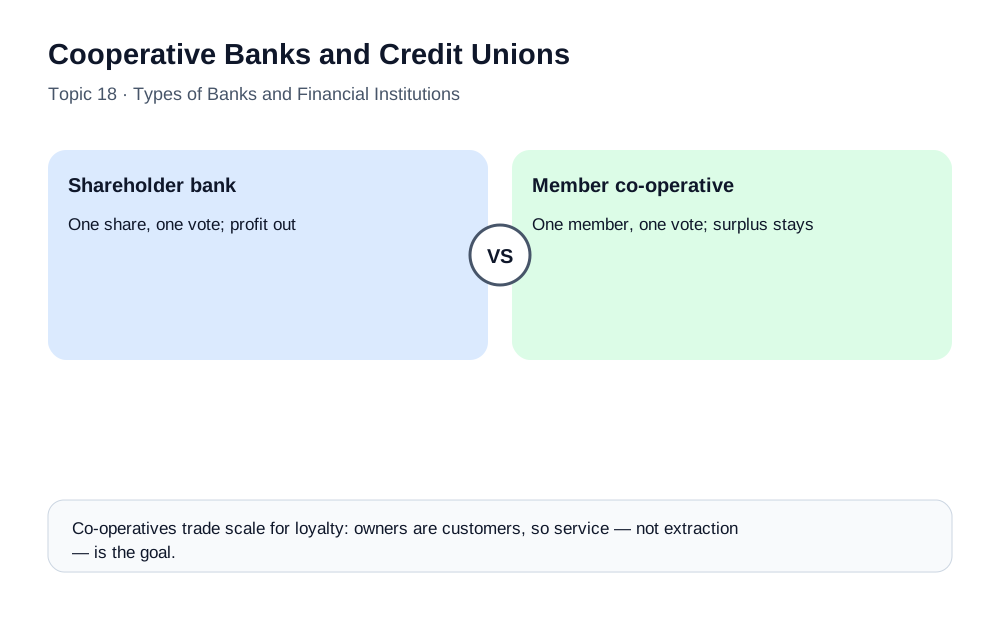
Cooperative Banks and Credit Unions at a glance — Member-owned institutions and community finance.
1. Why Ownership Matters: The First Principle
To understand cooperative banking, begin with a question that sounds abstract but is utterly practical: whose interests is a bank built to serve?
A shareholder-owned bank faces a structural tension. Its customers want low loan rates, high deposit rates, minimal fees, and patient service. Its shareholders want the opposite: margins, fees, and growth. Management lives in the middle, and when the conflict sharpens — in fee design, in sales practices, in crisis behaviour — the owners' claim on profits usually wins, because that is what ownership means. The mis-selling scandals of commercial banking (Topic 14) and the risk appetites exposed in 2008 (Topic 13) are not accidents of bad character; they are the predictable output of an incentive structure.
Cooperative banking attacks the problem at its root by merging the two roles: the customers are the owners. When the people who deposit, borrow, and pay fees are the same people who own the institution and elect its board, the structural conflict disappears. There is no external group demanding that surplus be extracted from members; surplus either returns to members (better rates, dividends, lower fees) or is reinvested in the services members use. Every advantage the model delivers — and every weakness it suffers — flows from this single design decision.
This is why cooperative banking belongs in a serious banking education. It is not a quaint alternative or a charity; it is a live experiment, running for over 170 years across every continent, in whether banking works better when customers and owners are the same people. The evidence it has produced — in rates, in stability, in inclusion — deserves to be understood on its merits. Along the way we will encounter the movement's formal principles, its greatest institutional successes worldwide, and the honest limitations that prevent it from displacing commercial banking entirely.
2. The Cooperative Structure
Cooperative banks and credit unions are owned by their members — the people who use their services. This simple distinction from commercial banks has profound implications for governance, objectives, and operations.
Ownership is membership, not shareholding. Each member typically holds a nominal share (often a small fixed sum, not a market-traded investment) and — the crucial rule — one vote, regardless of how much money they have deposited. A member with $100 and a member with $100,000 carry equal democratic weight. This is the exact inversion of corporate governance, where voting power scales with capital. Members elect the board of directors, approve major decisions, and hold the institution accountable to their interests. There are no external shareholders extracting profits or demanding returns that might conflict with member service.
Surplus belongs to members. Earnings are returned as dividends on member shares, patronage refunds related to usage, improved rates, or reinvested in services and reserves. The contrast with commercial banks is direct: profits flow to the people who generate them by banking with the institution, aligning individual interest with institutional performance.
Membership requires a common bond. Credit unions traditionally serve specific groups — employees of a company, residents of a community, members of an association. This bond creates the social cohesion and shared interest that strengthens the cooperative: lending decisions can weigh character and community knowledge alongside credit scores, because members are known to each other. Cooperative banks often serve broader populations but retain member-governance structures that preserve democratic accountability.
A comparison crystallises the models:
| Dimension | Commercial Bank | Cooperative Bank / Credit Union |
|---|---|---|
| Owners | External shareholders | Members (the customers) |
| Voting power | Proportional to shares held | One member, one vote |
| Primary objective | Shareholder returns | Member service and community benefit |
| Profit destination | Dividends to shareholders | Returned to members or reinvested |
| Typical pricing | Market rates, fee-driven | Lower loan rates, higher deposit rates, fewer fees |
| Scale logic | Grow without membership limits | Grow within the common bond |
| Accountability | Markets and regulators | Members, boards, and regulators |
3. Historical Origins
The cooperative banking movement emerged in Germany during the 1850s, founded by two men who recognized that conventional banks were failing to serve large segments of the population.
Friedrich Wilhelm Raiffeisen established the first rural credit union in 1864, responding to the plight of German farmers who had no access to credit from commercial banks. Farmers faced a brutal credit market: moneylenders charged ruinous rates, and banks saw no profit in small rural borrowers. Raiffeisen's cooperatives pooled the savings of rural communities to make loans to farmers for agricultural improvements and working capital. His model emphasized self-help, mutual responsibility, and community solidarity — early cooperatives even used unlimited joint liability of members, making the whole village the guarantor of each loan, which is why they monitored each other's borrowing so carefully. The Raiffeisen name remains prominent in cooperative banking, particularly in Germany and Central Europe.
Hermann Schulze-Delitzsch developed a parallel movement for urban artisans and small tradespeople. His cooperatives served craftsmen who needed capital for materials and equipment but lacked the collateral or credit history commercial banks required. The Schulze-Delitzsch model emphasized economic education and business training alongside financial services — treating member development as part of the mission, not a marketing extra.
Both movements spread rapidly across Europe and then worldwide. The model proved remarkably adaptable: to Canadian fishing villages (the caisses populaires), to American factory towns (credit unions, from the early twentieth century), to Indian agricultural communities, and to post-colonial Africa and Asia. By the early twentieth century, cooperative banks were significant players in many national financial systems — and their founding problem, financial exclusion, remained relevant enough to power a second wave of growth through the microfinance movement of the late twentieth century.
4. Cooperative Banks Today
Modern cooperative banks range from small community institutions to some of the world's largest financial organizations, demonstrating the model's scalability.
Rabobank in the Netherlands stands as one of the world's largest cooperative banks, serving customers domestically and internationally while maintaining cooperative structure. Founded to serve Dutch agriculture, it has expanded into a full-service institution while retaining member-owned governance — proof that cooperatives can achieve scale and sophistication without abandoning their character.
Crédit Agricole in France traces its origins to regional agricultural cooperatives of the late nineteenth century. Today it ranks among the world's largest banking groups, spanning retail banking, insurance, asset management, and investment banking — while maintaining cooperative governance through its regional bank structure.
Desjardins Group in Canada is the largest cooperative financial group in North America. Founded by Alphonse Desjardins in 1900 to serve working-class Quebecois who were exploited by moneylenders — the Raiffeisen problem in a new world setting — it has grown to serve millions of members while maintaining cooperative principles and community focus.
India's cooperative system illustrates the model's importance in developing economies. Over a thousand urban cooperative banks and tens of thousands of rural credit societies (including the vast network of Primary Agricultural Credit Societies) serve millions, particularly in farming communities where cooperative credit supports agriculture and rural development. These institutions have been central to financial inclusion, reaching populations commercial banks historically neglected — though the sector has also faced governance and supervision challenges, with periodic failures prompting tighter regulatory oversight.
Germany's Volksbanken and Raiffeisenbanken — the direct descendants of the two founding movements — remain pillars of the German banking system, holding a substantial share of the country's deposits and dominating banking for small and medium enterprises, the famed Mittelstand. Their dense local networks exemplify relationship banking at community scale.
5. Credit Unions in Practice
Credit unions operate as cooperative financial institutions with specific characteristics distinguishing them from both commercial banks and larger cooperative banks.
Member-owned incentives translate into member economics. Without shareholders demanding returns, credit unions focus on serving members as effectively as possible — typically delivering lower loan rates, higher savings rates, and fewer fees than comparable commercial products. The pattern is consistent enough across markets and decades to be considered the model's signature.
A worked example makes the difference tangible. Consider a $20,000 car loan over five years. At a commercial bank rate of 9.5%, the monthly payment is about $420 and total interest roughly $5,200. At a credit union rate of 7.5%, the payment falls to about $401 and total interest to roughly $4,050 — a saving of over $1,100 on a single ordinary loan. Apply the same direction of difference across mortgages, credit cards, and deposit rates over a member's lifetime, and the aggregate benefit of the cooperative pricing advantage becomes a serious financial fact, not a slogan. (Rates vary by institution and market; the direction of the typical gap, not these specific numbers, is the point.)
Tax status often differs from commercial banks. Many jurisdictions exempt credit unions from certain taxes, recognising their not-for-profit, member-serving character. This advantage passes to members through better rates — and generates ongoing debate with commercial banks about competitive fairness, particularly as large credit unions grow to resemble banks in everything except ownership and taxation.
The common bond, while loosening in many jurisdictions, remains defining: members share employment, residence, or organizational connection. It builds community and constrains growth — the deliberate trade at the model's heart.
Scale varies enormously. In the United States, several thousand credit unions serve well over a hundred million members. Globally, the World Council of Credit Unions has reported tens of thousands of credit unions across more than a hundred countries, with collective assets measured in the trillions of dollars. Individually small, credit unions are collectively a major force in world finance.
6. The Cooperative Advantage
Cooperative banks and credit unions offer several advantages that explain their persistence and growth alongside commercial banking.
Better rates typically characterize cooperative offerings. Without shareholders to pay, surplus returns to members through pricing — the worked example above quantified what this means on an ordinary loan.
Community focus keeps profits local rather than extracted by distant shareholders. Cooperative banks maintain deep community roots, supporting local development and staying present when commercial banks withdraw from unprofitable areas. In rural regions and small towns worldwide, the cooperative branch is often the last bank branch — an economic lifeline disguised as a business decision.
Personal service flows from smaller scale and member orientation. Cooperatives can maintain relationships uneconomical for large banks, understanding member circumstances and flexing solutions accordingly. Lending to members whose stories the institution knows — the farmer, the shopkeeper, the young family with thin credit files but strong local reputation — is information-based banking that scoring models cannot replicate.
Financial inclusion is the historical strength. By serving populations commercial banks consider unprofitable or too risky, cooperatives extend formal finance to the underserved — from Raiffeisen's farmers to today's rural credit societies. The model's emphasis on member welfare creates space for service where profit maximisation sees none.
Stability through crises has repeatedly characterized cooperative banking. Conservative lending, member loyalty (which reduces deposit flight), long-term orientation, and distance from complex trading activities helped many cooperatives weather storms that damaged commercial banks. Studies of the 2008 crisis found cooperative banks, on average, less affected than shareholder-owned institutions — the incentive structure doing exactly what it was designed to do: no shareholders pressing for yield meant less reaching for risk.
7. The Honest Limitations: Challenges Facing Cooperatives
A definitive reference owes the same rigor to weaknesses as to strengths. The model's constraints are structural, not incidental.
Limited scale handicaps technology investment. Large commercial banks invest billions in digital infrastructure, AI, and cybersecurity. Small cooperatives cannot match this, risking a service gap precisely where member expectations are rising fastest. Cooperative responses — shared technology platforms, inter-institutional service companies, and mergers that preserve the model while pooling resources — mitigate but rarely eliminate the gap.
Democratic governance can fail through apathy. One member, one vote only disciplines management if members vote. Most do not: turnout in cooperative elections is often minimal, leaving management with weak member oversight. The governance advantage is a capability, not a guarantee — and where it lapses, cooperatives can suffer exactly the agency problems they were designed to avoid, occasionally compounded by weaker external scrutiny than listed banks face.
Regulatory burden falls disproportionately on the small. Compliance requirements comparable to those on major banks consume a far larger share of a small cooperative's resources, squeezing the member benefits that justify its existence. This is the same scale economics seen in retail banking (Topic 14), felt most acutely by the smallest institutions.
Concentrated risk is the shadow of the common bond. A credit union serving one employer or one town is exposed to that employer's or town's fortunes. When the anchor factory closes, the credit union's members, deposits, and loan quality all suffer simultaneously — diversification that commercial banks achieve geographically and sectorally is structurally harder for cooperatives.
Commercial competition has learned to imitate. Large banks now match cooperative pricing on headline products while offering superior technology and broader service ranges, attacking the rate advantage that was once the cooperatives' clearest selling point.
8. Regulation and Member Protection
A common misconception holds that cooperatives operate outside the regulatory perimeter. In fact, member-owned institutions are regulated, supervised, and insured much like commercial banks, though often through parallel structures reflecting their distinct nature.
Prudential supervision applies: cooperatives face capital, liquidity, and governance requirements scaled to their size and risk. In many jurisdictions they are supervised by the same central banking or financial regulatory authorities as commercial banks (Topic 8); elsewhere, dedicated cooperative regulators exist — the United States, for example, supervises federal credit unions through the National Credit Union Administration (NCUA).
Deposit protection extends to members. US credit union deposits are insured by the NCUA's Share Insurance Fund up to $250,000 per depositor — the same limit as FDIC coverage at banks (Topic 9). European cooperative banks participate in national deposit guarantee schemes on equivalent terms to commercial banks. The member-ownership model changes who owns the institution; it does not change the public interest in protecting the people who entrust it with savings.
Failures do happen, and honest treatment requires saying so. Cooperative institutions have failed throughout history — through mismanagement, fraud, concentrated local shocks, or governance collapse — and their members have been protected by insurance on the same terms as bank depositors. India's urban cooperative bank sector, in particular, has seen high-profile failures that drove regulatory tightening. The model changes incentives; it does not repeal human fallibility, which is why supervision matters as much here as anywhere in banking.
9. The Seven Cooperative Principles
The movement's identity is codified in seven internationally recognised cooperative principles, descended from the rules of the Rochdale Pioneers (an 1844 English consumer cooperative) and maintained today by the International Cooperative Alliance. They are worth learning because they show that cooperative banking is one application of a general organisational philosophy:
- Voluntary and open membership — open to all able to use the services and willing to accept membership responsibilities, without discrimination.
- Democratic member control — one member, one vote; members actively participate in setting policies and making decisions.
- Member economic participation — members contribute equitably to capital and control it democratically; surpluses go to reserves, member benefits, or purposes members approve.
- Autonomy and independence — cooperatives remain self-help organisations controlled by members, even when partnering with governments or raising external capital.
- Education, training, and information — members, representatives, and employees are developed so they can contribute effectively — the Schulze-Delitzsch insight institutionalised.
- Cooperation among cooperatives — institutions strengthen the movement by working together: shared platforms, networks, and federations.
- Concern for community — sustainable development of the communities served is an explicit objective, not a side effect.
Reading these against a commercial bank's operating model reveals how deliberately different the design is: principles 2 and 3 restructure power and profit; principles 5 through 7 embed obligations no commercial charter contains. When evaluating any institution calling itself cooperative, these principles are the authentic benchmark against which practice can be measured.
10. Case Study: Desjardins — From One Caisse to a Financial Group
The Desjardins Group's history compresses the cooperative model's entire argument into one institution's biography.
The founding problem (1900). In Lévis, Quebec, working-class French Canadians faced a familiar exclusion: commercial banks served merchants and manufacturers, while workers who needed credit met moneylenders charging extortionate rates. Alphonse Desjardins, a parliamentary journalist who had studied the European cooperative movements, founded the first caisse populaire — a people's bank — pooling his neighbours' small savings to lend to those same neighbours. The founding deposit base was measured in dimes; the founding principle was that ordinary people, organised cooperatively, could bank themselves.
The growth logic. The caisse model spread across Quebec parish by parish — each community institution member-owned, locally governed, and united in a federation that provided shared services none could afford alone: central liquidity management, shared technology, inspection, and eventually insurance and investment products. This federated structure is the sixth cooperative principle in architectural form: local democracy at the branch, institutional strength at the centre.
The modern group. Today Desjardins serves millions of members across Canada as a full-service financial group — deposits, mortgages, insurance, wealth management, business banking — while each caisse remains member-owned and locally governed. Surplus flows back as member dividends and community investment; the group maintains the community presence mandate that founded it.
The lessons. First, the common bond scaled: from one parish to millions, because federation solved the scale problem without surrendering local ownership. Second, the model competed: Desjardins holds its own against Canada's dominant shareholder-owned banks on service and pricing, proving cooperative ownership is a competitive structure, not a protected niche. Third, the founding problem persisted: a century later, the world's underbanked populations still pose Raiffeisen's question — and the cooperative answer keeps being reinvented to meet it, from village credit societies to digital-first community lenders.
11. The Member and Institution Perspectives
From your perspective as a potential member:
- The rate advantage is real and compounding. Compare total borrowing costs and deposit returns across your options; the worked example in Section 5 shows a single loan can differ by four figures.
- Membership is ownership — use it or lose its value. Attend the annual meeting, vote for the board, read the accounts. Democratic control only works when members exercise it; apathy is the model's known vulnerability.
- Check the deposit insurance. Confirm your cooperative participates in your jurisdiction's guarantee scheme and know the coverage limit — the protection is typically equivalent to commercial banks, but verify rather than assume.
- Understand the common bond's trade-off. Community knowledge can get you a fair hearing a scoring model would deny; the same concentration means your institution shares your community's economic fate.
From the institution's perspective:
- The surplus decision is the strategic decision. Every year's earnings pose the question: return to members now (rates, dividends) or invest for members later (technology, reserves)? The balance defines the institution's competitiveness.
- Member loyalty is the funding moat. Sticky, relationship-based deposits behaved well in crises — the same stability commercial banks prize (Topics 11 and 14) — and it is earned through service, not bought through pricing alone.
- Scale problems demand cooperative answers. Shared service companies, technology pools, and strategic mergers let small institutions access capabilities none could fund alone — cooperation among cooperatives, a principle the movement calls its own sixth principle.
- Governance must be cultivated, not assumed. Member engagement programmes, transparent reporting, and contested elections are not democratic decoration; they are the control system that substitutes for market discipline.
12. Common Mistakes and Misconceptions
Misconception 1: "Credit unions are charities, not real banks." They are fully regulated financial institutions offering the same core services — deposits, loans, payments, cards — with equivalent deposit insurance. The difference is ownership and objective, not legitimacy or capability.
Misconception 2: "Cooperatives are small and marginal." Collectively they are a global force: some of Europe's largest banking groups are cooperatively owned, and worldwide credit union membership runs into the hundreds of millions.
Misconception 3: "Member-owned means member-run, so amateurs manage your money." Members govern through elected boards; professional executives manage operations — the same governance/management separation as any bank. Democratic control sets direction; it does not require members to price loans.
Misconception 4: "Better rates mean worse safety." Cooperative institutions are supervised and insured on terms equivalent to commercial banks, and their historical record through crises has, on average, been comparatively conservative. Rate advantages come from ownership structure, not corner-cutting.
Misconception 5: "One member one vote is just idealism." It is a functional design: it prevents wealth concentration from capturing the institution and keeps management oriented toward the median member's interest rather than the largest depositor's. Whether it works depends on participation — a design feature, not a slogan.
Misconception 6: "Cooperatives are relics that technology will soon finish." The technology gap is real, but the model has survived 170 years of banking revolutions — branch networks, ATMs, cards, internet, mobile — by adapting delivery while retaining ownership structure. The threat is genuine; the obituary is premature.
Misconception 7: "You can't join unless you're invited." Common bond criteria are broader than most people assume — community, employer, association, or family of existing members — and in many jurisdictions, joining has become straightforward. The bond defines the community; it rarely locks the door as tightly as people think.
13. Frequently Asked Questions
What is the actual difference between a cooperative bank and a credit union? The terms overlap and vary by jurisdiction. Broadly: credit unions are not-for-profit cooperatives serving a defined common bond, often with tax exemptions; cooperative banks may operate more like full-service banks with cooperative ownership, sometimes serving broader markets. Both share member ownership and democratic control.
How do I join a credit union? Find one whose common bond you fit — employer, community, profession, or association — and open an account with a small membership share. In many countries you can search by eligibility; the process is typically no harder than opening a bank account.
Are my deposits safe in a credit union? In major jurisdictions, yes on equivalent terms to banks: US credit unions carry NCUA insurance to $250,000; European cooperatives join national guarantee schemes. Always verify the specific institution's coverage and limits.
Why can credit unions offer better rates? No external shareholders. Surplus returns to members as pricing rather than to investors as dividends — plus, in many jurisdictions, tax exemptions reflecting their not-for-profit status. The advantage is structural, which is why it persists.
Can a cooperative bank become a commercial bank? Yes — demutualisation converts member ownership into shareholder ownership, typically giving members shares or payouts. It has happened repeatedly worldwide, usually justified by capital-raising needs, and remains controversial: members trade their ownership for a one-time windfall, and the institution loses its cooperative character permanently.
Why don't cooperatives dominate banking if their rates are better? Scale economics (technology, product breadth, convenience), member apathy weakening governance, common-bond growth limits, and commercial banks' competitive imitation all constrain expansion. The models coexist because each has structural strengths the other cannot fully replicate.
Do cooperative banks fail? Yes — ownership model does not confer immunity from mismanagement, fraud, or concentrated local shocks. Deposit insurance protects members in such events, and supervision exists precisely because cooperative status is no substitute for sound management.
What is a federated cooperative structure? The architecture that lets small cooperatives achieve scale: local institutions remain member-owned and governed, while a central federation provides shared liquidity, technology, risk management, and product platforms. Desjardins, Rabobank's historical structure, and Germany's cooperative network all embody it — local democracy below, institutional strength above.
Can I lose money as a member beyond my deposits? Modern cooperative shares are typically small nominal amounts at par value; members' risk is essentially limited to that share and their deposits are insured to scheme limits. Historical unlimited-liability cooperatives (where members guaranteed all debts jointly) have been replaced by limited-liability structures in modern systems.
14. Key Terms in This Chapter
- Cooperative bank — a member-owned bank democratically controlled by its customers.
- Credit union — a not-for-profit cooperative financial institution serving a defined common bond.
- Common bond — the shared characteristic (employer, community, association) defining credit union membership eligibility.
- One member, one vote — democratic governance giving equal voting power regardless of deposit size.
- Patronage refund — surplus returned to members in proportion to their use of the institution.
- Demutualisation — conversion from member ownership to shareholder ownership, usually to raise capital, permanently ending cooperative status.
- Raiffeisen model — rural cooperative credit founded on self-help and mutual responsibility (1864).
- Schulze-Delitzsch model — urban artisan cooperatives combining finance with business education.
- NCUA — the US regulator and deposit insurer for federal credit unions, counterpart to the FDIC.
- Primary Agricultural Credit Society (PACS) — India's village-level cooperative credit institutions.
- Volksbanken / Raiffeisenbanken — Germany's cooperative banking networks, descendants of the founding movements.
- Common-bond concentration risk — the exposure arising from membership tied to one employer, industry, or locality.
- Cooperation among cooperatives — the movement principle of pooling resources across institutions for shared services.
- Federation — the structure uniting local cooperatives under a central body providing shared liquidity, technology, and oversight.
- Rochdale Pioneers — the 1844 English consumer cooperative whose rules became the template for the seven cooperative principles.
15. Interview Insights: How This Topic Appears in Banking Interviews
"How does ownership structure affect bank behaviour?" The complete answer links structure to incentives to outcomes: shareholder banks face an owner-customer conflict resolved toward returns (fees, sales pressure, risk appetite); cooperatives merge the roles, so surplus returns as pricing and service. Then give evidence both ways — cooperative rate advantages and crisis resilience versus commercial banks' scale and technology. Interviewers reward candidates who treat ownership as mechanism, not morality.
"Why do cooperatives tend to survive crises better?" Mechanism-first: no shareholder yield pressure means less reaching for risk; member loyalty stabilises deposits; traditional lending limits exotic exposure; local knowledge improves credit decisions. Add the honest caveat: concentrated common-bond risk and weaker governance participation create their own vulnerabilities. Balance signals judgment.
"Should credit unions keep their tax exemptions?" A policy question testing argument structure. Credit union case: not-for-profit member service justifies the exemption, benefits flow to members. Bank case: large credit unions now compete directly with taxed banks, so the exemption distorts competition. Strong candidates present both and conclude with a principle — for example, tying exemption to demonstrated member benefit or size.
"What's the biggest threat to small cooperatives, and how would you address it?" Technology scale is the strongest answer: fixed digital costs that small balance sheets cannot carry. Address it through the movement's own principle — cooperation among cooperatives: shared platforms, service companies, and mergers that pool capability while preserving member ownership. This shows you can reason from the model's logic to practical strategy.
"Would you bank with a credit union? Defend your answer analytically." A personal question testing structured trade-off thinking: rate and service advantages plus equivalent insurance versus technology gaps, product breadth, and common-bond fit. There is no wrong side; the scoring is in the analysis.
Summary and Key Takeaways
Cooperative banks and credit unions are banking reorganised around a single transformative idea: the customers own the institution. The essential points:
- Ownership determines incentives. Merging the customer and owner roles eliminates the structural conflict that drives fee extraction, sales pressure, and risk appetite in shareholder banking.
- The model was born of exclusion. Raiffeisen (1864) and Schulze-Delitzsch built cooperatives because commercial banking would not serve farmers and artisans — the same financial-inclusion problem that still defines their mission.
- Democratic governance is the mechanism: one member, one vote, elected boards, and surplus returned to members as rates, dividends, or reinvestment.
- The rate advantage is structural and compounding — quantifiable on a single car loan, significant across a financial lifetime.
- The model scales: Rabobank, Crédit Agricole, Desjardins, Germany's cooperative networks, and India's vast rural system prove cooperative ownership operates from village societies to global banking groups.
- Crisis resilience is designed in: conservative incentives, loyal deposit bases, and traditional lending have repeatedly helped cooperatives weather storms.
- The limitations are equally structural: technology scale gaps, governance apathy, common-bond concentration, and regulatory burden on small institutions.
- Regulation and deposit insurance apply fully — member ownership changes incentives, not the public interest in protecting savers.
- The model endures because it serves needs commercial banking structurally under-serves — community presence, relationship lending, and inclusion — while coexisting with, competing against, and continuously learning from its shareholder-owned rivals across every continent.
In the next topic, we examine institutions built around purpose rather than profit or membership: development banks — the public financial institutions that fund infrastructure, growth, and transformation where markets alone will not go.
Next: Topic 19 — Development Banks →
<!-- MBA-DEEP-DIVE-START -->Deep Dive: Cooperative Banking as a Member-Owned Financial System
Cooperative banks and credit unions are often introduced with one sentence: they are owned by their members rather than outside shareholders. That is correct, but it understates how much this changes the institution. Ownership affects governance, funding, pricing, risk appetite, community obligations, capital formation, technology choices, and even the way failures must be managed. To understand cooperative banking properly, it helps to treat it as a distinct operating model rather than a smaller version of a commercial bank.
The defining principle is member ownership. A customer may also be an owner, usually through membership shares or another cooperative interest. Voting commonly follows a one-member-one-vote principle rather than one-share-one-vote, although exact legal structures differ by jurisdiction. This is designed to prevent a wealthy investor from buying control simply by contributing more capital. The governance objective is democratic participation and service to a defined member community.
That creates a different economic objective. A shareholder-owned bank must ultimately earn returns for investors. A cooperative institution still needs profit because capital must be built, losses absorbed, systems funded, and regulation satisfied, but profit is normally a means to sustain member service rather than the sole end. Surplus may be retained as reserves, returned through better deposit pricing or cheaper credit, or distributed as patronage benefits where local law permits.
The common bond and why it matters
Many credit unions historically formed around a common bond: employees of one company, residents of a locality, members of a profession, a religious community, or another defined group. The common bond created social information that formal credit scoring could not easily capture. Members knew one another, behaviour was observable, and the institution understood the local economy deeply.
This can reduce information asymmetry, especially in small-business, agricultural, and household lending. A local cooperative may understand the seasonality of farmers’ income, the cash cycle of neighbourhood merchants, or the employment stability of a particular industrial cluster better than a national bank applying a generic model.
But the same local concentration creates risk. If many members work for the same employer, depend on the same crop, or own property in the same region, one economic shock can affect deposits and loans simultaneously. The institution may know its customers exceptionally well while still being poorly diversified. Relationship knowledge reduces some credit risk; it does not repeal portfolio mathematics.
Governance: democracy is valuable but not automatically safe
One-member-one-vote can align the institution with members, but cooperative governance has its own vulnerabilities. Members may not have time or expertise to scrutinise financial statements. Board elections can attract low participation. Directors may be respected community figures without deep banking knowledge. Long-serving management can become difficult to challenge. Local relationships can create pressure to lend to influential members even when underwriting is weak.
A strong cooperative therefore needs the same basic governance disciplines as any bank: capable directors, independent risk and audit functions, fit-and-proper management, clear delegation, conflict-of-interest controls, related-party rules, internal audit, and reliable management information. Member ownership changes who the institution serves; it does not reduce the need for professional banking governance.
The board must also manage a subtle tension between member benefit today and institutional resilience tomorrow. Members naturally prefer higher deposit rates, lower loan rates, lower fees, and generous community support. Every one of those choices can reduce earnings and therefore retained capital. A prudent board must explain why some surplus must stay inside the institution as reserves. Capital is not money withheld from members; it is the buffer that allows the cooperative to survive bad loans, fraud, operational incidents, and economic downturns.
Capital formation is structurally harder
A commercial bank can issue new equity to external investors if markets are receptive. Cooperative institutions usually have fewer options because control cannot simply be sold to outside shareholders without changing the nature of the institution. Capital is therefore often accumulated primarily through retained earnings and member shares, subject to local regulatory treatment.
This makes profitability and growth discipline particularly important. Rapid loan growth consumes capital. If a cooperative expands faster than it can retain earnings, its capital ratio can weaken even if individual loans still perform well. Management must therefore connect business growth directly to capital planning.
A simple example illustrates the point. Suppose a credit union has assets of ₹1,000 crore and ₹100 crore of eligible capital. If the balance sheet grows to ₹1,500 crore while capital rises only to ₹110 crore, the institution becomes materially more leveraged. Management may proudly report 50% growth, but supervisors and a prudent board will ask whether loss-absorbing capacity kept pace.
The cooperative balance sheet
The asset-liability structure is usually straightforward but still requires sophisticated management. Deposits from members or customers fund loans, securities, and liquidity buffers. Loans may include mortgages, personal credit, vehicle finance, small-business lending, agricultural finance, and community lending depending on the charter.
Because deposit relationships can be sticky, cooperative funding may appear stable. Yet liquidity stress can still occur. A local shock may cause households and businesses to withdraw funds just when loan arrears are rising. Digital channels make withdrawals faster than historical branch-based models assumed. Liquidity risk must therefore be measured using stressed outflow assumptions, liquid-asset buffers, funding concentration analysis, and contingency plans rather than relying on member loyalty.
Interest-rate risk is equally important. A cooperative may hold long-dated fixed-rate mortgages funded by short-term deposits whose rates reprice quickly. When market rates rise, deposit costs can increase while mortgage income remains fixed. The resulting margin compression can be severe even if no borrower defaults. Asset-liability management is therefore not an advanced topic reserved for large banks; it is central to the survival of small deposit-funded institutions.
Credit underwriting: relationship banking plus evidence
Cooperative banking can excel at relationship lending, but the best institutions combine local knowledge with formal credit discipline. A loan officer may know a borrower personally, understand the family business, and have seen its reputation over years. That information is valuable, but it should complement rather than replace verified income, cash-flow analysis, collateral valuation where relevant, affordability testing, and repayment capacity.
For small enterprises, cash flow matters more than collateral alone. A borrower can own valuable property and still be unable to meet monthly repayments. For agriculture, underwriting must consider seasonality, crop cycles, weather risk, input costs, market prices, insurance, and the timing of harvest receipts. For household lending, affordability should survive a reasonable shock to income or interest rates.
Cooperatives also need portfolio limits. Even if every individual loan appears sensible, too much exposure to one industry, employer, geography, borrower group, or collateral type can create systemic concentration. Risk is not only about whether one borrower can repay; it is about whether many borrowers can fail for the same reason.
Collections and member relationships
Delinquency management in a community institution requires balance. Aggressive collections can damage trust and social legitimacy. Excessive forbearance can hide credit deterioration and transfer losses to other members. Good practice distinguishes temporary hardship from structural inability or unwillingness to repay.
Restructuring may be appropriate where a viable borrower has suffered a short-term shock. But repeated extensions that merely postpone recognition of default are dangerous. The institution must monitor arrears ageing, cure rates, restructurings, recoveries, and expected loss. Member ownership should encourage fairness, not accounting denial.
Payments and everyday banking
For many members, the cooperative’s value is not only credit but access to everyday financial services: transaction accounts, debit cards, transfers, direct debits, cash access, digital banking, and bill payments. This moves the institution into the same operational risk landscape as larger banks.
Payment services require strong customer authentication, transaction monitoring, fraud controls, reconciliation, exception handling, cut-off management, and resilient connectivity to clearing or correspondent partners. A small institution can still suffer a large fraud loss if account takeover or payment redirection controls are weak.
Where the cooperative does not directly participate in a national payment system, it may depend on sponsor banks, processors, card networks, or shared service providers. This creates third-party dependency risk. The cooperative remains accountable to members even when a vendor operates the technology. Contracts, service levels, cyber controls, business continuity, exit plans, and incident escalation become board-level concerns.
Shared infrastructure: a cooperative advantage
One powerful feature of the sector is shared infrastructure. Cooperative institutions can pool resources for core banking platforms, ATM networks, card processing, cybersecurity, compliance tooling, treasury services, and training. This preserves local ownership while gaining some economies of scale.
Shared services can be strategically valuable, but concentration must be understood. If hundreds of small institutions rely on one technology provider, an outage or cyber incident at that provider becomes a sector-wide event. Resilience planning should therefore ask not only whether the cooperative itself can recover, but whether critical suppliers can recover at the same time.
Digital transformation without losing the cooperative model
Digital banking changes the traditional advantage of proximity. Members no longer need to visit a local branch to make routine transactions. A cooperative that remains entirely branch-dependent can lose younger customers and become operationally expensive. Yet simply copying a large bank’s app does not create differentiation.
The strongest digital strategy uses technology to automate routine service while preserving human value where local knowledge matters. Members should be able to open accounts, make payments, manage cards, upload documents, and receive alerts digitally. Relationship staff can then spend time on credit conversations, financial guidance, business needs, and community engagement.
Data can also improve inclusion. Transaction histories, deposit patterns, payroll information, or verified business cash flows can support more accurate underwriting for members who have limited traditional credit histories. But alternative data must be governed carefully: lawful use, consent where required, explainability, fairness, model validation, and privacy remain essential.
Fraud, insider risk, and the danger of familiarity
Small community institutions sometimes underestimate internal fraud because employees and members know each other personally. Familiarity can actually create control weaknesses. Staff may share passwords, bypass dual controls, process transactions for acquaintances without proper verification, or assume a known member cannot be fraudulent.
Strong controls should be designed around the principle that trust and control are complementary. Sensitive actions require segregation of duties. Privileged access should be logged. Cash differences, dormant-account activity, manual overrides, unusual loan approvals, related-party transactions, and employee accounts should receive targeted monitoring. Whistleblowing channels are particularly important where local social relationships make direct challenge uncomfortable.
Failure and resolution
When a cooperative fails, the social impact can be larger than its balance-sheet size suggests because members may depend on it for deposits, credit, payments, and local business finance. Resolution frameworks vary by country, but common objectives are to protect insured depositors, maintain critical services, preserve viable assets, and allocate losses according to law rather than political pressure.
Possible outcomes include merger with a stronger cooperative, transfer of deposits and assets, recapitalisation where legally possible, or orderly liquidation. Sector stabilisation funds or central cooperative bodies may play roles in some jurisdictions, but mutual support should not become a substitute for supervision. If weak institutions are always rescued by stronger ones without consequences, risk discipline erodes.
A rural cooperative example
Consider a cooperative serving a district dominated by dairy farming and small food processors. It has deep member knowledge and strong deposit loyalty. For years, credit losses are low. Management therefore becomes confident and expands dairy-related lending rapidly.
Then feed costs rise, milk prices weaken, and a livestock disease reduces production. Farm incomes fall at the same time. Processors experience lower throughput. Members draw down savings to cover expenses. The cooperative now faces three linked pressures: rising loan arrears, deposit outflows, and declining collateral values.
A weak institution treats these as separate problems. A strong institution sees one concentration event. It activates liquidity plans, identifies vulnerable borrowers early, distinguishes viable restructurings from uncollectable exposures, stops further concentration growth, increases loss provisions, communicates transparently with members, and works with supervisors before capital becomes critical.
The lesson is central to cooperative banking: local knowledge is powerful, but local concentration must be actively managed.
How to judge a strong cooperative institution
A high-quality cooperative bank or credit union should be able to answer a demanding set of questions. Does member governance produce competent oversight? Is capital growing fast enough to support the balance sheet? Are loans underwritten on repayment capacity rather than relationships alone? Are sector and geographic concentrations measured? Can liquidity survive a local shock? Are interest-rate mismatches controlled? Are payment, cyber, and third-party risks treated professionally? Are problem loans recognised early? Does digital investment improve service without weakening controls? And are members receiving sustainable value rather than short-term benefits funded by underpricing risk?
When these disciplines are present, the cooperative model can combine something rare in finance: professional risk management with genuine local ownership. Its strength is not that it avoids the hard economics of banking, but that it applies those economics in service of a member community rather than external shareholders.
<!-- MBA-DEEP-DIVE-END -->