Beyond the bustling branches of retail banking and the deal-making floors of investment banks lies a quieter, more exclusive world where banking becomes truly personal. Private banking serves the wealthiest individuals and families, offering financial services that extend far beyond the standardized products available to ordinary customers. Here, the relationship between banker and client spans years or decades, built on deep understanding of family circumstances, financial goals, and the complex challenges that substantial wealth creates.
The private banking client is not merely an account number but a partner in a comprehensive advisory relationship. The services provided range from investment management and estate planning to tax optimization, family governance, and even lifestyle assistance. The objective is not simply to manage money but to preserve and enhance wealth across generations while fulfilling the broader purposes that wealth serves for the family.
What you will learn in this topic:
- What private banking is, and why substantial wealth creates needs that ordinary banking cannot serve
- How clients are segmented: affluent, high net worth, ultra high net worth
- Investment management: discretionary and advisory models, alternative investments, global diversification
- Estate and succession planning: trusts, family governance, and philanthropy
- Tax planning across borders — and where the legal line sits
- Specialized lending: Lombard loans, luxury mortgages, and art finance, with a worked example
- Family offices: the pinnacle of wealth management
- The economics of the business and why banks prize it
- The compliance transformation that has reshaped the industry
- What defines the private banking relationship itself
This topic completes a trio: retail banking (Topic 14) serves everyone, corporate banking (Topic 15) serves businesses, investment banking (Topic 16) serves institutions and transactions. Private banking serves the people at the top of the wealth pyramid — whose needs, paradoxically, are often more complex than any institution's.
Visual overview
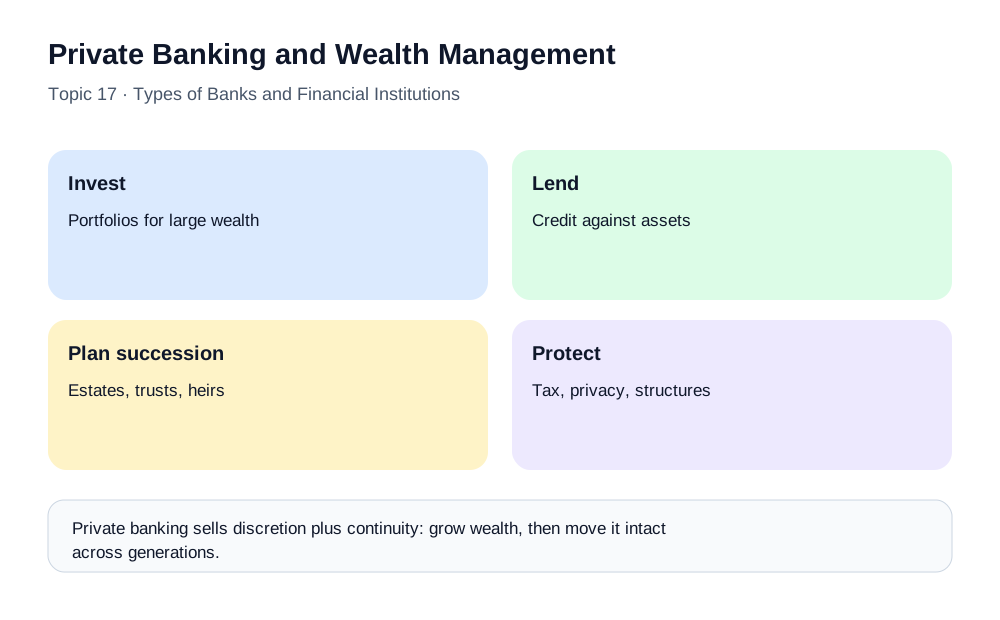
Private Banking and Wealth Management at a glance — High net worth services, portfolio advisory, trust structures.
1. Why Private Banking Exists
It is tempting to assume private banking is simply retail banking with better furniture. The reality is structural: substantial wealth creates categories of problems that barely exist for ordinary households, and these problems demand a different service model entirely.
Consider what changes as wealth grows:
- Complexity multiplies. A family with $20 million may hold operating businesses, properties in several countries, investment portfolios, trusts, and philanthropic commitments — spanning multiple tax jurisdictions, legal systems, and generations. Managing this is a professional undertaking, not a personal chore.
- The stakes of each decision grow. A five-percentage-point tax inefficiency costs a median household little; at scale, it costs millions. Expertise pays for itself many times over.
- Time horizons stretch across generations. Ordinary financial planning spans a career and retirement; wealth planning spans children, grandchildren, and institutions that may outlive the founder by a century.
- Risk changes shape. The wealthy worry less about making ends meet and more about concentration (most wealth in one business), litigation, currency, confiscation, and — remarkably often — the effects of inheritance on their own children.
- Standardisation stops working. A mass-market product assumes a typical customer; there is no typical billionaire family. Every situation is bespoke.
Private banking exists to professionalise the management of this complexity. The client effectively hires an institution to act as their financial chief of staff: coordinating investments, credit, tax, legal structures, and family affairs under one accountable relationship. The fee the bank earns is, in essence, the salary of that function — which is why the relationship, not the product, is the unit of value in this industry.
A comparison with retail banking (Topic 14) clarifies the boundary:
| Dimension | Retail Banking | Private Banking |
|---|---|---|
| Clients | Mass market, standardised | Wealthy individuals and families, bespoke |
| Core offering | Products (accounts, loans, cards) | Advice and coordination (investments, tax, succession, credit) |
| Revenue basis | Interest margin + product fees | Fees on assets under management + tailored lending |
| Interface | Apps, branches, call centres | Dedicated relationship manager and specialist team |
| Time horizon | Transactions and life events | Generations |
| Risk focus | Affordability and credit scoring | Suitability, concentration, jurisdiction, reputation |
A brief historical note grounds the segment. Private banking's roots lie in the merchant-banking houses of eighteenth and nineteenth century Europe — firms like the Rothschilds and the Geneva private bankers who managed the fortunes of aristocracy and industrial dynasties, often as literal partnerships where the banker's family and the client's family knew each other across generations. Switzerland's twentieth-century dominance grew from political neutrality and, later, the banking secrecy laws of 1934, which made it the default vault for international wealth — a model that thrived until the transparency revolution of the 2010s (Section 5) forced the industry's reinvention. Today's global private banking centres — Switzerland, Singapore, London, New York, Hong Kong, Dubai — compete on expertise, stability, and market access rather than secrecy, but the founding idea has survived every regime change: a small number of trusted professionals managing everything that wealth involves.
2. The Private Banking Client
Private banking services are segmented by wealth level, with different service models appropriate to different degrees of affluence. (Thresholds vary by institution and market, but the tiers below are a widely used convention.)
Affluent clients — roughly $100,000 to $1 million in investable assets — receive enhanced advisory services: dedicated advisors, investment guidance, and access to premium products. The service is more personal than retail but remains relatively standardised, often delivered through structured advisory programmes rather than individual teams.
High net worth (HNW) clients — typically $1 million to $30 million — receive truly dedicated service. Each client has a relationship manager who understands their complete financial picture and coordinates the full range of banking services. Portfolios are customised, lending is tailored, and the relationship extends to family members.
Ultra high net worth (UHNW) clients — $30 million and above — command the most comprehensive offerings. Multiple professionals serve a single family: investment specialists, tax advisors, estate planners, philanthropic consultants. The relationship encompasses family governance, succession planning, and coordination of the family's external lawyers and accountants.
A crucial nuance for practitioners: banks define these tiers by investable assets — liquid financial wealth — not total net worth. A founder whose $50 million sits inside their own company is a different client from one holding $50 million in securities; private banks care deeply about the distinction because it determines what they can actually manage and lend against. Client segmentation drives the entire economics of the business: the cost of a dedicated team can only be justified by the revenue a client's assets generate, which is why entry thresholds exist at all.
3. Investment Management
Investment management sits at the heart of the private banking offering, delivered through two principal models.
Discretionary portfolios place investment decisions in the hands of the bank's professionals. Based on detailed analysis of risk tolerance, return objectives, time horizon, liquidity needs, and constraints, the bank constructs and manages a diversified portfolio under an agreed mandate, rebalancing and adjusting without seeking approval for each trade. Regular reporting keeps clients informed; periodic reviews ensure the strategy remains appropriate as circumstances change. The discretionary model suits clients who want professional management without daily involvement — and it generates the most stable fee income for the bank.
Advisory portfolios provide recommendations while leaving decisions to the client. The bank's professionals suggest allocations, securities, and tactical adjustments; the client approves each. This suits clients who wish to remain actively involved or hold strong views on particular assets — and it keeps the bank's legal role as advisor rather than manager, a distinction with real regulatory significance.
Alternative investments distinguish private banking from retail wealth management. Clients gain access to hedge funds, private equity, private credit, real estate partnerships, and infrastructure — assets unavailable to ordinary investors, potentially offering returns uncorrelated with public markets. The trade-offs are real: multi-year lock-ups, high fees (the traditional "2 and 20" hedge fund structure — 2% annual management fee plus 20% of profits), valuation opacity, and complexity that demands genuine suitability assessment. Art and collectibles may also be treated as investment assets, with banks providing valuation, authentication, and lending services against them.
Global diversification is standard practice. Portfolios span geographies, asset classes, and currencies to reduce risk and capture opportunity wherever it arises. The bank's research capability and product access allow construction of genuinely global portfolios that individuals could not practically replicate — one of the clearest demonstrations of what the institution adds beyond what a client could do alone.
4. Estate and Succession Planning
For wealthy families, transferring wealth across generations involves far more than simple inheritance. Estate planning structures wealth to minimise tax burdens, protect assets from creditors, and — often most delicately — ensure inheritances support rather than harm recipients.
Trust structures form the foundation of sophisticated planning. By placing assets in trust, families control how wealth is used, when it is distributed, and under what conditions beneficiaries receive support. Trusts can protect spendthrift heirs from their own poor judgment, provide for family members with special needs without compromising government benefits, and keep assets out of probate to preserve privacy. The trustee — often the bank's trust department — manages assets according to the trust document, with fiduciary duties enforceable in law. The trust is, in effect, a rulebook for wealth that survives its author.
Family governance addresses the human dimensions of wealth transfer. Multi-generational wealth requires collective decisions about shared assets, philanthropic goals, and business interests. Family councils, constitutions, and regular meetings provide forums for communication; private banks facilitate these processes, sometimes mediating between generations with different values and priorities. The sobering industry statistic — that most family wealth dissipates within a few generations — is usually attributed less to investment failure than to governance failure: families that never learned to make decisions together.
Charitable giving strategies fulfil philanthropic objectives while optimising tax position. Private foundations offer maximum control at significant administrative cost; donor-advised funds offer simplicity — contribute now, deduct now, recommend grants over time. The bank coordinates with tax and legal advisors to align giving with both charitable intent and financial planning.
5. Tax Planning and Optimization
Wealthy individuals face complex obligations across jurisdictions: income, gains, and estates potentially taxable in different countries depending on citizenship, residence, and asset location. Private banking tax planning structures affairs legally to minimise these burdens while maintaining full compliance — and the word "legally" carries the weight of the industry's modern history.
The bright line: avoidance versus evasion. Tax avoidance — using lawful structures, treaties, and exemptions as intended — is legitimate planning. Tax evasion — concealing income or assets from authorities — is crime. For decades, parts of the private banking industry blurred this line behind banking secrecy; the consequences have been transformational. The US Foreign Account Tax Compliance Act (FATCA) and the OECD's Common Reporting Standard (CRS) now require automatic exchange of account information between tax authorities across most of the world. Undeclared offshore accounts are no longer meaningfully hideable, and banks face severe penalties for facilitating concealment. Modern private banking has consequently repositioned itself: the value proposition is no longer secrecy but expertise, access, and service — a shift every student of the industry should understand as permanent.
Cross-border planning requires mastery of tax treaties that prevent double taxation and govern information sharing. Families with members in different countries, international businesses, or foreign assets face genuine complexity requiring specialist coordination between the bank and the client's external advisors.
Tax-advantaged structures vary by jurisdiction — retirement accounts, education plans, insurance wrappers, specific investment vehicles — and private banks help clients use them appropriately, holding investments in tax-efficient wrappers without compromising strategy.
6. Specialized Lending
Private banking credit goes far beyond retail lending, with terms reflecting both the scale of client wealth and the sophistication of their arrangements.
Lombard loans allow clients to borrow against investment portfolios without selling. Pledging securities as collateral provides cash for other purposes — a new investment, a property, tax payments — while keeping the portfolio intact and avoiding taxable disposals. Rates are favourable because collateral is liquid and easily valued.
A worked example: a client pledges a $10 million portfolio of blue-chip equities. At a conservative 60% loan-to-value for volatile equity collateral, the bank extends a $6 million credit line. The client draws $4 million to acquire a property stake. The portfolio keeps compounding; the client pays interest only on the drawn amount. The risk discipline sits in the margin call: if the portfolio's value falls toward the point where the loan exceeds the agreed ratio, the bank demands additional collateral or partial repayment — and can sell pledged assets if the client cannot comply. In the 2008 and 2020 market crashes, margin calls on leveraged portfolios forced distressed sales that deepened some families' losses — the product's convenience and its danger are the same feature: the loan is only as stable as the collateral's price.
Luxury property mortgages are standard: large loans on primary residences, vacation homes, or investment properties, underwritten against overall wealth rather than salary alone — essential for clients whose income is irregular but whose assets are substantial.
Art lending provides liquidity against collections without sale, at conservative loan-to-value ratios reflecting art's illiquidity and valuation uncertainty. Specialist expertise is required: authentication, valuation, and the practicalities of enforcing against a Rembrandt differ considerably from enforcing against a bond portfolio.
7. Family Offices
For the wealthiest families — typically $100 million and above — a family office provides comprehensive management of all financial and personal affairs. Private banks offer family office services in two forms.
Single family offices employ staff dedicated to one family: investment management, accounting, tax compliance, legal coordination, philanthropy, and personal services from household management to travel. The family office is effectively a private corporation whose business is the family itself. The costs — easily millions per year — explain the wealth threshold.
Multi-family offices serve several families, sharing costs of professional staff and infrastructure while maintaining personalised service. Private banks operate multi-family offices as extensions of their private banking, leveraging existing capabilities while adding family office functions.
Services include investment management across all family assets, consolidated reporting over complex holdings, accounting and tax preparation for family entities, bill payment and cash management, coordination with external advisors, philanthropy management, and next-generation education preparing heirs for stewardship. That last function reflects the industry's hardest-learned lesson: the greatest risk to dynastic wealth is rarely the market — it is unprepared heirs.
8. The Economics and the Relationship
What makes private banking attractive to banks is its economics: fee income on assets under management (AUM) — typically a fraction of a percent to around one percent annually, depending on service level and asset size — supplemented by lending spreads, product margins, and transaction fees. This revenue is recurring, capital-light, and remarkably stable through market cycles, contrasting beautifully with investment banking's episodic fees (Topic 16). A private bank managing $50 billion at a blended 0.7% generates $350 million annually with modest capital requirements — which is why every universal bank covets the segment.
What distinguishes private banking from other financial services, however, is the depth and duration of the relationship itself.
Trust forms the foundation. Clients entrust bankers with intimate knowledge of their finances, family dynamics, and personal concerns, relying on judgment, discretion, and demonstrated integrity. Trust is earned through consistent performance and honest communication — including, especially, honest communication in falling markets.
Personalization means no two relationships are identical. The banker must understand not just finance but the client's business, family, values, and aspirations. Suitability obligations formalise this: recommendations must fit the documented client profile, a regulatory requirement with teeth.
Confidentiality remains paramount in professional terms even where legal secrecy has been dismantled by CRS and FATCA: clients expect their affairs private from everyone except the tax authorities entitled by law to know.
Long-term perspective governs the economics: relationship value compounds over decades, so short-term revenue maximisation is subordinated to retention. A private banker who oversells a product for quarterly numbers is destroying the franchise's actual asset.
9. Case Study: The Okafor Family — Three Generations With One Bank
To see private banking's services operate as an integrated whole, follow the fictional Okafor family through a stylised engagement spanning a generation.
The founder. Adaeze Okafor builds a logistics company over thirty years and sells it at fifty-eight, receiving $45 million. Her private bank's work begins before the sale completes: coordinating with her lawyers on the sale structure, establishing the account architecture to receive proceeds, and — critically — planning for the concentrated, illiquid position to become a diversified, liquid one. Within a year, her wealth sits in a discretionary global portfolio built around her mandate: capital preservation first, moderate growth, and $2 million of annual liquidity for family spending and philanthropy.
The structures. Working with the bank's trust specialists and her external counsel, Adaeze establishes a family trust. The trust owns the investment portfolio; its deed specifies that distributions support education and housing for her three children, with discretionary payments beyond that requiring trustee approval — her deliberate protection against the spendthrift scenario. A donor-advised fund channels her philanthropy, and the bank's reporting consolidates everything: portfolio, trust, property mortgages, and the Lombard facility she occasionally draws for opportunities, pledged against the portfolio at a conservative 50% LTV.
The transition. At seventy, Adaeze's priority shifts to succession. The bank facilitates family governance: annual family meetings with an agenda, a written family constitution describing what the wealth is for, and a next-generation programme in which her adult children learn portfolio basics, meet the trust officers, and gradually assume observer roles. Her eldest daughter, a physician with no interest in finance, discovers through this process that governance does not require investment expertise — it requires judgment and shared values.
The inheritance. When Adaeze dies at eighty-one, nothing dramatic happens — which is precisely the point of everything that came before. The trust continues without probate; the successor trustees (the bank's trust company and her daughter) step into roles they have occupied in training for a decade; distributions continue under the deed's rules; the portfolio is not liquidated in grief or panic. The bank that served the founder now serves the second generation, because the relationship was deliberately built to outlive its founder.
Notice the full stack in operation: investment management, credit, structuring, philanthropy, governance, and education — coordinated by one accountable relationship across thirty years. No single product in this story is extraordinary. The integration is the service.
10. Digital Transformation and Industry Challenges
Private banking was long considered immune to digitisation — surely billionaires demand human service? The reality is more nuanced. Clients now expect institutional-quality digital reporting, consolidated views across all assets, secure document exchange, and responsive remote access — while continuing to value human advice for consequential decisions. The emerging model is hybrid: digital for information and transactions, human for judgment and reassurance.
The industry faces structural challenges beyond technology:
- Fee compression. Passive investing and transparent pricing pressure traditional fee levels; banks must demonstrate advice value beyond product access.
- Intergenerational transfer. The largest wealth transfer in history is under way as founding generations pass assets to heirs who are more digital, more sceptical of incumbents, and often hold different values (driving demand for sustainable and impact investing). Banks that built relationships with parents must win the children anew.
- Compliance burden. Suitability, cross-border rules, source-of-wealth verification, and conduct requirements have raised the cost of serving complex clients — sometimes to the point where banks exit clients or jurisdictions.
- Talent. The relationship manager is the product, and experienced RMs are scarce; poaching and succession are permanent management concerns.
11. The Client and Bank Perspectives
From the client's perspective:
- Understand the fee stack. Management fees, underlying fund fees, transaction costs, and custody charges compound; at wealth scale, a transparent one-percent difference is worth millions per decade. Ask for total cost of ownership.
- Alignment beats access. The key question is whether your banker's incentives match your outcomes — discretionary mandates, fee structures, and product shelves all contain embedded incentives worth interrogating.
- Use the leverage of scale. Substantial clients can negotiate fees, demand senior attention, and obtain terms unavailable at retail — banks compete for exactly your business.
- Governance is your job, not the bank's. The bank can facilitate family structures, but only the family can decide what the wealth is for.
From the bank's perspective:
- AUM growth is the north star — through net new money, market performance, and above all retention of the next generation.
- The RM is both asset and flight risk. Clients often follow departing bankers; institutions build team coverage, brand attachment, and platform quality to keep relationships with the house.
- Compliance is existential. A single facilitated evasion scandal can cost billions in fines and decades of franchise damage; source-of-wealth diligence is now a core discipline, not an irritation.
- Suitability is the legal core of advice. Documented client profiles, product appropriateness testing, and clear records are the difference between advice and liability.
12. Common Mistakes and Misconceptions
Misconception 1: "Private banking is just retail banking with nicer offices." The service model is categorically different: bespoke advice, cross-border structuring, alternatives access, tailored credit, and multi-generational planning — coordinated through a dedicated relationship rather than sold as products.
Misconception 2: "Private banking exists to hide money from tax authorities." That era is over. FATCA and CRS automatic information exchange ended practical secrecy; modern private banking sells expertise, access, and service. Banks actively verify source of wealth and refuse undeclared money.
Misconception 3: "Wealthy clients always get better investment returns." Wealth buys access and advice, not guaranteed outperformance. Many private portfolios underperform simple low-cost index strategies after fees — the industry's honest value proposition is holistic management (tax, structuring, credit, succession), not magic returns.
Misconception 4: "A Lombard loan is free liquidity." It is leverage against volatile collateral. Margin calls in falling markets can force asset sales at the worst moment — convenience and fragility in one product.
Misconception 5: "Trusts are only for tax avoidance." Trusts are primarily governance instruments: controlling distribution, protecting vulnerable beneficiaries, and ensuring wealth serves intended purposes across generations. Tax effects vary and are secondary to control.
Misconception 6: "Family offices are just big portfolios." A family office is an operating organisation — investments plus accounting, tax, legal coordination, governance, philanthropy, and education — a private institution managing a family's entire affairs.
Misconception 7: "The relationship manager is just a salesperson." Sales pressure exists in every financial institution, but the RM model's economics run on retention over decades, which punishes overselling. The best RMs act as coordinators and fiduciaries of the client's whole situation; judging any individual banker requires examining their incentives, not assuming them.
13. Frequently Asked Questions
How much money do I need for private banking? Thresholds vary widely: some institutions begin enhanced services around $100,000–$250,000 in investable assets, classic private banking commonly starts near $1 million, and the most comprehensive offerings target $10 million and above. Multi-family offices typically make sense from around $25–50 million.
What is the difference between a private bank and a family office? A private bank is an institution serving many wealthy clients with banking and investment services; a family office is a dedicated organisation managing one family's (or a few families') entire affairs. Banks offer multi-family office services as an extension of private banking.
What does a relationship manager do that an app cannot? Coordinate complexity: cross-border tax structuring with external lawyers, bespoke credit against unusual assets, succession conversations across generations, and judgment in crises. The RM's value is synthesis and accountability across everything, not any single transaction.
Are alternative investments worth their fees and lock-ups? Sometimes — genuine diversification and illiquidity premiums exist — but selection skill and fee discipline determine outcomes. Alternatives suit portfolios large enough to tolerate illiquidity; suitability assessment exists precisely because they suit fewer clients than salesmanship suggests.
What is a donor-advised fund? A giving vehicle: contribute assets now (receiving the tax deduction now), then recommend grants to charities over time. It trades a private foundation's control for simplicity and lower administration.
Why do private banks ask intrusive questions about where my money came from? Source-of-wealth verification is a legal AML obligation, not curiosity. Banks must satisfy themselves that client wealth is legitimate; refusal or implausible answers can mean declined relationships or exit.
What happens to my banking relationship when wealth passes to my children? That depends on preparation. Well-governed families involve heirs early — education, structured exposure, governance participation — and relationships transfer smoothly. Without it, inherited clients frequently leave: the intergenerational retention battle is the industry's defining strategic contest.
Can private banking help with sustainable or impact investing? Yes — and demand from younger generations has made it one of the fastest-growing service areas. Offerings range from ESG-screened portfolios to dedicated impact investments targeting measurable social outcomes alongside returns. The same suitability discipline applies: values alignment should not mean abandoning diversification or fee scrutiny.
Do private banks serve clients in countries other than their own? Extensively — cross-border wealth is the industry's historical core. But international service multiplies compliance complexity: each booking centre (Switzerland, Singapore, London, and others) applies its own rules to which clients it may serve, what products it may offer them, and what tax reporting applies. Clients with international lives typically need the bank and their tax advisors working from the same map.
14. Key Terms in This Chapter
- Private banking — bespoke banking, investment, and advisory services for wealthy individuals and families.
- HNW / UHNW — high net worth (typically $1M–$30M investable) and ultra high net worth ($30M+) client tiers.
- Investable assets — liquid financial wealth, the industry's segmentation basis, distinct from total net worth.
- Discretionary mandate — the bank manages the portfolio within agreed parameters without per-trade approval.
- Advisory mandate — the bank recommends; the client decides each transaction.
- AUM (assets under management) — client assets the bank manages, and the basis for fee income.
- Alternative investments — hedge funds, private equity, private credit, real assets; illiquid, complex, access-restricted.
- Lombard loan — credit secured against an investment portfolio.
- Loan-to-value (LTV) — the loan amount as a percentage of pledged collateral value.
- Margin call — the lender's demand for more collateral or repayment when pledged values fall.
- Trust — a legal structure holding assets under a rulebook for beneficiaries, managed by a fiduciary trustee.
- Family governance — the structures (councils, constitutions, meetings) by which families make collective wealth decisions.
- Donor-advised fund — a charitable vehicle giving an immediate deduction with grants recommended over time.
- FATCA / CRS — the US and OECD regimes imposing automatic cross-border exchange of account information, ending practical banking secrecy.
- Source of wealth — the verified origin of a client's assets, a core AML requirement.
- Single / multi-family office — dedicated organisations managing one family's or several families' complete affairs.
- Suitability — the regulatory requirement that advice and products fit the documented client profile.
- Booking centre — the jurisdiction where a client's assets are legally held and serviced (e.g., Switzerland, Singapore), determining applicable regulation and reporting.
- ESG / impact investing — strategies integrating environmental, social, and governance criteria or targeting measurable social outcomes alongside returns.
15. Interview Insights: How This Topic Appears in Banking Interviews
"Why does private banking exist as a separate business?" The strong answer is structural, not flattering: wealth creates complexity (multi-jurisdiction tax, concentrated holdings, cross-generational horizons) that standardised products cannot serve, so clients buy coordinated expertise through a dedicated relationship. Mention the tier segmentation and that banks segment by investable assets, and you have demonstrated commercial understanding rather than brochure knowledge.
"How do private banks make money, and why do universal banks covet the segment?" Fees on AUM (recurring, capital-light, cycle-resistant) plus tailored lending spreads — contrasted deliberately with investment banking's episodic fees and commercial banking's capital intensity. Candidates who quantify (X billion AUM × blended fee) show they think like operators.
"What ended Swiss-style banking secrecy, and what replaced it?" FATCA and CRS automatic information exchange — and the industry's repositioning from secrecy to expertise, access, and service. This question tests whether you understand modern private banking's actual value proposition and its compliance core (source of wealth, suitability). Answering "discretion" without "compliance" is a red flag to modern interviewers.
"A client wants to borrow against their portfolio instead of selling. What do you explain?" Lombard mechanics: LTV ratios by asset volatility, interest-only flexibility, tax and compounding advantages of not selling — and the margin call risk that makes the product dangerous in crashes. Balance is the point: enthusiasm without the risk discussion fails the interview.
"What is the biggest strategic challenge in wealth management today?" Intergenerational retention is the highest-quality answer: the great wealth transfer, heirs' different expectations (digital, sustainable investing, fee transparency), and the fact that relationships built with founders do not automatically survive inheritance. Supporting with the fee-compression or hybrid-service trends also scores.
Summary and Key Takeaways
Private banking is finance at its most personal: comprehensive, bespoke management of the complexity that substantial wealth creates across lives and generations. The essential points:
- Wealth creates different problems, not just bigger ones — multi-jurisdiction tax, concentrated holdings, generational horizons, and family dynamics that standardised banking cannot address.
- Clients are tiered by investable assets — affluent, HNW, UHNW — with service depth and dedicated teams scaling accordingly.
- Investment management splits into discretionary and advisory models, extended by alternatives and global diversification that wealth makes accessible — with suitability as the regulatory guardrail.
- Estate planning is governance, not just tax: trusts, family constitutions, and philanthropy structures determine whether wealth survives its transfer.
- The secrecy era is over. FATCA and CRS made transparency the global default; modern private banking competes on expertise and service, with source-of-wealth compliance at its core.
- Specialized credit — Lombard loans, luxury mortgages, art finance — unlocks liquidity against wealth, carrying leverage risks that market crashes expose.
- Family offices represent the pinnacle: entire professional organisations managing one family's affairs, where heir preparation matters more than any investment decision.
- The economics are prized: recurring, capital-light AUM fees that survive market cycles — but the franchise depends on trust, talent, and winning the next generation.
- The relationship is the product. Trust, personalization, confidentiality, and long-term perspective are not soft values here; they are the business model itself, compounding over decades of client retention.
In the next topic, we turn from banking's most exclusive institutions to its most community-rooted: cooperative banks — member-owned institutions that serve local communities on fundamentally different ownership principles.
Next: Topic 18 — Cooperative Banks →
<!-- MBA-DEEP-DIVE-START -->Deep Dive: How a Private Bank Actually Runs
Private banking looks highly personal from the client side, but behind the relationship manager sits a disciplined operating model. The relationship manager is the coordinator, not the sole expert. Investment counsellors design portfolios, credit specialists structure lending, trust and fiduciary teams handle succession vehicles where the bank is permitted to do so, product specialists cover alternatives and structured solutions, operations teams execute and settle transactions, compliance teams control onboarding and financial-crime risk, and risk functions challenge concentrations and leverage. A world-class private bank therefore behaves less like a luxury branch and more like a multidisciplinary financial control room built around one family.
The client lifecycle begins with acceptance, not investment selection. Before discussing products, the bank must understand who the client is, where the wealth came from, how it was accumulated, who ultimately owns relevant entities, which countries are involved, what tax residencies apply, whether politically exposed persons or sanctions risks are present, and whether the expected activity makes economic sense. For a salaried retail customer, source of funds may be straightforward. For an entrepreneur who sold a cross-border business through a holding company and family trust, establishing source of wealth can require company accounts, sale agreements, ownership charts, tax records, probate documents, and independent verification. This is not administrative friction added to private banking; it is foundational risk management.
A useful distinction is source of funds versus source of wealth. Source of funds asks where the money entering a particular transaction or account came from: for example, proceeds from a property sale or dividend from a company. Source of wealth asks how the client accumulated their overall fortune over time: business ownership, inheritance, employment, investments, or other legitimate activity. Strong onboarding establishes both and keeps the explanation consistent with transaction behaviour after the account is opened. A client accepted on the basis of a long-term manufacturing business whose account later receives unexplained transfers from unrelated offshore entities should trigger renewed scrutiny rather than being treated as automatically safe because onboarding was once completed.
The next step is client suitability and mandate design. A private bank should not begin with a product catalogue. It should build a financial map: total assets and liabilities, liquidity requirements, recurring cash flows, future commitments, tax constraints, currencies, investment horizon, loss tolerance, knowledge and experience, legal restrictions, and objectives for each pool of capital. A family may have one portfolio whose purpose is to fund annual living costs, another designed for long-term intergenerational growth, a third reserved for philanthropy, and a concentrated stake in the family business that dominates overall risk. Treating all of this as one generic ‘balanced portfolio’ would be poor advice even if the securities inside it were individually high quality.
Risk capacity is not the same as risk appetite
A wealthy client may say, ‘I am comfortable with risk,’ but the banker must separate three ideas. Risk appetite is the client’s emotional and strategic willingness to accept uncertainty. Risk capacity is the financial ability to withstand losses without jeopardising essential goals. Risk requirement is the amount of risk actually needed to achieve the objectives. The correct portfolio sits at the intersection of all three.
Consider a retired founder with ₹200 crore of liquid assets and annual family spending of ₹3 crore. The client may have high capacity to absorb volatility but may not need aggressive risk to sustain the family’s lifestyle. Conversely, an entrepreneur with a large headline net worth concentrated in an illiquid private company may appear very wealthy while having limited liquid risk capacity. Good private banking looks through the headline number and asks what can genuinely absorb a market shock.
This becomes especially important when the bank also lends to the client. A portfolio that is acceptable without leverage may become dangerous when pledged against a Lombard facility. Falling asset values then create two simultaneous problems: investment loss and collateral pressure. The bank must therefore assess the investment portfolio and the credit exposure together rather than in separate product silos.
Portfolio construction: from asset list to risk architecture
Professional portfolio management is not simply choosing good investments. It is allocating risk deliberately. A practical private-bank portfolio process normally begins with strategic asset allocation: a long-term mix of cash, high-quality fixed income, equities, alternatives, and possibly private-market assets. Tactical views may adjust this mix, but strategic allocation should dominate the long-run outcome.
Diversification must be measured across economic drivers, not just product labels. Holding shares in ten technology companies is not meaningful diversification. Owning bonds issued by several companies in the same stressed sector may create the same hidden concentration. A family whose business, property, employment income, and equity portfolio are all exposed to one country can be economically concentrated even if the securities list appears diversified. The banker should ask what happens if the same adverse event strikes several parts of the family balance sheet at once.
Currency deserves separate treatment. A client may measure wealth in Indian rupees, spend part of the year in Europe, fund children studying in the United States, and own property in Singapore. Foreign-currency assets are not automatically speculative; some are natural hedges against future foreign-currency liabilities. The correct currency strategy starts with the family’s real obligations and then decides which exposures should be retained, diversified, or hedged.
Liquidity also needs layers. Immediate needs belong in cash or near-cash instruments. Medium-term commitments should not depend on selling volatile assets at an inconvenient moment. Only capital that can remain invested through market cycles should support long-duration or illiquid exposures such as private equity, private credit, venture capital, or certain real-estate funds. The most common portfolio mistake in private markets is not necessarily choosing a bad fund; it is committing too much capital without modelling the timing of capital calls, distributions, taxes, and other family cash needs.
Private-market commitments and the denominator effect
Private-market allocations introduce a subtle risk. Suppose a family intends to keep 15% of its portfolio in private equity. Public markets fall sharply, reducing the value of listed assets, while private valuations update more slowly. The private-equity percentage can suddenly rise above target even without any new commitment. At the same time, funds may continue issuing capital calls. This denominator effect can force the family to sell liquid assets at depressed prices or abandon its target allocation. A strong private bank therefore manages private-market exposure using commitment schedules and liquidity forecasts, not merely current reported valuations.
The credit side of private banking
Credit is not an accessory to wealth management; it can be one of the most valuable parts of the relationship when used carefully. Wealthy clients often prefer borrowing to selling assets because a sale may disrupt strategy, crystallise taxes, reduce ownership of a strategic holding, or miss a time-sensitive opportunity. The bank can lend against liquid securities, property, deposits, or other acceptable collateral.
The central concept is borrowing base discipline. Different assets receive different advance rates because their liquidity and volatility differ. Cash and high-quality government securities support higher loan-to-value ratios than concentrated equities, small-cap securities, hedge-fund interests, or art. The bank also applies haircuts, concentration limits, eligibility rules, and stress scenarios. A portfolio worth ₹100 crore does not imply ₹100 crore of usable collateral.
For a securities-backed loan, daily collateral valuation can create margin calls. Suppose eligible collateral is worth ₹50 crore and the facility outstanding is ₹25 crore. If a market shock cuts collateral value to ₹35 crore, the bank may require additional assets or repayment depending on the agreed maintenance margin. If the borrower cannot respond, the bank may liquidate collateral. That is why leverage against volatile portfolios must be discussed as a liquidity risk, not merely a cheap source of funding.
Credit risk also connects to concentration risk. A founder who owns a listed company may want to pledge those shares to borrow. The same company may already represent the family’s principal source of wealth and income. Lending against it increases dependence on one asset even further. The banker’s role is not simply to maximise the facility; it is to make the leverage survivable under stress.
Succession is an operating problem as well as a legal problem
Trusts, wills, foundations, companies, partnerships, and insurance can all be useful, but legal documents alone do not create a successful succession plan. The bank must ask whether accounts can continue operating after incapacity or death, who has signing authority, how trustees will obtain liquidity for taxes or family expenses, whether investment mandates survive a change in control, and how heirs will access information.
A beautifully drafted trust can still fail operationally if assets were never transferred into it. A family company can create conflict if voting rights, economic rights, and management roles were never separated clearly. A will can identify beneficiaries but leave an estate dominated by illiquid assets with no cash to meet obligations. Private banking adds value by forcing legal, investment, credit, and operational arrangements to meet in one coherent plan.
Family governance is equally practical. A family constitution is not legally magical; its usefulness comes from clarifying expectations before a crisis. Who may work in the family business? How are directors selected? What level of distributions is sustainable? Which decisions require unanimity? How are conflicts handled? How should younger family members be educated about wealth? The strongest private banks help families ask these questions early, while leaving legal advice to qualified counsel.
Conflicts of interest: where good advice is tested
Private banking contains built-in conflicts. A bank may earn more from a proprietary fund than from a low-cost external product. A structured product can generate higher margins than a plain bond portfolio. A relationship manager may be rewarded for revenue growth while also expected to act in the client’s best interest or comply with suitability rules. These tensions do not disappear because the client is sophisticated.
A robust model separates client need, product governance, suitability, and remuneration. Product committees decide what may be offered. Due diligence teams assess products independently of sales enthusiasm. Suitability controls test whether a recommendation fits the mandate. Disclosure explains material costs and conflicts. Supervisors review concentration, churn, and unusual revenue patterns. The objective is not to eliminate commercial incentives but to prevent them from overriding the client’s documented objectives.
Portfolio turnover is a useful warning signal. Frequent trading can look active and attentive while adding costs, taxes, spread leakage, and behavioural risk. If a client’s long-term objectives have not changed, repeated transactions require a genuine investment rationale. Private banking should not confuse activity with value.
Performance reporting must answer the right question
A client does not need only a return number. They need to know why the return happened, what risks were taken, how much came from strategic allocation versus manager selection, how much was lost to fees and taxes, and whether the portfolio remains aligned to objectives.
Performance should be compared with an appropriate benchmark rather than a headline stock index. A conservative multi-asset mandate cannot reasonably be judged against an equity bull market. Equally, a portfolio that beats its benchmark by taking much more concentration or leverage may not represent superior management. Risk-adjusted performance and drawdown behaviour matter.
Consolidated reporting becomes particularly valuable for complex families. The private bank may directly custody only part of the wealth, but the client’s true exposure may include external brokers, private companies, real estate, funds, and liabilities. Where systems and permissions allow, aggregating these positions can reveal risks invisible inside any single account: duplicate exposures, excessive currency concentration, hidden leverage, or insufficient liquidity.
Technology has changed the service model, not the fiduciary logic
Private banking used to be associated with paper statements and personal meetings. Modern clients expect institutional-grade digital access: real-time portfolio views, secure document exchange, digital approvals, cash-flow projections, consolidated reporting, and mobile communication. Technology should reduce administrative friction and improve transparency, but the core judgement remains human in complex situations.
The technology stack also introduces new risks. Sensitive client data requires strong entitlement management and audit trails. Relationship managers should not move instructions into uncontrolled personal messaging channels. Payment requests need strong authentication and call-back or independent verification for unusual activity. Cybercriminals specifically target wealthy families and their advisers because a single successful social-engineering attack can be extremely valuable.
A mature private bank therefore treats communication security as part of wealth preservation. A convincing email apparently sent by a family member requesting an urgent international transfer is not merely an operations issue; it is a direct attack on the client’s balance sheet.
A practical end-to-end client event
Imagine a client sells a family business for €80 million. The private bank should not treat the incoming wire as the end of onboarding and immediately start selling investments. The end-to-end process is broader.
Before completion, compliance validates the transaction and expected source of funds. Treasury and operations prepare for a large cash receipt and currency needs. The advisory team maps near-term tax and family obligations so that money needed within months is not invested in volatile assets. Credit specialists decide whether existing facilities should be repaid or retained. Portfolio managers design a staged investment plan to avoid allowing market timing pressure to dominate. Estate specialists coordinate with external lawyers on ownership structures. The relationship manager aligns the family on objectives and reporting. Operations ensure custody accounts and settlement instructions are ready. After investment, risk teams monitor concentration, leverage, liquidity, and suitability.
That joined-up sequence is the real distinction between private banking and a collection of premium products. The bank earns its place when it makes the client’s entire financial system coherent.
What excellence looks like
World-class private banking can be judged by a few demanding questions. Does the bank understand the lawful origin and structure of the wealth? Can it explain the family’s true risks across investments, businesses, currencies, liabilities, and generations? Are recommendations driven by objectives rather than product margins? Can the client obtain liquidity without creating fragile leverage? Will the plan still work through a market crash, incapacity, death, or family dispute? Are operations and cyber controls strong enough for the value at stake? And does the family understand the plan well enough to govern it after the founding client is gone?
If those questions are answered well, private banking is doing something far more important than offering exclusivity. It is converting complex wealth into a controlled, transparent, resilient financial architecture that can serve a family for decades.
<!-- MBA-DEEP-DIVE-END -->