At the pinnacle of the financial system, where corporate strategy meets capital markets, investment banks operate as architects of economic transformation. These institutions do not take deposits from ordinary customers or make routine loans to businesses. Instead, they serve corporations, governments, and institutional investors with specialized services that shape how capital flows through the global economy. When a company raises billions through a stock offering, when two corporations merge in a transaction that reshapes an industry, when a government issues bonds to finance its operations, investment bankers are the professionals who make these complex transactions possible.
The scale and complexity of investment banking distinguish it from other banking activities. Where a corporate bank might manage a loan portfolio of millions or billions, an investment bank might underwrite a single bond issue worth tens of billions. Where retail banks handle thousands of similar transactions daily, investment banks orchestrate unique transactions that may be months or years in the making. The stakes are high, the fees are substantial, and the expertise required is deep and specialized.
What you will learn in this topic:
- What investment banking is, and how it differs fundamentally from commercial banking
- Why investment banks exist — the economic problem they solve
- Capital raising and underwriting: how companies and governments raise billions
- The anatomy of an IPO, from due diligence to the first day of trading
- Mergers and acquisitions advisory: buy-side, sell-side, fairness opinions, and hostile takeovers
- Sales and trading: market making, research, and the post-crisis limits on proprietary trading
- The industry's structure: bulge bracket, elite boutiques, and specialists
- Revenue models, conflicts of interest, and the Chinese walls that manage them
- Careers, culture, and how investment banking appears in interviews
This topic completes the industry map begun with retail banking (Topic 14) and corporate banking (Topic 15). Those segments take deposits and make loans — the balance-sheet business of banking. Investment banking is the markets business: connecting those who need capital with those who have it, and advising on the transactions that restructure corporate ownership itself.
Visual overview
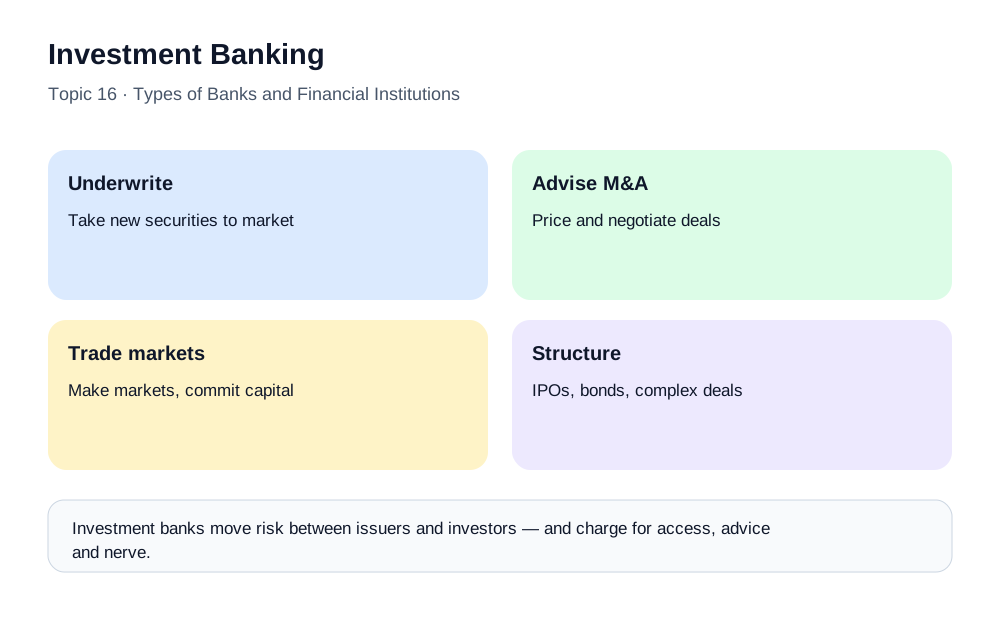
Investment Banking at a glance — Underwriting, M&A advisory, IPOs, capital markets.
1. Why Investment Banks Exist
Strip away the glamour and investment banking solves a fundamental economic problem: the people who need large amounts of capital and the people who have it cannot find, trust, or transact with each other directly.
Consider the obstacles. A company seeking $5 billion cannot simply ask the public for it — millions of investors must be identified, informed, and persuaded. Those investors know far less about the company than its managers do; without credible verification, they would either refuse to invest or demand punitive prices for the risk of being misled (economists call this information asymmetry, and it would cripple capital markets if unaddressed). The transaction itself involves securities law, valuation judgment, precise timing, and distribution mechanics that no issuer performs often enough to master. And once securities exist, investors need ongoing markets in which to trade them.
Investment banks exist as the specialist intermediaries that clear every one of these obstacles:
- Certification. A respected bank's involvement — its due diligence, its reputation, its capital at risk in underwriting — signals credibility to investors who cannot verify the issuer themselves.
- Distribution. Banks maintain standing relationships with the institutional investors who actually buy large offerings: pension funds, insurers, asset managers, sovereign wealth funds.
- Expertise. Valuation, structuring, regulatory navigation, and market timing are rare, perishable skills that issuers need once a decade and banks practise daily.
- Liquidity. Sales and trading operations keep markets functioning after issuance, so investors know they can exit — which makes them willing to enter.
Notice what this means: the investment bank is not really selling financial products. It is selling trust, access, and judgment — and charging fees commensurate with how scarce those commodities are.
A comparison with commercial banking clarifies the boundary:
| Dimension | Commercial Banking (Topics 14–15) | Investment Banking |
|---|---|---|
| Core business | Deposits and loans (balance sheet) | Capital raising, advisory, markets (fees) |
| Clients | Individuals, businesses | Corporations, governments, institutional investors |
| Revenue | Interest margin + fees | Advisory, underwriting, and trading fees |
| Risk | Credit risk held for years | Market and underwriting risk held for days/weeks |
| Regulation | Banking licence, deposit insurance, capital rules | Securities regulation, market conduct, information barriers |
Historically, the two were deliberately separated in the United States by the 1933 Glass-Steagall Act (Topic 13) after the Depression-era diagnosis that mixing deposit banking with securities speculation had amplified the crash. The separation eroded and was formally repealed in 1999; today's universal banks house both under one roof, separated by compliance walls rather than law — a settlement whose wisdom the 2008 crisis reopened for debate.
2. Capital Raising and Underwriting
When corporations or governments need to raise substantial capital, they turn to investment banks to manage the process. This underwriting function — the core of traditional investment banking — involves far more than simple brokerage. The investment bank becomes strategic advisor, financial engineer, risk manager, and distribution partner throughout the capital raising process.
The process begins with advice on structure and timing. Should the client issue equity or debt? What maturity, coupon, or dividend terms will attract investors while meeting the issuer's needs? When should the offering come to market for optimal pricing? These decisions require understanding market conditions, investor appetite, comparable transactions, and the client's strategic objectives. A well-timed, well-structured issue can save an issuer hundreds of basis points of cost for decades; a botched one can burden it just as long.
Pricing is a critical exercise in judgment. Price securities too high, and the offering fails or trades down in the aftermarket, damaging issuer reputation and bank credibility. Price too low, and the issuer leaves money on the table while investors enjoy instant gains. Investment banks conduct extensive investor sounding — analysing the demand curve for the offering — and calibrate price to balance issuer proceeds against placement certainty. The recurring tension: existing shareholders want maximum price; the bank's distribution credibility wants deals that perform afterward. Managing that tension honestly is the underwriting craft.
The underwriting commitment transforms the bank from advisor to risk-taker. In a firm-commitment underwriting, the bank commits to purchasing any securities investors do not buy. This guarantee lets issuers raise capital with confidence, whatever the markets do between launch and close. For assuming this risk, underwriters earn fees proportional to size and complexity. (The alternative, best-efforts distribution, places the risk on the issuer and suits smaller or riskier offerings.) Syndicates of multiple banks typically share large underwritings — spreading both the risk and the fee pool, mirroring the loan syndication logic of Topic 15.
Distribution completes the process. Investment banks market offerings through their institutional relationships worldwide, allocate securities among competing demands, and seek appropriate long-term holders. The quality of a bank's distribution network is a core competitive advantage — the ability to place paper even in difficult markets is what issuers ultimately pay for.
A worked example makes the economics concrete. Suppose a technology company raises $2 billion in a stock offering at a 5% gross underwriting spread. The fee pool is $100 million, shared among the syndicate: perhaps $25 million to the lead bookrunner, the rest divided among co-managers and the selling group. For that fee, the banks advised on structure for months, conducted due diligence, priced the deal against a live demand curve, guaranteed completion with their own capital, and placed the shares with institutions they expect to remain clients for decades. Fee income of this scale — earned per transaction, not per year — is why underwriting sits at the industry's economic centre.
3. Initial Public Offerings: Taking Companies Public
The initial public offering, in which a private company first sells shares to the public, represents one of the most complex and consequential transactions in finance. Investment banks guide companies through this transformation, managing regulatory compliance, financial disclosure, investor marketing, and price discovery.
Due diligence forms the foundation. Bankers, lawyers, and accountants thoroughly review the company's finances, legal status, operations, and risk factors. Every material fact must be verified, every significant risk disclosed. This protects investors by ensuring offering documents are accurate — and protects the company and its bankers by reducing liability for misrepresentation, a liability securities law takes seriously.
The prospectus communicates the opportunity to potential shareholders. Drafting it requires translating complex business reality into clear, compelling narrative while satisfying requirements for comprehensive disclosure: history, strategy, financial performance, management, risk factors, use of proceeds. The prospectus is simultaneously a legal shield, a compliance document, and the offering's central marketing artefact.
Roadshows bring management before institutional investors. Senior executives and bankers travel financial centres worldwide, conducting dozens of meetings, answering hard questions, and gauging appetite. These presentations shape perceptions and build the order book that determines pricing. Management quality — assessed live, under questioning — moves valuations materially at this stage; investors are buying leadership as much as financials.
Book building collects investor orders and determines allocation. Investors indicate demand at various prices, letting underwriters construct the demand curve and set the final price for full subscription at maximum proceeds. Allocation favours long-term holders over short-term flippers, promoting stable aftermarket trading — though the tension between rewarding loyal institutions and achieving fair price discovery is a permanent feature of the craft.
Stabilization supports the stock in the days after listing; underwriters may buy shares in the market to prevent disorderly declines, under strict regulation to prevent manipulation. The greenshoe option — an overallotment allowing underwriters to sell up to roughly 15% additional shares and cover the resulting short in the market or from the company — is the standard stabilization mechanism.
Why do companies accept this costly, exhausting process? Because going public transforms a firm's strategic options: permanent capital, a liquid currency for acquisitions, an exit for early investors, and market visibility no private company possesses. The costs are equally real — ongoing disclosure, quarterly earnings pressure, and public scrutiny — which is why the IPO decision, and its timing, is among the most consequential an investment banker advises on.
4. Mergers and Acquisitions Advisory
When corporations combine, acquire, or divest businesses, investment banks advise on strategy, valuation, negotiation, and execution. These advisory services command substantial fees because the transactions they facilitate create — or destroy — billions in shareholder value.
Buy-side advisory helps acquirers identify targets, assess value, structure offers, and negotiate. Bankers analyse strategic fit, build financial models projecting combined performance, and advise on offer terms — cash versus stock, timing, conditions. They assist in due diligence, financing arrangements, and the regulatory approvals large combinations require. A buy-side banker's deepest value is often valuation discipline: knowing what a target is worth and, critically, advising the client when to walk away. Overpayment is the most reliable destroyer of acquisition value, and the advisor paid on completion faces an incentive to see deals close — a conflict sophisticated clients manage explicitly.
Sell-side advisory helps companies seeking buyers maximise value. Bankers prepare confidential information memoranda, identify potential acquirers, manage competitive bidding, and negotiate terms. The objective is controlled competitive tension: multiple credible buyers, a disciplined process, and a price driven up by rivalry rather than negotiation alone.
Fairness opinions provide independent assessment of whether a transaction price is fair to shareholders. Boards rely on them to satisfy fiduciary duties; the opinion applies multiple valuation methodologies — comparable companies, precedent transactions, discounted cash flow — to a defensible conclusion.
Hostile takeovers present the most dramatic advisory challenges. Attackers develop strategies to overcome resistance: tender offers directly to shareholders, proxy contests to replace boards, public pressure campaigns. Defenders deploy poison pills (shareholder rights plans that dilute an acquirer), seek white knight alternative buyers, litigate, and lobby their own shareholders. These contests can run for months, reshaping corporate control and generating the advisory war stories that define banking careers.
Beneath the tactics sits the strategic question every M&A assignment must answer: why should these two businesses be worth more together than apart? Synergies — cost savings, revenue opportunities, capabilities one side lacks — must exceed the control premium paid, or the deal transfers value from the acquirer's shareholders to the target's. The historical record shows a large share of acquisitions fail this test, which is why disciplined advisory (and the courage to advise against deals) is the profession's claim to social value.
5. Sales and Trading
Investment banks maintain sales and trading operations that connect buyers and sellers in financial markets, providing liquidity and facilitating price discovery. These activities generate revenue through commissions, bid-ask spreads, and principal trading profits.
Market making provides continuous liquidity by standing ready to buy or sell at quoted prices. When investors want to trade, market makers ensure counterparties exist, narrowing spreads and reducing transaction costs — essential plumbing that lets investors enter and exit positions with minimal friction. Market makers earn the spread while bearing inventory risk: prices can move against positions they must hold to serve clients.
Proprietary trading — banks trading their own capital purely for profit — was significantly restricted after the 2008 crisis by regulations such as the Volcker Rule in the United States, aimed at preventing excessive risk-taking with institutions backed by insured deposits. Prop trading continues in limited, modified forms, and banks still hold positions to facilitate client transactions and hedge exposures — the boundary between permitted market-making inventory and prohibited speculation remains a live regulatory question.
Research departments publish analysis on companies, industries, and economies. Equity analysts cover specific stocks with buy/hold/sell recommendations; fixed income analysts evaluate bonds and rates; macro strategists assess economies and policy. Research supports trading relationships and, increasingly, earns direct revenue — though its independence is protected by the information barriers described in Section 7, after scandals in which research was distorted to win banking business.
The trading floor's transformation deserves note: electronic trading, algorithmic execution, and automation have replaced much of the floor's historic headcount with technology. A function once defined by shouting traders is now substantially defined by engineers, quants, and execution algorithms — human judgment concentrating in complex, illiquid, and client-relationship trading where machines add least.
6. The Structure of the Industry
The investment banking industry is organized in tiers reflecting firm size, deal capacity, and specialization.
Bulge bracket firms such as Goldman Sachs, J.P. Morgan, and Morgan Stanley dominate the largest global transactions. They operate in all major financial centres, employ thousands of professionals, and handle the biggest mergers, equity offerings, and bond issues. Brand, balance sheet capacity, and global distribution give them structural advantage on the largest, most complex deals.
Elite boutique firms such as Lazard, Evercore, and Rothschild specialize in advisory without the trading and lending operations of full-service firms. They compete on advice quality rather than service breadth, often winning the most complex and sensitive assignments — restructurings, hostile defences, board-level counsel — precisely because their focused model avoids the conflicts that arise when one firm advises, lends to, and trades the same client.
Regional and specialized firms serve mid-market companies and specific sectors. Firms like Jefferies, Piper Sandler, and Houlihan Lokey developed deep expertise in particular segments, serving companies too small for bulge bracket attention or requiring specialist knowledge. Within their niches, their relationships and credibility can outmatch any global giant.
The tier structure reflects a fundamental economics point: investment banking is a relationship and reputation business with enormous fixed costs. Brand, coverage, and distribution must be built over decades and maintained continuously — which is why the industry's leaders change slowly, why talent commands extraordinary compensation, and why new entrants succeed only in niches where specialization outweighs scale.
7. Revenue, Conflicts, and the Chinese Wall
Investment banks generate revenue through multiple channels. Advisory fees for mergers and acquisitions typically range from one to two percent of transaction value — a higher percentage on smaller deals, lower on the largest, where absolute fees remain enormous. Underwriting fees for equity IPOs range from three to seven percent of proceeds; debt underwriting commands lower percentages given lower risk and complexity. Trading commissions and spreads and asset management fees add further streams.
This diversity creates a problem the industry must manage constantly: conflicts of interest. A bank may simultaneously advise a company on a merger, lend to its acquirer, trade its securities, and publish research on it. Information obtained in one role is valuable — and potentially illegal to use — in another.
The primary control is the information barrier, traditionally called the Chinese wall: strict separation preventing material non-public information from flowing between divisions. Advisory teams working on mergers cannot share information with trading desks. Researchers cannot tip preferred clients before publication. Staff are "brought over the wall" formally when they must be exposed to confidential information, and their trading is restricted accordingly. Compliance monitors communications and transactions for violations, and breaches carry severe insider-trading penalties — for individuals and for the firm's licence and reputation.
Beyond information barriers, regulation addresses conflicts directly: research independence rules, disclosure requirements, restrictions on tying banking business to research coverage, and conduct rules on allocation and pricing. The 2008 crisis added capital, leverage, and resolution requirements for the largest firms, and the post-crisis settlement continues to evolve. The underlying reality students should absorb: an investment bank's most valuable asset is the market's belief that it can be trusted with everyone's secrets simultaneously — and the entire compliance architecture exists to make that belief justified.
8. Case Study: An IPO From Mandate to Listing
To see the machinery of Sections 2 and 3 operate as one process, follow Aurora Robotics, a fictional industrial automation company, through a stylised but realistic nine-month IPO.
Month 1 — the mandate. Aurora's board invites four banks to pitch. Each presents valuation analysis, comparable listings, a proposed syndicate, and its distribution credentials. The board appoints a lead bookrunner and two co-managers. Fees are set at roughly 5% of proceeds — the industry norm for a mid-sized offering.
Months 2–4 — due diligence and drafting. Bankers, lawyers, and auditors descend on Aurora. Three years of financials are rebuilt to public-company standard; customer contracts, patents, and litigation are reviewed; the risk factors section of the prospectus grows to forty pages. Every material claim the prospectus will make must be verifiable, because the banks' own liability depends on it. Regulators review the filing; comments are answered in rounds of revision.
Month 5 — the education of the market. Analysts at the syndicate banks initiate research coverage internally and brief their sales forces. Aurora's story is sharpened into an investment thesis: recurring service revenue, exposure to factory automation growth, founder-led management. The equity story matters because roadshow investors will test it line by line.
Month 6 — the roadshow. Aurora's CEO and CFO, flanked by the lead banker, present to over a hundred institutions across two weeks: pension funds, asset managers, sovereign funds. Questions are forensic — customer concentration, margin sustainability, why now. Order indications begin accumulating in the book.
Pricing night. The book shows demand for roughly three times the shares offered at the top of the $22–25 range. The syndicate prices at $26 — above range, justified by oversubscription. Aurora sells 40 million shares: $1.04 billion raised, about $52 million in the fee pool. Allocation favours institutions judged likely long-term holders.
Listing day and after. Shares open at $29 and close at $28.40 — a 9% rise: strong enough to reward investors, modest enough that Aurora did not obviously underprice. The greenshoe is partially exercised to cover the syndicate's short position from overallocation. For thirty days the lead bank stabilises trading; then Aurora is simply a public company — filing quarterly, performing against guidance, and living with the visibility it bought.
The case shows the functions stacked: advice (structure, timing), verification (diligence), certification (the banks' names), price discovery (book building), risk transfer (underwriting commitment), and distribution (allocation). Every fee dollar maps to one of those functions.
9. Careers and Culture in Investment Banking
No survey of the industry is complete without understanding its human machinery, because the career structure is itself an economic feature.
The hierarchy runs analyst → associate → vice president → director/executive director → managing director. Analysts (typically hired from university) build models and presentations; associates manage analysts and process; vice presidents run deal execution; directors originate client relationships; managing directors own the franchise and the fees it generates. Progression is a tournament: each level is smaller, and promotion requires not just competence but client trust.
The work is famously demanding — 80-to-100-hour weeks are common in peak deal periods at junior levels, driven by the economics: fees arrive in lump sums on unpredictable deadlines, and clients paying millions expect immediate response. The industry's repeated attempts to reform working conditions reflect the tension between that economic reality and sustainable human practice.
Compensation is high and heavily bonus-weighted, because it is directly tied to revenue generated: a rainmaking MD's bonus is a share of franchise economics, while junior bonuses reward execution quality and survival through the cycle. This pay structure is the visible edge of the industry's core model — a small number of trusted people converting relationships and judgment into very large, episodic fees.
Skills that actually matter: financial modeling and valuation fluency, stamina and precision under pressure, communication that survives hostile questioning, and — increasingly — genuine industry specialisation, as clients demand advisors who understand their sector as well as they do. Technology is reshaping entry-level work (automating models, data rooms, and first-draft documents), pushing junior value toward judgment and client interaction earlier in careers.
10. The Client and Bank Perspectives
From the client's perspective (corporations, governments, institutional investors):
- You are buying judgment, distribution, and credibility — price them accordingly. Fee pressure is legitimate, but the cheapest underwriter can be the most expensive outcome if the deal misprices or fails.
- Manage the completion conflict. Your advisor earns on closing; your shareholders earn on value. Independent board processes and fairness opinions exist to balance this.
- The bank's conflicts are your risk. Ask who else the bank serves in your sector, where the walls sit, and how your confidential information is contained.
- Timing is advice's hardest test. Windows open and close with markets; the counsel to wait is sometimes the most valuable advice given — and the hardest to sell internally.
From the bank's perspective:
- Reputation is the franchise. A century of credibility can be damaged by one conflicted deal; risk management in this industry is reputation management.
- Talent is the asset that walks out the door nightly. Compensation structures, promotion tournaments, and culture exist to retain the people who hold client relationships and technical skill.
- Cycles govern the P&L. Deal flow booms and collapses with markets and confidence; cost flexibility and diversified business lines determine who survives the lean years.
- Regulation shapes the map. Capital rules, conduct requirements, and structural reforms continuously redraw which activities are profitable — adaptability to the regulatory cycle is a core competency.
11. Common Mistakes and Misconceptions
Misconception 1: "Investment banks are banks like the one on the high street." They neither take public deposits nor make routine loans as their core business; they intermediate capital markets and advise on transactions. The word "bank" obscures more than it reveals.
Misconception 2: "Underwriting is just marketing." The underwriter stakes capital and reputation: it guarantees completion, prices against a real demand curve, and is legally exposed on disclosure. Marketing is the visible tip of a risk-bearing iceberg.
Misconception 3: "Investment bankers create nothing of value." Their economic function is reducing information asymmetry and transaction costs in capital allocation. Done well, this channels savings to productive use at lower cost of capital; the legitimate critique concerns fees and incentives, not the function itself.
Misconception 4: "A successful IPO is one that doubles on day one." A large first-day "pop" usually means the offering was underpriced — value transferred from the issuer to allocated investors. A well-priced deal trades modestly up; both issuer and investors got a fair result.
Misconception 5: "M&A advice is just negotiation theatrics." The substance is valuation, structure, financing, regulatory strategy, and process management. Theatrics exist — but the fees are earned in models, data rooms, and disciplined process design long before the dramatic phone calls.
Misconception 6: "Chinese walls make conflicts disappear." They manage, not eliminate, conflicts — and their effectiveness depends on culture and enforcement, not policy documents. Sophisticated clients and regulators treat them as necessary but insufficient.
Misconception 7: "Trading floors are still gangs of shouting men in jackets." Electronic and algorithmic trading has transformed execution; today's floor is substantially engineers and quants, with human traders concentrated in complex and illiquid products.
12. Frequently Asked Questions
What is the difference between corporate banking and investment banking? Corporate banking lends to companies and runs their payments (balance-sheet business); investment banking helps them issue securities and advises on M&A (markets and advisory business). Universal banks often serve the same client through both.
What does an underwriter actually guarantee? In a firm-commitment deal, that the issuer will receive the agreed proceeds: if investors do not buy the securities, the underwriter must. The bank's capital absorbs the placement risk; the fee compensates it.
Why are IPO fees so high (3–7%)? They reflect months of advisory work, legal liability on disclosure, underwriting risk, and distribution through expensive standing networks — priced against the value of a successful, credible market debut.
What is book building? The process of collecting institutional demand at various prices to construct a demand curve, set the final offer price, and allocate shares — the price discovery mechanism of modern equity issuance.
What happened to Glass-Steagall? The 1933 separation of commercial and investment banking eroded over decades and was repealed in 1999, creating today's universal banks. Post-2008 reforms (such as the Volcker Rule) rebuilt partial separation by restricting specific activities rather than institutions.
How do boutiques beat global banks for mandates? On independence and senior attention: no trading or lending conflicts, and partners rather than juniors doing the work. On sensitive assignments — restructurings, defences, board advice — that profile often wins.
Is investment banking still a good career given automation? Execution automates; judgment does not. The career is shifting toward advisory complexity, client relationships, and technical fluency — smaller analyst intakes in trading, sustained demand in advisory and technology-adjacent roles.
13. Key Terms in This Chapter
- Underwriting — guaranteeing an issuer's capital raise by committing to buy unsold securities.
- Firm commitment vs best efforts — underwriting where the bank absorbs, versus merely places, the placement risk.
- IPO (initial public offering) — a private company's first sale of shares to the public.
- Prospectus — the regulated disclosure document describing an offering.
- Roadshow — management presentations to institutional investors before an offering.
- Book building — collecting investor demand to set price and allocation.
- Greenshoe (overallotment) — the option allowing underwriters to sell extra shares for stabilization.
- M&A advisory — counsel on acquisitions, mergers, and divestitures; buy-side and sell-side.
- Fairness opinion — independent assessment that a transaction price is fair to shareholders.
- Hostile takeover — an acquisition attempt without target board cooperation; poison pills and white knights are defences.
- Market making — standing ready to buy and sell at quoted prices, earning the spread.
- Proprietary trading / Volcker Rule — trading the bank's own capital for profit, and the post-2008 restriction on it.
- Bulge bracket / elite boutique — the global full-service tier and the advisory-specialist tier of the industry.
- Chinese wall — the information barrier preventing confidential information flowing between bank divisions.
- Bookrunner — the lead bank responsible for an offering's book building and allocation.
- Syndicate — the group of banks sharing an underwriting's risk and fees.
14. Interview Insights: How This Topic Appears in Banking Interviews
"What does an investment bank actually do?" Answer by function, not prestige: raise capital (underwriting equity and debt), advise on transactions (M&A), and operate markets (sales and trading) — for corporations, governments, and institutional investors. Then state the economic why: reducing information asymmetry and transaction costs between those who need capital and those who have it. Candidates who explain the function earn more credit than those who recite the glamour.
"Walk me through an IPO." Hit the stages in order: selection of underwriters → due diligence → prospectus drafting → roadshow → book building → pricing and allocation → first-day trading with stabilization. Adding one insight per stage (liability in diligence, demand curves in book building, what a big first-day pop really means) separates preparation from memory.
"Why do most acquisitions fail to create value?" The disciplined answer: the control premium plus integration risk usually exceeds realisable synergies; management overconfidence and advisor completion incentives compound the problem. Mentioning that good advisors sometimes counsel against deals shows you understand where the profession's integrity lives.
"What is a Chinese wall, and does it work?" Define it, give the advisory/trading example, then offer judgment: walls manage rather than eliminate conflicts, and their effectiveness depends on enforcement and culture. Nuanced honesty here scores higher than either cynicism or naivety.
"How would you value a company?" Name the core methodologies — comparable companies, precedent transactions, discounted cash flow — and when each dominates (public comps for market context, precedents for M&A pricing, DCF for intrinsic value). Interviews probe depth afterward, but the triad is the non-negotiable foundation.
Summary and Key Takeaways
Investment banking is the markets-facing half of high finance: raising capital, advising on corporate transformation, and operating the markets where securities trade. The essential points:
- The function is trust and access. Investment banks exist because issuers and investors cannot find, verify, or transact with each other directly; banks sell certification, distribution, and judgment.
- Underwriting is risk-bearing, not brokerage. Firm commitments guarantee issuers their proceeds, with bank capital absorbing placement risk — priced through fees of 3–7% on equity issuance.
- The IPO is the flagship transaction: diligence, prospectus, roadshow, book building, pricing, and stabilization, compressing years of private building into one priced public debut.
- M&A advisory sells valuation discipline and process craft — and its social value hinges on whether synergies genuinely exceed the premiums paid.
- Trading has been transformed twice: by electronic automation, and by post-2008 rules confining banks to client-facilitating rather than speculative risk.
- The industry tiers by scale and independence — bulge bracket balance sheets, boutique judgment, specialist niches — because reputation and relationships are the durable moats.
- Conflicts are structural; walls are the management. The business model concentrates sensitive information, so information barriers, conduct rules, and culture are existential, not bureaucratic.
- Reputation is the balance sheet. In a business where clients buy trust, credibility is the asset every deal either builds or spends.
Investment banking shapes how capital flows through the global economy — determining which companies raise funds, which industries consolidate, and which projects get financed. Understanding it reveals the mechanism by which financial markets allocate society's savings. In the next topic, we turn to banking's most exclusive segment: private banking — the management of wealth for high-net-worth individuals and families.
Next: Topic 17 — Private Banking →
<!-- MBA-DEEP-DIVE-START -->Deep Dive: How Investment Banking Actually Works Inside a Bank
Investment banking is often explained through visible outcomes: an IPO rings the exchange bell, an acquisition is announced, a bond issue raises billions, or a company hires an adviser to sell a business. Those outcomes are only the front page. The real discipline sits underneath them: mandate origination, valuation, due diligence, structuring, documentation, risk approval, investor distribution, market execution, settlement, regulatory controls, and post-deal accountability. A world-class understanding of investment banking therefore requires seeing it not as a collection of glamorous transactions but as a controlled process for moving ownership, risk, and capital between issuers and investors.
The first practical distinction is between advisory work and balance-sheet work. In pure advisory, the bank earns a fee for judgment, execution support, and access; it may never put significant principal capital at risk. In underwriting, bridge financing, committed acquisition financing, or inventory taken in market-making, the bank can expose its own balance sheet. That changes everything. Once principal capital is involved, credit risk, market risk, liquidity risk, legal risk, concentration risk, capital usage, and funding cost enter the transaction economics. Two deals with the same headline fee can therefore have radically different risk-adjusted profitability.
The mandate lifecycle: from relationship to execution
Most major transactions begin well before a formal mandate. Coverage bankers maintain long-term relationships with chief executives, chief financial officers, treasurers, boards, sponsors, and institutional clients. They continuously study the client’s strategy, capital structure, investor base, competitors, debt maturities, acquisition opportunities, and valuation. When a transaction becomes possible, the bank develops a pitch: strategic rationale, valuation, potential structure, expected investor reception, execution timetable, regulatory constraints, and likely fees.
Winning the mandate is not the same as being ready to execute. Once appointed, the bank must establish governance around the transaction. Deal teams are formed, responsibilities are allocated, conflicts checks are performed, inside-information controls are activated, legal counsel and accountants are coordinated, and internal approval paths are identified. For securities offerings, the process may involve equity capital markets or debt capital markets teams, syndicate desks, sales, research restrictions, legal and compliance functions, and operational teams responsible for settlement. For M&A, the advisory team may work with financing, tax, legal, antitrust and industry specialists while the client’s board evaluates fiduciary duties and strategic alternatives.
A strong banker must therefore think in two timelines at once. The first is the client timeline: announcement, launch, pricing, shareholder vote, closing. The second is the bank-control timeline: approvals, due diligence, documentation, risk sign-offs, wall-crossing, information barriers, investor communication rules, and settlement readiness. Transactions fail when either timeline is ignored.
Equity capital markets: not simply “selling shares”
An equity offering is a price-discovery and risk-allocation exercise. Before launch, bankers analyse the issuer’s valuation relative to comparable companies, recent transactions, earnings outlook, free float, existing shareholder concentration, liquidity, and market volatility. They assess how much stock investors can realistically absorb without forcing the price down and whether the issuer should raise capital immediately or wait for a more supportive market window.
Once marketing begins, investor feedback becomes central. Orders are not all equal. A large order from a long-term institutional investor may be more valuable to the issuer than an equally large order from a short-term trading account likely to sell immediately after listing. The order book must therefore be interpreted, not merely counted. The syndicate team evaluates price sensitivity, investor quality, geographic mix, concentration, and likely aftermarket behaviour.
The final allocation is one of the most sensitive parts of the process. Investors want as many shares as possible in attractive deals; issuers want stable holders and strong pricing; banks want to reward important client relationships without damaging fairness or market integrity. Allocation decisions must therefore balance commercial relationships with regulatory and conduct obligations. Poor allocations can create immediate selling pressure, reputational damage, and suspicion that the bank favoured selected investors improperly.
Debt capital markets: the economics of borrowing at scale
Debt issuance follows a different logic because the issuer is not selling ownership; it is committing to future cash flows. The core questions become maturity, coupon, benchmark spread, currency, ranking in the capital structure, security, covenants, call features, and investor suitability. A corporate treasury team may ask whether to issue five-year fixed-rate debt, ten-year debt, floating-rate notes, subordinated debt, or bonds in another currency and swap the proceeds back into its functional currency.
Pricing is commonly expressed as a spread over a benchmark government yield or swap rate. That spread compensates investors for credit risk, liquidity, structure, and market uncertainty. A few basis points matter enormously on multibillion-dollar issuance. For a $5 billion bond, a 10-basis-point difference in annual funding cost is roughly $5 million per year. Over a decade, small pricing differences can translate into tens of millions of dollars of additional interest expense.
This is why debt bankers spend so much time on relative value. They compare the issuer’s existing bonds, peer issuers, secondary-market spreads, credit ratings, expected supply, investor demand, and broader rates markets. Timing can be critical: an issuer may postpone a deal because a central-bank decision, geopolitical shock, or sudden volatility has widened spreads beyond acceptable levels.
Underwriting risk is real risk
The word “underwriting” should never be treated as a ceremonial label. A firm-commitment underwriting means the bank has agreed to purchase securities and resell them to investors. If the market moves sharply between commitment and distribution, the bank can be left holding inventory at a loss. Large deals are therefore subjected to underwriting committees and risk limits.
The approval process asks practical questions. What happens if the market falls 10% before placement? What if the investor book is weaker than expected? What if a rating agency downgrades the issuer? How concentrated is the exposure relative to the bank’s capital? Is the transaction hedged? How quickly can unsold securities be distributed? What is the worst-case loss under stressed conditions?
These questions connect investment banking directly to enterprise risk management. Front-office enthusiasm for a transaction is only one input. Independent risk functions must assess whether expected revenue justifies potential downside. This separation matters because bankers are paid to win and close business, while risk officers are paid to protect the institution from losses that may not be visible in the headline fee.
M&A execution: valuation is only the beginning
Mergers and acquisitions are often taught as valuation exercises, but execution risk is equally important. A transaction can be strategically attractive and still fail because financing is unavailable, competition regulators object, shareholders reject the terms, due diligence uncovers liabilities, foreign-investment approvals are denied, or the parties cannot agree on representations, warranties, indemnities, or closing conditions.
The adviser’s role therefore extends well beyond producing a discounted cash-flow model. Bankers coordinate the process, maintain bidder tension, evaluate financing certainty, assess transaction structure, track regulatory approvals, prepare board materials, support negotiation, and continuously update valuation as new information emerges.
Consider a company being sold through an auction. The sell-side adviser may first prepare a buyer universe, then contact selected parties under confidentiality agreements, distribute an information memorandum, manage access to a virtual data room, coordinate management presentations, request indicative bids, shortlist bidders, and invite binding offers. The adviser compares not only price but also financing certainty, regulatory risk, conditionality, timing, and the buyer’s ability to close. A nominally higher bid can be inferior if it carries a high probability of failure.
That is a crucial professional lesson: transaction value is not just the announced price. It is price multiplied by the probability and quality of completion.
Due diligence: where reputation and liability meet
Due diligence is the discipline that prevents a bank from distributing securities or advising on a transaction using information that is incomplete, misleading, or insufficiently tested. Financial statements are reviewed, management assumptions challenged, legal claims examined, material contracts studied, regulatory matters assessed, and disclosures tested for consistency.
In securities offerings, the objective is both investor protection and liability management. Banks, issuers, lawyers, and auditors create a documented record showing that reasonable investigation was performed. This is not administrative paperwork. If material information is wrong or omitted, investors may suffer losses and regulators or courts may ask what the bank knew, what it should have known, and what steps it took to verify the disclosure.
A world-class banking process therefore values scepticism. The strongest deal teams do not merely ask, “Can we market this story?” They ask, “Can we defend every material statement in this story if challenged later?”
Information barriers and inside information
Investment banks routinely receive material non-public information. A company considering an acquisition, a confidential capital raise, an earnings warning, or a strategic sale cannot allow that information to leak into trading or research activity. The bank therefore uses information barriers, restricted lists, watch lists, wall-crossing procedures, and surveillance.
When an employee is “wall-crossed,” they are formally brought inside a confidential transaction and may be restricted from trading or discussing affected securities. The purpose is to prevent insider dealing and inappropriate information flow. The control environment must also protect clients from conflicts where the bank serves multiple parties with competing interests.
These controls are commercially inconvenient but institutionally essential. A single misuse of confidential information can create criminal exposure, regulatory sanctions, client loss, and severe reputational damage. In investment banking, trust is an economic asset; information-control failures destroy that asset quickly.
Settlement and operational completion
A deal is not complete when the press release is published. Securities must be issued, cash must move, legal conditions must be satisfied, ownership records updated, custodians and clearing systems instructed, fees calculated, and settlement confirmed. In large capital-market transactions, operations teams coordinate with central securities depositories, custodians, paying agents, registrars, exchanges, clearing houses, and internal ledger systems.
This is where front-office strategy meets banking infrastructure. A perfectly priced bond that fails to settle creates financial, legal, and reputational consequences. Corporate actions must be captured correctly. Interest and principal obligations must be serviced over the life of the instrument. Investor allocations must reconcile with settlement instructions. Breaks must be investigated quickly.
For learners coming from payments or operations, this is an important bridge: investment banking is not separate from transaction processing. The instrument may be more complex, but the institution still depends on precise data, controlled movement of cash and securities, reconciliation, exception management, and finality.
How to judge a transaction professionally
A good transaction should be evaluated on more than whether it closed. For the client, did it achieve the strategic objective at an acceptable cost? For investors, was disclosure sufficient and pricing reasonable? For the bank, were fees adequate relative to capital, risk, execution effort, and reputational exposure? For regulators, were market-conduct and disclosure obligations respected? For operations, did settlement complete cleanly and were downstream obligations captured correctly?
This multi-dimensional view is what separates professional banking judgment from deal-counting. An adviser that closes many transactions but repeatedly leaves clients overleveraged, investors mispriced, or the bank exposed to hidden risk is not performing world-class investment banking. The best practitioners combine commercial ambition with valuation discipline, risk awareness, execution control, and the willingness to advise a client not to transact when the economics are wrong.
That final point is the heart of the profession. Investment banking is valuable when the bank’s judgment improves the allocation of capital, not merely when it generates a fee.
Post-deal review closes the learning loop
Strong investment banks also review important transactions after settlement. They compare expected versus actual investor demand, underwriting profit or loss, execution slippage, settlement breaks, client feedback, control issues, and any regulatory or legal lessons. A transaction that closed successfully can still expose weak assumptions or avoidable operational risk that should not be repeated. Capturing those lessons improves future pricing, approval standards, documentation, staffing, and investor strategy. In that sense, the final output of a deal is not only the security issued or acquisition completed; it is also better institutional judgment for the next mandate.
<!-- MBA-DEEP-DIVE-END -->