While retail banking serves millions of individuals with standardized products, corporate banking operates in a different realm entirely, serving businesses from mid-sized companies to multinational corporations with financial solutions that are as complex and varied as the enterprises themselves. This is relationship banking at scale, where dedicated managers understand their clients' industries, challenges, and opportunities well enough to craft customized solutions that keep businesses running, growing, and competing in global markets.
Corporate banking manages fewer relationships than retail banking but handles vastly larger transactions. A single corporate loan may exceed the total deposits of a thousand retail customers. The complexity of corporate financial needs, the sophistication of corporate treasury operations, and the strategic importance of corporate relationships all demand a banking approach that is consultative, customized, and deeply integrated with client operations.
What you will learn in this topic:
- What corporate banking is and how it differs from retail banking in scale, structure, and logic
- Working capital finance: overdrafts, cash credit, bill discounting, and supply chain finance — with a worked example of the cash conversion cycle
- Term loans: structure, security, covenants, and how banks assess repayment capacity
- Cash management: the treasury services that keep corporate money moving
- Trade finance: letters of credit and bank guarantees that make global commerce possible
- Escrow services and the bank's role as trusted intermediary
- The relationship model that defines the segment
- How corporate banks analyse and manage credit risk — and how they earn their revenue
This topic is the mirror image of Topic 14 (retail banking). Where retail banking industrialises millions of small, standardised needs, corporate banking crafts a smaller number of large, bespoke solutions. Together they form the twin pillars of commercial banking. Topics 16 and 17 complete the industry map with investment banking and private banking.
Visual overview
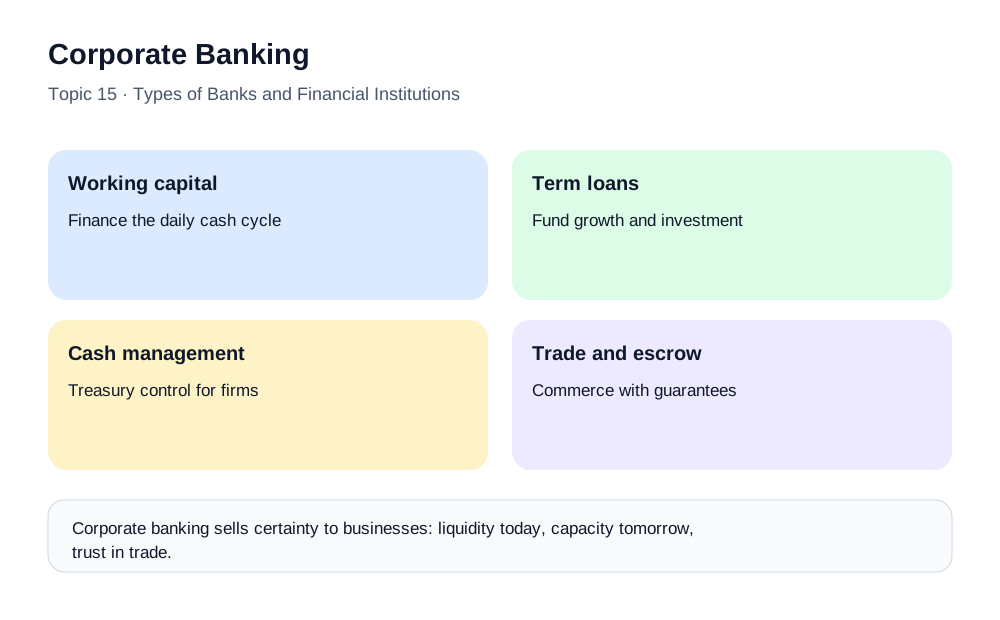
Corporate Banking at a glance — Working capital finance, cash management, escrow services.
1. Why Corporate Banking Exists
To understand corporate banking, start with a simple observation: a business's financial life is fundamentally different from a household's. A household earns a salary and spends it; timing mismatches are small and personal. A business, by contrast, must spend money continuously — on materials, wages, rent, and tax — long before its customers pay it, and it must do so at scales no individual credit card could bridge. Add growth (factories, acquisitions, new markets), geographic complexity (suppliers and customers across borders and currencies), and institutional scale (thousands of employees, hundreds of vendors), and you have financial needs that standardised retail products cannot meet.
Corporate banking exists to solve three classes of business problems:
- Timing problems — bridging the gap between paying and being paid (working capital finance, Section 2)
- Scale problems — providing investment capital far beyond retained earnings (term loans, Section 3)
- Complexity problems — managing money across accounts, currencies, borders, and counterparties who may not trust each other (cash management, trade finance, escrow, Sections 4–6)
A useful contrast with retail banking makes the segment's nature concrete:
| Dimension | Retail Banking | Corporate Banking |
|---|---|---|
| Clients | Individuals, small businesses | Mid-sized companies to multinationals |
| Products | Standardised, mass-market | Customised, negotiated |
| Deal size | Hundreds to hundreds of thousands | Millions to billions |
| Pricing | Rate cards, algorithmic | Negotiated, relationship-based |
| Credit assessment | Scoring models, bureau data | Financial statement analysis, industry research, covenant structures |
| Interface | Apps, branches, call centres | Dedicated relationship managers |
| Risk profile | Granular (no single default matters) | Concentrated (one default can be material) |
That last row captures the deepest difference. Retail banking is a statistical business — portfolios of millions behave predictably. Corporate banking is a judgment business — each exposure is large enough to matter individually, so each must be understood individually. Everything about the segment, from relationship managers to covenant monitoring, follows from that concentration.
2. Working Capital Finance: The Lifeblood of Business
Every business faces a fundamental timing problem. Expenses must be paid before revenue is received. Suppliers demand payment, employees expect salaries, and operating costs accumulate while the company waits for customers to pay their invoices. This gap between cash outflows and inflows is the working capital challenge, and corporate banks provide the financing solutions that bridge it.
A worked example makes the problem vivid. Consider a manufacturer with this operating cycle: it buys raw materials on 30-day supplier credit, holds and processes inventory for 45 days, then sells finished goods on 60-day payment terms. Cash leaves for materials on day 30 and for wages and overheads continuously; cash returns from customers only on day 105. The company must finance 75 days of operations — the cash conversion cycle — out of something other than customer payments. If monthly operating costs are $2 million, that gap means roughly $5 million of working capital that must come from somewhere: retained profits, shareholder funds, or — most commonly — the bank. A growing company makes the problem worse, not better: every dollar of growth requires more inventory and more receivables before it generates cash. Businesses can be profitable on paper and insolvent in practice for exactly this reason, which is why bankers say revenue is vanity, profit is sanity, and cash is reality.
Corporate banks bridge the gap with a family of instruments:
Overdraft facilities represent the simplest form. A corporate current account may go negative up to an agreed limit, allowing the company to keep paying bills through temporary shortages. Interest is charged only on the overdrawn amount and only for the days used — flexibility essential for seasonal businesses and irregular payment cycles.
Cash credit lines provide more structured financing, typically secured by the company's inventory or accounts receivable. Unlike overdrafts, these are formal arrangements with defined limits and terms, requiring regular reporting on the collateral securing them. The bank monitors the borrower's condition and collateral value, adjusting the facility as circumstances change — lending against the very assets the working capital creates.
Bill discounting addresses unpaid invoices directly. When a company has delivered goods but must wait thirty, sixty, or ninety days for payment, the bank advances money against the receivable. The company receives immediate cash, less a discount representing the bank's fee and interest; the bank collects the full amount when the invoice falls due. This technique — also called receivables financing or factoring in its various forms — converts future cash flows into present liquidity.
Supply chain finance optimises cash flow across entire supply chains rather than single companies. The bank facilitates early payment to suppliers, funded by the bank and repaid by the buyer on the original terms. Suppliers receive cash sooner (at financing rates reflecting the buyer's typically stronger credit), buyers keep their payment schedules, and the bank earns fees for intermediating. These programmes strengthen supply chain relationships while improving working capital efficiency for all parties — a rare three-way win.
3. Term Loans: Financing Growth and Investment
While working capital finance addresses day-to-day operations, term loans provide capital for longer-term investments: machinery, factories, expansions, acquisitions. These loans are repaid over years, with terms typically ranging from three to fifteen years depending on asset life and projected cash flows.
Term loans are usually secured against company assets, giving the bank recourse if the borrower defaults — the specific assets financed, general company assets, or both. Interest rates may be fixed for the term or floating, tied to benchmark rates. (Where loan documentation once referenced LIBOR, the market has transitioned to replacement benchmarks such as SOFR in the US dollar markets, following LIBOR's discontinuation — a reminder that even the plumbing of corporate lending evolves.) Floating rates transfer interest rate risk to the borrower while allowing banks to manage their own rate exposure — the asset-liability discipline whose failure destroyed the S&L industry in Topic 13.
Structuring a term loan requires careful analysis of repayment capacity. Banks examine historical financial performance, project revenues and expenses, and model the debt service coverage ratio (DSCR) — the cushion between operating cash flow and required payments. A DSCR of 1.5x, for instance, means cash flow covers debt payments one and a half times over; below 1.0x, the borrower cannot service the debt from operations at all.
Covenants — contractual promises embedded in the loan agreement — protect the bank through the loan's life. They require the borrower to maintain specified financial ratios (maximum leverage, minimum interest cover), and restrict dividends, additional borrowing, or asset sales that might impair the bank's position. Covenants are early-warning tripwires: they give the bank the contractual right to act before default, while time remains to restructure. We return to covenant monitoring in Section 8.
For very large loans, a single bank may not wish to carry the entire exposure. In a syndicated loan, a group of banks jointly funds one facility — arranged by a lead bank, shared among participants, and governed by a single loan agreement. Syndication lets banks serve clients' largest needs while keeping each institution's exposure within its concentration limits — the risk-management logic of the segment applied to its biggest deals.
4. Cash Management: The Treasury Function
Corporate treasuries manage complex cash flows across multiple accounts, currencies, and time zones. Corporate banks provide the services enabling this management — optimising liquidity, controlling payments, and maintaining visibility over financial positions. This transaction banking business is less glamorous than lending but strategically precious: it is fee-based, capital-light, operationally sticky, and it anchors the daily relationship.
Collections services gather incoming payments efficiently, whether from customers across a country or subsidiaries around the world. Traditional lockbox arrangements route customer payments through bank-managed processing for rapid deposit; electronic collection systems capture digital payments and consolidate funds from multiple sources into central accounts.
Payment services handle the outward flow: bulk salary disbursements to thousands of employees, vendor payments to hundreds of suppliers, tax payments to multiple jurisdictions, dividend distributions to shareholders. Modern systems provide scheduling, multi-level authorisation workflows (a corporate fraud-control essential — no single person should both initiate and approve a payment), and direct integration with corporate enterprise resource planning systems via host-to-host connections and APIs.
Liquidity management optimises the cash itself. Sweep arrangements automatically transfer excess balances from many accounts into a central concentration account, making funds available where needed while earning interest or reducing borrowing. Notional pooling offsets balances across accounts for interest calculation without physically moving money — particularly valuable across currencies and entities where physical movement is costly or restricted.
For the treasurer, the bank's cash management platform is the operational nervous system of the company: real-time visibility of every balance, every payment, every exposure. For the bank, it is the product a client almost never switches — re-plumbing a multinational's payment flows is a project measured in years — making transaction banking one of the most durable franchises in the industry.
5. Trade Finance: Enabling Global Commerce
International trade presents unique financial challenges. Exporters want payment before shipping goods; importers want goods before paying. The parties may be separated by thousands of miles, different legal systems, and fluctuating currencies. Banks bridge these gaps through instruments providing payment assurance and financing across borders.
Letters of credit (LCs) are bank guarantees of payment that let parties who do not fully trust each other trade safely. The mechanics repay careful study:
- Importer and exporter agree a sale and contract for LC payment
- The importer's bank issues the LC, promising to pay the exporter upon presentation of documents proving shipment (bills of lading, invoices, inspection certificates)
- The exporter ships the goods, confident that a bank — not just a distant stranger — stands behind payment
- The exporter presents the documents; if they comply exactly with the LC terms, the bank pays
- The importer's bank releases the documents (which control the goods) to the importer against payment or an agreed credit arrangement
The profound insight inside the LC is that banks deal in documents, not goods. The bank never inspects the cargo; it verifies that paperwork matches the credit's terms with exacting precision. This documentary discipline is what makes the instrument legally robust — and also why LC practice is a specialist craft, governed by internationally standardised rules (the ICC's Uniform Customs and Practice for Documentary Credits). Banks earn fees for issuing, advising, confirming, and negotiating LCs; confirmation — a second bank, often in the exporter's country, adding its own payment promise — protects the exporter even against the issuing bank's or country's risk.
Bank guarantees and standby letters of credit provide alternative assurance, promising payment if the applicant fails to fulfil contractual obligations. Performance guarantees support construction contracts, bid bonds accompany project tenders, advance payment guarantees secure deposits made before work begins. Each substitutes bank credit for commercial credit, enabling transactions too risky to attempt without a bank's standing behind them.
6. Escrow Services: Trusted Intermediation
In complex transactions, parties need a neutral third party to hold funds until agreed conditions are satisfied. Corporate banks provide escrow services fulfilling this need, releasing funds strictly according to predefined contractual terms.
Escrow arrangements are common in mergers and acquisitions, where the buyer deposits purchase funds pending verification of the seller's representations; in real estate, holding down payments until title searches and inspections complete; and in legal settlements, disbursing funds to claimants under court-approved formulas. In each case, the bank's trusted intermediation allows parties to transact who might otherwise lack confidence in each other — the same trust-bridging function as the letter of credit, applied to domestic deal-making.
7. The Relationship Model
Corporate banking is fundamentally relationship-driven. Unlike retail banking's standardised products, corporate solutions are customised to each client's circumstances — requiring deep understanding of the client's business, industry dynamics, competitive position, and strategic objectives.
Relationship managers (RMs) are the primary interface between bank and client. These professionals develop industry expertise, understand their clients' financial challenges, and coordinate the bank's resources to address them. An RM might orchestrate a syndicated loan involving multiple banks, structure a cross-border financing, or assemble advisory services for a complex transaction — acting as the client's single point of contact into the bank's entire capability set. The best RMs function almost as outsourced members of the client's finance team, anticipating needs before they are articulated.
These relationships span decades and product lines. A corporate client may maintain deposits, borrowing facilities, cash management, foreign exchange, and advisory relationships with one bank. This breadth creates switching costs that provide stability — but also obliges the bank to maintain quality across every touchpoint, because a failure in any one service endangers the whole relationship. The economics mirror retail's "primary account" logic (Topic 14) at institutional scale: the relationship, not any single product, is the unit of profitability.
8. Risk Management in Corporate Banking
Corporate lending involves significant, continuously updated risk assessment. Exposures are large, and one major borrower's failure can inflict serious damage — the concentration risk from Section 1 in action. Corporate credit analysis therefore goes far beyond retail scoring.
Financial analysis examines the borrower's statements through ratios measuring profitability, leverage, liquidity, and efficiency. Cash flow projections model future performance under multiple scenarios, stress-testing debt service capacity against deteriorating conditions. Industry analysis assesses whether the sector is growing or declining, consolidating or fragmenting — because a good company in a collapsing industry is still a credit risk.
Management quality is a critical, partly judgment-based factor: are the leaders competent, trustworthy, and capable of navigating adversity? Track record and reputation weigh alongside the numbers — corporate credit is extended to management teams as much as to balance sheets.
Collateral evaluation determines what secures the loan and what protection it truly provides. Real estate, equipment, inventory, and receivables each carry different valuation challenges and recovery prospects — and the question is never just current value but value under stress, when the bank may actually need to sell. (Topic 13's property crises show what happens when stressed collateral values were never honestly modelled.)
Covenant monitoring ensures borrowers maintain the financial health that justified approval: regular reporting, ratio tests, activity restrictions. A breached covenant triggers a graduated response — waiver, repricing, additional collateral, or acceleration — depending on severity and prospects. Early, honest covenant conversations are where corporate banks earn their keep: restructurings agreed at the first sign of stress routinely save situations that denial would destroy.
9. How Corporate Banks Earn: The Revenue Mix
Corporate banking generates revenue through multiple channels. Loan interest provides the largest share, typically forty to fifty percent of corporate banking income. Transaction banking fees for cash management, payments, and trade services contribute another twenty to thirty percent. Trade finance fees, treasury and foreign exchange income, and advisory fees round out the mix.
This diversification matters strategically. Lending income is cyclical and capital-intensive; fee income is stable and capital-light. A corporate bank earning a healthy share from services can maintain client relationships profitably even when loan demand is weak or credit losses are elevated — one reason transaction banking franchises are so highly prized.
Digital transformation is reshaping the segment just as it did retail, though differently: API connectivity that pipes banking directly into corporate ERP systems, real-time payments and liquidity visibility, digital trade finance platforms attacking the LC's notorious paper burden (electronic bills of lading and blockchain-based trade networks), and data-driven credit monitoring that watches borrowers continuously rather than quarterly. The relationship remains human at the top; the machinery beneath it is increasingly digital.
10. Case Study: One Company, One Bank, One Year
The products of corporate banking make most sense in combination. Consider Meridian Components, a fictional but typical mid-sized manufacturer — $80 million in annual revenue, exporting industrial parts to customers in three continents — and watch how its bank serves it across a single year.
January — the working capital foundation. Meridian's cash conversion cycle runs about 80 days: materials purchased on 45-day terms, 50 days in production and inventory, 75 days waiting for export customers to pay. The bank provides a $6 million cash credit facility secured on inventory and receivables, reviewed annually against stock reports and debtor listings. This facility flexes up and down weekly; Meridian pays interest only on what it uses.
March — a new customer in an unfamiliar market. A buyer in a country Meridian has never shipped to places a $1.2 million order. Meridian's bank issues the deal through a letter of credit: the buyer's bank promises payment against compliant shipping documents, and Meridian's bank confirms the LC, removing even the foreign bank and country risk. Meridian ships with confidence; the documents are presented, found compliant, and payment arrives on time. Neither company ever had to trust a stranger.
June — the growth decision. Meridian wins a long-term supply contract requiring a new production line costing $15 million. The bank structures a seven-year term loan, secured on the new equipment and the factory, priced at a floating benchmark rate plus a margin reflecting Meridian's credit profile. Because the loan exceeds what the bank will carry alone for this client group, $6 million is placed with two other banks in a small syndicate. Covenants require leverage to stay below 2.5x and DSCR above 1.4x, tested quarterly.
September — daily treasury life. Meridian's treasurer runs the company on the bank's cash management platform: collections from three continents consolidated automatically, payroll for 400 staff disbursed by bulk file with dual authorisation, excess balances swept nightly against the revolving facility to minimise interest. The platform's API feeds every balance straight into Meridian's ERP system — the bank is, functionally, part of the company's finance department.
November — the covenant conversation. A weak quarter in one export market pushes Meridian close to its leverage covenant. The CFO does not hide it: she calls the relationship manager with the numbers, a recovery plan, and a request for a temporary covenant relaxation. Because the conversation is early, honest, and well-evidenced, the bank grants a waiver with modest repricing rather than escalating. The relationship model works exactly as designed — the covenant was a tripwire, the tripwire forced a conversation, and the conversation protected both sides.
Notice what this year contained: no single product, but an integrated financial partnership — liquidity, trust, growth capital, operational plumbing, and risk discipline, delivered through one relationship. That integration is corporate banking.
11. The Customer and Bank Perspectives
From the corporate customer's perspective:
- Your bank is a strategic vendor — manage it like one. Treasurers maintain multiple banking relationships deliberately: competition keeps pricing honest, and redundancy protects against any single bank's retrenchment in a crisis.
- Covenants are commitments with teeth. Finance teams must model covenant headroom continuously; a technical breach in a bad quarter can hand the bank leverage over dividend policy, strategy, and pricing.
- Trade instruments buy trust you cannot build alone. An LC from a respected bank substitutes institutional credit for commercial reputation — especially valuable when entering new markets.
- Cash visibility is worth paying for. The daily value of knowing every balance, in every entity, in every currency, compounds across a multinational's entire liquidity position.
From the bank's perspective:
- Concentration is the defining risk. Portfolio limits by client, industry, and geography are survival disciplines, because one large default can erase a year of segment profit.
- Fee businesses stabilise the franchise. Transaction banking and trade finance smooth the cyclicality of lending and lock in relationships.
- The RM is both asset and risk. Deep client knowledge creates value — and key-person dependence. Succession and team coverage are deliberate management practices.
- Credit judgment cannot be fully automated. Models inform corporate credit decisions, but industry insight, management assessment, and structuring skill remain human crafts — which is why corporate banking careers are apprenticeships.
12. Common Mistakes and Misconceptions
Misconception 1: "Corporate banking is just bigger retail loans." The logic differs fundamentally: retail credit is statistical and standardised; corporate credit is judgment-based, individually structured, covenant-protected, and continuously monitored.
Misconception 2: "Profitable companies don't need working capital finance." Profitability and cash are different things. A fast-growing, profitable company routinely needs more working capital finance, because growth consumes cash through inventory and receivables before it generates any.
Misconception 3: "A letter of credit guarantees the goods." LCs guarantee payment against compliant documents, not the quality or existence of goods. Documentary fraud exists precisely because banks deal in paper, not cargo — due diligence on counterparties remains essential.
Misconception 4: "Covenants are a formality." Covenants are the bank's early-warning system and its leverage in distress. Sophisticated borrowers negotiate them as hard as pricing, because covenant terms determine who controls the conversation when conditions deteriorate.
Misconception 5: "Relationship banking is old-fashioned in a digital age." Digitisation is transforming corporate banking's machinery (APIs, real-time liquidity, digital trade documents) while leaving its core intact: large, complex, customised credit still requires human judgment and trust.
Misconception 6: "Banks only earn from corporate lending interest." Fees from transaction banking, trade finance, FX, and advisory commonly supply a third or more of segment revenue — and are strategically valued precisely because they do not consume capital or depend on the credit cycle.
Misconception 7: "Syndication means the borrower negotiates with many banks." The borrower negotiates one agreement with the arranging bank; syndication happens among the lenders behind it. The client keeps a single interface while the banks share the exposure among themselves.
13. Frequently Asked Questions
What is the difference between corporate banking and investment banking? Corporate banking provides credit, payments, and transaction services to companies; investment banking provides capital markets access (share and bond issuance) and advisory (M&A). Large banks often house both, serving the same clients at different needs — Topic 16 covers investment banking in detail.
What is the cash conversion cycle and why does it matter? The days between paying suppliers and collecting from customers (inventory days + receivable days − payable days). It measures how much working capital a business needs and therefore how much financing the bank must supply — the foundation of working capital lending.
Why would a healthy company use supply chain finance? To strengthen its suppliers (who get cheap early payment based on the buyer's stronger credit) without extending its own payment terms — improving supply chain resilience at no cash cost to itself.
What happens when a covenant is breached? The bank gains contractual rights — typically to demand remedy, reprice, require additional security, or accelerate repayment. In practice, most breaches open negotiations; acceleration is the exception, reserved for deteriorating situations where the bank must protect its position.
Who uses syndicated loans? Large corporates borrowing amounts beyond any single bank's concentration limits — acquisitions, major capital projects, refinancing of large existing debt. The syndicate shares both funding and risk under one agreement.
Are letters of credit still used in an era of instant payments? Yes — because the LC solves a trust problem, not a speed problem. Instant payment rails do not tell an exporter whether a stranger across the world will pay; a bank's documentary undertaking does. Digitisation is modernising the paperwork, not eliminating the instrument.
How do corporate banks monitor so many large borrowers at once? Through covenant reporting cycles, annual and interim credit reviews, watchlist processes for deteriorating names, and increasingly data-driven early-warning systems that flag stress signals between formal reviews.
What does a relationship manager actually do day to day? An RM's week mixes client meetings (understanding plans and problems), internal advocacy (shepherding credit applications through approval), coordination (bringing in trade, treasury, and FX specialists), and portfolio duties (reviews, covenant tracking, documentation). The role is part consultant, part credit officer, part project manager.
14. Key Terms in This Chapter
- Working capital — the funds tied up in day-to-day operations: inventory plus receivables minus payables.
- Cash conversion cycle — days between paying suppliers and collecting from customers; the working capital financing gap.
- Cash credit — a secured working capital facility, typically against inventory or receivables.
- Bill discounting / receivables finance — advancing cash against unpaid invoices.
- Supply chain finance — bank-funded early payment to suppliers, repaid by the buyer on original terms.
- Term loan — multi-year credit for investment, repaid from projected cash flows.
- Covenant — a contractual promise in a loan agreement (financial ratios, activity restrictions) protecting the lender.
- Debt service coverage ratio (DSCR) — operating cash flow divided by required debt payments.
- Syndicated loan — one facility funded jointly by a group of banks.
- Transaction banking — fee-based cash management, payments, and trade services.
- Sweep / notional pooling — liquidity tools concentrating or offsetting balances across accounts.
- Letter of credit (LC) — a bank's documentary promise to pay an exporter against compliant shipping documents.
- Confirmation — a second bank's added payment guarantee on an LC.
- Bank guarantee / standby LC — a bank's promise to pay if the applicant fails its obligations.
- Escrow — funds held by a neutral third party until contractual conditions are met.
- Relationship manager (RM) — the dedicated banker coordinating a corporate client's full relationship.
- Watchlist — the bank's internal list of borrowers showing early stress, subject to heightened monitoring.
15. Interview Insights: How This Topic Appears in Banking Interviews
"A profitable company asks why it needs working capital finance. What do you tell them?" The model answer separates profit from cash: explain the cash conversion cycle with a simple day-count example, show that growth increases the financing gap (receivables and inventory scale ahead of collections), and conclude that working capital lines fund timing, not losses. Candidates who mention that paper profits can coexist with actual insolvency demonstrate real credit thinking.
"How would you assess a corporate loan application?" Structure it as the corporate credit framework: industry analysis first (is the sector sound?), then financial analysis (leverage, liquidity, DSCR under stress), management quality, security and stressed collateral values, and finally structure — tenor, pricing, covenants that protect the bank. Mentioning that you would size covenants as early-warning tripwires, not decoration, shows practical credit culture.
"How is corporate banking different from retail banking?" Go beyond scale: contrast statistical versus judgment-based credit, standardised versus structured products, rate cards versus negotiated pricing, and granular versus concentrated risk. The insight that lands best: retail portfolios fail statistically, corporate exposures fail individually — which is why the two segments are organised, staffed, and monitored so differently.
"Why do banks value transaction banking so highly?" Because it is fee-based, capital-light, stable across credit cycles, and exceptionally sticky — re-platforming a multinational's payments is measured in years. It anchors the relationship and funds the franchise when lending is weak. This question tests whether you understand banking economics beyond the loan book.
"Explain a letter of credit to a client exporting for the first time." Walk the five-step flow in plain language, emphasising the trust substitution (the bank's promise replaces the stranger's) and the documentary discipline (payment against compliant documents, exactness matters). Warn about the documents-not-goods principle — practical risk awareness is what the question is really testing.
Summary and Key Takeaways
Corporate banking finances the timing, scale, and complexity problems of business — through judgment-based credit and relationships rather than algorithms and rate cards. The essential points:
- Working capital finance bridges the fundamental business timing gap — paying before being paid — measured by the cash conversion cycle and bridged by overdrafts, cash credit, bill discounting, and supply chain finance.
- Growth consumes cash. Profitable expansion increases working capital needs; "profitable and insolvent" is a real condition, not a paradox.
- Term loans fund investment against projected cash flows, protected by security, DSCR analysis, and covenants — the contractual early-warning system.
- Cash management is the sticky core: collections, payments, and liquidity tools that make the bank the client's operational nervous system — and the relationship nearly immovable.
- Trade finance substitutes bank credit for commercial trust. Letters of credit and guarantees make cross-border commerce possible between strangers; banks deal in documents, not goods.
- Concentration defines the risk. Corporate exposures fail individually, so credit analysis — industry, financials, management, collateral under stress — is a continuous human discipline.
- The relationship is the product. Dedicated RMs coordinate decades-long, multi-product partnerships where switching costs and service quality protect both sides.
- Revenue diversification stabilises the segment: lending interest anchored by transaction banking, trade, FX, and advisory fees.
- Digital is transforming the machinery — APIs, real-time liquidity, electronic trade documents — while the judgment at the top remains human.
Corporate banking is the engine that finances business growth and economic development. Its loans, services, and relationships channel the financial system's resources toward productive enterprise — the lending side of the economy made visible. In the next topic, we move to the markets side of the industry: investment banking — capital raising, trading, and advisory at the commanding heights of finance.
Next: Topic 16 — Investment Banking →
<!-- MBA-DEEP-DIVE-START -->Deep Dive: Corporate Banking as a Relationship, Balance-Sheet and Transaction Business
Corporate banking serves companies whose financial needs are larger, more complex and more interconnected than a typical retail customer’s. A corporate relationship can combine working-capital finance, term lending, trade finance, cash management, payments, collections, liquidity services, guarantees, foreign exchange, account structures and specialised credit facilities. The bank is not simply selling one product; it is supporting the company’s operating cash cycle while controlling credit, liquidity, operational, compliance and concentration risk.
The easiest way to understand corporate banking is to follow the company’s cash flow. A business pays employees and suppliers before it receives all the money owed by customers. It purchases inventory, imports goods, invests in equipment, pays taxes, manages multiple accounts and may operate across countries and currencies. Corporate banking provides the accounts, credit and transaction infrastructure that bridge those timing and operational gaps.
The relationship model
Corporate banking is usually relationship-led. A relationship manager or coverage team coordinates the bank’s engagement with the company and brings in specialists from credit, cash management, trade finance, payments, markets, implementation, operations, legal and compliance.
This model exists because one corporate decision often affects several products. A company asking for a larger revolving credit facility may also generate deposits, payment volumes, FX flows and trade-finance business. The bank therefore looks at the total relationship: revenue, credit exposure, capital consumption, liquidity value, operational cost, strategic importance and risk.
Relationship profitability does not justify unsafe lending. Credit decisions remain subject to independent risk governance, delegated authorities and policy. A strong corporate bank separates commercial advocacy from risk approval while enabling both sides to share complete information.
Corporate onboarding is entity onboarding
Onboarding a company is materially different from opening a simple personal account. The bank needs to understand the legal entity, ownership, authorised representatives, business activity and expected use of products. Depending on jurisdiction and risk, this can involve constitutional documents, registration information, beneficial ownership, directors, signing authorities, tax data, source-of-funds or source-of-wealth information, sanctions screening and enhanced due diligence.
A corporate group may contain dozens or hundreds of legal entities. The bank must know which entity owns each account, which parent provides support, who can sign, how limits are allocated and which jurisdictions are involved. An error in legal-entity mapping can become a credit, sanctions, tax, reporting or payment problem.
Corporate onboarding therefore depends heavily on data quality. Names, registration numbers, addresses, country codes, ownership relationships and authority records need controlled sources and effective dates. A business analyst should treat this master data as part of the product, not as administrative detail.
Current accounts and operating balances
Corporate current accounts are the foundation for transaction banking. Companies use them to receive sales revenue, pay suppliers, salaries and taxes, fund investments and settle financial transactions.
Balances can be large but volatile. A corporate treasurer may move surplus cash between banks daily based on interest rates, counterparty limits and liquidity policy. The bank therefore analyses the stability and operational purpose of deposits rather than assuming that a large balance will remain indefinitely.
Corporate account services may include multi-currency accounts, virtual account structures, account reporting, sweeping, pooling, controlled disbursement, collection services and host-to-host or API connectivity. The availability and legal form of these services differ across markets.
Working capital is about the cash-conversion cycle
A company can be profitable and still run short of cash. Imagine a manufacturer that pays suppliers today, holds inventory for thirty days, sells goods and then waits another sixty days for customers to pay. Cash is tied up for ninety days even if the sale generates a good margin.
Working-capital finance bridges that gap. Facilities can include overdrafts, revolving credit, receivables finance, inventory finance and other short-term structures. The exact product is less important than the risk question: what cash flow will repay the bank, and how does the borrowing move with the operating cycle?
Credit analysts examine receivables quality, inventory, supplier terms, customer concentration, seasonality and cash-flow forecasts. A facility that looks reasonable during the company’s peak sales season may be excessive during quieter months. Limits and covenants can therefore be structured around the business cycle.
Revolving credit facilities
A revolving credit facility gives a company a committed or otherwise agreed borrowing limit that can be drawn, repaid and redrawn subject to terms. It provides liquidity insurance for uncertain cash needs.
The bank does not assess only the amount currently drawn. An undrawn commitment can still create credit and liquidity exposure because the customer may draw during stress—exactly when many other customers are doing the same. Banks therefore consider committed lines in capital, liquidity and stress analysis according to applicable rules and internal models.
Operational systems must distinguish total limit, available amount, drawn balance, sub-limits, expiry, utilisation, currency and conditions. If several subsidiaries share a group limit, each draw must update the group position promptly. A delayed limit feed can allow exposure beyond approved authority.
Term loans finance longer-lived investment
Corporate term loans often finance equipment, acquisitions, expansion or refinancing. Repayment may be amortising or concentrated at maturity, and pricing can be fixed or floating depending on structure.
The bank analyses projected cash flows, leverage, debt-service capacity, business risk, collateral where relevant and structural subordination. A facility to a holding company can have different risk from one lent directly to an operating company because cash may need to move through dividends or intercompany arrangements before debt can be serviced.
Covenants provide additional discipline. They can require the borrower to maintain agreed financial ratios or restrict certain actions. Covenant design must be measurable from clearly defined financial information. Ambiguous definitions create disputes precisely when the borrower is under stress.
Bilateral versus syndicated lending
A bilateral loan involves one lender. Large financing requirements may be syndicated among multiple banks so that no single institution holds the entire exposure. One or more banks may arrange the transaction, while an agent bank administers payments, notices and other functions according to the facility agreement.
Syndication introduces operational complexity. Each lender needs accurate information on its commitment and participation. Drawdowns, interest, fees and repayments must be allocated correctly. Amendments may require specified lender consent thresholds. Agent communications become legally and financially important.
For systems teams, this means a syndicated loan cannot always be modelled as a larger version of a retail loan. Participant shares, agent roles, notices, rate resets, fees and secondary transfers may require dedicated servicing capabilities.
Cash management is the daily operating heartbeat
For many corporate clients, cash management is as important as lending. The company needs to know where its cash is, collect it efficiently, make payments securely and avoid idle or unexpected balances.
Banks provide account information, collection channels, payment initiation, liquidity structures and reconciliation data. Connectivity may include portals, file transfer, host-to-host channels and APIs. The company’s ERP or treasury-management system may generate thousands of instructions without a human typing each payment.
This creates a different control model from consumer banking. Corporate customers may use approval matrices, maker-checker rules, signing groups, transaction limits and bulk authorisation. The bank must enforce the customer’s mandate consistently across channels.
Payment factories and shared-service centres
Large groups may centralise payments through a payment factory or shared-service centre. Subsidiaries send payment requests to a central team, which validates and transmits them to banks. The group gains stronger control and standardisation, but the bank must still understand which legal entity is the account owner and payment originator.
Centralisation can create complex “on behalf of” structures. Legal, tax, accounting and payment-scheme implications need to be analysed before implementation. Technology should not infer that because one technical channel sends every file, one legal entity is responsible for every underlying transaction.
Collections and reconciliation
Receiving money can be harder to automate than sending it. A corporate customer may receive thousands of incoming credits that need to be matched to invoices. If payer references are incomplete or inconsistent, finance teams spend time manually reconciling receipts.
Banks can support reconciliation through structured references, virtual accounts, detailed reporting and APIs. Virtual accounts can provide unique identifiers linked to customers, invoices or business units while funds settle to a physical account structure, depending on the product design and jurisdiction.
The value to the corporate is operational: faster matching, lower manual effort and better cash visibility. The value to the bank is deeper integration with the customer’s financial processes, which can make the relationship more durable.
Liquidity management
A corporate group may hold surplus cash in one entity while another entity is borrowing. Liquidity-management products can help centralise or optimise balances, subject to legal, tax, regulatory and cross-border constraints.
A cash sweep automatically transfers balances according to rules, for example moving surplus above a threshold to a concentration account. Notional pooling, where available, may calculate interest benefits across balances without physically transferring every position, but legal and regulatory treatment varies and should not be generalised across countries.
Cross-border liquidity structures are especially sensitive. Currency, withholding tax, thin-capitalisation rules, exchange controls, intercompany lending rules and insolvency law can affect feasibility. Corporate bankers therefore work with legal and tax specialists rather than treating liquidity pooling as a pure technology configuration.
Trade finance connects payment with performance risk
International trade often creates a trust problem: an exporter wants payment assurance while an importer wants evidence that goods have been shipped or contractual conditions met. Trade-finance instruments help manage that gap.
Letters of credit, documentary collections, guarantees and supply-chain finance have distinct legal and operational structures. A bank may take documentary, performance, country and counterparty risk in addition to normal credit exposure.
A beginner should avoid reducing trade finance to “the bank pays the exporter.” The bank’s obligation depends on the instrument and its terms. Documentary processes can focus on whether presented documents comply with agreed conditions rather than whether the underlying goods themselves are satisfactory. Exact rules should be checked against the applicable instrument and governing framework.
Guarantees and contingent liabilities
A bank guarantee may support a company’s contractual obligation to a beneficiary. The customer may not owe the bank cash on day one, but the bank has taken a contingent exposure: if a compliant demand is made under the guarantee, the bank may have to pay and then seek reimbursement from its customer.
This illustrates why off-balance-sheet or contingent products still consume risk capacity. Limits, expiry dates, claim conditions, collateral and wording are carefully controlled. Operational teams must prevent expired guarantees from remaining incorrectly available and ensure amendments are authorised.
Corporate credit analysis
Corporate underwriting is fundamentally cash-flow analysis. Historical financial statements matter, but the bank is lending against the borrower’s ability to generate future cash.
Analysts examine revenue stability, margins, operating cash flow, leverage, debt maturity, interest coverage, working capital, capital expenditure, customer concentration, industry dynamics and management strategy. They may build downside cases to see what happens if sales fall, costs rise or refinancing becomes more expensive.
Collateral can reduce loss severity but should not substitute for repayment capacity in ordinary lending. The value and enforceability of collateral can deteriorate during the same stress that causes default. A warehouse full of inventory is not automatically equivalent to cash.
Group structures and connected exposure
Large companies operate through multiple subsidiaries. Credit risk can therefore sit at several levels. A profitable parent may not legally guarantee a subsidiary’s debt. Cash may be trapped in one jurisdiction. Minority shareholders may restrict upstream distributions. Structural subordination can place one lender behind others economically even where documents look similar.
Banks map ownership, guarantees, intercompany exposures and sources of repayment. Group-wide exposure aggregation is also important for concentration risk. Two borrowers with different names may belong to one economic group and should not be treated as independent if their ability to repay depends on the same business.
Pricing a corporate relationship
The headline interest margin is only one part of corporate profitability. Pricing should consider funding cost, expected credit loss, capital usage, liquidity consumption, operational cost and the probability of ancillary revenue.
A low-margin loan may be strategically sensible if it supports a broader profitable relationship, but cross-sell assumptions should be realistic. Risk-adjusted return measures help compare transactions with different credit quality and capital consumption.
Internal transfer pricing matters because a business unit should not receive credit for cheap funding that the wider bank has to provide. Treasury assigns economic funding and liquidity costs so that product decisions reflect the full balance-sheet impact.
Credit approval and segregation of duties
Corporate deals can be commercially attractive and relationship teams may be under pressure to win them. Independent credit governance protects the bank from allowing revenue targets to override risk discipline.
Approval structures depend on exposure, rating, product, tenor, collateral and policy. Larger or riskier deals typically require higher authority. Conditions precedent may need to be satisfied before drawdown. Exceptions to policy should be explicit and approved, not buried in implementation notes.
Technology should enforce approved terms. A facility system that allows operations to disburse above the sanctioned limit because “the relationship manager asked” has defeated the control framework.
Facility implementation is a high-risk handoff
After approval, legal documentation, limits, pricing, collateral, covenants and account details must be translated into operational systems. This implementation step is vulnerable because complex credit decisions become system parameters.
A wrong interest spread, expiry date, repayment schedule or limit hierarchy can create financial loss. Good banks therefore use controlled setup, independent verification and evidence that system configuration matches signed documentation and approval conditions.
For a BA, requirements should define the source of each parameter and the approval needed to change it. Free-text interpretation of legal agreements should be minimised where structured data can be captured.
Drawdown and disbursement
A corporate borrower may have an approved facility but cannot necessarily draw at any time. Conditions might include receipt of documents, compliance certificates, collateral perfection or absence of default.
The drawdown process checks availability and conditions before creating the loan position and releasing funds. Payments may go to the borrower, a supplier, an acquisition target or another destination according to the transaction.
Accounting, lending and payment systems must remain aligned. If the loan is booked but the payment fails, the bank needs a controlled state: retry, reversal or pending disbursement according to product rules. A silent mismatch can create interest on money the customer never received.
Ongoing monitoring
Corporate credit risk continues after origination. Banks review financial information, covenant compliance, account behaviour, utilisation, arrears, industry developments and external signals. Internal ratings may change as risk evolves.
Early-warning indicators can include repeated excesses, declining account turnover, delayed financial statements, covenant pressure, falling market values or unusual requests for waivers. None proves default alone, but combinations can justify closer review.
Monitoring should be linked to action. A deteriorating borrower may move to watchlist status, face reduced limits, require additional approval for drawings or enter restructuring discussions. Systems need effective dates and audit trails so that the current risk state is clear.
Restructuring and workout
When a viable company experiences financial difficulty, immediate enforcement may destroy more value than a controlled restructuring. Banks may extend maturity, alter repayment profiles, obtain additional collateral or coordinate with other creditors, subject to policy and accounting requirements.
Restructuring does not erase the original credit problem. The bank must assess whether the modified terms reflect genuine repayment capacity and recognise credit deterioration appropriately. “Extend and pretend” behaviour—repeatedly delaying recognition of an unsustainable exposure—creates hidden losses.
Workout teams therefore combine legal, credit, collateral and cash-flow expertise. Their objective is to maximise recovery while treating the borrower according to law and agreed strategy.
Corporate banking and markets products
Corporate clients often need foreign exchange or interest-rate hedging because their operating cash flows span currencies and rate structures. A company importing goods in one currency but earning revenue in another has FX risk. A borrower paying a floating rate may wish to manage rate uncertainty.
These products introduce market and counterparty risk and may sit organisationally outside the core corporate bank, but the relationship manager coordinates access. Suitability, documentation, collateral and regulatory requirements vary by product and jurisdiction.
The educational point is that corporate banking is connected to treasury and markets but not identical to investment banking. A normal operating company may use FX forwards and interest-rate swaps without issuing securities or undertaking mergers and acquisitions.
Data, reporting and connectivity
Corporate customers expect detailed, machine-readable account and transaction information. ERP and treasury platforms depend on timely balances, statements, payment status and remittance data.
Poor data quality has direct cash-management consequences. If payment references are lost, reconciliation breaks. If balances arrive late, the corporate treasurer may borrow unnecessarily. If a rejected payment status is unclear, a supplier may not be paid on time.
Banks therefore treat reporting and connectivity as core products. Service-level expectations, cut-off times, status definitions, file or API idempotency, security, retry behaviour and reconciliation all need precise requirements.
Fraud and cyber risk in corporate channels
Corporate payments can be high value, making channel security critical. Threats include compromised credentials, fraudulent beneficiaries, payment-file manipulation, business-email compromise and malicious insiders.
Controls can include strong authentication, digital signatures, approval matrices, beneficiary controls, transaction limits, anomaly detection and out-of-band verification for sensitive changes. The correct control design depends on channel and customer risk.
Because many corporate payments are system-generated, the bank cannot rely on a human visually reviewing every instruction. Security must be built into identity, entitlements, file integrity and behavioural monitoring.
Corporate service and investigation
When a high-value payment is delayed or a liquidity structure behaves unexpectedly, the customer needs rapid, informed support. Corporate servicing therefore requires access to transaction status, account data, cut-offs, clearing information and product configuration.
Investigation teams trace events across systems. Was the instruction received? Was it authorised? Was it booked? Was it released externally? Did the receiving institution reject it? Was settlement completed? The quality of identifiers and timestamps determines how quickly the bank can answer.
This is why operational observability is commercially important. A technically successful payment product can still feel poor if the bank cannot explain exceptions to its corporate customer.
A full corporate relationship example
Consider a manufacturer with domestic sales and imported raw materials. The bank opens operating accounts and a collection structure. Customer receipts flow into the accounts. A revolving facility bridges seasonal inventory purchases. A term loan finances new machinery. Trade-finance instruments support selected imports. The company sends salary and supplier payments through host-to-host connectivity and receives structured reporting for reconciliation.
Treasury monitors the deposit and drawdown pattern. Credit monitors leverage, cash flow and covenants. Operations service payments and facilities. Compliance monitors the relationship under applicable requirements. Markets provides FX hedging for imports. The relationship manager coordinates the whole engagement.
If sales fall sharply, the same relationship changes character. Revolver utilisation rises, deposits fall, covenant headroom narrows and payment behaviour may become more stressed. Credit, treasury and relationship teams need a shared view. Corporate banking is therefore not a collection of separate product silos; it is the management of one company’s financial relationship across the bank.
Applied Learning: Build a Corporate Banking Map
Take a hypothetical company and map its full cash cycle: customer collections, supplier payments, payroll, taxes, inventory purchase, receivable period and capital expenditure. Add the banking products that support each stage. Then overlay the bank’s credit limits, KYC data, payment controls, liquidity impact, collateral, accounting, monitoring and reporting.
If you can explain how one corporate drawdown affects the customer, the facility system, the bank’s ledger, payment settlement, liquidity, capital and relationship profitability, you understand corporate banking at an operating level rather than as a list of products.
<!-- MBA-DEEP-DIVE-END -->