When most people think of a bank, they picture the institution on their high street, the mobile app on their phone, or the ATM on the corner. This is retail banking, the segment of the financial system that serves individual consumers and small businesses with the everyday products that manage our financial lives. Savings accounts, current accounts, personal loans, mortgages, and credit cards form the familiar toolkit of retail banking — products so commonplace that we rarely consider the sophisticated infrastructure that makes them possible.
Retail banking is the largest segment of banking by customer count, serving billions of people worldwide. It is also the foundation of financial inclusion, the mechanism through which individuals gain access to the formal financial system. Whether a farmer in rural India opening their first savings account or a professional in London managing multiple currencies through a mobile app, retail banking provides the essential services that connect people to the broader economy.
What you will learn in this topic:
- What retail banking is, and why it exists as a distinct segment of the industry
- The six core products — savings accounts, current accounts, fixed deposits, personal loans, mortgages, and credit cards — explained from first principles
- A worked example of how loan pricing and repayment actually operate
- How retail banks make money: net interest margin, fees, card income, and cross-selling
- The operational machinery behind the products: onboarding, underwriting, and servicing
- The digital transformation reshaping every aspect of the business
- The challenges: thin margins, fintech competition, regulation, and financial inclusion
- What retail banking means for you as a customer, and what it looks like from inside the bank
This topic marks a shift in the series. Topics 1 through 13 built the foundations — money, central banking, monetary architecture, and crises. From here, we examine banking as a business: how institutions are organised, whom they serve, and how they operate. Retail banking is the natural starting point, because it is the banking most people experience directly. Topic 15 follows with its counterpart, corporate banking.
Visual overview
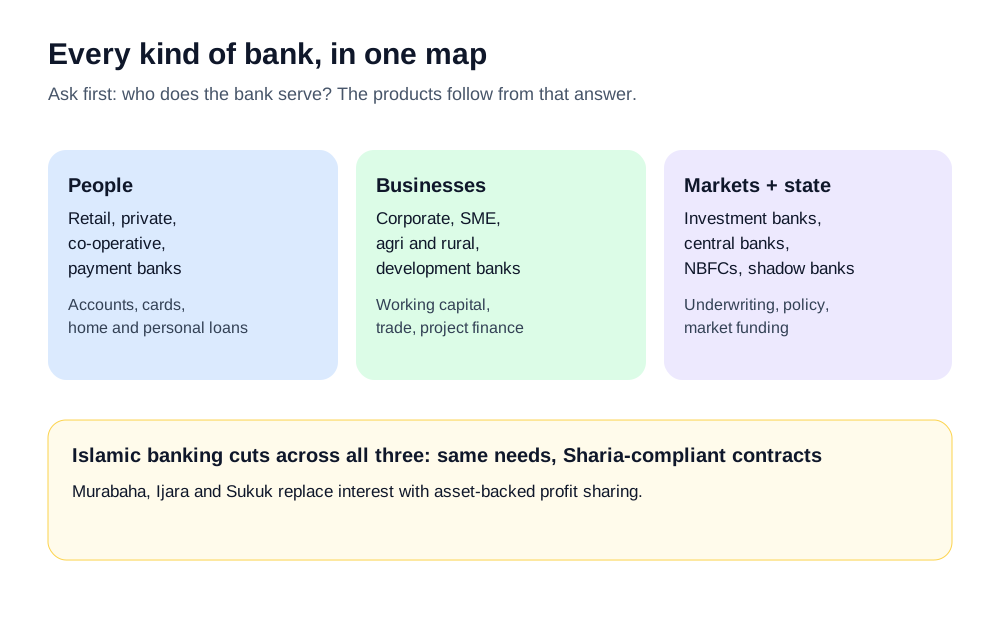
Phase 3 map: banks differ by who they serve — people, businesses, or markets and the state. Products follow the customer.
1. Why Retail Banking Exists
"Retail" banking takes its name from the same idea as retail commerce: selling to individuals in small quantities rather than to institutions in bulk. Its defining characteristics are massive customer numbers, small average transaction sizes, standardised products, and relationship-based trust.
Why does this segment exist at all? Because individuals have financial needs that are small, frequent, and long-lived — and no individual could efficiently meet them alone:
- Safekeeping. Holding wealth as cash at home invites theft and loss; a bank account provides security, records, and insurance-backed protection (Topic 9).
- Payments. Modern life requires paying and being paid constantly; banks operate the account and transfer infrastructure that makes this effortless.
- Credit across time. Lives are uneven: people need houses before they have saved for them, education before they can earn from it, and smoothing when income pauses but expenses do not. Retail credit moves purchasing power across a lifetime.
- Saving and yield. Surpluses need a productive home that remains accessible and safe.
Individually, each customer's balances and loans are too small to matter to a financial market. Aggregated across millions, they become something powerful: a vast, stable, diversified pool of deposits (the cheapest funding a bank can obtain) and a granular loan book in which no single default can break the institution. Retail banking is, in essence, the industrialisation of small financial needs — standardisation and scale applied to the household. This is also why retail deposits sit at the heart of the fractional reserve system of Topic 11: the public's everyday balances are the raw material of the money creation engine of Topic 12.
A useful mental model: a retail bank is simultaneously a utility (payments and safekeeping, expected to work flawlessly like electricity), a shop (selling products with margins and sales targets), and a custodian of trust (holding the public's money and data under intense regulation). Much of what seems contradictory about banks — their conservatism alongside their sales culture — comes from these three roles colliding inside one institution.
2. The Core Products of Retail Banking
The product suite of retail banking has evolved over centuries, but its fundamental purpose remains constant: to help individuals manage their money, access credit when needed, and protect their financial resources. Understanding these products reveals how retail banks serve their customers and generate the revenue that sustains their operations.
Savings accounts
Savings accounts represent the most basic relationship between a bank and an individual. These accounts allow customers to deposit funds securely while earning interest on their balances. The interest rate paid varies dramatically with economic conditions and central bank policy — near-zero in periods of loose monetary policy, five percent or higher when central banks tighten. This direct link to the policy rate is the customer-facing edge of the monetary transmission we covered in Topic 8: when the central bank moves, your savings rate eventually follows.
In many jurisdictions, savings accounts carry withdrawal limits or notice conditions designed to maintain the stability of bank funding, while deposit insurance schemes protect account holders against bank failure up to specified limits. From the bank's perspective, savings balances are sticky, low-cost funding — among the most valuable liabilities on the balance sheet, which is why banks compete so hard for primary-account relationships.
Current accounts (checking accounts)
Current accounts serve a different purpose. They are designed for frequent transactions, with no limits on withdrawals and immediate access to funds through every channel. They typically pay little or no interest because their function is transactional rather than savings-oriented — the customer is effectively paying for payments infrastructure rather than earning a return. They come with the essential toolkit: debit cards for purchases and ATM withdrawals, cheque books where still used, online and mobile banking, and often an overdraft facility — agreed borrowing within limits when the balance runs low, a form of instant short-term credit.
The current account is the anchor product of retail banking. The institution that holds your main current account sees your salary arrive and your spending leave — a privileged data position and the natural platform from which every other product is sold. Bankers call this the primary relationship, and winning it is strategically worth far more than the account's direct profitability.
Fixed deposits (term deposits / certificates of deposit)
Fixed deposits offer higher interest in exchange for reduced liquidity. The customer commits funds for a specified period — thirty days to ten years — and the longer the commitment, the higher the rate typically offered. Early withdrawal usually incurs penalties, making these products suitable for money that will not be needed immediately. In markets like India, where fixed deposit rates can exceed seven percent, they remain enormously popular among savers seeking yield without market risk.
Notice the underlying trade from the bank's perspective: the customer's sacrificed liquidity is worth money. A deposit locked in for five years is far more valuable funding than one withdrawable tomorrow — it cannot run in a panic (Topic 11) — so the bank pays a premium for it. This is the term premium in its simplest retail form.
Personal loans
Personal loans extend credit to individuals without specific collateral — unsecured lending, granted on the borrower's income, credit history, and assessed ability to repay. Because the bank has no asset to seize on default, interest rates are substantially higher than on secured credit, typically ranging from around ten to twenty-four percent depending on creditworthiness and market conditions. Personal loans finance life events that exceed immediate savings: medical expenses, education costs, weddings, home improvements. They are repaid through equated monthly installments (EMIs) — fixed payments combining principal and interest over the term.
Mortgages (home loans)
Mortgages represent the largest financial commitment most people ever make. These loans are secured against the property purchased: if the borrower defaults, the bank can claim and sell the property to recover its money. The security is why mortgage rates sit far below personal loan rates — collateral transforms the lender's risk. Terms are long, typically fifteen to thirty years, spreading the cost of home ownership across decades. For most families the monthly mortgage payment is their largest single expense, which makes housing finance simultaneously a personal-finance cornerstone and a macroeconomic stability issue — as the crisis history of Topic 13 demonstrated so destructively in 2008.
Credit cards
Credit cards provide revolving credit with unique characteristics. Unlike term loans with fixed schedules, cards let borrowers carry balances month to month, paying interest only on outstanding amounts. A grace period — usually twenty-one to forty-five days — means customers who pay in full each month borrow for free. Interest on unpaid balances is high, typically eighteen to thirty-six percent APR, reflecting unsecured risk and convenience value. Cards also earn interchange fees from merchants on every transaction, and premium cards add annual fees — making the credit card a rare product that can profit from customers who never pay interest at all.
A worked example: the anatomy of an EMI
To make retail credit concrete, consider a $20,000 personal loan at 12% annual interest over five years. The EMI works out to roughly $445 per month. Over sixty payments, the borrower repays about $26,700 in total — the $20,000 principal plus roughly $6,700 of interest.
Three insights hide inside that arithmetic. First, interest is front-loaded: early payments are mostly interest (the first payment is about $200 interest and $245 principal), while late payments are mostly principal — because interest accrues on the outstanding balance, which shrinks slowly at first. Second, the rate reflects risk: at 12% unsecured versus, say, 6–7% for a mortgage, the gap prices the absence of collateral and the lender's expected losses. Third, the bank's profit is not the full $6,700: from it come the bank's own funding costs, operating costs, and provisions for the borrowers who will default — in unsecured lending, expected losses of several percent of the book are normal, which is precisely why the rate is what it is.
3. How Retail Banks Generate Revenue
Retail banking operates on a business model that combines interest income with fee-based revenue, creating multiple streams that together produce profitability.
Net interest margin is the fundamental source. Banks pay less on deposits than they earn on loans, and the spread — minus operating costs and provisions for loan losses — is the profit from intermediation. If a bank pays depositors three percent while charging borrowers seven percent, the four-point spread funds the entire enterprise. Managing this spread requires constant attention to the composition of deposits and loans, their durations, and their sensitivity to interest rate changes — the asset-liability management discipline that failed so catastrophically in the S&L crisis of Topic 13.
Fees and charges provide significant supplementary revenue: account maintenance fees, ATM charges, overdraft fees, transfer costs, and service charges. Individually small, they aggregate to substantial income across millions of customers. Their fairness and transparency have become areas of regulatory scrutiny, with many jurisdictions capping certain charges and requiring clear disclosure — overdraft fee practices in particular have drawn repeated regulatory action in several countries.
Card income grows as electronic payments replace cash: interchange fees from merchants, annual fees on premium cards, foreign exchange markups, and interest on revolving balances. The payment networks — Visa and Mastercard — operate alongside banks in this ecosystem, each taking a share of the value generated.
Cross-selling deepens relationships and revenue per client: insurance, mutual funds, wealth management, and other products marketed to existing customers who already trust the institution. Done well, this serves genuine customer needs; done badly — when sales targets override suitability — it produces mis-selling scandals that have cost major banks billions in redress and immeasurable trust. The tension between the "shop" and "custodian" roles from Section 1 is sharpest here.
4. The Operational Machinery Behind the Products
Products are the visible surface; underneath sits an operational engine customers rarely see. Three workflows matter most.
Onboarding. Opening an account is a regulated process, not a courtesy. Banks must verify identity under Know Your Customer (KYC) rules — collecting documents, screening against sanctions and watchlists, and assessing risk under anti-money-laundering (AML) law. What looks like bureaucratic friction is the front line of the financial system's defence against crime, and digital onboarding (video KYC, document scanning) exists to satisfy the same obligations with less friction.
Underwriting. When you apply for credit, the bank must answer one question: can and will this person repay? Retail underwriting blends credit bureau data (repayment history, existing debts), income verification, affordability assessment, and increasingly algorithmic scoring that prices risk in seconds. The output is not just yes or no — it is the interest rate and limit you are offered, calibrated so that across thousands of similar borrowers, the interest earned covers the defaults expected with margin to spare. Regulation shapes every step: responsible-lending rules prohibit credit the customer cannot afford, and fair-lending law prohibits discrimination by protected characteristics — constraints that also apply, with growing scrutiny, to the algorithms.
Servicing and collections. After disbursement, the loan must be administered for years: payments processed, statements issued, arrears managed. When borrowers fall behind, collections teams work the spectrum from gentle reminders to restructuring to recovery — increasingly with regulatory obligations to treat struggling customers fairly and offer forbearance before enforcement. The quality of servicing determines much of a loan book's real-world profitability.
5. The Digital Transformation of Retail Banking
Retail banking has undergone a transformation more profound than any in its history, driven by digital technology that has changed how customers interact with their banks and how banks deliver their services.
Mobile banking has become the primary channel for many customers. Smartphones allow users to check balances, transfer money, pay bills, and manage finances from anywhere at any time. Branch visits have fallen dramatically, fundamentally changing retail banking economics: institutions that once competed on branch networks now compete on app quality, digital security, and user experience design.
Digital account opening has eliminated the paperwork and branch visits once required to establish a relationship. Video KYC allows banks to verify identity remotely, complying with regulation while providing seamless onboarding. Accounts open in minutes rather than days — though as Section 4 explained, the compliance obligations remain fully intact behind the smooth interface.
Contactless payments using near-field communication have transformed point-of-sale transactions. Tapping a card or phone has replaced cash and chip-and-PIN for many purchases; the COVID-19 pandemic accelerated the shift as consumers sought contactless options.
Peer-to-peer payments allow instant transfers between individuals without traditional delays. India's Unified Payments Interface (UPI) enables real-time transfers using mobile numbers or QR codes and has grown to process billions of transactions monthly — a genuine case study in how public digital infrastructure can leapfrog card-based models entirely. Similar instant-payment systems now operate across Europe, Brazil (Pix), Southeast Asia, and beyond. These systems delight consumers while threatening traditional bank payment revenues — payments being one of the few areas where banks once enjoyed comfortable margins.
Artificial intelligence drives personalisation and security. Chatbots handle routine inquiries; machine learning analyses transaction patterns to block fraud in real time; recommendation engines suggest products tailored to individual circumstances. Each capability raises its own governance questions — algorithmic bias in lending, privacy in personalisation, accountability when automated decisions harm customers — which regulators are actively working to address.
The branch is not dead, but it has changed jobs. Where branches survive, they increasingly serve advice, complex products, and vulnerable customers rather than transactions. The economics of banking's physical presence are being rewritten around trust and complexity rather than cash and cheques.
6. The Challenges Facing Retail Banking
Despite its essential role, retail banking faces significant challenges that are reshaping the industry.
Low margins. Intense competition, regulatory pressure, and the high cost of technology and compliance make retail banking a high-volume, low-margin enterprise. Efficiency ratios — operating costs as a percentage of revenue — are watched obsessively. Banks must process enormous volumes profitably while continuously investing in technology and compliance.
Fintech and neobank competition. New entrants, unburdened by legacy systems and branches, offer superior digital experiences that attract younger customers. Specialist fintechs attack individual product lines — better savings rates, cheaper payments, transparent foreign exchange — unbundling the package traditional banks once sold as a whole. Incumbents respond with their own digital brands, faster innovation cycles, and the enduring advantages of trust, deposit insurance, and full-service capability.
Regulatory burden. Consumer protection, fair lending, data privacy, and capital standards all impose real costs. These rules serve essential public purposes — the crisis record of Topic 13 explains why they exist — but their weight falls hardest on smaller institutions, subtly favouring scale.
Rising customer expectations. Consumers benchmark banks against the best digital experience they have anywhere, not against other banks. Instant service, 24/7 availability, intuitive design — delivered with banking-grade security and reliability — require investment that never ends.
Financial inclusion. Billions worldwide remain unbanked or underbanked, lacking access to basic services. Serving them profitably is hard: low incomes, irregular cash flows, no collateral. Yet inclusion is both a social imperative and the industry's largest untapped market. Mobile money in East Africa, India's Jan Dhan account programme paired with UPI, and agent banking models across Asia and Africa demonstrate that innovation can reach populations the branch model never could — often by designing for low-cost, high-volume simplicity rather than by shrinking traditional products.
Retail banking continues to evolve, shaped by technology, regulation, and changing consumer behavior. The fundamental purpose remains unchanged: to provide individuals and small businesses with the financial tools they need to manage their resources, access credit, and participate in the economy. How banks fulfil this purpose is being transformed as profoundly as at any time since the invention of modern banking itself.
7. Case Study: Financial Inclusion at Scale — India's Jan Dhan and UPI Stack
The most instructive modern example of retail banking's transformative power comes from India, which executed the largest financial inclusion expansion in history within a single decade.
The problem. In the early 2010s, hundreds of millions of Indians had no bank account. They saved in cash, borrowed from informal moneylenders at punishing rates, received government benefits through leaky intermediaries, and were invisible to the formal financial system.
The first layer — accounts. The Pradhan Mantri Jan Dhan Yojana programme, launched in 2014, offered zero-balance accounts with a debit card and overdraft eligibility, and pressed banks to open them at massive scale. Hundreds of millions of accounts were opened in the programme's first years — the largest account-opening drive ever recorded.
The second layer — identity. The Aadhaar biometric identity system gave over a billion people a verifiable identity, enabling electronic KYC at trivial cost. Onboarding that once required documents many poor people did not possess became a fingerprint and a phone number.
The third layer — payments. The Unified Payments Interface (2016) built instant, free, interoperable bank-to-bank transfers on top of those accounts, usable through any participating app with a phone number or QR code. Street vendors, rickshaw drivers, and rural shopkeepers began accepting digital payments directly into their own accounts — no card terminal, no merchant fees, no cash risk.
The result. India moved from a majority-cash society to the world's largest real-time payments market by volume in under a decade, with UPI processing well over ten billion transactions per month by the mid-2020s. Government benefits began flowing directly to beneficiaries' accounts, cutting leakage. And millions of previously invisible customers began generating the transaction histories that make formal credit possible — the first rung on the lending ladder.
The lessons for banking everywhere. Inclusion succeeds when infrastructure is treated as public utility (identity and payment rails), when products are designed for simplicity and near-zero cost rather than shrunk from premium offerings, and when accounts lead to usable payment functionality — an account people cannot transact from is an account they abandon. The model's elements are now studied and adapted across Africa, Southeast Asia, and Latin America.
8. Regional Variations in Retail Banking
Retail banking's fundamentals are global, but its forms vary meaningfully by market, and professionals should recognise the major patterns:
- United States: a fragmented system of thousands of banks and credit unions; cheques persisted long after other countries abandoned them; credit scoring through nationwide bureaus is central to underwriting.
- Europe: consolidated universal banks dominate; instant SEPA payments and open banking rules (PSD2) let licensed third parties initiate payments and access account data with customer consent — a regulatory export now influencing the world.
- India: public payment infrastructure (UPI) plus enormous fixed-deposit culture; inclusion policy drives account design.
- China: retail payments leapt directly to mobile super-app wallets (Alipay, WeChat Pay) that process most consumer transactions, with banks operating behind the wallet layer.
- Sub-Saharan Africa: mobile money services such as M-Pesa in Kenya demonstrated that basic banking could be delivered over simple phones through agent networks, years before smartphone banking became standard elsewhere.
The variation carries one consistent message: the products are universal — deposits, payments, credit — but the delivery rails are local, shaped by each market's regulation, infrastructure, and leapfrog opportunities.
9. The Customer and Bank Perspectives
From your perspective as a customer:
- The primary-account relationship is valuable — make the bank earn it. The institution holding your current account gains data, deposits, and sales opportunities. Compare what you receive in return: rates, fees, service, digital quality.
- Secured versus unsecured is the great price divide. A mortgage costs far less than a personal loan because collateral changes the lender's risk. Borrowing against assets you have, rather than on your signature alone, is usually the cheaper path.
- The EMI's interest is front-loaded. Understanding the amortisation pattern explains why early extra repayments save disproportionate interest, and why early settlement of a loan can be financially powerful.
- Credit cards are free money or expensive debt — your behaviour decides. Paying in full within the grace period costs nothing and builds credit history; revolving a balance at 30% APR is among the most expensive borrowing in retail finance.
- Deposit insurance limits are worth knowing. Spread large balances if they exceed your jurisdiction's insured ceiling (Topic 9).
From the bank's perspective:
- Retail is a scale game. Profit comes from millions of small margins, so cost-to-serve, automation, and digital adoption are strategic obsessions.
- Deposits are the crown jewels. A stable, low-cost retail deposit base funds the entire balance sheet and survives crises better than wholesale funding — the 2023 bank failures proved the point by its absence.
- Risk is managed in portfolios, not individuals. No single default matters; the statistical behaviour of thousands of similar borrowers determines profitability. Pricing, provisioning, and scoring are all portfolio disciplines.
- Compliance is a product feature. KYC, AML, consumer protection, and data privacy are embedded in every workflow; failures are existential — fines, licence risk, and trust destruction.
- The trust franchise is the ultimate moat. Fintechs can replicate features; they cannot quickly replicate generations of deposit-insured trust. Incumbents defend, and challengers attack, the same asset.
10. Common Mistakes and Misconceptions
Misconception 1: "Banks make most retail profit from fees." Fees matter, but the net interest margin — the spread between deposit and loan rates — remains the core engine for most retail banks. Fee income supplements; it rarely leads.
Misconception 2: "Paying the minimum on a credit card is reasonable management." Minimum payments are designed around the bank's interests, not yours: a balance paid at minimums can take decades to clear and cost multiples of the original spend. Paying in full within the grace period is the only free ride in retail credit.
Misconception 3: "A higher EMI always means a worse loan." Total cost depends on rate and term. A longer term lowers the EMI but increases total interest paid, sometimes dramatically. Compare total repayment, not just the monthly figure.
Misconception 4: "Neobanks are unregulated and therefore risky." Models vary — some neobanks hold full banking licences with deposit insurance; others operate through partner banks. The question for customers is not the app's age but where deposits legally sit and which guarantee scheme covers them.
Misconception 5: "KYC checks are the bank being nosy." Identity verification is a legal obligation under anti-money-laundering law in every serious jurisdiction. The friction you experience at onboarding is the financial system's border control.
Misconception 6: "Branches are disappearing because banks don't care about service." Branch economics collapsed because transaction volumes migrated to apps. The surviving branch strategy — advice, complexity, inclusion for the digitally excluded — is a reallocation toward what physical presence does uniquely well, not simple neglect.
11. Frequently Asked Questions
What is the difference between retail banking and corporate banking? Retail serves individuals and small businesses with standardised, high-volume products; corporate (wholesale) banking serves companies and institutions with tailored, large-ticket services — the subject of Topic 15. The dividing line is customer type and deal size, not product name.
What is a "primary bank account" and why do banks want it? The account where your income arrives and bills leave. It generates stable low-cost deposits, rich behavioural data, and the platform for cross-selling — which is why banks offer switching bonuses and bundled benefits to win it.
Why are mortgage rates so much lower than credit card rates? Collateral and term. A mortgage is secured on a saleable asset and underwritten for decades; card debt is unsecured, instantly withdrawable, and statistically loss-heavy. Risk is priced into rate.
Are fixed deposits safe? Within deposit insurance limits, they carry the same protection as savings accounts. The real risks are liquidity (early-withdrawal penalties) and inflation eroding real returns — not bank default, up to the insured ceiling.
How do banks decide my credit limit or loan rate? Through underwriting: credit bureau history, verified income, affordability calculation, and scoring models that estimate default probability for borrowers like you. The offered price is calibrated so the portfolio of similar borrowers is profitable after expected losses.
What is UPI and why does it matter globally? India's Unified Payments Interface: an instant, interoperable, nearly free bank-to-bank payment system processing billions of transactions monthly. It demonstrated that public digital rails can deliver instant payments at population scale — a model studied and adapted worldwide.
Is my money safer in a big bank or a small one? Within deposit insurance limits, protection is equivalent for licensed institutions. Beyond the limit, institutional strength matters more — which is why the 2023 failures saw uninsured deposits migrate toward the largest banks.
12. Key Terms in This Chapter
- Retail banking — banking services for individuals and small businesses: deposits, payments, and personal credit at scale.
- Current account / checking account — a transactional account with unlimited access, typically paying little interest.
- Fixed / term deposit — funds committed for a set period in exchange for a higher, fixed interest rate.
- Overdraft — agreed borrowing on a current account when the balance runs below zero.
- Personal loan — unsecured instalment credit based on income and creditworthiness.
- Mortgage — a long-term loan secured on property, repossessable on default.
- Revolving credit — credit that can be borrowed, repaid, and reborrowed up to a limit (credit cards).
- Grace period — the interest-free window on card balances paid in full.
- EMI (equated monthly installment) — a fixed loan payment combining principal and interest.
- Amortisation — the schedule by which payments gradually extinguish a loan; interest-heavy early, principal-heavy late.
- Net interest margin — the spread between loan yields and deposit costs.
- Interchange fee — the merchant-paid fee on card transactions, shared across the card ecosystem.
- KYC / AML — Know Your Customer identity verification and anti-money-laundering obligations.
- Underwriting — the assessment of a borrower's ability and willingness to repay.
- Primary relationship — the bank holding a customer's main transactional account.
- Neobank — a digital-first banking provider, licensed directly or operating through partner banks.
- UPI — India's instant, interoperable public payments system.
13. Interview Insights: How This Topic Appears in Banking Interviews
"How does a retail bank make money?" Structure the answer in layers: net interest margin as the engine, fees and card income as supplements, cross-selling as relationship deepening. Then show insight: the strategic product is the primary current account, because it supplies cheap funding, data, and the cross-sell platform — even if the account itself is barely profitable. That distinction between product profitability and relationship profitability marks a strong candidate.
"Why are unsecured rates so much higher than mortgage rates?" Answer through the lender's loss equation: price = funding cost + operating cost + expected loss + capital charge + margin. Collateral slashes expected loss; remove it and the rate must carry the defaults. Bonus depth: note that the EMI structure and amortisation are how the priced risk is collected over time.
"How is digital changing retail banking?" Avoid feature lists; answer in economics: distribution costs collapse (branches → apps), customer acquisition shifts to onboarding quality, payments margins compress under instant public rails like UPI and Pix, data and AI become underwriting and service assets, and the competitive moat moves from physical presence to trust plus digital experience. One concrete example (UPI's scale, or interchange pressure) demonstrates applied knowledge.
"How would you assess a loan application?" Walk the underwriting workflow: identity and KYC first, then credit bureau history, income verification, affordability analysis, and scoring; the output is approve/decline plus risk-based pricing and limits. Mention responsible-lending and fair-lending constraints — including on algorithms — to show compliance awareness, which retail roles weigh heavily.
"Should banks serve the unbanked, and can they do it profitably?" Strong answers combine purpose with business logic: low-income customers need low-cost, high-volume simple products delivered through mobile and agent channels, not shrunken versions of affluent-market products. Cite mobile money or India's Jan Dhan-plus-UPI model as proof that inclusion and viability can align — and note the deposits and lifetime relationships inclusion creates.
Summary and Key Takeaways
Retail banking is the face of the banking system for most of humanity — and a business of millions of small margins built on trust, scale, and discipline. The essential points:
- Retail banking industrialises small financial needs: safekeeping, payments, credit, and saving, standardised for mass delivery.
- Six core products do the work — savings and current accounts, fixed deposits, personal loans, mortgages, and credit cards — each pricing a distinct combination of liquidity, risk, and collateral.
- The primary current account is the strategic prize, supplying cheap deposits, behavioural data, and the cross-selling platform.
- Net interest margin is the profit engine; fees, card income, and cross-selling supplement it. Relationship profitability matters more than product profitability.
- Credit price is risk made visible: secured versus unsecured, term, and expected losses explain why a mortgage and a credit card can differ by twenty percentage points.
- Behind every product sits regulated machinery — KYC onboarding, portfolio-based underwriting, and years of servicing — where compliance is a feature, not friction.
- Digital transformation has rewritten distribution: mobile-first service, instant public payment rails (UPI, Pix), AI-driven fraud detection and personalisation, and branches repurposed for advice.
- The industry's challenges are structural: thin margins, fintech unbundling, regulatory weight, rising expectations, and the unfinished work of financial inclusion.
- Trust remains the moat. Deposit insurance, licensing, and generations of reliability are the assets fintechs attack and incumbents defend.
In the next topic, we cross to the other side of the industry: corporate banking — how banks serve businesses with credit, cash management, trade finance, and tailored solutions at institutional scale.
Next: Topic 15 — Corporate Banking →
<!-- MBA-DEEP-DIVE-START -->Deep Dive: Retail Banking as a Complete Customer and Operating Model
Retail banking is the part of banking most people experience directly, but describing it as “savings accounts and personal loans” understates its complexity. A retail bank combines customer acquisition, identity verification, deposits, payments, lending, cards, service, collections, fraud control, regulatory compliance, pricing, data, technology and branch or digital distribution into one operating model. The products may look simple to a customer, yet each depends on multiple systems and control functions working correctly every day.
A strong learner should understand retail banking from three angles at once. The first is the customer view: open an account, receive money, pay bills, save, borrow and get help. The second is the bank’s economic view: attract stable funding, price products, manage credit and fraud losses, earn interest and fees, control costs and retain customers. The third is the operating view: execute millions of transactions accurately while complying with local law and protecting customer data.
The customer relationship begins before the first transaction
Retail banking starts with onboarding. Before an account becomes usable, the bank normally needs to establish who the customer is, what products they are eligible for and whether the relationship creates unacceptable financial-crime or regulatory risk. The exact requirements differ by country, product and channel, so there is no single universal onboarding checklist.
Typical activities include identity verification, address or contact validation, sanctions and watch-list screening where required, tax-residency information, customer due diligence, product disclosures, consent capture and acceptance of terms. A bank may also assess age, legal capacity, residency, employment, source-of-funds information or other factors depending on the product.
Digital onboarding turns these rules into a technology workflow. A mobile app may capture a document, perform authenticity checks, compare a selfie or other evidence, query internal and external data, screen names, collect declarations and create the customer record. Any one of those steps can fail. The user experience must therefore distinguish between a genuine rejection, a temporary technical failure, missing evidence and a case that requires manual review.
A customer who sees “something went wrong” does not care which microservice failed. The bank does. Good design therefore preserves a clear status model: application received, verification in progress, additional information required, referred for review, approved, declined, account created and account activated. Those states should map cleanly across channel, customer master, compliance, core banking and communications systems.
Deposit accounts are liabilities, not stored envelopes of cash
When a retail customer has a positive balance in a current or savings account, that balance is normally a liability of the bank. The bank owes the customer the amount according to the account terms. The customer sees “my money”; the bank’s ledger sees an obligation.
Deposits are economically valuable to the bank because they can provide relatively stable funding. Banks therefore compete on convenience, trust, digital experience, branch access, interest rates, bundled services and rewards. But not all deposits behave the same way. Salary accounts, transactional balances, fixed-term deposits and rate-sensitive savings balances have different stability and pricing characteristics.
Pricing a deposit product requires more than selecting an interest rate. The bank considers customer acquisition cost, expected balance, transaction behaviour, liquidity value, funding strategy, competitor offers, operational cost and regulatory constraints. A promotional rate can attract balances quickly but may also attract customers who leave as soon as another institution offers a better rate.
From a system perspective, account configuration includes currency, interest method, fees, minimum balance rules, overdraft treatment, statement cycle, transaction limits, dormancy, closure rules, tax treatment and channel access. One incorrect parameter can affect thousands or millions of customers, making product configuration a controlled activity rather than a simple data change.
Payments make the account useful
A current account becomes valuable because customers can move money. Retail payment functions may include internal transfers, domestic credit transfers, instant payments, direct debits, standing orders, bill payments, cards, ATM withdrawals, mobile-wallet funding and international payments depending on the market.
The channel through which the customer starts a payment is only the visible layer. Behind it, the bank may validate account status, balance, limits, beneficiary data, fraud indicators, sanctions or compliance conditions, fees and execution rules. The instruction may then be routed to an internal ledger transfer, a domestic clearing system, a card network, a correspondent banking path or another payment infrastructure.
For Basics of Banking, the important lesson is not to memorise every payment message. It is to understand the operating sequence: initiation → validation → authorisation → posting/booking → external clearing or routing where applicable → settlement → customer notification → reconciliation and reporting. Different payment types may arrange those steps differently, but the control objectives remain recognisable.
A bank must also handle exceptions. The customer may have insufficient funds. A beneficiary account may be invalid. A fraud control may stop the payment. A network may be unavailable. A payment may be rejected downstream after the customer was provisionally debited. Operational design therefore needs clear reversal, retry, investigation and customer-communication rules.
Cards combine lending, payments and fraud control
Debit and credit cards look similar at the point of sale but represent different banking economics. A debit-card transaction normally draws from a deposit account. A credit-card transaction uses a revolving credit facility subject to a limit, billing cycle, repayment terms and interest conditions.
Card processing introduces authorisation, clearing and settlement stages. At authorisation, the issuer decides whether to approve the attempted transaction based on available balance or credit, card status, fraud indicators and other controls. Clearing later provides transaction details used to calculate the final financial obligation. Settlement transfers value between participating institutions according to network arrangements.
Disputes and chargebacks add another operational layer. A customer may claim a transaction was unauthorised, duplicated, not received or otherwise disputable under applicable network and legal rules. The bank needs evidence, deadlines, case management and accounting treatment. A weak dispute process can create customer harm even when the original payment processing was technically correct.
Cards are also a major fraud-control environment. Real-time scoring, device signals, merchant characteristics, behavioural patterns and authentication controls may be used to decide whether to approve, challenge or decline. Product teams must balance fraud loss against false positives; blocking every unusual transaction would reduce fraud but destroy customer usability.
Retail lending starts with affordability and ends with collections
Retail credit includes products such as mortgages, personal loans, auto finance, overdrafts and credit cards. The core principle is that lending creates an asset for the bank and a repayment obligation for the customer. The bank earns interest and possibly fees, but takes credit risk.
Origination normally involves eligibility, application data, credit assessment, affordability, fraud checks, pricing and approval. The precise legal and regulatory expectations vary by jurisdiction, especially around consumer protection and responsible lending. A bank should not simply maximise approval rates. It needs to ensure the product is appropriate to its strategy and that lending decisions fit risk appetite and applicable rules.
The underwriting model may combine income, existing debt, repayment history, collateral, bureau information and internal behavioural data. Automated decisions are common, but exceptions and manual review remain important for cases that models cannot handle confidently. Where automated decision-making is regulated, banks may also need specific transparency, governance and customer-rights processes.
After disbursement, servicing becomes the long-term relationship. Systems calculate instalments, interest, principal, fees and due dates. Customers may make early repayments, miss payments, request restructuring or change payment methods. Every variation has accounting and customer-impact consequences.
Collections begins before default becomes severe. Banks segment delinquent customers, communicate arrears, offer appropriate payment arrangements where policy permits and escalate cases according to risk and legal requirements. Good collections is not simply aggressive recovery. It seeks to distinguish temporary financial difficulty, operational mistakes, fraud, strategic non-payment and genuine inability to pay, while complying with customer-treatment standards.
Mortgages illustrate how many functions meet in one retail product
A mortgage combines customer onboarding, credit underwriting, property valuation, legal documentation, collateral, disbursement, payments, interest-rate risk, liquidity, servicing and collections. It can remain on the bank’s books for decades.
A customer may focus on rate and monthly instalment. The bank must consider much more: loan-to-value, affordability, property risk, interest-rate structure, expected prepayment, funding cost, capital consumption and portfolio concentration. A fixed-rate mortgage can create duration risk for the bank. A variable-rate mortgage transfers more rate variability to the borrower and may create affordability pressure when rates rise.
Operationally, the bank must ensure that collateral is correctly linked to the loan, repayment schedules are accurate, interest changes are implemented correctly, statements are understandable and property-related events are handled. A simple parameter mistake can affect years of customer cash flows.
Fraud and financial crime affect the entire relationship
Retail banking creates many attack surfaces: account opening with false identity, account takeover, payment scams, card fraud, mule accounts, synthetic identities, loan application fraud and social engineering. Controls therefore operate throughout the customer lifecycle, not only at onboarding.
Financial-crime monitoring may examine transactions for suspicious patterns according to the bank’s legal obligations and risk framework. Fraud monitoring focuses more directly on preventing or detecting unauthorised or deceptive activity affecting customers or the bank. The two areas overlap but are not identical.
A crucial product principle is that controls should have explicit outcomes. A suspicious event may be declined immediately, stepped up for authentication, held, referred for review, allowed but monitored or escalated according to policy. The customer-facing message should not expose sensitive detection logic, but it should still provide appropriate guidance and avoid unnecessary confusion.
False positives matter. A control that blocks too many legitimate customers can create complaints, service costs and reputational damage. Risk teams therefore monitor both loss prevented and customer friction. The “best” model is not necessarily the one with the highest theoretical detection rate; it is the one that produces an acceptable balance of risk, cost and customer impact within policy.
Customer service is part of the control environment
Retail banking generates enormous volumes of service interactions: lost cards, forgotten credentials, disputed transactions, beneficiary mistakes, fee questions, loan settlement requests, deceased-customer cases, account closures and complaints.
Service processes need reliable identity verification. A contact-centre employee who can change a phone number or reset access can become a fraud target. Permissions, dual controls, audit logs and secure authentication are therefore as important in servicing as in transaction processing.
Complaint data is also a valuable risk signal. Repeated complaints about one fee, one payment failure or one disclosure may reveal a systemic product problem. Mature banks aggregate complaint themes rather than treating each case as an isolated customer-service event.
Branches and digital channels are different interfaces to the same bank
Retail banking has shifted strongly toward mobile and web channels, but branch and assisted-service models remain important in many markets. The correct architecture is not “digital versus branch”; it is a consistent customer and product model exposed through multiple channels.
A customer should not receive contradictory balances, limits or product status depending on channel. Channel systems therefore need authoritative data sources and clear ownership. If a customer freezes a card in the mobile app, the contact centre and authorisation system should recognise the same status. If a branch closes an account, digital access should reflect the change appropriately.
Omnichannel design also needs continuity. A customer might start a mortgage application online, upload documents later and complete verification with an employee. The process should preserve context rather than forcing re-entry because organisational departments use separate systems.
The economics of a retail bank
Retail-bank income typically includes net interest income from deposits and loans plus fees and other product revenues where permitted. Costs include technology, branches, people, fraud losses, credit losses, compliance, funding, operations and customer acquisition.
Profitability should be viewed over the customer relationship rather than one transaction. A free current account may appear unprofitable alone but support deposits, cards, loans and long-term retention. Conversely, a high-fee product can generate short-term revenue while creating complaints and attrition.
Banks therefore use customer and product profitability models, but those models must be interpreted carefully. Allocating technology and shared-service costs is complex. Future value is uncertain. Regulatory and conduct considerations mean that profitability cannot override fair customer treatment.
Core banking and the system of record
At the centre of retail banking sits one or more systems that maintain customer accounts and financial positions. A core banking platform typically manages account balances, interest, fees, product parameters and accounting events, although modern architectures distribute functions across many services.
The important concept is system of record. For every critical data element, the bank should know which system is authoritative. Customer identity may be mastered in a customer-information platform. Account balance may be mastered in core banking. Card authorisation limits may live in a card platform. Fraud status may live elsewhere.
Integration must preserve consistency. If a channel displays a cached balance while a payment has already posted, the customer can receive misleading information. If a loan servicing event does not reach the general ledger, finance has a break. If a fraud block is not propagated to all channels, the control is incomplete.
Reconciliation protects customers and the bank
Reconciliation compares independent records to prove that financial events are complete and consistent. In retail banking, this can include account sub-ledgers versus general ledger, ATM or card records versus network settlement, payment platform records versus clearing reports, and suspense accounts versus resolved exceptions.
A difference does not automatically mean money is lost. Timing differences can be legitimate. But every unexplained difference needs ownership and resolution. High-volume businesses depend on automated reconciliation and controlled exception handling because manual comparison cannot scale.
Suspense accounts deserve particular attention. They temporarily hold amounts whose final accounting destination is unresolved. Old or growing suspense balances can indicate broken interfaces, failed processes or unresolved customer-impact cases. Operational teams therefore monitor ageing as well as total value.
Product governance keeps simple products from becoming hidden risk
Retail products evolve through rate changes, fee changes, regulatory updates, channel enhancements and marketing campaigns. Product governance should ensure that changes are assessed across customer outcomes, operations, legal/compliance, risk, finance, tax, technology and reporting.
A seemingly minor fee change may require new disclosures, updated statements, revised tax treatment, customer notification, complaints scripting and regression testing. A new instant-payment limit can alter fraud exposure and liquidity patterns. A faster onboarding flow can increase conversion while weakening controls if verification is removed without proper risk assessment.
Good governance therefore asks: who owns the product, which customer group is it designed for, what risks does it create, how is performance monitored, which controls are mandatory, and what would trigger withdrawal or remediation?
Metrics that reveal retail-banking health
Useful metrics depend on the product but can include deposit growth and attrition, active customers, digital adoption, transaction success rate, fraud loss, false-positive rate, arrears, non-performing loans, credit losses, approval rates, complaint volumes, service response times, account-opening conversion, cost to serve and product profitability.
Metrics should be interpreted together. A rising loan approval rate looks positive until combined with falling credit quality. A lower fraud loss rate looks positive unless caused by excessive declines of legitimate transactions. Faster onboarding looks positive unless manual-review backlogs have simply moved elsewhere.
A practical retail-banking lifecycle
A customer opens a salary account digitally. Identity and compliance checks complete, the core account is created and the customer receives channel access. Salary deposits arrive monthly. The customer uses debit-card and instant-payment services. After a year, behavioural data and income information support an offer for a personal loan.
The customer accepts, underwriting approves and the loan is disbursed. Instalments are collected from the current account. One payment later fails because the salary is delayed. The bank sends a reminder and the customer pays a few days later. Nothing dramatic has happened, but dozens of systems and controls have participated: onboarding, customer master, core banking, payments, card processing, credit decisioning, loan servicing, communications, collections, ledger, reporting and analytics.
That is retail banking. The customer sees one app; the bank operates an integrated financial machine.
Applied Learning: Design One Retail Journey End to End
Choose one journey—open a current account, make a domestic transfer, dispute a card transaction or obtain a personal loan. Write the customer steps first. Then add the bank’s validation, risk, accounting, settlement, exception, communication and reconciliation steps underneath each customer action.
If you can show who owns each decision, which system is authoritative and what happens when a step fails, you have moved beyond product descriptions into real retail-banking understanding.
<!-- MBA-DEEP-DIVE-END -->