Visual overview
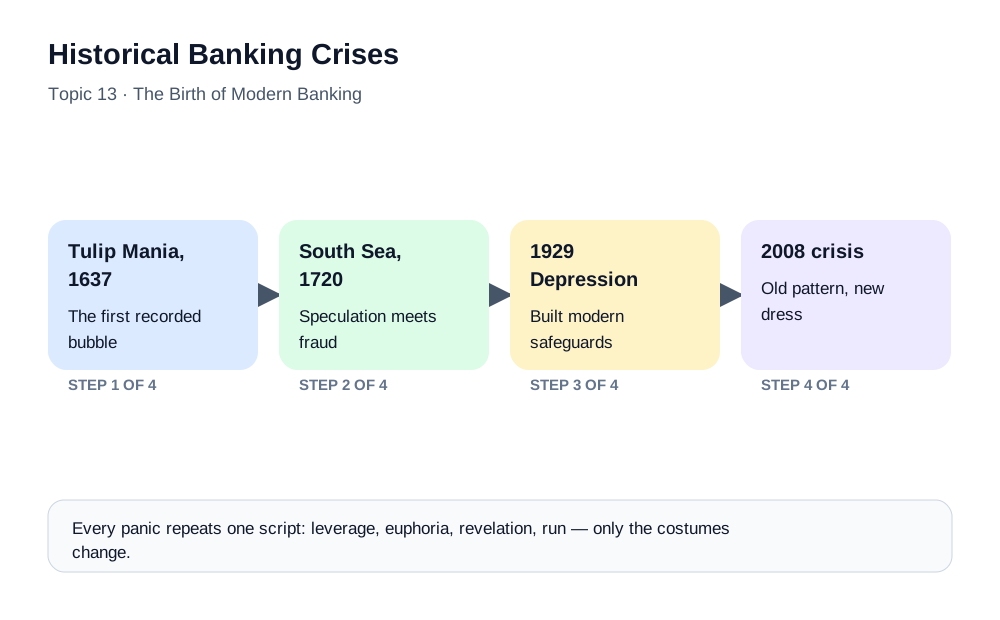
Historical Banking Crises at a glance — Tulip Mania, South Sea Bubble, Great Depression.
Tulip Mania, South Sea Bubble, and the Great Depression
Financial crises are as old as finance itself. Every generation believes it has learned the lessons of the past, yet the pattern repeats: speculative excess, overleveraging, panic, and collapse. Studying historical crises is not just academic — it reveals the enduring vulnerabilities of financial systems.
Why begin a banking education with its disasters? Because modern banking is, to a remarkable degree, a museum of its own crises. Deposit insurance exists because of the 1930s. The Federal Reserve exists because of 1907. Capital rules exist because of 2008. Every safeguard we examined in Topics 9 and 11 is a scar left by a specific historical wound. To understand why the system is built the way it is, you must study the moments it failed.
What you will learn in this topic:
- How the first recorded asset bubble — Tulip Mania — established the template for every bubble since
- How the South Sea Bubble combined speculation with fraud, and what it teaches about financial promotion
- How the Panic of 1907 proved that a modern economy cannot rely on a private banker as its rescuer — and gave birth to the Federal Reserve
- How the Great Depression unfolded from market crash to banking collapse to global catastrophe, and how it created the modern regulatory state
- How the 2008 financial crisis replayed the ancient pattern with modern instruments — and nearly broke the global banking system
- The anatomy that all crises share, formalised in Hyman Minsky's five stages
- Why banking crises are more dangerous than ordinary market crashes
- What the crisis record means for bankers, regulators, and customers today
A note on scope: this topic covers the historical crises that shaped the system. The mechanics of bank runs and their safeguards were covered in Topic 11, and the money-creation cycle that powers booms and busts in Topic 12. Here we put faces, dates, and consequences on those mechanics.
1. Tulip Mania (1636–1637): The First Recorded Bubble
What happened
In the Dutch Republic — then the richest nation on Earth — tulip bulb prices reached extraordinary heights. At the peak, a single rare tulip bulb sold for more than a luxury Amsterdam canal house.
The mechanics
- Tulips had been introduced to Europe from the Ottoman Empire and became status symbols among the wealthy merchant class
- A futures market developed where bulbs were traded on contract before they bloomed — meaning people were trading claims on flowers they had never seen and, in winter, could not see
- Speculators bought bulbs not to plant them but to resell at higher prices to the next buyer
- Prices rose roughly twenty-fold in three months during the winter of 1636–37
Several features deserve emphasis, because they recur in every later bubble. First, a genuine novelty: tulips really were new, beautiful, and scarce — the initial price rise had a rational kernel. Second, financial innovation: the futures contracts allowed speculation without owning the underlying asset, lowering the barrier to entry and detaching prices from the physical flowers. Third, the influx of amateurs: as prices soared, weavers, farmers, and shopkeepers mortgaged property to join the trade. When a market's newest participants are borrowing to buy what they do not understand, the bubble is in its final stage.
The crash
In February 1637, buyers stopped appearing at a routine auction in Haarlem. Panic spread instantly. Within weeks, prices collapsed to a small fraction of their peak — often cited as around one percent. Investors who had borrowed to buy tulips were ruined.
Historians debate how severely the crash damaged the broader Dutch economy — the direct losses were concentrated among a relatively small group of traders. But the episode's importance was never its macroeconomic size. It was the demonstration of the template: novelty + leverage + crowd psychology + financial engineering = a bubble that inflates far beyond any fundamental value and then evaporates.
Lesson
Asset bubbles can form in anything — even flowers. When prices are driven by the expectation of reselling to someone else at a higher price rather than by fundamental value, collapse is inevitable. Economists call this the "greater fool" dynamic: the only return is the next buyer, and the supply of greater fools is finite.
2. The South Sea Bubble (1720): Speculation Meets Fraud
What happened
The South Sea Company was granted a monopoly on British trade with South America. Its stock price surged from around £100 to over £1,000 within months in 1720 as investors piled in — and then collapsed within weeks.
The mechanics
- The company had minimal actual trading revenue — the "South Sea trade" was largely hypothetical
- Its real business was financial engineering: a scheme to convert government debt into company shares, which aligned the interests of the state, the company's directors, and the investing public in a rising share price
- Directors actively manipulated the stock through insider lending (lending investors money to buy the company's own shares), selective announcements, and false promises of trading riches
- The mania was contagious: dozens of copycat companies floated shares on absurd premises, prompting the government to pass the "Bubble Act" restricting new company formations
- Even Sir Isaac Newton invested, sold early at a profit, re-entered near the top, and lost £20,000 — a fortune. He famously said:
"I can calculate the motion of heavenly bodies, but not the madness of people."
Newton's experience carries its own lesson: intelligence is no defence against bubble psychology. He understood the overvaluation, exited rationally — and then could not bear watching others get rich. Re-entry at the peak is one of the most reliable behaviours in speculative history.
The crash
When investors began questioning the company's actual profits, selling began. The stock collapsed, wiping out thousands of investors across all classes of British society. Parliament intervened, directors' estates were confiscated to compensate victims, and the episode scarred British attitudes toward joint-stock companies for generations.
Lesson
Financial fraud thrives in speculative environments. The South Sea scheme was not merely a bubble — it was a bubble deliberately inflated by insiders with something to sell. When prices rise fast, scrutiny falls; promoters learn quickly that in a mania, a good story outsells a good business. The permanent investor defence — asking where the actual revenue comes from — was born in episodes like this.
3. The Panic of 1907: The Crisis That Created the Fed
What happened
A failed attempt to corner the copper market triggered a crisis of confidence in New York financial institutions — particularly the trust companies, lightly regulated institutions that operated like banks without the discipline of the clearing house system. Depositors rushed to withdraw funds, institutions began failing, and the contagion spread to the stock market, which fell sharply. With no central bank in the United States, there was no official source of emergency liquidity.
The resolution
- J.P. Morgan, the most powerful banker of the era, personally organised the rescue — summoning leading bankers to his library, assessing which institutions were solvent, and compelling the group to pledge liquidity to those worth saving
- One private citizen essentially performed the role of a central bank: lending freely against good collateral to institutions facing runs, exactly as Walter Bagehot had prescribed half a century earlier
- The rescue worked — the panic subsided within weeks — but the episode left a chilling realisation: the stability of the world's rising financial power had depended on one seventy-year-old man's judgement, authority, and willingness to act
The consequence
The Panic of 1907 directly led to the creation of the Federal Reserve System in 1913. The logic was inescapable: a modern banking system generates periodic liquidity crises (the fractional reserve fragility of Topic 11), and no responsible society can leave its rescue to the health and goodwill of a private banker. The United States institutionalised the lender-of-last-resort function that Morgan had improvised.
Lesson
Liquidity crises require a lender of last resort, and that role belongs to a public institution. The Fed was not created to prevent all crises — it was created so that when panic strikes, someone has both the power and the duty to lend. Every central bank emergency facility in the world today descends from this insight.
4. The Great Depression (1929–1939): The Catastrophe That Built Modern Banking
What happened
The worst financial crisis in modern history, beginning with the stock market crash of October 1929 and lasting a full decade.
The sequence
- Stock market crash (October 1929): The Dow Jones fell roughly 25% in two days, ending a speculative decade of margin-fuelled stock buying
- Bank failures: Over 9,000 US banks failed between 1930 and 1933, wiping out depositors' savings — the banking system effectively disintegrated in waves of panic
- Credit contraction: Surviving banks stopped lending, starving businesses of capital; the money supply collapsed as the creation-destruction engine of Topic 12 ran in reverse
- Deflation: Prices and wages fell by roughly a third, increasing the real burden of every dollar of debt
- Unemployment: Reached approximately 25% in the United States, with similar devastation across Europe
- Global contagion: The crisis spread worldwide through trade collapse, gold standard linkages, and financial panic — Germany's banking crisis of 1931 helped destroy the Weimar Republic's remaining legitimacy
Why it was so severe
The Depression was not simply a crash; it was a crash multiplied by policy failure on every front:
- No deposit insurance — When a bank failed, depositors lost everything, so any rumour triggered a run, and each run caused the next failure. Thousands of solvent-but-illiquid banks were destroyed by pure panic.
- Gold standard rigidity — As we saw in Topic 9, the gold standard prevented governments and central banks from expanding the money supply to fight the contraction. Countries were forced to tighten policy into the downturn. Research has since shown that the countries that abandoned gold earliest (Britain in 1931) recovered earliest; those that clung to it longest suffered longest.
- The Federal Reserve's failure — The institution created in 1913 precisely to prevent banking panics stood aside as the banking system collapsed. It failed to act as lender of last resort on the scale required — a failure its own later leaders publicly acknowledged.
- Debt deflation — Falling prices increased the real value of debts, bankrupting borrowers, which destroyed more bank capital, which contracted credit further — the spiral described in Topic 12 operating at full force.
- Protectionism — The Smoot-Hawley Tariff of 1930 triggered retaliatory trade barriers worldwide, deepening the collapse in trade and output.
The reforms that followed
The Depression rebuilt American — and by extension global — finance. The major reforms:
| Reform | Purpose |
|---|---|
| FDIC (1933) | Insure bank deposits to prevent bank runs |
| Glass-Steagall Act (1933) | Separate commercial and investment banking |
| SEC (1934) | Regulate securities markets and require honest disclosure |
| Social Security (1935) | Provide automatic economic stabilizers |
Deposit insurance deserves special note: it attacked the crisis at its psychological root. If depositors know their money is guaranteed even when the bank fails, the rational-panic logic of Topic 11 dissolves. Bank runs in insured systems became rare events rather than routine catastrophes. The Glass-Steagall separation, meanwhile, embodied the era's diagnosis that mixing deposit banking with securities speculation had amplified the crash — a diagnosis later generations would revisit when the separation was repealed in 1999.
Lesson
Banking crises become depressions when the monetary system itself collapses. A stock crash hurts shareholders; a banking collapse destroys the payments system, the money supply, and the credit mechanism simultaneously. The 1930s taught that the state must guarantee deposits, the central bank must lend without limit in panics, and rigid monetary frameworks must not override economic survival. Modern banking regulation was written in the ink of this decade.
5. The 2008 Global Financial Crisis: The Ancient Pattern in Modern Dress
No honest survey of banking crises can stop in 1939. The 2008 crisis — the most severe since the Depression — deserves its place here, both because of its scale and because it demonstrated that the ancient pattern operates through whatever instruments the era provides.
The mechanics
- Displacement and boom: Low interest rates in the early 2000s, global capital inflows, and financial innovation (securitisation — packaging mortgages into tradable securities) drove a massive expansion of mortgage credit in the United States and property booms across the Western world
- Euphoria: Lending standards collapsed. Mortgages were issued with minimal documentation, minimal deposits, and teaser rates — on the theory that rising house prices made borrower quality irrelevant. Banks and investors worldwide held the resulting securities, often rated far more safely than they deserved
- The turn: US house prices peaked in 2006 and began falling. Borrowers who could never truly afford their loans began defaulting
- Panic: In 2008 the structure unravelled with extraordinary speed — the rescue of Bear Stearns in March, the government takeover of mortgage giants Fannie Mae and Freddie Mac in September, and then, on 15 September 2008, the bankruptcy of Lehman Brothers, a 158-year-old investment bank, which triggered full-scale global panic. Interbank lending — the circulatory system of global banking — froze. Banks would not lend to each other because no one knew who held how much bad debt.
The response and the lesson
Governments and central banks responded on a scale unseen since the 1930s: bank recapitalisations with public money, guarantees of bank debt, emergency lending in multiple currencies, and interest rates cut toward zero, followed by quantitative easing. The system held — barely. A repeat of 1929–1933 was avoided precisely because policymakers applied the lessons of that era: guarantee liabilities, supply liquidity without limit, and recapitalise the banks.
The crisis's lessons reshaped regulation once again:
- Capital matters more than anything — banks had operated with equity buffers far too thin for their risks; the Basel III framework (Topic 11) roughly doubled effective capital requirements
- Liquidity is as vital as solvency — institutions died of funding runs even before their losses were confirmed; new liquidity rules (LCR, NSFR) followed
- Risk migrates to where it is least regulated — much of the fragile credit had moved into the "shadow banking" system of investment banks, off-balance-sheet vehicles, and money market funds, outside the safeguards built for commercial banks
- "Too big to fail" is a real problem — governments rescued enormous institutions because their failure threatened everyone, creating the moral hazard that post-crisis resolution regimes were designed to reduce
The echo of earlier crises is unmistakable: novelty (securitisation) + leverage + crowd psychology + detachment from fundamentals + fraud and negligence at the margins. Change the instruments and the story repeats.
6. The Savings and Loan Crisis (1980s): A Slow-Motion Collapse
Between the Depression and 2008 sits a crisis often overlooked in short surveys but essential in a banking education, because it shows how crises can unfold in slow motion through regulatory failure rather than sudden panic.
America's savings and loan associations (S&Ls, or "thrifts") were simple institutions: they took short-term deposits and made long-term fixed-rate home mortgages. When interest rates soared in the late 1970s and early 1980s, the model broke — the S&Ls were paying more for deposits than their old mortgages earned, a fatal maturity mismatch (the exact transformation risk of Topic 11). Hundreds were technically insolvent almost overnight.
The policy response made everything worse. Instead of closing failed institutions, regulators — under political pressure and short of insurance funds — let them operate, loosened rules, and deregulated their permitted activities. "Zombie" thrifts, with nothing left to lose, gambled on risky commercial real estate and junk bonds: the classic moral hazard of insured deposit funding combined with insolvent owners. Losses compounded for years. When the reckoning finally came, more than a thousand institutions had failed, and the cleanup cost roughly $160 billion, most of it borne by taxpayers.
The lessons: delaying the resolution of insolvent banks multiplies the cost; deposit insurance without tough supervision invites gambling with public guarantees; and interest rate risk — the mismatch between what a bank earns on assets and pays on liabilities — can kill an entire industry. That last lesson returned with a vengeance in 2023, when rapidly rising rates destroyed the value of Silicon Valley Bank's bond portfolio and triggered its digital-age run. The instruments change; the mismatch does not.
7. The Anatomy of Crisis: Minsky's Five Stages
Economist Hyman Minsky identified a recurring pattern in financial crises — a cycle so reliable it reads like a script:
- Displacement — A new innovation or opportunity emerges: tulips, South Sea trade, railways, the internet, securitised mortgages. The displacement is usually real — which is exactly what makes it dangerous.
- Boom — Credit expands to exploit the opportunity; prices rise; early participants profit; the money-creation engine of Topic 12 accelerates.
- Euphoria — Valuation discipline is abandoned. "New era" thinking takes hold: this time is different, old rules do not apply, prices can only rise. Leverage increases; amateurs and fraudsters pile in.
- Profit-taking — Insiders and sophisticated investors quietly exit, selling to the latecomers. Newton's failed second act is the individual version of this stage.
- Panic — A trigger — a failed auction, a defaulted borrower, a bankrupt bank — reverses expectations. Everyone heads for the exit simultaneously. Prices collapse; leveraged positions are liquidated; credit contracts; the panic feeds on itself.
This "Minsky Moment" — the instant when overleveraged optimism flips into forced selling — has repeated in every major financial crisis in history. Minsky's deeper insight was that stability itself is destabilising: long periods of calm make successively riskier behaviour feel safe, so the system breeds its own crises from its own success. Risk does not disappear during quiet years; it accumulates quietly, in leverage, in eroded standards, in forgotten lessons.
A second framework helps distinguish crisis types, because not all crises are the same animal:
- Asset bubbles and crashes (tulips, 1929, dot-coms) — wealth destruction concentrated among investors; dangerous but survivable if the banking system is not entangled
- Banking crises (1930s, 2008) — the failure of the credit and payments mechanism itself; these are the economy-threatening events
- Currency crises (the collapses of Topic 10) — loss of confidence in the national money
- Sovereign debt crises — governments unable to service their obligations, often dragging their domestic banks down with them (the eurozone crisis of 2010–2012 showed banks and sovereigns can poison each other in a "doom loop")
Real crises often combine types: 2008 was simultaneously a property bubble, a banking crisis, and, in the eurozone, eventually a sovereign debt crisis.
8. Why Banking Crises Are Worse Than Market Crashes
A fair question: stock markets crash regularly without destroying economies — why are banking crises so much worse? Three reasons, all connecting back to what banks uniquely do:
Banks are the payments system. When banks fail, salaries cannot be paid, suppliers cannot be settled, commerce seizes. A stock crash does not stop the supermarket tills; a banking collapse can.
Banks are the money supply. As Topic 12 established, bank lending creates most money. Banking collapse means monetary collapse — the 1930s contraction of credit and money turned a recession into a depression.
Banks are the economy's memory. Banks hold the information, relationships, and credit assessments that make lending possible. When a bank dies, that institutional knowledge dies with it, and credit to its borrowers does not simply reappear elsewhere. Economists call this the loss of "relationship capital."
This is why societies rescues banks they would never rescue for other industries — not out of affection for bankers, but because the banking system is public infrastructure wearing private clothing. The entire regulatory architecture of Topics 8, 9, and 11 is the formal recognition of this fact.
9. The Customer and Bank Perspectives
From your perspective as a customer:
- Deposit insurance is your personal crisis shield. The difference between 1929 and today is that a bank failure no longer automatically means losing your savings. Know your coverage limit and how it applies per depositor per bank.
- Bubbles reach retail customers last. When a speculative mania dominates casual conversation — and borrowing to invest feels normal — history says the Minsky cycle is in its euphoria stage. The tulip weavers and Newton's re-entry are permanent warnings.
- "This time is different" are the four most expensive words in finance. Every crisis generation believed its innovation had abolished the old risks. None had.
- Diversification and modest leverage are the civilian versions of crisis defence. The ruined participants in every historical episode shared two traits: concentration in the bubble asset and borrowed money.
From the bank's perspective:
- Risk management is crisis memory institutionalised. Stress tests, capital buffers, liquidity rules, and concentration limits are the formalised lessons of every section of this topic.
- Credit standards are set in good times and regretted in bad ones. The most dangerous lending decisions are made at the peak of euphoria, when competitive pressure makes discipline feel like a commercial disadvantage. Every crisis post-mortem finds the same sentence: "we knew, but we could not afford to sit out."
- Liquidity survival is measured in days. In 2008 and again in 2023 (Silicon Valley Bank's digital-speed run), institutions learned that funding can evaporate faster than any committee can convene. Contingency funding plans exist because history shows there is never time to improvise.
- Reputation and trust are the ultimate capital. Every crisis in this topic was, at the end, a collapse of confidence. Banks are in the confidence business; the crisis record is the record of what happens when confidence leaves.
10. Common Mistakes and Misconceptions
Misconception 1: "Tulip Mania destroyed the Dutch economy." Popular retellings exaggerate the macroeconomic damage; scholarly work suggests the losses were concentrated among a limited group of speculators. Its importance is the template it revealed, not the devastation it caused.
Misconception 2: "The Great Depression was caused by the 1929 stock crash." The crash was the trigger, not the catastrophe. What converted a severe recession into a depression was the collapse of the banking system, the money supply, and policy — thousands of bank failures, deflation, and official paralysis.
Misconception 3: "Crises are caused by a few greedy individuals." Villains exist in every episode, but the recurring pattern — Minsky's cycle — emerges from the ordinary behaviour of crowds, incentives, and leverage. Systems that rely on everyone behaving wisely will fail, which is why regulation targets structures, not souls.
Misconception 4: "Modern regulation has eliminated banking crises." The 2008 crisis and the 2023 bank failures occurred inside the most regulated financial system in history. Regulation manages and reduces crisis risk; it does not abolish the cycle, and every safeguard eventually meets an innovation designed around it.
Misconception 5: "Bubbles are obvious while they are happening." In real time, every bubble has a plausible story: tulips genuinely were scarce, the internet genuinely was revolutionary, house prices genuinely had risen for decades. The euphoria stage is precisely when scepticism looks most foolish — that is what makes it euphoria.
Misconception 6: "Governments bailed out banks in 2008 out of favouritism." The rescues, however distasteful, prevented the payments and credit system from collapsing — the 1930s lesson applied. The legitimate policy debate is about terms: how to rescue the system without rescuing the reckless, which is the moral hazard problem regulators still wrestle with.
Misconception 7: "It can't happen again because we learned the lessons." Every generation learned the previous generation's lessons — and then met a new displacement, built new instruments, and repeated the cycle in a form the old rules did not cover. Humility, not confidence, is the correct lesson from the crisis record.
11. Frequently Asked Questions
What was the first financial crisis in history? Crises predate records, but well-documented early examples include the Roman financial panic of 33 CE (a credit crunch resolved by imperial liquidity provision — an ancient lender-of-last-resort episode) and medieval sovereign defaults. Tulip Mania (1637) is the first thoroughly documented asset bubble.
Are financial crises becoming more or less frequent? Research on eight centuries of crises suggests frequency has not obviously declined; if anything, financial liberalisation eras see more crises, while heavily regulated eras see fewer — with the trade-off of less credit and slower growth. The instruments change; the cycle persists.
What is a "Minsky Moment"? The point in a credit cycle when overleveraged borrowers must sell assets to meet obligations, flipping the market from euphoria to panic. Named for Hyman Minsky, whose five-stage crisis model (Section 6) remains the standard framework.
Why did the Fed fail in the 1930s but succeed in 2008? In the 1930s, the gold standard constrained action and institutional doctrine favoured letting weak banks die; in 2008, fiat money allowed unlimited liquidity creation, and the 1930s lessons — lend freely, guarantee liabilities, recapitalise — were applied deliberately. Leadership and doctrine mattered as much as tools.
Could a crisis like 2008 happen again? Yes, though likely in a different form: the next crisis will probably emerge from whatever activity has migrated outside the post-2008 regulatory perimeter — non-bank lending, private credit, crypto markets, or something not yet prominent. Crises exploit the gap between where risk lives and where regulation looks.
What is the difference between a recession and a financial crisis? A recession is a decline in economic activity; a financial crisis is a breakdown of the financial system's ability to channel funds. Financial crises cause the deepest recessions because they damage the credit and payments machinery the recovery depends on.
Did anyone predict these crises? In every episode, some observers warned of the excess — and were ignored because the warnings came early, and early warnings look like errors while the boom continues. The lesson is not that crises are unpredictable but that timing them is nearly impossible, and incentives to ignore warnings are powerful.
12. Key Terms in This Chapter
- Asset bubble — prices driven far above fundamental value by speculation and the expectation of resale to a later buyer.
- Greater fool theory — the dynamic in which the only return is selling to the next buyer at a higher price.
- Minsky Moment — the tipping point when leveraged speculation flips into forced selling and panic.
- Displacement — the genuine innovation or shock that initiates a credit cycle.
- Lender of last resort — the institution (now always a central bank) that lends freely in panics to solvent but illiquid institutions.
- Bank panic / run — mass withdrawals driven by fear, capable of destroying solvent banks (Topic 11).
- Contagion — the spread of crisis between institutions and markets through interconnection and fear.
- Debt deflation — the spiral in which falling prices raise real debt burdens, causing defaults, credit contraction, and further deflation.
- Moral hazard — risk-taking encouraged by the expectation of rescue.
- Too big to fail — institutions whose collapse would damage the entire system, compelling public rescue.
- Shadow banking — credit intermediation outside the regulated banking perimeter.
- Doom loop — the mutual poisoning of banks and their home sovereign during debt crises.
- Basel III — the post-2008 international framework strengthening bank capital and liquidity requirements.
13. Interview Insights: How This Topic Appears in Banking Interviews
"What do all financial crises have in common?" The complete answer combines structure and psychology: leverage (borrowed money amplifies both directions), a plausible new story (displacement is always real), maturity and liquidity mismatch somewhere in the system, and crowd psychology (euphoria then panic). Cite Minsky's five stages, then give one historical and one modern example. This framework-plus-evidence structure is exactly what interviewers are scoring.
"What caused the Great Depression, and how was the response in 2008 different?" This tests whether you understand policy history, not just events. Key contrast: in the 1930s — no deposit insurance, gold standard rigidity, a passive Fed, and trade protectionism turned a crash into a decade of depression; in 2008 — deposit guarantees, unlimited central bank liquidity, and bank recapitalisation applied those lessons. The meta-point: crisis policy is built from the previous crisis's autopsy.
"Can crises be predicted or prevented?" Balanced answers distinguish predicting vulnerability (possible — leverage, credit growth, and asset prices are observable) from predicting timing (nearly impossible). Prevention is about resilience — capital, liquidity, insurance — not clairvoyance. Minsky's insight that stability breeds instability shows you understand why the cycle cannot simply be abolished.
"Was bailing out the banks in 2008 the right decision?" Interviewers want both sides: the rescue prevented systemic collapse (the 1930s counterfactual), but it entrenched moral hazard and "too big to fail." Strong candidates then mention the post-crisis answer: resolution regimes, living wills, higher capital, and bail-in mechanisms designed to make the next rescue unnecessary or less costly.
"What would you watch today as early warning indicators?" Apply the framework forward: rapid credit growth relative to GDP, asset prices detaching from income fundamentals, loosening lending standards, leverage migrating outside the regulated perimeter, and widespread "new era" narratives. Showing you can convert historical pattern into present-day vigilance is the highest-scoring move.
Summary and Key Takeaways
Financial crises are not aberrations; they are recurring features of financial systems — and the modern banking system is largely a structure built from their lessons. The essential points:
- The template is ancient. Tulip Mania (1637) already contained every element: genuine novelty, financial innovation, leverage, amateur participation, and instant collapse when confidence broke.
- Fraud rides the bubble. The South Sea Bubble (1720) showed that manias create ideal conditions for insiders with something to sell — and that even Isaac Newton could not resist re-entering at the top.
- Panics require a public rescuer. The Panic of 1907, resolved by one private banker, proved the lender-of-last-resort role cannot depend on individuals — and created the Federal Reserve in 1913.
- The Great Depression was a policy failure compounding a market crash. Nine thousand bank failures, monetary contraction, gold-standard rigidity, and official passivity turned a recession into a decade of catastrophe — and produced deposit insurance, securities regulation, and the modern safety net.
- 2008 proved the cycle survives modernisation. Securitisation played the role tulips once played; the response succeeded because it applied the 1930s lessons — guarantee, lend, recapitalise.
- Minsky's five stages — displacement, boom, euphoria, profit-taking, panic — describe every major crisis, and his insight that stability breeds instability explains why the cycle never ends.
- Banking crises outdamage market crashes because banks are simultaneously the payments system, the money supply, and the economy's credit memory.
- Every safeguard is a scar. Deposit insurance, central banking, capital rules, and liquidity requirements are the institutionalised memory of the episodes in this topic.
- The next crisis will look different and rhyme perfectly. It will emerge from whatever the current rules do not cover, carried by a story that, once again, feels new.
In the next topic, we turn from the system's failures to its everyday operations: retail banking — the products, services, and business model through which banks serve hundreds of millions of individual customers.
Next: Topic 14 — Retail Banking →
<!-- MBA-DEEP-DIVE-START -->Deep Dive: How Banking Crises Actually Form, Spread, and Get Resolved
Banking crises are rarely caused by one bad loan, one rumour, or one day of withdrawals. They usually emerge from an interaction between credit quality, leverage, liquidity, funding structure, asset valuation, confidence, governance and the wider economy. A strong explanation therefore needs to move beyond a list of famous historical events and show the mechanism that converts ordinary banking risk into a system-wide problem.
A bank can survive individual credit losses if earnings and capital absorb them. It can survive temporary liquidity pressure if it has cash, liquid assets, collateral and reliable funding access. A crisis develops when those buffers prove inadequate, uncertainty rises, market participants lose confidence and defensive actions by one institution create stress for others.
The difference between a bank failure and a banking crisis
A single institution can fail without creating a banking crisis. Banks are businesses and some will make poor decisions. A systemic banking crisis is broader: distress affects a significant part of the banking system or threatens critical financial functions such as deposits, payments, credit provision and settlement. The authorities may then need extraordinary measures to preserve financial stability.
The distinction matters for policy. If one small bank fails because of fraud and can be resolved over a weekend without disrupting depositors or markets, ordinary resolution tools may be sufficient. If many large institutions are exposed to the same collapsing asset class, depend on the same short-term funding markets or distrust each other’s solvency, the problem becomes systemic.
Systemic crises are particularly dangerous because banks are interconnected through payments, securities, derivatives, correspondent relationships, funding markets and common asset holdings. A shock does not have to travel only through direct loans between banks. It can spread because institutions respond to the same signal by selling the same assets, tightening the same credit lines or hoarding the same liquidity.
The typical crisis build-up
Although every crisis is different, a recurring sequence appears across many episodes.
First comes optimism and balance-sheet expansion. Economic conditions are favourable, defaults are low and asset prices rise. Banks compete for growth. Lending standards may gradually weaken because recent experience makes risk appear smaller than it really is. Borrowers take on more leverage, and collateral values seem to justify larger loans.
Second comes concentration. Credit growth may become heavily exposed to property, construction, leveraged firms, sovereign debt, foreign-currency borrowing or another common theme. A bank can look diversified by customer while still being concentrated by economic driver. Thousands of mortgages may all depend on the same housing market.
Third comes the trigger. Interest rates rise, property prices fall, an export market collapses, a currency depreciates, a fraud is revealed, a major counterparty fails or confidence in public finances deteriorates. The trigger matters, but it is usually not enough on its own. What makes the event dangerous is the vulnerability accumulated beforehand.
Fourth comes reassessment. Investors, depositors and other banks ask whether reported asset values and capital are still credible. Funding becomes more expensive. Some creditors refuse to roll short-term obligations. Depositors may move balances. Banks respond by raising liquidity and reducing risk.
Fifth comes feedback. Banks sell assets, tighten lending and call in exposures. Asset prices fall further. Borrowers lose access to refinancing. Defaults rise. Losses increase. The banking system’s attempt to protect itself worsens the economy, and the weaker economy creates more losses for banks. This is the adverse feedback loop that turns a financial shock into a deep recession.
Credit losses and liquidity stress reinforce each other
A crucial analytical discipline is to distinguish solvency from liquidity while understanding how quickly they can interact. A bank may initially face a liquidity problem because deposits leave faster than expected. To raise cash it may sell securities whose market values have fallen. If those losses are realised, capital can weaken. Market participants then worry about solvency, leading to further withdrawals.
The reverse can also occur. If markets believe a bank has large unrecognised credit losses, counterparties may reduce funding even before the losses are fully realised. A solvency concern becomes a liquidity crisis. This is why official emergency liquidity support is normally designed for institutions that are judged to have adequate collateral and a credible path to viability; liquidity assistance cannot permanently repair an insolvent balance sheet.
For learners, the key lesson is that “the bank ran out of cash” is almost never a complete explanation. Ask what caused the outflows, what assets were available, what losses existed, how funding was concentrated, what information depositors saw, and whether management could execute its contingency plan.
Asset-price booms and collateral feedback
Property crises illustrate the feedback mechanism clearly. When property values rise, borrowers appear wealthier and collateral coverage improves. Banks may be willing to lend more against the same type of property. The additional credit enables buyers to bid prices higher, validating optimistic assumptions.
If prices reverse, the process works backward. Loan-to-value ratios deteriorate. Refinancing becomes harder. Developers may be unable to sell finished projects at expected prices. Borrowers default. Banks recognise impairments and tighten standards. Fewer buyers can obtain credit, putting further pressure on prices.
This is not evidence that every asset-price increase is caused by banks, nor that every fall produces a crisis. The point is that credit and collateral can amplify each other. Risk managers therefore examine not only individual borrower affordability but also portfolio sensitivity to common asset-price and macroeconomic shocks.
Funding structure can be as important as asset quality
Some crises are accelerated by the liability side of the balance sheet. A bank funded mostly by diversified insured retail deposits may behave differently under stress from one funded by large uninsured deposits, short-term wholesale borrowing or foreign-currency markets.
Funding that looks cheap in normal times can disappear abruptly. Wholesale investors can refuse to roll maturities. Large corporate treasurers can transfer deposits rapidly. Cross-border funding can retreat when country risk rises. Secured lenders can demand more collateral if market values fall. A bank that depends on frequent refinancing therefore needs credible liquidity buffers and contingency options.
This is why modern supervision pays attention to funding concentration and stability rather than looking only at loan losses. A profitable bank with good assets can still be vulnerable if it cannot finance those assets through stress.
Interest-rate risk can create a banking problem without traditional credit defaults
A bank may hold long-duration fixed-rate securities or loans. If market interest rates rise sharply, the economic value of those assets can fall. Accounting treatment determines when and how the change appears in reported profit or equity, but the economic exposure exists regardless of presentation.
If the bank can hold assets to maturity and its funding remains stable, temporary market-value changes may be manageable. If depositors leave and the bank must sell assets quickly, unrealised losses can become realised losses. This interaction between interest-rate risk and liquidity risk was highlighted again by bank failures in 2023.
The lesson is broader than any one case: asset-liability management must consider the behaviour of both sides of the balance sheet under the same interest-rate scenario. It is not enough to model assets without asking how deposit pricing and withdrawals will change.
Contagion does not require identical banks
Contagion can spread through several channels. Direct counterparty exposure is the obvious one: Bank A loses money because Bank B fails to repay. But market contagion may be faster. Investors may assume that banks with a similar business model have similar hidden losses. Depositors may move funds from smaller institutions to perceived safer ones. Banks may become unwilling to lend to each other because they cannot distinguish strong counterparties from weak ones.
There is also fire-sale contagion. If one bank must sell a large volume of securities, market prices can fall. Other banks holding the same assets then show weaker valuations or collateral positions. They may also be forced to sell, creating a downward spiral even though their original portfolios were sound.
Operational contagion matters too. A bank failure can disrupt payment, clearing, custody or correspondent services used by other institutions. Resolution planning therefore focuses not only on preserving a legal entity but on maintaining critical economic functions.
Historical episodes should be taught with precision
Banking history is full of tempting shortcuts. The seventeenth-century Dutch tulip episode, for example, is often labelled a “banking crisis,” but it is better understood as a famous speculative-price episode whose economic importance is debated; it should not be used as a straightforward example of modern bank insolvency. The South Sea Bubble involved speculative finance and political scandal, but its institutional mechanics differ greatly from twentieth- and twenty-first-century banking crises.
The Great Depression, by contrast, clearly involved waves of bank failures and depositor runs in the United States alongside severe monetary and economic contraction. The precise causes and policy failures remain subjects of economic scholarship, so learners should avoid reducing the episode to one sentence such as “banks lent too much.” Weak banks, falling asset values, deflation, deposit withdrawals, monetary contraction and policy responses interacted over several years.
The global financial crisis of 2007–09 is another case where precision matters. US subprime mortgages were important, but the crisis became global because mortgage risk had been distributed through securities and funding structures, leverage was high, short-term wholesale funding was fragile, complex exposures were difficult to value, and confidence between institutions collapsed. The failure of Lehman Brothers intensified market stress, but vulnerabilities existed long before that event.
Sovereign and banking crises can also reinforce each other. Banks often hold government debt, while governments are expected to support banking systems in distress. If sovereign creditworthiness weakens, bank assets and funding can deteriorate. If banks require large public support, government finances can weaken further. This “doom loop” has been an important feature of some European crisis episodes and is a reminder that banks do not operate independently of public finances.
What authorities try to achieve during a crisis
Authorities typically pursue several objectives at once: protect financial stability, maintain critical payments and deposit access, avoid unnecessary destruction of viable firms, impose losses according to the legal creditor hierarchy, reduce moral hazard and protect public funds where possible.
The toolkit can include central-bank liquidity, deposit-insurance payouts or transfers, resolution of failing institutions, guarantees, capital raising, asset separation, mergers, temporary public ownership, market-wide liquidity facilities and changes to supervisory rules. The exact legal powers vary by jurisdiction.
The distinction between liquidity support and solvency support is important. A central bank can provide temporary liquidity against eligible collateral. If an institution has insufficient capital or its assets are worth materially less than its liabilities, a restructuring or resolution solution may be required. Public recapitalisation has been used historically, but modern resolution regimes in many jurisdictions seek to make shareholders and eligible creditors absorb losses before taxpayers where the law permits.
Deposit insurance is designed to protect confidence, not every investor
Deposit insurance reduces the incentive for covered depositors to run and helps maintain public confidence in the banking system. Coverage limits, eligible deposit types, payout arrangements and institutional structures differ by jurisdiction and should always be checked against current local rules.
Insurance does not eliminate risk from all liabilities. Large uninsured deposits, bonds, subordinated debt and equity have different legal treatment. Nor does insurance eliminate moral hazard. If depositors pay less attention to bank risk because they expect protection, supervisors and capital rules become even more important as substitutes for market discipline.
Resolution: failing safely is part of financial stability
A resilient financial system should not require every bank to be kept alive. The goal is to allow institutions to fail without destroying critical functions or destabilising the wider system. Resolution planning therefore asks how deposits, payment services, custody, lending operations and essential technology can continue if the legal entity enters distress.
Authorities may transfer viable parts to another institution, create a bridge bank, write down or convert eligible liabilities, sell assets and businesses, or place residual entities into insolvency. Large banks are often required to prepare recovery and resolution information in advance so that authorities are not designing the plan for the first time during a weekend crisis.
For technology teams, this has concrete consequences. Customer and account data must be separable. Legal-entity positions must be identifiable. Critical services need continuity arrangements. Interfaces with payment infrastructures must be understood. Data on liabilities and creditor hierarchy must be reliable. A resolution strategy can fail operationally if information is fragmented across legacy systems.
Early-warning indicators inside a bank
A bank does not wait for queues outside branches before declaring stress. Management monitors asset-quality indicators, arrears, non-performing exposures, expected credit losses, collateral values, concentration, deposit outflows, funding spreads, liquidity buffers, market prices, collateral usage and capital ratios. Treasury watches intraday cash and settlement positions. Risk teams run scenarios. Finance tracks profitability and provisioning. Communications teams monitor confidence and disclosure risk.
No single metric proves a crisis is coming. The value lies in combining signals. Rapid deposit outflows may be manageable if liquidity is strong. Rising defaults may be manageable if capital is abundant. A modest deterioration across several areas at once can be more dangerous than one dramatic metric in isolation.
Stress testing deliberately combines adverse assumptions. What if unemployment rises, property prices fall, interest rates remain high, wholesale funding closes and deposit outflows accelerate? The point is not to predict the exact next crisis. It is to test whether the institution has enough capital, liquidity and operational capacity to survive plausible severe conditions.
The BA, product and technology view of a crisis
A banking crisis eventually appears as system events: increased arrears, limit reductions, collateral revaluations, margin calls, deposit transfers, payment queues, emergency funding, product repricing, account restrictions, regulatory reporting and management dashboards.
A business analyst should ask which systems are authoritative for exposure, collateral, deposits and liquidity; how quickly data reaches risk and treasury; whether balances can be reconciled intraday; how stress classifications flow into accounting; how customer communications are triggered; and whether contingency procedures work when transaction volumes surge.
A product owner should understand that crisis controls can conflict with normal growth targets. During stress, the correct objective may be liquidity preservation, risk reduction and customer protection rather than volume. Requirements, permissions and approval matrices may need emergency states that are rarely used in normal operations but must work perfectly when activated.
A tester should include failure scenarios that normal happy-path testing misses: delayed market data, unavailable collateral systems, duplicate emergency funding entries, payment rejection after customer posting, deposit outflow spikes, stale liquidity feeds, incorrect legal-entity mapping and manual override controls. Resilience depends on the ability to operate under degraded conditions.
A compact crisis diagnostic
When analysing any historical or current banking crisis, use six questions.
What vulnerability accumulated? Was it poor underwriting, leverage, duration risk, concentration, foreign-currency mismatch, weak governance or another exposure?
What triggered reassessment? A rate shock, asset-price fall, fraud, sovereign event or another catalyst?
How did funding behave? Which deposits or wholesale sources left, and how fast?
What losses existed? Credit losses, market-value losses, operational losses or combinations?
How did the stress spread? Counterparty exposure, common assets, market confidence, payment dependencies or economic contraction?
What stopped it? Private capital, central-bank liquidity, resolution, deposit protection, government measures, economic recovery or some combination?
This diagnostic keeps the explanation grounded in banking mechanics instead of dramatic headlines.
Applied Learning: From Headline to Balance Sheet
Choose a historical bank failure and reconstruct it in balance-sheet terms. Identify the vulnerable assets, the funding structure, the trigger, the liquidity response, the capital effect, the role of depositors and counterparties, and the authority’s intervention. Then identify which controls might have detected the vulnerability earlier.
That exercise is the bridge from “history of crises” to professional banking knowledge. The purpose of studying crises is not to memorise dates. It is to recognise the recurring interaction between risk, funding, confidence and institutional design before the next crisis arrives.
<!-- MBA-DEEP-DIVE-END -->