Visual overview
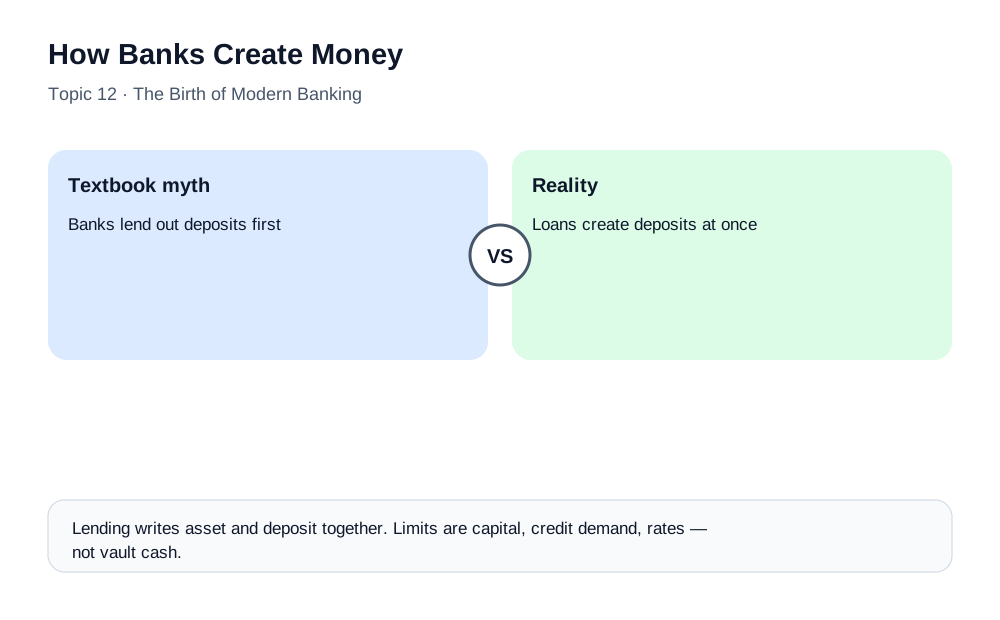
How Banks Create Money at a glance — Endogenous money creation and credit expansion.
Endogenous Money Creation and Credit Expansion
One of the most surprising facts about modern banking is that commercial banks create most of the money in the economy — not the central bank, not the government. When a bank makes a loan, it literally creates new money. Understanding this process is essential to understanding how modern economies function.
This idea shocks people when they first encounter it, and for good reason: it contradicts the intuitive picture most of us carry. We imagine banks as warehouses that gather deposits and then lend those same funds out. The reality is stranger and more powerful. Banks do not primarily move money around the economy — they manufacture it, through the everyday act of lending. Every mortgage approved, every business loan signed, every overdraft extended adds brand-new purchasing power to the economy that did not exist the moment before.
What you will learn in this topic:
- Why the textbook story of banking (collect deposits, lend them out) is backwards
- Exactly what happens on a bank's balance sheet when a loan is approved
- Where the newly created money goes, and how it moves between banks
- The scale of bank money creation — why over 90% of money is created by commercial banks
- What actually limits money creation (it is not what most people think)
- How loan repayment destroys money, and why the money supply is always in flux
- How money creation drives credit booms, busts, and asset bubbles
- What this means for monetary policy, for banks, and for you as a customer
- The most common misconceptions — including the ones that appear in economics textbooks
This topic builds directly on Topic 10 (fiat money — the institutional foundation that makes bank-created money possible) and Topic 11 (fractional reserve banking — the system within which creation happens). It connects forward to Topic 13 (banking crises), because the same mechanism that creates money in good times destroys it in bad ones.
1. The Conventional Story vs Reality
Most people — and many older economics textbooks — describe banking as a three-step process of intermediation:
The textbook version (simplified):
- The central bank prints money
- People deposit that money in banks
- Banks lend out those deposits to borrowers
In this story, banks are passive middlemen: they shuffle existing money from savers to borrowers, earning a spread for the service. The total amount of money is fixed by the central bank; banks merely redistribute it.
What actually happens:
- A bank approves a loan
- It creates a new deposit in the borrower's account
- New money now exists that did not exist before
The sequence is reversed. Lending does not wait for deposits; lending creates deposits. When your bank approves your mortgage, it does not phone another customer and ask permission to move their savings. It simply credits your account with new numbers — and those numbers are money, as real and spendable as any other balance in the economy.
This is not a fringe theory or a heterodox claim. The Bank of England confirmed it in a landmark 2014 quarterly bulletin article, stating plainly:
"Whenever a bank makes a loan, it simultaneously creates a matching deposit in the borrower's bank account, thereby creating new money."
The Bundesbank, the International Monetary Fund, and numerous other central banks have published similar explanations. Economists call this the endogenous money view — "endogenous" meaning money is created from within the banking system, by private lending decisions, rather than being injected from outside by the central bank. As we saw in Topic 11, the old money-multiplier story (reserves in → deposits multiplied out) captures some aggregate accounting relationships, but it gets the causal sequence wrong. Loans come first; reserves follow.
Why does the textbook version persist? Partly because it is simpler to teach, partly because it described some historical systems more accurately, and partly because the true mechanism is genuinely counterintuitive. But if you want to understand credit cycles, housing bubbles, monetary policy, or banking crises, you must start from how money actually enters the economy: through the loan officer's pen.
2. How Money Creation Works: The Balance Sheet View
The cleanest way to see money creation is through double-entry bookkeeping — the accounting system banks actually use. Every transaction affects at least two entries on a balance sheet, and assets must always equal liabilities plus equity. Watching the entries move reveals exactly where new money comes from.
Step by step: a $200,000 mortgage
Imagine you apply for a $200,000 mortgage:
- The bank approves your loan application
- It does NOT take $200,000 from another depositor's account
- Instead, it types $200,000 into your account — creating the money from nothing
- Your balance sheet: you now have $200,000 in your account (asset) and a $200,000 debt (liability)
- The bank's balance sheet: a $200,000 loan receivable from you (asset) and a $200,000 deposit it owes you (liability)
Here is the same event as accounting entries:
Your balance sheet:
| Assets | Liabilities |
|---|---|
| +$200,000 bank deposit | +$200,000 mortgage debt |
The bank's balance sheet:
| Assets | Liabilities |
|---|---|
| +$200,000 loan (your mortgage) | +$200,000 deposit (your account) |
Both sides of both balance sheets increase simultaneously. No existing money moved. New money has been created — matched, as accounting requires, by new debt. This is the deepest structural fact about modern money: in our system, money and debt are born as twins. Nearly every dollar, euro, or rupee of deposit money in existence is someone's liability to a bank.
Where does the money go?
When you buy a house with that mortgage:
- The $200,000 moves from your account to the seller's bank account
- Your deposit disappears; the seller's bank now holds a new deposit
- The total money supply in the economy remains $200,000 larger than before the loan was made
Notice what did not happen: the seller did not receive a stack of vault cash, and no other depositor's balance fell. The purchasing power was created at loan approval and simply transferred at purchase.
What happens between the banks?
This is the piece the simplified story skips — and it matters. When your $200,000 payment moves to the seller's bank, your bank owes the seller's bank a real settlement obligation. Interbank payments are settled in central bank reserves — the special money that only banks hold, in accounts at the central bank (introduced in Topic 10 as the base layer of the fiat system). So while your bank created the deposit money freely, it must hold or borrow enough reserves to settle the payment that deposit makes possible.
This is why "banks create money from nothing" needs one refinement: banks create deposit money from nothing, but they operate within a settlement system they do not control. A bank that creates deposits aggressively must continually obtain reserves to settle the outflows those deposits generate — and reserves cost money, at the interest rate set by the central bank. That cost, not a fixed reserve ration, is the central bank's true lever over money creation, as we will see in Section 5.
What makes the deposit "money"?
Why does everyone accept these typed numbers as money? The answer completes the chain we built across Topics 9 through 11: the deposit is denominated in the national fiat currency, convertible into cash at par, protected by deposit insurance up to defined limits, spendable through the payment system, and accepted for taxes. A bank-created deposit inherits all the institutional properties of fiat money. It is, functionally and legally, money — which is precisely why its creation by private institutions is such a significant economic fact.
3. The Scale of Money Creation
Once you see the mechanism, the obvious question is: how much of the economy's money is created this way? The answer: nearly all of it.
In most modern economies, over 90% of money in everyday use exists as bank deposits created through lending — not as physical cash issued by central banks:
| Type of Money | Created By | Approximate Share |
|---|---|---|
| Physical cash (notes & coins) | Central bank / government mint | ~3–5% |
| Central bank reserves (settlement money held by banks) | Central bank | ~3–5% |
| Commercial bank deposits (the money people and businesses actually hold and spend) | Commercial banks, via lending | ~90–95% |
(Exact shares vary by country and by which monetary aggregate you measure, but the pattern is universal: deposit money dwarfs physical cash.)
Sit with this for a moment, because it inverts the popular picture of the monetary system. When people worry about governments "printing money," they are usually watching the smallest part of the machine. The great engine of money creation is the thousands of daily lending decisions made inside commercial banks — mortgage approvals, business credit lines, car loans, credit cards. Monetary conditions in the economy are shaped as much by bank credit departments as by central bank boardrooms. The central bank steers; the banks power the vehicle.
This also explains the state's intense interest in bank regulation. Institutions that manufacture the economy's money supply cannot be allowed to operate like ordinary businesses. Their lending standards are, in effect, monetary policy at ground level — which is why capital rules, supervision, and the safeguard architecture from Topic 11 exist.
4. Money Destruction: The Forgotten Half of the Cycle
Just as loans create money, repaying loans destroys money:
- When you make a mortgage payment, money moves from your account to the bank
- The deposit is extinguished and the loan balance shrinks by the principal repaid
- The money supply decreases
Watch the balance sheet entries run in reverse — the mirror image of Section 2. Your deposit (an asset for you, a liability for the bank) shrinks; your loan (your liability, the bank's asset) shrinks. Both sides of both balance sheets contract. The money that was typed into existence at origination is typed back out of existence at repayment. Only the interest portion persists as the bank's income — and even that flows back into the economy through the bank's costs, dividends, and taxes.
This means the money supply is constantly in flux: new loans create money, repayments destroy it, and the net change depends on whether total lending is growing or shrinking. Three states are possible:
- Lending expanding faster than repayment → the money supply grows (the normal state of a healthy, growing economy)
- Lending and repayment roughly balanced → the money supply is stable
- Repayment outrunning new lending → the money supply contracts
That third state is more dangerous than it sounds, and it is not hypothetical. When banks collectively pull back — after heavy losses, in a panic, or under regulatory pressure — and borrowers collectively pay down debt, the economy's money supply shrinks. Less money chasing the same goods means falling spending, falling prices, falling incomes, and then more loan defaults, causing banks to pull back further. Economists call this a debt deflation or credit crunch, and it describes the mechanics of the Great Depression, Japan's stagnation after its 1990 property bubble burst, and the credit contraction that followed the 2008 financial crisis. In each case, the money-destruction half of the cycle amplified the downturn. We return to these dynamics in Topic 13.
The takeaway: the money supply is not a fixed quantity the central bank sets and the economy inherits. It is the ever-changing net result of millions of lending and repayment decisions. Understanding booms and busts requires watching both halves of the cycle.
5. What Limits Money Creation?
If banks can create money by lending, what stops them from creating infinite amounts? This is the question that separates real understanding from headline-level knowledge. The answer is a system of five interlocking constraints — and notably, "the central bank rations the reserves" is no longer the main one in most advanced economies.
Constraint 1: Capital requirements
Banks must maintain a minimum ratio of shareholders' equity to their loans and other risk-weighted assets. Under the Basel III international framework:
- 4.5% minimum Common Equity Tier 1 (CET1) capital
- With conservation and other buffers, effectively 10–13% for most major banks
Every new loan adds risk-weighted assets and therefore consumes capital capacity. A bank that lends too aggressively relative to its equity breaches regulatory minimums and faces supervisory intervention. This is the binding regulatory constraint on money creation in modern systems: capital, not reserves. Expanding the loan book requires either raising new equity or retaining profits — both slow and expensive, which is exactly the discipline regulators intend.
Constraint 2: Demand for loans
Banks can only create money when creditworthy borrowers want to borrow. Money creation is a two-sided transaction: the bank must be willing to lend and someone must be willing and able to take on debt. During recessions, even willing banks find demand collapsing — households defer mortgages, businesses shelve expansion plans. You cannot create a loan unilaterally.
Constraint 3: The price of credit — central bank interest rates
Every loan the bank creates generates settlement obligations that must be met in central bank reserves, and those reserves have a price: the policy interest rate. When the central bank raises rates, the bank's funding costs rise, loan rates follow, and borrower demand falls. When rates fall, credit becomes cheaper and creation accelerates. This is how monetary policy actually works — not by printing or withholding money, but by pricing the reserves that the lending engine consumes. Topic 11 covered the toolkit; here you see exactly where the lever connects to the machine.
Constraint 4: Regulation, supervision, and credit risk
Banks must assess each borrower's creditworthiness, follow lending standards, hold liquidity buffers (such as the Basel Liquidity Coverage Ratio from Topic 11), and provision for expected losses. Supervisors examine loan books and can force banks to tighten standards. Reckless creation is constrained by the knowledge that bad loans destroy capital — the very resource that permits lending in the first place.
Constraint 5: Competition and market discipline
Banks compete for borrowers. Price loans too high and borrowers go elsewhere; lend too loosely and defaults erode the franchise. Markets impose a private discipline that operates alongside the public one.
Notice the common thread: money creation is constrained by profitability, solvency, and demand — not by a fixed pile of pre-existing money. The system is elastic by design. That elasticity is what allows the money supply to grow with a growing economy, and it is also what makes credit booms possible. Which brings us to why all of this matters so much.
6. Why This Matters: Credit Cycles, Policy, and Power
Understanding that banks create money through lending explains several of the most important phenomena in modern economic life.
Credit booms and busts. When lending runs hot — optimistic banks, eager borrowers, rising collateral values — money creation accelerates, and the new purchasing power flows into asset markets, particularly property. Rising prices validate more lending against the inflated collateral, creating a self-reinforcing spiral: more credit → higher asset prices → more collateral → more credit. The 2008 crisis was this spiral in American and European housing; Japan's 1989 peak was the same pattern. When the spiral reverses, Section 4's destruction mechanics take over. Credit cycles are money-creation cycles.
The true nature of central bank power. The central bank does not directly control the money supply; it influences it indirectly through interest rates, reserve pricing, and regulation. This is why monetary policy sometimes "pushes on a string": low rates cannot force banks to lend or borrowers to borrow (Japan in the 1990s, the euro area after 2008). Policy works through the banking system, never around it — which is why a damaged banking system means weak policy transmission.
Why banks are special institutions. They are not just intermediaries; they are the primary mechanism of money creation in the economy. This single fact justifies the entire edifice of banking regulation, deposit insurance, central bank backstops, and supervisory scrutiny covered in Topics 8, 9, and 11. Institutions that create the public's money operate under public obligations.
The money-debt link. In our system, more money means more debt, and less debt means less money. This has a startling implication that thinkers about monetary reform often raise: if everyone repaid their bank debts, the deposit money supply would largely vanish. The economy's money stock and its debt stock are two faces of one aggregate balance sheet. Whether one considers this a design flaw or a feature, it is the architecture we live in — and it is why debt levels and monetary conditions can never be analysed separately.
Inflation's monetary side. When money creation persistently outpaces the growth of real output, more purchasing power competes for the same goods, and prices rise. Inflation has many drivers — supply shocks, wages, expectations — but its monetary foundation is always the rate of credit-driven money creation relative to real economic capacity. Hyperinflations (Topic 10) are the extreme case where this creation, captured by government finance, runs entirely unchecked.
7. Case Study: A Credit Boom and Bust in Miniature
To see the full creation-destruction cycle in action, consider a simplified national housing boom — a composite of patterns visible in the United States and Ireland before 2008 and in many property cycles since.
Stage 1 — Accelerating creation. Banks compete aggressively for mortgage market share. Lending standards quietly loosen: smaller deposits, higher income multiples, lighter documentation. Each approval creates new deposit money, which buyers use to bid for houses. Total mortgage lending grows at double-digit annual rates, and the money supply grows with it.
Stage 2 — Self-validation. The newly created purchasing power pushes house prices up. Higher prices mean the collateral backing existing loans looks safer, so banks' risk models report lower risk. Lower measured risk justifies more lending at higher valuations. Buyers, seeing prices rise, borrow eagerly to avoid being priced out. Credit creation and asset prices chase each other upward — and nearly everyone in the system (banks, borrowers, regulators, politicians) feels vindicated while it lasts.
Stage 3 — The turn. Prices reach levels where new buyers simply cannot service the debt from real incomes. Lending slows. The flow of newly created money into the market weakens — and since money creation was what supported prices, prices stall. The most leveraged borrowers begin to default.
Stage 4 — Destruction. Defaults burn through bank capital — the very resource that permits lending (Constraint 1 in Section 5). Banks slash new lending to protect their capital ratios. Meanwhile, frightened households accelerate repayments and stop borrowing. Creation falls while destruction rises; the money supply stagnates or contracts. Spending falls, incomes fall, defaults rise further, and banks tighten more. The boom's creation engine now runs in reverse, and the economy experiences the destruction phase as recession.
Stage 5 — Policy response. The central bank cuts rates and supplies reserves; governments recapitalise banks, precisely because capital — not reserves — is what the creation engine lacks. Only when bank capital is rebuilt and credit demand recovers does money creation resume.
This cycle has repeated across centuries and continents with different costumes — canals, railways, property, technology stocks — but the monetary mechanics are constant: creation fuels the ascent, capital loss triggers the reversal, and destruction deepens the descent. Every banking crisis in Topic 13 is, at its monetary core, this story told at scale.
8. The Customer and Bank Perspectives
From your perspective as a customer:
- Your borrowing literally creates the money you receive. When your loan is approved, new purchasing power enters the economy through you. This is not a metaphor — it is the accounting reality.
- Your repayments destroy money. Each principal payment shrinks the money supply slightly. Your mortgage is a tiny thread in the economy's monetary fabric, being woven and unwoven simultaneously by millions of borrowers.
- Credit conditions affect you before interest rates visibly do. When banks tighten lending standards — requiring larger deposits, higher credit scores, more documentation — money creation slows even if the central bank has not moved. "Credit availability" in the news is really "money creation conditions."
- Your deposits are largely born as someone's loan. The balance you hold exists because a borrower somewhere took on debt. Deposit insurance (Topic 9) and bank regulation (Topic 11) are what make holding that money safe.
From the bank's perspective:
- Lending is money creation, and it is the business. The loan approval workflow — application, credit assessment, pricing, documentation, disbursement — is simultaneously a commercial process and an act of monetary creation. Every credit officer participates in monetary policy at ground level.
- Capital allocation governs growth. Because each loan consumes capital, banks ration their balance sheets strategically: which sectors, which products, which risk profiles deliver the best return per unit of capital consumed. This is why bank strategy presentations are organised around capital ratios.
- Funding and liquidity management follow lending. Creating deposits means managing the settlement and liquidity obligations they generate — the treasury function that keeps the creation engine within its prudential limits.
- The credit cycle is the bank's weather. Booms bring loan growth, fee income, and later, losses; busts bring deleveraging and money destruction. Risk management exists to keep the bank's own creation engine from destroying the bank.
9. Common Mistakes and Misconceptions
Misconception 1: "Banks lend out the money people deposit." The deepest and most persistent error. Banks create new deposits when they lend; they do not transfer existing savers' funds. Savers' balances remain untouched and spendable throughout.
Misconception 2: "The central bank prints most of the money." Physical cash and reserves are a small minority of the money supply. Over 90% of the money in everyday use is commercial bank deposit money created through lending.
Misconception 3: "'Creating money from nothing' means creating value from nothing." Banks create money claims, not wealth. The new deposit is matched by new debt; the borrower's obligation to repay is the anchor. The bank creates liquidity and purchasing power — a real economic service — but the borrower's future income ultimately backs the arrangement.
Misconception 4: "Money creation is uncontrolled and unlimited." Five constraints — capital, demand, interest rates, regulation, competition — bind it tightly in normal times. The 2008 crisis shows the constraints can fail under collective optimism; it does not show they are absent.
Misconception 5: "If banks create money, individual banks profit from seigniorage like counterfeiters." Banks earn the interest spread on loans, not the face value of the money created — and they carry the full credit risk and capital cost of each loan. A counterfeiter gets something for nothing; a bank gets a risky, capital-consuming asset matched by a liability. The economics are entirely different.
Misconception 6: "Money can only be created, never destroyed." Repayment destroys money continuously. The money supply is a flow equilibrium, not an accumulating stock — which is why credit contractions are deflationary events.
Misconception 7: "This is a controversial or conspiratorial claim." The loans-create-deposits mechanism is described in official publications of the Bank of England, the Bundesbank, and other major central banks. It is mainstream monetary economics, however poorly it is taught.
10. Frequently Asked Questions
If banks create money when they lend, why do they need my deposits at all? Deposits remain essential: they are the bank's cheapest and most stable funding, they determine how the bank manages its settlement and liquidity obligations, and they anchor customer relationships. Banks compete for deposits fiercely — not because they lend out deposits, but because deposits fund and stabilise the operation that does the lending.
Does money creation cause inflation automatically? Not automatically. Inflation arises when money and credit grow faster than the economy's capacity to produce goods and services. Money creation that finances productive investment can expand output alongside purchasing power. The relationship is real but conditional — supply matters as much as money.
Who profits from money creation? Banks earn the net interest margin on loans (Topic 11); the state earns seigniorage on physical currency (Topic 10). The broader economy benefits from elastic credit — or suffers from its excesses during credit cycles.
Can a bank create money if it has no capital left? No — and this is precisely what "bank failure" means in regulatory terms. Capital exhausted by losses ends the ability to lend; the bank must raise equity, shrink, or be resolved. Capital is the fuel gauge of money creation.
Do non-bank lenders create money too? No — only institutions that can issue deposit liabilities (licensed banks) create money when they lend. Non-bank lenders ("shadow banks") must first borrow or raise funds, then lend them; they move money, they do not create it. This distinction is one reason regulators watch credit migrating outside the banking system.
If repaying loans destroys money, would paying off all debt destroy the economy? Gradual, economy-wide deleveraging is deflationary and painful — that is Japan's post-1990 experience. A sudden hypothetical repayment of all debt would indeed extinguish most of the money supply, which illustrates why monetary reformers debate this architecture and why policymakers fear rapid deleveraging. In practice, mature debts are continually replaced by new lending.
How does quantitative easing relate to bank money creation? QE creates central bank reserves (the settlement layer), not the deposit money the public spends. It aims to lower long-term rates and encourage lending — working indirectly on the bank-creation engine. Post-2008 experience showed reserves alone do not guarantee lending if banks are capital-constrained or demand is weak.
11. Key Terms in This Chapter
- Endogenous money — money created from within the banking system through lending, rather than injected by the central bank.
- Loans create deposits — the principle that bank lending simultaneously creates a matching deposit: new money.
- Credit expansion — growth in total bank lending, which grows the money supply.
- Money destruction — the extinguishing of deposit money when loan principal is repaid.
- Double-entry bookkeeping — the accounting system in which every entry has matched effects, revealing how money and debt are created together.
- Central bank reserves — settlement money held only by banks at the central bank; the base layer beneath public deposit money.
- Settlement obligation — the interbank debt that arises when deposits move between banks, settled in reserves.
- Capital requirements — minimum equity relative to risk-weighted assets; the binding regulatory constraint on lending.
- CET1 (Common Equity Tier 1) — the highest-quality regulatory capital: ordinary shares and retained earnings.
- Credit crunch — a sharp contraction in lending that shrinks the money supply and deepens downturns.
- Debt deflation — the spiral in which debt repayment and lending contraction shrink money, prices, and incomes together.
- Net interest margin — the spread between loan yields and funding costs; the bank's earnings from money creation.
- Shadow banking — credit intermediation outside licensed banks, which moves but does not create money.
12. Interview Insights: How This Topic Appears in Banking Interviews
"Where does money come from?" The career-making answer runs in three beats: (1) correct the premise — most money is not printed by the central bank; (2) state the mechanism — commercial banks create deposits when they lend, confirmed by the Bank of England's own publications; (3) name the constraints — capital, credit demand, interest rates, regulation. Candidates who reach the third beat stand out immediately, because most stop at the slogan.
"If banks create money, what stops them creating unlimited amounts?" Interviewers use this to test whether you understand the system or just the headline. Walk through capital requirements as the binding constraint, funding costs set by the policy rate, the two-sided nature of credit demand, and supervisory discipline. Bonus depth: explain that settlement obligations in reserves are what connect private creation to central bank control.
"Explain the 2008 crisis through the lens of money creation." Structure it as a full cycle: credit boom (accelerating creation into property) → asset bubble validated by its own collateral → defaults impair bank capital (the creation constraint) → lending collapses → repayment outpaces new lending → money destruction deepens the recession. This answer demonstrates you can apply the mechanics to real events — the exact skill the question tests.
"Does quantitative easing print money?" A precision question. Answer: QE creates central bank reserves, not public spending money; it works by lowering yields and encouraging the bank-lending channel. Whether it "worked" depends on whether banks had capital and borrowers had demand — post-2008 evidence says reserves alone were not sufficient.
"Is our money system fundamentally unstable because money is debt?" A judgment question for senior roles. The balanced answer: the money-debt link makes the system elastic and procyclical — it amplifies both booms and busts — which is why regulation, deposit insurance, and central bank backstops are structural necessities rather than policy choices. Proposals for alternative architectures exist, but the managed fractional system remains dominant because its flexibility has historically outweighed its fragility.
Summary and Key Takeaways
The monetary system is not a fixed stock of cash handed down by the central bank; it is a living engine of creation and destruction running inside commercial banks. The essential points:
- Banks create money by lending. Approving a loan creates a matching deposit — new purchasing power that did not exist before. The Bank of England and other central banks confirm this openly.
- The textbook sequence is backwards. Lending does not wait for deposits; lending creates deposits. Reserves follow, priced by the central bank.
- Over 90% of everyday money is bank-created. Cash and central bank reserves are the small foundation; commercial bank deposits are the edifice.
- Money and debt are twins. Every deposit created is matched by someone's obligation to repay — the deep structural link between the money supply and the debt stock.
- Repayment destroys money. The supply is a flow equilibrium of creation and destruction, which is why credit contractions are deflationary and dangerous.
- Creation is constrained, not unlimited. Capital requirements are the binding regulatory limit, alongside credit demand, interest rates, supervision, and competition.
- Credit cycles are money-creation cycles. Booms manufacture the money that inflates asset bubbles; busts destroy it, deepening recessions — the engine behind 2008, Japan's lost decades, and the Great Depression.
- Monetary policy works through banks, never around them. Interest rates steer the price of the reserves and funding that the creation engine consumes.
- This is why banks are regulated like no other industry. Institutions that manufacture the public's money carry public obligations — capital, liquidity, insurance, and supervision.
- Understanding both halves of the cycle — creation and destruction — is the foundation for everything that follows in this series about crises, policy, and banking practice.
In the next topic, we see what happens when this engine misfires at scale: historical banking crises — the panics, crashes, and collapses that shaped every safeguard the modern system now relies on.
Next: Topic 13 — Historical Banking Crises →
<!-- MBA-DEEP-DIVE-START -->Deep Dive: How Bank Money Is Created, Moved, and Destroyed in Practice
The statement “banks create money when they lend” is correct, but it becomes useful only when we explain precisely which money, which accounting entries, what happens when the borrower spends it, and what ultimately constrains the process. Modern banking contains several layers of money. Notes and coins are central-bank or sovereign money used by the public. Commercial-bank deposits are liabilities of individual banks and form most of the money households and firms use for payments. Central-bank reserves are settlement assets used primarily within the banking system. Confusing these layers creates many of the myths surrounding money creation.
A bank does not normally need to find a specific existing depositor whose savings can be handed to a new borrower. When a loan is originated, the bank records a loan asset and a corresponding deposit liability or payment obligation. The borrower has gained purchasing power, while also taking on debt. The bank has gained a claim on the borrower and created an obligation to honour the newly created deposit. Both sides of the bank’s balance sheet expand.
This is an accounting event, not a magic trick. A bank cannot create unlimited money simply because double-entry bookkeeping permits the initial entries. The loan exposes the bank to credit risk, capital usage, liquidity needs, funding costs, interest-rate risk, operational risk, concentration limits and regulation. It must also be able to settle any payments the borrower makes to other banks. Money creation is therefore endogenous to the credit process but constrained by the economics and safety of the bank’s entire balance sheet.
The origination entry
Assume a bank approves a business loan for 1,000,000 units of local currency and credits the borrower’s current account. In simplified form, the bank records:
- Asset: +1,000,000 loan receivable.
- Liability: +1,000,000 customer deposit.
The borrower’s balance sheet records a bank deposit as an asset and a loan payable as a liability. The private sector now has an additional deposit balance and an additional debt. That is why it is misleading to describe bank lending as the creation of net wealth. Gross financial assets and liabilities have expanded together.
The quality of the loan matters enormously. If the borrower uses the funds to finance productive investment that generates future cash flows, the new credit can support additional output and income. If lending instead chases scarce assets without adding productive capacity, it may contribute to asset-price inflation. If underwriting is poor, later defaults can destroy bank capital and weaken the credit system. The same accounting ability can therefore support growth or amplify instability depending on how credit is allocated.
What happens when the borrower pays someone at another bank
Suppose the business immediately pays a supplier whose account is held at Bank B. Bank A must honour its customer’s payment instruction. The customer deposit at Bank A falls. Bank B credits its supplier’s account. Between the two banks, settlement occurs through the relevant payment and settlement infrastructure, normally using a settlement asset accepted by the system, often central-bank money.
The important point is that the loan asset remains on Bank A’s balance sheet after the customer deposit has moved away. Bank A therefore needs a funding and liquidity strategy for the asset it originated. It may retain other deposits, attract new deposits, borrow in wholesale markets, issue debt, use secured funding or undertake other treasury actions. The bank did not need pre-existing deposits to create the loan, but it cannot ignore the funding consequences after the loan is created.
This distinction resolves a false argument often seen in public discussions. One side says “banks lend deposits,” while the other says “banks do not need deposits.” A more accurate statement is: banks can create a deposit when they originate credit, but they still need sustainable funding and settlement liquidity for the resulting balance sheet. Deposits remain a critically important source of funding even though they are not a mechanical prerequisite for each individual loan.
Money creation and payment settlement are different processes
The banking system creates deposit money through balance-sheet expansion. Payment systems transfer claims and settle obligations created when customers move those deposits. The two processes are connected but should not be collapsed into one.
A customer can receive a newly created loan deposit without any immediate interbank settlement if the funds remain at the same bank. Settlement pressure appears when value moves to another institution or another settlement arrangement. This is why customer behaviour matters. A bank whose borrowers tend to pay customers of other banks will experience different liquidity patterns from a bank with a large internal payment ecosystem.
For payments professionals, this distinction is practical. A payment message does not itself create the underlying customer loan. It instructs, communicates or confirms movement associated with positions already recorded in banking systems. The payment platform must ensure that customer posting, settlement posting, fees, FX where relevant, rejection handling and reconciliation remain consistent. Money creation belongs to the lending and balance-sheet event; settlement belongs to the transfer of claims between participants.
Repayment destroys deposit money, but interest needs careful explanation
When a borrower repays principal from a bank deposit, the bank reduces both its deposit liability and the loan asset. The principal portion is therefore the reverse of origination: deposit money is extinguished as the loan claim is reduced.
Interest is different. Interest paid by the borrower becomes income to the bank, subject to accounting recognition, impairment rules, operating expenses, taxes and distributions. It is not correct to say that every unit of interest “remains forever” in the money supply. The bank pays salaries, suppliers, taxes and dividends, and those payments create or transfer deposits elsewhere. The monetary effect depends on the full set of transactions and balance-sheet entries.
Similarly, when a loan is written off, the result should not be described simply as “money destruction.” The deposit created by the original loan may have moved through the economy long before default. A credit loss primarily reduces the value of the bank’s asset and is absorbed through provisions, earnings and capital. Understanding default therefore requires separate analysis of money, credit and bank solvency.
Central banks influence creation; they do not mechanically set every deposit balance
Central banks strongly influence monetary conditions, but the relationship between central-bank money and commercial-bank money is not a fixed one-for-one control mechanism. Policy rates affect bank funding costs, loan pricing, deposit pricing, asset valuations and credit demand. Prudential policy affects capital and liquidity capacity. Central-bank operations influence settlement conditions and the availability and price of reserves.
When policy rates rise, some borrowers become less willing or less able to borrow, banks may tighten underwriting, and refinancing becomes more expensive. Credit growth can slow. When policy rates fall, borrowing may become cheaper, but banks cannot be forced to create sound loans if borrower demand is weak or risk is high. This is one reason monetary transmission differs across economic cycles and banking systems.
Quantitative easing and other asset-purchase programmes also require careful explanation. When a central bank purchases assets, it can increase central-bank reserves and, depending on the seller and transaction structure, affect commercial-bank deposits and asset prices. But a larger reserve balance does not automatically cause banks to multiply loans by a textbook factor. Lending still depends on credit demand, capital, risk appetite, expected return and broader economic conditions.
What actually constrains a bank’s ability to expand credit
A useful hierarchy is to think about creditworthiness, capital, liquidity and funding, profitability, concentration, and regulation.
A bank first needs a borrower and a transaction that satisfy credit policy. Underwriting asks whether cash flows, collateral, leverage, industry conditions and other factors support repayment. Next, the exposure must fit the institution’s risk appetite and concentration limits. The loan must generate a return after expected credit loss, capital consumption, funding cost, liquidity cost, operational cost and overhead.
Capital places a loss-absorption constraint on growth. New risk-weighted assets consume regulatory and internal capital capacity. Liquidity and funding place a different constraint: the bank must be able to support customer outflows and maintain a resilient funding profile. Treasury may therefore charge business units an internal transfer price that reflects the economic cost of funding and liquidity.
Regulators and supervisors add additional constraints through capital buffers, liquidity standards, large-exposure limits, underwriting expectations, stress testing, consumer-protection rules and institution-specific requirements. The precise framework differs by jurisdiction and can change over time, which is why banking professionals should verify current local rules rather than memorise one global percentage.
Credit creation can change the composition of economic activity
Not all bank lending has the same macroeconomic effect. A working-capital facility that helps a manufacturer pay suppliers is different from a mortgage used to buy an existing property, which is different again from financing a new housing development. All can create deposits, but the destination of spending changes the consequences.
Credit directed toward productive investment may expand future supply. Credit directed toward existing assets may raise asset prices more quickly than productive capacity. Consumer credit may bring future consumption into the present. Trade finance can bridge timing gaps in commerce. Corporate revolving facilities can provide insurance against uncertain cash needs even when they are not fully drawn.
For this reason, broad money growth alone does not tell the whole story. Analysts also examine credit by sector, borrower type, collateral, maturity, currency, interest-rate structure and purpose. The composition of credit can reveal vulnerabilities long before aggregate totals become alarming.
A worked corporate example
Imagine a mid-sized company receives a five-year term loan to purchase new production equipment. On disbursement, its bank records the loan asset and credits the company’s account. The company pays the equipment supplier at another bank. Settlement liquidity moves between banks, while the originating bank retains the loan asset.
Over the following years, the company sells additional output and receives customer payments. It uses part of those deposits to repay principal and interest. Principal repayment reduces the loan asset and the deposit used to make the payment. The bank recognises interest income over time according to accounting rules. If the company’s business performs well, the credit supports productive capacity and the loan amortises normally.
Now change one assumption. Suppose demand collapses and the borrower cannot service the loan. The bank may restructure, classify the exposure as impaired, recognise expected credit losses, enforce collateral or eventually write down the asset. The original deposit money has already circulated through the economy; the bank’s problem is now an asset-quality and capital problem. This demonstrates why credit creation and credit loss are related but not symmetric monetary events.
Data and system implications
Money creation is recorded through systems, not through an economist’s diagram. Lending platforms capture approval, limit, product, interest, schedule, collateral and conditions. Core banking or loan servicing creates the customer and accounting positions. The general ledger receives balanced entries. Payment systems move disbursed funds. Treasury systems forecast the resulting liquidity. Risk engines calculate exposure and capital consumption. Regulatory reporting aggregates the position according to local requirements.
A weakness in integration can distort the economic picture. If a disbursement is posted to the customer but not reflected correctly in the ledger, the bank can have an unexplained break. If the loan system records a repayment but the cash posting fails, customer and accounting balances diverge. If a drawdown is missing from a liquidity feed, treasury may underestimate cash needs. If a restructuring is not propagated to risk systems, expected loss and capital measures may be wrong.
For a BA, the essential questions are therefore event-driven. Which event legally creates the loan? Which event makes funds available to the customer? Which system creates the deposit posting? Which event triggers settlement? What is the accounting treatment if disbursement fails after loan booking? How is a reversal distinguished from repayment? Which date drives interest accrual? Which identifier connects loan, payment and ledger entries? How are partial repayments, overpayments, write-offs and restructures handled?
Common claims that should be avoided
Avoid saying that commercial banks create “all” money. Physical currency and central-bank reserves have different issuers and functions. Avoid presenting a fixed percentage such as “90% of money” as a universal constant; the share depends on country, time and the monetary aggregate being measured. Avoid saying that reserves are irrelevant. Banks need settlement assets and liquidity management even where reserve requirements are zero. Avoid saying that capital is money available for withdrawal; capital is a loss-absorbing funding layer. Avoid saying that loans can expand without limit; profitability, credit risk, funding, liquidity, capital and regulation impose real constraints.
Most importantly, avoid saying that money creation means banks can create purchasing power without consequences. Every loan creates contractual obligations, risk and future cash flows. The banking system’s ability to create deposit money is socially useful precisely because it can finance activity before sufficient cash has accumulated, but that elasticity has to be governed. Poorly allocated credit can become a banking crisis; well-allocated credit can support investment and growth.
Applied Learning: Trace One Unit of Bank-Created Money
Take a single loan and follow it from approved limit to signed contract, disbursement, deposit creation, external payment, interbank settlement, funding, monthly interest, principal repayment and final closure. Then identify the customer account, loan sub-ledger, general-ledger accounts, payment references, liquidity position and risk exposure at every stage.
If you can explain that chain clearly, you understand bank money creation at the level needed for real banking work—not merely as a monetary-policy slogan.
<!-- MBA-DEEP-DIVE-END -->