Among the concepts essential to understanding modern banking, fractional reserve banking stands as both fundamentally important and widely misunderstood. This practice, whereby banks maintain only a fraction of deposits as reserves while lending out the remainder, serves as the mechanism through which banks create money, fuel economic growth, and simultaneously create the inherent fragility that makes banking regulation necessary. To understand fractional reserve banking is to understand the very heart of how modern monetary systems function.
The term itself describes a simple reality that contradicts common intuition. Most people assume that when they deposit money in a bank, the bank keeps that money safe in a vault, ready to be withdrawn on demand. In fact, banks keep only a small portion of deposited funds as reserves, lending the majority to borrowers who then spend the money, which gets redeposited in other banks, which lend it again. This process multiplies the money supply far beyond the initial deposits, creating the liquidity that lubricates economic activity while establishing the conditions under which banking crises can occur.
What you will learn in this topic:
- What fractional reserve banking is, explained from first principles
- How the deposit-and-lending cycle multiplies money through the banking system
- The money multiplier — what it is, and why the textbook version oversimplifies reality
- Why banks operate this way: the economics of maturity transformation
- The inherent risks: bank runs, contagion, and systemic fragility
- Famous bank runs from the Great Depression to Silicon Valley Bank
- The safeguards that make the system work: reserve requirements, deposit insurance, lender of last resort, capital rules, and stress tests
- The modern "loans create deposits" understanding of money creation
- What fractional reserve banking means for you as a customer and for banks as businesses
- Common misconceptions that even finance students get wrong
By the end, you will understand why banks are unlike any other business, why they are regulated more heavily than almost any other industry, and why the same mechanism that powers economic growth also requires constant vigilance. This topic builds directly on Topic 4 (how banks create money) and Topic 10 (fiat money), and connects forward to Topic 12 (money creation) and Topic 13 (banking crises).
Visual overview
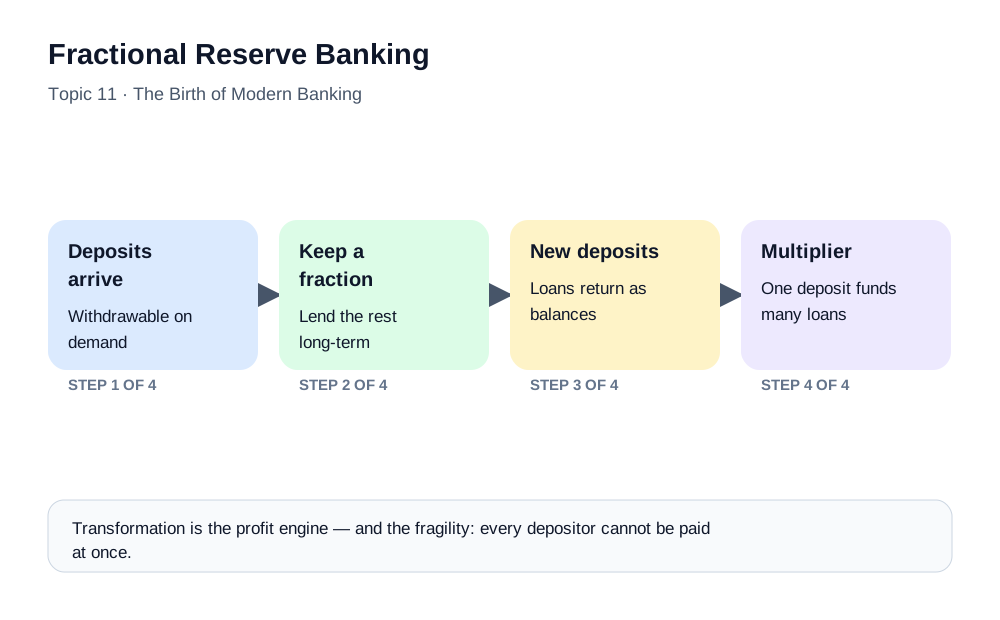
Fractional Reserve Banking at a glance — Banks lending more than they hold and the money multiplier.
1. The Core Concept: Your Deposit Is Not in the Vault
Let us begin with the fact that surprises everyone when they first learn it: the money you deposit in a bank does not sit in the bank.
When you hand over cash or receive a salary payment, your account balance increases — but the bank treats most of those funds as raw material for its business. It keeps a fraction available to meet withdrawals and lends the rest to borrowers: homebuyers, businesses, students, governments. Your balance is not a pile of notes with your name on it. It is a promise — the bank's obligation to pay you on demand — backed by a portfolio of loans that will be repaid over months and years.
This is fractional reserve banking in one sentence:
Banks hold only a fraction of their deposit liabilities as immediately available reserves, and lend or invest the remainder.
The "fraction" in question varies. It may be set by regulation (a reserve requirement imposed by the central bank) or by prudential judgment (the bank's own assessment of how much liquidity it needs). Either way, the defining feature is the same: reserves are always smaller than deposits. No commercial bank on Earth could repay all its depositors at once. The system runs on the statistical near-certainty that they will never all ask at the same time.
Why would society organise its money this way? Because the alternative — 100% reserve banking, where every deposit is fully backed by idle cash — would make banking little more than a warehousing service. Banks could not lend, credit would collapse, mortgages and business loans would largely vanish, and banks would have to charge depositors fees for safekeeping rather than paying them interest. Fractional reserve banking is what allows the same pool of savings to serve two purposes at once: it is simultaneously available to depositors (as account balances) and working in the economy (as loans). That dual service is the source of both its enormous value and its inherent risk.
2. The Mechanics: How One Deposit Becomes Many
To understand how fractional reserve banking works, consider a simple example that traces the path of money through the banking system. When you deposit one thousand dollars in your bank account, the bank does not simply store that money. Instead, suppose it is required to keep only a fraction — say ten percent, or one hundred dollars — as reserves. The remaining nine hundred dollars can be lent to a borrower.
That borrower spends the nine hundred dollars at a shop, and the shopkeeper deposits this money in their own bank. This second bank now keeps ten percent, or ninety dollars, as reserves and lends out the remaining eight hundred ten dollars to another borrower. That borrower spends the money, which gets deposited in a third bank, which keeps ten percent and lends out the rest. The process continues, with each round creating new deposits and new loans, multiplying the initial deposit throughout the banking system.
This multiplication is not infinite. Each round creates less new money than the previous one, and the total eventually converges to a limit determined by the reserve requirement. With a ten percent reserve requirement, the theoretical maximum expansion is ten times the initial deposit. The initial one thousand dollars can create up to ten thousand dollars in total deposits across the banking system. This mathematical relationship — the money multiplier, equal to one divided by the reserve requirement — explains why changes in reserve requirements can have such powerful effects on the money supply.
Two important clarifications belong here:
First, no single bank "multiplies" money in this story — the system does. Each individual bank lends only from its own deposits and sees the proceeds flow out to other banks. The multiplication is an emergent property of thousands of banks lending and redepositing simultaneously.
Second, as we will see in Section 6, this textbook sequence is not how modern banking actually operates day to day. The multiplier model remains the clearest way to build intuition, and it accurately captures the aggregate relationship between reserves and deposits — but real banks create loans first and manage reserves afterward. Hold both ideas together: the multiplier explains the system's structure; the modern view explains its mechanics.
The actual reserve requirement varies across countries and time periods. The United States reduced its reserve requirement to zero percent in 2020, during the COVID-19 pandemic, after previously requiring ten percent on many deposits. The euro area has required around one percent of eligible deposits. India maintains a Cash Reserve Ratio of several percent, and China has used its required reserve ratio — at times well above ten percent for large banks — as an active instrument of monetary policy. These differences reflect varying approaches to monetary management and different assessments of the trade-offs between liquidity creation and financial stability. The trend in advanced economies has been toward lower or zero formal requirements, with prudential liquidity rules and central bank interest rates doing the work that reserve ratios once did.
3. Why Banks Operate This Way: The Economics of Transformation
Fractional reserve banking exists not because of regulatory requirement but because of a simple observation about depositor behavior: not all depositors want their money at the same time. On any given day, some people make deposits while others make withdrawals, and these flows roughly balance out. Banks can rely on this pattern to hold only enough cash to meet normal withdrawal demands while lending the surplus to earn interest.
This practice allows banks to perform their essential intermediary function. By gathering deposits from many individuals who have temporary surplus funds and lending to borrowers who have productive uses for capital, banks bridge the gap between savings and investment. Without fractional reserve banking, banks could not earn sufficient returns to cover their costs and pay interest to depositors, making the banking business economically unviable.
Economists describe what banks do here with two precise terms worth learning:
Maturity transformation is the conversion of short-term liabilities (deposits withdrawable on demand) into long-term assets (loans repayable over years). Your deposit is instantly available; the mortgage it helps fund takes twenty-five years to repay. The bank stands between these two time horizons and manages the gap.
Liquidity transformation is the related conversion of illiquid assets (individual loans that cannot be quickly sold at fair value) into liquid liabilities (deposits that function as money). The bank's loan book would be hard for you to spend at a supermarket; your deposit balance is effortlessly spendable.
These transformations are genuinely valuable social functions — they let savers enjoy liquidity while borrowers enjoy long-term funding — but they are also, precisely, the source of banking's fragility. A bank is structurally short of cash relative to its promises. That is not a defect of a badly run bank; it is the design of every bank.
The bank's profit model depends on the spread between the interest paid on deposits and the interest earned on loans. If a bank pays depositors three percent on savings while charging borrowers seven percent on loans, the four percentage point spread — bankers call it part of the net interest margin — represents the gross return from intermediation. After covering operating costs, provisions for loan losses, and taxes, this spread generates the profits that compensate shareholders for their investment and risk.
This business model creates value for all parties. Depositors earn interest on funds that would otherwise sit idle while retaining access on demand. Borrowers obtain capital for productive investment. The economy benefits from the channeling of savings into investment, generating growth and employment. Yet this mutually beneficial arrangement carries risks that become apparent when the assumptions underlying it break down — which is where we turn next.
4. The Inherent Risks: Runs, Contagion, and Fragility
The fundamental risk of fractional reserve banking arises from the mismatch between the liquidity banks promise to depositors and the illiquidity of their loan portfolios. Banks promise to return depositors' money on demand, yet they have lent most of it to borrowers who will repay only over months or years. If depositors collectively demand more withdrawals than reserves can cover, the bank cannot meet its obligations regardless of the value of its underlying assets — a perfectly solvent bank can still die of illiquidity.
This scenario, the bank run, has destroyed countless institutions throughout banking history. Its cruel logic deserves careful attention, because it explains why banking panics can strike even healthy banks:
- Each depositor knows the bank holds only a fraction of deposits as reserves.
- Each depositor therefore knows that if others withdraw first, the bank may fail and leave latecomers with nothing.
- So the moment doubt arises, the rational individual strategy is to withdraw immediately — even if you believe the bank is fundamentally sound.
- When everyone reasons this way, the rush to withdraw exhausts reserves and forces closure. The panic fulfils itself.
This is a classic coordination failure: individually rational, collectively catastrophic. It also explains why banking confidence is so delicate — the system's stability rests partly on beliefs about other people's beliefs.
Historical examples illustrate both the destructive power of runs and their persistence across eras:
During the Great Depression of the 1930s, thousands of American banks failed as panicked depositors withdrew en masse, transforming a severe recession into a catastrophic economic collapse. The images of desperate depositors queuing outside closed banks became defining symbols of the era — and the policy response, including the creation of federal deposit insurance in 1933, reshaped banking permanently.
In 2007, Northern Rock experienced the first British bank run in roughly 150 years, with queues forming around branches as depositors sought to withdraw their funds. The scenes of orderly British citizens lining up to rescue their savings demonstrated that run psychology remains potent even in modern economies with deposit insurance and regulatory safeguards.
The 2023 failure of Silicon Valley Bank showed how digital banking has transformed run dynamics. In a single day, depositors withdrew forty-two billion dollars through electronic transfers — a pace impossible in the era of physical queues and paper checks. Uninsured corporate deposits, concentrated in a single industry and coordinated through social media and group chats, fled in hours. The speed of modern runs leaves little time for intervention and proves that fractional reserve fragility persists despite every technological advance.
Beyond individual failures, fractional reserve banking creates systemic risk through interconnectedness. Banks lend to each other as well as to non-bank borrowers, creating a web of obligations that can transmit distress rapidly. When one bank fails, its creditors — including other banks — suffer losses that may impair their own solvency. This contagion can transform isolated problems into systemic crises, which is why regulators treat the failure of a large, connected institution differently from that of a small one. We examine these dynamics fully in Topic 13 (banking crises).
5. The Safeguards: How the System Manages Its Own Fragility
Modern banking systems have developed multiple layers of protection designed to prevent bank runs and contain their consequences when they occur. These safeguards reflect centuries of painful experience and represent efforts to preserve the benefits of fractional reserve banking while mitigating its inherent risks. Each layer attacks a different link in the chain of panic.
Reserve requirements — mandated minimums banks must hold against deposits — provide the traditional first line of defense, ensuring some liquidity is always available for withdrawals. However, modern central banking has largely de-emphasised mandatory ratios, recognising that a central bank's ability to create reserves on demand makes the precise percentage less critical than once believed. In their place, liquidity requirements (notably the Basel III Liquidity Coverage Ratio) require banks to hold buffers of high-quality liquid assets sufficient to survive stressed outflows for thirty days — a more sophisticated answer to the same ancient problem.
Deposit insurance represents perhaps the most effective protection against bank runs. Government-backed schemes guarantee deposits up to specified limits, removing the incentive for panic withdrawals. In the United States, the Federal Deposit Insurance Corporation guarantees deposits up to $250,000 per depositor per bank. The United Kingdom's Financial Services Compensation Scheme covers up to £85,000. India's Deposit Insurance and Credit Guarantee Corporation insures deposits up to ₹5,00,000. Knowing their deposits are protected even if the bank fails, depositors have no reason to join a panic — making runs less likely to start and easier to contain. (The Silicon Valley Bank case revealed the limit of this protection: deposits above the insurance cap fled instantly, which is why coverage design remains a live policy debate. Topic 9 explores deposit insurance in depth.)
The central bank's role as lender of last resort provides another crucial protection. Banks facing temporary liquidity shortages can borrow from the central bank rather than being forced to call in loans or dump assets at distressed prices. This access to emergency liquidity can prevent temporary cash flow problems from becoming permanent failures. Walter Bagehot's nineteenth-century principle — that central banks should lend freely, at a penalty rate, against good collateral — remains the foundation of this protection, balancing rescue against the moral hazard of banks taking excessive risks in the expectation of being saved.
Capital requirements, strengthened significantly following the 2008 financial crisis, provide a buffer to absorb losses before depositors are affected. Banks must maintain minimum levels of shareholders' equity relative to their risk-weighted assets, ensuring losses are absorbed by shareholders rather than threatening depositors or taxpayers. The Basel Accords — the international framework for banking regulation — establish minimum capital standards while allowing national regulators to impose stricter ones. Note the division of labour: capital addresses solvency (can losses be absorbed?), while reserves and liquidity rules address liquidity (can withdrawals be met?). A healthy bank needs both.
Stress testing has become an essential supervisory tool. Regulators require banks to demonstrate sufficient capital to withstand simulated shocks — severe recessions, market disruptions, sharp interest rate moves. Banks that fail must raise capital or reduce risk, strengthening the system before crises arrive rather than after.
Together these layers form a coherent architecture: liquidity rules make runs less likely to succeed, deposit insurance makes them less likely to start, the lender of last resort prevents liquidity problems from becoming solvency problems, and capital ensures that when losses do occur, shareholders — not depositors or taxpayers — bear them first.
6. The Modern Understanding: Loans Create Deposits
While the fractional reserve multiplier model provides a useful pedagogical framework, modern economists and central banks recognise that it oversimplifies how money creation actually works in contemporary banking. The traditional model suggests banks wait for deposits, keep a fraction as reserves, and lend the remainder. In practice, the sequence largely operates in reverse.
Modern banks typically create loans first and find reserves afterward. When a bank approves your mortgage, it does not check a vault or lend out someone's existing savings; it simply credits your account with new purchasing power — a deposit created at the moment of lending. This newly created deposit is new money. The bank must then manage its reserve and liquidity position after the fact, borrowing reserves from other banks or from the central bank if needed.
This endogenous money view — "endogenous" meaning money created from within the banking system rather than injected from outside — recognises that the real constraints on bank lending are not reserve requirements but:
- Capital. Each new loan adds risk-weighted assets; the bank must have enough equity to satisfy capital rules and absorb potential losses. Capital, not reserves, is the binding regulatory constraint.
- Demand for credit. There must be creditworthy borrowers willing to borrow at rates the bank can profitably charge.
- The cost of funds. Reserves are always available from the central bank — at the policy interest rate. That rate, not reserve scarcity, is how the central bank steers lending conditions.
This understanding, now acknowledged in official publications by institutions such as the Bank of England, has important implications for monetary policy. If the central bank wants to influence money creation, it works through the price of credit (interest rates), capital and liquidity regulation, and the broader funding environment — not by mechanically rationing reserves. Simply adjusting reserve requirements may have limited effect if banks can readily obtain reserves and have capital adequate to support additional lending.
Does this mean the multiplier model is "wrong"? Not exactly. It remains a faithful description of the accounting relationships across the system as a whole, and the cleanest intuition for why deposit-taking and lending are inseparable. What the modern view corrects is the causal story: banks are not passive intermediaries sitting between depositors and borrowers; they are active creators of deposit money, disciplined by capital, regulation, and the price of central bank reserves. Topic 12 (money creation) develops this mechanics in full detail; here, the essential insight is that fractional reserve banking and money creation are two views of the same process.
7. The Customer and Bank Perspectives
From your perspective as a customer, fractional reserve banking explains several everyday realities:
- Why your account earns interest at all. The bank can pay you because your deposit funds loans earning higher rates. Under 100% reserve banking, you would pay storage fees instead.
- Why deposit insurance matters to you personally. Since the bank does not hold your money in a vault, the insurance guarantee — not the vault — is what makes your balance truly safe. Knowing your jurisdiction's coverage limit and how it applies per depositor per bank is practical financial literacy.
- Why "the bank has my money" is a shorthand. Legally, your deposit is a loan you make to the bank; you are its creditor. This is why bank failures, uninsured balances, and bail-in rules can affect depositors — and why a bank's creditworthiness matters.
- Why instant payments coexist with twenty-five-year mortgages. The bank's maturity transformation is what allows your balance to be spendable today while the underlying assets mature over decades.
From the bank's perspective, fractional reserve banking defines the entire operating model:
- Liquidity management is a daily discipline. Treasury teams forecast deposit flows, maintain buffers of liquid assets, manage nostro accounts and settlement obligations, and plan for stressed outflows — the operational machinery that makes the fractional system viable.
- Regulatory ratios shape strategy. Capital ratios, liquidity coverage, and funding requirements determine how much the bank can lend, to whom, and at what price. A lending decision is simultaneously a credit decision, a capital-allocation decision, and a liquidity decision.
- Funding stability is a core risk metric. Banks analyse their deposit base obsessively: insured versus uninsured, concentrated versus diversified, sticky versus flighty. As 2023 demonstrated, an unstable deposit base can be fatal even with sound assets.
- The spread is the engine. Net interest margin — the difference between loan yields and deposit costs — remains the primary profit source for most commercial banks, directly linking the fractional reserve model to bank profitability (Topic 14 explores retail banking economics further).
8. Common Mistakes and Misconceptions
Misconception 1: "The bank keeps my money in a vault." The foundational misunderstanding. Banks keep only a fraction of deposits as reserves and liquid assets; the rest is lent or invested. Your balance is a claim on the bank, not stored property.
Misconception 2: "Banks lend out existing depositors' savings to borrowers." In the modern view, banks create new deposits when they lend — the borrower's spending power is newly created money, not transferred savings. The multiplier model's "lend out deposits" sequence is a teaching simplification.
Misconception 3: "Fractional reserve banking is a modern scam or conspiracy." The practice is centuries old, openly documented in law, regulation, and central bank publications, and foundational to every functioning modern economy. One may debate its risks, but there is nothing hidden about it.
Misconception 4: "A bank failure means all depositors lose everything." Deposit insurance protects balances up to defined limits, and even uninsured depositors typically recover substantial portions through resolution proceedings. Total loss is the exception, not the rule.
Misconception 5: "The money multiplier means one bank turns $1,000 into $10,000." No single bank does this. The expansion happens across the banking system as a whole, through lending and redeposit chains — and in modern practice, lending is constrained by capital and credit demand, not a mechanical multiplier.
Misconception 6: "Zero reserve requirements mean banks hold no reserves." Reserve requirements and reserve holdings are different things. Banks still hold substantial reserves and liquid assets for settlement, liquidity rules, and prudence — the mandate changed, not the operational need.
Misconception 7: "Bank runs only happen to badly managed banks." Run logic can strike solvent institutions, because it is driven by expectations about other depositors' behavior. Even fundamentally sound banks can face fatal liquidity spirals if confidence breaks — which is precisely why the safeguard architecture exists.
9. Frequently Asked Questions
If banks lend out my deposit, can I still withdraw it anytime? Yes — because withdrawals and deposits across millions of customers roughly balance, and banks hold reserves and liquid assets precisely to meet net outflows. Your withdrawal is paid from that buffer, not by recalling a loan.
What happens if everyone withdraws at once? That is a bank run, and no fractional reserve bank can survive one unaided. This is why deposit insurance, lender-of-last-resort facilities, and liquidity regulation exist: to ensure "everyone at once" never actually happens.
Is fractional reserve banking why we have inflation? Bank lending does expand the money supply, but inflation results from money and credit growing faster than the economy's productive capacity — a relationship central banks actively manage through interest rates and regulation. Fractional reserve banking is the mechanism; monetary policy is the steering wheel. Topic 11's neighbours — Topic 12 (money creation) and the monetary policy topics that follow — explore this in depth.
Why did the US reduce reserve requirements to zero? Because modern monetary frameworks steer the economy through interest on reserves and liquidity regulation rather than mandatory ratios. A zero requirement does not mean zero reserves — banks hold large reserve balances voluntarily for settlement and prudential purposes.
What is the difference between reserves and capital? Reserves are liquid assets used to meet withdrawals and payments (a liquidity concept). Capital is shareholders' equity that absorbs losses (a solvency concept). A bank needs adequate levels of both, and confusing them is one of the most common errors in discussions of banking.
Could a 100% reserve system work better? Proposals for full-reserve or "narrow" banking have existed for decades. They would eliminate run risk on deposits but at significant cost: credit creation would shrink or migrate to less-regulated institutions, depositors would likely pay fees rather than earn interest, and lending would need entirely new funding channels. No major economy has adopted the model, judging the regulated fractional system — with its safeguards — the better trade-off.
How does this connect to central banking? The central bank sits at the apex of the fractional reserve system: it issues the reserves banks hold, sets the price at which they borrow, acts as lender of last resort, and (in most countries) supervises the capital and liquidity rules that keep the structure stable. Topic 8 covers central banking in full.
10. Key Terms in This Chapter
- Fractional reserve banking — the practice of holding only a fraction of deposits as reserves while lending the remainder.
- Reserves — a bank's immediately available funds: vault cash plus balances at the central bank.
- Reserve requirement — the regulatory minimum fraction of deposits that must be held as reserves.
- Money multiplier — the theoretical maximum money supply expansion (1 ÷ reserve ratio) in the textbook model.
- Maturity transformation — converting short-term deposits into long-term loans.
- Liquidity transformation — converting illiquid assets into spendable, money-like deposits.
- Net interest margin — the spread between loan yields and deposit costs; the core of bank profitability.
- Bank run — mass withdrawals driven by fear that others will withdraw first; self-fulfilling and potentially fatal even to solvent banks.
- Contagion — the spread of distress between institutions through interlinked obligations.
- Deposit insurance — government-backed guarantee of deposits up to defined limits.
- Lender of last resort — the central bank's emergency lending role for illiquid but solvent banks.
- Moral hazard — the risk that protection against failure encourages excessive risk-taking.
- Capital requirements — minimum shareholders' equity relative to risk-weighted assets.
- Endogenous money — the view that bank lending creates deposits from within the banking system, constrained by capital and credit demand rather than reserve ratios.
- Liquidity Coverage Ratio (LCR) — Basel III rule requiring liquid asset buffers for thirty days of stressed outflows.
11. Interview Insights: How This Topic Appears in Banking Interviews
"Explain fractional reserve banking to a customer with no finance background." Strong candidates use the vault correction first ("the bank doesn't keep your money; it lends most of it"), then explain why this benefits the customer (interest, credit availability) and what protects them (deposit insurance, regulation). The ability to make fragility sound managed rather than alarming is exactly what client-facing roles require.
"What actually constrains bank lending — reserves or capital?" This question separates textbook knowledge from current understanding. The best answer: in modern systems, capital requirements, credit demand, and funding costs are the binding constraints; reserves are supplied elastically by the central bank at the policy rate. Mention the multiplier model as the teaching framework, then explain the loans-create-deposits reality. Citing that central banks themselves now describe money creation this way demonstrates genuine, up-to-date knowledge.
"Why do bank runs happen, and can they be prevented?" Structure the answer in three parts: the mechanical cause (liquidity mismatch), the psychological mechanism (rational panic — individually sensible, collectively fatal), and the safeguards (insurance removes the incentive, lender of last resort removes the mechanics, capital removes the solvency doubt). A recent example — SVB's forty-two billion dollars in a day — shows you connect theory to events.
"What is the difference between liquidity and solvency?" A liquidity problem is a timing problem — good assets you cannot sell fast enough; a solvency problem is a value problem — assets worth less than liabilities. Fractional reserve banking makes banks permanently liquidity-fragile but not necessarily insolvent; the lender of last resort exists precisely for the first case, and capital rules for the second.
"Would you support 100% reserve banking?" Interviewers want balanced judgment, not ideology. Acknowledge the appeal (no run risk), then the costs (credit contraction, disintermediation to shadow banking, deposit fees), and conclude with why regulated fractional banking plus safeguards remains the dominant model — while noting the debate itself is legitimate and ongoing.
Summary and Key Takeaways
Fractional reserve banking is the operating system of modern money: banks hold a fraction of deposits as reserves and lend the rest, simultaneously powering credit creation and accepting structural fragility. The essential points:
- Your deposit is a promise, not a pile of cash. Banks lend most of what they receive; your balance is a claim on the bank, protected by regulation and insurance rather than a vault.
- The system multiplies money collectively. Through lending and redeposit chains, an initial deposit supports many times its value in total deposits — the multiplier captures the aggregate structure.
- Modern reality runs loans-first. Banks create deposits when they lend; capital, credit demand, and the cost of central bank reserves — not reserve ratios — are the real constraints.
- Maturity and liquidity transformation are the social value. Savers get instant access; borrowers get long-term funding. The mismatch that enables this is also the system's core vulnerability.
- Bank runs are rational panics. Because reserves cover only a fraction of deposits, fear of others' withdrawals makes withdrawing rational — a self-fulfilling dynamic that can destroy even solvent banks, now at digital speed.
- The safeguard architecture is layered. Liquidity rules make runs hard to execute, deposit insurance removes the incentive, the lender of last resort converts panic into manageable liquidity events, and capital ensures shareholders absorb losses first.
- Solvency and liquidity are distinct problems with distinct tools — confusing them leads to bad analysis and bad policy.
- The model endures because its benefits exceed its managed risks. Centuries of refinement have not eliminated fractional reserve fragility — they have built the institutional machinery that keeps it productive.
In the next topic, we follow this mechanism to its natural conclusion: money creation — a complete, modern account of how new money actually enters the economy through bank lending, and what that means for inflation, policy, and you.
Next: Topic 12 — Money Creation →
<!-- MBA-DEEP-DIVE-START -->Deep Dive: Fractional-Reserve Banking Without the Textbook Shortcuts
Fractional-reserve banking is easier to understand when we separate three ideas that are often mixed together: deposit money, central-bank reserves, and bank capital. A customer deposit is a liability of the commercial bank to its customer. Central-bank reserves are a different form of money, normally held by eligible financial institutions in accounts at the central bank and used for settlement between banks. Capital is not a pool of cash at all; it is the loss-absorbing layer represented by shareholders’ funds and retained earnings. A bank can therefore be well capitalised but temporarily short of liquidity, or highly liquid but weakly capitalised. The distinction matters because different regulations and management actions address different problems.
The phrase “fractional reserve” can create the misleading impression that a modern bank mechanically receives a deposit, locks away a fixed percentage, and lends the rest. That sequence can be useful as a first classroom illustration, but it should not be treated as a universal operating description. In contemporary banking systems, a bank typically makes a lending decision based on credit risk, pricing, capital, funding, liquidity, concentration limits, risk appetite and regulation. When the loan is booked, the bank normally creates a corresponding deposit or payment obligation. If the borrower spends to an account at another bank, the originating bank must settle the interbank obligation using settlement assets, usually central-bank money. It manages that need through its existing reserve balance, incoming payments, wholesale funding, secured borrowing, asset sales, central-bank facilities where eligible, or other treasury actions.
That is why a reserve requirement, where one exists, should not be confused with the practical liquidity buffer a bank needs. Formal reserve requirements vary by jurisdiction and may change over time. Some systems use them actively, while others rely more heavily on interest-rate implementation frameworks and prudential liquidity standards. A serious banking explanation should therefore avoid presenting one percentage as if it were a global rule. The operational question for a bank is broader: can it meet expected and stressed cash outflows when due, in the currencies and legal entities where those outflows arise?
Deposit creation is not the same as creating wealth
When a bank grants a new loan, both sides of its balance sheet generally expand. The loan is an asset of the bank because the borrower owes principal and interest. The matching deposit is a liability because the bank owes that balance to the customer. New deposit money has been created, but society has not received free net wealth from nowhere. The borrower has both purchasing power and a debt obligation. Whether the credit ultimately adds to productive capacity, merely changes asset prices, or produces losses depends on what is financed and whether the borrower can repay.
This distinction protects learners from a common misunderstanding. Saying “banks create money” does not mean a bank can create unlimited economic value or ignore the need to fund itself. A bank that expands credit recklessly may suffer deposit outflows, rising funding costs, credit losses, capital depletion, liquidity stress and supervisory restrictions. Money creation is an accounting capability embedded inside a heavily constrained business model.
A realistic mortgage flow
Consider a customer whose bank approves a home loan. At origination, the bank records a loan asset and credits the customer’s account or otherwise creates the payment amount required for completion. If the property seller banks elsewhere, the buyer’s bank sends the payment through the relevant payment and settlement arrangements. The seller’s bank credits the seller, while settlement takes place between the banks according to the infrastructure and rules of that market.
For the originating bank, the mortgage remains on the asset side after the payment has left. What changed is the funding and liquidity composition of the balance sheet. The deposit initially created for the borrower may have moved to another institution, while the bank still owns the long-dated mortgage asset. Treasury therefore has to ensure that the remaining asset is funded in a stable and economical way. Funding may include retail deposits, corporate deposits, wholesale debt, secured funding, covered bonds, securitisation, central-bank eligible collateral arrangements or other sources depending on the institution and jurisdiction.
This is one reason loan growth and deposit growth are monitored together. A bank can have a strong credit franchise and still face pressure if loans grow much faster than stable funding. The problem is not that each individual loan must be matched to a particular depositor. The problem is that the aggregate balance sheet must remain fundable, liquid and within risk appetite.
Maturity transformation is a service and a risk
Customers often want deposits that are safe, immediately accessible and usable for payments. Borrowers often want credit that lasts for years. Banks connect those preferences. A bank may fund a long-term mortgage portfolio partly with deposits that customers can withdraw on demand. This maturity transformation is economically useful because it allows households and businesses to hold liquid claims while borrowers receive longer-term financing.
But the transformation means the bank cannot simply wait for every asset to mature before paying depositors. It must continuously manage inflows, outflows, collateral, liquid assets and market access. In ordinary conditions, customer flows are diversified and predictable enough for this to work efficiently. Under stress, however, behaviour changes. Depositors may withdraw faster than historical models predicted, wholesale lenders may refuse to roll funding, collateral haircuts may rise and assets may become difficult to sell without loss.
A modern liquidity framework therefore asks more than “how much cash is in the vault?” It asks what cash flows may occur over different horizons, which assets can be monetised, how quickly collateral can be mobilised, whether funding is concentrated, whether a legal entity can receive liquidity from the rest of the group, and whether operational systems can execute the contingency plan at speed.
Liquidity risk and solvency risk must not be confused
A bank is illiquid when it cannot meet payments when due without unacceptable loss or disruption. A bank is insolvent when the economic value of its assets is insufficient relative to its liabilities and loss-absorbing resources. The two can interact, but they are not identical.
A solvent bank can experience a run if depositors demand funds faster than the bank can monetise assets. Conversely, an insolvent bank can temporarily appear liquid if it still has cash or emergency funding. Supervisors and resolution authorities therefore examine both dimensions. Emergency liquidity can buy time for a solvent institution experiencing temporary stress, but liquidity alone cannot repair a fundamentally impaired loan book or restore depleted capital.
The distinction is crucial when studying bank failures. A simplistic narrative that every failed bank “ran out of reserves” hides the real questions: what losses existed, how quickly deposits left, how concentrated the funding base was, what collateral was available, whether interest-rate risk had been hedged, whether management had credible contingency actions, and whether public authorities judged the institution viable.
Why a bank run accelerates
A traditional bank run required people to queue at branches. Modern runs can be digital. Large depositors can transfer funds rapidly, news spreads instantly, and customers may coordinate through social networks, messaging groups or common advisers. That changes the speed assumption inside liquidity risk management.
The mechanics of a run are straightforward. A customer instruction reduces the bank’s deposit liability. If the receiving account is at another bank, settlement resources leave as well. If many customers do this together, the bank has to replace the lost funding and settlement liquidity. It may draw liquid-asset buffers, borrow against collateral, obtain market funding, reduce new lending or activate contingency facilities. If confidence keeps deteriorating, the required funding can grow faster than the institution can mobilise it.
Deposit insurance can reduce incentives for insured retail customers to run, but it does not make all funding behaviour identical. Large corporate balances, operational deposits, financial-institution balances and amounts above local insurance limits may behave differently. Banks therefore segment deposits by stability and purpose rather than treating every account balance as equally sticky.
Capital constrains lending differently from liquidity
Every loan creates credit exposure. If the borrower defaults, the bank may suffer a loss. Capital absorbs those losses before depositors and senior creditors are affected. Regulatory capital frameworks therefore link the size and risk of a bank’s exposures to minimum capital requirements and buffers. Internal management adds its own targets above regulatory minima.
Liquidity rules perform a different function. They seek to ensure that the institution can survive stressed cash outflows and maintain a sufficiently stable funding profile. A bank can therefore have room to lend from a capital perspective but decide not to do so because liquidity or funding is expensive. It can also have ample liquidity but restrict lending because capital is scarce or credit risk is outside appetite.
For a business analyst or product professional, this explains why a lending “decline” or limit is not always a customer-credit decision. A product may be constrained because of portfolio concentration, capital consumption, funding strategy, liquidity risk, country limits, sector risk or balance-sheet optimisation. Requirements should capture the real decision hierarchy rather than assuming that a credit score is the only control.
The money-multiplier model: useful, but not a literal operating engine
The classic multiplier example starts with a reserve injection and assumes each bank lends a fixed fraction of deposits, producing a geometric expansion of deposits. It demonstrates that a banking system with fractional reserve holdings can support a larger stock of deposits than the initial stock of base money. As a conceptual exercise it remains useful.
The mistake is to treat the multiplier as a mechanical forecast of how much banks will lend. Banks do not automatically lend because additional reserves appear. They lend when risk-adjusted opportunities satisfy credit policy, pricing, capital, liquidity, operational and regulatory constraints. Customers must also want to borrow. In systems where central banks supply settlement balances elastically at the policy rate or through their operating framework, reserve quantity is often not the binding constraint imagined by the simple textbook model.
The safer learning sequence is therefore: understand the multiplier as an introductory accounting relationship, then move to the balance-sheet and endogenous-money view for real-world banking mechanics. Both belong in education, but they answer different questions.
What treasury actually watches
Bank treasury turns these principles into daily decisions. Teams monitor the liquidity position by currency and entity, expected payment flows, deposit movements, wholesale maturities, collateral availability, central-bank balances, secured funding capacity and the market value of liquid assets. They also assess structural funding needs created by loan growth.
Asset-liability management adds interest-rate risk. A long fixed-rate loan funded by short-term deposits can create earnings and economic-value exposure when market rates move. The bank may use hedging, behavioural modelling, transfer pricing and product repricing to manage that risk. The issue is not simply “reserves versus loans”; it is the combined management of duration, liquidity, funding cost, customer behaviour and capital.
Funds-transfer pricing is particularly important. Business units may appear profitable if they look only at the customer loan rate. Treasury assigns internal funding and liquidity costs so that product profitability reflects the economic cost of using the bank’s balance sheet. This prevents a lending desk from expanding volumes that look attractive locally but destroy value for the institution as a whole.
What operations and technology must get right
Fractional-reserve banking may sound like macroeconomics, but it creates concrete technology requirements. Core banking must maintain accurate customer balances and product terms. Lending systems must book principal, interest, fees, collateral and repayment schedules correctly. Payment platforms must move funds without creating duplicate postings. General-ledger interfaces must keep the bank’s books balanced. Treasury platforms need reliable cash-flow forecasts and positions. Risk systems must aggregate exposures and liquidity assumptions across products.
Data lineage matters because one transaction can appear in multiple views: customer balance, product sub-ledger, general ledger, liquidity forecast, regulatory report and risk engine. If those views disagree, the bank may make a bad funding decision even though the customer-facing account appears correct. Reconciliation is therefore part of liquidity safety, not merely back-office housekeeping.
A good requirement should answer questions such as: Which event creates the accounting entry? When does a customer balance become available? Which settlement event changes the bank’s liquidity position? What happens if settlement fails after the customer has been credited? Which system is authoritative for the cash position? How are reversals handled? How does a late payment affect the liquidity forecast? Which timestamps are required for intraday monitoring?
A practical stress scenario
Imagine a bank with a large portfolio of long-dated mortgages and a rapidly growing base of large, rate-sensitive deposits. For several years the funding appears cheap and stable. Market interest rates then rise sharply. Some securities held for liquidity purposes fall in market value, while competing banks offer materially higher deposit rates. Customers begin moving balances.
The correct analysis is not “the bank lent out too much of its deposits.” The deeper analysis asks whether management measured deposit sensitivity properly, whether asset duration was controlled, whether liquid assets could be monetised without unacceptable loss, whether contingent funding capacity was operationally ready, whether unrealised losses affected confidence, and whether capital remained adequate after recognising economic stress.
Product teams may have contributed by pricing deposits too aggressively or by failing to build retention features. Treasury may have underestimated outflow speed. Risk models may have relied on historical behaviour that no longer applied. Technology may have delivered delayed liquidity reporting. Senior management may have reacted too slowly. The episode demonstrates why banking resilience is a system property rather than a single reserve percentage.
Accuracy guardrails for learners
When discussing fractional-reserve banking, keep five guardrails in mind. First, do not assume every jurisdiction imposes the same reserve requirement; rules and operating frameworks differ and change. Second, do not equate reserves with capital. Third, do not imply that a bank can lend without considering funding and settlement consequences. Fourth, do not present the textbook money multiplier as a literal sequence that describes every modern loan. Fifth, do not describe deposit creation as free wealth: the new money is accompanied by a corresponding liability and credit risk.
These guardrails make the topic more useful for real banking work. They also connect cleanly to the next two topics. Topic 12 examines how money is created and destroyed through bank balance sheets. Topic 13 shows what happens when credit quality, confidence, liquidity, funding and asset values interact badly enough to become a banking crisis.
Applied Learning: Questions a Banker Should Be Able to Answer
A strong learner should be able to explain why a customer deposit is a bank liability, why a mortgage is a bank asset, why a payment to another bank creates a settlement need, why liquidity is different from solvency, and why capital is different from reserves. They should also be able to describe why formal reserve requirements are only one part of modern prudential management.
For a BA or product role, go one step further. Trace one loan from approval to disbursement, customer credit, external payment, interbank settlement, general-ledger posting, liquidity forecast, repayment and closure. Identify which systems own each state and which reconciliations prove that the states agree. That exercise converts an abstract monetary concept into a genuine banking operating model.
<!-- MBA-DEEP-DIVE-END -->