Imagine you are holding a $20 note in your hand. You can exchange it for groceries, fuel, or a movie ticket. The shopkeeper accepts it without hesitation. But pause for a moment and ask a deceptively simple question: why?
The note is not made of gold. You cannot take it to a bank and swap it for precious metal. It is, at its core, a piece of specially printed paper or polymer. Its production cost is a few cents, yet it buys twenty dollars' worth of goods. The gap between what the note physically is and what it economically does is one of the most remarkable facts about modern life — and understanding that gap is the key to understanding modern banking.
The answer is a fiat monetary system: the sovereign unit of account is not redeemable into a commodity at a fixed rate, and its usefulness depends on the legal, fiscal, monetary and payment institutions that support widespread acceptance. Government designation matters, but decree alone is not enough to preserve purchasing power or confidence. In this topic you will learn what fiat money is, how it differs from the commodity money that preceded it, why it works, who controls it, what happens when it fails, and why it remains the foundation of every modern banking system on Earth.
What you will learn in this topic:
- What fiat money is and where the word "fiat" comes from
- How fiat money differs from commodity money and commodity-backed money
- Why fiat money has value — the three pillars of trust
- What "legal tender" actually means (a widely misunderstood term)
- How central banks manage the supply and value of fiat currency
- How bank deposits relate to physical cash in a fiat system
- What hyperinflation is, and the cautionary tales of Weimar Germany, Zimbabwe, and Venezuela
- Why the US dollar dominates the global monetary system
- The security features that protect physical currency from counterfeiting
- How digital payments, stablecoins, and central bank digital currencies are reshaping fiat money
By the end of this topic you will be able to explain — clearly and confidently — why the money in your account has value, who guarantees that value, and what could cause it to break down. These are not academic questions. They sit beneath every deposit, loan, payment, and banking decision in this series.
Visual overview
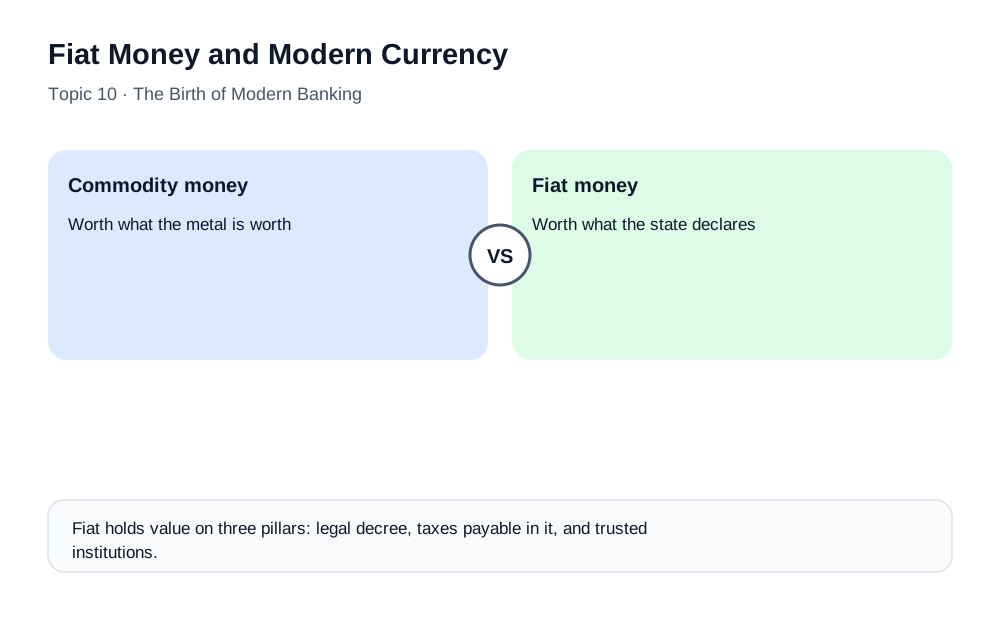
Fiat Money and Modern Currency at a glance — Government decree, legal tender, trust in institutions.
1. The Core Concept: Value by Decree
The word "fiat" comes from Latin and means "let it be done" — the language of official command. Fiat money is money that exists and has value by government decree, not because of any intrinsic worth of the material it is made from.
Fiat currency is sovereign money whose monetary value is not defined by a promise to redeem it for a fixed quantity of a commodity such as gold or silver. Its acceptance rests on the monetary and legal framework, tax obligations, payment usability, convertibility at par within the banking system, and confidence in the institutions managing the currency.
This definition contains three essential elements:
- Sovereign monetary framework. The state defines the unit of account, accepts it for taxes and public obligations, and establishes legal rules governing monetary debts. Legal-tender provisions are jurisdiction-specific and should not be confused with a universal obligation for every merchant to accept cash.
- Public trust and acceptance. The declaration only works because people, businesses, and banks accept the currency in exchange for real goods and services — confident that others will accept it in turn.
- No intrinsic or commodity value. The paper, polymer, or digital record has negligible value in itself. Nothing physical "backs" it in the traditional sense.
That third element unsettles many people when they first encounter it. If a $100 note is just paper, what stops it from becoming worthless tomorrow? The answer is a carefully constructed architecture of law, taxation, institutional credibility, and collective confidence. When that architecture holds, fiat money works remarkably well. When it collapses, the results can be catastrophic, as the hyperinflation case studies later in this topic show.
A useful mental image: fiat money is like a national language. A language has no intrinsic physical value — it is just sounds and symbols — yet it is enormously powerful because everyone agrees to use it and the state conducts its business in it. Money works the same way: its value is a social and institutional achievement, not a physical property.
2. A Brief History: From Gold to Decree
To appreciate fiat money, it helps to understand what came before it. As we explored in Topic 2 (the evolution of money), human economies have used several forms of money, and fiat currency is the most recent stage.
Commodity money came first: money with value in its own right. Cattle, grain, salt, shells, and eventually precious metals served as money because they were useful, scarce, durable, and widely desired. A gold coin needed no government decree — the gold itself was valuable.
Representative (commodity-backed) money followed. Paper notes were introduced as convenient claims on commodities. Under a gold-convertibility regime, eligible monetary liabilities could be redeemable for gold at an official parity subject to the rules then in force. A banknote was therefore a monetary liability with a convertibility promise, not literally a warehouse receipt assigning a specific quantity of stored metal to its holder.
The transition to pure fiat happened gradually, then suddenly. The strains of two world wars and the Great Depression pushed countries to suspend gold convertibility. After World War II, the Bretton Woods system (1944) created a compromise: most currencies were pegged to the US dollar, and the dollar alone remained convertible into gold at $35 per ounce for foreign governments.
The final break came on 15 August 1971, when US President Richard Nixon suspended the dollar's convertibility into gold — the "Nixon Shock." The United States had issued far more dollars than its gold reserves could cover, and foreign governments were increasingly demanding gold. Rather than deplete its reserves, the US closed the "gold window." By March 1973 the major currencies had moved into generalized floating and the international system no longer relied on a gold anchor. Exchange-rate regimes nevertheless remained diverse, with many currencies managed or pegged to other fiat currencies rather than freely floating.
This history carries a practical lesson: fiat money in its pure form is barely five decades old. Its continued success depends on the quality of the institutions that manage it — which is why central banking (Topic 8) and monetary policy (Topic 11) matter so much.
3. Fiat Money vs Commodity Money
The distinction is fundamental, so it is worth setting out side by side:
| Aspect | Commodity Money | Fiat Money |
|---|---|---|
| Source of value | Intrinsic value of the material (gold, silver) | Government decree and public trust |
| Intrinsic value | High — useful independent of its role as money | Negligible — paper, polymer, or digital entries |
| Supply | Constrained by the commodity supply and the monetary rules governing convertibility | Central-bank money is controlled by the monetary authority; broad money also depends on commercial-bank lending, repayment, funding, regulation and credit demand |
| Backing | Self-backing (the commodity itself) | Faith in the issuing government and economy |
| Inflation risk | Low in normal times, but vulnerable to supply shocks | Depends entirely on monetary management |
| Flexibility in crises | Very limited — supply cannot expand when needed | High — central banks can respond to emergencies |
| Historical examples | Gold and silver coins, salt, cattle | US dollar, euro, pound sterling, yen, rupee |
Each system has genuine strengths and weaknesses. Commodity money's natural scarcity disciplines governments — but that scarcity becomes a straitjacket during wars, depressions, and financial crises, when an economy desperately needs flexible money. Fiat money provides that flexibility — but removes the automatic discipline, placing enormous responsibility on the competence and integrity of central banks and governments. The global move to fiat was a deliberate choice to accept the second risk in exchange for escaping the first.
4. Why Does Fiat Money Have Value? The Three Pillars
This is the question at the heart of the topic. Fiat money is not valuable "just because people believe in it" — belief alone is too fragile a foundation. In practice, the value of a sound fiat currency rests on three mutually reinforcing pillars.
Pillar 1: Legal status and tax demand
The sovereign defines its monetary unit and normally requires public obligations such as taxes to be discharged through legally recognised payment arrangements denominated in that unit. This creates recurring demand for the currency, although exact tax-payment methods and legal-tender rules vary by jurisdiction. Tax demand is an important support for monetary use, not a complete explanation of the currency's market value.
Pillar 2: Network acceptance
Money is useful because it is widely accepted and prices, wages, contracts and bank accounts are commonly denominated in the sovereign unit. Acceptance is extensive but not literally universal: merchants may lawfully restrict payment methods in many jurisdictions, contracts can use foreign currencies, and cross-border activity may rely on another unit. Each person's willingness to accept the currency reinforces everyone else's: you accept dollars or rupees or euros because you are confident the next person will, and they are confident because you do.
Pillar 3: Institutional credibility
The value of money depends on its purchasing power remaining reasonably stable — money that loses value quickly stops being accepted. An independent central bank with a clear mandate (usually low and stable inflation), transparent policies, and a track record of competence gives people confidence that the currency will hold its value. The strength of the underlying economy — its productivity, institutions, rule of law, and political stability — underpins everything.
When people say a fiat currency is "backed by nothing," they are usually contrasting it with commodity redemption. A fiat currency is not a redeemable claim on the economy or on future tax receipts. Its monetary value is supported by a broader institutional environment: tax obligations, legal and payment-system use, monetary-policy credibility, productive capacity and confidence that the unit will continue to function as a reliable medium of exchange and store of nominal value. Whether that backing is strong or weak depends on how well these pillars are maintained — which is why the same fiat system produces both the Swiss franc and the Zimbabwean dollar.
5. Legal Tender: What It Really Means
"Legal tender" is one of the most misunderstood terms in everyday finance, so let us define it precisely.
Legal tender is a legal concept governing the discharge of monetary obligations. Its exact effect, permitted denominations, limits and exceptions depend on the jurisdiction; it does not by itself mean that every seller must accept every cash payment.
The key phrase is "to settle a debt." The consequences of a valid legal-tender offer depend on the applicable law and the nature of the obligation. In some systems it affects whether a debtor can be treated as remaining in default or can stop further interest or costs, but the exact legal effect should be checked jurisdiction by jurisdiction rather than stated as a universal rule.
Here is the nuance that surprises most people: legal tender laws typically do not force a seller to accept cash in an ordinary purchase. When you walk into a shop, no debt exists yet — the transaction is an offer and acceptance between you and the merchant. In many jurisdictions, a business can legally refuse cash entirely and insist on card payment, provided this is made clear in advance. Some cities and countries have passed specific laws requiring cash acceptance to protect people without bank accounts, but that is a separate consumer-protection rule, not a consequence of legal tender status.
Two practical examples:
- Settling a debt: You owe a plumber $500 for completed work. Whether a cash tender has a specific legal effect depends on the jurisdiction, contract and denomination rules; legal-tender status is relevant, but it should not be turned into a universal rule that every creditor must accept every form of cash.
- Making a purchase: A coffee shop displays "card payments only." You cannot compel them to accept your $10 note, because no debt exists until they agree to serve you.
Legal tender status still matters enormously. It guarantees the currency can always discharge tax liabilities, court judgments, and contractual debts — the deepest layer of the economy's payment obligations. Combined with tax demand, it anchors the currency at the foundation of economic life.
6. Who Controls Fiat Money? The Central Bank's Toolkit
Because fiat money has no anchor in a physical commodity, its supply and value must be actively managed. That responsibility falls to the central bank — the Federal Reserve in the United States, the European Central Bank in the eurozone, the Bank of England, the Reserve Bank of India, and so on. (We covered central banks in depth in Topic 8; here we focus on their role as guardians of the currency.)
The central bank's core challenge is to set monetary and liquidity conditions consistent with its statutory objectives, commonly including price stability. It controls central-bank money directly, while the much larger stock of commercial-bank deposit money responds to lending, repayment, funding conditions, regulation, risk appetite and credit demand as well as monetary policy. The main tools are:
Policy interest rates. Raising or lowering the benchmark rate makes credit more expensive or cheaper throughout the banking system. Higher rates restrain borrowing and spending (cooling inflation); lower rates stimulate them (fighting recessions).
Open market and liquidity operations. Depending on the operating framework, the central bank buys or sells assets, conducts repos or other liquidity operations, and remunerates reserve balances to steer short-term rates and reserve conditions. An asset purchase creates central-bank reserves; it does not mechanically create an equivalent amount of household or business deposits or lending.
Reserve requirements. Some jurisdictions require banks to maintain specified reserve balances or ratios, while others rely on different operating frameworks. Reserve requirements can affect liquidity conditions and intermediation costs, but bank lending is not mechanically capped by a simple reserve-ratio money multiplier; capital, funding, credit risk, regulation and borrower demand also constrain lending.
Quantitative easing (QE) and tightening (QT). Central banks can expand or reduce their securities holdings to influence financial conditions, especially when conventional rate policy is constrained. QE creates central-bank reserves as assets are purchased; QT reduces or allows those holdings and associated reserve balances to decline over time. Neither process maps one-for-one into commercial-bank lending or broad money.
Currency issuance and cash distribution. Central banks commonly issue banknotes and organise their distribution and replacement. Coin issuance and minting arrangements can sit with a treasury, finance ministry or mint depending on the jurisdiction, so physical currency should not universally be attributed to the central bank alone.
Too little money, and the economy suffocates — credit dries up and deflation can take hold. Too much, and each unit buys less — inflation erodes savings and destabilises planning. A crucial institutional point: fiat money works best when the central bank is independent from day-to-day politics. Elected governments face constant temptation to print money for popular spending. Many major hyperinflations involved severe fiscal breakdown and monetary financing of government deficits, often alongside war, political instability, output collapse or external shocks. The fiscal-monetary link is central, but historical episodes differ and should not be reduced to one universal cause. Central bank independence is essentially a pre-commitment device: society tying its own hands to protect the currency.
7. Cash, Deposits, and the Two Faces of Fiat Money
Here is a subtlety most introductions to fiat money miss: most fiat money is not cash.
When we say "the money supply," we mean two quite different things bundled together:
Physical currency — notes and coins issued directly by the central bank and the government mint. In most advanced economies, physical cash represents only a small fraction of total money.
Bank deposits — the numbers in your current and savings accounts. As we explained in Topic 4 (how banks create money), the vast majority of money in a modern economy is created by commercial banks when they make loans. Your deposit balance is a claim on your bank, denominated in the national fiat currency — not a stack of notes with your name on it.
These are different forms of money denominated in the same fiat unit. Notes and reserve balances are central-bank liabilities; a customer's bank deposit is a liability of the commercial bank. The monetary system is designed to keep reputable commercial-bank deposits convertible at par into cash and transferable at par to other banks. Central-bank liquidity supports settlement, while deposit insurance or guarantee schemes—whose institutional home varies by jurisdiction—protect eligible depositors up to defined limits.
This two-tier structure has important implications:
- The central bank directly controls only the base of the system (physical cash plus bank reserves). The much larger deposit layer expands and contracts through commercial bank lending.
- A run can create an extreme liquidity problem. Commercial-bank deposits greatly exceed the stock of notes normally circulating, but central banks can issue additional cash and reserves subject to operational and policy constraints. Deposit protection, emergency liquidity, resolution frameworks and credible supervision all help reduce destabilising runs; no single mechanism exists solely for that purpose.
- "Printing money" is mostly digital. When people say a central bank is printing money, they usually mean it is creating bank reserves electronically — not running printing presses.
The practical takeaway is that notes and commercial-bank deposits use the same sovereign unit of account but are legally different claims. Their everyday one-for-one interchangeability is an institutional achievement supported by regulation, bank liquidity, settlement in central-bank money and, where applicable, deposit-protection arrangements.
8. When Fiat Fails: Hyperinflation Case Studies
The strongest argument ever made against fiat money is not theoretical — it is historical. When the three pillars collapse, fiat currencies can fail with devastating speed. Hyperinflation (conventionally defined as inflation exceeding 50% per month) is the terminal stage of that failure. Three cases teach the essential lessons.
Case Study 1: Weimar Germany, 1921–1923
Germany emerged from World War I with a shattered economy and massive reparations demanded by the victorious Allies, payable partly in gold and foreign currency. The government ran enormous deficits and, lacking the ability or will to tax sufficiently, financed them by printing money. As the money supply exploded, prices followed: inflation reached roughly 29,500% per month at the 1923 peak. Workers were paid twice daily and rushed to spend wages before they became worthless; people carted cash in wheelbarrows and burned banknotes for heat. Savings, pensions, insurance policies, and bonds — the entire middle class's stored wealth — were annihilated.
The lesson: hyperinflation begins when a government finances its deficit with the printing press and a central bank unable or unwilling to refuse.
Case Study 2: Zimbabwe, 2007–2008
Zimbabwe's crisis followed a collapse in productive capacity combined with persistent fiscal deficits financed by money creation. The Reserve Bank printed ever-larger denominations — at the height of the crisis, a 100 trillion dollar note. Monthly inflation peaked at an almost incomprehensible estimated 79.6 billion percent in November 2008. The currency became functionally worthless, the economy dollarised informally, and in 2009 Zimbabwe abandoned its own currency entirely, adopting the US dollar and other foreign currencies.
The lesson: once public confidence breaks, the network-acceptance pillar fails — people simply stop using the currency, and no decree can force them back.
Case Study 3: Venezuela's hyperinflationary crisis in the late 2010s
Venezuela combined all the classic ingredients: dependence on a single export (oil), a collapse in oil prices, severe economic mismanagement, destructive price and exchange controls, and — decisively — a central bank directed to finance massive government deficits. Annual inflation exceeded 1,000,000% at the 2018–2019 peak. The bolívar was redenominated repeatedly, millions of citizens emigrated, and everyday commerce shifted heavily toward US dollars.
The lesson: hyperinflation is never just a monetary event. It is the final symptom of institutional breakdown — the currency is where the failure becomes visible.
The common pattern
Every hyperinflation shares the same anatomy: (1) a government with spending it cannot finance through taxes or borrowing, (2) a central bank forced to print the difference, (3) accelerating loss of public confidence, and (4) a velocity collapse — people spending money as fast as they receive it, multiplying the inflationary effect of every printed unit. The record also shows the reverse: fiat currencies managed by credible, independent institutions — the dollar, euro, yen, franc, pound — have delivered decades of relative stability. The system is only as good as its stewards.
9. Why the US Dollar Rules the World
In a world of roughly 180 currencies, one dominates. The US dollar is involved in the great majority of global foreign exchange transactions, is the primary currency for pricing international trade (oil, commodities, aircraft), and accounts for roughly 58% of the world's disclosed official foreign exchange reserves — far ahead of the euro at around 20%.
This dominance, sometimes called the dollar's "exorbitant privilege," confers real advantages:
- Cheap borrowing. Global demand for safe dollar assets (especially US Treasury bonds) lets the US government borrow at lower interest rates than its finances might otherwise allow.
- Sanctions power. Because most international payments clear through the dollar system and US-regulated banks, the United States can project financial pressure far beyond its borders.
- Trade convenience. American firms trade in their own currency, avoiding exchange rate risk that others must manage and hedge.
But the privilege cuts both ways. Persistent global demand for dollars tends to keep the dollar strong, making American exports more expensive — one factor behind chronic US trade deficits. And reserve status creates an obligation: the world expects the Federal Reserve to supply dollar liquidity in global crises (as it did via swap lines in 2008 and 2020), effectively making the Fed a backstop central banker to the world.
Could the dollar be displaced? The euro was designed partly as a challenger; China's renminbi is gradually internationalising. Yet displacing a reserve currency requires what challengers still lack: deep, open, trusted capital markets and institutional credibility built over generations. Reserve status is ultimately a trust ranking — slow to build and slow to lose. Most economists expect the dollar's centrality to diminish only gradually, over decades, rather than through any sudden shift.
10. Protecting the Currency: Security Features
Because fiat money's value vastly exceeds its production cost, counterfeiting has always been profitable — and protecting physical currency is a constant technological arms race. A modern banknote is one of the most engineered objects you will ever handle. Typical security features include:
- Watermark — a portrait or pattern embedded in the paper during manufacture, visible when held to light.
- Security thread — a thin strip embedded in (or windowed through) the note, often micro-printed and sometimes colour-shifting.
- Colour-shifting ink — numerals that change colour as the note is tilted, produced with optically variable ink unavailable commercially.
- Microprinting — text so small it appears as a line to the naked eye and blurs when photocopied.
- Raised (intaglio) printing — distinctive tactile ridges you can feel; also essential for visually impaired users.
- Holograms and foil patches — multi-dimensional images that change with viewing angle.
- UV features — patterns invisible in normal light that glow under ultraviolet, allowing instant machine verification.
- See-through register — partial images on each side that align into a complete picture only when held to light.
Protection also operates at the system level: central banks continuously upgrade designs (polymer banknote transitions in the UK, Canada, and Australia), banks and retailers use detection machines, and counterfeiting is prosecuted as a grave crime — historically treated as an attack on the state itself.
For everyday users, the advice is consistent worldwide: feel, look, tilt. Feel the raised print, look at the watermark against the light, and tilt to see colour shifts. If a note feels wrong, do not accept it — and never pass on a suspected counterfeit, which is itself a crime in most jurisdictions.
11. Fiat Money in the Digital Age
Fiat money began as paper, but its future is increasingly digital. Three developments are reshaping what "fiat currency" means in practice.
The decline of cash. Card and mobile payments have made physical cash a minority of transactions in many economies — in Sweden, cash accounts for only a small single-digit share of payment volume. This raises real policy questions: cash serves the unbanked, works during power and network outages, and provides privacy that digital payments do not. Many central banks now explicitly commit to maintaining cash availability, treating it as essential public infrastructure.
Stablecoins: private tokens pegged to fiat. Cryptocurrencies like Bitcoin are not fiat money — no government issuer, no legal tender status, volatile purchasing power. Stablecoins (such as USDC or USDT) are a hybrid: privately issued digital tokens designed to hold a fixed value against a fiat currency, typically backed by reserves of cash and government bonds. They function as digital claims on fiat money rather than fiat money itself, and regulators are actively developing frameworks for their issuance — a topic we explore in Topic 107.
Central Bank Digital Currencies (CBDCs). The most direct digital evolution of fiat: central bank money in purely digital form, available to the public — essentially a digital banknote with the same state backing as physical cash. China's digital yuan (e-CNY) is the most advanced major-economy pilot; the digital euro and a potential digital dollar remain under study. CBDCs would not change what fiat money is — value by state decree and institutional trust — but would change how the public holds and spends it. We examine CBDCs in detail in Topic 108.
The enduring point: whether fiat money exists as polymer notes, bank deposits, or future CBDC wallets, its defining nature — government-declared money sustained by trust and institutional management — remains the same. Technology changes the form; the monetary foundation does not change.
12. The Customer and Bank Perspectives
From your perspective as a customer, fiat money's properties shape your financial life in ways worth understanding consciously:
- Your savings are denominated in trust. The real value of your deposit depends on inflation — which depends on monetary management. A 3% interest rate during 6% inflation means your purchasing power is shrinking even as your balance grows (Topic 11 explores inflation in depth).
- Deposit protection is part of the fiat architecture. Deposit insurance (Topic 9) exists because the deposit layer rests on confidence; the guarantee keeps that confidence stable through bank failures.
- You hold exchange rate risk when you travel, trade, or invest abroad. Fiat currencies float against each other, and their relative values move constantly (Topic 64 covers exchange rates).
- Cash remains your fallback. Digital payments depend on networks and electricity; keeping modest cash on hand for emergencies is prudent.
From the bank's perspective, fiat money is the raw material of the entire business:
- Every asset and liability on the balance sheet is denominated in the national fiat unit; capital adequacy, liquidity, and profitability are all measured in it.
- Banks are the distribution channel of monetary policy: central bank decisions flow through banks' lending and deposit rates to the whole economy.
- Banks operate the cash cycle — ordering notes, stocking ATMs, authenticating currency, returning worn notes — a substantial and invisible operational function.
- Compliance obligations (anti-money-laundering, sanctions screening, counterfeit detection) make banks front-line guardians of the currency system's integrity.
13. Risk, Regulation, and Systemic Safeguards
The fiat system concentrates enormous power — the power to create money — and therefore requires equally serious safeguards:
Inflation risk is managed through central bank independence, explicit inflation targets (2% is the most common benchmark among major central banks), transparent policy communication, and accountability mechanisms such as parliamentary testimony and published minutes.
Fiscal dominance risk — the danger that government borrowing needs overwhelm monetary discipline, the root cause of every hyperinflation — is addressed through legal restrictions on direct central bank financing of governments and institutional separation between the treasury and the central bank. These protections are only as strong as the political culture sustaining them, which is why currency crises so often coincide with institutional breakdown.
Counterfeiting risk is managed through security features, continuous note redesign, law enforcement, and international cooperation.
Confidence risk — bank runs and currency panics — is managed through deposit insurance, central bank emergency lending (the "lender of last resort" function), capital and liquidity regulation, and crisis communication.
External risk — speculative attack or capital flight against the currency — is managed through foreign exchange reserves, exchange rate policy choices (float, peg, or managed float), and, in extreme cases, capital controls.
The recurring theme: fiat money replaces the automatic discipline of gold with institutional discipline. Every safeguard above is a human arrangement that must be maintained and defended. That is fiat money's greatest vulnerability and — because institutions can adapt in ways a gold standard never could — also its greatest strength.
14. Advantages and Disadvantages: An Honest Assessment
Advantages of fiat money:
- Flexibility. Central banks can expand liquidity during crises — 2008 and 2020 would have been catastrophically worse under a rigid gold standard.
- Cost efficiency. No need to mine, refine, store, and guard vast gold reserves to back the currency.
- Countercyclical policy. Money supply can be managed against the economic cycle — tightened in booms, loosened in recessions.
- Supports economic growth. Money supply can grow with the economy rather than being capped by geological accident.
- Practical convenience. Paper, polymer, and digital forms are light, divisible, durable, and easy to transfer.
Disadvantages and vulnerabilities:
- Inflation risk. Nothing physical prevents over-issuance; discipline is purely institutional.
- Hyperinflation tail risk. When institutions fail, fiat currencies can collapse completely — commodity money never becomes worthless.
- Dependence on trust. The system's value is a confidence structure; confidence can erode gradually or break suddenly.
- Political temptation. Governments face constant incentive to monetise deficits; independence frameworks must continually resist this.
- Purchasing power decay. Even well-managed fiat currencies lose value slowly by design (a 2% inflation target halves purchasing power roughly every 35 years) — a deliberate feature that critics see as a hidden tax on savers.
The fairest summary: fiat money is a tool of extraordinary power that demands extraordinary governance. Its record contains both the stability of the modern Swiss franc and the ashes of the Zimbabwean dollar — and the difference between them is never the paper. It is always the institutions.
15. Common Mistakes and Misconceptions
Misconception 1: "Fiat money is backed by nothing." It is not backed by a commodity, but it is backed by the government's taxing power, the legal system, the central bank's credibility, and the productive capacity of the entire economy. "Backed by nothing" confuses commodity backing with any backing whatsoever.
Misconception 2: "All fiat currencies eventually fail." History contains spectacular fiat failures — but also fiat currencies that have delivered stability for generations. Failure is a risk of mismanagement, not a law of nature.
Misconception 3: "Legal tender means shops must accept cash." Legal tender governs the settlement of debts, not ordinary purchases. Businesses in many jurisdictions can legally refuse cash at the till.
Misconception 4: "Printing money means running printing presses." Modern money creation is overwhelmingly digital — central bank reserves and commercial bank deposits. Physical note production simply follows cash demand.
Misconception 5: "Bitcoin and stablecoins are fiat money." Neither is. Cryptocurrencies have no state issuer or legal tender status; stablecoins are private claims pegged to fiat currency. Only a CBDC would be genuinely digital fiat.
Misconception 6: "The gold standard prevented all monetary problems." Commodity standards produced their own crises — deflationary spirals, supply shocks, and brutal rigidity during depressions. The 1930s depression was deepened, not prevented, by gold standard constraints.
Misconception 7: "Hyperinflation is caused by greedy shops raising prices." Price rises are the symptom, not the cause. Every hyperinflation traces back to governments financing deficits through money creation, collapsing the currency's supply-demand balance and the public's trust.
16. Frequently Asked Questions
What does "fiat" literally mean? Latin for "let it be done" — the language of official decree. Fiat money has value because the state declares it, not because of what it is made of.
Is the money in my bank account fiat money even though it is digital? Yes. Bank deposits are the largest component of fiat money. They are denominated in the national currency, convertible into cash at par, and ultimately anchored by the central bank.
Can a country return to the gold standard? Technically yes, but practically it would be extraordinarily disruptive: modern money supplies vastly exceed available gold, implying either enormous deflation or a gold price revaluation by orders of magnitude. No major economy seriously proposes it.
What happens to my savings if hyperinflation starts? Cash and fixed-rate deposits lose purchasing power rapidly. Historically, people protect wealth through real assets (property, commodities), foreign currency, or inflation-indexed instruments. The better protection is systemic: strong institutions that prevent hyperinflation in the first place.
Is the US dollar backed by gold today? No. The final link was severed in 1971. The dollar is backed by the US government's taxing authority, legal framework, economic output, and the Federal Reserve's credibility.
Why do some countries use another country's currency? When domestic institutions cannot sustain a trustworthy currency, countries sometimes "dollarise" — adopting the US dollar (Ecuador, El Salvador, Zimbabwe in practice) or another stable currency — effectively importing monetary credibility they cannot produce at home. The cost: they lose independent monetary policy and seigniorage.
What is seigniorage? The profit the state earns from issuing currency: the difference between a note's face value and its production cost. A $100 note costs cents to produce; the difference accrues to the issuer. It is a quiet but significant source of government revenue, and one reason states guard their currency monopoly jealously.
Will CBDCs replace cash? Most central banks designing CBDCs explicitly describe them as a complement to cash, not a replacement — at least initially. Whether cash survives long-term is a societal choice about privacy, resilience, and inclusion, not merely a technology question.
17. Key Terms in This Chapter
- Fiat money — currency with value by government decree and public trust, without commodity backing.
- Legal tender — money that must by law be accepted to settle debts denominated in that currency.
- Commodity money — money with intrinsic value (gold, silver, salt).
- Representative money — paper claims convertible into a commodity, e.g., gold-standard banknotes.
- Bretton Woods system — the 1944–1971 framework pegging currencies to the gold-convertible US dollar.
- Nixon Shock — the 1971 suspension of dollar-gold convertibility, completing the fiat transition.
- Seigniorage — the state's profit from issuing currency (face value minus production cost).
- Hyperinflation — inflation exceeding roughly 50% per month; terminal currency collapse.
- Reserve currency — a currency held by foreign central banks as reserves and used for global trade.
- Exorbitant privilege — the advantages the US gains from the dollar's reserve status.
- Quantitative easing (QE) — large-scale central bank bond purchases that create new money.
- Central bank independence — insulation of monetary policy from short-term political control.
- Fiscal dominance — when government financing needs override monetary discipline; the hyperinflation trigger.
- CBDC (central bank digital currency) — a potential digital form of central bank fiat money.
18. Interview Insights: How This Topic Appears in Banking Interviews
"Why does fiat money have value if it's not backed by gold?" The strongest answer uses the three pillars: tax-driven demand (you must pay taxes in it), legal tender status (it discharges debts by law), and institutional credibility (the central bank protects purchasing power). Add the network effect — universal acceptance reinforcing itself — and you have a complete answer. Bonus depth: commodity backing is not the only form of backing; a currency is ultimately backed by the productive economy and institutions behind it.
"What caused the shift from gold to fiat, and was it a good idea?" Trace the arc: classical gold standard → wartime suspensions → Bretton Woods (dollar-gold link) → Nixon Shock 1971 → floating fiat era. Then give a balanced verdict: fiat enabled crisis-fighting flexibility that prevented repeats of the 1930s, at the price of requiring institutional discipline that sometimes fails. Interviewers reward candidates who present both sides honestly.
"What causes hyperinflation, and how would you prevent it?" Answer with the anatomy, not just the definition: unfinanced fiscal deficits + captive central bank + confidence collapse + velocity surge. Prevention: central bank independence, prohibition of direct deficit monetisation, credible inflation targeting, and fiscal sustainability. Cite one case study (Weimar or Zimbabwe) to show applied understanding.
"Is cryptocurrency going to replace fiat money?" A measured answer scores best: crypto assets currently fail money's core tests (stable purchasing power, universal acceptance, unit of account); stablecoins are fiat-linked claims, not replacements; the more likely evolution is fiat itself going digital via CBDCs.
Summary and Key Takeaways
Fiat money is currency that has value by government decree and public trust rather than commodity backing — and it is the foundation of every modern banking system. The essential points to carry forward:
- "Fiat" means "let it be done." The currency's value begins with state declaration — but declaration alone is never enough to sustain it.
- Value rests on three pillars: tax-driven demand, universal network acceptance, and institutional credibility anchored by the central bank.
- Legal tender is about debts, not shops. Creditors must accept it for debt settlement; merchants can often legally refuse cash for purchases.
- Most fiat money is digital already. Bank deposits — created largely through bank lending — dwarf physical cash, and the two forms are interchangeable at par.
- Central banks actively manage the currency through interest rates, open market operations, and crisis tools like quantitative easing. Independence from political pressure is the critical safeguard.
- Hyperinflation is institutional failure made visible. Weimar Germany, Zimbabwe, and Venezuela share the same anatomy: deficits financed by printing, a captured central bank, and collapsing trust.
- The dollar dominates as the world's reserve currency, conferring "exorbitant privilege" on the US — and corresponding obligations.
- Physical currency is high-technology. Watermarks, security threads, colour-shifting ink, and holograms defend the note against counterfeiting.
- The future is digital fiat. Stablecoins, CBDCs, and declining cash use are reshaping the form of fiat money — but not its fundamental nature.
- Fiat money is only as good as its institutions. It trades the automatic discipline of gold for the adaptable discipline of governance — a trade that has produced both extraordinary stability and extraordinary disaster.
In the next topic, we look under the bonnet of the banking system itself: fractional reserve banking — how banks hold only a fraction of deposits as reserves, lend out the rest, and in doing so create the money and the fragility that define modern banking.
Next: Topic 11 — Fractional Reserve Banking →
<!-- MBA-DEEP-DIVE-START -->Deep Dive: Fiat Is a Monetary System, Not a Claim That Every Dollar Is Government-Issued Cash
A modern fiat economy has several forms of money that use the same unit of account. This is the most important distinction to carry into real banking work. A banknote issued by a central bank is not the same legal claim as a balance in a customer's commercial-bank account. A reserve balance held by a bank at the central bank is different again. Yet all three can be denominated in dollars, euros, rupees or another sovereign fiat unit and are normally exchangeable at par inside a well-functioning monetary system.
That one-for-one relationship is so familiar that users rarely notice the institutional machinery behind it. A customer sees ₹10,000 in an account and expects to withdraw ₹10,000 in notes, transfer ₹10,000 to another bank, or use the account to settle a ₹10,000 bill without applying an exchange rate between "Bank A money" and "Bank B money." Achieving that apparent simplicity is one of the core accomplishments of modern banking.
The three money layers a banking professional should distinguish
Physical currency consists mainly of banknotes and coins. Banknotes are generally central-bank liabilities, while coins may be issued under government or mint arrangements that differ by jurisdiction. Cash is available to the public and can settle many obligations without creating a new claim on a commercial bank.
Central-bank reserves are electronic balances held by eligible institutions at the central bank. A household normally cannot open an ordinary reserve account. Banks use reserves to settle obligations with one another, satisfy applicable liquidity or reserve arrangements and interact with central-bank facilities. Reserves are therefore central-bank money, but they are not ordinary retail money.
Commercial-bank deposits are liabilities of commercial banks. If a customer's current account shows ₹10,000, the customer has a claim on that bank for ₹10,000. The bank has an equal liability on its balance sheet. That deposit can be transferred, withdrawn or used for payment according to the account contract and payment rules. Most money used by households and firms in advanced banking systems is this deposit money rather than physical notes.
Calling all three simply "fiat money" can hide operationally important differences. A better expression is that they are forms of money operating within a fiat monetary system and denominated in the same sovereign unit of account.
How a bank loan creates deposit money
Suppose a bank approves a ₹1,000,000 business loan and credits the borrower's account. At the moment of booking, the bank records a loan asset of ₹1,000,000 and a deposit liability of ₹1,000,000. New commercial-bank deposit money has been created through the expansion of the bank's balance sheet.
The bank has not printed ₹1,000,000 in notes. Nor did the central bank necessarily create ₹1,000,000 of new reserves at that moment. If the borrower later pays a supplier at another bank, reserves or another settlement arrangement are needed between the banks. The lending bank must therefore manage liquidity and funding, but reserve availability is not accurately described as a simple pile that must be lent out before a deposit can be created.
When the borrower repays principal, the reverse occurs. The bank reduces the loan asset and debits deposit money used for repayment, extinguishing that portion of commercial-bank money. Interest is treated differently because it becomes income to the bank rather than simply reversing principal.
This balance-sheet view explains why modern money supply is not under one mechanical control knob. Central banks set the conditions under which banks fund and settle, regulation constrains balance-sheet risk, banks decide whether lending is profitable and prudent, and customers decide whether they want to borrow. Broad money is therefore endogenous to the interaction of policy, banks and the economy.
What keeps commercial-bank money at par with central-bank money
Imagine if a ₹1,000 balance at Bank A traded for only ₹980 at Bank B because people doubted Bank A. Everyday payment would become a currency-conversion problem between banks. Modern monetary systems are designed to prevent that fragmentation.
Several institutions work together. Prudential regulation requires banks to hold capital and manage liquidity. Supervision assesses financial soundness. Payment systems settle interbank obligations. Central banks supply an ultimate settlement asset and may provide liquidity to eligible institutions under defined conditions. Deposit-protection arrangements can reduce the incentive of insured retail customers to run at the first sign of stress. Resolution frameworks provide legal tools for dealing with a failing bank.
None of these makes every bank risk-free. Equity investors can lose money; creditors can face loss depending on the resolution regime; deposit insurance has limits and eligibility rules. The objective is to preserve the functioning of money and payments while allowing bank owners and appropriate creditors to bear risk.
Legal tender has a narrower meaning than everyday acceptance
The phrase "legal tender" often produces two opposite mistakes. One mistake is to assume that anything declared legal tender must be accepted by every shop in every circumstance. The other is to conclude that legal tender is meaningless because many payments occur by bank transfer or card.
The correct answer depends on jurisdiction. Legal-tender rules usually concern the legally recognised means of discharging certain monetary debts and can contain limits by denomination, amount or circumstance. Separate laws may require or permit merchants to accept or refuse cash. Contract terms also matter. A customer therefore should not infer a universal right to force any retailer to accept any form of cash merely from the words "legal tender."
The concept remains important because it identifies money recognised within the legal framework for settling obligations. But the everyday success of the currency depends on much more: banks must provide accounts, payment systems must work, prices and wages must be quoted in the unit, taxes must be payable in it, and users must expect its purchasing power to remain reasonably reliable.
Taxes support demand but do not explain the whole monetary value
A state requiring taxes in its own unit creates a recurring reason for residents and businesses to obtain that unit. This is an important source of monetary demand. It is not, however, a complete theory of the exchange rate or purchasing power.
A strong currency also depends on the productive economy, inflation expectations, interest rates, external balances, financial markets, institutions, political stability and confidence in monetary and fiscal policy. International reserve currencies add another layer because non-residents may demand them for trade invoicing, borrowing, investment, collateral and official reserves even though those users do not owe domestic taxes in the issuing country.
This is why fiat money cannot be reduced to either "government decree" or "collective belief." It is an institutional network in which legal obligations, economic activity, payments, balance sheets and expectations reinforce one another.
A payment example: one retail transfer, three balance sheets
A customer at Bank A sends ₹25,000 to a customer at Bank B. Bank A debits the payer's commercial-bank deposit. Bank B credits the beneficiary's commercial-bank deposit according to the payment scheme and its posting rules. Between the institutions, the payment creates an interbank settlement obligation.
If settlement occurs in central-bank money, Bank A's reserve position is reduced and Bank B's reserve position rises by the relevant settled amount, either transaction by transaction or after a clearing process determines net obligations. The retail customers never held those reserve balances. Their experience is expressed through commercial-bank money; the banks' final settlement is expressed through central-bank money.
This is the practical architecture behind the phrase "one currency." Different issuers and balance sheets participate, but a common settlement asset and legal unit keep the layers aligned.
Cards, wallets and payment apps usually are not new forms of sovereign money
A card changes the way a customer instructs payment; it does not normally create a separate monetary unit. A mobile banking app displays and moves a commercial-bank deposit. Many e-money or wallet products create a claim on the e-money issuer that is expected to be safeguarded according to applicable regulation. The customer experience may look like a bank balance, but the legal structure can differ.
This distinction becomes important when product teams describe every digital balance as "digital money." Ask who the issuer is, what liability the customer holds, where safeguarding assets sit, whether the balance is a bank deposit, how redemption works and what happens in insolvency. The interface does not determine the legal nature of money.
Stablecoins imitate one property of fiat while changing the issuer
A stablecoin denominated as one US dollar attempts to maintain a one-for-one price with the sovereign dollar. The token itself is not Federal Reserve money merely because it uses the dollar as its unit. Its value depends on the issuer's legal obligations, reserve assets, redemption process, custody, technology and regulatory treatment.
If reserves are high quality, segregated and readily redeemable, the token may trade close to par. If holders doubt reserve quality or redemption capacity, the peg can break. This is a private convertibility promise layered on top of a fiat currency, which makes its risk analytically closer to other redeemable claims than to central-bank cash.
CBDC would change access to central-bank money, not the definition of fiat
A central bank digital currency, if issued for public use, would generally be a direct central-bank liability in digital form. That would distinguish it from a commercial-bank deposit and from most privately issued stablecoins. Its design could affect privacy, bank funding, payment resilience and the role of intermediaries.
A CBDC does not make the currency "more fiat" or "less fiat." The sovereign unit already operates without commodity convertibility. The innovation is the form of central-bank liability and who is allowed to hold and transfer it.
Hyperinflation is institutional breakdown expressed through money
Hyperinflation is often summarised as "too much money chasing too few goods." That captures part of the price mechanism but can hide the underlying political economy. Severe fiscal crisis, collapse in tax capacity, loss of productive output, foreign-currency obligations, political instability and inability to borrow can push a government toward monetary financing. Once households expect rapid depreciation, they minimise holdings of the currency, wages and prices reprice faster, and velocity rises sharply.
Money creation and collapsing confidence then reinforce one another. Stopping hyperinflation normally requires more than a new banknote or removing zeros. The fiscal position, monetary financing mechanism and institutional credibility must change. Stabilisation programmes may also require exchange-rate, banking and debt measures depending on the crisis.
For bankers, hyperinflation creates operational problems as well as macroeconomic ones: transaction limits become obsolete, cash denominations fail, pricing systems need constant updates, interest calculations become unstable, accounting numbers lose economic meaning and customers seek foreign currency or real assets. Monetary failure quickly becomes system and data failure.
Inflation under normal fiat management is different from currency failure
A fiat currency can experience positive inflation for long periods while remaining fully functional. Many central banks deliberately target a low positive rate rather than zero inflation because it provides room for relative-price adjustment and reduces the probability of damaging deflation. The exact target and mandate differ by jurisdiction.
The relevant distinction is between controlled changes in the general price level and a loss of the currency's ability to serve as a reliable unit of account, medium of exchange and store of nominal value. A 2–4% annual inflation environment and a monthly hyperinflation are not points on the same practical banking scale; the second changes contracts, behaviour and institutional viability far more radically.
The fiat discipline is institutional rather than metallic
Under a gold regime, convertibility constrains policy through the need to defend the gold parity. Under fiat, there is no metal redemption rule to force adjustment. Discipline instead comes from legal mandates, governance, central-bank credibility, fiscal sustainability, market expectations and political accountability.
This gives policymakers more flexibility in recessions and financial crises, but flexibility is not the same as unlimited capacity. Creating more nominal money cannot create real labour, energy, food, housing or productive capital. If nominal demand persistently outruns an economy's productive capacity, inflation pressure follows. Monetary sovereignty removes the metal constraint; it does not remove real-resource constraints.
Accuracy guardrails for this topic
Do not say that a fiat currency has value only because a government declares it so. Do not call every commercial-bank deposit a direct government or central-bank liability. Do not say a bank lends out pre-existing reserves in a one-for-one money-multiplier process. Do not say legal tender universally forces every merchant to accept cash. Do not say quantitative easing mechanically gives households new spendable money. Do not describe deposit insurance as necessarily provided by the central bank. Do not treat cards, apps or payment rails as separate currencies merely because they digitise payment. And do not claim fiat money is "backed" by national output in the way a gold certificate is redeemable for a backing asset.
The best practical definition is institutional: a fiat monetary system uses a sovereign unit of account whose value is not fixed by commodity redemption. Central-bank money anchors the system, commercial banks create most transaction deposits, payment infrastructures connect institutions, and law and policy work to preserve par convertibility and purchasing-power confidence. That joined structure—not the paper in a wallet—is modern money.
<!-- MBA-DEEP-DIVE-END -->