Visual overview
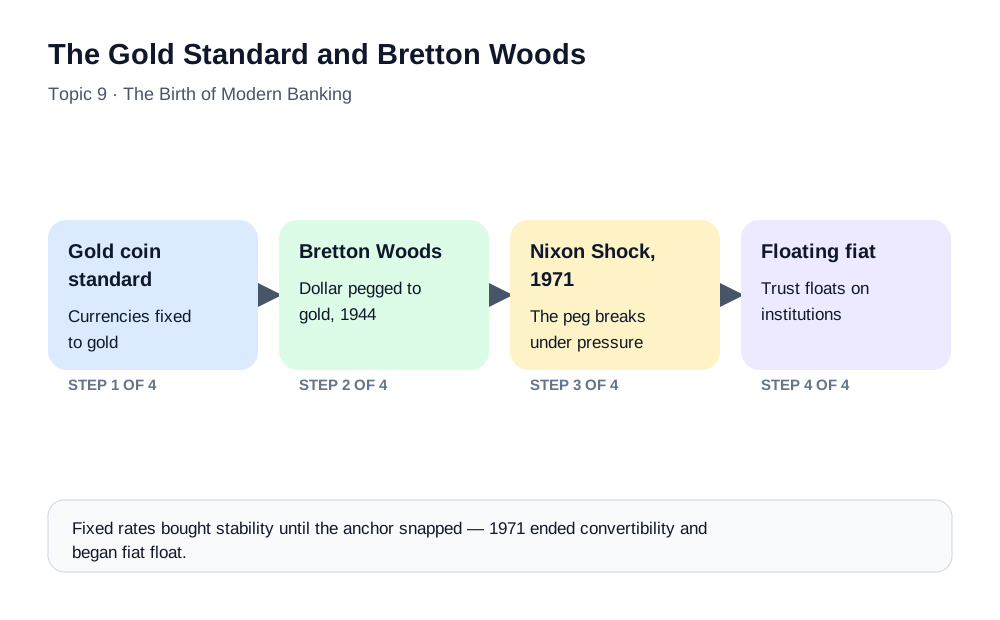
The Gold Standard and Bretton Woods at a glance — Fixed exchange rates, Nixon Shock, fiat money transition.
Fixed Exchange Rates, Nixon Shock, and Fiat Money Transition
For centuries, the world's currencies were tied to gold. This system provided stability but also imposed rigid constraints on economies. The story of how the gold standard rose, operated, and ultimately collapsed is one of the most consequential episodes in financial history — and the single best case study in this course of a universal truth: every monetary system is a promise, and every promise has conditions under which it will be broken.
Learning objectives
- Define the gold standard precisely and explain how gold parities automatically produced fixed exchange rates.
- Explain the price-specie flow mechanism — the self-correcting adjustment engine of the classical system — and its hidden social costs.
- Trace the system's lifecycle: classical era (1870s–1914), wartime suspension, interwar failure, Bretton Woods (1944–1971), and the Nixon Shock.
- Explain the Triffin dilemma and why it made the dollar-based gold-exchange standard mathematically terminal.
- Distinguish commodity money, a gold-exchange standard, and fiat money as progressively abstract foundations of value.
- Evaluate what the gold era teaches about modern exchange-rate regimes, credibility, and constraints on policy.
1. What Is the Gold Standard?
Under the gold standard, a country's currency is directly linked to a specific quantity of gold:
- The government guarantees to exchange its paper money for gold at a fixed rate.
- Convertibility into gold constrains monetary policy and the expansion of the monetary base, but the relationship between gold reserves and the broader money supply is not mechanically one-for-one because commercial bank deposits and credit also form part of money.
- Exchange rates between countries are automatically fixed based on their gold parities.
Example
If the US sets $20.67 = 1 ounce of gold, and Britain sets £4.25 = 1 ounce of gold, then the exchange rate is automatically $20.67 ÷ £4.25 = $4.86 per pound.
Why the parity holds in practice
The arithmetic parity is enforced by arbitrage, and understanding the enforcement is essential. If the market exchange rate drifted far from $4.86 — say a pound could be bought for $4.70 in New York — a trader could buy pounds cheaply in New York, ship them to London, convert them to gold at the Bank of England, ship the gold back, and convert it to dollars at the US Treasury for a riskless profit. This arbitrage pulled market rates back toward parity. Because shipping gold cost money (freight, insurance, interest in transit), rates could actually fluctuate within a narrow band around parity before arbitrage became profitable — the famous gold points, the boundaries of the band. Within the band, rates moved with supply and demand; beyond it, gold itself flowed and forced correction. The "fixed" exchange rate of the gold standard was thus a pegged rate defended by physics: the anchor was not a law but a shipment.
2. History of the Gold Standard
The Classical Gold Standard (1870s–1914)
- Britain formally adopted the gold standard in 1821; most major economies followed by the 1870s.
- This era saw remarkable price stability and international trade growth — the first great age of globalisation, with goods, capital, and people moving across borders at levels not seen again until the late twentieth century.
- The Bank of England was the de facto manager of the global system; London was its financial centre and sterling its reserve currency.
- Persistent external deficits could generate gold outflows and tighter monetary conditions. The textbook price-specie-flow mechanism describes how this pressure can lower domestic prices and improve competitiveness, but actual adjustment also depended on banking behaviour, interest rates, capital flows, policy choices and institutional frictions.
That self-correcting mechanism deserves a full explanation, because it is the intellectual heart of the classical system. Economists call it the price-specie flow mechanism (David Hume described its logic as early as the 18th century):
- A country imports more than it exports. Foreigners are owed the difference, and gold flows out to settle the imbalance.
- Gold loss puts pressure on reserves and monetary conditions. Central banks or banking systems may respond with tighter credit and higher rates; the resulting contraction is not necessarily a mechanically proportional fall in every measure of money.
- Less money chasing the same goods pushes domestic prices and wages down.
- Cheaper domestic goods become more competitive abroad, while foreign goods become relatively dearer. Exports rise, imports fall.
- The trade balance corrects; gold outflow stops. The mirror-image process — gold inflow, monetary expansion, rising prices, falling competitiveness — corrected surpluses simultaneously.
The mechanism created a strong adjustment pressure through reserves, interest rates, credit, capital flows and prices, but it was not literally automatic. Central banks and governments made policy choices about discount rates, convertibility, borrowing and the distribution of domestic adjustment. But notice what did the adjusting: domestic prices and wages, meaning the burden of international imbalance was passed directly into the domestic economy. If your country ran a deficit, the cure was an engineered fall in the price of everything its citizens produced, including their labour. In an era before strong unions, unemployment insurance, or electoral pressure for full employment, governments could let this mechanism grind. The classical gold standard worked, in part, because the societies operating it tolerated adjustment costs that modern democracies would not.
World War I (1914–1918)
- Major belligerents suspended or restricted gold convertibility during World War I so that wartime finance and domestic monetary conditions were no longer constrained by pre-war convertibility rules. Governments relied on combinations of taxation, borrowing and monetary expansion rather than operating under a literally fixed money supply.
- Massive inflation followed in many nations — the predictable result of financing expenditure by money creation, the same dynamic as ancient debasement (Topic 3) at industrial scale.
- After the war, returning to pre-war gold prices proved devastating: prices had risen enormously, so the pre-war parities no longer reflected economic reality.
The Interwar Period (1920s–1930s)
- Britain returned to the gold standard in 1925 at the pre-war parity — this overvalued the pound, making British exports uncompetitive and demanding deflation at home. The decision contributed to industrial strife (including the 1926 General Strike) and years of economic pain. Keynes had warned precisely of this outcome.
- The Great Depression was worsened by the gold standard's constraints and by policy decisions taken to defend parities. Monetary expansion was not literally impossible, but aggressive easing risked gold outflows and loss of convertibility, which sharply constrained crisis response in countries committed to the peg. The adjustment mechanism that had been a virtue in stable times became a trap — defending gold parities required policies that deepened domestic collapse, and gold itself became something to hoard rather than a stabiliser.
- One by one, countries loosened or abandoned pre-war gold commitments. Britain left gold in 1931. The United States suspended domestic gold convertibility and restricted private monetary gold holdings in 1933, then changed the official gold price under the Gold Reserve Act of 1934. The dollar nevertheless remained linked to gold internationally in a different form before and during Bretton Woods. The historical record here is unambiguous and heavily studied: countries that left gold earlier recovered earlier. The lesson reshaped monetary thought permanently — monetary flexibility in a crisis is not a luxury; it is survival equipment.
3. The Bretton Woods System (1944–1971)
In July 1944, representatives from 44 nations met at the Mount Washington Hotel in Bretton Woods, New Hampshire, to design a new global monetary order — deliberately attempting to combine the gold standard's stability with the flexibility its collapse had proven necessary.
The design
- The US dollar was pegged to gold at $35 per ounce.
- All other currencies were pegged to the dollar at fixed (but, in principle, adjustable) exchange rates.
- Countries could adjust their exchange rates in cases of "fundamental disequilibrium," with IMF oversight — the deliberate escape hatch the classical system had lacked.
- Bretton Woods was an adjustable-peg, dollar-centred international monetary system in which the United States maintained an official gold commitment for foreign monetary authorities while other participating currencies maintained par values against the dollar, with changes permitted in defined circumstances. It is often described as a gold-exchange system, but it differed materially from the classical gold standard.
Key institutions created
| Institution | Role |
|---|---|
| International Monetary Fund (IMF) | Monitor exchange rates, provide emergency lending to countries in balance-of-payments difficulty |
| World Bank | Fund reconstruction and development projects |
| GATT (later WTO) | Reduce trade barriers |
Why it worked (initially)
- The US held most of the world's gold reserves after WWII and ran the only major economy undamaged by the war.
- American economic dominance gave the dollar unquestioned credibility; dollars were not merely as good as gold — they were more useful, earning interest and financing trade.
- Fixed exchange rates provided the stability international trade and investment needed to rebuild a shattered world economy.
The fatal flaw: the Triffin dilemma
Buried in the design was a contradiction identified by economist Robert Triffin in 1960. The growing world economy needed a growing supply of dollars for trade and reserves. The only way to supply those dollars was for the United States to run persistent balance-of-payments deficits — exporting dollars. But the more dollars accumulated abroad, the wider the gap grew between outstanding dollars and the US gold stock pledged to redeem them at $35. Confidence in convertibility depended on the ratio of gold to dollars; the system's growth required that ratio to fall continuously. The mechanism that supplied the world's liquidity simultaneously destroyed the credibility of the promise backing it. Triffin identified a structural tension: an international system relying heavily on one national reserve currency needs that currency to be supplied abroad, yet a growing stock of external claims can weaken confidence in a fixed convertibility promise. The tension became increasingly important in Bretton Woods, but the system's collapse also reflected US inflation, fiscal and monetary choices, capital flows, exchange-rate misalignments and political decisions rather than one mathematical law operating alone.
4. The Collapse: Nixon Shock (1971)
By the 1960s, the system was under severe strain:
- US spending exceeded its means — The Vietnam War and Great Society programs created large deficits, financed partly by monetary expansion that exported inflation through the fixed-rate system.
- Dollar overhang — Far more dollars circulated globally than US gold could back at $35.
- Gold drain — France, under de Gaulle, pointedly converted dollars into gold, and other countries followed; US reserves fell steadily.
- Speculators attacked currencies they believed were mispriced, forcing repeated crises and emergency rescues through the late 1960s.
On August 15, 1971, President Richard Nixon announced that the US would no longer convert dollars into gold. This "temporary" measure became permanent.
"I have directed Secretary Connally to suspend temporarily the convertibility of the dollar into gold." — Richard Nixon
Consequences
- The Smithsonian Agreement of December 1971 attempted to establish new parities, but pressures continued. By March 1973 the major currencies had moved into generalized floating, although many countries continued—and still continue—to use managed, pegged or other exchange-rate regimes rather than pure free floating.
- The price of gold surged from $35 per ounce to over $800 by January 1980 — the market repricing an asset that had been artificially priced for a generation.
- The major international monetary system moved away from a gold anchor and into a fiat-currency era. Exchange-rate regimes remained diverse: some currencies floated, while others were managed or pegged to another fiat currency or basket.
Why nobody could stop it
By 1971, maintaining official convertibility at $35 had become increasingly difficult as foreign dollar claims grew relative to US gold and confidence weakened. Suspending convertibility was a policy decision made under severe structural and political pressure. The bank-run analogy is useful for understanding redemption incentives, but foreign official dollar claims were not ordinary bank deposits and the Bretton Woods crisis involved exchange-rate, fiscal, monetary and geopolitical forces as well as reserve arithmetic. The episode is the cleanest modern illustration of the course's oldest lesson (Topic 4): a convertibility promise is only credible while holders believe it can be honoured, and it is only honoured while they believe it. Once the belief breaks, the promise ends.
5. The Transition to Fiat Money
The post-1971 world operates on fiat money, where currencies derive value from:
- Sovereign monetary and legal framework — The state defines the unit of account, accepts it for public obligations and establishes rules for discharging monetary debts; the precise scope of legal-tender rules varies by jurisdiction.
- Central bank management — Monetary policy steers interest rates, reserve conditions and broader financial conditions rather than defending a metal parity. Broad money also reflects commercial-bank lending, repayment, funding, regulation and credit demand (Topic 8).
- Tax-driven demand — Obligations to the state are denominated and payable in the currency (Topic 3's ancient mechanism).
- Economic output — A currency's value reflects the strength, productivity, and stability of its economy.
- Market confidence — Trust in institutions and governance, the fiat-era substitute for the vault.
The transition replaced one discipline with another. Under gold, the discipline was more external and rule-bound because convertibility and reserve losses constrained policy, but domestic credit and deposit money could still expand and contract. The constraint was powerful without being a mechanically fixed ratio between all money and metal. Under fiat, the discipline is institutional and internal: independent central banks, inflation mandates, and credibility built through restraint. The gold standard's enduring appeal — and it retains advocates to this day — is that automatic discipline cannot be talked out of existence by politicians. Its enduring verdict from the 1930s is that automatic discipline cannot adapt when adaptation is the difference between recession and collapse. The modern settlement — flexible fiat money managed by constrained, independent institutions — is the attempt to keep gold's credibility without gold's rigidity. Whether it endures depends, as it always has, on whether the institutions keep their promises better than the metal kept its.
6. Worked Example: One Ounce of Gold Through Three Eras
Follow gold's changing role to make the three systems concrete.
Classical era, 1900. You hold a £20 Bank of England note in London. Subject to the legal and institutional convertibility arrangements then in force, the note is redeemable into gold at the official parity. It is a monetary liability under a convertibility regime, not literally a warehouse receipt assigning specific metal to the note holder. A French exporter owed £1,000 accepts payment confident that pounds, francs, and dollars all translate through gold at fixed rates. Your note's backing is physical and its convertibility personal.
Bretton Woods, 1960. You hold a $20 bill in New York. You personally cannot redeem it for gold — convertibility now runs only between the US Treasury and foreign official institutions. The Deutsche Bundesbank, holding dollars from Germany's trade surpluses, can present them for gold at $35 — and increasingly wonders whether it should. Your dollar's backing is now indirect, one step removed, resting on America's gold ratio and America's word.
Fiat era, today. You hold a $20 Federal Reserve note or $20 in a commercial-bank account. Both use the same dollar unit, but they are different legal claims: the note is central-bank money, while the deposit is a liability of the commercial bank. Neither is redeemable for a fixed quantity of gold; par convertibility within the monetary system is supported by the legal, banking and settlement framework. The gold window is a museum exhibit. Your money's backing is institutional credibility — and the system's entire stability apparatus, from inflation targeting to deposit insurance, exists to keep that credibility from being tested the way it was tested in 1931, 1933, and 1971.
7. The Customer and Bank Perspectives
From the customer's perspective, the gold era offered long-run price certainty at the cost of crisis-era insecurity: money kept its value across decades, but banks and currencies could collapse in weeks when convertibility was tested, and depositors had no insurance behind them (Topic 85). Fiat money inverted the trade: gradual erosion of purchasing power across decades (inflation risk, Topic 62) in exchange for system-level shock absorbers — flexible monetary policy, lender-of-last-resort liquidity, and deposit guarantees — that make sudden monetary collapse far rarer.
From the bank's and policymaker's perspective, the gold standard outsourced discipline to geology: credit growth, fiscal expansion, and crisis response all hit the wall of the reserve stock. Bretton Woods kept the wall but added an escape hatch and a referee (the IMF). Fiat removed the wall and replaced it with institutional restraint. Each regime shift re-priced risk across the whole economy: gold constrained bankers and treasuries by scarcity; fiat constrains them by credibility — and credibility, unlike geology, must be defended continuously, which is why the modern central bank's communications, mandates, and track record are strategic assets rather than public relations. A bank's treasury function (Topic 35) internalised the same lesson: under gold, liquidity management meant watching reserve ratios against the vault; under fiat, it means reading the central bank's reaction function — the professional skill of anticipating how the institution that replaced gold will behave when the system is next tested.
8. Digital Banking Implications: The Gold Debate in the Digital Age
The gold standard's logic reappears, mutated, in digital finance. Fixed-supply cryptocurrencies consciously imitate gold's scarcity discipline — a hard cap standing in for a metal stock — and inherit its characteristic problem too: an inelastic supply meeting volatile demand produces violent price swings rather than stable money (Topic 107). Stablecoins, conversely, recreate the Bretton Woods structure in miniature: tokens pegged to a reserve asset, credible only while reserves are verifiably sufficient — and subject to the same run dynamics that broke dollar-gold convertibility when reserve doubts emerge. And recurring proposals for gold-backed digital settlement or commodity-linked CBDC designs show that the search for an external anchor never died; it was digitised. Evaluate every such design with this module's toolkit: what is the parity, who defends it, at what cost, and what happens when everyone tests it at once?
The run dynamics deserve one more layer of detail because they repeat so faithfully. Under Bretton Woods, doubt about the $35 promise accumulated silently for years — the ratio of dollars to gold deteriorating quarter by quarter in public data — and then converted into redemptions all at once when a critical mass of holders decided to be early rather than right. Modern peg and stablecoin failures follow the same two-phase pattern: a slow phase of observable reserve deterioration that sophisticated holders monitor, and a fast phase in which redemption becomes a race. The lesson for any designer or analyst of pegged systems is that credibility is consumed gradually and lost suddenly, and the observable reserve ratio is the gauge to watch. This is as true for a currency board's cover ratio today as it was for the US gold stock in 1968.
9. The Classical System in Operation: A Numerical Walk-Through
The price-specie flow mechanism becomes vivid only with numbers attached. Consider two simplified gold-standard economies in 1890 — Albion and Iberia. To illustrate the textbook mechanism, assume monetary and banking conditions respond strongly to changes in gold reserves; real historical systems were more complex than a fully proportional reserve-to-money relationship.
The imbalance opens. Albion's merchants develop a taste for Iberian wine and textiles. Over a year, Albion imports £12 million of Iberian goods but exports only £9 million of its own manufactures. The £3 million difference must settle somehow, and under gold it settles in gold: Iberian exporters, paid in sterling, present the sterling for gold and ship it home. Albion's reserves fall by £3 million; Iberia's rise by the same amount.
The monetary consequence. Because note issuance is constrained by reserves, Albion's money supply contracts proportionally — say from £100 million toward £97 million — while Iberia's expands from the equivalent of £80 million toward £83 million. No committee decided this; the banking systems of both countries mechanically expand or contract credit against their reserve positions.
The price consequence. Albion's economy now has roughly 3% less money chasing the same goods: prices and wages drift downward. Iberia has nearly 4% more: its prices drift upward. Within a couple of years, Albion's cloth is noticeably cheaper on world markets and Iberian wine noticeably dearer.
The correction. Albion's exporters win back orders; Iberian consumers switch toward now-cheaper Albion goods. The trade gap narrows, gold stops flowing, and the system settles at a new equilibrium — without a single policy decision, tariff, or summit.
The hidden ledger. Now examine what the correction cost. In Albion, the 3% price fall arrived as wage cuts, squeezed margins, farm distress, and bankruptcies among debtors whose fixed debts grew heavier as prices fell — debt deflation in miniature (Topic 5). In Iberia, the boom fed inflation that eroded savings. The mechanism was impartial, automatic, and socially indiscriminate: it did not distinguish between reducing "excess demand" and reducing a miner's wages. The classical gold standard worked beautifully as engineering and brutally as social policy — which is why, when twentieth-century electorates gained power over economic policy, governments increasingly refused to run the mechanism, and the system's foundation crumbled long before its formal end.
10. Silver, Bimetallism, and the Periphery
The gold standard was never the whole monetary world, and a complete account must include the systems that coexisted with it.
Bimetallism. For much of the 19th century, major economies operated legally bimetallic systems, fixing official ratios between gold and silver — France maintained both metals at a legal ratio for decades, and the Latin Monetary Union (formed 1865 by France, Belgium, Switzerland, and others) standardised coinage across borders on bimetallic principles. Bimetallism suffered the arithmetic flaw identified in Topic 3: whenever the market price ratio of the metals drifted from the legal ratio, Gresham's Law drove the undervalued metal out of circulation. Great silver discoveries in the Americas repeatedly depressed silver's market price, straining every bimetallic system and pushing countries, one by one, onto gold alone.
Silver-standard economies. China, India for much of the era, and parts of Latin America ran on silver. When silver's gold price fell steeply in the late 19th century, silver-standard countries experienced effective currency depreciation against gold-standard trading partners — raising their export competitiveness while inflating the local-currency burden of any gold-denominated debts. The gold-silver divergence was not an abstract concern; it redistributed advantage across the world economy and complicated every international balance sheet of the era.
The periphery's experience. For commodity-exporting and borrowing countries of Latin America, Asia, and Eastern Europe, the classical gold standard's discipline cut deeper than in the industrial core. Capital inflows from London financed railways and ports in good times; at the first financial shock in the core, the flows reversed, gold drained from peripheral reserves, and the adjustment mechanism demanded domestic compression from economies least able to absorb it. The pattern — capital floods in during calm, flees during stress, and the periphery adjusts — survived the gold standard itself and reappears in every later era of international finance, a thread Topic 64 (exchange rates) and the crisis chapters pick up again.
The broad lesson of these variations: "the gold standard era" was actually a world of competing metallic standards, legal fictions, and asymmetric burdens, stitched together by the City of London's finance. Its retrospective image of order is partly nostalgia; its daily reality was as politically contested as any monetary regime since.
11. Key Terms in This Chapter
Bretton Woods system. The 1944–1971 monetary order: dollar pegged to gold at $35/oz, other currencies pegged to the dollar, adjustable under IMF oversight.
Fiat money. Currency with no commodity backing, deriving value from law, institutional credibility, and economic output (Topic 10).
Fixed exchange rate. A currency value pegged to another currency or commodity and defended by the issuer (Topic 64).
Floating exchange rate. A currency value determined by market supply and demand, the post-1973 norm for major currencies.
Gold-exchange standard. A system in which one anchor currency is convertible into gold and other currencies peg to the anchor rather than to gold directly.
Gold points. The thresholds around parity, set by gold shipping costs, beyond which arbitrage moved gold and forced exchange rates back.
Gold standard. A monetary system in which currency is convertible into a fixed quantity of gold, limiting money supply to gold reserves.
Nixon Shock. The August 15, 1971 suspension of dollar-gold convertibility, ending Bretton Woods.
Parity (mint parity). The fixed exchange rate implied by two currencies' gold definitions.
Price-specie flow mechanism. The classical self-correction in which gold flows adjust money supply, prices, and trade balances automatically.
Seigniorage (international). The advantage enjoyed by a reserve-currency issuer — like the US under Bretton Woods — whose liabilities circulate as the world's money.
Triffin dilemma. The contradiction that a reserve-currency system must supply growing liquidity through anchor-country deficits while thereby undermining confidence in the anchor's convertibility.
12. Common Mistakes and Misconceptions
"The gold standard lasted continuously until 1971." It was suspended in WWI, reconstructed partially and disastrously in the 1920s, abandoned piecemeal in the 1930s, and replaced in 1944 by a gold-exchange standard that only the dollar anchored. The 1971 event closed a system, not a continuous three-century regime.
"Under Bretton Woods, anyone could swap dollars for gold." Convertibility applied to foreign governments and central banks, not private individuals; US domestic gold convertibility had ended in 1933.
"Nixon devalued the dollar." Nixon severed convertibility; the dollar's market value then floated. Devaluation is a change in a maintained peg; 1971 was the abandonment of the peg itself.
"The gold standard prevented inflation." It constrained long-run average inflation but delivered severe deflations and gold-supply-driven price swings in between. It traded price level stability for devastating short-run volatility.
"Floating rates are inherently unstable." The post-1971 float has coexisted with both disorder and stability; volatility depends on policy credibility and shocks, not the regime label alone. The 1970s were turbulent; the inflation-targeting era that followed was, for decades, notably calm.
"A return to gold would fix modern monetary problems." It would re-impose the adjustment mechanism — domestic price and wage compression — that the interwar experience proved modern democracies cannot sustain, and it would disable crisis-era monetary response. The debate is legitimate; the historical evidence about costs is not ambiguous.
13. Frequently Asked Questions
Q: Why gold, specifically? Gold's properties (Topic 2) — durability, divisibility, uniformity, cognisability, and a supply that grows only slowly and predictably — made it the best natural anchor for money. Silver served similarly in many systems; gold ultimately dominated because its high value density suited an era of large international settlements.
Q: What exactly ended the classical gold standard? World War I. War finance required money creation incompatible with fixed parities, so belligerents suspended convertibility; the pre-war system was never truly restored, and the 1920s reconstruction collapsed in the Depression.
Q: Was Bretton Woods a gold standard? A diluted one — a gold-exchange standard. Only the dollar was gold-convertible, and only for official foreign holders. Other currencies pegged to the dollar, making the system one promise deep: everyone held dollars, and dollars alone were (nominally) gold.
Q: Could the US have saved Bretton Woods? Only by accepting the domestic discipline the system demanded — tighter money and fiscal restraint to shrink the dollar overhang — which domestic politics would not sustain, or by revaluing gold massively, which would have rewarded early redeemers and confirmed the inconsistency. The Triffin logic made some form of ending nearly inevitable.
Q: Do any countries still use a gold standard? No national currency is convertible into gold today. Modern fixed-rate regimes peg to other currencies (dollar or euro pegs, currency boards) rather than to metal — the same discipline idea with a different anchor (Topic 64).
Q: What replaced gold as the world's anchor? Nothing physical — and that is the point. The post-1971 system anchors on institutional credibility: independent central banks with stability mandates, deep government bond markets, and the network position of the dollar. Whether that is sturdier or more fragile than gold is the central open question of modern international finance.
Q: What is a currency board, and how does it relate to the gold standard? A currency board is the modern descendant of gold-standard discipline: a monetary authority that issues domestic currency only against full backing by a foreign anchor currency (such as the dollar or euro) at a fixed rate, renouncing discretionary monetary policy entirely. It trades flexibility for credibility exactly as gold did — and, as several crises have shown, it is tested by markets in exactly the same way.
Q: Did ordinary people benefit from the gold standard? In calm decades, yes: price stability protected savings and made long contracts reliable. In adjustment periods, no: the correction mechanism worked through falling wages, farm prices, and employment, and depositors had no insurance when banks failed. The system's benefits and costs were real but very unevenly distributed — a distributional lesson that applies to every monetary regime debate since.
14. Interview Insights
"Explain the gold standard's self-correcting mechanism." Describe the price-specie flow chain — deficit → gold outflow → monetary contraction → falling prices → restored competitiveness — and then immediately name its cost: adjustment through domestic price and wage compression. Interviewers use this to see whether you can hold both the elegance and the brutality of the mechanism.
"Why did Bretton Woods collapse?" The strong answer is structural, not anecdotal: the Triffin dilemma. World liquidity needs forced US deficits; those deficits outgrew the gold stock; convertibility credibility was arithmetically doomed; France's gold conversions merely brought the date forward. Candidates who blame "Vietnam spending" alone have the proximate cause; Triffin is the mechanism.
"Was the gold standard good or bad?" Refuse the binary with the trade: long-run price-level stability and automatic discipline versus short-run rigidity, deflationary bias, and crisis impotence. Cite the Depression evidence — early leavers recovered earlier — and conclude that the modern fiat-plus-credible-institutions settlement is an attempt to keep the discipline without the rigidity.
"Is anything like a gold standard possible today?" Discuss fixed-supply crypto (scarcity discipline, volatility failure), stablecoins (Bretton Woods in miniature, same run dynamics), and currency boards (the discipline without the metal). This shows you can apply the framework to current instruments rather than treating it as museum history.
Summary and Key Takeaways
- The gold standard fixed currency values to gold, providing stability but limiting monetary flexibility; gold parities made exchange rates automatically fixed, defended by arbitrage within the gold points.
- The classical gold standard (1870s–1914) was the first truly global monetary system; its price-specie flow mechanism corrected imbalances automatically — through domestic price and wage compression that modern societies would not tolerate.
- WWI suspended the system for war finance; the interwar return at overvalued parities deepened the Depression; the historical verdict is clear: countries that left gold earlier recovered earlier.
- Bretton Woods (1944) was a deliberate hybrid — dollar pegged to gold at $35, others pegged to the dollar, IMF as referee — that delivered a generation of stability.
- The Triffin dilemma made the system terminal: supplying world liquidity required US deficits that progressively destroyed the credibility of gold convertibility.
- Nixon ended convertibility on August 15, 1971; rates floated, gold repriced massively, and the fiat era began — money anchored on institutional credibility rather than metal, a settlement that still governs every major currency in the world today, from the dollar to the rupee.
- The permanent trade-off: external automatic discipline (gold) versus internal institutional discipline (fiat); modern monetary architecture is the ongoing attempt to secure the second.
- The gold debate lives on digitally: fixed-supply crypto, stablecoin pegs, and currency boards are all re-runs of this module's central question — what anchors the promise, and who pays when it is tested?
A closing synthesis to carry into Topic 10: the entire arc of this module can be read as three successive answers to one question — what makes money trustworthy? The classical answer was the metal itself: trust the gold, and convertibility makes the paper honest. The Bretton Woods answer was the metal once removed: trust the dollar, because America holds the gold. The fiat answer is institutional: trust the central bank, because its mandate, independence, and track record constrain it. Each answer removed a layer of physical discipline and replaced it with a layer of institutional design; each made money more flexible and more dependent on the quality of governance behind it. Understanding this progression is the key to everything that follows in the course — fiat money, money creation, monetary policy, inflation, and the digital currencies of the final modules are all, in the end, arguments about whether institutions can reliably do the job gold once did, and at what price in vigilance, design, and discipline.
Next: Topic 10 — Fiat Money and Modern Currency →
<!-- MBA-DEEP-DIVE-START -->Deep Dive: Gold Was a Convertibility Rule, Not a Simple Vault Ratio
The gold standard is often taught as though every banknote and every bank deposit were backed one-for-one by gold in a vault. That picture is too simple. A gold standard is better understood as a monetary rule under which the monetary authority commits to a defined relationship between the currency and gold, while banks, money markets and international capital flows operate around that commitment. Gold reserves matter because convertibility must remain credible, but the broader supply of bank deposits and credit can be much larger than the stock of monetary gold.
This distinction matters because it changes the way we interpret both the strengths and the weaknesses of the system. Gold did not eliminate banking leverage, credit cycles, bank runs or financial crises. It constrained the monetary authority's room to respond to them. A central bank defending convertibility could raise interest rates, tighten credit or allow domestic conditions to weaken in order to protect its reserve position. That could restore external balance, but it could also deepen unemployment and deflation.
Convertibility creates a hierarchy of claims
Under a classical gold-standard arrangement, the monetary unit has a legally defined gold content or an official redemption relationship. A banknote is a monetary claim issued within that regime. Commercial-bank deposits are a separate layer: they are claims on individual banks denominated in the same monetary unit. A depositor may convert a bank deposit into notes, and eligible notes may ultimately be convertible into gold under the rules then in force.
That creates a hierarchy. Commercial-bank money depends on confidence in the bank. Banknotes depend on confidence in the issuing authority and the convertibility promise. Gold sits at the end of the chain as the external settlement asset. A run can therefore move upward through the hierarchy: depositors demand notes; banks demand reserve assets; foreign holders demand gold. The monetary authority must be able to meet enough of those demands to keep the promise credible.
The same analytical habit is useful today even though the settlement asset has changed. A retail deposit remains a commercial-bank liability. Central-bank reserves remain a different liability at a higher layer of the domestic monetary system. Modern systems protect par convertibility with prudential regulation, liquidity facilities, deposit insurance and central-bank settlement rather than a gold redemption promise.
Gold points show that "fixed" did not mean motionless
If two currencies each have a fixed gold parity, the cross-rate between them follows from those parities. But market rates can still move within a range. Shipping gold is not free: there are transport, insurance, assay and financing costs. Only when the exchange rate moves far enough from parity does it become profitable to settle by exporting or importing gold.
Those upper and lower boundaries are known as gold points. This is a useful reminder that even a fixed exchange-rate system contains market dynamics. The peg defines the centre; arbitrage and official policy defend it; transaction costs define the band within which rates can move without physical gold flows.
For a modern banking analyst, the closest conceptual comparison is not a permanently frozen FX rate but a credible peg with a defendable intervention band. The bank treasury still asks the same questions: what is the anchor, what assets defend it, who can demand conversion, what is the cost of defence, and what happens if the market believes the authority will abandon the parity?
The price-specie-flow mechanism is a model, not a machine
The textbook adjustment story is elegant. A deficit country loses gold, monetary conditions tighten, prices fall, exports become more competitive and imports become less attractive. A surplus country receives gold, experiences easier conditions and higher prices, and loses some of its competitive advantage. External imbalance therefore tends to correct itself.
Historical economies did not behave as frictionlessly as that sequence suggests. Banks could alter credit independently of a simple reserve ratio. Central banks could raise discount rates to attract capital and defend gold before large physical outflows occurred. International capital movements could finance trade imbalances. Wages and prices could be sticky rather than falling immediately. Governments could suspend convertibility in exceptional circumstances. The mechanism was real as a pressure, but it was mediated through institutions and policy.
The social distribution of adjustment is also essential. Restoring external balance through deflation can mean wage cuts, bankruptcies, unemployment and falling asset prices. In the nineteenth century, political systems often placed a high priority on maintaining the parity. As democratic participation expanded and governments became more responsible for employment and social welfare, accepting severe domestic contraction solely to preserve an external convertibility rule became politically harder.
Gold did not eliminate inflation or crisis
Gold supply is relatively inelastic compared with fiat money, but it is not perfectly fixed. New discoveries, mining technology and shifts in monetary demand can change the purchasing power of gold. The nineteenth century experienced both inflationary and deflationary periods. The correct claim is not that gold guarantees stable prices every year; it is that the long-run monetary anchor constrains discretionary expansion and links price-level behaviour partly to the supply and demand for gold.
Nor did the gold standard eliminate financial crises. Banking panics occurred repeatedly in the nineteenth and early twentieth centuries. A gold constraint can even intensify a panic when a central bank must choose between supporting domestic liquidity and defending reserves. The policy challenge is visible in the famous tension between internal stability and external convertibility.
This is why the gold standard should never be sold as a simple contest between "disciplined gold" and "undisciplined fiat." Both systems need institutions. Gold changes the form of discipline; it does not remove banking risk or political judgment.
World War I changed the monetary bargain
War finance exposed the rigidity of pre-war convertibility. Governments needed enormous resources quickly. They raised taxes, issued debt, borrowed through banking systems and expanded money. Maintaining unrestricted gold redemption while simultaneously mobilising economies for total war became impractical, so major belligerents suspended or restricted convertibility.
After the war, policymakers faced a difficult question: at what parity should currencies return to gold, if at all? Restoring the old parity could require domestic deflation if wartime prices and money stocks had risen substantially. Choosing a new lower parity could be seen as repudiating pre-war commitments. Britain's 1925 return at the old sterling parity is one of the classic examples of the economic costs of attempting to restore a pre-war monetary price after the underlying economy had changed.
The interwar system therefore differed from the classical era in politics, reserve distribution, war debts and central-bank behaviour. Treating the 1920s simply as the return of the old system misses why it proved so fragile.
The United States in 1933–1934: distinguish domestic gold from international gold
The United States did not move from an unchanged classical gold standard directly to pure fiat in one step. In 1933, domestic gold convertibility was suspended and private monetary gold holdings were restricted. The Gold Reserve Act of 1934 transferred monetary gold to the Treasury and changed the official gold price from $20.67 to $35 per ounce, effectively devaluing the dollar against gold.
Yet an international official gold link remained. This distinction matters because Bretton Woods later relied on the dollar's official relationship to gold at $35 per ounce for foreign monetary authorities. A timeline that says "the United States left gold in 1933" is therefore incomplete unless it specifies that the domestic convertibility regime changed while a different official international gold relationship persisted.
Bretton Woods was designed to be more flexible than classical gold
The 1944 Bretton Woods agreement did not simply recreate the nineteenth-century gold standard. Participating countries declared par values, generally in relation to the dollar, while the United States maintained the official dollar-gold relationship. Exchange rates were intended to be stable but adjustable when a country faced fundamental disequilibrium. The IMF provided a framework for surveillance and temporary balance-of-payments support.
Capital controls were also an important part of the post-war environment. Policymakers wanted enough exchange-rate stability to support trade and reconstruction without allowing highly mobile capital to overwhelm domestic economic policy. This is one reason Bretton Woods could coexist with greater domestic policy autonomy than a pure classical-gold interpretation would suggest.
For banks, the system meant that FX risk existed but was organised around official parities and controlled adjustments rather than continuous free floating among major currencies. Cross-border payments still required liquidity, correspondent balances, documentation and foreign-exchange operations. A fixed-rate regime changes the price behaviour of FX risk; it does not remove operational or settlement risk.
The Triffin dilemma is about supplying reserve assets credibly
As international trade and reserves expanded, the world demanded more dollar assets. Supplying those assets required the United States to make dollars available abroad through deficits, investment, lending and other balance-of-payments flows. But a larger stock of external dollar claims relative to the US gold stock made the $35 official convertibility commitment increasingly vulnerable to doubt.
That is the core of the Triffin dilemma: the issuer of the principal reserve asset must supply international liquidity, yet doing so can weaken confidence in the reserve asset's external anchor. The problem is not best described as a one-line mathematical inevitability; policy choices, capital flows and institutional arrangements mattered. But the structural tension was real and became more acute as foreign official dollar holdings grew relative to US gold reserves.
1971 was the suspension; 1973 was the generalized float
On 15 August 1971, President Richard Nixon suspended official dollar convertibility into gold. That decision ended the central gold commitment holding Bretton Woods together, but it did not instantly create today's exchange-rate system. In December 1971, the Smithsonian Agreement attempted to establish revised parities. Pressures continued, further realignments followed, and by March 1973 the major currencies had moved into generalized floating.
Even after 1973, the world did not become uniformly free-floating. Countries have continued to choose among free floats, managed floats, crawling arrangements, currency boards, conventional pegs and monetary unions. The post-Bretton Woods lesson is therefore not "all currencies now float." It is that gold no longer provides the organising anchor for the major international monetary system, leaving jurisdictions to choose exchange-rate regimes within a fiat monetary order.
What this history means for a bank today
The regime matters directly to treasury and risk management. Under a credible fixed exchange rate, day-to-day FX volatility may be low, but tail risk concentrates around devaluation, revaluation or capital controls. A bank can appear to have little market risk until confidence in the peg weakens. Liquidity risk can then rise rapidly as customers convert deposits, buy foreign currency or transfer funds abroad.
Under floating rates, price risk is visible every day and banks hedge it continuously. Under a peg, the risk can be latent. That distinction explains why stress testing should not rely solely on recent historical volatility. A currency that has traded in a narrow range for years can still carry large regime-break risk.
The same logic applies to any convertibility promise, including currency boards and some reserve-backed digital instruments. Ask four questions: what exactly is redeemable, into what asset, by whom, and under what legal conditions? Then ask whether reserves are liquid and available when redemptions accelerate. A convertibility promise is a balance-sheet commitment before it is a marketing statement.
Accuracy guardrails for the gold-standard story
Do not say that every unit of bank money was backed one-for-one by gold. Do not say a gold standard prevents inflation, prevents banking crises or eliminates monetary-policy judgment. Do not say the United States had no central banking history before the Federal Reserve. Do not describe Bretton Woods as identical to classical gold. Do not imply that US citizens could redeem dollars for gold at $35 during Bretton Woods. Do not say the entire world began freely floating on the evening of 15 August 1971. And do not treat the textbook price-specie-flow model as an automatic mechanical law with no role for credit, capital flows or policy.
The enduring lesson is more useful: every fixed monetary promise trades flexibility for credibility. Gold made the promise visible in metal. Bretton Woods made it visible in the dollar-gold relationship. Modern pegs make it visible in reserve portfolios and intervention capacity. The analytical task is always the same—understand the promise, the balance sheet behind it, the adjustment mechanism and the conditions under which policymakers may decide that defending the promise costs more than changing it.
<!-- MBA-DEEP-DIVE-END -->