Among all the institutions that shape modern economic life, central banks wield perhaps the most pervasive yet least understood influence. The Federal Reserve in the United States, the European Central Bank in Frankfurt, the Bank of England in London, and other monetary authorities influence monetary and financial conditions, implement policy through interest rates and balance-sheet tools, provide the settlement asset used by banks, and can act as crisis-liquidity backstops. Supervisory responsibilities differ by jurisdiction, so a central bank should not automatically be described as the regulator of every commercial bank. Their decisions ripple through every aspect of economic activity, affecting the interest rates on mortgages, the availability of credit for businesses, the value of currencies, and ultimately the prosperity of billions of people.
Understanding why central banks were created, how they evolved, and how they operate is essential not only for financial professionals but for anyone seeking to comprehend the forces that shape modern economies. The central bank is both a guardian of monetary stability and a tool of economic management, an institution that must balance multiple objectives while maintaining the trust upon which the entire financial system depends.
Learning objectives
- Explain the structural problems — bank runs, wildcat banking, missing liquidity backstops, and sovereign financing needs — that central banks were created to solve.
- Trace the institutional template from the Bank of England's 1694 fiscal origins to the modern comprehensive monetary authority.
- Describe each core central bank function: monetary policy, financial stability, lender of last resort, currency issuance, government banking, and reserves management.
- Explain how a policy rate decision actually transmits to a family's mortgage and a firm's investment.
- Evaluate the case for and against central bank independence.
- Compare the operating contexts of the major modern central banks.
Visual overview
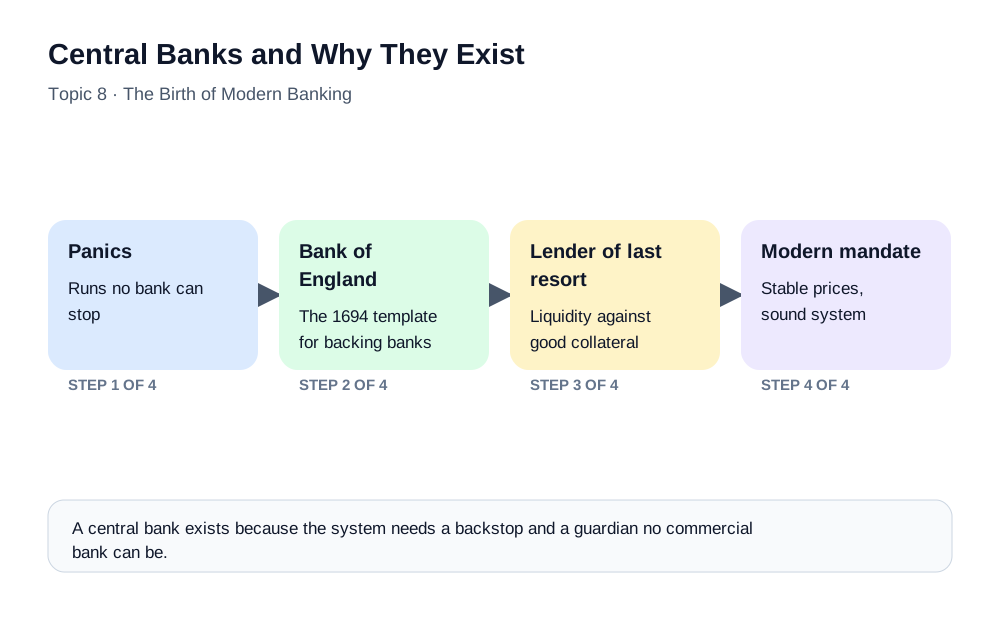
Central Banks and Why They Exist at a glance — Bank of England, lender of last resort, monetary authority.
1. The Problem That Central Banks Solved
Before the emergence of central banks, financial systems were remarkably fragile, prone to periodic crises that could devastate economies and destroy livelihoods. The problems that central banks were designed to address grew from the inherent nature of banking itself and the absence of any institution capable of providing stability when confidence faltered.
Bank runs and contagious panic
Bank runs represented perhaps the most dramatic manifestation of this fragility. Banks fund longer-dated and less liquid assets with liabilities that can include deposits withdrawable on demand or at short notice. That liquidity transformation makes a bank vulnerable when many depositors seek to withdraw or transfer funds at once. The risk is not accurately described as simply lending out a fixed remainder of deposits after keeping a reserve fraction; modern banks manage liquidity through cash, reserves, marketable assets, funding markets and central-bank facilities within prudential constraints. The bank fails not because it is insolvent but because it is illiquid, unable to convert its loans into cash quickly enough to satisfy panicked depositors.
Throughout the nineteenth century and earlier, such bank runs were common occurrences. A rumor of financial difficulty could spark a panic that would destroy a healthy institution overnight. As depositors rushed to withdraw funds, banks would be forced to call in loans or sell assets at distressed prices, spreading financial distress throughout the economy. The absence of any mechanism to stop these panics meant that financial crises could develop with terrifying speed and devastating consequences.
Wildcat banking and currency chaos
Wildcat banking compounded these problems in many countries, particularly the United States during the nineteenth century. Lightly regulated banks, often with minimal capital and questionable management, issued banknotes that circulated as currency. Without any oversight or guarantee, the value of these notes depended entirely on the issuing bank's continued solvency. Notes traded at discounts reflecting the market's assessment of each issuer — a merchant accepting payment had to evaluate the bank, not just the customer. When such banks failed, their notes became worthless, destroying the savings of those who held them and undermining confidence in the entire monetary system. The deeper point: a monetary system without a credible, uniform unit of account re-imposes the verification costs that money was invented to eliminate.
The missing backstop
The absence of a lender of last resort meant that when banks ran out of cash, there was no institution capable of providing temporary liquidity to see them through a crisis. Solvent banks with sound assets could fail simply because they could not convert those assets into cash quickly enough to meet withdrawal demands. The lack of any backstop transformed temporary liquidity problems into permanent institutional failures.
The state's own problem
Governments also needed reliable institutions to finance their operations, particularly during wartime. Monarchs and states required access to credit on terms that would not cripple their finances, and they needed mechanisms for managing the national debt that would maintain confidence in government obligations. The traditional reliance on private banking houses or foreign lenders exposed governments to volatile credit conditions and potential political pressure.
Central banks evolved along different national paths in response to combinations of sovereign finance, note issuance, payment and settlement needs, monetary instability and banking crises. Lender-of-last-resort practice and modern monetary-policy responsibilities were added gradually rather than forming one universal founding blueprint. Notice the design tension embedded at birth: the central bank serves the state that created it, yet must sometimes refuse that same state — a tension this module returns to in the discussion of independence.
2. The Bank of England: The Template for Modern Central Banking
The Bank of England, founded in 1694, established the template that most modern central banks would follow. Its creation was driven by immediate necessity: King William III needed to finance his war against France, and traditional sources of royal finance had proven inadequate. The solution was ingenious in its simplicity and profound in its consequences.
Private investors subscribed £1.2 million to the new bank, lent to the government in exchange for interest and privileges. The new Bank of England could issue notes as part of its banking business and enjoyed important charter privileges, while note-issue arrangements and the Bank's eventual privileged position developed further through later legislation. Its founding transaction provided the government with a major war-financing loan, but the modern monopoly-like note-issue framework should not be projected fully back into 1694. This arrangement, born of fiscal desperation, established a pattern of central bank creation that would be repeated across the world: a bank created to manage government debt that gradually acquired additional central banking functions over time.
As the Bank of England evolved, it absorbed responsibilities that transformed it from a simple government creditor into a true central bank. It became the government's banker, managing official accounts and processing state payments. It took responsibility for managing the national debt, ensuring that government bonds remained attractive to investors and that interest payments were made reliably. It began influencing other banks, using its privileged position to shape banking practices across the country. Most crucially, it gradually assumed the role of lender of last resort, providing emergency liquidity to banks facing temporary difficulties.
Bagehot's dictum: the crisis doctrine
This last function was articulated most clearly by Walter Bagehot, editor of The Economist, in his 1873 book Lombard Street. Bagehot's nineteenth-century analysis is commonly summarised as lending freely in a panic, against good collateral and at a rate intended to discourage routine reliance on emergency support. The formulation remains influential, but it is not a universal legal rule and modern facilities differ by jurisdiction, counterparty, collateral, pricing and crisis circumstances. The underlying distinction is between liquidity support for a viable institution and the much harder problem of insolvency; in practice that distinction can be uncertain during a fast-moving crisis.
The Bank of England's evolution from war financing mechanism to comprehensive monetary authority demonstrated both the potential and the challenges of central banking. Its success in maintaining monetary stability during much of the nineteenth century established central banking as an essential feature of modern financial systems, while its periodic suspensions of gold convertibility during crises revealed the tensions inherent in managing a monetary system subject to conflicting demands — tensions that Topic 9 (the gold standard) and Topic 13 (banking crises) examine in full.
3. The Global Spread of Central Banking
While the Bank of England established the pattern, central banking institutions emerged across the world through the eighteenth, nineteenth, and early twentieth centuries, adapting to local conditions while retaining core functions.
Sveriges Riksbank in Sweden, founded in 1668, actually predates the Bank of England and holds the distinction of being the world's oldest central bank. Created in the aftermath of the failure of a predecessor institution (Stockholms Banco, whose over-issued notes had collapsed), the Riksbank gradually evolved central banking functions and pioneered techniques of monetary management. Its origin story is itself instructive: the world's first central bank was born from a paper-money failure, establishing from the start the link between central banking and monetary credibility.
The Banque de France was established in 1800 under Napoleon to stabilize French finances after the revolutionary period. Its creation demonstrated how political upheaval drives central banking innovation, as new regimes seek monetary institutions capable of supporting their authority and financing their ambitions.
The United States, despite its economic importance, was relatively late. Two earlier experiments (the First and Second Banks of the United States) had been created and then allowed to die amid political suspicion of concentrated financial power. The Federal Reserve System was created only in 1913, following the Panic of 1907 — a crisis contained not by any public institution but by the private efforts of J.P. Morgan and fellow bankers, a rescue that convinced even sceptics that the world's largest economy could not leave its last-resort function to one man's Rolodex. The Fed's unique structure, with twelve regional banks coordinated by a Board of Governors in Washington, reflected American traditions of federalism and distrust of concentrated financial power.
The Reserve Bank of India, established in 1935, represents the adaptation of central banking to a developing economy with a vast population and diverse regional conditions. Its mandate extends beyond monetary stability to include development-oriented objectives reflecting India's particular circumstances, and it was nationalised in 1949 as part of the new state's economic architecture.
The European Central Bank, established in 1998, represents a major structural innovation in central banking. Following Bulgaria's adoption of the euro on 1 January 2026, the euro area has 21 member countries. The ECB conducts a single monetary policy across sovereign states with different fiscal positions, business cycles and banking structures, while national central banks participate through the Eurosystem.
4. The Core Functions of Central Banks
Modern central banks perform several distinct functions that together constitute comprehensive monetary authority. These functions have evolved over centuries of practice and continue to develop in response to changing economic conditions.
Monetary policy
Monetary policy — the use of interest-rate, liquidity and balance-sheet frameworks to influence financial conditions and achieve statutory macroeconomic objectives — represents the most visible central bank function. Broad money is largely commercial-bank deposit money, so modern central banks influence its growth and the conditions under which credit is created rather than mechanically selecting a fixed quantity of money. By setting benchmark interest rates, central banks influence the cost of borrowing throughout the economy, affecting spending by consumers and investment by businesses. Through open market operations, the purchase and sale of securities, central banks adjust the supply of reserves in the banking system, steering short-term rates toward their target. In extraordinary circumstances, central banks employ quantitative easing or tightening, expanding or contracting their balance sheets to influence longer-term rates and broader financial conditions. Topic 60 (monetary policy) develops the full toolkit; the essential point here is that the policy rate is a wholesale price whose influence reaches every retail price of credit in the economy.
Financial stability and supervision
Financial-stability responsibilities have become increasingly important as financial systems have grown more complex. Central banks commonly monitor systemic risk and may contribute to stress testing and macroprudential policy, but the allocation of prudential supervision and macroprudential powers varies across jurisdictions and may be shared with separate regulatory authorities. This role recognizes that the stability of individual banks is not sufficient for system-wide stability: the interconnectedness of modern finance can transmit distress rapidly across institutions and markets, and no single bank can see, let alone manage, the network it is part of. System-level risk requires a system-level institution.
Lender of last resort
The lender of last resort function remains central to central banking, though its exercise has become more sophisticated. When banks face temporary liquidity shortages, central banks can provide emergency funding that prevents solvent institutions from failing due to cash flow problems. This function was exercised at unprecedented scale during the 2008 financial crisis, when central banks around the world provided emergency liquidity on an enormous scale to prevent a complete collapse of the financial system — and again in March 2020, when central banks intervened within days to stabilise markets seizing up at the onset of the pandemic.
Currency issuance
Banknote issuance is one of the most tangible manifestations of central-bank authority in many jurisdictions. The institutional arrangements for coins and, in a few cases, aspects of note issuance can differ, so the broader point is that the state monetary framework controls the official currency while the central bank anchors its monetary value and settlement role. While physical cash constitutes a declining portion of money usage in many countries, managing currency remains important for public confidence and for ensuring sufficient cash is available to meet demand. Central banks also manage the integrity of currency, constantly updating designs and security features to stay ahead of counterfeiters — the modern chapter of the anti-fraud arms race that began with milled coin edges (Topic 3).
Banker to the government
As the government's banker, central banks manage the state's financial operations: maintaining government accounts, processing payments, and managing the issuance and servicing of government debt. This function provides governments with efficient financial services while giving central banks unique insight into fiscal conditions and government financing needs — insight that cuts both ways, since proximity to the treasury is also the channel through which fiscal pressure on monetary policy historically arrives.
Foreign exchange reserves and exchange-rate management
Central banks hold and manage foreign currency reserves, intervene in currency markets when necessary to influence exchange rates, and manage the country's position within international monetary arrangements. For countries with fixed or managed exchange rates, this function is particularly demanding, requiring constant attention to market conditions and reserve adequacy (Topic 64).
Worked example: how one rate decision reaches a household
A central bank raises its policy rate by 0.25 percentage points. What actually happens?
- Money markets move first. Overnight market rates normally adjust rapidly toward the new policy stance because the central bank designs its reserve-remuneration, standing-facility and liquidity framework to steer those rates. The exact mechanism depends on whether the system operates with scarce, ample or abundant reserves.
- Bank funding costs follow. Banks' own borrowing costs — deposits, wholesale funding — adjust upward over weeks.
- Retail rates reprice. New variable-rate loans cost more; fixed-rate offers are quoted higher; mortgage and business loan rates rise; deposit rates creep up more slowly — the gap is the bank's margin (Topic 31).
- Behaviour shifts. A family postpones a home purchase at the new mortgage rate; a firm shelves an expansion whose projected return no longer clears the higher cost of capital; savers earn slightly more and spend slightly less.
- Aggregate demand cools. Multiplied across millions of decisions, spending pressure eases, and with it the inflationary pressure the central bank was targeting — typically with lags of quarters, not weeks, which is why monetary policy requires forecasting rather than reaction.
This transmission chain — policy rate → money markets → bank funding → retail rates → behaviour → demand → prices — is the single most important mechanism in practical central banking, and every step has frictions that central banks study obsessively. When you read that a central bank "raised rates," this chain is what it actually did.
5. Central Bank Independence and Accountability
Most modern central banks operate with considerable independence from elected governments, a practice that reflects hard-learned lessons about the dangers of political interference in monetary policy. This independence, however, exists within frameworks of accountability and legal mandate that vary considerably across countries.
The case for independence
Inflation control requires unpopular decisions. Raising interest rates to cool an overheating economy imposes immediate, visible pain for benefits that arrive later. Politicians facing reelection may be reluctant to impose such restraint, preferring short-term stimulus even when it creates long-term inflationary problems. Independent central bankers, with longer terms and insulation from political pressure, can make these difficult choices on economic rather than electoral calculations.
Credibility does half the work. Markets trust independent institutions more than politically controlled ones because they believe independent central bankers will prioritize price stability over short-term political advantage. This credibility is not merely reputational comfort — it changes outcomes: when workers and firms believe inflation will stay low, they set wages and prices accordingly, and the central bank achieves stability with less drastic action. Independence is, in part, a technology for making promises believable.
Time horizons differ. Politicians naturally focus on the next election; monetary policy operates over quarters and years. Institutions with longer terms and narrower mandates can weigh the full horizon over which their decisions play out.
The limits of independence
Independence is never absolute. Central banks are created by legislation and can be modified or abolished by the same means. They are typically accountable to legislatures, required to report regularly and explain their decisions. Their mandates are established by law, defining the objectives they must pursue and the constraints within which they operate. The balance has also shifted over time: after the 2008 crisis, critics argued central banks had acquired enormous power over credit allocation and asset prices with limited democratic oversight; defenders replied that independence was precisely what allowed decisive crisis response when legislatures were paralysed.
This debate reflects the fundamental tension at the heart of central banking: technical expertise and long horizons must be balanced against the democratic principle that significant public power requires public accountability. Topic 65 examines this tension as a subject in its own right.
6. Central Banks in the Modern World
Today, the world's most influential central banks manage monetary conditions for economies that together constitute the majority of global output. Their decisions affect not only their own countries but the entire international economic system.
The Federal Reserve, with its control of the dollar, the world's primary reserve currency, exercises influence extending far beyond American borders. When the Fed adjusts interest rates, capital flows shift across the globe, exchange rates move, and other central banks must respond — a dynamic sometimes called the global financial cycle, in which Fed policy transmits worldwide through dollar-denominated borrowing everywhere.
The European Central Bank manages monetary policy for the Eurozone, setting a single policy for countries with different economic conditions — a stance that will be too loose for some members and too tight for others at any given moment, making its judgment calls structurally harder than those of single-country central banks.
The Bank of Japan has pioneered policies that push the boundaries of conventional central banking. Its decades of ultra-low rates and massive quantitative easing, deployed against persistent deflation, have provided lessons for other central banks while raising questions about the limits of monetary policy in aging, low-growth societies.
The People's Bank of China manages monetary conditions for the world's second-largest economy using tools that differ significantly from Western practice, including direct guidance over credit quantities alongside market-based rates — a hybrid reflecting China's economic structure. As China's weight grows, the PBOC's decisions increasingly shape global conditions.
The Reserve Bank of India faces perhaps the most complex balancing act of any major central bank: controlling inflation, supporting growth, maintaining financial stability, and advancing financial inclusion for a population exceeding 1.4 billion across a vast and diverse economy. Its flexible inflation-targeting framework, adopted in 2016, illustrates how the inflation-targeting model has been adapted to developing-economy conditions.
7. The Customer and Bank Perspectives
From the citizen-customer's perspective, the central bank is the most powerful institution most people never think about. It does not hold their deposits or approve their loans, yet it sets the price of both, guarantees the cash in their pocket, and stands behind the banking system that holds their savings. Its failures arrive as inflation eroding paycheques or crises destroying jobs; its successes are invisible — panics that never happened, currency that never wavered. This invisibility is why central bank communication has become a policy tool in its own right: an institution whose power works through expectations must explain itself to be effective.
From the commercial bank's perspective, the central bank is simultaneously supplier, regulator, competitor, and insurer. It supplies the reserves every bank needs to settle payments; it supervises balance sheets and conduct; its rate decisions compress or expand lending margins; and its last-resort facilities insure the system against liquidity death. Managing the relationship — reserve positions, regulatory expectations, collateral eligibility at the discount window — is a core treasury discipline in every bank (Topic 35), and understanding the central bank's reaction function is among the most commercially valuable skills in finance.
8. Digital Banking Implications: The Central Bank's Next Chapter
Two digital-era developments follow directly from this module's foundations. First, instant payment systems (Topic 72) extend the central bank's settlement role to retail speed, moving interbank settlement onto rails that clear in seconds — the central bank as operator of the economy's core plumbing, now visible to every smartphone user. Second, central bank digital currencies (Topic 108) ask whether the central bank's liability should be directly available to the public in digital form — potentially the most significant redesign of the two-tier money system (central bank money for banks, bank money for the public) since that system emerged. Both debates are unintelligible without the functions mapped in this module: whoever issues money, settles payments, and backstops liquidity is the central bank, whatever technology it runs on.
9. Key Terms in This Chapter
Bagehot's dictum. The crisis-lending doctrine: lend freely, at a penalty rate, on good collateral.
Central bank independence. The insulation of monetary policy decisions from short-term political control, bounded by legal mandate and accountability.
Discount window / standing facilities. The central bank's mechanisms for lending reserves to banks, routinely or in emergencies.
Fractional reserve banking. The banking model — holding only a fraction of deposits as reserves — whose inherent run risk created the need for a lender of last resort.
Lender of last resort. The central bank's function of providing emergency liquidity to solvent but illiquid institutions during panics.
Macroprudential policy. Regulation aimed at the stability of the financial system as a whole rather than individual institutions.
Monetary policy transmission. The chain from policy rate through money markets, bank funding, retail rates, and behaviour to aggregate demand and prices.
Open market operations. Purchases and sales of securities by the central bank to manage reserves and steer short-term rates.
Policy rate. The benchmark interest rate set by the central bank, anchoring the economy's entire structure of borrowing costs.
Quantitative easing (QE). Large-scale asset purchases expanding the central bank's balance sheet to ease conditions when the policy rate reaches its effective lower bound.
Reserve currency. A currency held by other nations' central banks as reserves, giving its issuer outsized global influence (as with the US dollar and the Fed).
Systemic risk. The risk of distress cascading across the financial system through interconnections, rather than remaining confined to one institution.
Wildcat banking. Lightly regulated note-issuing banking (notably in the pre-Fed US), whose failures demonstrated the need for uniform, credible currency.
10. Common Mistakes and Misconceptions
"Central banks print money to fund governments." They can, and historically sometimes have — with inflationary consequences that are precisely why independence and mandates were developed. Modern central banks create reserves to implement monetary policy, not routinely to finance deficits; conflating the two misses the institutional settlement this module describes.
"The central bank controls all interest rates directly." It sets one policy rate and influences the rest through transmission; mortgage, corporate, and bond rates are market prices that respond — with lags, frictions, and occasional disobedience.
"Bank runs were caused by bad bankers." Runs are a structural feature of fractional reserve banking; honest, solvent banks died in panics for want of a backstop. That structural diagnosis is exactly why the fix was institutional (central banks, deposit insurance) rather than moral.
"The Federal Reserve is part of the US government." It is a deliberately hybrid structure — a public Board of Governors and twelve regional banks with private-bank member ownership — designed to keep monetary policy at arm's length from electoral politics. "Private" and "government" both misdescribe it alone.
"Central bank independence means no accountability." Independence operates inside legal mandates, legislative reporting, published minutes, and appointment processes. The design question is the degree and form of accountability, not its absence.
"Central banks always prevent crises." They reduce the frequency and severity of liquidity crises; they cannot prevent solvency crises, asset bubbles, or policy errors — including their own. 2008 demonstrated both their indispensable crisis role and their imperfect foresight.
11. Frequently Asked Questions
Q: What is the difference between a central bank and a commercial bank? A commercial bank serves customers — taking deposits and making loans for profit. A central bank serves the system: it issues currency, holds banks' reserves, sets policy rates, supervises stability, and lends in emergencies. Commercial banks are its customers and its instruments.
Q: Why was the Bank of England founded before the concept of central banking existed? Because central banking was discovered, not designed. The Bank was created to finance a war and acquired its system functions — note monopoly, banker to banks, last-resort lending — over two centuries of crisis response. Most central banks followed the same accretion pattern.
Q: What does "lender of last resort" actually mean in practice? When a solvent bank cannot fund itself in markets, the central bank lends to it against collateral — at a penalty rate — so a temporary liquidity shortage does not force a fire-sale death. In systemic panics, it extends this lending system-wide, as in 2008 and 2020.
Q: Why do politicians complain about rate rises but rarely control central banks? Because most countries legislated independence after learning that politically controlled money ends in inflation. Complaining is electorally free; abolishing independence would carry the credibility costs markets impose on politicised money.
Q: Does every country need its own central bank? No — members of currency unions (like the Eurozone) share one, and some economies use another country's currency outright. But every monetary system needs the functions: someone must issue money, settle payments, and backstop liquidity, or accept the fragility this module began with.
Q: How do central banks make money, and where does it go? Primarily through seigniorage — the margin between the near-zero cost of creating money and the interest earned on the assets acquired with it (Topic 3's ancient concept, institutionalised). After covering operating costs, profits are typically remitted to the government.
Q: Can a central bank go bankrupt? Not in the ordinary commercial sense, because it can create the currency in which its obligations are denominated. But it can suffer large losses — for instance on assets bought during quantitative easing when rates rise — and those losses ultimately reduce the profits remitted to the state, meaning the public purse bears them. A central bank's real constraint is not solvency but credibility: if its losses or policies destroy confidence in the currency, no accounting convention can protect it.
12. Interview Insights
"Why do central banks exist?" Answer with the problem set, not the institution: fractional reserve fragility and runs, currency chaos under competitive note issuance, the missing liquidity backstop, and sovereign financing needs. Then show the template — the Bank of England's accretion of functions — and you have demonstrated both the "why" and the "how it happened."
"Explain Bagehot's dictum and its modern relevance." Recite it precisely — lend freely, at a penalty rate, on good collateral — then unpack the purpose of each clause (stop the panic, deter moral hazard, protect the public balance sheet). Close with 2008 or March 2020 as large-scale applications. This is one of the most common central banking questions asked anywhere.
"Should central banks be independent?" Give the three-part case (unpopular decisions, credibility, time horizons), then the counterweight (accountability for unelected power, post-2008 distributional concerns), and conclude that the operative question is designing accountability around independence rather than choosing between them. Balanced structure beats a one-sided verdict.
"How does a rate hike actually slow inflation?" Walk the transmission chain — policy rate → money markets → bank funding costs → retail rates → spending and investment decisions → aggregate demand → prices — and note the lags. Candidates who recite "higher rates reduce demand" without the chain reveal they have memorised outcomes rather than understood mechanism.
Summary and Key Takeaways
- Central banks were created to solve structural problems: fractional reserve run risk, chaotic private currency issuance, the missing liquidity backstop, and unreliable sovereign finance.
- The Bank of England (1694) set the template — born as a war-financing vehicle, acquiring note issuance, government banking, system influence, and last-resort lending over two centuries; the Riksbank (1668) is older still and was itself born from a paper-money failure.
- Bagehot's doctrine — lend freely, at a penalty rate, on good collateral — remains the operating manual for crisis liquidity, applied at unprecedented scale in 2008 and 2020.
- Core functions: monetary policy, financial stability and macroprudential supervision, lender of last resort, currency issuance, government banking, and reserve management — each traceable to a specific historical failure.
- The transmission chain (policy rate → funding costs → retail rates → behaviour → demand → prices) is the practical heart of monetary policy, and its lags make central banking a forecasting discipline.
- Independence rests on the need for unpopular decisions, credibility, and long horizons — bounded always by legal mandate and democratic accountability (Topic 65).
- Major modern central banks operate in radically different contexts — the Fed's global dollar role, the ECB's multi-country mandate, the BoJ's deflation frontier, the PBOC's hybrid toolkit, the RBI's development balance — but all perform the same five functions invented over three centuries.
- The digital era extends rather than replaces these functions: instant payments widen the settlement role, and CBDC debates reopen the question of who may hold central bank money directly.
A closing synthesis: the central bank is where nearly every thread of this course converges — money (Topics 2–4), credit and crises (Topics 5, 13), commercial banking (Topics 14–15), payments (Topics 67–72), and regulation (Topics 84–86). Learn its functions and its constraints now, and the monetary chapters ahead will read as elaborations of a single design: an institution built to keep promises when everyone else's are failing.
Next: Topic 9 — The Gold Standard →
<!-- MBA-DEEP-DIVE-START -->Deep Dive: A Central Bank Is a Monetary Institution, a Settlement Institution, and a Crisis Institution
Central banks are easiest to understand when they are not reduced to "the institution that sets interest rates." Interest-rate decisions are highly visible, but a central bank sits underneath the monetary and banking system in several other ways. It issues or anchors the safest form of domestic money, provides the settlement asset used between banks, manages liquidity conditions, often acts as banker or fiscal agent to government, holds reserves, and in many jurisdictions contributes to supervision and financial stability. During a crisis, its balance sheet can become the bridge between a temporary loss of market liquidity and a disorderly collapse of otherwise viable institutions or markets.
Those functions did not appear together at one moment. Sveriges Riksbank traces its origins to 1668 and is generally described by the institution itself as the world's oldest central bank. The Bank of England was founded in 1694 as a private bank acting as banker to government and primarily helping finance war against France. The modern central bank—with a statutory monetary-policy mandate, operational framework, reserve accounts, financial-stability responsibilities and extensive public accountability—is the product of centuries of institutional evolution.
Start with the central bank balance sheet
A practical way to understand the institution is to begin with its balance sheet rather than its speeches. On the liability side are forms of central bank money, principally banknotes held by the public and reserve balances held by eligible financial institutions. On the asset side may be government securities, lending to banks, foreign-exchange reserves, gold and other assets determined by the jurisdiction's framework.
Commercial banks use central bank reserves as the ultimate domestic settlement asset for payments between themselves. If a customer at Bank A pays a customer at Bank B, the customer-facing deposit entries occur on the two commercial banks' books, but the interbank obligation ultimately has to be settled. Where settlement occurs in central bank money, Bank A's reserve balance is reduced and Bank B's reserve balance is increased, directly or through the relevant payment infrastructure and settlement arrangements.
This is why reserves are more than a monetary-policy variable. They are operational money for the banking system. The central bank provides the asset in which banks can finally discharge obligations to one another without taking the credit risk of another commercial bank. That role supports the "singleness" of money: a unit in one well-regulated bank account is expected to be worth the same as a unit in another bank account or in cash.
Central bank money and commercial bank money are different claims
A banknote is a central bank liability. A reserve balance is also a central bank liability, normally accessible only to eligible institutions. A household's current-account balance is different: it is a liability of a commercial bank. The public uses both forms as money because the banking framework is designed to keep them convertible at par.
That par relationship is maintained by more than confidence. Prudential regulation, supervision, liquidity requirements, deposit protection, access to central bank liquidity and settlement in central bank money all support the expectation that a commercial bank deposit can be transferred or converted without an exchange-rate haircut against the sovereign unit of account.
This distinction matters for every banking professional. A customer payment does not normally move central bank money directly from one retail customer to another. It changes commercial-bank deposit balances, while the participating banks settle the resulting interbank position using central bank money or an arrangement ultimately anchored in it. Payment messaging describes and coordinates obligations; settlement extinguishes them in the chosen settlement asset.
Why central banks developed: different countries solved different problems
There is no single universal origin story. Some early central banks were closely connected to sovereign borrowing and public finance. Others developed in response to monetary disorder, note issuance or banking instability. Many central banks now perform similar functions, but their legal mandates and historical paths remain different.
The Swedish case is especially useful because it prevents the Bank of England from being presented as the first central bank. Riksens Ständers Bank, the predecessor of Sveriges Riksbank, was established in 1668 after the collapse of Stockholms Banco. The Riksbank's own history links that predecessor's problems to excessive note issuance. The new institution was created under the Estates of the Realm, demonstrating that monetary credibility and political control were intertwined from the beginning.
The Bank of England's 1694 origin was different. It began as a private bank that acted as banker to government and lent £1.2 million to the government. Its later lender-of-last-resort role and modern public responsibilities evolved over time. That evolution is essential. A founding charter does not instantly create the modern concept of central banking.
The United States offers another path. The Panic of 1907 exposed the weakness of relying on private clearing arrangements and prominent financiers to coordinate emergency liquidity. The Federal Reserve System was created in 1913 partly to provide a more elastic currency and a stronger institutional response to financial panics. Its decentralised regional structure reflected political concerns about concentrating monetary power in New York or Washington.
Lender of last resort: liquidity support is not a promise to rescue every bank
Walter Bagehot's nineteenth-century discussion remains influential because it distinguishes emergency liquidity from indiscriminate bailout. The familiar summary—lend freely, against good collateral, at a high or penalty rate—captures an objective: in a panic, a central bank should be willing to supply liquidity against assets that justify lending so that temporary market dysfunction does not force solvent institutions into avoidable failure.
The slogan is not a mechanical modern rule. Actual emergency-liquidity frameworks vary by jurisdiction, collateral, counterparty, legal authority and crisis. A central bank must also consider moral hazard, financial stability, public risk and the difference between illiquidity and insolvency. A bank that lacks cash today but owns sound assets faces a different problem from a bank whose assets are worth less than its liabilities.
That distinction is difficult in real time. Asset values can collapse precisely when a crisis is underway. Information may be incomplete. Collateral can become illiquid. The central bank therefore needs risk controls, haircuts, eligibility rules, legal agreements, valuation processes and governance around extraordinary support. Emergency lending is an operational capability, not merely a policy statement.
A numerical settlement example
Assume a customer of Bank A pays ₹1,000,000 to a supplier at Bank B. Bank A debits the payer's deposit account by ₹1,000,000. Bank B credits the beneficiary's deposit account by the same amount once the payment is accepted according to the applicable process. Between the banks, however, Bank A now owes value to Bank B.
If the payment settles individually in an RTGS system, the settlement mechanism transfers ₹1,000,000 of eligible settlement balances from Bank A to Bank B at the central bank. If many payments are netted before settlement, the gross customer payments may be far larger than the final net movement of reserves. Either way, the central bank's money provides the final settlement asset.
Now suppose Bank A has insufficient reserves at the required moment. Several possibilities exist depending on the system and jurisdiction: it may obtain liquidity from the market, use intraday credit against collateral, draw on a standing facility, receive incoming payments, or manage its queue. This is where central banking, payments and liquidity management meet. A policy rate is important, but the ability of the payment system to settle safely throughout the day is equally fundamental.
Monetary policy operates through an implementation framework
A central bank does not simply announce a rate and hope that banks obey. It operates a framework designed to influence short-term market rates and financial conditions. The exact mechanism differs. Some systems use an interest-rate corridor, some a floor-like system with abundant reserves, and some a combination of standing facilities, open-market operations and reserve remuneration.
When the policy rate changes, banks reassess the cost and return of funding, reserves and market instruments. Money-market rates adjust. Deposit and lending prices change with different speeds. Bond yields, exchange rates, asset prices and expectations may move. Households and companies then alter borrowing, saving and investment decisions. The effect on inflation and output appears with uncertain lags.
This explains why a policy-rate increase should never be described as a direct administrative increase in every mortgage or loan. Contracts differ. Fixed-rate loans may not reprice immediately. Banks have different funding structures. Competition affects pass-through. Expectations can move before the formal decision. Monetary transmission is a chain of incentives, balance sheets and market prices rather than one switch.
The money-supply language needs care
Introductory explanations often say central banks "control the money supply." That is too strong for modern systems. Central banks control or strongly influence the monetary base and short-term monetary conditions, but most money used by households and firms is commercial bank deposits. Those deposits are created and extinguished through banking activity, especially lending and repayment, within a framework influenced by capital, liquidity, credit demand, risk appetite, regulation and monetary policy.
The central bank therefore influences money and credit conditions rather than mechanically selecting one quantity of broad money. Its control is powerful but indirect. This distinction matters when explaining quantitative easing: a central bank creates reserves to purchase assets, but additional reserves do not mechanically multiply into a predetermined amount of commercial-bank lending.
Supervision is not a universal central bank function
Another common error is to say that every central bank regulates all commercial banks. Institutional arrangements differ. Some central banks are major prudential supervisors. In other jurisdictions, supervisory responsibilities are shared with or assigned to separate agencies. Conduct supervision, securities regulation, deposit insurance and resolution may sit elsewhere even where the central bank supervises bank safety and soundness.
The correct learning habit is jurisdiction-first. Ask what the central bank's statute actually assigns to it. A central bank can be responsible for monetary policy and financial stability without being the sole regulator of every financial institution. Even within one country, responsibilities can change through legislation after crises.
Government banking and central bank independence are not contradictory
A central bank can maintain government accounts, act as fiscal agent or support government-debt operations while remaining operationally independent in monetary policy. The crucial issue is governance: who sets the mandate, who makes policy decisions, whether the central bank can be compelled to finance deficits, what limits exist on monetary financing, and how officials are held accountable.
Independence does not mean absence of democratic legitimacy. The mandate normally comes from law. Officials report to legislatures or the public through defined mechanisms. Financial statements are audited. Decisions are explained. Independence usually means protection from day-to-day political direction over instruments used to achieve the statutory objective.
The case for that protection is strongest where governments might prefer easier money before elections or direct central bank financing of spending. The countervailing concern is that central banks make decisions with large distributional consequences. Accountability therefore has to strengthen as powers expand.
Foreign reserves and exchange-rate regimes
Central banks often manage foreign-exchange reserves, but the purpose varies. Reserves can support intervention, external liquidity, confidence, debt-service capacity or crisis management. Under a fixed or tightly managed exchange rate, reserve adequacy may be central to defending the parity. Under a freely floating regime, intervention may be less frequent or serve different objectives.
Holding reserves also creates balance-sheet and governance questions: currency composition, liquidity, credit risk, duration, gold holdings, investment policy and the trade-off between safety and return. A central bank reserve portfolio is not managed like a commercial investment fund because its first purpose is policy capacity and liquidity, not profit maximisation.
Financial stability: focus on the system, not only one institution
Microprudential supervision asks whether an individual bank is safe. Macroprudential policy asks whether interactions across institutions and markets can destabilise the system even if each participant appears individually rational. Common exposures, leverage, maturity mismatch, interconnected funding and asset fire sales can make the whole system fragile.
For example, if many banks respond to a shock by selling the same liquid asset, the sale can depress the market price. Falling prices create losses, which cause further selling. The individually sensible act of reducing risk can amplify system-wide risk. Central banks and other financial-stability authorities therefore monitor system-level liquidity, leverage and market functioning, not only individual credit files.
What a payments or banking analyst should understand
A central-bank story should connect four layers. The policy layer sets monetary and financial-stability objectives. The balance-sheet layer creates reserves, lending and asset positions through which policy is implemented. The infrastructure layer provides or oversees settlement arrangements in central bank money. The banking layer transmits these conditions into deposits, loans, liquidity decisions and customer prices.
That joined view prevents common mistakes. A payment message is not central bank money. A commercial bank deposit is not the same liability as a reserve balance. A lender-of-last-resort loan is not necessarily a solvency rescue. A central bank rate does not mechanically set every retail rate. And supervision does not have the same institutional location everywhere.
Accuracy guardrails for this topic
Do not say the Bank of England was the world's first central bank; Sveriges Riksbank dates from 1668. Do not describe the Bank of England's complete modern role as present in 1694. Do not say central banks universally "regulate commercial banks" without jurisdictional qualification. Do not claim they directly control every measure of money supply. Do not equate creating reserves with handing spendable retail money directly to households. Do not describe Bagehot's dictum as a binding universal rule. And do not treat central-bank independence as freedom from legal mandate or public accountability.
The central bank's deepest function is to provide a credible monetary anchor. That anchor appears in prices through monetary policy, in interbank settlement through reserves, in crises through liquidity capacity and in public confidence through institutional governance. Once those pieces are understood together, central banking stops looking like a mysterious committee adjusting a percentage point and starts looking like the operating core of a modern monetary system.
<!-- MBA-DEEP-DIVE-END -->