While coins and paper money solved the problems of exchange and value storage, the full potential of financial intermediation required institutions that could systematically gather savings and channel them toward productive investment. Many recognisably modern banking practices were consolidated and scaled in the merchant-finance centres of medieval and Renaissance Italy, building on much older traditions of lending, exchange, deposit-like custody and payment administration found across several civilisations. The banking houses of Florence, Venice, and Genoa established patterns of deposit-taking, lending, and money transfer that remain the foundation of banking practice today.
The Medici family of Florence, whose name has become synonymous with both banking and artistic patronage, built the most influential financial institution of the Renaissance. Genoa's Casa di San Giorgio, founded in 1407 primarily to consolidate and administer public debt, later combined important fiscal, administrative and banking functions and became an unusually powerful institution in Genoese public finance. The public banks of Venice created models of deposit safety and payment efficiency that influenced monetary thinking for centuries. Together, these institutions forged the essential techniques of banking: branch networks, double-entry bookkeeping, bills of exchange, and the complex art of credit assessment.
Learning objectives
- Explain why medieval Italy — rather than any other region — produced the first recognisably modern banks.
- Describe the organisational innovations of the Medici Bank: branch networks, partnership governance, and information advantages.
- Understand double-entry bookkeeping and why it became banking's control backbone.
- Analyse how bills of exchange moved money without moving metal — and how they quietly embedded credit and profit under a usury ban.
- Compare private family banking (Florence), public deposit banking (Venice), and chartered quasi-state banking (Genoa), and trace the northern European and English successors.
- Extract the risk lessons early banking failures teach — especially sovereign credit risk and concentration risk.
Visual overview
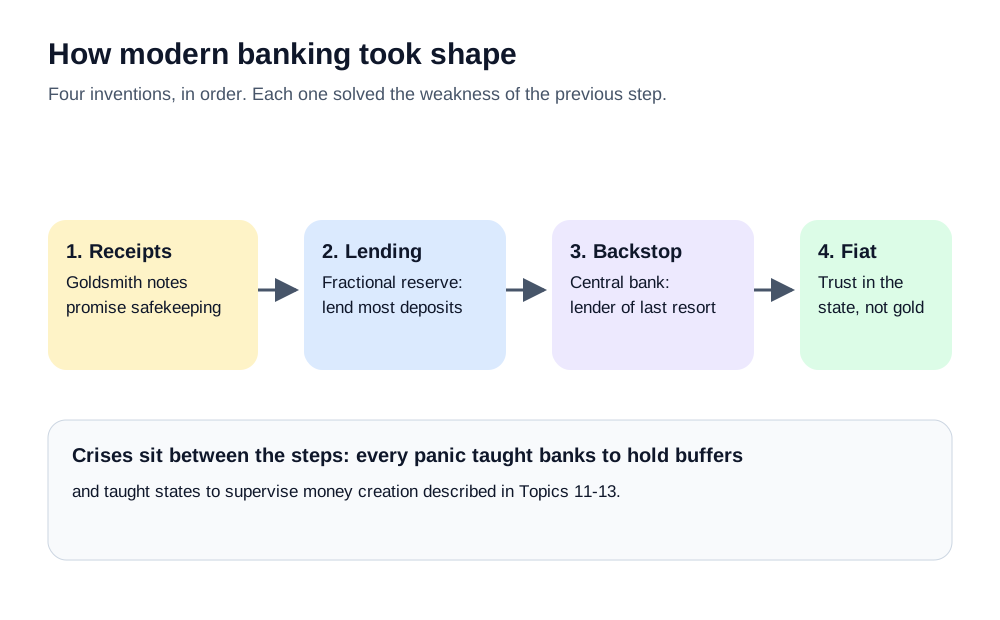
Phase 2 map: receipts → lending → central-bank backstop → fiat money. Each step solved the weakness of the previous one.
1. Why Italy Birthed Modern Banking
The emergence of banking in medieval Italy was not accidental. Several converging factors created an environment uniquely favorable to financial innovation, and they are worth examining individually because the same recipe — trade density, payment friction, fiscal demand, and competitive fragmentation — has located every subsequent banking boom in history, from Amsterdam to London to today's financial centres.
Trade density. Italian city-states dominated Mediterranean trade during the medieval period. Venice, Florence, Genoa, and their rivals sat at the crossroads of European, Byzantine, and Islamic commerce, connecting the manufacturing centers of the north with the luxury goods and spices of the east. This trade generated enormous wealth and created constant demand for financial services: credit to finance voyages, currency exchange to handle diverse coinages, and payment mechanisms to settle accounts across vast distances. Banking, as Topic 6 established, always grows at transaction chokepoints — and medieval Italy was the largest chokepoint in Christendom.
The Crusades. The Crusades created unprecedented financing challenges that drove innovation. Moving vast sums to support military campaigns across the Mediterranean required new financial tools. Transporting physical coinage was dangerous and impractical; transferring value through paper instruments offered obvious advantages. The same techniques developed for crusade financing found immediate application in commercial transactions.
The Papacy's fiscal plumbing. The Papacy, seated in Rome but collecting revenues from across Christendom, needed efficient systems for gathering and managing funds. The Vatican's financial requirements created demand for banking services that could operate across national boundaries, handling multiple currencies and settling accounts over long distances. Serving as papal bankers gave houses like the Medici both steady fee income and a continent-spanning reason to maintain branches — the closest thing the medieval world had to a global anchor client.
Competitive fragmentation. Political fragmentation among Italian city-states created competition that drove innovation. Unlike unified kingdoms where a single authority might suppress financial experimentation, Italy's patchwork of independent cities meant that banking practices could evolve through competitive trial. A technique that proved successful in one city would be adopted or improved by rivals, creating a dynamic environment of continuous financial development.
Intellectual infrastructure. To these we should add a fifth factor the period itself produced: commercial mathematics and literacy. Italian merchants educated their sons in abbaco schools teaching arithmetic applied to trade, and the city-states' notarial culture put every significant transaction in writing. Finance runs on numeracy and documentation; Italy had both in unusual depth.
2. The Medici Bank and the Architecture of Modern Finance
The Medici Bank of Florence, founded by Giovanni di Bicci de' Medici in 1397, became the most influential financial institution of the Renaissance and established patterns that would define banking for centuries. At its height, the Medici Bank operated branches across Europe, from Florence and Rome to Venice, Milan, London, Bruges, and Geneva, creating a financial network that spanned the continent.
The branch network as an organisational invention
This branch network represented a revolutionary organizational form. Rather than operating as a single location or relying on occasional correspondents, the Medici Bank established permanent branch offices staffed by partners who shared in profits while the Medici family provided capital and oversight. Branches were generally organised through separate partnership agreements with local managers who shared capital and profits. The structure decentralised management and incentives, but it should not be equated mechanically with modern limited-liability subsidiaries or assumed to have insulated the wider Medici enterprise from branch losses. These branches maintained regular communication, sharing credit information and coordinating activities across the network. A merchant in London could obtain credit that drew upon the resources of the entire Medici organization, backed by the family's reputation and wealth.
The information economics deserve emphasis. The network's letters carried prices, exchange rates, political news, and credit intelligence between branches faster than ordinary merchants could obtain them. The Medici did not merely have branches; they had the best information system in Europe, and information — about who was creditworthy, where rates were moving, which ruler was about to default — was the era's decisive competitive asset. Modern relationship banking and credit bureaus industrialise the same advantage.
Double-entry bookkeeping: the control backbone
The Medici Bank popularized, though they did not invent, the systematic use of double-entry bookkeeping to record transactions. In this system, every transaction generates equal and opposite entries in different accounts, creating a mathematical check on accuracy and providing comprehensive records of financial flows. The Venetian monk Luca Pacioli would formalize double-entry bookkeeping in his 1494 treatise, but the Medici and other Italian banking houses had already made it standard practice, bringing rational accounting to financial management.
Why did this matter so much? Because double-entry is not merely arithmetic — it is a control framework that makes the financial consequences of transactions visible and supports reconciliation. An unbalanced posting can expose an error, but a fraudulent transaction can still be recorded with perfectly balanced debits and credits, so double entry does not by itself prevent or detect fraud. A family managing partners in eight distant cities could audit those partners through their books, and a banker could know his own position — assets, liabilities, liquidity — with precision his competitors lacked. Topic 29 (bank financial statements) and Topic 96 (databases and ledgers) are this invention's direct continuation.
Bills of exchange: the profit engine
Bills of exchange became the Medici Bank's signature instrument and primary source of profit. These documents allowed money to move across borders without physical transport, solving the security and logistical problems of medieval commerce. A merchant purchasing goods in one city could obtain a bill payable in another, with the banker earning fees on the exchange and profit from interest implicit in the exchange rates quoted. The Medici perfected these techniques, making their bills accepted across Europe and establishing the family name as a guarantee of value.
Foreign exchange operations naturally accompanied bill business. Each Medici branch handled local currencies, profiting from exchange rate differences and providing merchants with the currency conversions necessary for international trade. This currency business required sophisticated understanding of market conditions across multiple cities, information that the Medici branch network was uniquely positioned to gather and exploit.
Working around the usury prohibition
The Catholic Church's prohibition of usury — the charging of interest on loans — posed a significant challenge to medieval bankers. The Medici and their competitors developed workarounds that preserved profitability while maintaining technical compliance with religious law. Interest might be embedded in foreign exchange: a bill payable in another city and another currency, weeks hence, could be priced so that the exchange margin contained the lender's return. Loans could be structured as partnerships in which the bank shared profits rather than charging fixed interest. Discretionary gifts from grateful borrowers could substitute for contractual interest.
These structures are more than historical curiosities. They demonstrate a permanent principle of financial practice: when a legal form is restricted but the economic function is demanded, innovation redesigns the form to preserve the function. The same dynamic later produced the profit-and-loss-sharing contracts of Islamic banking (Topic 20) and countless modern structured products. Regulators and students alike should learn to look through instrument labels to the underlying economics — the Medici case is the classic training example.
The fall: sovereign risk teaches its first great lesson
The Medici Bank's legacy extended far beyond banking techniques. The family used their banking wealth to become rulers of Florence, demonstrating the political power that financial success could confer, and funded the artistic flowering we call the Renaissance — patronage to Michelangelo, Leonardo da Vinci, Botticelli, and countless others.
Yet the bank itself proved vulnerable to the risks it managed. Its decline and effective collapse in the 1490s — after the death of Lorenzo de' Medici in 1492 and amid the French invasion of Italy in 1494 — followed years of mounting losses on loans to European rulers, most notoriously the English crown's borrowing from the Bruges and London branches. Sovereign borrowers possessed armies and lawyers; bankers possessed contracts. When princes declined to pay, there was no court to compel them. The lesson is timeless and was expensive: credit analysis that ignores enforceability is fiction. Lending power concentrated in a few prestigious, unenforceable sovereign exposures destroyed the best-run bank in Europe — concentration risk and sovereign risk in a single stroke, centuries before those terms existed.
3. Venetian Banking and the Public Good
Venice developed banking through its unique position as Europe's gateway to Asian trade and its distinctive political culture that valued public institutions. While Florentine banking was dominated by private family enterprises, Venetian banking saw significant state involvement, creating models of public banking that addressed concerns about deposit safety and monetary stability.
The Banco della Piazza di Rialto, established in 1587, represented one of Europe's first public banks. Unlike private banking houses that accepted deposits to fund their own lending operations, the Rialto Bank focused on providing a stable payment system for merchants. It guaranteed deposits and facilitated transfers between accounts, but it did not make loans. This separation of deposit and lending functions, which might seem limiting, offered merchants security that private banks could not match. The public guarantee, backed by the Venetian state, provided confidence that deposits would be honored regardless of market conditions.
The design principle here is strikingly modern: a narrow bank — an institution that holds deposits in safe, liquid form and provides payments, without the credit risk of a lending book. The idea recurs in every era, most recently in debates about whether payment institutions should hold 100% reserves. Venice proved the concept's stability virtues; it also illustrated its limit: a bank that cannot lend earns no spread, so such institutions need public sponsorship or fee income to survive.
The Banco del Giro, created in 1619 to manage government debt, expanded public banking functions. Credits in this bank could be transferred between accounts, creating a form of book money that circulated without physical currency changing hands. Merchants preferred these bank transfers to handling physical coins, and the Giro Bank became central to Venetian commercial life. This system of account-based transfers, with the public bank serving as intermediary, established principles that would influence central banking development for centuries.
4. Banco di San Giorgio: A State Within a State
The Banco di San Giorgio, founded in Genoa in 1407, stands as one of the world's first chartered banking institutions and a unique example of the political power that financial organizations could wield. Originally created to manage Genoa's public debt and reduce the burden of war financing, the Banco di San Giorgio evolved into something far beyond a conventional bank.
The institution accepted deposits and made loans like other banks, but its management of state finances gave it extraordinary influence. As the bank handled tax collection, made payments on behalf of the government, and managed colonial revenues, it effectively controlled substantial portions of Genoa's economic life. The bank came to possess its own coercive apparatus and administered Genoese territories, effectively governing on behalf of the state that had created it.
Machiavelli, observing this arrangement, described the Banco di San Giorgio as a state within a state, capturing the extraordinary autonomy that financial power could create. The bank operated for nearly four hundred years, surviving the rise and fall of governments, until Napoleon dissolved it in 1805 during his conquest of Italy. Its long history demonstrated both the potential and the dangers of concentrated financial power — and posed, for the first time in durable institutional form, the governance question that Topic 8 (central banks) and Topic 88 (corporate governance) still wrestle with: who supervises the institution that finances the state?
5. The Northern European Banks
While Italian city-states pioneered modern banking, important innovations also emerged in northern Europe. The Bank of Amsterdam, founded in 1609, deserves particular attention for its creation of a stable bank guilder that merchants across Europe trusted more than any physical coin.
The Wisselbank, as it was known, accepted deposits of the era's chaotic coinage — clipped, debased, and foreign coins of every weight and fineness — and credited depositors with a standardized bank guilder defined by its metal content. This bank money eliminated the confusion of multiple currencies and degraded coinages that plagued international trade. Merchants could transfer balances between accounts, settle debts through book entries, and conduct business confident that the bank guilder represented real, assay-verified value. The Wisselbank's credible accounting unit and high-quality settlement balances often commanded an agio over heterogeneous circulating coin. Its operating model changed over time, however, and later credit—especially to the Dutch East India Company and the city—means it should not be described as an unchanged full-reserve bank throughout its history.
This system anticipated the concept of a reserve standard that transcended national boundaries, providing a neutral medium for international transactions. The bank guilder anchored Dutch commerce's golden age until the bank's hidden lending to the Dutch East India Company compromised its backing; when the divergence between claims and metal became public knowledge, confidence — the only true backing any ledger money ever has — drained away. The Wisselbank's arc repeats the ancient lesson: the ledger is the product, and its integrity is the franchise.
Hamburg established its own bank in 1619, creating a stable unit of account for trade in northern Germany, and other cities followed. These public banks spread the techniques across Europe and established an enduring principle: monetary stability is a public good requiring institutional support — the philosophical foundation of central banking.
6. The Bank of England and Central Banking
The founding of the Bank of England in 1694 marked an important stage in the evolution of central banking, although Sweden's Riksbank traces its predecessor to 1668 and the modern bundle of central-bank functions developed gradually rather than appearing fully formed at either institution's founding. Created specifically to finance King William III's wars against France, the Bank of England was granted the privilege of issuing banknotes in return for lending to the government.
This arrangement established a pattern repeated across the world: a central bank created to manage government debt that gradually acquired additional functions — banker to other banks, issuer of currency, and lender of last resort during financial crises. The Bank of England's notes, initially hand-written promises to pay, evolved into the standard currency of British commerce and eventually into the foundation of the international gold standard (Topic 9).
Over the eighteenth and nineteenth centuries, the Bank of England's role expanded from government banking and note issue toward functions associated with modern central banking, including influence over monetary conditions and crisis liquidity. Its experience became highly influential internationally, but those functions evolved through practice and legislation rather than being complete in 1694. Topic 8 takes up this story in full; what matters here is recognising the pivot: with the Bank of England, banking's centre of gravity shifted from serving merchants to stabilising nations.
One structural feature deserves explicit attention, because it confuses many students: the Bank of England was a privately owned company performing public functions. Its shareholders were merchants and investors; its customer and master was, increasingly, the British state; and its notes became everyone else's money. This hybrid — private capital executing public monetary power under a government charter — was the pragmatic settlement of its era, and it set a precedent: most early central banks began as private or semi-private chartered institutions and were only brought fully under public ownership or control in the twentieth century. The tension the arrangement embeds — who does the monetary authority ultimately answer to? — leads directly to the modern debate over central bank independence, examined in Topic 65.
7. Worked Example: One Bill of Exchange, End to End
The Medici-era bill of exchange rewards a step-by-step reading, because three modern transactions hide inside one document.
The deal. A Florentine wool merchant, having sold cloth to a Bruges buyer, needs funds now in Florence; the buyer will have funds in Bruges in three months. The merchant approaches the Medici's Florence branch.
Issuance. The Florence branch draws a bill: it accepts the merchant's florins today and issues a document instructing the Medici's Bruges branch to pay a stated sum in Bruges currency to the buyer (or the merchant's designate) in three months. One document thereby contains: (1) a payment instruction across distance — the remittance function; (2) a currency conversion — florins to Flemish money at the quoted rate, the FX function; and (3) a time shift — money now against money later, in which the exchange rates quoted between the two cities embed the bank's return, the credit function.
Settlement. Three months later, the Bruges branch pays the bill out of its local balances. The two branches do not ship coin; they reconcile through the network's books, where thousands of such bills largely offset one another — correspondent netting, the direct ancestor of modern clearing (Topic 68).
The economics. The bank's profit lived in the gap between the exchange rates it quoted in the two cities and the rates prevailing when the positions were settled. Note where the risk sat: exchange-rate movement between issuance and settlement (market risk), the counterparty's failure to honour the bill (credit risk), and branch imbalance if flows ran one way too long (liquidity risk). A medieval instrument, a modern risk map.
8. The Customer and Bank Perspectives
From the customer's perspective, the Italian banks converted geography from a barrier into a service. A merchant could sell in one city and be paid in another without convoys of coin; a prince could move an army's payroll through paper; a pilgrim institution — the Papacy — could collect revenue from the entire continent. The new dependency was institutional: customers now needed their bank to be solvent, honest, and well-connected, because the value they held was increasingly the bank's promise rather than metal in hand. Choosing a banker became a credit decision of its own — an early lesson in counterparty risk.
From the banker's perspective, the era defined the profession's durable skill set: building and governing multi-office organisations, controlling them through double-entry books, pricing exchange and credit under incomplete information, managing liquidity across a branch web, and navigating the politics of lending to power. It also defined the profession's recurring sins — concentration in prestigious borrowers, and maturity mismatch hidden by accounting conventions. The Medici failure and the Wisselbank's concealed lending are early entries in a casebook that runs through every later crisis chapter of this course.
9. Digital Banking Implications: Why This History Is Still Operational
Strip the technology away and today's transaction banking is the Medici model at electronic speed: branch and correspondent networks became payment rails and SWIFT messaging (Topic 70); bills of exchange became documentary credits and trade-finance instruments (Topic 37); double-entry became the core banking ledger (Topic 96); the Rialto's narrow-bank design reappears in debates about fully reserved payment institutions and stablecoin backing; and the Bank of England's debt-management origins explain the modern central bank's entanglement with government finance. The era's deepest lesson is also its most current: financial systems run on trusted records, and every fraud, crisis, and reform in this course is a dispute about the integrity, governance, or backing of the ledger.
10. From Italian Innovation to European Standard: A Timeline
The techniques of this module did not spread all at once. Seeing their diffusion in sequence clarifies which inventions proved durable and why.
13th–14th centuries: the merchant-banker era. Italian merchant companies — the great Florentine houses among them — combine trade with finance, operating bills of exchange across Champagne fairs and Mediterranean ports. Double-entry bookkeeping spreads through Italian counting houses. Sovereign lending already proves lethal: major Florentine houses collapse in the 1340s after English royal defaults, a full century before the Medici repeat the lesson.
1397–1494: the Medici system. The branch-partnership model, network information flows, and exchange-embedded credit reach their Renaissance peak — and then fail on sovereign concentration, demonstrating that organisational excellence cannot compensate for broken credit discipline.
1407–1805: the chartered institution. Genoa's Banco di San Giorgio proves that a financial institution can outlive dynasties, manage state debt, and govern territory — the first durable demonstration of banking as permanent infrastructure rather than personal enterprise.
1587–1619: the public payment bank. Venice's Rialto and Giro banks separate safe payments from risky lending and make transferable public-bank credits the preferred money of a great trading city.
1609–17th century: the standardised ledger currency. Amsterdam's Wisselbank, followed by Hamburg and others, turns bank balances into Europe's preferred settlement money and establishes full-backing integrity as the price of trust.
1694 onward: the central-bank pivot. The Bank of England joins state finance to private banking technique, and over the following two centuries accretes note-issue monopoly, banker-to-banks, and lender-of-last-resort functions — the template every modern monetary authority inherits (Topic 8).
Read the sequence as natural selection: instruments and structures survived when they reduced friction or risk at scale — branches, double-entry, bills, public payment banks, standardised ledger money — and institutions failed when they violated credit or integrity fundamentals, however prestigious their clients or clever their accounting. The modern banking world is the survivor set of five centuries of exactly this testing.
11. Key Terms in This Chapter
Bank money. Ledger balances transferable by book entry, valued above physical coin for their standardisation and safety (as with the Amsterdam bank guilder).
Bill of exchange. A written order to pay a stated sum at a stated place and date, combining remittance, currency conversion, and — implicitly — credit in one instrument.
Branch network. Permanent offices in multiple cities under one ownership and control, enabling information sharing, credit mobility, and net settlement.
Chartered bank. An institution operating under a specific state grant of rights and obligations, as with the Banco di San Giorgio.
Concentration risk. Exposure clustered in a few borrowers or sectors — fatal to the Medici through sovereign loans.
Correspondent banking. Relationships allowing one institution to transact through another in distant markets.
Double-entry bookkeeping. Recording every transaction as equal debit and credit entries, creating a self-checking, auditable account of an institution's position.
Lender of last resort. A central bank's emergency liquidity function for solvent but illiquid banks, developed by the Bank of England's successors.
Narrow bank. An institution taking deposits and providing payments without lending them out, holding safe liquid assets instead — the Venetian Rialto model.
Public bank. A state-created or state-backed bank serving monetary stability and payment functions rather than private profit.
Seigniorial / sovereign credit risk. The risk that a ruling borrower cannot be compelled to repay — the Medici Bank's fatal exposure.
Usury prohibition. The medieval Church's ban on charging interest, which drove the design of exchange-embedded and partnership-based returns.
12. Common Mistakes and Misconceptions
"The Medici invented double-entry bookkeeping." They systematised and spread it; the technique circulated among Italian merchants earlier, and Pacioli's 1494 treatise documented existing practice rather than creating it.
"Bills of exchange were just medieval cheques." A bill bundled payment, FX conversion, and credit; a cheque is only a payment instruction. The comparison hides the bill's real significance.
"The usury ban stopped lending." It changed lending's form, not its existence — returns were embedded in exchange margins and partnerships. Economically demanded functions route around formal restrictions.
"The Medici Bank failed because of the Renaissance art spending." Patronage was family expenditure, not the bank's cause of death. The bank died of credit losses on unenforceable sovereign loans and the resulting liquidity and confidence collapse.
"Public banks were inefficient state projects." Venice's and Amsterdam's public banks delivered something private banks could not: deposits merchants trusted more than coin. Their payment systems were the best in Europe and were copied precisely because they worked.
"The Bank of England was founded to run monetary policy." It was founded to finance a war. Monetary policy, bank regulation, and lender-of-last-resort functions accreted over the following two centuries — a useful reminder that institutions are often born for one purpose and repurposed by events.
13. Frequently Asked Questions
Q: What actually made the Medici Bank "modern"? Its organisational architecture: a multi-city branch network under common ownership, partnership governance with local incentives, double-entry controls, and standardised instruments (bills of exchange) accepted across Europe. Techniques existed earlier; the Medici integrated them into a replicable institutional system.
Q: How did bankers profit under a usury ban? Through exchange margins on bills of exchange (which contained an implicit time-based return), profit-sharing partnerships, fees, and FX trading. The interest was present in the economics, absent from the contract's wording.
Q: Why did merchants trust the Bank of Amsterdam's balances more than coins? Because the balances were standardised by metal content, transferable by book entry, and initially fully backed — while circulating coin was clipped, debased, and heterogeneous. Verified uniformity beat physical possession.
Q: Were these early banks regulated? They operated under charters, guild rules, municipal oversight, and — as Topic 6 showed — long-standing legal duties around books and disclosure. Modern-style prudential supervision came later, but banking was never unregulated.
Q: What is the connection between the Medici network and today's correspondent banking? Direct lineage in function: permanently linked institutions in different cities executing payments for each other's customers and settling net through their books. SWIFT-era correspondent banking is the same architecture with electronic messaging replacing couriered letters.
Q: Why is 1694 treated as a turning point if banks already existed for centuries? Because the Bank of England fused private banking technique with state finance, creating the central-bank template — note issuance, government debt management, and eventually system-wide stability functions. It changed what a bank could be.
Q: Did any of these early banks survive to the present? The Banco di San Giorgio operated until 1805; the Venetian and Amsterdam public banks closed earlier. But institutional descendants and successor traditions are everywhere: the Bank of England still operates at the centre of British finance, and the organisational forms — branches, correspondents, double-entry, public payment banks — never disappeared. Early banking's legacy is architectural rather than corporate: the techniques survived even where the firms did not.
14. Interview Insights
"Why did modern banking emerge in medieval Italy?" Structure the answer around the four or five converging conditions — trade density at a commercial chokepoint, fiscal/payment demand (Crusades, Papacy), monetary fragmentation needing exchange services, competitive political fragmentation enabling experimentation, and commercial numeracy. Candidates who give conditions rather than a date demonstrate systems thinking.
"Explain a bill of exchange to a client." Use the three-in-one decomposition: remittance + FX conversion + credit, with profit embedded in the exchange margin. Then note its modern descendants — documentary credits and trade finance. This question tests whether you can see economics through legal form.
"What killed the Medici Bank, and what does it teach?" Sovereign and concentration risk: large unenforceable loans to princes, losses hidden by loyalty to prestigious names, collapse of confidence. The transferable lesson — enforceability and diversification are non-negotiable — lands in any credit interview.
"What did the Bank of England change in 1694?" It created the central-banking pattern: private capital financing the state in exchange for note-issuance privilege, evolving into currency issuance, banker to banks, and lender of last resort. Distinguishing this from ordinary commercial banking shows command of the institutional map that Topic 8 completes.
Summary and Key Takeaways
- Modern banking crystallised in medieval Italy because trade density, payment friction, fiscal demand, competitive fragmentation, and commercial numeracy converged there — the standing recipe for financial centres.
- The Medici Bank (1397–1490s) built the template: branch networks with partnership governance, information advantages, double-entry controls, and the bill of exchange as a triple-function instrument.
- The usury prohibition proved that demanded economic functions route around legal forms — returns moved into exchange margins and partnerships, a design dynamic still visible in Islamic finance and structured products.
- Venice's public banks pioneered deposit safety and narrow banking; the Banco del Giro's transferable credits previewed central-bank book money.
- Genoa's Banco di San Giorgio showed finance and state power fusing into a "state within a state," posing governance questions still unresolved.
- Amsterdam's Wisselbank demonstrated that standardised, fully backed ledger money can outrank physical coin — and that concealed lending destroys exactly the trust that gives ledger money its value.
- The Bank of England (1694) pivoted banking's purpose from serving merchants to stabilising nations, inaugurating central banking.
- The era's failures are as instructive as its inventions: sovereign risk, concentration, hidden lending, and broken ledger integrity — the same entries appear in every crisis chapter that follows.
A closing synthesis: this module marks the point in the course where banking stops being a set of techniques and becomes an industry — with durable institutions, transferable methods, professional specialisation, and its first genuine regulatory settlements. Notice, too, that every institution studied here succeeded when it honoured two disciplines — credit discipline (lend only where repayment is real and enforceable) and ledger discipline (keep the record honest and fully backed) — and failed when it violated either, whatever its prestige. Those two disciplines are the spine of everything from Topic 8 onward: central banks exist largely to enforce them on the whole system at once.
Next: Topic 8 — Central Banks →
<!-- MBA-DEEP-DIVE-START -->Deep Dive: From Merchant Banking to Durable Banking Institutions
The phrase "the first banks" sounds simpler than the history really is. Financial intermediation did not begin on one date in one city. Earlier societies had lenders, money changers, deposit-like arrangements and payment by book entry. What changed in medieval and early-modern Europe was the density and durability with which those functions were organised into specialist businesses and public institutions. Merchant banking houses developed permanent partnerships, branch and correspondent networks, bills of exchange, sophisticated accounts and cross-border credit. Public banks then added legally privileged payment ledgers and a stronger connection between finance and the state.
That is the useful dividing line for this topic. It is not necessary to claim that Florence or Venice invented every banking function. The stronger claim is that the commercial revolution of the late medieval and Renaissance Mediterranean helped assemble many financial functions into institutions whose organisation, accounting, information flows and risk problems are recognisably related to modern banking.
Why the Italian city-states became financial laboratories
Banking deepened in northern and central Italy because trade created repeated financial problems that could not be solved efficiently with bags of coin. A merchant buying wool in England, selling cloth in the Low Countries and paying partners in Florence faced multiple currencies, long travel times, political borders, theft risk and a mismatch between when goods were purchased and when they were sold. Finance had to bridge both distance and time.
Political fragmentation mattered too, but not because fragmentation automatically creates innovation. It created multiple fiscal systems, currencies and legal jurisdictions while highly commercial cities competed for trade. The result was demand for specialists who could evaluate coinage, maintain accounts, finance inventories and move claims between cities. Dense merchant networks supplied the trust and information needed to make those services workable.
The growth of notarial records, merchant correspondence and commercial numeracy was equally important. Finance scales only when obligations can be documented and compared. A bank with branches cannot be managed from family memory. Partners need books showing cash, receivables, bills, deposits, profits and exposures. This is why the history of banking is also the history of accounting and information systems.
The Medici Bank: important, influential, but not the inventor of banking
The Medici Bank, founded in 1397 by Giovanni di Bicci de' Medici, became one of the most prominent banking houses of fifteenth-century Europe. Its importance lies less in inventing individual techniques than in combining organisation, reputation, branch partnerships, information and political relationships at considerable scale.
The branch structure deserves close attention. Medici branches were generally organised as partnerships with local managers who had capital and profit interests. This distributed decision-making while keeping the network tied to the Medici name and strategic control. A modern banking group uses subsidiaries, branches, central policies, risk limits, treasury and consolidated reporting; the Medici structure was far less formal, but the governance problem is familiar. Local managers understand customers and markets better, while head office needs enough control to prevent one branch from endangering the whole enterprise.
That tension contributed to the bank's decline. Remote managers could build exposures that Florence could not easily supervise. Lending to politically powerful borrowers introduced sovereign and concentration risk. A ruler's prestige did not make a claim easily enforceable. When large exposures deteriorated, reputation could not substitute for repayment. The lesson is more precise than "the Medici failed because kings defaulted": growth through decentralised relationships can become dangerous when information, incentives and limits do not keep pace with the network.
Double-entry bookkeeping: do not confuse adoption with invention
Italian merchants and bankers were important users and developers of double-entry bookkeeping, and Luca Pacioli's 1494 printed description helped disseminate the method. But no single bank should be described as the simple inventor of double entry. Commercial bookkeeping practices evolved over time across Italian trading centres before Pacioli documented them.
For banking, the importance of double entry is operational. Every transaction affects at least two accounts, allowing the institution to preserve the equality between what it owns and what it owes plus owners' capital. A transfer from one depositor to another does not create or destroy the bank's total deposit liability; it moves the liability between customer accounts. A loan disbursement creates an asset claim on the borrower and, when credited to the customer's account, a corresponding deposit liability. These relationships are basic to modern bank accounting.
Double entry is therefore more than an error-checking trick. It provides a model of the institution. Managers can see whether a branch's apparent profit is accompanied by doubtful receivables, whether cash is being consumed, whether liabilities are growing, and whether positions reconcile. Modern core banking and general-ledger systems automate those relationships, but the control principle remains recognisable.
Bills of exchange: payment, credit and foreign exchange in one commercial instrument
The bill of exchange was one of the central tools of European merchant banking. It allowed a payment obligation arising in one place to be discharged in another place and often another currency at a later date. This made it valuable for remittance and trade finance without transporting the full value in coin.
It is important not to describe every bill as a disguised interest-bearing loan. Bills served genuine payment and exchange functions. But the combination of different currencies, locations and dates created room for a financial return through exchange rates and pricing. Medieval restrictions on usury shaped the contractual forms and language used by bankers, so economic return could be embedded in a transaction that was legally framed as exchange rather than a simple loan with explicit interest.
Consider a Florentine merchant who must pay a supplier in Bruges. Instead of sending coin, the merchant buys a bill from a banker in Florence. A correspondent or branch in Bruges pays the beneficiary according to the instrument's terms. Across many transactions, opposite flows can offset, reducing the amount of specie that must actually travel. This is an early example of why clearing is powerful: gross commercial obligations can be much larger than the net quantity of settlement assets that must move.
The bank still bears risk. The party expected to pay may fail. Exchange rates can change. Correspondent balances can become one-sided. Documentation can be forged or disputed. Political events can interrupt access to funds. The bill reduces one set of frictions while creating a need for credit assessment, records and network governance.
Correspondent logic before electronic correspondent banking
A cross-border banking network does not require a branch in every city. It requires trusted counterparties willing to honour instructions and settle balances. Merchant banks therefore relied on correspondents as well as owned or partnered branches. This is conceptually related to modern correspondent banking, where one bank holds an account for another and executes payments in markets where the respondent lacks direct access.
The comparison should stop at the economic logic. A modern correspondent relationship is governed by banking law, anti-money-laundering requirements, sanctions controls, payment standards, account agreements and sophisticated reconciliation. A Renaissance correspondent network relied much more heavily on personal reputation, commercial law and letters. Yet both solve the same geographical problem: give a customer access to payment and liquidity outside the institution's own physical footprint.
Casa di San Giorgio: begin with public debt, then follow the financial functions
The Casa delle Compere e dei Banchi di San Giorgio was established in Genoa in 1407 to consolidate and administer public debt. That origin matters because it prevents a common simplification: it was not merely a private commercial bank that later became politically important. Public finance was central to its creation. It acquired important fiscal and administrative roles, and a public deposit, giro and credit bank began operating within the institution in the early fifteenth century.
This makes San Giorgio a valuable bridge between banking and sovereign finance. Creditors of the state needed an institution that could administer claims and revenues. The institution needed governance capable of operating across political cycles. Over time it exercised powers that went well beyond ordinary banking, including the administration of revenues and territories. Describing it as a "state within a state" captures the unusual concentration of financial and administrative authority, but students should distinguish its debt-management body from the specific banking operations it conducted.
Modern parallels exist in pieces rather than as a direct equivalent. Debt management offices administer sovereign borrowing. Central banks act as fiscal agents in many jurisdictions. Commercial banks provide deposit and payment services. Public authorities collect taxes. San Giorgio combined functions that modern institutional design usually separates. That makes it interesting precisely because it shows why later systems developed clearer boundaries and accountability.
Venice and the public deposit-bank solution
Venice's Banco della Piazza di Rialto began operations in 1587. Its purpose was closely tied to the need for dependable payment and deposit services after problems with private banks. The public-bank model aimed to improve confidence in settlement by placing the payment ledger under public authority and restricting risky use of deposited funds.
Calling it an early "narrow bank" can be a helpful analogy if carefully qualified. Its design emphasised custody and book transfers rather than the broad credit intermediation of a modern commercial bank. What matters is the policy choice: payment safety can be improved by separating the settlement ledger from risky lending. Modern debates about safeguarded payment institutions, full-reserve proposals and access to central bank money revisit the same trade-off between safety, credit creation and profitability.
The Banco del Giro, established later in Venice, developed a prominent book-transfer system. Again, the important innovation is not that Venetians discovered accounting transfers—the idea was older—but that public authority created a trusted monetary ledger that merchants were encouraged or required to use for important transactions.
Amsterdam: trusted bank money was built on governance, not magic
The Bank of Amsterdam, founded in 1609 by the city, accepted many types of coin and provided account balances used for book-entry payments. In a monetary environment plagued by clipped, worn and heterogeneous coinage, a standardised bank unit was extremely useful. Merchants could settle in a unit whose quality did not depend on inspecting each individual coin.
The bank is often described as a simple full-reserve institution. That description captures aspects of its early reputation but becomes misleading if applied to its entire history. Research on the Wisselbank shows that its operations evolved and included credit, notably to the Dutch East India Company and the city. Its later difficulties are therefore a governance lesson: a trusted monetary ledger can lose credibility when users believe the assets and institutional support behind it no longer justify confidence in its liabilities.
This point is central to modern money. A monetary claim can be valuable even when users never inspect the assets behind it, but that apparent simplicity depends on institutions maintaining convertibility, liquidity and confidence. The trusted unit on the screen is the final layer of a deeper balance-sheet and governance structure.
The Bank of England belongs partly here and fully in the next topic
The Bank of England was founded in 1694 as a private bank acting as banker to the government, primarily to help fund war against France. It lent £1.2 million to the government at inception. It should not be projected backwards as a fully formed modern central bank on day one. Its note issue, government banking role and later position within the banking system evolved over time.
Its relevance to the history of the first banks is the fusion of public credit and banking. Investors subscribed capital to a chartered institution; the institution lent to the state and obtained privileges that supported its business. Over the eighteenth and nineteenth centuries, the Bank's systemic role expanded, and lender-of-last-resort practice developed gradually, especially through the nineteenth-century crises later associated with Bagehot's analysis. Topic 8 should therefore treat central banking as an evolution, not as a function completely designed in 1694.
Three institutional models, three different balance-sheet questions
The private merchant bank asks: can deposits, capital and correspondent credit support profitable lending and exchange without one branch or borrower destroying the firm? The public deposit bank asks: can a trusted settlement asset and transfer ledger be kept safe and liquid enough that merchants prefer bank money to uncertain coin? The public-debt institution asks: can long-term claims on the state be organised, serviced and governed credibly enough to deepen sovereign borrowing?
These are different problems. Combining them under the label "first banks" is useful only if the differences remain visible. Modern financial systems still separate them imperfectly among commercial banks, central banks, payment infrastructures, debt-management offices and fiscal authorities.
A practical risk walk-through: a fifteenth-century branch network
Imagine a banking partnership with headquarters in Florence and branches in Bruges, London and Rome. The London branch finances wool merchants and a politically connected borrower. The Bruges branch receives payments related to the same trade. Rome handles papal revenues. Headquarters sees periodic account summaries rather than real-time positions.
The first risk is credit concentration. A large borrower can dominate one branch's assets. The second is liquidity mismatch: deposits or payment obligations may fall due before loans are repaid. The third is FX risk because obligations exist in several currencies. The fourth is operational risk from inaccurate books, lost correspondence or dishonest agents. The fifth is country and political risk: rulers can impose restrictions or simply refuse payment. The sixth is governance risk because a local manager's incentives may favour growth and profit before losses become visible to headquarters.
A modern bank attacks those risks with exposure limits, capital, liquidity buffers, independent risk functions, audit, consolidated reporting, legal agreements, market-risk measurement and escalation. The medieval house relied on partnership structure, correspondence, reputation, personal supervision and diversification. The gap between the two is the history of bank governance.
The information advantage is the enduring banking asset
Early bankers succeeded not because they possessed secret arithmetic. They sat at information-rich nodes. Money changers observed currencies and merchants. Papal bankers saw fiscal flows. branch networks collected prices and political news. Public banks observed settlement. A bank that knows who trades with whom, who pays on time, which markets are liquid and where funds are accumulating has a powerful advantage in pricing credit and allocating liquidity.
Modern banking digitises that informational role. Transaction histories inform fraud controls and credit decisions. Treasury sees cash flows and funding needs. relationship managers understand business cycles. compliance teams interpret counterparties and jurisdictions. The ethical and regulatory boundaries are now far stricter, but the basic reason transaction banking and lending reinforce each other is old: payment activity creates information about economic behaviour.
Accuracy guardrails for this topic
Do not say that banking began in medieval Italy; earlier societies had important banking functions and some specialist bankers. Do not say the Medici invented double-entry bookkeeping. Do not treat every bill of exchange as merely a disguised loan. Do not describe San Giorgio as if its only or original purpose were commercial deposit banking; public-debt administration was central to its creation. Do not call Venice the first public bank in Europe without qualification, because earlier public banking experiments and institutions existed elsewhere. Do not describe the Bank of Amsterdam as maintaining an unchanged full-reserve model throughout its history. And do not describe the Bank of England in 1694 as though all modern central-bank functions already existed.
The durable lesson is that modern banking was assembled rather than invented. Merchant banks combined information, credit, exchange and cross-border networks. Public banks strengthened the reliability of ledger money and settlement. Public-debt institutions connected banking techniques to sovereign finance. Central banks later emerged from this institutional landscape. Seeing those layers separately produces a much better understanding of what a bank actually does today.
<!-- MBA-DEEP-DIVE-END -->