By the time coinage, paper money, and credit had been conceptualized, the components of banking existed, but they were disjointed. A merchant might borrow grain from a temple, exchange coins with a moneychanger in the market, and store wealth in a hidden vault. A major institutional step occurred when specialist financiers and public or religious institutions began combining functions such as custody, exchange, payment and lending. Historians use the word "banking" cautiously here because these functions were distributed across different institutional forms and did not necessarily sit under one modern-style legal entity or balance sheet.
In this module, we will explore early financial institutions and specialists whose activities illuminate the long history of banking functions. We will examine Greek trapezitai, Roman financial specialists such as argentarii, the royal banking and fiscal institutions of Ptolemaic Egypt, and guild-based finance in ancient India. The goal is not to label these arrangements as modern banks, but to understand how custody, exchange, credit, accounting and payment administration developed in different institutional settings.
Learning objectives
- Define what turns a collection of financial services into a bank — institutional aggregation around a ledger.
- Explain ledger banking: settlement by book entry, and why it transformed the velocity and scale of commerce.
- Map the three business lines of the Greek Trapezitai onto modern retail, commercial, and investment banking.
- Analyse Roman banking regulation — audit powers, liquidation hierarchies — as the ancestor of modern supervision and depositor protection.
- Evaluate Ptolemaic Egypt's grain giro as an early centralized payment system.
- Describe India's shreni guilds as a contrasting, association-based institutional model.
- Compare the civilisations' institutional designs and draw out the design principles modern banking inherited.
Visual overview
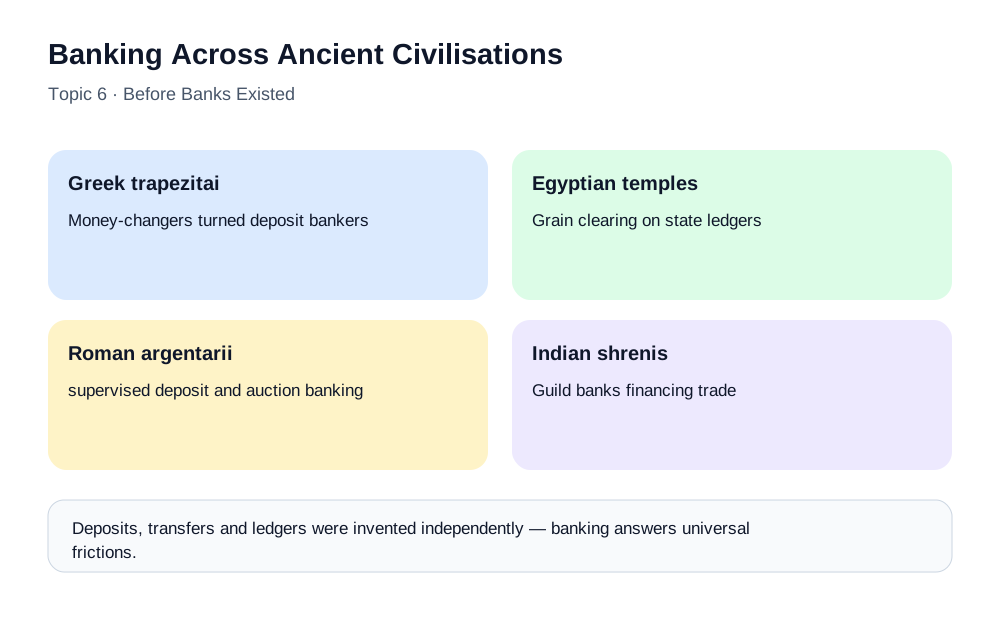
Banking Across Ancient Civilisations at a glance — Greek Trapezitai, Egyptian temples, Indian Shrenis.
1. What Makes a Bank a Bank?
Topics 1 through 5 assembled the raw materials: exchange, money, coinage, paper instruments, and credit. Yet none of those alone constitutes a bank. A moneychanger is not a bank; neither is a vault, nor a lender operating from personal wealth. For modern banking, deposits, transfers and credit often interact on one regulated balance sheet. Ancient evidence is more varied, so these three functions should be treated as an analytical comparison rather than a universal historical threshold:
- Deposits — holding other people's money, repayable on demand or notice;
- Transfers — moving value between customers by instruction rather than by physical delivery; and
- Credit — lending, funded at least partly by the pooled deposits of others.
The defining feature is the combination, because the combination creates the balance-sheet dynamics that make banking uniquely productive and uniquely fragile. Deposits are liabilities payable on demand; loans are assets repayable over time. The institution in the middle is performing maturity transformation (Topic 4) and liquidity transformation at once. Every civilisation in this module crossed this threshold independently — and each immediately confronted the same consequences: the need for trustworthy ledgers, for rules on failure, and for managing the gap between promises and reserves.
2. Foundational Concept: Institutional Aggregation and Ledger Banking
The foundational concept of ancient institutional banking is ledger banking — the ability to clear transactions via book entries rather than the physical movement of metal.
As trade expanded in ancient Greece and Rome, physically moving silver to settle large commercial transactions became highly inefficient and dangerous. To solve this, specialized professionals emerged who offered to hold a merchant's money securely.
Once multiple merchants held their deposits with the same professional, a technological breakthrough occurred. If Merchant A owed Merchant B 1,000 drachmae, and both held accounts with the same banker, the banker did not need to move any physical silver. The banker simply adjusted the ledger, subtracting 1,000 from A's column and adding 1,000 to B's column. The accounting logic resembles an internal modern book transfer, although modern clearinghouses, settlement systems and bank databases operate within very different legal, technological and institutional frameworks. It drastically increased the velocity of money.
Why ledger settlement was revolutionary
Consider what book-entry settlement actually accomplishes. First, it economises on the settlement asset: repeated transfers among customers can be recorded without moving the same coins each time, although liquidity and redemption constraints still matter. Second, it reduces some physical-settlement risks: fewer coin movements can lower transport, theft and repeated-assay frictions, without making operational, credit or custody risk disappear. Third, it creates records as a by-product: every payment leaves a written trail, enabling audit, credit assessment, and dispute resolution — the informational foundation of all later finance. Fourth, and most subtly, it concentrates knowledge: the banker who sees both sides of a town's payments learns who is sound and who is struggling, and that information advantage is precisely what makes the banker a better lender than any outsider. Information asymmetry reduction through payment data is not a fintech invention; it is the original business model of deposit banking.
The precondition, of course, is trust in the ledger's keeper. A ledger is only as good as its integrity and the institution's willingness to honour it — which is why every banking civilisation quickly wrapped its ledger-keepers in law, oath, reputation systems, or state authority. The ledger and its governance are one invention, not two.
3. Step-by-Step Operational Workflow: The Greek Trapezitai
The most famous early bankers were the Greek Trapezitai, named after the trapeza — the table — where they sat in the public squares to conduct business. From that humble furniture, they operated what functionally amounted to combined retail and commercial banks, and their three business lines map cleanly onto modern divisions.
Phase 1: Foreign Exchange (Retail Operations)
- The friction: A merchant arrives in Athens from Corinth carrying Corinthian staters. He needs to buy Athenian goods, but local sellers only accept Athenian Owls.
- The execution: The merchant approaches the trapezites. The banker assays the foreign coin, quotes an exchange rate reflecting weight, purity, and local demand, deducts a margin, and hands over Athenian coin. This is the origin of the foreign-exchange spread — the banker's compensation for expertise, inventory risk, and liquidity provision (developed fully in Topic 36).
Greek banking was born at the FX counter because Greece was a multi-currency world (Topic 3): hundreds of city-state issues circulated, and someone had to price them against one another. The trapezites' core skill was cognisability as a profession — knowing instantly what any coin was actually worth.
Phase 2: Deposit and Clearing (Commercial Operations)
- Deposit: Wealthy citizens, seeking safety from theft, deposit their wealth with the trapezites. The banker records the liability on a ledger. Greek law and practice distinguished deposits held for safekeeping from funds the banker could employ — a distinction with legal consequences we will meet again in Rome.
- Book-transfer clearing: A client instructs the banker to pay a supplier. The banker processes a ledger transfer. No coins move. The speeches of the Athenian orators — our best documentary sources — describe exactly such instructions, including orders to pay third parties from a client's balance.
- Documentary credit: For long-distance trade, merchants and financiers used agents, partnerships, written obligations and correspondent-like relationships to reduce the need to carry metal over dangerous routes. These arrangements are useful precursors for thinking about later remittance and trade-finance networks, but they should not be treated as identical to the modern documentary letter of credit.
Phase 3: Commercial Lending (Asset Management)
- Sitting on pools of deposited capital, the Trapezitai became significant lenders. Their signature product was maritime finance: loans funding trading voyages, secured on ship or cargo, structured so that if the ship was lost, the borrower's obligation could be extinguished. These bottomry arrangements bundled credit with insurance — the lender absorbed the sea risk and charged accordingly, with effective rates far above ordinary lending (commonly described in the 20–30% range, varying with the voyage's danger).
- Functionally, bottomry combined features of a loan, an insurance policy, and an equity stake: high-yield, high-risk capital allocation to ventures the lender could not control but could price. It is the ancient relative of project finance, marine insurance, and venture lending all at once.
The Pasion example: banking as an institution, not a person
The most documented Greek banking house belonged to Pasion, who began as an enslaved clerk in an Athenian bank, was freed, and eventually owned the bank itself — becoming one of the wealthiest men in Athens. His story matters structurally: when Pasion later leased the bank to his own manager Phormion (another formerly enslaved banker), the enterprise continued across changes of ownership and personnel. The bank had become an institution with customers, records, procedures, and reputation of its own — separable from any individual. That transition, from personal trade to durable institution, is the true birth of banking as an industry, and court speeches from Pasion's era preserve enough detail about his books and disputes that historians can reconstruct his operations transaction by transaction.
4. Risk and Regulatory Factors: The Roman Argentarii and State Oversight
The Romans adopted Greek banking practices but overlaid them with a sophisticated, highly codified legal framework. Roman financial specialists, including argentarii, nummularii and coactores argentarii, operated within a developed legal order that imposed recordkeeping and dispute-resolution obligations. This is valuable evidence of legal governance around finance, but it should not be equated directly with modern prudential bank supervision.
Regulatory reporting and audit
Under Roman law, a banker was required to maintain proper accounting ledgers, and in disputes, Roman courts could compel production of the banker's books (rationes edere — "to render the accounts"). The ledgers carried evidentiary weight: a banker's books, properly kept, could decide a lawsuit. Fraudulent or chaotic accounts exposed the banker to legal penalties and ruinous loss of reputation. The comparison with modern books-and-records and audit requirements is conceptually useful because records carried legal consequences, but court-compelled production of accounts was not the same institution as today's recurring prudential or regulatory reporting.
Bankruptcy and liquidation rules
Roman law also developed protocols for bank failure. When a banker failed, creditors' claims were not all equal: the law distinguished depositors — especially those who had placed funds for safekeeping — from the banker's ordinary commercial creditors, and legal commentary and practice tended to privilege deposit claims in the distribution of the failed bank's assets. The principle animating this was already the modern one: people who entrust money for safekeeping are not investors and should not be treated as such. The Roman distinction is an illuminating historical comparison with later depositor-preference ideas, but modern depositor preference, resolution law and deposit insurance developed in very different legal and institutional settings and should not be presented as a simple direct lineage.
The auction connection
A distinctively Roman feature was the banker's integration with the auction system. Argentarii commonly operated at public auctions — receiving sale proceeds, advancing credit to buyers, and settling between parties — effectively providing the payment and credit rails of Roman commerce. The lesson generalises: banks have always grown fastest where they embed themselves in a market's settlement flow, capturing deposits and credit demand at the point of transaction. Modern transaction banking (Topic 15) runs on exactly this logic.
5. High-Impact Real-World Scenario: The Egyptian State Bank and Grain Clearing
While the Greeks and Romans developed private banking, Ptolemaic Egypt (roughly 3rd–1st centuries BCE) developed a highly centralized, state-run banking system that functioned on an agricultural standard.
The scenario: the grain giro system
The context: Egypt's wealth rested on the immense grain harvests of the Nile valley. Transporting millions of sacks of physical grain around the country to pay taxes or settle commercial debts was logistically untenable.
The execution (the workflow):
- The infrastructure: The Ptolemaic state established a network of royal granaries functioning as deposit points across the country, coordinated through central accounting in Alexandria, alongside royal banks handling monetary accounts.
- The deposit: A farmer in a regional village delivers 100 sacks of grain to the local royal granary. The local official records the deposit and credits the farmer's account in the state's records.
- The payment instruction: The farmer owes 50 sacks in taxes to the state and 20 sacks to a merchant in another district.
- The clearing: Instead of shipping grain, written payment orders instruct the granary network to adjust accounts: the farmer is debited, the state's tax account is credited, and the merchant's account is credited — settlement by book entry across a vast geography, with grain moving only when physically needed for consumption or seed.
The financial mechanics and impact
Ptolemaic Egypt developed sophisticated accounting and payment administration across royal banks, fiscal offices and granary institutions. Some obligations could be discharged or reallocated through written records rather than repeated physical movement of the underlying asset, but the evidence should not be compressed into the claim that the entire system was one modern-style centralised giro or clearing network. (The same architecture, two thousand years later, powered European postal giro systems — Topic 25's territory.)
Notice the design choices that made it work. The state standardised the asset (grain of accepted quality at official granaries), centralised the ledger (one accounting authority, so transfers were internal book entries), and anchored demand (taxes payable through the system guaranteed universal participation — the tax-driven demand mechanism of Topic 3 operating on grain rather than coin). The Ptolemaic system monetised an agricultural economy without requiring the countryside to handle coin at all, and it funnelled the fiscal flows of the kingdom through a single auditable channel. It is the most complete ancient demonstration that a payment system is, at heart, a ledger plus rules plus an institution everyone must use.
6. India's Shreni: Banking Inside the Guild
The Indian subcontinent developed a markedly different institutional answer to the same problems, one organised around association rather than state or market table. Ancient Indian economic life was structured through shrenis — guilds of merchants and craftspeople that governed quality, prices, training, and dispute resolution within their trades. Classical Indian texts, including legal and economic treatises, describe guilds and corporate bodies receiving deposits, holding and deploying collective funds, extending credit to members, and operating with recognised internal governance — office-holders, rules (shreni-dharma), and collective liability.
The banking significance of the shreni model is the location of trust. In Greece, trust sat with the individual banker's reputation and, later, Roman law; in Egypt, with the state's granaries. In India, trust was associational: the guild stood behind its members and policed them, so a deposit with the guild was protected by the guild's collective interest in its own standing. Depositing with, and borrowing from, one's guild internalised credit risk within a community that could observe and sanction its members continuously — peer monitoring as a risk-management technology.
South Asian merchant finance later developed important written instruments, including the diverse family of instruments known as hundis, which supported credit, remittance and trade across long-distance networks. Their later prominence should not be projected backwards without evidence into every ancient period. The more defensible continuity is the repeated use of trusted merchant networks, written obligations and reputation to move value and extend credit across distance.
The shreni model has modern descendants worth recognising: cooperative banks and credit unions (Topic 18) organise trust associationally in much the same spirit, and the peer-monitoring logic reappears in contemporary microfinance group lending. Institutional design, it turns out, is a small set of answers to the trust question — and ancient India wrote one of the most durable.
7. Comparing the Ancient Banking Worlds
The four systems in this module solve the same problem set with different institutional designs. Laying them side by side clarifies what is universal and what is a design choice.
| Dimension | Greece | Rome | Ptolemaic Egypt | India |
|---|---|---|---|---|
| Institutional anchor | Private banker (trapeza) | Private banker under law | State granaries & royal banks | Guild (shreni) |
| Location of trust | Reputation | Law + reputation | State authority | Associational membership |
| Core settlement asset | Silver coin | Silver coin | Grain (and money accounts) | Coin, goods, instruments |
| Signature innovation | FX + ledger transfers | Supervision, books as evidence | Centralised giro clearing | Peer-monitored group finance |
| Regulatory style | Custom & courts | Codified oversight | State administration | Guild rules & royal recognition |
| Modern descendant | Commercial banking | Banking supervision | Payment systems, giro | Cooperatives, microfinance |
Three generalisations survive every column. First, banking emerges at transaction chokepoints — the FX counter, the auction, the tax granary, the guild hall — wherever flows of value naturally concentrate. Second, the ledger is the product; everything else is distribution. Third, no civilisation sustained banking without an enforcement framework — court, code, state, or guild — because a ledger is a promise about the future, and promises need power behind them.
8. The Customer and Bank Perspectives
From the customer's perspective, the arrival of institutions changed the texture of financial life. The Athenian merchant no longer needed personal relationships across the Mediterranean — the banker's correspondents carried his credit. The Roman auction buyer could bid beyond his purse because the argentarius stood beside the auctioneer. The Egyptian farmer settled obligations in writing rather than by ox-cart. The Indian artisan borrowed from an institution that knew his craft standards and would still exist next year. Each gain, though, came with the depositors' ancient question: is the institution itself sound? Rome's depositor-preference rules are early evidence that customers demanded, and law supplied, an answer.
From the bank's and regulator's perspective, aggregation created the modern management problem set: liquidity management against redemption risk, credit assessment at scale, ledger integrity under audit, and conduct under law. Notably, the ancient evidence already shows banking's talent economics: Pasion's rise from clerk to owner illustrates that banking rewards those who master its information — books, counterparties, and risk — and that institutional knowledge is the industry's core capital.
9. Digital Banking Implications: The Ancient Shape of Modern Rails
Modern payment architecture can be compared with ancient record-based value transfer only at the level of economic function. Internal book transfers reduce physical movement of settlement assets, while interbank clearing and central-bank settlement add legal finality, standardisation, liquidity management and technology that ancient systems did not possess. Ptolemaic fiscal and granary administration is therefore a useful recordkeeping comparison, not an ancient RTGS or instant-payment rail. Guild peer monitoring likewise offers an analogy to relationship and cooperative finance rather than a direct institutional predecessor. Even the regulatory pattern repeats: Rome compelled production of ledgers; modern supervisors compel production of data. The medium changed from wax tablets and papyrus to databases — the supervisory question (show me your books, and prove they are honest) has not changed in two thousand years.
10. Worked Example: A Day at the Trapeza
To see the whole institution operating at once, follow one trapezites through a single morning in 4th-century BCE Athens, reconstructed from the kinds of transactions the surviving court speeches describe.
Opening. The banker sets out his table in the agora with his clerk, his scales, his assay needles, and his ledger rolls. His opening position: deposits of clients on his books, a chest of mixed coin from a dozen cities, and outstanding loans to three shipowners.
First customer — the FX trade. A Megarian merchant needs Athenian currency for the day's purchases and offers Megarian coin. The banker weighs it, tests the alloy, and quotes a rate that reflects the coins' true silver content, local demand, and his margin. Books untouched, chest rebalanced: retail business, fee earned, and — unnoticed by the customer — the banker has just refreshed his map of which coins are flowing where, intelligence that will inform his lending.
Second customer — the book transfer. A regular client instructs payment of 2,000 drachmae to a timber supplier who also banks at the table. Two ledger lines are written; no coin moves. The banker notes the supplier's growing balance — a man doing well, and therefore a possible future borrower at good rates.
Third customer — the maritime loan. A shipowner seeks financing for a grain voyage. The banker prices the deal: principal plus a premium scaled to the season's storm risk, secured on the cargo, obligation extinguished if the ship is lost. He is bundling credit and insurance, and he funds it knowing that only a fraction of his depositors will ever call their balances on the same day — fractional liquidity management, four centuries before the term.
Midday — the dispute. A client alleges an error in his balance. The ledger is produced, entry by entry, before witnesses. The banker's willingness and ability to prove his books is his licence to operate; in Rome a generation of lawyers will turn this commercial necessity into legal obligation.
Closing. The chest is counted against the books — reconciliation, the daily control every operations department still runs. The day earned an FX margin, kept two clients' payments inside the ledger, placed one high-yield loan, and proved the books once. Every modern bank branch and payments operation runs this same daily shape, at higher speed and larger scale.
11. The Universal Design Pattern: Five Functions Every Ancient Bank Performed
Comparing civilisations can feel like a catalogue unless the underlying pattern is named. Across these examples we can identify recurring functions—safekeeping, verification, transfer, financing and enforcement—but not every institution performed all five in the same way. Modern banking also adds functions and governance frameworks that have no simple ancient equivalent, including prudential capital and liquidity management, deposit protection, regulated payment-system access and complex market-risk intermediation.
Safekeeping. Protecting clients' value better than clients can protect it themselves — vault, granary, or guild strongroom. The custody function creates the deposit base.
Verification. Certifying the quality of money and counterparties — assaying coin, standardising grain, vouching for guild members. Verification converts strangers into counterparties.
Transfer. Moving value by instruction and book entry rather than physical delivery — ledger transfers, giro orders, documentary credit. Transfer turns a stock of value into a payment system.
Transformation. Converting pooled short-term deposits into longer-term, risk-bearing credit — maritime loans, member advances, state finance. Transformation is banking's productive engine and its structural fragility in one.
Enforcement. Anchoring promises in power — courts and codified law, state administration, guild sanction, collective liability. Enforcement is what makes the other four functions credible to strangers.
A useful diagnostic follows: when analysing any financial institution, ancient or modern, ask which of the five it performs and which it outsources. A payments fintech performs transfer but rents safekeeping from a partner bank; a cooperative performs all five at community scale; a central bank (Topic 8) performs verification and enforcement for the entire system. The institutions of this module invented the pattern; everything since is variation on it. Master this five-function lens now, and the rest of the course — from medieval banks to central banks to digital platforms — will read as one continuous, comprehensible story.
12. Key Terms in This Chapter
Argentarii. Roman bankers, operating under legal obligations including ledger-keeping and court-compelled disclosure of accounts.
Book-entry (ledger) settlement. Transferring value by adjusting account balances rather than moving the physical settlement asset; the core technology of banking.
Bottomry. Ancient maritime lending secured on ship or cargo, with repayment contingent on the voyage's survival — credit bundled with insurance.
Correspondent banking. Arrangements allowing a customer of one institution to transact through another in a distant location; ancient root of cross-border payment networks.
Giro. A payment system in which transfers occur as book entries between accounts within a single network, without movement of the settlement asset.
Hundi. A family of traditional Indian negotiable instruments used for remittance, credit, and settlement across trade networks.
Institutional aggregation. The combination of deposit-taking, transfer services, and lending under one institution — the definitional threshold of banking.
Letter of credit (documentary credit). A banker's written undertaking enabling a merchant to draw funds at a distant correspondent; ancestor of modern trade-finance instruments.
Rationes edere. The Roman legal mechanism compelling a banker to produce his accounts in court; ancient books-and-records enforcement.
Shreni. Ancient Indian guilds — trade associations that also performed financial functions including deposits, credit, and peer-guaranteed trust.
Trapezitai. Greek bankers (from trapeza, table), operating FX, deposit/clearing, and lending businesses from the 5th century BCE onward.
Velocity of money. The rate at which money changes hands; ledger settlement raised it dramatically by removing physical settlement friction.
13. Common Mistakes and Misconceptions
"Banking was invented in Renaissance Italy." Medieval and Renaissance Italian banking was a revival and sophistication of institutional banking, not its invention. Greece, Rome, Ptolemaic Egypt, Mesopotamia, and India all operated recognisable banking institutions more than a millennium earlier.
"Ancient banks were just moneychangers." Moneychanging was the origin of one line of business, but the Trapezitai and argentarii took deposits, executed ledger transfers, extended commercial credit, and operated documentary instruments — a full commercial-banking service set.
"Ancient finance had no regulation." Rome enforced ledger-keeping with evidentiary and punitive teeth, distinguished depositor claims in failure, and supervised banking-adjacent activities; Hammurabi's code regulated credit centuries earlier (Topic 5). Regulation is as old as institutional finance.
"The grain giro was primitive barter accounting." It was a centralised clearing system with standardised assets, institutional ledgers, and written payment orders — architecturally a payment system, not a barter tally.
"Guild banking was informal and therefore unreliable." Shreni finance rested on formal internal governance, collective liability, and continuous peer monitoring — a different enforcement technology than state law, not an absence of enforcement.
"Book-entry settlement is a digital-age idea." It is at least 2,400 years old. Digital systems changed its speed and scale, not its principle.
14. Frequently Asked Questions
Q: What is the oldest known bank? There is no single "first bank." Temple-based lending in Mesopotamia predates everything else; the Greek Trapezitai are the first well-documented private deposit-and-transfer bankers; Ptolemaic Egypt ran the first state clearing network. Banking was invented in pieces, in several places, for the same reasons.
Q: How did ancient bankers make money? Through FX spreads, custody and transaction fees, and — above all — the interest margin between what they paid (or did not pay) depositors and what they charged borrowers, with maritime finance at the high-risk, high-return end.
Q: Were ancient deposits safe? Safety depended entirely on the institution and its enforcement environment. Roman law offered depositors meaningful protection including priority in some failures; elsewhere, depositors relied on reputation, guild liability, or state authority. Losses happened — which is why depositor protection kept evolving.
Q: Did ancient banks create money like modern banks? Some ancient financiers created credit claims and operated with assets and liabilities that did not map one-for-one to the coin physically on hand. The surviving evidence does not justify treating their balance sheets as if modern deposit-money creation or fractional-reserve mechanics applied fully and uniformly.
Q: What is the connection between ancient guilds and modern cooperative banks? Both locate trust in a membership association that monitors its own members and stands behind them collectively. Topic 18 (cooperative banks) traces the institutional lineage in detail.
Q: Why do we know so much about Athenian banking specifically? Because Athenian court speeches — written for lawsuits involving bankers like Pasion — survive and describe deposits, transfers, disputes, and books in transactional detail. Litigation, ironically, is our best archive of ancient banking operations.
Q: Did these ancient banking systems interact with one another? Direct institutional links were limited, but practices travelled with trade and conquest. Greek banking techniques spread through the Hellenistic world after Alexander; Rome absorbed Greek practice and added its legal layer; Egypt's system, already centuries old, was folded into the Roman economy. Financial technique is among the most portable of all technologies — it moves wherever merchants move.
Q: What ended the ancient banking systems? They faded with the political and economic fragmentation of the late Roman world — shrinking long-distance trade, depopulated cities, and collapsing monetary circulation removed the transaction density banking needs to thrive. The knowledge survived in legal texts and Mediterranean commercial practice, to be reassembled and advanced by medieval Italian bankers — the starting point of Topic 7.
Q: What is the single most important lesson of this module? That banking is a solution to trust at scale, and it is institutional, not technological. Coins, tablets, and granaries were the available materials; the invention was the institution — the governed ledger — that made promises between strangers credible. Every later chapter of this course is a variation on that one invention.
15. Interview Insights
"When and where did banking begin?" Resist the single-origin answer. Distinguish the components (Mesopotamian credit, Topic 5) from the institution (aggregation of deposits, transfers, and lending), then cite the three early institutional models: Greek Trapezitai (private commercial banking), Ptolemaic Egypt (state clearing), and Indian shrenis (associational finance). Showing that banking was invented repeatedly signals genuine understanding.
"What is ledger banking, and why did it matter?" Explain book-entry settlement and its four effects: economising on the settlement asset, eliminating physical settlement risk, generating records as a by-product, and concentrating payment information that improves lending. Then land the modern punchline: this is still exactly how commercial banks and clearing systems work — databases replaced tablets, nothing else.
"What can Roman banking regulation teach us?" Two things: books-and-records enforcement (rationes edere) as the root of supervisory reporting and audit, and depositor-priority in failure as the root of depositor protection. The broader insight — that banking has always been a regulated industry because ledgers are promises — is what interviewers are probing for.
"How is ancient guild banking relevant today?" Map shreni peer monitoring and collective liability onto cooperative banks, credit unions, and microfinance group lending. The ability to connect institutional history to modern financial-inclusion design distinguishes candidates in development-banking and fintech interviews alike.
Summary and Key Takeaways
- A bank is born when deposits, transfers, and lending are aggregated under one institution around one ledger — a threshold crossed independently in Greece, Rome, Egypt, and India.
- Ledger banking — settlement by book entry — economises on the settlement asset, eliminates physical settlement risk, generates records, and concentrates the information that makes lending intelligent. It remains the core mechanism of modern banking.
- The Greek Trapezitai ran three business lines that map onto modern retail FX, commercial payments/clearing, and high-yield commercial lending (bottomry); Pasion's house demonstrates banking's transition from personal trade to durable institution.
- Rome contributed the regulatory layer: court-enforced ledger disclosure (rationes edere) and depositor-priority principles in failure — the ancestors of supervision, audit, and depositor protection.
- Ptolemaic Egypt operated a centralised grain giro — standardised asset, central ledger, tax-anchored participation — architecturally a state payment system two millennia early.
- India's shrenis located trust in association rather than state or individual reputation, pioneering peer-monitored group finance with living descendants in cooperative banking and microfinance.
- The universal design principles: banking grows at transaction chokepoints; the ledger is the product; and no ledger survives without an enforcement framework behind its promises.
- Modern digital rails have changed the medium of these ancient mechanisms — from wax and papyrus to databases — but not their structure, their risks, or their supervision.
A final synthesis for the road ahead: by the end of the ancient period, every foundational element of banking existed somewhere — commodity and coined money, credit and its regulation, paper instruments, ledger settlement, institutional aggregation, supervision, and depositor protection. What the ancient world never achieved was durability: its banking systems rose and fell with their empires. The next phase of financial history, beginning with the medieval revival in Topic 7, is the story of how these scattered inventions were reassembled into permanent, internationally connected institutions — banks designed to outlive the states around them.
Next: Topic 7 — First Banks and Early Monies →
<!-- MBA-DEEP-DIVE-START -->Deep Dive: Reading Ancient Finance Without Turning It Into Modern Banking
Ancient finance becomes more useful when we resist the temptation to describe every temple, merchant, money changer or royal office as a bank in the modern sense. The surviving evidence shows sophisticated lending, deposit-like custody, money changing, accounting, payment orders and commercial finance long before modern banking companies existed. But those functions were distributed across households, temples, palaces, merchant partnerships, guilds, state offices and specialist financiers. The safest historical method is therefore functional: ask what economic problem an institution solved, what claim or obligation it created, what records supported that claim, and who enforced it. Only after answering those questions should we compare the arrangement with a modern banking function.
That distinction matters because a modern bank is not merely a place where money is stored or lent. It is a legally constituted balance-sheet institution operating inside a monetary, prudential, accounting, payments and insolvency framework. Ancient institutions did not share that framework. The comparison is nevertheless powerful because the recurring economic problems are recognisable: borrowers need funds before income arrives; merchants need a way to transfer value over distance; savers need custody and trusted claims; states need taxes and payment administration; counterparties need evidence; and every credit relationship needs a way to deal with default.
Mesopotamia: credit, accounting and enforceable obligations before coinage
Mesopotamian evidence is a strong starting point because clay tablets preserve actual financial obligations rather than later stories about them. Surviving tablets record loans of silver and barley, repayment obligations, receipts, promissory notes and accounts. This immediately corrects a common misconception: sophisticated credit does not require coinage. Silver could function as a unit of account or settlement asset by weight, while barley and other commodities could also denominate obligations. The important innovation was not a coin but a measurable obligation recorded in a form that could be witnessed, sealed and enforced.
A loan tablet can be read as a miniature credit file. It identifies parties, principal, repayment terms, witnesses or seals and, depending on period and contract, interest or other conditions. The clay itself is not the economic value. It is evidence of a claim. That is conceptually close to a modern loan agreement or ledger record, but the institutional setting is different. Modern credit rests on banks, credit policies, accounting standards, collateral law, courts, consumer rules and prudential capital. Ancient credit relied on the legal and social institutions available at the time. The useful continuity is the need to turn a future promise into evidence that other people recognise.
The records from Old Assyrian trading networks make the commercial dimension especially clear. Merchants operating between Assur and Anatolian trading settlements used written records, partnerships, credit and settlement arrangements across distance. A merchant could have capital tied up in goods, receivables and obligations at different locations. That is already a working-capital problem. The modern bank solves it with overdrafts, trade loans, receivables finance and payment services; the ancient merchant network solved it through private capital, family and partnership relationships, written debt and trusted agents. The tools differ, but timing risk and counterparty risk do not disappear.
Temples and palaces were economically important, but they should not be treated as universal equivalents of commercial banks. They could receive, store, allocate or lend resources and could maintain large administrative accounts. Yet their role was tied to religious, political and redistributive structures as well as commerce. Calling them simply banks hides more than it reveals. A better formulation is that some temples and palatial institutions performed functions that resemble custody, lending, treasury management and accounting while remaining fundamentally different institutions.
Greece: when money changing, deposits and lending became a specialist business
Classical Greek banking provides stronger evidence for specialist private bankers, particularly the trapezitai. In a world of many coinages, money changing was valuable because merchants needed expertise in weight, fineness and acceptability. From that transaction flow, some specialists also accepted deposits, made payments for clients and lent money. This combination is closer to recognisable banking, but even here historians debate scale, funding structures and how far modern categories should be projected backwards.
Pasion is useful precisely because the documentary evidence is unusually rich. Court speeches show a banking enterprise with deposits, loans, account disputes and a business that could continue under managers other than its founder. What they do not justify is the claim that one Athenian bank operated like a twenty-first-century universal bank. The accurate insight is narrower and stronger: specialised financial intermediation had become a durable private business, supported by records, reputation, legal process and relationships.
Deposit-taking also needs careful language. A deposit can mean safekeeping, a repayable claim or funds available for the banker to employ. Those are economically different arrangements. Modern banking law distinguishes custody assets from deposits because a deposit normally becomes a liability of the bank, while custody property may remain legally attributable to the customer. Ancient legal categories did not map neatly onto that distinction, but the same analytical question is essential: did the recipient merely hold the asset, or could it use the asset and owe an equivalent amount back later?
Maritime lending is another example where modern analogies can mislead. Ancient sea loans could make repayment contingent on successful completion of a voyage, so the lender bore a form of maritime risk and charged a high return. That does not make the contract identical to modern marine insurance, project finance or venture debt. It does show that finance can price risk into contract design. A banker today separates probability of default, loss given default, collateral, insurance and pricing through more formal models; ancient contracts bundled some of those exposures together.
Rome: financial specialists inside a developed legal order
Roman commerce used several categories of financial intermediary, including argentarii, nummularii and auction-related financiers. Their activities overlapped but were not identical. Money changing, deposit and payment services, lending, auction settlement and account keeping all appear in the evidence. Roman law also gave books and accounts legal importance, which makes Rome especially valuable for understanding the connection between finance and evidence.
The lesson is not that Rome had modern regulatory reporting. A court compelling production of accounts is not the same thing as a prudential supervisor receiving capital, liquidity or large-exposure returns. The deeper continuity is governance through records. Once an intermediary holds claims and obligations for many clients, disputes cannot be resolved reliably from memory. Records become operational infrastructure and legal evidence. Modern banks extend that principle through general ledgers, sub-ledgers, customer statements, audit trails, reconciliation, regulatory reports and retention rules.
The auction connection also shows why financial institutions cluster around settlement points. An auction concentrates buyers, sellers, payment obligations and short-term credit needs in one place. A financier positioned there can earn from settlement, liquidity and information. The same economic logic explains why modern transaction banks value payment flows: payments reveal commercial relationships and create opportunities for deposits, working-capital finance, foreign exchange and risk services.
Ptolemaic Egypt: separate the royal bank from the granary system
Ptolemaic Egypt is often presented too neatly as an ancient national giro bank in which grain deposits were simply transferred across one central ledger. The reality was more complicated. Royal banks existed in provincial capitals and were closely connected to fiscal administration, while granaries and tax offices formed other parts of the state economy. The system demonstrates extensive accounting, taxation, collection and payment administration, but it is safer to describe a network of royal financial and administrative institutions than to claim an exact equivalent of a modern centralised clearing platform.
This distinction improves the banking lesson. A state does not need one technological database to create a coordinated payment and fiscal system. It needs standard units, authorised offices, records, instructions, reconciliation and an enforcement structure. Ptolemaic administration achieved these functions with papyri, officials, local offices and hierarchical reporting. A modern government treasury performs analogous coordination using central bank accounts, commercial banks, payment systems and digital records, but the institutional technology is radically different.
The role of tax collection is equally important. Tax obligations create recurring payment flows and force administrative standardisation. When a state must know who owes what, where payment was made, whether value was received and whether the obligation is discharged, it needs something that looks remarkably like a receivables and reconciliation process. That does not make a tax office a bank. It shows why fiscal administration and financial recordkeeping developed together.
Ancient India: guild finance requires careful chronology
The shreni or guild is an important part of the history of Indian economic organisation. Guilds could possess collective property, operate under recognised rules, receive endowments and deploy funds for continuing purposes. Inscriptions and legal traditions provide evidence of corporate economic activity, including arrangements in which funds were entrusted to guilds and returns supported religious or public purposes. That makes guilds relevant to the history of deposit-like funding and credit.
The careful point is chronology. Later instruments such as hundis became central to South Asian merchant finance, remittance and credit, but they should not be casually projected into every earlier period as though a single instrument operated unchanged across ancient India. The stronger story is institutional continuity in merchant networks: trusted communities, written obligations, reputation, agents and transferable claims progressively supported commerce across distance. Where the evidence is later, the article should say so.
Guild finance also illustrates information advantages. A craft or merchant association may know members' skills, reputation, inventory cycles and trading relationships better than an outside lender. Modern cooperative finance and relationship banking exploit the same informational proximity, but modern institutions add formal governance, capital, liquidity and consumer-protection rules. The analogy is useful when it remains an analogy rather than a claim of direct institutional identity.
A comparative framework that works across civilisations
A better comparison of ancient financial systems uses six questions. First, who owes whom? That identifies the balance-sheet relationship even when no formal balance sheet exists. Second, what is the unit of account? Silver by weight, coin, grain or another standard may be used. Third, what settles the obligation? Physical delivery, book entry, netting or a later promise produce different risks. Fourth, who records it? A merchant, temple, state office, guild or banker controls the evidence. Fifth, who enforces it? Courts, political authority, religious authority, guild sanctions and reputation provide different forms of recourse. Sixth, what happens on failure? The answer reveals whether the arrangement is custody, credit, partnership, insurance-like risk sharing or something else.
These questions are more valuable than asking which civilisation "invented banking." Financial functions emerged in several places and evolved through exchange between cultures. The surviving evidence is uneven, so confident priority claims often say more about which records survived than about the full history of economic life. For an educational platform, intellectual honesty is a strength: it is better to show how financial functions accumulated than to force them into a single invention story.
Practical banking bridge: translate functions, not labels
Suppose a modern business analyst is studying an ancient silver loan. The useful exercise is not to rename the tablet a core-banking record. Instead, identify the data that a modern system would need: lender, borrower, principal, unit, interest or profit condition, maturity, collateral if any, witnesses, repayment event, default state and evidence. Then identify modern controls: customer due diligence, authority, documentation, limit check, booking, accrual, settlement, delinquency handling and accounting. This reveals both continuity and difference.
The same method works for a Greek money changer. The ancient business needs inventory of multiple coinages, assay expertise, prices and a spread. A modern FX desk needs positions, market prices, counterparty limits, settlement instructions and risk controls. The economic function—transforming one monetary asset into another—is recognisable, but modern market infrastructure and legal obligations change the risk profoundly.
For a royal bank or fiscal office, focus on account authority, payment instruction, record integrity and reconciliation. For a guild, focus on membership, governance, pooled funds, credit decisions and collective enforcement. This function-first method keeps the article practical without pretending that an ancient organisation was secretly running modern banking software.
What ancient finance teaches about trust
Across the civilisations, trust is not a vague feeling. It is engineered through different mechanisms. A seal authenticates a tablet. Witnesses strengthen a claim. Reputation disciplines a private banker. Courts make books producible as evidence. State authority makes official records consequential. Guild rules create peer enforcement. Standard weights and coinage reduce valuation disputes. Each mechanism lowers the cost of transacting with someone who cannot simply be trusted personally.
Modern banking layers these mechanisms rather than replacing them. Identity verification authenticates parties. Contracts define claims. digital signatures authenticate instructions. General ledgers preserve financial state. reconciliation compares records. prudential regulation constrains risk. deposit protection supports confidence. central bank money supports final settlement between banks. The technology is new, but the design objective is old: make promises credible enough that strangers can transact at scale.
Failure scenarios are where institutional differences become visible
Imagine three failures. In the first, a borrower cannot repay a silver loan. The issue is credit and enforcement. In the second, a money changer has accepted funds but disappears. The issue is custody or deposit liability and recourse. In the third, a state office's records disagree with a taxpayer's receipt. The issue is operational evidence and reconciliation. These are different failures even though all involve money.
Modern banking often becomes confusing when every problem is labelled a "payment issue." The ancient examples teach the opposite habit. Determine the underlying obligation first. Was value never delivered? Was a claim recorded incorrectly? Was a debtor unable to pay? Was an intermediary insolvent? Did two ledgers diverge? Investigation becomes much clearer once the economic failure is identified before the technology is blamed.
Accuracy guardrails for this topic
Do not say that the ancient world moved through one universal sequence from temples to money changers to banks. Do not describe every temple as a bank or every stored commodity as a deposit. Do not equate court access to a banker's books with modern prudential supervision. Do not present Ptolemaic granaries and royal banks as though they were one modern real-time gross settlement system. Do not move the later hundi tradition backwards in time without qualification. And do not claim that ancient financiers practised modern fractional-reserve banking merely because some intermediaries accepted funds and lent.
The evidence does support a more interesting conclusion. Long before modern banks, societies built contractual, accounting and institutional technologies for credit, custody, transfer, exchange and enforcement. Banking emerged by combining and professionalising those functions. What modern banking adds is not the discovery of debt or ledgers but scale, legal standardisation, monetary integration, prudential control, technology and public backstops. That is the bridge from ancient finance to the banking system studied in the rest of this academy.
<!-- MBA-DEEP-DIVE-END -->