Credit developed alongside—and in important settings before—coinage and paper money. It allows value, goods, or purchasing power to be provided now against an obligation that will be settled later. Money can make those obligations easier to measure and transfer, but credit does not depend on coins having existed first.
Credit can finance activity before the related income is received: a farmer may obtain seed before harvest, a merchant may acquire inventory before sale, or a business may invest before future cash flow arrives. Used well, credit supports investment and working capital; used poorly, it can amplify losses and financial stress. Economic growth depends on many factors, so credit should be understood as an important financing mechanism rather than as the sole boundary between stagnation and growth.
In this module, we will explore the origins of credit and lending. We will dissect the foundational concept of interest, the operational mechanics of ancient debt contracts in Mesopotamia, the severe systemic risks of debt deflation, and how ancient societies managed the regulatory friction surrounding usury.
Learning objectives
- Define credit precisely and distinguish it from money and from barter's deferred exchange.
- Explain interest from first principles: time preference, opportunity cost, risk compensation, and the productivity of capital.
- Map the operational workflow of an ancient Mesopotamian loan, from underwriting to tablet-breaking settlement.
- Identify the risk categories credit creates and the mitigation toolkit ancient lenders developed — most of which modern banking still uses.
- Examine credit-related provisions associated with the Code of Hammurabi as evidence that ancient legal systems governed lending, while avoiding direct equivalence with modern consumer-credit regulation.
- Analyse ancient debt-remission practices in their own political and social context, then compare their economic function cautiously with modern restructuring, insolvency, and debt-distress mechanisms.
Visual overview
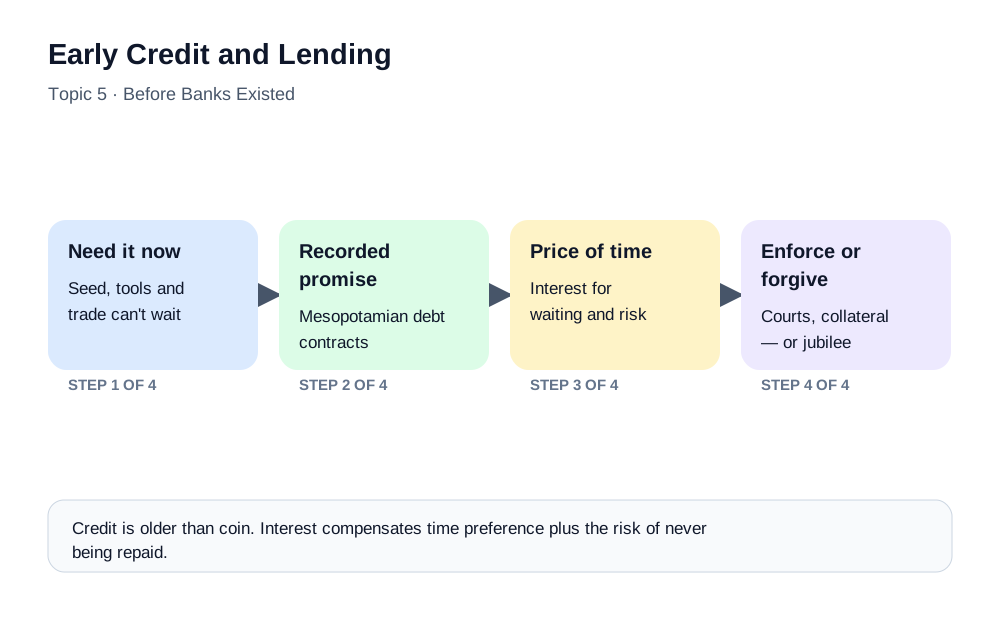
Early Credit and Lending at a glance — Temple banks, moneylenders, and interest origins.
1. Credit Before Money: Getting the Sequence Right
Topic 1 noted that deferred exchange within a barter relationship is already credit in embryo; Topic 4 showed credit creation emerging from paper money. It is now time to be precise, because students frequently carry a false chronology: that credit is a refinement invented after money. The evidence points the other way. Obligations to deliver value in the future — tracked socially, then recorded on clay — predate coined money by millennia. Mesopotamian accounts tracked debts in standard units of barley and silver long before anything resembling a coin existed. Credit did not grow out of money; in important ways, money grew up inside a world already running on credit.
A working definition: credit is a transfer of value in the present in exchange for a promise of value in the future. Every credit arrangement therefore contains three elements: a principal (what moves now), a term (when the promise matures), and compensation (what the lender receives for waiting and for bearing the risk that the promise fails). Everything else in the history of lending — collateral, guarantees, documentation, courts, credit bureaus — is machinery for making the promise believable.
This framing also explains why credit and trust share etymological roots (Latin credere, to believe). A loan is, at bottom, a belief made enforceable. Banking is the industry that manufactures, prices, and polices such beliefs at scale.
2. Foundational Concept: Time Preference and Interest
The core concept underpinning all lending is the time value of money, driven by human time preference.
Fundamentally, humans prefer to consume resources today rather than tomorrow. If you offer a person one apple today or one apple next year, they will invariably choose the apple today. Therefore, to convince someone to delay their consumption (to lend you their apple for a year), you must compensate them for their patience and the risk of default. You must offer them one apple today in exchange for more than one apple next year.
This compensation is interest.
The four components of interest
Modern credit analysis decomposes interest into distinct components, and every one of them was already visible in ancient lending:
- Time preference compensation. The pure price of waiting — giving up present consumption.
- Opportunity cost. The lender's funds are locked in this loan and unavailable for the next opportunity that appears.
- Risk premium. The expected loss from default: some borrowers will not repay, so those who do must cover the shortfall. Higher-risk borrowers have always paid higher rates.
- Productivity share. When borrowed resources are genuinely productive — seed becomes a harvest — the borrower can repay more than was lent because the capital itself grew. This is the deepest justification for interest and the reason credit can be wealth-creating rather than merely redistributive.
Interest as a biological fact
In ancient agricultural societies, interest was not a mathematical abstraction; it was a biological reality. The Sumerian word for interest, máš, is the same word used for a calf, and the ancient Greek word for interest, tokos, means offspring. If you lent someone a herd of ten cows for a year, the herd would reproduce as a biological certainty. The lender naturally expected the ten cows back plus a share of the new calves.
This biological reality translated to grain. If you lent seed grain, the borrower planted it, nature multiplied it, and the borrower repaid the principal plus a share of the harvest. Interest, in its first form, is simply the financialization of natural productive growth. The etymology matters educationally because it answers the question every beginner asks — why should a lender get back more than they lent? — with the answer that governed four thousand years of practice: because properly employed capital is fertile, and the lender's patience helped plant it.
Why lending silver was different — and why it still charged interest
Cows calve and grain germinates, but a talent of silver does not reproduce on a shelf. Why, then, did silver loans bear interest? Because silver was a claim on productive assets: borrowed silver bought seed, animals, labour, and trade goods that did multiply. The fertility was in what money could command. This distinction — money itself is sterile, but money deployed is productive — is the conceptual bridge from agricultural interest to commercial finance, and it is the logic that eventually legitimised interest on purely monetary loans.
3. Step-by-Step Operational Workflow: A Mesopotamian Debt Contract
To understand how early credit functioned, we must look at the earliest extensively documented financial system: ancient Mesopotamia (roughly the third and second millennia BCE). The temples and palaces of Sumer and later Babylon acted as the world's first major lending institutions, and their paperwork survives in quantities modern bankers would respect: hundreds of thousands of clay tablets, a large share of them financial records.
Phase 1: Origination and Underwriting
- The need: A tenant farmer's crops fail, or he needs silver to pay state taxes before the harvest comes in.
- The application: The farmer approaches a wealthy merchant or the temple administration for a loan of silver or grain.
- Underwriting: The lender assesses the borrower's ability to repay. Without credit bureaus or accounts, ancient underwriting rested on three pillars still in use today: character (reputation and prior dealings), capacity (land, livestock, and expected harvests), and collateral (pledges of land, future crops, or — in the darker pages of the record — the labour of family members).
Phase 2: Documentation and Execution
- The contract: A scribe records the loan terms on a wet clay tablet in cuneiform.
- The terms: The tablet specifies the principal, the interest rate (commonly cited customary rates were around 20% per annum for silver and about one-third for grain, later reinforced by law), the repayment date, and the names of witnesses.
- Execution: The tablet is hardened or baked to render it immutable. Frequently it was enclosed in a second clay envelope bearing a duplicate text, so that any tampering with the outer copy would be exposed by breaking the envelope open against the original — a remarkably sophisticated ancient implementation of data integrity and tamper evidence.
Pause on the witnesses and the duplicate envelope. They are the operational ancestors of two permanent features of credit operations: evidentiary documentation (the loan agreement that a court can enforce) and auditability (the ability to detect unauthorised alteration). Modern loan files, signature verification, and immutable audit logs in core banking systems (Topic 96) are these clay technologies rendered in silicon.
Phase 3: Servicing and Settlement
- The term: The farmer uses the loan to survive the season or plant crops.
- Repayment: After the harvest, the farmer delivers the required silver or grain to the lender.
- Clearing: The scribe verifies payment, and the tablet is broken or marked to extinguish the obligation — physical settlement finality, four thousand years before the term existed.
Phase 4: Default and Enforcement
- If the harvest fails, enforcement follows the contract: pledged collateral passes to the creditor. First land, then labour — debt bondage absorbed households that could not pay.
- The severity of this phase is exactly what produced the regulation and the periodic resets examined in Sections 4 and 5. Ancient credit was efficient machinery wrapped around a brutal default process, and much of the subsequent history of lending law is the story of softening that process without breaking the machinery.
4. Risk and Regulatory Factors: Default, Usury, and the State
Credit multiplied the risk surface of exchange. In spot barter, the transaction settles immediately and risk ends with delivery. Credit stretches risk across time, and ancient societies developed a recognisable risk-management and regulatory toolkit in response.
Credit and default risk
With credit, there is always the risk that the borrower fails to produce the expected return — a crop failure, a lost caravan, a death — and defaults. Ancient lenders managed this with the same instruments used today: collateral, co-signers and guarantors, conservative loan-to-value ratios (lending less than the pledge was worth), and diversification across many borrowers. The names are modern; the practices are Sumerian.
Interest-rate ceilings: the Code of Hammurabi
The Code of Hammurabi (c. 1754 BCE) provided one of the earliest known regulatory frameworks for lending. To protect borrowers from predatory terms, the Code established maximum legal interest rates — the figures commonly cited are 20% for silver loans and 33⅓% for grain — and prescribed consequences for lenders who exceeded them, including forfeiture of the principal. Whatever its enforcement gaps, the Code establishes a principle that has never left banking: the price of credit is a matter of public policy, not merely private bargain. Usury ceilings, disclosure rules, and conduct regulation across the modern world are its direct descendants.
The usury debate: a three-thousand-year argument
Hammurabi capped rates; later traditions questioned interest itself. Greek philosophers distrusted money breeding money; medieval Christian doctrine condemned usury; Islamic jurisprudence developed an entire interest-free financial architecture (the subject of Topic 20). The details differ, but the underlying tension is constant and worth naming precisely: interest is simultaneously the legitimate price of productive patience and a mechanism that can grind the vulnerable into ruin. Every regulatory regime in history is an attempt to locate the boundary between those two truths. When Topic 33 (types of loans) and Topic 86 (compliance) discuss modern consumer-credit regulation, the argument they are having began in Babylon.
The ancient risk-management toolkit
It is worth pausing to inventory the mitigation techniques Mesopotamian and other ancient lenders developed, because the list reads like a modern credit-policy manual:
| Ancient practice | Risk addressed | Modern equivalent |
|---|---|---|
| Collateral pledges (land, crop, labour) | Loss given default | Secured lending, mortgages, charges over assets |
| Guarantors and co-signers | Borrower default | Personal/corporate guarantees, co-borrowers |
| Lending below collateral value | Market risk on the pledge | Loan-to-value ratios, haircuts, margin |
| Witnessed, sealed, duplicated contracts | Documentation fraud, repudiation | Executed loan agreements, e-signatures, audit trails |
| Temple/palace ledgers | Record integrity, dispute resolution | Core banking ledgers, credit registers |
| Standardised customary rates | Pricing disputes | Benchmark rates, rate cards |
| Legal rate ceilings with forfeiture penalties | Predatory pricing | Usury laws, APR caps, conduct regulation |
| Periodic sovereign debt resets | Systemic over-indebtedness | Bankruptcy codes, restructuring regimes, crisis intervention |
Two observations follow. First, the techniques of credit risk management were largely complete by the second millennium BCE; what modern banking added is scale, data, and statistical discipline, not new categories. Second, every row of the table is a control, and every control has a cost — collateral excludes the asset-poor, guarantors shrink the eligible pool, rate caps push marginal borrowers toward informal lenders. Credit policy, ancient and modern, is the art of choosing which costs to accept. A recurring failure mode in every era is adopting the control without pricing its exclusion effects — a lesson consumer-credit regulators relearn in every generation.
There is also a lesson in what the toolkit could not fix. None of these instruments addresses correlated risk: when the same drought strikes every borrower at once, collateral values fall together, guarantors default alongside principals, and the lender's diversification proves illusory. Ancient lenders had no answer to systemic correlation except the sovereign's reset. Modern banking's answers — capital buffers, stress testing, central bank liquidity, and macro-prudential policy (Topics 8, 13, 84) — are the continuing search for one.
5. High-Impact Real-World Scenario: The Clean Slate Edicts (Debt Jubilees)
To understand the macro-prudential risks of early credit systems, we must examine how ancient regulators handled systemic debt crises.
The scenario: the crisis of compound debt in Babylon
The context: In agrarian societies, weather is volatile. A drought could wipe out a harvest, meaning farmers could not repay their loans. With customary interest rates high, unpaid debt compounded rapidly.
The execution (the workflow of crisis):
- Default: Unable to pay, farmers forfeited pledged collateral. First they lost land to creditors, then they and their families entered debt bondage.
- Systemic risk: This created a national threat for the crown. A society of landless, bonded debtors cannot pay taxes and will not serve in the army; meanwhile, land concentration in a few creditor families created rival centres of wealth and power.
- The regulatory intervention: To prevent societal breakdown, Babylonian and earlier Sumerian rulers periodically proclaimed what historians call Clean Slate edicts (andurārum in Babylonian tradition).
- The reset: Such proclamations — often issued at a king's accession — cancelled agrarian and personal debts, freed debt-bonded persons, and returned forfeited land. Debts between merchants in the ordinary course of trade were typically left intact; the target was the household debt spiral, not commercial credit itself.
The financial mechanics and impact
The Clean Slate was not an act of charity; it was a mechanism of macroeconomic stabilization. It cleared unpayable debt from the system before compounding rendered the entire economy unworkable. Two features deserve emphasis. First, the resets were periodic and anticipated — creditors knew a jubilee might come, and this expectation was itself priced into lending behaviour, shortening terms and raising effective rates as expected proclamation dates approached. Moral hazard and anticipation effects are not modern discoveries. Second, the policy explicitly distinguished debt types, preserving commercial credit while cancelling household debt — an early exercise in what modern regulators call targeted intervention.
The ancient scenario mirrors modern dynamics with uncomfortable fidelity. When a modern economy is over-leveraged, the policy menu — bankruptcy protection, debt restructuring, moratoria, and in crises, large-scale state absorption of private liabilities — is the Clean Slate logic wearing institutional clothing. The 20th century's bankruptcy codes are, in essence, routinised jubilees: they convert the king's occasional decree into a predictable legal process, protecting the debtor's fresh start while preserving the credit system's overall credibility.
6. The Customer and Bank Perspectives
From the borrower's perspective, ancient credit was survival infrastructure and a trap at once. A seed loan turned an empty spring into a harvest; the same loan, after one failed season, could cost a family its land and freedom. The borrower bore weather risk, price risk, and the compounding arithmetic of the loan itself — a burden modern consumer-protection law exists precisely to redistribute. Understanding this ancient asymmetry explains modern rules that otherwise seem arbitrary: rate caps, disclosure of total repayment, cooling-off periods, and bankruptcy discharge all answer dangers first documented on clay.
From the lender's perspective, credit was the highest-margin and highest-skill business in the ancient economy. The lender's craft — assessing character, pricing risk, securing collateral, diversifying exposures, and surviving sovereign debt resets — is recognisably the craft of a modern credit officer. Notably, the temple and palace lenders were institutions, not merely rich individuals: they held deposits of grain and silver, kept central ledgers, and enforced standard terms. When Topic 7 examines the first formal banks, it will be describing the further specialisation of functions these temples had already assembled.
7. Digital Banking Implications: What Clay Tablets Teach Core Banking
The Mesopotamian workflow is, step for step, the workflow of a modern lending operation: origination, underwriting, documentation with tamper-evidence, disbursement, servicing, repayment, ledger update, and enforcement on default. Digital banking has changed the speed and scale of each step — automated credit scoring replaces the scribe's reputation check; immutable database logs replace the clay envelope; loan-management systems replace the broken tablet — but the control objectives are identical: know your borrower, document enforceably, record immutably, settle finally.
Two modern echoes deserve note. First, algorithmic underwriting is the latest answer to the ancient information problem: the temple knew its borrowers personally; the modern lender knows them through data, and each era's defaults reflect the blind spots of its information model. Second, the Clean Slate anticipation effect survives as a live design question in credit markets: whenever borrowers or lenders expect rescues — moratoria, bailouts, debt-relief programmes — those expectations are priced into credit behaviour. Systems thinking about credit has not outgrown Babylon; it has industrialised it.
8. The Arithmetic of Credit: A Worked Agricultural Year
Abstract principles settle into understanding only when numbers run through them. Follow one loan through a full cycle at customary Babylonian terms.
Spring. A farmer borrows 100 measures of seed grain from a temple granary at the customary grain rate of one-third per annum, repayable at harvest. The tablet records principal 100, interest 33⅓, total due 133⅓ measures. The temple's underwriting: the farmer holds secure tenure on fields that have produced roughly 400 measures in normal years, pledges the standing crop, and names his brother as guarantor.
What the rate pays for. Of the 33⅓ measures of interest, the temple's steward mentally allocates perhaps a third to expected defaults — one season in three brings partial crop failure across the district, and the temple's losses on failed farms must be covered by the survivors. Another portion compensates the opportunity cost: the granary's seed could have fed temple households or been lent to a more creditworthy estate. The remainder is the institution's margin, funding scribes, storage, guards, and the reserve against a truly catastrophic year. The "high" rate is, on inspection, mostly risk and cost priced honestly.
Autumn, good year. The harvest yields 420 measures. The farmer delivers 133⅓ to the temple; the scribe marks the tablet; the obligation dies. The farmer's family retains roughly 287 measures — food, next year's seed, tax, and a small surplus. Credit has converted an empty spring into a funded household. Both parties are better off than they would have been without the loan: this is the growth engine working.
Autumn, bad year. Suppose instead the harvest yields 90 measures. The farmer cannot deliver 133⅓. Under the contract, the pledged crop passes entirely, and the shortfall rolls forward with new interest, secured now against the land itself. If the next year also fails, the arithmetic turns terminal: debt compounds while capacity shrinks, the land is forfeited, and the household descends toward debt bondage. Multiply this outcome across a drought-stricken district and the loan book of every temple converges on the same failure at the same time — correlated default, the seed of the systemic crises that produced the Clean Slate edicts.
The whole module is in this arithmetic: credit's enormous value in the good year, its brutal mechanics in the bad one, the honest composition of the interest rate, and the way individually sound loans become collectively catastrophic when every borrower's risk is the same weather. Learn to run this two-scenario test — good year, bad year — on every credit proposal you ever evaluate, and you will have internalised the oldest discipline in banking.
9. Productive, Consumptive, and Commercial Credit
A final structural distinction completes the topic's foundations: not all credit serves the same economic function, and ancient practice already separated the types.
Productive credit finances assets that generate the means of their own repayment — seed grain, livestock, tools, a trading voyage. The loan creates the harvest from which it is repaid. This is credit as growth engine: the borrower's capacity expands because the loan exists.
Consumptive credit finances survival — food after a failed harvest, tax payments due before income arrives. Nothing is created to repay the loan; repayment must come from future earnings that were going to exist anyway. Consumptive credit is humane and necessary, but it is economically fragile: it concentrates all repayment risk on the borrower's undifferentiated future, which is why ancient consumptive debt is where the bondage and forfeiture stories cluster.
Commercial credit moves goods and settles accounts among merchants — advances against consignments, credit between supplier and buyer, financing for trade ventures. It is the most sophisticated layer, resting on documentation, reputation networks, and enforceable contracts rather than collateral alone, and it is the layer the Clean Slate edicts deliberately left untouched.
Modern banking preserves the same triage. A term loan for machinery, an overdraft for payroll timing, a mortgage, a credit card balance, an invoice-financing facility — each maps onto one of these ancient types, and each carries its ancestor's risk signature. Credit professionals still ask the Babylonian question first: does this loan create the means of its own repayment, or does it merely defer the borrower's problem? The answer predicts the loss experience more reliably than any other single feature of a loan. It also predicts the appropriate price, structure, and supervision: productive credit can carry longer tenors and thinner collateral because repayment is endogenous; consumptive credit demands tighter affordability assessment and stronger borrower protections, because the borrower's future is the only collateral on offer.
10. Key Terms in This Chapter
Capacity. The borrower's ability to repay from future income or production; a pillar of underwriting since antiquity.
Character. The borrower's reputation and track record of honouring obligations; the oldest underwriting input.
Collateral. Assets pledged against a loan that pass to the lender on default, reducing loss given default.
Compound interest. Interest charged on accumulated interest as well as principal; the arithmetic engine of ancient debt spirals and modern long-term debt alike.
Credit. A transfer of present value in exchange for a promise of future value, comprising principal, term, and compensation.
Debt bondage. The pledging of personal or family labour against debt; the severest ancient enforcement outcome and a driver of the Clean Slate edicts.
Debt deflation. A self-reinforcing cycle in which falling asset prices raise the real burden of debt, causing distress sales, further price falls, and systemic collapse risk.
Interest. The price of credit — compensation for time preference, opportunity cost, risk, and the productivity of deployed capital.
Principal. The sum originally lent, excluding interest.
Risk premium. The component of interest compensating the lender for expected default losses.
Time preference. The general human preference for present over future consumption; the foundational reason interest exists.
Underwriting. The assessment of a borrower's willingness and ability to repay, and the structuring of a loan to that assessment.
Usury. Historically, any interest at all in some traditions; in modern usage, interest above legal or ethical limits.
11. Common Mistakes and Misconceptions
"Credit was invented after money." Recorded credit is older than coined money by millennia; Mesopotamian ledgers tracked debts in standard units long before coins circulated. Money matured inside an already credit-based world.
"Interest is a modern or artificial construct." Interest is anchored in time preference and in the observable productivity of capital — so natural that the Sumerian and Greek words for it literally meant offspring.
"Ancient loans were informal handshake deals." Mesopotamian lending was documented, witnessed, sealed, tamper-evidenced, and registered on institutional ledgers — a formal credit system by any functional definition.
"Hammurabi's Code was the first law ever written." It is among the most famous early law codes but not the earliest — earlier Sumerian codes, such as that of Ur-Nammu, precede it. Its credit provisions matter because of their detail and survival, not primacy.
"The Clean Slate edicts cancelled all debts." They targeted household and agrarian debt; ordinary commercial debts between merchants were typically preserved. The resets were surgical macroeconomic tools, not blanket amnesties.
"High ancient interest rates prove lenders were simply greedy." Rates reflected real default losses, enforcement costs, drought frequency, and anticipated sovereign resets, as well as market power. Price the risk of a Babylonian farm loan honestly and 20–33% looks less like extortion and more like arithmetic — though the human cost of default was unquestionably brutal.
12. Frequently Asked Questions
Q: What is the difference between credit and money? Money transfers value in the present; credit transfers value across time, resting on a promise. In modern economies the two intertwine — bank lending creates deposit money (Topic 11) — but conceptually they solve different frictions: space and time respectively.
Q: Why do lenders charge interest at all? Because lending imposes real costs: delayed consumption, forgone alternative uses, expected default losses, and administration. Interest prices those costs, and where capital is productive, the borrower's returns can cover them with surplus to spare.
Q: How did ancient lenders check creditworthiness without credit bureaus? Through reputation and relationships (character), visible productive assets and expected harvests (capacity), and pledges (collateral) — the same three pillars modern underwriting uses, powered then by local knowledge instead of data systems.
Q: Were clay tablets legally enforceable? Yes — they were formal legal instruments, witnessed and sealed, producible before authorities in disputes, and tamper-protected by duplicate envelopes. Breaking or marking the tablet extinguished the debt, which is why so many surviving tablets represent loans that were never repaid or never cleared.
Q: Is the modern bankruptcy code really related to debt jubilees? Functionally, yes. Both prevent unpayable debt from permanently destroying economic participants. The jubilee was a sovereign's periodic decree; bankruptcy is the same idea routinised into predictable law — preserving a fresh start for debtors while keeping the credit system credible for lenders.
Q: Did ancient societies ever ban interest entirely? Attitudes varied. Some Mesopotamian rulers capped rates rather than banning interest; later religious traditions — medieval Christianity and classical Islamic jurisprudence among them — restricted or prohibited it, spawning elaborate lawful structures to finance commerce without nominal interest. Topic 20 traces the Islamic architecture in depth.
13. Interview Insights
"Why does interest exist?" Give the layered answer: time preference (people prefer now to later), opportunity cost (funds are tied up), risk premium (some borrowers default), and productivity (deployed capital grows). Then deploy the máš/tokos etymology — interest literally meant "offspring" — to show that the concept predates formal finance. Interviewers consistently reward the candidate who grounds finance in first principles rather than formulas.
"How would you assess a borrower with no credit history?" This is the ancient underwriting question in modern dress. Structure the answer around character, capacity, and collateral — and note that these pillars predate credit bureaus by four thousand years. For depth, explain how each era's information model (personal knowledge, then documented records, then bureau data, now alternative data) changed how the pillars are measured without changing what they are.
"What happens to an economy when debt grows faster than the ability to repay?" Describe the ancient pattern: compounding, collateral forfeiture, concentration of assets, and a debt-overloaded economy that stops functioning — followed, historically, by resets (Clean Slates) and, in modern systems, by restructuring, bankruptcy, and policy intervention. Name debt deflation as the modern analytical frame. This answer demonstrates that you see credit cycles as structural phenomena, not moral failures.
"Is credit good or bad for an economy?" Reject the binary. Credit is the mechanism that lets economies invest from future earnings rather than accumulated savings — the single most powerful growth technology finance possesses — and it carries an equally powerful failure mode when promises outrun production. Strong candidates quote the boundary condition: credit funds growth when it finances productive capacity, and crises when it funds consumption and speculation beyond repayment capacity.
Summary and Key Takeaways
- Credit solves temporal friction: it moves value across time, letting economies invest from future production rather than accumulated savings alone.
- Recorded credit predates coined money by millennia; Mesopotamian temples ran documented, witnessed, ledger-based lending systems before coins existed.
- Interest rests on four foundations — time preference, opportunity cost, risk premium, and the productivity of capital — and ancient languages encoded it as "offspring," the financialization of natural growth.
- The Mesopotamian loan workflow (origination, underwriting, sealed documentation, servicing, settlement by tablet-breaking) is the direct ancestor of every modern lending operation and its controls.
- The Code of Hammurabi's rate ceilings established that the price of credit is a matter of public policy — the root of all later usury law and consumer-credit regulation.
- Collateral, guarantors, conservative loan-to-value, and diversification are ancient risk tools still in daily professional use.
- The Clean Slate edicts were early macro-prudential interventions: targeted cancellations of household debt that prevented systemic collapse, anticipated and priced by creditors, and echoed today in bankruptcy law and crisis-era restructuring.
- The permanent tension of credit — growth engine versus debt spiral — was visible in Babylon and remains the central management problem of every bank's loan book and every regulator's supervisory agenda across the modern world today.
Hold three ideas from this module as you proceed. First, credit is older than money as we know it, and understanding that order explains why ledgers, contracts, and institutions — not tokens — are the deep structure of finance. Second, every element of a modern loan is an ancient answer to an ancient risk: the rate prices default and patience, the collateral prices loss, the documentation prices repudiation, and the regulation prices the harm done when all three fail together. Third, credit systems fail systemically, not individually — through correlated shocks that no single contract can survive — which is why societies from Hammurabi's Babylon onward built reset mechanisms, and why modern banking embeds capital, supervision, and crisis frameworks at its core. Topic 6 now widens the lens to compare how the great ancient civilisations each assembled these same pieces into recognisably different banking worlds.
Next: Topic 6 — Banking Across Ancient Civilisations →
<!-- MBA-DEEP-DIVE-START -->Deep Dive: Credit Before Banking Became an Industry
Credit is older than modern banking and older than coinage. Long before a customer could sign a loan agreement with a regulated bank, people advanced grain, silver, livestock, tools, labour, and other resources against promises of future repayment. Surviving cuneiform tablets from Mesopotamia record loans, repayment dates, witnesses, security arrangements, and interest. The technology was clay rather than a core banking platform, but the underlying economic problem is immediately recognisable: one party gives up value now and relies on another party to perform later.
The history is important because it prevents a common conceptual error. Credit is not simply "money lent out." Credit is a time-separated exchange backed by an obligation. The obligation can be denominated in money, grain, metal, or another agreed unit. Modern money makes credit easier to price and settle, while legal systems and financial institutions make it easier to document, monitor, transfer, and enforce.
Credit moves purchasing power across time
A farmer may need seed before harvest. A merchant may need inventory before customers pay. A craft business may need tools before additional production generates revenue. A household may need a durable asset before it has accumulated the full purchase price. Credit connects a present need with future income or production.
That connection creates economic value when future capacity is credible. It can also create distress when the expected future cash flow fails to materialise. A drought can reduce the farmer's harvest. A merchant's goods may not sell. A borrower can become ill or lose income. Credit therefore cannot be understood only as a growth mechanism. It is a contractual allocation of uncertainty between borrower and lender.
Modern banking professionalises that allocation. Underwriting estimates repayment capacity. Collateral and guarantees reduce loss in some scenarios. Pricing reflects funding cost, expected loss, capital, operating cost, and commercial considerations. Monitoring detects deterioration. Collections and restructuring address stress. Provisioning and capital recognise that not every promise will be honoured in full.
Why interest exists: more than one explanation
Interest is the compensation associated with lending, but reducing it to one universal cause is too narrow. Several economic factors can contribute. The lender gives up access to resources for a period and therefore bears an opportunity cost. Future repayment is uncertain, so compensation may include a risk premium. Inflation can reduce the purchasing power of the amount returned. Administration, safekeeping, information gathering, and enforcement create costs. In commercial lending, the borrower may use the resources productively and share some of the economic benefit through the agreed price of credit.
The relative importance of these components varies across products and periods. An ancient grain loan tied to an agricultural cycle is not priced through the same institutional framework as a modern mortgage or corporate revolving credit facility. A bank today also faces funding costs, regulatory capital requirements, liquidity costs, operating expenses, expected credit losses, competition, and legal or consumer-protection constraints.
For this reason, "interest is the price of money" is a useful shorthand but an incomplete professional explanation. It is more precise to say that interest is part of the price for transferring purchasing power across time while bearing funding, risk, and opportunity costs.
Agricultural credit has seasonal logic
Many early loans were linked to agriculture because farming naturally separates expenditure and income. Seeds, labour, animals, irrigation, or food may be needed before the crop can be harvested. Repayment after harvest aligns the maturity of the obligation with the expected source of repayment.
Modern banks still use this principle. A good repayment schedule should fit the borrower's cash-flow cycle. An agricultural loan may have seasonal payments. A construction facility may be drawn in stages. A trade-finance exposure may mature when goods are sold and receivables are collected. A term loan may amortise from operating cash flow.
When repayment dates ignore the underlying business cycle, default risk rises even if the borrower is economically viable. Credit analysis is therefore partly a timing discipline: when does cash leave, when does cash return, and what happens if the expected timing changes?
Evidence from cuneiform loans
Museum collections provide unusually concrete evidence that ancient credit was sophisticated. The Metropolitan Museum of Art describes an Old Assyrian cuneiform tablet from the early second millennium BCE recording six minas of silver owed to a merchant. The document specifies staged repayment, states that interest will accrue if repayment is late, names witnesses, and was associated with a sealed clay envelope. Other museum collections preserve barley and silver loan contracts with defined interest arrangements.
The striking lesson is not that ancient lending was identical to modern banking. It clearly was not. The lesson is that lenders and borrowers already needed documentation, maturity dates, witnesses, evidence, and consequences for late performance. Those requirements arise naturally whenever economic value is transferred today against a future promise.
A modern loan file is vastly more complex because regulation, accounting, consumer rights, taxation, prudential standards, data protection, and financial-crime controls add layers of governance. But the contractual core remains recognisable.
Underwriting before credit scores
Ancient lenders did not have bureau scores, automated income verification, or probability-of-default models. They could still assess risk using information available in their community: reputation, family relationships, trading history, land, crops, guarantors, pledged assets, or social status. Close networks can produce rich qualitative information even without formal databases.
Modern underwriting turns similar questions into structured evidence. Capacity asks whether expected income or cash flow can service the obligation. Character or behaviour is approximated through credit history and repayment patterns. Capital considers the borrower's own financial stake. Collateral provides a secondary recovery source where relevant. Conditions examine the economic, industry, and transaction environment.
Different banks and products use different frameworks, so these labels are not universal rules. The underlying principle is universal: lending should be based on a reasoned view of how repayment will occur, not merely on the existence of an asset that might be seized after failure.
Collateral is a secondary source of repayment
Collateral can reduce loss when a borrower defaults, but it does not make weak lending safe automatically. Assets can fall in value. Ownership can be disputed. A lien may not be perfected. The asset may be difficult to locate, insure, repossess, maintain, or sell. Legal enforcement can take time. During stress, many lenders may try to sell similar collateral at once, depressing prices.
This is why sound credit practice usually treats expected cash flow as the primary source of repayment and collateral as a secondary protection, although specialised asset-based lending can place greater emphasis on collateral quality and controls.
Ancient secured lending faced the same basic distinction in harsher forms. A pledge had value only if ownership and enforcement were credible. Modern banking replaces informal power with legal documentation, registries, valuation standards, custody arrangements, and controlled enforcement processes.
Guarantees transfer risk; they do not erase it
A guarantor promises to perform if the borrower does not. Economically, the lender is substituting or supplementing one credit exposure with another. The guarantee is useful only if the guarantor has the capacity and legal obligation to honour it when needed.
A business analyst should therefore never model a guarantee as a simple yes/no flag. The system may need guarantor identity, guarantee amount, currency, coverage, expiry, conditions, documentation status, utilisation, and links to the underlying exposure. Credit teams also need to avoid double-counting the same protection across multiple facilities.
The principle is ancient: witnesses and sureties can increase confidence in a promise. The modern implementation is more formal because the bank must prove exactly what protection exists and how it affects risk measurement.
Hammurabi: legal rules around debt, not a modern consumer-credit regime
The Code of Hammurabi is frequently described in modern language as if it were an early banking regulation book. That analogy should be used carefully. The code was a royal legal text from ancient Babylon covering many areas of social and economic life, not a prudential banking rulebook or modern consumer-protection statute.
Some provisions dealt with loans, interest, crop failure, pledges, and debt relationships. These show that credit was important enough to require formal rules and that rulers recognised the social consequences of lending. But calling the code a modern "price-control regime" or "consumer-protection framework" can be misleading because the institutions, rights, enforcement mechanisms, and social structure were radically different.
The disciplined comparison is this: once credit becomes economically significant, societies develop rules around evidence, permissible claims, repayment, default, and enforcement. Modern credit law continues that governance need within a very different legal and political framework.
Interest-rate numbers need context
Historical loan documents sometimes record rates that look very high by modern retail-banking standards. A British Museum tablet, for example, records a barley debt at a stated 20 percent rate; another records a barley loan at 33 percent. These objects demonstrate that interest-bearing debt was documented, but isolated rates should not be turned into claims about a single standard cost of credit across all Mesopotamia.
Commodity, period, location, maturity, risk, custom, and legal convention mattered. Some rates were conventional in particular settings; other loans had different terms. Comparing an ancient nominal rate directly with an annual percentage rate on a modern regulated loan can be misleading because the units, compounding conventions, maturity, enforcement, and economic environment differ.
The professional habit is to ask: rate on what principal, for what period, using what day-count or time convention, with what fees, under what repayment rule, and what happens on default? A number without its calculation basis is not yet a complete price.
Default is a process, not a moment
A missed payment does not tell the whole credit story. The lender must determine why the obligation was missed, whether the borrower can recover, whether the contract allows a cure period, whether collateral or guarantees should be called, and whether restructuring produces a better outcome than immediate enforcement.
Modern banks formalise these stages through delinquency buckets, credit monitoring, collections strategies, forbearance rules, non-performing exposure classification, expected-credit-loss processes, and recovery teams. Definitions differ across accounting and regulatory regimes, so local rules matter.
The underlying economic choice is old: enforce immediately, grant time, restructure the obligation, accept alternative settlement, or recognise loss. Each option changes incentives and distributional outcomes.
Debt distress can become a system problem
Credit risk is usually analysed borrower by borrower, but widespread debt stress can become macroeconomic. If many households or firms cut spending simultaneously to service debt, demand can weaken. If asset prices fall, collateral values deteriorate. If banks experience losses, they may tighten lending. These feedback loops can amplify a downturn.
Ancient rulers sometimes cancelled or remitted certain debts in political and social contexts very different from modern bankruptcy systems. It is useful to compare the function—preventing debt relationships from producing intolerable social or economic outcomes—while avoiding the claim that ancient clean-slate proclamations were equivalent to modern macroprudential policy.
Modern systems use bankruptcy law, insolvency procedures, restructuring, supervisory intervention, borrower-protection rules, fiscal policy, and monetary policy in ways that have no exact ancient counterpart. Historical analogy can illuminate the problem but should not erase institutional differences.
Credit risk and liquidity risk interact
A lender can suffer because borrowers fail to repay, which is credit risk. It can also suffer because expected repayments arrive later than required while the lender's own obligations still fall due, which creates liquidity pressure. In a bank, the two can interact: deteriorating credit quality can reduce the market value or funding usefulness of assets precisely when liquidity is needed most.
This is why lending cannot be separated from treasury and asset-liability management. The lending business determines the timing and quality of asset cash flows. Funding determines when the bank must return value to depositors and wholesale creditors. Liquidity buffers protect against timing mismatches and stress.
A loan is therefore never only a relationship between a relationship manager and a borrower. It ultimately affects the bank's balance sheet, capital, liquidity, profitability, accounting, reporting, and risk profile.
The credit lifecycle in a modern bank
The lifecycle usually begins with origination, where the customer need and product are identified. Application and data collection gather financial and legal evidence. Underwriting assesses affordability or repayment capacity and risk. Approval applies delegated authority and policy. Documentation creates enforceable terms and security. Disbursement makes funds available after conditions are satisfied. Servicing calculates interest, repayments, fees, statements, and balances. Monitoring watches payment behaviour and risk indicators. Collections or restructuring handle stress. Closure confirms that obligations are discharged and any collateral is released appropriately.
Each stage creates data and controls. A failure early in the lifecycle can emerge years later. Incorrect borrower identity affects enforcement. A missing security document affects recovery. A wrong interest parameter affects every repayment. A disbursement before conditions are met creates unauthorised exposure. Weak status management causes inaccurate reporting.
This is why strong credit platforms are not merely calculators. They are controlled evidence systems.
A practical scenario: seasonal borrower under stress
Consider a small food-processing company that borrows to purchase agricultural inputs before its peak sales season. The credit case assumes receivables will be collected in four months. A logistics disruption delays deliveries and collections by six weeks.
The borrower may still be fundamentally viable, but timing has changed. Operations sees a late instalment. Credit monitoring sees increased utilisation and weaker cash flow. Treasury sees expected asset inflows arriving later. The relationship manager sees a customer asking for temporary relief. Finance may need to reassess expected loss. A restructuring team may consider whether extending maturity is better than accelerating the debt.
The correct response cannot be chosen from payment status alone. The bank needs current information about orders, inventory, receivables, liquidity, other creditors, and the cause of the delay. Credit management is therefore information management under uncertainty.
What a business analyst should model
A credit system should distinguish facility, drawdown, borrower, guarantor, collateral, repayment schedule, interest parameters, fees, covenants, conditions precedent, delinquency state, restructuring events, write-offs, recoveries, and closure. These objects are related but not interchangeable.
Dates are particularly important. Approval date, offer date, drawdown date, value date, interest start date, payment due date, grace date, maturity date, default date, restructuring date, and closure date can drive different business rules. Treating them as one generic "transaction date" creates defects.
The analyst should also identify the source of truth for balances and statuses, the accounting events generated by each lifecycle step, reconciliation between servicing and general-ledger records, audit evidence for approvals, and how corrections are controlled. Credit is a long-lived product, so historical state matters as much as current state.
Accuracy guardrails
Do not state that credit necessarily appeared after money; debt obligations and accounting existed before coinage. Do not reduce interest to one theory such as time preference; risk, opportunity cost, funding, inflation, administration, and market structure can all matter. Do not present the Code of Hammurabi as though it were a modern banking regulator's handbook. Do not assume a historical interest percentage is directly comparable with a modern annualised customer rate. Do not treat ancient debt cancellations as identical to modern bankruptcy or macroprudential policy. And do not assume collateral eliminates the need to assess repayment capacity.
Verification anchors
The Metropolitan Museum of Art preserves cuneiform loan records from Old Assyrian and Babylonian contexts, including a silver obligation with staged repayment, witnesses, and interest upon late payment. The British Museum holds multiple tablets recording barley and silver loans, including examples with stated interest. These primary artefacts provide strong evidence that documented credit, interest, security, and repayment terms existed long before modern banks.
The enduring lesson is that banking did not invent the promise to pay. Banking industrialised it. Modern credit turns a human promise into a governed lifecycle supported by law, data, underwriting, accounting, capital, liquidity management, monitoring, and recovery. Understanding that transformation is the foundation for every later lending topic.
<!-- MBA-DEEP-DIVE-END -->