The invention of standardized coinage solved the problem of assaying and weighing, but it did not solve the problem of physical gravity. As trade networks expanded across continents, the sheer weight of precious metals became a crippling bottleneck to economic growth. Moving tons of copper, silver, or gold across bandit-infested Silk Road routes or storm-tossed seas was astronomically expensive and intensely risky.
One response to this friction was to transfer claims on value instead of moving the underlying metal on every occasion. Paper instruments could represent deposits, promises, or transferable payment rights, and later state-issued notes could circulate as money in their own right. The historical path from representative claims to modern fiat currency was gradual and differed across jurisdictions rather than following one automatic sequence.
In this module, we will explore the evolution of paper money and promissory notes. We will analyse early transferable claims, official note issuance, the liquidity risk created when deposit-taking institutions also lend, and the different historical contributions of Song-period Chinese paper currency and early modern European banking to later monetary and banking practice.
Learning objectives
- Explain the representational leap: how a claim on value came to function as value itself.
- Define a promissory note and understand negotiability — the legal property that lets paper circulate as money.
- Map the operational workflow of a goldsmith depository and identify the exact moment credit creation occurs.
- Analyse fractional reserve banking as both an engine of growth and a structural source of liquidity risk.
- Explain the mechanics and psychology of bank runs, and why they are rational as well as contagious.
- Trace the regulatory responses — central banking, note monopolies, lender of last resort, deposit insurance — to the instabilities paper money created.
- Evaluate Song-period jiaozi as a major early case of private paper instruments moving toward official issuance, and examine the governance challenges created by paper-money supply.
Visual overview
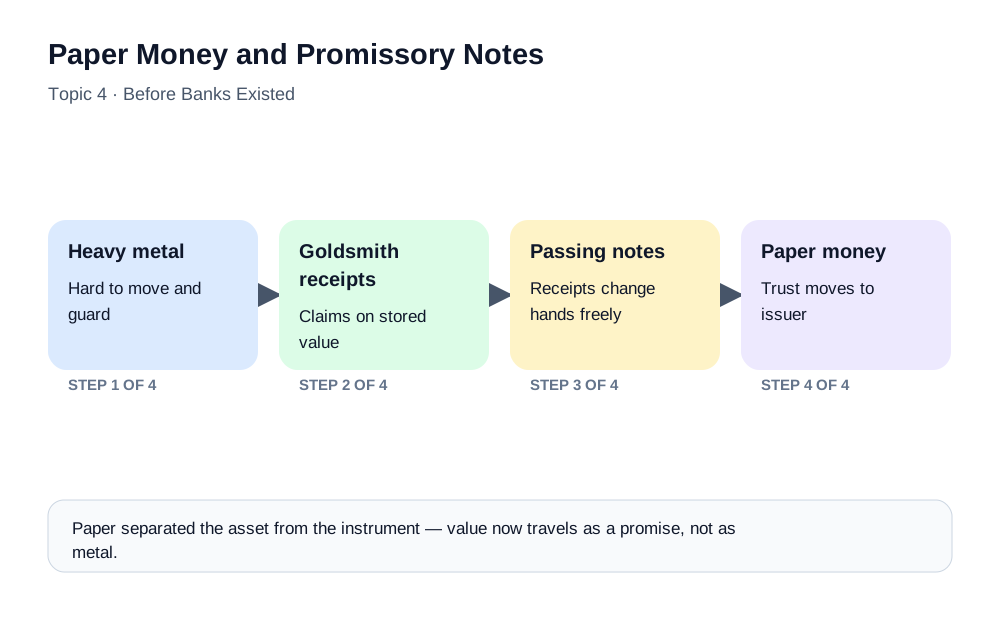
Paper Money and Promissory Notes at a glance — China's innovation and goldsmiths' receipts.
1. The Friction Paper Was Invented to Remove
Topic 3 ended with coined money triumphant: standardized, certified, countable. But every improvement leaves a residual friction, and coinage's residual friction was mass. Money made of metal scales with the wealth it must move. A merchant settling a caravan's worth of trade faced the cost of packing, guarding, insuring, and transporting hundreds of kilograms of coin; a state moving tax revenue between provinces ran the same gauntlet. Theft was not a tail risk but a routine cost of doing business, priced into every long-distance transaction.
There was a subtler cost, too: idle capital. Coin in transit earns nothing and buys nothing. A monetary system in which significant value is perpetually sitting on ships and pack animals is a system with liquidity locked in the logistics layer. Reducing time-in-transit for value is a theme that runs through the entire course — from paper notes to telegraph transfers to real-time payment systems — and paper was the first great compression of it.
The stage was therefore set for a genuinely new idea. Coins had improved the quality of money's physical form; paper would question whether money needed a physical form at all.
2. Foundational Concept: The Separation of Asset and Instrument
The core foundational concept behind paper money is the decoupling of the physical asset from the transactional instrument.
In a coinage system, the settlement asset (gold) and the medium of exchange (the coin) are the exact same physical object. When you buy a horse with a gold coin, the gold physically moves.
Paper money introduces an intermediary layer. The valuable asset (gold or silver) is stored securely in a vault. The vault issuer provides a paper receipt — a promissory note — that says, "The bearer of this note is entitled to claim X amount of gold from the vault."
Because this paper is lightweight and easy to conceal, merchants begin trading the receipts instead of the physical gold. The paper becomes the medium of exchange, while the gold remains stationary, acting merely as the reserve backing the paper. This abstraction is the technological foundation of modern finance: wealth becomes data recorded on a ledger (or a piece of paper), distinct from the physical asset it represents.
Why the abstraction works
The representational note functions only because of a chain of confidence with three links. First, existence: the holder must believe the gold is really in the vault. Second, convertibility: the holder must believe the note can be exchanged for that gold on demand, in full. Third, transferability: the holder must believe the next person will accept the note, which depends on the next person believing links one and two. When all three links hold, the paper trades at par with the metal it represents, and nobody bothers redeeming it — redemption is exercised only when confidence wavers. This is why paper money, from the beginning, was not merely a physical innovation but a psychological and institutional one.
Notice also what the note is legally: a liability of the issuer and an asset of the holder. A gold coin was nobody's liability — it simply existed as wealth. A promissory note is someone's promise. Money, for the first time, became a balance-sheet item. Every subsequent monetary form covered in this course — bank deposits, central bank reserves, fiat currency, and even digital balances — inherits this character: modern money is overwhelmingly someone's liability circulating as everyone else's asset.
Promissory notes and negotiability
For paper to circulate as money, a further legal property was required: negotiability. An ordinary contract binds the two parties who made it. A negotiable instrument is designed to travel: it is payable to the bearer, or to the order of a named payee who can transfer it by endorsement, and — crucially — a person who takes it in good faith and for value can acquire rights to it that are largely free of disputes between earlier parties. Without negotiability, every recipient of a note would have to investigate the entire chain of prior dealings, and paper could never circulate the way coin did.
The legal architecture of negotiability matured alongside commercial paper — bills of exchange, promissory notes, and later banknotes and cheques — and it is still studied today under laws modelled on doctrines that merchants and courts developed over centuries. The educational point for this topic is simple: paper money is as much a legal technology as a physical one. The paper carried value because the law and commercial custom made the promise portable.
3. Step-by-Step Operational Workflow: The Goldsmith's Depository
To understand the mechanics of early paper money, we examine the classic operational workflow of 17th-century European goldsmith-bankers, who inadvertently created the blueprint for modern banking. (The goldsmith narrative is a stylised teaching model — real practice was diverse and incremental — but it captures the essential mechanics with unusual clarity.)
Phase 1: Deposit and Custody (Asset Ingestion)
- The friction: A wealthy merchant has 1,000 gold coins but fears keeping them at home due to the risk of theft.
- The solution: The merchant takes the gold to a local goldsmith, who possesses heavy, secure iron safes.
- The transaction: The merchant deposits the 1,000 gold coins. The goldsmith charges a small custody fee for providing security.
- The instrument: The goldsmith issues a paper receipt stating: "I promise to pay the bearer on demand 1,000 gold coins."
Phase 2: Market Circulation (The Note as Currency)
- The transaction: The merchant wishes to buy a ship. Instead of returning to the goldsmith, hauling 1,000 gold coins across town, and giving them to the shipbuilder (who would likely just deposit them back in a vault), the merchant simply hands the shipbuilder the goldsmith's paper receipt.
- Acceptance: Because the goldsmith is highly reputable, the shipbuilder accepts the paper as if it were physical gold. The note has achieved liquidity.
Observe what has happened to the gold: nothing. It sits in the vault while its paper shadow does the trading. The settlement asset and the medium of exchange have parted company — the defining event of this topic.
Phase 3: The Birth of Fractional Reserve (Credit Creation)
- The observation: The goldsmith notices that, on any given day, only about 10% of his clients return to redeem their paper notes for physical gold. The other 90% of the gold just sits in the vault.
- The innovation (lending): Another merchant asks the goldsmith for a loan of 500 gold coins. Instead of handing over physical gold, the goldsmith writes out new paper receipts for 500 coins and hands them to the borrower, charging interest on the loan.
- The result: There are now 1,500 gold coins' worth of paper receipts circulating in the economy, but only 1,000 physical gold coins in the vault. The goldsmith has created purchasing power beyond the stock of deposited metal. This is the birth of the fractional reserve system.
It is worth being precise about what "creating money" means here, because Topic 11 returns to it in depth. The goldsmith has not printed gold; he has issued claims on gold in excess of his holdings, on the statistical confidence that not all claims will be presented at once. Both the depositor and the borrower now believe they hold 1,000 and 500 coins respectively — 1,500 of perceived money against 1,000 of metal. The extra 500 exists because the goldsmith's promise is credible, and it is useful: the borrower can build, hire, and trade with it today, repaying from tomorrow's earnings. Credit creation is the monetary system lending the future to the present.
Phase 4: Redemption, Clearing, and Netting
- Periodically, note-holders present notes for redemption. The goldsmith pays out physical gold, shrinking both his reserves and his outstanding liabilities.
- Where several issuers operate in one town, their customers pay one another in different issuers' notes. The issuers then settle among themselves: rather than hauling gold for every obligation, they exchange bundles of each other's notes and settle only the net difference in metal. This practice — clearing — is the ancestor of the clearing houses and interbank settlement systems covered in Topic 68, and it is the second way paper economised on gold: not only did notes replace metal in circulation, but netting replaced gross metal movements between vaults.
4. Risk and Regulatory Factors: Bank Runs and Trust
The leap to paper money and fractional reserve banking unleashed unprecedented economic growth by expanding the money supply and providing credit. However, it introduced a catastrophic new vulnerability: liquidity risk at the level of the entire institution.
The bank run (liquidity crisis)
The entire system of paper money rests on a psychological foundation: public confidence. If the public believes the goldsmith is solvent, the system works flawlessly.
However, if rumours spread that the goldsmith has issued too many paper notes and does not have enough gold in the vault, panic ensues.
- The mechanic: Every note-holder rushes to the vault simultaneously to demand their physical gold before it runs out.
- The collapse: Because the goldsmith holds only a fraction of the gold in reserve (e.g., 1,000 coins backing 1,500 in notes), he cannot pay everyone. He defaults, the remaining notes become worthless paper, and the local economy experiences a severe deflationary shock as circulating "money" evaporates.
Three features of bank runs deserve professional attention, because they recur in Topic 13 (banking crises) and Topic 79 (why banks fail).
Runs are individually rational, collectively catastrophic. If you suspect the vault is short, queueing early is the smart move — even if you suspect it only slightly, and even if you know the suspicion is probably false. Waiting costs you everything if the rumour is true; queueing costs you an afternoon if it is false. When every depositor runs this calculation, the run becomes self-fulfilling: the fear of illiquidity produces the illiquidity.
Solvent is not the same as liquid. A goldsmith whose loans are sound but cannot be recalled instantly may be solvent — assets exceed liabilities — and still die in a run, because his assets are illiquid while his liabilities are payable on demand. This maturity transformation — borrowing short, lending long — is the structural heart of banking, and its fragility is the price of its usefulness.
Runs are contagious. Depositors cannot easily inspect vaults, so they reason by analogy: if the goldsmith across the street has failed, perhaps mine is also short. One failure triggers withdrawals elsewhere, and a local panic can become a systemic one. Contagion, more than any single default, is what made paper money a matter of public policy rather than private contract.
Regulatory evolution: centralisation and fiat
To prevent continuous cycles of bank runs, governments eventually stepped in to regulate paper money. The full institutional history belongs to Topic 8 (central banks), but the logical sequence of responses belongs here, because each is a direct answer to a failure mode of private paper:
- Monopoly on issuance: States established or empowered central banks (the Bank of England, founded in 1694, became the archetype) and progressively stripped private banks of the right to print their own banknotes, centralising the issuance of paper money in a single, supervised institution.
- Reserve and backing rules: Regulations constrained how much paper could circulate against how much metal or other reserve, attempting to legislate the confidence that reputation alone had failed to stabilise.
- Lender of last resort: Central banks took on the role of lending freely to solvent-but-illiquid institutions in a panic, breaking the solvent-versus-liquid trap before it killed healthy banks.
- Deposit insurance (a 20th-century addition, Topic 85): guaranteeing small depositors removed the individual incentive to queue early, striking directly at the run's rationality.
- The shift to fiat: Eventually, governments recognized that if public trust in the state was strong enough, paper notes did not need to be backed by gold at all. The value of the paper could rest on government mandate (fiat) and the state's fiscal and monetary credibility. In 1971, the United States suspended dollar convertibility into gold, completing the global transition from representational money to pure state credit — the subject of Topic 10.
Each response narrowed a specific vulnerability, and each concentrated more monetary authority in the state — the same trade-off we watched coinage perform with verification, now performed with trust itself.
5. High-Impact Real-World Scenario: Jiaozi — The World's First Paper Money
While European goldsmiths popularised the fractional reserve pattern in the 17th century, the operational deployment of state-backed paper money occurred centuries earlier, during China's Song Dynasty (11th century CE).
The scenario: the iron coin burden in Sichuan
The context: In the province of Sichuan, the currency in circulation was heavy iron coin rather than lighter, more valuable copper. Iron's low value density meant that everyday purchases required transporting absurd weights of coin — a severe physical friction on trade.
The execution (the workflow):
- Private innovation: Wealthy merchants in Sichuan — traditionally described as a syndicate of sixteen merchant houses — opened deposit operations where traders could lodge their heavy iron coins and receive lightweight paper certificates called jiaozi.
- Standardization and security: These certificates were produced with sophisticated woodblock printing and marking techniques to frustrate forgery — early operational-risk management applied to paper.
- State nationalisation: In 1023, the Song government recognised both the utility and the danger of private paper and established a state monopoly over jiaozi issuance — history's first government-issued paper currency.
- The slide toward over-issuance: Initially, the government maintained reserve backing for the notes. But fiscal pressure from prolonged wars eroded that discipline, and issuance expanded beyond the reserves supporting it.
The financial mechanics and impact
The Song experiment traced the full arc that monetary theory predicts. Paper money delivered enormous benefits — trade unshackled from iron's weight — and then, as issuance outran backing and credibility, the currency depreciated and the system degraded. Later Chinese dynasties repeated versions of the cycle: paper money was a technology the world would keep rediscovering, and keep abusing, for a thousand years.
The jiaozi story encapsulates the dual nature of paper money: it is an extraordinary tool for reducing transactional friction and expanding economic capacity, and it is permanently exposed to the temptation of over-issuance. The tension between those two truths — capacity versus discipline — is the central drama of monetary history, and it has not ended; it has only acquired better statistical reporting.
6. The Customer and Bank Perspectives
From the customer's perspective, paper money was a revolution in convenience layered on top of a new kind of worry. The depositor traded the risk of theft at home for the risk of the goldsmith's solvency — exchanging a risk she could see for one she had to take on faith. The circulating note spared her weighing, hauling, and guarding metal, but it also asked her to evaluate an issuer's reputation, a task for which an ordinary merchant had little information. Every later consumer-protection institution in banking — supervision, disclosure, deposit insurance — is an answer to that asymmetry.
From the proto-banker's perspective, paper changed the business model from fee-for-custody to spread-for-intermediation. The goldsmith's insight — that reserves could be fractionally held — converted a warehouse into a credit engine: income now flowed from interest on loans rather than only from safekeeping fees. But the same insight made risk management the core competence of banking. Managing the reserve ratio, diversifying loans, holding liquid assets against redemptions, and protecting reputation were no longer administrative details; they were survival. When Topic 14 (retail banking) and Topic 11 (fractional reserve) formalise these ideas, their goldsmith origins will be visible throughout.
7. Digital Banking Implications: Paper Was the First Virtualisation
It is tempting to think of digital money as a recent abstraction. Paper money shows that the abstraction happened centuries ago: value was separated from the physical asset and placed onto a portable record. The digitisation covered in later topics is the second virtualisation — from paper record to database record — and it follows the same logic: cheaper transport, cheaper verification, faster settlement, and new risks clustered around whoever maintains the record.
The parallels are structural. A bank deposit today is a digital promissory note: the bank's liability, the customer's asset, circulating by transfer rather than by physical handover. The confidence chain — existence, convertibility, transferability — now runs through core banking systems, payment rails, deposit insurance, and central bank settlement rather than through vaults and reputations, but the links are the same. And the bank run, far from being eliminated, has been accelerated: withdrawals that once required a queue outside the goldsmith now execute from a phone in seconds, a lesson modern regulators absorbed in the digital-era bank failures of the 2020s. Paper taught banking that trust is the product; digital banking only raised the speed at which trust is tested.
8. Beyond the Vault: Bills of Exchange and Moving Money Without Moving It
The promissory note was not the only paper instrument that compressed medieval commerce, and the other one — the bill of exchange — matters equally to banking history because it solved the distance problem rather than the custody problem.
Suppose a merchant in one city owed payment to a supplier in another. Shipping coin was slow and dangerous. The bill of exchange offered an alternative: the debtor paid a local banker, who issued a written order instructing the banker's correspondent in the distant city to pay the supplier, often in the local currency, at a stated date. The two bankers settled their mutual balances later, in bulk. Money had effectively teleported: value moved between cities while metal stayed home, carried instead by a network of trusted correspondents and their paper.
Three banking consequences followed. First, the correspondent relationship became the skeleton of international banking — the direct ancestor of the correspondent banking networks examined in Topic 70 (SWIFT and cross-border payments). Second, because the bill bundled a payment instruction with a currency conversion and a time delay, it quietly contained an embedded credit and an embedded foreign-exchange transaction; pricing those embedded elements is the seed of both FX markets and the modern trade-finance instruments covered in Topic 37. Third, bills could themselves be sold before maturity — discounted — creating a secondary market in paper claims and, with it, a new banking business: buying future payment rights at a discount to face value. The discount houses and money markets of later centuries (Topic 50) grew from this practice.
Religious and legal constraints also shaped this machinery. Where charging explicit interest on loans faced doctrinal objections — a thread developed fully in Topic 20 (Islamic banking) — merchants and bankers embedded the cost of credit inside exchange rates and fees rather than nominal interest. The instruments were more than payment tools; they were legal engineering, and studying them teaches a lasting lesson: financial innovation often advances by redesigning the form of a transaction around a constraint while preserving its economics.
By the early modern period, then, European commerce ran on a layered paper system: promissory notes solving custody and local circulation, bills of exchange solving distance and cross-currency settlement, and discounting providing liquidity against both. When central banks later monopolised banknote issuance, they were crowning a system that merchants and bankers had already built.
9. Worked Example: The Lifecycle of One Note
Follow a single promissory note through its life to see every concept in this module operating at once.
Issuance. A cloth merchant deposits 200 gold coins with a reputable goldsmith and receives a note promising payment on demand. The goldsmith debits nothing and credits nothing — he records a liability (note outstanding) and an asset (coin in vault). The merchant's wealth is unchanged; only its form has changed, from metal at risk of theft to paper at risk of the issuer.
Circulation. Over the following months the note passes through five hands: to a wool supplier for fleece, to a weaver for finished cloth, to a dyer, to a tailor, to a landlord settling rent. Each holder accepts it because the goldsmith's name is good, and none redeems it, because redemption means a walk across town and the note spends as easily as coin. The gold has moved zero metres; its paper shadow has financed five transactions.
Credit creation. Meanwhile, observing that redemptions average only a tenth of outstanding notes, the goldsmith lends 60 coins' worth of new notes to a vintner expanding her cellar. Total claims on the vault now exceed its contents — fractional reserve in miniature. The vintner's notes circulate too, and the town's effective money stock has grown without a single new coin entering it.
Stress and redemption. A rumour spreads that the goldsmith has lent recklessly. The landlord, third-hand holder of our note, decides not to test it: he presents the note for redemption. The goldsmith pays — reserves are adequate this week — the note is cancelled, liability and asset shrink together, and its life ends. Had the whole town presented notes on the same day, the vault would have emptied early in the queue, and every later holder would have discovered the difference between a claim on money and money itself. The note's lifecycle is the module in one object: abstraction, circulation, credit creation, confidence, and redemption.
10. Key Terms in This Chapter
Bank run. A simultaneous mass redemption of notes or deposits driven by fear of an issuer's illiquidity; individually rational, collectively destructive, and often contagious.
Clearing. The process by which issuers (later, banks) exchange obligations and settle only net differences, economising on the movement of reserves.
Convertibility. The holder's right to exchange paper for the backing asset (historically gold or silver) on demand; the central link in paper money's confidence chain.
Custody. Safekeeping of assets on behalf of clients — the original fee business of depositories and a live banking line today.
Fiat money. Money whose value rests on state decree and institutional credibility rather than convertibility into a commodity (developed fully in Topic 10).
Fractional reserve banking. The practice of holding reserves equal to only a fraction of outstanding demand liabilities, lending out the remainder — the credit engine born in the goldsmith's vault.
Jiaozi. The paper certificates of Song Dynasty Sichuan; the first privately issued, then state-monopolised, paper currency (11th century CE).
Lender of last resort. A central bank's function of lending to solvent but illiquid institutions during panics, preventing liquidity crises from causing insolvencies.
Liquidity risk. The risk of being unable to meet obligations as they fall due despite holding adequate assets; paper money's signature vulnerability.
Maturity transformation. Borrowing short (demand liabilities) and lending long (illiquid loans) — banking's core function and its structural fragility.
Negotiability. The legal property allowing an instrument to circulate by delivery or endorsement, with transferees largely protected from prior-party disputes.
Promissory note. A written, signed promise to pay a stated sum — the instrument through which claims on stored value first circulated as money.
Representational money. Money with no significant intrinsic value that derives value from representing, and being convertible into, a backing asset.
11. Common Mistakes and Misconceptions
"Paper money was invented by governments." In both China and Europe, private actors innovated first — Sichuanese merchants, European goldsmiths — and states followed with monopolies and regulation. The recurring pattern is private innovation, then public absorption.
"Fractional reserve banking is a modern invention or a scam." It is neither: it emerged naturally from 17th-century (and earlier) depository practice as a rational response to redemption statistics, and it is the legal, supervised foundation of modern credit creation (Topic 11). Its risks are real; so is its role in funding economic growth.
"A bank run means the bank was crooked." Runs can kill honest, solvent institutions, because the vulnerability is structural — demand liabilities against illiquid assets — not necessarily fraudulent. Fraud causes some failures; arithmetic causes most runs.
"Fiat money appeared suddenly in 1971." 1971 completed a long transition. Elements of unbacked or partially backed paper had appeared for centuries — the Song dynasty among them — and convertibility had been suspended and restored repeatedly before the final break.
"Paper money eliminated the risks of metal money." It traded old risks for new ones: theft and transport risk fell, but counterparty risk (the issuer's promise), liquidity risk (runs), and over-issuance risk (inflation) rose. Every monetary technology redistributes risk rather than deleting it.
"Notes replaced gold because paper is inherently better." Paper won on logistics, not on trust. It circulated because it was convertible into something trusted, and later because states built institutions that made unbacked paper trustworthy. Convenience explains the adoption; institutions explain the confidence.
12. Frequently Asked Questions
Q: What is the difference between a promissory note and a banknote? A promissory note is a written promise to pay a stated sum, historically issued by merchants or bankers for specific transactions. A banknote is a standardised, negotiable promissory note issued by a bank (now exclusively central banks) intended from the outset to circulate generally as money.
Q: Did the goldsmith really "create money"? In a precise sense, yes: by issuing claims exceeding his gold, he increased the total purchasing power in circulation. He did not create gold — he created credit, and credit functioning as money. Topic 11 explains how modern banks do the same at scale under regulation.
Q: Why did people trust paper at all? Because of the confidence chain: belief that the backing existed, that conversion would be honoured, and that others would accept the paper. Where those beliefs held, paper traded at par; where they cracked, it traded at a discount or not at all.
Q: What stopped a goldsmith from issuing unlimited notes? Self-interest (redemptions would bankrupt him), reputation, and eventually law: reserve requirements, note-issuance monopolies, and central bank oversight progressively replaced personal restraint with institutional restraint.
Q: Were bank runs common in the paper-money era? Yes — recurrent bank panics were a defining feature of 18th and 19th century finance in many countries, and their repetition is precisely what motivated central banking, lender-of-last-resort doctrine, and eventually deposit insurance.
Q: Is a modern bank deposit the same thing as a jiaozi or a goldsmith note? Functionally, yes: it is an issuer's liability circulating as the holder's money. The differences are institutional — deposits live on ledgers rather than paper, are typically insured up to limits, and settle through regulated payment systems — but the underlying balance-sheet logic is the goldsmith's.
13. Interview Insights
"How was paper money invented?" Avoid a single-story answer. Present the two independent strands — Song China (state paper money, 11th century, born of iron coin's weight) and European goldsmiths (private depository receipts, 17th century, born of custody and credit) — and identify the shared conceptual leap: separating the settlement asset from the medium of exchange. Candidates who give both strands show they understand paper money as a convergent solution, not a one-off event.
"Explain fractional reserve banking to a non-specialist." The goldsmith example is the interview-standard illustration: 1,000 deposited, 1,000 plus 500 in claims, redemption statistics making it safe — until it isn't. Close by naming the trade-off: credit creation and growth on one side, structural liquidity risk on the other. Balanced framing beats enthusiasm or cynicism.
"Why do bank runs happen even to healthy banks?" Walk through the three mechanisms: demand liabilities against illiquid assets (maturity transformation), the individually rational decision to queue early, and contagion through analogy. Then name the institutional fixes — lender of last resort and deposit insurance — and which mechanism each fix targets. This question is really testing whether you understand that banking fragility is structural, not accidental.
"What did the end of gold convertibility in 1971 actually change?" It severed the last link between major currencies and a commodity anchor, completing the shift from representational money to fiat — value resting on state credibility, tax-driven demand, and central bank management rather than vault contents. Connect it forward to Topic 10 (fiat money) and Topic 9 (the gold standard) and you demonstrate command of the whole narrative arc.
Summary and Key Takeaways
- Paper money solved the physical-gravity problem of metal currency by decoupling the settlement asset (vault gold) from the transactional instrument (the circulating note).
- A promissory note made money a balance-sheet item — someone's liability circulating as someone else's asset — and negotiability made that liability portable.
- The goldsmith depository model shows how custody became circulation, and circulation became credit: fractional reserve banking begins the moment claims exceed reserves.
- Fractional reserve creates purchasing power and funds growth, at the price of structural liquidity risk: maturity transformation makes every such institution vulnerable to a run.
- Bank runs are individually rational, self-fulfilling, and contagious — which is why the system's responses (central banks, issuance monopolies, lender of last resort, deposit insurance) progressively centralised monetary trust.
- The jiaozi of Song China ran the entire cycle centuries early: private innovation, state monopoly, fiscal over-issuance, depreciation — the template for every later paper-money failure.
- Paper was the first virtualisation of money; digital balances are the second, running on the same confidence chain at higher speed.
- The enduring lesson: every monetary technology redistributes risk rather than eliminating it, and the history of money is the history of who bears which risk, under what institutional discipline.
Next: Topic 5 — Early Credit and Lending →
<!-- MBA-DEEP-DIVE-START -->Deep Dive: From Valuable Object to Transferable Claim
Paper money represents a change in the architecture of trust. With commodity money, much of the value is associated with the thing itself. With a representative note or transferable receipt, the holder accepts a document because it is a credible claim on value held or promised elsewhere. With modern fiat banknotes, the note is no longer a warehouse receipt for a fixed amount of metal, but it remains a monetary claim supported by the issuing framework, legal system, central bank, and public confidence.
That shift is more important than the material change from metal to paper. It teaches a principle that still defines banking: a well-governed record or claim can move economic value without moving the underlying asset at every step. Deposits, cheques, banknotes, securities, bills, and modern electronic payments all depend on some version of this abstraction.
China: separate the milestones carefully
Paper instruments developed in China over a long period, and simplified histories often compress several centuries into one event. Paper-based payment and credit instruments appeared before state-issued circulating notes. Merchant practices, deposit receipts, and instruments sometimes described as "flying cash" reduced the need to transport heavy coin over long distances. In the Song period, private exchange notes known as jiaozi developed in Sichuan, and the state later brought issuance under official control. By the eleventh century, government-backed paper currency had become an important monetary institution.
The safest lesson is not that one date marks the invention of all paper money. It is that commercial need, transferable claims, issuer credibility, and state standardisation interacted over time. Bank of England historical material notes that paper money was introduced in China centuries before European banknotes and that later European note issuance followed its own institutional path.
The Chinese experience also provides an early warning about paper issuance. A paper claim is easy to produce relative to metal coin. That is its great operational advantage, but it means supply discipline becomes an institutional rather than a physical constraint. If issuance grows far beyond the economy's willingness to hold the notes, confidence and purchasing power can weaken. The problem is not "paper" itself. The problem is the governance of claims whose marginal production cost is low.
Receipt, promise, note, and money are not the same thing
A receipt proves that something was received. A promissory note records a promise to pay. A banknote is a monetary instrument issued by an authorised note issuer. A cheque is an instruction by an account holder to a bank to pay. A bill of exchange is an order directing one party to pay another, usually under defined commercial terms. These documents can overlap historically in function, but a banking professional should not use the labels interchangeably.
A transferable receipt can begin to circulate because the next holder trusts that the underlying asset exists and can be redeemed. A promissory note can circulate if the promise, issuer, endorsement rules, and legal enforceability are sufficiently credible. Negotiability can make certain instruments easier to transfer, but the exact legal meaning depends on the applicable law. Modern practitioners therefore need to distinguish the economic idea—transferring a claim—from the legal characteristics of a specific instrument.
Why portability changed finance
Metallic money carries a logistics burden. High-value trade can require heavy shipments, guards, secure storage, counting, and insurance. A paper claim can represent the same nominal value at a fraction of the physical weight. This lowers transport cost and makes remote settlement easier.
But paper does not eliminate risk; it relocates it. The holder now cares less about the weight of the payment instrument and more about the issuer's credibility, the authenticity of the document, redemption terms, legal enforceability, and the quality of the underlying custody or balance-sheet arrangement. Physical risk gives way to a mixture of issuer risk, fraud risk, liquidity risk, and legal risk.
Modern electronic money continues the same pattern. Moving a number across controlled ledgers is far cheaper than transporting a physical asset, but value depends on the integrity of the records, systems, access controls, settlement arrangements, and institutions behind the number.
European goldsmith banking: useful history, but avoid a straight-line myth
In seventeenth-century London, goldsmith bankers accepted deposits, made loans, and issued receipts or notes that could be used in payment. Bank of England historical material describes goldsmiths as acting as custodians of money and valuables and increasingly lending deposited funds. Their promissory notes payable on demand became convenient payment instruments and contributed to the development of English banknotes.
It is tempting to tell this as a single invention story: people deposited gold, received receipts, discovered that receipts circulated, and goldsmiths then invented fractional-reserve banking. The reality was more institutional and gradual. Deposit taking, lending, payment instructions, transferable claims, government finance, legal rules, and merchant networks developed together. The important banking insight is not a heroic invention but a balance-sheet transformation: an institution accepts liabilities to customers and uses part of its funding to acquire earning assets, while remaining responsible for meeting valid payment and withdrawal demands.
That structure produces both economic value and liquidity risk.
The balance-sheet transformation
Suppose customers place coin with a banker. From the banker's perspective, the physical coin becomes an asset and the obligation to repay customers becomes a liability. If some of the funds are lent to borrowers, the bank exchanges part of its liquid asset position for loan assets. The loans may earn interest, but they are not normally repayable on demand in the same way as transaction deposits.
This difference in maturity and liquidity is fundamental. Customers may want their money today while borrowers repay over months or years. Banking therefore requires liquidity management. A profitable bank can still fail if it cannot meet immediate obligations when due. Modern banks manage this through liquidity buffers, funding diversification, central-bank facilities where applicable, contingency plans, asset-liability management, and prudential rules. The basic tension—shorter-dated liabilities funding less liquid assets—was visible long before modern regulation gave it formal metrics.
What a bank run actually reveals
A bank run occurs when many depositors attempt to withdraw at the same time because they fear the institution may not be able to honour future withdrawals. The behaviour can be individually rational even when collective withdrawals worsen the bank's liquidity position. If depositors believe others will withdraw first, waiting can appear dangerous.
A bank run must be distinguished from insolvency. Liquidity concerns the ability to meet obligations when due. Solvency concerns whether the value of assets is sufficient relative to liabilities and capital. The two can interact. A solvent institution can suffer severe liquidity stress if forced to sell assets quickly at large discounts. An insolvent institution can temporarily appear liquid if it still has cash. Sound analysis asks both questions separately.
Modern safeguards—prudential liquidity requirements, lender-of-last-resort arrangements, deposit insurance in many jurisdictions, recovery and resolution frameworks, supervision, and transparent communication—aim to reduce the probability or damage of destabilising runs. The design varies by country, so an educational chapter should describe the principles without pretending one rule applies globally.
Convertibility is a contractual and confidence mechanism
Representative banknotes historically promised redemption into another asset such as coin or bullion. Convertibility disciplines the issuer because holders can demand the underlying asset. But it also creates a liquidity requirement: the issuer must be able to honour redemption requests.
If everyone tries to redeem simultaneously, the system faces pressure similar to a bank run. Suspension of convertibility can preserve remaining reserves but changes the holder's rights and may alter confidence. This is why the legal terms of a monetary claim matter. A note that says "promise to pay" is not merely decorative language; historically, it expressed a redemption relationship.
Modern Bank of England notes still retain traditional promise-to-pay wording, but the contemporary sterling system is fiat. The wording should not be interpreted as a modern promise to hand the bearer an equivalent weight of gold. Historical language can persist after the monetary architecture changes.
Fixed denomination changed usability
Early banknotes could be issued for specific, sometimes irregular amounts associated with individual deposits or transactions. Over time, fixed denominations made notes more standard and easier to circulate. Standard denomination is another example of trading flexibility for efficiency. A bespoke claim can match one transaction perfectly, but a standard instrument can be recognised and reused across millions of transactions.
Banking technology repeatedly makes this trade-off. Standard payment products, account types, message formats, and settlement cycles reduce processing cost because systems know what to expect. Bespoke structures remain necessary for some corporate or investment needs, but standardisation makes mass-market finance scalable.
Authenticity becomes central when value is represented cheaply
A precious-metal coin has material properties that can be tested. A paper note is comparatively inexpensive to manufacture physically, so the issuer must make unauthorised reproduction difficult and public verification practical. Watermarks, specialised paper or polymer, intricate printing, serial numbers, security threads, holographic features, and machine-readable elements are different generations of the same control objective.
The modern digital equivalent is authentication and integrity. If value is represented as data, the system must prevent unauthorised creation, alteration, replay, and duplicate processing. Access controls, cryptographic protections, transaction identifiers, validation, logging, and reconciliation replace the physical anti-counterfeit toolkit. Again, abstraction does not remove control; it makes control more dependent on process and technology.
Promissory notes and commercial credit
A promissory note is fundamentally a written promise by one party to pay a defined sum under specified terms. Its commercial usefulness comes from creating evidence of an obligation. Depending on legal form and jurisdiction, negotiability can allow the instrument to be transferred to another holder.
For a business, this can turn a future receivable into something that may be financed or transferred. The same principle underlies much of trade finance: a future payment right can have present economic value if the obligor, documentation, maturity, and enforceability are acceptable. Banks analyse such claims rather than looking only at physical cash.
The risk questions are familiar. Who owes the money? Is the signature or authority valid? Has the instrument been altered? Is there a dispute about the underlying transaction? When is payment due? Can the claim be transferred? Which law governs it? What happens on default? Historical paper finance becomes modern credit analysis very quickly once these questions are asked.
Operational lifecycle of a paper claim
A paper-based monetary or credit instrument can be understood through stages. Issuance establishes the claim and its terms. Distribution places it with the first holder. Transfer changes the holder or uses the instrument for payment. Presentation asks the responsible institution or obligor to honour it. Verification confirms authenticity, authority, amount, and status. Redemption or settlement discharges the obligation. Cancellation or archival prevents the same claim from being honoured twice and preserves evidence.
Modern digital payment systems follow recognisable stages even though the documents are electronic. Instructions are created, authenticated, validated, routed, accepted, settled, reconciled, and retained for audit. A bank that loses track of state—whether an item is issued, paid, cancelled, or outstanding—creates duplicate-payment and financial-reporting risk.
A practical scenario: duplicate presentation
Imagine a historical merchant issues a transferable claim for a fixed amount. The claim is paid, but the paid document is not marked or retained properly. If it is later presented again, the paying institution needs evidence that the obligation has already been discharged. This simple problem explains why cancellation marks, serial numbers, paid-item archives, and controlled recordkeeping developed.
The digital version is equally important. A payment platform must handle repeated messages, retries, timeouts, and uncertain acknowledgements without paying twice. Idempotency controls, unique transaction identifiers, status management, and reconciliation are modern solutions to an old state-management problem.
What a business analyst should model
For any instrument that represents value, the analyst should define issuer, holder, face amount, currency, issue date, maturity or redemption terms, status, transferability, authentication evidence, settlement event, cancellation state, and audit history. If the claim is backed by an asset, the relationship between issued claims and backing assets must also be explicit.
The analyst should then map exceptional states: lost instrument, damaged instrument, suspected counterfeit, duplicate presentation, disputed signature, partial redemption, expired claim, issuer failure, blocked payment, and legal hold. A happy-path flow alone is not enough because the value of a financial system is tested most severely when claims are contested.
Accuracy guardrails
Do not compress all Chinese paper-money history into one invention date. Distinguish private commercial instruments from later official note issuance. Do not describe every goldsmith receipt as a modern banknote or every promissory note as currency. Do not say fractional-reserve banking means a bank can ignore liquidity; the system requires careful management of liquid assets and funding. Do not equate a liquidity crisis automatically with insolvency. And do not interpret historical convertibility language on modern fiat notes as a current promise to redeem for precious metal.
Verification anchors
The Bank of England Museum's early-banknote material documents running cash notes as early Bank of England promises to pay and explains their development toward fixed-denomination notes. Its historical account of English banknotes also records the role of London goldsmiths in taking deposits, lending, and issuing promissory notes payable on demand. Bank of England material on modern banknotes notes the much earlier development of paper money in China. For the Chinese chronology, specialist monetary history should be used to distinguish early paper instruments, private jiaozi, and later government-controlled issuance.
Paper money matters because it separates monetary value from the physical mass of the settlement asset. Once society accepts that a trustworthy claim can move instead of the underlying object, finance becomes capable of enormous scale—but the burden shifts to governance, authenticity, liquidity, recordkeeping, and confidence.
<!-- MBA-DEEP-DIVE-END -->