While commodity money — such as grain, salt, or cattle — solved the immediate failures of the barter system, it remained cumbersome. Measuring grain accurately took time; assessing the health of a cow required expertise; and dividing a large silver ingot in a marketplace was a fraught, inexact process. The friction of trade had been reduced, but it had not been eliminated.
The move from weighed metal to standardised coinage was one of the most important reductions in transaction cost in monetary history. Some of the earliest widely recognised struck electrum coins known today come from Lydia and neighbouring western Anatolia around the late seventh and early sixth centuries BCE. Their marks, weight standards, and recognisable types reduced the amount of verification required at each trade, although historians continue to debate the precise identity and institutional status of some of the earliest issuers.
In this module, we will explore the invention of coins through a modern operational lens. We will examine the mechanics of early minting, the critical shift from commodity value to state-guaranteed value, the systemic risks of debasement, and how these ancient innovations laid the groundwork for modern central banking and foreign exchange markets.
Learning objectives
- Explain the transaction-cost problem that coinage was invented to solve.
- Describe how early standardised coinage shifted part of the verification burden from each individual transaction to trusted issuers, mints, and recognised weight standards.
- Define seigniorage and trace it from ancient mints to modern central bank finance.
- Map the full operational workflow of an ancient mint, from metal ingestion to market circulation.
- Analyse debasement and Gresham's Law as recurring monetary pathologies, not just ancient history.
- Explain why coins behaved as currency inside borders but as commodities across them — the origin of foreign exchange.
- Evaluate the Athenian tetradrachm as a widely accepted international trade coin and draw disciplined, qualified parallels with modern reserve currencies.
Visual overview
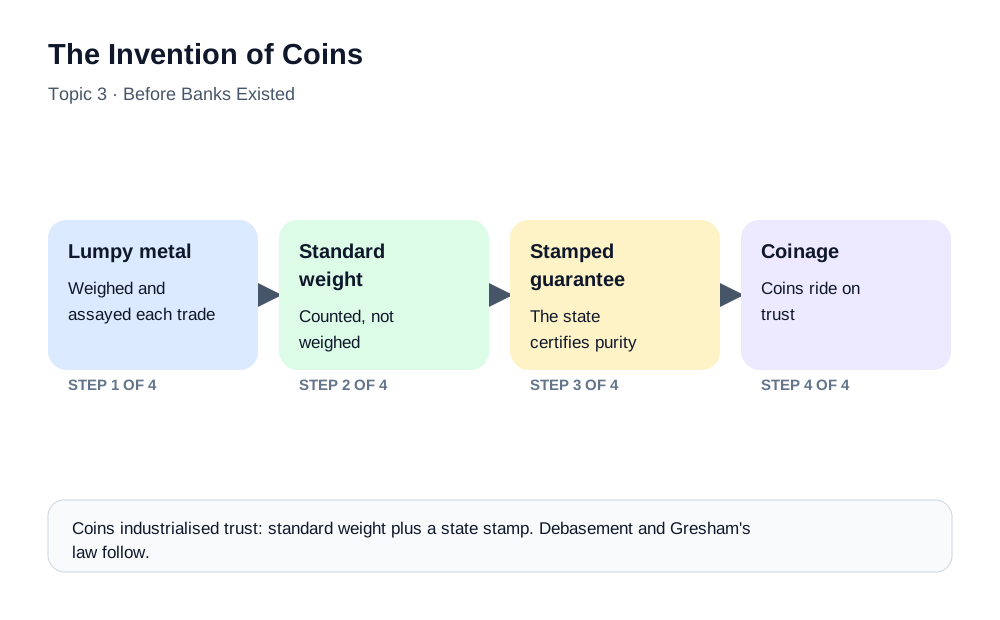
The Invention of Coins at a glance — Lydia's electrum coins and state-backed currency.
1. The Problem Coins Were Invented to Solve
Topic 2 closed with a checklist of the properties of good money, and noted that weighed precious metal scored well on almost all of them — durability, portability, divisibility by weight, scarcity — but poorly on one: cognisability, the speed and cost of verification. Every significant transaction in weighed silver or gold required three operations: weighing the metal, testing its purity, and negotiating over any disagreement in either. Both parties needed scales, touchstones or other assay equipment, and the expertise to use them. Disputes were constant, because small differences in measured weight or assessed purity translated directly into wealth.
This verification burden had real economic consequences. It made small transactions impractical, because the fixed cost of assay did not shrink with the size of the trade. It slowed markets, because queues formed around the scales. And it advantaged specialists — professional money-changers and merchants — over ordinary participants, because verification skill was a form of market power. In the vocabulary of modern finance, the verification problem was a transaction cost and an information asymmetry combined.
Coinage attacked both at once. By pre-weighing and pre-certifying metal at a central point, the invention converted a per-transaction verification cost into a one-time production cost. The genius of the idea is easy to miss today because coins feel obvious; but nothing about them is obvious until someone centralises trust. That is the thread running through this entire module.
2. Foundational Concept: Standardization and State Guarantee
The foundational concept behind the invention of coins is the reduction of transaction costs through standardization and centralized trust.
Before coins, merchants trading in precious metals had to carry scales and touchstones. For every transaction, they had to weigh the silver or gold and test its purity. This process (assaying) was slow, prone to dispute, and required specialized knowledge.
A coin solves this by acting as a pre-weighed, pre-tested, and certified unit of precious metal. The breakthrough of the Lydian kings was to take electrum (a naturally occurring alloy of gold and silver found in local rivers), separate it into uniform pieces, and stamp them with a royal seal — famously, the head of a roaring lion.
The stamp as a trust device
The royal stamp functioned as the ancient world's authentication signature. It declared: "The State guarantees that this piece of metal contains a specific weight and purity." Therefore, merchants no longer needed to weigh the metal; they only needed to count the coins.
Notice what actually changed. The silver did not change; the location of trust changed. Under weighed-metal money, trust was bilateral and had to be rebuilt in every transaction. Under coinage, trust was centralised in a single issuer whose reputation covered all transactions at once. This is a pattern the course will return to repeatedly — in banknotes, in central bank settlement, in card networks, in payment systems: economies scale when bilateral trust is replaced by institutional trust. Coinage was the first large-scale execution of that pattern.
The shift to seigniorage
This innovation introduced the concept of seigniorage — the difference between the face value of money and the cost to produce it. The state charged a premium for the convenience and guarantee of the coin. If a coin contained 9 grams of silver, the state might declare its legal value as 10 grams. This premium was the first formalized monetary revenue, funding the state while simultaneously accelerating trade liquidity.
Seigniorage is not an ancient curiosity. It survives as a line item in modern central banking: a currency note costing a fraction of its face value to produce, or reserves created at negligible cost and exchanged for interest-bearing assets, generates income for the issuing authority. The Lydian mint and a modern central bank are separated by twenty-six centuries and share one balance-sheet insight: the issuer of trusted money earns the spread between what money costs to make and what it commands in exchange.
Why the state, and not a private issuer?
Students often ask why coinage arrived as a state monopoly rather than a merchant service. Private stamped metal did exist in places, but three forces favoured the state. First, the value of the guarantee depended on the guarantor's power to punish forgery, and states held that power. Second, states could manufacture demand for their coin by requiring taxes to be paid in it — a mechanism examined below. Third, seigniorage revenue made coinage worth monopolising and worth defending. Money and state power have been entangled ever since.
The problem of small change and bimetallism
One operational problem early coinage never fully solved was small change. A gold or high-grade silver coin was simply too valuable for daily purchases — a loaf of bread could not practically be priced in fractions of a gold stater. Societies responded with multi-metal systems: gold for large settlements, silver for commerce, and bronze or copper for everyday transactions. This layered structure is the ancestor of modern denominations, and it created a durable headache known as bimetallism when two monetary metals circulated side by side.
The bimetallic problem is arithmetic. If the state fixes a legal ratio between silver and gold coins, but the market price of the two metals drifts — because a new mine opens or trade shifts demand — one metal becomes legally undervalued. Gresham's Law then operates across metals: the undervalued metal is hoarded, melted, or exported, and the monetary system is left limping on one leg. Governments spent centuries adjusting official ratios to chase market prices, never quite winning. The episode matters for this course because it teaches a general principle that later topics (exchange-rate pegs, Topic 64) revisit: a fixed price between two things the market reprices is a standing invitation to arbitrage, and arbitrage always collects. Coinage solved the verification problem; the pricing problem between monies proved far more stubborn.
3. Step-by-Step Operational Workflow: The Minting and Circulation Cycle
To understand the economic impact of coinage, we must map its operational workflow, from raw material to market circulation and ultimate settlement. Readers with operations experience will recognise the skeleton immediately: it is a supply chain with quality gates, a monetary injection channel, and a settlement layer — the same architecture a modern currency operation runs today.
Phase 1: Raw Material Sourcing and Assay (Treasury Operations)
- Ingestion: The state treasury collects raw precious metals through taxation, mining, or tribute.
- Refinement: The metal is melted and standardized to a specific purity (e.g., separating electrum into pure gold and silver, a process refined under the Lydian King Croesus, whose name survives in the expression "rich as Croesus").
- Quality control: The treasury assays the batch to ensure strict compliance with the state's legal standard.
Phase 2: The Minting Process (Production)
- Planchet creation: The metal is cast into uniform blank discs, known as planchets.
- Striking: The planchet is placed between two engraved dies (an anvil die and a punch die). A minter strikes the punch die with a hammer, impressing the state's seal onto both sides of the coin.
- Verification: The minted coins are weighed and verified before being authorized for release. This gate matters: a mint that releases off-weight coins is quietly debasing its own guarantee.
Phase 3: Injection into the Economy (Monetary Policy)
- The state injects the coins into the economy by paying its soldiers, civil servants, and contractors.
- Because the state demands that taxes be paid in this specific coin, it instantly creates universal demand for the currency within its borders.
This tax mechanism deserves emphasis, because it answers a deep question: why does anyone accept money at face value in the first place? Part of the answer, then and now, is that the issuer's own obligations are denominated in it. If the state only accepts its coin in settlement of taxes, everyone who owes taxes needs the coin, and everyone who trades with those who owe taxes finds the coin useful. Economists call this the tax-driven demand for money, and it remains a pillar of why modern fiat currencies hold value (Topic 10). The Lydians and their successors were running this loop in the 6th century BCE.
Phase 4: Market Circulation and Settlement
- A merchant sells goods and accepts the coin at face value, without weighing it, entirely on the trust of the royal seal.
- Cross-border settlement: If the coin crosses borders into a foreign kingdom, the foreign merchant does not trust the Lydian seal. In foreign exchange, the coin reverts to a mere commodity. It is thrown on a scale, weighed for its intrinsic metal content, and melted down or re-stamped.
This dual behaviour is the embryonic form of the foreign exchange market. Inside the issuing jurisdiction, a coin trades at face value — it is currency. Outside it, a coin trades at metal value — it is a commodity with a spread. The money-changers who weighed, melted, and re-stamped foreign coin were the first FX desks, and their margin between face value and metal value was the first exchange-rate quotation. When Topic 36 covers foreign exchange and Topic 64 covers exchange rates, the underlying mechanics are these.
Worked example: a coin's journey
Follow one Lydian stater. Gold and electrum arrive at the Sardis treasury as tribute from river concessions; refiners separate and standardise the metal; planchets are cast; a striker impresses the lion; inspectors pass the batch. The stater is paid to a stonemason building fortifications — the injection channel. The mason spends it with a grain merchant, who accepts it by count because the seal answers the purity question he could not answer himself. The grain merchant holds it until tax season, when the state pulls it back through the tax channel, completing the circulation loop. At every step, the seal did the work that scales and touchstones used to do. Years later, the same coin turns up in a Greek port: there a money-changer weighs it, finds it good, and re-stamps it or melts it, because the Lydian seal's jurisdiction ended at the border. One coin, two monetary regimes — domestic currency abroad-facing commodity — in a single object.
4. Risk and Regulatory Factors: Debasement and Gresham's Law
The creation of state-backed coinage immediately introduced complex macroeconomic risks. When a state controls the money supply, it faces overwhelming temptations that require strict discipline to manage. Coinage concentrated monetary trust in one place — which meant, for the first time, that trust could be betrayed at scale.
The risk of debasement (systemic inflation)
The greatest risk in early coinage systems was debasement — the intentional reduction of the precious metal content in a coin by the issuing authority.
- The mechanic: A kingdom facing war debts might recall its silver coins, melt them down, mix them with cheap copper, and re-mint them with the same face value. The state has effectively created money to fund its deficit.
- The consequence: As merchants realized the new coins contained less silver, they demanded more coins for the same goods. This is the ancient mechanism of monetary inflation. The Roman Empire notoriously debased its silver denarius from nearly full purity under Augustus to only a few percent silver by the late 3rd century CE, contributing to the economic disorder of the empire's crisis decades.
Debasement is the fiscal temptation in its purest form: an invisible tax collected not by legislation but by metallurgy. It requires no collector and no consent, and its costs arrive later and land on holders of money. The institutional defences built against it — independent mints, legal standards, and in the modern era independent central banks with price-stability mandates (Topic 65) — are all answers to the same ancient problem: the issuer of money always faces an incentive to cheat, so credible monetary systems are designs for restraining the issuer.
Gresham's Law
Debasement triggers a phenomenon known as Gresham's Law, famously stated as "bad money drives out good."
- If the state mandates that a new, debased (copper-filled) coin has the exact same legal value as an older, pure silver coin, citizens will rationally hoard the pure silver coins (good money) and only spend the debased coins (bad money).
- Regulatory response: Ancient states attempted to combat this with price controls and decrees forcing merchants to accept debased coins at par, but market forces repeatedly overpowered such decrees.
The logic is worth stating carefully, because the law is often misquoted. When two monies are legally forced to trade at a fixed ratio but differ in intrinsic value, the undervalued one disappears from circulation — into hoards, melting pots, or foreign trade — and only the overvalued one circulates. The law operates only under a forced fixed exchange rate between the two monies. Where rates float freely, good and bad money simply trade at different prices, and the effect vanishes. This nuance matters beyond history: the same mechanism appears whenever authorities fix an artificial parity — between old and new notes, between a pegged currency and market reality, or between parallel exchange rates.
Clipping and counterfeiting (fraud risk)
Criminals would physically shave or "clip" the edges off gold and silver coins, accumulating the shavings while passing the clipped coin at face value.
- Regulatory mitigation: In much later centuries, mints introduced "milled" or ridged edges on coins — a feature still visible on many modern coins. If a coin's edge was smooth, merchants immediately knew it had been clipped and rejected it. This was an early, physical form of tamper-evident security.
Sweating (shaking coins in a bag to collect abraded metal), plugging (hollowing a coin and filling it with base metal), and outright counterfeiting completed the fraud catalogue. Each attack drove a defensive innovation: designs extending to the coin's edge, lettered edges, and eventually machine-struck uniformity beyond the reach of hand tools. The arms race between counterfeiters and issuers that began at the Lydian mint has never paused — it simply moved from metallurgy to printing chemistry to cryptography. Modern banknote security threads, holograms, and the authentication checks run by cash-processing machines are the current chapter of a story that starts with a hammer, a die, and a clipped edge.
5. High-Impact Real-World Scenario: The Athenian Owl and the First Reserve Currency
To understand the power of a trusted, standardized coin, we can look at the most famous currency of antiquity: the Athenian tetradrachm, commonly known as the "Owl" due to the image of Athena's owl stamped on the reverse.
The scenario: international trade in the Mediterranean (5th century BCE)
By the 5th century BCE, the Mediterranean was a complex network of independent city-states, each with its own local currency. Trade was heavily localized due to the high friction of currency exchange.
The execution (the workflow):
- The standard: Athens, rich from the Laurion silver mines, made a strategic, long-term policy decision. It minted the tetradrachm to a famously high and consistent standard of purity and weight. Even under severe fiscal pressure, Athens largely resisted the temptation to debase the Owl.
- The liquidity premium: Because merchants across the Mediterranean trusted that an Athenian Owl was what it claimed to be, they stopped weighing it. They accepted it by count — even far from Athens, where no Athenian authority could enforce the guarantee.
- Reserve currency status: The Owl became accepted well outside Athenian territory, circulating in Egypt, Sicily, and the Levant — making it antiquity's closest analogue to an international reserve currency.
The financial mechanics and impact
By maintaining discipline and refusing to debase its currency, Athens achieved a compounding economic advantage. Its coin became a preferred settlement medium, so foreign merchants actively sought it, which deepened its liquidity, which made it still more acceptable. Athens could import easily, and its bankers could offer loans and exchange services into a wide market.
The parallel with modern reserve currencies is real but must be drawn with care. Like the US dollar today, the Owl's status rested on credibility: counterparties used it because they trusted its consistency, not because anyone forced them at the point of trade. Unlike a modern fiat reserve currency, the Owl's credibility was metallurgical rather than institutional — backed by silver content and mint discipline rather than by a central bank's mandate and an economy's depth. Both cases share the core lesson: reserve status is earned through restraint and lost through abuse. A state that spends its monetary credibility for short-term fiscal relief is running the debasement playbook, whatever century it is in — and history suggests the market's verdict arrives slowly and then all at once.
6. The Customer and Bank Perspectives
From the merchant's perspective, coinage was a direct cut in operating costs. The scales stayed in the drawer; small transactions became viable; disputes over purity largely vanished; and the customer base widened to anyone who could count. The merchant's residual risks narrowed to two: accepting counterfeit or clipped coins (fraud risk, managed by inspection) and holding coins whose issuer was quietly debasing (inflation risk, which no individual merchant could manage at all). That second risk is the ancient ancestor of the purchasing-power risk every saver still carries.
From the state's and proto-banker's perspective, coinage created a new operating model. The mint was a production facility with input sourcing (tribute, mines, taxes), quality gates (assay, weight verification), and a distribution channel (state payments). Money-changers at the borders became the first foreign-exchange businesses, earning spreads between face value and metal value. And the state's twin levers — spending coin into circulation and taxing it back — formed the first recognisable monetary-fiscal loop. A modern treasury, central bank, mint, and cash-in-transit industry all perform recognisable versions of these ancient roles.
7. Digital Banking Implications: What Coinage Teaches the Present
Three lessons carry forward directly.
Certification beats re-verification. Coinage's core move — verify once, centrally, then let everyone transact by count — is the design principle behind tokenised money, card-network authentication, and digital signatures. A chip-and-PIN cryptogram and a Lydian lion solve the same problem: proving authenticity without re-testing the underlying asset in every transaction.
Issuers need restraint mechanisms. Debasement showed that whoever can cheaply expand the money supply eventually will, unless institutions make it costly to do so. Central bank independence, inflation mandates, and reserve-requirement frameworks are the modern restraint architecture; Topics 60 and 65 develop them.
Money is domestic currency and foreign commodity at once. The border behaviour of ancient coins is today's exchange-rate regime in miniature: inside the issuer's domain money trades at face value by law and habit; outside, it trades at a market price reflecting trust, scarcity, and demand. Every FX quote is a money-changer's scale, digitised.
8. Coinage Beyond Lydia: Parallel Monetary Traditions
The Lydian model was not the only path to coined money, and accuracy requires acknowledging the other great traditions — both because they matter historically and because they demonstrate that standardisation is a convergent solution, not a cultural accident.
The Greek city-states. Within decades of the Lydian innovation, coinage spread through the Greek world, where it became intensely local: each city-state minted its own coins bearing civic symbols — the Athenian owl, the Corinthian pegasus, the turtle of Aegina. Greek practice perfected the idea that a coin is a civic brand: the stamp advertised the issuer, and the issuer's reputation determined how far the coin travelled. The Greek system also produced the Mediterranean's first genuine multi-currency environment, in which money-changers weighed and priced hundreds of local issues against one another — a working foreign-exchange market in everything except electronics.
Punch-marked coins of India. In the Indian subcontinent, a distinct coinage tradition emerged with punch-marked coins — irregular pieces of silver (and sometimes copper) stamped with multiple small symbols punched individually into the metal. Associated particularly with the Mauryan period, these coins served large, monetised economies for centuries. Their format differed from the die-struck Mediterranean model, but the economic logic was identical: standardised weight, certified metal, trust anchored in authority.
Chinese coinage. China developed its own independent metallic money tradition, including early cast forms shaped like miniature tools (spade and knife money) before converging on the round bronze coin with a square central hole — a format that persisted, with dynastic inscriptions, for roughly two millennia. The hole was practical: coins could be strung together in standard counts, easing counting, transport, and payment in bulk. Chinese coinage also illustrates a different metallurgical philosophy: where Mediterranean money derived value from precious-metal content, Chinese cast bronze cash functioned closer to a token, with value resting more heavily on state certification — a step, conceptually, toward the credit and fiat money explored in Topics 4 and 10.
The comparison table below summarises the three traditions against the Lydian template.
| Tradition | Metal & method | Certification | Distinctive feature |
|---|---|---|---|
| Lydian / Greek | Electrum, gold, silver; die-struck | Royal / civic seal | Civic branding; multi-currency markets |
| Indian | Silver (punch-marked) | Multiple official punches | Composite certification on irregular flans |
| Chinese | Cast bronze (cash) | Dynastic inscription | Token-like value; stringable format |
The convergent lesson is the one that matters for banking: wherever trade density exceeded the capacity of bilateral verification, societies independently built the same machine — a standardised, certified, countable unit of value. The details were cultural; the function was universal.
9. Key Terms in This Chapter
Assay. The testing of metal to determine purity; the verification step coinage was invented to eliminate from everyday trade.
Clipping. Shaving metal from a coin's edge while passing the coin at face value; countered historically by milled and lettered edges.
Debasement. The issuer's deliberate reduction of a coin's precious-metal content while preserving its face value; an invisible tax on money holders.
Electrum. A naturally occurring gold–silver alloy from which the earliest Lydian coins were struck.
Face value. The value a coin is legally declared to carry by the issuing authority, as distinct from its metal (intrinsic) value.
Gresham's Law. Under a forced fixed exchange rate between two monies, the undervalued ("good") money is hoarded or exported and only the overvalued ("bad") money circulates.
Milled edge. The ridged edge introduced with mechanised minting to make clipping immediately visible; an early tamper-evident security feature.
Planchet. The blank metal disc from which a coin is struck.
Seigniorage. The profit from issuing money: face value minus production cost, earned by mints historically and central banks today.
Tax-driven demand. The demand for an issuer's money created by requiring taxes to be paid in it; a foundational explanation of why state money is accepted.
Tetradrachm. The four-drachma silver coin of Athens (the "Owl") that became antiquity's closest analogue to a reserve currency.
Touchstone. A stone used with assay needles to test metal purity by streak comparison; the merchant's pre-coinage verification tool.
10. Common Mistakes and Misconceptions
"Coins were the first money." They were not. Commodity money and ledger-based accounting units long preceded coinage (Topics 1–2). Coins were the first standardised, state-certified money — a verification innovation, not the invention of money itself.
"The Lydian stamp made coins valuable." The stamp made coins convenient and trusted; the metal made them valuable. When states later severed money from metal entirely (Topics 4 and 10), the guarantee had to be rebuilt on new foundations — a much harder problem than stamping.
"Gresham's Law means bad money always wins." Only under a legally forced fixed exchange rate. Where good and bad money trade at floating prices, both circulate at different values. The law describes a distortion created by fixed parities, not a universal law of circulation.
"Debasement is ancient history." The metallurgy is ancient; the incentive is permanent. Funding state expenditure by expanding money at the expense of holders is a live policy tension in every modern economy, debated under names like monetary financing and inflation tax.
"Milled edges are decorative." They are anti-clipping security features, introduced with mechanised minting in the early modern era to make edge-shaving immediately visible — one of the oldest continuously deployed anti-fraud technologies.
"The Athenian Owl was a reserve currency exactly like the US dollar." It is an analogy, not an equivalence. The Owl's backing was metallurgical and its reach purely commercial; modern reserve status rests on institutional, legal, and market-depth foundations. The shared lesson is about credibility, not structure.
11. Frequently Asked Questions
Q: When and where were coins invented? The earliest widely recognised coins were struck in Lydia (western Anatolia) around the late 7th to early 6th century BCE, from electrum. Related metallic money traditions also developed in other regions, but the Lydian stamped-coin model is the direct ancestor of Western coinage.
Q: What is seigniorage in one sentence? It is the profit an issuer earns from creating money — the gap between money's face value and its production cost — earned by ancient mints and modern central banks alike.
Q: Why did coins circulate at face value at home but by weight abroad? Face value rests on the issuer's authority, which ends at the border. Abroad, with no trust in the seal, only the metal content is objectively verifiable, so the coin reverts to being a commodity — the original foreign-exchange transaction.
Q: How did states force people to accept their coins? Primarily through the tax channel: requiring taxes to be paid in the state's coin creates unavoidable demand for it, anchoring acceptance throughout the economy.
Q: What is the difference between debasement and counterfeiting? Debasement is committed by the issuer, reducing content while keeping face value; counterfeiting is committed by criminals, imitating the issuer's certification. Both defraud holders, but only one is an inside job — which is why monetary institutions are designed around restraining the issuer as much as the forger.
Q: Why do some modern coins still have ridged edges? The ridges descend from anti-clipping defences: a smooth edge would signal that metal had been shaved off. On modern low-value token coins the function is largely vestigial and also aids identification by touch, but the design lineage is a fraud countermeasure.
12. Interview Insights
"Why were coins such a big deal if metal money already existed?" The strongest answer isolates the verification cost: coinage centralised weighing and purity certification, collapsing a per-transaction cost into a one-time production cost, and replaced bilateral trust with institutional trust. Candidates who frame it as a transaction-cost innovation — not just a new object — show real understanding.
"What is Gresham's Law, and does it still apply?" State it precisely: under a forced fixed exchange rate, undervalued money is hoarded and overvalued money circulates. Then show range: it appears in any regime with artificial parities — pegged currencies, dual exchange rates, parallel notes. Candidates who add the "floating rates neutralise it" nuance stand out immediately.
"How did ancient states create demand for their currency?" The tax-driven demand mechanism: spend coin into circulation through state payments, then require taxes back in the same coin. This connects directly to modern chartalist arguments about why fiat money holds value, and signals that the candidate links ancient practice to modern theory.
"What can the Roman debasement of the denarius teach modern policymakers?" That monetary credibility is an asset that compounds when protected and collapses when spent; that expansion of money at holders' expense is an ancient temptation with modern forms; and that restraint mechanisms — then mint discipline, now central bank independence and mandates — exist precisely because issuers cannot be trusted to restrain themselves.
Summary and Key Takeaways
- Coinage emerged in Lydia around 600 BCE to eliminate the weighing and assaying burden of raw commodity money, converting verification from a per-transaction cost into a centralised production cost.
- The royal seal relocated trust from bilateral inspection to institutional guarantee — the first large-scale execution of a pattern that still defines finance.
- Seigniorage made money issuance profitable, funding states then and central banks now; the issuer earns the spread between production cost and face value.
- The mint's workflow — sourcing, assay, striking, verification, injection through state payments, tax-driven recirculation — is the template for every currency operation since.
- Coins behaved as currency inside borders (face value) and commodities across borders (metal value), birthing foreign exchange.
- Debasement revealed the permanent temptation of issuers to fund themselves at holders' expense, and Gresham's Law showed how forced parities drive good money out of circulation.
- Fraud countermeasures — milled edges, full-face designs, machine striking — began an issuer-versus-counterfeiter arms race that continues in digital form.
- The Athenian Owl demonstrated that credibility compounds into reserve-currency status; restraint earns it and abuse forfeits it, in every era.
Taken together, the invention of the coin marks the moment money became a technology — standardised, certified, and scalable — and the moment monetary policy, for better and for worse, became possible.
Next: Topic 4 — Paper Money and Promissory Notes →
<!-- MBA-DEEP-DIVE-START -->Deep Dive: Coinage as a Technology of Standardised Trust
Coinage should be understood as a major improvement in the standardisation of metallic money, not as a single moment when a state suddenly invented money. Precious-metal exchange, weighed silver, accounting units, and credit existed before struck coins. What coinage changed was the cost of verification. A recognisable piece of metal produced to an accepted weight standard and marked by an issuer could circulate with less repeated weighing and assaying than raw metal.
Some of the earliest widely recognised struck electrum coins known today come from Lydia and neighbouring western Anatolia around the late seventh and early sixth centuries BCE. British Museum examples from Lydia are dated around 600 BCE and the sixth century BCE. Historians continue to study who issued the very earliest pieces and for what exact purposes, so the careful formulation is "among the earliest known coinages" rather than a claim that one king, mint, or date can be identified with absolute certainty as the universal first.
The real innovation: verification before the transaction
Before standard coinage, a merchant receiving precious metal had three practical questions: how much does it weigh, how pure is it, and will someone else value it similarly? A scale can answer the first question. Assay techniques can help with the second. The third depends on market convention and trust. Repeating those checks at every trade consumes time and creates room for dispute.
Coinage moves part of that verification upstream. The mint or issuing authority selects metal, prepares units to a weight standard, and applies a recognisable design or mark. The receiver still needs to guard against clipping, wear, counterfeiting, and debasement, but the transaction begins with more information than an anonymous lump of metal provides.
Modern banking uses the same design principle repeatedly: perform controlled validation once, then allow trusted information to be reused. Customer due diligence establishes identity so that every internal team does not have to restart identity verification from zero. Reference data defines currencies, countries, and financial institutions consistently. Standard message formats reduce free-form interpretation. Securities identifiers let market participants refer to the same instrument. The objective is always to lower transaction cost by moving repetitive verification into governed infrastructure.
Weight, fineness, denomination, and face value
A coin has several attributes that must not be confused. Weight is the physical mass of the coin. Fineness is the proportion of precious metal in the alloy. Denomination is the monetary unit assigned to the piece. Face value is the amount at which the coin is accepted within the monetary system. In early metallic systems, material value and monetary value could be closely related, but they were not necessarily identical in every place or period.
This distinction becomes essential when studying debasement. An authority can reduce precious-metal content while maintaining the same denomination. If users continue accepting the coin at its nominal value, the issuer gains resources from the difference. If confidence collapses, people may discount the lighter or less pure coin, demand more units, or prefer older coins.
For a modern banker, the conceptual equivalent is the distinction between the instrument's physical or technical form and the legal claim it represents. A banknote's paper or polymer is worth far less than its denomination. A deposit is not valuable because of the bytes used to store it. Monetary value comes from the recognised claim, the issuer, the legal framework, and the ability to transfer or redeem that claim.
Seigniorage without mythology
Seigniorage broadly refers to the economic benefit an issuer can obtain from creating money. In a metallic coinage system, a mint could receive bullion and return coins whose monetary value exceeded the issuer's metal and production cost, subject to the institutional arrangement of the period. In modern currency systems, the economics are different because central-bank notes are not simply precious metal transformed into stamped units.
The concept should therefore be used carefully. Ancient mint charges, profits from debasement, and modern central-bank income are related through the idea that issuing accepted money can generate economic value, but they are not operationally identical. A world-class explanation describes the mechanism in the relevant system rather than assuming one formula applies across two thousand years.
Debasement: a monetary and governance problem
Debasement means reducing the precious-metal content of coinage while retaining a nominal denomination or official value. Authorities historically used it for several reasons, including fiscal pressure and the need to increase the number of coins obtainable from a given quantity of precious metal. The short-term benefit could be larger monetary resources for the issuer. The longer-term cost could be inflation, distrust, hoarding of higher-content coins, exchange-rate adjustments, and higher transaction costs as users resumed weighing and testing.
The governance lesson is broader than coins. A monetary standard works when users can predict the properties of the unit. If those properties are changed unexpectedly, confidence can move from the official label to independent verification. Modern financial systems therefore rely heavily on transparent rules, controlled issuance, auditability, and credible institutions. Trust grows when the rule for creating and redeeming monetary claims is understandable and consistently applied.
Gresham's Law needs conditions
The phrase "bad money drives out good" is useful but often repeated too casually. The effect associated with Gresham's Law arises when two forms of money are required or expected to circulate at a fixed legal or conventional ratio even though their market values differ. People have an incentive to spend the overvalued form and hoard, melt, export, or otherwise retain the undervalued form.
If exchange rates between the two monies are free to adjust, both may continue circulating at different prices. The principle is therefore not that inferior currency automatically eliminates superior currency in every market. It is that a fixed nominal relationship can cause the undervalued asset to disappear from ordinary circulation.
This distinction matters in banking because pricing rules create behaviour. Whenever a system forces two economically different claims to be treated as identical, participants look for ways to retain the more valuable claim and deliver the less valuable one. Risk managers should therefore ask whether contractual conversion rules, collateral valuations, or redemption terms create similar incentives.
Coinage and the expansion of market scale
Standardised coins lowered the friction of small and medium-value transactions. A merchant could count familiar denominations more quickly than weighing raw metal for each purchase. Soldiers could be paid in portable units. Taxes and fees could be expressed and collected in standard denominations. Markets could post prices in a shared monetary unit.
This supported commercial expansion, but coins did not eliminate the need for credit or accounting. Large transactions could still be cumbersome in metal. Long-distance traders continued to use credit relationships, bills, deposits, and money-changing services as institutions evolved. Coinage should therefore be seen as one layer in a financial ecosystem, not as a technology that made every other financial technique unnecessary.
The same is true today. Instant electronic payments do not eliminate credit cards, trade finance, securities settlement, cash, or correspondent banking because each solves a different combination of timing, trust, acceptance, risk, and geography.
Money changers and the early foreign-exchange problem
Once multiple cities and states issued different coins, traders faced a familiar cross-border problem: one monetary unit was not automatically accepted on equal terms everywhere. A money changer needed to recognise coin types, assess weight and purity, know local acceptance, and quote an exchange value. The economic substance resembles foreign exchange even though modern FX markets operate through bank deposits, electronic trading, and institutional settlement rather than bags of coins.
The analogy must be disciplined. An ancient merchant comparing silver content and local acceptability was not using a modern floating exchange-rate regime. There were no global central-bank reserve systems, electronic order books, or standard settlement infrastructures. What survives across time is the business problem: value denominated or embodied in one monetary form must be converted into another form accepted at the destination.
For a bank, cross-currency conversion today adds market risk, liquidity risk, settlement risk, cut-off times, correspondent relationships, sanctions screening, and reconciliation. The ancient money changer handled a simpler version of the same trust and valuation boundary.
The Athenian tetradrachm: a widely trusted trade coin, not a modern reserve currency
The Athenian silver tetradrachm became widely recognised and circulated across a broad trading area. Its consistent design and reputation supported acceptance beyond Athens. It is reasonable to compare this network effect with the way certain modern currencies are accepted internationally, but calling the tetradrachm the "first reserve currency" without qualification imports a modern institutional concept into an ancient setting.
Modern reserve currencies are held by central banks and monetary authorities as official reserve assets, used in intervention, liquidity management, international debt, trade invoicing, and financial markets. Ancient trade coins did not operate inside that institutional architecture. The stronger formulation is that the tetradrachm was a widely accepted international trade coin whose reputation reduced verification and conversion friction. That is already an important achievement without forcing a modern label onto it.
Coin production as an operational workflow
A mint can be analysed as an early controlled production process. Metal must be acquired and accounted for. Alloy composition must be managed. Blanks or flans must be prepared to target weights. Dies must be created and protected. Coins must be struck, inspected, counted, stored, and released. Defective or underweight pieces need treatment. Records are needed to reconcile metal input, output, wastage, and issued value.
This resembles the control logic of modern financial operations. Input control asks whether the correct asset entered the process. Transformation control asks whether the defined standard was followed. Output control checks quantity and quality. Inventory control protects unissued value. Reconciliation confirms that inputs, outputs, and authorised losses agree. Access control limits who can create or release monetary instruments.
Modern note printing, card personalisation, security-key management, and digital token issuance use very different technology, but the control questions are recognisable because monetary production is always sensitive to unauthorised creation.
Counterfeiting and authenticity
A standard mark reduces verification cost only while users believe the mark is difficult to reproduce fraudulently. Counterfeiting attacks that belief. Ancient responses included distinctive designs, controlled dies, weight checks, and penalties. Modern currency adds sophisticated security features, machine-readable elements, controlled printing, and public education.
The banking principle is authentication. A payment system must answer whether an instruction came from an authorised source. A card system authenticates the cardholder or credential. Online banking verifies access. Securities systems verify ownership and entitlement. The object changes; the requirement to distinguish authentic claims from fraudulent ones does not.
A practical banking scenario
Imagine a museum dealer deposits a collection of historical gold coins as collateral for a specialised secured loan. The bank cannot treat the stamped denomination as the relevant value. It needs professional authentication, ownership evidence, provenance checks where required, market valuation, insurance, secure custody, and a policy for valuation volatility. The economic value comes from rarity, metal, condition, and collector demand, not from the old face value.
This example demonstrates how far modern coinage has travelled from its monetary role. Some historical coins are now collectibles or investment assets rather than circulating money. Classification matters because the bank's legal rights, valuation process, liquidity assumptions, and financial-crime controls depend on what the asset actually is.
What a business analyst should learn from coinage
Coinage is an excellent requirements example because a monetary unit must connect business meaning to controlled data. A system representing coins or cash needs currency, denomination, quantity, status, location, ownership, authenticity status, and reconciliation records. A treasury or cash-management system may also need expected versus actual counts, variances, transit status, custody provider, and insurance information.
More broadly, the analyst should recognise the value of standardisation. If every branch, product, or country represents the same economic attribute differently, reconciliation and reporting become difficult. Canonical reference data is the digital equivalent of a common weight standard: it lets many participants rely on the same definition.
Accuracy guardrails
Use "among the earliest known coinages" for Lydia and western Anatolia rather than asserting an uncontested single first coin. Do not assume every early coin was issued by a modern-style centralised state; the precise identity and purpose of some early issuers remain debated. Do not describe face value, metal value, and market value as automatically identical. Do not apply Gresham's Law without its fixed-rate or overvaluation context. And describe widely circulated ancient trade coins as analogies to international monetary acceptance, not as literal equivalents of modern official reserve currencies.
Verification anchors
The British Museum's collection includes electrum coins minted in historic Lydia around 600 BCE and the sixth century BCE, providing a firm material anchor for the chronology. Museum numismatic catalogues, specialist coin scholarship, and economic history should be preferred over simplified claims about one inventor or one exact "first" coin. Modern central-bank material is useful for comparison when explaining issuance, authenticity, trust, and the institutional role of currency, while the differences between ancient and modern systems should remain explicit.
Coinage matters because it turned monetary verification into an infrastructure problem. Once weight, identity, and acceptance could be standardised in advance, markets could transact with less friction. That principle—standardise trusted information once so it can be reused safely—remains one of the foundations of banking architecture.
<!-- MBA-DEEP-DIVE-END -->