Money was not invented by a single genius or created everywhere through one identical historical sequence. Monetary practices emerged over long periods through several overlapping mechanisms: widely accepted commodities, credit relationships, accounting units, tribute and taxation, merchant networks, and later formal state issuance. Barter frictions help explain why a common medium of exchange is useful, but they are only one part of the history.
The story of money's birth is not a single narrative but many parallel stories. From the cattle-herding societies of ancient Europe to the cowrie-shell traders of Africa and Asia, from the salt merchants of Rome to the grain accountants of Mesopotamia, different civilisations converged on similar solutions to the problem of exchange. Their collective experience reveals the fundamental characteristics that any successful money must possess.
In this module, we will dissect the origins of money through a structured banking lens, analysing the precise functions money must perform, the operational workflow of early commodity money, the associated risk factors, and how these ancient dynamics apply to modern liquidity crises.
Learning objectives
- Define the three functions of money and explain why each is indispensable.
- Identify the physical and economic properties that make a commodity suitable as money.
- Explain, step by step, how a "most salable good" emerges organically from barter.
- Analyse the risks inherent in commodity money — counterfeiting, supply shocks, storage — and map them to modern risk categories.
- Evaluate real-world cases, from cowrie shells to POW-camp cigarettes, as evidence that money is an emergent institution.
- Connect the birth of money to the foundations of banking: ledgers, verification, and monetary policy.
Visual overview
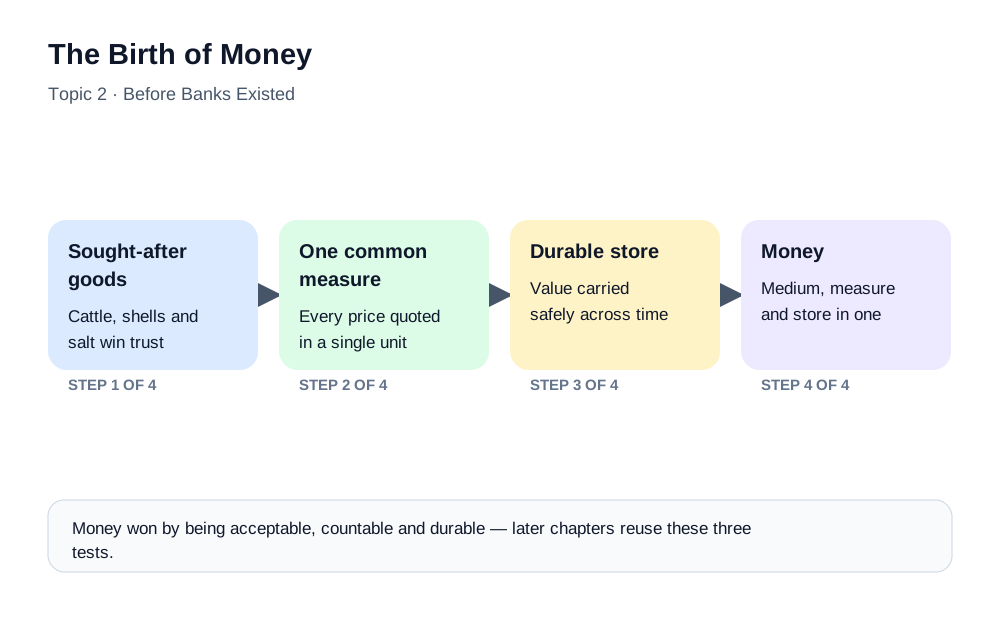
The Birth of Money at a glance — Cowrie shells, cattle, salt, and the common medium of exchange.
1. From Barter to Money: Why Widely Accepted Monetary Media Became Attractive
Topic 1 mapped the frictions of direct exchange: the double coincidence of wants, the explosion of pairwise exchange ratios, indivisibility, decay, search costs, and settlement friction. Money is the consolidated answer to all of them. But it is worth pausing on how the answer arrived, because the mechanism matters more than the chronology.
One important economic model explains commodity money through decentralised trade. Individual traders have an incentive to accept goods that are easier to pass on, even when they do not personally need them. As acceptance broadens, liquidity can reinforce itself and a highly salable good can begin to perform a monetary role. This model is useful, but it should sit alongside the historical evidence for credit, accounting units, institutional standards, taxation, and state influence on monetary acceptance.
This insight carries a professional lesson that recurs throughout the course: acceptability is the true engine of money. Legal tender laws, central bank backing, and deposit insurance are modern machinery for engineering acceptability, but the underlying phenomenon — an asset becoming money because people confidently expect others to accept it — is older than any state.
2. Foundational Concept: The Three Functions of Money
Before examining the historical emergence of money, we must define what money actually does. In modern economic theory, for any object or asset to function as money, it must fulfil three distinct, interdependent roles. If an asset fails in any of these three areas, it ceases to be an effective currency.
1. Medium of Exchange
This is the most visible function of money. Money must be universally accepted by market participants in trade for goods and services. It solves the "double coincidence of wants" problem inherent in barter. By acting as an intermediary asset, it decouples the act of buying from the act of selling. Without universal acceptance (liquidity), an object cannot function as money, no matter its intrinsic value.
2. Store of Value
Money must retain its purchasing power over time so that it can be saved for later use. This function allows economic actors to separate the act of earning from the act of spending, smoothing consumption across time and enabling the accumulation of capital. A perishable good like fish cannot serve as money because its value rapidly decays; a durable good like gold can because its physical and economic properties persist.
3. Unit of Account
Money must provide a common denominator, a standard measure against which the value of all other goods and services can be priced and compared. This function enables rational economic calculation. It collapses the quadratic explosion of barter exchange rates — $N(N-1)/2$ pairwise ratios for $N$ goods — into a single, linear pricing system of roughly $N$ prices, allowing producers to calculate profit and loss accurately.
How the three functions interact
The functions are mutually reinforcing. An asset is more readily accepted (medium of exchange) when people trust it will hold value (store of value), and pricing everything in one unit (unit of account) is only practical when the unit itself is widely held and traded. Conversely, failure in one function poisons the others: when hyperinflation destroys the store-of-value function, merchants stop quoting prices in the currency (unit of account breaks down) and eventually refuse it in payment (medium of exchange collapses). Students should learn to diagnose monetary failures by asking which function broke first — a habit that applies equally to ancient shell currencies and modern currency crises.
It is also worth noting what economists sometimes add as a fourth function: a standard of deferred payment — money as the unit in which debts and future obligations are expressed. Credit, the subject of Topic 5, is almost unworkable without it.
3. The Properties of Good Money: A Practical Checklist
Why did some commodities become money while others did not? Across civilisations, successful monetary commodities share a recognisable set of properties. This checklist is more than history: it is the scorecard against which every later monetary innovation — coins, paper, bank deposits, digital currencies — is still informally judged.
Durability. The good must survive storage and repeated handling without spoiling. Grain works seasonally but rots; metals and shells endure.
Portability. Significant value must fit in a small space so it can be carried to market. Cattle score poorly; cowrie shells and precious metals score highly.
Divisibility. The good must be separable into small units for small transactions without destroying its value. Salt can be measured by the pinch or the bag; a cow cannot be meaningfully divided.
Uniformity (fungibility). Each unit must be interchangeable with every other unit of the same size or grade, so that no inspection is needed beyond quantity and authenticity. Shells of similar size and stamped metal pieces approach this ideal; livestock never does.
Acceptability. The good must be broadly desired, either for its own use or because others reliably accept it. This is the social property that ties all the others together.
Cognisability. Users must be able to verify authenticity and quality quickly — by sight, weight, or simple test. Verification cost is transaction friction; money that is easy to check circulates faster and farther.
Stability of supply (scarcity with predictability). The good must be scarce enough to hold value, but not so erratic in supply that its purchasing power swings wildly. This is the hardest property to satisfy naturally, and the one whose modern management became monetary policy.
No commodity scores perfectly on all seven. The history of money is, in large part, the story of trading weaknesses on this list against one another — and of institutions (mints, banks, central banks) compensating for the residual weaknesses.
4. Commodity Money Around the World: Convergent Solutions
The parallel emergence of money across unconnected civilisations is one of the strongest pieces of evidence that money answers universal problems rather than local tastes.
Cattle and livestock. Among pastoral societies of Europe, Africa, and Asia, livestock functioned as a store of wealth and a rough unit of account. The Latin pecunia (money) derives from pecus (cattle), preserving the memory in language. Cattle store value and are universally desired, but they fail on divisibility, portability, and uniformity — which is precisely why herding societies drifted toward weighed metal as trade intensified.
Cowrie shells. Cowries — small, durable, nearly impossible to counterfeit convincingly, and naturally uniform — served as money across an enormous belt of Africa and Asia for centuries, and in some regions into the modern era. They excel on durability, portability, uniformity, and cognisability; their weakness is supply stability, since shells could be harvested and imported in quantity, producing inflation in importing regions. Cowrie inflation in parts of West Africa, as European traders shipped shells in bulk, is an early, well-documented lesson in what happens when the money supply outruns the economy.
Salt. In several trading systems — including routes across the Sahara and within the Roman world at various points — salt's universal usefulness and easy divisibility made it a natural medium. The association of salt with payment survives in the English word salary (from Latin salarium), though the popular claim that Roman soldiers were literally paid in salt is disputed by historians; the safer statement is that salt was economically important enough to anchor the vocabulary of pay.
Grain and weighed silver in Mesopotamia. The temple and palace economies of Mesopotamia kept accounts in standard units of barley and, increasingly, in weighed silver. This is a landmark in monetary history: the unit of account function was operating inside administrative ledgers — with debts, rents, wages, and taxes denominated in standard units — long before anything resembling a coin circulated. Money as a system of accounting came first; money as a portable object came later. Banking students should hold this ordering firmly, because it repeats: the ledger precedes the token.
Other candidates. Tobacco in colonial Virginia, beaver pelts in North American fur trade, cacao beans in Mesoamerica, rice in parts of Asia — the catalogue is long, and every entry satisfies most of the seven properties in Section 3 while failing a few. The failures are as instructive as the successes.
The rai stones of Yap: money as pure record
One case deserves special attention because it points directly at modern banking. On the island of Yap in Micronesia, large carved limestone discs (rai) served as stores of value. Because the largest stones were effectively immovable, ownership could change hands without the stone moving at all: the community simply acknowledged that a stone now belonged to someone new. In one often-retold account, a stone that sank during transport by sea continued to be recognised as valid wealth, because everyone agreed it existed and its ownership was known.
The Yap stones demonstrate that, at its limit, money is a trusted, shared record of ownership. The physical object is almost incidental; the ledger — here, collective memory — does the work. Strip away the stone and keep the ledger, and you have the conceptual skeleton of a bank deposit, a book entry, and ultimately a digital balance. This is why Topic 96 (databases and ledgers) is the modern descendant of a limestone disc.
5. Step-by-Step Operational Workflow: The Mechanics of Commodity Money
The earliest forms of money were commodity money — items that had intrinsic value in themselves as well as value in their use as money. Let us examine the operational workflow of how a community transitioned from barter to using a specific commodity (e.g., cowrie shells or salt) as money.
Phase 1: Emergence of a 'Most Salable' Good
- Market friction: In a barter economy, participants notice that certain goods are more easily traded than others. For example, almost everyone needs salt for food preservation.
- Strategic hoarding: Individuals begin accepting salt in trades even if they do not immediately need it, because they know others will accept it in the future.
- Liquidity snowball: As more people accept salt, its liquidity increases. It transitions from being a consumable commodity to a medium of exchange. It has become the "most salable good."
Phase 2: Transactional Execution (The Payment Flow)
- Pricing: A farmer wishes to buy a plough. Instead of negotiating how many chickens equal one plough, both items are priced in the unit of account (e.g., "bags of salt"). The plough is priced at 10 bags; a chicken is priced at 1 bag.
- Settlement: The farmer delivers 10 bags of salt to the blacksmith.
- Verification: The blacksmith must verify the money. This involves checking the weight and purity of the salt to ensure it has not been adulterated with sand.
- Finality: Once verified and accepted, the transaction settles immediately.
Phase 3: Wealth Storage and Capital Formation
- Because salt does not rot, the blacksmith can safely store the 10 bags. This stored wealth acts as capital, allowing the blacksmith to delay immediate consumption and perhaps hire an apprentice next month.
Phase 4: Intermediation Begins
- As holdings of commodity money grow, a new specialist appears: the person who stores wealth safely for others, verifies quality professionally, and lends stored value to those who need it. In Mesopotamia, temples performed versions of this role; in later centuries, goldsmiths and merchant bankers did. The birth of money thus creates, almost immediately, the conditions for the birth of banking — a vault, a ledger, and a balance of trust.
Worked example: one economy's transition
Imagine a riverside market town trading grain, cloth, tools, fish, and pottery — five goods, hence ten pairwise exchange ratios to track under barter. Salt arrives regularly via caravan and everyone uses it. A potter who needs fish cannot find a fisher who wants pots, so she sells pots to a toolmaker for salt, then buys fish with salt. Within a season, most traders quote both their goods and their debts in measures of salt. The town now tracks five prices instead of ten ratios; a trader arriving from another valley can learn the entire price structure in an afternoon; and the town's headman begins recording tax obligations in salt-equivalent, because accounts in five prices are auditable while accounts in ten shifting ratios are not. Nothing was decreed. Each participant simply made the locally sensible choice, and the monetary system assembled itself.
6. Risk and Regulatory Factors in Early Money Systems
The use of commodity money introduced new risk vectors that required early forms of regulation and risk management, many of which parallel modern banking frameworks.
Counterfeit and Adulteration Risk (Operational Risk)
When a commodity is used as money, there is an immense incentive to degrade it. If salt is money, mixing it with white sand increases one's purchasing power fraudulently.
- Risk mitigation / early AML: Merchants developed specialised testing techniques. With metals, this led to the development of touchstones and assaying (testing purity). This is the ancient equivalent of modern fraud detection and the authenticity checks applied to currency at every bank counter and cash centre today.
Supply Shocks and Inflation Risk (Market Risk)
Commodity money is vulnerable to sudden changes in supply. If a society uses cowrie shells and a new, massive shell bed is discovered, the supply of money rapidly increases.
- The result: Inflation. The value of each shell drops, destroying the savings (store of value) of those holding them. This perfectly mirrors modern purchasing power risk when the money supply expands faster than real output — the difference is that today the supply decision rests with a central bank rather than with geology and harvests.
Storage and Security Risk
Unlike digital ledgers, physical commodity money requires vaulting and armed security. Accumulating large amounts of grain, salt, or cattle invited theft and required significant operational expenditure to protect. The cost of safekeeping physical money is one of the oldest economic arguments for intermediaries — temples, strongrooms, and eventually banks — whose core product was, and remains, protected custody.
Debasement and Trust Risk
Once authorities began stamping or standardising monetary commodities, a new risk appeared that did not exist in decentralised commodity money: the standard-setter could cheat. Reducing the precious-metal content of stamped money while keeping its face value — debasement — transfers wealth quietly from users to issuers and corrodes trust in the unit of account. The full mechanics belong to Topic 3 (coins), but the seed is visible here: centralising verification solves one risk and manufactures another, which is the perpetual trade-off of monetary governance.
Early Standardisation (The Proto-Regulator)
To reduce the friction of verifying commodity money in every transaction, central authorities (temples or kings) began stamping or standardising the commodities, guaranteeing their weight and purity. This was the nascent beginning of state-regulated currency and centralised monetary authority — the first attempt to engineer the acceptability and cognisability properties rather than leaving them to the market.
7. High-Impact Real-World Scenario: Cigarettes as Currency in POW Camps
To truly understand how money is born from necessity, we do not need to look back to ancient Mesopotamia. The organic emergence of money has been rigorously documented in modern times, most famously by economist R.A. Radford in his 1945 article, "The Economic Organisation of a P.O.W. Camp," based on his own wartime imprisonment.
The scenario: a micro-economy behind barbed wire
In the prisoner-of-war camps Radford describes, prisoners received standardised Red Cross parcels containing various items: chocolate, cheese, jam, and cigarettes. Preferences varied wildly among the prisoners — some were non-smokers who loved chocolate; others were heavy smokers willing to trade their food.
The execution (the workflow):
- The barter phase: Initially, prisoners engaged in direct barter. A non-smoker would trade his cigarettes for a smoker's chocolate. The double coincidence of wants caused immense friction.
- The emergence of money: Very quickly, prisoners realised that cigarettes possessed nearly all the ideal traits of money. They were standardised, highly portable, reasonably durable, and easily divisible (down to a single cigarette).
- The pricing system (unit of account): The camp economy shifted. Goods were no longer bartered directly; they were priced in cigarettes. A tin of cheese might be quoted at so many cigarettes; a chocolate bar at so many more.
- Market operations: A sophisticated market emerged, complete with arbitrage. Traders would notice price differences between sections of the camp and use cigarettes to buy low and sell high, inadvertently equalising prices across the camp — a miniature demonstration of how arbitrageurs integrate markets.
The financial mechanics and impact
This scenario illustrates that money is not created by government decree; it is an emergent property of human exchange. The cigarette currency exhibited all three functions: it was universally accepted (medium of exchange), could be saved for later (store of value), and was used to price all other goods (unit of account).
However, the camp also suffered from classic monetary risks. When Red Cross parcels arrived in bulk — an injection of new money — prices measured in cigarettes rose sharply: monetary inflation in miniature. When supplies were interrupted, prices fell: deflation. Radford also records episodes in which the cigarette standard was temporarily displaced when cigarette supplies collapsed, with prisoners reverting to cruder barter — proof that a money survives only while it retains the properties that made it money.
For the banking student, the camp is a controlled experiment. Strip away every institution — no state, no bank, no law — and money still appears, priced goods still integrate, monetary shocks still produce inflation and deflation. Institutions do not create monetary phenomena; they harness and manage phenomena that arise spontaneously wherever people trade.
8. The Customer and Bank Perspectives
Even at this foundational level, it helps to practise the habit of viewing every monetary arrangement from both sides of the counter.
From the customer's perspective, commodity money was liberating but burdensome. It freed the trader from the double coincidence of wants, made prices comparable, and allowed saving across seasons. But the customer bore the full operational load: verifying weight and purity, protecting stored value, and absorbing the inflation risk of the commodity itself. The customer's demand — safety, convenience, and certainty of value — is precisely the demand banks later industrialised.
From the proto-banker's perspective, commodity money created three durable business lines. First, verification as a service: professional weighing, assaying, and later minting converted a per-transaction cost into a specialist's economy of scale. Second, custody as a service: strongrooms and temples stored other people's commodity wealth for a fee or for the right to use it. Third, ledger-keeping as a service: recording obligations in a standard unit made credit administrable. Every modern bank still runs these three businesses beneath layers of technology — cash operations and fraud detection, deposits and custody, and the core banking ledger.
9. Digital Banking Implications: Old Money Lessons in New Rails
Nothing in this chapter is obsolete. The seven properties of good money are exactly the design constraints of every modern monetary instrument. Bank deposits score perfectly on divisibility and uniformity, outsource durability and storage to the ledger, and depend entirely on engineered acceptability — deposit insurance, central bank settlement, and legal frameworks standing where salt's usefulness once stood. When later modules cover real-time payments, mobile money, stablecoins, or central bank digital currencies, evaluate each one against the Section 3 checklist: it will tell you, faster than any marketing document, where an instrument is strong and where it will fail under stress.
The Yap lesson is equally current. Modern money is already overwhelmingly ledger-based: a bank deposit is an entry on a bank's books, transferable because the record is trusted. Debates about blockchain and distributed ledgers, covered later in this course, are fundamentally debates about who maintains the ledger and what makes it trustworthy — the same question the islanders of Yap answered with collective memory.
10. The Layered Emergence of Money: A Chronological View
Because monetisation was gradual and overlapping, students often struggle to sequence it. The following layered view — deliberately approximate, because precise dating varies by region and by scholarly interpretation — helps fix the order of events without pretending the process was tidy.
Layer 1: Obligation and accounting (earliest). Communities track contributions, debts, and dues informally, then in writing. Mesopotamian temple records denominate obligations in standard units of barley and silver. Money exists as a unit of account inside ledgers before it exists as a circulating object.
Layer 2: Commodity media of exchange. Recognisably monetary goods — cowries, salt, weighed metal, grain — circulate in trade. Weighing and testing accompany every significant transaction. The medium of exchange and store of value functions go live.
Layer 3: Standardisation and certification. Authorities weigh, stamp, and eventually coin monetary metal, certifying quantity and purity. Verification costs fall; acceptability widens; and the issuer acquires the power — and temptation — of debasement. Topic 3 begins here.
Layer 4: Representative and credit instruments. Claims on stored commodity money (receipts, notes, deposit entries) begin circulating in place of the commodity itself. Money migrates from the vault to the ledger. Topics 4, 5, 10, and 11 develop this layer.
Layer 5: Fiat and digital money. The link to any commodity is severed; money rests on institutional trust, law, and central bank management; balances become database entries moving over electronic rails. Topics 10, 12, and the digital modules cover this layer.
The order matters more than the dates: ledger first, commodity second, certification third, claims fourth, pure trust fifth. Each layer solves weaknesses in the one before it while introducing new risks of its own — the recurring rhythm of monetary history.
11. Key Terms in This Chapter
Acceptability. The property of being willingly taken in settlement by others; the social engine of all money.
Commodity money. An item with intrinsic use value that also circulates as money (salt, cowries, weighed silver).
Cognisability. How quickly and cheaply users can verify a money's authenticity and quality.
Debasement. The deliberate reduction of a certified money's intrinsic content while preserving its face value; an early form of hidden taxation.
Double coincidence of wants. The requirement, in barter, that each party hold what the other wants at the same time — the friction money eliminates (see Topic 1).
Fungibility (uniformity). Interchangeability of units; what allows a money to trade at a single price.
Liquidity snowball. The self-reinforcing process by which rising acceptability makes a good more acceptable still, until it becomes money.
Medium of exchange. The money function of being accepted in trade, separating the act of selling from the act of buying.
Most salable good. The commodity that wins the liquidity snowball and becomes a community's money.
Purchasing power risk. The risk that money buys less over time as prices rise; the modern name for the inflation risk visible in cowrie gluts and POW-camp parcel arrivals alike.
Standard of deferred payment. Money's role as the unit in which debts and future obligations are expressed; sometimes listed as a fourth function.
Store of value. The money function of retaining purchasing power across time, separating earning from spending.
Unit of account. The money function of providing the common measure in which values, prices, accounts, and contracts are expressed.
12. Common Mistakes and Misconceptions
"Money was invented by governments." States standardised, certified, and eventually monopolised money, but commodity money — including the POW camp's cigarettes — emerges without any state. Government is money's most successful regulator and issuer, not its inventor.
"Money needs intrinsic value to work." Commodity money had it, but the three functions do not require it. Later topics cover representative and fiat money, which function through trust and institutional backing rather than intrinsic worth. The POW camp is the bridge: cigarettes had use value, but their monetary role depended on acceptability.
"Roman soldiers were paid in salt." A popular embellishment. Salt was economically vital and anchored the Latin root of salary, but the claim that soldiers received salt rations as wages is not well supported by historians. Repeat the vocabulary lesson, not the myth.
"Inflation is a modern, paper-money problem." Supply shocks inflated commodity monies long before paper existed — cowrie imports inflated shell money; new silver supplies transformed price levels in early modern Europe. Inflation is a money-supply phenomenon, not a technology phenomenon.
"Barter was replaced everywhere at once by money." Monetisation was uneven and layered: accounting units preceded circulating media, and barter persisted alongside money for centuries, retreating only as monetary infrastructure deepened. It still resurfaces whenever that infrastructure fails.
"The three functions are independent." They are interdependent. Destroy the store of value and the other two collapse with it — the standard pattern in every currency crisis.
13. Frequently Asked Questions
Q: What is the difference between commodity money and barter? Barter is direct goods-for-goods exchange requiring a double coincidence of wants. Commodity money is a specific good that everyone accepts because it can be re-exchanged, converting every sale into immediate generalised purchasing power.
Q: Which of the three functions of money matters most? They fail together, so ranking them is less useful than diagnosing which breaks first. In practice, the store-of-value function usually fails first in crises (inflation), and the medium-of-exchange function fails last (people keep using a weakening currency longer than theory suggests, out of habit and lack of alternatives).
Q: Why did precious metals eventually win over salt, shells, and cattle? They score best overall on the seven properties: durable, portable at high value density, divisible by weight, uniform when refined, cognisable through assay, and naturally scarce with a supply that grows only slowly. Topic 3 takes up how coinage then solved their verification problem.
Q: Is a bank deposit commodity money? No. A deposit is a claim — a ledger entry representing the bank's obligation to pay. It functions as money because institutions (deposit insurance, central bank settlement, law) engineer its acceptability. It belongs to the family of credit and fiat money covered in Topics 10–12.
Q: What does the Yap stone story actually prove? That money's essence is a trusted record of ownership, not a physical token. If a community maintains a credible ledger of who owns what, the underlying object barely needs to exist — the conceptual foundation of deposit banking and digital money.
Q: Did money appear only once in history? No — it emerged independently in many civilisations, and re-emerges whenever organised exchange exists without official money, as the POW camp shows. Convergent emergence is the strongest evidence that money solves universal exchange problems.
14. Interview Insights
"Define money and its functions." Deliver the three functions crisply, then add two depth signals: the interdependence of the functions (which fails first in a crisis) and the optional fourth function — standard of deferred payment. Most candidates stop at the textbook list; the interactions are what distinguish you.
"How did money evolve from barter?" Resist the "money was invented" framing. Describe the liquidity snowball: traders accept the most salable good to improve their own position, acceptability compounds, and the commodity becomes a medium of exchange organically. Citing the POW camp as evidence that this process is spontaneous and repeatable marks you as someone who understands money as an institution, not an artefact.
"What makes a good money?" List the seven properties (durability, portability, divisibility, uniformity, acceptability, cognisability, supply stability) and immediately apply them: score gold, then score a bank deposit or a digital currency. Interviewers use this question to see whether you can apply a framework, not recite one.
"Is bitcoin/digital currency money?" A modern favourite. Apply the three functions and seven properties rather than giving an opinion: strong on divisibility and portability, contested on store of value (volatility) and acceptance breadth. The framework answer is the professional answer; Topic 107 develops it fully.
Summary and Key Takeaways
- Money emerged gradually and independently across civilisations, driven by the practical failures of barter — not by a single inventor or decree.
- To function as money, an asset must serve as a medium of exchange, a store of value, and a unit of account; the functions are interdependent and collapse together in crises.
- Successful monetary commodities share recognisable properties — durability, portability, divisibility, uniformity, acceptability, cognisability, and stable supply — and this checklist still evaluates every modern monetary instrument.
- The transition mechanics are a self-reinforcing liquidity snowball: the most salable good becomes money because everyone expects others to accept it.
- Accounting money came before portable money: Mesopotamian ledgers and Yap's stones show that money is, at its core, a trusted record.
- Commodity money carried real risks — counterfeiting, supply-shock inflation, storage costs, and eventually debasement — that drove the first standardisation and monetary regulation, and that map directly onto modern operational, market, and purchasing-power risk.
- The POW camp demonstrates that monetary phenomena (emergence, pricing, arbitrage, inflation, deflation) are spontaneous features of exchange; banks and central banks harness them rather than create them.
- Every later topic in this course — coinage, paper money, fiat currency, fractional reserve, digital money — is a continuation of the same search for better answers to the seven properties.
Next: Topic 3 — The Invention of Coins →
<!-- MBA-DEEP-DIVE-START -->Deep Dive: Money Did Not Have One Birth
The safest way to understand the origin of money is to resist the temptation to tell one universal story. Economists often use a useful model in which traders move from barter toward a more widely accepted commodity because that commodity lowers search costs. Economic historians and anthropologists add an important qualification: many societies also used credit, reciprocity, tribute, redistribution, and accounting units long before coins or universally circulating commodity money became dominant. These explanations describe different mechanisms through which communities solved different exchange and recordkeeping problems.
For banking professionals, the distinction matters. Money is not defined by one material or one historical route. It is defined by the functions that people and institutions rely on: a medium of exchange, a unit of account, and a store of value. One instrument can perform all three strongly, or different instruments can perform them to different degrees. Modern cash, bank deposits, central-bank reserves, money-market assets, and foreign currencies show that monetary usefulness depends on context.
Medium of exchange: solving the acceptance problem
A medium of exchange is useful because people expect other people to accept it. This expectation creates a network effect. If an asset is accepted by only one household, it is not very useful as money. If most merchants, workers, lenders, and tax collectors accept it, its liquidity rises dramatically.
This helps explain why salability matters. A trader may accept an item not because it is personally useful but because it can be passed on easily. That behaviour can reinforce itself: the more widely an asset is accepted, the more rational it becomes for additional people to accept it. The process need not be purely private or spontaneous. States, temples, trading institutions, legal systems, taxation practices, standard weights, and public accounting can all influence what people are willing or required to accept.
The banking parallel is immediate. A payment instrument is useful only if acceptance is broad enough for the customer's purpose. A card accepted across a large network is more useful than one accepted at a handful of merchants. A domestic account may be highly liquid inside one currency area but require conversion for foreign purchases. Central-bank reserves are crucial for interbank settlement even though households do not normally use reserve accounts for retail purchases. Acceptance always has an institutional and operational boundary.
Unit of account: the function students underestimate
A unit of account allows prices, debts, wages, taxes, profits, and financial statements to be expressed in a common measure. Historically, this function can exist even when the unit itself is not circulating as a physical object in every transaction. Administrative systems could record obligations in standard quantities of grain or silver while settlement occurred later or in another acceptable form.
For modern banking, the unit of account is foundational. A loan contract needs a principal amount and repayment schedule in a defined currency. A bank's general ledger must aggregate transactions into monetary values. Limits, fees, interest, capital, liquidity ratios, provisions, and regulatory reports all depend on common measurement. Foreign-currency positions require conversion into a reporting currency so exposures can be aggregated.
This is also why currency redenomination, severe inflation, or exchange-rate instability creates operational problems beyond purchasing power. Banking systems contain decimal precision, currency codes, limits, reference data, statement formats, historical balances, contracts, and reporting logic. A currency is embedded deeply into banking architecture because it is a measurement system as well as a payment asset.
Store of value: useful, but never perfect
Money normally needs to preserve enough purchasing power between receipt and spending to remain useful. That does not mean it must hold value perfectly. Inflation reduces the purchasing power of cash over time, yet cash can still perform monetary functions effectively when inflation is reasonably stable and public confidence remains high.
Different assets trade off liquidity and return. Physical currency is immediately spendable but generally pays no interest. A bank deposit may combine high liquidity with some return, depending on the account. A term deposit sacrifices immediacy for yield. A bond can store wealth but is not normally used directly for everyday purchases. Gold can preserve value over some periods but has price volatility, storage costs, and limited retail acceptance. The better analytical question is therefore not simply "Is this money?" but "Which monetary functions does this asset perform, for whom, and under what conditions?"
What makes a good monetary medium
Durability matters because an asset that spoils quickly cannot bridge time well. Portability matters because settlement becomes expensive if value is difficult to move. Divisibility matters because trade occurs at many price points. Recognisability matters because users must distinguish genuine units from inferior or counterfeit ones. Relative scarcity matters because a large unexpected expansion of supply can weaken purchasing power. Fungibility matters because users prefer one standard unit to be equivalent to another.
None of these properties is absolute. Precious metals are durable but heavy. Cattle can be valuable but are not conveniently divisible. Grain can be standardised to a degree but requires storage and is vulnerable to spoilage. Cowrie shells were portable and recognisable in many historical settings, but their monetary value depended on local supply and trading conditions. Paper is light and divisible by denomination but requires a trusted issuer and strong anti-counterfeit controls. Digital bank money is highly portable through networks but depends on operational resilience, cybersecurity, identity controls, and institutional trust.
Money evolves because societies continually rebalance these properties as technology, trade, institutions, and political authority change.
Commodity, representative, and fiat money are different concepts
A commodity used as money has non-monetary usefulness or material value of its own, although its exchange value can exceed that use value when monetary demand is strong. Precious metals, salt, grain, and other goods have served monetary roles in different places and periods.
Representative money is a claim on an underlying asset. A receipt for a defined quantity of metal can become transferable. If users trust the issuer, the paper claim may circulate more efficiently than the metal itself. The critical questions then become custody, convertibility, reserve sufficiency, authenticity, and redemption.
Fiat money does not promise conversion into a fixed quantity of a commodity. Its value operates within a broader institutional system: the issuing state's monetary framework, taxation, legal arrangements, central-bank credibility, economic capacity, payment infrastructure, and public confidence. Describing fiat money as "backed by nothing" therefore misses the institutional foundation that supports its use.
Commercial-bank deposits add another layer. Much everyday money in modern economies exists as deposits recorded on bank balance sheets rather than as physical notes and coins. A customer's deposit is generally a liability of the commercial bank to that customer. Transfers between customers change records, and transfers between different banks can also require settlement between the banks through payment arrangements and central-bank money.
Money and credit developed together
One of the most important historical guardrails is that credit should not automatically be presented as an invention that came after physical money. A community can record that one person owes another a future delivery of grain, labour, or silver without first possessing coins. Once obligations are measured and remembered, credit exists in an economic sense.
This interaction between money and credit remains central to banking. A bank's assets and liabilities are linked through lending, deposits, funding, settlement, and liquidity management. The customer sees an account balance; the bank sees a legal claim, a ledger entry, an obligation to honour valid withdrawals or payments, and a position that must be managed within prudential and operational controls.
The important insight is that modern money is deeply connected to trusted balance sheets. Physical currency is only one form of monetary value.
One transaction, several monetary layers
Suppose a coffee exporter invoices a buyer for USD 100,000. The contract is priced in US dollars, so the dollar is the unit of account. The buyer instructs payment from a commercial bank account, so a bank deposit is the immediate payment asset from the customer's perspective. If the receiving bank is different, institutions may need to settle obligations between themselves through correspondent accounts or a payment system. If the exporter keeps the proceeds on deposit for several months, the deposit also serves as a store of value during that period.
The same currency unit can therefore sit above several layers of money and claims. Customers see a currency amount. Banks see deposit liabilities, settlement assets, liquidity requirements, accounting entries, and possibly foreign-exchange positions. Payment professionals need to distinguish these layers because customer messaging, interbank settlement, and reconciliation are related but not identical events.
Confidence is built through controls
Textbooks often say money works because people trust it. Banking makes that statement concrete. Users trust a banknote partly because security features make authenticity harder to fake and easier to verify. They trust a deposit because the bank maintains controlled records, protects access, processes valid payments and withdrawals, and operates within a legal and regulatory framework. They trust payment infrastructure because transactions are validated, monitored, reconciled, and governed by defined settlement and recovery rules.
Confidence can therefore be damaged operationally. Persistent processing errors, unreliable redemption, weak controls, severe monetary instability, or widespread counterfeiting can reduce willingness to hold or accept an instrument. Trust is not decoration added to a monetary system. It is an outcome produced by dependable institutions and infrastructure.
Commodity money is not automatically stable
Commodity money is sometimes presented as naturally stable because supply is physically constrained. History is more complicated. New sources of a commodity can change supply. Trade can bring large quantities into a region. Technology can lower extraction or production costs. Hoarding can reduce circulating availability. Seasonal production can affect agricultural commodity money. Political authorities can change the metallic content of coins.
Scarcity must therefore be considered relative to demand. A monetary asset can become unstable when its available supply changes materially compared with the demand to hold and use it. Modern central banks address monetary stability through policy frameworks rather than by mechanically tying currency to one commodity, but policy still involves judgment, trade-offs, and uncertainty.
The bank balance-sheet lens
For a banker, the word "money" should always be followed mentally by "whose liability or asset?" Physical cash in a branch is an asset of the commercial bank. A customer's current-account balance is generally a liability of that bank. Reserves held at a central bank are assets of the commercial bank and liabilities of the central bank. A payment between two customers of the same bank may be completed by changing internal deposit balances. A payment between customers of different banks can also require interbank settlement.
This prevents the mistake of imagining all money as one homogeneous pool. Different forms carry different credit, liquidity, operational, legal, and access characteristics. Cash can be handed over without the payer's bank being online at that moment; electronic deposits depend on functioning infrastructure. Deposits can support automated payments and may pay interest; cash normally does not. The forms coexist because they solve different needs.
Digital forms do not remove monetary fundamentals
A mobile banking screen makes value look weightless, but the fundamentals remain. The balance needs a unit of account. The payer needs an accepted claim or asset. The receiver needs confidence that the transfer is valid. Systems must prevent inconsistent records and unauthorised use. Settlement and reconciliation must establish whether obligations between institutions have been discharged correctly.
When evaluating any new digital form of money, begin with basic questions: who issues it, what legal claim does the holder have, what unit is it denominated in, how can it be redeemed, what supports settlement, who can access it, when does transfer become final, and which risks remain with the holder? Those questions are more useful than labels because the regulatory and operational answers differ by design and jurisdiction.
What a business analyst should model
If a bank launches a new monetary product, the analyst should identify the issuer, holder, denomination, balance representation, funding mechanism, transaction lifecycle, settlement asset, redemption rights, fees, limits, interest treatment, accounting entries, reconciliation points, dispute process, and regulatory classification. Calling something a wallet, token, account, or digital currency is not enough; the economic and legal substance must appear in the requirements.
A strong data model also distinguishes amount from currency. The number 1000 is economically incomplete without its unit. Systems need controlled currency reference data, decimal rules, effective dates, supported transaction types, and conversion logic. Errors in these basics can become financial losses or reconciliation breaks, which is why the unit-of-account function remains a technology concern thousands of years after monetary systems began to develop.
Accuracy guardrails
Do not present money as the product of one invention, one civilisation, or one purely private market mechanism. Do not claim that barter universally preceded credit. Do not assume the three functions of money are always performed equally well by one instrument. Do not describe fiat currency as economically empty merely because it is not redeemable for a fixed quantity of precious metal. And do not equate commercial-bank deposits with central-bank money; they are monetary forms issued by different institutions and used in different layers of the financial system.
Verification anchors
Federal Reserve educational material provides a clear explanation of the medium-of-exchange, unit-of-account, and store-of-value functions and of how a generally accepted medium reduces the double coincidence of wants. Central-bank material, including Bank of England explanations of banknotes and modern money, helps explain the transition from physical forms to institutional claims. For early monetary history, museum collections and specialist economic history add necessary context because surviving objects alone do not show the full network of credit, accounting, and social obligations around them.
The enduring insight is that money is a social and institutional technology for making value measurable, transferable, and preservable. Its forms have changed repeatedly; the core problems it solves have remained remarkably consistent.
<!-- MBA-DEEP-DIVE-END -->