Long before modern bank accounts, payment cards, or digital balances, people exchanged value through many arrangements: direct exchange, reciprocal obligations, communal sharing, tribute, credit, and informal records of who owed what to whom. Barter, the direct exchange of one good or service for another, was one of these arrangements.
The familiar textbook model of a pure barter economy should therefore be treated as an analytical model rather than a claim that every early society operated only through spot exchanges. The model remains extremely useful because it exposes the frictions that money, banking, contracts, and payment systems were designed to reduce.
A farmer with surplus grain might exchange it for tools. A craftsperson might provide work today in return for food after harvest. A trader might accept a commodity that was not personally needed because it could later be exchanged more easily. Each arrangement requires agreement on value, quality, timing, delivery, and trust.
This chapter examines barter through a modern banking lens. It connects an ancient exchange problem to liquidity, price discovery, counterparty risk, settlement, standardisation, and the eventual emergence of money. By the end, you should be able to explain not only what barter is, but why every function a modern bank performs — payments, credit, safekeeping, settlement, risk management — can be traced back to a problem that direct exchange could not solve on its own.
Learning objectives
- Define barter precisely and distinguish it from related exchange arrangements.
- Explain the double coincidence of wants and why it constrains trade.
- Quantify the pricing complexity of a moneyless economy.
- Identify the structural frictions of direct exchange and map each one to the modern financial function that addresses it.
- Describe the operational lifecycle of a barter transaction using payment-system vocabulary.
- Analyse barter through the standard banking risk taxonomy: credit, liquidity, market, operational, and settlement risk.
- Recognise barter-like arrangements in modern commerce, including countertrade, and explain when and why they reappear.
Visual overview
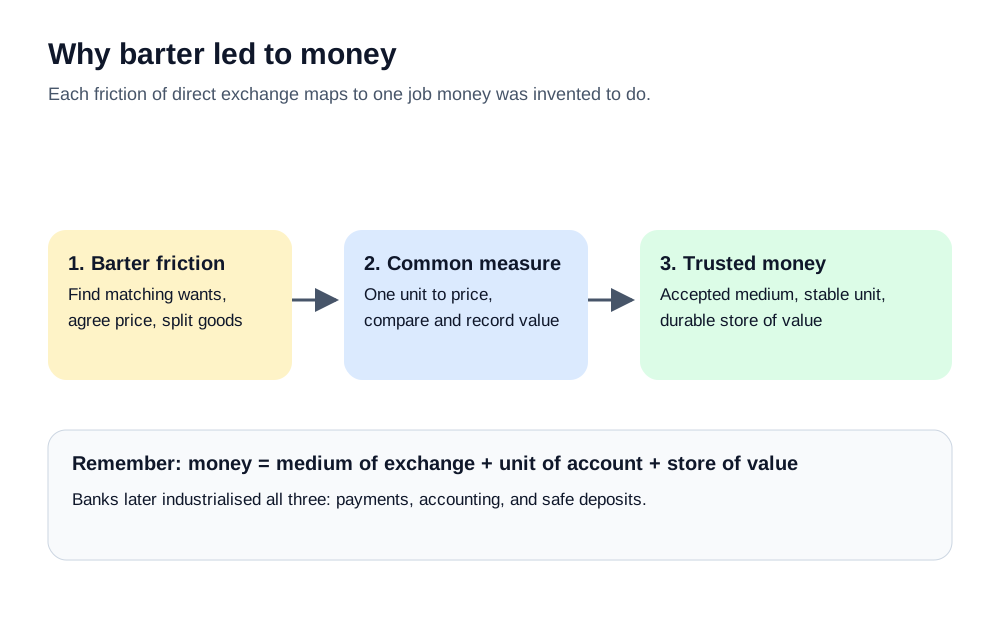
Phase 1 map: barter friction → common measure → trusted money. Money works when it is a medium of exchange, a unit of account, and a store of value.
1. Why Study Barter at All?
It is reasonable to ask why a banking course begins with an exchange method that most readers will never use. The answer is that barter is not really a history topic. It is a diagnostic tool.
Every financial institution exists because some friction in direct exchange was too costly to tolerate. Banks did not invent the need for trust, records, liquidity, or settlement — those needs existed in every trading community. What banks, markets, and payment systems did was industrialise the solutions. If you understand precisely which problems barter could not solve, you understand the reason each banking function exists, rather than merely memorising what each function does.
This first-principles approach matters professionally. A banker who understands why settlement finality exists will treat an unsettled transaction with appropriate caution. A product manager who understands why a unit of account emerged will design clearer pricing and statements. A risk officer who understands why deferred exchange created credit exposure will recognise the same exposure inside a modern instrument, whatever its legal label. Barter is the control experiment: remove money and institutions, watch what breaks, and you have a map of what finance rebuilds.
A second reason is accuracy. Popular accounts often describe early economies as pure barter systems that "failed" until money was invented. Economic anthropology paints a subtler picture: many early communities relied heavily on reciprocity, gift obligations, redistribution through temples or chiefs, and informal credit, with spot barter concentrated in dealings between strangers or across community boundaries. Treating barter as a model — a thought experiment that isolates frictions — is both more honest and more educational. We will use it that way throughout this chapter.
2. The Double Coincidence of Wants
In a direct spot exchange, each party must possess something the other party wants at the same time and in an acceptable quantity and quality. Economists call this the double coincidence of wants.
Suppose a blacksmith needs grain. Finding a farmer with surplus grain is not enough. The farmer must also want metalwork at that moment. If the farmer wants cloth instead, the blacksmith may need a chain of additional exchanges before obtaining grain.
Notice what this chain costs. Each intermediate exchange takes time to find, negotiate, verify, and complete. Each intermediate good must be accepted, transported, and possibly stored. And at every link, the blacksmith bears the risk that the intermediate good loses value or proves hard to pass on. The chain is not just inconvenient; it is a compounding of transaction costs and risks.
Money reduces this dependency by separating the sale from the purchase:
- The blacksmith sells metalwork for money.
- The blacksmith uses the money to buy grain.
- The farmer can use the same money for something entirely different.
The parties no longer need matching wants at the same time. Economists sometimes describe this as the separation of the "sale leg" from the "purchase leg" of economic activity. That single separation — trivial to state — is the foundation on which specialisation, long-distance trade, and eventually credit and banking are built. A craftsperson who can always sell output for money can afford to specialise deeply; a craftsperson who must find customers who happen to have the right goods must stay a generalist.
A banking translation
In modern terms, the double coincidence problem is a liquidity and search-cost problem. The blacksmith's metalwork is valuable, but that value is locked in a form the farmer does not want. Money is the asset that is always acceptable, so it converts any sale into immediate purchasing power. When later chapters discuss market liquidity, bid–ask spreads, or the role of market makers, the underlying idea is the same: how easily can value held in one form be converted into value in the form you actually need, at a fair price, right now?
3. The Mathematics of Barter Complexity
Assume an economy contains $N$ different goods and every pair may need its own exchange rate. The number of possible unordered pairs is:
$ \text{Pairwise Exchange Rates} = \frac{N(N-1)}{2} $
With 20 goods, this produces 190 possible pairwise rates. With 1,000 goods, it produces 499,500.
The growth is quadratic, not factorial. The important point is that pairwise pricing becomes difficult to communicate and maintain as the number of goods increases.
With a common unit of account, each good can instead be quoted against one reference unit. Depending on whether the reference asset itself is included in the count, an economy with $N$ goods needs roughly $N$ money prices rather than $N(N-1)/2$ pairwise rates. This is one reason a unit of account dramatically simplifies price comparison, accounting, taxation, and contracting.
Why this matters beyond arithmetic
The number of exchange ratios is only the beginning. Each ratio must also be discovered, remembered, communicated, and kept consistent. Consider consistency first. If grain trades at two pots per sack, and pots trade at three knives each, then grain should trade at roughly six knives per sack. If a trader can get eight knives per sack somewhere, an arbitrage opportunity exists — but noticing it requires tracking all cross-rates simultaneously. In a monetary economy, consistency is largely automatic because everything is priced against one unit. In a barter economy, it requires continuous mental or recorded computation across thousands of ratios.
Consider discovery next. A modern shopper compares prices because prices are posted in one unit. A barter participant must learn each counterparty's private valuation of each pair — information that is dispersed, unstable, and costly to gather. Price comparison, the most basic discipline of a competitive market, barely functions without a unit of account.
Finally, consider records. A community that keeps any form of accounts — who contributed what, who owes what, what a tax or tribute payment is worth — needs a measuring rod. Temples and palaces in ancient Mesopotamia used standard units of grain and silver for accounting long before coins circulated, precisely because administration is impossible in thousands of pairwise ratios. The unit of account function of money, in other words, historically preceded its widespread use as a physical medium of exchange.
4. Structural Frictions in Direct Exchange
Beyond the double coincidence and the pricing explosion, barter suffers a cluster of structural frictions. Each one maps directly onto a modern financial solution, which we flag as we go.
Indivisibility
Some goods cannot be divided without destroying value. A cow, machine, or specialised tool may be worth more than the item being purchased, but there may be no practical way to transfer only the required fraction. The owner of the cow faces a hard choice: overpay (give the whole cow for less than its worth) or walk away.
Money solves this by being divisible to small units. Modern equivalents include fractional pricing, minimum denominations, and — in securities markets — fractional shares. The principle is constant: trade can only clear at fair value if value can be transferred in suitably small increments.
Quality and Standardisation
Two units of the "same" good may differ in age, purity, weight, condition, or usefulness. Each transaction may therefore require inspection and negotiation. Grain varies by moisture and contamination; metal varies by purity; animals vary by health.
The historical responses — standard weights, assay marks, quality grades, and later hallmarks on precious metals — are the ancestors of modern standardisation: contract specifications in commodity markets, assay certificates, credit ratings, and the standardised terms that make instruments fungible. Fungibility (one unit being interchangeable with another) is what allows a market to quote a single price; barter goods often lack it entirely.
Limited Store of Value
Perishable goods may lose value before they can be exchanged. Durable goods can preserve value better, but storage, security, maintenance, and transport still create costs. A wheat farmer's wealth literally decays in the silo; a livestock owner's wealth can die of disease.
This friction answers a question students often pose: why not simply hold wealth in goods? Because holding goods is expensive and risky. The store-of-value function of money — imperfect though it is under inflation — separates the act of earning from the act of spending across time. Banking extends this: deposits, and later interest-bearing accounts, let value be stored safely and put to productive use elsewhere.
Weak Unit of Account
Without a common measurement unit, it is difficult to prepare accounts, compare alternatives, calculate profit, define taxes, or write long-term contracts. A contract promising "a cow next year" embeds enormous ambiguity: which cow, of what age and condition, valued how if substituted? Long-term contracting — the basis of credit, insurance, and investment — needs a stable numeraire.
Search and Liquidity Friction
A person may own valuable goods but still be unable to exchange them quickly without accepting a large discount. This is a liquidity problem: value exists, but it cannot easily be converted into a form accepted for the required purchase. Search costs compound it: finding the counterparty who wants exactly what you have, exactly when you need to trade, consumes time and effort that a monetised market largely eliminates.
Transport and Settlement Friction
Physical goods may need to be stored, moved, inspected, and delivered. Distance, spoilage, theft, and timing differences can turn a simple exchange into a logistics problem. Two parties may agree a trade and still fail to complete it because one leg of delivery breaks down. Modern payment systems are, at heart, machines for making the "delivery" of value cheap, fast, and synchronised — the direct descendants of this friction.
A summary mapping
| Barter friction | Modern financial answer |
|---|---|
| Double coincidence of wants | Money as universally acceptable medium; market liquidity |
| Pairwise pricing explosion | Unit of account; posted prices; accounting standards |
| Indivisibility | Divisible currency; fractional denominations |
| Quality uncertainty | Standardisation, grading, assay, certification |
| Decay and storage cost | Store of value; safe custody; bank deposits |
| Search costs | Organised markets; intermediaries; market makers |
| Deferred delivery | Credit contracts, collateral, enforcement |
| Non-simultaneous delivery | Settlement systems, delivery-versus-payment |
Keep this table in mind throughout the course: nearly every later topic elaborates one row of it.
5. How Exchange Actually Worked in Early Communities
Because accuracy matters, this section briefly separates the barter model from the historical record.
Within small, stable communities — villages, kin groups, tribal networks — everyday allocation often ran on reciprocity and obligation rather than negotiated spot trades. A household helped with a neighbour's harvest expecting help in return; surpluses flowed through feasts, tribute, or redistribution by temples and chiefs; and repeated dealings created running informal credits. Debts could be remembered socially long before they were written down. Where records did emerge, as in Mesopotamian temple economies, they tracked obligations in standard units of grain or silver — accounting money without circulating coin.
Negotiated barter, in the strict textbook sense, appears most clearly at the margins: trade between strangers, between communities, or in emergencies when normal credit relationships broke down. This is worth remembering because it previews a pattern that recurs throughout banking history. Trust-based credit is the default inside relationships; impersonal exchange mechanisms dominate where trust is thin. Modern banking sits exactly at that frontier: it uses institutions, collateral, law, and data to extend credit-like trust to strangers.
The lesson for the banking student is not "barter was primitive and money fixed it." It is that exchange systems are chosen by context, and every system embeds a theory of trust. When trust infrastructure fails — hyperinflation destroying the currency, sanctions cutting off convertibility, banking systems collapsing — barter-like arrangements return, as we will see in the case studies below.
6. Operational Workflow of a Barter Transaction
A barter transaction can be mapped like a modern payment lifecycle. Using the same vocabulary you will meet in payments chapters makes the continuity visible.
Phase 1: Need and Counterparty Discovery
- Party A identifies what it needs.
- Party A identifies goods or services it can offer.
- Party A searches for a counterparty with both the required asset and a compatible need.
Modern parallel: order routing, marketplaces, broker networks, and request-for-quote systems all exist to compress this search phase.
Phase 2: Due Diligence and Valuation
- Each party inspects the quality and ownership of the offered asset.
- The parties negotiate the exchange ratio.
- They agree the quantity, condition, location, timing, and responsibilities for delivery.
Modern parallel: know-your-customer checks, asset verification, price discovery, and term negotiation. In barter, due diligence is entirely manual and repeated for every trade; modern finance standardises and shares much of it.
Phase 3: Contract and Risk Allocation
- A spot exchange may be completed immediately.
- A deferred exchange creates credit exposure because one party performs before the other.
- The parties may use witnesses, collateral, reputation, written records, or a local authority to reduce risk.
Modern parallel: this is the birth of credit. The moment performance is separated in time, someone is lending and someone is borrowing, and every later credit instrument — loan, bond, guarantee, letter of credit — is a more formal version of the same arrangement.
Phase 4: Delivery and Settlement
- Assets are delivered at the agreed location and time.
- Simultaneous delivery reduces principal risk because neither party performs materially earlier than the other.
- Once delivery occurs, the economic exchange is complete. However, there is no universal built-in chargeback mechanism. Any later recourse depends on the agreement, customary law, relationship between the parties, or an available dispute-resolution authority.
Modern parallel: delivery-versus-payment in securities settlement and payment-versus-payment in foreign exchange exist precisely to recreate "simultaneous exchange" electronically across distance and institutions. Settlement finality law defines the barter-like moment when a transfer becomes irrevocable.
Worked Example: One Trade, End to End
Consider a potter, Asha, who needs two sacks of wheat, and a farmer, Biren, who needs six storage pots before the harvest. Neither uses money.
Discovery. Asha visits the weekly market and asks three farmers. The first has no surplus wheat; the second has wheat but wants wool, not pots; the third, Biren, has surplus wheat and a genuine need for pots. Two of three enquiries fail — this is the double coincidence friction measured in time.
Due diligence and valuation. Biren inspects Asha's pots for cracks and firing quality; Asha checks the wheat for moisture and chaff. They agree that six pots exchange for two sacks. Neither has a reliable way to check whether this ratio is "fair" — there is no posted price, only each party's sense of prior deals. Asha suspects she is conceding slightly more than usual but cannot verify it. This is weak price discovery in action.
Contract and timing. Biren's wheat is ready now, but Asha's six pots are still being fired and will be ready in ten days. They agree that Biren delivers the wheat today and Asha delivers the pots later. Instantly, the arrangement has become credit: Biren is owed six pots, and his recourse is Asha's reputation, two witnesses, and the knowledge that she trades at this market every week. If Asha were a stranger passing through, he would likely refuse the deferral or demand part-payment in a third good — collateral in embryo.
Delivery and settlement. The wheat leg settles immediately. Ten days later, Asha delivers five sound pots; the sixth cracked in firing. They renegotiate: she owes one pot next week, or compensates with a smaller vessel plus a basket. There is no clearing house, no netting, no formal default process — only negotiation backed by relationship. The residual obligation is remembered, not recorded, and both parties carry that operational burden until it is discharged.
Every element of this vignette — search failure, unverifiable pricing, quality inspection, deferred performance, partial fulfilment, informal recourse — corresponds to a function modern finance has institutionalised. The chapters that follow are, in large part, the story of those institutionalisations.
7. Risks Viewed Through a Banking Lens
One of the most useful habits a banking professional develops is to ask of any arrangement: where does each risk type live? Barter, analysed this way, contains every major risk category in embryonic form.
Counterparty and Credit Risk
If one party delivers now and the other promises to deliver later, the first party has extended credit. The risk depends on the counterparty's willingness and ability to perform, the enforceability of the agreement, and any collateral or guarantee. Nothing about this changes when the promise is written on a clay tablet, a loan note, or a swap confirmation. Credit risk is born the instant exchange is not simultaneous.
Liquidity Risk
A good may have value but lack a ready buyer. The owner may need to accept a discount, wait for a suitable counterparty, or complete several exchanges before obtaining the desired asset. Liquidity risk is therefore not a modern invention; it is intrinsic to holding any asset that is not the universally accepted medium. Financial markets manage it with market makers, centralised exchanges, and — at the systemic level — central bank liquidity facilities.
Market and Valuation Risk
The exchange ratio may change between agreement and delivery because of scarcity, seasonality, quality changes, or shifts in demand. A farmer who agrees in spring to trade grain for cloth at harvest has taken a price-risk position on both goods. Forward contracts and hedging instruments are the modern machinery for managing exactly this exposure.
Operational Risk
Loss, theft, spoilage, measurement errors, transport failures, and misunderstandings can interrupt the transaction. Dishonest weights — a recurring theme of ancient law codes — are an operational-risk problem addressed by standards and inspection, just as modern banks address processing error and fraud with controls, reconciliation, and audit.
Settlement Risk
If the parties do not exchange simultaneously, one may deliver while the other fails. The modern financial-system response to the same problem includes delivery-versus-payment, payment-versus-payment, collateral, settlement limits, and legally defined finality. The 1974 failure of Bankhaus Herstatt — which left counterparties having paid one currency without receiving the other — is simply settlement risk at institutional scale, and it reshaped global FX settlement design.
Reading barter through this taxonomy demonstrates something important: banking did not create new risks. It concentrated, measured, priced, and redistributed risks that always existed — and in doing so created a few new ones of its own, which later chapters examine.
8. Standards, Trust, and Early Governance
Barter does not mean the absence of governance. Communities historically used weights, measures, witnesses, market rules, customary law, temples, guilds, councils, and rulers to establish acceptable conduct.
Standard weights reduce disputes over quantity. Quality grades reduce uncertainty. Written obligations improve evidence. Trusted intermediaries reduce search costs and help resolve disputes. These developments are early versions of functions later performed by banks, clearing systems, courts, regulators, and market infrastructures.
Two details deserve emphasis. First, standardisation is a public good: individual traders benefit from honest weights, but no single trader can easily impose them, which is why standards historically arrived attached to authority — temple, palace, guild, or state. Modern financial regulation follows the same logic: disclosure rules, settlement standards, and conduct rules exist because markets alone under-produce them. Second, record-keeping is the ancestor of the ledger. The earliest writing in Mesopotamia was largely accounting — tallies of grain, livestock, and obligations. Banking, in a deep sense, began as the art of keeping trustworthy records, and it remains exactly that: a modern core banking system is a ledger with legal force.
9. Modern Countertrade: Barter Never Really Left
Barter-like arrangements still appear whenever ordinary monetary settlement is difficult, expensive, or blocked. International trade calls this family of practices countertrade: reciprocal arrangements in which sales are linked to purchases, goods, or assets flowing back in return.
Case study: PepsiCo and the Soviet Union
A well-known example is the countertrade relationship between PepsiCo and the Soviet Union.
The Soviet rouble was not freely convertible into the hard currency PepsiCo needed. Earlier arrangements exchanged Pepsi concentrate for Stolichnaya vodka that PepsiCo could market outside the Soviet Union.
In 1989, a joint arrangement involving PepsiCo, Soviet entities, and a Norwegian shipping partner used decommissioned naval vessels destined for scrap as part of a broader countertrade structure. PepsiCo did not operate an active navy; the vessels were commercial assets to be transferred and monetised.
A separate, larger agreement announced in 1990 contemplated vodka and newly built merchant ships as part of the value exchanged for expanded Pepsi operations. The commercial purpose was to convert otherwise difficult-to-use Soviet value into assets that could be sold or leased in international markets.
This arrangement did not literally remove every bank or financial intermediary from the transaction. Contracts, shipping, insurance, financing, currency conversion, and asset sales still required commercial infrastructure. The countertrade structure reduced reliance on direct payment in a non-convertible currency.
The closest modern comparison is countertrade and asset monetisation. It should not be treated as legally or economically identical to a derivative, securities swap, or collateral transformation transaction.
Banking lens: notice that even here, the parties' core problem was a broken unit of account and settlement medium (a non-convertible currency). The workaround — accepting tradable goods and assets instead of money — reintroduced every barter friction: valuation of disparate assets, quality and market risk on vodka and ships, storage and resale logistics, and long deferred settlement. Countertrade persists in pockets of international trade (offsets in defence procurement, commodity-for-infrastructure deals) for the same reason: it is the fallback when the monetary rails fail or are unavailable.
Case study: Argentina's barter clubs, 2001–2002
During Argentina's severe economic crisis of 2001–2002, as peso liquidity collapsed and banking restrictions froze deposits, millions of people participated in local barter networks (clubes de trueque), exchanging goods and services — often using locally issued scrip vouchers. At their peak, participation was estimated in the millions, before the networks faded as the monetary system stabilised and counterfeiting and governance problems undermined the scrip.
Banking lens: this is a natural experiment confirming the chapter's thesis. When the official medium of exchange and banking system became unreliable, communities rebuilt exchange from scratch — and immediately rediscovered the classic frictions: valuation disputes, counterfeit scrip (an integrity-of-the-ledger problem), liquidity imbalances (too many people offering services, too few offering goods), and the absence of credible governance. The episode is a modern reminder that money and banking are infrastructure: invisible when working, painfully visible when withdrawn.
Other modern echoes
- Barter exchanges and trade networks still operate commercially, letting businesses swap excess capacity (hotel rooms, advertising space, inventory) through a trade-credit ledger — essentially a mutual credit system with a private unit of account.
- Offset and counterpurchase agreements in large procurement (especially defence and aerospace) tie purchases to reciprocal local economic activity.
- Informal swapping reappears in every liquidity crisis, from wartime economies to hyperinflation episodes.
None of this contradicts the superiority of money. It demonstrates instead that barter is the economy's emergency protocol: inefficient, but available when better rails are down.
10. Digital-Age Reflections: What Barter Teaches a Modern Banker
Three lessons carry directly into contemporary practice.
First, acceptability is the essence of money. An asset functions as money to the extent that others accept it in settlement. This is why convertibility, legal tender status, deposit insurance, and central bank backing matter so much: they are acceptability engineering. When you later study why bank deposits trade at par with currency, or why stablecoins wobble, you are studying the acceptability question barter forces us to ask.
Second, ledgers are the real product. Barter communities tracked obligations in memory; temple economies on clay; banks in double-entry books and now in core banking databases. The technology changed; the function — a trusted, authoritative record of who owns and who owes what — did not. Distributed ledger debates later in this course are best understood as arguments about who maintains the ledger and why we trust it.
Third, settlement is where theory meets risk. A trade is not done when it is agreed; it is done when value has irrevocably changed hands. Barter makes this visceral because delivery is physical. Electronic finance hides the same moment behind screens, but settlement risk, finality, and synchronisation remain as real as they were for two farmers exchanging sacks at a market gate.
11. Common Mistakes and Misconceptions
"All early economies were pure barter." Not supported by the evidence. Reciprocity, redistribution, tribute, and informal credit coexisted with, and often dominated, spot barter. Barter is best used as an analytical model of exchange frictions.
"Money was invented to replace barter in one stroke." The functions of money emerged separately and gradually: units of account in ancient administration long predate coins; media of exchange evolved through commodities, weighed metal, and eventually coinage and notes. There was no single invention event.
"Barter economies have no credit." Deferred exchange is credit. Any arrangement where one party performs first creates a lender and a borrower. Informal credit within communities is historically pervasive.
"Barter is tax-free and law-free." Modern tax authorities in many jurisdictions treat barter transactions as taxable at fair market value, and contract law applies to barter agreements much as to sales. Barter avoids money, not law.
"The Pepsi deal shows barter removes banks from trade." It shows the opposite: contracts, shipping, insurance, financing, and asset sales still required commercial and financial infrastructure. Countertrade changes what is exchanged, not whether infrastructure is needed.
"Barter complexity grows factorially." Pairwise rates grow quadratically, $N(N-1)/2$. The point stands — pricing explodes — but precision matters in professional contexts.
12. Frequently Asked Questions
Q: Is barter still legal today? Yes. Private parties may generally exchange goods and services directly. The practical caveats are tax (barter is typically taxable at fair market value), contract enforceability, and consumer-protection rules, which apply to barter much as to cash transactions.
Q: Why is money better than barter if both are "just exchange"? Money collapses search costs, pricing complexity, and the double coincidence problem into a single acceptable medium; it is divisible, storable, and standardised. The barter model shows that these are not conveniences but the difference between a village economy and a global one.
Q: What is the difference between barter and countertrade? Barter is a direct goods-for-goods exchange. Countertrade is a family of modern, contract-based arrangements (counterpurchase, offsets, buyback) linking reciprocal flows of goods, services, or assets, usually across borders and usually with monetary valuation and financial infrastructure involved.
Q: Did barter economies have prices? They had exchange ratios, negotiated pair by pair, not prices in a common unit. The distinction matters: prices allow comparison, accounting, and contracts; pairwise ratios mostly do not.
Q: Why do barter networks reappear during crises? Because crises often break the monetary or banking rails — currency collapse, deposit freezes, capital controls — while the need to exchange remains. Barter is the always-available fallback, but crisis barter networks quickly hit the frictions described in this chapter and usually fade once monetary order returns.
Q: Is a gift economy the same as barter? No. Gifts create social obligations rather than negotiated immediate exchanges. Gift and reciprocity systems rely on ongoing relationships and reputation; barter is a discrete, arms-length swap. Confusing them obscures how each allocates risk and trust.
13. Interview Insights
Questions touching this topic appear in banking, economics, and finance interviews more often than candidates expect, usually disguised as conceptual probes.
"Why does money exist?" Strong answers go beyond "barter was inconvenient." Structure the reply around the three classic functions — medium of exchange, unit of account, store of value — and show that each solves a specific barter friction (double coincidence, pricing explosion, decay/storage). Mentioning that unit-of-account use historically preceded coinage signals genuine depth.
"What is the double coincidence of wants, and does it matter today?" Define it crisply, then bridge to the present: it survives as liquidity and search-cost problems in markets, which is why market makers and payment systems exist. Interviewers reward candidates who connect the textbook concept to market microstructure.
"Can you give a modern example of barter?" Countertrade is the professional answer — the Pepsi–Soviet case is memorable if told accurately (vessels as scrap assets to be monetised, not "Pepsi bought a navy"). Crisis barter networks such as Argentina's trueque clubs show range.
"What risks exist in a simple deferred exchange?" This tests your risk taxonomy. Walk through credit, settlement, market, liquidity, and operational risk in a two-party swap of goods, and you have quietly demonstrated the framework used for every modern instrument.
Summary and Key Takeaways
The barter model reveals the problems that money and banking solve:
- Money reduces the need for matching wants.
- A unit of account simplifies pricing and accounting.
- A store of value separates earning from spending.
- Banks and markets improve liquidity and credit intermediation.
- Contracts and legal frameworks allocate risk.
- Payment and settlement systems coordinate transfer, confirmation, and finality.
Five points to carry forward:
- Barter is a model, not just a history lesson. It isolates the frictions — coincidence of wants, pricing complexity, indivisibility, decay, search, settlement — that define what finance must fix.
- Credit is born in deferred exchange. The instant performance is separated in time, counterparty and settlement risk exist, and with them the need for trust infrastructure.
- Governance precedes money. Standards, honest weights, records, and enforcement are public goods historically supplied by authority — the direct ancestors of regulation and market infrastructure.
- Barter returns when money fails. Countertrade and crisis barter networks show that exchange continues when monetary rails break — but so do all the classic frictions.
- The ledger is the through-line. From clay tallies to core banking systems, finance is fundamentally the keeping of trusted records of ownership and obligation.
Barter is therefore more than an ancient curiosity. It is a useful baseline for understanding why modern economies need common value, trusted records, financial intermediaries, and reliable settlement infrastructure.
Next: Topic 2 — The Birth of Money →
<!-- MBA-DEEP-DIVE-START -->Deep Dive: Barter as the Control Case for Modern Finance
Barter becomes much more useful when it is treated as a control case rather than as a simplistic story about a primitive economy. Remove a widely accepted monetary asset, remove banks, remove a shared payment infrastructure, and ask two parties to exchange value directly. The problems that immediately appear—finding a counterparty, agreeing a price, verifying quality, coordinating delivery, remembering obligations, handling disputes, and managing delayed performance—are the same problems that later financial institutions solve at scale.
That does not mean history followed one neat sequence from barter to commodity money to coins to banks. Evidence from anthropology and economic history shows that reciprocity, communal allocation, tribute, redistribution, and credit often existed alongside direct exchange. In many communities, people who knew one another did not insist on an immediate one-for-one swap. They remembered obligations, settled later, or relied on social rules about giving and returning value. Direct barter was especially useful where relationships were weak, money was unavailable, or two parties had goods that could be exchanged immediately. The accurate lesson is therefore not that all societies began with pure barter. It is that barter exposes the transaction frictions that money, credit, accounting, and financial intermediation reduce.
Exchange without a common measuring language
Imagine a market with wheat, wool, fish, pottery, timber, cattle, salt, copper tools, leather, and labour. A person who wants to compare alternatives must think in many bilateral ratios. How much wool is one sack of wheat worth? How many pots equal a day of labour? How much salt should be exchanged for a calf? Those ratios are not merely arithmetic. Quality differs, timing differs, location matters, and each participant has a different urgency to trade.
A unit of account changes the problem profoundly. Once all goods can be expressed against one common measure, economic comparison becomes easier even before the measuring unit is physically handed over in every transaction. A household can calculate whether it is better to sell grain, store it, or exchange it for tools. A merchant can measure profit across several trades. A lender can state a future obligation in a common unit. A tax authority can assess dues consistently. An organisation can maintain records that are comparable from one period to another.
This is why the unit-of-account function deserves as much attention as the medium-of-exchange function. Students often remember only that money removes the double coincidence of wants. In banking, however, a shared measuring unit is equally fundamental. A balance sheet, customer statement, general ledger, profitability report, regulatory return, limit, fee schedule, and loan contract all depend on values being expressed in a common monetary language.
Search cost is an economic cost
In a monetary economy, a seller normally searches for a buyer who wants the product, not for a buyer who both wants the product and owns exactly what the seller wants in return. That distinction is enormous. Under barter, the set of usable counterparties is smaller. The seller may therefore spend more time searching, accept an unfavourable exchange ratio, or conduct several intermediate trades.
Suppose Meera repairs farm equipment and needs rice. A farmer with rice may not need repairs this month. Meera might first repair a cart for a textile producer, accept cloth, exchange the cloth for cooking oil, and finally exchange the oil for rice. Economically, each intermediate trade has a spread. It consumes time, requires inspection, creates transport and storage costs, and exposes Meera to the risk that the intermediate item falls in value before she can exchange it again.
Modern finance compresses those search costs. Money provides a generally accepted intermediate asset. Markets aggregate buyers and sellers. Dealers and market makers provide immediacy. Banks provide accounts and payment instruments that let one sale fund an unrelated purchase. Digital platforms reduce the time required to discover a counterparty. The technology has changed dramatically, but the economic purpose is recognisable: convert a difficult bilateral matching problem into a liquid network.
Why simultaneity matters
A simple face-to-face barter exchange can be remarkably safe when both parties inspect the goods and hand them over at the same moment. Neither side is materially exposed to the other after the exchange. The moment performance becomes asynchronous, the risk profile changes.
Assume Ravi agrees to deliver fifty bags of grain today and receives a machine part from Sofia next week. Ravi has effectively extended credit. If Sofia fails, he has a claim rather than the machine part. The transaction now requires evidence of the agreement, a due date, a definition of acceptable performance, and some form of recourse. Reputation may be enough in a close community. Larger or more anonymous markets need written contracts, collateral, guarantors, courts, insurers, or financial intermediaries.
This is the conceptual bridge to settlement risk. In securities markets, delivery-versus-payment seeks to ensure that securities and cash transfer in a coordinated way. In foreign exchange, payment-versus-payment arrangements reduce the risk that one currency is paid while the other is not received. A barter exchange is not the same as a modern securities or FX transaction, but the control objective is comparable: avoid a situation in which one party has delivered final value while the countervalue remains uncertain.
Quality risk and the importance of standardisation
Barter also demonstrates why markets reward standardisation. Ten sacks of grain are useful as a trading object only if counterparties have confidence about weight, moisture, contamination, and variety. Ten pieces of metal are not equivalent if their purity differs. A promise to provide a working animal is incomplete if age, health, and capability are unspecified.
Markets respond by developing weights, measures, grades, inspection practices, warranties, and standard contract terms. Banking performs a similar transformation with information. Customer identities are verified against defined evidence. Account numbers follow controlled formats. Credit applications use common data fields. Financial instruments are documented with standard terms. Payment instructions use schemas and validation rules. The purpose is not bureaucracy for its own sake. Standardisation reduces the number of questions that must be renegotiated every time value changes hands.
A useful way to think about fungibility is that it allows the market to care less about the history of each individual unit. If one standard unit of a currency is equivalent to another standard unit, pricing and settlement become much easier. Barter goods often lack that property. Their identity and condition matter, so verification becomes part of every trade.
Barter, credit, and the ledger
The boundary between barter and credit is important. A direct exchange of wheat for tools today is barter. If the wheat is delivered today and the tools are promised after harvest, the arrangement includes credit. If such obligations repeat, participants need a way to remember who owes what. The simplest ledger may be human memory; the next may be marks, tallies, tokens, or written records.
This matters because banking is inseparable from recordkeeping. A modern deposit balance is not a pile of customer-specific banknotes stored in a labelled box. It is a recorded claim on the bank. A loan balance is a recorded obligation of the borrower. Payment processing changes records across accounts and institutions. Reconciliation checks whether separate records agree. Dispute handling investigates why they do not.
The ledger therefore solves a different problem from physical money. Money makes value transferable in a commonly accepted form; a ledger makes rights and obligations persistent over time. Early exchange systems frequently combined both ideas in different proportions. That is why a careful history of banking should not present physical currency as the only path to financial sophistication.
Modern countertrade: why barter-like structures survive
Barter-like arrangements still appear in international commerce, especially when a buyer has limited access to convertible currency, when exchange controls restrict ordinary settlement, or when a government links procurement to reciprocal economic commitments. The broad category is often called countertrade. It can include direct barter, counterpurchase agreements, buyback arrangements, or compensation structures in which goods and services form part of the consideration.
These arrangements are more complex than the neighbourhood exchange of one product for another. Values still need to be expressed for accounting, tax, customs, financing, and performance measurement. Banks may be involved in guarantees, documentary trade products, financing, foreign-exchange conversion for the monetary legs, or due diligence on the parties. Compliance obligations do not disappear because settlement is partly non-cash. Sanctions, export controls, anti-money-laundering requirements, anti-bribery rules, and restrictions on specific goods or jurisdictions can remain highly relevant.
The practical lesson is that removing cash does not remove financial risk. It can make valuation and transparency harder. A compliance team must understand the real economic substance of the transaction: what is being delivered, by whom, to whom, at what value, through which jurisdictions, and with what residual monetary settlement.
Barter during monetary or banking disruption
Barter and local exchange networks tend to become more visible when normal monetary arrangements become unreliable. A severe shortage of cash, banking disruption, exchange controls, or a collapse in confidence can push households and firms toward direct exchange or informal credit. Such behaviour does not prove that barter is more efficient. Usually it demonstrates the opposite: people accept its inconvenience because the normal payment mechanism is temporarily unavailable or distrusted.
A business-continuity perspective is useful here. A payment system is infrastructure, not merely convenience. If people cannot transfer accepted value, commercial activity becomes harder even when goods, skills, and productive capacity still exist. Banks therefore invest heavily in operational resilience, backup processing, liquidity arrangements, cyber controls, incident management, and recovery planning. The economic cost of losing the payment function is much larger than the technical cost of a system outage.
How a bank would analyse a barter-linked corporate transaction
Consider a manufacturing company that agrees to supply industrial equipment to an overseas buyer. Part of the price will be paid in a commodity produced by the buyer's country. The company asks its bank to finance production and provide a performance guarantee.
The bank cannot treat the commodity leg as though it were cash already received. Credit teams need to understand whether the commodity can legally be imported, how its value will be determined, who bears price risk, how easily it can be sold, and what happens if quality is below specification. Legal teams need to understand the enforceability of the reciprocal obligations. Operations teams need clear documentary triggers. Compliance teams need visibility over the ultimate parties, shipping route, goods, ports, and jurisdictions. Treasury may need to assess the eventual currency exposure when the commodity is monetised. Accounting teams must determine how the non-cash consideration is measured and recognised under the applicable accounting framework.
This single example shows why barter is relevant to banking. The absence of a normal cash payment does not make the transaction simpler. It removes a highly standardised settlement asset and replaces it with something that must be valued, inspected, delivered, stored, and sold.
Tax, accounting, and legal reality
A common misunderstanding is that barter sits outside ordinary commercial obligations because no money changes hands. In modern economies, that is generally unsafe thinking. Jurisdictions commonly require barter transactions to be recognised at an appropriate monetary value for tax and accounting purposes. The precise treatment depends on local law, the type of parties, and the nature of the transaction, so practitioners must use the relevant tax and accounting rules rather than assume that a non-cash exchange is invisible.
Contracts also matter. A useful barter agreement needs more than a description of the two goods. It should address quantity, quality, valuation methodology, delivery point, delivery date, title, risk of loss, inspection, rejection, substitution, taxes, warranties, force majeure, dispute resolution, and the consequence of partial performance. These are the same questions a bank asks when deciding whether the transaction can be financed or whether documentary conditions are sufficiently clear.
A practical risk map
Barter makes the standard risk taxonomy intuitive. Credit risk appears when one party performs before the other. Market risk appears when the relative value of the goods changes between agreement and delivery. Liquidity risk appears when an accepted good cannot easily be converted into the item or purchasing power actually needed. Operational risk appears in measurement, documentation, transport, storage, inspection, and recordkeeping. Legal risk appears when obligations or remedies are unclear. Compliance risk appears when the goods, parties, or jurisdictions are restricted. Settlement risk appears when the two legs are not coordinated.
The important point is not to force every ancient exchange into modern regulatory terminology. It is to recognise that the economic exposures existed before the vocabulary did. Modern banking gives those exposures names, measures them, allocates limits, builds controls, and maintains evidence that the controls operated.
What a business analyst should take from this topic
For a business analyst, barter is a useful requirements exercise. Imagine designing a platform to support non-cash exchange. The first questions immediately expose the data model: what are the assets, quantities, units of measure, owners, quality specifications, valuations, delivery obligations, dates, locations, and statuses? Then come the controls: who can approve a valuation, what evidence proves delivery, how is a rejected good handled, can obligations be partially settled, how are disputes represented, and when is the transaction considered final?
Those questions are almost identical to the questions asked when designing payment, trade-finance, settlement, or reconciliation systems. Good financial analysis starts by defining the economic obligation before choosing the message, screen, database field, or API. The technology should represent the transaction faithfully; it should not be allowed to redefine the transaction accidentally.
Accuracy guardrails
Keep four guardrails in mind. First, do not claim that every society historically operated through pure barter before money. Second, do not confuse a unit of account with a physical medium of exchange; communities can measure obligations in a standard unit without handing over that unit in every transaction. Third, do not assume non-cash settlement removes tax, legal, or compliance obligations. Fourth, do not treat every delayed barter exchange as identical to a modern bank loan. The economic idea of credit is present, but modern loans sit inside far more developed legal, accounting, prudential, and consumer-protection frameworks.
Verification anchors
For the economic mechanics of barter and the double coincidence of wants, Federal Reserve educational material provides a clear description of how money reduces search costs and supports specialisation. For the broader history of money, central-bank and museum material should be read alongside economic history and anthropology so that the textbook barter model is not mistaken for a universal historical sequence. When applying barter or countertrade in a real bank, current local tax rules, sanctions requirements, export controls, accounting standards, and contractual law must always take precedence over historical analogy.
The enduring lesson is simple: direct exchange can move value, but it scales poorly. Money supplies a common settlement asset, credit separates economic activity across time, ledgers preserve obligations, and institutions standardise trust. Barter is valuable because it lets us see all of those functions by temporarily removing them.
<!-- MBA-DEEP-DIVE-END -->