Wire Transfer Transparency
Wire transfer transparency is the discipline of making sure that a payment can be connected to the people or organisations behind it as it moves through the financial system. The idea sounds simple: identify who is sending value, who is supposed to receive it, preserve the information as the payment moves between institutions, and keep enough evidence to reconstruct what happened. In a real bank, however, that information crosses customer channels, account systems, payment hubs, message translators, correspondent relationships, clearing infrastructures, screening platforms and investigation tools. A payment can therefore be financially valid while the information needed to understand it becomes incomplete, truncated, inconsistent or detached from the transaction.
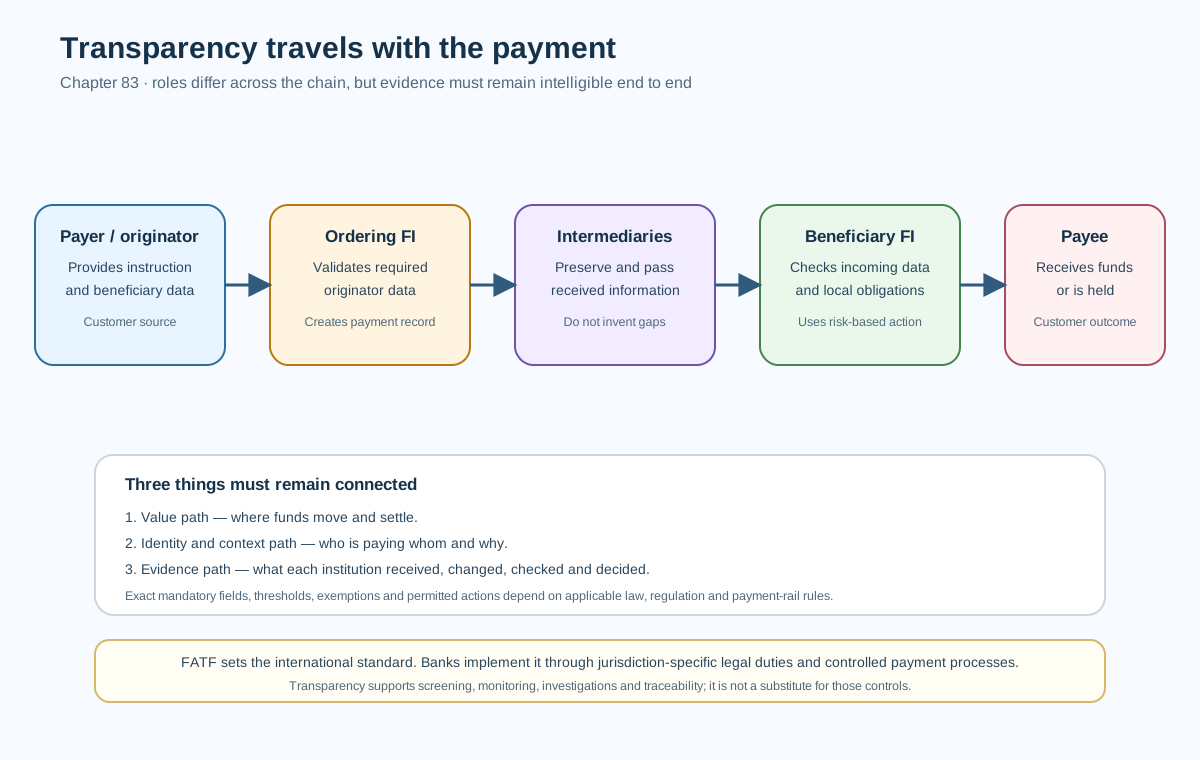
A useful mental model is to separate three paths that must stay connected. The value path is where money or settlement positions move. The identity and context path is the information that describes the payer, payee and relevant institutions. The evidence path records what each institution received, transformed, checked, repaired and decided. A transparent payment keeps those three paths aligned closely enough that the parties can be identified, legal obligations can be applied and investigators can later reconstruct the chain without guessing.
This chapter focuses on wire and funds-transfer transparency rather than every ISO 20022 field. Later chapters examine party data, ultimate parties, agents, identifiers, remittance information and message-quality issues in more detail. Here the central question is broader: what information needs to accompany a transfer, who is responsible for it at each stage, and what should a bank do when the information is missing or unusable?
Why transparency matters in a bank
Payment transparency is a financial-crime control because anonymous or poorly attributed money movement makes many other controls weaker. A sanctions-screening engine cannot reliably compare a party with a sanctions list if the party name has disappeared. Transaction monitoring cannot interpret a corridor or counterparty pattern if important parties are replaced by generic labels. An investigator cannot confidently trace funds if originator information changes between systems without a preserved audit trail. Law-enforcement or FIU enquiries become slower when the bank cannot retrieve the information that accompanied a transfer at the relevant point in time.
Transparency also matters outside AML and sanctions. Complete party and account information helps payment operations repair failed transfers, supports fraud investigation and recovery efforts, makes customer enquiries easier to resolve, and helps institutions identify where a misdirected payment originated. The June 2025 revision of FATF Recommendation 16 explicitly reflects the changing payment landscape and introduces stronger expectations intended to improve payment transparency and protection against fraud and error. FATF's June 2026 consultation on implementation guidance confirms that countries are expected to be ready for the strengthened standard by the end of 2030. That future implementation date matters because banks in 2026 are operating in a transition period: current domestic laws may still reflect the earlier Recommendation 16 framework while policy, architecture and industry planning are beginning to prepare for the revised standard.
FATF is an international standard setter, not the law that a bank executes directly. Exact mandatory fields, thresholds, exemptions, verification duties, treatment of missing information, reporting requirements and record-retention periods come from the laws and regulations applicable to the institution and transaction. This distinction is essential. A global bank should not take a rule from the United States, European Union or another jurisdiction and describe it as the universal meaning of the “travel rule.” The common principle is transparency; the legal implementation differs.
The payment-chain accountability model
A wire transfer normally involves several roles. The customer who initiates the transfer provides an instruction. The ordering or originating financial institution converts that instruction into a payment that can travel over the selected rail. One or more intermediary institutions may pass the payment onwards, sometimes changing message format or settlement route. The beneficiary institution receives the transfer and makes funds available to the intended recipient when the payment can be processed. Payment-market infrastructures, correspondent banks, service providers and non-bank payment service providers can add further layers.
The ordering institution has a special role because it is closest to the originator relationship and normally has access to the customer information collected through onboarding and ongoing due diligence. FATF's revised Recommendation 16 framework continues to place core responsibility on the ordering financial institution for sending required originator information and for ensuring the accuracy of information it is required to verify. That does not mean the originating institution can guarantee every piece of beneficiary information supplied by its customer. A bank should distinguish between information it has verified through its own customer relationship and information it is transmitting because the customer provided it for the beneficiary side of the instruction.
Intermediaries occupy a different position. They may see only the information that previous institutions transmitted. They should preserve information they receive and apply the duties imposed on their role by applicable law, regulation and payment-rail rules. A crucial principle for system design is that an intermediary should not manufacture missing customer information simply to make a field appear complete. If data was never received, the control question is how the gap should be handled, not how to invent a plausible value. The United States illustrates this role distinction clearly: for covered transfers under the U.S. Travel Rule, intermediary financial institutions must pass on required information they received, while the rule does not impose a duty on them to obtain information that was not provided by the preceding institution.
The beneficiary institution has its own obligations. It may need to detect missing or incomplete data, verify beneficiary identity in defined circumstances, decide whether to request information, hold or reject a payment, or perform post-event review, depending on applicable law and the payment context. The European Union's Regulation (EU) 2023/1113 and the EBA Travel Rule Guidelines are a good example of a detailed regional regime. The EBA Guidelines, applicable from 30 December 2024, explain how payment service providers and intermediary providers should detect missing or incomplete information and manage deficient transfers. The operational response is risk-sensitive and tied to the regulation; it should not be generalised into a worldwide rule.
Complete is not the same as meaningful
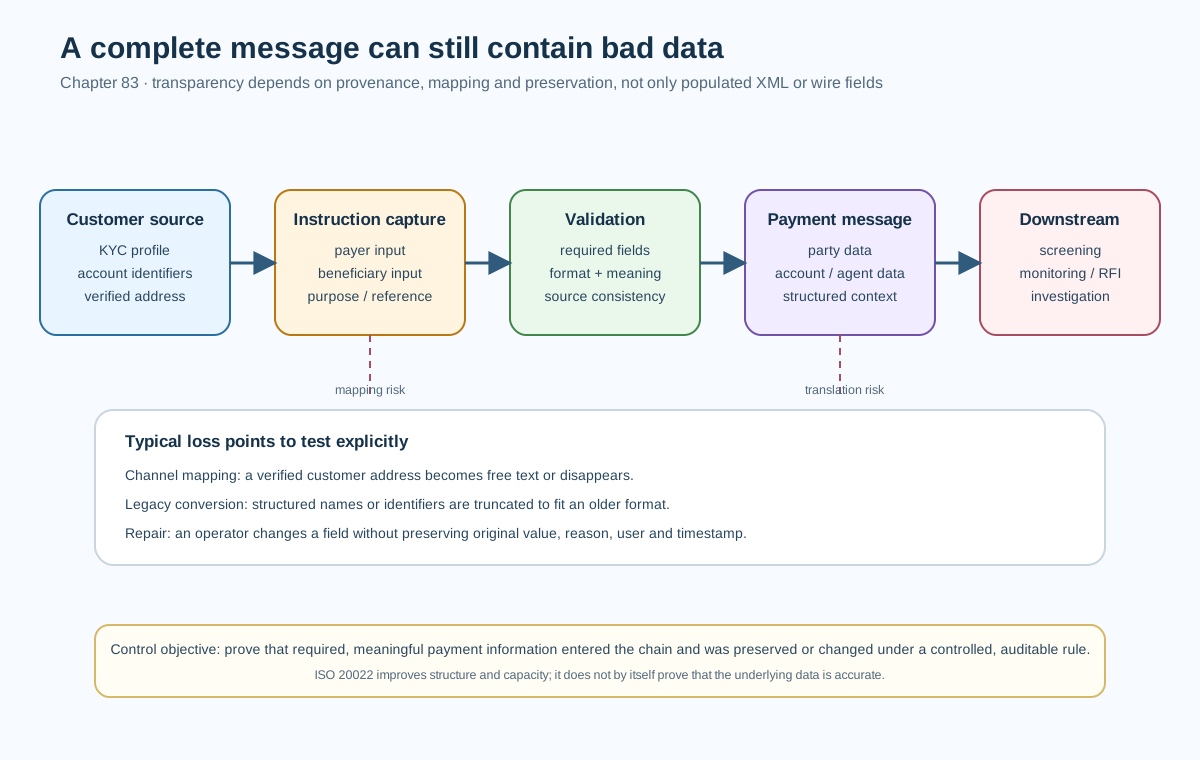
A payment message can pass a technical “mandatory field present” check and still be poor from a transparency perspective. A name such as MR X, an address such as N/A, a beneficiary identifier copied into the wrong field or a remittance narrative filled with repeated punctuation may satisfy a syntax rule without giving a reviewer usable information. Banks therefore need to distinguish at least four conditions: missing data, incomplete data, inconsistent data and meaningless data.
Missing data means an expected element is absent. Incomplete data means some information is present but does not meet the applicable requirement or is insufficient to identify the party. Inconsistent data means two sources disagree, for example when a country derived from a structured address conflicts with the country stored in customer master data. Meaningless data is technically populated but unusable, such as placeholders or random characters. These conditions should not automatically produce the same payment outcome. The correct response depends on what information is legally required, whether the party can still be identified, what role the bank performs, whether the rail permits delay or repair, the risk context and the institution's documented procedure.
This is why transparent payments need semantic validation as well as schema validation. A schema answers “is this element structurally allowed?” A transparency control asks “does the information help identify the relevant party and can we explain where it came from?” The second question is harder, but it is the one that matters in an investigation.
Source, message and evidence must remain connected
Banks should know where payment information originates. Some data is sourced from a verified customer profile. Some comes from an individual payment instruction. Some is enriched from bank reference data, such as account details or legal-entity identifiers. Some is generated by the payment platform itself. A strong data-lineage design records the source, transformation, destination and effective version so that the final message can be traced back to the information used at initiation.
Problems often appear at format boundaries. A modern channel may collect rich structured data and then send it into a legacy payment engine with shorter fields. A gateway may convert one message standard to another. A local rail may not support every field available in the bank's internal canonical model. An operations team may repair a rejected payment manually. Each transformation creates the possibility that a name is truncated, an address is flattened into free text, a party role is changed, a country is lost or two fields are concatenated in a way that later screening cannot interpret.
The correct design is not to assume that one “golden message” exists. It is to preserve enough lineage to compare the original instruction, the validated internal representation, the outbound message, any intermediary or gateway transformations visible to the bank, and the final received representation where available. If a field changes, the bank should be able to determine whether the change was expected, who or what made it, and whether the change affected a legal or control requirement.
Serial, cover and more complex payment structures
The transparency problem becomes more interesting when the value route and customer-payment route are not identical. In a straightforward serial correspondent payment, the customer payment instruction moves through a chain of institutions that also participate in the movement of value. In a cover payment model, the customer transfer information and the interbank settlement or cover leg may travel through different message paths. Banks therefore need architecture and operating procedures that understand the relationship between the legs rather than assuming that every message contains the same information for the same purpose.
The control objective is still traceability. The institution should be able to associate the customer-payment context with the relevant settlement movement and retain identifiers that allow the relationship to be reconstructed. This matters for investigations, sanctions enquiries, fraud recovery and payment operations. The detailed message mechanics vary by network and standard and are covered elsewhere in the Academy; the point here is that transparency should follow the economic payment, not merely one technical message.
Bulk, batched, netted and payment-service-provider arrangements create similar challenges. A correspondent bank may see a payment-service provider as its direct customer while the underlying transfer relates to that provider's customer. Industry guidance increasingly addresses these models because a chain can contain banks and non-bank PSPs with different access to customer information. The Wolfsberg Group's 2026 guidance for banking services to non-bank PSPs reinforces the need to understand which actor is responsible for complete originator and beneficiary information and how downstream banks should handle the data they actually receive.
A practical control objective
For delivery teams, a useful control objective is: required payment transparency information is sourced from controlled data, included and preserved according to the institution's role and applicable rules, tested for usability, and handled through an auditable exception process when it is deficient. This statement is more implementable than “comply with the travel rule” because it identifies the control components a business analyst, architect or tester can observe.
The objective also avoids a dangerous assumption: that more data is always better. Banks must collect and transmit what is required and justified, protect personal data appropriately, and avoid unnecessary duplication or uncontrolled leakage. Payment transparency and data-protection obligations need to be designed together. The goal is accountable traceability, not indiscriminate collection.
A well-designed payment transparency control therefore combines customer data, payment-validation logic, message construction, preservation rules, exception handling, monitoring, governance and evidence. No single application owns the whole outcome. The rest of this chapter follows that chain from data creation to investigation and remediation.
Operational deep dive: detecting and resolving transparency defects
A payment-transparency defect is not automatically a suspicious transaction. It is first a control exception: the institution expected information that is absent, incomplete, inconsistent or unusable. The financial-crime significance depends on context. A one-off mapping defect affecting thousands of otherwise ordinary payments is primarily a data and control problem. Repeated omission of originator information from one respondent bank can become a correspondent-risk issue. Deliberate use of vague parties, shell entities and changing intermediaries may contribute to suspicion. A mature operating model separates these possibilities rather than treating every exception as evidence of criminality or, at the other extreme, dismissing every exception as a harmless formatting problem.
Where detection should happen
Transparency checks can exist at several stages. A customer channel can prevent an instruction from being submitted without data required for that product. The payment hub can compare the instruction with customer and account records before constructing the outbound message. A gateway can validate that a message contains the fields required by a specific network profile. An intermediary can check whether information received from the prior institution is present and usable to the extent required for its role. A beneficiary institution can assess the incoming payment before or after crediting, according to applicable rules and the rail's processing model.
These are different controls. If a channel requires a beneficiary country, that does not prove that the country is preserved in the outbound message. If a message gateway validates schema conformance, it does not prove that the name is meaningful. If the receiving bank has a strong incoming control, it does not excuse the originating bank from sending information correctly. Control inventories should therefore identify the purpose and limitation of each check.
The bank should also distinguish hard validation from risk detection. Hard validation prevents the payment from progressing when an objectively required condition is not met. Risk detection identifies a pattern that requires review but may not justify immediate blocking. Combining the two into a single opaque score creates operational confusion. A reviewer should know whether an item stopped because of a legal field requirement, a rail rule, a sanctions or AML concern, a data-quality rule, or an internal risk threshold.
Missing, incomplete, inconsistent and meaningless information
A useful exception taxonomy makes the root cause visible. Missing information is easiest to detect because a field is empty. Incomplete information requires a definition of what “enough” means in the applicable context. A name that contains only one character may be technically populated but insufficient. Inconsistent information requires comparison across sources. Meaningless information often requires pattern recognition, such as placeholder values, repeated characters or obvious test data.
Banks should be cautious with aggressive data cleansing. Converting accented characters, punctuation or local naming conventions into a normalised form can help matching, but the original value should remain available. A customer's legal name should not be silently rewritten because a downstream system finds another spelling easier to process. The same applies to addresses. Normalisation can create a control view; it should not erase the source evidence.
A transparent repair process records the original field, repaired value, reason, source of the replacement information, user or service making the change, timestamp and downstream message affected. This is particularly important when operations teams repair payments under time pressure. Without that history, a later investigator cannot tell whether a suspicious-looking value came from the customer, an intermediary or the bank itself.
The decision after an exception
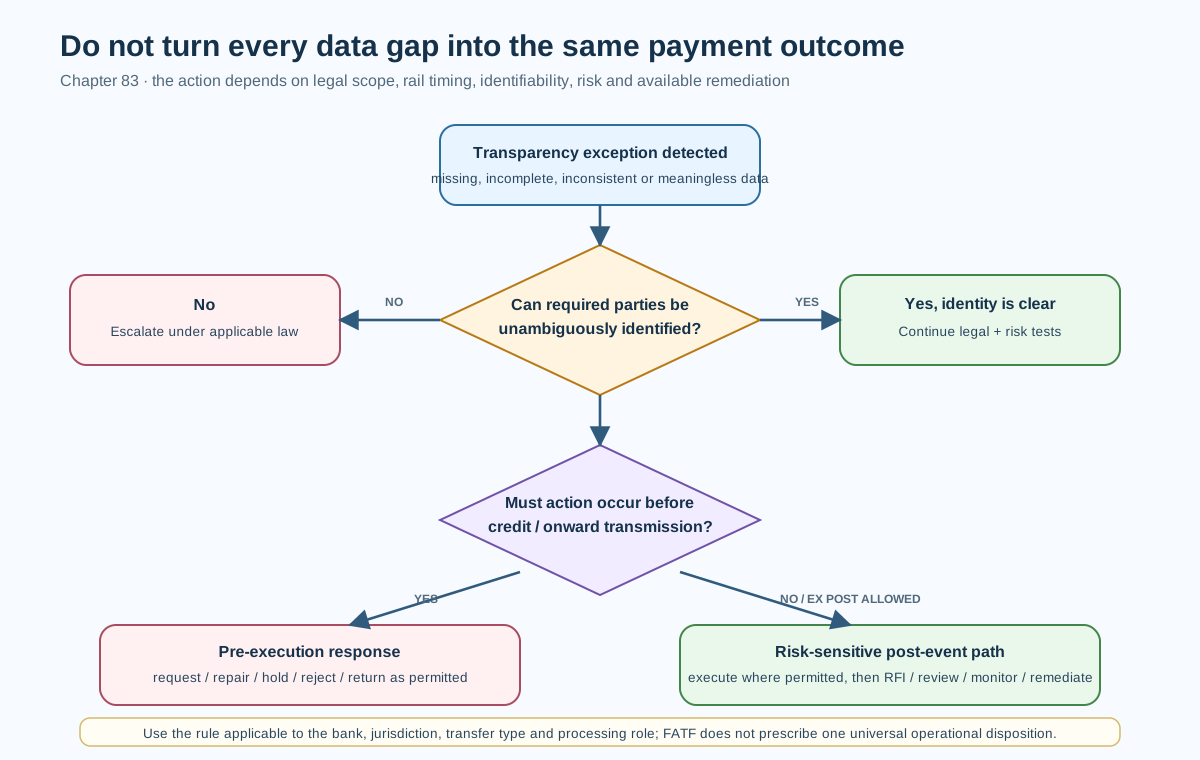
There is no universal decision tree that produces the same outcome for every jurisdiction and rail. The bank should first establish the legal and regulatory requirement that applies to its entity and role. It should then determine whether the transfer and parties can be identified, whether the missing information can be obtained reliably, whether action must occur before execution or can occur after it, and whether other risk indicators are present.
Possible outcomes can include requesting additional information, repairing the payment from a trusted source, holding the transfer while information is obtained, rejecting or returning it, executing where legally permitted and completing an ex-post review, escalating the customer or correspondent relationship, or opening an AML investigation. These outcomes are not interchangeable. “Repair” should not become a way to bypass a control. “Reject” should not become the automatic response to every data-quality issue if applicable rules allow proportionate remediation. “Execute and review later” should not be used where the law requires a pre-execution condition.
European Union example
The European Union provides a useful example of how detailed regional implementation changes the operational design. Regulation (EU) 2023/1113 establishes information requirements for transfers of funds and certain crypto-assets. The EBA Travel Rule Guidelines, applicable from 30 December 2024, describe how PSPs and intermediary PSPs should detect missing or incomplete information and manage affected transfers.
The important lesson for a global designer is not to memorise one EU workflow and apply it everywhere. It is to observe the architecture that a legal regime creates. Systems need to know the entity processing the transfer, the role that entity performs, the transfer type, the information required for that role, and the permitted response when information is deficient. Rules should therefore be versioned by legal scope and effective date rather than hard-coded as a universal “travel rule check.”
The EBA framework also demonstrates why instant and other fast payments complicate exception management. A process that relies on a human waiting several days for an answer cannot simply be inserted into a rail whose customer-facing outcome is expected in seconds. The legal regime may allow risk-sensitive ex-post handling in defined circumstances, while other cases require pre-execution action. Architecture should represent those choices explicitly rather than leaving operations to improvise during an exception.
United States example
The United States provides a different model. Under the current U.S. Travel Rule, as described in the FFIEC BSA/AML Examination Manual, funds transmittals of USD 3,000 or more are subject to specified information-transmission requirements. The transmittor's financial institution must include required information in the transmittal order. An intermediary financial institution must pass on required information it received from the preceding institution, but the Travel Rule does not require that intermediary to obtain information that the prior institution failed to provide.
That $3,000 threshold is a U.S. rule, not a global threshold. It should therefore appear in requirements as jurisdiction-scoped configuration with a legal source and effective date. The same is true for U.S. recordkeeping obligations connected with funds transfers. Developers should not encode 3000 in a generic payment-transparency microservice and assume it applies to every bank entity, currency or payment.
For business analysts, this example is useful because it shows how a single user story can become dangerously vague. “The system shall validate Travel Rule data for payments above the threshold” is not enough. Which jurisdiction? Which legal entity? Which role? Which type of transfer? Which threshold and currency basis? What data? What happens when information was never received by an intermediary? What evidence is retained? A defensible requirement answers those questions or points to a controlled rule source that does.
Correspondent and PSP quality as a relationship issue
Individual payment defects can reveal a broader relationship problem. If one correspondent, respondent or PSP repeatedly sends deficient payment information, operations should not endlessly repair each transfer as an isolated event. The bank should aggregate the pattern. Useful measures include defect rate by counterparty, type of field affected, recurrence after notification, number of RFIs, time to response, payment value affected, jurisdictions involved and whether defects prevented effective screening or investigation.
Repeated failures may lead to enhanced engagement, technical remediation, revised routing, contractual or service-level action, risk escalation or, in severe cases, relationship restrictions. The decision belongs within the bank's correspondent or third-party governance, not solely within the payment repair queue. The Wolfsberg payment-transparency work is helpful here because it treats transparency as a shared payment-chain responsibility while recognising that different actors possess different information.
This is also where non-bank PSP relationships require care. A bank providing services to a PSP may not directly onboard the PSP's underlying customer. It still needs to understand the PSP's business model, payment flows, data arrangements and financial-crime control environment sufficiently to manage the relationship risk. The transparency architecture should preserve the underlying party information required for the relevant payment type rather than allowing every underlying transfer to appear as a payment from the PSP itself.
When a transparency defect becomes an investigation issue
A transparency exception can be resolved operationally and still contribute to a financial-crime case. Suppose a customer repeatedly sends payments through different intermediaries, beneficiary names vary slightly, purpose text is vague, and originator information is repeatedly altered before arrival. None of those facts alone proves laundering or sanctions evasion. Together they may justify review of the customer, counterparties and payment network.
The hand-off to investigation should preserve the payment evidence. Investigators need the original customer instruction, customer profile at the time, outbound and inbound message representations available to the bank, repair history, screening results, transaction history, correspondent information and prior transparency exceptions. The case should make clear which data was supplied by the customer and which was created or changed by an institution. Without that distinction, an investigator may incorrectly attribute a bank-generated repair value to the customer.
A suspicious-activity decision remains separate from the transparency exception itself. Local law determines reporting obligations and confidentiality rules. The bank's case workflow should therefore allow a transparency issue to be linked to an AML investigation without automatically treating every data defect as suspicion. That separation improves both customer fairness and investigative quality.
Advanced practice: architecture, governance and control effectiveness
Payment transparency becomes difficult when a bank has several legal entities, many payment rails and a mixed estate of modern and legacy systems. The architecture must answer a deceptively basic question: which rule applies to this payment at this processing point? That answer may depend on the booking entity, customer location, sending and receiving jurisdictions, currency, rail, institution role, value, counterparty type and effective date of the relevant legal or scheme rule. A global bank therefore needs more than a list of mandatory fields. It needs a controlled obligation model that can be translated into executable validation and review logic.
Build the rule model before the validation rule
A robust design separates legal interpretation from technical implementation. Compliance or legal teams define the obligation and its scope. Product and payment experts translate it into operational outcomes. Business analysts express those outcomes as requirements and rule tables. Engineers implement the logic, while testing and control owners prove the implementation matches the approved interpretation.
The rule record should identify at least the legal source, jurisdiction, legal entity or entity group, transfer type, processing role, effective date, required information, verification requirement where applicable, exemption or threshold conditions, allowed treatment of missing information and the evidence that must be retained. Changes should be versioned. A decision made in September 2026 may need to be reconstructed years later using the rule that was effective at that time rather than today's rule.
This versioning becomes especially important as FATF's revised Recommendation 16 moves toward the end-2030 implementation target. Banks will face staggered national implementation. One jurisdiction may update domestic law early, another later, and a third may use different terminology or thresholds. The control platform should support that transition without forcing every market onto one date.
Data ownership and lineage
Transparency data usually crosses organisational boundaries. Customer-data teams own KYC attributes. Payment-product teams own instruction capture. A payment hub may own canonical payment representation. Message gateways own transformations. Financial-crime platforms consume party data for screening or monitoring. Operations teams may repair exceptions. Data platforms supply MI and investigations.
If no one owns the end-to-end transparency outcome, each component can pass its own local test while the payment fails globally. For example, the onboarding system may correctly store a verified address. The channel may retrieve it. The hub may receive it. A translator may then flatten the address into a legacy field and truncate the country. Every upstream team can claim its component worked. Only an end-to-end reconciliation control reveals that the information available at source did not survive to the payment message.
A useful architecture therefore creates both field-level lineage and control-level lineage. Field-level lineage shows where a value came from and how it changed. Control-level lineage shows which validation, screening or exception rule consumed the value and what decision resulted. The two together allow a reviewer to distinguish a customer-data defect from a transformation defect or a control defect.
Reconciliation should prove transparency preservation
Financial reconciliation normally asks whether amounts and entries balance. Transparency reconciliation asks whether important payment information survived the processing chain. A bank can sample or systematically compare source and outbound representations for required party fields, account identifiers, agent information and key references. It can also compare pre- and post-conversion messages at gateways known to create truncation risk.
The objective is not byte-for-byte identity. Formats legitimately transform. Names may be normalised, structured addresses may be rendered differently, and identifiers may move into different elements. The test is semantic preservation: did the information required to identify and understand the parties remain available in an authorised form? Where transformation is unavoidable, is the rule documented and tested?
Controls should pay particular attention to silent loss. A hard message rejection is visible. Silent truncation can be more dangerous because the payment succeeds operationally while the transparency defect is hidden. Monitoring for field-length utilisation, repeated truncation patterns, dropped elements and unexpected nulls can expose this class of problem.
Quality metrics that support decisions
A transparency dashboard should not be a collection of green percentages. Management information needs enough detail to decide whether the problem is customer behaviour, counterparty quality, system mapping, operational repair, legal interpretation or control calibration.
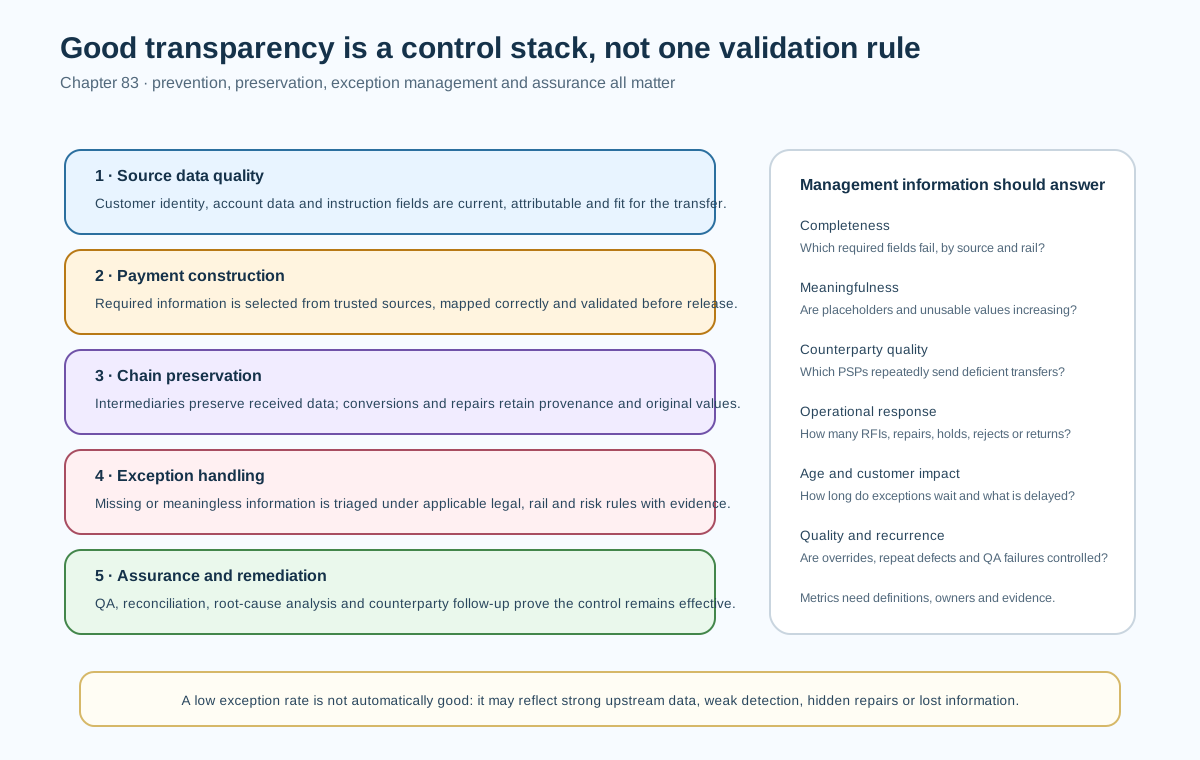
A useful set of measures can include the proportion of transfers with required-field defects, defects by field and source system, meaningless-value detections, repairs by type, RFIs sent and received, holds or returns where applicable, repeated failures by correspondent or PSP, average age of unresolved exceptions, number of manual overrides, QA error rate and recurrence after remediation. These measures should be segmented by rail and jurisdiction so that one high-volume low-risk flow does not hide a concentrated problem elsewhere.
Metrics must have definitions. “Missing originator information” should mean the same thing in operations MI, risk reporting and audit evidence. If one team counts an empty field and another counts empty plus meaningless values, their trends cannot be compared. Data dictionaries should therefore define numerator, denominator, exclusions, timing point and ownership for each key indicator.
A low defect rate is not automatically proof of a strong control. Detection may be weak. A high defect rate is not automatically proof of poor compliance if a new control has just exposed a previously hidden data issue. Management should look at root cause, severity, trend and remediation rather than judging one number in isolation.
Repeated counterpart failures
Where a bank receives deficient payments from another institution, the first response may be an operational RFI or repair. If the same deficiency recurs, the issue should move from transaction processing to relationship governance. A bank should be able to show that it recognises repeated failure, communicates expectations, tracks remediation and escalates when the counterparty does not improve.
This is not a reason to create an indiscriminate blacklist of institutions. Cross-border payments pass through different infrastructures and legal frameworks, and some apparent deficiencies may arise from message conversion rather than negligence by the sending bank. Relationship governance should therefore use evidence: which fields are affected, at what stage, on which routes, how often, whether the institution was notified and whether the issue persists after agreed corrective action.
The same thinking applies to internal entities in a banking group. A subsidiary that repeatedly sends incomplete information should not be treated as automatically safe because it is part of the same group. Internal service relationships still need accountable data-quality ownership and remediation.
Privacy and transparency are not opposites
Payment transparency requires personal and commercial data to move through financial infrastructure. Data-protection and secrecy requirements therefore belong in the design from the beginning. The bank should identify the lawful basis and permitted purpose for processing, limit access, protect data in transit and at rest, control retention, and avoid exposing information to systems or parties that do not need it.
The right design is not to strip legally required payment information in the name of privacy, nor to transmit every customer attribute because transparency is useful. It is to define the minimum appropriate data set for the payment and control purpose under applicable law. Access to historical payment data should be role-based, logged and retrievable for legitimate operational, compliance and investigative needs.
Cross-border data transfers can add complexity. A global architecture should document where transparency data is processed, which service providers can access it, how local restrictions are handled and how an investigator obtains the same evidential view across jurisdictions. These questions are architectural requirements, not merely privacy-policy language.
Governance and ownership
The first line should own the operational effectiveness of payment creation, validation and repair. Financial-crime compliance sets or interprets control expectations, provides challenge and assesses residual risk. Data owners are responsible for source quality and lineage. Technology teams are accountable for reliable implementation and change control. Second-line oversight should challenge trends, exceptions and material weaknesses. Internal audit independently assesses design and operating effectiveness.
Material transparency failures should have clear escalation criteria. Examples include a system change that strips required party data, a correspondent repeatedly sending unusable information despite remediation, a control outage affecting high-risk corridors, a backlog that prevents timely treatment of exceptions, or evidence that a payment product was launched without required legal mapping. Escalation should identify affected populations, risk, immediate containment, accountable owner, remediation date and validation approach.
The governance objective is not to eliminate every payment defect. It is to make defects visible, respond proportionately, prevent recurrence and demonstrate that the bank knows whether its transparency control is working across the whole payment chain.
Practice close: requirements, testing and operational readiness
A payment-transparency control becomes real only when teams can state what should happen, prove that it happens across supported payment routes and recognise quickly when it stops happening. This section converts the chapter into delivery questions for business analysts, architects, developers, testers, product owners, operations and control teams.
Requirements that can actually be tested
A requirement should identify the payment population and the institution's role before describing the field rule. “Originator information must be present” is incomplete because the required information can vary by legal regime, transfer type and effective date. A stronger requirement links the rule to an approved obligation record and describes how the payment engine determines that the rule applies.
The requirement should then identify the trusted source of each required attribute. If the originator name comes from customer master data, the design should say whether the channel can override it and under what authority. If the beneficiary address is supplied by the customer, the system should not label it as bank-verified unless the bank has actually verified it. Provenance should remain available for downstream controls and investigations.
Transformation rules need the same precision. When a target format cannot carry a source value without change, the requirement should define the permitted transformation, priority of information, truncation behaviour, preservation of the original value and exception path. Silent data loss should never be an undocumented feature of message conversion.
A useful acceptance criterion for an outbound flow might read: for every payment in the defined population, the payment service selects the applicable transparency rule using legal entity, role, rail and effective date; sources each mandatory originator attribute from the approved customer or instruction record; maps it to the required outbound element; retains source and outbound representations; and prevents release or routes an exception where the approved rule is not satisfied. The exact condition and outcome belong to the jurisdiction-specific rule rather than to a generic global threshold.
Architecture questions before implementation
Architects should be able to answer where the transparency rule is evaluated, whether all channels use the same rule service, how offline or batch flows behave, how message conversions are controlled, where original values are stored, how manual repair is audited, and what happens if the reference-data or rule service is unavailable.
The design should avoid unnecessary duplication. If three payment products independently implement the same legal rule, they may drift as regulation changes. A reusable rule capability can reduce that risk, but centralisation should not remove product context. The service still needs enough information to know the processing role and payment type.
Failure modes deserve explicit architecture. If customer master data is unavailable, should the payment fail, queue or use a previously validated snapshot? If the transparency service times out during an instant payment, what action is legally and operationally permitted? If a message translator falls back to a legacy route, are transparency validations repeated? A system that behaves safely only when every dependency is healthy is not a complete control design.
Test the meaning, not only the schema
Testing should start with positive cases: complete ordinary payments across each supported route, jurisdiction and role. It should then cover the boundaries that reveal real defects. Use names at maximum supported length, multi-line and structured addresses, customers with multiple accounts, beneficiary information containing non-Latin characters, different country formats, optional identifiers, corporate and individual parties, and payments that cross message-format boundaries.
Negative tests should distinguish missing from meaningless values. An empty originator name, a placeholder such as UNKNOWN, repeated characters, whitespace-only content and data inserted into the wrong element are different defects. Systems should produce the expected exception category rather than one generic “invalid payment” result.
Transformation tests should compare source and destination semantics. Populate all required source attributes, pass the transaction through each converter and verify that the final payment representation preserves the information according to the approved mapping. Where truncation is unavoidable and permitted, test the exact rule and verify that the original value remains retrievable.
Intermediary-role testing is particularly important. The system should preserve information received from an upstream institution and should not invent information absent from the incoming transfer. Where applicable rules require detection or action on missing data, test both one-off and repeated failures from the same counterparty. The relationship-level escalation should be demonstrable separately from the transaction disposition.
Regression suites should include historical defects. Once a bank has experienced a mapping loss, a placeholder-value defect or a broken RFI workflow, the scenario should become a permanent automated regression test where feasible. Otherwise the organisation pays to discover the same weakness again after the next platform upgrade.
Test the end-to-end evidence
Functional success is not enough if the audit trail is weak. A tester should be able to reconstruct the source value, rule version, validation result, transformation, final message value, exception decision and any manual repair. Timestamps and actor identifiers should be consistent across systems. If a case is opened, the case should link to the payment and preserve the relevant evidence rather than relying on screenshots taken by an analyst.
Performance tests should include transparency controls because a rule that works only at low volume may be bypassed operationally during peaks. Batch windows, high-volume salary files, correspondent bursts and instant-payment traffic can expose latency and queueing problems. Degraded-mode tests should verify that failover behaviour matches approved policy instead of silently disabling controls.
Operational playbook
Operations staff need clear distinctions between technical repair, transparency remediation and financial-crime escalation. A technical repair corrects a payment-format or data-mapping problem using an approved source. Transparency remediation obtains or corrects information required for the transfer under the applicable procedure. Financial-crime escalation occurs when the facts create suspicion, sanctions concern or another risk requiring specialist review. One item can involve more than one path, but the reasons should not be conflated.
The playbook should explain who can repair which fields, what evidence is required, when a payment can be released, when a second approver is needed, how RFIs are sent and tracked, how customer communication is handled and how repeated counterparty failures are escalated. High-risk or legally sensitive overrides should be visible in MI and quality review.
Customer communication should avoid language that implies criminal suspicion when the issue is simply missing payment information. A customer may be asked to provide or correct beneficiary details without being told that the bank suspects money laundering. Conversely, where an AML investigation or reporting process is underway, staff must follow local confidentiality and tipping-off restrictions. Front-line scripts and case notes should respect that distinction.
Management and quality review
Quality assurance should sample both cleared and stopped payments. Reviewing only exceptions can tell the bank whether analysts handled detected issues correctly, but not whether the detection control missed deficient payments. Independent sampling of processed transactions can test whether the expected information was actually present and meaningful.
Root-cause coding should be stable enough to identify trends: customer instruction, customer master data, channel capture, message mapping, correspondent or PSP, manual repair, reference data, rule configuration or unknown. “User error” should not become a default category that hides system design weaknesses.
Material incidents should trigger population analysis. If one mapping is wrong, determine when the defect began, which products and routes used it, how many transfers were affected, whether risk-relevant information was lost, whether downstream institutions raised RFIs, whether sanctions or monitoring controls used the defective representation, and what retrospective action is necessary. The investigation should end with an evidence-based closure decision, not merely confirmation that new payments now work.
Knowledge check
A payment arrives with a complete originator name but no usable address. The first question is not “is this money laundering?” It is “what rule applies to this institution and role, and what does that rule require us to do with this transfer?” The next questions establish whether the party can be identified, whether the missing information can be obtained, whether action must occur before execution, and whether other risk indicators justify financial-crime escalation.
An intermediary receives a payment without an element that the original customer bank should have supplied. The intermediary should not invent the value. It should preserve what it received and follow the obligations applicable to its own role, which may include detection, request, rejection, return, reporting or other treatment depending on jurisdiction and rail.
A payment message contains all mandatory XML elements, but the originator field contains a placeholder. The message is syntactically complete but may not be transparent. This is why schema validation and semantic data-quality controls are separate.
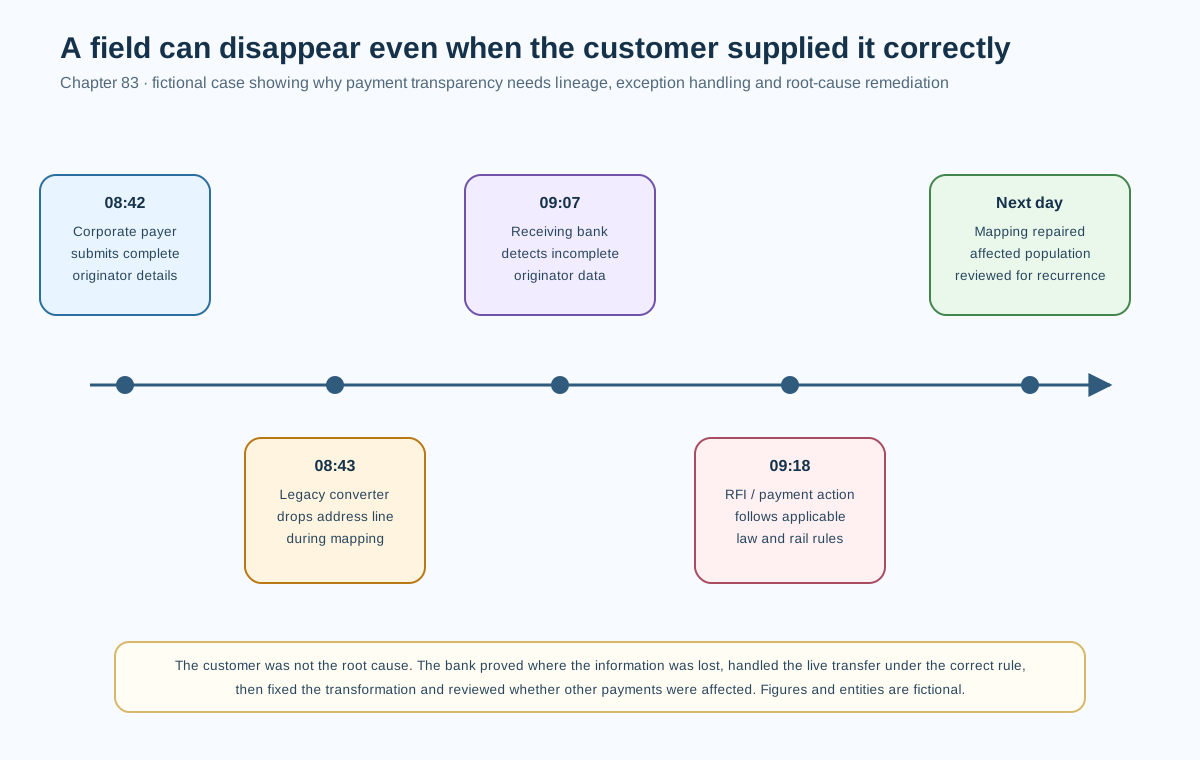
A customer supplied a correct address, but a converter removed it. This is primarily an internal control and data-lineage failure. The bank must still handle affected live payments under applicable rules, but remediation should fix the transformation and assess the historical population rather than repeatedly asking the customer for information the bank already possesses.
Final takeaways
Wire transfer transparency is best understood as an end-to-end evidence discipline. The bank needs to know who is behind the payment, what information was required for its role, where that information came from, how it moved through systems and institutions, what changed, which controls used it and how exceptions were resolved.
FATF Recommendation 16 provides the global standard, but operational requirements must be mapped to applicable law. The revised Recommendation 16 agreed in June 2025 is moving the industry toward strengthened cross-border payment transparency, with countries expected to be ready by the end of 2030. In 2026, banks therefore need both current-state legal compliance and controlled preparation for future implementation.
The strongest control is not the one that rejects the most payments. It is the one that consistently sends and preserves meaningful required information, catches real defects, applies the correct jurisdiction-specific response, avoids unnecessary customer harm, learns from repeated failures and leaves a record another competent reviewer can reconstruct years later.
Mini case study: the address that disappeared between systems
The following case is fictional. It is designed to show how a transparency failure can arise inside the payment chain even when the customer has provided correct information, and why the bank needs both transaction handling and root-cause remediation.
A manufacturing company, Northfield Components Ltd, has banked with Bank A for several years. Its KYC profile contains a verified legal name, registration details, registered address and operating countries. On Monday morning the company's treasury team sends a cross-border payment to a long-standing supplier at Bank D. The customer enters the supplier name, account, supplier bank and invoice reference through Bank A's corporate channel. Bank A's payment platform enriches the instruction with the originator information held in customer master data.
At the channel and payment-hub stages the record is complete. The payment then passes through a legacy gateway used for one correspondent route. The gateway maps Bank A's richer internal party model into an older message representation. Because of a defect introduced in a recent release, the originator street and town are dropped for one particular address pattern. The country remains, and the payment passes the gateway's technical validation because the output message is syntactically valid.
The payment reaches intermediary Bank B and then Bank D. Bank B preserves the information it received; it cannot pass on address elements it never saw. Bank D's transparency control detects that the originator data is incomplete for the incoming transfer under the rules applicable to Bank D. It does not conclude that Northfield is suspicious. Instead it classifies the item as a payment-transparency exception and applies the response permitted by its legal framework and internal procedure.
What the first investigation should establish
The first task is to reconstruct the payment rather than infer motive. Bank D can see the message it received. Bank B can establish what it received and forwarded. Bank A can compare the customer instruction, customer master data, canonical payment record and outbound gateway message. This comparison shows that the customer did not omit the address. The defect occurred inside Bank A's transformation layer.
That finding changes the response. Customer outreach may be unnecessary because the bank already holds the correct source data. The right remediation is technical and operational: correct the mapping, identify the population affected since the faulty release, determine whether other fields or routes were impacted, and assess whether any payments require follow-up under applicable rules. A customer should not be blamed for a defect created by the bank.
The investigation also demonstrates why original values matter. If Bank A's payment system stored only the final outbound representation, the bank might wrongly conclude that the customer record was incomplete. Because lineage is preserved, investigators can see that the address was present before conversion and absent afterwards.
What each team learns
Operations learns that technical success is not the same as transparency success. The payment was accepted by the gateway and moved through the network, yet an important data element was lost. Operations therefore needs exception categories that distinguish customer-data issues from bank-generated transformation defects.
Financial-crime compliance learns whether the defect could have impaired screening, monitoring or downstream investigations. If the lost information included a country, party name or other risk-relevant attribute, the bank may need a retrospective control assessment. The answer depends on what controls consumed which version of the data. If screening occurred before the field was lost, the bank's own screening result may remain valid even though the downstream bank received poorer information. That does not eliminate the transparency failure; it changes the control-impact analysis.
Technology learns that schema-valid messages can still be semantically defective. Regression tests should therefore compare critical source attributes with generated messages rather than only checking whether the message validates against a schema. A field mapping test should include long names, multi-line addresses, non-Latin characters, optional elements, empty values and combinations known to stress legacy formats.
The business analyst learns to write end-to-end acceptance criteria. “Address is sent” is too vague. A better requirement identifies the approved source, required message representation, transformations allowed, handling when the target format cannot carry the source value, audit evidence, and expected result at each supported route.
Risk governance learns to distinguish incident containment from closure. Fixing the mapping stops new defects. It does not prove that the affected historical population has been assessed. Closure requires evidence that the defect window is known, impacted transfers are identified, material control consequences are understood, counterparties are informed where required, and the corrected mapping has passed regression and production monitoring.
A second scenario: the defect is not purely technical
Now change one fact. Assume Bank A's source record itself contains a weak originator value because a legacy customer was migrated years ago with incomplete address information. The outbound gateway is working correctly. This becomes a customer-data and KYC remediation issue rather than a message-mapping issue. Payment teams should not repeatedly repair the same field manually while the source remains defective. The bank needs to determine whether the customer's information must be refreshed and whether the relationship remains within its KYC standards.
Change the facts again. Assume the source record and gateway are complete, but the customer repeatedly chooses payment structures involving PSPs and intermediaries that produce unusually opaque transfers, and the beneficiary identities change frequently. This may now justify broader transaction review. Transparency defects become one signal among several rather than the whole case.
These variations show why root-cause classification matters. The visible symptom — an incoming payment lacks usable information — can arise from customer data, payment capture, mapping, intermediary processing, counterparty behaviour or deliberate evasion. A bank that jumps directly from symptom to suspicion will inconvenience customers and miss system defects. A bank that treats every symptom as a technical issue may miss financial-crime risk.
Evidence pack for defensible closure
A strong closure pack would contain the original customer instruction, customer-data snapshot, canonical payment representation, outbound and received messages available to the bank, transformation logs, timestamps, users or services involved, screening and monitoring results, exception decision, RFI correspondence if any, affected-population analysis, root cause, remediation change record, regression evidence and post-implementation monitoring.
The exact contents depend on the incident and jurisdiction, but the principle is stable: another competent reviewer should be able to reconstruct why the payment was handled as it was and why the remediation is considered complete. That is the practical meaning of transparency beyond simply filling message fields.
Release engineering for payment transparency
A bank can have an accurate policy, well-trained investigators and a modern payment message while still losing the information that makes a transfer traceable. The weak point may be a small implementation change: a channel stops sending a field, an enrichment service chooses the wrong party, or a repair screen replaces the original value without recording who changed it. The practical question is therefore not only whether the bank collects the required information. It is whether a particular release preserves the meaning of that information through the actual processing path.
The following operating model is a bank-design example, not a prescribed international message layout or a universal rejection policy. FATF's June 2025 Recommendation 16 revision clarifies responsibility in the payment chain and aims to improve the consistency of accompanying information. FATF identifies an end-2030 implementation horizon for the revised standard; that does not postpone requirements already applicable under national law or an existing payment arrangement. The current obligations of the bank, its role and the relevant service remain the starting point. Primary source: FATF's Recommendation 16 update.
Define a semantic contract, not just a field mapping
Consider a fictional corporate channel that submits payments for several subsidiaries through a treasury centre. The channel, payment engine and compliance service may each use a different representation. A mapping specification should identify the business role behind each value, not merely a source column and a destination tag. The account holder, the party on whose behalf a payment is initiated and the receiving party are not interchangeable merely because they belong to one group.
For each role, the contract should state the originating system, the evidence supporting the identity, the circumstances in which the role is applicable, the transformations permitted and the downstream controls that need it. It should distinguish information supplied by the customer from information retrieved from a verified record and information inferred by a technical service. These distinctions allow an investigator to challenge a value without losing the ability to see how the bank obtained it.
A useful contract also states what must not happen. An optional role must not be populated with a duplicate simply to make a dashboard look complete. A missing value must not become a fictional name. A transliteration must not silently overwrite the original script. A field whose meaning is unknown must not be relabelled as a different party merely because the target interface requires text. Where the receiving representation cannot carry the relevant information, the bank needs an approved treatment rather than an undocumented truncation.
| Checkpoint | Evidence to retain | Failure the test should expose |
|---|---|---|
| Channel acceptance | Original instruction and source reference | A mandatory value absent at capture |
| Canonical representation | Party role, value and transformation version | A real value assigned to the wrong party |
| Control interface | The exact data supplied to the control | Screening or monitoring receives a reduced identity |
| Outbound transmission | Actual transmitted representation and route | Information present internally but missing externally |
| Repair or information request | Original value, new evidence, decision and actor | A change cannot be reconstructed later |
The table is a proposed evidence contract. It is not a claim that all jurisdictions require the same fields, retention period or technical architecture.
Test the release against relationships between values
A schema test asks whether an element is present and correctly formed. A semantic regression test asks whether it still refers to the intended person or organisation. Both are necessary in the design example. A populated field may contain a product label; a correctly formatted country may belong to an agent rather than the customer; and a valid identifier may have been copied from the previous transaction in a bulk file.
Build a small, reviewed set of synthetic business cases before generating a large volume of test messages. Include a direct payer, an approved treasury arrangement, two unrelated parties with similar names and a payment whose original identity uses a different writing system. Include a legitimate absence where the role is not applicable. The expected result should describe the business meaning as well as the technical representation, so a reviewer can detect a technically neat but conceptually wrong mapping.
Then change one attribute at a time. Remove a source value, make the source stale, exchange two role assignments, interrupt an enrichment response and supply a customer correction after the initial control decision. These tests show whether the implementation understands the distinction between missing, unusable, inconsistent and newly amended information. They also show whether an exception is assigned to someone able to resolve it rather than disappearing into a generic repair queue.
A particularly valuable negative test preserves the outbound message but removes a party from the screening interface. The payment might still pass a network validation. The bank's own test must nevertheless fail because the expected control did not receive the intended identity. This is why checking only the final message is insufficient evidence for an end-to-end transparency claim.
Treat correction as a new controlled event
Suppose an operations user receives reliable evidence that the initiating party was recorded under an outdated legal name. The proposed repair should be evaluated against the original instruction, customer context and local procedure. The system should record the original and corrected values, evidence source, reason, approving authority and timestamps. It should not rewrite the history of a control that previously considered different information.
A material identity change may require a fresh control decision under the bank's applicable policy. The implementation should make that dependency explicit. The fact that an earlier version was cleared is not evidence that the new version was considered. Equally, a harmless display-format change should not automatically create an endless cycle of duplicate investigations. The rules should distinguish a change in identity or relevant meaning from a purely presentational adjustment and should preserve the justification for that distinction.
Reporting and payment processing also require separate outcomes. A payment repair may succeed while a related information request remains unanswered. An information request may be answered while the payment has already been returned. A case may require further investigation even when a formatting defect has been resolved. One universal status called “completed” would hide those differences.
Work through a bounded production incident
In this fictional incident, a morning release introduces a transformation error in one corporate channel. At 09:10 the control team sees an increase in mismatched party roles. At 09:20 the release owner identifies the affected mapping version. At 09:35 the bank has prevented further use of that mapping on the affected path under an approved incident procedure. These times describe the example only; they are not regulatory response limits.
The incident team should establish the population by channel, route, mapping version and processing interval. It should distinguish instructions stopped before transmission from payments already sent and records that only reached an internal control. Counting all of them as “failed payments” would exaggerate one impact and conceal another. The team also needs to identify control decisions made with incomplete information, including decisions attached to payments that otherwise completed successfully.
Remediation should follow the state of each item. An unsent instruction may be repaired and re-evaluated within the bank's authority. A transmitted payment may require coordination with the next institution and an investigation of whether additional action is needed. A completed transaction may still require historical control review. The bank must not assume that replaying a message is safe: an additional transmission can create a second payment rather than correct the first.
Reconciliation should account for every item in the bounded population as reviewed, awaiting evidence, repaired, subject to another defined action, or excluded with a documented reason. The population definition and its extraction logic should be retained. When new evidence changes that definition, the incident record should explain the change rather than quietly replacing yesterday's count.
Make the evidence useful to the next team
A practical handover should contain a readable business explanation, the affected population, representative source-to-output comparisons, the correction applied, unresolved cases and the owner of each remaining action. Technical logs alone are rarely enough: they may show that a service responded successfully without showing that the response carried the correct party meaning.
Quality assurance should select samples from different routes and outcomes, including successful payments. Sampling only rejected instructions can miss silent information loss in transactions that completed. It should also verify that access to original payment data and repair evidence is limited to authorised users and that customer-facing explanations do not expose confidential investigation decisions.
Useful management measures include the proportion of applicable roles preserved through each interface, unresolved semantic exceptions by age, repeated defects by source and the number of historical control decisions requiring review. A raw field-population percentage is a poor substitute. The objective is not to fill every box. It is to preserve enough accurate, attributable information for the payment and its control decisions to remain explainable.
References and further reading
The sources below were reviewed for this chapter on 19 September 2026. FATF material provides the international standard; regional and national sources illustrate how that standard is implemented differently in law and supervision.
- Financial Action Task Force, The FATF Recommendations, current version updated June 2026: https://www.fatf-gafi.org/en/publications/Fatfrecommendations/Fatf-recommendations.html
- Financial Action Task Force, Public consultation on guidance to increase payment transparency, 24 June 2026. This explains the June 2025 revision of Recommendation 16 and the end-2030 implementation target: https://www.fatf-gafi.org/en/publications/Fatfrecommendations/R16-Public-Consultation-June-2026.html
- Financial Action Task Force, Explanatory Note for Revised Recommendation 16: https://www.fatf-gafi.org/content/dam/fatf-gafi/recommendations/Explanatory%20Note%20for%20Revised%20R.16.pdf.coredownload.pdf
- European Union, Regulation (EU) 2023/1113 on information accompanying transfers of funds and certain crypto-assets: https://eur-lex.europa.eu/legal-content/EN/TXT/?uri=CELEX:32023R1113
- European Banking Authority, Guidelines on information requirements in relation to transfers of funds and certain crypto-assets transfers under Regulation (EU) 2023/1113. Application date 30 December 2024: https://www.eba.europa.eu/activities/single-rulebook/regulatory-activities/anti-money-laundering-and-countering-financing-terrorism/guidelines-information-requirements-relation-transfers-funds-and-certain-crypto-assets-transfers
- European Banking Authority, Travel Rule Guidelines PDF: https://www.eba.europa.eu/sites/default/files/2024-07/6de6e9b9-0ed9-49cd-985d-c0834b5b4356/Travel%20Rule%20Guidelines.pdf
- Federal Financial Institutions Examination Council, BSA/AML Examination Manual — Funds Transfers Recordkeeping. This contains the current U.S. funds-transfer recordkeeping and Travel Rule requirements, including the USD 3,000 threshold and intermediary-bank responsibilities: https://bsaaml.ffiec.gov/manual/AssessingComplianceWithBSARegulatoryRequirements/09
- Wolfsberg Group, Payment Transparency Standards, October 2023: https://wolfsberg-group.org/resources/legacy/136
- Wolfsberg Group, Guidance on Payment Transparency — Roles and Responsibilities, December 2024: https://wolfsberg-group.org/resources/203/200
- Wolfsberg Group, Guidance on the Provision of Banking Services to non-bank Payment Service Providers, July 2026: https://wolfsberg-group.org/resources/correspondent-banking/206