ISO 20022 Party Data for Screening
ISO 20022 gives a bank something older payment formats often struggled to provide: a more explicit description of who is involved in a payment and what each piece of information means. A debtor name can sit in a name element instead of being mixed with an address. A town can sit in a town field. A country can sit in a country field. An organisation identifier can be carried separately from free text. A financial institution can be represented through a BIC or other institution identifier. This richer structure creates a real opportunity for better sanctions screening and better investigation, but only if the bank preserves the meaning of the data from source to decision.
That last point is the heart of this chapter. ISO 20022 does not make screening effective by itself. A beautifully structured pacs.008 can still produce weak control outcomes if a customer channel captured the wrong party, if a converter moved a legal name into an address line, if transliteration destroyed useful distinctions, if a screening engine treated every element as the same kind of text, or if an investigator cannot tell where a value came from. Structure creates the possibility of precision. The bank still has to design the control.
For screening teams, the simplest mental model is this: party data is identity evidence attached to a defined payment role. The role tells you why the person or organisation appears in the transaction. The data tells you what is known about that party. The source and transformation history tell you how much confidence to place in each attribute. Screening then compares selected attributes with sanctions or other risk data, while the remaining attributes can help an analyst decide whether a potential match is the same person or entity.
This chapter focuses on the bank-practical use of debtor, creditor, ultimate-party, address and identifier data for screening. It does not assume that every ISO 20022 field must be screened, and it does not treat an industry market practice as a universal legal requirement. The exact control scope depends on the sanctions regimes, payment rail, legal entity, jurisdiction and bank policy that apply.
Why structured party data changes screening
In a legacy message, a screening engine may receive a block of text containing a name, street, town and country. The engine can search the text, but it has limited understanding of what each token means. A word such as Jordan could be a surname, a country, a city, a company name or part of an address. The control either screens broadly and creates noise, or applies exclusions that can accidentally hide risk.
ISO 20022 can separate those concepts. A party name is carried as a name. Postal-address elements can distinguish town, post code, country subdivision and country. Organisation-identification structures can carry a BIC, LEI or another identifier. Private-identification structures can carry identifiers relevant to natural persons. Financial institutions sit in agent structures rather than being mixed with customer parties. This means screening can be more targeted. A name can be compared with sanctioned individuals or entities using fuzzy logic appropriate to names. A two-character country code can be compared exactly with geographic restrictions. A BIC or LEI can be matched as a structured identifier rather than as free text. Other attributes can support alert disposition even when they are not sensible primary match triggers.
Swift's industry guidance on screening ISO 20022 payments described this as targeted screening: selected tags are matched against the list data for which they are meaningful, while other message data remains available to help an investigator distinguish a true match from a false match. That is a better design principle than "screen every field against everything." It also fits the wider Wolfsberg view that sanctions screening should be risk based, controlled and supported by good reference data, governance and testing.
The bank still needs to decide its actual screening scope under the sanctions regimes, products, jurisdictions and risk appetite that apply to it. An industry guideline is not a universal legal rule. The operational point is that ISO 20022 gives the bank enough structure to make those decisions deliberately rather than forcing every data element through one generic matching process.
Party data, agent data and context are not the same thing
One recurring design error is to collapse all named actors in a payment into a single concept called "party." In ISO 20022, the role matters. The debtor is not the debtor agent. The creditor is not the creditor agent. An ultimate debtor or ultimate creditor, where present, has a different relationship to the movement of funds. A financial institution identifier belongs to an agent structure rather than a customer party structure. A remittance narrative may mention another person or company but does not automatically make that named subject a formal payment party.
For screening, this distinction matters because list matching is only the first step. An alert against the debtor has a different factual meaning from an alert against the debtor agent. A potential match in a creditor postal address is different from an exact match on a bank BIC. A company name appearing in unstructured remittance information may be highly relevant, but the bank should not silently relabel that name as the creditor. Good case management therefore preserves both the value and the role in which the value appeared.
A useful internal canonical model normally carries at least the party role, source field, original value, normalised value, source system and message reference. If enrichment occurs, such as resolving a BIC or adding a country from an approved reference source, the enrichment source should be recorded separately. That allows an investigator to distinguish what the customer supplied, what the bank already knew, what the payment system derived and what an analyst later added.
This becomes especially important in chains involving several payment service providers. Each institution sees a different part of the customer relationship and may be responsible for different checks. A correspondent or intermediary bank should not assume that beneficiary data was verified merely because it appears in a structured field. Structure tells the receiving bank what the field means; provenance tells the receiving bank what confidence it can reasonably place in it.
The main party attributes used in screening
The most obvious screening attribute is the name. For the bank's own customer, this should normally trace to an identified customer record where the bank owns that relationship. For an organisation, the registered legal name is usually more useful than a trading style when the purpose is identity resolution, although aliases and trade names can still matter. Beneficiary information received from an originator is different: the ordering bank may not independently know or verify that beneficiary in the same way it knows its own customer. That difference should be visible in data provenance and investigator tooling.
Postal address data provides geographic and identity context. ISO 20022 can represent street, building, post code, town, country subdivision and country as separate elements. In current CBPR+ practice, the industry is moving decisively away from fully unstructured addresses. Swift originally planned to remove fully unstructured postal addresses on 14 November 2026, but its 27 August 2026 announcement deferred SR2026 payments changes. Structured or hybrid addresses, with town and country in designated elements where required, remain the target model; the replacement enforcement timetable requires confirmation from Swift. This is a network and market-practice requirement for CBPR+, not a universal legal rule for every payment rail in every jurisdiction.
That change matters to screening because country and town no longer need to be inferred from a free-text line. It also matters operationally because banks must remediate source data and channels, not just their outbound XML formatter. If an ERP, corporate host-to-host file or legacy customer master still stores the whole address in one field, the problem exists before the payment reaches the ISO 20022 gateway.
Organisation identification can be particularly useful because identifiers behave differently from names. A BIC, LEI or another structured identifier may support exact matching where suitable list data exists. Exact matching is powerful because it can reduce ambiguity, but it should not be treated as magic. An identifier can be missing, stale, mapped to the wrong party or unavailable on the sanctions list. A bank may therefore use identifiers as a primary signal where the control design and reference data support it, while still retaining names and addresses for identity resolution.
Private identification can include other identifiers for natural persons and data such as date and place of birth. Not every such field should necessarily trigger a transaction-screening alert. Some attributes are better used to resolve a name hit after an alert has been generated. Date of birth is a classic example: it can be very valuable in distinguishing two people with similar names, but using every date as an independent screening trigger can add little detection value and large operational noise. The bank should document why each attribute is screened or retained for disposition.
Country-of-residence information can also be useful, but it should not be confused with address country, nationality or the country of the servicing bank. Each concept answers a different question. A sanctions regime may care about location, residence, nationality, ownership or transaction nexus in different ways. The data model must therefore keep these concepts separate enough for policy and legal interpretation.
Global payment-transparency context
FATF Recommendation 16 is the global standard most closely connected with payment transparency. FATF revised Recommendation 16 in June 2025 to adapt it to newer payment business models and messaging standards and to improve the quality and consistency of information accompanying payments. The revised standard is not the same thing as a directly applicable law in every country. Countries need to implement the standard through their own legal and regulatory frameworks, and FATF has said that the strengthened requirements are expected to be implemented globally by the end of 2030.
For a bank in 2026, that creates two parallel obligations for change teams. First, the bank must comply with the law and payment-scheme rules that apply today. Second, architecture and data teams should understand where the direction of travel is heading so that current transformation programmes do not build new dead ends. The revised Recommendation 16 places stronger emphasis on consistent originator and beneficiary information, while the 2026 FATF consultation on implementation guidance also addresses payment-alignment checks, privacy and newer payment methods.
Wolfsberg's Payment Transparency Standards reinforce the practical point that transparency is needed not only for formal compliance but also for sanctions screening and transaction monitoring. The standards use ISO 20022 terminology and emphasise that the party initiating the payment flow has primary responsibility for structuring payment information appropriately, while acknowledging that different intermediaries see different amounts of data. This is important for system design: a receiving or intermediary bank should not invent missing source information simply to make a message look complete.
From customer source to screening decision
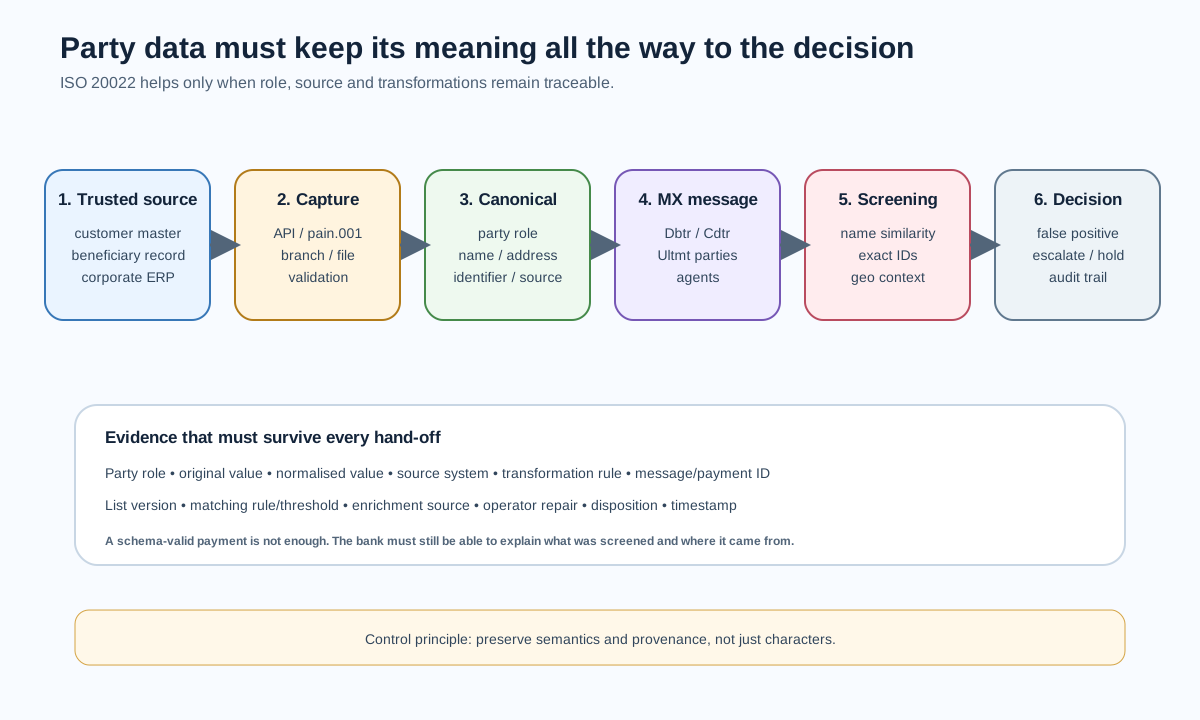
A robust party-data control begins before the payment message exists. The customer profile, onboarding system, corporate channel or upstream payment application is often the true source of the name and address. The payment hub may enrich the instruction. A canonical payment model may transform the source. A mapping layer then creates pain.001, pacs.008, pacs.009, pacs.009 COV or another relevant message. The sanctions engine extracts selected elements, normalises them and compares them with list data. Alerts enter a case workflow. The final payment disposition is then returned to the orchestration layer.
Each of those hand-offs is a control point. If a name is truncated between the channel and the hub, screening sees a weaker identity. If a creditor country is copied into the debtor field, the data can be structurally valid and semantically wrong. If the case system only stores the normalised name and not the original, the analyst cannot see what the customer actually supplied. If a screening vendor upgrades its transliteration logic without controlled regression testing, the alert population can change even though the payment flow looks unchanged.
The control therefore needs end-to-end lineage. A strong evidence chain can answer: where did the party value originate, what transformations were applied, what exact data was sent to screening, which list and rule version were used, what generated the alert, what supporting attributes were visible to the analyst, and what final decision was recorded? This is what turns a screening platform from a black box into an auditable bank control.
Screening logic should respect data type
Names are rarely suited to exact matching only. People and organisations can have aliases, spelling variations, different word order and different transliterations. Screening engines therefore use fuzzy or similarity logic, phonetic techniques, tokenisation or other methods. Those methods require thresholds and tuning. A high threshold may miss relevant variants. A low threshold can create a large volume of false positives. The bank should be able to explain how the threshold was chosen, how it is tested and how different scripts or languages are handled.
Structured identifiers are different. If a sanctions list contains an LEI and the payment contains a valid LEI for the party, exact comparison can be highly discriminating. The same principle can apply to a BIC for a financial institution. But exact matching only works where the identifiers on both sides are complete and comparable. A false sense of confidence can arise when the payment contains an identifier but the reference list does not, or when an identifier is attached to the wrong party.
Country codes can be exact, but policy must define what the country means. A creditor address country can support geographic screening. A creditor-agent BIC country identifies the bank location, not automatically the creditor's residence. An account number format may imply a country but should not silently replace explicit party geography without an approved rule. Good control design avoids treating all country-like information as one signal.
Free text deserves careful treatment. Remittance information, purpose text and address lines can contain relevant names or geography, especially during transitions from older standards. Yet unrestricted fuzzy screening of every narrative field often creates noise. The bank should decide which free-text fields create enough incremental risk coverage to justify screening, and which are better retained as investigation context. Wolfsberg's sanctions-screening guidance explicitly supports a risk-based approach to the data elements screened.
Alert investigation: preserve the reason for the hit
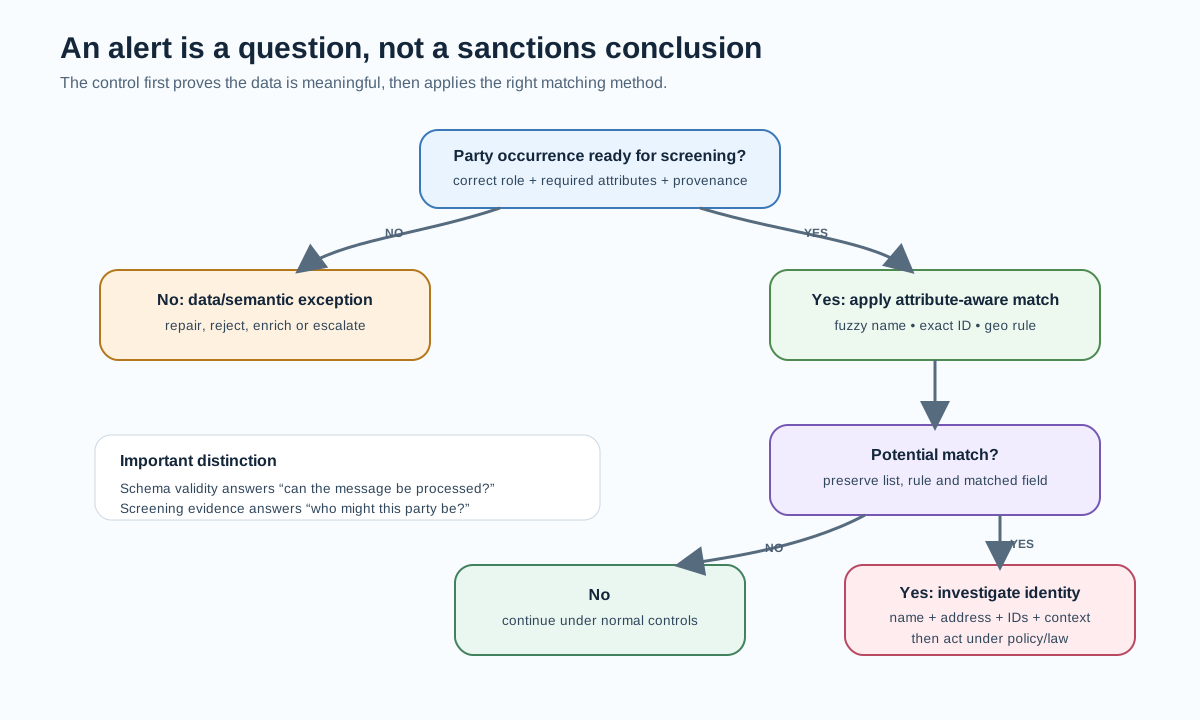
A well-constructed alert should tell the analyst what matched and why. "Payment matched sanctions" is not enough. The case should identify the party role, attribute, original value, normalised or transliterated value, matched list record, match score where relevant, list version and rule or threshold that produced the alert.
The analyst then uses supporting data to resolve identity. A similar name may be distinguished by a different date of birth, town, country, LEI or other reliable identifier. A matching address can increase concern but does not independently prove that two entities are the same. A different address can reduce confidence but may not rule out identity if the listed party has moved or the list data is stale. The case system should therefore expose evidence rather than hide it behind a single composite score.
The outcome depends on the applicable sanctions programme and the bank's policy. A false positive can be released. A potential match may require specialist escalation. A confirmed match may require blocking, rejecting, freezing or another action depending on the legal framework. The screening engine should not hard-code one global outcome because sanctions rules differ across jurisdictions and programmes.
Where the bank uses previously cleared false-positive rules or good-guy logic, the suppression decision should be tied to stable identifying evidence, not merely a name. A structured identifier can help here, but the bank should control expiry, revalidation and list changes so that a historical clearance does not become a blind spot.
Data quality is part of the control, not an IT housekeeping task
A bank can have an excellent matching algorithm and still have weak screening if the data entering it is poor. Common problems include truncated names, overloaded address lines, invalid country codes, default values, lost diacritics, wrong party roles, missing ultimate parties and identifiers without issuer context. These are not merely formatting defects when they affect the information used to detect sanctions risk.
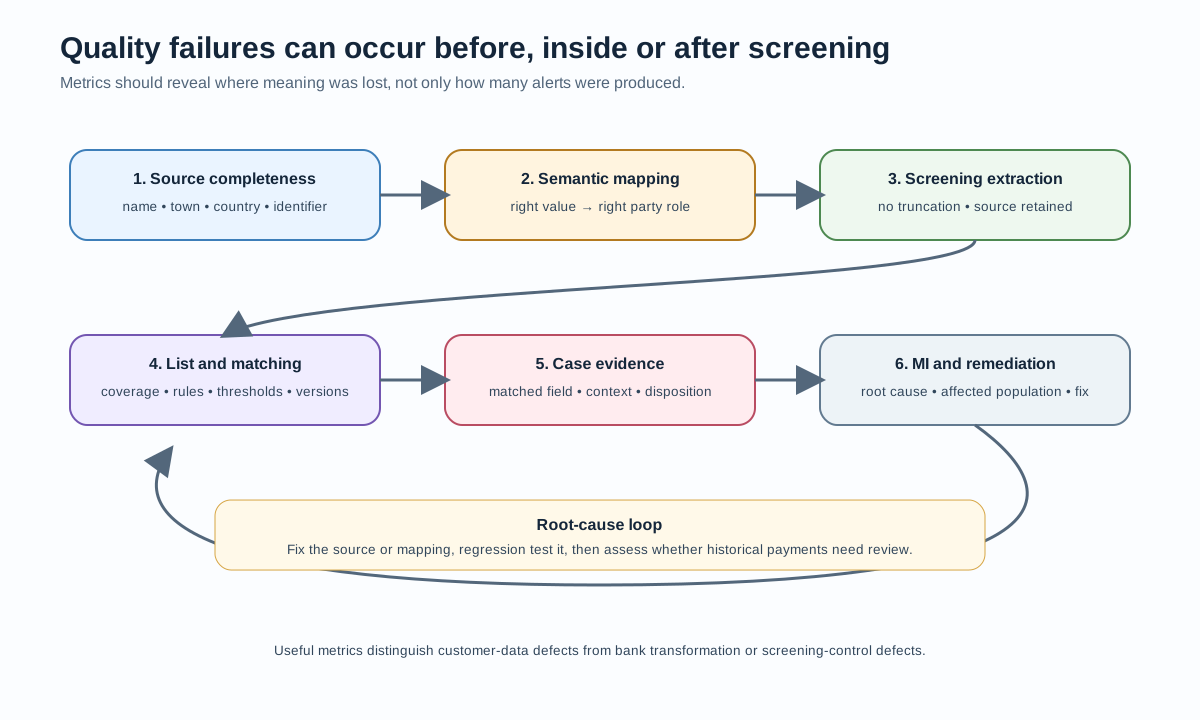
Data quality should therefore be measured at several points. The channel should validate what the customer provides. The payment hub should check semantic completeness. The mapping layer should reconcile source and target values. The screening interface should confirm that the intended fields were extracted. The case platform should preserve both match evidence and supporting context.
The bank should distinguish syntactic validity from semantic validity. An XML schema can prove that a country code has two characters; it cannot prove that the country belongs to the correct party. A message can pass a CBPR+ usage rule and still contain the wrong creditor name. Financial-crime testing therefore needs business assertions in addition to schema validation.
The 2026 structured-address transition makes this especially visible. A bank that simply parses a free-text line and fills TwnNm and Ctry may produce a technically valid message while overstating the confidence of the data. If an address-structuring tool infers a town or country, the bank should retain the original value, inference method and confidence so analysts and auditors can tell derived information from customer-supplied information.
Control architecture and ownership
Ownership should follow the data and the decision. Customer-data teams own the quality of mastered customer information. Channel teams own capture and validation. Payment-platform teams own canonical mapping and message generation. Financial-crime technology owns extraction and screening configuration. Sanctions compliance owns policy, risk coverage, escalation standards and approved matching methodology. Operations owns the timely handling of alerts and repairs. Quality assurance and independent testing challenge whether the control works as designed.
Those accountabilities need to meet somewhere. A payment-data governance forum can review repeated mapping defects, address-quality readiness, screening false positives, list-coverage issues and upcoming standards changes. The point is not to create another committee. It is to prevent one team from saying "the XML was valid" while another says "the sanctions engine never received the creditor country."
Management information should connect data quality with control outcomes. Useful measures include missing critical party attributes by source channel, mapping defects, address-format rejections, alert rate by party type, exact-identifier match rate, false positives by root cause, repeated corporate repair, and defects requiring retrospective screening. Volume alone is not enough.
Where a control limitation is accepted temporarily, the owner should document compensating controls, affected population, target remediation date and risk acceptance. A limitation such as "legacy channel cannot carry ultimate creditor" is meaningful only if the bank knows which payments use that channel and what alternative control exists.
What business analysts and architects should specify
A business analyst should define the party and screening requirements in observable language. Instead of writing "screen all relevant fields," specify which party roles are in scope, which attributes are sent to screening, what matching treatment applies, what validation is required, what supporting context enters the case, and what happens when information is missing or contradictory.
The interface contract should make semantic types explicit. A partyName field should not be reused for a BIC because both happen to be strings. Identifier structures should include identifier type and issuer where required. Address country should be separate from agent country. Original and normalised values should be distinguishable. The contract should include a stable payment identifier and party occurrence identifier so alerts can be linked back to the correct transaction and party.
Architects should decide where normalisation and transliteration occur. Performing the same transformation independently in several applications can produce different results and make debugging difficult. A central service can improve consistency, but it must be resilient and versioned. If screening depends on it for real-time payments, failure behaviour needs to be defined.
Testing should cover clean data, likely false positives, known true-match test records, different scripts, missing fields, duplicate parties, long names, structured and hybrid addresses, incorrect role mapping, enrichment failure and replay. Test evidence should compare source data with the exact screening payload, not merely assert that an alert was or was not created.
Failure modes that look harmless
One dangerous failure is flattening. A payment hub receives rich ISO 20022 party data but sends the screening engine a single concatenated string. The bank keeps the XML but loses the ability to apply attribute-aware matching and to explain which field generated the hit.
Another is silent enrichment. A country or identifier is added from a reference service, but the case does not distinguish enriched information from customer-supplied information. An analyst may assume the attribute was verified at source when it was not.
A third is role confusion. A bank BIC or correspondent name is screened as if it were the creditor. Alerts increase and operations create suppressions to cope, making it harder to detect a real creditor match later.
A fourth is schema complacency. Teams assume that because a message validates, screening data is correct. The payment carries a syntactically valid country under the wrong party and passes technical testing while weakening the control.
A fifth is uncontrolled transliteration. A library upgrade changes how certain names are converted to Latin characters. The alert population shifts, but no one links the change to the release because matching logic was treated as a vendor detail rather than controlled configuration.
A sixth is list-data overclaiming. The bank advertises exact LEI screening, but most relevant sanctions-list entries do not carry LEIs. The capability exists technically but adds less coverage than management believes.
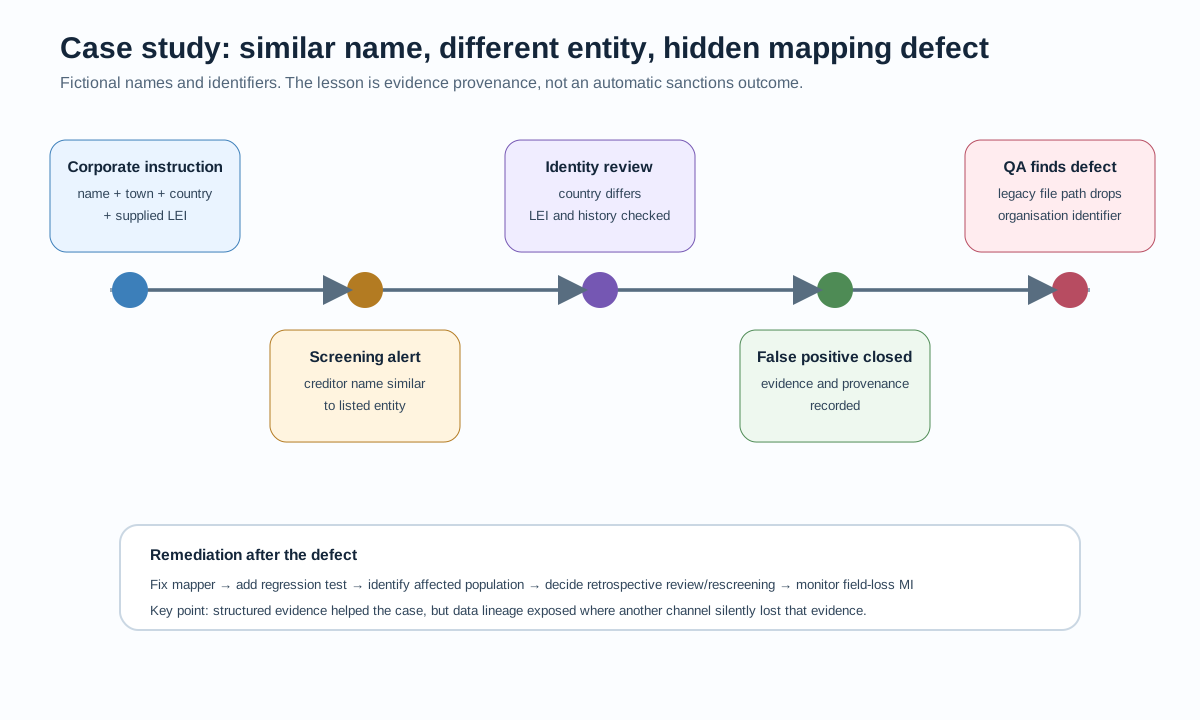
Mini case: a clean XML message with the wrong identity evidence
A corporate customer submits a cross-border payment to a supplier. The creditor name is Nortstar Industrial Trading LLC, with a structured town, country and LEI. A legacy transformation in the bank's payment hub mistakenly maps the supplier's town to the ultimate-creditor address while leaving the creditor town blank. The outbound pacs.008 remains schema-valid because the required elements are satisfied elsewhere in the message.
The creditor name produces a potential sanctions match against a similarly named entity. The screening engine receives the name and country but not the intended town. The missing town does not create the alert, but it removes useful differentiating evidence. An analyst has to search another system to find the original beneficiary record before closing the hit as a false positive.
Quality assurance later detects the mismatch by comparing source party fields with screening payloads. The issue is classified as a semantic mapping defect rather than an isolated analyst inconvenience. Technology fixes the mapping, adds a regression test and identifies the payment population processed during the defective period. Sanctions compliance assesses whether any historical alerts or payments need retrospective review.
The lesson is important: rich ISO 20022 data only strengthens screening if its meaning survives the full chain. The XML can look perfect while the control evidence is wrong.
Takeaway
ISO 20022 party data can make screening more precise because names, addresses, identifiers and agent details no longer need to be treated as one undifferentiated block of text. Names can use matching logic designed for identity variation. Structured identifiers can support exact comparison where reference data permits it. Geography can be handled as geography. Supporting attributes can help investigators distinguish true matches from false positives.
The benefit is not automatic. Banks still need reliable source data, correct party roles, controlled transformations, suitable matching logic, list-data coverage, case evidence, testing and governance. They must also distinguish global standards, payment-market practices and jurisdiction-specific law. In 2026, the CBPR+ transition away from fully unstructured addresses and the implementation direction of the revised FATF Recommendation 16 make this especially important.
The practical test is simple: if an investigator asks, "What exactly did we screen for this party, where did it come from, how was it changed and why did we reach this decision?" the bank should be able to answer from evidence rather than memory. Swift timetable source, checked 2 October 2026: Structured-address migration extension and 21 September release update. The deferred release includes exceptions/investigations messages on 12 June 2027; structured-address enforcement timing remains separately governed: https://www.swift.com/news-events/news/swift-accepts-community-request-extend-structured-address-migration-iso-20022-payment-messages
Operational deep dive: from party record to screening evidence
ISO 20022 improves the structure of payment data, but a screening control only benefits if the bank preserves the meaning of that structure from the source system through every transformation. This is where many implementations become weaker than they look. A payment may arrive in an XML message with separate debtor, creditor and agent elements, yet the screening engine can still receive a flattened text string because an internal hub was built for older formats. Conversely, a screening platform may support dedicated name, country and identifier inputs while an upstream channel captures a beneficiary as one free-text block. The operating question is therefore not simply whether the payment is ISO 20022. It is whether screening receives the right attribute, for the right party role, with enough provenance to understand what the attribute means.
The practical control model begins before the payment message is created. A retail customer may select a saved beneficiary. A corporate may send a pain.001 from an ERP or treasury workstation. A branch employee may enter a payment on behalf of a customer. An API client may submit a structured instruction. Each source has its own data ownership and verification characteristics. The debtor agent normally knows its own customer through CDD, but the beneficiary name and address may be supplied by the payer and may not have been independently verified by the payer's bank. Those differences matter when an investigator decides how much weight to give an attribute.
The party role is part of the evidence
A screening engine should not treat every name as an interchangeable string. Dbtr, Cdtr, UltmtDbtr and UltmtCdtr express different roles. Financial-institution agents such as debtor agent, creditor agent, intermediary agent and instructing or instructed agent belong to a different part of the payment model. Remittance text can contain names, but a name appearing in an invoice narrative is not automatically a payment party. The same text can therefore have different screening significance depending on where it appears.
That distinction is especially important when case systems show an alert. An analyst should be able to see not merely that the term “ABC Trading” matched a list entry, but whether ABC Trading was the creditor, an ultimate debtor, an intermediary bank, or a word inside unstructured remittance information. The disposition standard will usually differ. A credible architecture carries the semantic role into the alert payload and retains a link back to the original message element. Flattening all fields into a single search string may generate alerts, but it weakens explainability and can make false-positive suppression unsafe.
Party roles also affect repair. Suppose the creditor name is missing but a remittance line contains a supplier name. Operations should not silently copy that text into the creditor element merely to satisfy a schema or screening rule. Such a repair changes the asserted meaning of the payment data. The safer workflow is to obtain or reconstruct the missing information under an approved process, record the source, and preserve who made the change. A schema-valid message is not necessarily a semantically trustworthy message.
Name data: rich structure does not remove matching complexity
The Nm element gives screening a cleaner location for a party name, but it does not make name matching deterministic. Individuals can have multiple given names, family-name ordering conventions, patronymics, compound surnames, titles, transliterations and aliases. Organisations can have legal names, trading names, abbreviations and local-script names. Sanctions lists can contain different spellings or incomplete identifiers. For this reason, name screening commonly uses fuzzy or similarity-based techniques rather than exact equality alone.
The input should still be controlled. Normalisation may remove punctuation differences, standardise case and manage whitespace, but it should not destroy meaningful characters or silently change identity. Transliteration is useful when a list and payment use different scripts, yet transliteration creates variants rather than certainty. A sound solution keeps the original script where available, records the transliterated form that was screened and can reproduce the matching logic later.
A screening rule should also distinguish between a match trigger and supporting information. The Wolfsberg sanctions-screening guidance makes this distinction useful in practice: some data elements are strong candidates for screening, while others are better used to resolve an alert. A date of birth, nationality or place of birth may help distinguish individuals if the underlying list provides those attributes. For payment-party screening, the exact set of available attributes will often be smaller than in customer screening, so analysts may need to combine payment data with customer or counterparty information under approved access rules.
Postal address data: geography, identity and data quality
Postal address information can contribute in at least three ways. First, country, town or other geographical elements may themselves be relevant to sanctions or country restrictions. Second, address attributes can distinguish two parties with similar names. Third, address quality can reveal whether the bank is preserving payment transparency correctly across channels and transformations.
Structured data is valuable because it lets a bank handle these uses differently. A two-letter country code can be assessed deterministically against geography rules. A town name can be normalised against a reference set. Street information can support identity resolution without necessarily becoming an independent sanctions trigger. A screening policy should explain which address fields trigger screening, which support disposition, and which are retained primarily for transparency and audit. Screening every piece of text equally can create noise without adding risk detection.
For CBPR+ specifically, the target address model is operationally important: where address information is required, structured or hybrid formats use town and country in designated elements at a minimum. Swift deferred the earlier 14 November 2026 enforcement plan on 27 August 2026; use the latest confirmed usage guidelines and effective date rather than that superseded cut-over. This is a Swift market-practice and network requirement, not a universal legal rule for every ISO 20022 community. A domestic instant-payment system or local market infrastructure may have different usage guidelines, so requirements must be mapped by rail and message profile.
Banks should use the deadline as more than a formatting exercise. If a corporate channel captures an address as one string, an outbound transformation cannot reliably manufacture trusted town and country fields at the last moment without a governed source or enrichment process. The remediation belongs as far upstream as possible: customer master data, beneficiary templates, ERP interfaces, branch screens and API contracts. Swift has also provided tooling to help structure legacy address data, but any inferred result needs confidence handling, auditability and human-review rules rather than blind acceptance.
Organisation identifiers: exact matching only works when semantics are correct
ISO 20022 can carry organisation identifiers separately from names. Depending on the message and business context, this may include a BIC, LEI or another proprietary or scheme identifier. Structured identifiers are attractive for screening because an exact identifier match can be far more discriminating than a name similarity score. The benefit is real only if the sanctions or internal list contains the same identifier type and the payment data is authoritative enough to rely on.
A BIC identifies a financial institution or business party in a specific messaging context; it is not a universal identifier for every legal entity relationship. An LEI identifies a legal entity under the LEI system, but not every payment party has one and not every sanctions list consistently publishes one. Proprietary identifiers need an issuer or scheme context, otherwise identical character strings can mean different things. A screening engine should therefore bind an identifier to its type and issuer rather than search the raw value in isolation.
Exact matching also changes the quality-control problem. With fuzzy names, teams think about thresholds and aliases. With structured identifiers, the risk shifts toward missing values, wrong identifier type, stale mappings or list coverage. A test suite should deliberately include a correct LEI attached to the wrong party, a BIC truncated by an interface, a proprietary identifier with the issuer lost, and a list entry where no identifier exists. “Exact match” is only strong when both sides of the comparison are semantically sound.
Private identifiers and personal data
ISO 20022 also allows private-person identifiers in relevant structures. These may include identifiers whose use is governed by national law, privacy rules or bank policy. Their presence does not mean a bank should automatically use them as screening keys. The decision should consider legal permission, list availability, data reliability, proportionality and whether the identifier adds genuine detection value.
A useful design pattern separates collection, transport, screening and case display. An identifier may be required to travel with a payment under a specific rule but may not be necessary for every analyst to view. A privacy-sensitive attribute might be used in a controlled matching service while only the result and limited supporting context appear in the operational case. Access logging, masking, retention and purpose limitation should be part of the architecture, not an afterthought added once compliance teams notice the field.
From pain.001 to pacs.008: preserve meaning, not just characters
Corporate payment initiation illustrates the end-to-end challenge. A creditor entered in an ERP can travel in a pain.001 to the bank, be enriched with account and routing information, converted into a pacs.008, screened, sent through one or more intermediaries and finally received by the beneficiary bank. At every step, a mapper decides what to copy, transform, default or discard.
A bank should be able to reconcile critical party elements between stages. If the corporate supplied a town and country, the outbound payment should not lose them. If a canonical payment model merges legal and trading names into one string, the design should be deliberate and tested. If a legacy system cannot carry an ultimate party, the resulting loss should be visible as a known control limitation with remediation, not hidden in mapping code.
For cover payments, serial payments or flows involving pacs.009 and pacs.009 COV, the distinction between customer parties and financial-institution agents becomes even more important. Screening design should reflect the actual message and role model rather than apply one generic extraction rule to every MX. The business analyst should document the message path, screening points and ownership of each transformation so a defect can be traced to the right system.
Alert construction and investigation evidence
When a party attribute triggers an alert, the case should preserve enough information to recreate the decision. At minimum, the evidence should identify the payment, message type, party role, original value, normalised or transliterated value used for matching, matched list record, list version, screening rule or threshold, and the other relevant party attributes available at the time. If an enrichment service added a country or resolved a BIC, the source and timestamp of that enrichment should be retained.
This is where structured ISO 20022 data can materially improve investigation. An analyst can compare a name match with town, country, organisation identifier and agent information without manually reconstructing a free-text block. It can also reduce inappropriate certainty. A matching country does not prove identity; a different town does not always disprove it; the absence of an LEI may simply mean none was provided. The case interface should present attributes as evidence, not as a machine-generated conclusion.
Disposition should follow the bank's sanctions framework and applicable law. The outcome could be false positive, possible match requiring escalation, confirmed match, payment hold, rejection, blocking or another controlled action depending on jurisdiction and programme. ISO 20022 does not decide that outcome. It improves the quality and meaning of the information on which the outcome is based.
Data lineage is a financial-crime control
A mature bank can answer a deceptively simple question: “Where did this screened value come from?” For each critical party field, the answer should identify the source, transformations and control points. That lineage can be represented as source customer data or payment instruction → channel validation → canonical model → message mapping → screening extraction → alert/case → disposition and reporting.
Lineage supports incident response. If a branch of the architecture strips creditor country values, teams can identify affected payment populations and assess whether rescreening is required. If a transliteration component changes behaviour after a release, teams can compare before-and-after alert outcomes. If a corporate API sends a field in the wrong semantic location, client support can fix the contract rather than repeatedly repairing individual payments.
The most important lesson is that ISO 20022 does not create good screening automatically. It creates the possibility of better screening because the standard can express party meaning more precisely. The bank earns that benefit only when it protects semantics, validates data quality, applies matching appropriate to each attribute and retains evidence from source through final decision.
Cross-rail consistency without pretending every rail is identical
Global banks frequently reuse one screening platform across CBPR+, domestic high-value systems, instant-payment rails, internal book transfers and corporate-payment initiation. Reuse is sensible, but the data contract cannot assume every rail exposes the same party model. One rail may carry ultimate debtor and ultimate creditor explicitly. Another may not. One market infrastructure may require structured addresses. Another may allow a smaller mandatory set. A customer channel may collect an LEI even when the downstream scheme does not transmit it.
The bank therefore needs a control data model that is broader than any single message. The model should define concepts such as payment party, financial-institution agent, original source, name, address, identifier, country, account and verification status. Each message or channel maps into that model with explicit rules. The screening service then receives a stable semantic contract while the mapping layer preserves which source fields were actually available.
This avoids two bad extremes. The first is rail-specific screening logic scattered through dozens of applications, making change expensive and inconsistent. The second is an over-simplified common model that flattens every payment into debtor name, creditor name and free text, throwing away the very richness ISO 20022 was meant to preserve. A well-designed canonical layer standardises meaning without erasing differences.
Requirements should also distinguish not provided, not applicable, not supported by the rail and lost during transformation. These states can look identical if the downstream value is simply null, but they imply very different risk. If an ultimate creditor was never part of the source instruction, that is different from a mapper silently dropping an ultimate creditor that was present. The first may be normal for the rail; the second may be a control defect requiring retrospective analysis.
Re-screening and historical reconstruction
Party data changes over time. Customer addresses change, sanctions lists are updated, legal entities obtain or retire identifiers, and banks improve mappings. A later investigation may need to reconstruct what the bank knew at the moment a payment was screened rather than apply today's data retrospectively without context.
For that reason, evidence records should carry effective time and version information where practical. The case should identify the list version used, the screening-rule version and the actual party attributes sent to screening. If a reference directory enriched a BIC or LEI, the bank should be able to show the enrichment result used at that time. This protects both the bank and the customer from hindsight reasoning.
Historical reconstruction is also important when a defect is discovered. Suppose a release on 1 August caused the creditor country to be omitted from screening requests for a specific channel until 10 August. The bank needs a population query that identifies those payments and determines whether the missing attribute could have changed sanctions or financial-crime outcomes. If necessary, the payments can be re-screened using the relevant historical list or under an approved retrospective methodology. Without lineage and timestamps, the bank may know a defect existed but be unable to quantify its real exposure.
What “better data” should change operationally
The benefit of rich party data should be visible in operations. Analysts should spend less time searching unrelated systems for basic geography or identity context. Repair teams should receive clearer reasons for missing or invalid data. Corporate clients should receive actionable feedback rather than generic “payment rejected” messages. Control owners should be able to separate genuine sanctions-risk alerts from avoidable data-quality noise.
Better data should not be used to create false certainty. A structured town and country are easier to process than a free-text address, but they still reflect whatever the source supplied. An exact identifier is powerful only if its type, issuer and party relationship are correct. The strongest implementation combines machine-readable structure with an evidence model that tells reviewers how trustworthy each attribute is.
That is the practical standard to aim for: not the maximum number of populated XML tags, but the maximum amount of reliable, semantically correct and traceable information available to the control at the moment a decision is made.
Swift timetable source, checked 2 October 2026: Structured-address migration extension and 21 September release update. The deferred release includes exceptions/investigations messages on 12 June 2027; structured-address enforcement timing remains separately governed: https://www.swift.com/news-events/news/swift-accepts-community-request-extend-structured-address-migration-iso-20022-payment-messages
Advanced practice: designing a screening policy for rich party data
Once the bank has reliable party data, the harder question is what to do with it. A mature screening policy does not send every ISO 20022 field into the same matching algorithm. It assigns a control purpose to each attribute, considers the quality and availability of reference-list data, and defines what should happen when the attribute is absent, inconsistent or unreliable.
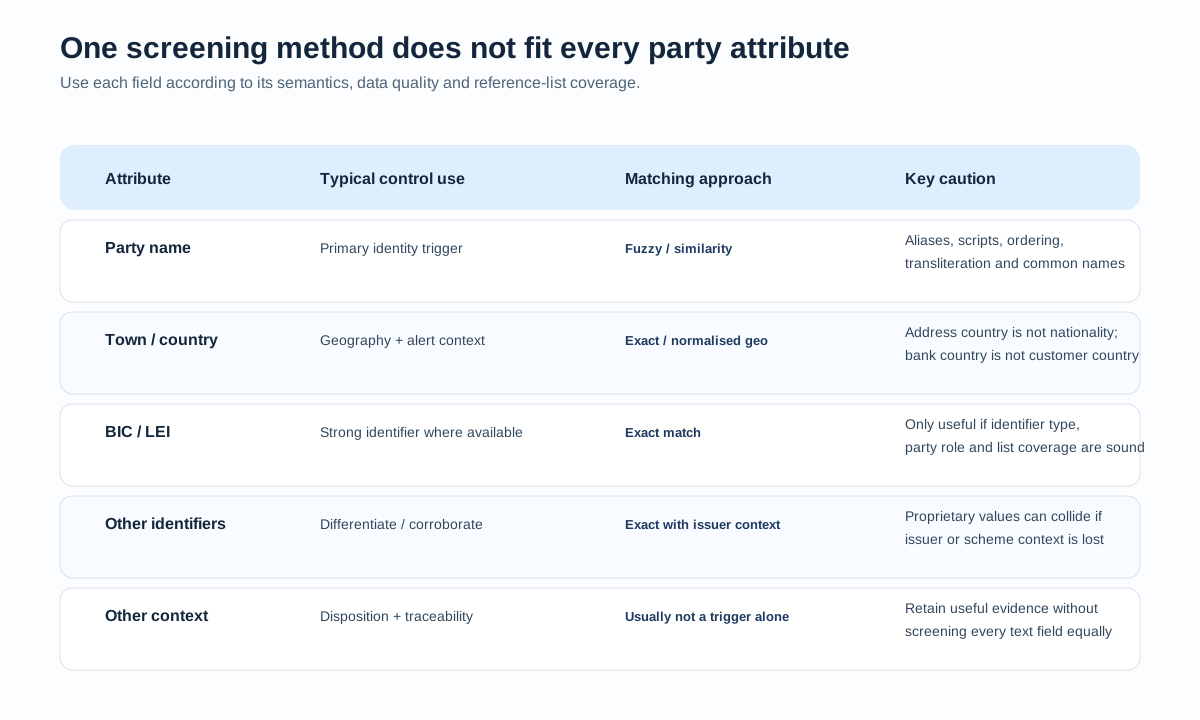
A useful way to design the policy is to separate four functions: trigger, corroborate, differentiate and trace. A party name commonly acts as a trigger because sanctions lists are strongly name-oriented. A country or town may trigger a geography restriction or corroborate a name alert. A BIC or LEI may differentiate one legal entity from another through exact comparison where reference data supports it. Other information may be retained mainly to trace the transaction and explain the final decision. One data element can serve more than one function, but the policy should say which function is intended.
Matching method should follow the attribute
Names and structured identifiers should not be treated alike. Name matching usually needs tolerance for spelling variation, ordering, punctuation, transliteration and aliases. The objective is to capture plausible identity variants while containing false positives. BICs, LEIs and well-governed codes normally lend themselves to exact matching. Country codes can also be exact, but the business rule must distinguish sanctions geography, residence, nationality, address country and institution domicile; those concepts are not interchangeable.
This is why a simple “screen all strings” architecture becomes difficult to govern. It may raise an alert because the letters IR appear inside a street name, or suppress a meaningful name because normalisation removed characters that mattered. The screening service should know the attribute type and party role. Rule configuration can then say, for example, “apply fuzzy name matching to creditor name,” “apply exact match to BIC,” and “use creditor address country as geography context under this policy.” The rule catalogue becomes testable instead of relying on opaque vendor defaults.
Thresholds need the same discipline. A name-similarity threshold should be approved with evidence about expected false-positive and false-negative behaviour. Different scripts or name populations may require different techniques. There should be governance around phonetic algorithms, transliteration libraries, tokenisation and stop-word handling. Changes should be versioned so the bank can identify which logic assessed a historical transaction.
List data quality sets the ceiling on identifier screening
Structured payment data cannot compensate for poor reference-list data. If a sanctions authority publishes only name and date-of-birth information, an LEI carried in the payment cannot create an exact-list match unless the bank has a reliable enrichment linking the sanctioned party to an LEI. Enrichment can improve detection, but it introduces a new data source that needs ownership, effective dates and validation.
The bank should know, by list or sanctions programme, which identifiers are available and trusted. Metrics can then show how much of the screened population contains those identifiers and how often they contribute to alert resolution. A dashboard that simply reports “LEI screening enabled” is not enough if only a small portion of relevant list records contain LEIs. Control claims should reflect real coverage.
The same applies to BICs. A BIC can be extremely useful for financial-institution screening, but not every sanctioned legal entity is a financial institution and a BIC can identify an institution rather than a specific branch relationship relevant to the transaction. Where BIC data is enriched from reference directories, the bank should record whether the match came from the payment itself or from a separate directory lookup.
Screening-point architecture and duplicate alert control
Large banks often screen at several points: channel entry, payment hub, sanctions gateway, correspondent gateway or post-event monitoring. Multiple points can be justified by different obligations or operational needs, but uncontrolled duplication creates repeated alerts and inconsistent outcomes.
The target architecture should explain why each screening point exists. Pre-execution screening may be necessary to prevent prohibited processing. Customer screening covers a continuing relationship. Post-event monitoring can detect patterns or data issues that are not suitable for transaction interdiction. If the same party is screened twice during one payment journey, the systems should pass enough identifiers and decision context to prevent unnecessary rework where policy allows reuse.
A common integration pattern is to create a stable payment control identifier and a party occurrence identifier. The screening service receives the party role, attribute set, message reference and control identifier. The case platform links all alerts back to the payment and records whether a previous decision can be reused. This avoids a situation where one screen clears “North Star Logistics Ltd” while a downstream screen opens an apparently unrelated alert for the same party because the data was reformatted.
Change control for the deferred postal-address transition
Swift deferred the planned 14 November 2026 removal of fully unstructured CBPR+ postal addresses on 27 August 2026. This is an example of why financial-crime, payments and data teams need one change plan: maintain readiness for the target structured or hybrid model, but activate network rejection rules against the confirmed effective timetable. The financial-crime value lies in the upstream data improvement.
A complete readiness plan should inventory every source of debtor, creditor and agent address data: customer masters, beneficiary templates, corporate files, APIs, branch applications, payment-repair tools and message converters. Each source needs an owner, current format, target format, validation rule and migration approach. For corporate customers, the bank may need new pain.001 specifications, testing windows and communications. For legacy MT101 usage, the bank needs to understand how required structured data will be supplied and mapped to the outbound MX flow.
Testing should not stop at schema acceptance. The bank should prove that town and country survive end to end, that hybrid address lines do not duplicate structured elements incorrectly, and that screening extracts the intended values. Negative cases should include missing town, invalid country codes, town values placed in address lines, contradictory countries across source and message, and address transformations that appear valid but change meaning.
Any automated address structuring or inference needs a separate control design. Confidence scores, low-confidence review, original-value retention, approval rules and audit logging are essential. An inferred town or country may help remediation, but it should not be represented as customer-verified data unless it actually has been verified. The screening case should be able to distinguish source-supplied information from inferred or enriched information.
Data minimisation and privacy are part of screening design
Rich party data raises a legitimate privacy question: just because an ISO 20022 message can carry an attribute, should every screening and investigation component receive it? The answer depends on the control purpose, legal basis, market rule and local privacy obligations.
A practical architecture minimises unnecessary replication. The screening engine receives the attributes required for matching and disposition. The case platform displays what investigators need. Highly sensitive identifiers can be masked or accessed through controlled lookup. Logs should avoid copying entire payment payloads where a smaller evidence record is sufficient. Retention schedules should align with legal and investigation requirements rather than defaulting to indefinite storage.
This does not mean deleting context that is necessary for financial-crime control. It means being explicit about purpose. FATF's current work on revised Recommendation 16 recognises that payment transparency and data protection need to operate together. Banks should therefore involve privacy, legal and financial-crime teams when adding new party attributes to cross-border flows, especially where data crosses jurisdictions.
Quality metrics should measure control meaning, not just throughput
Useful metrics describe whether party data supports the intended control. Examples include the percentage of payments with complete mandatory party attributes by channel, the rate of semantic mapping defects, the proportion of alerts where structured identifiers materially assist disposition, repeated repair by corporate client, payments rejected for address-format defects, screening extraction failures, and aged data-quality issues awaiting remediation.
Alert volumes remain useful, but they need interpretation. A fall in false positives may reflect better structured data, a threshold change, a list update or a broken feed. A rise in exact identifier matches could reflect improved coverage or an upstream mapping that mistakenly copied one identifier to many parties. Metrics should therefore connect operational outcome to source-system change.
Management information should also separate control failure from customer data quality. A missing creditor town supplied by a corporate is different from a town received correctly but dropped by the bank's mapper. Both need remediation, but the owner and risk response differ. Root-cause coding should be specific enough to drive action.
Independent testing and model-like governance
The Wolfsberg sanctions-screening guidance emphasises risk-based testing, data integrity and review of screening rules and thresholds. That is particularly relevant when ISO 20022 increases the number of attributes available to the engine. Independent testing should verify that required data is actually loaded, transformations are accurate, expected alerts fire and approved suppression or threshold rules behave as designed.
Testing should include positive and negative populations. Positive tests use known list entries or controlled synthetic cases to prove detection. Negative tests use innocent near matches to measure false-positive behaviour. Transformation tests compare source and screened values across scripts, punctuation and address formats. Regression tests verify that releases do not silently alter matching. Failure-mode tests simulate unavailable enrichment, delayed list updates, partial messages and duplicated screening events.
If the screening solution uses complex matching logic, machine learning or vendor scoring, the bank may apply model-risk or model-like governance according to local policy. Even when formal model governance does not apply, there should be documented methodology, change approval, performance monitoring and independent challenge. “The vendor owns the algorithm” is not an adequate control explanation.
From alert to case: evidence hierarchy
Analysts need guidance on how to weigh structured data. A matching LEI from a reliable source may be strong evidence, but a mismatching address should not automatically override it without understanding effective dates or list quality. A different town may be plausible after relocation. A BIC country may describe the creditor bank, not the creditor. An ultimate-party field may reveal the real economic actor, but only if the field was populated correctly.
A good case view therefore presents provenance. It labels information as source-supplied, bank-mastered, enriched, inferred or analyst-added. It shows effective time where relevant. The analyst can then explain why a particular attribute increased or reduced confidence. This is more defensible than a composite risk score whose inputs cannot be reconstructed.
Escalation should remain tied to sanctions policy and applicable law. A high similarity score is not itself a legal determination. The investigator establishes whether the payment party is the listed person or entity and whether the relevant sanctions programme applies. Legal or specialist escalation may be needed for ownership, control, licensing or complex programme questions that party-data screening alone cannot solve.
A practical acceptance model
For delivery teams, the chapter can be translated into six acceptance questions. Can the bank identify every screened party role? Can it trace every screened attribute to a source? Can it explain the matching method by attribute type? Can it reproduce the list and rule version used at the decision time? Can it show how exceptions and repairs are controlled? Can it identify affected payments if a mapping or screening defect is discovered later?
If any answer is no, the implementation may still process payments, but it is not yet a strong screening control. Rich ISO 20022 data should make the control more explainable, not merely increase the amount of XML flowing through the architecture.
Swift timetable source, checked 2 October 2026: Structured-address migration extension and 21 September release update. The deferred release includes exceptions/investigations messages on 12 June 2027; structured-address enforcement timing remains separately governed: https://www.swift.com/news-events/news/swift-accepts-community-request-extend-structured-address-migration-iso-20022-payment-messages
Practice close: requirements, test evidence and operating decisions
This section converts the chapter into the questions a delivery team should be able to answer before a party-data screening change is accepted into production. It is intentionally practical. The aim is not to create a universal checklist for every jurisdiction or payment rail, but to make requirements observable and testable.
BA requirements that can actually be verified
A requirement such as “the system shall screen ISO 20022 party data” is too vague to test. A stronger requirement identifies the party role, the data element, the source, the validation rule, the matching treatment and the expected evidence. For example: the outbound cross-border payment service must pass the original creditor name, structured town and ISO country code from the canonical payment record to the sanctions-screening service; the alert payload must retain the party role, original value and payment identifier; any transformation must be reproducible from logged rule versions.
Requirements should also cover absence and failure. What happens if the creditor name is missing? What happens if the country code is syntactically valid but contradicts the customer-supplied country? What happens if a BIC enrichment service is unavailable? Can an operator repair the party data, and if so who can approve the repair and how is the original retained? A control is defined as much by its exception path as by its happy path.
For CBPR+ address readiness, the acceptance criteria should be scoped explicitly to the relevant Swift usage guidelines. A business rule should require the applicable structured or hybrid format, with town and country in designated fields at minimum where required, from the confirmed network effective date and subject to message-specific exceptions. Swift deferred the earlier 14 November 2026 cut-over; acceptance tests must cover the currently applicable profile and the approved target profile separately. A separate local-rail requirement should not inherit that rule automatically unless the local market practice says so.
A compact test pack
A useful test pack should contain several families of scenarios rather than hundreds of nearly identical examples.
Clean-path cases prove that correctly structured debtor and creditor data passes through the source, canonical model, ISO 20022 message, screening extraction and case evidence unchanged. Use personal and corporate parties, different countries and at least one non-Latin-script example where the bank supports it.
Positive screening cases use controlled list entries to prove expected alerts for a party name, a geography rule and an exact structured identifier where list data supports that identifier. The test should record the list version and expected matched attribute.
False-positive cases use common or similar names with differentiating address or identifier data. The purpose is not simply to close the alert, but to prove that the case shows enough structured context for a reviewer to make that decision consistently.
Transformation cases test punctuation, diacritics, transliteration, long names, hybrid addresses, legacy channel conversion and multiple ultimate-party combinations. Compare the source data to what the screening engine actually receives.
Failure cases remove required data, corrupt a country code, duplicate a party, place creditor data into an agent field, stop an enrichment service and replay a previously screened payment. Each case should lead to an approved fallback rather than silent loss.
Regression cases are retained permanently for known defects. If a previous release stripped town name from a subset of corporate payments, that exact pattern belongs in the regression suite so the same fault cannot return unnoticed.
Review the evidence, not only the status
A green test status is weak evidence if nobody has checked the payload. Testers should inspect the party role and values at several points: source instruction, canonical record, outbound ISO 20022 XML, screening request, alert payload and stored case. They should confirm that the original and any normalised values are distinguishable. Where the system enriches a BIC, LEI, town or country, the enrichment source should be visible.
The same principle applies in production assurance. A sample of released payments should be reconstructable. A sample of alerts should show the matched list entry, party role and supporting attributes. A sample of repairs should show who changed what and why. A sample of suppressed alerts should show that the suppression logic was approved and is still appropriate.
Common misconceptions
“ISO 20022 eliminates false positives” is wrong. Better structure can reduce ambiguity, but common names, weak aliases, incomplete list data and legitimate shared geographies still create alerts.
“A BIC or LEI is always better than a name” is also wrong. An identifier can be stronger only when the payment value is valid, the identifier type is understood and the reference list has reliable coverage.
“Structured address means verified address” is wrong. Structure describes format and semantics. Verification depends on who supplied the data and what CDD or validation the relevant institution performed.
“CBPR+ rules apply to every ISO 20022 payment” is wrong. CBPR+ is a specific cross-border market practice. Domestic systems and other market infrastructures can adopt different usage rules.
“An alert means the payment is prohibited” is wrong. An alert is a control event requiring disposition. The legal outcome depends on identity resolution, sanctions programme scope and the law or policy applicable to the institution and transaction.
Operational playbook for a data defect
When a bank discovers that party data has been mapped incorrectly, the first response should be containment, not guesswork. Identify the affected source, message type, field and time window. Determine whether the defect affects formatting only or changes the information available to screening. Stop or restrict the faulty path if the risk warrants it.
Next, quantify the affected population. Reconstruct what the screening engine received. If material data was omitted or changed, financial-crime control owners should decide whether historical payments require rescreening or case review. That decision should be documented with the defect severity, sanctions exposure, duration and compensating controls.
Then repair the root cause. Correct the mapping, add regression tests, remediate upstream master data where necessary and communicate with affected customers or corporate channels if their input needs to change. Close the incident only after production evidence shows the fix working and any retrospective action is complete.
What a learner should now be able to explain
After this chapter, a learner should be able to explain why ISO 20022 party structure is useful but not sufficient; distinguish debtor, creditor, ultimate parties and financial-institution agents; describe when fuzzy name matching differs from exact identifier matching; explain why town and country have specific importance in the 2026 CBPR+ address transition; trace a party attribute from source to screening case; and design tests that prove both data quality and control behaviour.
More importantly, the learner should be able to challenge a project statement such as “we already migrated to MX, so screening is covered.” The right follow-up is: Which party attributes reach the screening engine, with what role and provenance, using which matching method, and can we prove it end to end? That question turns standards adoption into an actual financial-crime control.
Swift timetable source, checked 2 October 2026: Structured-address migration extension and 21 September release update. The deferred release includes exceptions/investigations messages on 12 June 2027; structured-address enforcement timing remains separately governed: https://www.swift.com/news-events/news/swift-accepts-community-request-extend-structured-address-migration-iso-20022-payment-messages
Masterclass: a cross-border supplier payment that looked like a sanctions match
This fictional case is designed to show how structured party data changes an investigation without pretending that one attribute provides certainty. The organisations, names and identifiers are invented. The control behaviour illustrates realistic bank practice, but the final action in a real case would depend on the applicable sanctions regime, local law and the bank's approved policy.
The instruction
A European manufacturing company, Northbridge Components GmbH, sends a corporate payment instruction through its bank's API. The beneficiary is Nortstar Industrial Trading LLC, a long-standing supplier in another jurisdiction. The corporate's beneficiary master contains the supplier's legal name, account number, town, country and an LEI that the corporate imported from its vendor onboarding record. The payment purpose refers to industrial sensor components under an ordinary purchase order.
The bank's channel validates the mandatory fields and stores the instruction in its canonical payment model. The outbound route is CBPR+. The canonical record maps Northbridge to the debtor, Nortstar Industrial Trading to the creditor, and both financial institutions to their respective agent roles. The creditor address is carried as a hybrid address: town and country in structured elements, with street information in permitted address lines. The LEI is carried in the organisation-identification structure.
Before release, the payment hub sends the creditor party to the sanctions-screening service. The payload includes the creditor role, original name, normalised name, town, country, LEI, payment identifier and source-data provenance. The system does not concatenate the creditor bank BIC into the creditor name field; the bank agent is screened separately under its own role.
The alert
The name engine produces a high-similarity alert against North Star Industrial Trade Company, an entity on a sanctions list used by the bank. The two names are close enough that a name-only control would reasonably stop for review. The list entry also includes a different country, a different town and an organisation identifier published by the relevant authority.
The alert is not automatically released merely because some data differs. The case platform shows the evidence side by side. The payment creditor is in Country A; the listed entity is in Country B. The payment carries a LEI; the listed entity carries a different identifier. The town names differ. The legal names are similar but not identical.
The analyst first confirms the party role. The matched name belongs to the creditor, not an address line, remittance narrative or creditor-agent bank. This matters because the alert is genuinely about the person receiving value. The analyst then checks the provenance of the differentiating attributes. The country and town came from the corporate instruction. The LEI came from the corporate's beneficiary record and was passed unchanged by the bank. Because the bank did not itself verify the beneficiary LEI through CDD, the analyst treats it as useful but not conclusive.
Corroboration
Under the bank's approved process, the analyst consults permitted reference sources and internal counterparty history. Previous payments to the same account show the same legal name, town and country. The beneficiary bank details are consistent. A controlled LEI lookup confirms that the supplied LEI resolves to Nortstar Industrial Trading LLC in Country A and is active. No ownership or control link to the listed entity is identified in the sources available for the case.
The list record for North Star Industrial Trade Company is in Country B and contains a different registration context. The combination of country, identifier and historical account behaviour provides strong differentiating evidence. The analyst records why the parties are not considered the same entity and closes the alert as a false positive under the bank's procedures.
The important point is not that “LEI cleared the payment.” The decision came from a bundle of evidence whose provenance was understood. Had the LEI been missing, stale or inconsistent, the analyst might have needed more information. Had the country matched and ownership information been unclear, the case might have escalated. Structured data improved the investigation because it made the evidence easier to interpret and trace.
The hidden defect discovered afterwards
During monthly quality assurance, reviewers notice that similar corporate payments created unnecessary alerts more often on one channel than another. The names are the same, but the API channel retains creditor LEIs while an older file-upload channel drops the organisation-identification element when converting a pain.001 into the bank's canonical record.
This is not simply an efficiency problem. Losing an identifier can remove useful evidence from sanctions disposition and may weaken the bank's ability to distinguish entities. The control owner raises a data-lineage defect. Technology traces the mapping and finds that the legacy file parser was built before the organisation-identification field was included in the bank's canonical model. It silently discarded the value.
The remediation has four parts. First, the mapper is fixed and regression-tested. Second, the case payload is changed to label identifier provenance explicitly. Third, the bank identifies the historical payment population processed through the defective mapping and assesses whether retrospective rescreening or review is warranted under its sanctions-control framework. Fourth, management information is enhanced so future material field-loss can be detected by comparing source-field presence with screening-field presence.
A second issue: address migration
The same corporate also has several beneficiary templates containing one-line free-text addresses. While preparing for the deferred CBPR+ structured-address transition, the bank cannot rely on its outbound gateway to guess the correct town and country indefinitely. Corporate onboarding and payments teams contact the client to update beneficiary masters and API payloads. Where the bank uses address-structuring assistance, the original value and confidence are retained and low-confidence results are reviewed rather than silently asserted as verified customer data.
Testing proves that the final structured or hybrid address satisfies the relevant CBPR+ usage guideline and that town and country reach screening as distinct fields. The team also checks a non-CBPR+ domestic payment rail separately rather than assuming the same message rule applies.
What each role learns from the case
For the compliance investigator, structured party data improves the quality of identity resolution but does not remove judgement. For operations, repair must preserve source and meaning rather than merely make XML valid. For the business analyst, party role, provenance and exception handling need explicit requirements. For the architect, the canonical data model and screening contract must keep semantic types rather than flattening rich data. For the developer, transformation rules and logging become control logic. For the tester, positive alerts are only half the job; field-loss, wrong-role and provenance scenarios matter just as much.
For the product owner, customer experience is linked to data quality. A good beneficiary template can reduce later repairs and false positives. For data owners, address and identifier quality are no longer back-office housekeeping; they directly affect payment acceptance, screening and investigation. For senior governance, the useful question is not “How many sanctions alerts did we have?” but “Do our critical party attributes reach the control completely and accurately, and how do we know?”
Final control lesson
The case demonstrates the central lesson of this chapter. ISO 20022 creates a richer language for identifying parties, but screening effectiveness comes from disciplined use of that language. Names need appropriate matching. Structured identifiers need type and provenance. Address fields need semantic quality. Party roles must survive transformation. Alerts need evidence. Changes need testing. Defects need population-level remediation.
A bank that does those things can use ISO 20022 to make sanctions screening more precise, explainable and auditable. A bank that merely changes the message format can still lose the same information in a newer-looking system.
Swift timetable source, checked 2 October 2026: Structured-address migration extension and 21 September release update. The deferred release includes exceptions/investigations messages on 12 June 2027; structured-address enforcement timing remains separately governed: https://www.swift.com/news-events/news/swift-accepts-community-request-extend-structured-address-migration-iso-20022-payment-messages
References and further reading
The sources below are public, authoritative materials used to frame this chapter. ISO 20022 and CBPR+ are messaging and market-practice frameworks; sanctions obligations and payment-transparency duties still need to be mapped to the law, regulation and scheme rules applicable to the bank, legal entity and payment route.
- Financial Action Task Force, The FATF Recommendations (current consolidated Recommendations; updated June 2026): https://www.fatf-gafi.org/en/publications/Fatfrecommendations/Fatf-recommendations.html
- Financial Action Task Force, Public consultation on guidance to increase payment transparency, 24 June 2026. It explains that Recommendation 16 revisions were agreed in June 2025 and that countries are expected to be ready to implement the strengthened standard by the end of 2030: https://www.fatf-gafi.org/en/publications/Fatfrecommendations/R16-Public-Consultation-June-2026.html
- Financial Action Task Force, Explanatory note for revised Recommendation 16: https://www.fatf-gafi.org/content/dam/fatf-gafi/recommendations/Explanatory%20Note%20for%20Revised%20R.16.pdf.coredownload.pdf
- Swift, Removal of unstructured address data. Earlier migration background; the November 2026 timetable is superseded by the later release announcement: https://www.swift.com/standards/iso-20022/removal-unstructured-address
- Swift, ISO 20022 for Financial Institutions. Earlier migration background; the November 2026 timetable is superseded by the later release announcement: https://www.swift.com/es/node/310120
- Swift, Guiding principles for screening ISO 20022 payments. Useful field-level discussion of targeted screening, party names, addresses and structured identifiers: https://www.swift.com/sites/default/files/files/swift_iso_20022_screening_guidelines_october_2021_0.pdf
- ISO, ISO 20022 universal financial industry message scheme: https://www.iso20022.org/
- Wolfsberg Group, Payment Transparency Standards (2023): https://wolfsberg-group.org/resources/legacy/136
- Wolfsberg Group, Sanctions Screening Guidance: https://wolfsberg-group.org/resources/legacy/53
Learners working on a live implementation should also use the exact message usage guidelines, sanctions lists, regulator guidance, local payment-transparency law and internal policy applicable to their institution and payment rail. Those sources can change more quickly than the general principles in this chapter.
Swift timetable source, checked 2 October 2026: Structured-address migration extension and 21 September release update. The deferred release includes exceptions/investigations messages on 12 June 2027; structured-address enforcement timing remains separately governed: https://www.swift.com/news-events/news/swift-accepts-community-request-extend-structured-address-migration-iso-20022-payment-messages