Alert Backlog, Capacity and SLA Risk
An alert queue is not just an operations workload. It is a financial-crime control waiting to be completed.
When a monitoring rule, behavioural model, screening process or human referral identifies activity that deserves review, the bank has created unfinished control work. If that work accumulates faster than trained investigators can assess it, the institution develops a backlog. The operational symptom is a queue of ageing alerts. The underlying risk is more serious: suspicious behaviour may continue while the bank has not yet understood it, legal or regulatory reporting clocks may be approached or missed, customer restrictions may remain unresolved, investigators may rush decisions to meet targets, and management may receive a reassuring average that hides a dangerous tail of old high-risk cases.
The central lesson is therefore simple: backlog management is risk management. A healthy programme does not aim for an empty queue at any cost. It aims to keep the right work within defensible time boundaries, preserve investigation quality, meet applicable legal deadlines, and make any loss of control visible early enough for management to act.
This chapter separates four concepts that are often mixed together. Alert age is the elapsed time since the item entered a defined workflow state. Service level is the bank's internal expectation for completing or advancing that work. Capacity is the sustainable amount of work the operating model can complete at the required quality. Legal or regulatory time is any deadline created by applicable law, regulation, scheme rule, sanctions obligation or reporting requirement. These clocks may interact, but they are not interchangeable.
There is no single FATF-wide number that says every AML alert must be closed in five, ten or thirty days. FATF sets global standards around risk-based controls, ongoing monitoring, internal controls and reporting of suspicious transactions; national frameworks translate those standards into specific obligations. Basel supervisory guidance expects banks to have adequate monitoring, sufficient AML/CFT resources, prompt reporting processes and effective oversight. National regulators may then impose more specific requirements or use enforcement cases to show that stale queues and inadequate resourcing can make monitoring ineffective. An internal SLA is therefore a control design choice that should be anchored to risk and applicable obligations, not treated as a universal law.
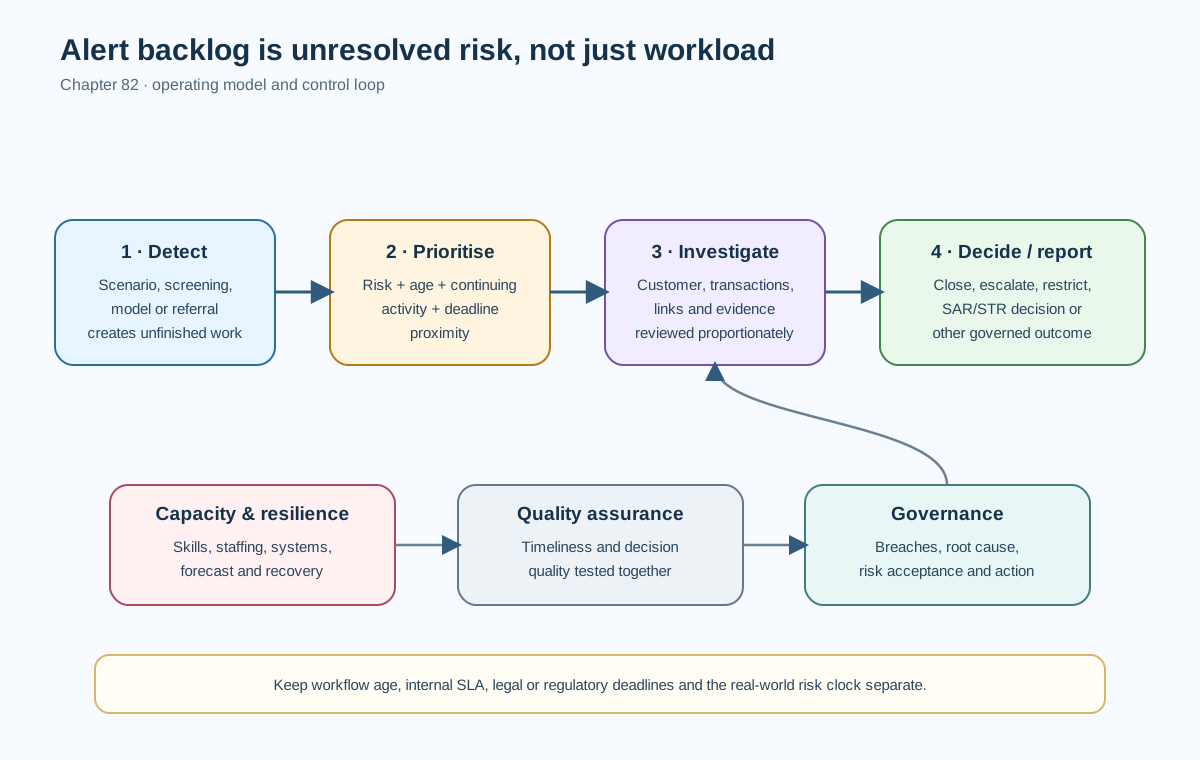
A practical mental model: inventory of unresolved risk
Think of a monitoring queue as inventory. New alerts arrive every hour or day. Investigators complete work at another rate. Some alerts are straightforward; others require customer information, transaction history, linked-party analysis, a request to another business unit, translation, sanctions advice, enhanced due diligence or senior approval. A queue remains stable only when sustainable completion capacity keeps pace with demand over time, including seasonal peaks, absences, outages and changes in detection logic.
That sounds like ordinary workforce management, but financial-crime queues have an additional dimension: the inventory is not homogeneous. An alert involving a low-value pattern that has a plausible explanation is not equivalent to an alert involving rapid movement through suspected mule accounts, a high-risk correspondent relationship, possible terrorist financing, a sanctions-related concern or a customer already linked to previous suspicious activity. Backlog management must therefore consider both volume and risk concentration.
This is why the headline number "12,000 open alerts" tells management very little. A useful risk view asks additional questions. How many are high, medium and lower priority? What is the oldest high-risk item? How much of the queue is beyond the bank's internal age threshold? Which scenarios created the growth? Are alerts waiting for investigation, external information, second-line advice or final reporting? Are there customers with multiple unresolved alerts? Has suspicious activity continued after the first alert? Are queues growing because detection improved, because data created false positives, because an upstream system duplicated alerts, or because capacity fell?
The answer determines the remedy. Hiring more investigators will not fix duplicated alerts caused by a data defect. Tuning a rule will not solve an outage in case assignment. Bulk closure will not solve a population that contains genuinely suspicious activity. A mature bank diagnoses the queue before choosing the treatment.
What the global standards actually require
The current FATF Recommendations, amended through June 2026, remain the global baseline. They require jurisdictions and financial institutions to apply measures according to risk, conduct ongoing due diligence, maintain internal controls and report suspicious transactions under the applicable national framework. FATF deliberately recognises that countries have different legal and operational systems, so implementation is not identical everywhere.
For a bank, the operational implication is that a backlog must not undermine the substance of those controls. A monitoring programme that technically creates alerts but leaves significant risk unreviewed for excessive periods may not be effective in practice. The 2014 FATF banking-sector risk-based guidance remains useful for understanding proportionality, although it predates later revisions to the FATF Standards and should be read with the current Recommendations rather than treated as a 2026 rulebook by itself.
The Basel Committee's consolidated AML/CFT guidance, published in its current consolidated form in January 2026, is more explicit about bank operations. It states that banks should have procedures for detecting and reporting suspicious transactions, that the AML/CFT officer should have sufficient resources, that monitoring should be appropriate to the bank's size, activities, complexity and risk, and that suspicious-transaction processes should be clearly specified. Basel also expects ongoing monitoring to identify unusual activity and genuine suspicious transactions to be reported promptly. None of this creates a universal alert SLA, but it makes clear that inadequate capacity and unmanaged ageing can compromise the monitoring control.
The Wolfsberg Group's 2024 and 2025 work on Monitoring for Suspicious Activity adds an important effectiveness perspective. Wolfsberg argues that institutions should not manage monitoring purely by volume metrics or a "no alert left behind" mentality. Monitoring should be risk-based and focused on useful outcomes. That matters for backlog management because a bank can appear productive while wasting scarce investigative capacity on low-value work and allowing higher-value risk to wait. Queue governance should therefore measure both timeliness and effectiveness.
The four clocks a bank must keep separate
A well-designed case platform should make four clocks visible rather than collapsing everything into one ageing field.
The first clock is workflow age. It begins when the alert enters a defined state, such as NEW, TRIAGE, INVESTIGATION, AWAITING_INFORMATION, QUALITY_REVIEW or REPORTING_DECISION. This clock helps operations understand where work is accumulating.
The second is the internal service-level clock. The bank defines a target or limit based on risk, workflow stage and local policy. A high-risk alert may have a shorter internal target than a lower-risk alert. Different stages can have different targets. A bank may also define escalation thresholds before the limit is breached, for example at 50%, 75% and 90% of the allowed age. These are internal controls, not universal legal numbers.
The third is the legal or regulatory clock. This must be modelled separately because its start event and deadline can differ by jurisdiction. A useful example comes from the United States. The FFIEC BSA/AML Examination Manual explains that the SAR filing period generally runs from the initial detection of facts that may constitute a basis for filing, and it also makes the important point that the moment an automated system flags a transaction is not necessarily the same as "initial detection" for the SAR rule. Banks are nevertheless encouraged to review flagged activity expeditiously. A case system that simply assumes alert_created_at equals sar_clock_started_at would therefore encode the law incorrectly.
The fourth is the risk clock. This is not a statutory timer but an operational reality. If suspicious activity is continuing, funds are moving quickly, a customer may be harmed, or a payment rail provides little recovery time, the risk can become more severe even before an internal SLA or reporting deadline is reached. Instant payments, mule networks and rapidly moving fraud proceeds illustrate why elapsed calendar time alone is not enough.
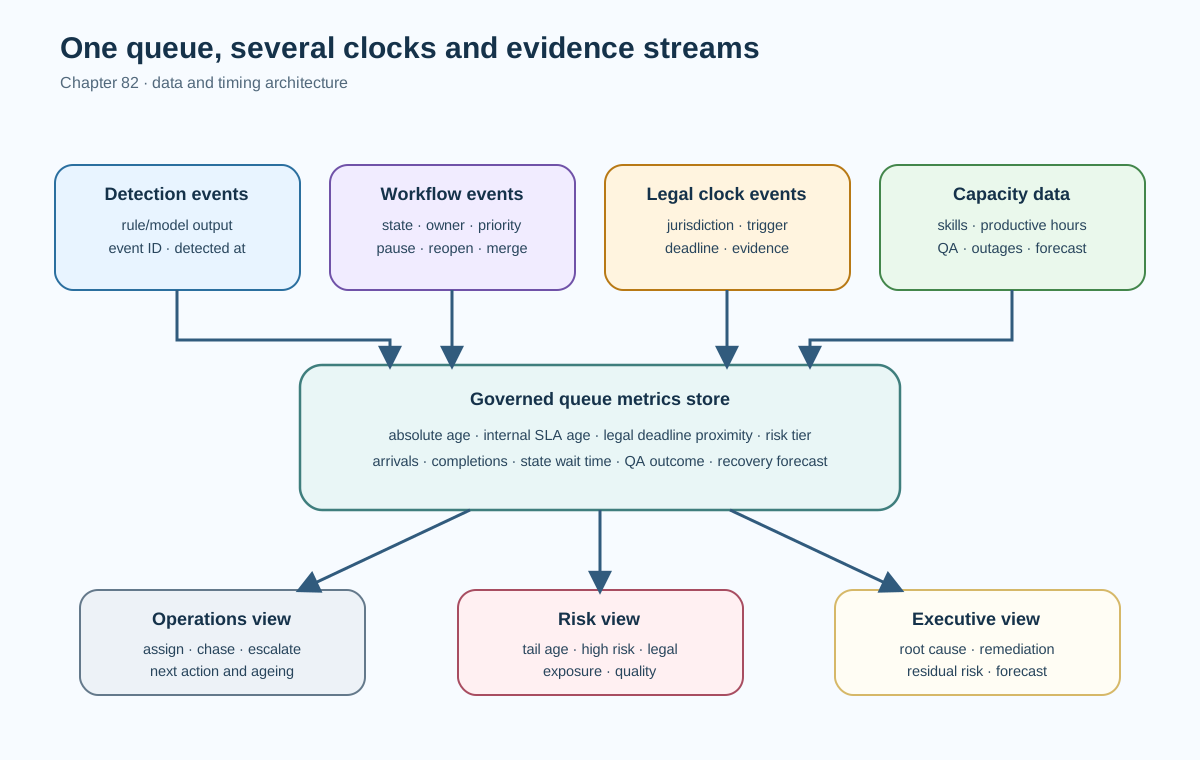
How a backlog forms
Backlogs usually come from a combination of demand, capacity and process friction.
Demand can rise because the bank grows, a new product launches, a rule threshold changes, a new typology is added, a sanctions or fraud event creates a surge, a data correction exposes previously unseen activity, or a monitoring platform migration produces different alert volumes. Demand may also rise because a defect generates duplicates or false positives. The distinction matters. A surge caused by better detection may represent real additional risk; a surge caused by a broken join or badly mapped country code is a control defect.
Capacity can fall because trained investigators leave, new hires are not yet competent, sickness or holidays reduce available hours, outsourcing capacity is constrained, the case tool is slow, data enrichment is unavailable, second-line advice queues become bottlenecks, or a major remediation programme competes for the same specialists. Headcount alone is therefore a poor measure of capacity. Ten investigators who each spend half their day waiting for systems or doing manual data collection do not provide ten investigators' worth of effective throughput.
Process friction creates less visible queues. Alerts may be technically assigned but paused while waiting for customer information. Cases may sit with a specialist sanctions team. Quality assurance may become a bottleneck. A case may bounce repeatedly between first and second line because decision rights are unclear. A workflow may require excessive approvals for low-risk closures while providing too little scrutiny for high-risk decisions. Queue design should therefore measure state transitions and wait reasons, not just open versus closed.
Capacity is more than headcount
A useful capacity model starts with the work itself. Different alert types have different handling times and skill requirements. Retail velocity alerts may be reviewed in minutes. Complex corporate cases involving beneficial ownership, trade activity and cross-border flows may take hours or days and require multiple specialists. A single average handling time can therefore distort planning.
Banks should segment capacity by queue or skill family. The model can consider expected alert arrivals, median and upper-percentile handling time, analyst productive hours, shrinkage for training and leave, QA requirements, escalation rates, rework, system availability and the proportion of work that needs specialist support. Forecasts should also include known events such as month-end, salary days, holiday periods, product launches and scenario changes.
The simplest operational relationship is intuitive: if arrivals exceed sustainable completions for long enough, backlog grows. If completions exceed arrivals, backlog shrinks. However, management must resist the temptation to increase completion rate by weakening quality. A team can apparently improve throughput by shortening narratives, skipping linked-account analysis or closing alerts with generic rationale. That does not increase real control capacity; it converts visible backlog risk into hidden investigation-quality risk.
For this reason, a capacity dashboard should pair throughput with quality measures such as QA failure rate, reopen rate, escalation accuracy, SAR/STR decision quality, missing-evidence rate and investigator calibration results. Capacity is acceptable only when the bank can complete the work and maintain the required standard.
Risk-based prioritisation without disguising old work
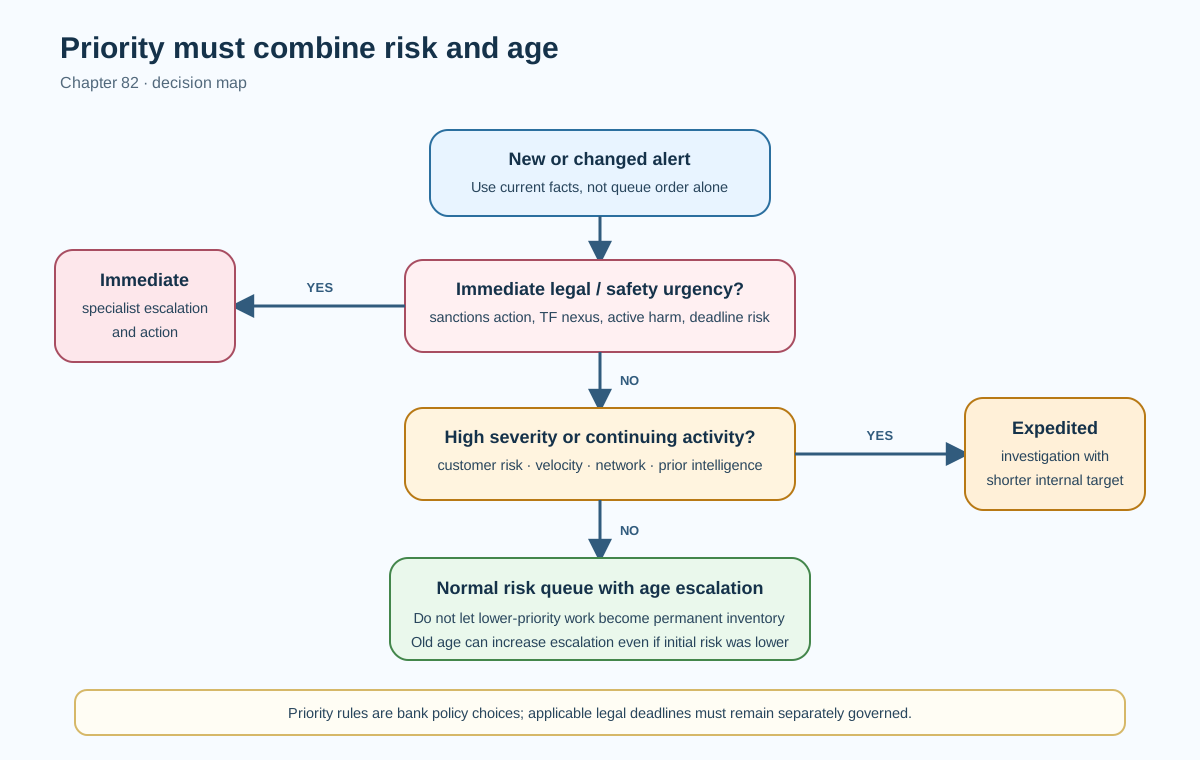
Prioritisation is necessary when all work cannot be completed simultaneously. It should be explicit, governed and explainable.
Useful factors include customer risk, scenario or typology risk, transaction value and velocity, geography, product, linked adverse information, previous alerts or reports, vulnerable-customer indicators, suspected mule behaviour, continuing activity, law-enforcement interest, sanctions or terrorism-financing nexus, and proximity to a legal or internal deadline. The weighting should reflect the bank's own risk assessment and local obligations.
Age also matters. A lower-risk alert should not be allowed to remain indefinitely simply because new high-risk work keeps arriving. Mature queues therefore combine risk priority with age escalation. One approach is to maintain risk tiers but increase escalation as an item approaches an age limit. Another is to reserve a portion of capacity for the oldest items within each tier. The exact mechanism can vary, but the governance objective is the same: prevent low-priority work from becoming invisible permanent inventory.
A bank should also guard against priority inflation. If every scenario owner labels their alerts "critical", prioritisation stops working. Priority definitions need common criteria, approval, testing and periodic calibration.
Service levels should describe a control, not decorate a dashboard
An SLA is useful only when its definition is precise. Teams need to know the starting event, stopping event, calendar basis, pauses, exclusions, escalation point and accountable owner.
Consider a target stating, "High-risk alerts must be completed within two days." Does the clock start when the detection engine creates the alert, when the queue receives it, when an analyst first opens it or when required data is available? Are weekends counted? What happens if the alert is waiting for a customer response? Does reassignment reset the clock? Does the target mean first triage, full investigation, MLRO decision or SAR/STR filing? Without answers, the metric can be manipulated unintentionally or deliberately.
Pause logic is especially dangerous. Some pauses are legitimate operational states, but a bank should never allow a queue to look healthy simply because work has been moved to AWAITING_INFORMATION. Paused items remain unresolved risk. Management information should show both SLA-adjusted age and absolute elapsed age, together with the reason and owner for the pause.
The system should preserve every clock event. If an alert changes priority, the old priority and effective time should remain reconstructable. If an SLA is overridden, the approver and reason should be captured. If a queue is reconfigured, historical reporting should not rewrite old performance. Good evidence makes the control explainable to audit and supervisors.
Management information that exposes risk
A good backlog dashboard answers three different questions: Are we in control today? Are we likely to lose control soon? Are we clearing work at an acceptable quality?
Useful measures include:
| Measure | What it tells management | Common trap |
|---|---|---|
| Open alerts by risk tier and age band | Size and risk concentration of unresolved work | Reporting only a total count |
| Oldest alert by priority | Whether the tail contains extreme ageing | Hiding outliers behind averages |
| New alerts versus completed alerts | Direction of backlog movement | Celebrating high completions while arrivals are even higher |
| Forecast time to recover | Whether the remediation plan is realistic | Assuming every analyst works at theoretical capacity |
| Queue state and wait reason | Where work is blocked | Treating awaiting information as resolved |
| QA failure and reopen rate | Whether speed is damaging quality | Measuring productivity alone |
| High-risk SLA breach rate | Timeliness of the most important work | Blending all priorities together |
| Customers with multiple unresolved alerts | Accumulated relationship risk | Reviewing each alert in isolation |
| Continuing activity after alert | Whether risk is still moving | Looking only at the transaction that triggered the alert |
| Legal-deadline proximity | Reporting exposure | Using internal SLA as a proxy for statutory timing |
Management should see trend and forecast, not only the current position. A queue can be within tolerance today while arrivals are accelerating toward a breach next week. Early-warning triggers can include a sustained arrival-to-completion ratio above one, increasing high-risk age, falling investigator availability, growing rework, data outages or a scenario change expected to increase alerts.
Roles and decision rights
Backlog control cuts across several teams, so ownership must be explicit.
Monitoring operations usually owns day-to-day queue execution, assignment and first-line escalation. The monitoring or scenario owner owns the detection logic and should understand how tuning changes affect volume and risk coverage. Workforce management or operations planning helps translate forecast demand into staffing and shift patterns. Technology owns platform availability, workflow logic, timestamp integrity and data feeds. Quality assurance tests whether decisions remain consistent and evidenced. AML compliance or the MLRO function defines policy, risk acceptance and reporting requirements according to the bank's governance model. Senior management should receive material breaches, remediation status and residual-risk decisions. Internal audit independently assesses whether the overall framework is designed and operating effectively.
Outsourcing does not remove the bank's accountability. A vendor may perform alert review, but the bank still needs sufficient oversight of competence, throughput, QA, data access, escalation, confidentiality, resilience and subcontracting. Contractual SLAs are useful, but contractual performance is not the same as regulatory effectiveness. A vendor can meet a numeric target and still produce poor investigations.
Customer and payment impact
Backlog risk is not only about regulatory exposure. Customers can be harmed when alerts remain unresolved.
An account restriction may stay in place longer than necessary. A payment may be held while a sanctions or fraud concern is reviewed. A customer may repeatedly be asked for the same evidence because separate alerts are not linked. A legitimate business may experience service disruption if its activity is repeatedly routed into an overloaded queue. Conversely, pressure to reduce customer friction can cause investigators to release activity too quickly when evidence is incomplete.
The operating model therefore needs an explicit customer-impact dimension. High-risk queues may justify faster review not only because of financial-crime risk but because the customer impact of waiting is severe. Where a hold or restriction is legally sensitive, operations should know which team can decide, what evidence is required, how communications are controlled and what escalation applies outside normal business hours.
A real supervisory lesson: backlog plus SLA pressure can degrade quality
A useful historical example comes from the UK. In its 2022 Final Notice for Santander UK, the FCA described transaction-monitoring resourcing pressure and a backlog of 6,464 medium-risk alerts in December 2012, with the oldest alert 161 days old. The notice also recorded that workload and pressure to remain within the service-level agreement created a risk that investigations would be rushed and insufficiently detailed. This was a firm-specific enforcement finding under the UK framework, not a universal benchmark for acceptable queue age.
The lesson is broader than the numbers. A backlog can create two simultaneous control failures: late review and poor review. Management that focuses only on closing the queue may fix the first metric by worsening the second. Sustainable recovery requires enough capacity, clear prioritisation, quality guardrails and evidence that the underlying cause has been removed.
The FCA's review of challenger banks reached a similar practical conclusion: some transaction-monitoring alerts were not reviewed in a timely manner because firms had not put adequate resources in place, affecting their ability to make SARs as soon as practicable under the UK framework. Again, the point is not that another bank should copy a UK SLA. The point is that timeliness, resources and reporting effectiveness are connected.
What good looks like
A strong bank can answer the following questions without a manual reconstruction exercise. How many alerts are open, by risk and age? Which queues are outside tolerance? Which legal deadlines could be affected? Why did the backlog form? Which customers or networks carry concentrated unresolved risk? What capacity is available today and forecast next week? Which temporary controls are active? How is quality being protected? Who has accepted residual risk? When will the queue return to steady state? What evidence proves that recovery is real rather than a temporary drop in count?
Those answers should come from controlled data and governed decisions, not from a spreadsheet assembled the night before a committee meeting. The best operating model treats queue health as part of the financial-crime control itself.
Operational deep dive: queue engineering, recovery and control effectiveness
The base chapter established why backlog is unresolved financial-crime risk rather than ordinary work-in-progress. This deep dive looks at the mechanics of keeping a monitoring operation stable and recovering safely when it is not.
From alert arrival to sustainable capacity
Capacity planning starts with three observable quantities: how much work arrives, how much work the operation can complete at the required quality, and how much unresolved work already exists. The arithmetic is simple, but the inputs are often misleading.
Alert arrival rate should be measured by queue, risk tier, scenario family, customer segment and time period. A single daily average can hide large peaks. Salary days, weekends, holidays, month-end, product launches, bulk file processing, sanctions events or changes to monitoring rules can all alter demand. Instant-payment products can also create intraday bursts that matter even if the daily total appears stable.
Completion rate should be based on real productive capacity rather than contracted headcount. Analysts spend time on training, coaching, quality feedback, mandatory meetings, system outages, requests for information, escalation and rework. Complex alerts may also need different skills. A workforce plan that assumes every analyst can handle every case at the same speed will usually overstate capacity.
The bank should therefore maintain queue-specific handling distributions rather than one universal average. Median handling time is useful for planning ordinary work, while upper-percentile handling time helps explain complex investigations. Cases involving business customers, international payments, beneficial ownership, correspondent banking or linked-account networks may take far longer than routine retail alerts. That does not mean the long case is inefficient; it may simply contain more risk and evidence.
A stable operation has enough trained capacity to absorb ordinary variation without creating persistent age growth. Temporary peaks are normal. Persistent growth is not. When arrivals remain above completions for several periods, management should treat the change as a control signal and diagnose it before the queue becomes materially aged.
Diagnose the backlog before treating it
Backlog recovery fails when the bank assumes the problem is simply "too many alerts". A useful diagnostic separates at least five causes.
Demand growth occurs when more real activity is being detected. This may happen because customer volumes grew, a new product was launched, or monitoring coverage improved. Capacity may genuinely need to increase.
Detection defect occurs when bad data or logic generates unnecessary alerts. Duplicate events, incorrect country mapping, broken customer segmentation or a badly tuned threshold can multiply false positives. Adding reviewers treats the symptom rather than the cause.
Process bottleneck occurs when investigation can proceed but another stage cannot. Examples include second-line approval, enhanced due diligence, legal advice, translation or quality review. The visible alert queue may not show the true bottleneck unless workflow states are granular enough.
Technology constraint occurs when case tools, data enrichment, screening services or upstream feeds are unavailable or slow. Analysts may remain logged in while effective completion capacity collapses.
Capability constraint occurs when headcount exists but the required skill does not. Rapid recruitment can create a temporary paradox: more people but lower throughput because experienced staff are coaching new joiners and reviewing their work.
Each cause needs a different response. The bank should record a root-cause hypothesis, evidence, owner and expected recovery effect. That turns backlog remediation into a managed control change rather than a volume-clearing exercise.
The danger of averages
Average age is one of the easiest backlog metrics to misuse. Imagine a queue containing 9,900 alerts one day old and 100 alerts one hundred days old. The average age may look manageable, but the hundred oldest items can contain serious unresolved risk. The same problem arises when lower-risk high-volume queues dominate a dashboard and conceal a smaller high-risk population.
For this reason, queue reporting should include distributions. Age bands, percentiles, maximum age and oldest-item lists by risk tier are more informative than a single mean. High-risk alerts should be visible as their own population. Management should also see customers or entities with repeated unresolved alerts because risk can accumulate at relationship level even when individual alerts remain below a threshold.
A good dashboard also distinguishes stock from flow. Stock is the number of unresolved alerts at a point in time. Flow is what arrived and what was completed during a period. A falling stock is encouraging only if it is not caused by suppressed alert generation, mass closure or movement into a hidden state. A rising completion count is encouraging only if quality remains acceptable.
Risk-weighted ageing
Pure first-in-first-out handling is rarely appropriate for financial crime because not all alerts represent equal risk. Pure risk-priority handling is also insufficient because lower-priority work can age indefinitely. The practical answer is a controlled combination of risk and age.
A bank can assign an initial priority using factors such as customer risk, scenario severity, known criminal or fraud indicators, velocity, geography, transaction finality, sanctions or terrorism-financing nexus, previous alerts, law-enforcement interest and customer harm. It can then apply an ageing uplift so that older unresolved work escalates progressively.
The exact algorithm is a bank design decision. What matters is that it is documented, tested and governed. Investigators should understand why an alert is in front of them. Managers should be able to explain why one queue receives additional capacity while another waits. If overrides are allowed, the reason and approver should be retained.
Queue segmentation should also recognise legal and operational differences. A post-transaction AML alert, a sanctions interdiction decision, a fraud scam alert and a customer due-diligence review may all sit within the wider financial-crime operating model, but they do not necessarily share the same permissible timing or action. Forcing all of them into one SLA can create false assurance.
Legal reporting clocks are not the same as operational age
The distinction is especially important in suspicious-activity reporting.
Under the US SAR framework, the FFIEC manual explains that the filing period generally runs from initial detection of facts that may constitute a basis for filing. The manual also explains that an automated flag is not necessarily that initial detection because many alerts have legitimate explanations; an appropriate review is needed. This protects against a simplistic system rule that starts the statutory clock at every alert creation.
However, the same guidance recommends expeditious review where possible. A bank cannot use the legal distinction as permission to let alerts sit indefinitely. Excessive backlog can delay the point at which reportable suspicion is identified and can weaken the bank's ability to provide timely, useful information.
Other jurisdictions use different concepts and deadlines. Therefore a global case-management platform should not hard-code one reporting clock for all legal entities. It should hold jurisdiction, reporting regime, clock start event, deadline, extension conditions where applicable, and the evidence supporting the timing decision.
Designing an SLA hierarchy
A mature bank often uses a hierarchy rather than one SLA.
At the top sits any external legal, regulatory, scheme or contractual deadline that genuinely applies. Below that sits an internal risk deadline designed to give the bank enough time to comply safely. Below that can sit stage-level operating targets for triage, investigation, quality review and reporting. Early-warning thresholds should trigger before a breach.
This hierarchy prevents a common anti-pattern: setting an internal target equal to the legal deadline. If the investigation completes at the last possible moment, there is no buffer for quality review, MLRO decision, technical filing failure or new evidence. Internal targets should provide enough room for the end-to-end process.
The hierarchy should also define what happens outside business hours. If a queue supports 24/7 payment products but specialist escalation exists only during local office hours, the bank needs a documented fallback. That may involve an on-call specialist, temporary restriction, defined risk acceptance or a separate real-time control. The answer depends on the product and legal framework, but the gap must be designed rather than discovered during an incident.
Pause states and hidden backlog
Paused work deserves special scrutiny because it is easy to remove from operational statistics.
An alert waiting for customer information remains unresolved. So does a case waiting for another bank, a sanctions licence decision, law-enforcement guidance or second-line approval. The bank may legitimately exclude some waiting time from a narrow productivity metric, but it should not erase the absolute age or risk exposure.
Each pause state should therefore capture who or what is awaited, when the request was made, the expected response date, chase frequency, escalation point and fallback if no response arrives. Management reporting should show both active-processing age and total elapsed age.
A useful control is to prohibit indefinite pause. Every waiting state should have a next-action date. When that date passes, the item should return to an actionable queue or escalate automatically.
Recovery planning when the queue is already out of control
Backlog recovery should begin with containment. The bank first needs to understand whether risk is still increasing. That may require temporary extra capacity, tighter high-risk triage, targeted preventive controls, restrictions on a product feature, or a temporary hold on non-essential monitoring changes. The aim is to stop the problem getting worse while root cause is assessed.
Next comes population analysis. The bank should determine the size, age, priority, scenario, customer and jurisdiction profile of the backlog. It should identify whether data defects or duplicates have contaminated the population. It should also look for customers with multiple alerts and continuing activity.
Then the bank can design a recovery strategy. High-risk and legally sensitive items normally require first attention. Lower-risk populations may be handled through dedicated workstreams with stronger QA sampling. Additional investigators can be added, but competence requirements should not be waived simply because the queue is large. Temporary staff may be suitable for simpler work while experienced investigators focus on complex cases.
Scenario tuning can be part of recovery only where evidence supports it. A bank should not increase thresholds merely to reduce volume. Any tuning change should go through risk assessment, testing, approval and post-change monitoring. Where false positives are driven by a defect, the bank may need to identify historical alerts affected by that defect and decide whether a lookback or reprocessing exercise is necessary.
Recovery should end only when the operating model is demonstrably stable. Clearing the visible queue is not enough. The bank should confirm that arrivals and completions are balanced, high-risk ageing is within tolerance, QA is acceptable, outstanding root causes are closed, temporary controls can be retired safely, and management understands any residual risk.
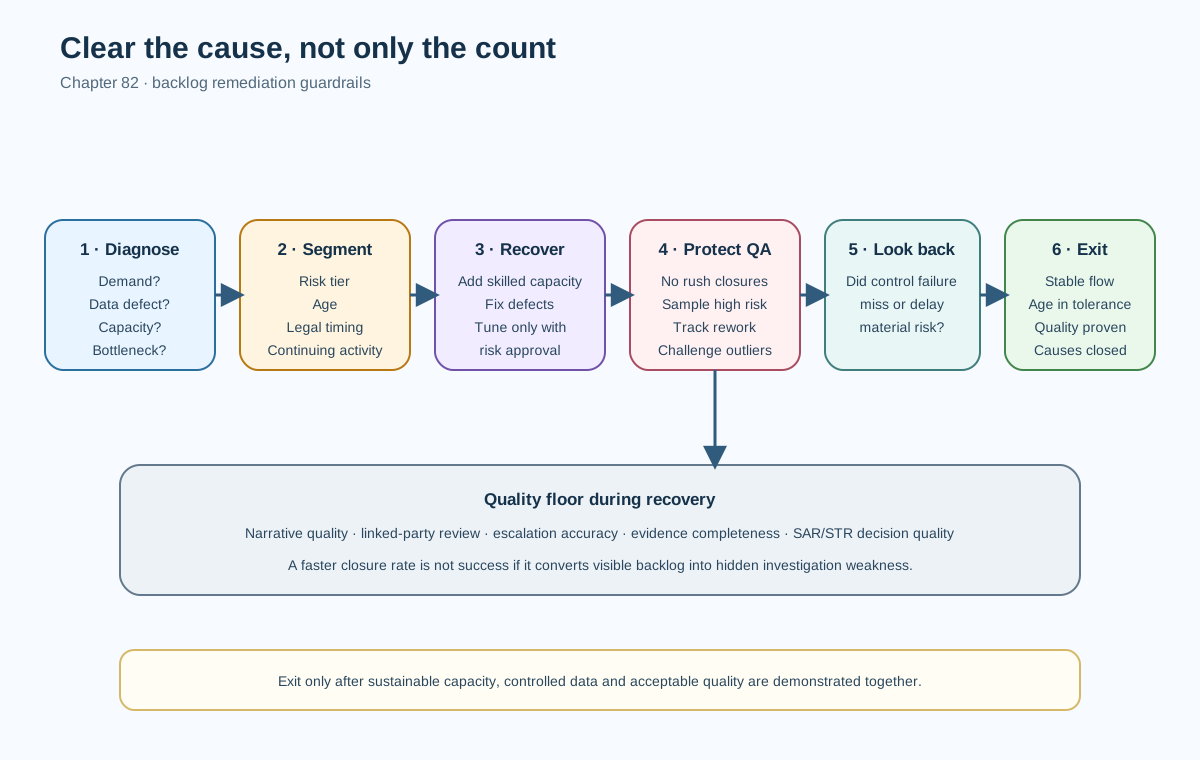
Quality cannot be traded for speed
The biggest behavioural risk in a backlog is pressure. Investigators know the queue is large. Managers know breaches are approaching. Senior leaders want the number down. Under those conditions, small compromises can become normal: shorter narratives, less linked-account review, fewer escalation questions, copied closure text and reluctance to reopen a weak case.
Quality controls should therefore be strengthened during material remediation, not weakened. The bank can increase targeted QA on high-risk decisions, sample bulk-closure populations, compare closure rationale across teams, track investigator-level outliers and monitor whether SAR/STR conversion or escalation patterns change abruptly. A sudden improvement in productivity with a simultaneous fall in escalation can be positive, but it can also be a warning that review quality changed.
Second line should challenge both timeliness and quality. Internal audit can later assess whether the bank's recovery was sustainable, whether management information was accurate, and whether the root cause was addressed rather than displaced.
Scenario changes need capacity impact assessment
Every material detection change should ask two questions: will the change improve risk coverage, and what operational demand will it create?
A model can be analytically excellent and operationally unsafe if it generates more high-risk alerts than the bank can investigate. Conversely, a capacity concern should not veto necessary risk coverage without an explicit risk decision. The change process should estimate expected alert volume, handling complexity, specialist needs, system load and transition risk. Pilot or parallel testing can provide empirical data before full rollout.
This is a key BA and product-owner responsibility. Requirements for a new monitoring scenario should include not only detection logic but downstream operational acceptance criteria. If expected volume increases by 40%, the implementation plan should explain who will review that work, how quickly, at what quality, and what happens if the forecast is wrong.
Management escalation should be trigger-based
Backlog escalation works best when management does not rely on judgement alone to decide when a problem is material. Trigger-based governance can include high-risk age thresholds, breach percentages, sustained arrival-to-completion imbalance, maximum queue age, rising QA failure, critical-system outage, legal-deadline proximity or forecast inability to recover within an agreed period.
The trigger should route to a defined forum or accountable executive. Material issues may require a formal risk acceptance, remediation plan, additional funding or regulatory notification depending on the jurisdiction and severity. The operating team should not be left to manage a structural capacity deficit indefinitely through overtime.
The purpose of governance is not to create more meetings. It is to ensure that when the control can no longer operate within its designed boundary, someone with the authority to change resources, scope or risk posture makes the decision.
The effectiveness test
A backlog programme is effective when it does more than meet a dashboard target. It should identify genuinely concerning activity in time to act, produce useful investigations and reports, maintain defensible customer outcomes, and remain stable under foreseeable stress.
That aligns with the broader direction of FATF, Basel and Wolfsberg: financial-crime programmes should be risk-based and effective, not merely procedurally busy. Queue metrics are important because they reveal whether the control can execute. They are not the final objective. The final objective is timely, proportionate and high-quality financial-crime risk management.
Advanced practice: architecture, data and delivery controls
Backlog risk becomes manageable when the platform represents the operating model faithfully. Weak systems reduce every problem to an OPEN flag and an age_in_days field. Strong systems preserve the events, clocks, ownership and evidence needed to understand why the item is still open and whether the bank remains within control.
Model the queue as a state machine
The case-management platform should use explicit states with controlled transitions. A typical lifecycle can include NEW, TRIAGE, INVESTIGATION, AWAITING_INFORMATION, SPECIALIST_REVIEW, QUALITY_REVIEW, REPORTING_DECISION, CLOSED_NO_ESCALATION and CLOSED_ESCALATED. The exact names vary, but the principle matters: every state should represent a real decision or dependency.
Each transition should capture event time, actor, source, reason and previous state. Reassignment should not delete history. Reopening should preserve the original closure. A merged or split case should retain links to its parent alerts. This event history allows operations to calculate queue age accurately and enables audit to reconstruct how the item moved.
The design should avoid using mutable fields as the only source of truth. If assigned_team is overwritten every time a case moves, management cannot later determine how long it sat with each team. Event-sourced history or an equivalent immutable transition table is far safer for queue analysis.
Use separate timestamp families
At minimum, the data model should distinguish:
- detection-event time, when the underlying rule or model identified the activity;
- alert-created time, when the case platform created the alert;
- queue-entry time for each workflow state;
- first-review time;
- investigation decision time;
- quality-review time where applicable;
- reporting-decision time;
- external report submission time where applicable;
- legal-clock start and deadline where a jurisdiction-specific reporting rule applies;
- internal SLA start, warning thresholds and deadline;
- pause start and end times, with reason;
- closure and reopen times.
These timestamps should use a consistent technical standard such as UTC while retaining the local business timezone needed for legal calendars and operations reporting. Daylight-saving changes, local public holidays and cross-border processing should be tested explicitly.
A bank should never derive a legal deadline casually from an operational timestamp. The US SAR example illustrates why: the FFIEC manual distinguishes an automated alert from the later point at which facts are initially detected as potentially reportable. The case platform therefore needs a legally governed clock event, not a developer assumption that every alert timestamp starts every reporting deadline.
Data model for capacity and queue health
A useful backlog data set links the case to risk and workload attributes. These can include alert type, scenario or model, customer and account identifiers, legal entity, jurisdiction, customer risk rating, priority, payment rail, transaction value, alert owner, team, skill requirement, status, pause reason, age band, previous alerts, previous reports, continuing-activity indicator and quality outcome.
Capacity data belongs beside the queue data. Useful fields include rostered analyst hours, productive hours, planned leave, training time, system downtime, active analysts by skill, average and percentile handling times, QA rework, vacancy levels and outsourced capacity. The objective is not to surveil analysts minute by minute. It is to understand whether the control has enough competent capacity for the work arriving.
The reporting layer should preserve effective dating. If a scenario changes priority on 1 October, historical alerts created in September should not silently appear as if they always had the new priority. Similarly, a change to age bands or SLA policy should not rewrite prior performance without clear versioning.
Queue calculation rules must be testable
Age calculations should be deterministic. Requirements need to say whether the measure uses calendar time, business time or both. If a high-risk queue runs 24/7, a business-hours-only clock may be misleading. If an internal target excludes weekends, the system should still retain absolute elapsed time.
Pause rules should be explicit. For example, AWAITING_CUSTOMER_INFORMATION might pause one internal productivity clock but should not pause absolute age or a statutory reporting deadline unless the relevant law actually permits that treatment. The UI should never imply that moving a case into a pause state removes the risk.
Priority recalculation also needs rules. If new adverse information arrives, should the case move immediately from medium to high? If an investigator manually reduces priority, what approval is required? If multiple alerts for the same customer merge into a case, which priority wins? These are business decisions that must be specified before coding.
Management information architecture
A mature architecture usually separates operational dashboards from risk and governance reporting.
Operational views help team leaders assign work. They need current counts, age, owner, priority, skill and next action. Risk views show whether the control is healthy: high-risk breaches, tail ageing, continuing activity, legal-deadline proximity, scenario concentrations and recovery forecast. Executive views summarise material exposure, root cause, remediation and residual-risk decisions.
All three should come from the same controlled source definitions. If operations calculates age from the case tool while risk calculates age from a data warehouse with different pause logic, committees can spend their time debating numbers instead of managing risk.
A data dictionary should therefore define each metric precisely. OPEN_ALERTS should specify included states. SLA_BREACH should define clock start and exclusions. HIGH_RISK should identify the source of priority. RECOVERY_DATE should state the forecasting method. Metric lineage matters because senior management may make resource and risk decisions from these numbers.
Alert-to-customer aggregation
Backlog dashboards should not only count alerts. Criminal behaviour often spans multiple events and accounts.
The platform should be able to show unresolved exposure by customer, related party, account, device, beneficiary or network where the bank has lawful and technically reliable linkage. Five medium-priority alerts on one customer may represent more concern than one isolated medium alert. A second alert arriving while the first is unresolved should trigger a rule or investigator view that exposes the relationship.
Care is needed with entity resolution. Fuzzy links are not facts. The UI should distinguish confirmed customer relationships from probabilistic network associations so investigators do not treat analytics as verified identity evidence.
Integrating monitoring change with workforce planning
A monitoring change-management process should have a formal capacity-impact step.
Before a scenario, threshold, model or data source changes, the project should estimate incremental alert volume by segment and risk tier. The estimate should be converted into handling demand using realistic complexity assumptions. Operations should confirm whether trained capacity exists. If not, the implementation plan should include recruitment, temporary resources, phased rollout or another approved control response.
Testing should compare forecast and actual volumes after release. If a scenario expected 500 alerts per week produces 5,000, that is not merely an operations problem. It is a controlled-change exception requiring investigation. The root cause could be incorrect assumptions, unexpected criminal activity, bad data or faulty logic.
Product owners should resist an unhealthy split where compliance "owns the rule" and operations "owns the volume". Detection design and operational execution are one end-to-end control.
Resilience and degraded mode
Case-management outages can create invisible backlog if alerts continue generating but cannot be ingested or reviewed. The architecture should therefore reconcile source detections to case creation.
A daily or intraday control can compare the number of detection events emitted by the monitoring platform with the number accepted by the case system, allowing for legitimate rejects and retries. Sequence numbers, event IDs or controlled batch totals can help. Missing events should raise an operational incident, not wait for an investigator to notice a quiet queue.
If enrichment services fail, the system should identify which alerts were reviewed without normal context and whether re-review is needed after restoration. If the workflow platform is unavailable, business continuity procedures should define how critical alerts are identified and handled manually, how decisions are recorded, and how they are reconciled back into the system later.
Queue recovery after an outage should also consider duplicate risk. Replay mechanisms must be idempotent so resending events does not create thousands of duplicate alerts.
BA acceptance criteria that prove control intent
Good requirements are specific enough to test. Examples include:
Clock separation. The case record shall display absolute alert age, internal SLA age and any applicable legal reporting clock as separate values. A change to one shall not automatically change another.
Risk escalation. When a case receives a configured high-risk indicator after creation, the system shall recalculate priority, retain the previous priority and effective time, and record the source of the new indicator.
Pause transparency. Moving a case to an approved waiting state may pause the configured internal service clock, but absolute elapsed age shall continue and remain reportable.
No silent reset. Reassignment, team transfer, reopen or merge shall not reset original alert creation time or erase previous age history.
Deadline warning. The system shall produce controlled warning events before internal or legal deadlines according to configurable policy and route unresolved breaches to a defined escalation owner.
Capacity traceability. Management reporting shall show arrivals, completions, open stock and age distribution from reconciled source data with metric definitions versioned and auditable.
Change impact. A material scenario release shall record forecast alert volume, actual alert volume and operational readiness sign-off so post-release deviations can be investigated.
Testing the difficult edges
Functional testing should cover more than ordinary case closure. Boundary tests should place alerts just before and after every age threshold. Weekend and public-holiday tests should confirm the correct calendar. Daylight-saving tests should confirm time calculations across affected jurisdictions. Reassignment tests should prove clocks do not reset. Pause and unpause tests should verify both adjusted and absolute age.
Concurrency tests should cover two investigators attempting to claim or close the same alert. Merge tests should ensure child alerts remain traceable. Reopen tests should preserve prior rationale. Batch reassignment should not overwrite event history. Outage tests should prove that source alerts are reconciled into the case platform after recovery without duplication.
Risk tests should confirm that high-priority work moves ahead appropriately without starving lower tiers forever. Aged lower-risk work should eventually escalate according to policy. Cases with approaching legal deadlines should route correctly even if their ordinary internal SLA remains within limit.
Performance testing should simulate the queue conditions that matter operationally. A dashboard that works with 10,000 alerts but times out at 500,000 is not safe if the bank's stressed scenario can reach that volume. Search, assignment, bulk export and management reporting all need realistic load.
Quality analytics and human judgement
Automation can support queue control, but it should not turn investigator performance into simplistic speed ranking. Analysts who handle complex cases may complete fewer alerts while producing more valuable outcomes. Pure productivity targets can create pressure to avoid difficult work or close alerts prematurely.
A balanced performance view includes quality, complexity, escalation accuracy, rework and evidence completeness. Team-level patterns are usually more useful for capacity planning than minute-level surveillance of individuals.
The same principle applies to automated triage. A model may help prioritise alerts, but governance should understand training data, false-negative risk, drift and explainability. High-risk de-prioritisation should have stronger controls than ordinary prioritisation. Model outputs should support accountable decisions, not obscure them.
Architecture principle
The design goal is not a beautiful queue screen. It is a system that makes unresolved risk visible, preserves every material decision, keeps operational and legal clocks distinct, and gives the bank enough evidence to demonstrate that timeliness, capacity and investigation quality remain under control.
Practice close: operating controls, testing and governance checklist
The chapter becomes useful only when teams can convert it into a working control. This practice close brings the main requirements together in a form that operations, compliance, product, architecture and testing teams can use during implementation or remediation.
Control objectives
The first objective is to ensure that unresolved financial-crime alerts remain visible and are reviewed according to risk. The second is to ensure that internal service targets support, rather than substitute for, applicable legal and regulatory obligations. The third is to ensure that recovery from a backlog does not damage investigation quality. The fourth is to ensure that management receives enough evidence to intervene before the queue becomes materially uncontrolled.
A bank should be able to demonstrate all four objectives independently. A queue can be timely but low quality. It can be high quality but materially late. It can appear within SLA because pause logic hides old work. It can have adequate headcount but insufficient skill. Each failure requires different evidence and remediation.
Daily operating controls
At the start of each operating cycle, team leaders should understand new arrivals, open stock, high-risk population, oldest items, breached items, legal-deadline proximity, absent skills, system incidents and expected demand peaks. The purpose is not to hold a long meeting; it is to make risk visible before work is assigned.
High-risk alerts should be reviewed for continuing activity and linked unresolved alerts. Where payment finality, customer harm or another time-sensitive factor matters, the workflow should surface it clearly. Items waiting for information should have a next-action date and an accountable owner.
End-of-day or end-of-shift reconciliation should confirm that expected alerts entered the case platform and that any source-to-case exceptions are understood. For 24/7 operations, the same control may run continuously or at defined intervals rather than once per business day.
Weekly capacity and quality review
A weekly review should compare arrivals with completions, forecast queue movement and assess whether the operating model remains sustainable. The review should explain changes, not merely display them.
If alert volume rises, teams should identify whether the increase comes from real activity, scenario change, customer growth, data defect or duplication. If completions fall, management should distinguish staffing, training, system performance, specialist bottlenecks and investigation complexity.
Quality should be reviewed alongside throughput. Useful indicators include QA failure, reopen rate, incomplete evidence, missed escalation, inappropriate closure, excessive use of generic rationale and unusual investigator-level patterns. A material improvement in speed should be challenged if quality changes unexpectedly at the same time.
Governance triggers
The bank should define escalation triggers before a crisis. Examples include:
- a high-risk alert exceeding a defined age threshold;
- a sustained period where arrivals exceed sustainable completions;
- a material share of a priority queue breaching internal service levels;
- legal or regulatory reporting deadlines at risk;
- a critical monitoring or case-management outage;
- a significant increase in QA failures or reopened cases;
- material unexplained volume deviation after a scenario change;
- evidence that analysts are rushing or bulk-closing alerts to meet production targets;
- a forecast showing that the backlog cannot return to tolerance within the approved recovery period.
Triggers should route to named owners and forums. A threshold without an escalation path is only a dashboard colour.
Recovery plan minimum content
A credible remediation plan should document the backlog population, risk segmentation, root cause, current arrival rate, sustainable completion capacity, temporary controls, additional resources, quality approach, legal-deadline assessment, customer impact, forecast recovery date, decision owners and exit criteria.
The forecast should be refreshed using actual performance. If new alerts continue arriving faster than expected, the recovery date should move transparently rather than remain fixed for reporting convenience.
Temporary measures should have end dates or review points. Overtime, contractor support, manual triage, temporary product restrictions or additional approvals can help during a crisis, but they should not become an undocumented permanent operating model.
Testing catalogue for business analysts and testers
A complete test pack should include ordinary, boundary, stress and failure cases.
Age boundary tests create alerts seconds before and after every internal threshold and confirm the correct age band and escalation.
Calendar tests cover weekends, holidays, leap days and daylight-saving transitions for each supported jurisdiction.
Pause tests move alerts into every waiting state and confirm which clocks pause and which continue.
Reassignment tests transfer work across teams and legal entities without resetting original alert age.
Priority tests add new high-risk information after creation and confirm that the case escalates while retaining the previous priority history.
Merge and split tests combine or separate alerts while preserving traceability, age and source events.
Reopen tests reopen a closed case and confirm that previous decisions remain visible and the new investigation does not erase history.
Legal-clock tests verify jurisdiction-specific reporting deadlines using approved legal requirements rather than generic SLA logic.
Outage tests interrupt the monitoring engine, message bus, enrichment service and case platform separately and confirm reconciliation after recovery.
Volume tests generate stressed queue sizes and prove that search, assignment, dashboards and exports remain usable.
Duplicate tests replay source events and confirm idempotent case creation.
QA tests seed weak closure rationale and missed escalation to confirm second-line or QA controls detect them.
Access tests verify that investigators can see only the customer and case information appropriate to their role while authorised oversight functions retain necessary access.
Evidence expected by assurance teams
Assurance should not rely on a single month-end spreadsheet. Evidence should include approved SLA definitions, risk-priority rules, workflow-state definitions, timestamp logic, capacity assumptions, queue dashboards, breach logs, escalation decisions, scenario-change assessments, QA results, staffing and training records, source-to-case reconciliations, outage records and remediation tracking.
Sampling should cover both recent and aged work. If the queue experienced a material backlog, QA or audit should examine whether closure quality changed during the recovery period. Sampling only current steady-state alerts can miss the period of highest pressure.
Where a vendor performs alert review, evidence should also show oversight of vendor throughput, competence, QA, incidents, subcontracting and escalation. The bank should be able to demonstrate how it knows the outsourced control is effective rather than merely within contract.
Common anti-patterns to reject
"We are within average SLA." An average can hide extreme high-risk ageing.
"The queue is smaller, so remediation worked." The queue may have fallen because alert generation failed, thresholds changed, work was moved into pause states or closures accelerated without quality.
"The statutory clock has not started, so age does not matter." Legal timing and risk timing are different. Delayed review can still weaken detection and reporting effectiveness.
"The vendor met the SLA." Contract compliance does not prove investigation quality or regulatory effectiveness.
"We need to tune the scenario because operations cannot cope." Capacity pressure is not, by itself, evidence that the detection logic is wrong. Risk coverage and operational readiness must be assessed together.
"We hired more people." New headcount is not immediately equivalent to competent capacity. Training, access, systems and QA matter.
"Paused alerts are not backlog." They remain unresolved risk and need absolute-age visibility.
Exit criteria for a backlog remediation
A remediation should not close simply because the visible alert count reaches a target. A stronger exit gate confirms that:
- the backlog population has been reviewed according to approved risk prioritisation;
- legal or regulatory reporting exposure has been assessed and any breaches handled under the applicable framework;
- arrivals and sustainable completions are balanced under normal forecast conditions;
- high-risk and tail ageing are within approved tolerance;
- QA and rework metrics remain acceptable;
- root causes have been fixed or formally accepted with durable compensating controls;
- temporary capacity or restrictions can be removed without recreating the backlog;
- management information reconciles to source systems;
- customer-impact issues created by the backlog have been addressed; and
- accountable senior management has reviewed residual risk.
This makes backlog recovery a control outcome rather than a production milestone.
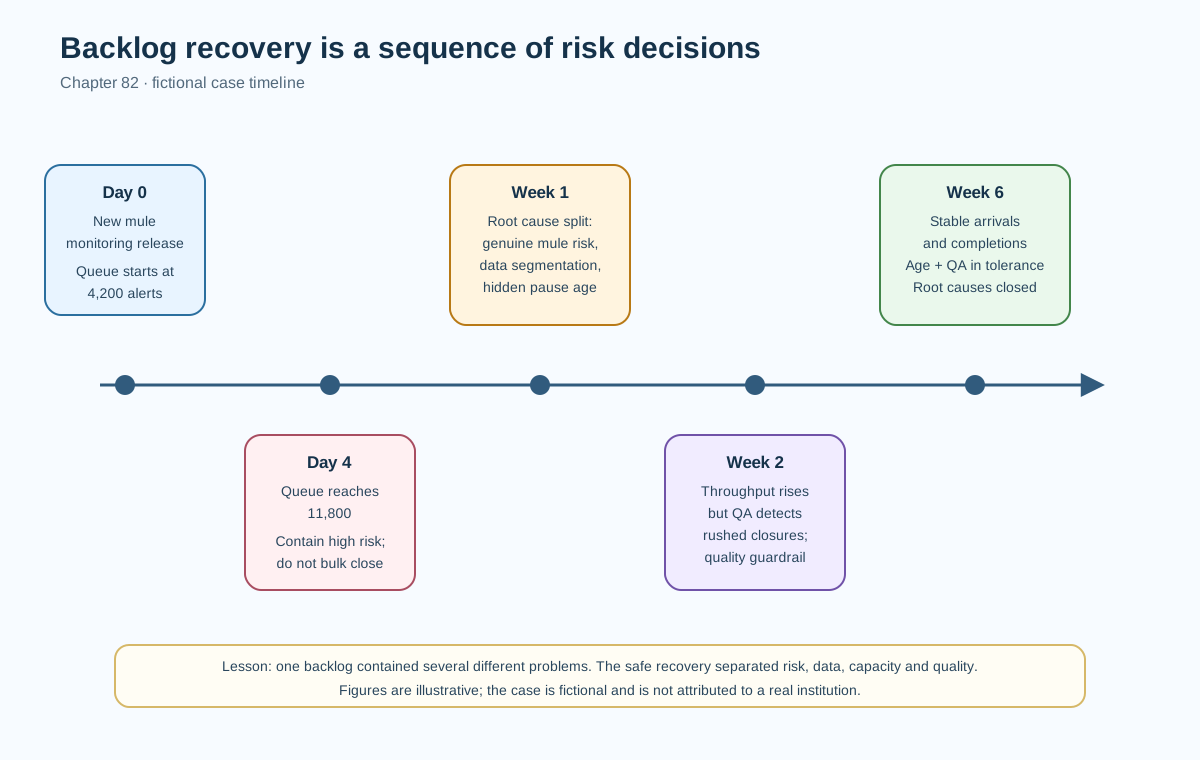
Masterclass: the backlog that looked like a staffing problem
This case is fictional but bank-realistic. The figures are illustrative and are used only to show how a financial-crime operations team should reason through a queue problem.
A regional bank launches a revised mule-account monitoring package for retail current accounts and instant payments. The change was analytically tested and approved. During user acceptance testing, alert volumes looked manageable because the test population represented an ordinary week. In production, the release lands just before a salary-payment cycle and a public holiday weekend.
Within four days, new-alert volume doubles. The existing investigation teams are already operating close to planned capacity. The visible queue grows from 4,200 to 11,800 alerts. Management's first reaction is predictable: add overtime and temporary reviewers.
The operations lead resists treating headcount as the only answer and asks for the backlog to be decomposed. The analysis produces five important findings.
First, almost half of the increase comes from one scenario detecting rapid inbound and outbound movement through newly opened accounts. Those alerts have a higher historical escalation rate than the queue average and include several customers who already have unresolved fraud referrals. This is not noise that can safely be tuned away without analysis.
Second, a separate scenario has unexpectedly tripled because a data transformation now supplies a transaction-country value where the legacy flow often supplied a blank. The rule is technically behaving as designed, but its segmentation assumptions were based on the old data profile. Many alerts are legitimate international activity. This population needs model review and perhaps recalibration, but it should not be mixed with the higher-risk mule population.
Third, the case-management dashboard shows 1,600 alerts as "paused" and therefore outside the SLA breach count. A deeper query shows that several hundred have been waiting for customer or branch information longer than the oldest active alerts. Absolute age was not visible to managers. The queue is therefore older than the headline SLA report suggested.
Fourth, two experienced investigators are spending most of their time quality-checking new contractors. Gross headcount increased, but effective capacity for complex high-risk work actually fell during the first week of remediation.
Fifth, the bank's internal alert SLA is being discussed as if it were the legal reporting deadline. The compliance team clarifies that these are separate concepts. The alert-review target is an internal operating control. Any suspicious-activity reporting deadline must be assessed under the applicable jurisdictional rule and its own trigger event. The case tool therefore needs to show legal reporting clocks separately where they apply.
The containment decision
The incident forum agrees that the immediate objective is to protect high-risk coverage while stopping uncontrolled queue growth.
The bank creates a dedicated high-risk workstream for the mule scenario, including customers with multiple alerts, continuing rapid movement, prior fraud intelligence or other material risk factors. Experienced investigators are moved to this queue. Contractor support is focused on lower-complexity populations with enhanced QA rather than on the most difficult cases.
The international-activity scenario is sent through an expedited model review. The team compares alerted and non-alerted populations, verifies the changed data semantics and tests revised segmentation. The bank does not simply raise the threshold to make the queue smaller. Any change is documented as a monitoring-control change with risk approval and post-release observation.
Paused alerts are returned to management reporting using two clocks: SLA-adjusted age and absolute age. Every waiting item receives a next-action date. Items beyond the chase threshold automatically return to an active escalation queue.
Operations also introduces a source-to-case reconciliation because the sudden rise exposed another concern: if alert volume can increase unexpectedly, a sudden fall could also be caused by a broken feed. Monitoring completeness should not be inferred from a quiet queue.
The capacity plan
Workforce planning separates the queue into three handling bands rather than using one average handling time. Simple alerts can be handled by trained junior investigators under standard QA. Medium-complexity cases need experienced review. Networked mule cases and alerts with previous suspicious activity require specialist investigation.
The recovery forecast includes new arrivals as well as the existing backlog. This prevents the classic mistake of dividing the open queue by daily closure capacity while pretending no new alerts will arrive tomorrow.
The forecast also deducts realistic shrinkage for training, QA, meetings and leave. Management sees that adding twenty contractors does not produce twenty full-time investigators of immediate capacity. The recovery date is initially later than executives wanted, but it is credible.
Quality pressure appears
By the second week, throughput improves sharply. A manager notices that the closure rate for one team has doubled while its escalation rate has fallen. That could be a positive learning effect, but QA samples show another explanation: some investigators are using short generic closure rationales and not checking linked accounts consistently.
The bank responds by increasing targeted QA for that team, coaching investigators and clarifying minimum evidence standards. Productivity temporarily falls. Senior management accepts the slower recovery because the alternative would be to convert visible backlog into hidden investigation-quality weakness.
This is a key governance lesson. A remediation target must never encourage people to manufacture the appearance of control.
The legal-clock check
During the same period, several alerts progress to a genuine suspicion decision. For US-regulated activity, the compliance team uses the FFIEC SAR guidance to determine the applicable reporting clock. The team explicitly distinguishes the automated alert date from the later point at which facts are initially detected as potentially reportable. For other legal entities, local reporting rules are applied instead.
The global case platform stores these legal-clock events independently. No global "30-day AML rule" is coded because such a rule would be legally wrong outside its specific context and conceptually wrong even within the US if the clock start were tied blindly to alert creation.
Recovery and exit
Six weeks later, the open queue is back within approved tolerance. Management does not close the remediation immediately.
The exit review confirms that the mule scenario is producing useful cases, the international-activity rule has been recalibrated after controlled testing, paused-alert visibility is fixed, source-to-case reconciliation is operating, high-risk ageing is within tolerance and QA results have returned to expected levels. Contractor capacity can be reduced without causing the backlog to rebuild. The revised monitoring-change process now requires an operational capacity assessment before material releases.
The incident is closed only after the root causes, not just the alert count, are addressed.
What the case teaches
The queue grew because several different problems arrived together: genuine new risk detection, a data-and-segmentation issue, hidden pause ageing and temporarily reduced experienced capacity. Treating all of that as a staffing problem would have wasted money and left the control weaknesses intact.
The strongest response separated the populations, protected high-risk work, kept legal clocks distinct from internal SLAs, fixed data and workflow weaknesses, and refused to trade investigation quality for speed.
That is the standard a bank should aim for whenever a financial-crime backlog appears.
References and further reading
The sources below were reviewed for this chapter on 19 September 2026. They are public, authoritative sources. Jurisdiction-specific material is identified as such and should not be treated as a universal rule outside its legal context.
Global standards and bank supervisory guidance
- Financial Action Task Force, The FATF Recommendations, as amended June 2026: https://www.fatf-gafi.org/en/publications/Fatfrecommendations/Fatf-recommendations.html
- Financial Action Task Force, Guidance for a Risk-Based Approach: Banking Sector. This guidance was adopted in 2014 and should be read alongside the current FATF Recommendations: https://www.fatf-gafi.org/content/dam/fatf-gafi/guidance/Risk-Based-Approach-Banking-Sector.pdf
- Basel Committee on Banking Supervision, Anti-money laundering and counter-terrorist financing, Basel Consolidated Guidelines, published in consolidated form 1 January 2026: https://www.bis.org/committees/bcbs/basel-consolidated-guidelines/module/afs/10
Effectiveness and monitoring practice
- Wolfsberg Group, Statement on Effective Monitoring for Suspicious Activity, Part I: Moving Beyond Automated Transaction Monitoring: https://wolfsberg-group.org/resources/general/168
- Wolfsberg Group, Statement on Effective Monitoring for Suspicious Activity, Part II: Transitioning to Innovation: https://wolfsberg-group.org/resources/195/202
- Wolfsberg Group, Statement on the Risk-Based Approach, July 2025: https://wolfsberg-group.org/resources/rba/203
- Wolfsberg Group, Principles for Auditing for Effectiveness, 2024: https://wolfsberg-group.org/resources/157/157
United States: SAR timing and suspicious-activity reporting
- Federal Financial Institutions Examination Council, BSA/AML Examination Manual — Suspicious Activity Reporting. This is the source used for the US-specific distinction between an automated alert and the later "initial detection" point relevant to SAR timing: https://bsaaml.ffiec.gov/manual/AssessingComplianceWithBSARegulatoryRequirements/04
United Kingdom: monitoring, resourcing and backlog lessons
- Financial Conduct Authority, Financial crime controls at challenger banks. The FCA identified examples of transaction-monitoring alerts not being reviewed in a timely manner because of inadequate resources: https://www.fca.org.uk/publications/multi-firm-reviews/financial-crime-controls-at-challenger-banks
- Financial Conduct Authority Handbook, FCG 3 — Money laundering and terrorist financing, including ongoing monitoring: https://handbook.fca.org.uk/handbook/fcg3
- Financial Conduct Authority, Final Notice: Santander UK Plc (2022). The chapter's historical example of 6,464 medium-risk alerts and an oldest alert of 161 days comes from this notice: https://www.fca.org.uk/publication/final-notices/santander-uk-plc-2022.pdf
- Financial Conduct Authority, FCA fines Metro Bank £16m for financial crime failings, 12 November 2024, updated 5 December 2025. Useful for understanding monitoring completeness and data-feed control risk: https://www.fca.org.uk/news/press-releases/fca-fines-metro-bank-16m-financial-crime-failings
Australia: current ongoing monitoring expectations
- AUSTRAC, How to monitor your customers. Current guidance expects monitoring systems and controls to identify unusual activity, manage escalation and investigation, and alert the business in a timely way: https://www.austrac.gov.au/industry-and-business/obligations-and-guidance/your-amlctf-program/customer-due-diligence/ongoing-customer-due-diligence/how-monitor-your-customers
- AUSTRAC, What you must monitor for: https://www.austrac.gov.au/industry-and-business/obligations-and-guidance/your-amlctf-program/customer-due-diligence/ongoing-customer-due-diligence/what-you-must-monitor
- AUSTRAC, Responding to unusual transactions and behaviour: https://www.austrac.gov.au/industry-and-business/obligations-and-guidance/your-amlctf-program/customer-due-diligence/ongoing-customer-due-diligence/responding-unusual-transactions-and-behaviour
These sources support the chapter's central distinction: global standards expect effective, risk-based monitoring and adequate controls, while exact alert-review SLAs and statutory reporting deadlines depend on the applicable jurisdiction, legal entity, product and reporting regime.