Vessel and Aircraft Screening
A sanctions list does not only name people, companies and officials. It also names physical transport assets: oil tankers, bulk carriers, container ships and aircraft that a sanctions authority has identified as owned or controlled by a designated party, or as involved in sanctionable activity. When a bank finances, insures, pays for, charters, refuels or otherwise services trade that moves on such an asset, the institution can face the same legal exposure as if it had dealt directly with the listed person. Vessel and aircraft screening is the control that finds those assets in the bank's own data before the transaction completes.
This chapter explains the screening operation itself. The companion topics on maritime evasion patterns and on goods screening cover how evasion behaves and what is carried; this chapter covers how a bank detects a listed or high-risk vessel or aircraft in its payments, trade-finance portfolio, customer activity and service operations, and what it does with the finding. Payment sanctions screening and customer sanctions screening are prerequisites, but neither of them answers the transport question on its own: a payment can have a clean payer and beneficiary yet still pay for freight on a designated tanker, and a customer screen at onboarding cannot see a vessel the customer starts using two years later.
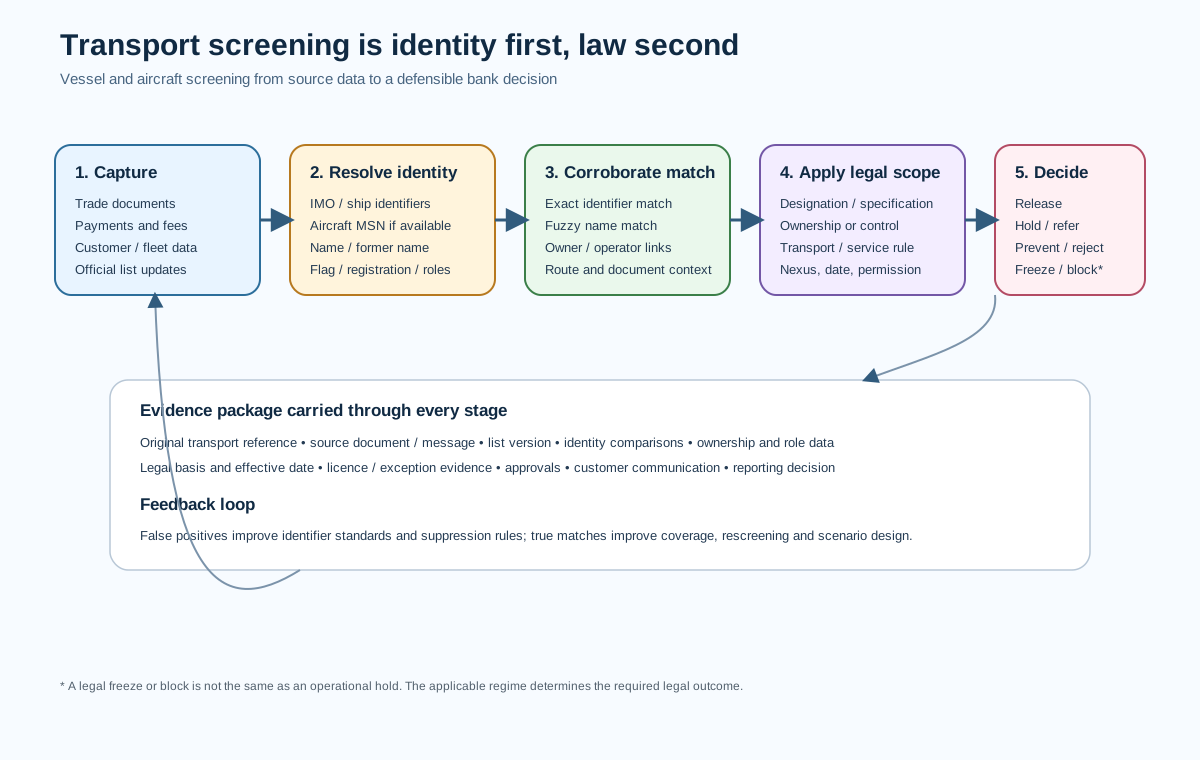
The diagram above is the working map for the whole chapter. Transport data enters the bank through several channels, a screening step compares it against current list data, candidate matches are investigated, and the outcome is a legally precise disposition plus preserved evidence. Every section below examines one stage of that lifecycle and the decisions inside it. The insight to carry forward is that screening quality is determined less by the matching algorithm than by whether the right transport data reaches the engine, with identifiers intact, at a point where the bank can still act.
Why transport assets are listed separately
Authorities list vessels and aircraft explicitly because ownership of a ship or aircraft is easy to obscure and quick to rearrange. A tanker can be renamed, reflagged, sold to a newly formed single-ship company and put under commercial management in another jurisdiction within weeks. If lists named only the owning company, each rearrangement would break the connection. Naming the asset itself, with a persistent identifier, keeps the restriction attached to the steel hull or airframe regardless of what it is painted on the stern this month.
For a bank, this means the screening target is not only "who is my customer" but "which physical assets touch the value or services I am providing". The asset can appear in a letter of credit, a bill of lading, a charter-party reference, a freight invoice, a bunker payment, an insurance policy, a port-agent disbursement, an aviation handling invoice, a lease schedule or a free-text remittance line. The screening control must therefore look beyond party names and into transport references wherever the bank's risk assessment says they matter.
A common misunderstanding is that vessel and aircraft screening is only a trade-finance concern. Trade finance is where the richest transport data sits, but a corporate banking team paying monthly charter hire by standing order, a payments team processing a port-agent fee, and an insurance-services team settling hull cover all touch the same risk. The control boundary should follow the bank's actual services, not an assumption that one department owns the topic.
What "screening" means for a transport asset
Screening a vessel or aircraft means comparing the asset's identifying data held or seen by the bank against current sanctions-list records for vessels and aircraft, and against related ownership, flag, route and service restrictions where the bank has taken on that scope. A candidate match is then resolved to one of three outcomes: the asset is not the listed asset, the asset is or is likely to be the listed asset, or the evidence is insufficient and the transaction cannot proceed without more information.
That sounds identical to name screening, and the workflow discipline is the same, but the data behaves differently. People have dates of birth and nationalities; companies have registration numbers and directors. Vessels and aircraft have their own identifier systems, and the central skill of this chapter is knowing which identifiers persist through disguise and which ones change with a coat of paint. Screening that keys only on the changeable attributes will miss the assets that matter most, because those are exactly the attributes an evader changes first.
Vessel identifiers and their screening strength
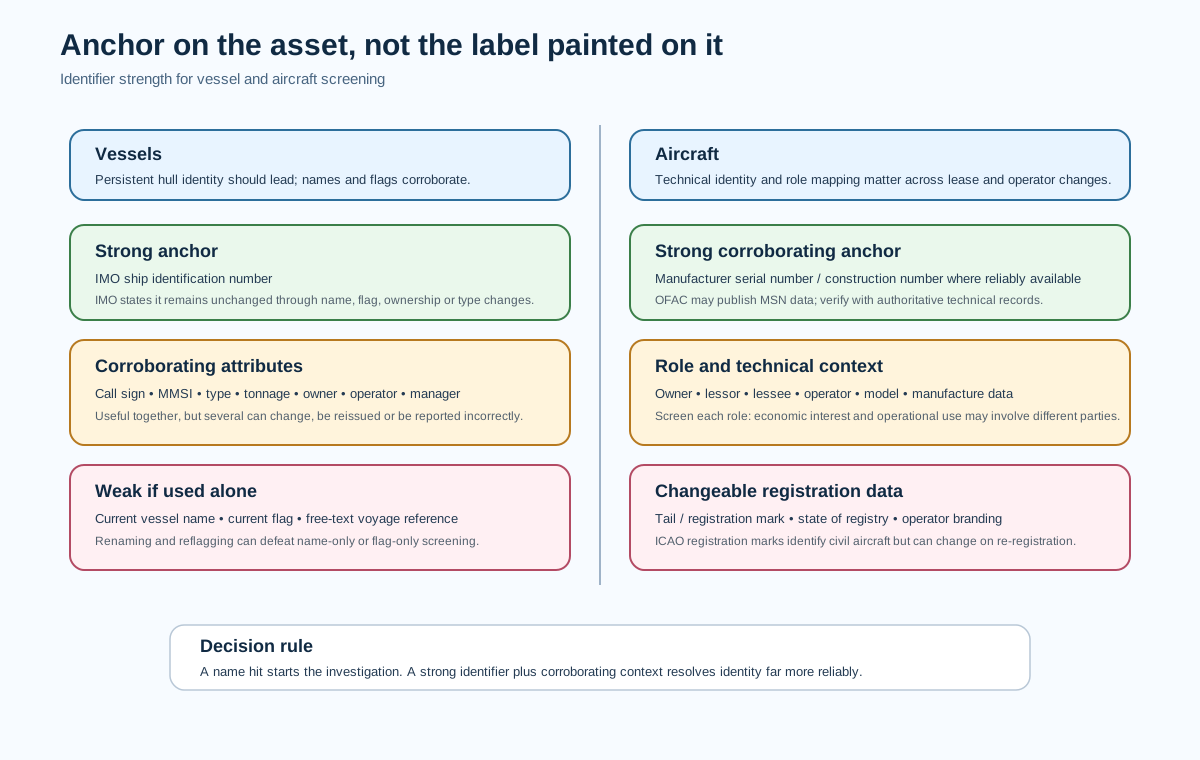
A vessel can be described by name, flag, call sign, Maritime Mobile Service Identity number, hull dimensions, owner, operator, manager and International Maritime Organization number. These are not equal as screening keys, and the difference decides whether the control works.
The IMO number is the anchor. Under the IMO ship identification scheme it is a permanent number that stays with the hull for its life, including through changes of name, flag and ownership. Sanctions authorities publish it alongside listed vessels precisely so that screeners can match on something renaming cannot defeat. Any vessel-screening design that cannot ingest, preserve and match IMO numbers is screening the disguise rather than the asset. Where trade documents or payment references carry an IMO number, the control should extract it as a structured field rather than letting it dissolve into narrative text.
The Maritime Mobile Service Identity number is a nine-digit radio identity associated with the ship station rather than the hull in the same permanent sense. It is useful corroboration: a vessel whose transmitted MMSI does not correspond to its declared identity deserves attention. But MMSI can be reprogrammed and misreported, and manual entry errors are common, so it should support rather than carry an identification decision.
The vessel name is the weakest primary key and paradoxically the most common field a bank actually receives. Names repeat across the world fleet, transliteration varies, prefixes and suffixes drift, and renaming before or after designation is standard evasion practice. Name matching still has a role as a first net, especially combined with type, size and flag, but a name-only screen that declares "no match" has proven very little. Analysts should treat a name hit as the start of identification work, not as identification.
Flag, call sign, gross tonnage, owner, operator and manager sit in the middle: each is mutable, but changes in them are themselves informative. A vessel that changes flag, owner and manager in quick succession around the time of a designation is exhibiting the classic administrative shuffle. The screening control should therefore keep history, not just the current value. A point-in-time screen answers whether the vessel matches today; a screening history answers whether someone has been rearranging the vessel's identity, which is often the more valuable question for the investigation.
Aircraft identifiers and their screening strength
Aircraft screening is the less mature sibling in most banks, which is itself a risk worth naming. The concepts transfer from vessels, but the identifier landscape and the data sources differ, and controls built only around shipping leave aviation exposure uncovered.
The manufacturer's serial number, often called the construction number or MSN, is the closest equivalent of the IMO number: it is assigned at manufacture, does not change with sale, lease, registration or repainting, and is the persistent thread through an airframe's life. Sanctions authorities publish serial numbers for listed aircraft where known. A bank involved in aviation finance, leasing or related services should treat the MSN the way a shipping desk treats the IMO number, and should be suspicious of any transaction documentation for an aircraft that omits it without reason.
The registration mark, commonly called the tail number, is the nationality-plus-registration identifier painted on the aircraft. It changes when the aircraft moves between national registers, which happens routinely in leasing and sale transactions, so it behaves more like a vessel name than an IMO number: useful for matching, dangerous to rely on alone. Registration data sits with national aviation authorities, and re-registration to a new jurisdiction shortly before or after a designation is the aviation analogue of reflagging.
Owner, operator and lessee must be kept as separate roles, because in aviation they very often are separate parties. An aircraft can be owned by a leasing company in one jurisdiction, leased to an airline in a second, subleased or wet-leased to an operator in a third, and maintained and insured by further parties. A screen that checks only the registered owner misses the operator actually flying sanctioned routes, while a screen that checks only the operator misses the designated owner collecting the lease income. The control should screen each role and should map the lease chain rather than flattening it to a single name.
Flight and basing information, where legitimately available to the bank, plays the role that AIS and port data play for ships: it shows what the asset actually does rather than what its papers claim. A bank will not usually track aircraft directly, but lease, insurance, maintenance and handling documentation can reveal operating patterns, and inconsistencies between declared operation and documented movement are investigation material. As with vessels, the bank should be precise about what it genuinely sees: a financier that never receives operating data should not claim movement monitoring it does not perform, and should instead control the parties, documents and payment flows it does see.
Screen on every role, anchor on what cannot change: persistent hull and construction numbers first, changeable names and flags second.
Where transport data enters the bank
Screening can only find what reaches it. Before designing matching logic, a bank should map every channel through which vessel or aircraft data arrives, because each channel has different data richness, timing and reliability.
Trade-finance operations are the richest source. Documentary credits, collections, guarantees and supply-chain finance carry bills of lading, airway bills, charter-party references, insurance certificates, inspection documents and invoices that routinely name vessels, voyage details, ports, aircraft, flights and handlers. The strength here is documentary depth; the weakness is timing, because documents often arrive after shipment, and the control must decide which decisions still sit ahead of it, such as honouring a presentation, releasing documents or authorising reimbursement.
Payments carry thinner but faster data. Freight, charter hire, bunker, port-disbursement, handling, overflight, maintenance and lease payments reference assets in remittance and instruction fields, sometimes with an IMO number or tail number, more often with a name or voyage reference, sometimes with nothing recognisable at all. Payment screening tuned only for party names will walk straight past a freight payment to a designated tanker, so the payment-screening scope needs an explicit transport-data element wherever the risk assessment warrants it. The companion payment-screening chapter covers field-level screening design; the point here is that vessel and aircraft references belong in the screened population, not outside it.
Customer onboarding and periodic review contribute the portfolio view: shipping companies, airlines, lessors, charterers, freight forwarders, handlers and commodity traders whose business inherently involves transport assets. Knowing at onboarding that a customer operates or finances vessels or aircraft allows the bank to set expectations about the documentation it will require and the screening it will perform. Discovering mid-relationship that a "general trading company" is chartering tankers is a control failure that screening alone cannot fix, because the bank never asked for the data its engine would need.
Service and fee operations are the channel most often forgotten. Insurance premiums and claims, port-agency fees, bunker supply payments, maintenance invoices, navigation and handling charges each reference an asset or voyage. These flows are individually small and operationally routine, which is exactly why they can carry a designated asset past controls designed around large trade tickets. Coverage mapping should include them explicitly rather than assuming they are immaterial.
External feeds complete the picture: sanctions-list data with vessel and aircraft records, commercial maritime and aviation data, AIS-derived reporting where the bank subscribes, port-call information, and official guidance and advisories. Each feed needs an owner, an update path into screening, and a documented understanding of what it does and does not prove. A feed that labels risk is intelligence; only the authority's list, properly interpreted with legal advice, determines designation.
List data for transport assets
Transport screening draws on the relevant authorities' party lists, identified transport assets and programme-specific legal annexes. OFAC publishes vessel and aircraft identifiers in its sanctions data. The FCDO's UK Sanctions List is the current UK designation source following closure of the former OFSI Consolidated List on 28 January 2026; applicable ship specifications and transport measures also need to be mapped. EU transport restrictions require the relevant legal annexes as well as financial-sanctions data: for example, Article 3s and Annex XLII of Regulation (EU) No 833/2014 address targeted vessels and related services. A consolidated financial-sanctions feed alone is not complete transport coverage. UN committee vessel measures and other locally applicable authorities belong in the source inventory too. Preserve the measure attached to each asset rather than assume every vessel listing creates an asset freeze.
Three properties of transport list data deserve emphasis because they drive control design. First, vessel and aircraft records are a small minority of list entries, so generic list statistics and generic screening tuning describe party screening, not transport screening. Transport matching needs its own test data and its own thresholds. Second, identifiers in list records are uneven: some entries carry IMO numbers or serial numbers, others carry only a name and former names, and transliteration of names from other scripts introduces the same matching challenges covered in the name-matching chapter. The control must handle records with strong identifiers and records with weak ones without pretending both give equal assurance. Third, lists change the transport picture through ownership as well as naming: a vessel owned or controlled by a designated person can be restricted even before the vessel itself is named, which connects this chapter directly to the ownership-and-control topics. Screening the asset name alone misses ownership-based exposure; screening ownership alone misses the named asset when ownership is obscured. Both are needed.
List-update timing is operationally critical for transport. A vessel designation that takes effect on a Tuesday can strand a freight payment already queued for Wednesday, a documentary presentation already in examination, or a charter hire already instructed. The control must define whether pending populations are re-screened on list updates, how quickly new transport records load into the engine, and what happens to items already released but not yet settled. Chapter 37's new section on designation timing examines the pending-payment problem in depth; the screening-specific point is that transport re-screening on list change is a designed behaviour with an owner and evidence, not something improvised during the incident.
Matching: from text to candidate
Matching transport references against list records combines the name-matching techniques of the dedicated chapter with identifier logic specific to assets. A bank that treats vessel matching as ordinary customer-name matching will generate noise on common ship names and miss designations hidden behind renaming. Four design choices separate a working control from a decorative one.
First, normalise before matching. Vessel and aircraft names arrive with prefixes, punctuation, spacing variants and transliteration differences. Stripping or standardising these decorations before comparison, while preserving the original value for evidence, materially improves both detection and false-positive rates. The normalisation rules should be documented, versioned and tested, because silent changes to normalisation alter what the control detects.
Second, match identifiers exactly where identifiers exist. An IMO number or serial number either matches or it does not, and an exact identifier match should route directly to specialist review rather than sitting in a general fuzzy-match queue. Conversely, the absence of an identifier in bank data where one would be expected, such as a trade document for an ocean shipment with no IMO number anywhere, is itself a data-quality signal worth recording.
Third, score name matches with transport-aware context. A vessel-name match gains weight when type, size, flag or former names align with the list record, and loses weight when they contradict it. An aircraft registration match gains weight when the serial number or operator aligns. Scoring that ignores these attributes treats all name similarities as equal, which they are not. Thresholds should be set and tested against realistic transport data, including the common-name problem: there are many vessels sharing ordinary names, and a threshold tuned on party names will typically over-alert on ships.
Fourth, keep former names and aliases in the match population. Authorities publish former vessel names and known aliases precisely because renaming is an evasion method. Matching only current names discards that intelligence. The same applies to aircraft previously registered under different marks. History is part of the record, and the engine should search it.
Triage of a transport alert
When the engine produces a candidate, an analyst must resolve identity before considering any legal conclusion. The triage sequence for a vessel candidate runs through a disciplined set of comparisons: the matched reference against the list record, identifier against identifier first, then name and former names, then type and physical characteristics, then flag and registration history, then owner, operator and manager against the bank's customer and counterparty data, then voyage, port and cargo context where available. Each comparison is recorded with its source, because a later reviewer, auditor or authority will need to see not just the conclusion but the evidence path.
Aircraft triage follows the same discipline with aviation attributes: registration mark against the record, serial number where either side carries it, owner-operator-lessee chain against customer data, and documented operation against declared business. The lease chain deserves particular care, since the listed party may sit two or three contracts away from the name on the payment.
Resolution has three distinct outcomes. A false positive is closed with the evidence that distinguishes the bank's asset from the listed one, such as a different IMO number, incompatible vessel type, or a serial number that does not correspond. A probable or confirmed identity match is escalated under the bank's sanctions-response procedure. Place the bank's instruction or service in an approved operational review state where applicable while the authorised decision-maker determines the restriction; this does not itself freeze the vessel, aircraft or funds in law. For an inconclusive result, seek proportionate additional evidence or specialist advice rather than treating missing data as a false positive. The permitted hold, refusal or other handling depends on the applicable law, product, payment deadlines and approved uncertainty procedure.
Time pressure is the defining difficulty of transport triage. A port disbursement needed for a vessel to sail, a bunker payment with a tidal window, or a documentary credit nearing expiry all create commercial urgency that pushes toward release. The control framework should acknowledge this openly: define expedited review paths, senior sign-off for time-critical transport decisions, and a clear rule that urgency never lowers the evidence standard. Chapter 47 examines interdiction operations under time pressure in full; this chapter's contribution is that transport alerts should arrive with enough context, identifiers, voyage data, customer linkage, to be decidable quickly, which is a data-preparation achievement, not an analyst heroism story.
Disposition: block, reject, hold, escalate or release
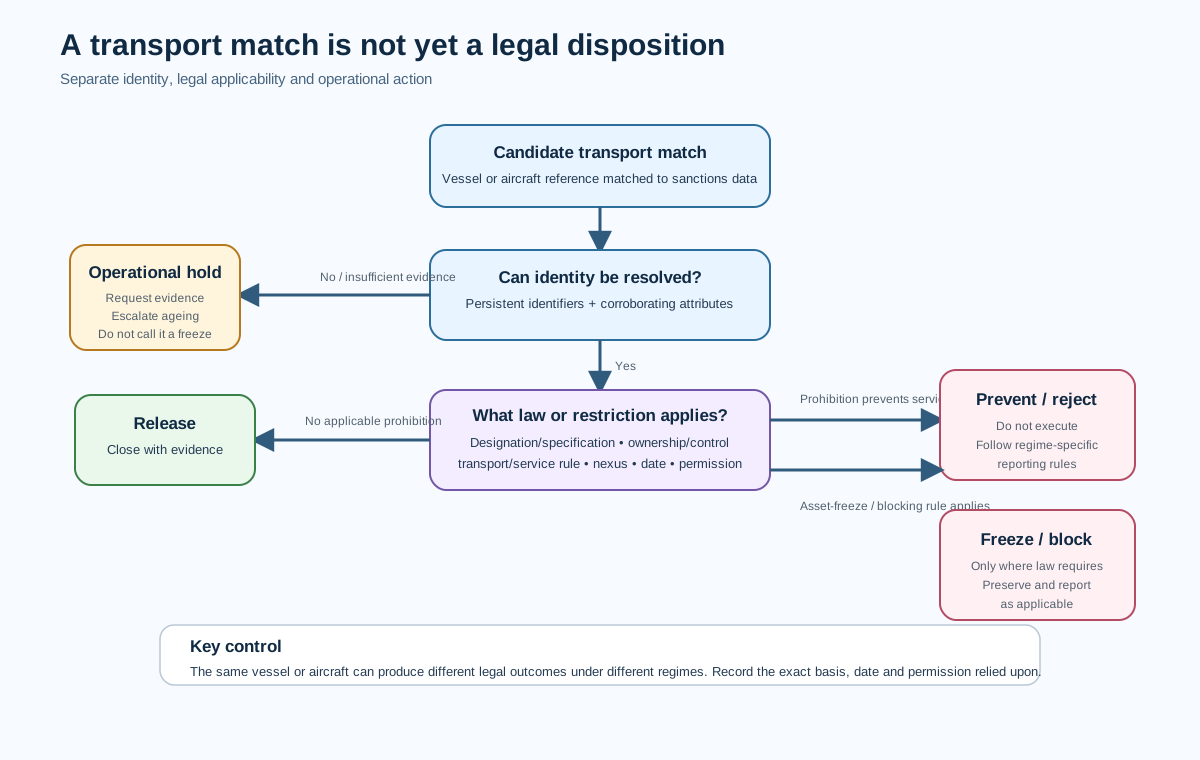
Transport dispositions use the same legal vocabulary as other sanctions decisions, and precision matters because each word carries different accounting, reporting and customer consequences. An operational hold pending review is not a legal block. Blocking or freezing holds the asset or funds under legal authority and triggers reporting, in the United States under OFAC's framework with its ten-business-day reporting rule for applicable blocking and rejection actions, and under equivalent domestic rules elsewhere. Rejecting refuses the transaction and returns or refuses the funds without a continuing freeze. Each jurisdiction's rules determine which disposition fits, and legal advice, not operations habit, makes that call.
Two transport-specific disposition problems recur. The first is the part-shipment problem: one vessel carries cargo for many customers, or one payment covers several voyages, and only one element is restricted. The disposition must be granular enough to stop the restricted element without unlawfully seizing the clean ones, and the systems must support that granularity rather than offering only all-or-nothing choices. The second is the services problem: the bank may hold no funds to block but be providing insurance, a guarantee, or payment processing that constitutes a prohibited service. Stopping a service has different mechanics from freezing money, different customer communication, and different evidence, and procedures should cover both.
Release after a false-positive determination should return the transaction to its normal path with the reasoning attached, so that re-screening does not regenerate the same alert without new information. Good-list or allow-list treatment for recurring transport references, such as a regular charter on a verified-clean vessel, can reduce repeat work but needs governance: the entry should record what was verified, when, by whom, and what change, such as a flag change or ownership transfer, invalidates it. An allow-list that never expires and never re-validates is a hole, not an efficiency.
Hold, block, reject, escalate and release are distinct workflow outcomes. A review hold and an escalation are operational controls; blocking or freezing requires the relevant legal basis. The recorded outcome must match the bank's actual action and its legal consequence.
Records, reporting and the evidence package
Every transport screening decision should leave an evidence package that reconstructs the decision months or years later: the data screened, the list version applied, the candidate record, the comparisons performed with sources, the conclusion and its rationale, the disposition, approvals, customer communication, and any reports filed. For true matches and for near-misses with regulatory significance, the package also supports the reports the bank must make to its competent authority, under that authority's form, channel and deadline, and any internal escalation to compliance leadership and the board-level committee structure.
Suspicious-activity reporting sits alongside sanctions reporting rather than replacing it. A transport case can involve both a sanctions restriction and money-laundering suspicion, for example opaque ownership layered through single-ship companies with no commercial rationale, and the two reporting streams have different triggers, recipients and confidentiality rules. Analysts should understand which report serves which purpose and should not assume that filing one satisfies the other. The investigations and reporting section of this course develops both streams; the screening chapter's duty is to make sure the handoff carries the full transport evidence rather than a bare alert code.
Retention follows the bank's legal obligations for sanctions and AML records in each jurisdiction, extended by legal hold where investigation or proceedings require it. Transport evidence has a long tail: a vessel's ownership history can matter to a case years after the voyage, and AIS-derived or registry snapshots that supported a decision should be preserved in the form relied upon, not merely referenced as a visited website.
Roles, ownership and handoffs
Transport screening fails most often at handoffs, not inside any single team's work. A workable ownership map names who captures transport data, who maintains list and reference data, who tunes matching, who triages alerts, who decides legal disposition, who communicates with the customer, who files reports, and who assures the whole chain. Trade finance, payments, corporate coverage, financial-crime operations, sanctions advisory, legal, technology and data teams all appear on that map, and the seams between them need defined inputs, outputs and service levels.
Two handoffs deserve explicit design. The first is relationship-to-transaction: the coverage team that knows a customer charters vessels must ensure that knowledge reaches the screening configuration, for example by flagging the customer for transport-data requirements, rather than keeping it in relationship notes the engine never sees. The second is alert-to-decision: the triage analyst's package must reach the legal decision-maker with identifiers, voyage context and customer linkage intact, not as a one-line "possible vessel match" that forces legal to redo the investigation. Handoff quality is measurable in rework rates and decision times, and management information should track it.
Aircraft-specific operational notes
Three practical points help banks starting or strengthening aircraft screening. First, build the aviation customer and portfolio inventory before tuning engines: lessors, airlines, operators, maintenance providers, handlers and brokers in the customer base define where aviation data will appear. Second, require the serial number in aviation-finance and leasing documentation standards, and treat its absence as a documentation exception with risk-based follow-up. Third, connect aviation screening to the export-control and dual-use chapter as well as to sanctions: aircraft, parts, avionics and maintenance services can carry export-control restrictions independent of any designation, and the screening that catches a listed tail number is not the same control that catches a controlled avionics shipment to a restricted end-user. Both need owners.
General-aviation and private-aircraft activity warrants a proportionate note. Corporate jets move through handling agents and management companies that can distance the beneficial user from the paperwork, mirroring maritime opacity at smaller scale. Where the bank services such activity, the same discipline applies: identify the asset persistently, map the parties around it, and resolve candidates on evidence.
Operational deep dive: transport data, lists and matching machinery
The base chapter described what vessel and aircraft screening decides. This deep dive examines the machinery underneath: how transport data travels from documents and payments into the screening engine, how list and reference data is governed, how matching is built and tested, and how the control stays correct as lists, fleets and bank systems change. Readers who implement, test or assure screening will find their material here; analysts who only triage alerts can focus on the triage and evidence sections and return to this material when they need to challenge a system limitation.
Transport data lineage from capture to screening request
A screening decision is only as complete as the data lineage feeding it. For each channel identified in the base chapter, the bank should be able to trace the path field by field: where the transport reference is first captured, how it is stored, which transformations it undergoes, and exactly what string or structured record the screening engine receives. This tracing repeatedly exposes quiet losses. An IMO number typed into a trade-finance free-text field may never be parsed into the screening feed. A vessel name in a payment remittance may be truncated by a downstream format limit before screening sees it. A charter-party attachment held as an unscanned image contributes nothing to automated screening no matter how relevant its contents.
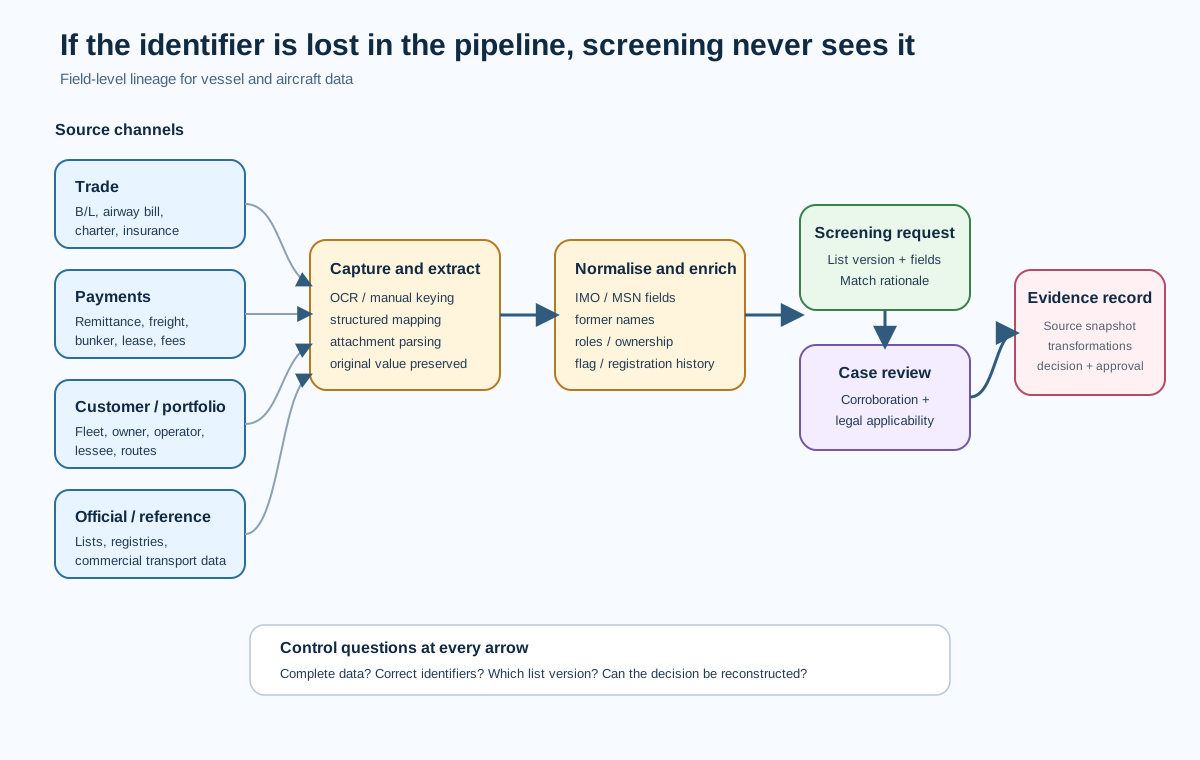
The diagram above shows the lineage stages the bank should document for each channel: capture, extraction, normalisation, enrichment, screening request, and evidence return. Its practical message is that every arrow is a place where transport data can be lost, altered or delayed, and each arrow therefore needs an owner and a test. A lineage map that stops at "documents go to screening" has not mapped anything; the value is in naming the specific fields, formats and transformations at each step.
Extraction from trade documents deserves special attention because it is where the richest data is also the hardest to use. Bills of lading, charter parties, insurance certificates and invoices arrive as structured electronic messages, PDFs, scanned images or paper, in varying languages and layouts. The bank should know, for each document type it relies on, whether vessel and aircraft references are extracted automatically, manually keyed, or not captured at all, and what quality control applies. Manual keying introduces transcription risk on exactly the long alphanumeric strings, IMO numbers and serial numbers, where accuracy matters most; double-keying or independent verification for identifier fields is proportionate where volumes allow. Where optical character recognition is used, its error rate on identifiers should be measured rather than assumed, because a misread digit in an IMO number converts a true match into a clean screen.
Payment-channel lineage has the opposite character: data arrives structured but thin. The lineage question is which message fields are passed to screening and which are dropped. ISO 20022 migration is directly relevant here, because richer structured party and remittance data can improve transport screening only if the fields are populated, mapped and preserved into the screening request. A migration programme should include transport-screening regression testing: the same economic payments screened before and after migration, with differences in transport-alert outcomes investigated rather than assumed to be improvements. Truncation, field-mapping changes and character-set handling are the usual suspects when a migration silently weakens detection.
Customer-channel lineage concerns reference data rather than transactions: the transport-relevant attributes of shipping, aviation, commodity and logistics customers, such as fleet lists, operated routes, chartering activity and leased assets, captured at onboarding and review. This data rarely flows automatically into transaction screening, but it should flow into risk assessment and into screening scoping decisions, for example by marking a customer as transport-active so that its payments receive transport-field screening and its trade documents face transport-data completeness checks. The lineage here is organisational rather than technical, which makes it harder to test and easier to neglect; periodic sampling of transport-active customers against screening configuration is a proportionate assurance activity.
List and reference-data governance
Transport screening consumes several reference datasets with different authorities, rhythms and reliability, and governing them as one undifferentiated "sanctions feed" causes predictable failures.
Sanctions-list data for vessels and aircraft arrives through the bank's standard list-management channel, but needs transport-specific handling. List records for assets carry identifier fields that party records do not, and the loading process must preserve them into matchable form rather than flattening every record to a name. Former names and aliases of vessels must load as searchable history, not as display-only text. Update latency should be measured separately for transport records where the feed structure allows it, because a same-day vessel designation that sits unloaded while party updates flow is a coverage gap with legal consequences. The list version applied to each screening decision should be recorded in the case evidence, so that a later question about whether a designation was effective at decision time can be answered from the record rather than reconstructed from release notes.
Commercial maritime and aviation reference data, such as registry information, fleet registers, ownership and management data, AIS-derived reporting and aviation registers, is intelligence, not law. Its governance questions are fitness for purpose, refresh frequency, coverage limits and known error modes. A maritime data product that tracks the large commercial fleet well may cover coastal, fishing or newly built vessels poorly; an aviation register may lag re-registrations. The bank should document what each source is used for, identity corroboration, ownership context, voyage context, red-flag enrichment, and what it must never be used for, such as treating a vendor risk label as a designation. Vendor labels for concepts like shadow fleets support prioritisation and enhanced review; they do not create legal restrictions, and procedures should say so explicitly so that analysts neither ignore them nor overreact to them.
Internal reference data completes the set: allow-lists for verified-clean recurring assets, previously resolved false positives with their distinguishing evidence, and customer-linked asset inventories built up through onboarding and investigations. This data needs the same governance as external feeds, including ownership, expiry, change triggers and audit trail. An allow-list entry for a vessel should record the IMO number verified, the evidence relied upon, the approver, the expiry or review date, and the events that invalidate it, such as ownership change, flag change or designation of an associated party. Without those controls, internal reference data decays into assumptions that suppress future alerts.
Rescreening policy ties the datasets together. The bank should define which populations are re-screened on which triggers: list updates, customer-data changes, asset-attribute changes, periodic cycles for high-risk portfolios, and event-driven rescreening such as a new charter relationship or a voyage into higher-risk waters. Each trigger needs a defined population, a timeframe and evidence of completion. Rescreening the entire historical payment archive on every list change is rarely proportionate or technically feasible; rescreening defined pending, portfolio and high-risk populations is the defensible middle ground, documented in policy rather than invented per incident.
Matching design and testing
Transport matching should be designed as its own configuration, not inherited unexamined from party-name screening. The design starts from the identifier hierarchy established in the base chapter: exact matching on IMO numbers and aircraft serial numbers where present, contextual scoring on names with transport attributes, history-aware matching on former names and previous registrations, and ownership-chain matching that connects assets to designated persons through the ownership-and-control logic covered elsewhere in this course.
Thresholds and scoring weights need transport-specific test data. A test pack built from party names will not reveal that a threshold over-alerts on common vessel names or under-alerts on transliterated former names. The bank should assemble transport test cases from sanitised real patterns: renamed vessels with and without IMO numbers, common-name collisions resolved by type and flag, reflagged aircraft with unchanged serial numbers, lease chains with the designated party at different positions, and remittance references carrying partial identifiers. Tuning decisions, the thresholds chosen and the trade-offs accepted between detection and alert volume, should be recorded with their rationale and approval, because a future incident will ask why the engine was set as it was.
False-positive management for transport has its own shape. Common vessel names generate recurring volume that tempts broad suppression rules, such as suppressing all alerts on a frequently seen name. Suppression keyed on name alone is dangerous precisely because names are the mutable attribute; a suppressed name can later belong to a genuinely different, designated vessel. Suppression rules should key on persistent identifiers plus distinguishing attributes, carry expiry and review, and be owned outside the team measured on alert volumes, so that efficiency pressure cannot quietly widen them. Metrics should distinguish suppression coverage from detection effectiveness, and assurance should periodically test suppressed populations with seeded true matches.
Performance and resilience matter because transport screening increasingly sits in time-critical paths. Instant payments carrying freight or handling references, just-in-time documentary decisions and port-disbursement deadlines all compress the time from screening request to disposition. The design should specify latency expectations, queue behaviour under load, fallback behaviour when the engine or a data feed is unavailable, and whether the fallback queues, rejects or routes to contingency. As with payment screening, the fallback must be designed and approved in advance; an outage is the worst moment to decide what screening means. Capacity planning should account for rescreening bursts after major list actions, which can multiply transport-alert volumes overnight.
Model, analytics and change governance
Where screening uses scoring models, machine-learning components or vendor analytics, the bank's model-risk and technology-governance expectations apply. Transport models need validation against transport-relevant outcomes, monitoring for drift as fleets, routes and evasion methods change, and explainability sufficient for an analyst to understand why a candidate was presented. An analyst who cannot see which attributes drove a score cannot write a sound resolution rationale, and a control whose reasoning is opaque to its operators is difficult to defend.
Change governance covers the full lifecycle: list-format changes, feed replacements, matching-rule changes, threshold adjustments, normalisation updates, document-extraction changes and migration events such as ISO 20022 adoption. Each change should carry an impact assessment for transport screening specifically, pre-implementation testing with transport test packs, post-implementation monitoring for alert-rate and outcome shifts, and rollback criteria. Silent changes are the recurring villain in screening incidents: a vendor update that alters transliteration handling, a document-system upgrade that stops extracting an identifier field, a mapping change that drops former names. The governance answer is a transport-screening regression suite run on a schedule and after every relevant change, with results reviewed by someone who understands what the numbers mean for legal exposure rather than only for system health.
Practitioner checkpoint
A practitioner finishing this deep dive should be able to draw the bank's transport-data lineage from memory for at least one major channel, name the reference datasets and their governance owners, explain why transport matching needs its own test data and thresholds, describe the rescreening triggers and their evidence, and state the fallback behaviour when screening or its feeds are unavailable. Gaps in any of those answers are findings, and they belong in the control-improvement plan with owners and dates rather than in working papers nobody reads.
Advanced practice: worked transport-screening cases
The cases below are entirely fictional, with illustrative amounts, timings and internal policy thresholds. They show how the lifecycle from the base chapter operates under realistic pressure: thin data, commercial urgency, lease chains, renaming and inconclusive evidence. Each case states the trigger, the evidence gathered, the alternatives considered, the outcome with its reasoning, and the control lesson. Read them as decision training, not as precedent: real cases turn on the actual list wording, jurisdiction and legal advice applicable at the time.
Across all five cases, identity is resolved before any legal conclusion. Persistent identifiers are tested first where available, weaker names and registrations are corroborated with asset attributes and ownership context, and inconclusive evidence leads to a controlled hold or information request rather than an automatic release. Only after the bank knows which asset it is dealing with should legal and sanctions specialists determine the applicable restriction and operational disposition.
Case 1: the renamed tanker in a documentary credit
A trade-finance operations team in the bank's London branch examines a presentation under a documentary credit for a crude-oil shipment valued at an illustrative 28 million in the transaction currency. The bill of lading names the carrying vessel as the fictitious "SEA MERIDIAN", flagged in an illustrative open registry, with no IMO number on the bill. The advising bank's cover schedule mentions a different spelling, "SEA MERIDIANE", in one line. The credit requires a clean on-board bill of lading and shipment before an illustrative expiry date nine days away.
The examiner runs the vessel name through screening as a matter of procedure and receives a candidate against a listed vessel record carrying a former name close to the presented spelling, with an IMO number published on the list. The name similarity alone would be a weak basis for action, and the commercial pressure is immediate: the beneficiary's bank is pressing for honour, and the applicant, the bank's customer, insists the shipment is routine.
The investigation proceeds along the identifier hierarchy. The examiner requests the vessel's IMO number and full particulars from the presenting bank rather than debating spellings. The presenting bank supplies particulars showing an IMO number that matches the listed record exactly, together with a recent history of two renamings and a flag change within the previous eighteen months. Ownership documentation names a single-ship company incorporated in an illustrative secrecy jurisdiction six months earlier, with management by a company sharing an address with several similar single-ship entities. The bank's own customer, the applicant, is a commodity trader onboarded two years earlier as a general trading customer with no declared chartering activity, a discrepancy the relationship team cannot explain beyond "spot business".
Three alternatives are on the table. Honouring the presentation treats the candidate as unproven and prioritises the commercial timetable; it is rejected because the IMO match plus renaming history makes the candidate probable, and honouring would move value under a likely restriction. Rejecting the documents on discrepancy grounds alone, such as the name inconsistency, would stop this presentation but would misstate the reason, leave the underlying exposure unaddressed, and invite a corrected re-presentation that cures the discrepancy while preserving the sanctions problem. The chosen path is escalation as a probable true match: the transaction is held, sanctions specialists and legal are engaged, the relevant authority-reporting analysis begins, and the customer relationship is reviewed for the undisclosed chartering activity and the ownership opacity.
The outcome, after legal confirmation, is refusal of the transaction with the sanctions basis documented, reporting made to the competent authority under its applicable procedure, the customer exited through the bank's standard high-risk exit process, and the screening configuration updated so that the IMO number and associated ownership network are known to the bank's reference data. The control lesson is concrete: the case was decided by the IMO number obtained on request, not by the name on the bill. A control that accepted documents without identifier follow-up would have had nothing to decide with, and a disposition recorded as a documentary discrepancy would have hidden a sanctions event from reporting and management information.
Case 2: charter-hire standing order and the managed fleet
The bank's corporate banking division processes a monthly standing order, an illustrative 340,000 per month, from a logistics customer to a ship-management company described as technical manager for three bulk carriers. The payment reference carries only a fleet code and month. Nothing in the payment resembles a sanctions target, and the customer's annual review six months earlier recorded "no owned vessels; third-party chartering only".
A routine periodic-review refresh, rather than any alert, surfaces the issue: updated corporate registry data shows the customer's group acquired a controlling interest in a vessel-owning entity four months earlier, and one of the three managed bulk carriers changed flag and commercial manager shortly afterwards. A targeted transport review of the customer's payments finds that the standing-order amounts changed twice in five months without any documented charter renegotiation, and one payment's free-text field, visible only in the full remittance record, names a vessel that fuzzy-matches a former name on a sanctions list, though without an identifier.
The evidence is thinner than in Case 1 and points in two directions at once. The ownership change may be legitimate fleet expansion; the flag and manager changes may reflect ordinary commercial repositioning; the amount changes may reflect bunker-adjustment clauses the bank never asked about. Equally, the pattern matches the administrative shuffle that precedes or follows designation risk. The analyst resists both premature escalation and premature closure and instead builds the missing evidence: vessel particulars including IMO numbers obtained through the customer and corroborated against commercial maritime data, the management agreements behind the standing order, the contractual basis for the amount changes, and the group structure connecting the customer to the owning entity.
The IMO numbers resolve two of the three vessels as clearly distinct from any listed record, with consistent type, size and history. The third vessel's IMO number returns no authoritative registry corroboration; the number supplied by the customer fails the IMO check-digit structure, suggesting either transcription error or fabrication. Further inquiry establishes that the third vessel was sold by the group two months earlier but continues to appear in the manager's fee base, which explains the amount confusion but raises fresh questions about what the standing order actually pays for.
The outcome is neither a sanctions finding nor a clean bill of health. The bank declines to continue the standing order on its current documentary basis, requires the customer to provide verified vessel particulars and charter documentation as a condition of continued service, files an internal suspicious-activity assessment on the opacity and the invalid identifier, and places the relationship under enhanced monitoring with a defined review date. The control lesson is that transport screening of payments cannot function where the bank does not know what its customers' payments buy. The relationship-to-transaction handoff failed first: the group acquired vessels, and nobody told screening. The standing-order review, not the matching engine, found the case, which argues for portfolio-level transport reviews of customers in shipping-adjacent sectors as a complement to transaction screening.
Case 3: the leased aircraft with three contracts between the bank and the risk
An aviation-finance team is asked to approve the novation of a lease for a fictional narrow-body aircraft into a structure where the bank funds the owning entity. The pack names the owner, a special-purpose vehicle; the lessee, a regional airline; and a sublease to a charter operator in a third jurisdiction. The serial number is present in the technical schedule but appears nowhere in the credit summary, which discusses only the airline credit and the lease rate. Screening has been run on the owner and the airline; both are clear.
A sanctions specialist reviewing the pack asks for screening of all three roles plus the charter operator's operating pattern, and for the serial number to be screened directly against aircraft list records. The serial-number screen returns a candidate: a listed aircraft record with the same serial number but a different registration mark and a different stated operator from the pack. The airline's credit officers argue the match must be wrong because the registration differs; the specialist holds the line on the principle that a manufacturer serial number is generally a stronger airframe-identity attribute than a registration mark that can change when the aircraft is re-registered.
Resolution requires untangling the chain rather than re-running the screen. The charter operator subleased the aircraft eight months earlier; before that it operated under a different registration in another jurisdiction for an operator that has since been designated, though the aircraft itself was listed only recently. Maintenance records confirm continuous operation across the re-registration, and the current registration was issued four months ago, after the designation of the former operator but before the listing of the aircraft. The bank's proposed funding would therefore refinance an asset that is now itself listed, with the exact legal consequence determined under the applicable sanctions regime rather than inferred merely from the existence of a list record.
The alternatives clarify the decision. Proceeding on the airline's credit strength ignores the transport asset and the contractual chain. Restructuring around a different aircraft in the same fleet is commercially plausible but requires the same serial-number discipline applied to the substitute, plus confirmation that no designated party retains an interest in the lease chain. The chosen outcome is to decline the novation after legal review confirms the applicable restriction, document the serial-number evidence and legal analysis, consider the reporting position, and update aviation-finance procedures so that serial-number screening of every airframe and relevant financed asset is a mandatory credit checklist item rather than a specialist favour.
The lesson generalises beyond aviation: where assets persist through paperwork changes, screening must key on the strongest available identity attributes, and credit processes must surface those attributes to screeners. A control that screens only the names the front office chooses to summarise will always be vulnerable to re-registration, leasing layers and ownership changes.
Case 4: the port-disbursement deadline
A payments team receives an urgent port-disbursement payment, an illustrative 96,000, for a bulk carrier due to sail on the evening tide. The remittance names the vessel and port but carries no IMO number. Screening returns a candidate against a listed vessel with a similar name but a different flag and substantially different deadweight tonnage from the particulars the agent supplies by phone. The agent warns that delaying the payment will strand the vessel, incur demurrage running at an illustrative five-figure daily figure, and damage the bank's standing with a long-term customer, the charterer.
This is the case the time-pressure rules exist for. The analyst works the identity comparison briskly but completely: name similarity noted, flag mismatch documented from two sources, tonnage incompatibility confirmed against registry data, former names checked, owner and manager compared against the list record's ownership details with no connection found. Each check is timestamped in the case record as it completes. A second analyst independently reviews the distinguishing evidence before release, under the bank's expedited-review procedure for time-critical transport alerts, and the payment is released forty minutes before the tidal deadline with the full rationale attached.
The outcome includes a post-event control improvement rather than just a closed alert. The bank writes to the agency and charterer customers setting out the transport-data standard for disbursement payments, including IMO numbers where available, and configures the screening so that this vessel's verified identity suppresses only identifier-anchored repeats, never name-only repeats. The lesson is twofold. First, urgency must accelerate evidence-gathering, never waive it; the expedited path worked because the procedure, the second reviewer and the evidence standard were defined before the tide timetable appeared. Second, a false positive is control raw material: every one that costs analyst time should buy a durable improvement in data standards or suppression governance.
Case 5: the inconclusive file that must wait
A commodity-trade customer presents documents for a fertiliser shipment where the carrying vessel's name matches a listed former name exactly, but no IMO number is available, the flag registry of the stated flag does not publish an online register the bank can check, ownership papers show a recently formed intermediary with nominee characteristics, and the commercial maritime data product the bank subscribes to has no record of the vessel under either name. The customer presses for documents to be released against an expiry deadline, arguing that the bank has proved nothing.
This case exists to establish the inconclusive rule. The analyst has a genuine exact former-name match, zero ability to confirm or exclude identity through the persistent identifier, opaque ownership consistent with layering, and no independent corroboration. Releasing on the basis that nothing is proven would convert absence of evidence into evidence of absence, the exact error the standards in this chapter forbid. The file is escalated as inconclusive with a defined information requirement: verified IMO number and registry particulars, ownership chain to beneficial owner, and explanation of the intermediary structure. The customer is managed through standard restricted-communication wording approved for sanctions reviews while the transaction waits; the bank does not disclose unnecessary details about screening logic or legal analysis.
The outcome, after eleven days, is that the customer withdraws the presentation and routes the business elsewhere. The bank records the attempted transaction, the match, the information requests and the withdrawal, assesses the suspicious-activity position on the pattern of opacity plus withdrawal, and reviews the customer's continued suitability. The lesson is uncomfortable but necessary: a screening control that cannot say "we do not know, so we do not proceed" is not a control. Its effectiveness in this case is measured not by a confirmed interdiction but by a risky transaction the bank declined to touch, evidenced well enough to defend.
Practice close: the analyst's transport-screening playbook
This section is written for the analyst who receives a vessel or aircraft candidate at 4pm with a payment deadline attached, and for the team leader who must confirm the analyst's work is sound. It compresses the chapter into a usable sequence, then examines the exceptions and failure modes that separate routine triage from genuinely difficult judgement.
The ninety-minute triage sequence
Treat every transport candidate as an identity question first. The first fifteen minutes establish what the bank actually holds: the exact matched reference as received, the source document or message, the list record with its identifiers and history, and the customer and transaction context. Capture screenshots or record extracts with timestamps rather than relying on memory, because list data and commercial data change and the evidence must show what the analyst saw.
The next thirty minutes follow an identifier hierarchy. Persistent or comparatively stable identifiers are compared first: IMO number against IMO number for vessels, and manufacturer serial number or equivalent technical identifier where the aircraft record and the bank's documentation provide one. An exact strong-identifier match is a serious identity signal that moves the case to specialist review; a verified mismatch can be powerful distinguishing evidence. Only when strong identifiers are unavailable or inconclusive should the analyst depend more heavily on names, former names, registration marks and transliteration variants, supported by type, size, flag or registry history, owner, operator, manager, lessee and other contextual attributes. A name match with corroborating attributes can support probable identification; a name match with strong contradictory evidence can support false-positive closure; a name match with too little evidence remains inconclusive, and the transaction waits while information is sought.
The following thirty minutes test the identification against the alternative hypotheses a reviewer will raise. Could the identifier have been transcribed incorrectly, and does the registry or another reliable source corroborate what the bank holds. Could the list record's former name be the vessel's current name under different transliteration. Could the ownership chain connect the bank's customer to the listed party even where the asset identification is negative, which converts a transport false positive into an ownership investigation. Could the voyage, port, cargo, landing, overflight, registration or service context indicate a restriction independent of a named-asset match. Each alternative is either excluded with evidence or converted into a further information requirement with an owner and deadline.
The final fifteen minutes produce the disposition package: conclusion stated plainly, evidence cited by source, alternatives addressed, disposition recommended in precise legal vocabulary, approvals obtained per the time-critical procedure where applicable, and customer communication drafted within the bank's legal and confidentiality requirements. An analyst who cannot write the package has not finished the triage, however confident the verbal conclusion sounds.
Exceptions that change the playbook
Listed-asset evidence discovered after settlement, rather than before, converts the case from prevention to containment. The analyst preserves the transaction record exactly as it stood, establishes the list effective time against the settlement time with the list-version evidence, identifies follow-on exposure in related voyages, sister assets and recurring payments, and escalates for legal advice on reporting. The error to avoid is retrospective editing of records to suggest the transaction was stopped; the record must show what happened, when it was known, and what was done next.
Designation, specification or another relevant restriction affecting an asset already in the bank's financed portfolio, such as a funded vessel or aircraft during the life of a loan or lease, creates a servicing problem rather than only a payment-screening problem. The bank cannot undo funds already advanced, but continued servicing, receiving hire, providing insurance, approving subleases or making related payments may be restricted depending on the applicable regime and any licence or exception. These cases belong with legal and the relationship team immediately, with discretionary servicing decisions controlled until the legal position is established. The screening control contributes detection; the workout belongs to a designated-asset or sanctions-response procedure the bank should have written before it needs it.
Conflicting data between reputable sources is routine in transport work: the registry says one flag, the commercial feed says another; the customer states one operator, port data suggests another. The analyst resolves conflicts by weighting sources explicitly, giving appropriate weight to competent-authority or registry data, contemporaneous documents and independently corroborated evidence, and records the weighting. Where conflict cannot be resolved on available evidence, the case is inconclusive and the transaction waits. Commercial inconvenience does not resolve evidential conflict.
Assets with no widely available persistent identifier, which can occur with smaller vessels and parts of general aviation, require a documented approach rather than analyst improvisation. Policy should state the minimum identification package for such assets, the enhanced due-diligence triggers, and the approval level for proceeding. A bank that regularly services segments where strong identifiers are unavailable needs controls designed for that reality, such as ownership verification, route or operating-context corroboration and tighter ongoing monitoring, not a quiet acceptance that screening simply does not apply.
Customer communication during a sanctions review
Transport holds create some of the hardest customer conversations in sanctions work, because the customer often faces immediate commercial loss: a sailing may be missed, a charter disputed, demurrage may accrue, or an aircraft financing deadline may be at risk. The discipline is to communicate consequences and requirements without disclosing unnecessary details about the bank's screening logic, intelligence sources or legal analysis. Standard formulations, agreed with legal in advance, should state that the transaction requires additional review, specify the documents or information needed, give a realistic timeframe, and identify the decision-maker the customer can contact.
Front-office colleagues need briefing before the call, not after it. Relationship managers who improvise explanations under pressure can create legal, confidentiality and conduct problems. The case owner should agree the communication line with the relationship team, confirm what may and may not be said, and record what was communicated. Where the customer supplies the missing identifiers or documentation promptly, the case can often be resolved within the commercial window, which is itself a reason to make information requests specific and actionable rather than generic.
Failure scenarios and what they teach
Review the control against five failures. The engine screens names but cannot receive IMO numbers, so renamed designated vessels pass; the lesson is identifier-capable ingestion. The list updates daily but transport records load weekly, so a new designation or specification is unenforced for days; the lesson is separately measured transport update latency. Pending payments are never re-screened, so restrictions land on queued value; the lesson is designed rescreening triggers. Allow-list entries suppress repeats without expiry, so a sold or re-registered asset's old clean history shields new risk; the lesson is identifier-anchored, expiring suppression. Analysts clear name matches without checking former names or role changes, so renamed or re-leased assets pass on human review; the lesson is triage quality assurance with seeded testing. Each failure has a named owner and a measurable test, which is what makes this list a control-improvement plan rather than pessimism.
Tester and data-analyst view
Testers validating transport screening should sample across the identifier spectrum rather than only the easy cases: exact IMO matches, aircraft technical-identifier matches where the source data supports them, transliterated former names, common-name collisions, reflagged and re-registered assets, lease chains with risk at different positions, thin-remittance payments, and list-update timing scenarios. Expected results should be defined by the screening policy, not inferred from current system behaviour, and regression packs should run after every list-format, feed, mapping or migration change. Data analysts supporting the control should monitor the lineage metrics that predict failures: identifier presence rates by channel, extraction error rates, screening latency distributions, rescreening completion, suppression-rule age and coverage, and the proportion of alerts resolved as false positive, true match and inconclusive with their evidence quality. Trends in these measures reveal control decay long before an incident does.
Masterclass: governing transport screening across the bank
Most banks do not fail transport screening for lack of a screening engine. They fail it organisationally: the engine exists, the lists load, analysts triage, yet designated assets pass because no single forum owns the end-to-end control, data standards are nobody's mandate, and assurance tests the parts rather than the chain. This masterclass addresses the governance layer that decides whether the operational machinery examined so far actually protects the bank.
Owning the control end to end
Transport screening should have a named control owner with authority across the contributing functions, typically within financial-crime compliance with formal service agreements from trade finance, payments, corporate coverage, technology, data and legal. The owner's mandate covers the screening policy for transport assets, the channel-coverage map, data standards for identifiers in documents and messages, list and reference-data governance, matching configuration and testing, triage procedures and service levels, disposition and reporting procedures, training and competence, management information, and the remediation plan. Where the mandate stops, the control stops, so the mandate document deserves the same care as the matching rules. Gaps commonly appear at the edges: aviation data owned nowhere, service-fee channels outside scope, allow-lists maintained informally, rescreening owned by nobody. An annual control-boundary review that asks explicitly what changed in the bank's transport-touching business, new corridors, new products, new customer segments, prevents silent scope decay.
Three-lines accountability should reflect how the control actually runs. The first line owns the business decisions that create or accept transport risk: onboarding shipping and aviation customers, structuring trade and lease transactions, setting documentation standards. Financial-crime operations and sanctions advisory, wherever the bank places them, own the screening operation, triage quality and reporting. Independent assurance, audit and model validation where applicable, tests the chain from data capture to disposition rather than auditing the engine configuration in isolation. The eight-chapter foundations section of this course develops the three-lines model; its transport application is that each line's responsibilities name transport assets explicitly, because generic financial-crime responsibilities diffuse into nobody checking the IMO field.
Risk assessment and appetite for transport
The enterprise-wide financial-crime risk assessment should quantify transport exposure rather than gesturing at it: volumes and values of trade, freight, charter, bunker, handling, insurance and lease flows by corridor and customer segment; the proportion carrying usable identifiers; the jurisdictions, flags, registries and routes touched; and the inherent-risk rating that follows. Residual risk then reflects the actual coverage map, including channels without screening and data populations without identifiers, not the aspirational one. Where residual risk exceeds appetite in a segment, the response is a choice with a documented owner: extend screening, impose documentation requirements, restrict the business, or escalate acceptance to the level appetite policy demands. A risk assessment that records high transport risk and proposes no action is evidence of awareness without control, which examiners and authorities treat accordingly.
Appetite statements gain force when they name transport decisions: whether the bank finances single-ship companies, services designated-flag registries beyond a threshold, processes charter hire for undisclosed fleets, or maintains relationships that repeatedly fail documentation standards. Each position converts into screening scope, onboarding requirements and exit triggers, which is how appetite stops being a paragraph in a policy and starts shaping alerts.
Management information that reveals control health
Transport-screening MI should answer five questions every reporting cycle. Coverage: which channels, populations and identifier types were screened, with what completeness, and what changed. Timeliness: list-update latency for transport records, screening latency in time-critical paths, triage times against service levels, rescreening completion after list changes. Quality: alert volumes by channel, resolution mix with evidence-quality sampling results, suppression-rule performance and age, false-positive drivers, overturn rates on quality review. Outcomes: true matches and near misses with dispositions and reporting status, inconclusive cases with ageing, repeat-customer and repeat-asset patterns. Change: the incident, audit and regulatory developments affecting the control and the remediation position. A pack that reports alert counts without coverage, timeliness and evidence quality describes activity, not control.
Escalation paths should be calibrated to transport realities. A probable true match on a vessel about to load, an inconclusive file approaching document expiry, a portfolio discovery of undisclosed fleet ownership, and a systemic list-loading failure each need different escalation clocks and different forums. Pre-agreed matrices prevent both under-escalation, where a probable match sits in a general queue, and over-escalation, where every common-name alert reaches senior leadership and teaches them to ignore the topic.
Connecting the neighbouring chapters
Transport screening sits at the junction of several chapters in this course, and the masterclass reader should be able to state each boundary precisely. Payment sanctions screening provides the field-level screening discipline and the hold-versus-block vocabulary; transport screening adds the asset identifiers, reference data and voyage context that payment screening alone lacks. Customer screening and the KYC chapters provide the ownership, onboarding and review foundations; transport screening consumes their outputs and returns discoveries, such as undisclosed fleets, that trigger reviews. The ownership-and-control chapters provide the legal logic connecting assets to designated persons; transport screening applies that logic to hulls, airframes and lease chains. The goods-screening and export-control chapters examine what is carried and its end use; transport screening examines what carries it, and the two meet in cases where a clean vessel carries restricted goods or a listed vessel carries ordinary cargo. The investigations and reporting chapters own the SAR, STR and sanctions-reporting streams that transport cases feed. Stating these boundaries prevents both duplication and the more dangerous error of assuming a neighbouring control covers the transport question.
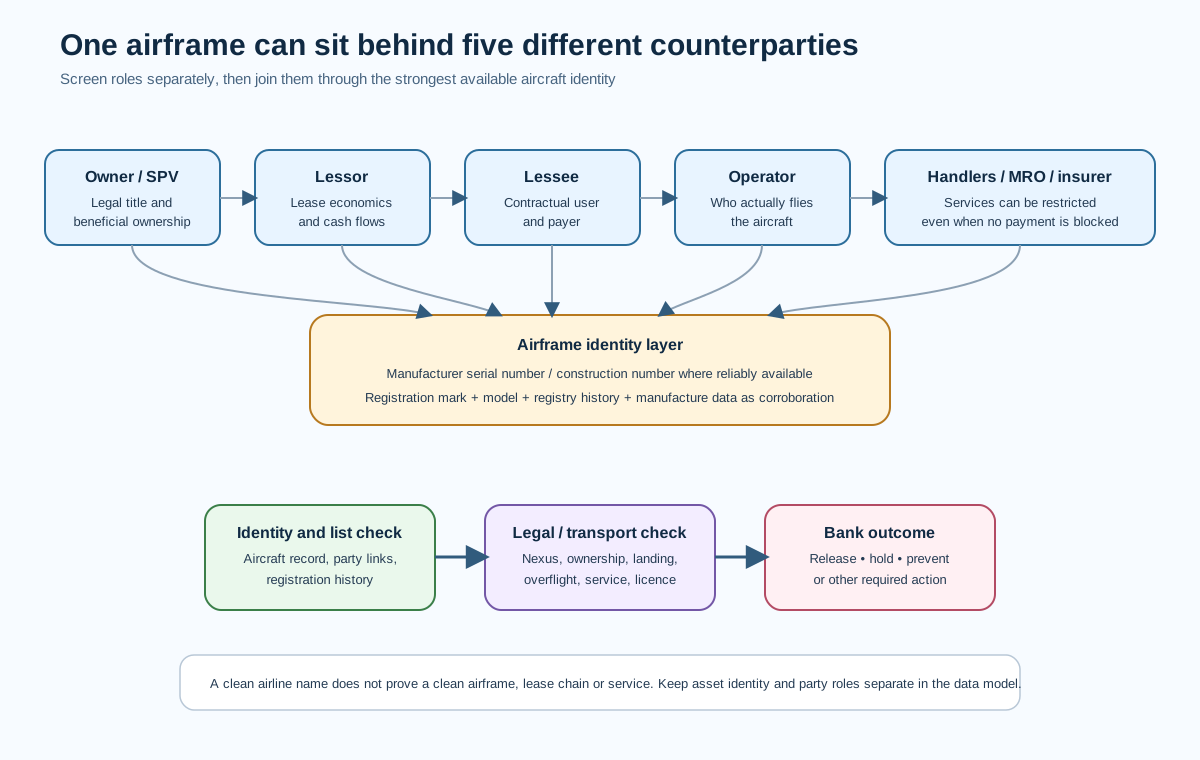
The aviation diagram above illustrates why boundary clarity matters in practice. An aircraft financing passes through registers, lessors, operators and handlers, each screened by a different control at a different time; the diagram's message is that serial-number anchoring is the thread connecting those separate screens into one asset view. Without it, each control can truthfully report that its own party was clear while the bank finances a listed airframe.
Requirements, acceptance and assurance for change programmes
Business analysts and architects extending screening to new channels, adding aviation coverage, replacing a list feed, or migrating payment formats should treat transport as an explicit requirements thread. Requirements state the transport populations in scope, the identifiers to be captured and preserved, the list and reference data with update latencies, the matching behaviour with testable thresholds, the triage workflow with service levels, the disposition vocabulary with legal mapping, the evidence package contents, the MI measures, and the fallback behaviour. Acceptance criteria include seeded true matches detected end to end, from document or payment through disposition and reporting evidence, identifier-loss tests proving IMO numbers and serial numbers survive the lineage, list-update timing tests, rescreening-trigger tests, and fallback tests under feed and engine outage. User-acceptance testing that screens only clean party names proves nothing about transport control.
Independent assurance, whether second-line testing, internal audit or external review, should periodically walk a sample of transport transactions from origination to final record and ask the uncomfortable questions: was the asset identifiable in what the bank held, was it screened against the current list, was the candidate resolved on evidence, was the disposition legally precise, was reporting considered, and does the MI reflect the case. Sampling should overweight the difficult populations, thin remittances, re-registered assets, lease chains, service-fee channels, because controls always perform best on the easy cases they were demonstrated with. Findings should name owners and dates, and repeat findings on data standards or rescreening should escalate as governance failures rather than recurring observations.
Training and judgement culture
Transport screening ultimately depends on analysts who understand ships and aircraft well enough to be suspicious for the right reasons. Training should build asset literacy alongside procedure: reading a bill of lading for transport data, interpreting IMO and registration information, recognising the administrative-shuffle pattern, understanding lease and management structures, and knowing when to call the specialist rather than clearing on instinct. Judgement culture is set by what happens to inconclusive cases and to false alarms raised in good faith. An organisation that penalises analysts for holding transactions on thin evidence will get releases on thin evidence; one that reviews holds respectfully, even when they prove to be false positives, will get the caution that transport screening requires. The knowledge checks that follow test the chapter's reasoning; the culture determines whether that reasoning survives contact with a deadline.
Knowledge checks with explained answers
1. A freight payment references a vessel by name only. Screening returns no match. Can the analyst record a clean transport screen?
No, not on that evidence alone. A name-only screen that returns no candidate has tested the weakest identifier against current list names and proved little, particularly where renaming is a known evasion method. The defensible position depends on context: for a low-risk, recurring, identifier-verified service the bank may accept name screening within its documented scope, but for trade, charter or higher-risk-corridor payments the analyst should seek the IMO number or corroborating particulars, check former names where the engine supports it, and record what was and was not verified. A clean conclusion must describe its own evidence limits.
2. The IMO number on a bill of lading matches a listed vessel exactly, but the vessel name and flag differ from the list record. Is this a false positive?
It is a probable true match, not a false positive. The IMO number is the persistent identifier that survives renaming and reflagging, and authorities publish it precisely to defeat disguise. Name and flag differences are expected in exactly the cases the control exists to catch. The case should be escalated immediately under the sanctions-response procedure, with operations holding further movement of value or documents pending legal determination. Treating identifier matches as name mismatches is one of the costliest errors in transport screening.
3. An aircraft's current registration mark does not appear on any sanctions list, but its serial number matches a listed aircraft record. The lessee is a well-known airline with no sanctions connection. May the bank proceed with financing?
No. The restriction attaches to the listed asset, and the serial number is the persistent identifier for an airframe across re-registrations, sales and leases. The lessee's clean status does not cure the asset's listing, just as a clean charterer does not cure a listed vessel. The bank must decline or suspend the transaction pending legal advice, assess its reporting position, and apply the same serial-number discipline to any proposed substitute asset. Screening the parties while ignoring the asset is the gap this scenario exposes.
4. Why is a vendor label such as "shadow fleet" insufficient, on its own, to block a transaction?
Because the label is risk intelligence, not law. Only a competent authority's designation, ownership-or-control analysis under applicable law, or a specific activity or service restriction creates a legal prohibition, and only legal interpretation establishes which applies. The vendor label is valuable as a prioritisation and enhanced-review trigger: it directs scarce analyst attention to opaque ownership, unusual trading patterns and layered structures. Conflating the label with designation produces both errors, blocking lawful business on analytics and, worse, assuming that unlabeled assets need no scrutiny. Procedures should state explicitly what vendor labels may trigger and what they may never decide.
5. A designation takes effect while a freight payment is queued for next-day settlement. The payment screened clean yesterday. What should happen?
The bank's pre-defined rescreening behaviour for pending populations should activate: the queued payment is re-screened against the updated list before release, with the list version and timing recorded. If the re-screen produces a candidate, the payment is held for triage under the time-critical procedure rather than released on yesterday's result. If the bank has no defined rescreening behaviour for pending payments, that is the finding this scenario reveals, and the incident response includes containing the exposure, seeking legal advice, and writing the missing procedure with an owner. List changes do not respect settlement queues, so screening must be designed for in-flight value.
6. A vessel-name candidate cannot be resolved because no IMO number is available from any source and ownership papers are opaque. The customer threatens to move its business. What is the correct outcome?
The transaction waits. Inconclusive evidence blocks release; commercial pressure never lowers the evidence standard. The analyst sets out the specific information required, communicates within tipping-off constraints, escalates under the inconclusive-case procedure, and records the attempted transaction with the match, the requests and the outcome. If the customer withdraws rather than provide basic asset identification, that withdrawal, combined with the opacity, becomes suspicious-activity assessment material. A control that releases what it cannot identify is not managing risk but documenting its own defeat.
Glossary of working terms
Designation is the act of a competent authority naming a person, entity, vessel or aircraft as subject to sanctions measures. Only designation, and legal analysis of ownership, control and activity, determines restriction; vendor labels and internal risk flags do not.
IMO number is the permanent vessel identifier under the IMO ship identification scheme, retained through changes of name, flag and ownership. It is the primary screening anchor for ships.
Serial number (MSN) is the manufacturer's persistent identifier for an airframe. It is the primary screening anchor for aircraft across re-registration, sale and lease.
MMSI is the nine-digit maritime radio identity associated with a ship station. It corroborates identity but can be reprogrammed or misreported and should not carry an identification decision alone.
Tail number (registration mark) is the nationality-plus-registration identifier of an aircraft. It changes between national registers and behaves as a mutable attribute for screening purposes.
Former names and aliases are previously used vessel names and known alternative identities published by authorities. Matching must search this history because renaming is a standard evasion method.
Operational hold is a temporary internal prevention of onward movement or release pending review. It is not itself a legal block or freeze and must be distinguished from them in systems, accounting and communication.
Blocking (freezing) holds funds or assets under legal sanctions authority, with jurisdiction-specific reporting obligations. Rejecting refuses the transaction without a continuing freeze. Legal advice determines which applies.
Rescreening is the re-application of screening to defined populations on triggers such as list updates, data changes or periodic cycles, with evidenced completion.
Allow-list (good list) is a governed set of verified-clean recurring references that suppress repeat alerts. Entries must be identifier-anchored, approved, expiring and invalidated by defined changes.
References and further reading
Vessel and aircraft screening must be built on the applicable sanctions law, the authority's current list or specification data, and the bank's actual transport-data visibility. Commercial maritime and aviation data can support identity resolution, ownership research and movement analysis, but vendor labels do not themselves create a legal prohibition. The exact consequence of a transport match depends on the applicable regime, legal nexus, designation or specification, ownership and control rules, activity restrictions, effective date and any licence, exception or authorisation.
- U.S. Treasury OFAC — Sanctions List Service. OFAC states that its SDN data includes blocked maritime vessels and aircraft: https://ofac.treasury.gov/sanctions-list-service
- U.S. Treasury OFAC — Guidance to Address Illicit Shipping and Sanctions Evasion Practices, 14 May 2020: https://ofac.treasury.gov/recent-actions/20200514
- U.S. Treasury OFAC — Example designation action showing vessel IMO/MMSI fields and an aircraft manufacturer serial number, 25 April 2024: https://ofac.treasury.gov/recent-actions/20240425
- U.S. Treasury OFAC — Filing Reports with OFAC FAQ 49. Applicable blocking and rejected-transaction reports are due within 10 business days under 31 C.F.R. Parts 501.603 and 501.604: https://ofac.treasury.gov/faqs/topic/1606
- International Maritime Organization — IMO Identification Number Scheme. IMO confirms the ship identification number remains unchanged throughout the life of the ship, including changes of flag, name, ownership or type: https://www.imo.org/en/ourwork/iiis/pages/imo-identification-number-schemes.aspx
- International Civil Aviation Organization — Aircraft Nationality and Registration Marks. ICAO explains the nationality and registration-mark framework under Annex 7: https://www.icao.int/nationality-marks
- UK Office of Financial Sanctions Implementation — Financial sanctions guidance for maritime shipping, updated 28 January 2026: https://www.gov.uk/government/publications/financial-sanctions-guidance-for-maritime-shipping/financial-sanctions-guidance-for-maritime-shipping
- UK Government — UK sanctions collection. From 28 January 2026 the UK Sanctions List is the only source for UK sanctions designations; the list includes designated persons and specified ships: https://www.gov.uk/government/collections/uk-sanctions
- UK Foreign, Commonwealth & Development Office — UK Sanctions List search tool user guide, updated 11 September 2026: https://www.gov.uk/government/publications/the-uk-sanctions-list/uk-sanctions-list-search-tool-user-guide
- UK Department for Transport — Transport sanctions guidance covering ship and aircraft restrictions and the fact that measures differ by regime: https://www.gov.uk/guidance/transport-sanctions
- UK Office of Financial Sanctions Implementation — UK financial sanctions general guidance, updated 12 May 2026: https://www.gov.uk/government/publications/financial-sanctions-general-guidance/uk-financial-sanctions-general-guidance
- European Commission — Overview of EU sanctions and related resources: https://finance.ec.europa.eu/eu-and-world/sanctions-restrictive-measures/overview-sanctions-and-related-resources_en
- European Commission — Targeted vessels FAQs, Article 3s and Annex XLII of Regulation (EU) No 833/2014. This programme-specific transport source complements financial-sanctions list data: https://finance.ec.europa.eu/document/download/2d053de7-f179-4814-bfaf-b8686fffd8f1_en?filename=faqs-sanctions-russia-targeted-vessels_en.pdf
- FATF — Complex Proliferation Financing and Sanctions Evasion Schemes, June 2025: https://www.fatf-gafi.org/en/publications/Financingofproliferation/complex-proliferation-financing-sanction-evasion-schemes.html
Accuracy note — reviewed 17 September 2026: a transport asset appearing in sanctions data does not mean every jurisdiction applies the same legal outcome. OFAC's SDN data can identify blocked vessels and aircraft, while UK transport measures can operate through specified ships, ownership, registration, movement, landing, overflight and related-service restrictions depending on the regime. The UK Sanctions List search tool covers individuals, entities and ships; aircraft restrictions also require review of the relevant transport regulations and guidance rather than assuming a named-aircraft list exists. OFSI's maritime guidance also recognises that practices such as ship-to-ship transfers, flag changes or AIS irregularities can have legitimate explanations, so they should be assessed in context rather than treated as automatic proof of evasion. Confirm the current competent-authority position and applicable legal text before acting on a live transaction.