Embargo Control
The word embargo sounds simpler than the control it describes. In ordinary conversation, people often use it to mean “do not do business with that country.” A bank cannot safely operate on that shortcut. Sanctions regimes can prohibit or restrict different combinations of people, entities, territories, sectors, goods, services, investments, financial services, vessels, aircraft, technology and economic activity. Some measures are broad and geographically oriented. Others are targeted. Even a broad programme can contain exceptions, general licences, individual licences, humanitarian permissions, wind-down provisions, grandfathering rules, reporting duties and effective dates that materially change the result.
The practical question is therefore not “is this country sanctioned?” It is which legal measure applies to this bank, customer, transaction or service, and what does that measure require at this point in time? That question forces the institution to connect geography with legal jurisdiction, ownership, parties, goods and services, payment routing, product type, permissions and operational action.
This distinction is not theoretical. OFAC states that U.S. sanctions programmes can be comprehensive or selective and also explains that it does not maintain one simple list of countries with which U.S. persons are universally forbidden to do business. The United Kingdom structures sanctions through regime-specific regulations and guidance, with different authorities responsible for financial, trade and transport measures. The European Union has more than 40 sanctions regimes, some implementing UN measures and others adopted autonomously. United Nations Security Council regimes themselves differ in objective and scope. A global bank must therefore preserve the identity of the legal regime instead of compressing all sanctions into a generic country flag.
A useful mental model is: geographic signal → legal nexus → applicable measure → scope of restriction → licence or exception → operational outcome. The signal may begin with a country code, territory, port, customer location, merchant location or trade route. None of those facts is the legal conclusion. The legal conclusion comes only after the bank identifies the rule that applies and the activity that the rule actually restricts.
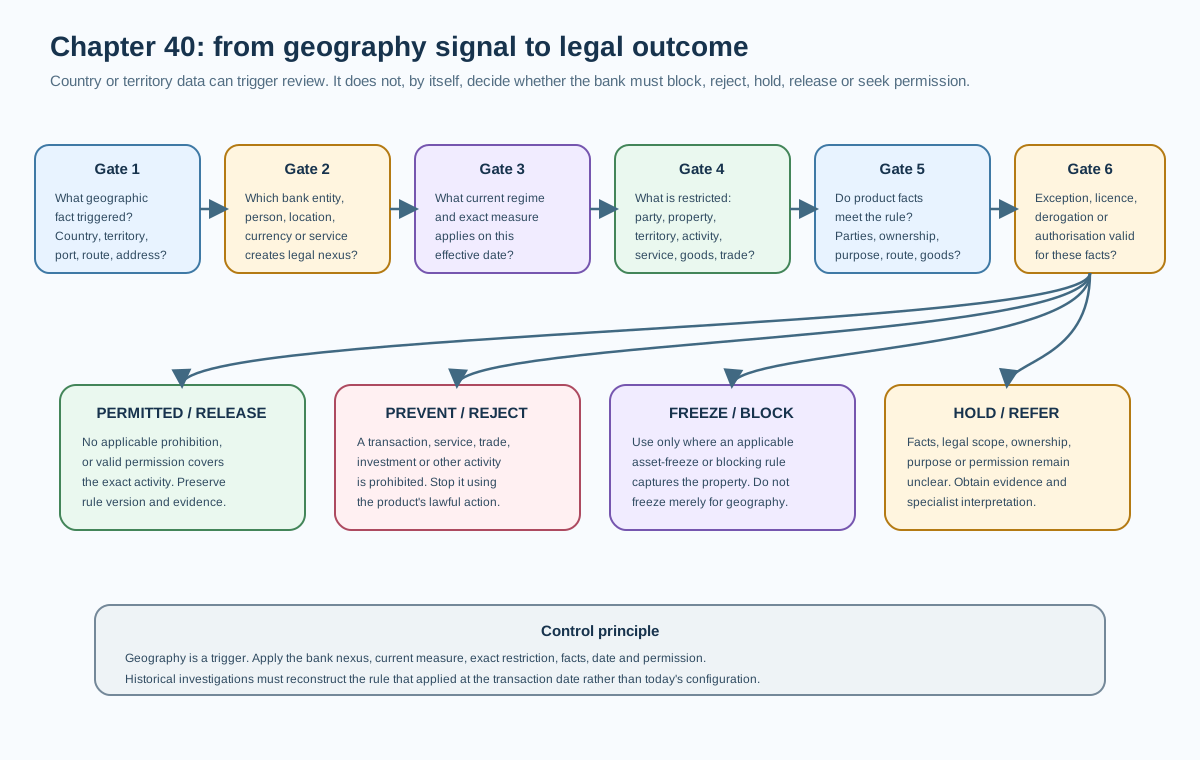
Why embargo control matters inside a bank
Country and territory sanctions can touch almost every banking product. A retail payment may involve a beneficiary in a restricted territory. A corporate payment may finance services that are prohibited even though the beneficiary is not listed. A letter of credit may involve permitted parties but restricted goods, origin or destination. An investment bank may face restrictions on dealing in specified securities or providing particular capital-market services. A card issuer may need to prevent use in certain locations. An asset manager may need to assess an issuer, security and market restriction. A correspondent bank may see only part of the underlying commercial purpose but still have legal obligations based on the payment and its own jurisdictional nexus.
The risk is asymmetric. Under-blocking can expose the bank to a prohibited transaction, asset-freeze breach, regulatory action or facilitation of sanctions evasion. Over-blocking can deny legitimate access to banking, interrupt humanitarian flows, reject permitted remittances, breach customer expectations and create large operational backlogs. A control that simply blocks everything associated with a high-risk geography can therefore be both inefficient and legally inaccurate.
The control also changes faster than many ordinary banking rules. New designations can take effect quickly. Regulations may introduce transition periods or wind-down dates. General licences can be issued, amended or revoked. Territorial scope can change. A regime can move from broad restrictions to more targeted measures, or the reverse. The U.S. Syria programme is an important recent example. OFAC states that the economic sanctions constituting the Syria Sanctions Program ceased to be in effect from 1 July 2025 following Executive Order 14312, while targeted authorities continued to apply to specified actors and activities. OFAC subsequently removed the old Syrian Sanctions Regulations and continued Syria-related targeted measures under other authorities. A static “Syria = block all” rule left running in 2026 would therefore produce an incorrect result.
This is why embargo control is not simply a screening problem. It is a legal-rule-management, data, product, decisioning and change-governance problem that happens to use screening as one of its tools.
Embargo, sanctions, restrictive measures and prohibitions
The language differs across jurisdictions. The United States commonly refers to economic and trade sanctions. The European Union uses the term restrictive measures. The United Kingdom uses sanctions legislation covering financial, trade, transport, immigration and other measures. The United Nations Security Council establishes sanctions regimes through resolutions, which are then implemented by states and regional bodies.
“Embargo” is often used most precisely for a prohibition on particular trade, such as an arms embargo, but banking teams frequently use the word more broadly to describe country or territory restrictions. That broader internal usage is acceptable only if the underlying system remains precise. A case labelled EMBARGO_ALERT still needs to identify the actual legal provision, restriction type, affected party or activity and jurisdiction.
The important categories include asset freezes, prohibitions on making funds or economic resources available, restrictions on financial services, transaction bans, correspondent-banking restrictions, import and export bans, services restrictions, investment restrictions, securities restrictions, transport measures, port-access restrictions, arms embargoes and controls on specified goods or technology. The same regime may contain several of these at once.
These categories should not be treated as synonyms. A transaction ban is not automatically an asset freeze. A trade prohibition is not automatically a prohibition on all banking services. A designated-country reference is not automatically a listed-party match. A service restriction may depend on the type of service and recipient. The system needs enough granularity to preserve these differences.
Comprehensive versus selective programmes
OFAC’s public description is useful because it makes the basic point clearly: sanctions programmes can be comprehensive or selective. A broad or geographically oriented programme can restrict a wide range of dealings connected to a country or territory. A selective programme may focus on specified persons, sectors or activities. Neither label should be used as a substitute for reading the current legal framework.
In practice, “comprehensive” also does not mean “there are no lawful transactions.” Regulations can contain authorisations, exceptions or licences. Humanitarian activity, personal remittances, telecommunications, information, diplomatic activity, food, medicine or other categories may receive different treatment depending on the regime. The conditions matter. A payment narrative saying “humanitarian” is not itself an authorisation.
Selective measures can also be severe. A country may not be subject to a broad embargo, yet a transaction can still be prohibited because a counterparty is designated, owned by a designated person under an applicable ownership rule, involved in a restricted sector, receiving a prohibited service or transacting in a restricted security. Conversely, a country can be high-risk without every transaction being prohibited.
For a bank, the right design is therefore a restriction matrix, not a traffic-light country list. The matrix links legal regime, restriction type, affected population or activity, bank entity, product, effective date, permission route and operational response.
Geography is evidence, not the legal conclusion
A geography signal can come from many places: nationality, residence, incorporation, branch location, operating address, counterparty country, beneficiary-bank country, postal address, merchant country, IP geolocation, port, vessel route, goods origin, goods destination, intermediary bank, payment narrative or documentary trade data.
Those signals do not all mean the same thing. A customer’s nationality is different from residence. Residence is different from the destination of funds. A beneficiary bank’s country is different from the location of the beneficiary’s underlying activity. A merchant-acquirer country is different from where an online service is delivered. A port of loading is different from country of origin. An IP address is an imperfect technical observation, not legal proof of where a customer is located.
This is why sanctions screening should preserve field provenance. If the term “Cuba” appears, the analyst should know whether it came from beneficiaryCountry, a street name, remittance text, merchant descriptor, port field or free-text customer note. A substring match without field meaning can produce an enormous false-positive population.
Structured data improves control only when it is used correctly. ISO 20022 can carry structured party and postal-address information, but an upstream channel can still populate the wrong country, an integration can default a field, or a transformation can flatten structured data into an unlabelled string. Country controls therefore depend on both reference data and data lineage.
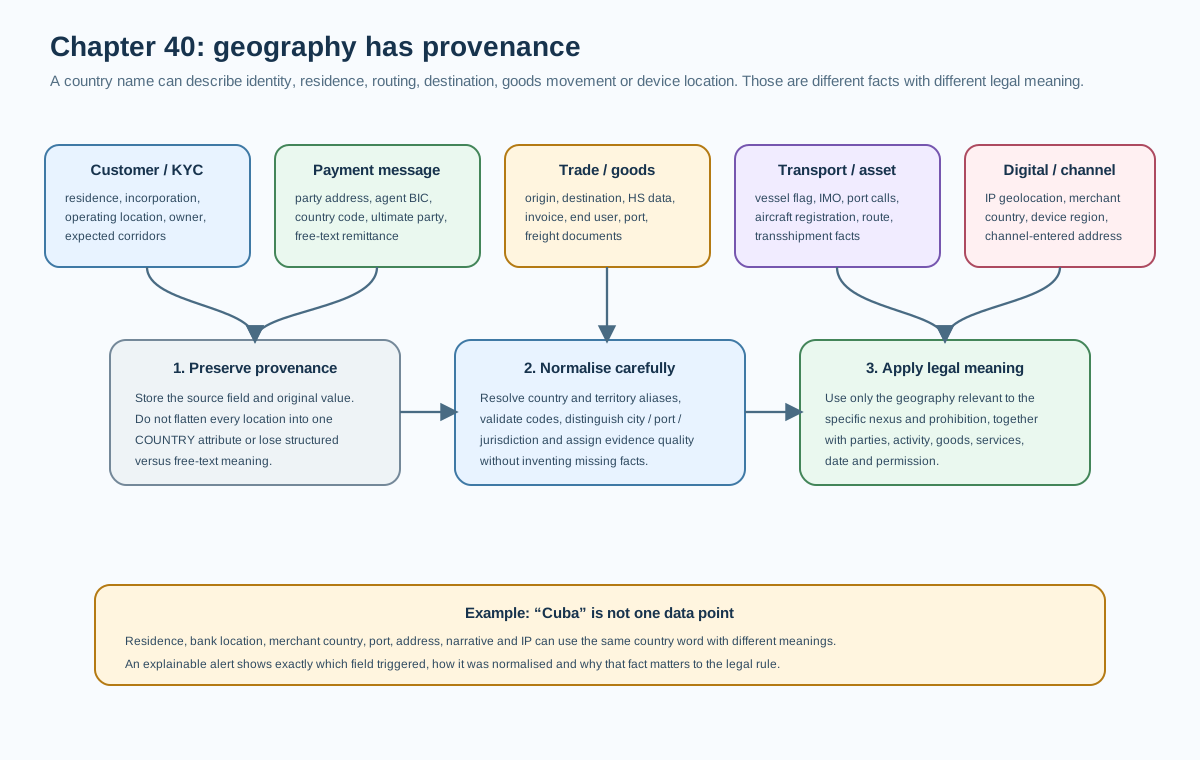
Country versus territory
Some sanctions measures apply to defined territories rather than an entire sovereign state. This creates a practical problem because many customer and payment systems are designed around ISO country codes and do not store sub-country geography consistently.
A territory control may require region, city, postal code, coordinates, free-text address interpretation or another structured geographic attribute. Names can have multiple spellings, languages and transliterations. Political naming can also be sensitive. The sanctions system should therefore follow the legal definition in the applicable measure and maintain controlled aliases rather than relying on analyst memory.
Testing must cover boundary conditions. If a rule applies to a named territory from a specific effective date, the engine should not automatically treat every transaction associated with the wider country as prohibited unless the legal measure does so. Conversely, a country-only field can be insufficient to detect a territorial restriction. The requirement should explicitly state what data is available and what risk remains where the bank cannot resolve the sub-country location.
Sanctions nexus: why a rule applies at all
Before deciding whether a restriction is breached, the bank has to understand why the relevant sanctions regime applies to the activity. Nexus can arise through the bank’s legal entity, the location of an activity, nationality or establishment of persons involved, currency clearing, payment routing, property, services, contractual performance, goods or other legally relevant connections.
The analysis is jurisdiction-specific. U.S. sanctions can apply to U.S. persons and, depending on the authority, to other conduct with a relevant U.S. nexus. A USD payment can involve U.S. clearing and create material sanctions considerations, but the slogan “all USD payments are governed by OFAC everywhere” is too broad to be a legal rule. UK sanctions apply to persons in the United Kingdom and to UK persons, including relevant legal entities, wherever they operate, as described in OFSI guidance. EU restrictive measures bind within EU jurisdiction, including EU nationals and entities as defined by the applicable legal framework.
A global bank therefore needs to represent the legal entity performing the activity and not only the customer-facing brand. A group may have a UK branch, EU subsidiary, U.S. entity and Asian affiliate participating in the same end-to-end service. The group can also maintain risk appetite stricter than the legal minimum. That policy overlay should be labelled as group policy, not misrepresented as a statutory prohibition.
For cases, a field such as applicableRegime = OFAC is not enough. The evidence should show the reason for applicability: for example, U.S. legal entity, U.S. person involvement, U.S. clearing, UK entity, EU establishment or other relevant nexus determined by approved legal interpretation.
Legal entity and processing chain
Modern banking platforms centralise processing, but legal obligations still attach to legal persons and activities. A payment may be initiated by a customer of one subsidiary, validated in a group channel, screened in a shared service, booked in another entity and cleared through an external correspondent.
That makes bookingEntity only one part of the picture. A useful model can also capture customerEntity, processingEntity, instructingAgent, intermediaryAgent, clearingAgent and settlementEntity. The exact fields depend on product and architecture, but the principle is stable: the sanctions decision must be traceable to the entities and roles that create legal exposure.
Shared screening services should therefore avoid one global rule outcome where legal scope differs. The engine can centralise data and matching while still applying entity-specific rule sets. A candidate hit may require one entity to prohibit, another to escalate under policy and a third to have no legal restriction. Centralisation should improve consistency without erasing legal distinctions.
The customer lifecycle
Embargo control starts before the first transaction. During onboarding, a bank may need to understand nationality, residence, incorporation, principal place of business, operating locations, beneficial ownership, controllers, counterparties, expected trade corridors and customer sector, depending on the product and applicable requirements.
The purpose is not to collect every possible country connection. It is to establish enough context to know whether the relationship is legally permissible and whether the institution can manage the risk. A multinational customer incorporated in a low-risk country may have material operations in a restricted territory. A humanitarian organisation may operate in a highly sanctioned environment under a valid permission structure. A student, refugee or family-remittance customer may have legitimate personal connections that should not be treated as evidence of evasion.
Expected geography should be stored as a living profile. If a corporate customer that historically operates within Europe suddenly begins paying intermediaries in new high-risk corridors related to restricted goods, the new geography can become relevant. If the customer legitimately expands, KYC should be refreshed. Monitoring is strongest when it can compare actual activity with current expected activity rather than stale onboarding text.
Sanctions changes can also trigger event-driven reviews. A previously acceptable counterparty country can become subject to new measures. A territory definition can change. A general licence can expire. A customer’s new owner can create a list-based restriction even when country exposure is unchanged.
Country risk is not the same as sanctions prohibition
Banks commonly maintain geographic risk ratings for AML/CFT, corruption, fraud, tax, sanctions, conflict and other risks. Those ratings are useful for customer risk assessment and monitoring, but they should not be confused with a sanctions prohibition.
A high-risk jurisdiction score may justify enhanced due diligence, stronger evidence, additional approval or monitoring. It does not by itself mean the customer or payment must be rejected. Conversely, a legally prohibited transaction can occur in a country that the AML country-risk model rates as low risk if a designated party or restricted activity is involved.
This separation should appear in the data model. CountryRiskRating, SanctionsRestriction, LegalProhibition, PolicyRestriction and MonitoringRisk are different concepts. When they collapse into one HIGH_RISK_COUNTRY flag, analysts can no longer explain why an action occurred.
Payment screening and interdiction
Payment screening is the most visible operational control because it can interrupt value movement before settlement. The engine may screen parties, financial institutions, addresses, countries, free text, vessels, identifiers and other relevant fields.
Country controls within screening should be designed with precision. A structured country code in the beneficiary address can be evaluated against current geographic restrictions. Free text may need fuzzy matching and contextual review. Agent locations can be relevant to routing. Ultimate debtor or creditor information can be relevant where present. Trade-related payment messages may include additional purpose or documentary information.
The difficult part is that a payment message often does not contain enough information to decide a complex sanctions question. An analyst may know the payer, payee, banks, amount, currency and remittance text but not the underlying goods, service, end user or licence. That should lead to a controlled request-for-information process rather than an invented conclusion.
The control also needs a timeout strategy. Instant payments, card authorisations and high-volume retail transfers cannot always support a long investigation before customer response. The product design should decide which risks can be resolved synchronously, which require pre-validation, which transactions are ineligible for an instant route and what fail-safe behaviour applies when a sanctions service is unavailable.
ISO 20022 and payment-data lineage
ISO 20022 improves the potential for structured party, agent and address data, but the standard does not guarantee sanctions-quality information. A debtor or creditor can still have incomplete address data. A channel can collect a country but lose it during mapping. An intermediary can truncate or transform data. A sanctions engine can receive a normalised record that no longer preserves the original field meaning.
For investigations, the bank should be able to reconstruct what was actually screened. That means retaining the source message or an immutable representation, the normalised screening input, the rule-set version, list version, country/territory reference-data version and outcome.
A good BA requirement does not simply state “screen all ISO 20022 fields.” It identifies which message elements are relevant by payment rail and role, how repeating parties are handled, how unstructured and structured addresses are normalised, which transformations occur and which data is unavailable at the decision point.
Traceability also matters for repairs. If an operator changes a beneficiary address after a sanctions alert, the system should retain both the original and amended values. Screening should run again on the changed data where policy requires. The audit trail should show why the repair was permitted and who approved it.
Correspondent banking and nested activity
Correspondent banking creates a special visibility problem. A correspondent processes payments for a respondent bank and may not have a direct relationship with the underlying originator or beneficiary. The payment message therefore becomes a critical source of information.
A correspondent should not pretend it can perform full customer due diligence on every underlying customer. It should, however, understand the respondent relationship, expected corridors, products, sanctions-control capability and material nested activity. If payment data repeatedly points to restricted territories, opaque underlying parties or unusual routing, the concern can move from a single payment to respondent-bank risk.
Nested relationships deserve particular attention because another financial institution may be using the respondent’s account to access the correspondent. Nested activity is not automatically improper, but it can reduce transparency. The bank should know whether it is permitted, whether it was disclosed and how the respondent controls the underlying risk.
Country controls in correspondent banking should therefore operate at both transaction and relationship level. A clean individual payment does not eliminate concern if the overall corridor is inconsistent with the respondent’s profile.
Trade finance: where geography becomes multidimensional
Trade finance shows why country-only logic is inadequate. A documentary transaction can involve applicant country, beneficiary country, issuing bank, confirming bank, goods origin, goods destination, port of loading, port of discharge, vessel, carrier, insurer, freight forwarder and end user. Several of those facts may create sanctions relevance.
The payment destination may be permitted while the goods destination is restricted. The buyer and seller may be clean while the goods are prohibited. The goods may be permitted but the vessel is designated. The shipment may route through a restricted port. A licence may authorise the activity only for a specified end user or period.
Trade controls therefore need joined-up evidence. Documentary data should not be reduced to a beneficiary-country field. Bills of lading, invoices, certificates of origin, transport documents and commodity descriptions can provide context, but documents are not infallible. In higher-risk cases the bank may need independent information or specialist trade-sanctions review.
Financial institutions also need to be realistic about role. A bank financing a documentary trade may have rich goods and shipment data. A bank processing an open-account payment may have almost none. Control expectations should reflect actual visibility and applicable legal duties rather than assuming all payment banks can classify goods.
Goods, services and end use
Broad country measures often interact with restrictions on goods, technology or services. The legal question may depend on what is supplied, to whom, for what purpose, from where and under which authorisation.
Goods controls can use customs classifications, export-control classifications, free-text descriptions and trade documents, but each has limitations. A vague invoice line such as “equipment” is not sufficient for a technical determination. A bank should not invent a goods classification simply to close an alert. Specialist export-control expertise may be required.
Services restrictions can be even harder because the payment may say only “consulting fee” or “IT support.” The sanction may prohibit a specific category of professional or technical service to specified recipients or territories. The bank’s customer profile, contract, invoice, counterparty and service description may therefore matter.
End use and end user can be central in export-control or proliferation-sensitive contexts. A transaction that appears to involve a distributor in a third country can still create risk if goods are intended for a prohibited final destination or restricted end user. The bank must distinguish legitimate re-export from evasion based on evidence rather than geography alone.
Origin, destination and transshipment
Country of seller, country of buyer, country of goods origin and country of destination are separate facts. A commodity can be sold by a company in one jurisdiction, shipped from another and originate in a third. Sanctions or import bans can depend on origin even where the immediate seller is not located in the restricted jurisdiction.
Transshipment is also common in legitimate global logistics. Goods move through hubs because of shipping schedules, consolidation and cost. An indirect route is therefore not proof of circumvention. Risk becomes stronger when routing is combined with unexplained document changes, newly formed intermediaries, restricted goods, inconsistent commercial rationale, unusual payment behaviour or a final destination that the customer is reluctant to disclose.
The bank should preserve route changes over time. A shipment that changes port after sanctions take effect may deserve review. The analyst should still ask whether there is a legitimate operational reason before drawing a conclusion.
Vessels, aircraft and ports
Country controls can overlap with transport sanctions. A vessel may be designated, subject to port restrictions or connected to prohibited trade even if the owner and payment beneficiary appear ordinary. Aircraft can be subject to similar measures.
Vessel identity should rely on stable identifiers such as IMO number where appropriate rather than name alone because names and flags can change. Port names and UN/LOCODE data can help structure geography. AIS and maritime intelligence can support investigation, but AIS gaps, ship-to-ship transfers and unusual routing are indicators rather than proof of sanctions evasion.
The bank’s visibility depends on the product. Trade finance may receive vessel and port data before financing. A later payment may not. Where transport information is available, it should be connected to the sanctions case rather than stored in an isolated trade platform.
Cards, merchants and digital commerce
Card sanctions controls operate under a different decision clock. The issuer may have merchant name, merchant category code, merchant country, acquirer information and network data at authorisation. That may be enough for some country restrictions but insufficient for complex ownership or service analysis.
Merchant country can also be misleading in digital commerce. A platform can be incorporated in one country, process payments through another and deliver a service elsewhere. A consumer can use a VPN. The card should not treat an IP or merchant descriptor as perfect evidence.
The product design should separate real-time hard prohibitions from post-event monitoring and relationship review. If a card transaction is declined for a sanctions reason, customer communication should use approved wording and avoid implying a criminal accusation.
Cash, ATM and branch activity
Cash and ATM transactions can create geographic signals when a customer withdraws or deposits funds in or near a restricted jurisdiction. The signal can be useful for risk monitoring, but it is not automatically a sanctions breach.
Travel, humanitarian work, migration, family circumstances and cross-border employment can all create legitimate cash behaviour. The applicable regime may also contain personal or travel-related permissions. The bank should therefore use customer context and legal scope.
Branch operations need similar discipline. A customer presenting documents from a sanctioned country should not be treated as prohibited merely because of document origin. Identity, residency, nationality and sanctions applicability should be analysed separately.
Securities, investments and asset management
Sanctions can restrict securities, new debt or equity, investment, capital-market access or transactions with specified issuers. These controls need instrument-level data, issuer data, ownership information and effective dates.
A security can remain in a portfolio after a new restriction takes effect. The institution then needs to determine whether holding, receiving income, selling, transferring or participating in a corporate action is permitted. A passive index product does not eliminate sanctions obligations.
Country rules therefore need to connect with security master data and corporate actions. The same issuer can have several instruments with different terms. A restriction on new debt of specified maturity, for example, is different from a full asset freeze. The decision engine should preserve the exact legal basis instead of simply labelling the issuer “sanctioned.”
Lending, guarantees and insurance
Country restrictions can apply before a payment occurs. A prohibited financing commitment can be problematic even if funds have not yet been drawn. Guarantees, letters of credit and insurance can also provide economic support.
This means sanctions controls should appear in product approval and deal lifecycle, not only at settlement. Relationship managers and credit teams need escalation paths for high-risk jurisdictions. Conditions precedent can require sanctions confirmation. Changes in law between signing and drawdown can require re-assessment.
For architects, the key design point is to identify the legally significant event. It may be contract entry, extension of credit, issuance of a guarantee, payment, renewal, amendment or performance of a service. Screening only the final cash movement can be too late.
Humanitarian activity and financial inclusion
Sanctions frameworks often include humanitarian exceptions or licensing pathways because broad financial restrictions can otherwise obstruct food, medicine, relief work and essential civilian activity. The existence and wording of those permissions vary by regime.
A bank should therefore have a practical route for handling humanitarian payments. The workflow needs to identify the organisation, purpose, counterparties, route, legal basis, licence or exception, conditions and recordkeeping requirements. Analysts should not accept a narrative saying “aid” as proof, but neither should the institution operate a blanket geographic block that makes lawful humanitarian activity impossible.
Operational capacity matters. If every humanitarian payment requires days of manual escalation, the control may technically permit the transaction but functionally prevent it. The bank should design recurring-party due diligence, licence templates and evidence reuse where legally appropriate while still rechecking time-sensitive facts.
The same principle applies to personal remittances, diplomatic activity and other permitted categories. A risk-based approach should protect the sanctions objective without creating unnecessary exclusion.
Exceptions, general licences and individual licences
Permissions are part of the legal framework, not a loophole outside it. An exception may apply automatically when defined conditions in the regulation are met. A general licence can authorise a class of transactions subject to its terms. An individual or specific licence is issued for a particular applicant, activity or set of facts. Terminology differs by jurisdiction, so system labels should map to the source authority.
OFSI’s UK guidance is especially clear that an exception operates automatically where its conditions are satisfied, while a licence is written permission for activity that would otherwise breach sanctions. UK authorities also divide licensing responsibility across financial, trade and transport functions. OFAC similarly describes a specific licence as an authorisation to engage in activity that would otherwise be prohibited and publishes general licences for classes of activity.
The control failure to avoid is the “whitelist.” A licence should not become a permanent instruction that all payments for a customer, beneficiary or country are safe. Permissions have scope, dates, parties, purposes, amounts and conditions. Some require reports or records. Some are amended or revoked.
A proper licence object therefore contains authority, regime, licence identifier, type, effective date, expiry date, covered parties, covered activity, conditions, reporting obligations, document source, legal owner and approval status. Transactions should reference the exact licence version used for the decision.
Effective dating is a core sanctions capability
Sanctions are time-dependent. A transaction can be permitted on Monday and prohibited on Tuesday, or the reverse. A licence can expire. A designation can be added or removed. A wind-down period can end. A territory rule can change. A court decision or regulatory guidance can affect interpretation.
Every sanctions rule therefore needs effective dates and versioning. “Current state” is not enough because investigations, audits and regulatory requests often look backward. The bank must reconstruct what rule applied at the time of the transaction and what information the control had.
The Syria example demonstrates this clearly. Historical transactions before 1 July 2025 may need analysis under the then-applicable U.S. Syria framework. Transactions after that date require the post-revocation framework and any other applicable targeted authorities. Replacing an old country flag with a new one without preserving history would destroy the audit trail.
Testing should explicitly include transactions around midnight and cutover boundaries, future-dated payments, standing orders, batches created before a rule change but released after it and delayed settlement.
Rule management and horizon scanning
A strong bank has a controlled path from external legal change to production behaviour. The sequence normally includes official-source monitoring, legal interpretation, policy impact, rule design, data impact, system configuration, testing, deployment, operations communication and post-change validation.
Not every change can wait for a monthly release. Designations and emergency measures may require rapid implementation. The institution should define emergency-change procedures with maker-checker control, documented legal approval and fast regression testing.
Horizon scanning should use competent-authority publications as the legal master. News services and vendors can provide awareness, but the final rule should be traceable to official legal text or approved legal interpretation. Vendor feeds also need governance: timeliness, completeness, schema changes, failed loads and reconciliation against source authorities should be monitored.
Change latency is a useful management metric. The bank should know the time between official publication, internal legal decision, rule deployment and confirmation that all relevant systems are operating correctly.
Screening versus policy decisioning
Screening is good at finding candidate matches. It is not always the best engine for applying complex country policy.
A screening engine can identify a country, territory, party or vessel. A policy or sanctions-rules engine can then evaluate legal entity, product, transaction type, goods, service, ownership, route, effective date and permission. Combining both functions in one opaque score can make explanations difficult.
The architecture can therefore separate detection from legal decisioning. Detection answers “what potentially relevant facts are present?” Decisioning answers “what rule applies and what action follows?” Case management handles unresolved questions and records evidence.
This separation also improves testing. Matching quality can be tested independently from legal-rule logic. A country alias defect is different from an incorrect licence rule. Operations can see whether an alert was created because of a data match or because a rule concluded the activity was restricted.
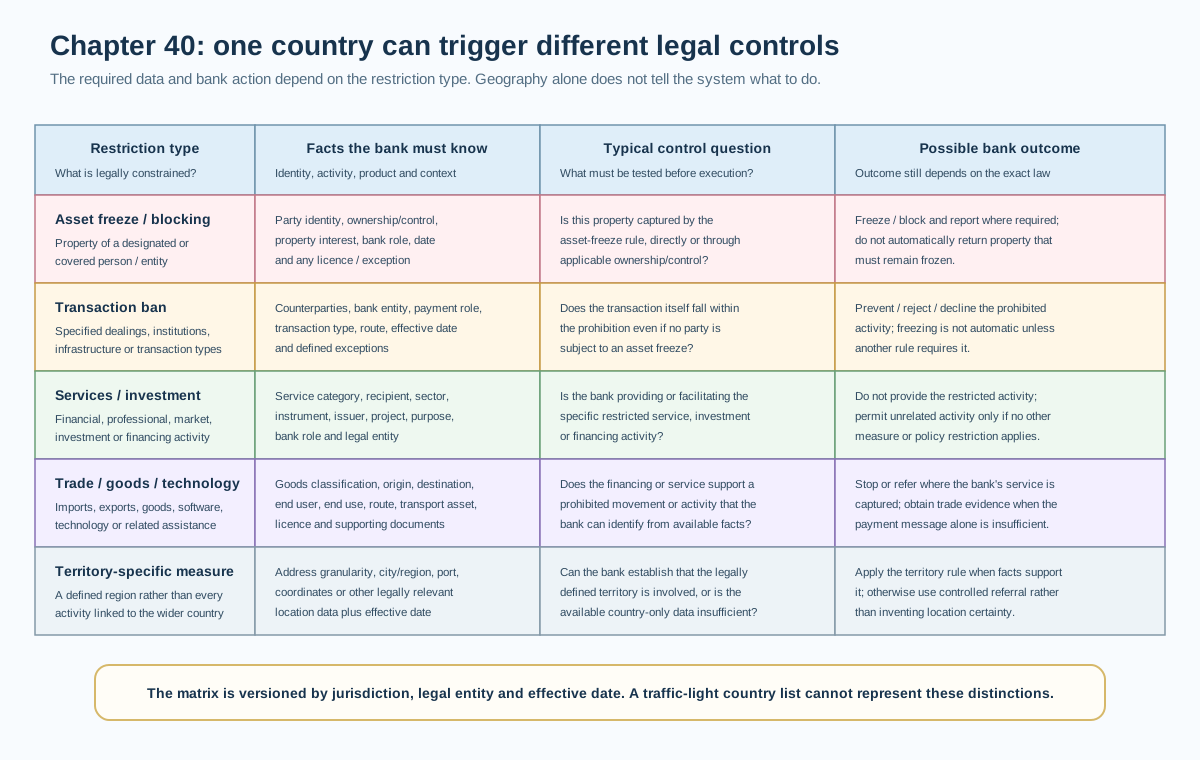
Alert, case and investigation flow
A country alert should begin with the trigger: which field, transaction or relationship fact created concern. The analyst then confirms the data. If the trigger is a malformed country code or obvious address false positive, the case can be resolved quickly. If the geography is real, the analyst identifies applicable regimes and the specific restriction.
The next questions are activity-based. Who are the parties and owners? What product is being used? What is the underlying purpose? Are goods, services, investments or transport involved? Is there a designated party? Is there a licence or exception? Does the bank need more information from the customer or respondent?
Evidence should be proportionate. A simple permitted remittance may require limited confirmation. A complex trade involving multiple intermediaries and restricted goods can require contracts, invoices, transport documents, ownership data and specialist legal review.
The investigator’s rationale should distinguish facts from inference. “Beneficiary bank located in Country X” is a fact. “Payment may support restricted activity” is an assessment. “Transaction is prohibited under Regulation Y because condition Z is met” is a legal conclusion based on approved interpretation. Keeping those layers separate makes QA and audit possible.
Hold, reject, return, freeze, release
Operational outcomes are not interchangeable. A hold is usually a temporary processing state while the bank resolves uncertainty. A reject normally means the bank refuses to execute or accept the instruction. A return moves value back through a payment chain where permitted. A freeze or block concerns property or funds subject to an applicable asset-freeze requirement. A release means the bank has resolved the control and permits processing.
The legal framework determines which outcomes are available. A bank should not “return to be safe” if the funds are required to remain frozen. Equally, it should not freeze property merely because a country alert is unresolved. The system state should represent the legal and operational reality.
The case should store the decision reason separately from the payment status. REJECTED alone does not explain whether the reason was sanctions, fraud, invalid account, scheme validation or customer cancellation.
Customer communication should use approved, neutral language. “Your payment is under review” is different from “your payment is blocked under sanctions.” The latter is a legal statement and should not be used unless that conclusion has actually been reached.
Returns are transactions too
One subtle failure mode occurs when a bank detects sanctions risk after receiving funds and assumes the safest step is to send them back. A return is itself a movement of value and can be subject to sanctions restrictions.
If property must be frozen, the bank may not be permitted to return it. If the payment can legally be rejected before acceptance, the outcome can differ. The exact treatment depends on the legal regime, the bank’s role, payment state and ownership of the funds.
Systems should therefore model the return as a linked transaction with its own sanctions decision. The original payment ID, return reason, amount, currency, parties and legal basis should be preserved. An automatic “sanctions alert = return” rule is unsafe.
Post-event discovery
Controls sometimes fail. A sanctions rule may be late. Data may have been missing. A payment can settle before a relevant ownership link is discovered. A customer may provide misleading information. A list update may reveal an earlier connection.
When the bank discovers an issue after the event, the response should preserve history rather than rewrite it. The team establishes the timeline, affected transactions, legal framework in force at the time, control behaviour, customer and counterparty relationships, potential reporting obligations and remediation.
A lookback may be required to identify related activity. Root-cause analysis should distinguish external intelligence change from internal control failure. If the bank did not have the information at the time, that is different from having it and failing to screen it.
Data lineage becomes critical here. Investigators need the original message, rule version and list version, not only today’s enriched record.
Circumvention and third-country routing
Sanctions evasion rarely announces itself with the name of the restricted destination in the payment narrative. Networks can use third-country companies, distributors, freight forwarders, nominee ownership, re-export routes, alternate currencies, cryptoassets or multiple banks.
The challenge is avoiding guilt by geography. A distributor in a regional trading hub can serve many legitimate customers. A transshipment route can be normal. A new counterparty can be commercially reasonable. The bank should look for combinations of indicators that conflict with the customer’s expected business.
Useful questions include whether the customer’s goods or services are sensitive, whether turnover changed after sanctions, whether counterparties are newly formed, whether ownership is opaque, whether invoices become vague, whether payment routes change without business explanation, whether goods destinations differ from payment destinations, and whether counterparties have links to known evasion networks.
Transaction monitoring can support embargo control by identifying these behavioural changes, while screening handles known lists and geographic terms. Neither control is sufficient alone.
Payment narratives and customer-provided purpose
Free-text payment purpose can help an analyst, but it is weak evidence by itself. A customer intent on evasion can omit restricted words. An innocent customer can use vague wording such as “invoice payment.” Automated keyword controls therefore need calibration.
Repeatedly inconsistent purpose information can become meaningful when combined with other evidence. If KYC says a company sells domestic consumer goods but payments describe industrial equipment exports through unfamiliar intermediaries, the bank has a reason to investigate.
Requests for information should be specific. Asking “please explain this payment” often produces generic answers. Asking for underlying contract, goods or service description, end destination, counterparty relationship and licence basis can produce actionable evidence.
Data architecture for embargo control
A robust domain model should avoid placing the whole legal conclusion on Country. Useful entities include Jurisdiction, LegalEntity, SanctionsRegime, LegalMeasure, Restriction, Country, Territory, Party, OwnershipRelation, Account, Payment, Security, GoodsClassification, ServiceCategory, Vessel, Aircraft, Port, Licence, Exception, Decision, Case and Evidence.
Relationships need effective dates. A legal measure applies from a date. A licence has a validity period. A beneficial owner may change. A customer’s operating location can change. A vessel can change flag or name while retaining a stable identifier.
Reference-data governance is equally important. Country codes, territory aliases, ports and sanctions-programme identifiers need controlled ownership. If the same territory is represented differently in KYC, payments and trade, the bank can miss a risk or create duplicate alerts.
Decision data should be immutable enough for audit. If a rule is updated, historical cases should still show which version produced the original result.
A practical sanctions decision object
A useful decision record contains the triggering facts, applicable bank entity, legal jurisdiction, regime, measure, restriction type, relevant parties, geography, goods or services where applicable, licence or exception, decision, operational action, decision timestamp, rule version, evidence references, analyst or automated decision source and approval.
This structure helps different users. Operations sees what action to take. Compliance sees the legal basis. Audit sees reconstruction. Developers can test deterministic fields. Data teams can measure outcomes without reading free text.
Free-text rationale remains valuable for nuanced cases, but it should sit on top of structured decision data rather than replace it.
Business analyst requirements
For a BA, sanctions requirements should be written as testable behaviour rather than slogans. “Block sanctioned countries” is not a usable requirement. A better requirement states which regime, legal entity, geography element, restriction, effective date and outcome apply, and what happens if required information is unavailable.
Requirements should cover positive, negative and boundary cases. A payment that is prohibited should be stopped correctly. A permitted humanitarian payment should proceed when all licence conditions are met. A street name containing a restricted-country word should not cause an unnecessary hard block. A rule should change on its effective date. A historical replay should use the historical rule set.
Dependencies must be explicit. If the rule assumes beneficiary country comes from a specific ISO 20022 element, the mapping should be documented. If trade screening needs vessel IMO, the source should be identified. If a licence must be linked to an account, the identifier and lifecycle should be defined.
Non-functional requirements matter too: decision latency, failover, list-update timing, audit retention, access control, privacy, resilience and case backlog thresholds.
Architecture considerations
The architecture should support multiple legal regimes without duplicating the entire platform. Shared capabilities can include list ingestion, name matching, geographic normalisation, case management, evidence storage and audit logging. Rule evaluation can be parameterised by legal entity and product.
A common anti-pattern is hard-coding country logic in multiple channels. The mobile app, corporate channel, payment hub, trade platform and card processor then drift apart. Central services can reduce inconsistency, but only if they meet the latency and availability needs of each product.
Another anti-pattern is a central screening result with no explanation. Downstream systems receive BLOCK=true but cannot tell whether the cause is a listed party, country rule, ownership, goods restriction or temporary service failure. The response contract should include controlled reason codes and rule identifiers while limiting sensitive detail exposed to inappropriate users.
Resilience design should define behaviour when the sanctions service is unavailable. Depending on product and risk, a transaction may queue, fail closed, fail open only under tightly governed exceptions or route to manual handling. That decision belongs to policy and product governance, not only to technology.
Testing strategy
Testing should prove legal logic and data behaviour. Core scenarios include customer residence in a restricted territory, incorporation elsewhere, beneficiary in a third country, restricted ultimate destination, designated owner, clean parties with prohibited goods, general licence, individual licence, expired licence, exception, humanitarian activity, restricted service, investment restriction, batch file, instant payment, card transaction, correspondent payment, return and post-settlement discovery.
Effective-date tests are essential. A payment created before a rule change but executed after it should use the appropriate decision point. A standing order should be re-evaluated at execution. A batch with several transactions should handle item-level sanctions outcomes according to product design rather than failing unpredictably.
Data-quality tests should include missing country, invalid code, aliases, transliteration, territory names, duplicate place names, address parsing and transformations between channel and screening engine.
Regression testing should cover overblocking. When a country restriction is removed or narrowed, the test pack should prove that old rules no longer fire. Syria is a strong 2026 test case for U.S. sanctions configuration because the old comprehensive framework is no longer in effect.
Quality assurance and second-line challenge
QA should assess more than whether the analyst clicked the correct disposition. It should ask whether the right regime was identified, whether the geographic fact was interpreted correctly, whether ownership and activity were considered, whether a licence was validated, whether the evidence was sufficient and whether the operational state matched the legal conclusion.
Second-line sanctions teams should challenge recurring patterns. If analysts frequently close a particular country alert as false positive, the rule may need tuning. If analysts repeatedly require information that the customer channel could collect upfront, the process can be redesigned. If licence cases are ageing, capacity or ownership may be inadequate.
Quality findings should feed policy, training, data and technology changes. A case-review programme that only grades investigators but never improves the control misses much of its value.
Roles and governance
First-line business and operations teams own customer and transaction activity within their responsibilities and execute approved controls. Specialist sanctions operations investigate alerts. Compliance or sanctions advisory interprets policy and provides challenge. Legal supports difficult jurisdiction and statutory questions. Product owners define how controls fit the customer journey. Technology implements data and decisioning. Data owners maintain source quality. Internal audit independently assesses design and effectiveness.
Responsibilities should be explicit around urgent legal change. Who interprets the measure? Who approves the rule? Who deploys it? Who tests it? Who informs operations? Who confirms completion across every product? Ambiguity during a fast-moving sanctions event can create either missed exposure or widespread unnecessary blocking.
Governance should also control exceptions to bank policy. A business sponsor should not be able to override a legal prohibition. Where policy permits risk acceptance, approval levels, rationale and expiry should be documented.
Management information
Useful metrics include alert volumes by regime and product, true legal prohibitions, referral rates, false positives, aged cases, licence usage, country-rule update latency, failed list or rule loads, data-quality exceptions, payment holds, customer complaints, overblocking events, post-event discoveries, QA findings and repeat issues.
Metrics need context. A lower alert volume is not automatically better; it may reflect missed coverage. A higher true-match rate can reflect good tuning or an overly narrow rule. Long case duration can reflect complexity rather than poor productivity.
Senior management should be able to see whether the control is both effective and operationally sustainable. A sanctions programme that meets legal expectations only by accumulating an unmanageable backlog is not healthy.
Failure mode: the static country blacklist
The simplest design is a table with country and BLOCK/ALLOW. It is also one of the most dangerous. It cannot represent targeted measures, services restrictions, goods controls, licences, different legal entities, effective dates or partial territorial restrictions.
It also becomes stale. A country’s status changes, but the embedded rule remains. The resulting overblocking can persist for months because operations assumes “the system must know.”
The cure is a versioned legal-rule model with owned source links, change governance and regression tests.
Failure mode: treating strictness as accuracy
A common cultural problem is the belief that rejecting more transactions is safer. Excessive restriction can create legal, conduct and humanitarian problems, damage customer trust and obscure genuinely high-risk cases inside a large alert population.
Accuracy means prohibiting what must be prohibited, escalating what requires judgment and permitting what is lawful when the bank can manage the risk. Strong controls are discriminating, not merely severe.
Failure mode: one jurisdiction presented as global law
Global banks often build procedures around the most restrictive or operationally mature regime, then accidentally describe that procedure as universal law. OFAC rules, UK ownership concepts, EU restrictive measures and UN implementation are not identical.
Group policy can legitimately choose a consistent global standard, but training and systems should identify when the rule is policy rather than local legal obligation. This distinction becomes essential when a customer challenges a decision or a regulator asks for the legal basis.
Failure mode: licence as permanent whitelist
A licence can be copied into a static whitelist and then forgotten. That can allow transactions beyond scope or after expiry.
The remedy is structured licence data, transaction linkage, effective dates, conditions, usage tracking, reporting controls and expiry alerts. Analysts should see the permission and its limits at decision time.
Failure mode: broken data lineage
A channel collects the correct destination country, but the payment hub maps it incorrectly. Screening receives a default value. The alert never fires.
Alternatively, a free-text address triggers a country hit, but the analyst cannot see the original structured address and closes it inconsistently.
Data lineage testing should therefore be part of sanctions-control assurance. Policy cannot be effective if the system does not receive the facts policy assumes.
Mini case study: the outdated Syria hard block
Consider a U.S.-linked payment platform that still contains a historical rule COUNTRY=SY -> REJECT. In August 2026 a customer initiates a commercial payment involving a Syrian bank. No party is otherwise designated and the activity is not prohibited under another applicable U.S. authority, but the payment is automatically rejected.
The problem is not “too little sanctions control.” It is stale sanctions control. OFAC states that the Syria Sanctions Program was revoked effective 1 July 2025, with targeted authorities continuing separately. The platform has converted an old legal framework into a permanent country policy.
The incident review should identify who owned the rule, why the regulatory change did not retire it, how many customers were affected, whether other country rules are stale and whether the bank’s legal-entity logic is correct. The remediation is not merely deleting SY. It is strengthening horizon scanning, effective dating, deployment evidence and regression testing.
This case teaches an important principle: current legal accuracy is more important than inherited severity.
Mini case study: humanitarian payment under permission
A corporate customer that is a recognised relief organisation sends funds for medical supplies into a country subject to broad sanctions. The beneficiary is not listed. The payment purpose is consistent with the customer profile. A current general licence or exception potentially authorises the activity, but only if specified conditions are met.
The sanctions alert should not be auto-released because the narrative says “medical.” Operations verifies the organisation, parties, purpose, permission scope, dates and any conditions. The case links the exact authority and records the evidence. If all conditions are met, the payment can be released subject to reporting and recordkeeping requirements.
This is not a weak control. It is the control functioning as designed: identify the restriction, identify the lawful permission, verify the facts, execute the permitted transaction and preserve evidence.
Mini case study: clean beneficiary, restricted ultimate destination
A manufacturing customer in the EU pays a distributor in a third country for specialised equipment. The beneficiary and bank are not designated. Payment screening is clean. Trade documentation obtained through the customer relationship indicates that the distributor will re-export the equipment to a territory subject to relevant EU restrictions.
The bank now has a different question from “is the beneficiary country sanctioned?” It must understand the goods, final destination, applicable EU measure, customer role and any authorisation. A clean beneficiary screen cannot override a trade prohibition.
If the customer can show a valid permission and the activity falls within it, the bank records the basis. If the activity is prohibited, the third-country routing does not make it permissible. If facts remain unclear, the transaction is held or escalated according to policy.
Mini case study: false geographic keyword
A beneficiary address contains “Cuba Street” in a country unrelated to Cuba. A simple text rule creates an alert because the token “Cuba” appears.
A field-aware engine sees that the structured country is different and that “Cuba” is part of a street name. The analyst closes the candidate with a documented false-positive reason. Repeated cases are used to improve matching so that the system does not keep consuming operational capacity.
The lesson is not to remove geographic text screening. It is to preserve context and tune safely.
Mini case study: return versus freeze
A payment arrives from abroad and is credited to a suspense account while screening is completed. Investigation identifies that the beneficiary is subject to an applicable asset-freeze measure and the funds constitute property that must be frozen.
An operations user proposes returning the payment to the sender. That would move property and may be prohibited. The case is escalated, the funds are treated according to the applicable freeze requirements and reporting obligations are followed.
This case illustrates why REJECT, RETURN and FREEZE need separate legal and system states.
Mini case study: instant payment with insufficient context
A customer attempts an instant cross-border payment to a new beneficiary. A country signal indicates possible territorial sanctions exposure, but the payment message does not contain enough information to resolve the beneficiary’s operating location.
The bank has designed the product so that unresolved high-risk territorial cases cannot be decided safely within the instant rail. The transaction is not falsely declared prohibited. Instead, the customer is directed to a route that permits additional information and review, if product and law allow.
The lesson is that product eligibility can be a sanctions control. Not every complex case belongs in a sub-second decision path.
A joined-up operating model
Embargo control works when legal interpretation, data, product design and operations form one loop. Official changes are detected. Legal teams translate them into controlled obligations. Rule owners map those obligations to entities and products. Technology deploys and tests them. Screening and monitoring identify relevant facts. Operations investigates unresolved cases. Decisions and customer outcomes are recorded. QA finds weaknesses. Data and rule tuning feed back into the control.
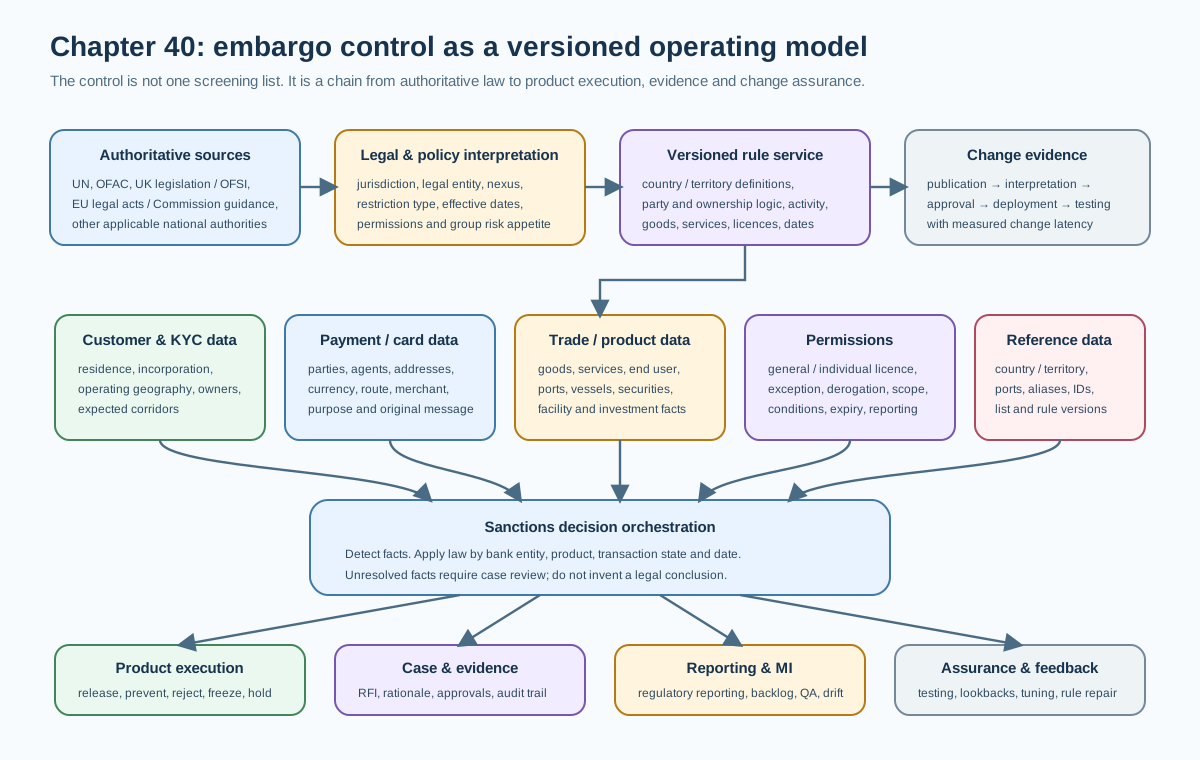
The strongest implementation is not the one with the most country blocks. It is the one that can explain, for every material decision, which rule applied, why it applied, what evidence was used, which permission was considered, what action followed and whether the same decision can be reconstructed later.
What a good analyst should be able to explain
By the end of this topic, an analyst should be able to explain why a country name is only a starting point; why comprehensive and selective sanctions differ; why the bank must identify legal nexus; why country, territory, party, ownership, goods, service, investment and transport restrictions are separate dimensions; why licences and exceptions are part of normal sanctions control; and why payment states such as hold, reject, return and freeze cannot be used interchangeably.
A business analyst should be able to translate those distinctions into data fields, rules, acceptance criteria and test cases. An architect should be able to separate detection, decisioning and case management while preserving rule versions and entity scope. A developer should understand why a Boolean country flag is insufficient. A tester should know that a permitted case is as important as a prohibited case. An operations analyst should know when to request more information rather than infer. A compliance professional should be able to connect the operational decision back to a current legal source.
The final mental model is simple enough to remember but precise enough to use: find the relevant fact, identify the legal nexus, locate the current measure, test the activity against its scope, test permissions, then take the exact authorised action.
References and further reading
- U.S. Department of the Treasury, Office of Foreign Assets Control — Sanctions Programs and Country Information: https://ofac.treasury.gov/sanctions-programs-and-country-information
- U.S. Department of the Treasury, Office of Foreign Assets Control — Where is OFAC's Country List?: https://ofac.treasury.gov/sanctions-programs-and-country-information/where-is-ofacs-country-list-what-countries-do-i-need-to-worry-about-in-terms-of-us-sanctions
- U.S. Department of the Treasury, Office of Foreign Assets Control — FAQ 1220, revocation of the Syria Sanctions Program effective 1 July 2025: https://ofac.treasury.gov/faqs/1220
- U.S. Department of the Treasury, Office of Foreign Assets Control — Syria Sanctions, inactive and archived / current Syria-related targeted authorities: https://ofac.treasury.gov/sanctions-programs-and-country-information/syria-sanctions-inactive-and-archived
- UK Office of Financial Sanctions Implementation — UK financial sanctions general guidance: https://www.gov.uk/government/publications/financial-sanctions-general-guidance/uk-financial-sanctions-general-guidance
- UK Government — How to use exceptions and licences to comply with sanctions: https://www.gov.uk/guidance/how-to-use-exceptions-and-licences-to-comply-with-sanctions
- European Commission — Overview of sanctions and related resources: https://finance.ec.europa.eu/eu-and-world/sanctions-restrictive-measures/overview-sanctions-and-related-resources_en
- United Nations Security Council — Sanctions information and sanctions committees: https://main.un.org/securitycouncil/en/sanctions/information
- The Wolfsberg Group — Sanctions Screening Guidance: https://wolfsberg-group.org/resources/legacy/53
Educational note: sanctions rules, designations, licences, exceptions and jurisdictional interpretations can change quickly. Live transactions should always be assessed against current competent-authority legal text and the bank's approved legal and compliance interpretation.
Advanced practice: embargo control as an applicability-and-decision problem
The mature way to operate embargo controls is to stop treating the word embargo as a payment outcome. It is a risk label for a family of legal measures whose actual effect depends on the authority, legal entity, jurisdictional nexus, parties, ownership and control, location, goods, services, investment activity, financial service, transaction date, licence or exception, and sometimes the route through which the value or service moves. The bank's job is therefore not to ask only “is this country sanctioned?” but to determine which measure applies to which activity at this point in time, what that measure prohibits or permits, and what controlled bank action follows.
This distinction matters because sanctions programmes can change rapidly and in different directions. A jurisdiction can move from broad economic restrictions to targeted measures, retain trade or security restrictions while lifting banking restrictions, or preserve list-based sanctions against specific people while opening ordinary commercial activity. A static COUNTRY = BLOCK_ALL rule may look conservative, but after a legal change it can become inaccurate, create unnecessary customer exclusion and hide the fact that more precise controls are needed elsewhere.
A current 2026 example: Syria demonstrates why country labels age badly
Syria is a particularly useful training case because major sanctions frameworks no longer tell the same simplistic “comprehensive embargo” story that older bank controls may still encode.
For the United States, OFAC states that it no longer maintains comprehensive sanctions on Syria or blocking sanctions on the Government of Syria. Executive Order 14312 removed the former Syria sanctions programme effective 1 July 2025 while maintaining authorities against Bashar al-Assad and certain other destabilising actors. OFAC later reworked the remaining Syria-related framework into the Promoting Accountability for Assad and Regional Stabilization Sanctions framework. On 24 August 2026, the United States also removed Syria's designation as a State Sponsor of Terrorism and associated restrictions, while other list-based and activity-specific authorities continue to matter.
The European Union took a different path and must be analysed separately. The Council states that it lifted Syria's economic sanctions in May 2025 to support transition and reconstruction, but retained targeted restrictive measures against people and entities linked to the former al-Assad regime and security-related measures. On 18 May 2026, those targeted measures were renewed until 1 June 2027 and seven entities were removed from the list.
The United Kingdom has its own statutory framework. Current UK Syria sanctions guidance, updated 1 May 2026, describes financial, director-disqualification, trade and immigration sanctions under the Syria (Sanctions) (EU Exit) Regulations 2019 as amended. The UK therefore cannot be represented merely by copying the U.S. or EU position. A payment involving Syria may be permissible under one relevant framework yet still require analysis under another because the customer, bank legal entity, payment route, goods, service or counterparty creates a different nexus.
The learning point is not that “Syria is allowed.” That would be another oversimplification. The point is that a bank needs an effective-dated legal-control model that can say which restrictions remain, for which population and activity, under which regime, instead of a timeless country flag.
Build the control around restriction objects, not country colours
A robust sanctions architecture can represent restrictions as structured objects. Each restriction object should identify the issuing authority or legal basis, regime, jurisdiction, effective-from date, effective-to date where known, legal entities or nexus conditions, geographic scope, party scope, ownership/control logic where relevant, prohibited activity, exceptions, licences or authorisations, reporting requirements, operational action, evidence requirements and source version.
Geography is then one input to applicability rather than the decision itself. The transaction may involve country of incorporation, customer residence, branch location, account-booking country, beneficiary country, intermediary-bank country, goods origin, goods destination, vessel location, service-delivery location and ultimate end-use location. These are different facts. A rule that reads a single country field without defining its business meaning can make both false-positive and false-negative decisions.
The same applies to product. A personal remittance, securities purchase, trade-finance document, correspondent payment, card transaction and insurance service can engage different restrictions. A banking prohibition cannot simply be inferred from a trade prohibition, and a goods restriction cannot be assumed to apply to every financial service connected to that country. Where a financial-services restriction supports or implements a trade restriction, the applicable legal text and approved interpretation should be explicit.
Country restriction, targeted designation and sectoral measure are separate control dimensions
A bank should deliberately separate at least three concepts.
A geographic or territory restriction depends on a country or defined territory and the activity captured by the measure. A targeted designation depends primarily on a person, entity, vessel, aircraft or other designated object and the relevant ownership or control rules. A sectoral or activity restriction may apply to a class of financing, securities, services, goods, investment or counterparties without requiring a full asset freeze.
These concepts can overlap in the same transaction. A payment to a non-listed company may still be prohibited because it finances a restricted activity in a restricted territory. A payment involving a permitted country may still be blocked or otherwise restricted because a counterparty is designated. A clean party-and-country screen can still miss prohibited goods, prohibited services or an investment restriction. Conversely, a geographic alert does not automatically mean the payment must be blocked; the activity may be outside the prohibition or may fall within a valid licence, exception or humanitarian authorisation.
For business analysts and solution architects, this argues against one boolean field such as sanctionsHit = true. A more useful decision model records what type of restriction was identified, which legal regime produced it, which object triggered it, which rule version applied, and which operational action was authorised.
Nexus should be explicit and testable
Jurisdictional nexus is where global-bank embargo controls become difficult. A group can have customers and legal entities in several countries, centralised sanctions technology in another, and payment routes that introduce additional jurisdictions or currencies. The bank should not teach users that one currency, one correspondent or one processing location automatically determines legal applicability in every situation. The approved sanctions framework needs to define the relevant nexus and legal entities for each regime.
A payment record should therefore preserve facts that legal rules may use: booking entity, instructing entity, account owner, customer residence and incorporation, payer and payee, agents, currency, clearing path, locations, goods and services where known, ultimate parties where relevant, and transaction timestamps. Applicability rules operate on those facts. Legal interpretation should not be buried in data ingestion or hard-coded in a channel.
World-class practitioner layer: embargo control without crude country blacklists
Embargo control is where simplistic sanctions design fails fastest. A country name in a payment does not by itself tell the bank whether the transaction is prohibited. The bank must determine which sanctions regime applies, what legal measure is in force, which parties or activities are covered, whether the goods or services are restricted, whether a licence or exemption applies, and what action follows for the specific bank entity and transaction.
The safest operating principle is therefore geography is an input, not the legal conclusion. Country, territory, port, address, IP location, branch location, nationality, vessel flag and routing data can all create useful signals, but each signal must be interpreted against the current legal rule. A static list labelled “embargoed countries” is usually too blunt for a global bank because regimes change, measures can be targeted rather than comprehensive, and different jurisdictions may impose different restrictions.
Syria as a case study in why static country logic becomes dangerous
U.S. Syria sanctions demonstrate how quickly old assumptions can become wrong. OFAC states that E.O. 14312 revoked the six executive orders forming the foundation of the Syria sanctions programme effective 1 July 2025. OFAC subsequently removed the Syrian Sanctions Regulations from the CFR in August 2025, while separate authorities continued to target specified actors and activities. In August 2026, Syria’s State Sponsor of Terrorism designation was also rescinded, while other targeted authorities remained relevant.
A control written years earlier as country = Syria → reject would therefore be materially inaccurate in 2026. The right control would identify which current authority, designated party, prohibited activity or other legal restriction is actually present. This example should teach a broader lesson: every country-based rule needs an authoritative source, effective date, owner, review mechanism and evidence of what the rule actually prohibits.
Geographic evidence hierarchy
Not every geography indicator has equal evidential value. A beneficiary bank BIC can indicate institution location but not necessarily the ultimate economic activity. An address in remittance text may be free-form and ambiguous. A vessel port call can indicate physical movement but not ownership of goods. A customer IP address can suggest device location but can be affected by VPNs or roaming. A branch location can be relevant to legal nexus but not prove customer residence.
The bank should therefore classify geographic attributes by source and purpose. High-confidence regulated identifiers and controlled master data should be distinguished from free text and behavioural signals. Alerts should show the provenance of each geography fact so investigators understand whether they are looking at a legal entity country, payment routing country, customer residence, goods origin, destination port, vessel flag, merchant location or device location.
Goods, services and activity restrictions
Many sanctions measures are not simply “country prohibitions.” They may restrict specified goods, technologies, professional services, investment, financing, transport, energy activity or exports. A payments platform rarely has enough data to determine all of these facts. That means control design must respect visibility.
For ordinary payments, remittance text may indicate an invoice or commodity but should not be treated as definitive trade documentation. Trade-finance systems may hold invoices, bills of lading, commodity descriptions, HS codes, vessel identifiers and ports. Securities systems may hold issuer and instrument attributes. Lending systems may hold purpose and facility documentation. Embargo control therefore requires orchestration across product systems rather than pretending one screening engine can infer every legal fact from a payment message.
Knowledge check
-
Why is a static list of “embargoed countries” an unsafe substitute for legal sanctions analysis?
-
What is the difference between a country-risk indicator and a legal prohibition?
-
Which geographic attributes can matter to embargo control besides customer incorporation country?
-
Why can a payment routed through a third country still require review for a restricted origin, destination, end-user or activity?
-
How should a bank handle a regime that changes from broad country restrictions to targeted sanctions, as happened with U.S. Syria sanctions in 2025?
-
Why do trade-finance controls normally have more ability than ordinary payment screening to assess goods, origin, destination and vessel risk?
-
How should humanitarian, personal-remittance or diplomatic activity be handled when a broad country restriction exists?
-
What evidence should a bank preserve when it releases or rejects a transaction involving a country or territory under sanctions controls?
Answer guide
Sanctions are programme- and activity-specific. Broad and targeted regimes differ, and licences, exemptions, authorisations, goods restrictions, investment bans and service prohibitions can change the outcome. Country risk can route or prioritise review, but a legal prohibition requires an applicable rule and nexus. Relevant geography can include residence, incorporation, operating footprint, party addresses, origin and destination of goods, ports, vessel route, merchant location, processing entity, correspondent route and other legally meaningful facts. Third-country routing can obscure or legitimately intermediate the true economic activity, so the bank should assess evidence rather than infer legality from the payment endpoint. When a regime changes, current controls must be re-mapped while historical transactions remain assessed under the law in force at their relevant time. Trade finance may possess invoices, transport documents, origin/destination and vessel data that an ordinary payment message does not; the bank must not claim visibility it lacks. Humanitarian and other potentially permitted activity should be tested against the exact current exemption, licence or legal provision rather than blanket-approved or blanket-rejected. Decision records should preserve applicable regime/version, nexus, geography, parties, ownership, goods/services/activity evidence, permission analysis, screening results, decision owner, timestamps and final transaction state.
Glossary
Embargo — A broad restriction on specified trade or economic activity. The precise scope depends on the applicable legal framework; it should not be assumed to mean a total ban on every transaction involving a country.
Comprehensive sanctions — A broad sanctions framework affecting a wide range of dealings with a jurisdiction or territory, still subject to the actual legal text, exemptions and licences.
Selective / targeted sanctions — Measures focused on identified persons, sectors, activities or conduct rather than broadly prohibiting dealings with an entire jurisdiction.
Territorial restriction — A measure applying to a specified region or territory; controls may need sub-country geographic data.
Sanctions nexus — A legally relevant connection between a transaction/activity and a sanctions jurisdiction, such as legal entity, person, property, location, service, payment route or other applicable fact.
Country risk — A risk-assessment attribute used for prioritisation and controls. It is not by itself proof that an activity is legally prohibited.
Origin — The legally or commercially relevant place from which goods or value originate; it may differ from seller or beneficiary location.
Destination — The place to which goods, services, funds or economic activity are directed; the legally relevant definition depends on the restriction.
Transshipment — Movement of goods through an intermediate location. It can be ordinary logistics or part of evasion and therefore requires contextual assessment.
End-user / end-use — The ultimate recipient or intended use of goods, software or technology, relevant to some sanctions and export-control restrictions.
Trade restriction — A prohibition or licensing requirement relating to specified imports, exports, goods, technology or associated services.
Service restriction — A rule prohibiting or limiting provision of defined services to specified persons, sectors, territories or activities.
Humanitarian permission — An exemption, licence, authorisation or other legal mechanism intended to permit defined humanitarian activity subject to applicable conditions.
Historical reconstruction — Rebuilding the legal and factual state that existed when a past transaction occurred, including the sanctions programme/version then in force.
References and further reading
Country and territory sanctions can change materially. Use current programme pages, legal instruments and regulator guidance for live decisions rather than maintaining a static “embargoed countries” table. The sources below were rechecked on 17 September 2026.
-
U.S. Treasury / OFAC — Sanctions Programs and Country Information. OFAC’s current programme index. It states that U.S. sanctions can be comprehensive or selective and shows programme-specific update dates rather than a universal country rule.
https://ofac.treasury.gov/sanctions-programs-and-country-information -
U.S. Treasury / OFAC — Where is OFAC’s Country List? OFAC explicitly states that it does not maintain one list of countries with which U.S. persons are universally prohibited from doing business. Programmes vary in scope, and listed persons can be restricted regardless of location.
https://ofac.treasury.gov/sanctions-programs-and-country-information/where-is-ofacs-country-list-what-countries-do-i-need-to-worry-about-in-terms-of-us-sanctions -
U.S. Treasury / OFAC — Syria Sanctions: Inactive and Archived. OFAC states that the broad Syria sanctions authorities were revoked effective 1 July 2025, while separate targeted authorities and enforcement for pre-revocation conduct continue where applicable.
https://ofac.treasury.gov/sanctions-programs-and-country-information/syria-sanctions-inactive-and-archived -
U.S. Treasury / OFAC — Promoting Accountability for Assad and Regional Stabilization Sanctions (PAARSS). Current Syria-related targeted sanctions framework. The page records the 2025 programme changes and the 24 August 2026 removal of Syria’s State Sponsor of Terrorism designation while retaining targeted authorities for specified actors and activities.
https://ofac.treasury.gov/sanctions-programs-and-country-information/paarss -
U.S. Treasury / OFAC — 24 August 2026 Syria and Iran action. Primary-source notice confirming the removal of Syria’s State Sponsor of Terrorism designation, associated list updates and changes to Syria-related permissions.
https://ofac.treasury.gov/recent-actions/20260824 -
UK Office of Financial Sanctions Implementation — UK financial sanctions general guidance. Updated 12 May 2026. The guidance explains UK territorial and personal scope, asset freezes, wider financial restrictions, ownership and control, reporting, exceptions, licensing and enforcement, and repeatedly directs users to the current regime legislation for live decisions.
https://www.gov.uk/government/publications/financial-sanctions-general-guidance/uk-financial-sanctions-general-guidance -
European Commission — Overview of sanctions and related resources. Official EU portal explaining that the EU has more than 40 sanctions regimes, some implementing UN measures and others autonomous, and linking current legislation, guidance, lists and competent-authority resources. Latest page update shown on 23 July 2026.
https://finance.ec.europa.eu/eu-and-world/sanctions-restrictive-measures/overview-sanctions-and-related-resources_en -
European Commission — Consolidated FAQs on sanctions against Russia and Belarus. Current implementation guidance for trade, finance, services and other EU restrictions. Last updated 24 August 2026.
https://finance.ec.europa.eu/publications/consolidated-version_en -
United Nations Security Council — Sanctions. The Security Council explains that sanctions measures can range from comprehensive economic and trade sanctions to targeted arms embargoes, travel bans and financial or commodity restrictions. Domestic or regional implementation must still be checked for the bank’s legal entities.
https://main.un.org/securitycouncil/en/sanctions/information -
United Nations Security Council — Consolidated List. Current UN consolidated-list entry point. The list was last updated on 4 September 2026 at the time of this review and supersedes earlier versions.
https://main.un.org/securitycouncil/en/content/un-sc-consolidated-list
Accuracy note
The word “embargo” is a convenient training label, not a universal legal outcome. Broad country restrictions, territorial measures, targeted sanctions, asset freezes, import and export bans, service prohibitions, investment restrictions, transaction bans and permissions differ by jurisdiction and can change quickly. Geography is evidence and routing context; legality requires the applicable rule, legal nexus, effective date, activity and transaction facts. A broad or geographically oriented sanctions programme can still contain exceptions, licences and authorised activity, while a country with no broad embargo can still present prohibited dealings because of designated persons, sectors, services, goods or other targeted measures.