Goods and Trade Screening
Party screening asks who the bank deals with. Goods and trade screening asks what moves, what service is provided, and where it ends up. A transaction with clean parties can still breach sanctions where the goods are prohibited, the end-user is restricted, the destination is embargoed for that product, or the service enables a restricted activity. This chapter covers the screening operation for goods, services and trade flows: identifying what is traded, testing it against goods-based restrictions, verifying end-use and end-users, and reaching defensible dispositions where goods, parties and jurisdictions interact.
The companion chapters divide the territory deliberately. Vessel and aircraft screening examines the transport asset. Trade-based money-laundering analysis examines value manipulation through trade. Proliferation financing examines weapons-programme risk. Export controls receive dedicated treatment for licensing architecture. This chapter examines the screening control itself: how a bank detects restricted goods and problematic trade in its own documentary, payment and customer data, and what it does with the finding.
The bank must establish which obligation applies to its own role and jurisdiction. Exporter, importer, broker, carrier and financing-bank duties are not interchangeable. A restriction on exporting an item does not automatically impose the exporter's classification or licensing duty on every bank processing its payment; separate financing, assistance, dealing, knowledge or circumvention provisions may nevertheless apply. Record the bank entity, service, jurisdictional nexus and exact prohibition before assigning a legal outcome. Risk-based information requests and specialist escalation can extend beyond a directly applicable prohibition, but should be identified as controls or policy decisions rather than universal legal duties.
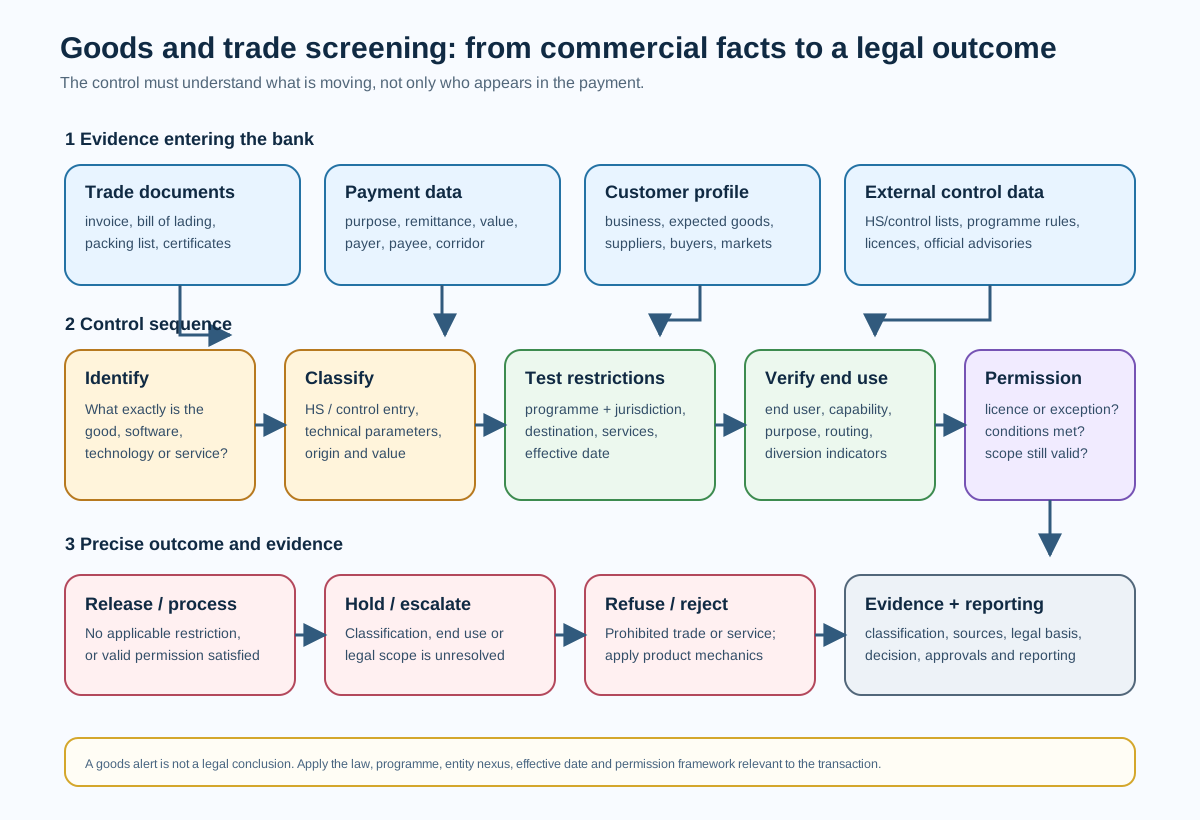
The diagram above maps the lifecycle this chapter follows. Trade information enters through documents, payments and customer profiles; classification translates commercial descriptions into control-relevant categories; restriction testing compares classified goods, services, destinations and end-users against applicable measures; end-use verification resolves the cases classification alone cannot; and disposition applies the legal outcome with evidence. The central insight is that goods screening fails most often at classification and end-use, not at list matching: banks that cannot say what the goods are, in control terms, cannot screen them regardless of engine quality.
Why goods restrictions need their own screening
Goods-based measures restrict things rather than persons: import bans on specified commodities from sanctioned origins, export bans on defined products to restricted destinations, sectoral goods measures covering energy, technology or luxury categories, and dual-use controls capturing items with civilian and military applications. Each measure defines its scope through goods descriptions, classification codes, technical parameters, value thresholds or origin rules that party-screening systems never evaluate. A payment-screening engine matching names walks past a shipment of prohibited machine tools between unlisted companies without registering anything, because nothing in its logic examines what the payment buys.
The control gap this creates is structural rather than incidental. Trade-finance operations hold rich goods data in commercial invoices, bills of lading, inspection certificates and insurance documents, but examination traditionally verifies documentary compliance under letter-of-credit rules rather than restriction relevance. Payments carry thinner goods references in remittance and purpose fields that screening configurations frequently ignore. Customer onboarding records expected trade profiles that monitoring rarely tests against actual goods flows. Each channel holds part of the goods picture, and goods screening is the control that assembles those parts into restriction decisions.
A common misunderstanding treats goods screening as trade-finance-only concern. Documentary business indeed provides the richest goods data, but open-account payments referencing goods, corporate procurement flows, e-commerce settlement, and commodity-trading customer portfolios all carry goods risk. The screening boundary should follow the bank's actual trade-touching business across products rather than assuming one department's examination covers the institution.
Classification: translating commerce into control categories
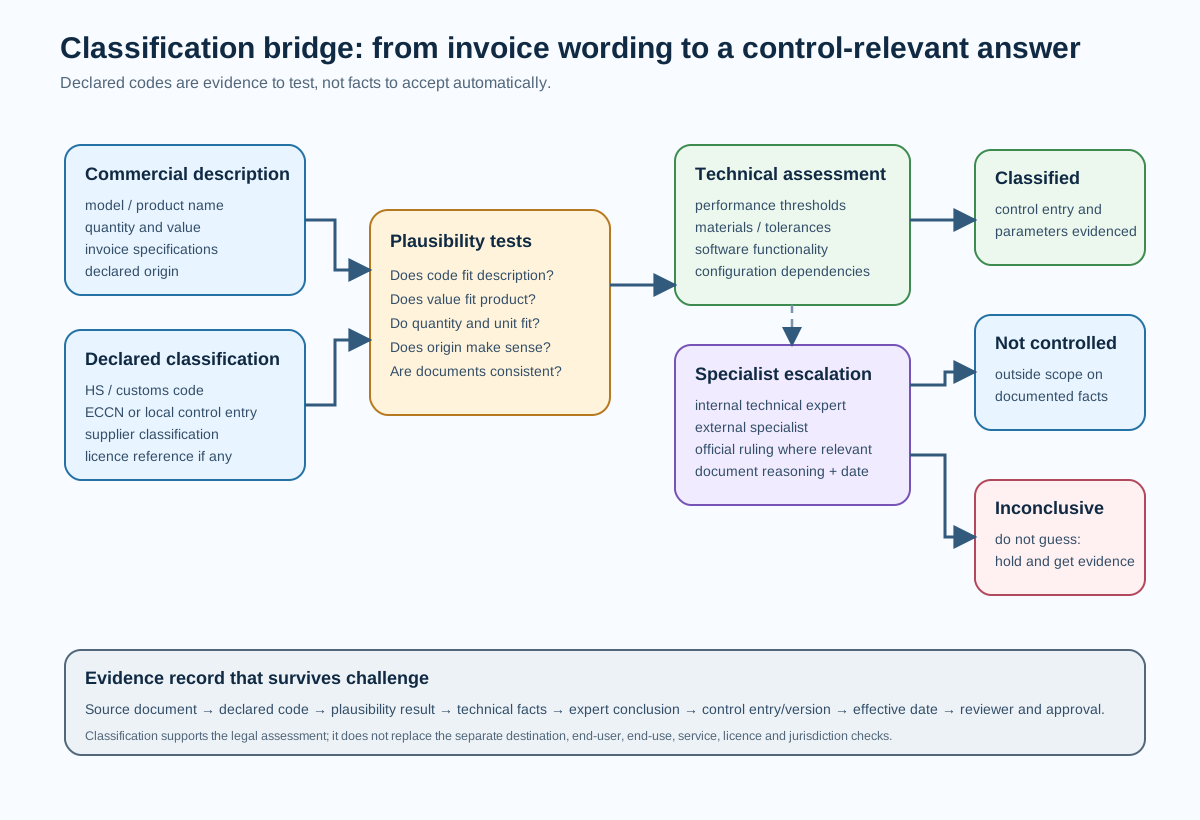
Classification converts commercial goods descriptions into the categories restrictions use: Harmonized System codes for customs and import-ban purposes, export-control list entries with technical parameters, sectoral-goods definitions with product scope, and dual-use classifications with performance thresholds. The translation is non-trivial because commercial language and control language describe goods differently: a commercial invoice describes marketable products while control lists describe technical characteristics, and the same commercial product can fall inside or outside control depending on specifications the invoice never states.
HS-code reliance illustrates both the utility and limits of classification shortcuts. Customs codes provide standardised goods identification supporting import-ban screening and origin analysis, and banks should capture and screen declared codes where documents carry them. But declared codes reflect the trader's classification, which may be mistaken or manipulated: misclassification to evade restrictions is itself a red flag pattern, and screening that trusts declared codes without plausibility testing validates the evader's paperwork. Code-description consistency checks compare declared codes against goods descriptions, values and quantities, flagging the mismatches that indicate error or deception. High-risk goods categories warrant classification verification beyond declared codes for material transactions, using technical assessment where thresholds are met.
Technical-parameter assessment addresses the dual-use boundary where control depends on specifications: performance thresholds for machine tools, electronics, materials and software that separate controlled from uncontrolled items. Bank staff cannot classify technically complex goods alone, nor should they attempt to: the control design routes technically ambiguous goods to classification expertise, internal specialists, external technical advisers or official classification rulings, with defined triggers and timeframes. The frontline skill is recognising potential control-list relevance sufficient to escalate, not performing classification independently. Goods descriptions containing performance specifications, technical standards references, or military-adjacent terminology should trigger escalation as a category rather than depending on individual analyst alertness.
Invoice language becomes control language through plausibility testing, threshold checks and expert routing for the ambiguous middle.
Restriction testing across measure types
Once classified, goods are tested against each applicable measure type with programme-specific scope rather than generic prohibited-goods treatment. Import-ban testing examines origin, routing and product scope: goods of sanctioned origin entering through third-country transhipment with obscured origin documentation engage import prohibitions regardless of the exporter's clean status, and origin-verification standards must reflect transhipment and mixing risks. Export-ban testing examines destination, end-user and diversion risk: goods bound for restricted destinations directly or through intermediaries, with routing economics suggesting diversion where direct shipment would be cheaper and faster.
Sectoral-goods testing applies the product-scope definitions of energy, technology, luxury and similar measures with their characteristic thresholds and exceptions: value thresholds for luxury categories, technical parameters for technology scope, and entity-list overlays where sectoral measures target specific companies alongside product categories. Service-restriction testing examines the services surrounding goods movement: financing, insurance, shipping, maintenance and technical assistance connected to restricted goods engage service prohibitions that operate independently of goods-title transfer. A bank financing a permitted goods sale with prohibited shipping insurance, or processing payments for lawful goods through restricted service providers, breaches through the service channel while the goods analysis clears.
Testing must also handle measure interaction: single shipments engaging multiple measures simultaneously, such as dual-use goods bound for a sanctioned destination ordered by a designated-adjacent entity, require combined assessment where each measure's requirements apply cumulatively. Licence and exemption analysis follows restriction identification rather than preceding it: the bank first determines which prohibitions engage, then assesses available permissions with the licence-handling discipline, since permission-first reasoning invites fitting transactions to licences rather than testing them against prohibitions.
End-use and end-user verification
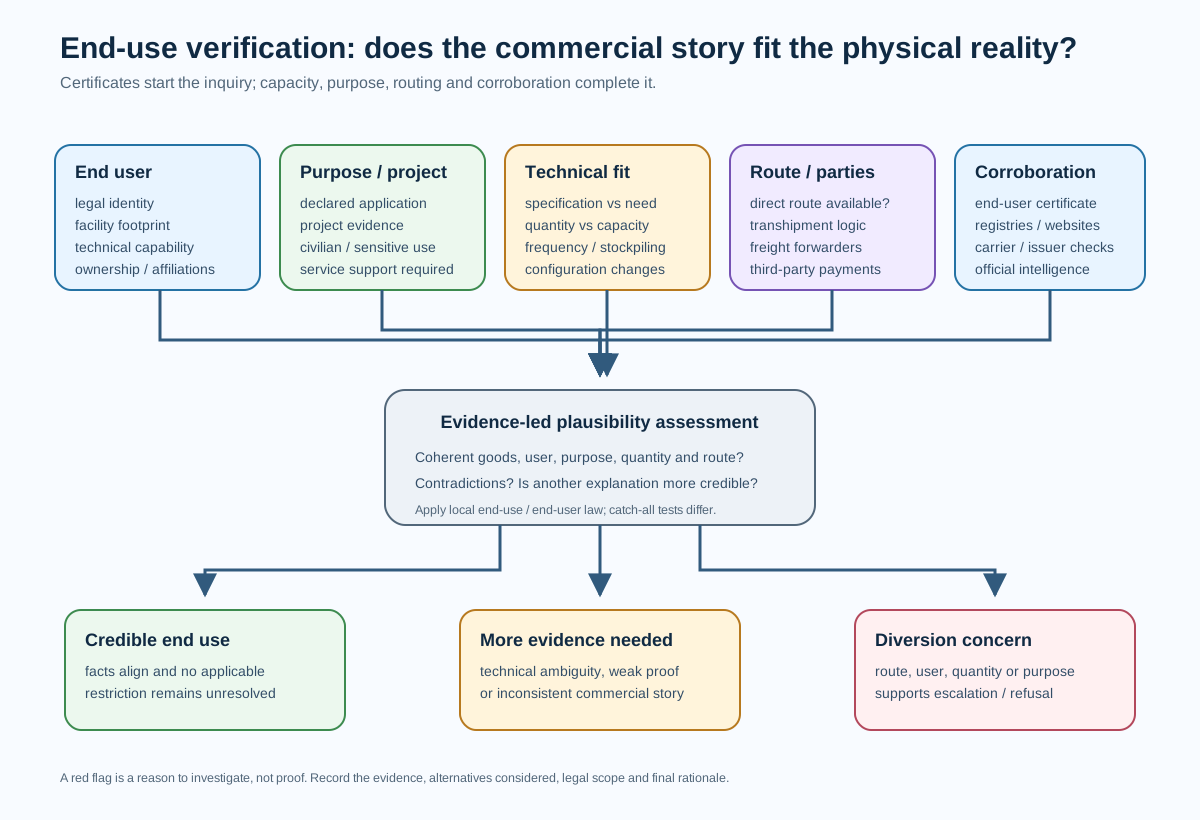
Classification determines what the goods are; end-use verification determines what happens with them, and for dual-use and sensitive goods the end-use decides legality. Verification examines the declared end-user's identity, legitimacy and technical capacity: manufacturing companies with verifiable facilities and production history present fundamentally different risk from recently formed intermediaries naming no production footprint. End-user certificates and statements provide starting documentation rather than conclusive assurance, verified through issuing-authority channels where mechanisms exist and corroborated through commercial intelligence on the end-user's actual operations.
Diversion-risk assessment addresses the probability that declared civilian end-use masks restricted applications: order quantities inconsistent with declared programmes, delivery routing through transhipment points associated with diversion, technical specifications exceeding civilian requirements, after-sales-service arrangements providing continued access, and payment structures involving third-country intermediaries without commercial logic. Each indicator is individually ambiguous; assembled patterns support diversion conclusions that trigger refusal, reporting and relationship review. End-use and end-user controls can also apply to items that are not controlled merely by product classification. The legal trigger differs across jurisdictions: for example, U.S. EAR provisions use defined knowledge, notification and end-use/end-user rules, while other regimes use their own tests. The bank should therefore identify the applicable framework and escalation trigger rather than treating every unlisted good as unrestricted or applying one jurisdiction's catch-all standard globally.
What the goods are is classification; what happens with them is end-use — verified through user capacity, diversion patterns and corroborated certificates.
Trade documents as screening evidence
Documentary trade provides the evidence base for goods screening, and document-examination discipline determines whether that evidence is reliable. Commercial-invoice analysis tests goods descriptions for specificity, prices against benchmarks, quantities against logistics, and parties against the transaction structure, with vague descriptions, anomalous pricing and inconsistent quantities each indicating error or deception warranting enhanced review. Transport-document analysis verifies shipment reality: vessel and voyage plausibility, routing economics, container and consignment consistency, and carrier authenticity through direct verification for material transactions. Insurance, inspection and origin documents provide corroborating layers tested for issuer credibility and internal consistency rather than accepted as independent assurance.
Document-fraud recognition distinguishes the characteristic fabrication patterns: template-generated document sets with uniform formatting across supposedly independent issuers, inspection certificates from unknown surveyors, origin declarations inconsistent with routing, and bills of lading with vessel, voyage or container anomalies. Verification routes run to independent sources: carriers confirming bill-of-lading authenticity, insurers confirming policy existence, inspection companies confirming attendance, and registries confirming entity particulars. The verification standard scales with risk: routine transactions receive consistency checks while higher-risk corridors, goods and parties trigger independent verification before processing decisions.
Goods references in payments and open-account trade
Documentary examination covers only the fraction of trade conducted under letters of credit and collections; open-account trade settles through payments carrying thinner goods references that screening must address proportionately. Remittance-field and purpose-code analysis extracts goods descriptions, invoice references, commodity terms and origin-destination hints from payment data, with screening scope defined for goods keywords and patterns rather than assuming party screening suffices. Entity and amount-pattern analysis compensates for thin goods data: traders dealing in restricted goods categories, amounts inconsistent with declared profiles, and corridor patterns suggesting diversion routing each trigger enhanced review even where goods descriptions are generic.
Customer-profile testing provides the structural control for open-account trade: expected-trade profiles recording product categories, corridors, counterparties and volumes at onboarding and review, tested continuously against observed payment activity with deviations triggering inquiry. A customer onboarded for textile trade making electronics payments to new corridors exhibits the goods-profile divergence that investigation must resolve. Profile maintenance keeps expected trade current through periodic review and event-driven updates, since stale profiles generate either false positives on evolved legitimate business or false negatives on drifted activity accepted against outdated baselines.
Disposition: goods-case outcomes and their mechanics
Goods-case dispositions apply the standard sanctions vocabulary with goods-specific mechanics. Refusal of documentary presentations cites the restriction basis with discrepancy documentation where letter-of-credit rules also apply, separating the sanctions refusal from documentary-compliance treatment so that each follows its proper process. Payment-interdiction for goods reasons holds or rejects transfers with the goods analysis documented to the standard supporting potential challenge, since goods-based decisions face greater customer contest than name matches. Relationship-level action addresses the customer dimension where goods cases reveal systematic restricted trade, undisclosed business lines or repeated documentation problems: enhanced requirements, product restrictions or exit with the documented reasoning connecting individual cases to relationship conclusions.
Licence-conditioned processing implements permissions with the condition-tracking discipline ensuring scope compliance: authorised goods, quantities, values, parties and timeframes encoded into processing controls with utilisation monitoring and expiry alerting. Reporting captures the goods dimension fully: restriction basis with classification evidence, end-use analysis, document findings and network implications for FIU, sanctions-authority and law-enforcement recipients as applicable. Recordkeeping preserves the classification reasoning, verification evidence and disposition trail supporting later examination of decisions that customers and authorities will both scrutinise.
Software, technology and intangible transfers
Goods screening increasingly concerns intangibles: controlled software transmitted electronically, technical data shared through cloud collaboration, manufacturing know-how transferred through consulting engagements, and technology embedded in services rather than shipped as products. These transfers defeat document-based goods controls entirely: no bill of lading, no customs declaration, no shipment to inspect. The bank's visibility comes through service payments, licence-fee flows, R&D-funding transfers and the customer-capability analysis that identifies who sends and receives technical value.
Service-payment screening for technology transfer examines the technical character of the underlying service through contract descriptions, deliverable specifications and provider-recipient capability matching: payments for undefined technical services between parties without plausible civilian R&D profiles warrant proportionate end-use inquiry. Cloud-service and software-licence payments are tested for the functionality's control relevance and the user's restriction status rather than cleared as routine IT expenditure. Consulting and secondment arrangements placing technical personnel with restricted programmes may engage technology-transfer or technical-assistance restrictions; U.S. deemed-export rules use their own defined tests. Payment purpose analysis should identify possible exposure and route it to the relevant specialist, rather than treating every personnel placement or payment as a deemed export.
The control design acknowledges fundamental visibility limits: banks cannot inspect data transfers the way they inspect shipments, so technology-transfer screening emphasises counterparty diligence, purpose analysis and pattern monitoring over consignment verification. Customer technology-capability profiles record R&D activities, technical partnerships and sensitive-sector exposure at onboarding and review, providing the baseline against which anomalous technology payments stand out. Information-sharing with export-control authorities through lawful channels supplements bank-held data where national-security dimensions arise. Staff need enough technology-transfer literacy to recognise the service payments potentially carrying controlled intangibles rather than processing all technical-service flows as benign commerce.
Operational deep dive: classification systems, verification and document forensics
The base chapter established what goods screening decides. This deep dive examines the machinery: the classification systems banks rely on, how goods descriptions are verified against reality, how technical ambiguity is routed to expertise, and how document forensics exposes fabrication. Readers building, testing or assuring goods controls will find their material here; analysts triaging alerts can focus on the verification sequences and return to systems material when challenging tooling limitations.
Harmonized System codes in banking practice
The Harmonized System provides the globally standardised goods nomenclature underlying customs tariffs, trade statistics and many import-ban scopes, structured in chapters, headings and subheadings with six-digit international uniformity extended by national subdivisions. Banking use of HS codes serves three functions: screening declared codes against restriction-relevant code lists for import-ban and sectoral-goods purposes, plausibility-testing declared codes against goods descriptions and values, and aggregating portfolio exposure by goods category for risk assessment. Each function needs defined data sourcing: declared codes captured from commercial invoices and customs documents where available, verified codes from independent classification review for higher-risk transactions, and mapped codes translating commercial descriptions into HS chapters where documents omit codes entirely.
Code-list maintenance for restriction screening requires programme-specific mapping rather than generic controlled-goods lists: each import ban, sectoral measure and goods prohibition defines its product scope through codes, descriptions or technical parameters that the bank must translate into screening rules with legal input on scope interpretation. Updates follow programme changes with the same implementation discipline as list updates, since goods-scope amendments create exposure identical in kind to designation waves. Code-description consistency analytics flag the mismatches indicating error or deception: declared codes inconsistent with goods descriptions, values inconsistent with coded product categories, and quantities inconsistent with coded units of measure. These analytics run systematically across documentary and open-account populations rather than depending on examiner alertness.
Classification verification beyond declared codes
Declared-code trust boundaries define where verification replaces acceptance: higher-risk goods categories, restricted-origin or destination corridors, new customer relationships, anomalous pricing or quantities, and intelligence-indicated evasion patterns each trigger independent classification review. Verification methods scale with risk: description-based reclassification by trained trade staff for routine cases, technical assessment for specification-dependent goods, external classification expertise for complex or high-value determinations, and official binding-tariff-information or classification rulings sought through proper channels for precedent-setting or high-exposure decisions. Each verification level records its method, evidence and conclusion to a standard supporting the processing decision under later scrutiny.
Misclassification-pattern analysis distinguishes error from deception through repetition, direction and beneficiary analysis: random errors distribute across directions and correct on inquiry, while systematic misclassification toward unrestricted codes, persistent after correction requests, indicates deliberate evasion. Origin-code interaction deserves specific attention where misclassification serves origin obscuration rather than product-scope evasion: codes suggesting different origin characteristics, processing claims inconsistent with the exporter's capabilities, and routing inconsistent with declared supply chains each indicate the code manipulation serves the origin fraud rather than the product classification. Response to confirmed misclassification addresses both the transaction and the trader's reliability: enhanced verification conditions for continued business, reporting where thresholds are met, and relationship review where patterns indicate systematic deception.
Routing technical ambiguity to expertise
Technical classification questions exceed frontline capability by design, and the control quality depends on escalation routing rather than analyst heroics. Trigger definitions specify which goods characteristics mandate technical review: performance specifications approaching control thresholds, military-adjacent terminology, dual-use-indicative product categories, unfamiliar technical standards references, and any goods where the analyst cannot confidently exclude control relevance. Trigger sensitivity should bias toward escalation for higher-risk corridors and customers while permitting streamlined handling for established benign trade, with the calibration documented and reviewed rather than left to individual judgement.
Expertise sourcing combines internal specialists, trade-finance product experts with classification training, central sanctions-advisory technical resources, and external technical consultants or legal advisers for complex determinations. Service-level agreements for technical review must match commercial timeframes for standard cases while permitting extended assessment for genuinely complex goods; the tension between thoroughness and velocity is managed through triage that fast-tracks clear-cut determinations and reserves deep assessment for true ambiguity. Expert-determination records capture the technical reasoning, standards applied, evidence reviewed and conclusion with effective-date applicability, building institutional classification knowledge that accelerates future equivalent cases.
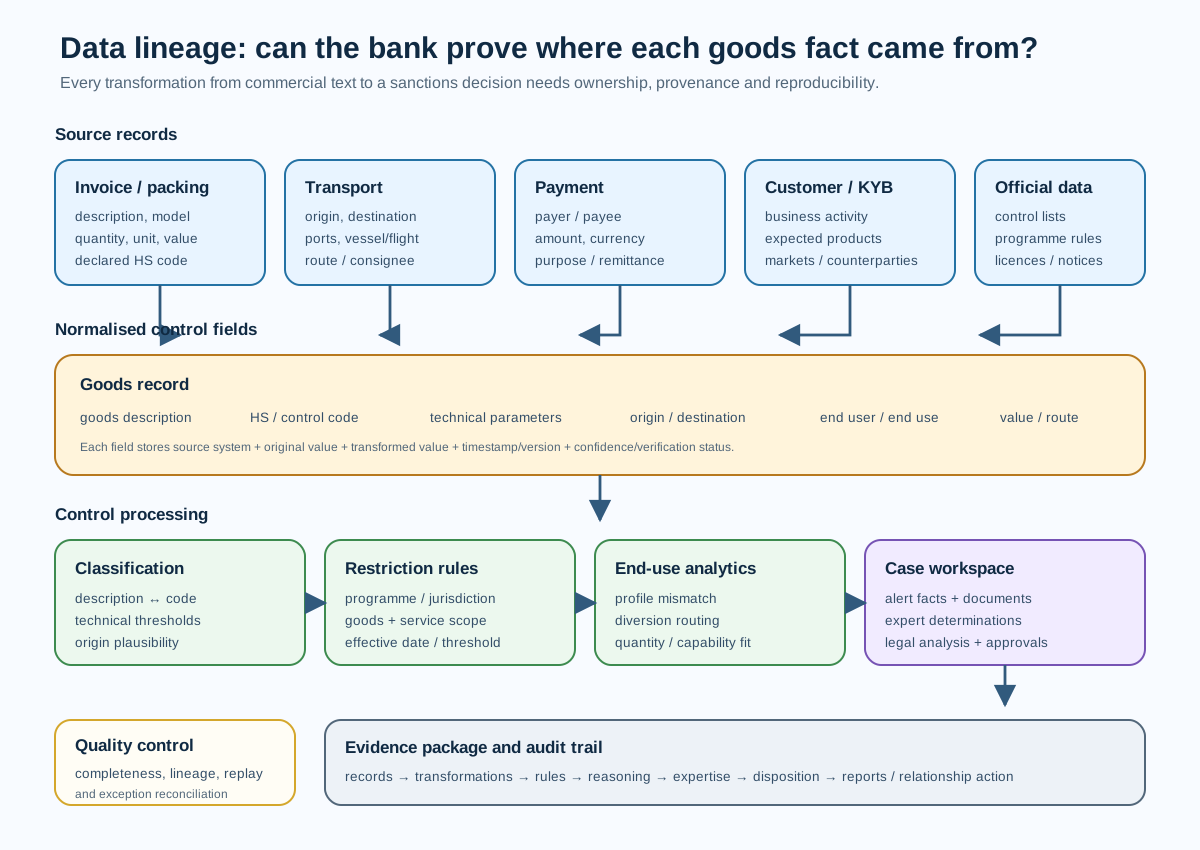
The diagram above shows the lineage from commercial data through classification and verification stages into restriction decisions. Its practical message is that each transformation, description to code, code to scope determination, scope to end-use assessment, needs defined ownership, method and evidence, and that unverified transformations compound uncertainty until the final decision rests on assumption rather than analysis.
Document forensics for trade examination
Document forensics applies systematic authenticity and consistency testing to trade documentation beyond letter-of-credit compliance checking. Forensic examination techniques include template analysis detecting uniform formatting across supposedly independent issuers, metadata examination of electronic documents revealing creation anomalies, stamp and signature verification against known exemplars, chronological consistency testing of document dates against claimed event sequences, and cross-document consistency verification ensuring the document set tells a single coherent story. Each technique needs defined application triggers scaling with risk rather than universal application that would paralyse processing volumes.
Issuer-verification channels provide independent grounding: carrier bill-of-lading confirmation desks, insurer policy-verification contacts, inspection-company attendance confirmation, chamber-of-commerce certificate authentication, and registry verification for entity particulars. Relationship-level verification infrastructure, maintained contact directories with authenticated channels established before incidents require them, determines whether verification happens in hours or weeks. Verification-result handling distinguishes confirmed authentic, confirmed fraudulent, and unverifiable outcomes with defined processing consequences for each: authentic documents proceed with remaining checks, fraudulent documents trigger refusal and investigation, and unverifiable documents receive risk-proportionate treatment rather than default acceptance or refusal.
Sanctions-goods data in payment messages
Open-account trade payments carry goods information in remittance fields, purpose codes and regulatory-reporting elements that screening configurations must address deliberately. Goods-keyword screening covers restricted-commodity terms, dual-use-indicative descriptions and evasion-suggestive language with programme-specific keyword sets maintained against over-matching through exclusion logic and corroboration requirements. Purpose-code analysis utilises structured purpose classifications where schemes provide them, testing declared purposes against customer profiles and corridor patterns. Regulatory-reporting elements in ISO 20022 and domestic formats carry goods and purpose detail where populated, and screening-data sourcing should ingest these elements systematically rather than examining narrative fields alone.
Threshold and aggregation logic prevents evasion through fragmentation: goods-value monitoring across related payments detects structuring around goods-review thresholds, corridor-aggregation identifies distributed shipments constituting single commercial transactions, and customer-level goods-flow analysis joins fragmented payments into assessable trade activity. The calibration challenge balances detection against the enormous legitimate trade volumes carrying similar keywords: commodity terms appear routinely in benign commerce, and keyword screening without corroboration requirements or customer-profile context generates unmanageable noise. Tiered review with automated clearance for established benign patterns and enhanced scrutiny for higher-risk combinations provides the workable middle ground.
Origin-verification methodology: rules, transformation and mixing
Origin determines import-ban applicability, preference-duty treatment and sanctions risk, yet origin is among the most manipulated trade attributes. Verification starts from origin-rule literacy: substantial-transformation standards determining when processing confers new origin, wholly-obtained criteria for primary commodities, and cumulation provisions where trade agreements permit multi-country content. Each rule creates manipulation vectors: minimal processing claimed as substantial transformation, mixing of restricted and unrestricted origin goods with origin laundered through the mixture, and transhipment with falsified origin certificates. The bank's verification must test origin claims against physical and commercial reality rather than accepting certificate presentation.
Capacity-based origin testing mirrors the commodity methodology: the declared origin must be physically capable of producing the claimed goods at claimed volumes, assessed through production statistics, industry structure and export records. Processing-capability testing examines intermediate jurisdictions: goods claimed as transformed in a hub jurisdiction require evidence of processing facilities, input sourcing and value-add consistent with the transformation claimed. A jurisdiction without relevant industry exporting large volumes of processed goods indicates origin laundering rather than manufacturing. Mixing analysis addresses the commingling problem where restricted-origin commodities blend with clean supply at mills, refineries, storage terminals and bulk-handling facilities: once mixed, physical segregation is impossible and origin attribution depends on mass-balance documentation tested for integrity rather than assumed accurate.
Certificate-verification channels provide independent grounding: chambers of commerce and authorised bodies confirming certificate authenticity, preferential-origin verification through customs-cooperation mechanisms where available, and supplier-declaration testing for consistency with known supply chains. Response to confirmed origin fraud addresses both the transaction and the trader's reliability with reporting where thresholds are met, since origin fraud serving sanctions evasion differs in consequence from preference-duty optimisation while sharing detection methods. Portfolio-level origin-risk mapping identifies the corridors, commodities and intermediaries where origin verification needs systematic enhancement rather than case-by-case attention.
Value-threshold gaming and aggregation discipline
Value thresholds in luxury bans, de-minimis provisions, reporting triggers and review cutoffs invite structuring through fragmentation: shipments split below thresholds, values under-declared to slip beneath limits, and related transactions distributed across time and entities to evade aggregation. Detection requires aggregation logic joining related activity across the dimensions fragmenters exploit: temporal clustering analysis identifying split shipments through timing, routing and counterparty commonality; entity-linkage joining related parties through ownership, infrastructure and behavioural connections; and value-reconstruction comparing declared values against benchmarks, insurance values and payment amounts where declared and actual values diverge.
Under-valuation detection combines benchmark comparison with logistics economics: declared values inconsistent with freight costs, insurance coverage or payment amounts indicate manipulation, since genuine trade maintains rough proportionality between goods value and movement cost. Related-party pricing analysis distinguishes transfer-pricing optimisation from evasion-motivated undervaluation through purpose assessment: prices serving tax objectives differ in pattern from prices serving restriction evasion, though both warrant inquiry. Customs-valuation intelligence, where cooperation channels provide it, offers independent verification that bank-held documents cannot.
Aggregation-policy design defines which related transactions combine for threshold purposes with documented rules preventing both evasion and overreach: time windows for clustering, entity-linkage standards for joining parties, and value-attribution methods for multi-item shipments. Customer communication explains aggregation treatment transparently so that legitimate traders structuring shipments for genuine logistics reasons understand the assessment, while evasion-motivated fragmenters face the joined analysis their structuring sought to defeat. Monitoring rules encode aggregation logic systematically rather than depending on analyst memory to connect fragmented flows across queues and time periods.
Practitioner checkpoint
A practitioner finishing this deep dive should be able to explain how HS codes support and limit goods screening, describe the verification hierarchy from declared-code acceptance through technical assessment, route technically ambiguous goods to appropriate expertise with defined triggers, apply document-forensic techniques proportionate to risk, and design payment-message goods screening with calibrated thresholds. Gaps in any answer indicate control areas needing development with owners and timelines rather than accepted limitations.
Catch-all controls in banking practice
Catch-all provisions extend export controls beyond listed items to any goods destined for prohibited end-uses, typically military, nuclear-propulsion, weapons-related or restricted-programme applications, creating obligations triggered by knowledge and suspicion rather than product classification. Banking implementation faces the distinctive challenge that catch-all triggers on end-use awareness the bank must develop rather than list entries it can screen: the control depends on staff recognising when ordinary goods serve extraordinary purposes. Trigger-recognition training covers the characteristic catch-all indicators: customer inquiries about military suitability, orders exceeding civilian requirements, end-users with defence or programme affiliations, delivery locations inconsistent with declared use, and reluctance to provide end-use information.
Knowledge-standard management addresses the legal threshold question of what the bank knew or should have known: documented escalation of catch-all indicators creates the knowledge record triggering control obligations, while unrecorded awareness leaves the bank exposed without evidence of diligence. Procedures must define the knowledge threshold explicitly, what staff must do upon encountering defined indicators, how suspicions are recorded and assessed, and when licence applications or refusals follow. The standard protects both compliance and commerce: defined triggers prevent over-cautious refusal of legitimate trade based on vague unease, while ensuring genuine indicators receive the assessment the law requires.
Licence-application support for catch-all cases follows the standard licensing discipline with additional technical complexity: applications describe the goods, end-use concerns and proposed safeguards with the precision licensing authorities require for unlisted-item assessment. Customer communication explains catch-all holds without disclosing sensitive reasoning, focusing on verification requirements and timelines. Monitoring rules capture catch-all typologies for the wider portfolio: goods-customer-end-user combinations matching known concern patterns receive enhanced review even where individual transactions appear routine, since catch-all risk concentrates in relationships and corridors rather than distributing randomly.
Screening-engine rules for goods content
Goods-aware screening rules translate restriction scope into executable logic operating on the bank's actual data fields, and rule design quality determines whether goods screening functions systematically or depends on analyst heroics. Rule architecture layers keyword and pattern rules for narrative fields, code-based rules for classified goods data, threshold rules for values and quantities, corridor rules combining goods with routing, and customer-profile rules testing activity against expected trade. Each rule carries defined scope, corroboration requirements preventing single-signal disposition, and exception logic for established benign patterns. Rule interaction management prevents the characteristic failures of layered systems: overlapping rules generating duplicate alerts on identical activity, contradictory rules clearing and flagging the same transactions, and coverage gaps between rule scopes that evasive structuring exploits.
Rule-testing methodology uses goods-specific test packs spanning true-positive restricted-goods cases with known classifications, near-miss threshold-proximate goods testing boundary precision, benign goods with restriction-evocative descriptions testing false-positive control, and evasion-structured cases testing pattern-rule effectiveness. Performance measurement reports detection and precision by rule and goods category with tuning decisions documented and approved. Rule-change governance treats goods-rule modification with the same rigour as matching-threshold changes, since each adjustment trades detection against capacity across the alert population it affects. Vendor-provided goods-screening content, keyword lists and rule packs require independent validation against the bank's own test packs and data characteristics rather than acceptance on vendor authority.
Advanced practice: worked goods-screening cases
The cases below are entirely fictional with illustrative amounts and timings. Each shows how goods screening operates where parties appear clean: the trigger, evidence assembled across documents and data, alternatives tested, outcome with reasoning, and control lesson. Read them as decision training; real cases turn on actual measure wording, jurisdiction and legal advice.
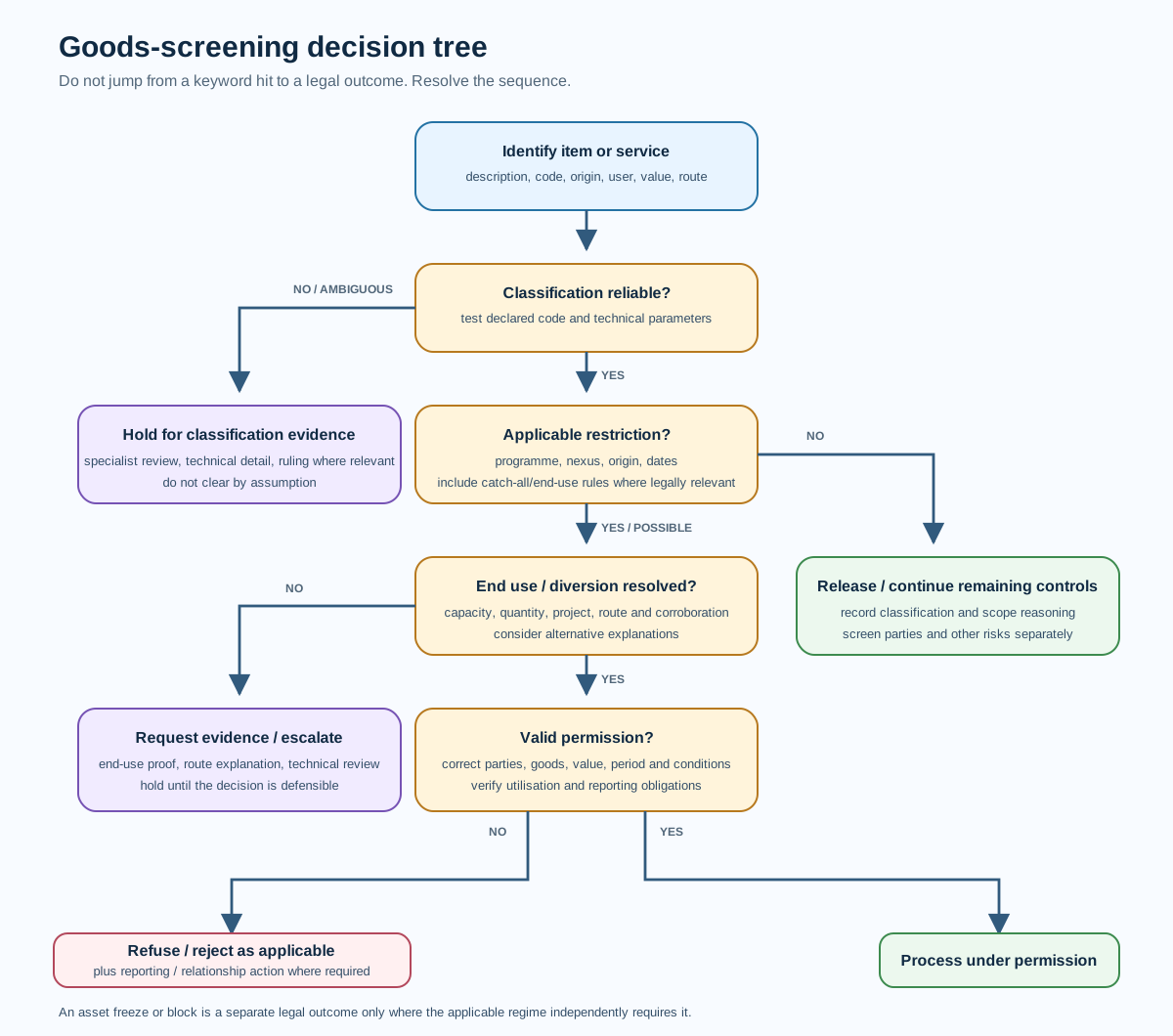
The decision tree above structures every case: identify the goods precisely, classify into control categories, test against applicable restrictions, verify end-use where classification alone cannot decide, and dispose with documented reasoning. Refer back to it as each case moves through its branches.
Case 1: bearings with two possible destinies
A documentary collection for precision bearings valued at an illustrative 340,000 arrives from an established customer, a machinery distributor with six years of clean history. The bearings' specifications sit near dual-use control thresholds: dimensional tolerances and load ratings approaching controlled parameters without clearly exceeding them. The declared end-user is a civilian manufacturing company in a jurisdiction neighbouring a sanctioned destination, incorporated two years ago with limited verifiable production history. The freight forwarder routes the shipment through a transhipment hub adding cost and ten days to a journey with direct alternatives.
The examination treats technical ambiguity as the trigger rather than the conclusion. Internal technical review compares specifications against control-list parameters and finds the bearings fall just below the controlled threshold on stated values, but notes the manufacturer's catalogue lists higher-specification variants under similar model designations, raising the possibility that actual shipped goods exceed stated specifications. End-user verification reveals the civilian manufacturer's premises as a small commercial unit inconsistent with precision-machinery production, no verifiable production output, and directors shared with a logistics company previously flagged in an industry advisory on diversion routing. The transhipment hub has documented diversion associations, and the routing economics show no commercial justification.
Three alternatives structure the assessment. Genuine civilian trade explains the documentation but requires accepting the end-user's manufacturing credibility, the specification coincidence and the routing economics simultaneously, each straining plausibility. Specification misrepresentation, where shipped goods exceed stated parameters into controlled territory, fits the catalogue ambiguity and the end-user opacity but needs physical verification unavailable before shipment. Diversion-structure trading, where the transaction's purpose is moving capable goods toward restricted applications regardless of precise classification, fits all observations including the routing and forwarder selection. The outcome combines refusal of the collection on the assessed restriction and diversion basis with reporting, relationship review examining the distributor's product-line shift into specification-ambiguous goods, and monitoring rules capturing the specification-proximity plus opaque-end-user plus diversion-routing signature.
The lesson is that threshold-proximate goods with opaque end-users and diversion routing must be assessed as structures rather than specifications: the classification question matters, but the end-use and routing evidence independently supports protective action even where classification remains technically arguable. Controls that await classification certainty before acting will process diversion while experts deliberate.
Case 2: timber with laundered origin
An open-account customer, a timber importer with three years of steady business, begins receiving shipments of tropical hardwood from a new supplier in a transhipment hub jurisdiction, declared as plantation-grown stock with sustainability certification. Volumes triple within five months while prices sit 20 percent below the customer's established suppliers for equivalent species. Payment analysis shows settlement through third-party entities unconnected to the supply chain, with amounts netting across multiple invoices in patterns suggesting offset arrangements. The sustainability certificates name a certifier the bank's trade team has never encountered.
Origin verification dismantles the plantation narrative systematically. The transhipment hub has no domestic plantation capacity for the declared species at the claimed volumes. The certifier, investigated through industry contacts, operates without recognised accreditation and issues certificates on documentation review alone without field verification. Price analysis shows below-market pricing inconsistent with certified sustainable production costs but consistent with illegal-harvest sourcing. Species testing of the declared versus plausible actual species, commissioned for a sample shipment, identifies protected-species content inconsistent with the plantation claim. The third-party settlement entities trace to corporate-service-provider addresses shared with the supplier's network.
The case resolves as suspected illegal-timber trade with origin fraud and potential sanctions exposure depending on the harvest jurisdiction, triggering transaction action on pending payments, reporting under the applicable environmental-crime and suspicious-activity frameworks, and relationship review with enhanced origin-verification conditions for any continued business. The monitoring rule derived from the case captures the origin-laundering signature for the wider commodity portfolio: transhipment-hub sourcing without domestic capacity, unknown certifiers, below-market pricing and third-party settlement clustering. The general lesson is that origin claims for restricted-origin-sensitive commodities require capacity-based verification: declared origins must be physically capable of producing the claimed goods at claimed volumes, and incapacity defeats documentation regardless of its apparent completeness.
Case 3: the software licence that enables production
A corporate customer processes quarterly licence payments of an illustrative 180,000 to a software vendor for industrial-automation software used in its manufacturing operations. A routine review notes the customer's manufacturing has shifted toward precision components for aerospace-adjacent customers, and the software's simulation modules have potential dual-use applications in controlled production processes. The vendor is mainstream, the licence terms are standard, and nothing in the payment pattern suggests evasion: the concern is entirely about end-use evolution rather than transaction suspiciousness.
The investigation examines whether the software's application has crossed into controlled territory through the customer's changed production profile. Technical assessment of the licensed modules against dual-use software controls identifies specific simulation capabilities with control-list relevance where applied to defined production processes. Customer-production analysis verifies the aerospace-adjacent shift through order books, customer references and facility capabilities, confirming the software now supports processes within the controlled scope. Licence-terms review finds no end-use restrictions in the commercial agreement constraining the customer's application, and vendor awareness of the end-use evolution is unestablished.
The outcome reflects the catch-all dimension: unlisted-software application to controlled end-uses engages restrictions based on knowledge and end-use rather than product classification, and the bank's continued payment processing with established knowledge would constitute facilitation exposure. Response combines immediate payment hold with legal assessment, customer engagement requiring end-use clarification with technical evidence, reporting where thresholds are met, and relationship-level review of the customer's production evolution against the bank's technology-sector appetite. The monitoring enhancement captures end-use-evolution detection for technology-sector customers: production-profile change triggers reassessing software and service payments previously cleared on earlier profiles. The lesson is that goods screening is never finished at onboarding or first assessment: customer evolution changes the restriction analysis of identical recurring payments, and only profile-maintenance discipline catches the shift.
Case 4: luxury watches in fragmented parcels
A private-banking customer's account shows twelve incoming transfers over two months from different individuals across three countries, each between an illustrative 8,000 and 12,000 with references to watch models, followed by consolidated outward payments to two luxury dealers in a free-zone jurisdiction. The customer describes personal collecting activity with friends purchasing together for volume discounts. Luxury-goods sanctions apply to defined categories above programme thresholds for sanctioned destinations and designated-connected parties, and the free-zone dealers have documented exposure to sanctioned-destination clientele.
Fragmentation analysis treats the twelve transfers as single commercial activity deliberately structured below attention thresholds: transfer timing clustering, model-reference consistency suggesting coordinated procurement, sender-network analysis revealing social-media connections to the customer inconsistent with arm's-length group purchasing, and the consolidation pattern showing collection-phase structuring followed by wholesale settlement. Dealer analysis examines the free-zone merchants' customer base, sanctions compliance posture and willingness to provide end-client information: dealers serving sanctioned-destination clientele through intermediaries without end-user verification function as sanctions-evasion infrastructure regardless of their own clean status.
Value-threshold analysis tests the luxury-measure applicability: individual transfers below thresholds aggregate into commercial quantities exceeding them, and the structuring itself indicates awareness of control boundaries. In this fictional case the evidence supports coordinated procurement for onward transfer toward sanctioned-destination exposure through non-compliant intermediaries, triggering relationship action with reporting and intelligence sharing on the dealer network. The lesson is that luxury-goods evasion uses the same fragmentation and intermediation mechanics as cash placement and trade layering, and the bank's network-analysis and structuring-detection capabilities apply directly where configured for goods contexts rather than confined to cash typologies.
Case 5: the inconclusive classification that must wait
A letter-of-credit application covers industrial pumps with specifications straddling dual-use control thresholds: flow rates and materials of construction requiring detailed technical assessment against control parameters that the bank's internal specialists cannot conclusively resolve from the documentation provided. The end-user is a water-utility company in a non-sanctioned jurisdiction with verifiable municipal operations, but the pumps' specifications exceed the utility's apparent requirements and the order quantity suggests stockpiling beyond credible project needs. The applicant customer presses for issuance against a tender deadline, arguing the civilian end-user and destination should settle the question.
The case establishes the classification-inconclusive standard: where technical ambiguity cannot be resolved on available evidence and the surrounding indicators, over-specification, excess quantity, tender-pressure timing, prevent confident clearance, the transaction waits for expert determination rather than proceeding on civilian appearance. The bank commissions external technical assessment with defined scope and timeframe, seeks additional specification detail and end-use clarification from the applicant through standard channels, and holds issuance pending determination. The applicant is managed through honest timeline communication without disclosing the control reasoning beyond procedural requirements.
The outcome, after nine days, is expert determination that the pumps fall outside control parameters but with a narrow margin and specific configuration dependencies: issuance proceeds with conditions recording the exact approved specifications, quantity limits and end-user confirmation, plus enhanced monitoring for repeat orders suggesting stockpiling patterns. The lesson validates the inconclusive-hold discipline in both directions: the hold cost the bank and customer nine days and tender-risk anxiety, but proceeding without determination would have risked controlled-goods facilitation, while blanket refusal would have destroyed legitimate business. Classification infrastructure that resolves ambiguity in days rather than months is the control investment this case justifies.
Case 6: transhipment-hub electronics diversion
A trade-finance portfolio review flags a customer onboarded eighteen months ago as a consumer-electronics distributor serving domestic retail chains. Over six months its import pattern shifts: high-performance computing components, including processors and accelerators with potential dual-use relevance, arrive from established manufacturing origins but route through a transhipment hub adding twelve days and significant cost to journeys with direct alternatives. The components' declared values sit 30 percent below benchmark pricing for equivalent specifications, and the customer's domestic sales records show distribution volumes covering barely half the imported quantity. The balance is re-exported to buyers in jurisdictions neighbouring sanctioned destinations, documented as regional distribution expansion.
The investigation assembles the diversion structure from trade, financial and corporate evidence. Goods analysis tests the components' specifications against dual-use control parameters and finds threshold-proximate performance with configuration-dependent classification requiring technical determination. Routing analysis establishes the transhipment hub's lack of commercial justification: no value-added processing occurs there, warehousing durations are minimal, and the hub's documented diversion associations compound the concern. Value analysis shows below-market import pricing consistent with volume-commitment discounts claimed by the customer, but the re-export pricing to regional buyers exceeds import cost by margins inconsistent with distribution economics, suggesting the margin compensates diversion risk rather than logistics value.
Corporate analysis reveals the regional buyers as recently formed entities with minimal commercial footprint, shared logistics infrastructure, and payment patterns showing third-country settlement disconnected from the goods flow. Domestic-distribution verification through retail-chain confirmations establishes the genuine business baseline against which the diverted share stands out clearly. In this fictional case the accumulated evidence supports suspected diversion-structure trading using genuine domestic business as cover, triggering transaction action on pending presentations, reporting under applicable export-control-evasion and suspicious-activity frameworks, and relationship-level review with the monitoring rule capturing the threshold-proximate-goods plus unjustified-transhipment plus re-export-to-sensitive-neighbourhood signature for the wider electronics portfolio.
Case 7: maintenance services sustaining a restricted fleet
A corporate banking customer, a marine-engineering company with a decade-long relationship, processes monthly service payments to subcontractors and receives contract income from vessel operators. A sectoral-review update notes two of its principal clients operate vessels connected to sanctioned programmes, though neither the customer nor its clients are designated. The service contracts cover propulsion-system maintenance, navigation-equipment servicing and hull inspection: services sustaining the vessels' operational capability. Payment analysis shows the service income representing an illustrative 40 percent of the customer's revenue, with contracts renewed after the relevant restrictions took effect.
The case examines service-prohibition applicability where neither party is designated but the services sustain restricted operations. Restriction analysis tests the specific services against programme scope: maintenance sustaining sanctioned-programme vessels engages service prohibitions in participating jurisdictions regardless of the provider's clean status, with wind-down and pre-existing-contract provisions assessed for transitional coverage. Contract-timing analysis establishes that renewals post-dating restrictions constitute new service provision rather than grandfathered commitment, defeating any wind-down reliance. Knowledge assessment examines what the customer knew about its clients' restriction status and when: industry advisories, public designation information and the bank's own prior communications each contribute to the knowledge picture supporting the disposition.
The outcome combines transaction action on pending service payments with relationship-level review: the customer must discontinue restricted services with managed wind-down under applicable authorisations, submit to enhanced monitoring of its client base and contract pipeline, and face exit proceedings if it continues restricted servicing. Reporting captures the service-prohibition dimension with the technical-service evidence supporting the assessment. The lesson is that service-prohibition screening must extend beyond the bank's direct customers to the customers' restricted-activity exposure: a clean service provider sustaining restricted operations breaches through its services, and the bank's customer review must detect restricted-activity servicing as a distinct risk category rather than clearing providers on their own designation status.
Case 8: antiquities with manufactured provenance
A wealth-management customer, a collector with a decade-long relationship, requests financing against a recently acquired antiquities collection valued by a private appraiser at an illustrative 4.5 million. The collection comprises objects attributed to a conflict-affected region with documented looting, acquired through a dealer operating from a free-zone jurisdiction. Provenance documentation traces ownership through three private collections over four decades, supported by sale invoices, exhibition records and the appraiser's authentication opinion. The customer proposes the collection as collateral for a Lombard facility funding further acquisitions.
Provenance verification dismantles the documentation systematically rather than accepting its apparent completeness. Exhibition-record checks with the named institutions find no record of two claimed exhibitions; the third confirms a loan exhibition but of different objects than those claimed. Invoice-chain analysis reveals sequential sales between entities sharing addresses and directors, indicating circular provenance manufacturing rather than genuine market transactions. The appraiser, investigated through professional channels, specialises in valuations for collateral purposes with a pattern of optimistic attributions unsupported by scholarly consensus. Stylistic and scientific assessment commissioned from independent experts identifies anachronistic features inconsistent with attributed periods in several key pieces, suggesting modern manufacture or heavy restoration misrepresented as original condition.
Conflict-region origin analysis compounds the concern: the attributed findspots cluster in areas with documented large-scale looting during specific conflict periods, and the claimed collection timeline shows objects surfacing shortly after looting episodes without excavation or export-permit documentation. The financing dimension adds integration mechanics: inflated collateral valuations supporting genuine loan proceeds, with the collection's purported value manufactured through circular sales and optimistic appraisal. In this fictional case the accumulated evidence supports suspected looted-antiquities handling with fraudulent provenance and manufactured collateral value, triggering facility refusal, reporting under applicable cultural-property and suspicious-activity frameworks, and relationship review extending to the customer's wider collecting and dealing activity.
The lesson generalises to all provenance-dependent goods finance: provenance is a verifiable hypothesis rather than a documentation package, tested through independent exhibition, transaction and scientific evidence with conflict-region sensitivity. Collateral acceptance for provenance-dependent objects requires provenance verification to the same standard as valuation verification, since manufactured provenance inflates both cultural legitimacy and financial value simultaneously. Relationship managers serving collecting customers need enough provenance literacy to recognise manufactured histories before committing the bank's balance sheet to objects whose value evaporates under scrutiny.
Practice close: the goods analyst's playbook
This section serves the trade-finance examiner, payments analyst and relationship reviewer who encounters goods-risk indicators with commercial deadlines attached. It compresses the chapter into usable sequences, then examines the exceptions and failure modes defining difficult goods judgement.
The goods-triage sequence
Treat every goods alert as a classification question first. The opening minutes establish what the goods are claimed to be: commercial description, declared codes, quantities, values, specifications where stated, and the documents carrying each claim. Capture the claims verbatim with document sources before interpreting them, because interpretation anchored to paraphrase rather than quotation drifts under challenge. The classification step translates claims into control categories with explicit reasoning: HS-chapter identification, control-list relevance assessment, sectoral-scope testing and dual-use proximity judgement, each recorded with the evidence supporting it.
The work narrows from broad commercial description through code mapping and technical assessment into precise control categories. Ambiguous goods should be routed to expertise rather than forced into a premature category, and every narrowing step should preserve the evidence and reasoning that produced it. Goods that cannot be classified confidently on the available evidence are inconclusive, not clear.
Restriction testing follows classification with programme-specific scope: origin testing for import bans, destination and end-user testing for export bans, product-scope testing for sectoral measures, and service-channel testing for service prohibitions. Each test records its result with the measure cited, building the multi-measure assessment where shipments engage several restrictions simultaneously. End-use verification resolves the cases classification leaves open through end-user credibility assessment, diversion-indicator analysis and catch-all evaluation. Disposition applies the legal outcome with the full evidence package: classification reasoning, restriction analysis, verification findings, alternatives addressed and approvals obtained.
Exceptions that change the playbook
Military and government end-users in non-sanctioned jurisdictions create the authorised-activity exception requiring careful handling: defence-ministry procurement, police-equipment orders and government-infrastructure projects involve controlled or sensitive goods legitimately, and the control distinguishes authorised government end-use from diversion risk through end-user-certificate verification, programme-corroboration and delivery monitoring rather than treating all military-connection indicators as prohibitions. The standard is verification depth proportionate to diversion risk, not clearance on official letterhead alone, since diversion operations routinely forge or misuse official documentation.
Humanitarian goods, food, medicine and medical equipment for sanctioned destinations operate under exemption and licensing frameworks that the bank must implement as permissions rather than prohibitions: verification focuses on goods eligibility within exemption scope, end-user humanitarian credibility, diversion safeguards and licence-condition compliance where authorisations apply. The operational failure to avoid is treating humanitarian goods with the same suspicion as dual-use ambiguity: delay and over-documentation demands on medicine shipments cause human harm without control benefit, while genuine diversion through humanitarian cover requires the same evidence-led detection as other channels. Differentiated procedures for humanitarian goods with trained reviewers provide both protection and humanity.
Returned, repaired and warranty goods moving across borders create circular-goods patterns that naive monitoring flags as suspicious trade: the same serial-numbered equipment crossing borders repeatedly for legitimate service reasons. Equipment-identity tracking through serial numbers distinguishes legitimate service circulation from value-transfer layering using goods movement as cover: genuine service flows show manufacturer or authorised-agent involvement, service documentation, and value consistency with maintenance economics, while cover movements lack service substance. Procedures should whitelist verified service-circulation patterns with defined scope rather than investigating each crossing afresh.
Customer communication on goods holds
Goods-based holds create distinctive customer conversations because the objection often concerns technical classification the customer disputes with commercial confidence. Communication discipline separates procedural updates from substantive reasoning: customers receive clear timelines, specific information requests and decision-maker contacts without disclosure of classification methodology, restriction-analysis detail or intelligence sources that would enable evasion adaptation. Information requests target the specific ambiguity blocking disposition: technical specifications, end-use evidence, classification rulings or supply-chain documentation, framed as standard verification rather than accusation.
Front-office preparation precedes customer contact: relationship managers briefed on what may and may not be discussed, with escalation paths for customer pressure and complaint scenarios. Disputed classifications need defined resolution mechanics: independent technical assessment with customer right to provide expert evidence, reasonable timeframes balancing thoroughness with commerce, and appeal routes for adverse determinations. The objective is decisions customers perceive as rigorous and fair even where adverse, preserving relationships that survive goods incidents while demonstrating the control integrity supervisors and authorities expect.
Failure scenarios and control improvement
Review goods screening against six failures. Declared-code trust without plausibility testing validates evader paperwork; the remedy is systematic code-description consistency analytics. Technical ambiguity resolved by non-expert analysts produces confident misclassification; the remedy is trigger-defined expert routing with service levels. End-use accepted on customer assertion without verification clears diversion; the remedy is end-user credibility standards with diversion-indicator monitoring. Open-account goods flows unscreened against restriction scope create the documentary-bias blind spot; the remedy is payment-message goods screening with calibrated thresholds. Licence conditions tracked manually lapse into breach; the remedy is systematic condition encoding with expiry alerting. Classification knowledge walking out with departing experts collapses capability; the remedy is determination records building institutional knowledge with training pipelines developing successor expertise. Each failure needs a named owner, measurable test and remediation timeline converting post-mortem insight into control improvement.
Tester and data-analyst view
Testers validating goods screening need scenario packs spanning classification accuracy, restriction-scope coverage, end-use verification quality and disposition correctness: threshold-proximate goods with known classifications, misclassified declarations testing plausibility analytics, diversion-structured transactions testing end-use assessment, licence-conditioned flows testing condition enforcement, and format-paired payment cases testing message-goods screening equivalence. Expected results derive from restriction analysis rather than current system behaviour, with regression execution after every rule, list-scope, feed and migration change. Data analysts monitor classification coverage rates by channel, verification trigger calibration, end-use assessment timeliness, disposition implementation completeness and typology-detection performance, with trends revealing decay before incidents do.
Second opinions and classification disputes
Goods classification disputes arise between the bank and customers, between internal specialists, and between the bank's determination and external expert views, requiring resolution mechanics that balance rigour with commercial practicality. Internal dispute handling routes classification disagreements to defined arbitration: senior technical authority with documented reasoning standards, dissenting-opinion preservation ensuring minority technical views remain visible rather than suppressed by hierarchy, and decision records showing how competing assessments were weighed. The objective is correct classification through structured challenge rather than seniority-based decree, since classification errors in either direction create breach exposure or commercial harm respectively.
Customer-disputed classifications need transparent resolution procedures: customer right to submit technical evidence and independent expert opinions, defined assessment timeframes balancing thoroughness with tender and shipment realities, and written determinations explaining the technical reasoning sufficiently for customers to understand and potentially challenge through proper channels. Adversarial collaboration, where customer and bank experts engage directly on technical parameters under defined protocols, resolves genuine ambiguity faster than sequential position statements while preserving the bank's independent judgement. Appeal routes for adverse determinations, internal review with fresh assessors and external determination options where frameworks provide them, complete the fairness architecture that sustains customer acceptance of adverse goods decisions.
Interdiction timing: documents, goods and funds move differently
Goods-case interdiction faces a three-clock problem: documents, physical goods and funds move on different timelines, and the bank's leverage varies across each. Documentary leverage applies before presentation honour, document release or reimbursement authorisation: refusing or conditioning document handling stops the trade-finance mechanism regardless of the goods' physical position. Funds leverage applies before payment execution or release: holding or rejecting transfers stops value movement even where documents already passed. Physical-goods leverage is indirect: the bank cannot stop ships, but refusing documents and funds disrupts the commercial viability that sustains shipment, and information sharing with authorities and industry partners can trigger physical interdiction where legal frameworks permit.
Timing coordination across the three clocks determines interdiction effectiveness: document examination must complete before expiry and shipment milestones, payment holds must precede execution cutoffs, and escalation must reach decision-makers with enough lead time for considered disposition rather than deadline-forced clearance. Pre-arrival review procedures for documentary business, examining goods risk before vessels sail where commercial timelines permit, maximise leverage by deciding before any clock expires. Post-shipment discovery procedures address the cases decided too late: funds recovery where possible, reporting with the goods-intelligence value preserved, and relationship action preventing recurrence. The interdiction-timing discipline converts goods screening from documentary commentary into effective prevention by aligning decision speed with commercial reality rather than procedural convenience.
Masterclass: governing goods screening across products
Goods screening fails organisationally more often than technically: documentary expertise sits in trade finance while payment goods-risk flows through operations unexamined, classification knowledge concentrates in individuals without institutional capture, and no forum owns the cross-product goods-risk picture. This masterclass addresses the governance layer connecting the operational machinery into bank-wide protection.
Owning goods risk across product silos
A named goods-screening control owner with cross-product mandate holds the policy, coverage map, classification standards, verification infrastructure, disposition procedures and improvement plan spanning trade finance, payments, corporate banking, commodities and private-wealth flows touching trade. The mandate document specifies decision rights explicitly: authority to set documentation standards for trade customers, to require verification infrastructure investment, to halt product launches with unaddressed goods risk, and to mandate remediation with deadlines. Coverage mapping shows for each product and channel which goods risks are screened, with what data, to what standard, exposing the gaps where open-account flows, service payments and commodity-customer activity proceed without goods assessment.
Three-lines accountability names goods responsibilities per line: business lines own trade-profile accuracy, documentation standards and first-line verification; financial-crime and sanctions functions own screening rules, specialist assessment, reporting and control effectiveness; independent assurance tests the chain from commercial data through disposition rather than auditing examination sampling in isolation. Committee reporting presents goods-risk exposure, control performance and remediation with the quantitative grounding that earns sustained investment: restricted-goods attempt volumes, classification-accuracy measures, verification timeliness and disposition quality replacing anecdotal assurance.
Risk assessment and appetite for goods exposure
The financial-crime risk assessment quantifies goods exposure through portfolio analysis: trade-finance volumes by commodity, corridor and product; open-account payment goods-risk scoring by customer segment; dual-use-adjacent customer inventories; and restricted-origin and destination corridor mapping. Residual-risk assessment reflects actual verification coverage rather than assumed examination quality, with honest treatment of open-account and service-payment blind spots. Appetite statements name goods positions explicitly: dual-use-adjacent sector acceptance with verification requirements, restricted-corridor trade conditions, commodity-trader onboarding standards and higher-risk goods-category treatment, each converting into screening scope, documentation requirements and exit triggers.
The control map is therefore operational rather than decorative: products and channels feed different source data, classification and verification services must work across them, and disposition authority must remain clear even when a case crosses trade finance, payments and relationship management. Governance should test the weakest product path, not only the best-controlled documentary flow.
Requirements, acceptance and assurance for goods controls
Business analysts extending goods screening to new products, corridors or customer segments should specify the goods populations in scope, classification data requirements, verification triggers and expertise routing, disposition vocabulary with legal mapping, evidence-package contents, MI measures and fallback behaviour. Acceptance criteria include seeded restricted-goods cases detected end to end from document or payment through disposition and reporting evidence, classification-accuracy testing against expert determinations, verification-trigger calibration proving ambiguous goods reach expertise, and condition-enforcement testing for licence-conditioned flows. User-acceptance testing with only clean obvious goods proves nothing about restriction detection.
Independent assurance walks sampled goods transactions from origination to final record asking whether classification was correct, restriction analysis complete, verification proportionate, disposition precise and reporting considered, overweighting difficult populations: threshold-proximate goods, opaque end-users, transhipment routing and service-payment contexts. Findings name owners and dates, with repeat findings on verification capacity or open-account coverage escalating as governance failures. Training builds goods literacy across trade, payments, relationship and assurance functions with role-specific depth: recognition and escalation for frontline roles, classification and verification technique for specialists, and control-design understanding for management, measured through demonstrated competence rather than attendance.
Connecting neighbouring chapters
Goods screening meets vessel and aircraft screening where transport assets carry restricted cargoes: clean vessels with prohibited goods and listed vessels with ordinary cargo each require both controls with joined investigation. It meets trade-based money-laundering analysis where value manipulation and restriction evasion coincide in single transactions, sharing pricing, document and network methods. It meets proliferation financing where dual-use goods serve weapons programmes, with classification and end-use verification as shared foundations. It meets export controls where licensing authorises otherwise prohibited goods movement, consuming licence permissions through condition-tracked processing. And it meets payment screening where goods references in payment messages provide the open-account detection layer. Stating each boundary with cross-references prevents duplication while ensuring no gap between neighbouring controls goes unowned.
Management information for goods-risk governance
Goods-risk MI must illuminate restriction exposure and control performance across products rather than reporting trade-finance examination statistics in isolation. Exposure reporting quantifies restricted-goods attempt volumes by category, corridor and customer segment, verification workload with timeliness against service standards, and disposition outcomes with reporting and relationship consequences. Performance reporting tracks classification accuracy through expert-agreement sampling, verification-trigger calibration proving ambiguous goods reach expertise, end-use assessment quality through overturn analysis, and disposition-implementation completeness verifying decided actions executed across systems. Trend reporting reveals control trajectory: attempt-volume evolution indicating shifting evasion pressure, verification-timeliness trends showing capacity adequacy, and typology-emergence signals from alert-content analysis directing scenario development.
Committee presentation connects MI to decisions explicitly: exposure trends informing appetite review, performance gaps driving investment proposals with quantified control return, and remediation tracking demonstrating issue resolution rather than issue acknowledgement. Benchmarking against industry typology intelligence and supervisory expectations positions the bank's performance realistically rather than self-referentially, since internally satisfactory metrics may still lag evolving threats. MI integrity requires the standard governance of metric definitions, data lineage and drill-down capability, with vanity metrics excluded in favour of measures that drive genuine control improvement through documented management action.
Building goods-screening capability over time
Goods-screening maturity develops through sequenced investment rather than single transformation programmes, and capability roadmaps should prioritise by exposure and leverage. Foundational investments establish classification data capture, verification triggers and disposition procedures delivering immediate coverage improvement across the highest-risk goods and corridors. Analytical investments add pricing benchmarks, origin-verification sources, document-forensic tooling and network-analysis capability that deepen assessment quality. Integration investments connect goods screening with party screening, transaction monitoring and customer-risk systems into unified case management where goods, party and behavioural signals combine. Workforce investments develop classification expertise, technical-assessment capacity and goods-literacy training pipelines that sustain capability through personnel change.
Each investment stage needs defined success criteria measured in control outcomes rather than project milestones: classification-coverage rates, verification timeliness, disposition quality and typology-detection performance improving demonstrably rather than systems merely going live. Sequencing should address the largest exposure gaps first while building foundations supporting later sophistication: open-account goods coverage before advanced analytics, verification capacity before expanded scope, and evidence standards before automation. The roadmap's credibility depends on honest current-state assessment acknowledging blind spots rather than presenting existing examination activity as comprehensive goods screening, since investment follows acknowledged gaps while complacency funds nothing. Roadmap governance should review capability progress against exposure evolution on defined cycles, since goods-risk profiles shift with programme changes, customer evolution and evasion innovation, and capability that stood still while risk moved has effectively regressed. Capability reviews should include independent assessment of verification quality through expert-agreement sampling, since self-assessed capability ratings inflate reliably without external calibration against determined adversarial challenge. Calibration exercises should use historical cases where verification failed alongside successes, since studying only successful detections teaches overconfidence while failure analysis builds the scepticism that difficult goods cases demand. Sustained scepticism, documented reasoning and verified evidence distinguish professional goods screening from documentary box-ticking.
Regulatory cooperation and information sharing for goods cases
Goods-case effectiveness multiplies through cooperation channels that individual banks cannot replicate alone: customs mutual-assistance providing origin and declaration verification, export-control authority classification support and end-use intelligence, law-enforcement typology sharing on diversion networks, and industry-forum intelligence on fraudulent traders, vessels and intermediaries. Each channel operates under legal frameworks defining what may be shared, with whom, and under what protections, and the bank's cooperation infrastructure should establish participation, contacts and procedures before cases require them rather than improvising access during time-critical investigations.
Public-private partnership mechanisms for trade-based financial crime, where they exist in the bank's jurisdictions, provide structured venues for typology exchange, control-benchmarking and joint analytical projects that elevate the entire sector's capability. Participation decisions weigh intelligence value against resource commitment and confidentiality constraints, with active contribution rather than passive attendance distinguishing valuable membership. Bilateral relationships with correspondent banks, carriers, insurers and inspection companies create verification pathways whose speed determines investigation quality under commercial deadlines. The cooperation portfolio needs ownership, maintenance and effectiveness review like any control asset: dead memberships consuming fees without intelligence return should be exited, while high-value channels deserve investment and senior sponsorship reflecting their case-winning contribution.
Knowledge checks with explained answers
1. A payment between unlisted companies references industrial valves. Party screening is clean. Is sanctions analysis complete?
No. Party screening answers only the who question; goods, destination, end-user and service analysis remain. Industrial valves can fall within dual-use or sectoral scope depending on specifications, and the destination, end-user and routing determine restriction applicability. The analyst must identify the goods precisely, classify against applicable measures, and verify end-use proportionate to the goods' sensitivity. Clean parties with restricted goods, or clean goods with restricted end-users, breach as readily as designated-party transactions.
2. The commercial invoice states an HS code outside any controlled category. May the bank rely on it?
Only within defined trust boundaries. Declared codes reflect the trader's classification, which may be mistaken or deliberately manipulated to evade restrictions. The bank should test code-description consistency, value and quantity plausibility, and origin-routing coherence, escalating to independent classification verification where risk indicators arise. Systematic misclassification toward unrestricted codes indicates evasion rather than error. Trusting declared codes without plausibility testing validates the evader's paperwork.
3. Technical specialists cannot conclusively classify specification-ambiguous goods before a commercial deadline. The end-user is civilian and the destination unsanctioned. Should the transaction proceed?
Not without resolving the ambiguity or establishing protective conditions. Civilian end-users and clean destinations do not cure controlled-goods status, and surrounding indicators, over-specification, excess quantity, diversion routing, must inform the decision alongside classification. The inconclusive standard holds the transaction for expert determination with honest timeline communication; where partial clarity permits conditional processing, conditions must be encoded and monitored rather than assumed. Proceeding on civilian appearance while classification remains genuinely ambiguous accepts unquantified facilitation exposure.
4. Why is end-user verification necessary where goods classification shows no control-list relevance?
Because catch-all controls restrict unlisted goods destined for prohibited end-uses, and because classification alone cannot detect diversion structures using ordinary goods as cover. End-user credibility assessment, diversion-indicator analysis and purpose verification catch the cases where clean goods serve restricted applications. Classification answers what the goods are; end-use answers what happens with them, and legality frequently depends on the second answer rather than the first.
5. A long-standing customer shifts from textiles to electronics shipments on new corridors. Payments continue normally. What should happen?
The goods-profile divergence should trigger review: expected-trade profiles exist precisely to catch business evolution that changes the restriction analysis. The review examines the new goods' restriction relevance, corridor risk, counterparty legitimacy and the commercial rationale for the shift, updating the expected profile where the evolution proves legitimate or escalating where it does not. Treating profile divergence as routine business change without assessment allows established relationships to become restriction-evasion channels behind trusted-customer status.
6. Humanitarian medicine shipments to a sanctioned destination face enhanced documentation demands causing delivery delays. Is this appropriate control?
No, where the goods clearly fall within humanitarian scope with credible end-users. Differentiated humanitarian procedures with trained reviewers should process eligible goods efficiently while directing scrutiny toward diversion indicators rather than generic suspicion. Delay and over-documentation on medicine cause human harm without control benefit and drive legitimate aid toward informal channels, reducing system visibility. Genuine diversion through humanitarian cover requires evidence-led detection, not blanket friction on all humanitarian flows.
Glossary of working terms
Classification is the translation of commercial goods descriptions into control-relevant categories through codes, technical parameters and scope definitions. It determines which restrictions potentially apply.
HS code is the Harmonized System goods identifier providing standardised customs nomenclature. Declared codes support screening but require plausibility testing since traders may misclassify mistakenly or deliberately.
Dual-use goods are items with civilian applications and potential military or proliferation uses, controlled based on technical parameters and end-use. Classification depends on specifications the commercial invoice may never state.
End-use verification assesses what happens with goods after delivery: end-user credibility, diversion indicators and catch-all applicability. It resolves cases classification alone cannot decide.
Catch-all controls restrict unlisted items destined for prohibited end-uses, extending verification duty beyond classified goods to any goods where restricted application is known or suspected.
Origin verification tests whether declared goods origins are physically and commercially plausible, addressing transhipment, mixing and misdeclaration that obscure restricted origins.
9. Technical specialists disagree internally on whether specification-ambiguous goods are controlled. The shipment faces a commercial deadline. How should the bank proceed?
Through structured dispute resolution with the transaction held pending determination: senior technical arbitration with dissenting opinions preserved, customer right to submit expert evidence within defined timeframes, and written determination explaining the technical reasoning. Deadline pressure accelerates the resolution process but never waives it; proceeding on either internal position without resolving the disagreement accepts unquantified exposure in one direction or inflicts unjustified commercial harm in the other. The resolution record must show how competing assessments were weighed, supporting the outcome under later scrutiny from customers, auditors or authorities.
10. What distinguishes catch-all controls from list-based goods restrictions in daily banking practice?
Catch-all controls trigger on end-use knowledge rather than product classification: unlisted goods destined for prohibited applications engage restrictions based on what the bank knows or suspects about end-use. Daily practice differs accordingly: list-based screening operates through classification and scope matching systematically, while catch-all compliance depends on staff recognising end-use indicators, recording knowledge that triggers obligations, and escalating for assessment. Training, procedures and monitoring must cover both dimensions, since list-based controls alone leave the catch-all obligation entirely unaddressed.
Disposition is the legal outcome applied to goods cases: refusal, hold, licence-conditioned processing, relationship action or release, each with defined mechanics and evidence.
7. A supplier's sustainability certificate for timber comes from an unknown certifier, prices sit below market, and settlement runs through third parties. The documents are complete and internally consistent. What should the analyst do?
Test origin capacity and certifier credibility rather than accepting documentary completeness. The transhipment or production jurisdiction must be physically capable of the claimed supply; the certifier needs accreditation and field-verification credibility; below-market pricing requires cost-structure explanation; and third-party settlement needs commercial logic. Documentary completeness proves paperwork quality, not origin truth. Where capacity, credibility, pricing and settlement each fail, the origin claim fails regardless of document polish, triggering enhanced verification, potential refusal and reporting assessment.
8. How should goods screening treat service payments connected to restricted goods, such as maintenance for a sanctioned-programme fleet?
As independently restricted activity assessed on service-prohibition scope rather than as ancillary to the goods transaction. Services sustaining restricted operations breach through the service channel even where the provider is clean and the goods analysis is separate. The assessment examines the specific services against programme scope, contract timing distinguishing grandfathered from new provision, and the provider's knowledge position. Clean service providers sustaining restricted operations require the same disposition discipline as goods violations, including discontinuation, reporting and relationship review.
References and further reading
Goods and trade screening must be grounded in the legal regime that applies to the bank entity, transaction, goods or technology, destination, end user and service being provided. Customs classifications, vendor databases, screening tools, adverse information and typology indicators help identify questions; they do not by themselves determine whether a transaction is legally prohibited, licensed, exempt or reportable. The sources below were used to validate the concepts in this chapter and should be read with their current effective dates and jurisdictional scope.
- World Customs Organization — What is the Harmonized System? Explains the international six-digit customs nomenclature and its role in classifying traded goods. https://www.wcoomd.org/en/Topics/Nomenclature/Overview/What%20is%20the%20Harmonized%20System
- U.S. Department of Commerce, Bureau of Industry and Security — Export Administration Regulations, Part 732. The decision process shows why classification, destination, end user, end use and certain supporting conduct must be assessed separately. https://www.bis.gov/regulations/ear/732
- U.S. Department of Commerce, Bureau of Industry and Security — Guidance on end-user, end-use and U.S. person controls. This is a U.S. EAR framework and should not be treated as a universal global catch-all rule. https://www.bis.gov/licensing/guidance-on-end-user-and-end-use-controls-and-us-person-controls
- U.S. Department of Commerce, Bureau of Industry and Security — What is a deemed export? Defines the release of controlled technology to foreign persons in the United States and the applicable EAR tests; employment or payment alone is not the technology release. https://www.bis.gov/learn-support/deemed-exports/what-deemed-export
- U.S. Department of Commerce, Bureau of Industry and Security — Export Compliance Toolkit, including red-flag, screening and compliance-program resources. https://www.bis.gov/learn-support/export-compliance-programs/export-compliance-toolkit
- U.S. Department of Commerce, Bureau of Industry and Security — Common High Priority Items List. The current list identifies 50 six-digit HS codes with heightened diversion concern in the Russia context and is a risk resource, not a universal prohibited-goods list. https://www.bis.gov/licensing/country-guidance/common-high-priority-items-list-chpl
- European Commission — Exporting dual-use items. Explains the EU framework under Regulation (EU) 2021/821, including the common control list, end-use controls for certain non-listed items, brokering, technical assistance, transit, compliance and recordkeeping. https://policy.trade.ec.europa.eu/help-exporters-and-importers/exporting-dual-use-items_en
- European Commission — 2026 Update of the EU Control List of Dual-Use Items, adopted 14 September 2026. The Delegated Regulation updates Annex I to Regulation (EU) 2021/821 in line with 2025 multilateral export-control decisions. The Commission states that the update enters into force after the scrutiny period and publication in the Official Journal, so adoption should not be confused with entry into force. https://policy.trade.ec.europa.eu/news/2026-update-eu-control-list-dual-use-items-2026-09-14_en
- Council of the European Union — 20th package of Russia sanctions, 23 April 2026. Relevant to goods screening because it added export restrictions and activated an anti-circumvention trade measure for specified goods and routing risk. https://www.consilium.europa.eu/en/press/press-releases/2026/04/23/russia-s-war-of-aggression-against-ukraine-20th-round-of-stern-eu-sanctions-hits-energy-military-industrial-complex-trade-and-financial-services-including-crypto/
- European Commission — EU adopts 21st package of sanctions against Russia, 23 July 2026. Includes additional entities subject to tighter dual-use export restrictions and further goods-related export measures. https://finance.ec.europa.eu/news/eu-adopts-21st-package-sanctions-against-russia-2026-07-23_en
- UK Government — Russia sanctions statutory guidance, updated 20 May 2026. Covers financial, trade, transport and other measures under the UK Russia Regulations and should be applied only within its legal scope. https://www.gov.uk/government/publications/russia-sanctions-guidance/russia-sanctions-guidance
- UK Government — Look up exceptions to the Russia trade and transport sanctions, updated 20 May 2026. Explains that specified exceptions can apply automatically but may carry reporting requirements; the legal text remains decisive. https://www.gov.uk/guidance/look-up-exceptions-to-the-russia-trade-and-transport-sanctions
- UK Government — Prohibited and restricted Great Britain exports, updated 4 September 2026. Provides current guidance on export restrictions and licensing routes for controlled goods. https://www.gov.uk/government/publications/prohibitions-and-restrictions-for-imports-and-exports/prohibited-and-restricted-great-britain-exports
- United Nations Security Council — Committee established pursuant to resolution 1718 (2006). The current DPRK measures include goods-related prohibitions, dual-use catch-all requirements, cargo inspection and associated financial and transport restrictions. https://main.un.org/securitycouncil/en/sanctions/1718
- FATF — Complex Proliferation Financing and Sanctions Evasion Schemes, published 20 June 2025. Covers procurement networks, front companies, dual-use goods and technology, transport and payment structures used in sanctions evasion. The indicators are risk signals to investigate, not automatic proof of a breach. https://www.fatf-gafi.org/en/publications/Financingofproliferation/complex-proliferation-financing-sanction-evasion-schemes.html
- FATF — The FATF Recommendations. Provides the global AML/CFT and proliferation-financing standards within which national legal frameworks and financial-institution controls operate. https://www.fatf-gafi.org/en/publications/Fatfrecommendations/Fatf-recommendations.html
Accuracy note — reviewed 17 September 2026: goods scopes, control-list entries, technical parameters, licensing positions, exceptions, anti-circumvention measures and related-service prohibitions change frequently. A live transaction must be assessed against the law and competent-authority material currently in force for the relevant bank entity, product, jurisdiction and transaction. A newly adopted rule or control-list update should not be treated as effective until its legal entry-into-force conditions are satisfied.