Vendor, List Provider and Financial Crime Technology Governance
Financial-crime controls depend heavily on third parties. A bank may obtain sanctions and politically exposed person data from a commercial provider, run customer and payment screening on a vendor platform, use external adverse-media or corporate-ownership data, host transaction-monitoring technology in the cloud, outsource alert review to a managed service, and rely on specialist analytics for network or virtual-asset investigations. Those services can improve coverage, speed and specialist capability. They can also create a dangerous illusion: because the technology or data came from a recognised provider, the bank may assume the control has been transferred with it.
It has not. The most important principle in this chapter is simple: a vendor can provide a capability, but the bank remains accountable for the control outcome that the bank relies on. The exact legal and supervisory basis varies by jurisdiction and type of institution, but the operating lesson is broadly applicable. A contract, certification, product brochure or service-level agreement cannot by itself prove that a sanctions, AML or customer-risk control is effective in the bank's own environment.
A strong governance model therefore asks two sets of questions at the same time. The first set concerns the provider: Is it competent, resilient, secure, financially and operationally sustainable, transparent enough, and able to meet the bank's requirements? The second set concerns the bank's implementation: Are the right data supplied, are the controls configured correctly, are releases tested, are changes governed, are alerts handled properly, and can the bank reconstruct what happened when a decision is challenged months later?
This chapter focuses on that joined view. It covers list and data providers, screening and monitoring technology, case-management tools, managed financial-crime services and the related third-party lifecycle. It also explains why list freshness, data provenance, configuration transparency, version control, independent testing and exit readiness matter as much as vendor selection.
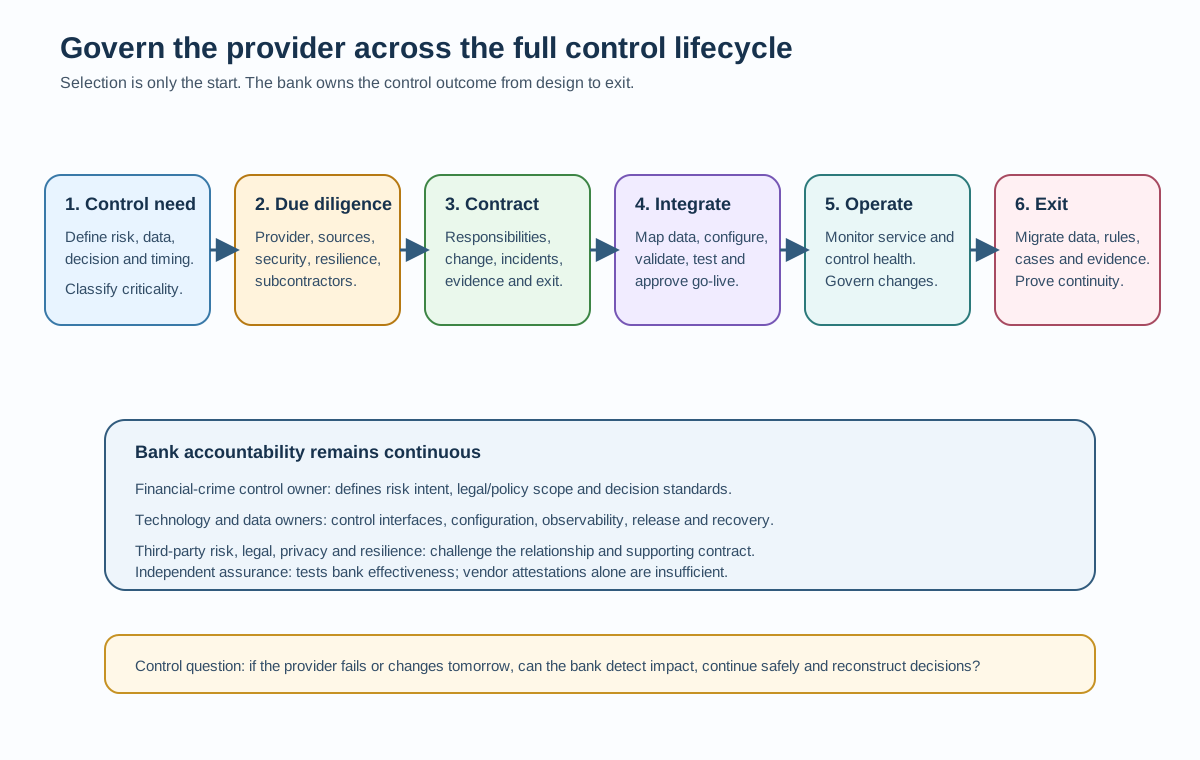
A practical mental model: capability, dependency and accountability
Every financial-crime third party creates a dependency. The dependency may be obvious, such as an external screening engine that decides whether a payment generates a sanctions alert. It may be less visible, such as a commercial dataset that enriches beneficial-ownership information before customer-risk scoring. It may also sit behind another vendor: a managed-service provider may depend on a cloud platform, data supplier or subcontracted analyst team that the bank never deals with directly.
The governance problem becomes easier to understand if the bank separates three layers. Capability is what the provider supplies: data, software, infrastructure, analytics, people or a combination. Dependency is how much the bank's control relies on that capability and what happens if it is wrong, late, unavailable or changed. Accountability is who within the bank owns the risk decision, the control design and the evidence that the service remains effective.
These layers should never be collapsed into one vendor score. A financially strong technology company may still be unsuitable for a particular sanctions use case if it cannot provide enough change transparency. A specialist list provider may have excellent data but the bank may load only part of the feed, suppress important attributes, or fail to reconcile a rejected update. A managed-service provider may meet its queue SLA while analysts close alerts with weak evidence. Vendor quality and control effectiveness are related, but they are not the same thing.
This distinction is especially important when internal teams say, "the vendor passed due diligence." Due diligence is a point-in-time assessment of the relationship and provider. It does not prove that a production control is working today. Production effectiveness requires evidence from the full chain: source data, provider processing, bank ingestion, configuration, decision logic, workflow, human handling, technical resilience and ongoing monitoring.
Three different vendor populations
Financial-crime teams often use the word "vendor" too broadly. Governance is stronger when third parties are classified according to what they actually do.
A data or list provider supplies reference information. This can include official sanctions-list content, PEP and relatives/close-associate data, adverse-media data, corporate registry or ownership information, vessel and aircraft data, country-risk indicators or other intelligence. The central risks are provenance, completeness, timeliness, normalisation, data meaning, identifiers, change handling and the provider's own source dependencies.
A technology provider supplies a control platform or component. Examples include customer screening, payment screening, transaction monitoring, case management, KYC workflow, entity resolution, graph analytics, adverse-media classification, document extraction or investigation tooling. The central risks include configuration, algorithm behaviour, performance, release management, explainability, audit logging, resilience, data interfaces and the bank's ability to test the deployed implementation.
A managed-service provider performs work on the bank's behalf. It may triage sanctions alerts, conduct KYC reviews, investigate transaction-monitoring cases, perform quality assurance or operate a technology platform. Here the bank must govern people, procedures, competence, location, access, confidentiality, service quality, judgement, escalation and continuity in addition to the technology and data beneath the service.
Some relationships span all three categories. A screening vendor may supply consolidated sanctions data, matching technology and hosted alert workflow. A KYC utility may combine external sources, orchestration software and human review. That does not remove the need to separate the risks. It makes the separation more important, because an incident in one layer can be misdiagnosed as an issue in another.
Why this matters specifically in financial crime
Financial-crime technology does not operate like an ordinary productivity tool. A defect can affect legal and regulatory obligations, payment execution, customer access to funds, suspicious-activity detection, sanctions decisions, regulatory reporting and the evidential record relied on by investigators. Some failures cause false negatives: a prohibited or suspicious relationship is not detected. Others cause false positives: legitimate customers are delayed, rejected, frozen or escalated unnecessarily. The bank must be able to govern both directions of error.
Timing can be critical. A sanctions-list update may need to reach screening controls promptly enough for the bank to apply the relevant legal or policy requirement. An instant-payment control may have only seconds to use external data. A transaction-monitoring platform can run later, but a delayed or incomplete data feed may contaminate an entire monitoring cycle. A managed KYC service can meet a contractual turnaround time while still creating risk if reviewers use outdated procedures or incomplete evidence.
The evidential burden is also high. When a regulator, auditor, legal team or internal investigation asks what data and configuration were in force on a particular date, the answer cannot be "the vendor manages that." The bank needs enough retained evidence to reconstruct the relevant version of the data, product, rules, thresholds, release and decision path.
Global standards and jurisdiction-specific rules
There is no single global law called "financial-crime vendor governance." Banks therefore need to map several frameworks rather than import one jurisdiction's rulebook into every entity.
The Basel Committee on Banking Supervision published current Principles for the sound management of third-party risk on 10 December 2025. The principles respond to banks' growing dependence on third-party service providers and broaden the traditional outsourcing lens to a wider range of arrangements. They are a global supervisory baseline rather than directly binding law in every jurisdiction, and they are intentionally flexible so national frameworks can differ.
FATF's 2021 work on new technologies for AML/CFT supports responsible, risk-based use of technology and emphasises informed oversight, privacy and data protection, and outcomes-focused approaches. FATF does not prescribe a commercial screening vendor or universal system architecture. Its relevance here is that technology should improve AML/CFT effectiveness within an accountable risk-based framework rather than become a substitute for governance.
The Wolfsberg Group's sanctions-screening guidance is useful industry guidance for list and screening governance. It recognises that regulatory lists are often supplied, enriched and maintained through external vendors and stresses that effectiveness depends on the institution's risk assessment, data, configuration and testing. Two banks using the same vendor product can therefore have very different control effectiveness because their data, settings, policy scope and operating processes differ.
In the United States, the Federal Reserve, FDIC and OCC issued interagency third-party risk-management guidance in June 2023 covering planning, due diligence and selection, contract negotiation, ongoing monitoring and termination. As of 21 September 2026, that existing framework must also be read alongside a proposal issued on 11 September 2026 by the Federal Reserve, FDIC, NCUA and OCC to revise and replace existing third-party guidance. The proposal is not final. It emphasises risk-based tailoring and, if finalised, would change the supervisory guidance landscape. A current bank procedure should therefore distinguish existing guidance from proposed future change rather than treating the September 2026 proposal as already effective.
In the European Union, DORA has applied since 17 January 2025 to in-scope financial entities and creates detailed ICT third-party risk requirements, including registers of contractual arrangements. In November 2025, the European Supervisory Authorities designated critical ICT third-party providers under DORA following analysis of information from those registers and other criteria. DORA is an EU legal framework and should not be described as a universal vendor rule for banks outside its scope.
The practical architecture is therefore global principle -> jurisdiction and entity applicability -> bank policy -> relationship-specific controls -> evidence. That chain prevents a common error in training material: converting useful guidance from one regulator into an alleged global mandatory requirement.
Start with the control, not the vendor
The best vendor governance begins before procurement. The bank should define the financial-crime problem it is trying to solve and the control outcome it needs. Buying a well-known product before defining the control can produce expensive technology that is badly aligned with the risk.
For a sanctions-list provider, the requirement may be to obtain specified official lists and associated identifiers within a defined operational window, preserve source provenance, identify additions, amendments and removals, and support reliable rescreening. For transaction monitoring, the requirement may be to detect defined behaviours using specific source data and produce explainable alerts with reproducible scenario versions. For a managed KYC service, the requirement may be to complete evidence-based reviews under bank policy with clearly defined escalation and quality standards.
This control-first approach changes procurement questions. Instead of asking only whether a product has "fuzzy matching," the bank asks what matching behaviours are needed for its names, languages and sanctions exposure, how the algorithm can be tested, which parameters can be configured, what the provider changes in releases, and how the bank can reproduce a historical match result.
The same approach helps avoid overbuying. Not every financial-crime process requires a sophisticated platform. A smaller, lower-risk portfolio may need a simpler solution if it meets the actual control objective and can be governed effectively. Proportionality does not mean weak governance; it means the intensity of governance matches the dependency and potential harm.
Criticality and materiality assessment
Third-party governance should be risk-based. The bank needs a consistent way to determine which relationships deserve the strongest scrutiny. Labels differ across frameworks, but the practical assessment usually considers the importance of the supported control, the potential impact of failure, customer and legal consequences, data sensitivity, transaction volumes, substitutability, concentration, geographic footprint, access privileges and reliance on subcontractors.
For financial crime, criticality should also consider control timing. A real-time sanctions-screening dependency can create immediate exposure if it becomes unavailable. A customer-risk data source may have more time for recovery but could affect thousands of risk ratings if the data is wrong. A case-management tool may not decide risk directly, yet its loss could destroy investigation continuity and evidential traceability.
Substitutability needs realistic analysis. A contract may say the bank can terminate on short notice, but moving a screening estate to another platform can require data migration, configuration rebuild, test packs, parallel running, user training and regulatory or governance approval. A provider should not be labelled "replaceable" simply because competitors exist in the market.
Concentration also matters inside the bank. Multiple control functions may depend on the same data provider, cloud platform or integration layer without recognising the shared dependency. One upstream incident can then affect customer screening, payment screening, KYC and monitoring simultaneously. A vendor inventory should therefore link providers to services, systems, data flows, legal entities, critical business services and financial-crime controls rather than store only procurement records.
Due diligence that tests the financial-crime use case
Generic supplier due diligence usually covers financial condition, information security, privacy, business continuity, legal status and operational capability. Those are necessary but not sufficient for a financial-crime provider.
A list provider should be able to explain source governance: which authoritative and public sources it uses, how often they are checked, how records are normalised, how aliases and identifiers are handled, how deletions and corrections are processed, how it distinguishes official designations from proprietary enrichment, and how customers are informed of material source or schema changes. For PEP or adverse-media products, the bank should understand taxonomy, sourcing rules, geographic and language coverage, inclusion and removal criteria, confidence handling and review processes.
A screening technology provider should explain product architecture, supported data types, matching methods, configuration controls, versioning, release practices, audit logs, testing tools, failure modes, capacity, resilience and historical reproducibility. If a vendor treats key control behaviour as an opaque trade secret, the bank must decide whether it can still obtain enough evidence to validate the control. Commercial intellectual property does not remove the bank's need to understand material limitations.
A managed service requires review of operating procedures, analyst competence, training, supervision, quality assurance, staffing model, location, subcontracting, conflicts, access control, escalation, retention and continuity. The bank should understand whether staff are dedicated or pooled and how rapid volume increases are handled without quietly weakening quality.
The quality of due diligence is measured by whether it changes the decision. A questionnaire containing hundreds of questions but no risk-based challenge is weaker than a focused assessment that identifies the few dependencies that could cause material control failure.
Contracting is part of control design
Contracts are not only commercial documents. For important financial-crime services, contractual terms should support the control model the bank expects to operate. The exact clauses depend on law, jurisdiction, service and negotiating position, but several themes recur.
The agreement should define the service clearly enough to distinguish provider responsibilities from bank responsibilities. It should address performance and availability where relevant, but also change notification, incident notification, access to evidence, audit or assurance rights, regulatory cooperation, data protection, confidentiality, security, business continuity, subcontracting, data location where required, retention, termination support and data return or deletion.
For list and data services, the contract should support source and change transparency. For screening or monitoring technology, it should support release documentation and adequate testing time for material changes. For managed services, it should address procedures, quality expectations, training, access, escalation, staffing and the bank's ability to review work.
An SLA that promises "99.9% availability" can still leave the bank poorly protected if the service delivers stale list data, changes matching behaviour without notice, or restores a system without restoring the historical audit trail. Service measures should therefore connect to the financial-crime control objective rather than focus only on infrastructure uptime.
The list-data chain: authority to production control
Sanctions screening provides the clearest example of why vendor governance is a data-lineage problem. Official authorities publish designations and related information. A commercial provider may ingest multiple official sources, normalise formats, add identifiers, transliterations or proprietary research, and package the result for clients. The bank then receives the feed, validates it, transforms it again, loads it into one or more screening engines and eventually rescreens customers or transactions.
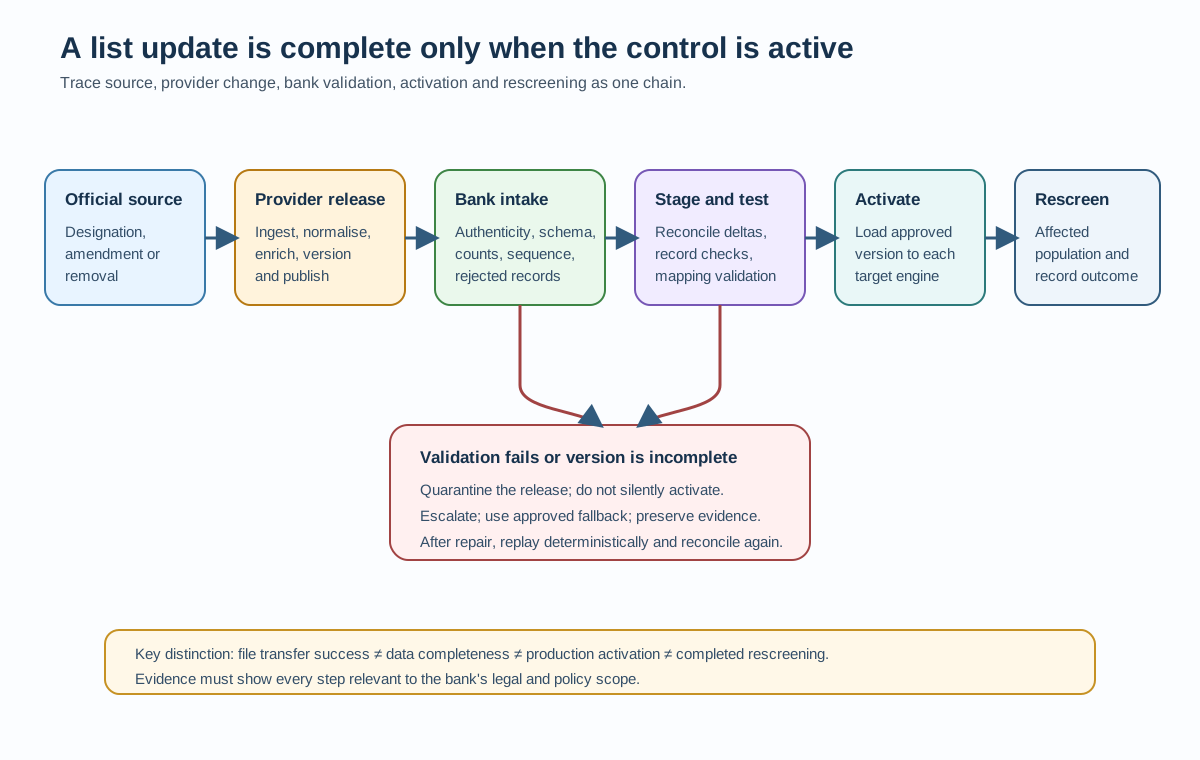
Each hand-off can fail. The authority can change a publication method. The provider can fail to ingest a record. The provider can ingest it but classify an attribute incorrectly. The bank can fail to receive the file. The file can arrive but fail schema validation. A transformation can truncate an identifier. The load can partly succeed. One screening engine can update while another remains on the prior version. Rescreening can be delayed or incomplete.
This is why "the vendor sent the file" is not an adequate control statement. The bank needs end-to-end evidence of freshness, completeness, integrity and activation. Useful evidence can include provider release identifiers, source timestamps, file hashes where used, record counts, add/change/delete counts, schema version, ingestion timestamps, validation results, rejected records, target-system versions, activation time and rescreening status.
OFAC's Sanctions List Service illustrates why technical source governance matters. OFAC provides current list data, separate SDN and non-SDN data, customised datasets, archived delta files and information on advanced data formats. OFAC also announced in 2023 that its public FTP service would be retired on or about 10 June 2024 and told users relying on automated downloads to migrate to website-hosted list content. The sanctions obligation did not disappear because a transport mechanism changed; users had to adapt their ingestion process. A mature bank therefore monitors not only list content but also source-delivery changes.
Provenance: official data and provider enrichment are different things
Commercial list services are valuable partly because they make raw public data easier to use. They may consolidate sources, standardise fields, create transliterations, add identifiers, link related records, research ownership or enrich data with other context. Governance is stronger when the bank knows which elements came from an official source and which were created by the provider.
That distinction matters during a disputed match. If a payment was stopped because of an official designation, the analyst should be able to identify the underlying authority record. If the concern came from proprietary ownership research or adverse-media classification, the bank should be able to understand the source and confidence sufficiently to apply its policy. "Vendor hit" is not a meaningful evidence category.
Provenance also supports correction. If an official authority amends a date of birth or removes an alias, the bank should be able to determine how the provider represented that change and whether downstream systems updated it. If the provider changes its own enrichment without any official-source change, that should be distinguishable too.
This is particularly important where data products combine sanctions, PEP, law-enforcement, regulatory and adverse-media information. Those categories do not have the same legal meaning. A PEP flag is not a sanctions designation. Adverse media is not proof of wrongdoing. A technology design that collapses them into one undifferentiated "watchlist" field can create serious decision errors even if the vendor data itself is accurate.
Screening platforms: the same product can produce different outcomes
A screening platform is not effective merely because another bank uses it. Matching performance depends on the bank's source data, fields selected for screening, normalisation, languages, transliteration, algorithms, thresholds, stop words, weak-alias treatment, suppression logic, list scope, workflow and operational handling.
Wolfsberg's sanctions-screening guidance makes this point practically: institutions should understand what data are relevant, how screening is configured, the limitations of the technology and how testing demonstrates effectiveness against the institution's own risk assessment. The same third-party solution can therefore be appropriate in one configuration and ineffective in another.
The bank should maintain a controlled inventory of material configuration. A useful configuration baseline identifies the software version, data/list version, matching engine version where available, algorithms, thresholds, field mappings, preprocessing rules, list selection, exclusions, suppressions, workflow routing and relevant interfaces. Changes to those elements should follow a risk-based change process.
Configuration ownership should also be explicit. Technology teams may administer parameters, but compliance or sanctions policy owners should define the risk intent. Operations may understand alert consequences, model or analytics teams may advise on performance, and independent testing may challenge effectiveness. No single team should silently change a material control simply because it has system access.
Monitoring technology and case-management vendors
Transaction-monitoring vendors create a related but different governance problem. The important question is not simply whether scenarios execute. The bank must know whether required data arrive completely and on time, whether transformations preserve meaning, whether scenario versions are controlled, whether thresholds and segmentation are approved, whether alert generation is complete, and whether cases remain linked to the data and logic that created them.
A vendor may supply a standard scenario library, but bank-specific risk assessment still matters. A scenario designed for one product, country or customer population may be poor for another. The bank should understand which scenario logic is provider intellectual property and which parameters or rules it can inspect, test and change. Where a model is involved, the model-governance requirements appropriate to the jurisdiction and bank should be applied in addition to third-party governance.
Case-management technology is sometimes treated as administrative, yet it preserves decisions that can become regulatory evidence. The platform should retain who did what, when, under which procedure and with which evidence. Role-based access, immutable or controlled audit trails, attachment handling, status transitions, approvals and data retention are therefore part of financial-crime control design, not merely usability features.
Managed services: outsourcing work does not outsource judgement ownership
Managed services can be effective where specialist skill or scalable capacity is needed. The danger is that work becomes remote from the bank's control owners. If an external team clears sanctions alerts or performs enhanced due diligence, the bank must still define the decision standard and know whether it is being followed.
Good governance separates task execution from decision accountability. The provider may gather evidence, apply documented procedures and recommend an outcome. Depending on the bank's policy and legal framework, some decisions may be delegated within defined boundaries, while higher-risk decisions remain with bank staff. Whatever the design, decision rights should be explicit and testable.
Quality assurance should examine reasoning, not only completion time. A provider can achieve impressive productivity by closing work too quickly. Useful quality review checks evidence sufficiency, correct application of policy, escalation, narrative clarity, disposition accuracy and handling of uncertainty. Error trends should feed training, procedure change and capacity planning.
The bank also needs surge and failure plans. What happens if alert volumes double after a major sanctions event? What happens if the provider loses connectivity, has a security incident, or cannot staff a region? Queue capacity is a resilience dependency and should be governed like technology capacity.
End-to-end financial-crime technology architecture
Financial-crime controls usually cross multiple vendors and internal systems. A customer-screening decision may depend on core customer data, an integration layer, a commercial watchlist, a matching engine, workflow software and case evidence stored elsewhere. Transaction monitoring may depend on dozens of transaction sources, an ETL platform, vendor analytics and a separate case tool.
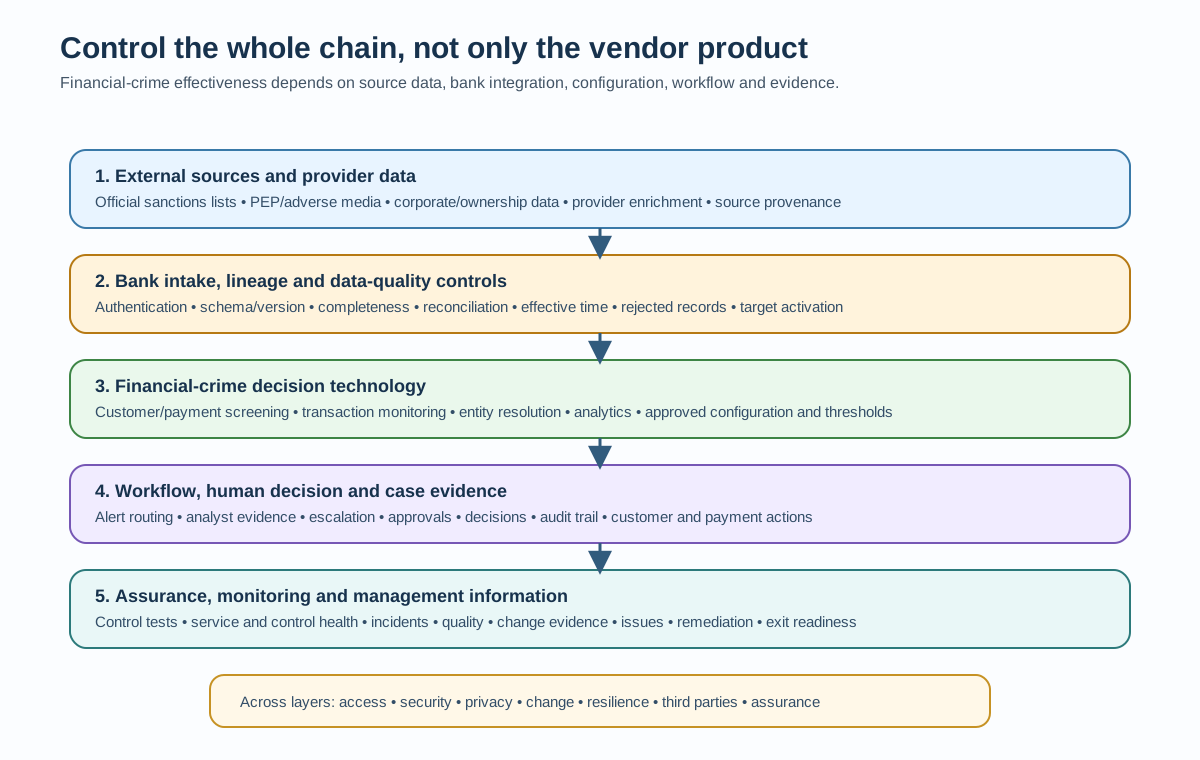
Architecture documentation should therefore show both data lineage and control responsibility. A box-and-arrow diagram is useful only if teams can answer where completeness is checked, where a failure becomes visible, who owns reconciliation, which component controls effective time, and how the bank prevents silent partial processing.
Interfaces need explicit contracts. For a list feed, the contract may define schema, mandatory identifiers, encoding, event type, sequence, timestamp and expected counts. For transaction monitoring, it may define transaction-event identifiers, booking and value dates, parties, amount, currency, channel and correction logic. Technical contracts should be versioned and tested because vendor and internal system releases can change them independently.
Observability is part of control effectiveness. Monitoring should identify stale feeds, failed jobs, queue growth, record rejection, latency, incomplete batches, API errors and abnormal output volumes. A green infrastructure dashboard is not sufficient if it only proves that servers are running while a control feed is empty.
Change is where good vendor controls often fail
A provider can pass procurement due diligence and operate successfully for years, then introduce risk through change. Examples include a new list schema, revised matching algorithm, changed default threshold, new cloud region, subcontractor change, data-source replacement, API retirement or product migration.
The bank therefore needs a change taxonomy. Low-impact technical fixes may follow standard technology change. Material control changes should involve financial-crime owners and appropriate validation. The threshold for "material" should consider whether the change can alter population coverage, detection behaviour, legal applicability, data meaning, decision rights, evidence or resilience.
Release notes alone are not validation. The bank should identify affected controls, review the provider's change explanation, update requirements where necessary, run regression and risk-specific tests, compare expected and actual results, approve the change and retain evidence. Where possible, important changes can be tested in a non-production environment or through parallel comparison before activation.
Emergency vendor changes require the same principles under tighter time pressure. If a critical vulnerability forces a rapid upgrade, the bank may accept a different test scope temporarily, but the risk acceptance, compensating controls and post-change validation should be explicit rather than disappearing into an emergency ticket.
Resilience, concentration and fourth parties
Third-party resilience is not simply whether the provider has a disaster-recovery document. The bank needs to know which financial-crime services could fail, how quickly harm develops, what fallback exists, whether fallback has been tested and how the service is restored with data integrity intact.
A screening outage may require queueing, alternate screening, restricted processing or other bank-defined measures depending on product and legal context. A list-feed failure may require direct retrieval from an official source or temporary controls while the provider issue is resolved. A monitoring outage may allow later catch-up, but the bank should know how missed periods are identified and replayed without duplication or gaps.
Fourth-party risk appears when the contracted vendor depends on other providers. The bank may not need to govern every subcontractor identically, but material dependencies should be visible enough to understand concentration, data location, access and continuity. A single cloud, data or identity provider can sit beneath multiple financial-crime vendors and create hidden common-mode failure.
EU DORA makes ICT third-party dependency particularly explicit for in-scope financial entities through contractual registers and oversight of designated critical ICT providers. Other jurisdictions use different frameworks. The broader bank-practical point is that an inventory must be useful during a crisis, not merely complete enough for procurement reporting.
Incidents and the evidence needed to respond
Financial-crime vendor incidents are often ambiguous at first. A drop in alert volume may reflect genuinely lower activity, a source-data failure, vendor processing defect or configuration change. A list version may appear current while one source subset is incomplete. A case-management outage may restore service but lose an attachment or workflow event.
Incident response should therefore begin with impact boundaries. Which legal entities, products, customers, transactions, lists, scenarios, dates and systems are affected? When did the problem start? What was the last known-good state? Which decisions may have been made on defective or stale information? Can affected populations be replayed or rescreened?
Evidence should be preserved before remediation destroys it. Logs, vendor notices, files, versions, counts, timestamps, configuration snapshots and decision records can be essential to determine scope. The bank should avoid fixing the immediate technical symptom while losing the ability to identify which customers or payments were affected.
The financial-crime response may include rescreening, lookback monitoring, case review, transaction review, reporting assessment, customer remediation or policy escalation, depending on the defect and jurisdiction. Those actions should be driven by facts rather than by the desire to close the technology incident quickly.
Customer impact is part of vendor governance
Vendor failures can harm customers in both directions. Under-detection exposes the bank and financial system to illicit activity. Over-detection can delay payments, block onboarding, create repeated requests for information, restrict accounts or route customers into unnecessary enhanced due diligence.
This means control tuning should consider customer outcomes without weakening legal obligations. If a data provider incorrectly marks a common name as a high-risk record, false positives may increase sharply. If a screening engine update changes transliteration behaviour, certain language groups may experience disproportionate friction. If a managed service is rewarded only for speed, customers may receive repetitive information requests because reviewers do not reuse existing evidence.
Management information should therefore connect technical and compliance measures with operational outcomes: false-positive patterns where measurable, investigation rework, customer delay, aged cases, repeated document requests, complaints linked to control defects and remediation volumes. Customer impact can reveal a vendor or configuration problem before a formal technology incident does.
Governance and decision rights
A mature model avoids the fiction that "vendor management" belongs to one department. Third-party risk teams, procurement, technology, information security, resilience, privacy, legal, financial-crime compliance, operations, model risk where relevant and the business owner each see different parts of the risk.
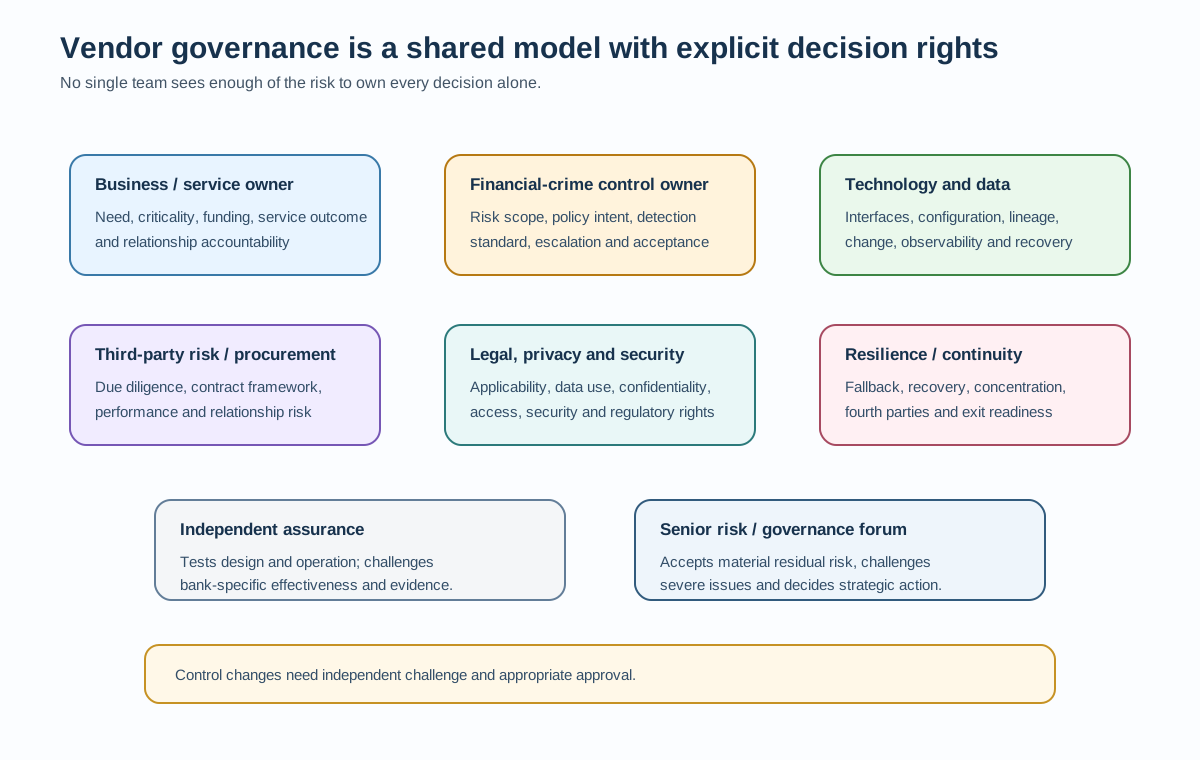
The business or service owner should understand why the service exists, its criticality and whether it remains fit for purpose. Financial-crime control owners define the required control outcome, list or risk scope, decision rules and escalation. Technology and data owners govern interfaces, configuration, releases, resilience and observability. Third-party risk and procurement support due diligence, contracting and relationship oversight. Legal, privacy and information-security teams address their respective requirements. Independent assurance tests whether the control is designed and operating effectively rather than relying only on vendor attestations.
A senior forum should receive issues that exceed agreed tolerance: prolonged list staleness, repeated quality failures, severe control defects, unresolved vendor limitations, concentrated dependency, material audit findings or an exit decision. Governance is not improved by sending every minor SLA miss to executives. Escalation should focus on risk and customer or legal impact.
What evidence should exist for assurance
Good governance leaves a trail that another competent person can review. The exact pack varies by service, but assurance commonly needs evidence of the control purpose, risk and criticality assessment, due diligence, approved contract, responsibilities, architecture, source and data lineage, configuration baseline, test results, production approval, service monitoring, change history, incidents, issues, remediation and exit planning.
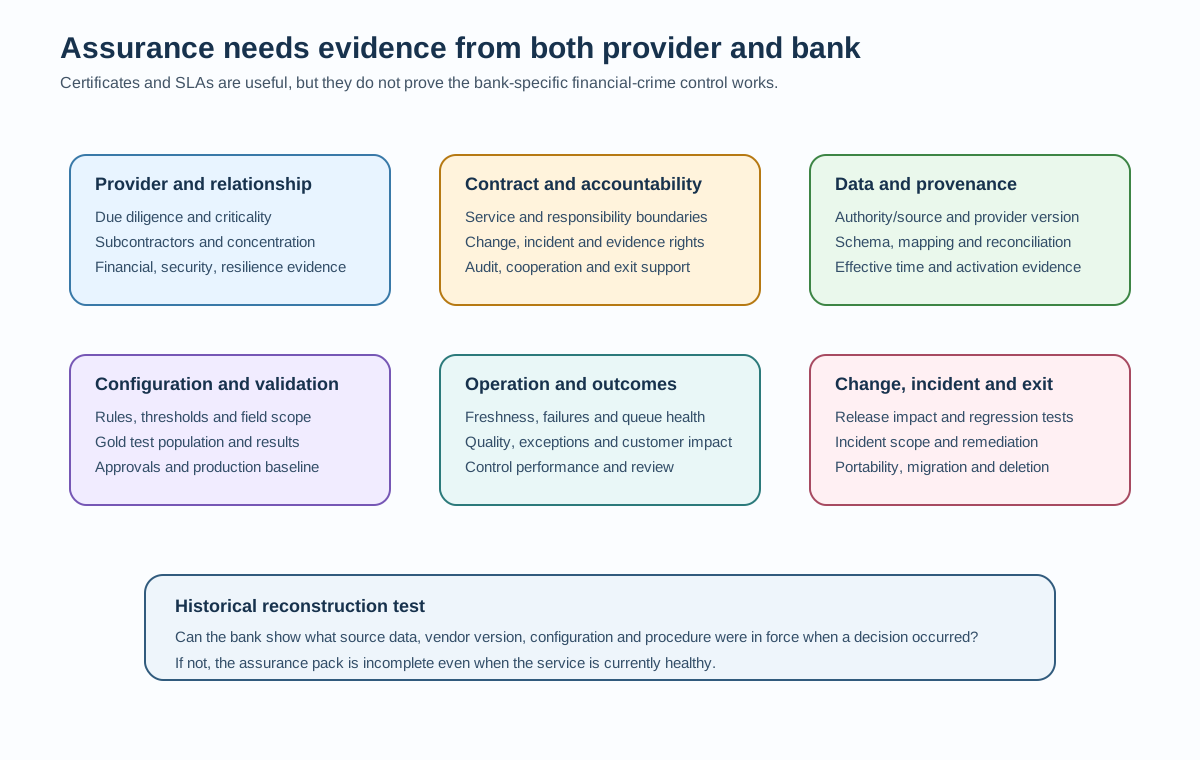
Vendor certifications can be useful evidence, but they answer only the questions within their scope. A security certification does not prove sanctions-list completeness. A service-auditor report does not prove that the bank configured fuzzy matching appropriately. A vendor's successful penetration test does not prove transaction-monitoring source completeness. Evidence must be matched to the control assertion being made.
The strongest assurance question is often: Can the bank independently demonstrate the control outcome without asking the vendor to explain it from scratch? The bank does not need to recreate the provider's entire product, but it should possess enough information to show what it relied on, what it tested, what version was used and why the outcome was accepted.
Mini case: a list feed is "green" but stale
Consider a global bank using a commercial sanctions-list provider. The provider releases an update after an authority adds new designations. The bank's integration platform receives a file and marks the transfer job successful. Overnight customer rescreening also completes without technical error. The next morning, sanctions operations notice that expected new names are not generating test matches.
Investigation shows that the provider changed an element in its data schema. The transfer succeeded, but the bank's transformation silently ignored records using the new element. Infrastructure monitoring therefore remained green. The failure is not simply a vendor problem or an integration problem; it is an end-to-end control failure.
A mature design would detect the issue through several independent signals. The bank would compare provider release counts with ingested counts, validate schema versions, reconcile additions and deletions, run known-designation control tests, monitor data freshness by source and verify that production screening loaded the intended dataset version. The operational response would identify the affected period and populations, correct the transformation, reload the data, rescreen relevant customers or transactions, preserve evidence and assess whether any decisions need review.
The governance lesson is powerful: availability is not completeness, successful transfer is not successful control, and current-looking version labels do not prove that every required record is active.
What a business analyst should take from the chapter
A business analyst working on financial-crime vendor integration should be able to trace a requirement from policy or control intent through data, system behaviour, operations and evidence. "Integrate vendor API" is not a sufficient requirement. The BA should know what the API data mean, which fields are mandatory, what happens on missing or rejected records, how versions are identified, what constitutes a material change, how operations know the service is stale, and what fallback applies.
Acceptance criteria should include unhappy paths. What happens when the provider sends a duplicate update, a late update, an empty file, an unknown schema version, a partial response or inconsistent counts? What happens when one target system loads successfully and another fails? What happens when the vendor service is unavailable during an instant payment? How will a replay avoid duplicate alerts or missing cases?
The BA should also connect non-functional requirements to financial-crime consequences. Latency, availability, recoverability, data retention, access control and logging are not abstract architecture attributes. They affect whether a payment is stopped in time, whether a customer can be screened, whether a lookback can be performed and whether an investigator can defend the decision.
The next supplements deepen the two areas most likely to fail in practice: list and data lineage, and bank-specific testing, metrics, change and exit controls.
Operational deep dive: list, watchlist and external-data governance
A financial-crime data service is easiest to govern when the bank stops treating it as a file subscription and starts treating it as a controlled evidence supply chain. The objective is not merely to receive data. It is to know what authority or source produced the underlying fact, what the provider changed or added, when the bank received it, what transformations occurred, which control version used it and whether the bank can reconstruct the state later.
Source taxonomy matters
Different external datasets support different decisions. Official sanctions designations come from competent authorities and have legal significance according to the applicable regime. PEP data are generally used to identify heightened corruption exposure and support enhanced due diligence; a PEP classification is not itself a finding of wrongdoing. Adverse-media data can surface allegations, investigations or other risk context, but source quality and relevance require judgement. Corporate and beneficial-ownership information may come from public registries, regulated data sources, commercial research or customer-provided evidence. Vessel, aircraft, geographic and trade data have their own source limitations.
A provider that combines these into one product may improve usability, but the bank should preserve category and provenance. A field such as risk_type = watchlist is too weak if downstream logic cannot distinguish a binding sanctions designation from a commercial adverse-media tag. Data models should preserve the legal or risk meaning of the source rather than flatten it for convenience.
For sanctions lists, provenance should normally identify the issuing authority, programme or list where relevant, provider record identifier, official identifier where available, source publication or effective information, and the provider's own version. Where the provider adds transliterations, ownership links or research, those additions should be distinguishable from the underlying official record so investigators know what evidence they are relying on.
Additions, amendments and removals all matter
Teams often monitor only additions because a new designation looks like the highest-risk event. Amendments and removals can be just as important operationally. An amended date of birth or alias can change matching behaviour. A corrected identifier can resolve false positives or reveal previously missed matches. A delisting or removed alias can prevent legitimate customers from being held against obsolete data.
The bank should therefore reconcile all material event types supported by the source and provider. If the feed uses full snapshots, the bank may need to derive differences safely. If it uses deltas, sequence and completeness controls become critical. A missing delta can make every later version appear current while leaving the database historically incomplete.
A robust ingestion process records enough information to answer questions such as: What provider release was expected? What arrived? How many additions, updates and removals were declared? How many records passed validation? Which failed, and why? Did every screening environment activate the same logical version? Was customer rescreening completed? Were any queues or target systems left behind?
Freshness is a control concept, not a timestamp decoration
A system may display today's date while still using stale underlying information. Freshness should therefore be measured against a known upstream event and expected processing path, not only against file creation time.
For example, a bank may record four timestamps: the authority publication or provider-source timestamp, the provider release timestamp, the bank receipt timestamp and the production activation timestamp. The difference between those times shows where latency occurred. The bank may also record when required rescreening completed. Not every source exposes every timestamp, but the architecture should preserve what is available rather than overwrite it during transformation.
There is no universal global rule saying every list must be loaded within one fixed number of minutes. Timing expectations depend on the sanctions regime, legal entity, product, control purpose, bank policy and technical design. Governance should define bank-approved operational tolerances that are consistent with applicable obligations and escalate breaches according to risk.
Schema governance and technical contracts
Data providers change formats. Fields are added, deprecated or retyped. Character encoding changes. New identifiers appear. Nested structures replace flat fields. A bank that consumes the feed through brittle transformation logic can fail even when the provider's change is legitimate and well documented.
The data interface should therefore have a versioned technical contract. It should define schema, mandatory and optional fields, accepted values, encoding, identifiers, event semantics, sequence behaviour, null handling and error behaviour. Unknown mandatory versions should fail safely rather than be silently accepted. Optional new fields can be tolerated where designed, but the bank should still assess whether they carry risk-relevant information that should be mapped.
Schema-change testing should use representative data rather than only synthetic happy paths. Sanctions data contain long names, multiple scripts, aliases, multiple dates, addresses, vessels, aircraft, entities and programme tags. A transformation that passes a simple Latin-script individual record may fail on the records most important to screening effectiveness.
Reconciliation across the chain
Reconciliation is one of the strongest controls because it tests the boundary between provider and bank. It should be designed at meaningful control points rather than as one total record count.
A useful chain can compare provider-declared counts with bank-received counts, bank-validated counts with staged counts, staged counts with production counts and production version with screening-engine version. Where multiple engines or legal entities use the same provider, the bank should know which targets have activated the release and which have not.
Record counts alone are not sufficient. A file can contain the right number of records but the wrong records. High-risk control checks can therefore include known-record sampling, source-specific counts, hash or checksum controls where available, unique identifier reconciliation, add/change/delete counts and targeted test queries against newly changed designations.
The reconciliation design should also distinguish a technical retry from a new business event. Otherwise a replay can double-apply a delta, create duplicate alerts or make monitoring dashboards believe two source updates occurred.
Alias, transliteration and name-quality governance
List providers often add value by normalising or transliterating names. Those transformations can improve matching across scripts and spelling systems, but they can also increase noise or create false confidence if the bank does not understand them.
Weak aliases deserve careful handling because an alias that is too generic can generate large volumes of low-quality alerts. OFAC publishes specific information about weak aliases, while different authorities may use different data conventions. A commercial provider may classify or enrich aliases further. The bank should understand how its vendor represents these attributes and how the screening engine uses them.
Transliteration should be tested against the languages and scripts relevant to the bank. A provider's generic transliteration capability may not behave equally well across all name populations. The bank's test library should therefore contain realistic examples from its own customer and payment data, not only vendor demonstration cases.
PEP and adverse-media data require different governance
PEP and adverse-media services are often updated continuously and depend on judgement-heavy research. Governance should focus on methodology as well as technical delivery. The bank should understand inclusion and removal criteria, source hierarchy, quality assurance, geographic and language coverage, relationship mapping, confidence treatment and the way contested or corrected information is handled.
For adverse media, a vendor may use machine learning or natural-language processing to classify articles. The bank should know whether the output is a search aid, a risk indicator or something more determinative in its workflow. A relevance score should not be mistaken for factual confirmation. Analysts need access to sufficient source context and should record why the information matters to the customer's risk assessment.
For PEP data, the bank should avoid treating vendor status as a permanent legal truth. Definitions and treatment differ by jurisdiction. The provider can identify candidates and relationships, but the bank's policy and applicable law determine the due-diligence response.
Ownership and control data
Sanctions ownership and control analysis is another area where third-party data can assist but should not become an invisible decision. Commercial providers may map corporate ownership, infer links or aggregate holdings. Those capabilities can be valuable, especially where legal structures are complex, but the bank should know the evidence source, effective date, confidence and applicable legal test.
Different sanctions regimes can apply different ownership or control concepts. The bank should not encode a single vendor field such as sanctioned_by_ownership = yes as a universal legal conclusion across all entities and jurisdictions. Instead, the architecture should preserve the underlying ownership facts and the rule or policy logic used for the relevant regime.
Historical effective-time data matter. If an investigator reviews a payment from six months ago, current ownership may not answer who owned or controlled the entity at the transaction date. Where the use case requires historical reconstruction, contracts, data models and retention should support it.
Monitoring the data service in production
Operational monitoring should tell the control owner whether the data remain usable, not merely whether an API endpoint responds. Useful measures include last successful release by source, age against expected update pattern, failed ingestion, rejected records, schema exceptions, reconciliation breaks, pending rescreening, target-system version divergence and unexplained changes in alert output after a data release.
Thresholds should be risk-based. An adverse-media source that publishes continuously may need a different freshness measure from an official sanctions list that changes only when an authority acts. The bank should avoid dashboards that turn every source into the same red-amber-green timer without understanding source behaviour.
Provider-reported service health is useful but should be supplemented by bank-side checks. A vendor can report its service as available while the bank's credentials have expired, a firewall blocks traffic, a transformation rejects records or one downstream screening engine is not loading the data.
Mini case: the provider changed a source, not just a file
A bank uses a commercial adverse-media and PEP provider. The provider replaces one regional news source after the publisher changes licensing terms. The API schema and record counts remain stable, so technical monitoring shows no incident. Three months later, investigators notice that a particular language region has far fewer adverse-media results than before.
A weak governance model treats this as unavoidable vendor behaviour because the SLA was met. A stronger model classifies material source changes as a governed event. The provider must notify the bank where agreed, the bank assesses coverage impact, compares outputs, adjusts risk acceptance or alternative sources where needed, and considers whether previously reviewed customers require targeted lookback.
The lesson is that semantic coverage can change without technical failure. Data governance must monitor what information means and where it comes from, not only whether a feed arrives.
What good looks like
A well-governed list or data service lets the bank trace a production decision back through the data chain without depending on memory. Teams know the authoritative or research source, provider version, bank receipt, transformation, target-system activation and relevant policy. They can identify failed records, reproduce historical state where required, explain provider enrichment, and respond to source or schema change without improvisation.
That level of traceability is not bureaucracy for its own sake. It is what turns external data into bank-controlled evidence.
Advanced practice: testing, change, incidents and exit
A financial-crime vendor relationship becomes trustworthy only when the bank can test it under normal conditions, change conditions and failure conditions. Vendor assurance reports and contractual commitments provide useful evidence about the provider. They do not replace bank-specific testing of data, configuration, integration, workflow and decisions.
Build a test strategy around control claims
Testing should begin with the claim the bank wants to make. If the claim is that the sanctions-list process loads all required records, testing should demonstrate completeness and rejected-record handling. If the claim is that customer screening detects relevant name variation, testing should challenge aliases, transliteration and distinguishing attributes. If the claim is that a managed service applies policy correctly, testing should sample evidence and decisions rather than only measure turnaround time.
A useful test pack for financial-crime technology normally contains several layers. Functional tests prove expected rules and workflows. Data tests prove completeness, mapping, types and effective-time behaviour. Control-effectiveness tests use known or constructed risk cases to show that the configured control detects what the policy says it should. Negative tests show that legitimate records do not generate unreasonable friction. Resilience tests prove fallback, recovery and replay. Regression tests show that a new vendor or bank release has not broken previously accepted behaviour.
The bank should own or be able to inspect critical test cases. A vendor's standard certification suite is not enough because it may not reflect the bank's languages, products, data quality or policy scope. Test evidence should identify the product and configuration version, data version, expected result, actual result, deviation and approval.
Screening test packs
For name screening, test cases should reflect the risk assessment. Examples can include exact matches, common spelling variation, reordered names, punctuation, transliteration, aliases, dates of birth, nationality or location differentiators, entity suffixes and known weak-alias situations. The objective is not to force every possible variation to alert. It is to demonstrate that the bank's chosen configuration is reasonable for its actual risk and data.
Payment screening needs message-aware testing. The bank should know which party and text fields are screened for each payment type and how truncation, structured addresses, intermediary data, remittance text and message transformation affect the screening input. An engine can perform perfectly on the data it receives while the upstream mapping silently omits a relevant party.
When a vendor changes a matching algorithm, the bank should compare outcomes on a controlled regression population. Alert-volume change is a useful signal but not proof of quality. A five-percent reduction in alerts could represent better precision or missed risk. The test must examine detection outcomes, not just volume.
Transaction-monitoring and analytics testing
For monitoring technology, the test strategy should cover source completeness, scenario population, joins, aggregation windows, thresholds, segmentation, alert creation and case linkage. Backdated corrections, late-arriving transactions and reversals should be tested because real banking data are not perfectly ordered.
Where the vendor uses proprietary analytics or machine learning, the bank should understand enough about inputs, outputs, limitations and change governance to validate the control at the level appropriate to the use case. The preceding chapter on AI model governance covers deeper model-specific requirements. Here the important point is that vendor ownership of an algorithm does not eliminate the need for bank evidence that the deployed control is fit for purpose.
Acceptance criteria for business analysts
Requirements should describe observable outcomes. Useful acceptance criteria for a list integration might say that every accepted provider release receives a unique version, declared additions/amendments/removals are reconciled, rejected records are quarantined with a reason, unknown schema versions do not activate automatically, and downstream systems expose the active version. It should also say what operational event is raised when those conditions fail.
For a screening platform, acceptance criteria can specify approved source fields, configuration version, test-pack pass criteria, audit-log requirements, role-based change permissions, production promotion controls and the evidence stored for a historical result. For a managed service, criteria can cover reviewer entitlement, approved procedure version, evidence capture, escalation, quality sample, decision authority and queue ageing.
Non-functional requirements should be expressed in risk terms. Instead of writing only "system available 24x7," the BA should define what happens when the service is unavailable: which transactions or customer actions are affected, what fallback is allowed, how queued work is protected, how replay works and who decides when normal processing resumes.
Metrics that reveal control health
Vendor governance dashboards often overemphasise SLA attainment. A provider can meet uptime and response-time targets while the financial-crime control deteriorates. Metrics should therefore combine service health with control health.
For list and data services, useful indicators include freshness by source, failed or late releases, reconciliation breaks, rejected records, unresolved schema exceptions, target-system version divergence and rescreening backlog. For screening technology, useful measures can include test-pack performance, unexplained alert-rate shifts, failed interfaces, override or suppression changes, latency and material defects. For managed services, measures can include quality error rate, repeat error themes, backlog ageing, escalation timeliness, rework, staff turnover where relevant, training completion and policy-version adherence.
Metrics need context. A low false-positive rate is not automatically good if detection is weak. A high alert closure rate can hide poor investigation. A zero-incident month can mean stability or poor detection of incidents. Governance forums should therefore ask what the measure proves and what it could conceal.
Material change and release governance
The bank should maintain a practical definition of material vendor change. Examples include a new matching engine, major algorithm change, data-source replacement, change to official-list ingestion, new hosting region, significant subcontractor change, migration to a new platform, change in identity-resolution logic or a release that alters decision workflow.
Materiality should determine review and testing depth. Minor user-interface changes may require limited regression. A list-schema migration or matching-engine update can require control-owner review, full regression, data reconciliation, performance testing, operational readiness and formal approval. The bank should avoid both extremes: sending every patch to a senior committee, or allowing the vendor to define unilaterally which changes are material to the bank's control.
Version evidence matters after the release. When an alert is investigated later, teams should be able to identify which version of the control produced it. That may require retaining release identifiers, configuration snapshots or effective-date records rather than trying to preserve the entire production environment indefinitely.
Incident response and lookback decisions
When a defect is discovered, the first governance decision is scope. Teams should identify the affected time window, data sources, systems, legal entities, customer or transaction populations and control outcomes. They should preserve the last known-good version and the defective version long enough to reproduce impact.
The second decision is remediation. Technical repair may be straightforward, but financial-crime remediation can require rescreening, replaying monitoring, re-reviewing cases or assessing transactions processed during the gap. The bank should decide whether any external reporting, regulatory engagement or customer remediation is required under applicable law and policy rather than assuming every technology incident has the same compliance consequence.
The third decision is learning. Root-cause analysis should distinguish provider failure, bank integration failure, configuration weakness, test-gap, monitoring weakness, procedure error and governance failure. Corrective action should address the cause, not only add another manual check after every incident.
Mini case: a vendor improves the algorithm and the bank loses coverage
A screening provider releases a new matching engine advertised as reducing false positives. The bank's test environment shows a substantial fall in alerts, which operations welcomes because queues are high. The release is promoted after basic regression tests pass.
Several weeks later, quality assurance finds that a set of transliterated names that alerted under the prior engine no longer alert at the same threshold. The vendor confirms that token weighting changed. The release did not technically fail; the bank's test pack was too narrow.
A stronger governance model would have treated the matching-engine change as material. The bank would run a risk-based gold dataset containing known true-match and non-match cases across relevant languages, compare old and new results, investigate every unexpected detection loss, document accepted trade-offs and obtain control-owner approval. Operations capacity pressure would not be allowed to redefine detection quality silently.
The case demonstrates why lower alert volume is not the same as better effectiveness. Tuning must be evidence-based and balanced against the risks the control is meant to detect.
Exit and portability are control requirements
Exit planning should begin before the relationship ends. A bank may terminate because of strategy, cost, control weakness, provider failure, regulatory concern or acquisition. In each case, financial-crime controls must continue while data, configuration and cases move.
The exit plan should identify replacement capability, required historical data, data formats, configuration and rule export, open cases, audit history, user records, retention obligations, rescreening or parallel-run needs, cutover controls, access revocation and provider data deletion where applicable. Contracts should support these needs, but the bank should also test whether its planned extraction is technically usable.
A screening migration illustrates the challenge. The new engine may interpret thresholds differently from the old one. The bank cannot simply copy a number such as "85" and assume equivalent behaviour. It needs outcome-based comparison and approved calibration. Historical alerts and decisions may need to remain searchable even after the old platform is decommissioned.
Exit readiness is also a concentration control. If a provider is genuinely difficult to replace, that fact should influence criticality, contingency investment and senior governance long before an incident forces a rushed migration.
The current US and EU change horizon
Vendor governance is a moving regulatory area, so chapters and bank policies should distinguish current requirements from proposals. In the United States, the agencies issued a proposed replacement for existing third-party risk-management guidance on 11 September 2026. The proposal emphasises tailoring to reasonably assessed risk and would apply when final; it should not be described as already-final guidance on 21 September 2026.
In the EU, DORA is already applicable to in-scope financial entities. Its ICT third-party framework includes contractual registers, governance and oversight features that go beyond a generic procurement process. The European Supervisory Authorities' November 2025 designation of critical ICT third-party providers shows that supervisory attention includes sector-level concentration and substitutability, not only each bilateral bank-vendor contract.
For a global bank, the practical response is a common enterprise third-party framework with jurisdiction-specific overlays. That provides consistent inventory, criticality, evidence and governance while allowing legal entities to meet local requirements without pretending that one regulator's terminology is universal.
Final professional test
A vendor relationship is mature when the bank can answer five questions without hand-waving: What control outcome do we rely on the provider for? What can fail and how will we know? What evidence proves the current implementation works? Who can change or override it and under what governance? How do we continue the control if the provider or service is unavailable or must be replaced?
If those answers exist only in the vendor's documentation, governance is incomplete. If they exist in bank-owned requirements, architecture, tests, monitoring, decisions and evidence, the third party has become a governed capability rather than an outsourced blind spot.
References and further reading
These sources support the chapter's global principles and jurisdiction-specific examples. They should be read with the law, regulatory guidance and internal policy applicable to the bank's own legal entity and service.
- Basel Committee on Banking Supervision, Principles for the sound management of third-party risk (10 December 2025, current): https://www.bis.org/publications/202512-guidelines-principles-sound-management-third-party-risk
- Basel Committee on Banking Supervision, Compliance and the compliance function in banks, consolidated guideline module including outsourcing of specific compliance tasks: https://www.bis.org/committees/bcbs/basel-consolidated-guidelines/module/iac/20
- FATF, Opportunities and Challenges of New Technologies for AML/CFT: https://www.fatf-gafi.org/en/publications/Digitaltransformation/Opportunities-challenges-new-technologies-for-aml-cft.html
- Wolfsberg Group, Sanctions Screening Guidance: https://wolfsberg-group.org/resources/legacy/53
- U.S. Federal Reserve, FDIC and OCC, Interagency Guidance on Third-Party Relationships: Risk Management (June 2023): https://www.federalreserve.gov/supervisionreg/srletters/SR2304.htm
- U.S. Federal Reserve, FDIC, NCUA and OCC, Proposed Third-Party Risk Management Guidance (11 September 2026; proposal, not final as of this review): https://www.federalreserve.gov/newsevents/pressreleases/bcreg20260911a.htm
- OCC, Third-Party Risk Management: Proposed Guidance and Request for Comment (11 September 2026): https://www.occ.gov/news-issuances/bulletins/2026/bulletin-2026-46.html
- Federal Reserve, FDIC and OCC, Third-Party Risk Management: A Guide for Community Banks (May 2024): https://www.federalreserve.gov/frrs/guidance/third-party-risk-management-a-guide-for-community-banks.htm
- European Banking Authority, Preparations for reporting of DORA registers of information: https://eba.europa.eu/activities/direct-supervision-and-oversight/digital-operational-resilience-act/preparation-dora-application
- European Banking Authority, European Supervisory Authorities designate critical ICT third-party providers under DORA (18 November 2025): https://www.eba.europa.eu/publications-and-media/press-releases/european-supervisory-authorities-designate-critical-ict-third-party-providers-under-digital
- European Banking Authority, Digital Operational Resilience Act overview: https://www.eba.europa.eu/activities/direct-supervision-and-oversight/digital-operational-resilience-act
- U.S. Treasury OFAC, Sanctions List Service: https://ofac.treasury.gov/sanctions-list-service
- U.S. Treasury OFAC, OFAC to retire its FTP server on or about June 10, 2024: https://ofac.treasury.gov/recent-actions/20230609_33