Digital Assets, Smart Contracts and Sanctions Interdiction
A sanctions control for digital assets has to answer a deceptively simple question: can the bank, custodian, exchange or other regulated firm lawfully execute or continue this activity, and what must it do if the answer is no or uncertain? The technology is new compared with traditional account payments, but the core legal problem is familiar. A person may be designated. Property may be blocked or frozen. A transaction may be prohibited because of a country, sector, service, counterparty or activity restriction. An authorization or licence may permit activity that would otherwise be prohibited. The institution must know which regime applies, which facts matter, and what operational action follows.
Digital assets make that problem harder because the financial object and the payment rail can be the same thing. A token can move directly between addresses without a bank in the middle. A smart contract can route, swap, lend, bridge or pool assets through several contracts in a single user action. A customer can interact through a self-hosted wallet, a centralised exchange, a decentralised application or an aggregator. Public blockchains provide unusually rich transaction history, yet the identity behind an address can still be uncertain. Blockchain-analytics tools can add valuable attribution, but their labels and exposure scores are analytical evidence rather than legal determinations.
The practical mental model is therefore law plus identity plus asset plus path plus control point. First determine the legal sanctions obligation that applies to the institution and transaction. Then establish who the relevant persons and entities are, what asset or property interest is involved, how the transaction is routed, and where the institution still has the technical ability and legal duty to intervene. A mature control keeps those layers separate enough to be auditable while connecting them quickly enough to make a decision before an irreversible transfer leaves the institution's control.
Why digital-asset sanctions controls are different
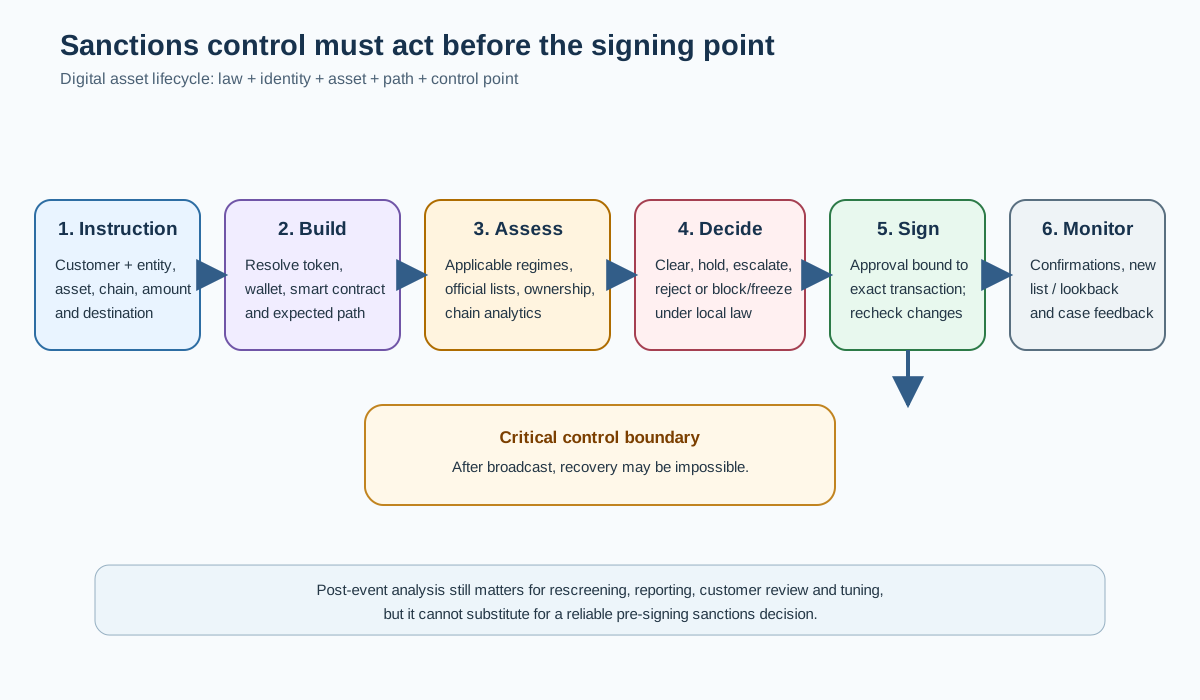
Traditional payment sanctions screening often takes place while a payment is still inside a bank-controlled workflow. A cross-border payment can be held before release, investigated, repaired, rejected or blocked according to the applicable regime. In a digital-asset environment, the decisive moment may be earlier. Once a valid blockchain transaction is signed and broadcast, settlement can become practically irreversible after network confirmation. There may be no correspondent bank downstream that can stop it. This changes the control objective from "screen somewhere in the flow" to screen and decide before the institution loses control of the asset.
The data model is also different. A payment message normally identifies named parties and financial institutions. A blockchain transaction commonly contains addresses, contract calls, token identifiers, values, transaction hashes, block data and event logs. Those records are highly traceable but not automatically attributable to legal persons. A sanctions system therefore needs both off-chain identity data and on-chain evidence. The customer record may establish the account holder. A wallet-ownership process may establish that a withdrawal address belongs to the customer or a counterparty. A vendor may attribute another address to a named exchange, sanctioned actor or service. Investigators must understand which facts are verified, which are inferred and which remain unknown.
Smart contracts introduce another distinction. Code can execute deterministically even when no employee is approving each transaction. A contract address may represent an application, token, pool, bridge, router, vault or proxy. Governance may sit with administrators, token holders, a multisignature wallet, a foundation or a dispersed community. The existence of software code does not by itself answer whether a legal person owns, controls or benefits from property under a particular sanctions regime. That analysis belongs to the relevant legal framework and approved bank policy, supported by technical facts about control and function.
This chapter therefore does not teach a universal rule such as "two hops from a sanctioned address means block" or "every interaction with a mixer is prohibited." Those shortcuts confuse risk analytics with law. The bank needs a defensible process that distinguishes a direct legal prohibition from elevated risk, uncertain attribution and historical exposure.
Global standards and jurisdiction-specific law
The FATF framework is the global AML/CFT baseline for virtual assets and virtual asset service providers. Recommendation 15 and related guidance call for countries to identify and mitigate virtual-asset risks, bring relevant VASPs within AML/CFT regulation and supervision, and apply relevant preventive measures. FATF's July 2026 seventh targeted update continues to identify uneven implementation across jurisdictions, while its July 2026 report on decentralised finance stresses a functional and risk-based analysis of DeFi arrangements, including the existence of control. These standards matter to banks because a customer, counterparty or protocol may operate across borders where regulatory coverage and supervision are not uniform.
FATF standards are not themselves a substitute for sanctions law. Sanctions obligations arise from the legal regimes applicable to the institution, its legal entities, people, currencies, customers, services and transaction nexus. The United States, United Kingdom, European Union and other jurisdictions have different designation lists, ownership and control tests, prohibitions, licensing mechanisms, reporting duties and enforcement frameworks. A global bank should therefore store the regime and legal basis of a decision rather than a single generic sanctioned=true flag.
The United States provides a useful operational example. OFAC states that U.S. sanctions obligations apply to digital currency in the same way they apply to traditional fiat currency for persons subject to OFAC jurisdiction. OFAC may include digital-currency addresses as identifiers associated with blocked persons, but it explicitly notes that such address listings are unlikely to be exhaustive. Its 2021 virtual-currency industry guidance encourages risk-based controls capable of identifying prohibited activity and discusses historical lookbacks after new addresses are listed. These are U.S. requirements and practices, not global rules.
The United Kingdom provides another current example. OFSI's July 2025 threat assessment for the cryptoassets sector focuses specifically on threats to UK financial-sanctions compliance. In January 2026, OFSI described operational collaboration with the Cryptoassets Compliance and FinCrime programme and reiterated that sanctions evasion using cryptoassets is treated as seriously as abuse involving traditional currencies. Again, the relevant legal scope is UK-specific even though many of the operational control lessons are transferable.
EU measures demonstrate why the control must support activity-based restrictions, not only name screening. During 2025 and 2026 the EU expanded measures involving crypto-asset service providers and specific crypto-related activity in the Russia sanctions programme. The Council's July 2026 package extended transaction bans to additional crypto-service platforms and introduced an anti-circumvention mechanism capable of targeting crypto-asset services in specified third countries. The correct operational lesson is not that every crypto transaction touching those countries is universally prohibited; it is that rule engines must be able to represent the actual EU restriction, its effective date, scope, exceptions and legal entities to which it applies.
A wallet address is an identifier, not a legal conclusion
One of the most important disciplines in digital-asset sanctions work is to avoid treating a wallet address as if it were a human identity record. An address is a technical identifier used to receive or control assets on a blockchain. It may be controlled by one person, a custodian on behalf of many customers, a smart contract, a multisignature group or a protocol. The relationship between an address and a legal person can change over time or be inferred with different degrees of confidence.
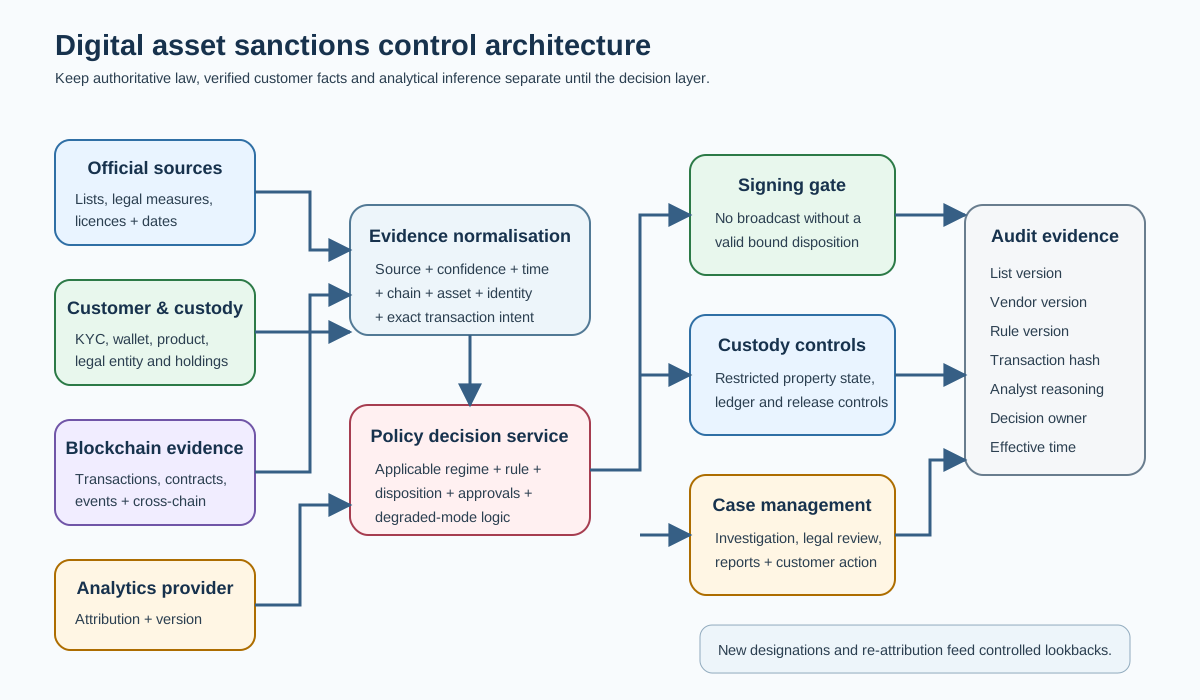
An official sanctions authority may publish an address as identifying property associated with a listed person. A blockchain-analytics provider may separately label addresses based on clustering, transactional behaviour, public information or proprietary research. A bank may have its own verified evidence from a customer's proof-of-wallet process. Those evidence types should not be flattened into one field. A robust data model records source, attribution type, confidence, effective date, last refresh and reasoning.
This distinction protects both sanctions effectiveness and customers. If the bank ignores unlisted addresses associated with a blocked person merely because the exact string is absent from an official list, it can miss real exposure. If it automatically treats every vendor-inferred neighbour of a designated address as legally blocked, it can create unjustified restrictions. The correct path is to determine whether the evidence establishes the legal connection required by the applicable regime or creates a risk that needs escalation and further investigation.
The 2025 U.S. removal of Tornado Cash from OFAC sanctions is a strong illustration of why address data needs effective dates and change control. OFAC removed Tornado Cash and associated addresses from the SDN List on 21 March 2025. A system that retained an old static list without processing deletions could continue blocking transactions on a legal basis that no longer applied. Conversely, historical cases from the designation period may still need to preserve the list version and facts that existed at the time. Sanctions data is therefore temporal evidence, not merely a current lookup table.
The digital-asset interdiction lifecycle
A bank should identify every point where it can prevent, pause, investigate or record a digital-asset transaction. The exact flow depends on the product, but a custody or exchange withdrawal commonly begins with an authenticated customer instruction. The platform resolves the asset, network, amount and destination address. It may validate address format, identify the chain, check whether the token contract is supported, assess wallet ownership and obtain any required beneficiary or transfer information. Sanctions and broader financial-crime controls should operate before the signing service releases the transaction.
At the pre-execution stage, the institution can screen the customer and connected parties against applicable lists, check the destination address against official and vendor data, analyse relevant exposure, assess country or service restrictions, and identify whether the destination is a hosted service, self-hosted wallet, bridge, mixer, protocol or other category. The result should be translated into a legal/control disposition such as clear, escalate, hold, reject, block/freeze, or require additional information. The vocabulary must map to the applicable regime because "reject" and "block" can have materially different legal consequences.
If the transaction is approved, the approval should be bound to the exact transaction intent that was screened. A later substitution of chain, address, token contract, amount or transaction payload should invalidate the prior decision and trigger re-evaluation. This is particularly important where transaction-building services, routers or smart-contract calls can change the ultimate recipients compared with a simple one-address transfer.
After broadcast, the bank still needs monitoring. Network confirmations establish finality according to the chain's characteristics. Chain reorganisations can alter recent transaction history. New sanctions designations or new attribution can reveal that an address interacted with the bank before it was known to be risky. Post-event controls therefore support rescreening, lookbacks, customer review, regulatory reporting and model tuning even though they cannot always reverse the original blockchain transfer.
Screening before signing, not after settlement
The most important architectural control point for an institution that controls private keys is the signing gate. The transaction should not reach signing while a sanctions decision is unresolved. A user-interface warning without an enforced backend control is inadequate because alternative channels, APIs or batch processes may bypass it. The policy result should be enforced where transaction authority is technically exercised.
A signing gate needs deterministic inputs. At minimum, the decision should know the legal entity, customer, relevant sanctions regimes, asset, network or chain ID, destination address or addresses, token contract where relevant, amount, transaction type and the version of sanctions and analytics data used. For smart-contract interactions it may also need the target contract, function or call data, expected token movements and any router or bridge path the platform can determine before signing.
The gate should also have defined behaviour when dependencies fail. A sanctions-list feed may be stale. The chain-analytics vendor may be unavailable. A new network may not be supported by the analytics provider. A transaction simulator may fail to decode a contract call. "Service unavailable, therefore allow" is rarely a defensible default for high-risk flows. The bank should establish risk-based fail-safe behaviour in advance: hard stop for some products, restricted fallback using locally cached current lists for others, manual review for defined cases, and clear recovery procedures.
Latency matters, but it is not a reason to hide control weaknesses. Retail crypto products may promise fast withdrawals. A bank should define service expectations that reflect control requirements rather than silently bypass screening to meet a speed target. Management information should show how often controls delay transactions, what caused those delays, how many were ultimately cleared, and whether false positives are concentrated in particular chains, asset types or provider labels.
Direct matches, indirect exposure and proximity
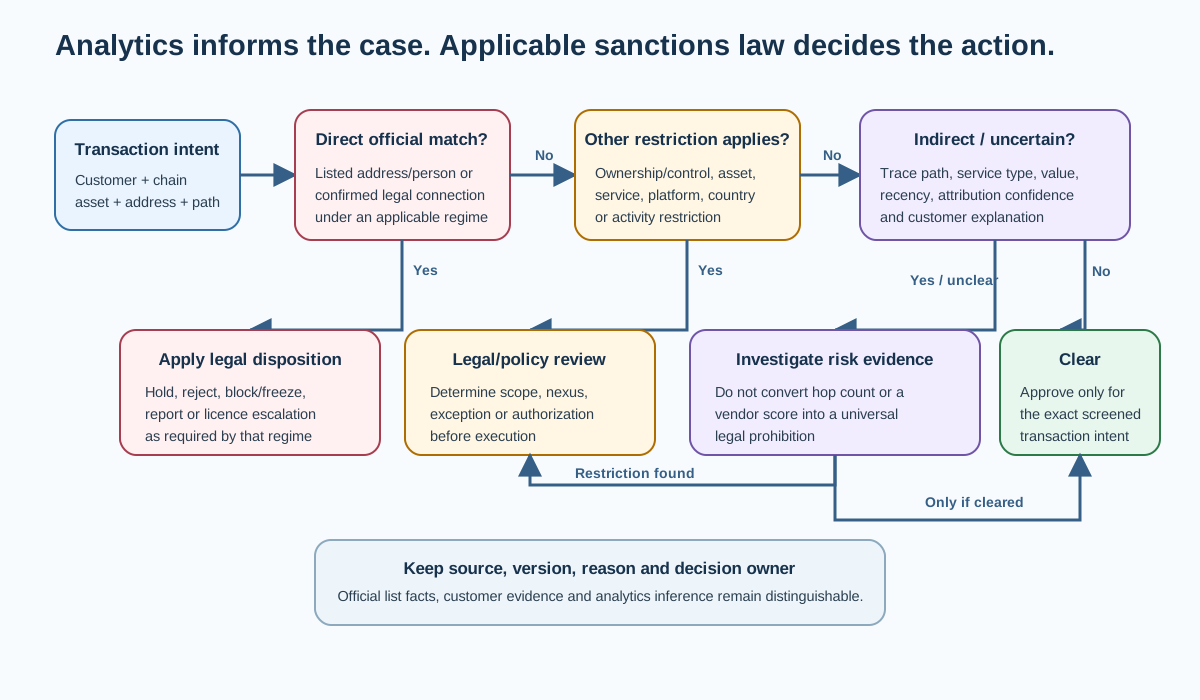
A direct match occurs where the transaction or property involves a person, entity, wallet or other identifier that the bank can establish is subject to a relevant restriction. The institution then applies the legal consequence defined by that regime and its policy. Direct address screening is powerful when official authorities publish identifiers, but the absence of a listed address does not establish that the person behind it is unrestricted.
Indirect exposure is different. A customer's destination may have received funds from, sent funds to, or interacted through contracts connected to a sanctioned actor. Blockchain analytics can trace these relationships over multiple hops. That information is valuable for risk detection and investigation, but hop count alone does not determine the legal result. Asset flows can pass through exchanges, smart contracts, liquidity pools or high-volume services that intermingle activity from many users. Exposure can also be economically trivial, historically remote or affected by unsolicited "dusting" and spam transfers.
A well-designed analytics policy therefore defines more than a percentage threshold. It considers direction, recency, value, service type, attribution confidence, transactional context, whether the path goes through a pooled service, whether the customer initiated the exposure, and whether legal ownership or property-interest concepts are actually satisfied. Some cases require immediate interdiction; others require enhanced due diligence, customer questions, case escalation or post-event monitoring.
This is where compliance and technology must use precise language. sanctions_exposure_score=85 is not a legal conclusion. The case record should preserve the factors behind the score, the vendor methodology version, the addresses and transactions that generated the exposure, and the policy rule that translated the evidence into an operational disposition.
Smart contracts change the path, not the need for accountability
Smart contracts are programs deployed to a blockchain. They can custody assets, enforce token logic, route swaps, manage lending positions, bridge value between networks, implement governance or coordinate many other functions. From a sanctions perspective, the difficult question is not whether a contract is "decentralised" as a marketing label. It is who controls relevant functions, what property interests exist, which persons benefit, and what the applicable law prohibits.
The technical architecture can be complex. A user's wallet may call an aggregator. The aggregator calls a router. The router sends tokens into a liquidity pool and returns another token. A proxy contract may delegate execution to an implementation contract that can later be upgraded by an administrator. A bridge may lock assets on one chain and mint or release representations on another. If screening only checks the first visible contract address, the institution can miss the actual transaction path.
Where technically feasible, pre-transaction controls should simulate or decode the intended call and identify material counterparties and asset movements. The bank does not need to understand every byte of arbitrary smart-contract code in real time, but it needs a defined scope for supported transaction types and a controlled response when the transaction cannot be understood. Allowing opaque contract interactions simply because a customer clicked a familiar application name transfers technical uncertainty directly into sanctions risk.
The FATF's 2026 DeFi work is useful here because it emphasises a functional analysis and the existence of control rather than relying solely on labels. Banks can apply the same discipline operationally without pretending that FATF defines the sanctions outcome: understand who operates or controls relevant parts of the arrangement, how users access it, what intermediaries or service providers are involved, and where the bank can gather reliable identity and transaction evidence.
Stablecoins, issuers and programmable controls
Stablecoins add another layer because they combine blockchain transferability with an issuer or arrangement that may have off-chain control capabilities. Some issuers can freeze specific addresses or prevent transfers at token-contract level. Others have different governance and redemption models. A bank should not assume that a stablecoin issuer will act as the bank's sanctions control or that an on-chain freeze is legally or technically available in every situation.
From a control-design perspective, stablecoins create several relevant data objects: the token contract address, issuing entity, chain, customer wallet, counterparty wallet, transaction hash and any smart-contract path. Token symbols are not sufficient because fraudulent or unrelated tokens can reuse familiar names. Systems should identify the canonical contract and network rather than screening a text label such as USDX without context.
Current EU sanctions developments also show that a token itself can become the subject of an activity restriction. In October 2025 the EU prohibited transactions involving the A7A5 stablecoin in the context of its Russia sanctions package, and subsequent 2026 measures continued expanding crypto-related restrictions. This is a useful architecture lesson: sanctions rules may target people, entities, services, platforms, jurisdictions or specific crypto assets and activities. A rule engine designed only for person-name matching is therefore incomplete.
Custody and blocked or frozen digital assets
Where an institution holds assets for a customer, sanctions can require it to deny access to property rather than simply reject a transfer. The exact action depends on the applicable legal regime. In the U.S. context, OFAC FAQ 646 explains that once a U.S. person determines it holds virtual currency required to be blocked, access must be denied and the property held and reported according to OFAC rules; OFAC also states that blocked virtual currency does not have to be converted to fiat. Other jurisdictions use their own legal concepts, reporting timelines and licensing mechanisms.
Operationally, a custody platform therefore needs a restricted-property state that is stronger than a customer-service note. Withdrawal, transfer, staking, trading, collateral release and other functions that could make value available may need to be controlled consistently. The system should record the legal basis, effective time, asset quantity, wallet or account, valuation method where reporting needs it, approvals, authority notifications and any later licence or unblocking decision.
Private-key architecture matters. If assets are in pooled hot and cold wallets, blocking a customer's economic interest may not require moving the exact on-chain units to a new wallet, provided the applicable law and control design are satisfied. The ledger must nevertheless ensure the customer cannot access or benefit from blocked property. Any consolidation transaction performed by the custodian must itself be assessed under applicable sanctions rules and operational policy.
A bank also needs to distinguish sanctions restrictions from fraud holds, AML reviews and security freezes. They can look similar to a customer because access is restricted, but they have different legal bases, confidentiality requirements, reporting duties, decision owners and release conditions.
Self-hosted wallets and proof of control
A self-hosted or unhosted wallet is not inherently illicit. The customer or another person controls the private keys rather than a regulated custodian. The risk challenge is reduced identity information and a different evidence path. A customer may claim that a destination wallet belongs to them. The bank may ask for evidence of control through a signed message, a controlled micro-transaction, wallet connection or another method appropriate to the product. Each technique has limitations and privacy implications.
Proof of control does not prove source of wealth, beneficial ownership of every asset ever received, or absence of sanctions exposure. It answers a narrower question: whether the customer appears to control the relevant key or wallet at the time of verification. A robust case keeps that fact separate from blockchain attribution and sanctions analysis.
For outbound transfers, wallet allowlisting can reduce address-substitution risk but should not become a permanent sanctions clearance. The status of an address, its counterparties and the sanctions lists can change. Re-screening should occur at appropriate points, particularly before a transaction is signed. High-risk changes such as a newly identified owner, new direct exposure, a new designation or a material vendor re-attribution should invalidate an old approval.
For inbound deposits, the institution cannot prevent an external party from sending assets to a public deposit address. Controls therefore need a post-receipt decision process: identify the source, assess legal exposure, restrict customer access where required, escalate, report and preserve the asset rather than automatically sweeping or returning it in a way that could itself create a prohibited transaction.
From alert to investigation
A digital-asset sanctions alert should open with reproducible evidence, not only a red score. The reviewer needs the customer and account, legal entity, transaction direction, asset, chain, addresses, transaction hash if available, direct and indirect exposure, attribution source, list source, data version and rule that triggered the alert. A visual transaction graph can help, but the case also needs a textual explanation that another reviewer can reproduce.
The first question is whether the alert is a true data match. Address formats reduce some forms of name ambiguity, but errors still occur through wrong-chain assumptions, token-contract confusion, copy mistakes, stale labels or vendor clustering. The second question is legal relevance: does the matched or attributed person fall under a regime applicable to this institution and transaction, and what prohibition or obligation follows? The third is transactional context: what exactly is the customer's relationship to the address or protocol and what property moved or would move?
Investigation can require blockchain tracing, customer KYC, wallet ownership evidence, transaction purpose, counterparty information, exchange/VASP information, IP/device context, source of funds, prior activity and external intelligence. For smart-contract interactions, investigators may need technical support to decode call paths and event logs. Case-management systems should allow structured technical evidence without forcing analysts to paste screenshots as the only record.
The outcome can be clear, false positive, enhanced monitoring, customer restriction, transaction rejection, asset blocking/freezing, licence escalation, suspicious-activity reporting or another local action. The control should not assume that a sanctions alert automatically becomes a SAR/STR. Sanctions reporting and AML suspicion are related but distinct obligations, and local law defines when each applies.
Evidence that must survive later review
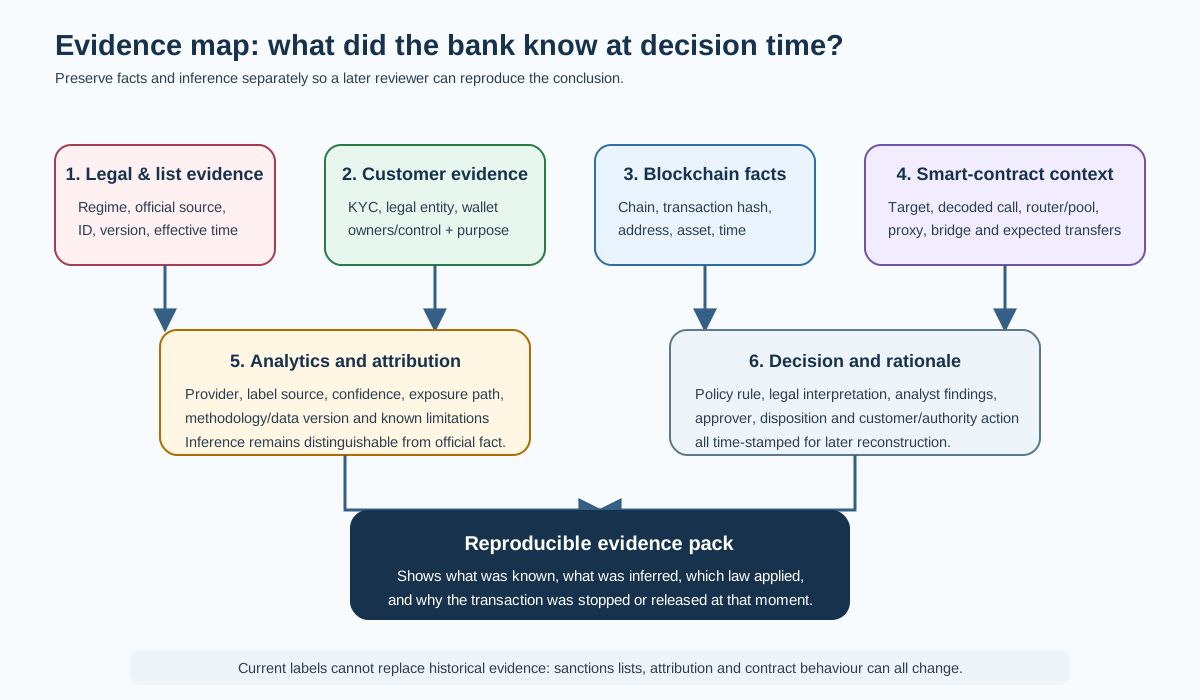
A regulator, internal audit team or quality reviewer should be able to reconstruct what the bank knew at the decision time. That means preserving not only the final status but also the versioned inputs. For a wallet-screening decision, important evidence can include official-list version or retrieval timestamp, analytics-provider dataset and methodology version, address attribution, exposure path, customer profile, transaction payload, rule version, analyst notes, approvals and the exact disposition returned to the transaction system.
Time is especially important because blockchain and sanctions data change. An address can be newly listed. A vendor can change an attribution from "unknown" to "exchange" or "sanctioned actor." A smart contract can be upgraded. A chain can reorganise. A sanctions authority can remove a designation. Historical reconstruction therefore needs effective-dated evidence rather than a current-screen screenshot generated months later.
Vendor evidence should preserve provenance. If the analytics provider says "sanctioned entity," the bank should know whether that label came directly from an official list, provider research, a cluster inference or a bank-defined mapping. Confidence scores should not be silently converted into facts. Analysts should be able to identify which parts of the case are authoritative, verified, inferred or unresolved.
This evidence model also supports lookbacks. When a sanctions authority lists a new address, or the vendor associates additional addresses with a designated actor, the institution can search historical transactions to determine whether earlier activity now warrants legal review, reporting, customer reassessment or control tuning. A lookback is not proof that every past transaction was prohibited at the time; the legal and factual timeline still matters.
Customer impact and communication
Sanctions interdiction can stop customers from accessing significant value, so the operational design must include customer communication that is lawful, accurate and controlled. A customer may see a pending withdrawal, rejected transaction or frozen balance. Service teams need approved wording that does not speculate about criminality and does not disclose information that local law or an investigation requires to remain confidential.
The institution should distinguish technical failure from compliance hold. If an analytics dependency is unavailable, telling the customer that they are sanctioned would be false and potentially damaging. If the bank is legally required to block property, generic "system delay" messaging may also be inappropriate. Communication templates should therefore map to disposition states and legal guidance.
Customer remediation is also part of control quality. False positives should have a route for review. Address misattribution can be challenged with evidence. Where a licence, authorization or delisting permits release, the bank needs a controlled unblocking process that removes all relevant restrictions, reconciles the ledger and documents the authority. OFAC FAQ 647, for example, confirms in the U.S. context that an institution may tell a customer it blocked access to digital currency under OFAC regulations and that the customer can apply for unblocking; other jurisdictions have their own processes.
Mini case: a withdrawal through a DeFi router
Consider a customer of a regulated digital-asset platform who requests a withdrawal of a stablecoin to a self-hosted wallet. The destination address itself is not on an official sanctions list. The blockchain-analytics engine reports that the address previously interacted with a DeFi router and shows indirect exposure to an address associated with a designated actor. The score is above the firm's escalation threshold, but the exposure occurred through a high-volume liquidity pool and is several transactions removed.
A weak control would block automatically because the score is high, or release automatically because the destination is not directly listed. A mature control separates the questions. First, it verifies the chain and destination address and confirms the customer's control of the wallet where required. It retrieves the exposure path and determines that the sanctioned address is not the destination and that the connection occurs through pooled smart-contract liquidity. It confirms which sanctions regimes apply to the legal entity and customer transaction. It asks whether the evidence establishes a prohibited property interest or direct dealing under those rules, or instead creates elevated risk requiring additional review.
The investigator checks the customer's expected activity, source of funds, purpose, prior use of DeFi services and any other relevant indicators. Technical support confirms the contract path and that the router is a widely used protocol rather than a wallet controlled by the designated person. Compliance determines that the indirect exposure alone does not establish the legal condition for blocking under the applicable policy, but the case warrants enhanced monitoring because other risk factors are present. The withdrawal is either released or escalated according to that conclusion, and the case records the official-list version, analytics evidence, contract path, legal rule, reviewer and approval.
Now change one fact: before signing, the vendor refresh identifies the destination address itself as an address published by the applicable sanctions authority for a blocked person. The transaction must be re-evaluated immediately under the relevant legal regime. The earlier approval cannot survive because the material fact changed. This is why sanctions controls must bind decisions to current data and exact transaction intent rather than treat wallet approval as permanent.
Roles and governance
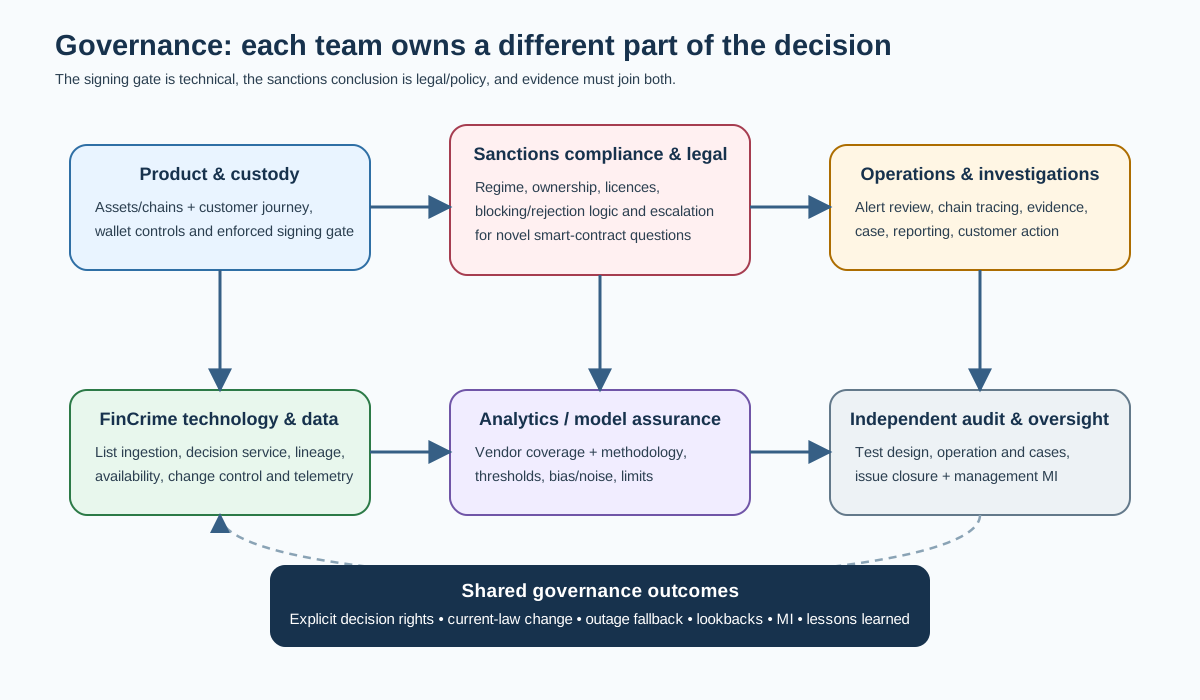
Front-line product teams own the design of customer journeys and must not create channels that bypass financial-crime controls. Sanctions compliance or the designated control function defines interpretation and escalation within approved legal policy. Operations teams investigate cases and execute holds, blocks or releases according to their authority. Legal provides jurisdiction-specific interpretation where the sanctions position is complex. Financial-crime technology owns reliable screening and analytics services. Custody and key-management teams enforce the signing gate. Data teams maintain lineage and quality. Model or analytics governance challenges vendor methodologies and thresholds. Internal audit independently assesses whether the control works as represented.
A governance forum should see more than alert volumes. Useful management information includes screening coverage by chain and asset, unsupported transaction types, stale-data incidents, control-service availability, direct and indirect match volumes, true matches, false positives, average case age, pre-signing stops, post-event discoveries, lookbacks, customer-impact metrics, vendor attribution changes, rule changes and unresolved high-risk exceptions.
Decision rights need to be explicit. An analyst may clear a known false positive. A senior sanctions officer may approve release after complex indirect exposure. Legal may be required for uncertain ownership/control or novel smart-contract questions. Technology must not override a legal hold simply to restore service. Emergency incident procedures should specify who can disable withdrawals if the sanctions control is unreliable and who can authorize restoration after evidence shows coverage is safe.
What good looks like
A strong digital-asset sanctions control does not pretend that blockchain transparency eliminates judgement. It uses transparency well. It knows which customer is asking for the transaction, which keys and systems the institution controls, which addresses and contracts are involved, what the blockchain shows, where attribution came from, which legal regime applies, and which action is required before the transaction becomes irreversible.
It also accepts uncertainty openly. Some wallets cannot be confidently attributed. Some smart-contract paths are difficult to decode. Vendor coverage differs by chain. Legal treatment of decentralised arrangements can evolve. Mature control design turns those uncertainties into explicit limits, escalation rules, fallback behaviour and governance rather than allowing them to disappear inside a numeric score.
For a business analyst or architect, the essential deliverable is a traceable chain from legal obligation to data to rule to transaction decision to evidence. For an investigator, it is the ability to separate official fact, customer evidence and analytical inference. For operations, it is knowing exactly when to hold, escalate, block, reject or release. For product teams, it is keeping customer experience fast without moving the control after the point of no return. For audit and regulators, it is the ability to reconstruct the same decision later and understand why it was reasonable on the facts then available.
That is sanctions interdiction in digital assets: not simply "screen the wallet," but a controlled, time-sensitive decision across identity, property, code, network activity, law and technical custody.
Operational deep dive: how on-chain evidence becomes a sanctions decision
The base chapter set out the legal and operating model. This deep dive focuses on the technical evidence that makes digital-asset sanctions work difficult in practice. The objective is not to turn sanctions investigators into blockchain engineers. It is to give them enough technical understanding to know what an address, transaction, contract interaction and analytics label can prove, what they cannot prove, and which facts must be preserved before a legal or operational conclusion is reached.
Address attribution and entity resolution
A blockchain normally records transactions between technical identifiers. Public ledgers can make movement visible, but they rarely state the legal identity of every controller. Attribution is the process of connecting an address or group of addresses to a known service, organisation or person. Evidence can come from official sanctions listings, regulated-customer records, exchange deposit information, public disclosures, court records, seizure notices, website payment instructions, verified wallet ownership or specialist analytics research.
Attribution quality varies. A sanctions authority publishing an address for a designated person is authoritative evidence that the authority has associated that identifier with the listed target. A bank proving that its own customer controls an address through authenticated signing is strong first-party evidence of control at that time. A vendor label based on a cluster heuristic is different: it can be useful and well researched, but the investigator should know the basis and confidence of the inference.
Entity resolution becomes harder because one actor can use many addresses and one service can control addresses for many users. Centralised exchanges commonly manage pooled infrastructure, and a deposit address can be associated with an individual customer while the underlying funds are swept into larger wallets. A sanctions decision should therefore avoid the simplistic assumption that every address in a service cluster belongs beneficially to the service itself or to every user of that service. The legal question depends on the property interest and parties relevant to the applicable sanctions regime.
A mature platform stores attribution as an effective-dated relationship: address -> attributed entity/service -> evidence source -> confidence -> valid from/to -> analyst/vendor version. This supports both current screening and historical reconstruction. If a vendor later changes an address from unknown to Exchange X, the institution should be able to identify which past decisions used the earlier label and whether a lookback is warranted.
UTXO and account-based chains produce different evidence
Blockchain analytics is not identical across networks. Bitcoin and similar UTXO-based systems represent value as unspent transaction outputs. A transaction consumes prior outputs and creates new outputs. Investigators often analyse inputs, outputs, change-address patterns and clusters. Heuristics can be powerful, but they can also be weakened by collaborative transactions, privacy techniques, exchange infrastructure and changes in wallet software.
Ethereum and other account-based networks represent balances and state associated with accounts and smart contracts. A user transaction can trigger internal calls, token transfers and emitted events that are not obvious from the top-level sender and receiver alone. Screening only the transaction's to address can miss the token recipient, router, pool, bridge or contract implementation involved in the economic activity.
The bank does not need one universal analytics rule. It needs chain-aware controls. Requirements should specify which networks are supported, which evidence types are available, how token transfers are decoded, how internal contract calls are handled, and which transaction types cannot be reliably assessed. Unsupported chains should appear as a control limitation, not silently receive the same confidence as fully supported networks.
Direct exposure is not the same as indirect exposure
Direct exposure typically means value moves to or from the address under assessment and an address associated with a sanctioned target without intervening hops, or that the address itself is attributed to the target. Indirect exposure describes a relationship through intermediate addresses or services. Analytics products may calculate it using hop count, value flow, percentage exposure, time, service categories or proprietary weighting.
These measures help prioritise risk but can become misleading when users treat them as legal rules. Consider a large exchange hot wallet that receives deposits from thousands of users, one of whom sends funds associated with a sanctioned actor. Another customer later withdraws unrelated assets. A graph may show proximity between the two flows, but that does not automatically establish that the second customer dealt in blocked property. Similarly, a liquidity pool can contain assets contributed by many unrelated users. A wallet may receive unsolicited dust from an unknown address. A bridge or mixer can break or complicate conventional flow tracing.
The review therefore needs to understand economic pathway and service function. Was the customer sending directly to a designated wallet? Did a protocol merely intermediate the route? Was the alleged exposure generated by an omnibus wallet? Did value actually flow from the sanctioned source to the customer, or did the graph only show common infrastructure? How recent and material was the connection? What confidence does the provider attach to the attribution? These questions prevent both false negatives and mechanical overblocking.
A good policy distinguishes legal interdiction triggers from risk-escalation triggers. A direct official-list address match under an applicable blocking regime may require immediate action. A small indirect exposure through a mainstream exchange may be a monitoring signal. A concentrated recent flow through an opaque service associated with evasion can justify stronger due diligence even when the destination is not itself listed. The exact thresholds are a bank policy decision informed by law, risk appetite, product and analytics capability.
Smart-contract call paths
A smart-contract transaction should be understood as an execution path, not merely a destination address. A user can approve a token to a router, call a swap function, transfer value into a pool, receive another token and route that token through a bridge. Each step can be represented in transaction calldata, internal calls, token transfer events and resulting state changes.
Where the product supports smart-contract interaction, pre-execution screening should identify the intended contract and material asset movements as far as reasonably possible. Transaction simulation can help: execute the transaction against a recent state snapshot without broadcasting it, then inspect expected calls and transfers. Simulation is not perfect. State can change before execution, contracts can use dynamic logic, or off-chain inputs can alter behaviour. The control should record whether the path was simulated, decoded statically or assessed only at a simpler address level.
Proxy patterns deserve specific attention. Many contracts are upgradeable. The visible proxy address remains constant while an implementation contract containing business logic can change. A sanctions-risk inventory should not assume that a contract's behaviour is permanently determined by its original code. If the bank supports interaction with a protocol, changes to implementation, administrator or governance structure can be an event that triggers re-assessment.
Router and aggregator contracts also complicate screening because they can choose among several liquidity sources. An aggregator may be legitimate infrastructure while one downstream pool or token is restricted. Product teams need to decide whether they can reliably identify the route before signing. If they cannot, the bank may restrict unsupported complex calls rather than presenting the limitation as a low-risk transaction.
DeFi and the question of control
"Decentralised" is not a legal safe harbour and it is not a precise technical state. DeFi arrangements range from highly controlled applications with identifiable operators and upgrade keys to protocols whose code and governance are broadly distributed. FATF's July 2026 DeFi report emphasises a functional approach, including analysis of control, and warns against relying on labels that do not reflect how an arrangement actually operates.
For a sanctions investigation, relevant control facts can include administrator keys, upgrade rights, emergency pause functions, fee recipients, governance token concentration, multisignature signers, front-end operators, foundations, developers, treasury ownership and the ability to restrict access. These facts do not themselves decide whether a person is legally subject to sanctions. They provide evidence for legal analysis about ownership, control, provision of services or benefit under the applicable regime.
A bank should also distinguish protocol code from the surrounding service stack. A customer may access a protocol through a hosted front end run by a legal entity, an independent aggregator, a wallet application or direct contract interaction. The relevant counterparty or service relationship can differ across those paths even when the same underlying smart contract ultimately executes.
Bridges and cross-chain tracing
Bridges transfer or represent value across blockchain networks. Mechanisms vary. Some lock an asset on one chain and mint a representation on another. Others use liquidity pools, burn-and-mint models or message-passing systems. A sanctions system that screens only the source chain can lose context when value moves to another network.
Cross-chain controls should preserve a linkage record where possible: source transaction hash, source asset, bridge contract or service, destination chain, destination address, minted or released asset and corresponding destination transaction. Analytics providers may infer these links, but the bank should understand provider coverage and uncertainty. If the bridge is custodial, counterparty due diligence and service screening may matter in addition to transaction tracing.
A bridge can also be used in sanctions-evasion patterns because rapid movement across chains increases investigative complexity. That does not make every bridge transaction suspicious. Risk should reflect the customer profile, counterparties, destination services, speed, layering behaviour, high-risk exposure and other facts. The bank should monitor for cross-chain sequences rather than evaluate each leg in isolation when it has the technical capability to connect them.
Mixers, privacy tools and sanctions
Mixers and privacy-enhancing technologies create a common source of confusion because AML risk and sanctions status are often conflated. A mixer can make source or destination tracing harder, which can elevate financial-crime risk and justify enhanced review. Whether interacting with a particular service is legally prohibited depends on the sanctions regime and current legal status.
The U.S. Tornado Cash history shows why controls must use current authoritative data. OFAC designated Tornado Cash in 2022, but Treasury removed the sanctions against Tornado Cash and OFAC removed associated entries from the SDN List on 21 March 2025. A training chapter that still states "Tornado Cash is sanctioned" would now be wrong. A bank policy may still treat mixer exposure as elevated AML or sanctions-evasion risk, but it must not present an old designation as current law.
The lesson is broader than one protocol. Sanctions screening engines must process additions, amendments and deletions. Risk-taxonomy labels such as mixer, privacy service or high-risk service should remain analytically separate from official sanctions status. This prevents a vendor category from silently becoming an invented legal prohibition.
Transaction and event evidence
A strong case stores the blockchain-native identifiers needed to reproduce the review. For a straightforward transfer, this includes chain/network, transaction hash, block number or height, timestamp, sender and recipient, asset, token contract if applicable, amount and confirmation status. For smart-contract interactions, it can also include target contract, function selector, decoded parameters, internal calls, event logs and relevant token-transfer events.
The evidence should be captured at the decision point. A browser block explorer is useful for investigation, but a link alone is not a durable audit record because third-party interfaces can change and labels can be updated later. The bank should retain structured transaction data or a controlled snapshot sufficient to show what the reviewer saw.
Chain finality also matters. Some networks reach probabilistic finality after a number of blocks; others provide stronger finality properties. Reorganisations can replace recent blocks and transaction ordering. A sanctions case involving a transaction that was initially observed but later orphaned needs a record of both the original event and final chain state. Product rules should define when a deposit becomes available and how compliance holds interact with confirmation thresholds.
List changes and retrospective lookbacks
Sanctions data can change after a transaction. An authority may designate a person and publish known wallet addresses. A vendor may identify additional addresses associated with that target. An existing designation can be amended, or a target can be removed. The institution should ingest changes with effective timestamps and clear source lineage.
A new designation should trigger risk-based lookback logic appropriate to the regime and product. The bank may search historical direct interactions with newly listed addresses, customers linked to the target, transactions involving newly attributed clusters and holdings still in its custody. The purpose is to identify current blocked property, reporting obligations, customers requiring review and control gaps. It is not to automatically label every historical transaction unlawful based on knowledge that did not exist at the time.
Deletions need equally disciplined handling. A delisting should remove the legal restriction from active controls according to the effective date while preserving historical evidence. If the bank maintains an independent risk restriction after delisting, the reason should be explicit and should not be misrepresented as an ongoing sanctions requirement.
Data lineage and vendor dependency
Most banks will use external blockchain-analytics data because maintaining global address attribution internally is impractical. This creates a critical third-party dependency. The bank remains accountable for the control even when a vendor provides the intelligence.
Due diligence should cover chain coverage, data sources, attribution methodology, refresh frequency, treatment of official sanctions lists, clustering logic, exposure calculation, historical corrections, API availability, data retention, security and change notification. Testing should include known positive examples and carefully selected negative examples. A vendor that detects direct listed addresses but performs poorly on the chains or smart-contract paths used by the bank's products may not provide adequate coverage.
Version control is essential. The case should record which provider result was used. If a provider later changes its methodology, the bank must be able to distinguish a genuine change in customer behaviour from a change in the analytics model. Major methodology changes can require regression testing, threshold recalibration and retrospective review.
Banks should also define the authoritative hierarchy. Official sanctions lists and legal interpretation take priority for the existence and scope of a designation. Vendor attribution enriches identity and exposure analysis. Internal verified customer information can confirm wallet control. Open-source intelligence can add context. The investigator should know which source can support which conclusion.
Interdiction when a smart contract is already executing
For non-custodial activity initiated directly by a customer's external wallet, a bank may have no technical ability to stop the on-chain transaction. Its control point may instead be the fiat funding leg, account relationship, VASP service or later receipt of assets. This is why architecture diagrams must not imply that every bank can "freeze the blockchain."
For a custodial product, the institution controls the private keys or transaction-signing process and therefore has a meaningful pre-broadcast intervention point. For an embedded wallet, the distribution of control between the bank, technology provider and customer must be clear. Multi-party computation and multisignature models can split signing authority across providers; sanctions requirements must be translated into that technical governance so that no path can complete a transaction without the required compliance disposition.
If an institution detects a problem after broadcast, actions depend on what control remains. It may be able to restrict the customer's account, prevent subsequent withdrawals, contact a counterparty VASP, notify authorities, preserve remaining assets, seek issuer assistance for a freeze-capable token, or conduct recovery work. None of these should be promised as guaranteed recovery because blockchain settlement and legal authority differ by asset and jurisdiction.
Investigation example: newly listed address after prior activity
Assume a bank-custodian receives an official sanctions-list update at 14:05 that includes three blockchain addresses associated with a newly designated entity. The bank's list-management service validates the update, timestamps it and distributes it to screening. Current balances and queued transactions are screened immediately. One customer has a pending withdrawal to one of the new addresses. The signing gate stops it before broadcast.
The historical lookback identifies two deposits from the same address during the previous month and one withdrawal to another address that the analytics provider associates with the same entity but that is not on the official list. The correct response is not to apply one automatic outcome to all three events. The pending transaction is assessed under the new designation and applicable regime before any execution. Assets currently held for the customer are reviewed for any blocked-property interest. Historical deposits are analysed against the legal effective date and reporting rules. The unlisted associated address is investigated using the provider's attribution evidence and the relevant ownership or control standard rather than being assumed legally equivalent merely because the vendor clustered it.
The case captures the list update, effective time, official identifiers, current holdings, historical transaction hashes, provider version, exposure graph, customer relationship and legal decision. If the designation later changes, that evidence still shows why the bank acted as it did on the day. This is what turns blockchain analytics into a defensible sanctions control rather than a visual investigation tool.
Advanced practice: architecture, testing and assurance
Digital-asset sanctions controls must survive real production conditions: list changes, analytics outages, smart-contract complexity, unsupported chains and pressure for fast withdrawals. This section turns the chapter into delivery requirements and test scenarios without repeating the legal and investigative detail already covered.
Requirements that expose the real control boundary
A requirement such as "screen crypto transactions against sanctions" is too vague. For a custodial withdrawal, the enforceable requirement should state that no signing request can proceed until the sanctions decision service has returned an approved disposition for the exact legal entity, customer, chain, asset, token contract, destination, amount and transaction intent. Web-page screening is not equivalent to a backend signing gate; mobile, API, batch and operational channels must converge on the same protected control.
Every decision should carry a correlation identifier across transaction building, screening, analytics, case management and signing. The data contract should distinguish fields such as token_contract, chain_id, destination_address, wallet_owner, official_list_match, vendor_attribution, exposure_score, legal_regime and disposition. Collapsing these into a generic risk flag destroys useful audit meaning.
Freshness and versioning acceptance criteria
The decision service should record the official-list version or retrieval timestamp and detect stale distribution. Analytics responses should identify provider, timestamp and, where supported, dataset or methodology version. Cached wallet results require an expiry policy because attribution and sanctions status can change.
Regression tests must cover both additions and removals. Adding a controlled test address should cause the expected pre-signing action. Removing it should clear the current official-list match after the effective change while preserving historical evidence. This tests a capability that is often overlooked when systems focus only on new designations.
Positive, negative and ambiguity tests
Positive tests should represent the restriction types the product actually supports: a directly listed destination, a blocked customer or relevant owner under the applicable regime, a specifically prohibited crypto asset, or an applicable service/platform restriction. Expected actions must follow the governing policy rather than one universal block response.
Negative tests should prove that weak proximity does not become invented law. A different wallet with a similar label must not match; unsolicited dust should not automatically make the recipient blocked; use of a mainstream exchange with historical sanctioned exposure should not contaminate every customer; and a delisted identifier must stop producing a current legal-list hit.
Ambiguity tests should include medium-confidence attribution, indirect exposure through a liquidity pool, an unsupported chain, an undecodable smart-contract call and conflicting provider labels. The pass condition is not automatic release or prohibition; it is correct routing into the controlled escalation state defined by policy.
Smart-contract, bridge and DeFi tests
Where the product claims path-level coverage, tests should verify more than the visible target contract. A call to an approved router that would transfer value to a prohibited destination should be detected. A proxy upgrade should trigger reassessment where implementation or administrator changes are risk-relevant. Tokens with the same symbol but different contract addresses must remain distinct until verified.
Bridge scenarios should preserve source chain, bridge, destination chain and destination address where the architecture supports cross-chain correlation. Simulation-failure tests are also essential. If a contract call cannot be decoded reliably, the product must apply the approved fallback such as manual review or treating the transaction type as unsupported rather than silently labelling it screened.
Outage and degraded-mode design
A sanctions-service outage is a control event, not merely a technology incident. The bank should predefine which activity stops and which may continue under reduced coverage. A local cache of current official lists might support basic direct-address checks during an analytics outage, but it must not be represented as equivalent to full attribution and exposure analysis.
The degraded response should explicitly record the missing capability. When service returns, transactions processed under fallback can be identified for retrospective screening where policy requires it. Any missed true match should feed incident management, legal/regulatory assessment and control remediation.
Idempotency and race conditions
Distributed systems create sanctions risk through ordinary defects. A customer can submit the same withdrawal repeatedly, a route can change after screening, or a list update can occur between decision and signing. Approval should therefore be bound to a stable representation or hash of the material transaction fields. A change to destination, chain, token, contract call or other material element invalidates the approval and requires a new decision.
For particularly time-sensitive direct-list changes, architecture may add a lightweight final check immediately before signing. This does not replace the fuller earlier assessment; it reduces the window in which a newly listed identifier could pass using an older approval.
BA acceptance criteria for case evidence
The case view should expose the customer, product, legal entity, direction, chain, asset, token contract, addresses, transaction hash when present, sanctions regime, direct-list result, vendor attribution, exposure path, timestamps and trigger rule. Block-explorer links can help investigation but should not be the only retained evidence.
Analyst findings should remain distinguishable: identity confirmed, wallet control established, designation confirmed, ownership/control question, indirect exposure assessed, customer explanation, legal interpretation, action and approval. Reopened cases must preserve earlier decisions rather than overwrite them so reviewers can see how the bank responded to facts available at each point in time.
Quality assurance and independent challenge
Quality assurance should sample direct matches, indirect exposure, self-hosted wallets, exchanges, contracts, bridges and different chains. Reviewers should compare conclusions with source evidence and approved legal policy. A correct outcome supported by weak reasoning is still a control weakness because the result may not be repeatable.
Independent challenge should test provider assumptions: address-clustering logic, treatment of pooled services, list-update speed, chain coverage, exposure calculations and correction processes. Threshold tuning should consider confirmed outcomes, false positives, investigation effort, customer impact and known false negatives rather than optimising only for queue volume.
Change control and assurance outcome
Current-law change must flow through data, policy and technology together. The March 2025 Tornado Cash delisting is a useful regression scenario: a correct control must process removal, stop presenting the old designation as current law, preserve historical decisions, and distinguish any continuing AML risk treatment from sanctions status. New asset, platform or service restrictions require the reverse process: source validation, scope analysis, rule implementation, testing and effective-date control.
The final assurance question is simple: could the bank reproduce why this exact digital-asset transaction was permitted or stopped using the law, data, analytics and policy that were effective at that moment? If the answer depends on a vendor screen that has since changed, an analyst's memory or an undocumented emergency decision, the control is not finished.
References and further reading
The sources below were used to validate the global standards, current sanctions examples and operational guidance in this chapter. FATF material provides global AML/CFT standards and risk guidance; sanctions obligations must still be implemented under the law that applies to the institution, legal entity and transaction.
- Financial Action Task Force (FATF), Seventh Targeted Update on Implementation of the FATF Standards on Virtual Assets/VASPs, 16 July 2026: https://www.fatf-gafi.org/en/publications/Fatfrecommendations/targeted-updated-virtualassets-vasps-2026.html
- FATF, Targeted Report on Regulatory Challenges from Decentralised Finance, 21 July 2026: https://www.fatf-gafi.org/en/publications/Virtualassets/targeted-report-decentralised-finance-2026.html
- FATF, Updated Guidance for a Risk-Based Approach to Virtual Assets and Virtual Asset Service Providers, 28 October 2021: https://www.fatf-gafi.org/en/publications/Fatfrecommendations/Guidance-rba-virtual-assets-2021.html
- FATF, Virtual Assets topic and standards hub: https://www.fatf-gafi.org/en/topics/virtual-assets.html
- U.S. Department of the Treasury, Office of Foreign Assets Control (OFAC), Sanctions Compliance Guidance for the Virtual Currency Industry, 15 October 2021: https://ofac.treasury.gov/recent-actions/20211015
- OFAC, Questions on Virtual Currency, including FAQs 560, 562, 563, 594, 646 and 647: https://ofac.treasury.gov/faqs/topic/1626
- OFAC, FAQ 646: How do I block digital currency?, updated 15 October 2021: https://ofac.treasury.gov/faqs/646
- OFAC, FAQ 562: How will OFAC identify digital currency-related information on the SDN List?: https://ofac.treasury.gov/faqs/562
- U.S. Department of the Treasury, Tornado Cash Delisting, 21 March 2025: https://home.treasury.gov/news/press-releases/sb0057
- OFAC, Cyber-related Designation Removal; North Korea Designation Update and Removal, 21 March 2025: https://ofac.treasury.gov/recent-actions/20250321
- UK Office of Financial Sanctions Implementation (OFSI), Sanctions compliance in the Cryptoassets sector: Threat Assessment, 21 July 2025: https://www.gov.uk/government/publications/sanctions-compliance-in-the-cryptoassets-sector-threat-assessment
- OFSI, OFSI and partners clamp down on the abuse of cryptoassets, 28 January 2026: https://ofsi.blog.gov.uk/2026/01/28/ofsi-and-partners-clamp-down-on-the-abuse-of-cryptoassets/
- Council of the European Union, 21st package of sanctions: EU hits Russian energy, financial services and crypto hard, 23 July 2026: https://www.consilium.europa.eu/en/press/press-releases/2026/07/23/21st-package-of-sanctions-eu-hits-russian-energy-financial-services-and-crypto-hard/
- Council of the European Union, EU sanctions against Russia: questions and answers: https://www.consilium.europa.eu/en/policies/sanctions-against-russia-explained/
- European Banking Authority (EBA), Travel rule guidance for transfers of funds and crypto-assets, 4 July 2024: https://www.eba.europa.eu/publications-and-media/press-releases/eba-issues-travel-rule-guidance-tackle-money-laundering-and-terrorist-financing-transfers-funds-and
- United Nations Security Council, Committee established pursuant to resolution 1718 (2006), current sanctions measures and financial restrictions relating to the DPRK: https://main.un.org/securitycouncil/en/sanctions/1718