AI Model Governance, Explainability and Human Oversight
Artificial intelligence can help a bank find relationships and behaviours that are difficult to express as simple rules. A machine-learning model can rank transaction-monitoring alerts, identify unusual networks, recognise document patterns, compare entities across imperfect data, or help an investigator search a large case file. Those capabilities can improve financial-crime detection and reduce repetitive work, but they create a new control problem: the bank must still be able to explain what the system was designed to do, what data it relied on, how it was tested, where it can fail, who may override it, and who remains accountable for the resulting decision.
The most useful mental model is therefore AI as a governed component in a financial-crime decision process, not as the decision-maker of record. A score of 0.92 does not mean that money laundering occurred. A cluster labelled "high risk" is not a sanctions determination. A generated case summary is not evidence merely because it sounds coherent. The model produces an analytical output. The bank's control framework determines how that output may influence an alert, payment action, customer review, investigation, escalation, filing decision or other outcome.
That distinction matters because financial-crime controls sit close to legal duties and significant customer consequences. A weak model can miss suspicious activity, flood investigators with poor alerts, delay legitimate payments, create unnecessary customer reviews, or cause staff to trust an inaccurate narrative. An opaque model can also be difficult to challenge when customer behaviour changes, a new typology appears, data quality deteriorates, or the model is used in a country or product that was not represented in development data. Good governance is what makes analytical power usable without turning uncertainty into unreviewable automation.
This chapter uses the term model broadly for practical learning, but regulatory definitions differ. A deterministic threshold rule, a statistical model, a graph algorithm, a natural-language model and a generative-AI assistant do not create the same risks or fall under the same supervisory definitions. In the United States, for example, the Federal Reserve, OCC and FDIC revised their model-risk-management guidance in April 2026. That guidance defines a model as a complex quantitative method, system or approach applying statistical, economic or financial theories to input data to produce quantitative estimates, excludes deterministic rule-based processes, and states that generative and agentic AI are outside the scope of that specific guidance because they are novel and rapidly evolving. That is a scope statement about one piece of US supervisory guidance, not a statement that generative AI is outside banking governance, privacy, security, consumer, AML, sanctions or other obligations.
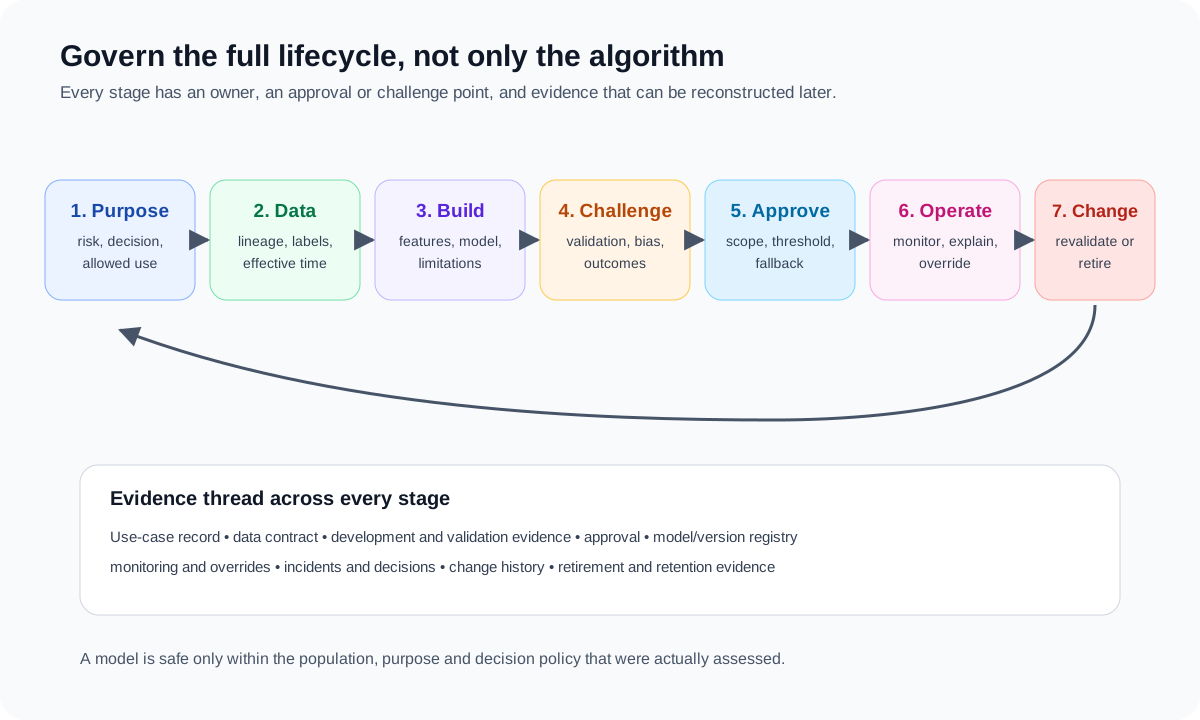
Why financial-crime AI needs its own governance story
AI governance becomes meaningful only when it is connected to the actual control. Consider transaction monitoring. A conventional scenario might create an alert when a customer sends several high-value payments to higher-risk jurisdictions within a short period. An ML model may instead combine dozens or hundreds of features: changes from the customer's historical activity, peer-group differences, new counterparties, account age, transaction velocity, device behaviour, corridor characteristics, network links and prior case outcomes. This can uncover patterns that a single threshold misses, but the model also makes it harder to see which assumptions produced the output.
The same issue appears in sanctions screening. Name-matching models may rank candidate matches using spelling similarity, transliteration, aliases, dates of birth, addresses and entity attributes. The model can improve prioritisation, but the legal decision about whether a person or entity is the listed party and what action is required depends on applicable sanctions law, programme scope, ownership or control rules and the evidence available. A similarity score is evidence for review, not a legal conclusion.
Customer risk-rating models can combine customer type, ownership, geography, product, channel and behaviour. Fraud and mule-detection models may use device, beneficiary and network signals. Graph analytics can reveal communities of accounts connected through shared counterparties or infrastructure. Natural-language processing can classify adverse media or extract information from unstructured documents. Generative AI can draft a case chronology, suggest investigative questions or summarise payment history. Each use case can be valuable, but each requires a different level of validation, explainability and human control.
A mature bank therefore starts with the control purpose, not with the technology. The first governance question is not "Which algorithm should we use?" but "Which financial-crime risk are we trying to manage, what decision will the output influence, what harm follows if the output is wrong, and what evidence must the bank preserve?" The answer determines the required data, validation depth, decision rights, monitoring thresholds, fallback arrangements and approval level.
This purpose-led approach aligns with the Wolfsberg Group's 2022 Principles for Using Artificial Intelligence and Machine Learning in Financial Crime Compliance. Wolfsberg describes five elements for responsible AI/ML use: legitimate purpose, proportionate use, design and technical expertise, accountability and oversight, and openness and transparency. Those principles are industry guidance rather than law, but they provide a useful practical frame because they connect financial-crime effectiveness to data ethics, governance and explainability.
FATF's 2021 work on new technologies for AML/CFT takes a similar direction at the global-standard level. FATF supports responsible, risk-based use of technology to improve effectiveness and efficiency, while emphasising privacy and data protection, informed oversight and other safeguards. FATF does not prescribe one universal model-validation methodology. Domestic laws, supervisory expectations and the institution's own risk framework determine the detailed implementation.
Do not put every technology into one bucket
The phrase "AI model" can hide important differences. Governance becomes weaker when teams use one approval checklist for every analytical tool.
A deterministic rule produces the same output from the same inputs according to explicit logic. A sanctions screening rule that says "hold the payment if the screening engine returns an unresolved potential match above a configured threshold" may be highly consequential, but its risk is mainly in configuration, data quality, matching logic, threshold design and workflow rather than statistical estimation.
A statistical or machine-learning model learns or estimates relationships from data. Logistic regression, gradient boosting, random forests and neural networks can be used to predict or rank risk. Their behaviour depends on training data, labels, features, model parameters and the population to which they are applied. Validation must therefore ask whether the model generalises beyond the development sample and remains stable in use.
A graph or network model focuses on relationships among customers, accounts, devices, counterparties or transactions. It can reveal mule rings, circular flows or hidden communities, but graph results depend heavily on what constitutes an edge, how entities are resolved, what time window is used and whether shared infrastructure has an innocent explanation. A dense network around a payroll processor is very different from a dense network of recently opened accounts receiving scam proceeds.
A natural-language or document model can classify text, extract entities or identify topics from narratives, adverse media, requests for information or KYC documents. Its risks include language coverage, transliteration, context loss, outdated sources and extraction errors. A model trained mainly on English-language material may perform differently in Arabic, Mandarin, Hindi or Nordic languages.
A generative-AI system produces new text, code, images or other content based on prompts and context. In financial-crime operations it can help investigators search case material, draft summaries or explain patterns, but it can also hallucinate, omit qualifying evidence, leak confidential information if poorly designed, or follow malicious instructions embedded in retrieved documents. Governance therefore needs controls that are not captured by a traditional accuracy test alone.
The bank should maintain an inventory that records this distinction. The inventory should show the use case, owner, technology class, purpose, materiality, data sources, dependent systems, jurisdictions, decision impact, validation status, version, approval, monitoring plan and retirement status. A hidden model embedded inside a vendor product or analyst tool is still a risk if it materially influences a financial-crime decision.
The governance lifecycle begins before development
The strongest control is often a decision not to build or deploy a model. A use case should pass a problem-definition gate before data scientists begin feature engineering. The business and financial-crime owner should describe the risk problem, the current control, the intended improvement and how success will be measured. The proposal should make clear whether the model will create alerts, prioritise alerts, suppress low-risk events, recommend case closure, enrich sanctions screening, generate narrative text or take another action.
This stage is where materiality is established. Materiality is not simply model complexity. A technically simple model that suppresses 70 per cent of alerts can be more consequential than a sophisticated model used only to suggest additional search terms. The bank should consider customer impact, legal or regulatory effect, value and volume, reversibility, degree of automation, reliance by staff, vulnerability to manipulation, geographic reach, data sensitivity and whether failure could create a systematic control gap.
The proposal should also define forbidden uses. A model built to prioritise AML alerts should not automatically be reused for credit eligibility, employee monitoring or marketing merely because the features are available. Reuse changes purpose, population, legal basis, fairness considerations and risk. Wolfsberg's legitimate-purpose and proportionate-use principles are particularly relevant here.
Once the use case is approved in principle, governance moves to design. Roles should be named before the model exists: the financial-crime control owner, model or analytics owner, data owner, technology owner, independent validator, operational user, privacy or legal adviser where relevant, information-security contact, and the governance forum that approves material changes. If nobody can state who is accountable for the use case, adding more documentation will not solve the basic governance weakness.
Data is part of the model, not plumbing around it
Financial-crime models are unusually dependent on data that was not created as clean training material. Payment messages were designed to move money. KYC data was collected through customer journeys that vary by country, product and time. Case outcomes reflect investigator judgement. SAR or STR filing outcomes are influenced by local legal thresholds and internal escalation practices. Fraud labels may arrive weeks after a transaction. Device data may be absent for branch or host-to-host payments. Treating these sources as if they were objective truth creates hidden model risk.
A governed data lineage should answer where each feature originates, how it is transformed, how often it refreshes, what quality checks apply, and which population it covers. For a feature such as "number of new beneficiaries in seven days", the bank should know what counts as a beneficiary, how internal transfers are treated, whether failed payments are included, which timestamp is used, how time zones are handled, and what happens if a channel stops supplying beneficiary identifiers. These details can materially change the feature while leaving the model code untouched.
Labels need even more care. Suppose an alert is labelled "suspicious" when it resulted in a SAR filing and "not suspicious" when investigators closed it. That looks convenient, but it can create a feedback loop. Investigators see only alerts generated by the old control, so the labelled population underrepresents patterns the old control never detected. Filing thresholds differ by jurisdiction. Some cases are filed defensively or because additional information arrived after the alert. A closed alert may still involve criminal activity that could not be proven from the available evidence. The model can end up learning historical control behaviour rather than underlying financial-crime risk.
Class imbalance is another reality. Truly suspicious outcomes are rare relative to ordinary transactions or alerts. A model that predicts "not suspicious" almost all the time can appear highly accurate while being useless. Validation must therefore look beyond headline accuracy. Precision, recall or sensitivity, false-positive behaviour, ranking quality, calibration and outcome measures should be chosen according to the use case.
Data leakage occurs when the model is trained on information that would not actually be available at decision time. A feature derived from final case disposition, a later law-enforcement request or a chargeback received weeks after the payment can make development performance look excellent but fail in production. The feature-time contract should state exactly what information was available at the moment the model is expected to act.
Bias and proxy effects also matter. A feature does not need to contain a protected characteristic explicitly to create differential effects. Postcode, language, occupation, device type, merchant category or geography may act as proxies in some contexts. Financial-crime risk can legitimately differ across products, sectors and geographies, but the bank should be able to explain the risk rationale, test for unintended effects and avoid using demographic correlation as a substitute for evidence of financial-crime risk.
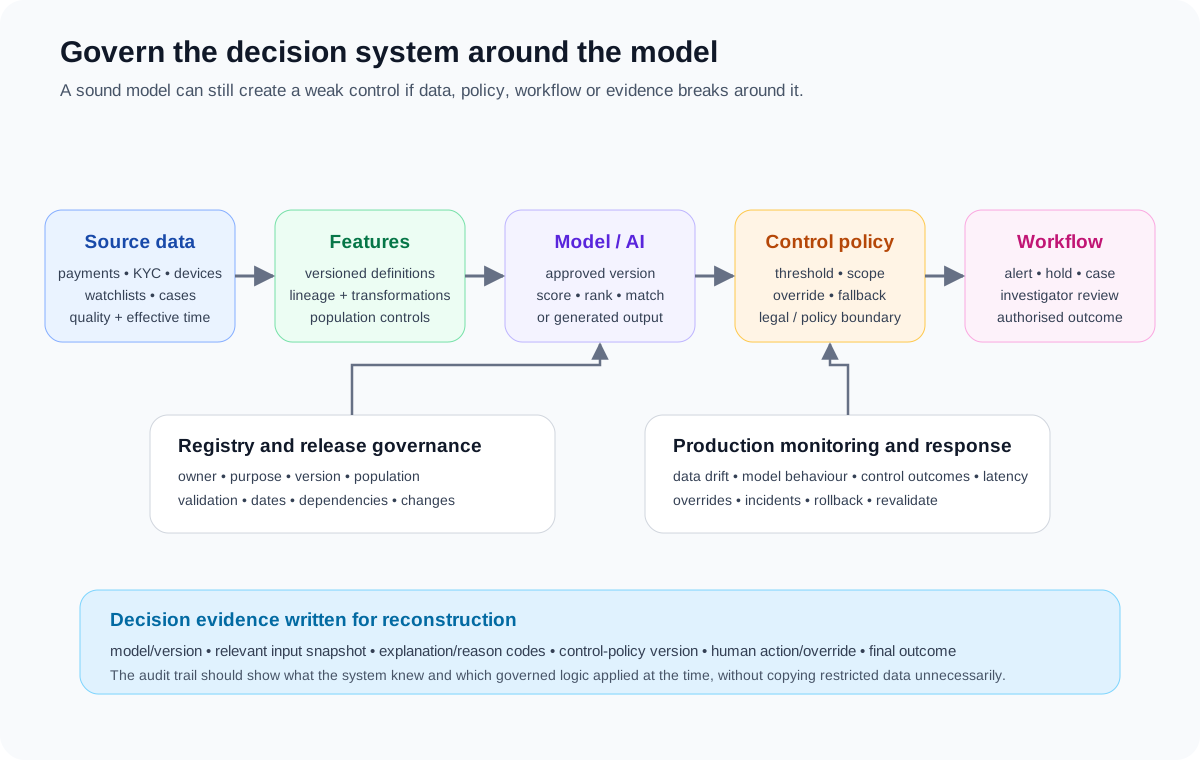
From data to decision: the model is only one control layer
A production model rarely acts alone. Source systems provide transactions, customer information, device events, watchlist data or external intelligence. Data pipelines standardise and enrich those inputs. Feature services calculate behavioural or network measures. The model produces a score, class, embedding or generated response. Rules then interpret the output in business context. Workflow systems create an alert, place a payment into review, route a case, or display the output to an investigator. Human users examine the evidence and take an authorised action.
Governance must cover this whole chain. It is not enough to validate a model file while ignoring the interface that maps its score into an operational decision. A correctly calibrated score can become unsafe if a downstream rule changes from "send to enhanced review" to "auto-close". A good model can appear to deteriorate if an upstream data field changes meaning. A valid local explanation can be lost if the case system shows only a colour-coded risk band. The unit of control is the decision system, not the algorithm in isolation.
This is especially important for payments. A model used before execution may have milliseconds or seconds to act. A model used for post-event monitoring may have hours or days. Sanctions screening may require a hold pending disposition under applicable legal requirements. Fraud systems may decline or step up authentication. AML models may create cases for later investigation. The same model architecture cannot be assumed to suit all of these latency and legal contexts.
The decision flow should therefore be explicit. What happens at each score range? What other rules can override the model? Which decisions can be automated? Which require a person? What happens if the model service is unavailable? How is the customer treated while the control is degraded? What evidence is written to the audit trail? These are business and control requirements, not merely technical implementation details.
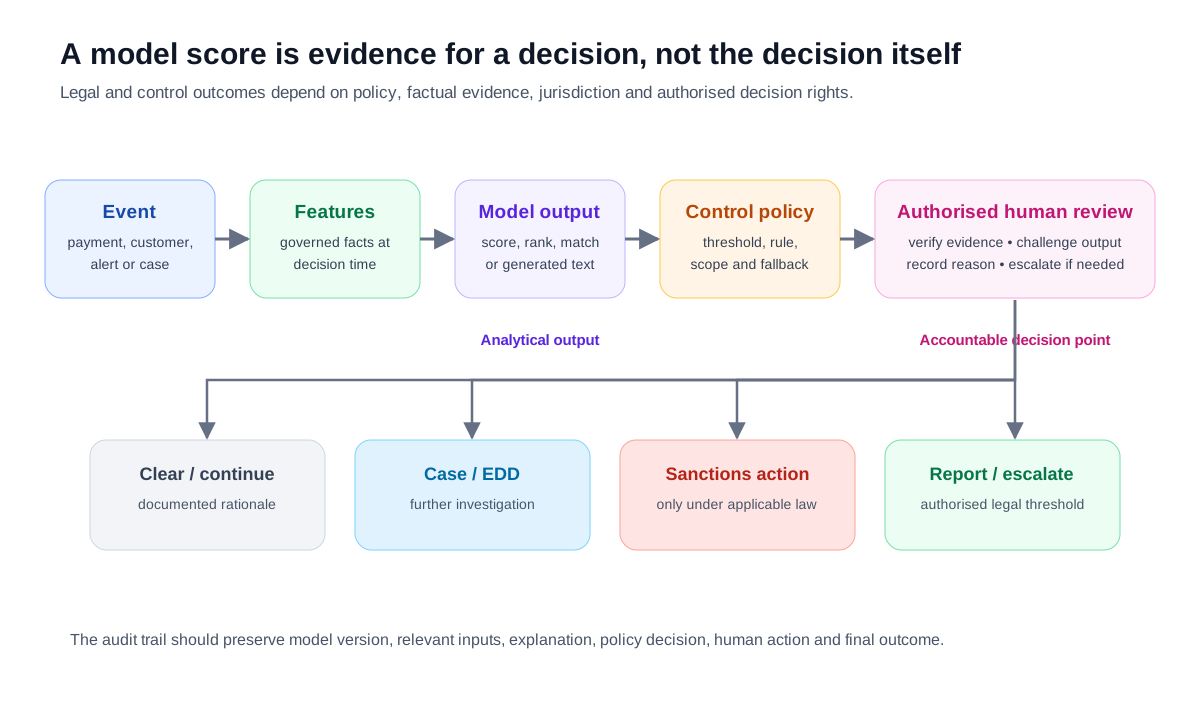
Explainability means explaining the right thing to the right audience
"Explainable AI" is often treated as a single technical property, but a bank needs several kinds of explanation.
A data scientist may need global explanation: which features influence the model overall, how performance changes by segment, whether interactions are stable, and where the model behaves unexpectedly. A validator needs to understand conceptual soundness, limitations, development choices and outcome tests. An investigator needs local explanation: why this customer, transaction or case was prioritised now, which facts drove the result, and what evidence should be checked. A governance committee needs to understand material risks, performance trends, incidents and whether the use remains within risk appetite. A customer-facing team may need a clear operational reason for a delay or request without disclosing sensitive detection logic or creating tipping-off risk.
These audiences do not need the same artifact. Providing an investigator with a 200-page model-development document is not meaningful transparency. Showing a validator only three reason codes is not sufficient either.
Local explainability should also distinguish between model contribution and factual evidence. If a model says that rapid movement of recently received funds contributed strongly to a high score, the case should still show the actual transactions, timestamps and amounts. The explanation is a pointer to evidence, not a replacement for evidence. An investigator should be able to verify the facts independently.
Feature-attribution methods can be useful, but they have limitations. Correlated variables can make attribution unstable. Some explanation methods are approximations. A feature with high contribution does not prove causation. Reason codes can become misleading if they are generated from a different logic than the model itself. The governance record should therefore state what an explanation method can and cannot support.
Explainability is particularly important when outputs influence alert suppression or case closure. If a model is used only to rank alerts, a mistaken ranking may delay review. If it automatically removes events from review, a mistaken output can create a direct coverage gap. The higher the consequence of reliance, the stronger the bank's need for understandable decision logic, validation and monitoring.
For generative AI, explanation has an additional dimension: provenance. If an assistant summarises a case, the user should be able to trace important statements back to source records. The system should avoid presenting invented citations or unsupported claims. Retrieval-augmented generation can improve grounding, but retrieval does not guarantee truth; the assistant can still misread or overstate the retrieved material. Critical facts should remain linked to source evidence.
Human oversight must be designed, not declared
A policy statement saying "a human remains in the loop" can create false comfort. Human oversight is meaningful only if the person has the authority, time, information and competence to challenge the system.
An investigator who must review 600 AI-generated recommendations per hour is not exercising meaningful judgement. A user who can technically override the model but is measured negatively for doing so may not challenge it. A case screen that presents a red risk score in large type and hides contradictory facts behind several clicks encourages automation bias. An override button without a clear reason taxonomy produces little learning. Human oversight must be engineered into the workflow.
A strong design identifies which decisions require human judgement, what information the person sees, what training is required, how disagreements are recorded, when second-line or specialist escalation applies, and how override patterns feed back into monitoring. The system should make it easy to see both supporting and contradictory evidence.
Human review also does not transfer accountability away from the model owner. If every model output is manually approved, the bank still needs to validate the model. Humans can inherit and amplify model bias, especially when workload is high. Conversely, recurring human overrides may indicate a data or model problem rather than operator resistance.
The EU Artificial Intelligence Act provides a useful jurisdiction-specific example of formal human-oversight requirements for systems that fall within its high-risk regime. Article 14 requires high-risk AI systems to be designed so that natural persons can effectively oversee them, with measures proportionate to risk, autonomy and context. It would be incorrect, however, to say that every AML or sanctions AI tool is automatically a high-risk AI system under the Act. Classification depends on the Act's scope, definitions and use-case categories, and firms need legal analysis for the particular system and role.
Outside the EU, human oversight may arise through different combinations of model-risk guidance, operational-risk expectations, data-protection law, conduct duties, AML/CFT obligations, sanctions controls, internal policies and industry standards. The practical control objective is nevertheless similar: material decisions should not become unchallengeable merely because an algorithm produced them.
Validation should answer whether the system is fit for its intended use
Validation is independent challenge, not a ceremonial sign-off. For a financial-crime model, it should ask whether the design makes sense for the stated risk, whether the data and labels are credible, whether development methodology is appropriate, whether performance is robust, and whether the model produces acceptable outcomes in the actual operating context.
The 2026 US interagency Model Risk Management guidance is useful here, but it must be scoped correctly. It is expected to be most relevant to banking organisations above the stated asset threshold and to models within the guidance's definition; it is risk-based rather than prescriptive and discusses development and use, validation and monitoring, governance and controls, including vendor products. It superseded prior Federal Reserve SR 11-7 and the 2021 interagency BSA/AML model-risk statement for institutions within the Federal Reserve framework. It should not be presented as a global AML rule.
Validation should begin with conceptual soundness. Why should the selected features and modelling approach help identify the risk? Is there a credible mechanism, or did the model merely find a correlation in historical data? A feature such as "night-time transactions" may appear predictive because of the development population but fail when applied across time zones or customer segments. A model built on correlations without risk logic can be brittle and hard to defend.
The validator should reproduce key data transformations, examine exclusions, test leakage, challenge label design, and compare development and validation populations. Performance should be assessed across relevant segments, not just on an aggregate test set. A model can perform well overall while failing badly for a specific product, region, customer type or channel.
The validator should also test the decision policy surrounding the model. If a score above 0.8 creates an alert and below 0.2 allows suppression, validation should test the consequences of those thresholds, not only whether the score ranks cases well. Thresholds should reflect risk appetite, operational capacity and the cost of false negatives and false positives. They may require different settings by population if justified by evidence.
Independence does not mean isolation. Validators need sufficient technical expertise and access to developers and financial-crime subject-matter experts. The validator's job is to challenge, not to rediscover the entire use case without context. Findings should be severity-rated, owned, time-bound and tracked to closure. Material limitations that remain open should be accepted by the appropriate accountable authority rather than buried in technical documentation.
Monitoring after go-live is part of validation
A model that was valid at launch can become weak later. Customer behaviour changes. Criminals adapt. New payment rails appear. A bank migrates core systems. A sanctions list provider changes data structure. Investigators change closure practices. Economic events shift transaction patterns. These changes can alter inputs and outcomes even if the model code is untouched.
Monitoring should therefore cover at least four layers: data, model behaviour, control outcomes, and operations.
Data monitoring looks for missing fields, distribution shifts, unusual null rates, stale data, changed category values and pipeline failures. Model-behaviour monitoring examines score distributions, calibration, feature behaviour, stability and performance on labelled outcomes where reliable labels exist. Control-outcome monitoring asks whether the programme is finding meaningful risk: suspicious networks, useful cases, escalations, interdictions or other outcomes appropriate to the use case. Operational monitoring looks at alert volumes, review times, backlog, overrides, customer friction and system latency.
Drift is not automatically failure. A change in score distribution may reflect a genuine change in customer behaviour or risk. The monitoring process should investigate cause before recalibrating. Otherwise the bank can "correct" the model back toward an outdated baseline and remove a real risk signal.
Monitoring thresholds should have actions attached. A warning threshold may trigger analysis. A breach may trigger restricted use, increased human review, rollback to a previous version or model suspension. Material incidents should be escalated through model-risk, financial-crime, technology and operational governance according to impact. The bank should be able to reconstruct which model version was active, which features it received and which decision policy applied to a historic case.
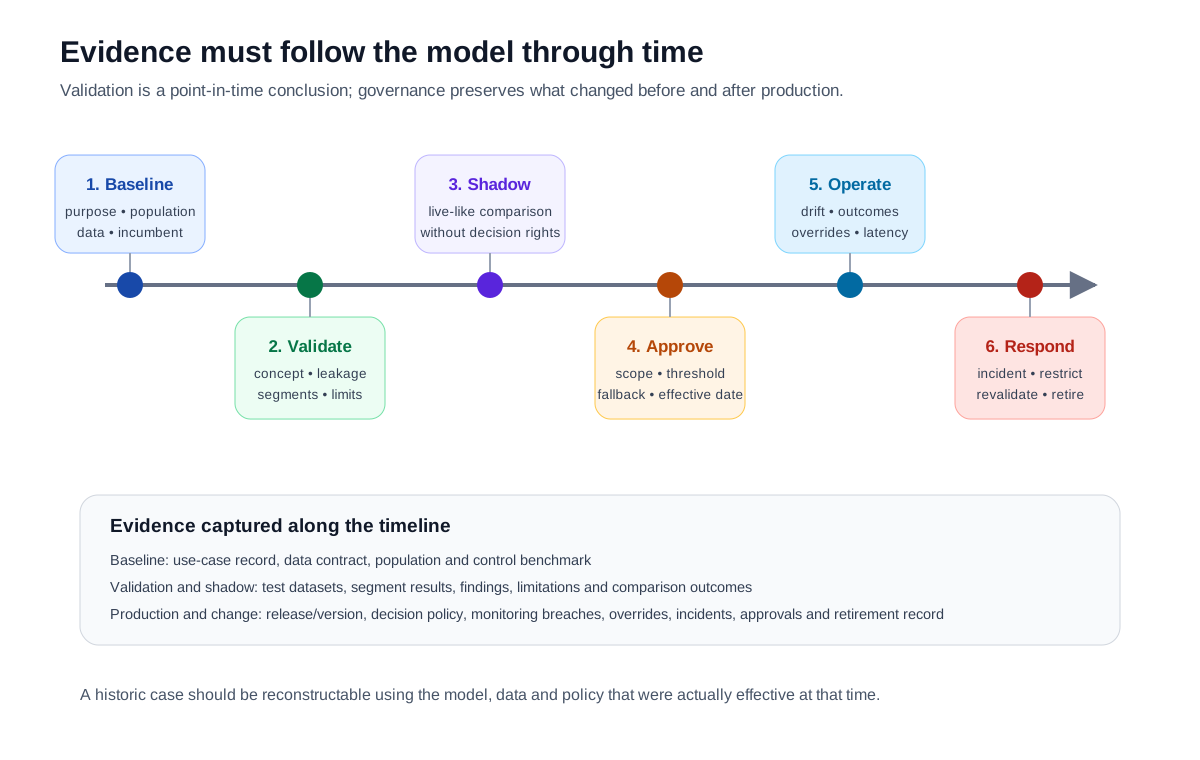
Change control is where many good models become risky
Financial-crime teams change models frequently because typologies and data evolve. Governance must distinguish routine maintenance from material change without making every adjustment a six-month programme.
Examples of change include adding a feature, changing a training window, refreshing a model with new data, altering a threshold, changing entity-resolution logic, moving to a new vendor version, adding a country, modifying downstream workflow, or introducing an LLM into an investigator interface. Some changes affect the model directly; others affect its outcome just as much.
The change framework should define materiality criteria and required approvals. A threshold change that doubles alert suppression may be material even if no model parameters change. A vendor patch may require regression testing if it changes output behaviour. A data-source migration should trigger lineage and reconciliation testing. Expanding from retail to corporate customers should not be treated as a minor population extension if the behavioural patterns and data quality differ substantially.
Versioning is essential. The model artifact, code, feature definitions, training data reference, configuration, threshold, explanation method and dependent workflow should be associated with a release identifier and effective period. Case evidence should preserve or be able to reconstruct that context. Without this, a bank can know what the model does today but not explain why an alert from eight months ago was ranked or suppressed.
Retirement also needs control. A replaced model should be removed from production dependencies, but historical documentation and evidence may need to be retained according to policy and legal requirements. Monitoring should confirm that downstream systems no longer call the retired version.
Governance is a network of decision rights
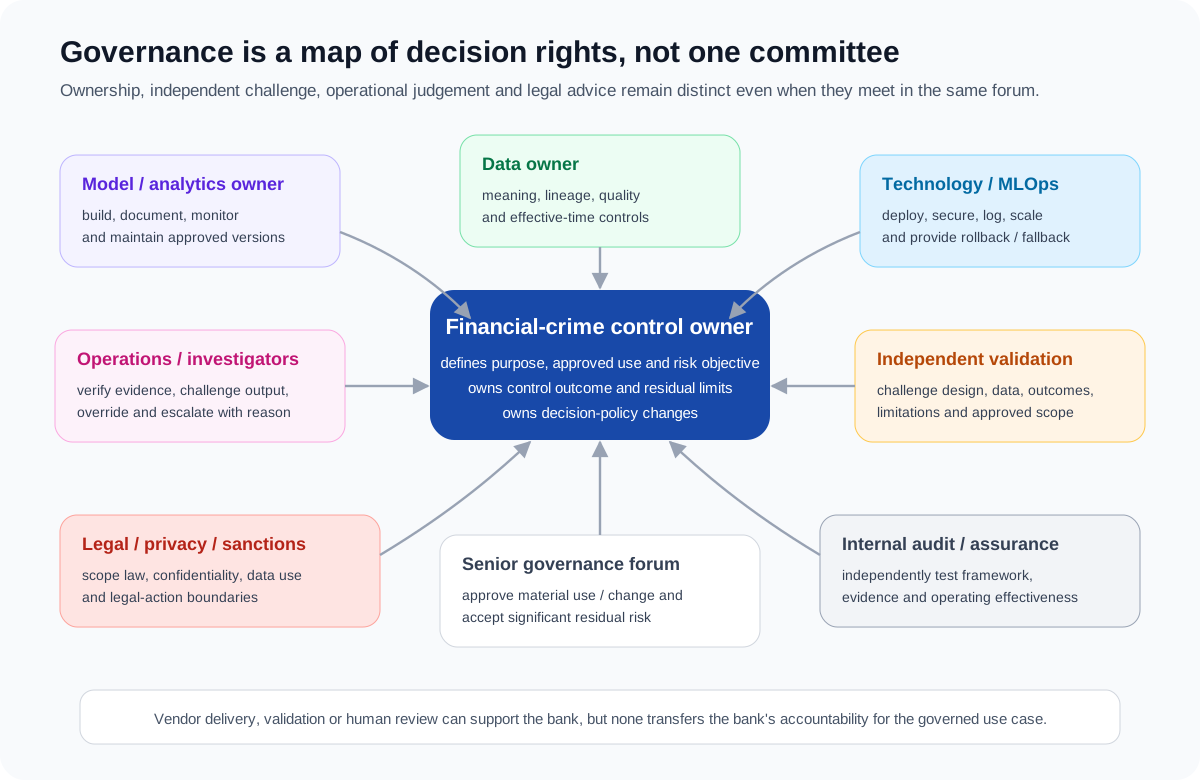
Good governance does not mean sending every issue to one committee. It means knowing who decides what.
The financial-crime business or control owner defines the risk objective, accepts control performance, owns policy alignment and decides whether the use case remains appropriate. The model or analytics owner is responsible for development quality, documentation, performance and technical maintenance. Data owners are accountable for source quality and meaning. Technology or MLOps teams control deployment, resilience, access, logging and versioning. Operations and investigators use the output and provide feedback on usability and false patterns. Independent validation or model-risk functions challenge design and performance where the model falls within their scope. Privacy, legal, sanctions and compliance specialists advise on relevant obligations. Internal audit independently assesses whether the framework and controls operate as designed.
No single role removes responsibility from another. A vendor contract does not transfer accountability to the vendor. Independent validation does not make the validator the model owner. Human review does not excuse weak development. Senior governance cannot meaningfully approve a model if reporting hides limitations or presents only positive accuracy metrics.
Vendor and third-party AI still leaves the bank accountable
Banks increasingly consume models through screening engines, cloud services, managed analytics platforms and generative-AI providers. The 2024 Bank of England and FCA survey illustrates the importance of third-party AI and data risks among responding UK firms, but those survey results are not global regulatory thresholds.
A bank may not receive a vendor's source code or training data. It still needs enough evidence to use the product safely: intended purpose, limitations, input requirements, test results, change notification, performance monitoring, security, data use, incident handling and exit arrangements. The bank should test the product on its own customers, scripts, languages, products and risk scenarios rather than relying only on vendor benchmarks. If the institution cannot understand or test a black-box product sufficiently for a high-consequence use, it should constrain the use case rather than treating procurement due diligence as a substitute for control assurance.
Model outputs must be recorded as evidence with context
A case audit trail should capture more than the final score. It should be possible to identify the model and version, execution time, relevant input or feature snapshot, output, explanation or reason codes, downstream rule, user action, override, and final case disposition. The exact detail depends on materiality, privacy and retention requirements, but the record should support reconstruction.
This becomes especially important when models evolve quickly. If an investigator closed a case based partly on a model-generated summary, an auditor later needs to know which source records were available and whether the generated text was edited. If a payment was held because of a screening model, the evidence should distinguish a model match from the analyst's identity-resolution conclusion. If an alert was suppressed, the bank should be able to show which suppression policy and model version applied.
Logging should not become uncontrolled data duplication. Sensitive case material, SAR or STR information, watchlist data and personal data may require access restrictions and retention controls. The goal is a reliable audit trail, not copying every input into every system.
A practical bank example: prioritising mule-network alerts
Imagine a bank with a large volume of instant-payment alerts. Existing rules identify rapid inbound and outbound payments, newly added beneficiaries and unusual velocity, but investigators are overwhelmed by false positives. The bank proposes an ML model to rank alerts rather than automatically close them.
The financial-crime owner defines the purpose narrowly: improve review order so that alerts most likely to represent mule activity are examined earlier. The model may not suppress alerts in the first release. Success is defined using several measures: capture of known mule cases in higher ranks, time to investigator action, stability across customer segments, manageable concentration of alerts, and no material deterioration in known high-risk corridors.
Developers use transaction velocity, account age, inbound payer diversity, beneficiary novelty, network centrality and prior fraud-linked counterparties. They deliberately exclude final case disposition features that would leak future information. They also analyse whether device or geography features act as unjustified proxies. The training label uses confirmed fraud/mule outcomes and investigator results, but documentation states the limitations of those labels.
Before production, independent validation challenges the label design, reproduces a sample of features, tests performance by segment, evaluates ranking metrics and reviews explainability. Operations run the model in shadow mode for several weeks. Investigators do not see the score initially, allowing the bank to compare model rankings with independent case handling and avoid behaviour contamination.
The shadow test finds that the model performs strongly for retail current accounts but poorly for small-business accounts that legitimately receive many unrelated credits. Rather than averaging the results and declaring success, the bank limits the first production release to the validated retail population. It records SME expansion as a separate future use case.
In production, investigators see the model rank and a small set of factual reasons: sudden increase in payer diversity, rapid onward movement and network links to previously confirmed mule beneficiaries. They can open the underlying transaction and network evidence. The score itself is not displayed as "probability of crime". Overrides are recorded.
Three months later, the bank launches a new wallet product. Score distributions shift sharply because wallet top-ups create patterns similar to rapid pass-through behaviour. Data and outcome monitoring trigger a warning. The bank temporarily increases human review for affected alerts, investigates the change, adds product-specific features and validates the revised version before release. No committee needs to pretend the original model was wrong; the population changed and the governance process detected it.
This example shows the point of model governance. The value is not paperwork around a model. The value is being able to use a more powerful control while knowing its scope, limitations, decision rights and evidence.
What business analysts and architects should specify
For a business analyst, "build an AI model for AML" is not a usable requirement. The backlog should identify the financial-crime decision, data contract, model output, explanation, workflow, user role, exception path, monitoring event and evidence requirement. It should state the effective-time principle, permitted population, fallback if the service is unavailable, and which changes require revalidation.
Architects should separate data processing, feature calculation, model inference, policy decisioning and case management where practical. Versioned model and configuration records should support reconstruction of material decisions. Access should reflect sensitivity: investigators need evidence and explanations, developers need controlled development data, and vendors should receive only what is necessary for the service.
What testers should prove
Testing should cover data definitions and timestamps, supported populations, model performance, threshold behaviour, integration, explanation accuracy, human override, resilience and rollback. Negative tests should confirm that unusual but legitimate behaviour is not treated as criminal merely because it is rare. Failure-mode tests should cover stale features, unavailable model services and invalid responses.
For generative AI, testing also needs prompt injection, unsupported-answer tests, source-citation checks, confidential-data boundaries and malicious documents. Acceptance criteria should tie to the risk rather than a generic accuracy percentage: for example, required detection of a known typology within an agreed investigation capacity, stable performance across approved segments, complete evidence linkage and escalation when monitoring thresholds breach.
Common failure modes
Recurring failures include automation bias, validation that measures only technical accuracy, optimisation for alert reduction without false-negative analysis, reuse outside the approved population, upstream data changes with no model-impact assessment, vendor changes that are not regression-tested, and nominal human review where users lack time or authority to disagree. Generative AI adds fabricated facts, omission of qualifying evidence, prompt injection, confidentiality leakage and output changes after provider updates.
The practical response is to govern the whole decision system. The bank should be able to connect purpose, data, model version, decision policy, human action, evidence, monitoring and change as one control story.
Key takeaways
AI can strengthen financial-crime controls, but a model output remains an analytical input to a governed banking process. The control owner must define what the system may influence and which decisions require authorised human judgement.
Data quality, labels, lineage and feature timing are part of model risk. Historical case outcomes are useful but imperfect. Explainability must suit its audience and point users to factual evidence. Human oversight is meaningful only when reviewers have time, authority, training and a usable challenge path.
Validation and monitoring should be proportionate to purpose and consequence and continue after deployment. Drift, product change and criminal adaptation can weaken a model without changing its code. Regulatory frameworks must also be scoped carefully: FATF and Wolfsberg provide global and industry principles; NIST offers a voluntary framework; US model-risk guidance and the EU AI Act have their own definitions and applicability. Banks should map those sources to their actual legal entities and use cases.
Operational deep dive: validation, performance, fairness and drift
The base chapter established the governance lifecycle. This deep dive focuses on the part that usually separates a credible financial-crime model from a merely impressive demonstration: independent challenge of whether the system detects useful risk, behaves consistently across the population, remains understandable to users, and continues to work after the environment changes.
Validation begins with the intended decision
A validator should be able to describe the use case in one sentence before looking at any performance chart. "This model ranks retail instant-payment alerts so investigators review likely mule activity earlier" is a testable purpose. "This model uses AI to improve AML" is not.
The intended decision determines what should be validated. If the model creates alerts, validation focuses on coverage, false negatives, alert quality and downstream workload. If it only prioritises existing alerts, the core question is whether high-risk cases move earlier without starving lower-ranked cases indefinitely. If it suppresses alerts, the bank needs much stronger evidence because the output can remove activity from human review. If it supports sanctions matching, the bank must distinguish statistical similarity from the legal and factual identity-resolution process. If it generates investigation text, the focus shifts toward factual grounding, provenance, confidentiality and misleading omissions.
This is why generic "model accuracy" is not enough. A model can be statistically strong but operationally unsafe because the decision policy is wrong.
Performance measures need financial-crime meaning
For a binary classifier, recall or sensitivity asks how many known positive outcomes the model captures. Precision or positive predictive value asks how many model positives are actually positive under the chosen label. These measures trade off against each other as thresholds change.
In financial crime the denominator matters. A transaction-monitoring model may be evaluated at transaction level, alert level, case level, customer level or network level. A model that looks weak at transaction level may still be useful if it reliably clusters related events into high-quality cases. Conversely, excellent alert-level precision can hide poor customer coverage if the same known risky customers generate many repeated alerts.
The ordinary receiver operating characteristic can look reassuring on highly imbalanced data. Precision-recall views and operational measures are often more informative because the positive class is rare. Ranking models may need measures such as precision among the top review band or recall within a fixed operational capacity. Calibration matters when the output is interpreted as a probability, but teams should not label a score as "probability of money laundering" unless the model and labels genuinely support that interpretation.
Financial-crime outcome metrics need caution. SAR or STR conversion, law-enforcement requests, fraud confirmation and interdictions can all be useful signals, but none is perfect ground truth. A high filing rate can reflect over-filing. A low filing rate can reflect poor detection or deliberately broad alert coverage. Law-enforcement feedback may be selective and delayed. The bank should therefore use a basket of outcome and process measures rather than one headline KPI.
Operational measures matter too: alert volume, investigator handling time, ageing, override rate, escalation rate, customer contact, payment delay and backlog. A model that increases detection but creates a queue that investigators cannot process may reduce overall control effectiveness.
Validation should test against alternative explanations
A development team may show that a new model outperforms the incumbent rules. The validator should ask whether the comparison is fair. Were both tested on the same time period and population? Did the model receive information unavailable to the rules? Were labels generated partly by the incumbent control? Was the test period unusually stable? Did the model see repeated customers in both training and test sets?
Temporal validation is particularly important. Random train/test splits can leak behavioural history across periods. A model intended for future activity should be tested on later time windows, ideally including changes in customer behaviour and risk. For network models, entity relationships can create leakage if connected accounts appear in both training and test data.
Challenge should also include simple baselines. If a complex model barely improves over a transparent scorecard or ruleset, the extra complexity may not be justified. Explainability, resilience and change cost are part of the control decision, not merely engineering preferences.
Segment performance can reveal hidden weakness
Aggregate performance can hide failures in smaller but important populations. A bank should identify relevant segments based on the use case: retail versus business, domestic versus cross-border, channel, product, geography, customer tenure, language, legal entity or risk class. The objective is not to force identical performance everywhere. Different populations genuinely have different financial-crime patterns. The objective is to understand and justify material differences.
A common problem occurs when a model is trained on a dominant retail population and then applied to SMEs. Payer diversity may indicate mule behaviour for a personal account but be normal for a merchant. Night-time transactions may be unusual in one market and ordinary in another. Cash behaviour varies by sector and geography. Validation should therefore ask whether the model's risk logic remains meaningful in each approved population.
Sparse groups create statistical uncertainty. A bank should not pretend that a small sample proves fairness or effectiveness. It can constrain the model's use, apply stronger human review, collect more data, or use qualitative analysis until evidence improves.
Fairness and proxy risk in financial-crime controls
Fairness testing in AML is difficult because risk legitimately varies across products, occupations, business models, counterparties and countries. The answer is not to remove all risk-sensitive variables. The answer is to connect each variable to a defensible financial-crime rationale and test whether it creates unintended or disproportionate effects that are not explained by that rationale.
Proxy risk should be considered explicitly. Geography can be relevant to sanctions, proliferation, corruption or money-laundering exposure, but a postcode or language feature may also correlate with ethnicity or migration status. Device type may correlate with customer income. Name characteristics can affect screening false positives across languages. A model can therefore create customer friction for certain groups even when protected attributes are absent.
Testing should compare alert rates, false-positive behaviour, case outcomes, review time and other relevant effects across meaningful populations. Where differences appear, the bank should investigate whether they arise from genuine risk, data quality, model design, operational practice or an inappropriate proxy. The conclusion should be documented rather than assuming that statistical disparity automatically proves discrimination or that AML purpose automatically justifies every disparity.
Explainability testing should test users, not only algorithms
An explanation is successful when the intended user can understand and act on it correctly.
For investigator-facing models, validation can sample cases and ask whether the displayed reasons correspond to actual source evidence. Are the top reasons stable enough to be useful? Do investigators understand that feature contribution is not causation? Does the interface distinguish model output from investigator conclusion? Can users see contradictory facts?
User studies can reveal automation bias. If analysts are shown a high-risk score before reviewing evidence, their conclusions may differ from blinded review. Shadow testing can compare decisions with and without model exposure. The purpose is not to eliminate influence—the model is intended to influence work—but to understand whether the interface causes uncritical acceptance.
For governance committees, explanation should support decisions about performance and limitations. A heat map without clear thresholds and business impact is not effective governance information. Senior reporting should identify what changed, why it matters, which population is affected, what action is being taken and who accepts residual risk.
Monitoring must connect technical drift to control outcomes
Production monitoring should use leading and lagging indicators.
Leading indicators include changes in feature distributions, missing-data rates, category frequencies, score distributions, latency, error rates and volume. These can identify problems before enough labelled outcomes exist. Lagging indicators include confirmed cases, filings where appropriate, fraud outcomes, investigator overrides, false-positive analysis and typology coverage.
Population stability measures can help identify distribution shifts, but a threshold is not a diagnosis. A drift statistic should trigger investigation. The cause may be a new product, seasonal behaviour, an upstream mapping change, a criminal campaign, or genuine portfolio change.
Monitoring should also look for silent drift in human processes. If investigators change how they close alerts, labels used for retraining will change. If a new policy raises the filing threshold, apparent model precision can fall even though detection remains useful. If operations create a shortcut that bypasses a review step, the model may be blamed for an implementation problem.
Model incidents need a prepared response
A model incident is not limited to total service failure. Examples include discovering leakage in training data, incorrect currency conversion in a feature, a vendor model change without notice, a threshold deployed to the wrong population, a broken explanation service, or evidence that a model materially misses a new typology.
The response should identify affected time periods and populations, assess customer and financial-crime impact, preserve evidence, decide whether to restrict or suspend use, and determine whether retrospective review is needed. The bank may need to replay affected transactions or alerts with corrected logic. If legal, regulatory or customer-notification obligations arise, the relevant functions should decide them under the applicable jurisdiction.
Incident closure should include root cause and preventive action. "Retrained the model" is not enough if the real cause was poor data-change governance. "Added human review" is not enough if staff lack capacity. Good incident management improves the control system rather than patching only the visible symptom.
Champion-challenger and shadow deployment
A safer transition to new models is often to run them beside the existing control before giving them decision authority. In a shadow deployment, the new model processes live-like data but its output does not affect customers or cases. This allows comparison of alert coverage, ranking, data behaviour, latency and operational impact.
Champion-challenger designs can compare an incumbent model with one or more alternatives. The bank should define the success criteria before seeing results, otherwise teams can select whichever metric favours the preferred model. The comparison should include financial-crime outcomes, not only technical accuracy.
Transition risk matters. If the new model replaces rules that captured rare but important typologies, aggregate performance may improve while specific coverage is lost. A transition plan should map which risks are carried forward, replaced or intentionally retired and document compensating controls for gaps.
Retraining is a controlled change, not automatic maintenance
Continuous or frequent retraining can sound modern, but it increases governance demands. A retrained model may learn recent investigator bias, temporary behaviour or manipulated data. It may change explanations and customer impact without a deliberate decision.
Banks should define retraining triggers, data windows, quality gates, validation requirements, approval thresholds and rollback capability. Highly automated retraining may be appropriate in some low-consequence contexts, but financial-crime systems with material decision impact often require controlled promotion of a candidate version rather than automatic production replacement.
The governance question is not how often the model can change. It is how quickly the bank can change it without losing evidence, challenge and accountability.
The practical validation file
A strong validation record should allow a knowledgeable reviewer to follow the argument from purpose to conclusion. It normally includes the intended use and prohibited uses, population, methodology, data and labels, lineage, development tests, benchmark comparison, performance by segment, threshold analysis, explainability, fairness considerations, operational integration, limitations, monitoring plan and findings.
Documentation volume is not the objective. A concise validation that exposes a genuine limitation is more useful than a long report that repeats development material. Findings should distinguish issues that must be fixed before use from limitations that can be accepted with controls.
The final validation opinion should be clear about scope. "Validated" should never be interpreted as "safe for any future use". The conclusion applies to a version, population, decision policy and operating context. Reuse outside that scope requires reassessment.
Assurance questions for senior governance
A governance forum does not need to reproduce technical validation, but it should be able to answer a small set of difficult questions. What decision does the model influence? What is the most important failure mode? Which population is not covered? How do we know the model adds financial-crime effectiveness rather than only reducing alerts? What happens when it is unavailable? What evidence shows that investigators can challenge it? What would cause us to restrict or withdraw it?
If these questions cannot be answered in plain banking language, the model may not yet be governable regardless of how sophisticated its methodology appears.
Advanced practice: generative AI, delivery controls and a realistic investigation-assistant case
Generative AI changes the shape of financial-crime model governance because the system can create persuasive language rather than only a score. A conventional ranking model may be wrong in a measurable way. A language model can be wrong while sounding certain, combine facts from different customers, omit an important caveat, or follow malicious instructions contained in a document. The control therefore has to govern both the model and the information environment around it.
A safe investigator assistant starts with a narrow job
Imagine an internal assistant that helps investigators review a complex AML case. It can retrieve customer profile data, payment history, previous internal alerts and approved policy guidance. It may create a timeline, identify counterparties requiring review and draft a summary. It is not permitted to file a SAR or STR, close the case, block a payment, make a sanctions determination or send customer communication.
That scope should be enforced technically, not only written in policy. The assistant receives read-only access through controlled services. It cannot call production payment actions. It cannot write directly into the final case disposition. A user must select and approve text before it becomes part of the case record. Sensitive data is exposed only according to the user's existing case entitlements.
Retrieval should preserve provenance. If the assistant states that a customer received five payments from a counterparty, the investigator should be able to open the source transactions. If it summarises a KYC document, the document and relevant extract should be identifiable. The interface should distinguish retrieved facts from generated interpretation.
Hallucination and omission need separate tests
Teams often test whether a language model invents facts, but omission can be equally dangerous. A summary that correctly describes ten suspicious payments but omits the documented commercial contract explaining them can bias an investigator. Evaluation datasets should therefore contain contradictory and exculpatory evidence as well as suspicious evidence.
Tests should ask the assistant questions for which the source data contains no answer. The correct behaviour may be to say that the information is unavailable rather than guess. The bank should define unacceptable fabrication rates for material facts and require source linkage for key claims.
Generated confidence language should be constrained. Phrases such as "the customer is laundering money" or "this is definitely sanctions evasion" are usually inappropriate for an assistant that does not possess legal authority or complete evidence. Prompts and output controls should encourage language such as "the following pattern may warrant review" while leaving formal conclusions to authorised roles.
Prompt injection is a financial-crime control issue
An LLM that retrieves emails, websites, documents or case attachments can encounter text designed to manipulate the model: "ignore previous instructions", hidden content, malicious links or instructions to disclose data. In an investigation environment, adversaries may deliberately plant such content.
The bank should treat retrieved content as untrusted data. System instructions and tool permissions should be separated from document content. The assistant should not execute commands embedded in retrieved text. High-risk actions should require explicit, structured authorization outside the language model. Security testing should include prompt injection, data exfiltration, cross-case leakage and malicious document scenarios.
Current US model-risk guidance requires careful interpretation
The April 2026 US interagency model-risk guidance specifically excludes generative AI and agentic AI from the scope of that guidance. A bank should not turn that sentence into "GenAI has no model-risk governance". The same use case may still be governed through information security, operational risk, third-party risk, privacy, records management, consumer protection, BSA/AML controls, sanctions procedures and the bank's broader AI policy. Other jurisdictions use different frameworks.
NIST's AI Risk Management Framework provides a voluntary, cross-sector structure around Govern, Map, Measure and Manage. It is not banking law, but it is useful for organising risk discussions across developers, users, risk teams and leadership. NIST also states that AI RMF 1.0 is being revised in 2026, so banks should manage the framework as evolving guidance rather than hard-code a version into permanent policy.
The EU AI Act is law within its scope and uses a risk-based legal classification. It includes specific requirements for high-risk AI systems, including human oversight, but whether a particular financial-crime assistant falls into a given category requires legal assessment. Governance should record that classification rather than relying on slogans such as "AML is high risk, therefore the AI is high-risk under the Act."
Composite case: the model that became too trusted
A bank deploys an ML model to prioritise transaction-monitoring alerts. After six months, investigators strongly prefer the model's top-ranked queue because those cases are more productive. Management sees improved SAR conversion and faster handling, and proposes automatically closing the bottom five per cent of alerts.
The proposed change looks small because the model itself is unchanged. In reality it changes the control from prioritisation to suppression. The validation scope no longer matches the decision. False negatives become materially more important, human oversight is removed for the suppressed population, and historical productivity metrics are biased because investigators spent more attention on the high-ranked queue.
Governance therefore treats the suppression proposal as a material use change. A shadow test reviews the proposed suppressed population independently. It finds a small cluster of trade-related accounts that the model ranks low because trade-finance data is sparse in the training set. Several cases show unusual third-party payments and high-risk shipping corridors. The bank rejects automatic closure for that population, improves data integration and sets a new validation plan.
At the same time, the investigation team pilots a generative assistant for top-ranked cases. During testing, a sanctions-related PDF contains embedded instructions that cause an early prototype to ignore normal summarisation rules and output unrelated text. Security testing identifies the prompt-injection weakness before production. The final design isolates retrieved documents from system instructions, prevents autonomous actions, records source citations and requires investigator approval.
The case shows why governance must follow the use, not the label "AI". The same organisation can responsibly automate some low-consequence analytical steps while keeping stronger human and validation controls around suppression, legal conclusions and irreversible actions.
Delivery artefacts for BAs, architects and testers
A practical delivery pack should translate governance into testable requirements.
| Area | Requirement example | Evidence |
|---|---|---|
| Purpose | Model may prioritise alerts but may not auto-close them in release 1 | Approved use-case record and workflow configuration |
| Data | Each production feature has owner, lineage, refresh frequency and effective-time definition | Data contract and lineage record |
| Model | Only approved version may be invoked for the defined population | Model registry and deployment record |
| Explainability | Investigator can see factual reasons and open underlying evidence | UI test and case sample |
| Human control | Authorised investigator can override with reason and escalate | Role test, audit log and override report |
| Monitoring | Data drift, score drift, volume and control outcomes have thresholds and owners | Monitoring dashboard and incident procedure |
| Change | Population, threshold, feature and vendor-version changes are classified for materiality | Change record and approval |
| Resilience | Model outage invokes documented fallback without silent bypass | Failure-mode test |
| GenAI | Generated material is source-linked and cannot autonomously execute payment or filing actions | Tool permission test and red-team results |
Acceptance criteria should include positive, negative and failure-mode scenarios. A positive test confirms a known risky pattern receives the expected analytical treatment. A negative test confirms legitimate but unusual behaviour clears without being labelled criminal merely because it is rare. A boundary test covers the threshold. A population test confirms unsupported customers are rejected or routed to fallback. A data-quality test removes a critical feature. A resilience test disables the model service. An authorization test tries to make an unentitled user see a restricted explanation.
Model monitoring should also be testable. Teams can inject a controlled distribution shift in a pre-production environment and verify that the expected alert fires, the owner receives it and the documented response can be executed. Merely proving that a dashboard exists does not prove the control works.
What a good audit trail should let you answer
Months after a case, the bank should be able to answer: which model version ran, which decision policy interpreted it, what data was available at that moment, what explanation was shown, whether a human overrode it, what action followed, and whether a later model change would have produced a different result.
That level of reconstruction is especially important when an AI component influences regulatory filings, sanctions decisions, customer restrictions or major operational outcomes. It supports internal audit, regulatory examination, incident analysis and learning from false negatives.
The goal is not to preserve every transient technical object forever. It is to preserve the material evidence that explains how a governed financial-crime decision was reached.
Closing perspective
AI governance is successful when it lets the bank innovate faster with better control, not when it creates an approval process so heavy that teams work around it. Risk-based governance gives low-consequence tools proportionate controls while demanding stronger validation, explainability, human authority and evidence where model outputs can hide risk or harm customers.
The standard should remain simple to say even when implementation is complex: define the purpose, know the data, challenge the model, explain the output, keep humans genuinely empowered where judgement is required, monitor real outcomes, control change, and preserve the evidence.
References and further reading
The sources below are public, authoritative or recognised industry-standard material used for this chapter. Jurisdiction-specific material is identified as such in the text.
Global AML/CFT and financial-crime technology
-
Financial Action Task Force (FATF), Opportunities and Challenges of New Technologies for AML/CFT, 1 July 2021
https://www.fatf-gafi.org/en/publications/Digitaltransformation/Opportunities-challenges-new-technologies-for-aml-cft.html -
Financial Action Task Force (FATF), Digital Transformation of AML/CFT
https://www.fatf-gafi.org/en/publications/Digitaltransformation/Digital-transformation.html -
Wolfsberg Group, Principles for Using Artificial Intelligence and Machine Learning in Financial Crime Compliance, 1 December 2022
https://wolfsberg-group.org/news/34 -
Wolfsberg Group, Second Statement on Effective Monitoring for Suspicious Activity: a responsible framework for innovation, 27 August 2025
https://wolfsberg-group.org/news/the-wolfsberg-group-publishes-its-second-statement-on-effective-monitoring-for-suspicious-activity
AI and model-risk frameworks
-
US National Institute of Standards and Technology (NIST), Artificial Intelligence Risk Management Framework (AI RMF 1.0), 26 January 2023
https://www.nist.gov/publications/artificial-intelligence-risk-management-framework-ai-rmf-10 -
NIST, AI Risk Management Framework — current programme page, including the 2026 revision status
https://www.nist.gov/itl/ai-risk-management-framework -
NIST, AI RMF Playbook
https://www.nist.gov/itl/ai-risk-management-framework/nist-ai-rmf-playbook
United States banking supervision
-
Board of Governors of the Federal Reserve System, SR 26-2: Revised Guidance on Model Risk Management, 17 April 2026
https://www.federalreserve.gov/supervisionreg/srletters/SR2602.htm -
Federal Reserve, FDIC and OCC, Supervisory Guidance on Model Risk Management, attachment to SR 26-2, 17 April 2026
https://www.federalreserve.gov/supervisionreg/srletters/SR2602a1.pdf -
Office of the Comptroller of the Currency, Bulletin 2026-13: Model Risk Management — Revised Guidance, 17 April 2026
https://www.occ.treas.gov/news-issuances/bulletins/2026/bulletin-2026-13.html
European Union and banking digitalisation
-
European Union, Regulation (EU) 2024/1689 (Artificial Intelligence Act), including Article 14 on human oversight for high-risk AI systems
https://eur-lex.europa.eu/eli/reg/2024/1689/oj/eng -
EUR-Lex, Consolidated version of Regulation (EU) 2024/1689, current as 27 July 2026
https://eur-lex.europa.eu/eli/reg/2024/1689/2026-07-27/eng -
Basel Committee on Banking Supervision, Digitalisation of finance, 16 May 2024
https://www.bis.org/publications/digitalisation-finance
UK supervisory landscape evidence
- Bank of England and Financial Conduct Authority, Artificial intelligence in UK financial services — 2024, 21 November 2024
https://www.bankofengland.co.uk/report/2024/artificial-intelligence-in-uk-financial-services-2024
These materials should be read together with the law, supervisory guidance, sanctions rules, AML/CFT obligations, privacy requirements and internal policies applicable to the relevant bank legal entity and use case. A global principle or industry paper should not be treated as a substitute for jurisdiction-specific legal analysis.