United Kingdom: MLR, NCA and OFSI
The United Kingdom does not have one financial-crime rulebook, one authority or one workflow that answers every case. A bank operating in the UK has to connect several frameworks that overlap but do different jobs. The Money Laundering Regulations (MLRs) provide much of the preventive AML and counter-terrorist-financing framework for relevant firms. The Financial Conduct Authority (FCA) supervises many financial-sector firms for compliance with those requirements and applies wider systems-and-controls expectations. The National Crime Agency (NCA) houses the UK Financial Intelligence Unit (UKFIU), which receives Suspicious Activity Reports. The Office of Financial Sanctions Implementation (OFSI), part of HM Treasury, implements and enforces UK financial sanctions and handles relevant reporting and licensing.
The practical discipline is to identify which legal or control question has been triggered, which owner and authority are relevant, which evidence is needed, and which action follows. A customer can require enhanced due diligence without being suspected of laundering money. A transaction can create a reportable suspicion with no sanctions target involved. A sanctions designation can require an asset freeze even where the payment looks commercially ordinary. Filing a SAR does not automatically mean the bank must close the account, and a SAR does not replace a sanctions decision where a legal prohibition applies.
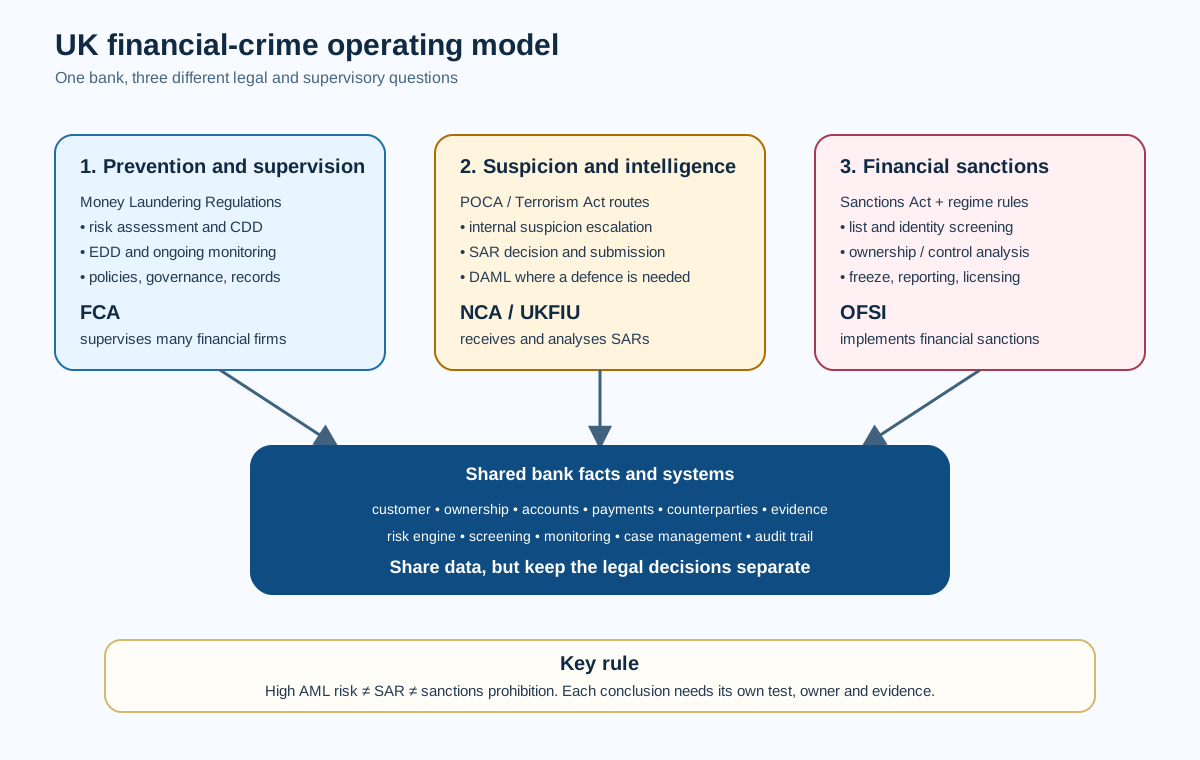
A three-pipeline mental model
The first pipeline is prevention and supervision. It asks whether the bank understands the customer, beneficial owners, purpose, expected activity and risk sufficiently to establish or continue the relationship. It covers business-wide and customer risk assessment, CDD, EDD where required, ongoing monitoring, policies, training, governance and recordkeeping. For many financial firms, the FCA is the relevant MLR supervisor.
The second is suspicion and intelligence. It asks whether information known to the bank meets the applicable threshold for internal escalation and a SAR to the UKFIU. Where dealing with suspected criminal property may expose the bank or its staff to a principal money-laundering offence, the firm may also consider a defence against money laundering (DAML) for the specific proposed act. A DAML is not general approval of a customer relationship.
The third is financial sanctions. It asks whether a person, entity, asset, ownership/control relationship, transaction or activity is restricted under an applicable UK sanctions regime. Screening locates possible exposure; investigation establishes identity and legal applicability. The bank may need to assess ownership or control, the nature of the prohibition, exceptions or licences, and OFSI reporting requirements.
These pipelines share data but must keep separate outcomes. KYC supports sanctions identity resolution. Transaction monitoring can produce a SAR and expose a sanctions nexus. A sanctions investigation can reveal ownership information that changes customer risk. The case platform should therefore record separate decisions such as customer-risk action, SAR decision, DAML requested, sanctions true match, asset freeze required and licence applied, rather than one generic “financial crime hit”.
The Money Laundering Regulations in a bank
The MLRs apply to defined relevant persons and activities. For the financial sector this includes banks and a range of credit institutions, financial institutions, payment and e-money businesses and certain cryptoasset businesses, subject to the detailed scope of the regulations. The FCA publicly identifies banks, building societies, credit unions, cryptoasset businesses and other relevant financial firms within its MLR supervisory remit.
For a bank, the MLRs are an operating-control framework, not a document checklist. The institution must understand its exposure, identify and verify customers and beneficial owners, understand why the relationship exists, monitor activity, apply stronger measures when required, maintain records and prove that its controls work.
“Risk based” does not make mandatory requirements optional. It determines proportionality and control intensity within the legal framework. Equally, it should not become an excuse for blanket de-risking. A system should distinguish legal triggers from risk indicators so a reviewer can tell whether EDD was legally required or chosen because the broader customer assessment was high risk.
The 2026 MLR changes and effective dates
The Money Laundering and Terrorist Financing (Amendment) Regulations 2026 changed several parts of the UK framework. Important operational changes took effect on 30 June 2026, while some provisions have later commencement dates.
A material change narrowed the automatic country-related EDD trigger. From 30 June 2026, the mandatory country-list treatment is aligned to FATF jurisdictions subject to a Call for Action, rather than automatically applying the same statutory trigger to every jurisdiction under FATF increased monitoring. Increased-monitoring jurisdictions remain relevant to geographic risk and may still contribute to a high-risk assessment requiring stronger measures. The important distinction is between a mandatory legal trigger and a bank’s wider risk-based treatment.
That means a pre-June rules engine cannot simply continue unchanged and describe all FATF-listed countries as the same statutory category. A bank can retain stronger controls through risk appetite, but the system and policy should label the basis correctly.
The amendments also address other areas including unusually complex or unusually large transactions, thresholds and pooled client-account due diligence. A new cryptoasset correspondent due-diligence regime under regulation 34A is scheduled for 1 February 2027. As at 22 September 2026 it is an upcoming requirement, not a currently effective rule.
For architects and BAs, this is a direct lesson in effective dating. Regulatory rules should carry source, version, effective_from, affected population and control mapping. A policy paragraph without an effective date is not enough for a bank-grade implementation.
CDD, EDD and ongoing monitoring
CDD should establish who the customer is, who owns or controls it, why the relationship is required, what activity is expected and what factors drive risk. For legal entities, ownership chains, controllers, directors, authorised persons, business activity and expected payment corridors often matter as much as the incorporation certificate.
Evidence should be treated as evidence, not as unquestionable truth. Registry data can support verification, but conflicts between customer declarations, corporate records, screening data and observed transactions should be surfaced rather than silently overwritten. Effective-dated ownership relationships are particularly important because later investigations may need to reconstruct who controlled an entity when a historical payment occurred.
EDD should strengthen understanding, not simply collect more documents. The reviewer should be able to explain what additional uncertainty needed resolution and how the additional evidence addressed it. Measures can include deeper ownership verification, stronger source-of-funds or source-of-wealth evidence, senior approval and closer monitoring, depending on the trigger and risk.
Ongoing monitoring closes the loop. Onboarding creates a baseline against which later behaviour can be interpreted. The same payment can have a very different risk meaning for a domestic consultancy and for an international commodity trader. Event-driven changes such as new owners, countries, products or counterparties should be capable of triggering reassessment before the next scheduled periodic review.
FCA supervision: proving effectiveness
The FCA is not the UKFIU and it is not OFSI. For firms within its remit, it supervises MLR compliance and expects appropriate financial-crime systems and controls. A bank therefore needs evidence of effectiveness, not merely approved policies.
That evidence can include calibrated risk models, current screening data, understood transaction-monitoring coverage, timely investigations, governed backlogs, high-risk approvals, data lineage, training, quality assurance and sustainable remediation. A business analyst can translate these expectations into concrete system requirements: overrides need approver and rationale; rules need versioning; list versions must be retained; case decisions need timestamps; and released sanctions alerts need identity-resolution evidence.
NCA, UKFIU and Suspicious Activity Reports
The UKFIU sits within the NCA and receives SARs through the SAR Portal. The NCA emphasises that a SAR is not the same as reporting a crime or fraud. In a bank, a front-line referral or monitoring alert normally starts an internal assessment; it is not automatically an external report.
A useful internal referral says who is involved, what happened, when and where money moved, why the activity differs from the known profile, which accounts and counterparties matter, and what evidence is available. The nominated officer or appropriate team then applies the legal reporting threshold and records the decision.
SAR information is sensitive. Customer-service staff may need to know that a transaction is under specialist review, but they do not need unrestricted access to SAR narrative. Systems should therefore separate operational status from protected intelligence and provide approved communication routes that avoid inappropriate disclosure or tipping-off risk.
DAML is specific to the proposed act
A DAML request can be relevant when the bank proposes to deal with suspected criminal property and seeks the statutory defence mechanism. It should be tied to the precise act under consideration, such as executing or returning a payment. It is not “NCA permission to bank the customer”.
The NCA’s current public guidance describes an initial seven-working-day notice period for a DAML request. If consent is refused within that period, a statutory moratorium may follow under the applicable framework. The bank needs legal-calendar logic, controlled payment holds, restricted access to sensitive information and a clear release authority. A generic SLA timer or a blanket account freeze is not an adequate substitute.
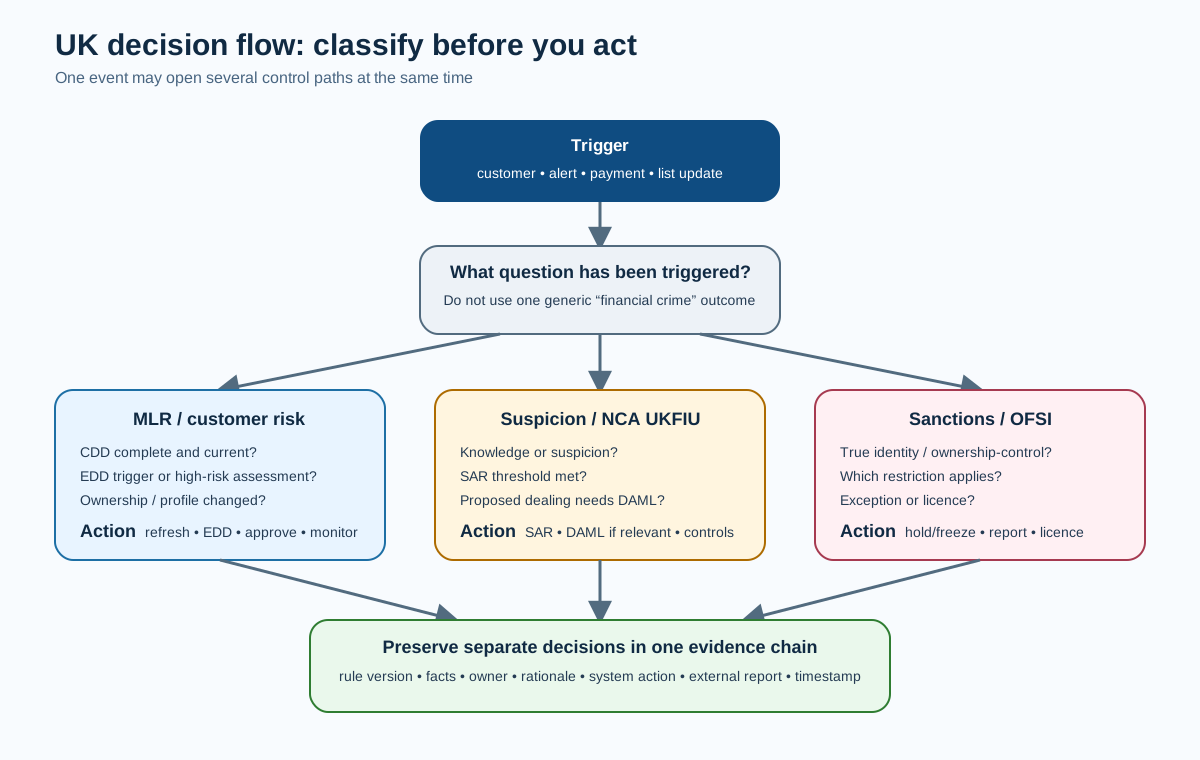
OFSI and UK financial sanctions
UK financial sanctions are implemented through the Sanctions and Anti-Money Laundering Act 2018 and regime-specific regulations. OFSI is responsible for implementing and enforcing financial sanctions. A bank must work from the applicable regime and restriction rather than treating sanctions as a universal “blocked country” list.
A screening hit is only an investigative starting point. The bank may need to establish whether the party is the listed person, whether an unlisted entity is owned or controlled by a designated person under the applicable test, whether funds or economic resources are caught by a prohibition, and whether an exception or licence changes the outcome.
Since 28 January 2026, the UK Sanctions List has been the single source for all current UK sanctions designations. The former OFSI Consolidated List is closed and no longer updated. That change has direct engineering consequences: screening services need a current list feed, reconciliation, parser and schema controls, update monitoring and evidence that a failed ingestion cannot leave the system silently stale.
Relevant firms also have reporting duties to OFSI in defined circumstances. Licensing is separate again. A licence is permission issued where an applicable licensing ground is available; it is not a bank-created exemption. The institution must verify that the parties, activity, amount, dates and conditions fall within the licence and fulfil any reporting and recordkeeping conditions.
Financial sanctions and trade sanctions are different controls
OFSI administers financial sanctions. Trade-sanctions implementation and export controls involve other government authorities and legal frameworks. A bank financing trade can therefore face overlapping questions. A transaction can be free of an OFSI asset-freeze prohibition but still involve controlled goods, or a trade licence can exist while a separate financial-sanctions restriction remains relevant.
This is why trade-finance requirements should not assume that a payment message contains enough data to classify the goods. The bank may need invoices, shipping documents, end-user information and specialist escalation. The financial-sanctions decision and the trade-control decision can share evidence without being treated as the same legal conclusion.
Where the framework touches the lifecycle
At onboarding the bank establishes identity, ownership, purpose, expected activity and risk, and screens relevant parties. During the relationship, ownership changes, new countries, products, adverse information or changed behaviour can trigger reassessment. At payment initiation, sanctions controls may need to act before execution, while AML monitoring can be real-time, near-real-time or post-event depending on the risk and use case.
After any decision, traceability matters. The bank should be able to show which customer data and list version were used, which rule triggered the alert, who reviewed it, what evidence resolved the issue, whether an external report was filed, whether funds were held or frozen, and whether the customer-risk rating changed.
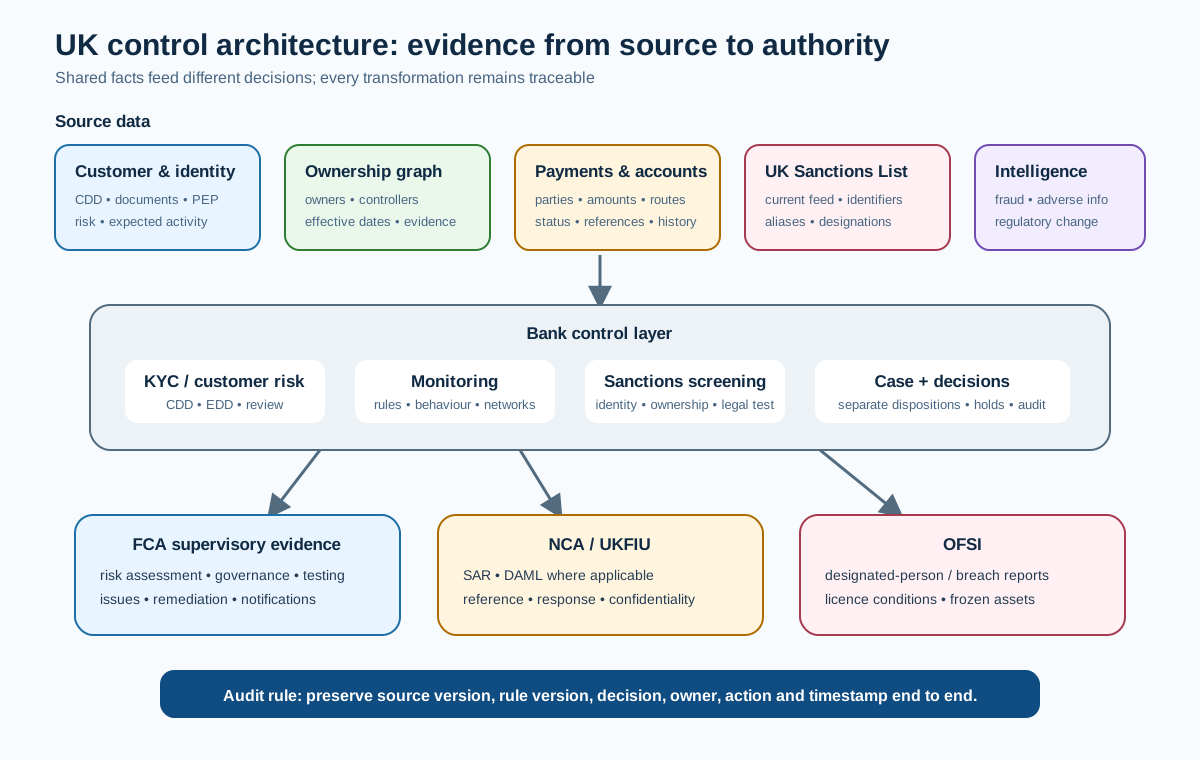
Different conclusions require different evidence
CDD evidence explains the customer and relationship. Monitoring evidence explains why behaviour is or is not consistent with that understanding. SAR evidence supports the nominated officer’s suspicion and reporting decision. Sanctions evidence supports identity resolution and the legal treatment of a party, asset or transaction.
Those evidence sets overlap but are not interchangeable. A passport can resolve a sanctions name match without proving source of wealth. An invoice can support commercial purpose without proving that no designated person controls a supplier. A clean sanctions result does not make a customer low AML risk. A SAR acknowledgement does not authorise conduct prohibited by sanctions.
Historical reconstruction is equally important. Ownership, lists, customer profiles and rules change. A review of a six-month-old payment should use the facts and rule versions that existed at that time rather than silently applying today’s data to yesterday’s decision.
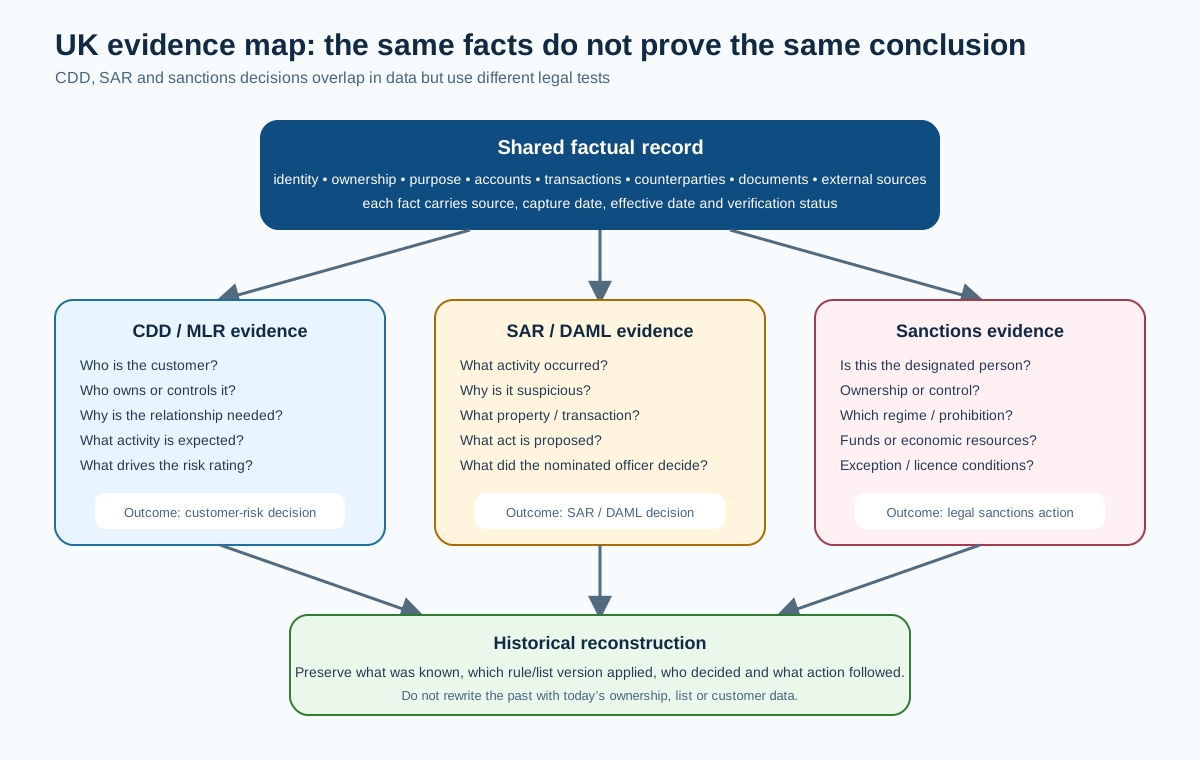
Governance and decision rights
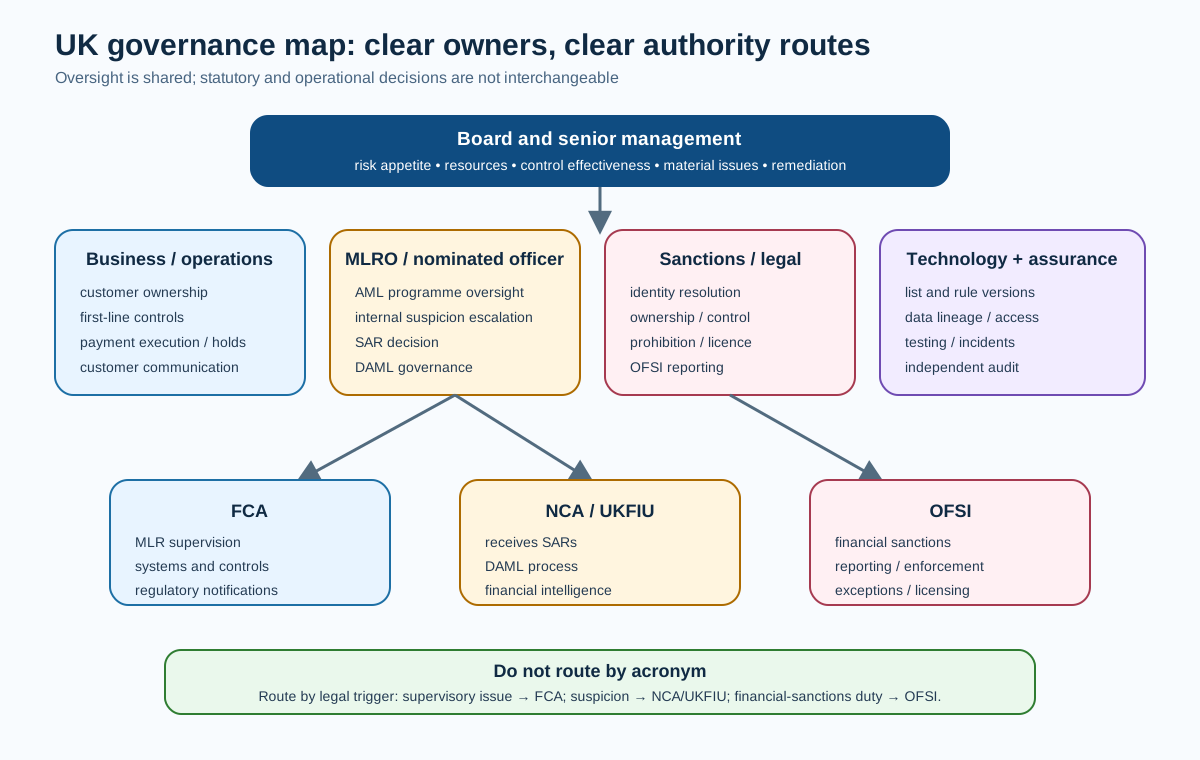
The business owns customer relationships and first-line controls. Operations execute onboarding, payments and restrictions under approved procedures. Financial-crime compliance sets standards and challenge. The MLRO or nominated officer owns defined AML reporting responsibilities. Sanctions specialists and legal counsel support applicability, ownership/control, licensing and disclosure questions. Technology and data teams own system reliability and lineage. Internal audit provides independent assurance rather than becoming the operational decision-maker.
External authorities remain distinct. The FCA supervises firms within its remit. The NCA/UKFIU receives and analyses SAR intelligence. OFSI administers and enforces financial sanctions. For dual-regulated firms, PRA considerations may also arise, but regulatory notification does not replace a statutory report to the authority that the law requires.
What good looks like
A mature UK operating model can explain a difficult case precisely: the customer was high risk for stated reasons; a defined EDD trigger or risk assessment drove additional measures; a transaction generated an alert; the investigation produced or did not produce suspicion; the nominated officer made a SAR decision; a DAML was considered only for a specific proposed act; sanctions screening was separately resolved; any OFSI reporting or licensing was handled under the applicable regime; and the relationship decision was then governed according to law, risk appetite and documented authority.
That precision makes systems buildable, tests meaningful and operations safer. It also reduces unnecessary customer harm because the bank can explain exactly why it is acting rather than treating every financial-crime concern as the same problem. The accompanying deep-dive, advanced-practice and case-study sections develop the preventive controls, reporting mechanics, sanctions architecture, testing and cross-control operating details.
Deep dive: how UK preventive AML controls work in practice
The UK preventive framework is easiest to operate when a bank separates four layers: scope, risk assessment, mandatory control triggers, and risk-based intensity. Problems arise when those layers are mixed. A rule that applies only to a defined relevant person can be incorrectly extended to an out-of-scope activity; a statutory enhanced-due-diligence trigger can be confused with a discretionary policy threshold; or a risk score can be treated as if it were the legal test itself.
Start with scope, not with a control checklist
The Money Laundering Regulations apply by reference to defined persons and activities. A large banking group may contain several legal entities, branches and businesses whose regulatory status differs. The group policy can set a common minimum standard, but the implementation layer must still know which UK entity is acting, what regulated activity is being provided, which supervisor is responsible and whether another jurisdiction also has a claim over the activity.
That is why the customer file should not simply store country = UK. Useful scope attributes include the booking legal entity, branch, regulated permissions, product, customer location, servicing location, channel, payment route and the entity that holds the customer relationship. These facts can determine which local addendum and reporting routes apply.
For the FCA-supervised financial sector, the regulator’s current public material describes the MLR control expectations in practical terms: firms should maintain an up-to-date risk assessment, appropriate systems and controls, customer due diligence, an MLRO or nominated officer where applicable, senior responsibility, monitoring and review. The FCA also expects firms to consider new technology risk before launch and to keep controls proportionate to the size, products, geographies and customers of the business.
Business-wide risk assessment drives control design
A business-wide risk assessment should not be a presentation written after the controls are already built. It should inform product design, customer acceptance, screening, monitoring, staffing, escalation and testing. For a bank, relevant dimensions commonly include customers, products, delivery channels, countries, transaction types, correspondent relationships, distribution models and emerging threats.
The assessment should also distinguish inherent risk from control effectiveness and residual risk. If an instant-payment product has high inherent scam and mule risk, the residual risk should not be reduced merely because a generic AML policy exists. The bank should be able to point to concrete controls: beneficiary intelligence, transaction monitoring, customer warnings, device signals, velocity controls, mule detection, post-event investigations and governance. The same discipline applies to private banking, correspondent banking, trade finance, cash-intensive products and cryptoasset relationships.
Regulatory change should feed back into the assessment. The 2026 MLR amendments did not simply require a policy-wording change. They affected how firms classify mandatory EDD triggers, transaction complexity, pooled accounts and certain thresholds. A bank should identify which risk models, rules, procedures, training artefacts and customer populations were affected and preserve evidence of that impact assessment.
Customer due diligence should establish an explainable baseline
CDD begins with identity but should end with understanding. The bank should know enough to judge whether later activity is consistent with the relationship. For a natural person, that may include identity, address, occupation, purpose, expected products, source of funds and relevant geographic connections. For a legal entity, it normally includes legal existence, business activity, directors, authorised persons, ownership and control, beneficial owners, expected transaction corridors, source of funding and the commercial purpose of the relationship.
Data architecture matters because these facts have different meanings. A party table should not force every relationship into a shareholder model. Directors, beneficial owners, trustees, settlors, beneficiaries, authorised signatories and controllers are different roles. Effective dates are important because ownership can change. Evidence sources should be attached to the relationship, not hidden in free-text notes.
Where identity is verified using digital methods, the bank still needs to understand assurance strength, fraud exposure and exception handling. Remote onboarding can improve evidence capture, but it can also introduce synthetic identity, deepfake, document-tampering and device-manipulation risk. The MLR obligation is not satisfied because a vendor returned a green status. The bank remains responsible for the control outcome and needs vendor governance, performance testing and fallback procedures.
Beneficial ownership is a relationship problem
Complex structures should be represented as graphs rather than flat text. A bank may need to trace several corporate layers to understand the natural persons who ultimately own or control a customer. It should preserve percentage ownership where relevant, other control relationships, effective dates, evidence and unresolved gaps.
This becomes particularly important when AML and sanctions analysis meet. The MLR beneficial-ownership analysis helps the bank understand the customer. A sanctions ownership/control analysis asks a related but legally distinct question under the applicable sanctions regime. The same ownership graph can support both, but the system should not assume the legal tests are identical.
A practical example is a UK company owned through two holding companies in different jurisdictions. The onboarding team establishes the beneficial owners for CDD. Months later one intermediate shareholder changes. That event should trigger re-evaluation of customer risk and rescreening of affected connected parties. If a newly connected person is a UK sanctions target, the sanctions team then applies the relevant ownership/control analysis. One data change has triggered two control pipelines with different legal conclusions.
Ongoing monitoring links profile to behaviour
Ongoing monitoring means more than checking transactions against fixed thresholds. The bank should compare actual behaviour with what it understands about the customer. Relevant questions include whether transaction amounts, counterparties, countries, frequency, products and funding patterns remain plausible.
A good monitoring architecture combines multiple signal types. Transaction rules detect known patterns. Customer-risk attributes provide context. Peer-group analytics compare behaviour with similar customers. Network analytics expose shared counterparties and hidden relationships. Fraud intelligence may identify mule networks. Screening updates can reveal a sanctions or PEP connection that was not present at onboarding.
The important governance principle is that detection outputs are not final legal conclusions. An alert is a request for review. The analyst should see the reason it fired, the underlying data, the customer context and relevant historical activity. Closure should explain why the concern was resolved. Escalation should explain what remains unexplained and why it matters.
Enhanced due diligence after the 30 June 2026 changes
The 2026 amendments make careful trigger design particularly important. The automatic country-related EDD requirement was narrowed to jurisdictions on FATF’s High-Risk Jurisdictions subject to a Call for Action list. FATF jurisdictions under increased monitoring continue to matter as geographic risk information, but they do not, merely by appearing on that list, create the same automatic statutory trigger after 30 June 2026.
The implementation pattern should therefore contain at least two dimensions. One indicates whether a jurisdiction creates a mandatory legal trigger. The other records the wider country-risk assessment used by the bank. This allows a grey-listed country to remain high risk for internal purposes without the system falsely stating that the MLRs automatically require EDD solely because of the list status.
The same principle applies to unusually complex or unusually large transactions. The amended wording focuses the mandatory trigger on transactions that are unusually complex or unusually large having regard to their nature. A control therefore needs a concept of expected or normal behaviour. It cannot identify “unusual” by looking only at an absolute amount or the number of payment legs.
A corporate treasury customer may routinely execute large FX transactions as part of its declared business. A £5 million payment may be normal. A small retail customer sending £60,000 through a newly opened account with no plausible source may be far more unusual. The decision needs context, not a universal number.
PEP controls: risk is elevated, not guilt presumed
Politically exposed person controls are a good example of proportionality. PEP status is a risk factor associated with potential abuse of public position; it is not evidence that the customer is corrupt. The bank should identify the relevant category, family members and known close associates as required, apply the applicable enhanced measures, obtain approval at the right level and perform ongoing monitoring proportionately.
The practical challenge is calibration. A system that produces endless false positives from common names can create backlogs that delay genuine risk. A system that only searches exact names may miss aliases, transliteration and incomplete data. The control therefore needs matching governance, good identity attributes, clear analyst guidance and periodic tuning.
Source of funds and source of wealth answer different questions
Source of funds asks where the money involved in a relationship or transaction came from. Source of wealth asks how a person accumulated their overall economic wealth. Those questions overlap but are not substitutes.
For example, a high-net-worth customer may have legitimate wealth from the sale of a business, but the source of a particular large inbound transfer may still require explanation. Conversely, a salary payment can have a clear source of funds while the customer’s broader asset base remains unexplained in circumstances where source-of-wealth understanding is required.
Evidence quality should be judged by relevance, independence and consistency. Bank statements, audited accounts, sale agreements, tax documents, probate records and corporate filings can all contribute depending on the case. An unexplained document mismatch should not be cured by adding more documents of the same weak type.
Pooled accounts and nested visibility
The 2026 amendments also changed the treatment of pooled client accounts. For banks, the risk question is visibility into underlying customers and the extent to which the account holder itself is subject to effective AML controls. A pooled structure can be legitimate and operationally efficient, but it can reduce direct visibility to the bank if the underlying population is opaque.
A good control captures the nature of the pooled arrangement, the regulated status of the account holder, the availability of underlying-client information, the risk assessment and the conditions under which the bank can request or obtain additional information. Monitoring should be calibrated to what the bank can actually observe and to the risks presented by the relationship.
Recordkeeping is part of the control, not an archive task
A bank should be able to reconstruct why it onboarded a customer, which evidence it used, what risk assessment applied, who approved higher-risk cases, what monitoring occurred and what changes were made. The MLR framework includes recordkeeping duties, and other legal or regulatory requirements may impose additional retention expectations.
From a systems perspective, retention should be policy-driven and type-specific. Identity evidence, transaction records, screening alerts, investigation notes, SAR records and sanctions decisions may have different access controls and legal sensitivities. Deletion schedules should not be coded as one global date. Legal hold and investigation requirements must be capable of suspending ordinary deletion where appropriate.
The 2027 cryptoasset change should be prepared, not prematurely applied
The 2026 amendment instrument includes a new cryptoasset correspondent due-diligence regime scheduled to commence on 1 February 2027. As of this chapter’s review date, it is a future obligation. A bank or cryptoasset business preparing for it should map affected relationships, data requirements, ownership, due-diligence workflows and approval steps in advance, while clearly marking the control as not yet legally effective.
That distinction is a good test of regulatory-change maturity. A weak implementation either ignores the future rule until the day before commencement or activates it early and then describes it as current law. A strong implementation has a controlled future-effective configuration, testing evidence, training and a go-live plan tied to the legal commencement date.
The practical test
A well-operated UK preventive framework can answer five questions for any high-risk relationship: what rule or risk triggered the additional control; what additional information was obtained; what uncertainty that evidence addressed; who approved the resulting risk; and how ongoing monitoring was changed because of it. If the file contains documents but cannot answer those questions, it is not yet a strong risk-based control.
Advanced practice: SARs, DAML, sanctions and control architecture
The most difficult UK cases are rarely difficult because the bank cannot find a rule. They are difficult because several rules and operational clocks are active at the same time. A payment can trigger transaction-monitoring concern, a potential sanctions match, a fraud alert and a customer complaint within minutes. The institution needs an orchestration model that lets each specialist reach the right legal conclusion without one workflow accidentally overriding another.
Internal suspicion is a controlled decision path
A front-line referral or monitoring alert is not itself a SAR. It is information that may need assessment by the bank’s nominated officer or delegated team under the firm’s procedures. The internal case should preserve the facts without forcing the originating employee to write a legal conclusion they are not authorised to make.
A useful referral contains the customer identifiers, account numbers, relevant transactions, dates, counterparties, narrative, known customer profile, unusual features and supporting documents. If the concern arose from another function, such as fraud, sanctions, cyber security or complaints, the referral should carry that provenance. That allows the nominated officer to understand both the underlying activity and why another control considered it significant.
The case-management system should distinguish at least four states: concern raised, nominated-officer review, external SAR submitted or not submitted, and post-reporting relationship action. Combining them into one SAR case state creates confusion. A customer can remain under investigation without a SAR being filed. A SAR can be filed while the relationship remains open. A relationship can be exited for risk appetite without implying that the NCA directed the closure.
SAR content should be intelligence, not a document dump
The NCA’s UKFIU receives SARs through the SAR Portal. A high-quality report gives law enforcement an intelligible financial story. The objective is not to prove a criminal offence beyond doubt. It is to communicate the suspicion and the information that makes the activity useful as intelligence.
Good drafting therefore identifies the subject, financial activity, relevant accounts and transactions, connected parties and the reason for suspicion. It avoids generic phrases such as “activity inconsistent with profile” unless the report explains what the profile was and what changed. It distinguishes observed facts from analyst inference. If the bank knows that a payment was described as “consulting” but the customer operates a small retail business, that is a fact-plus-context point. Saying the customer “is laundering money” would be an unsupported legal conclusion unless the evidence actually establishes that.
Structured fields also matter. Customer and transaction identifiers should be accurate. Dates, currencies and amounts should reconcile with bank records. Where UKFIU glossary codes are appropriate, the institution should use current guidance rather than storing a hard-coded list that is never maintained.
SAR confidentiality and operational communications
SAR data is highly sensitive. Access should be restricted to staff with a legitimate need. The bank must control downstream use so that routine customer-service tooling does not display “SAR FILED” to a call-centre agent or place SAR narrative into a general CRM note.
At the same time, the bank still has to communicate with customers. Payment delays, account restrictions and requests for information may need explanations. The operating model should provide approved wording and escalation so staff can answer legitimate questions without disclosing protected information or prejudicing an investigation.
This is also a data-classification problem. The system should mark SAR-related data with enhanced confidentiality controls, audit access, prevent inappropriate export and ensure retention rules reflect its legal sensitivity. Data teams should know that a generic analytics lake is not automatically an appropriate destination for unrestricted SAR narrative.
DAML needs a transaction control, not just a legal memo
When the nominated officer seeks a defence against money laundering for a proposed act involving suspected criminal property, operations must be able to stop that act while the statutory process runs. A legal decision stored in a case file is ineffective if the payment engine executes independently ten seconds later.
The architecture therefore needs a link from the DAML case to the affected account, payment or asset. The hold should identify the exact scope: which transaction or dealing is controlled, why, who can release it and which external response or timer changes the state. It should not automatically freeze every product held by the customer unless another legal or risk basis exists.
The current public UK guidance describes an initial seven-working-day period for the NCA response to a DAML request. If the request is refused, a moratorium may follow. Calendar logic must use the statutory definition and the bank’s approved legal interpretation. “Seven days” coded as 168 hours is not the same thing as seven working days.
The DAML workflow also needs contingency handling. If a payment has a scheme cut-off, the bank should know how to represent the payment status without accidentally treating the lapse of a commercial deadline as permission to proceed. Customer communication, complaints and operational fees should be governed separately from the legal hold.
A sanctions alert has a different logic tree
Sanctions screening asks first whether the data resembles a sanctions entry or a relevant restricted attribute. Investigation then asks whether the hit relates to the same person or entity and whether the applicable legal regime restricts the proposed activity.
Identity resolution should use reliable attributes such as full name, aliases, date of birth, nationality, address, registration details, passport or identification numbers and other list-specific data where available. A name similarity alone should not be treated as a confirmed designation. Equally, a weak mismatch such as one different address should not automatically clear a case if the person may have multiple addresses.
Once identity is established, the bank may still need an ownership-and-control assessment. An unlisted company can be affected where it is owned or controlled by a designated person under the applicable UK test. That analysis should record the ownership chain, control indicators, source evidence, legal interpretation and reviewer. The conclusion should be effective-dated because ownership can change.
From match to legal action
If a person or asset is subject to an asset freeze, the bank must implement the required restrictions. That can mean freezing funds or economic resources and preventing prohibited dealing or making funds or economic resources available, subject to the applicable regime, exceptions and licences.
The operational system should distinguish freeze, reject, hold pending investigation, return, and release. These words are not interchangeable. A payment held while identity is being resolved is different from a frozen asset. A rejected transaction may leave funds with the originator rather than freezing them. A return can itself be a prohibited dealing depending on the facts. The final status must follow legal analysis, not a generic screening-engine code.
OFSI’s current guidance requires relevant firms to report defined information as soon as practicable where they know or reasonably suspect certain sanctions facts, including a designated person or breach, when the information arises in the course of business. The bank should therefore create a reporting workflow that captures the basis for knowledge or suspicion, identifying information, relevant funds/economic resources and other required details.
UK Sanctions List ingestion is now a first-class control dependency
Since 28 January 2026, the UK Sanctions List is the only source for all current UK sanctions designations. The retired OFSI Consolidated List is no longer a valid current source. This creates a clear technology requirement: every screening service that claims UK coverage must demonstrate which current list feed it consumes and when it was last successfully updated.
A mature list-ingestion service records source URI, retrieval timestamp, publication/version timestamp where available, record count, checksum, parser version, validation result and downstream deployment state. If ingestion fails, the system should alert before screening silently becomes stale. If the list schema changes, parser failure should be visible and handled under incident procedures.
List testing should include additions, amendments and removals. A test that only proves a known designated person matches does not prove that the daily feed works. Banks should also test whether removed designations cease generating inappropriate new alerts while historical cases remain reconstructable.
Licences require machine-readable conditions
An OFSI licence can authorise otherwise prohibited financial activity where the applicable licensing ground exists. Operational risk appears when the licence is treated as a PDF stored in a legal mailbox while payment systems continue to screen every transaction as if no licence exists.
The control should capture licence identifier, legal entity, permitted parties, permitted activity, currency/amount constraints, validity period, conditions, reporting obligations and approvers. A transaction can then be tested against the licence conditions. Human review may still be required, but the system should at least prevent an expired or out-of-scope licence from being applied automatically.
Exceptions should be modelled separately from licences. An exception operates automatically where the statutory conditions are met; a licence is permission issued by the competent authority. Calling both “whitelists” destroys the legal distinction and can lead to uncontrolled bypasses.
Parallel AML and sanctions analysis
Consider a payment from a UK corporate customer to an overseas supplier. The supplier name resembles a UK sanctions target. At the same time, transaction monitoring flags the payment because the customer has never traded in that sector and the invoice appears inconsistent with previous activity.
The sanctions team resolves the name match and determines that the supplier is not the designated entity. That clears the sanctions alert; it does not clear the AML concern. The transaction-monitoring investigator may still find unusual routing, unexplained intermediaries and a newly changed beneficial owner. The nominated officer can decide that a SAR is required even though sanctions screening has closed false-positive.
The opposite can also happen. The transaction can make perfect commercial sense and create no AML suspicion, but the beneficiary can be a confirmed designated person. The sanctions prohibition still applies. The institution must avoid rules such as “release if AML case closed” or “close AML case if sanctions false positive.” Parallel controls should share evidence but retain independent dispositions.
Regulatory notifications are not substitutes for statutory reports
FCA notification duties can arise in financial-sanctions matters, and dual-regulated firms may also have PRA considerations. Those regulatory notifications do not replace an OFSI report where the sanctions regulations require one. Likewise, a SAR to the NCA does not automatically satisfy a notification owed to the FCA for a material control failure.
The case platform should therefore record recipient, legal basis, trigger, deadline, submission time, reference number and owner for each external communication. A generic reported = yes field is too weak.
Control testing should attack the seams
The most valuable tests cross organisational boundaries. Test whether a newly designated person reaches customer rescreening and payment screening. Test whether a confirmed hit prevents execution before settlement. Test whether a SAR-related hold is visible to payment operations without exposing SAR narrative to unauthorised staff. Test whether a regulatory-change effective date changes the correct customer population and only from the legal start date.
Failure-mode testing is equally important. What happens when the UK Sanctions List feed is unavailable? When the screening vendor times out? When the SAR Portal is inaccessible? When a payment engine cannot apply the case-management hold? When a customer-service agent receives a complaint about a restricted account? The procedures should define controlled degraded operation and escalation rather than leave staff to improvise under pressure.
The UK framework becomes manageable when each decision has its own legal basis, data, owner and action. Shared technology is valuable, but shared technology should orchestrate distinct conclusions rather than erase them.
Practice close: delivery, testing and decision-right checks
A UK financial-crime requirement is not complete when the policy sentence is written. It is complete when the bank can show which population it applies to, which data triggers it, which system enforces it, who can override it, what evidence is retained and how failure is detected.
Business-analysis questions
For any change to the MLR, SAR or sanctions process, start with applicability. Identify the legal entity, product, customer population, effective date and authority. Then separate mandatory legal triggers from internal risk appetite. A requirement such as “apply EDD to high-risk countries” is too vague after the 30 June 2026 amendment. The specification should say which country status creates an automatic legal trigger and how other geographic risk enters the bank’s risk-based assessment.
The BA should also define outcomes, not only inputs. If a sanctions screening alert is created, what statuses can it reach? If a SAR is filed, what changes in the customer workflow and what must not change automatically? If a DAML request is submitted, which precise transaction or dealing is held? If a licence applies, what conditions must be validated before release?
Architecture checks
The data model should represent customer, legal entity, account, payment, connected party, ownership relationship, sanctions entry, alert, case and external report as linkable but distinct objects. Each decision needs a timestamp, decision-maker, rationale, source data and effective rule version.
List ingestion should prove that the current UK Sanctions List is being consumed successfully. The architecture should not depend on the retired OFSI Consolidated List after 28 January 2026. Monitoring should detect failed or stale list updates. Historical list versions should remain reconstructable for investigation and audit.
SAR-related data should have stricter access controls than general case notes. Customer-service tools may need to know that an action is restricted, but they do not need the SAR narrative or the fact that a report was filed. Test role-based access from the perspective of a call-centre user, relationship manager, investigator, MLRO team, sanctions analyst, technology support engineer and auditor.
Testing scenarios that expose weak design
A useful test pack includes more than successful happy paths. Seed a customer whose ownership changes to a higher-risk structure and confirm that KYC refresh and rescreening occur. Put a country on an increased-monitoring list and confirm that the bank’s risk model responds without falsely labelling it an automatic Call-for-Action statutory trigger. Test a Call-for-Action jurisdiction and confirm the mandatory treatment operates from the correct effective date.
Create a sanctions false positive with similar name but conflicting identifiers and verify that the investigator can resolve it without disabling future screening. Then create a true match and confirm the payment cannot bypass the required restriction. Attach a valid licence with a limited date and amount, process an in-scope payment, then attempt a payment just outside the licence terms and confirm it is not automatically released.
Generate a transaction-monitoring case that results in a SAR but no DAML request and confirm that the system does not invent a payment hold merely because a SAR exists. Separately, create a DAML case tied to a specific proposed payment and prove that execution remains controlled for the required legal period. Test the time calculation around weekends and public holidays under the bank’s approved implementation rather than assuming seven calendar days.
Simulate loss of the UK Sanctions List feed, screening-service latency, a failed KYC event message and temporary unavailability of an external reporting portal. Each failure should produce a known operational state, an alert to the right owner and a documented fallback. Silent degradation is the dangerous result.
Governance and quality assurance
Management information should reveal control health, not reward volume. Useful measures include stale KYC populations, overdue high-risk reviews, sanctions-list freshness, screening alert ageing, material transaction-monitoring backlogs, SAR case ageing, DAML cases approaching legal milestones, OFSI reports due, unresolved ownership questions, data-quality failures and remediation actions.
Numbers should be interpreted carefully. A rising SAR count is not automatically evidence of a stronger programme, just as a falling false-positive rate is not automatically evidence of better screening. The bank needs quality sampling, outcome analysis and challenge from compliance and assurance functions.
Before signing off the chapter’s operating model in a real implementation, the team should be able to answer these final questions in plain language: What legal question are we answering? What evidence proves the answer? Who owns the decision? What system action follows? What external report, if any, is required? How do we prevent another control from accidentally overriding it?
If those six answers are explicit, the UK framework becomes testable and auditable. If they are hidden in procedure, free text or institutional knowledge, the control remains fragile.
Masterclass: one UK customer, three different financial-crime decisions
The following case is fictional but built from recurring banking patterns. It is designed to show why the UK operating model must keep MLR risk, SAR decisioning and sanctions analysis separate even when the same facts feed all three.
The customer
Northmere Components Ltd is a UK-incorporated engineering distributor that has banked with Albion Bank for six years. At onboarding it was privately owned by two UK-resident founders and sold industrial components to customers in the UK and western Europe. The account showed stable turnover, regular tax payments, supplier payments that matched the declared business and no material financial-crime concerns.
The customer was rated medium risk. The bank knew its principal products, expected monthly turnover, main supplier countries and beneficial owners. Transaction monitoring had generated occasional alerts for large supplier payments, all of which had been closed with commercial evidence consistent with the profile.
The event that changes the risk picture
In September, the bank’s event-driven review service detects that Northmere has filed a change in ownership. Forty percent of the shares have been acquired by Meridian Industrial Holdings, a company incorporated outside the UK. The relationship manager obtains a new group chart from the customer, but it ends at Meridian and does not identify the natural persons behind it.
At roughly the same time, Northmere receives several large incoming payments from a new overseas counterparty and sends a payment to a supplier it has never used before. The payment narrative says “machine parts”, while the invoice description is much less specific. The supplier’s name produces a sanctions-screening alert because it resembles an entity on the UK Sanctions List.
Three different control questions now exist.
Decision one: does the customer still satisfy the bank’s CDD and risk requirements?
The ownership change is a material event. The bank cannot simply preserve the old beneficial-ownership record because the customer has been on the books for six years. The KYC team requests evidence identifying Meridian’s ownership and control chain and asks Northmere to explain the commercial reason for the investment and the changed trading pattern.
The customer provides corporate records showing that Meridian is owned through two other companies. The chain eventually reaches two natural persons. Neither is a sanctions target, but one lives in a country that FATF places under increased monitoring. Under the post-30 June 2026 UK MLR position, that country status does not by itself create the automatic Call-for-Action-country EDD trigger. It is still a relevant geographic risk factor.
The bank’s customer-risk methodology also considers the ownership complexity, new countries, change in transaction profile and higher-risk industrial sector exposure. In combination, the risk rises to high. The bank applies enhanced measures under its risk-based framework, obtains stronger source-of-funds information for the investment, corroborates the business rationale, obtains senior approval and increases ongoing monitoring.
That is an MLR/customer-risk outcome. Nobody has yet concluded that money laundering is occurring.
Decision two: is the payment a UK sanctions true match?
The sanctions alert is investigated independently. The supplier name is close to a designated entity, but the supplier registration number, address and directors differ. The investigator also checks aliases and available identifiers on the UK Sanctions List and examines whether the supplier is owned or controlled by a designated person.
The evidence supports a false-positive conclusion. The beneficiary is not the listed entity and the available ownership evidence does not establish that it is owned or controlled by a designated person under the applicable UK test. The sanctions alert is closed with the identity-resolution evidence and legal/control rationale recorded.
This conclusion is important but narrow: the transaction is not prohibited merely because of the sanctions alert that was investigated. The sanctions closure does not certify that the transaction is legitimate, low-risk or free of money-laundering concern.
Decision three: does the activity create suspicion requiring a SAR?
The transaction-monitoring investigator continues reviewing the payment because the behavioural concern remains. The team finds that the new incoming funds were received from entities that do not appear connected to Northmere’s historic business. Several payments were quickly moved onward. The new supplier’s invoice uses generic language, shipping evidence is inconsistent with the customer’s explanation, and the customer cannot explain why unrelated third parties are funding purchases.
The investigator escalates the case to the nominated officer. The case notes separate facts from inference. Facts include the ownership change, new counterparties, amounts, timing, onward movement and document inconsistencies. The inference is that the pattern may represent movement of criminal property or use of the company as a pass-through vehicle. The nominated officer decides the threshold for a SAR is met and submits a report through the NCA SAR Portal.
The bank then considers whether any proposed dealing with the relevant funds requires a DAML request. That is handled as a separate legal question tied to the specific act the bank proposes to undertake. The SAR itself is not treated as permission to transact or as an instruction to close the account.
The payment-status problem
The customer calls because a payment has not completed. The front-line service agent can see that the transaction is under specialist review but cannot see SAR narrative. Approved customer-communication wording avoids disclosing the existence of a SAR or the nominated officer’s suspicion. The complaint is logged separately and routed to the appropriate team.
This separation protects confidentiality while preserving ordinary customer-service governance. It also prevents a common design mistake: exposing highly sensitive SAR data broadly simply because the customer-service platform needs to know a payment cannot currently proceed.
What if the sanctions match had been true?
Change one fact. Assume the supplier is confirmed as the designated entity and the applicable regime imposes an asset freeze and prohibition on making funds available. Now the bank has a direct sanctions issue. It must apply the legal restriction and consider its reporting obligation to OFSI. If the customer argues that the payment is for permitted activity, the bank checks whether an exception applies or whether an OFSI licence is required and available.
The AML investigation can still continue. A confirmed sanctions exposure can itself create additional suspicious context, but the bank should not wait for the SAR process before implementing a sanctions freeze where the law requires immediate restriction. Similarly, an NCA SAR acknowledgement would not authorise conduct prohibited by sanctions.
What if a licence exists?
Suppose the customer produces an OFSI licence that appears to permit specific payments for a defined purpose. Operations should not simply add the beneficiary to a permanent whitelist. The sanctions team verifies the licence, parties, permitted activity, amount, period and conditions. The payment is executed only if it fits those terms and any required reporting is completed.
A future payment outside the licence period or amount must be assessed again. That is why licence data should be structured and effective-dated rather than recorded only in free text.
Regulatory and governance aftermath
The case identifies two control weaknesses. First, the ownership-change feed reached the KYC team three days late because one corporate-registry message failed in an integration queue. Second, transaction monitoring did not automatically connect the new ownership event with the new payment pattern; the relationship was discovered manually by the investigator.
The bank therefore opens remediation actions. Technology repairs the event-delivery control and adds monitoring for failed corporate-registry messages. Financial-crime analytics adds an event feature so significant ownership changes can influence customer-risk and transaction-monitoring prioritisation. The data team documents lineage from registry event to KYC case to risk rating. Independent assurance later tests the fix.
If the control failure is material under the FCA framework or another notification duty applies, the bank considers the correct regulatory route separately from the SAR and OFSI processes. “We reported the customer” is not an answer to “did we report our own control failure where required?”
The evidence trail an examiner should be able to follow
A reviewer should be able to reconstruct the case from the system without relying on institutional memory. The evidence should show the ownership event and its source; the previous and revised customer-risk ratings; the beneficial-ownership chain and verification; the sanctions-list version and identity-resolution analysis; the transaction-monitoring alert and underlying transactions; the nominated-officer SAR decision; any DAML request and timing; any payment hold or release; customer communications; remediation actions; and governance approvals.
The bank should also preserve what was not concluded. The sanctions false positive did not clear the AML investigation. The SAR did not prove the customer committed a crime. The high-risk rating did not automatically require relationship exit. A DAML, if obtained, did not grant permanent permission to transact. Those boundaries are part of the control evidence.
Why this case matters for product and technology teams
A weak architecture would have four disconnected cases: KYC, sanctions, transaction monitoring and complaints. Analysts would copy information manually and important relationships could be missed. An equally weak “single financial-crime case” would merge legal decisions until one team’s closure accidentally releases another team’s hold.
The better design uses shared entities and events with separate decision objects. Customer, account, party, ownership relationship, transaction, list entry and external report can be common data objects. MLR risk decision, SAR decision, DAML decision, sanctions disposition and customer-treatment decision remain separately owned and separately auditable. Workflow orchestration coordinates them without pretending they are the same.
That is the central operating lesson of the UK model: one customer can generate several legitimate control questions at once, and good financial-crime design makes the relationship between those questions visible without erasing their legal differences.
References and further reading
The chapter was reviewed against the following public sources on 22 September 2026. UK requirements are effective-date and regime specific, so operational teams should always check current legislation and authority guidance before making a live legal decision.
Core UK AML and reporting law
- UK legislation, Money Laundering, Terrorist Financing and Transfer of Funds (Information on the Payer) Regulations 2017 (S.I. 2017/692): https://www.legislation.gov.uk/uksi/2017/692/contents
- UK legislation, Money Laundering and Terrorist Financing (Amendment) Regulations 2026 (S.I. 2026/621): https://www.legislation.gov.uk/uksi/2026/621/contents/made
- UK legislation, Proceeds of Crime Act 2002, Part 7 — Money laundering: https://www.legislation.gov.uk/ukpga/2002/29/part/7
- UK legislation, Terrorism Act 2000, Part III — Terrorist property: https://www.legislation.gov.uk/ukpga/2000/11/part/III
- HM Treasury, Money Laundering Advisory Notice: June 2026: https://www.gov.uk/government/publications/money-laundering-advisory-notice-high-risk-third-countries--2/money-laundering-advisory-notice-high-risk-third-countries--2
FCA supervision and systems and controls
- Financial Conduct Authority, Money laundering and terrorist financing: https://www.fca.org.uk/firms/financial-crime/money-laundering-terrorist-financing
- Financial Conduct Authority, Financial Crime Guide: https://handbook.fca.org.uk/handbook/FCG/
- Financial Conduct Authority, Financial sanctions: https://www.fca.org.uk/firms/financial-crime/financial-sanctions
NCA and UKFIU suspicious-activity reporting
- National Crime Agency, Suspicious Activity Reports: https://www.nationalcrimeagency.gov.uk/what-we-do/crime-threats/money-laundering-and-illicit-finance/suspicious-activity-reports
- National Crime Agency, UK Financial Intelligence Unit: https://www.nationalcrimeagency.gov.uk/what-we-do/crime-threats/money-laundering-and-illicit-finance/ukfiu
- National Crime Agency, SAR Portal: https://sarsreporting.nationalcrimeagency.gov.uk/
UK financial sanctions
- UK legislation, Sanctions and Anti-Money Laundering Act 2018: https://www.legislation.gov.uk/ukpga/2018/13/contents
- Office of Financial Sanctions Implementation, UK financial sanctions general guidance: https://www.gov.uk/government/publications/financial-sanctions-general-guidance/uk-financial-sanctions-general-guidance
- UK Government, UK sanctions collection and UK Sanctions List entry point: https://www.gov.uk/government/collections/uk-sanctions
- UK Government, Current UK sanctions regimes: https://www.gov.uk/government/collections/uk-sanctions-regimes-under-the-sanctions-act
- Office of Financial Sanctions Implementation, How to apply for a financial sanctions licence: https://www.gov.uk/guidance/licences-that-allow-activity-prohibited-by-financial-sanctions
- Office of Financial Sanctions Implementation, Reporting information to OFSI: https://www.gov.uk/guidance/suspected-breach-of-financial-sanctions-what-to-do
Global risk context
- Financial Action Task Force, High-risk and other monitored jurisdictions: https://www.fatf-gafi.org/en/topics/high-risk-and-other-monitored-jurisdictions.html
- Financial Action Task Force, FATF Recommendations: https://www.fatf-gafi.org/en/publications/Fatfrecommendations/Fatf-recommendations.html