European Union & EEA: AML Package, FIUs and AMLA
The European Union is moving from an AML/CFT framework that depended heavily on national implementation of directives toward a more integrated system built around a directly applicable regulation, a new directive on national mechanisms, and a dedicated EU authority. For a bank, this is not simply a legal-text update. It changes how obligations are mapped, how group standards are designed, how supervisory data is prepared, how suspicious-activity reporting evolves, and how cross-border governance is evidenced.
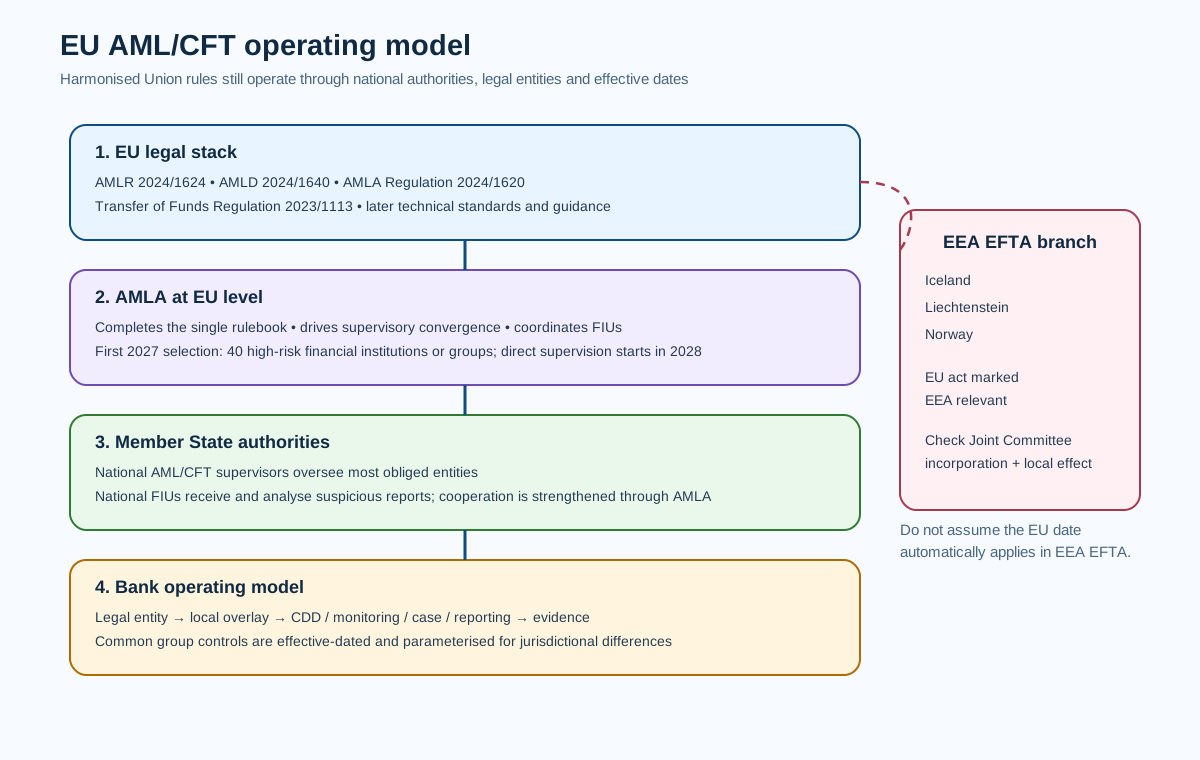
The most useful mental model is to separate four layers. The first is the substantive rulebook for obliged entities, centred on Regulation (EU) 2024/1624, commonly called the AML Regulation or AMLR. The second is the national-system layer in Directive (EU) 2024/1640, covering matters such as supervisors, Financial Intelligence Units, beneficial-ownership mechanisms and cooperation. The third is the institutional layer in Regulation (EU) 2024/1620, which established the Authority for Anti-Money Laundering and Countering the Financing of Terrorism, AMLA. The fourth is the wider payment and crypto-transfer transparency framework, including Regulation (EU) 2023/1113 on information accompanying transfers of funds and certain crypto-assets.
Those layers do different jobs. A bank should not reduce them to a single field called EU_AML_RULE = true. Applicability depends on the legal entity, product, customer, activity, Member State, effective date, and sometimes a national rule that is stricter than the Union minimum. The control challenge is therefore to turn a changing legal stack into an effective-dated operating model.
The 2026 position: adopted law, transition and future application
As of 22 September 2026, the 2024 AML package is legally adopted, but its main substantive operating date for obliged entities is still ahead. The AMLR applies from 10 July 2027, subject to later application for specified football-related obliged entities. Directive (EU) 2024/1640 has phased transposition deadlines, with the main deadline also on 10 July 2027. The previous Directive (EU) 2015/849 is repealed from that date.
This creates an important transition discipline. Banks must prepare for the 2027 framework without pretending that every future AMLR provision is already the rule governing a transaction in September 2026. Current national law, existing EU measures and applicable supervisory guidance remain relevant until replacement or repeal takes effect. The EBA and AMLA confirmed in January 2026 that existing EBA AML/CFT guidelines and standards continue to apply until AMLA replaces them. That continuity matters for policy teams and system owners because a transformation programme cannot safely remove an existing control merely because a future rulebook has been published.
The institutional transition is already much further advanced. On 1 January 2026, EU-level AML/CFT mandates and functions previously held by the European Banking Authority were transferred to AMLA. AMLA now sits at the centre of the EU-level AML/CFT architecture: completing the single rulebook, driving supervisory convergence, supporting and coordinating FIUs, and preparing for direct supervision of a limited set of high-risk cross-border financial institutions or groups.
Direct supervision also needs careful wording. AMLA does not become the direct AML supervisor of every European bank. AMLA has stated that selection will take place in 2027 for up to 40 high-risk financial institutions or groups, with direct supervision beginning in 2028. National supervisors remain directly responsible for most obliged entities. A global bank therefore needs to distinguish three questions: whether an entity is an obliged entity under the applicable framework, which national authority supervises it, and whether a particular financial group is eventually selected for AMLA direct supervision.
What the AMLR changes for a bank
The AMLR matters because it moves a large body of private-sector AML/CFT requirements into a regulation that applies directly in EU Member States. That should reduce some of the variation created when earlier directives were transposed differently, but it does not eliminate all local variation. Member States retain roles in areas expressly left to national law and may in some cases apply stricter measures.
For delivery teams, the practical impact is a need for a stronger obligation inventory. Each requirement should identify the legal source, article or mandate, affected legal entities, customer or product scope, effective date, whether national implementation is needed, whether local law can be stricter, the control that satisfies the requirement, and the evidence proving that the control operates. Without that mapping, a bank can easily mix a directly applicable AMLR requirement with an AMLD obligation that still depends on national implementation.
The AMLR reaches across core customer and transaction controls: business-wide risk assessment, customer due diligence, beneficial ownership, enhanced due diligence, politically exposed persons, internal policies and controls, reporting of suspicions, record keeping and restrictions on certain higher-risk practices. It also introduces an EU-wide cap on cash payments for goods or services of EUR 10,000, while allowing Member States to maintain or adopt lower limits. That is a good example of why harmonisation does not mean “one threshold everywhere.” A group policy can use the EU ceiling as a common reference, but country configuration must still preserve lower domestic limits where they apply.
A second practical point is that the AMLR is not a reason to hard-code legal text directly into channel software. Requirements should be represented through effective-dated policy parameters and controlled decision services. If a Member State sets a lower cash limit, or if AMLA later adopts technical standards that refine a data requirement, the bank should be able to update the rule without rebuilding unrelated applications.
Directive (EU) 2024/1640: the national system around the bank
The directive is just as important because AML/CFT does not work through bank controls alone. It requires a national ecosystem: competent supervisors, FIUs, beneficial-ownership mechanisms, access to account information, cooperation arrangements, and enforcement powers. A bank interacts with that ecosystem throughout the customer and case lifecycle.
The main transposition date is 10 July 2027, but the directive uses phased dates for some provisions. That means regulatory-change teams need an article-level timeline, not a single programme milestone called “AMLD6 go-live.” An implementation plan should identify which Member State has transposed which provision, whether national legislation changes a process earlier than the group target, and whether local technical specifications are available for reporting or data exchange.
The directive also strengthens the cross-border cooperation model for FIUs. AMLA supports that cooperation rather than replacing the FIUs. National FIUs remain the bodies that receive and analyse suspicious-transaction or suspicious-activity information under the applicable national system. The directive provides for stronger exchange and joint analysis arrangements, while AMLA develops common infrastructure and standards. FIU.net is central to that cooperation architecture, with management transferring to AMLA under the directive’s timetable.
For banks, this distinction is operationally critical. A group investigation function may assemble intelligence across several legal entities, but the legal reporting route remains jurisdiction-specific. A suspicious case involving accounts in Germany, France and Italy does not automatically become one report to AMLA. The bank must determine which legal entities have reporting duties, which FIU receives each report, what information may lawfully be shared inside the group, and how related filings are linked without breaching confidentiality or tipping-off restrictions.
AMLA: central authority, not a replacement for every national actor
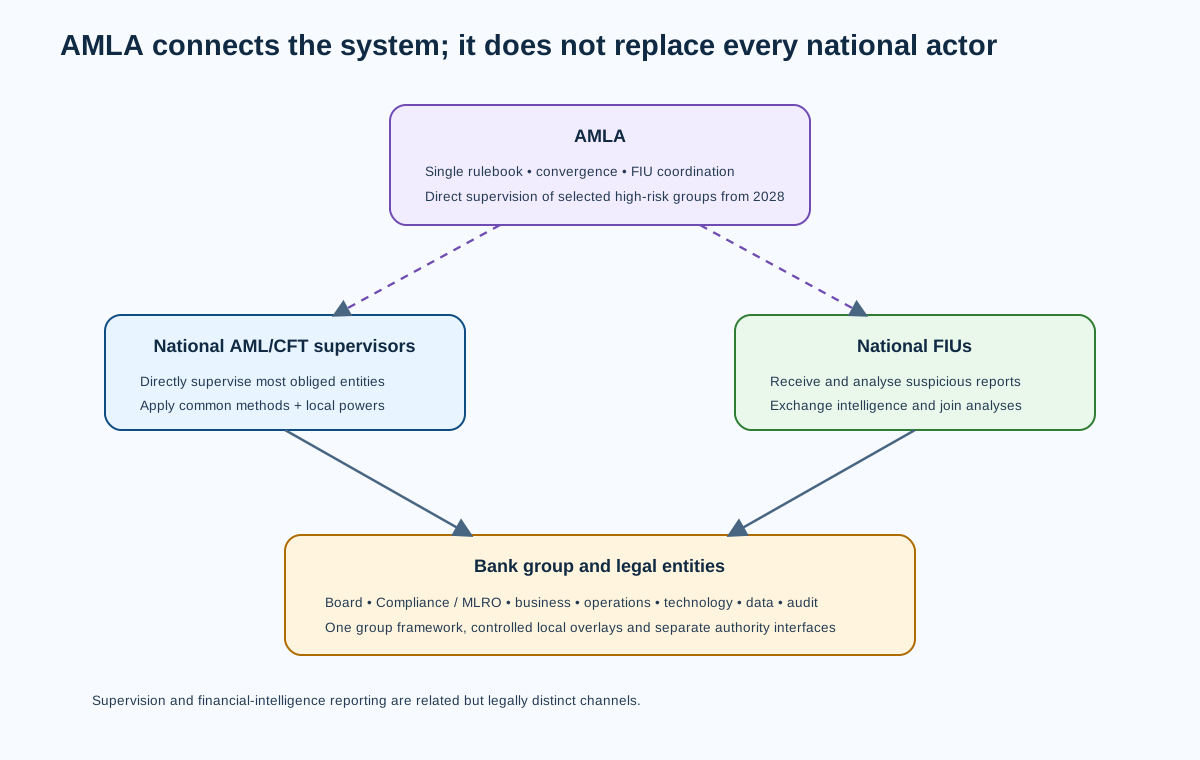
AMLA has two broad dimensions that a bank should understand. One is supervision. It sets common approaches, supports convergence, maintains supervisory information and will directly supervise a selected population of high-risk cross-border financial institutions from 2028. The other is FIU coordination. It supports cooperation, information exchange and joint analyses among national FIUs.
This creates a multi-authority model rather than a single-regulator model. A bank may interact with AMLA, a national AML/CFT supervisor, a prudential supervisor, an FIU and other national authorities for different purposes. Those authorities can use overlapping data but exercise different legal powers.
In system design, “regulator” should therefore not be one generic recipient type. Supervisory reporting, suspicious-transaction reporting, prudential reporting, law-enforcement disclosure and sanctions reporting should be represented as separate obligations with different recipients, access controls, confidentiality rules, data sets and retention evidence. A case-management platform that stores everything in one free-text field may function operationally, but it will struggle to demonstrate lawful purpose and controlled disclosure.
AMLA’s direct-supervision preparations are already creating real data work in 2026. AMLA launched data collections to test and calibrate risk-assessment models that will inform the 2027 selection exercise. Banks asked to participate need to treat those submissions as governed regulatory data: define ownership, reconcile source systems, preserve calculation logic and retain evidence for what was submitted. “It was only a preparatory exercise” is not a sound reason to accept weak lineage.
The EU is not the same thing as the EEA
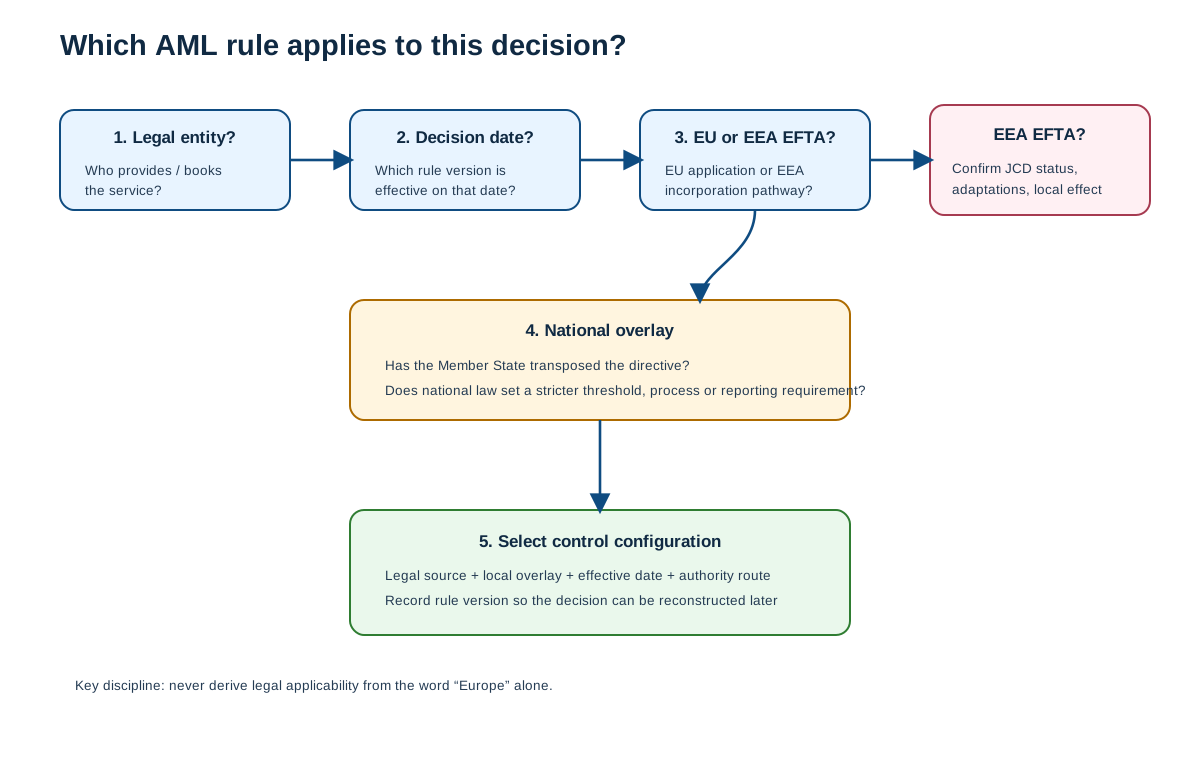
The chapter title deliberately mentions the EEA because many banking groups operate across the EU plus Iceland, Liechtenstein and Norway. But the distinction must be explicit.
EU regulations and directives do not automatically become EEA law for the EEA EFTA States at the same moment that they apply inside the EU. EEA-relevant acts normally require incorporation into the EEA Agreement through a Joint Committee Decision, with possible adaptations and national implementation steps where necessary.
As of 22 September 2026, the EFTA factsheets for Regulation (EU) 2024/1624 and Directive (EU) 2024/1640 show them as EEA-relevant acts under scrutiny, with draft Joint Committee Decisions under consideration and entry into force of those decisions pending. Therefore, a bank should not simply copy the EU 10 July 2027 application date into Norwegian, Icelandic or Liechtenstein legal-entity requirements and label it confirmed EEA law.
The correct control is an EEA applicability tracker. It should record the EU act, its EU date, EEA relevance, Joint Committee status, any adaptations, national implementation position and local legal approval. This sounds administrative, but it prevents a serious type of control error: switching a legal entity to a new rule too early, or failing to switch it when incorporation becomes effective.
How this lands in the customer lifecycle
The package affects the whole relationship, not only onboarding. At product design, teams need to know whether a service makes an entity an obliged entity or changes risk exposure. At onboarding, CDD must capture sufficient identity, beneficial-ownership, purpose and risk information. During the relationship, monitoring and event-driven review must respond to changed risk, ownership, behaviour and geographic exposure. At transaction time, payment transparency, screening and monitoring need usable party and transaction data. When suspicion arises, the case must move into a legally controlled investigation and reporting process. At exit, the bank still needs confidentiality, recordkeeping and defensible customer communication.
The highest-risk implementation mistake is to modernise policy but leave data contracts unchanged. For example, a new requirement may be correctly stated in a group AML standard while onboarding still captures beneficial-ownership evidence as unstructured attachments, transaction monitoring cannot connect related entities, and the STR process cannot populate structured fields without manual re-keying. The legal programme then appears complete on paper while the operating model cannot deliver it reliably.
A strong bank maps each AMLR or national requirement to the fields and events required to operate it. Examples include customer and beneficial-owner identifiers, country and residency attributes, product usage, expected activity, risk factors, PEP status, source-of-funds or source-of-wealth evidence where required, transaction parties, payment identifiers, alert reasons, case decisions, filing identifiers, authority acknowledgements and retention dates.
Suspicious reporting in the new architecture
Suspicion reporting is a particularly important transition area. AMLA opened a 2026 consultation on draft implementing technical standards for a common format for reporting suspicions and providing transaction records. The consultation closed on 20 September 2026. That draft is relevant to design planning because it points toward greater harmonisation of data fields and structure, but on 22 September 2026 it should not be described as a final binding reporting template.
This is where regulatory-change discipline matters. Architecture teams can prepare reusable structured data, field lineage and mapping capability without prematurely treating a consultation draft as production law. The bank can identify the likely source systems for party data, accounts, transactions, narrative, indicators and supporting evidence; assess gaps; and design a reporting layer that can adopt the final standard when legally effective.
A similar principle applies to AMLA’s July 2026 consultation on draft technical standards for cross-border information exchange between FIUs. The consultation remains open until 6 October 2026. It is a strong indicator of the direction of travel, but it places no direct current obligation on a bank simply because the consultation exists.
From alert to FIU: preserve the legal chain
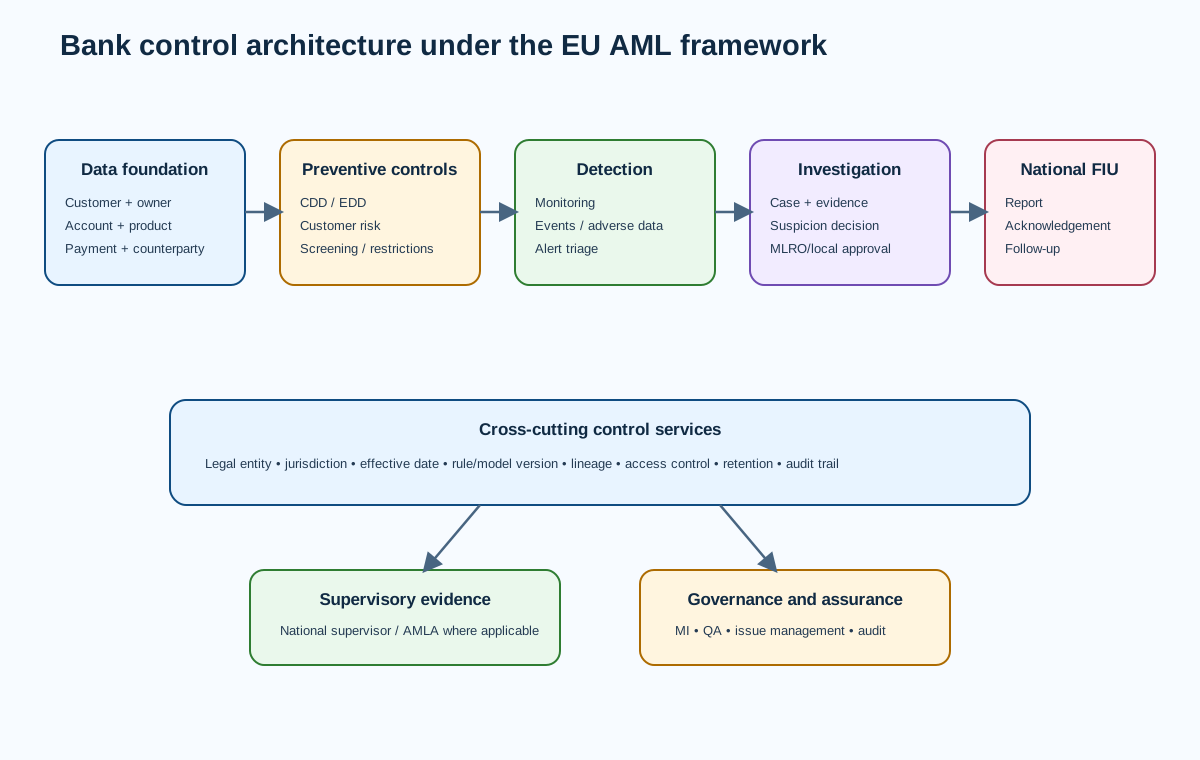
A good European case architecture preserves the difference between a detection event, an internal suspicion decision, an external report, and an authority response. Those are not synonyms.
An alert may come from transaction monitoring, sanctions screening, fraud intelligence, KYC review, adverse media, a law-enforcement request or employee escalation. The alert is triaged. Relevant activity is assembled into a case. The investigator decides whether the facts are explainable, need further information, require restriction, create suspicion, or trigger another legal pathway. Where the legal threshold for reporting is met, the appropriate reporting entity submits to the competent FIU under local requirements.
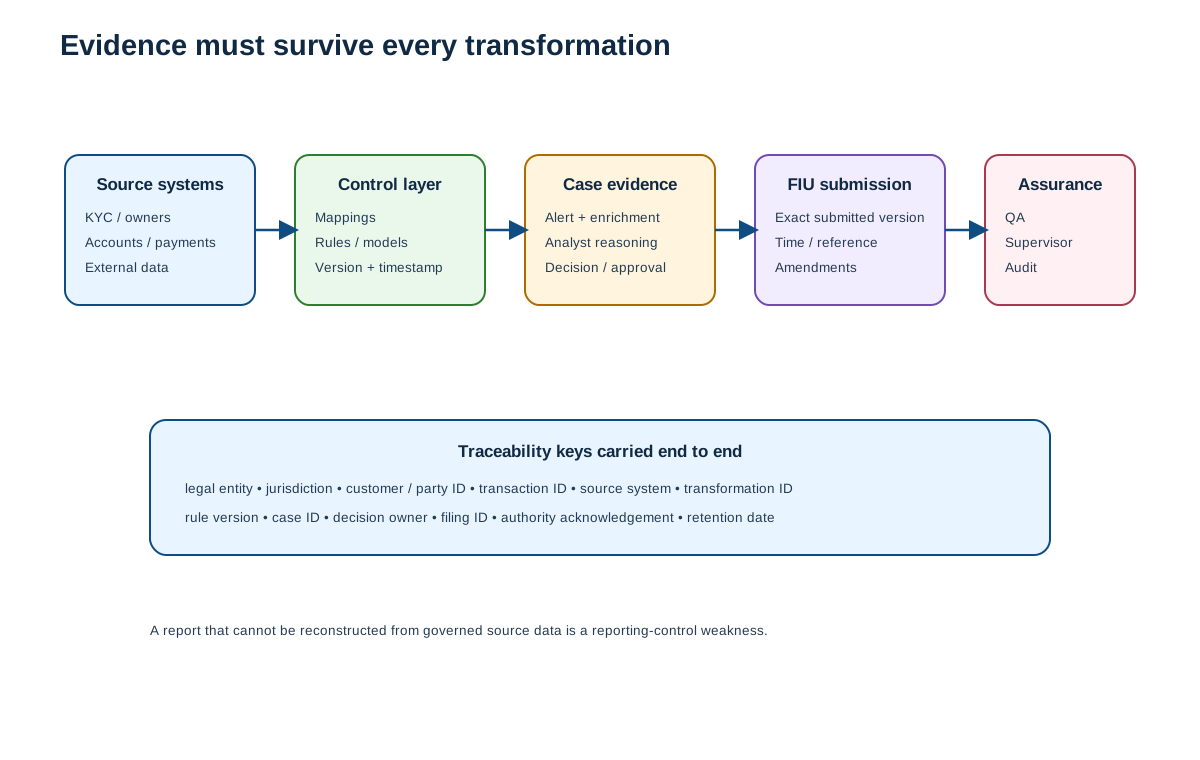
The audit trail should show who made the decision, which data was available at that moment, what legal entity owned the relationship, what time-sensitive steps were taken, which report was filed, what acknowledgement or reference was returned, and how confidentiality was protected. Cross-border cases should also record which facts were shared across group entities, under what legal basis and for what financial-crime purpose.
Data architecture and the single-rulebook transition
Harmonised law does not automatically create harmonised data. A multinational bank may still have different customer masters, product systems, local transaction platforms, reporting tools and retention repositories. The programme therefore needs a canonical financial-crime data model that can support common controls while preserving legal-entity and jurisdictional distinctions.
At minimum, every material record should carry the legal entity, customer or counterparty identity, product and account context, jurisdiction, event timestamp, source system, transformation history, rule or model version, decision owner and evidence reference. That allows the bank to answer a simple supervisory question: “Why did this entity reach this decision under the rule that applied on that date?”
Effective dating is essential. A rule service should know that one policy version applies before 10 July 2027 and another after the relevant implementation date. If a Member State adopts a stricter local threshold, the service should select it for that legal entity without contaminating other countries. If an EEA EFTA State has not yet incorporated an EU act, its legal entity should remain on the approved local regime until the incorporation and national steps are confirmed.
Governance: who owns what
Group Financial Crime Compliance usually owns the common framework and interprets Union-level change with Legal. Local compliance validates national applicability and regulator expectations. Business and operations own execution in customer and payment processes. Technology owns dependable implementation and traceability. Data owners are responsible for quality and lineage. Model or rule owners are responsible for detection logic. The MLRO or equivalent local officer owns statutory decisions where national law assigns that responsibility. Internal Audit provides independent assurance.
A central EU programme should not erase local accountability. The better model is a common control library with local overlays. Each overlay should document where the local rule is stricter, earlier, differently supervised, or differently reported. Exceptions should have an owner, rationale, approval, expiry or review point and evidence.
Senior governance should see readiness by obligation, not just by workstream. Useful views show how many legal entities have completed applicability assessment, policy mapping, data mapping, build, testing, training, local legal sign-off and production deployment. A green programme status should be impossible if a material jurisdiction still lacks a confirmed reporting path or critical data field.
Customer impact and proportionality
AML/CFT transformation can create customer harm when controls are poorly calibrated. Duplicate document requests, repeated beneficial-owner questions, payment holds caused by stale data, unexplained account restrictions and inconsistent branch decisions often reflect architecture and process weakness rather than legal necessity.
The risk-based approach still matters under a more harmonised rulebook. Standardisation should improve consistency, not create a one-size-fits-all customer journey. Higher risk can justify stronger evidence, more frequent review or enhanced monitoring, but the bank should be able to explain why the measure is proportionate to the risk and legally supported.
This becomes especially important during migration. If a new AMLR-aligned customer-risk model changes scores across a portfolio, the bank should not automatically trigger full refreshes for every affected customer without assessing materiality, legal need, capacity and customer impact. Migration rules, grandfathering where legally permissible, event-driven refresh and prioritisation need deliberate design.
A practical change programme
A credible 2026–2027 programme has four parallel tracks. The legal track maintains the obligation inventory and monitors AMLA standards, Commission adoption and Member State transposition. The policy track converts confirmed requirements into group standards and local addenda. The data and technology track maps fields, rules, models, reporting interfaces and evidence. The operating-model track trains teams, updates procedures, sets decision rights and validates capacity.
Those tracks converge in end-to-end testing. A bank should be able to start with a customer or transaction scenario and prove the full path: applicable rule selected, data captured, risk calculated, control triggered, case created, investigation recorded, report generated where required, authority response retained, management information updated and evidence retrievable.
The objective is not to “implement AMLA.” AMLA is an authority. The objective is to implement the applicable AML/CFT rules and an operating model capable of working with AMLA, national supervisors and FIUs as their respective roles evolve.
Key takeaway
The EU AML package is best understood as an operating-system change for financial-crime compliance. It combines a more harmonised substantive rulebook, stronger national mechanisms, a new EU authority and more structured cross-border cooperation. For banks, the hard part is not reading the legislation. It is maintaining a precise map from legal source to legal entity, date, data, control, decision, reporting route and evidence.
The safest design principle is therefore simple: harmonise what is genuinely common, preserve what remains jurisdiction-specific, and effective-date everything that can change.
Operational deep dive: FIUs, supervision and the bank’s control chain
The EU package becomes real when a bank has to make a decision under time pressure. A regulation may be harmonised, but the customer sits in a legal entity, the account is booked somewhere, the transaction uses a particular rail, the investigator works under a local reporting regime, and an authority expects evidence that can be reconstructed later. This section follows that chain from regulatory source to operational outcome.
Start with the legal entity, not the brand
A multinational bank can present one brand to customers while operating through many licensed entities and branches. AML/CFT obligations attach to those legal arrangements, not to the marketing name. The first question in any design therefore is: which entity provides the service and which law governs that entity for this activity?
That question influences the competent supervisor, the FIU reporting route, record-retention requirements, local escalation roles and sometimes customer-communication rules. It also influences whether information can be transferred to another group entity. A central case platform may support several countries, but it needs access controls and policy rules that preserve those distinctions.
The legal-entity model should be available to front-end channels and case systems rather than stored only in compliance spreadsheets. When a customer uses several entities in a group, investigators need to see those relationships without assuming one entity’s filing decision automatically satisfies another entity’s obligation.
The role of national Financial Intelligence Units
FIUs remain national authorities. Their role is to receive, analyse and disseminate financial intelligence within the applicable legal framework. AMLA strengthens cooperation between FIUs and provides common tools and coordination, but it does not turn suspicious reporting into one EU-wide report sent to AMLA.
For a bank, this means the suspicious-reporting workflow needs jurisdiction-aware routing. It should know the reporting entity, competent FIU, accepted submission channel, required data, language or formatting rules where relevant, local deadlines, acknowledgement handling and post-filing restrictions. Those parameters should be controlled configuration, because they can change without the underlying case-management process changing.
Cross-border cases need a second layer: relationship linking. Suppose a corporate group has accounts in three EU Member States and investigators identify a pattern moving funds through all three. A central intelligence team may see the whole network, but each legal entity still needs to determine its own reporting duty. The system should allow related cases and reports to be connected through internal identifiers without exposing confidential filing data to staff who are not authorised to see it.
The bank must also protect against tipping off. Customer-facing teams may need to explain that a payment or account is under review, but they should not be given language that reveals whether an FIU report has been made. Workflow design should therefore separate operational status from filing status.
FIU cooperation is becoming more structured
Directive (EU) 2024/1640 strengthens the basis for FIU cooperation and joint analysis. AMLA’s mandate includes facilitating that cooperation, supporting joint analyses and maintaining relevant information-exchange infrastructure. This is particularly important for activity that crosses Member States faster than national intelligence can be assembled manually.
For banks, more effective FIU cooperation can lead to more targeted follow-up requests and a greater expectation that records are structured and retrievable. A report should not be a narrative disconnected from the underlying transaction data. Party identifiers, account numbers, transaction timestamps, amounts, currencies, counterparties, payment references and linked cases should be reproducible from source systems.
AMLA’s 2026 consultation on a common format for reporting suspicions points in the same direction. The draft is not yet a binding production specification, but it is sensible for banks to improve structured-data readiness now. The design goal should be to generate a report from governed data with human-authored analysis, rather than manually re-keying the entire case into a local portal.
Supervision: national first, AMLA direct for a selected population
The supervisory model has two levels. National authorities continue to supervise most obliged entities. AMLA drives common methodologies, supervisory convergence and coordination across the Union. From 2028, it will directly supervise a selected set of up to 40 high-risk financial institutions or groups.
This matters for large banking groups because the target operating model must support both national and AMLA interaction. A group selected for direct supervision will need consolidated evidence across entities and products, but it will still operate inside national legal systems and interact with national authorities for matters outside AMLA’s direct remit. A group not selected is not outside AMLA’s influence either: common methodologies, technical standards and convergence work will shape national supervisory expectations.
The 2026 risk-assessment data exercises are an early signal of the data discipline expected. A bank should be able to reconcile regulatory submissions back to source systems and explain definitions consistently across countries. If one country counts a customer segment differently from another, the programme should resolve the taxonomy rather than average the numbers and hope the difference is immaterial.
The supervisory evidence pack
A mature bank should be able to produce a coherent evidence pack without creating it from scratch when a supervisor asks. That pack should connect policy to execution.
At policy level, the bank should show the governing standard, local addendum and effective date. At risk level, it should show the business-wide risk assessment and relevant customer or product risk methodology. At control level, it should show procedures, rules, scenarios, thresholds, model governance and approval. At operation level, it should show samples of actual cases, quality results, backlogs, breaches and remediation. At data level, it should show lineage and completeness. At governance level, it should show management information, committee challenge and accountable decisions.
The point is not to create a giant document repository. It is to preserve traceability. A supervisor should be able to move from a legal requirement to a control and from a control to evidence of operation.
Business-wide risk assessment under a harmonised framework
A single rulebook does not eliminate risk differences. Customer mix, products, delivery channels, geographies, distribution models and transaction patterns still vary by entity. A group may use a common methodology while allowing legal-entity risk assessments to reflect local exposure.
This is where centralisation can go wrong. If headquarters assigns identical risk factors and weights to every country without evidence, the model is harmonised but not risk-based. If every entity invents its own model, the group cannot compare risk or govern consistently. The better design is common definitions and methodology, documented local calibration, and governance over deviations.
AMLA’s work on common risk assessment methodologies increases the importance of this discipline. The bank should know which measures are internal risk tools, which are supervisory methodologies, and which are legal requirements. Those concepts should not be conflated.
Beneficial ownership and customer data
The new framework places continued emphasis on understanding who ultimately owns or controls customers and on keeping that information reliable. For a bank, the hardest issues are rarely the basic form fields. They are complex ownership chains, conflicting registries, changes between periodic reviews, trusts and similar arrangements, and customers spread across several entities.
The data model should treat ownership as a time-bound relationship, not a static list of names. Each link should have an owner, ownership or control basis, percentage where relevant, effective dates, evidence source and verification status. That allows the bank to reconstruct who was understood to own an entity when a transaction occurred.
A harmonised EU framework also increases the value of consistent entity identifiers and graph relationships. If one legal entity records “ABC Holdings S.A.” and another records a transliterated or abbreviated version with no common identifier, cross-border intelligence remains fragmented despite harmonised rules.
Payment data and the wider EU framework
AML/CFT controls do not stop at KYC. Regulation (EU) 2023/1113 sets information requirements for transfers of funds and certain crypto-assets. Its operational significance is that payment and crypto-transfer data can support screening, monitoring, tracing and investigation.
Banks need to understand where originator and beneficiary data is created, validated, transmitted, repaired and stored. Missing or poor-quality party data can weaken both sanctions screening and AML investigation. A regulatory programme should therefore include payment-data lineage, not just customer-master remediation.
The same principle applies to crypto-asset services. A bank dealing with crypto-asset service providers or providing relevant services itself needs to connect customer risk, transfer information, wallet or counterparty data, sanctions exposure and transaction-monitoring evidence. The legal perimeter should be confirmed for the actual entity and service rather than inferred from the word “crypto.”
Reporting technology: build for structured change
A resilient reporting architecture separates the case decision from the submission format. The case platform should hold the investigation and approved decision. A reporting service should transform approved case data into the format required by the competent FIU and retain the submitted version, acknowledgement and any later amendments.
This makes future harmonisation easier. If AMLA’s final technical standards introduce common data fields, the bank updates the reporting layer and source mappings rather than rewriting the investigation platform. Country-specific fields can remain as controlled extensions.
The reporting service also needs validation. Mandatory fields should be checked before submission. Codes and enumerations should use approved values. Dates and currencies should be normalised. The report should link back to source transactions. Rejected submissions should enter an exception queue rather than disappear into email.
Management information that actually matters
Volume alone is weak AML management information. Senior management and supervisors need to understand whether the control environment is healthy.
Useful measures include aged KYC reviews, unresolved beneficial-ownership gaps, transaction-monitoring backlog by risk, alert-to-case conversion, case ageing, suspicious-report timeliness, rejected or corrected filings, data-quality defects, sanctions or AML technology outages, rule changes awaiting deployment, high-risk customer trends and quality-assurance error rates.
During the EU package transition, readiness MI should add regulatory-change measures: obligations assessed, local transposition confirmed, policy changes approved, data gaps closed, systems tested, training completed, and legal entities signed off. The metric should show material exceptions, not just percentage complete.
Operational resilience and fallback
A harmonised rulebook still has to operate during outages. If a central screening or case platform is unavailable, the bank needs a documented fallback that respects legal deadlines and confidentiality. Manual workarounds should define what can continue, what must pause, how records are captured, how duplicate work is prevented and how normal systems are reconciled after recovery.
Cross-border centralisation can create concentration risk. A single case platform serving many Member States improves consistency but can also create a group-wide failure if access, data residency or connectivity is lost. Architecture reviews should consider resilience alongside compliance efficiency.
Failure modes worth testing
One common failure is date blindness: teams implement a future rule before it applies or fail to retire an old rule at the right date. Another is jurisdiction flattening: group policy removes valid local differences. A third is authority confusion: AMLA, a national supervisor and an FIU are treated as interchangeable recipients. A fourth is data harmonisation without lineage: fields are standardised but their source and meaning differ across countries. A fifth is consultation drift: a draft AMLA standard is treated as final law and coded into production prematurely.
Testing should deliberately target each of these. The strongest test cases are not simple happy paths; they combine legal entity, date, country, product and data-quality variations to prove the decision engine selects the right rule.
What good looks like
A strong EU AML/CFT operating model can answer five questions quickly: Which rule applied? Which entity was responsible? Which authority had the relevant role? Which data supported the decision? What evidence proves the control worked?
If the bank can answer those consistently across onboarding, payments, monitoring, investigations and reporting, the new EU framework becomes manageable. If it cannot, the problem is not a lack of policy text. It is a lack of operational traceability.
Advanced practice: regulatory change, architecture and test design
A bank can comply badly even when its policy is legally correct. The difference between a paper implementation and an operational implementation is whether every material requirement can be translated into data, system behaviour, decision rights, evidence and testable outcomes. The EU AML package is a useful case study because several legal instruments, application dates, national authorities and AMLA initiatives move at different speeds.
Build an obligation-to-control map
The regulatory-change inventory should be granular enough to support delivery. “Implement AMLR” is not a usable requirement. A better record contains the source instrument, article or mandate, obligation summary, legal entity, product or customer scope, effective date, national dependency, current control, target control, data fields, system components, procedure, training impact, owner and evidence.
Each obligation should have a status that distinguishes legal interpretation from implementation. For example: identified, applicability confirmed, policy approved, requirements baselined, build complete, system tested, operating procedure approved, training complete, legal-entity sign-off complete, and effective in production. That prevents a technology workstream from being marked green while Legal is still determining whether a national rule changes the intended design.
The map should also retain superseded interpretations. If a supervisor later asks why a control worked differently in March 2027 than in August 2027, the bank needs the historical decision, not just today’s configuration.
Effective-dated requirements are a core architecture feature
Every rules platform used for CDD, customer risk, enhanced due diligence, transaction monitoring or reporting should be able to select configuration by legal entity and effective date. The system should record the rule version used for each decision.
Consider a simple example. The AMLR applies from 10 July 2027 in the EU. A customer is onboarded on 8 July and makes a material change to its ownership on 20 July. The bank needs to know which rules governed onboarding, which rules govern the event-driven review, and whether migration provisions or local law require additional action. A system that stores only the latest rule version cannot reconstruct that history.
The same applies to EEA EFTA entities. If incorporation of an EU act into the EEA Agreement occurs later, the effective date for a Norwegian entity may differ from the EU date. Configuration must follow confirmed legal applicability, not geographic proximity.
Treat AMLA publications by legal status
A mature regulatory-change function labels every source by status. Primary legislation is not the same as a final technical standard. A final AMLA report awaiting Commission adoption is not yet the same as a legally binding delegated or implementing act. A consultation paper is not a production obligation. Guidance may be influential without having the same legal effect as a regulation.
This classification should be visible in the backlog. Draft standards can create discovery stories and data-gap analysis. Final adopted standards create implementation requirements. The distinction reduces wasted build and prevents a control from being defended using a document that never had the claimed status.
In September 2026, this matters for several AMLA initiatives. The consultation on a common suspicious-reporting format has closed, but the consultation process itself does not make the draft template binding. The cross-border FIU information-exchange RTS consultation remains open until 6 October 2026. Teams can prepare, but legal sign-off should gate production use.
Business analyst requirements that survive audit
Good requirements describe outcomes and evidence, not only screen behaviour. Instead of “add an AMLA field,” state why the field exists, its source, permitted values, when it is mandatory, who can change it, how changes are audited, and which downstream decisions consume it.
For an EU regulatory-change implementation, useful acceptance criteria include:
- the rule service selects the correct legal-entity and effective-date configuration;
- national overlays override the group default only where approved and traceable;
- an investigator can identify the governing policy version from the case record;
- suspicious-report output can be reconstructed from source fields and the submitted version is immutable;
- a rejected FIU submission creates an owned exception with timestamp and reason;
- access controls prevent unauthorised users from seeing confidential filing information;
- EEA EFTA entities do not inherit EU application dates unless the applicability record confirms incorporation and local effect.
Those are delivery controls as much as compliance controls.
Architecture: separate common services from jurisdictional parameters
The best target architecture centralises capabilities that benefit from scale while parameterising local differences.
Common capabilities can include customer identity, entity resolution, screening, transaction monitoring, case management, data lineage, management information and evidence storage. Jurisdictional parameters can include competent authority, filing route, local thresholds, local reporting fields, language, retention, approval roles and effective dates.
This design reduces duplication without pretending local law disappeared. It also makes change safer. If one Member State alters a lower cash threshold or a filing specification, the change should not require a new code branch across the entire AML platform.
The architecture should explicitly model legal entity as a first-class field. Many financial-crime failures begin because customer, account and transaction records can be seen globally but the legal owner of the relationship is ambiguous.
Testing the 2027 transition
Testing should include time travel. Test environments need scenarios before, on and after key effective dates. A July 2027 release should not be tested only with present-day data.
A practical regression pack should include an EU customer onboarded before the AMLR application date, a new customer onboarded after it, an existing customer with a material event after the date, a Member State with a stricter national rule, an EEA EFTA entity whose incorporation status differs, and a cross-border group customer with related cases in more than one FIU jurisdiction.
For each scenario, testers should validate not only the result but the evidence. Which rule fired? Which version? Which data caused the decision? Which local overlay applied? Which report format was selected? Was the audit trail complete?
Negative testing is equally important. Deliberately remove a beneficial-owner attribute, make a jurisdiction code invalid, provide conflicting legal-entity ownership, make an FIU interface unavailable, or attempt to access a filing from an unauthorised role. The control should fail safely and visibly.
Data migration needs its own control framework
New fields and new risk logic can make historical data incomplete. A migration programme should classify which gaps require customer outreach, which can be solved through reliable internal or external data, which can wait for an event-driven refresh, and which create immediate risk.
Mass outreach should not be the default answer. It can overwhelm operations and frustrate customers while producing low-quality documents. Prioritisation should consider legal requirement, customer risk, materiality of the missing data and timing.
Migration evidence should record the rule used to prioritise, the source of backfilled data, validation results and unresolved exceptions. Supervisors will care about the residual gap, not only the percentage of records migrated.
Model and scenario governance
If the bank changes customer-risk scoring or transaction-monitoring scenarios to align with the new framework, the change should pass normal model or rule governance. Regulatory change is not a reason to bypass performance testing.
Teams should document the intended risk, data inputs, segmentation, thresholds, expected alert impact, false-positive trade-offs, validation and post-deployment monitoring. Where machine learning is used, explainability and human oversight remain necessary. A harmonised legal framework does not make an opaque model acceptable.
Alert volumes should be capacity-tested. If a rule change doubles alerts without increasing investigative resources, backlog risk may undermine the control. The regulatory programme therefore needs operations forecasting as well as code delivery.
Governance and decision rights
The programme should have a clear RACI. Legal interprets law. Compliance owns policy and control expectations. The business owns customer and product processes. Technology implements approved requirements. Data owners remediate quality. Operations execute procedures. The MLRO or local equivalent retains statutory responsibilities assigned under national law. Internal Audit independently challenges the framework.
A central steering committee should not approve local legal applicability on behalf of a country unless that decision right has been explicitly assigned. Conversely, local entities should not be allowed to diverge from a group minimum standard without documented rationale and approval.
Issues should be ranked by financial-crime risk, legal deadline, customer harm and operational dependency. A cosmetic policy-format defect should not compete equally with a missing FIU reporting field.
Assurance after go-live
Go-live is the start of evidence collection, not the end of the programme. Post-implementation assurance should sample real customers, alerts, cases and reports across legal entities.
Reviewers should test whether correct rules are being selected, data remains complete, overrides are justified, filings are timely, exceptions are cleared, and customer outcomes are proportionate. They should compare expected alert volumes and risk-score movements with actual results.
Material deviations need root-cause analysis. A repeated reporting defect may come from bad source data, unclear procedure, poor training, an interface mapping or an overly permissive manual override. Fixing only the final symptom leaves the control weak.
A delivery principle for architects and product owners
Do not build “an AMLA system.” Build an AML/CFT control platform that can prove which requirement, authority and date governed each decision. AMLA is one part of the institutional framework. The enduring asset is the bank’s ability to absorb regulatory change without losing traceability, proportionality or local legal accuracy.
Practice close: questions a real delivery team should be able to answer
A learner should finish this chapter able to move between law, operations and technology without confusing them. The following checks are useful in design workshops, control reviews and testing.
Twelve challenge questions
-
Which instrument creates the requirement? Is it the AMLR, Directive (EU) 2024/1640 as transposed nationally, the AMLA Regulation, the Transfer of Funds Regulation, a national law, a binding technical standard, supervisory guidance or an internal risk control?
-
When does it apply? Record the legal effective date rather than the project release date. Future law should not be represented as current law.
-
Which legal entity is in scope? The answer should come from the service and booking model, not the customer-facing brand.
-
Does a national rule remain stricter? Harmonisation does not remove every Member State option or stricter measure.
-
Is an EEA EFTA entity actually covered on the EU timetable? Check EEA incorporation and national implementation rather than assuming.
-
Which authority has which role? AMLA, a national supervisor and an FIU are not interchangeable.
-
Can the system reconstruct the rule version used for a past decision? If not, auditability is weak.
-
Can reported information be traced back to source customer and transaction data? Manual re-keying without lineage creates avoidable reporting risk.
-
Are suspicious-report details protected from unauthorised staff and customer-facing channels? Confidentiality must be designed into roles and statuses.
-
Are consultation papers clearly labelled as draft? Preparation is sensible; premature claims of legal effect are not.
-
What happens if data or a reporting interface fails? A compliant control needs a fallback, ownership and reconciliation path.
-
What proves the control is effective? Policies and screenshots are not enough. Use real operating evidence, quality results, exceptions, remediation and management challenge.
Common misconceptions
“AMLA supervises all EU banks from 2028.” Incorrect. National supervisors continue to supervise most entities. AMLA will directly supervise a selected population of up to 40 high-risk financial institutions or groups.
“The AMLR already governs every customer decision in 2026.” Incorrect. The regulation is adopted and in force, but its main application date is 10 July 2027. Current law and valid existing guidance continue through the transition.
“One EU suspicious report replaces national FIU reporting.” Incorrect. FIUs remain national. AMLA coordinates and supports their cooperation.
“EEA means EU rules apply in Norway on the same date.” Incorrect. EEA-relevant acts require incorporation into the EEA Agreement and, where necessary, national implementation. Current EFTA status must be checked.
“A consultation is safe to build as if final.” Incorrect. Draft standards are valuable for readiness analysis, but production obligations should follow the final legal instrument and effective date.
A compact acceptance test
Take any customer, transaction or case and ask the team to show the full chain:
legal source → legal entity → effective date → local overlay → data → control → decision → report or action → evidence → governance.
If one arrow cannot be demonstrated, the operating model has a weakness worth fixing.
Final readiness drill: prove the control, not the programme slide
Before a legal entity is signed off, ask the delivery team to demonstrate one complete journey in the system rather than present a document pack. Start with a customer record and identify the legal entity that owns the relationship. Show the jurisdiction and the rule version selected for the chosen date. Open the beneficial-ownership evidence, show the source and verification status, and explain how a later ownership change would preserve history rather than overwrite it.
Then take a transaction from that customer through the relevant controls. Show the payment data used by screening and monitoring, the rule or scenario version, and the alert reason. If the alert becomes a case, demonstrate how the investigator obtains customer, counterparty and transaction context without manually copying facts into disconnected spreadsheets. The case record should show the decision owner and the information available at the moment the decision was made.
If the scenario reaches suspicion, demonstrate the reporting route for that specific legal entity. Show how the correct national FIU is selected, which fields are populated from governed data, which narrative is written by the investigator, and how the exact submitted version is retained. Confirm that a customer-service user cannot see confidential filing status. Simulate a rejected submission or interface outage and prove that the exception is owned, timed and reconciled.
Next, change the scenario date. Run it before and after a key regulatory effective date and show that the platform selects the intended configuration. Repeat the test for an EEA EFTA entity. If the system simply treats EEA = EU, the design fails the jurisdiction test even if every other control works.
Finally, ask governance to explain the evidence. Compliance should be able to identify the legal source and approved interpretation. Technology should show deployment and rule-version history. Data owners should show lineage and quality controls. Operations should show procedure and capacity. Quality assurance should show defect findings. Internal Audit should be able to reproduce the path independently.
This drill is intentionally demanding because regulatory-change programmes often look strongest at milestone level and weakest at transaction level. A true readiness decision should be based on whether real data can move through the real control chain under the real rule that applies to the legal entity on the relevant date.
What to remember
The EU AML package is moving financial-crime control toward greater consistency, but consistency does not remove legal context. The strongest implementation combines a common EU control architecture with precise national and EEA applicability.
AMLA strengthens the centre of the system, but national supervisors and FIUs remain essential. The new framework therefore rewards banks that already know how to operate a group-wide programme with clear legal-entity ownership, structured data, effective-dated rules, controlled reporting and strong evidence.
For business analysts and architects, the practical contribution is to make every legal requirement implementable and testable. For investigators and operations, it is to preserve the facts and decision trail. For compliance and legal teams, it is to distinguish confirmed obligation from expected change. For management, it is to understand residual risk rather than accept a percentage-complete programme status.
That joined-up discipline is what turns a single rulebook from legal text into a functioning banking control system.
Masterclass: one banking group, four jurisdictions, one regulatory transition
Consider a fictional banking group, NorthStar Bank, headquartered in an EU Member State. It has licensed banks in Germany and France, a branch in Italy, and a Norwegian subsidiary. It also operates a central financial-crime platform that performs screening, customer-risk calculation, transaction monitoring and case management for the group.
In late 2026, the board asks a simple question: “Are we ready for the new EU AML framework?” The question sounds singular. The answer is not.
Step 1: define the perimeter
The programme first maps which NorthStar entities and activities fall within the EU AMLR, which requirements depend on national transposition of Directive (EU) 2024/1640, and which current national rules continue to govern before 10 July 2027. It separately records the Norwegian subsidiary because the EEA incorporation status of the 2024 AMLR and directive is still pending in September 2026.
This prevents the first bad decision. An early programme draft proposed switching all “European” entities to the new AMLR control set on 10 July 2027. Legal rejects that design because Norway cannot simply be assumed to follow the EU date. The architecture is changed so regulatory applicability is stored by legal entity and effective date.
Step 2: identify the data gap
The group’s central KYC platform has strong identity data but weak ownership history. It stores current beneficial owners but overwrites old records when ownership changes. That is inadequate for investigation and audit because a reviewer cannot reconstruct the ownership structure that existed when a suspicious payment occurred.
The programme creates an effective-dated ownership model. Each ownership or control relationship now records start date, end date, source, verification status and the legal entity that relied on it. The change helps AMLR readiness, but it also improves current investigations before 2027.
This illustrates a useful principle: good regulatory change often fixes an existing control weakness rather than creating a totally new control.
Step 3: a cross-border customer triggers the model
A logistics company, Alpine Meridian GmbH, banks with NorthStar Germany and receives payments through an Italian branch account. Its French parent also banks with NorthStar France.
The German account begins receiving unusually large credits from counterparties inconsistent with its expected profile. Funds are rapidly transferred to new beneficiaries through Italy. A transaction-monitoring scenario creates alerts in Germany and Italy. Entity resolution shows the French parent is connected to several of the same counterparties.
The central investigation team can see all related activity because the group has lawful internal access for financial-crime purposes. But the case system does not assume that one filing solves everything.
The German legal entity determines whether it has a reporting obligation to the German FIU. The Italian branch follows its applicable reporting path. The French entity assesses whether the parent’s activity creates suspicion or additional due-diligence action. Each decision is linked internally while access to external filing details remains restricted.
Step 4: preserve the distinction between intelligence and reporting
An analyst writes one consolidated internal intelligence narrative describing the network. That narrative supports local decisions, but it is not itself an EU-wide suspicious transaction report.
The reporting service creates jurisdiction-specific submission packages from approved case data. It records which source transactions populate each report, which report version was submitted, the submission time, the authority reference and any follow-up request.
The case platform displays an operational status such as “enhanced review in progress” to customer-service teams. It does not display “SAR filed” or equivalent confidential information. This reduces tipping-off risk.
Step 5: a regulatory consultation appears mid-project
During the programme, AMLA publishes a draft common reporting format for suspicions. Technology proposes implementing the draft immediately so the bank can be “ahead of regulation.”
The programme does not ignore the consultation, but it does not treat it as binding law either. Instead, the team performs a field-gap assessment. It identifies where proposed structured fields already exist, where lineage is weak and where local reporting tools rely on manual re-keying. It designs an adaptable reporting data layer but gates production format changes until the final legal standard and implementation timetable are confirmed.
This approach avoids two extremes: waiting until the last moment, or hard-coding a consultation draft that may change.
Step 6: the supervision question
NorthStar is large and cross-border, so management assumes AMLA will supervise it directly from 2028. Compliance corrects that statement. AMLA’s process will select up to 40 high-risk financial institutions or groups in 2027. Until selection is confirmed, NorthStar should prepare data and governance to the expected standard without representing direct supervision as certain.
The bank participates in a preparatory data exercise requested through its national supervisor. Data owners reconcile customer, product and risk information across countries. Differences in definitions are logged and resolved rather than hidden.
The exercise exposes another weakness: France counts one digital product under a different product taxonomy from Germany. The issue is not merely reporting. Inconsistent taxonomy also affects group risk comparison. The programme creates a governed common taxonomy with mapped local values.
Step 7: test the date boundary
Before go-live, testers run the Alpine Meridian scenario at several dates.
For an event dated 30 June 2027, the system applies the approved pre-10 July control framework. For a new event dated 12 July 2027 in an EU entity, it selects the new applicable configuration plus the confirmed national overlay. For the Norwegian subsidiary, it uses the locally approved regime based on actual EEA incorporation and national implementation status rather than copying the EU date.
The test also removes a required ownership field and simulates an unavailable FIU reporting interface. The first case routes to a controlled data exception. The second preserves the reporting deadline through an approved fallback procedure and later reconciles the submission back to the case.
Step 8: what the board receives
The board does not receive a slide saying “AMLR 95% complete.” It receives a legal-entity readiness view.
For each entity, management can see applicability confirmed, policy approved, data gaps, technology status, reporting readiness, procedure sign-off, training completion, open high-risk defects and residual risk. The Norwegian line is clearly marked as dependent on EEA incorporation status and local confirmation.
The board can therefore distinguish a true legal dependency from an internal delivery delay.
Lessons from the case
NorthStar’s strongest design choice is not any single screening rule. It is the ability to preserve context. Every decision carries legal entity, jurisdiction, effective date, rule version, data lineage and accountable owner.
That context allows the same central platform to support several jurisdictions without flattening them into one. It allows the bank to take advantage of EU harmonisation while keeping national reporting routes and EEA boundaries accurate. And it gives supervisors and auditors a defensible answer when they ask why a particular action was taken at a particular time.
The case also shows why regulatory change belongs inside architecture and operations, not only inside Compliance. Legal interpretation, customer data, payment systems, detection models, case workflows, reporting interfaces, access controls and management information all have to move together.
References and further reading
These sources were used for the legal structure, dates, institutional roles and 2026 transition described in this chapter. EU legislation and authority publications should be read together with the law and supervisory material applicable to the bank’s own legal entity and Member State.
Core EU legislation
- European Union, Regulation (EU) 2024/1624 on the prevention of the use of the financial system for money laundering or terrorist financing (AMLR): https://eur-lex.europa.eu/eli/reg/2024/1624/oj/eng
- European Union, Directive (EU) 2024/1640 on Member State AML/CFT mechanisms (AMLD6): https://eur-lex.europa.eu/eli/dir/2024/1640/oj/eng
- European Union, Regulation (EU) 2024/1620 establishing AMLA: https://eur-lex.europa.eu/eli/reg/2024/1620/oj/eng
- European Union, Regulation (EU) 2023/1113 on information accompanying transfers of funds and certain crypto-assets: https://eur-lex.europa.eu/eli/reg/2023/1113/oj/eng
AMLA and EBA transition
- AMLA, EBA and AMLA complete handover of AML/CFT mandates, 19 January 2026: https://www.amla.europa.eu/eba-and-amla-complete-handover-amlcft-mandates_en
- European Banking Authority, EBA and AMLA complete handover of AML/CFT mandates, 19 January 2026: https://www.eba.europa.eu/publications-and-media/press-releases/eba-and-amla-complete-handover-amlcft-mandates
- AMLA, Data collection exercise to test risk assessment models, 16 March 2026: https://www.amla.europa.eu/amla-launches-data-collection-exercise-test-risk-assessment-models_en
- AMLA, Major step toward harmonised EU supervision, 18 December 2025: https://www.amla.europa.eu/amla-takes-major-step-toward-harmonised-eu-supervision_en
- AMLA, Frequently asked questions: https://www.amla.europa.eu/faqs_en
2026 standards work and FIU cooperation
- AMLA, Consultation on the draft ITS on the format for reporting suspicions and providing transaction records, opened 2 July 2026 and closed 20 September 2026: https://www.amla.europa.eu/policy/public-consultations/consultation-draft-its-format-reporting-suspicions-and-providing-transaction-records_en
- AMLA, Consultation on draft RTS on cross-border information exchange between Financial Intelligence Units, open 6 July to 6 October 2026: https://www.amla.europa.eu/policy/public-consultations/consultation-draft-rts-cross-border-information-exchange-between-financial-intelligence-units_en
- AMLA, Common EU approach to enforcing AML rules, 8 July 2026: https://www.amla.europa.eu/press-release-amla-introduces-common-eu-approach-enforcing-anti-money-laundering-rules_en
- AMLA, General Board and FIU composition: https://www.amla.europa.eu/about-amla/governance/general-board_en
EEA boundary
- European Free Trade Association, EEA-Lex factsheet for Regulation (EU) 2024/1624: https://www.efta.int/eea-lex/32024r1624
- European Free Trade Association, EEA-Lex factsheet for Directive (EU) 2024/1640: https://www.efta.int/eea-lex/32024l1640
International context
- FATF, The FATF Recommendations: https://www.fatf-gafi.org/en/publications/Fatfrecommendations/Fatf-recommendations.html
- Basel Committee on Banking Supervision, Sound management of risks related to money laundering and financing of terrorism: https://www.bis.org/bcbs/publ/d505.htm