India: PMLA, FIU-IND, RBI and Targeted Financial Sanctions
India's financial-crime framework is easiest to understand when it is treated as several connected legal and supervisory lanes rather than one generic "AML rule". The Prevention of Money-laundering Act, 2002 (PMLA) and the Prevention of Money-laundering (Maintenance of Records) Rules, 2005 establish core obligations for reporting entities. The Financial Intelligence Unit - India (FIU-IND) receives, processes, analyses and disseminates prescribed financial intelligence. For entities regulated by the Reserve Bank of India, the RBI Know Your Customer Directions translate the statutory framework into detailed customer acceptance, customer due diligence, risk management, monitoring and governance expectations. Targeted financial sanctions sit beside that preventive AML framework: terrorism-related freezing and prohibition measures are implemented through the Unlawful Activities (Prevention) Act, 1967 and the Section 51A procedure, while proliferation-financing measures are supported by Section 12A of the Weapons of Mass Destruction and their Delivery Systems (Prohibition of Unlawful Activities) Act, 2005 and its implementation procedure.
That separation matters operationally. An unusual payment can create a suspicious-transaction question without creating a sanctions hit. A sanctions match can require immediate restriction or freezing even before the bank knows whether the underlying funds are proceeds of crime. A customer can be fully identified for KYC purposes yet still display activity that becomes suspicious later. A regulatory reporting obligation can arise because a transaction falls within a prescribed reportable category even if the bank does not suspect criminality. Good systems therefore preserve different decision states instead of compressing them into a single "AML cleared" flag.
The mental model for this chapter is: know the customer, understand the activity, detect reportable or suspicious behaviour, apply targeted sanctions separately, preserve evidence, and route each outcome to the right authority and owner. The chapter focuses on banks and RBI-regulated financial institutions, while recognising that PMLA applies to a wider population of reporting entities and that sector-specific regulators may impose additional requirements.
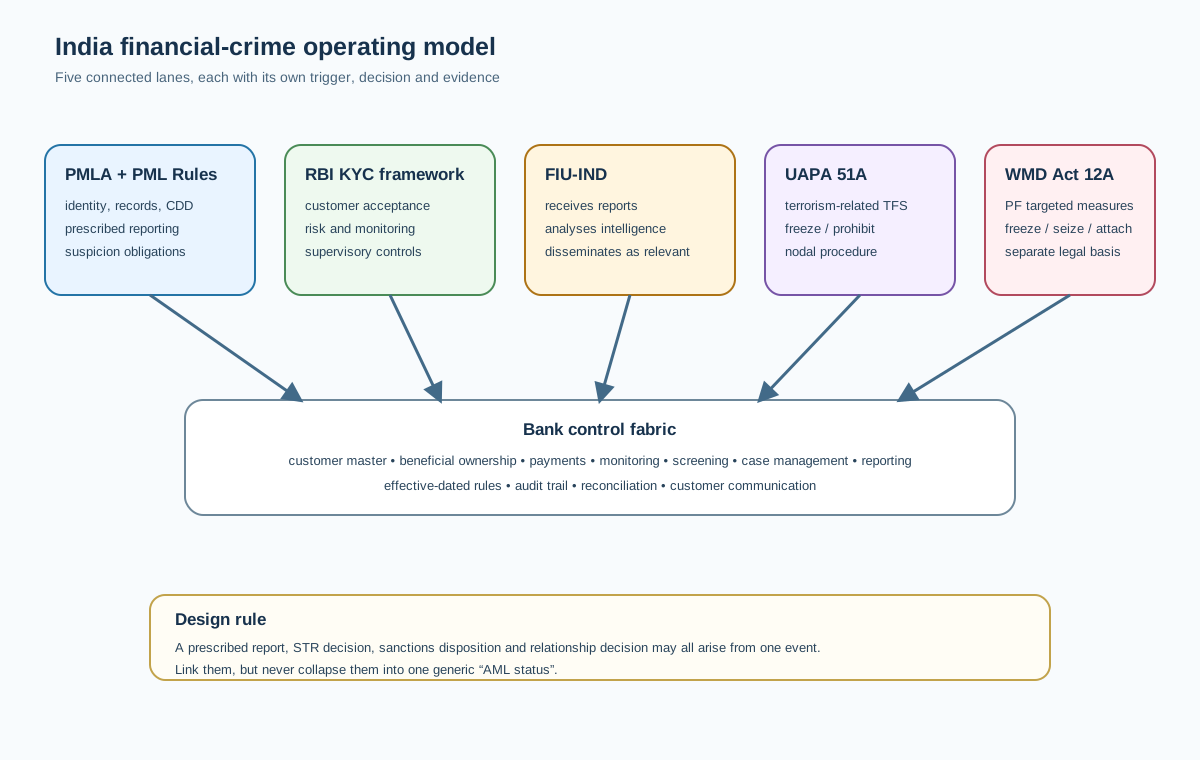
The legal and supervisory map
PMLA is the statutory foundation for preventing money laundering and for imposing preventive obligations on reporting entities. Chapter IV is especially important to banks because it covers customer identity verification, record maintenance, reporting and related duties. Section 11A addresses verification of identity. Section 12 requires reporting entities to maintain transaction records capable of reconstructing individual transactions, furnish prescribed information to the Director of FIU-IND, and maintain customer and beneficial-owner identity records together with account files and business correspondence. Section 12AA provides enhanced due-diligence measures for specified transactions. Section 13 gives the Director powers to address failures by reporting entities, including written warnings, directions and monetary penalties.
The PML Rules make those statutory obligations operational. They define reportable transaction categories, suspicious transactions, client due diligence, beneficial ownership, recordkeeping and reporting timelines. The rules are amended over time, so an implementation team should never hard-code a historical copy into policy or technology without an effective-date mechanism. A bank needs a regulatory inventory that points from the Act and Rules to the relevant RBI direction, internal policy, control, data element, system rule, test case and evidence owner.
FIU-IND is the central national financial intelligence unit. It is not the same as an investigating police agency and should not be described as the body that investigates every STR. FIU-IND receives reports from reporting entities, analyses the information and can disseminate financial intelligence to competent enforcement, intelligence and regulatory authorities. That distinction affects how analysts explain the purpose of an STR: the bank is providing financial intelligence because it has reached the statutory or policy threshold for suspicion; it is not making a criminal finding.
The RBI's KYC Directions apply to RBI-regulated entities within their scope. The Directions require a KYC policy covering customer acceptance, risk management, customer identification and transaction monitoring, supported by governance and independent evaluation. The RBI framework also brings targeted financial sanctions into the KYC control environment. Current implementation should always be checked against the latest RBI amendments. The sources reviewed for this chapter include the June 12, 2025 KYC Amendment Directions and a June 16, 2025 RBI circular that expressly refers to the Master Direction as amended on June 12, 2025.
Targeted financial sanctions require a different mental model from ordinary transaction monitoring. Under Section 51A of UAPA and the Government's implementation procedure, the bank must be able to identify persons or entities covered by applicable terrorism-related designations and execute the required restrictions, freezing, reporting and escalation steps. For proliferation financing, Section 12A of the WMD Act prohibits financing of prohibited WMD-related activity and gives the Central Government powers including freezing, seizure or attachment of funds or other financial assets or economic resources in the circumstances set out in law. These are legal-action controls, not merely risk scores.
Roles that must not be blurred
A bank's first line owns customer acceptance, accurate data capture, transaction execution within approved controls and escalation of concerns. Relationship managers and operations teams should not decide whether an STR will be filed merely because they know the customer; nor should compliance treat commercial teams as irrelevant. The strongest model combines frontline context with independent financial-crime judgement.
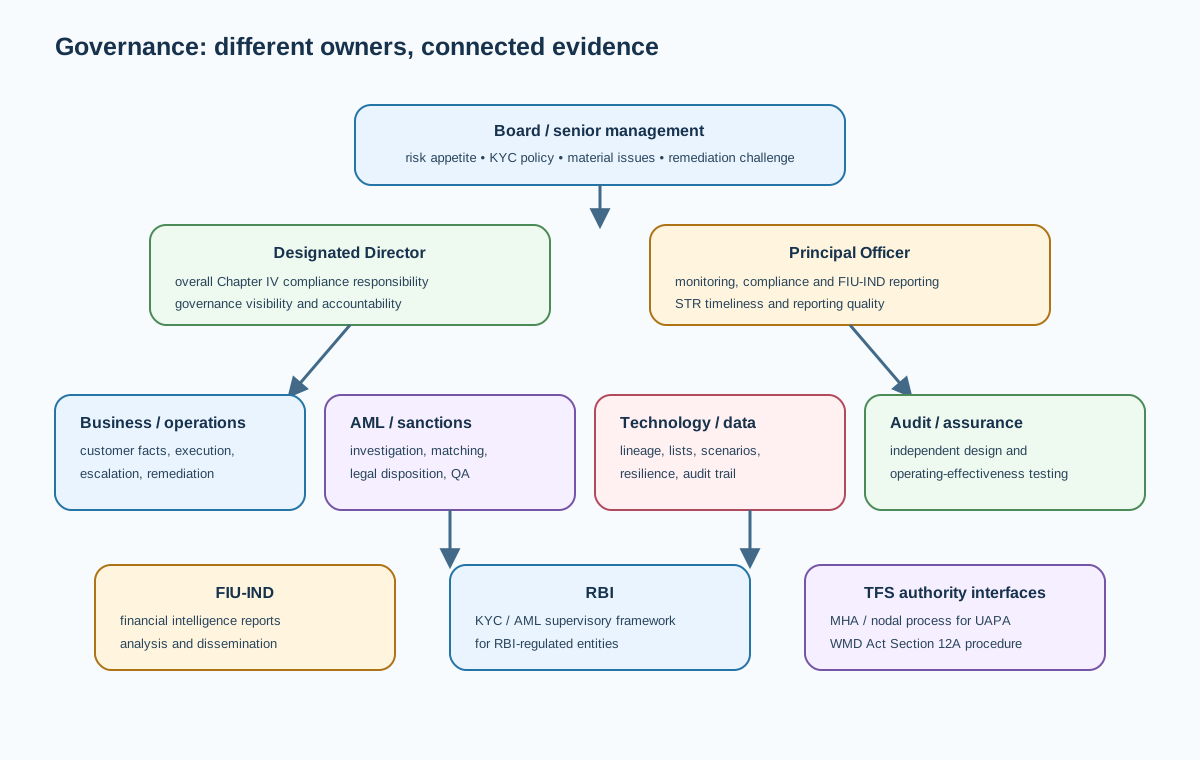
The Designated Director has overall responsibility for compliance with the Chapter IV obligations of PMLA and the Rules within the reporting entity. The Principal Officer is responsible for ensuring compliance, monitoring transactions and sharing or reporting information as required. RBI's KYC framework explicitly separates these roles; the Principal Officer should not simply be nominated as the Designated Director. The bank's organisation chart, delegation framework and workflow permissions should make that separation visible.
FIU-IND receives the prescribed reports. RBI supervises regulated entities for compliance with its directions and applicable statutory requirements. Enforcement Directorate responsibilities under PMLA are distinct from FIU-IND's intelligence role. MHA and designated nodal arrangements are relevant to UAPA targeted sanctions. The Department of Revenue procedure is relevant to WMD Act Section 12A implementation. A global bank should map these interfaces rather than use a vague destination called "regulator".
This role separation should also appear in technology. A case-management application should record who formed suspicion, who approved or submitted an STR where internal governance requires approval, when the filing was made, and which information was included. A sanctions application should separately record the screening list version, match attributes, legal basis, disposition, restriction or freeze action, notifications and release authority. An audit trail should make it impossible to confuse "STR filed" with "payment blocked" or "sanctions match confirmed".
Customer due diligence: identity is the beginning, not the end
RBI-regulated entities need a customer acceptance and identification process that can answer basic questions reliably: who is the customer, who acts for the customer, who ultimately owns or controls a legal entity, what products are being used, what activity is expected, what geographies and counterparties make sense, and what evidence supports the profile. KYC should create a usable operating baseline, not merely a scanned-document archive.
For individuals, the bank must obtain and verify identity using the methods permitted under the applicable PML Rules and RBI directions. For legal entities, verification extends to legal existence, authorised persons and beneficial ownership. The exact documentation path can differ by entity type. A bank should represent this in rules and data models rather than forcing companies, partnerships, trusts and sole proprietorships into the same screen.
Beneficial-ownership information is especially important because sanctions and suspicious-activity risks can sit behind an apparently ordinary legal entity. The system should preserve ownership percentages where relevant, control relationships, verification source, effective dates and historical changes. A later investigator may need to reconstruct who controlled a company on the date of a payment, not only who controls it today. Where legal thresholds change, the bank should be able to identify affected records and reperform the relevant analysis.
Customer risk rating should combine relevant factors such as legal form, occupation or business, product usage, delivery channel, geography, ownership complexity, expected transaction behaviour and other risk indicators. The purpose is to decide how much due diligence and monitoring is proportionate. The score should not be treated as a legal conclusion. A low-risk customer can still execute a suspicious transaction, while a high-risk classification does not mean the customer is a criminal.
RBI's risk-based framework also expects ongoing due diligence. Transaction monitoring must assess whether activity is consistent with the bank's knowledge of the customer, business and risk profile and, where necessary, source of funds. Periodic KYC updation is only one part of this lifecycle. Event-driven review can be more important when there is a material ownership change, adverse information, unusual transaction pattern, change in business activity, sanctions-list change, returned payment information or law-enforcement request.
One practical control is to separate identity freshness from risk-profile freshness. A customer's identity document may remain valid while the customer's business, beneficial ownership, expected countries or payment volumes have changed materially. Systems that show a single "KYC valid until" date can create false comfort. Better architecture records different review triggers and lets monitoring events update the customer-risk picture.
Prescribed reporting and suspicious transaction reporting
The PML Rules prescribe categories of transactions that reporting entities must record and report in the specified manner. FIU-IND's published FAQ describes, among other categories, cash transactions above the prescribed threshold, integrally connected cash transactions whose monthly aggregate exceeds the prescribed threshold, certain non-profit-organisation receipts, counterfeit or forged-note transactions, suspicious transactions, and cross-border wire transfers above the prescribed threshold where the origin or destination is in India. The exact report type relevant to a bank depends on the transaction and the bank's reporting-entity activity.
This means "regulatory report" is not synonymous with "STR". A cash transaction can be reportable because it meets a prescribed threshold without being suspicious. The same transaction can also be suspicious, in which case more than one reporting obligation may apply. Data architecture should therefore support multiple report classifications for the same underlying event and preserve the link between them.
A suspicious transaction under the PML Rules includes an attempted transaction and is not limited to cash. The definition covers activity that, to a person acting in good faith, gives reasonable grounds for suspicion that it may involve proceeds of a scheduled offence, appears unusually or unjustifiably complex, appears to have no economic rationale or bona fide purpose, or gives reasonable grounds to suspect terrorist financing. The practical lesson is that threshold-only monitoring cannot satisfy the full concept of suspicion.
FIU-IND states that the Principal Officer should furnish information on suspicious transactions promptly and no later than seven working days after being satisfied that the transaction is suspicious. A bank should not turn this into an artificial rule that "the alert can sit for weeks because the seven-day clock has not started". Internal service levels should move alerts and cases fast enough that the institution can form a view without avoidable delay, particularly where continuing activity may increase risk.
Suspicion is a judgement formed from facts, not a model score. Monitoring can generate alerts using scenarios, thresholds, behavioural analytics or peer comparison, but an alert is only an invitation to review. The investigator should reconstruct activity, compare it with KYC and expected behaviour, examine counterparties and linked accounts, consider plausible explanations, identify contradictions and decide whether the evidence crosses the relevant suspicion threshold.
Tipping-off risk should be built into customer-contact procedures. If the bank seeks information from a customer during an investigation, the request should be framed around legitimate due-diligence needs and should not disclose that an STR has been or may be filed. RBI's KYC Directions also recognise situations in which performing CDD could tip off a customer after suspicion has formed; the control path must follow the applicable rule rather than mechanically demanding more documents.
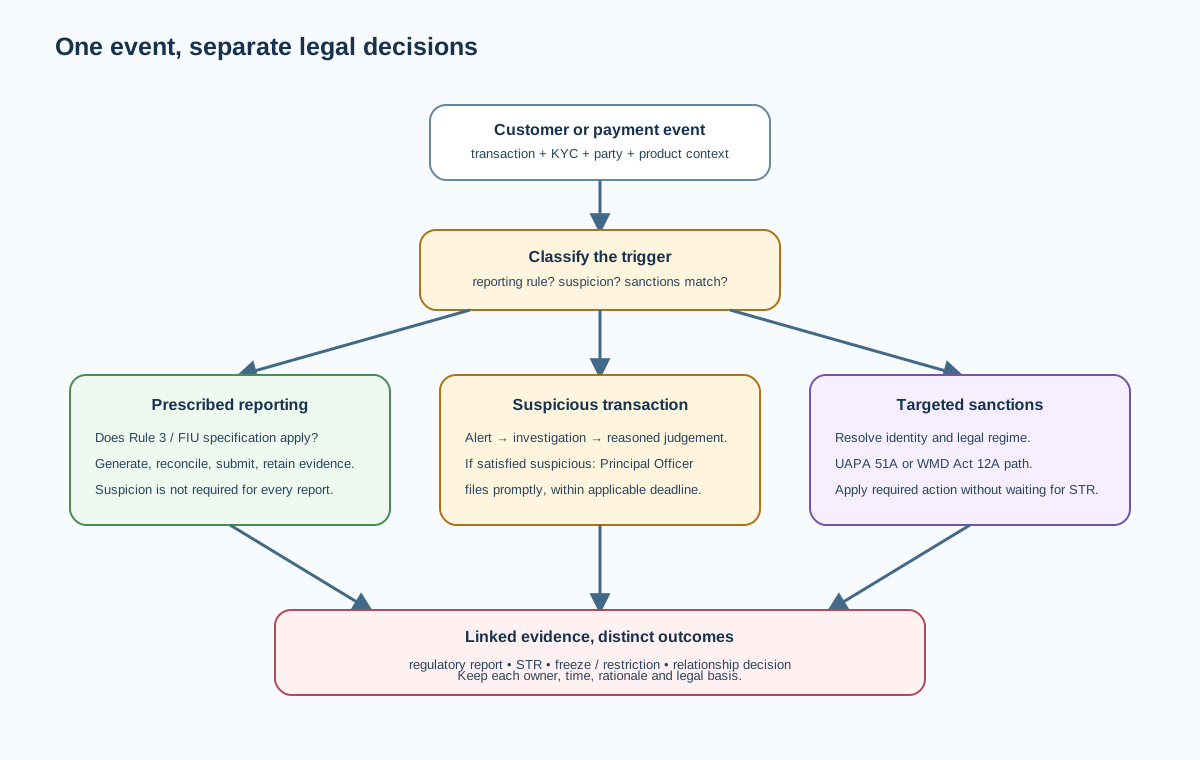
Transaction monitoring in Indian banking
Monitoring should begin with a clear understanding of the products and rails the bank actually offers. A retail savings account, current account, UPI-linked account, card, corporate cash-management account, remittance product, trade-finance relationship and correspondent-banking exposure create different data and typology patterns. One scenario catalogue cannot be blindly copied across all of them.
Useful monitoring variables include amount, velocity, cash intensity, beneficiary novelty, counterparties, geographic corridor, channel, time of day, relationship age, device or access signals where lawfully available, expected turnover, source of funds, business type, linked accounts and payment purpose. The bank should know which source system owns each element and what happens when the value is missing. A sophisticated rule fed by incomplete data can be weaker than a simple rule with controlled data quality.
For cross-border wires, payment-message data becomes important. Ordering customer, beneficiary, bank-chain, country, amount, currency, remittance and reference information can support both reporting and investigation. ISO 20022 improves the opportunity for structured party information, but only if mapping and truncation are controlled. A bank should test whether names, addresses and identifiers survive channel capture, payment hub transformation, clearing conversion, correspondent handling and case enrichment.
Cash patterns still matter in India, but cash is not the only risk. Mule-account networks, scam proceeds, cybercrime, trade-based laundering, shell companies, corruption proceeds, informal value-transfer interfaces and virtual-digital-asset off-ramps can all touch bank accounts. Monitoring should therefore combine transaction patterns with customer and network context.
False positives deserve disciplined treatment. If an alert is closed as expected behaviour, the file should show why. Repeated closure of the same scenario for the same customer may justify profile correction, scenario tuning or a different monitoring approach. It should not become an automatic exemption without governance. Conversely, a commercially important customer should not receive lower evidentiary standards simply because an alert is inconvenient.
Targeted financial sanctions: a separate control lane
India's targeted financial sanctions framework should never be reduced to "screen the UN list". The bank needs to know the legal basis, applicable lists, implementation procedures, ownership or control considerations required by current law or guidance, nodal-authority process, restriction type, reporting path and release mechanism.
For terrorism-related measures, Section 51A of UAPA provides powers to freeze, seize or attach funds and other financial assets or economic resources, prohibit making funds or related services available for the benefit of covered persons or entities, and prevent entry or transit in the circumstances set out in the Act. The Government's implementation procedure establishes nodal arrangements and the operational process. RBI's KYC Directions require regulated entities to ensure compliance with the applicable sanctions lists and Section 51A procedure.
The first operational problem is identity resolution. A screening engine can produce a name similarity, but a legal action should be based on a defensible match assessment. Date of birth, nationality, address, identification number, aliases and other list attributes can help distinguish a false positive from a potential or confirmed match. Common names require particular care. A bank should have a time-critical escalation route that does not release a legally restricted transaction merely because first-line staff cannot resolve the match quickly.
The second problem is scope. Customer screening at onboarding is not enough. Banks should consider existing-customer rescreening when lists change, payment screening where applicable, beneficial owners and controllers, beneficiaries, originators, agents and other relevant parties according to the product and legal framework. The system should record which population was screened, against which list version, at what time, with what matching logic.
The third problem is action. "Freeze", "reject", "hold", "decline onboarding" and "file STR" are not interchangeable verbs. The required outcome depends on law, procedure, product and facts. A workflow should present the permitted actions for the specific legal basis and prevent staff from improvising. Where a match is confirmed, the case record must preserve the action time because delay itself can be a material control failure.
Proliferation-financing targeted sanctions require their own legal mapping. Section 12A of the WMD Act prohibits financing of activities prohibited under the Act and provides for freezing, seizure or attachment and related measures. RBI's KYC Master Direction incorporates the Government procedure for implementation. A bank's sanctions platform should tag the legal regime so that a WMD/PF case is not processed as though it were an ordinary terrorism-list alert.
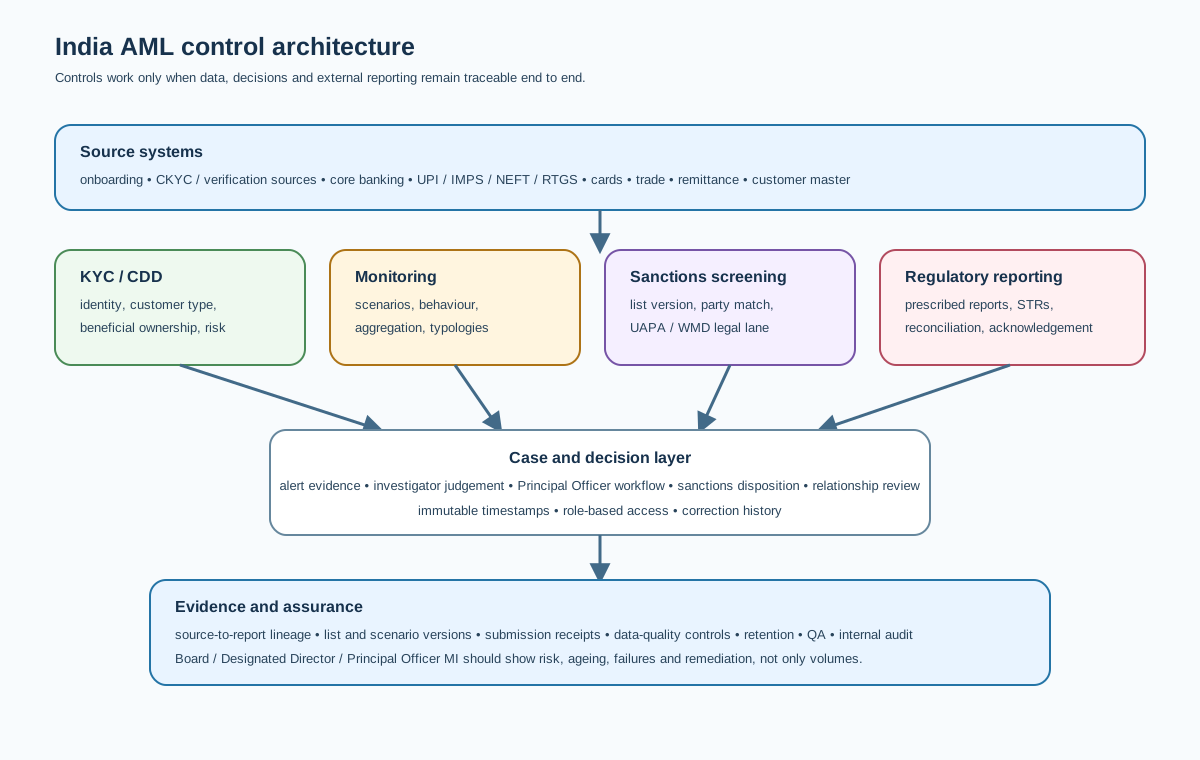
Data and systems: what the architecture must preserve
A mature India AML architecture starts with authoritative source systems. Customer master data should hold verified identity, addresses, tax or other identifiers where applicable, customer type, risk classification, onboarding channel and review dates. Entity data should hold beneficial owners, authorised signatories and control relationships. Product systems should identify accounts and services. Transaction systems should preserve amount, currency, date and time, channel, counterparties and payment references.
The financial-crime layer should enrich, not silently overwrite, that evidence. Screening results need list name, list version or update timestamp, matched fields, score or matching rationale, analyst decision and legal disposition. Monitoring alerts need scenario version, triggering transactions, customer profile at the time, enrichment, disposition and closure reason. Cases need evidence snapshots, investigator notes, approvals and external-report references.
FIU reporting introduces another lineage requirement. The bank should be able to trace every field submitted in a regulatory report back to its source or approved derivation. If a customer name in a report differs from the core-banking value because it was normalised, the transformation should be explainable. If transaction aggregation creates a reportable event, the bank should preserve the component transactions and aggregation logic.
A useful design principle is event-time reconstruction. Auditors and investigators often ask what the bank knew on a historical date. Current-state databases are not enough if they overwrite ownership, risk rating, address, sanctions-list status or scenario configuration. Effective-dated customer and rule data, immutable case evidence or controlled snapshots make later reconstruction possible.
Data quality should be governed as a financial-crime control issue. Missing date of birth can increase sanctions false positives. Truncated beneficiary names can weaken screening. Incorrect customer type can affect beneficial-owner logic. Missing transaction-purpose data can weaken investigation. Poorly mapped country codes can affect monitoring and cross-border reporting. Management information should therefore include material data defects and not only alert counts.
Governance and assurance
The Board-approved KYC policy should be more than a document. It should map to operational controls, system requirements, roles and evidence. Senior management should understand material ML/TF/PF risks, significant control weaknesses, overdue remediation, alert or case backlogs, reporting timeliness, sanctions incidents, data gaps and customer harm arising from controls.
The Principal Officer needs reliable management information. Useful measures include number and ageing of alerts, cases awaiting decision, STR timeliness, prescribed-report timeliness, reopened cases, quality-review failures, sanctions-match volumes and ageing, list-update latency, blocked or frozen asset cases, KYC review backlog, high-risk customer coverage, data-quality exceptions and repeated system failures.
Independent testing should examine design and operation. A control can look perfect on paper but fail when an upstream feed is delayed, a list update is missed, a branch captures an alias incorrectly, a case queue exceeds capacity, or an investigator cannot retrieve historical transactions. Testing should include positive and negative cases, boundary amounts, attempted transactions, duplicate reports, late-arriving data, false sanctions matches, true-match escalation and recovery after system outage.
Internal audit should be able to follow the chain from law to control to evidence. The bank should show why a requirement applies, how it is implemented, who owns it, when it was last tested, what defects were found, and whether remediation was completed. For regulatory change, the same traceability should show when a new rule became effective and which customer, product, system and process populations were affected.
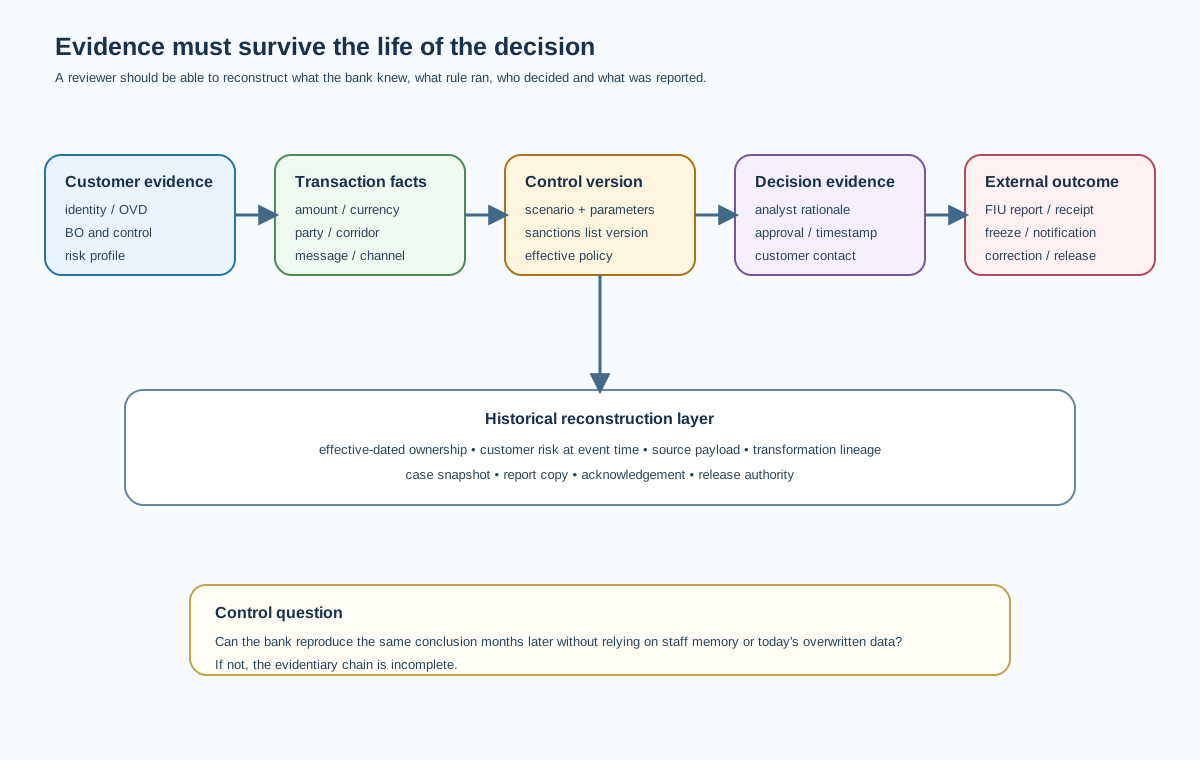
Customer impact and proportionality
Financial-crime controls can protect the system and still harm legitimate customers if implemented badly. KYC refreshes can disrupt customers who cannot easily obtain documentation. Over-sensitive screening can delay salary, medical or trade payments. Poorly designed account restrictions can create financial exclusion. Repeated requests for the same information can erode trust.
Proportionality does not mean weakening legal obligations. It means using the least disruptive control that still satisfies the obligation and manages the risk. For example, a potential sanctions match may require a controlled hold while identity is resolved, but the bank should not leave the case unworked for days because the name is common. A KYC deficiency may require restriction under policy, but the bank should provide clear, lawful communication and accessible remediation channels where permitted.
Customer communication must also respect confidentiality. The bank can explain that information is required for regulatory or account-maintenance purposes without revealing an STR decision. Staff scripts, complaint handling and escalation guidance should be aligned so that a well-meaning call-centre employee does not expose protected financial-intelligence activity.
The best operating models measure customer impact together with risk outcomes. False-positive rates, payment-hold duration, KYC abandonment, complaint volumes and vulnerable-customer impacts can reveal control-design weaknesses. These metrics should never become incentives to release risky activity, but they help teams improve accuracy and reduce unnecessary friction.
What a business analyst should specify
A business analyst translating this framework into delivery should begin with obligations, not screens. Each requirement should identify the legal or policy trigger, customer or transaction population, required data, decision logic, role, timing, exception path, external interface, evidence and test condition.
For KYC, the BA should define customer-type-specific data and document rules, beneficial-owner relationships, risk factors, review triggers and permitted verification methods. For monitoring, the BA should define scenario inputs, aggregation windows, exclusions, alert payload, case routing and versioning. For FIU reporting, the BA should define reportable categories, timeliness, data lineage, corrections and acknowledgements. For sanctions, the BA should define screening populations, list ingestion, matching, escalation, legal outcomes and rescreening.
Non-functional requirements are equally important. Sanctions screening may need low latency and highly available list services. Case systems need immutable audit trails and access controls. Reporting needs completeness and reconciliation. Monitoring needs enough performance to process daily volumes without silently dropping late data. Retention needs to meet applicable legal periods and litigation or investigation holds.
Acceptance criteria should test behaviour rather than UI presence. "System has sanctions screen" is not useful. A better criterion is that when a new list version is loaded, all required existing customers are queued for rescreening, results are linked to the list version, unresolved potential matches are prevented from moving into an inappropriate cleared state, and the full event is auditable.
A joined-up case
Consider an Indian corporate customer that imports industrial equipment. Its KYC profile shows established suppliers in two countries and monthly cross-border payments within a stable range. A new payment is initiated to a newly added intermediary in another jurisdiction. The amount is materially higher than normal, the invoice description is vague, and ownership data collected during an event-driven review shows a recently introduced shareholder.
The payment-screening engine generates a potential sanctions match on the intermediary's director. At the same time, transaction monitoring flags the payment because of the new counterparty, corridor change and deviation from expected value. These are two separate triggers.
The sanctions team first resolves identity using the applicable list attributes and reliable customer or counterparty evidence. If it is a false positive, that fact should be recorded with the evidence that distinguished the party. If it is a true or unresolved match requiring action under the applicable legal procedure, the bank follows the targeted-sanctions path, including any required freeze or prohibition and notification. The fact that the transaction-monitoring investigator has not yet decided whether it is suspicious does not permit the bank to ignore a legal sanctions restriction.
The AML investigator separately examines the commercial rationale, invoice, supplier history, ownership change, account activity, related counterparties and source of funds. A legitimate explanation may resolve the monitoring alert even though sanctions controls still determine the payment outcome. Conversely, the sanctions match may be false while the broader transaction still looks suspicious because the intermediary has no clear commercial role and funds are rapidly moved onwards.
If the bank becomes satisfied that the activity is suspicious, the Principal Officer's reporting process must meet the FIU-IND timeline. The STR should present the facts and rationale without pretending the bank has proven a crime. Customer contact must avoid tipping off. The account relationship may require enhanced monitoring or risk review, but any restriction should have a policy and legal basis rather than being an automatic consequence of filing an STR.
This example shows why good architecture uses linked but distinct objects: customerRiskEvent, monitoringAlert, sanctionsAlert, case, regulatoryReport, paymentDisposition and relationshipDecision. One event can create several objects, and each can reach a different lawful outcome.
What good looks like
A mature India financial-crime operating model can explain the legal basis for each control and can show the evidence that it works. Customer identity is verified and usable. Beneficial ownership is represented as data, not buried in PDFs. Monitoring reflects product and customer behaviour. Prescribed reports and STRs are complete and timely. Targeted sanctions use current lists and clear legal-action procedures. WMD/PF controls are not hidden inside generic AML monitoring. Decisions are reconstructable.
The operating model also changes safely. When PML Rules, RBI Directions, FIU specifications, UAPA procedures or WMD procedures change, the bank knows which policies, systems, reports, test packs and training materials are affected. Effective dates are controlled. Changes are not silently back-applied or left in policy while technology remains unchanged.
Finally, strong control is visible in judgement. Investigators can explain why an alert was closed or escalated. Sanctions analysts can explain why a match was false or true. The Principal Officer can explain reporting timeliness and quality. Technology teams can show lineage and resilience. Senior management can see risks and remediation. That joined-up evidence is what turns a collection of rules into a defensible bank operating model.
Operational deep dive: reporting, monitoring and evidence
The Indian framework becomes difficult not because the legal names are hard to memorise, but because the same customer activity can create several different obligations at once. A bank needs to recognise those obligations without allowing one process to substitute for another.
From transaction event to prescribed report
A prescribed report should be generated from controlled transaction data. The bank needs a reliable business date, transaction value, currency, customer identifier, account, counterparty, channel and report-specific fields. Threshold or aggregation logic should run on the correct population and currency-conversion basis defined by the bank's approved implementation of the PML Rules and FIU-IND reporting specifications.
Aggregation is a common failure point. Connected cash transactions can become reportable because their aggregate crosses a prescribed monthly threshold even though individual transactions do not. If data is split across branches, platforms or migrated accounts, the aggregation layer must still recognise the common customer or account relationship. A design that aggregates only within each source application can under-report.
The reporting engine should produce a reconciliation between eligible events, generated report records, submitted files or messages, FIU acknowledgements, rejects, corrections and final status. Operations should investigate breaks rather than treating a successful file transmission as proof that all reportable activity was included.
From alert to suspicion
Transaction monitoring should create a review population, not a conclusion. The first task is to understand why the alert fired. Investigators need the scenario name and version, triggering transactions, look-back period, customer profile and risk factors. They should not have to reconstruct those inputs manually from several applications.
The investigator then asks whether the activity fits the known customer. For a salaried retail customer, repeated credits from unrelated third parties followed by rapid UPI or IMPS transfers may be important. For a cash-intensive business, deposits may be expected but still need to match declared turnover, location, seasonality and downstream use. For a corporate customer, circular payments, unexplained trade counterparties or sudden high-value remittances outside the stated business model may create concern.
An explanation should be tested against evidence. "Customer said business payment" is not enough if the business does not normally trade in the goods or country described. Equally, a deviation does not automatically mean crime. New contracts, asset sales, investment events and family transactions can produce unusual but legitimate activity. A mature investigator looks for corroboration and contradiction.
If suspicion is formed, the bank should record the basis clearly and route the case into the Principal Officer's reporting process. The record should state when the institution became satisfied that the transaction was suspicious because that date is relevant to the external reporting timeline. The process should also support attempted transactions where the definition and facts require reporting.
The seven-working-day rule is not a backlog licence
FIU-IND's public guidance states that an STR should be furnished promptly and not later than seven working days after the Principal Officer or reporting entity is satisfied that the transaction is suspicious. The point of the rule is timely intelligence, not permission to delay investigation.
Banks therefore need internal service levels before the statutory deadline. High-risk cases may need immediate escalation. Lower-risk alerts can be prioritised, but backlog governance should identify cases whose age or continuing activity could create material risk. Senior management should see not only average closure time but the oldest unresolved high-risk cases and the reasons for delay.
Where a case remains unresolved because information is missing, the workflow should show what was requested, from whom, when it is due and what interim risk treatment applies. A "pending" status with no owner is not a control.
Reporting confidentiality and customer interaction
The bank may need to contact the customer during review, but the request should not reveal that an STR is contemplated or filed. Staff should ask questions that are genuinely necessary for CDD or transaction understanding and avoid investigative language that exposes confidential reporting.
This creates an important training need. A branch employee may know that compliance has asked for an invoice but should not be told more than is necessary. Relationship teams should receive clear instructions on what they can ask and what they must not disclose. Complaint handlers should know how to respond when a customer asks why a payment is delayed without exposing protected information or inventing a false reason.
FIU-IND reporting quality
An STR is useful when it tells a coherent financial story. The narrative should identify the customer and relationship, explain what happened, state why the behaviour is unusual or suspicious, quantify relevant transactions, identify counterparties and dates, explain links or patterns, and distinguish fact from inference. It should avoid generic wording such as "activity not satisfactory" without evidence.
Structured fields are equally important. Incorrect identifiers or dates can make matching and analysis harder. The reporting process should validate mandatory fields, check formats, avoid duplicate submission and preserve the exact content filed. Corrections should be linked to the original report where the reporting mechanism supports that relationship.
Monitoring and FIU reporting are not account-exit logic
Filing an STR does not by itself determine whether the customer relationship must be terminated. The bank should make a separate relationship-risk decision using applicable law, policy, risk appetite and facts. Some customers may require enhanced monitoring; others may be restricted or exited for independently justified reasons. The relationship decision must not be encoded as "STR equals closure".
That separation protects both control quality and customer fairness. If every STR automatically ends the relationship, frontline teams may hesitate to escalate legitimate concerns for fear of disproportionate customer impact. It can also deprive investigators of visibility into subsequent activity where law and risk management permit the relationship to continue.
Data lineage for supervisory defensibility
For every material control, a bank should be able to answer five questions: where did the data originate, what transformations occurred, which rule or model used it, who made the decision, and what external action followed. These questions are especially important where several systems are involved.
Take a cross-border wire report. The original payment may be captured in a channel, enriched in a payment hub, converted between message formats, posted in core banking, settled through another system and then extracted into a regulatory data mart. Country and amount fields may be derived at different points. A control owner needs lineage through that chain.
Sanctions screening has similar dependencies. A beneficiary name may be truncated or transliterated in one system. If the screening engine sees only the truncated value, a later audit cannot assume it screened the full name that the customer originally entered. End-to-end testing should compare source capture with the actual screened payload.
Record retention and reconstruction
PMLA requires transaction records to be maintained for the prescribed period, and customer identity and relationship records have their own retention requirements. The operating model should implement those periods in a controlled retention schedule, with legal-hold capability where other obligations require longer preservation.
Reconstruction means more than finding a transaction line. A reviewer should be able to see the customer profile, relevant identity and beneficial-owner evidence, monitoring scenario, alert, case notes, decision, regulatory report and sanctions disposition as they existed at the time. If a bank can reproduce the data but not the decision context, its evidence is incomplete.
Quality assurance
Quality assurance should sample both escalated and closed cases. Sampling only STRs can prove reporting quality but miss false-negative risk in closures. Sampling only alert closures can miss narrative or timeliness defects in reported cases. Risk-based QA should examine different products, branches, customer segments and investigators.
Findings should be coded to root cause: investigator judgement, training, data quality, scenario design, workflow, policy ambiguity, system defect or capacity. Repeated root causes should feed change programmes. The objective is not to score investigators; it is to make the control system stronger.
Practical test scenarios
A strong test pack includes a cash-aggregation boundary case; a cross-border wire just below and above the applicable reporting threshold; an attempted suspicious transaction; an alert where customer explanation is corroborated; an alert where evidence contradicts the explanation; a duplicate external-report scenario; a late-arriving transaction feed; and a customer whose risk rating changes during an open case.
For sanctions, tests should include exact name match, common-name false positive, alias match, date-of-birth mismatch, list update during an open payment, existing-customer rescreening, unavailable screening service, and confirmed match requiring time-critical action. WMD/PF list or procedure tests should prove that the correct legal regime and notification path are invoked rather than a generic terrorism-sanctions workflow.
These tests are strongest when evidence is generated automatically: list version, scenario version, timestamps, payload hashes, case IDs, approval IDs and report acknowledgements. Manual screenshots can supplement that evidence but should not be the primary control record.
Advanced practice: targeted sanctions, ownership, payments and change delivery
Targeted financial sanctions are where apparently small design choices can become legal failures. The objective is not maximum alert volume. It is reliable identification of relevant persons or entities and execution of the exact action required by the applicable Indian legal procedure.
List governance
A screening platform needs controlled list ingestion. The bank should know the authoritative source, retrieval frequency, publication timestamp where available, ingestion timestamp, validation result and deployment status. If a list feed fails, operations should receive an alert and have a documented fallback. "Last successful update" should be visible to control owners.
List changes can require rescreening of existing customers and connected parties. The population must be defined explicitly: customers, beneficial owners, authorised signatories, directors, trustees, beneficiaries or other parties according to the applicable control scope. If a new designation is loaded, the bank should be able to show when required populations were rescreened and whether unresolved hits remain.
Identity resolution
Name matching is deliberately sensitive, so false positives are unavoidable. The analyst's task is to resolve identity using reliable attributes, not to dismiss common names by intuition. Date of birth, nationality, place of birth, address, passport or other identifiers, aliases and entity registration details can be decisive where available.
Transliteration increases complexity across Indian and international names. A person can appear in Latin script and in different transliterations of another script. Matching logic needs tested normalisation and alias handling, but aggressive fuzzy matching can overwhelm analysts. Thresholds should be tuned against known test populations and subject to governance.
A false-positive disposition should state which differentiating attributes were used. A reusable whitelist, if permitted by policy, needs expiry and change triggers; otherwise a customer who later changes identifying information may remain incorrectly suppressed.
Ownership and control
A listed person may be connected to a legal entity that is not itself named. The correct treatment depends on the applicable legal rule and current implementation guidance. The bank should not import an ownership threshold from OFAC, the EU or another foreign regime and present it as a universal Indian rule.
Instead, the sanctions case should surface ownership and control evidence and route ambiguous cases for legal or sanctions-policy interpretation under the Indian framework. The data model should support direct and indirect ownership chains and control indicators without hard-coding one global legal conclusion.
Payment screening and instant rails
India's fast-payment environment compresses decision time. A sanctions control that depends on a human analyst reviewing every uncertain match may not fit the latency of an instant-payment product. The design may need pre-transaction customer screening, beneficiary intelligence, risk-based matching strategies and clearly defined real-time hold or reject logic where legally and scheme-operationally possible.
Speed does not change the legal obligation. It changes where controls must operate. If a real-time rail cannot tolerate a long manual hold, the bank must decide before launch how to handle potential matches: which data is screened, which scores can be cleared automatically, which require step-up, and when the payment cannot proceed.
Availability design is therefore part of sanctions compliance. A screening-service outage should trigger a predetermined fallback. Depending on product, law and policy, fallback may involve local cached lists, degraded screening, queuing, rejection or suspension of certain flows. The bank should not discover its legal posture during the outage.
Proliferation financing
Proliferation financing can look commercially ordinary. Payments may involve legitimate companies, industrial goods, intermediaries, logistics providers and common currencies. A bank normally does not have enough information to determine the technical end-use of every product, but it can identify risk from parties, ownership, trade documents, destinations, payment routes and known sanctions indicators.
The WMD Act Section 12A procedure means proliferation-financing controls should be visible within sanctions governance. Screening logic, escalation labels and case templates should distinguish PF-related targeted financial sanctions from terrorism-related TFS. Trade-finance and corporate-banking teams may need additional training because goods, end-user and routing context can be critical.
A payment description such as "industrial parts" is not proof of proliferation risk. Nor does the absence of a listed-name hit prove safety. The correct approach combines applicable legal prohibitions with proportionate risk assessment, customer understanding and escalation when the bank cannot reconcile the evidence.
RBI supervision and FIU-IND coordination
The 2025 FIU-IND/RBI memorandum of understanding illustrates the connected but distinct roles of intelligence and supervision. The published areas of cooperation include information sharing, reporting procedures, outreach and training, ML/TF risk assessment, red-flag identification and supervision of reporting entities regulated by RBI.
For a bank, that means the compliance programme should not be split into isolated "RBI work" and "FIU work". The same KYC, monitoring, reporting and data controls may be visible to both authorities for different purposes. Findings from one supervisory or reporting interaction should feed enterprise remediation where the underlying weakness is common.
Regulatory change
Indian AML rules evolve through Acts, Rules, Government notifications, RBI Directions, FIU specifications and sanctions procedures. A regulatory-change inventory should record the source, publication date, effective date, impacted entities, products, processes, data and controls.
A change should not be closed because policy text was updated. Completion means affected requirements are implemented in procedures and systems, users are trained, tests pass, reporting logic is reconciled, and evidence is retained. Where implementation is phased, the bank should record interim controls and residual risk.
The June 12, 2025 RBI KYC amendment is a good example of why effective dating matters. A bank reviewing a 2024 case should use the rules that applied at the time, while a 2026 control audit should use the current requirement. Case systems and policy libraries should support that temporal distinction.
Group policy versus Indian law
An international bank may have global AML standards that are stricter than local minimums. Global standards can improve consistency, but the bank must identify conflicts and local mandatory requirements. A group sanctions policy based on several jurisdictions may create restrictions beyond Indian legal obligations; those restrictions should be labelled as group-risk decisions rather than misrepresented as Indian law.
Data sharing creates another local-versus-group question. Cross-border investigations may benefit from enterprise information, but sharing must follow applicable confidentiality, privacy, secrecy and internal-access rules. The architecture should permit necessary controls without assuming all customer or STR information can be transferred freely across jurisdictions.
Model and analytics governance
If machine learning or advanced analytics supports monitoring, the bank needs explainable governance. The model's objective, features, training data, limitations, validation, drift and override process should be documented. Model scores can prioritise work but should not make an unreviewable STR decision.
Fairness also matters operationally. Geographic, occupation or demographic proxies can unintentionally create excessive friction for particular customer groups. Risk factors need a legitimate financial-crime rationale and should be tested for unintended effects. Human review does not automatically cure a biased model if investigators are trained to trust its score without challenge.
Metrics that reveal real risk
Alert count is a weak metric by itself. Better management information connects alert volumes to conversion, ageing, recurring customers, quality defects, data gaps and risk outcomes. For STRs, management should examine timeliness and narrative quality. For sanctions, it should examine list-update latency, potential-match ageing, false-positive drivers and any delayed legal actions.
Backlog metrics need risk segmentation. Ten old low-risk alerts and ten unresolved high-risk sanctions matches are not equivalent. Dashboards should show severity, age and exposure so senior management can allocate resources intelligently.
Scenario governance
Every monitoring scenario should have an owner, purpose, risk typology, input data, parameters, threshold rationale, segmentation, expected behaviour, testing record and review date. Changes should be versioned. Investigators should see the version that generated the alert, not only the current version.
Tuning should use evidence. A high false-positive rate may justify refinement, but the team should test whether proposed changes reduce noise without losing known suspicious cases. Back-testing and challenger rules can help. Any suppression should have approval and expiry.
BA acceptance criteria for an India AML platform
For a new customer, the platform should prevent account activation until mandatory KYC and sanctions checks required by the product are complete, while supporting the exceptions expressly permitted by policy and law. It should record verification method and source.
For a legal entity, the platform should support multiple beneficial owners and controllers, effective dates, evidence and relationship type. If ownership changes, historical structure should remain reconstructable.
For an STR, the system should preserve the suspicion-formation date, Principal Officer workflow, report content, submission timestamp, acknowledgement and correction history. Customer-facing channels should not expose the filing state.
For targeted sanctions, the system should store list source and version, matched fields, analyst disposition, legal basis, action and notifications. Confirmed-match actions should be time-stamped and protected from unauthorised reversal.
For regulatory reporting, the system should reconcile source events to submitted records and capture rejects. A successful transmission with missing eligible transactions should fail completeness assurance.
Those acceptance criteria turn regulatory language into testable behaviour and make later audit far easier.
Practice close: controls, testing and investigation checklist
A reviewer can use the following sequence to challenge an India AML control without turning the exercise into a box-ticking inspection.
Customer and KYC
Confirm that the customer type drives the correct identification and verification path. Check whether beneficial owners and authorised persons are captured as structured relationships, whether the risk rating has a reason, and whether expected products, geographies and transaction behaviour are usable by monitoring. Review how the bank handles event-driven changes rather than relying only on periodic KYC dates.
Monitoring
Choose a real alert and trace every triggering field to source. Confirm the scenario version and parameter set that applied on the alert date. Reconstruct the customer's activity around the alert and challenge whether the closure or escalation rationale addresses contradictory evidence. Check that high-risk open cases receive timely escalation.
FIU reporting
Select a prescribed report and an STR. For each, reconcile structured fields to source data and verify submission timing and acknowledgement. For the STR, confirm that the suspicion narrative explains the financial behaviour and that the filing state is restricted from customer-facing staff. Check how corrections and supplemental information are handled.
Targeted sanctions
Take one false positive and one confirmed or simulated true match. Verify list version, matching attributes, disposition evidence, action timing and legal basis. Check whether existing customers are rescreened after list updates and whether the platform distinguishes UAPA terrorism-related TFS from WMD/PF measures.
Resilience
Simulate a delayed transaction feed, list-feed failure, screening-service outage and case-management unavailability. The bank should have documented fallback and reconciliation. After recovery, missed events should be replayed or otherwise controlled, not silently discarded.
Governance
Trace one material defect from detection to remediation. There should be an owner, severity, due date, interim control, testing evidence and closure approval. Senior management reporting should make overdue high-risk defects visible.
Questions for a business analyst
Ask whether every field has a source owner, whether every automated decision is explainable, whether every external report can be reconstructed, whether effective dates are preserved, whether customer communication avoids tipping off, and whether a tester can reproduce both positive and negative outcomes without production data.
A good requirement pack makes those answers explicit. A weak one says only "system shall comply with PMLA and RBI KYC", leaving developers and testers to guess what compliance means.
Negative testing and false-positive control
Negative tests are as important as positive tests because an over-sensitive control can create customer harm and operational overload. Create legitimate profiles that resemble high-risk patterns: a festival-season retailer with a temporary volume spike, a newly funded start-up paying an overseas software supplier, a family receiving remittances from several relatives, and a business changing suppliers after a contract renewal. The expected result is not automatic clearance; it is a reasoned process that can distinguish those facts from criminal typologies.
For sanctions, use common-name cases and near matches. Test whether analysts see enough identifiers to resolve identity and whether the system records the differentiating evidence. A false-positive closure should be reproducible by a second reviewer. If the bank uses suppression or whitelisting, test expiry, change detection and list-version changes so an old decision cannot suppress a genuinely new risk forever.
Reporting completeness and reconciliation
At month end, the reporting team should reconcile source transactions to regulatory-report populations. The reconciliation needs explicit control totals: eligible records, excluded records with valid reasons, generated records, submitted records, acknowledgements, rejects and resubmissions. Where an upstream correction changes a historical transaction, the process should determine whether an amended or supplemental report is needed under the applicable FIU specification.
The same discipline applies to STR filing, even though STRs are judgement based. A case-management report can compare cases approved for filing with submissions and acknowledgements. Any approved case without evidence of successful filing should be treated as a control break, not an administrative inconvenience.
Release and restriction controls
Payment or account restrictions need controlled release. A sanctions hold should not disappear because a case was closed in a different system. The release event should cite the decision authority, evidence and timestamp. Dual control is appropriate for sensitive legal dispositions where policy requires it.
Likewise, relationship restrictions imposed for KYC remediation should have a clear basis and exit condition. When the customer supplies acceptable information, the workflow should restore services consistently. Long-lived restrictions with no owner create both conduct risk and operational risk.
Evidence for final sign-off
Before a project is declared complete, retain a requirement-to-test traceability matrix. Each material obligation should map to a requirement, control, source data, system component, test scenario and evidence. Known limitations should have owners and approved risk treatment. This is the difference between a system that appears compliant in a demonstration and a control that can survive supervisory review.
Masterclass case: one payment, four different decisions
An Indian bank has a long-standing corporate customer that distributes laboratory and engineering equipment. The customer is medium risk, has three known overseas suppliers and normally sends monthly cross-border payments of moderate value. Its beneficial ownership has been stable for several years.
A new outward payment arrives for a much higher amount. The beneficiary is a trading company in a jurisdiction not previously used by the customer. The remittance text says "equipment advance". At the same time, an event-driven KYC feed shows that a new minority shareholder has joined the customer and one authorised signatory changed recently.
The payment creates four potential control questions.
First, the bank must consider prescribed regulatory reporting. If the transaction falls within a category that requires a report, that obligation exists regardless of whether the investigator later forms suspicion. The reporting engine should assess the event using the applicable PML Rules and FIU specification.
Second, transaction monitoring evaluates behaviour. New corridor, new beneficiary, higher value and ownership change may combine to produce an alert. The investigator compares the payment with contracts, invoice, customer history, business purpose, related transactions and source of funds. None of the factors alone proves wrongdoing.
Third, payment screening produces a potential name match on a director of the beneficiary. The sanctions analyst compares list attributes. The date of birth and nationality do not match the designated individual, and reliable corporate-registry evidence supports a different person. The hit is closed as a false positive with the differentiating evidence recorded.
Fourth, the investigator discovers that the beneficiary was incorporated recently, the customer cannot explain why an intermediary is needed, the invoice gives no identifiable model numbers, and two earlier inward credits came from unrelated third parties before the outward payment. The combined pattern may create reasonable grounds for suspicion even though the sanctions alert was false.
The Principal Officer's process records when the bank became satisfied that the activity was suspicious and submits the STR within the applicable deadline. The narrative states the facts, pattern and unresolved concerns. It does not allege that the customer committed a scheduled offence as a proven fact.
The relationship-risk team then decides separately whether enhanced monitoring, transaction restrictions under another lawful basis or exit is appropriate. The STR itself is not used as an automatic closure instruction. The customer-facing team is given a controlled request for additional business information and is not told that an STR was filed.
Now change one fact: suppose the sanctions attributes instead confirm that the beneficiary is covered by an applicable Section 51A designation. The bank's targeted-financial-sanctions process becomes immediately decisive for the payment and relevant assets under the legal procedure. The AML investigator may still file an STR if the facts support suspicion, but the sanctions action does not wait for that decision.
Change another fact: suppose the party is connected to a WMD/PF designation or prohibition rather than the terrorism-related regime. The case must follow the applicable WMD Act Section 12A implementation path. A generic "sanctions hit" label is insufficient because notification, evidence and legal authority must remain traceable.
The lesson is that one payment can legitimately produce four different statuses: regulatory-report eligibility, monitoring suspicion, sanctions disposition and relationship decision. Good architecture links them without collapsing them. Good investigators know which question they are answering. Good governance can later show each decision, the evidence used and the authority behind it.
What the post-case review should ask
After the case closes, control owners should review more than the individual investigator's performance. Did the new shareholder reach the monitoring system quickly enough? Was the beneficiary name screened in full or truncated by a payment transformation? Did the scenario use current expected turnover? Could the sanctions analyst retrieve all list identifiers without leaving the case tool? Did the external report reproduce the transaction values accurately?
If any answer is no, the issue belongs in the control framework. A case that reached the right outcome by luck can still reveal a material weakness. Conversely, a false positive that was resolved quickly and accurately can show that sensitive screening is operating as designed.
The review should also compare customer impact with control necessity. How long was the payment delayed? What communication was given? Was a legitimate customer asked repeatedly for information already held by the bank? Could better structured data have shortened the review without weakening the legal control? Those questions help operations improve service while preserving financial-crime effectiveness.
Finally, capture lessons in scenario tuning, KYC event triggers, sanctions matching and training. A mature programme turns one difficult case into reusable knowledge. It does not leave the insight in the investigator's notes.
References and further reading
-
Government of India, India Code, The Prevention of Money-laundering Act, 2002
https://www.indiacode.nic.in/bitstream/123456789/2036/5/A2003-15.pdf -
Financial Intelligence Unit - India, PMLA 2002 and statutory provisions
https://fiuindia.gov.in/files/AML_Legislation/pmla_2002.html -
Financial Intelligence Unit - India, Prevention of Money-laundering (Maintenance of Records) Rules, 2005 and amendments
https://fiuindia.gov.in/files/AML_Legislation/notification.html -
Financial Intelligence Unit - India, Frequently Asked Questions on PMLA, reporting, records and suspicious transactions
https://fiuindia.gov.in/files/FAQs/faqs.html -
Financial Intelligence Unit - India, About FIU-IND and its functions
https://fiuindia.gov.in/files/About_FIU-IND/About_FIUIND.html -
Financial Intelligence Unit - India, FIU-IND and RBI MoU for enhanced coordination and information exchange, 17 April 2025
https://fiuindia.gov.in/pdfs/downloads/FIU_RBI_MoU17042025.pdf -
Reserve Bank of India, Master Direction - Know Your Customer (KYC) Direction, 2016
https://systemhealth.rbi.org.in/Scripts/BS_ViewMasDirections.aspx_id%3D11566.html -
Reserve Bank of India, Reserve Bank of India (Know Your Customer (KYC)) (Amendment) Directions, 2025, 12 June 2025
https://www.rbi.org.in/scripts/NotificationUser.aspx/searchnew/searchnew/NotificationUser.aspx?Id=12866 -
Reserve Bank of India, Implementation of Section 51A of UAPA, 1967: update to the UNSC ISIL (Da'esh) and Al-Qaida sanctions list, 16 June 2025
https://www.rbi.org.in/scripts/bs_circularindexdisplay.aspx/BS_CircularIndexDisplay.aspx?Id=12872 -
Ministry of Home Affairs, Government of India, Procedure for implementation of Section 51A of the Unlawful Activities (Prevention) Act, 1967, 2 February 2021
https://www.mha.gov.in/sites/default/files/2023-05/ProcedureImplementationSection51A_04052023.pdf -
Ministry of Home Affairs, Government of India, Corrigendum to the Section 51A implementation procedure, 15 March 2023
https://www.mha.gov.in/sites/default/files/2023-05/Procedure51Acorrigendum_04052023.pdf -
Reserve Bank of India, KYC Master Direction Annex III, Government procedure for implementation of Section 12A of the Weapons of Mass Destruction and their Delivery Systems (Prohibition of Unlawful Activities) Act, 2005
https://systemhealth.rbi.org.in/Scripts/BS_ViewMasDirections.aspx_id%3D11566.html -
Financial Action Task Force, Outcomes of the FATF Plenary, 26-28 June 2024: adoption of India's mutual evaluation report
https://www.fatf-gafi.org/en/publications/Fatfgeneral/outcomes-fatf-plenary-june-2024.html -
Financial Action Task Force, India country page and 2024 mutual evaluation results
https://www.fatf-gafi.org/en/countries/detail/India.html -
Financial Action Task Force, India Mutual Evaluation Report 2024
https://www.fatf-gafi.org/content/dam/fatf-gafi/mer/India-MER-2024.pdf.coredownload.inline.pdf