Tipping-Off and Confidentiality
Tipping-off is easy to describe badly. A simplified training sentence such as “never tell the customer anything once an investigation starts” sounds safe, but it is neither a reliable global legal rule nor a workable operating model for a bank. Different jurisdictions define the prohibited disclosure differently. Some focus on disclosure that a suspicious transaction report has been or will be made. Some extend the restriction to information connected with an investigation. Some use a prejudice or harm test. Some expressly permit particular forms of information sharing. At the same time, banks still have to answer customers, process or decline transactions, investigate fraud, handle complaints, manage exits, respond to courts and regulators, and allow authorised employees to perform their jobs.
The useful mental model is therefore not silence. It is controlled disclosure. The bank must know what information is protected, which legal entity and jurisdiction govern the situation, who may receive the information, what can safely be said to the customer or another team, and what evidence proves that the decision was reasonable. The control is successful when the bank protects the integrity of reporting and investigations without turning every unusual transaction into a secret that nobody is allowed to discuss.
At global-standard level, FATF Recommendation 21 establishes two important ideas. First, financial institutions and relevant staff should have legal protection for good-faith suspicious transaction reporting. Second, they should be prohibited from disclosing that a suspicious transaction report or related information is being filed with the financial intelligence unit. FATF also makes clear that these provisions are not intended to stop information sharing required or permitted under other parts of the standards. That qualification matters. Tipping-off controls should protect sensitive information, not destroy legitimate coordination.
The practical challenge for a bank is that protected information rarely lives in one place. A suspicion may begin as a transaction-monitoring alert, a fraud referral, a sanctions escalation, a relationship-manager observation, a law-enforcement request or a payment investigation. The eventual SAR or STR may sit in a specialist case system, while customer-service agents use a CRM, payment operations use a repair queue, relationship managers use email and collaboration tools, and senior committees consume management information. The legal restriction may attach most strongly to the filing and related information, but disclosure risk can arise through any of those channels.
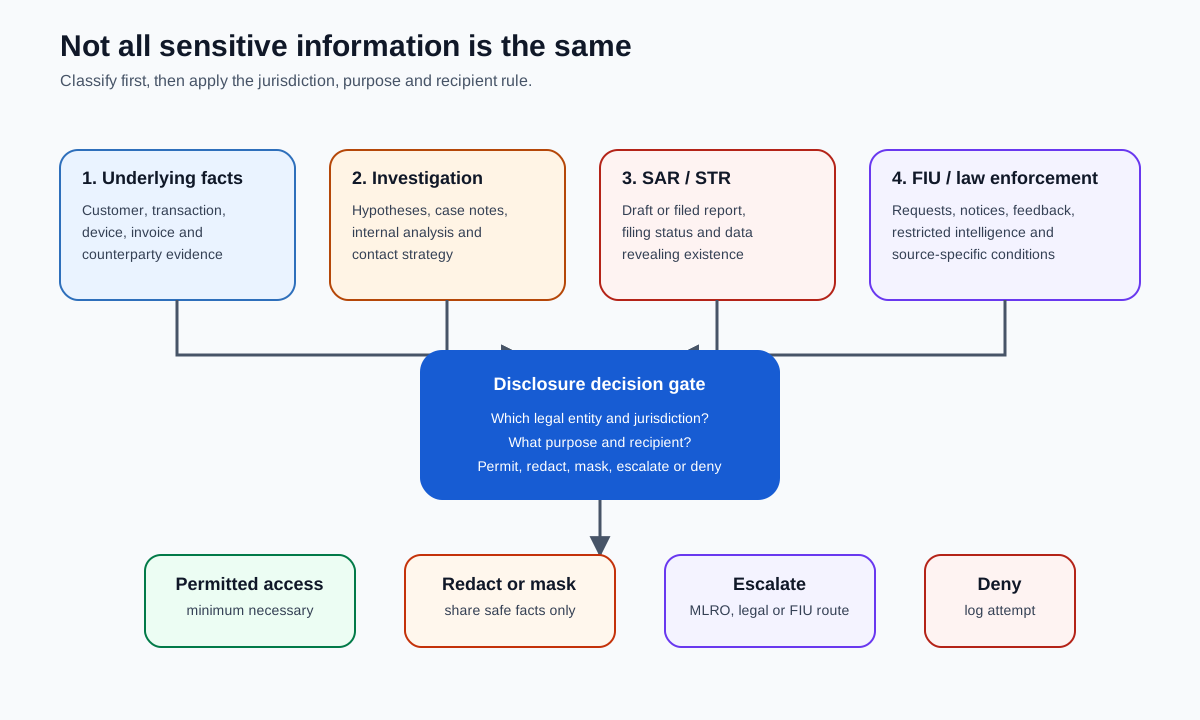
Three layers that should never be collapsed into one rule
The first layer is the statutory tipping-off prohibition. Its scope is jurisdiction-specific. In the United States, a SAR and information that would reveal the existence of a SAR are confidential. In the United Kingdom, the regulated-sector tipping-off offence under the Proceeds of Crime Act is concerned with specified disclosure and whether the disclosure is likely to prejudice an investigation. Under the current EU framework, Article 39 of Directive (EU) 2015/849 prohibits specified disclosure to the customer or third parties that information is being, will be or has been transmitted under the suspicious-reporting provisions, or that a money-laundering or terrorist-financing analysis is being or may be carried out, subject to defined exceptions. Australia changed its tipping-off offence on 31 March 2025 to focus on whether disclosure of protected information would or could reasonably be expected to prejudice an investigation. These examples illustrate why one global script cannot simply quote one country’s rule.
The second layer is SAR or STR confidentiality. A bank should distinguish the report itself, information revealing whether a report exists, supporting material, and the underlying facts that existed independently of the report. Those categories are not always treated identically. U.S. guidance is especially useful in illustrating the distinction: the SAR and information that would reveal its existence are confidential, but underlying facts, transactions and supporting documents do not become SAR-confidential merely because they were used in a SAR. In September 2026, FinCEN and the federal banking agencies reinforced that SAR confidentiality does not prevent appropriate customer communications about potentially fraudulent transactions, suspicious activity or account closures, provided the communication does not disclose a SAR or its existence.
The third layer is broader investigation and information confidentiality. Even where a particular fact is not legally protected as SAR or STR information, the bank may still need to restrict it because of privacy law, employment duties, legal privilege, law-enforcement restrictions, contractual obligations, information-security policy, need-to-know principles or operational risk. A customer’s identity documents, an investigator’s hypothesis, a confidential law-enforcement request and a whistleblower referral may all be sensitive for different reasons. Treating them all as “SAR data” creates legal confusion; treating them all as ordinary case notes creates leakage risk.
For architecture and business analysis, the distinction should become metadata rather than tribal knowledge. A case object should not have only a binary confidential = true flag. It should record the information class, legal entity, reporting jurisdiction, source, sensitivity, disclosure constraints, permitted recipient groups, effective period and, where applicable, the reason an exception is permitted. A user interface can then apply a policy decision to the data rather than asking every employee to remember every rule.
When tipping-off risk actually begins
A second common mistake is to assume tipping-off risk starts only after the FIU accepts a report. In reality, risk can arise earlier because customer communication may reveal that the bank is considering a suspicious-activity report or conducting an analysis that a jurisdiction protects. The exact legal boundary varies, so the bank needs a state model tied to local law and policy.
A useful operating lifecycle is: initial signal; investigation opened; suspicion assessment; filing decision; report preparation; report submission; FIU acknowledgement or further request; post-filing monitoring; and case closure. Each stage should have its own disclosure status. Before suspicion exists, normal customer contact may be entirely appropriate. During investigation, some questions may still be necessary to understand the transaction, but the wording and timing can become sensitive. After a filing decision, the control may become stricter. After submission, SAR or STR confidentiality and any local tipping-off prohibition must be applied precisely. Post-filing, customer-service and relationship teams may need approved scripts because the relationship itself continues.
The same event can sit in different states for different reasons. A payment may be held because of fraud risk, sanctions screening, missing information, operational repair or AML investigation. If the customer asks why the transfer is delayed, the answer should reflect the real operational state without exposing protected information. A generic “compliance review” response may sometimes be safer than a detailed explanation, but even that phrase should be approved within local policy because repeated or overly specific wording can itself signal what is happening.
The bank should also avoid false statements. Confidentiality does not justify inventing a technical failure, blaming another bank or saying that a payment is “randomly selected” if that is untrue. Misleading customers can create conduct, complaint, litigation and trust problems. The better design is a small library of truthful, non-disclosive communication patterns aligned to specific process states.
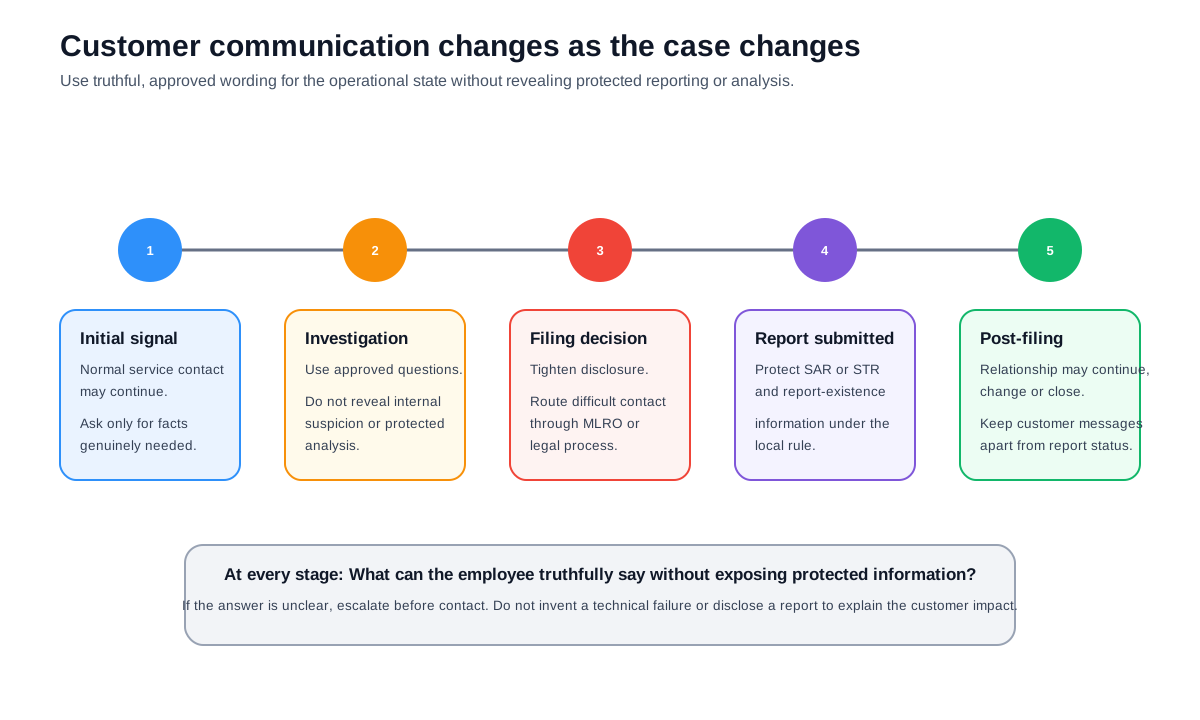
The customer conversation is part of the control
Customer-facing teams are where many practical failures occur. A relationship manager may know a customer well and want to “help” by warning that a transaction is attracting compliance attention. A call-centre agent may see a cryptic case code and try to explain it. A payments operator may paste an internal hold reason into a customer-visible field. A complaint handler may obtain screenshots from a case system. None of these people need malicious intent for a damaging disclosure to occur.
Banks therefore need to design communication as a controlled process. The customer should receive enough information to understand what action is required from them, what service state exists and what formal rights or complaint channels are available, but not protected information about a SAR, STR or sensitive investigation. If additional documents are genuinely needed for CDD or transaction review, the request should be framed around the information requirement rather than the bank’s suspicion. “Please provide the invoice and shipping document supporting this transfer” is different from “we suspect this payment may be laundering and need proof that it is legitimate.”
Questions asked during an investigation deserve particular care. An investigator may need to contact the customer to resolve an innocent explanation. In some jurisdictions and circumstances that can be permitted; in others, particular disclosures or timing may create risk. The decision should be policy-led and, for difficult cases, escalated to the MLRO, legal or another designated authority. The control should never depend on an investigator improvising the legal boundary while a customer is on the telephone.
Complaint handling creates another pressure point. A customer may demand to know why an account was restricted or closed. The bank may have customer-fairness, contractual or regulatory duties to communicate certain information, while SAR or STR confidentiality limits other information. The answer is not “AML overrides everything” and not “consumer law requires full transparency.” The institution needs a jurisdiction-specific communication matrix that reconciles the relevant obligations and gives frontline teams an approved path.
The 2026 U.S. joint statement on SAR confidentiality is a useful contemporary reminder. It states that SAR confidentiality should not be interpreted as preventing financial institutions from communicating with customers about potentially fraudulent transactions, suspicious activity or account closures. That does not authorise disclosure of the SAR or its existence. It does show why a blanket “say nothing” rule can be both operationally poor and legally inaccurate.
Internal disclosure can be just as dangerous as customer disclosure
Tipping-off training often focuses on the customer, but internal leakage is a major control problem. A broad distribution list, an open collaboration channel, a shared spreadsheet, an unredacted management pack or a CRM note visible to thousands of employees can spread sensitive information far beyond the people who need it. Once information is copied into multiple systems, later deletion rarely restores control.
Need-to-know access should be based on role and purpose, not seniority or curiosity. A senior salesperson does not automatically need to know that an STR was filed. A fraud investigator may need underlying transaction facts but not the existence of an AML report. A sanctions analyst may need party data and disposition history but not a confidential law-enforcement request. An auditor may require access for assurance, but the access should be controlled, logged and proportionate.
This is where data classification and entitlement design become practical AML controls. The case platform should support field-level or object-level restrictions for highly sensitive information. Search results should avoid exposing report titles or “SAR filed” indicators to users who lack permission. Exports should be limited and logged. API responses should enforce the same policy as the user interface. Data warehouses and analytics copies should not silently widen access. Lower environments should use masked or synthetic data rather than production case details.
Privileged access also needs scrutiny. Database administrators, platform engineers and support teams may technically be able to see data even if the application denies it. The bank should identify those paths, minimise standing privilege, use just-in-time access where feasible, log exceptional access and subject it to independent review. A system is not confidential merely because the case screen has a padlock icon.
Sharing within groups and across borders
Large banking groups want to share financial-crime intelligence because criminals use multiple products, entities and countries. The control challenge is to enable legitimate information sharing without unlawfully transferring protected report information.
FATF’s standards recognise the value of group-wide information sharing and explicitly state that Recommendation 21 is not intended to inhibit information sharing under Recommendation 18. That does not mean every SAR or STR can be copied anywhere in the group. Domestic laws can impose specific restrictions, and FIU information may carry use limitations. The institution should separate the need to share risk intelligence from the legal ability to share a filed report or its existence.
A practical approach is to define shareable information products. One product may contain customer and transaction facts that exist independently of a report. Another may contain a typology or risk signal stripped of report-existence information. A restricted product may contain report metadata accessible only within a permitted legal and operational boundary. The same underlying case can therefore support group risk management without indiscriminate dissemination.
Cross-border transfer adds privacy, bank-secrecy, data-localisation and FIU restrictions. The legal basis should be assessed for both source and recipient jurisdiction. If a U.S. entity is involved, current FinCEN guidance permits broad cross-border information sharing under the BSA in many circumstances but continues to prohibit sharing SARs or information that would reveal SAR existence except as specifically permitted. Other jurisdictions have their own rules. “Global policy” should never be used as a substitute for the applicable local restriction.
FIU information deserves its own handling model
Banks do not only send information to FIUs. They may receive requests for additional information, feedback, dissemination-related communications or other sensitive government information. FATF Recommendation 29 and related standards require strong protection for FIU information. Egmont Group principles likewise emphasise confidentiality and controlled information exchange between FIUs.
A bank should preserve the source and handling restriction of FIU-originated information. It should not be copied into a general customer note merely because the information concerns that customer. The case platform should allow source-specific restrictions, expiration or review dates where appropriate, and an audit trail showing who accessed the material and for what purpose.
The need is especially clear when a bank operates in multiple countries. An FIU request delivered to one legal entity may not automatically be shareable with another entity. Investigators should know whether they can use the information only for a specific purpose, whether onward disclosure requires consent, and which escalation route applies if another part of the group needs the intelligence.
Information architecture: classification before access
A mature control starts by classifying information at creation. A practical hierarchy could include ordinary customer and transaction information; sensitive investigation information; SAR or STR report information; information revealing report existence; law-enforcement or FIU-restricted information; and legally privileged material. The labels should reflect the bank’s actual legal and operational obligations and should not be copied blindly from another institution.
Classification should follow the data as it moves. If a case summary is exported to a document, the classification should be retained. If an event is sent to a data lake, the sensitive fields should remain tagged. If a report is generated for management, the system should know whether the audience is entitled to report-existence information. This is more reliable than placing a warning banner on one application while allowing unrestricted downstream copies.
The technical policy engine can evaluate user role, legal entity, purpose, jurisdiction, case state and information class. It can then allow, mask, redact or deny. Human override may be necessary, but it should require a reason, appropriate approval and logging. Overrides should be reviewed for patterns because repeated overrides often reveal a poor entitlement model or a business process that the original design did not understand.
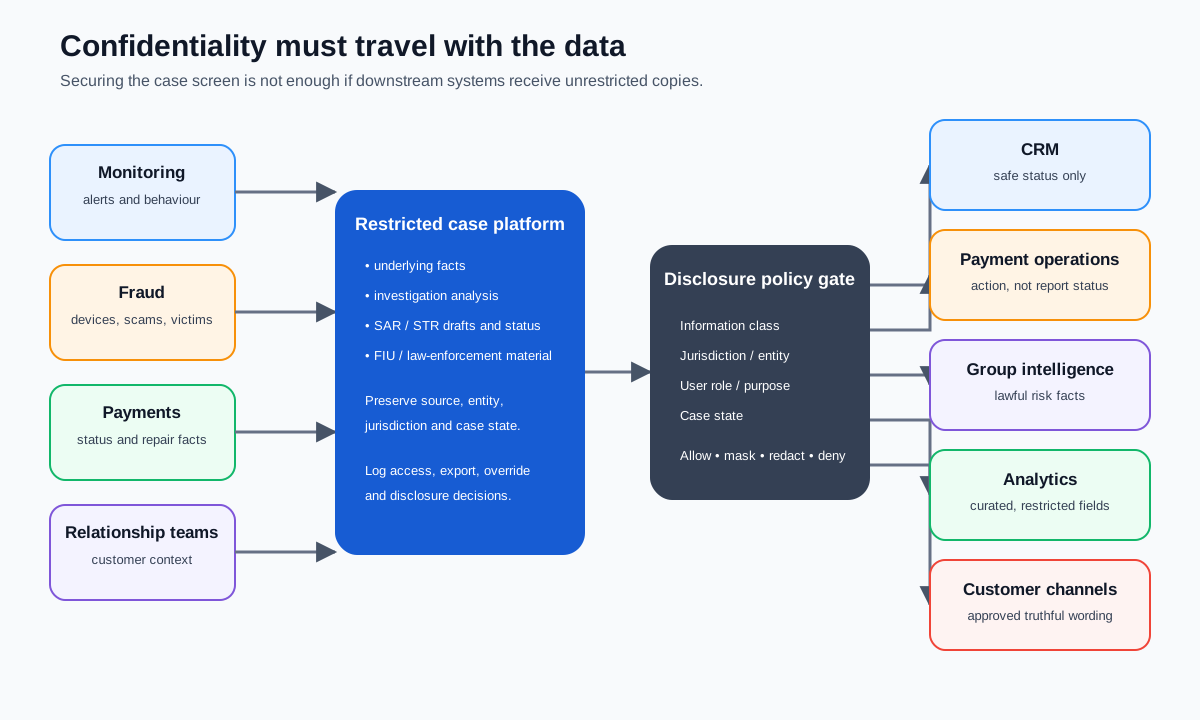
Automated notifications are a hidden tipping-off channel
Modern banking systems communicate constantly. Push notifications announce payment delays. Email templates explain account restrictions. Chatbots answer why a transfer failed. Case systems create service tickets. Fraud engines send step-up messages. These channels can expose sensitive information even if every employee understands the policy.
Notification design should therefore be included in the control inventory. Each customer-visible event should identify the internal reason code and the permitted external message. Internal reason codes should never be copied directly to the customer. A code such as AML_SAR_PENDING might be useful inside a restricted case system and completely inappropriate in a payment status API.
The same applies to third parties. A payment processor, correspondent bank, fintech partner or outsourced operations provider may receive status information. The bank should define what is necessary for the third party’s role and avoid disclosing more. Contractual confidentiality helps but does not replace statutory analysis. The question is not only “is the vendor trusted?” but “is the disclosure legally permitted and operationally necessary?”
Testing must include notification paths because production incidents often arise from configuration rather than deliberate employee disclosure. A tester should trigger a sensitive case state and inspect mobile notifications, web messages, API responses, statements, email, SMS, service-desk tickets, data exports and operational dashboards. If any of them reveal the investigation or report, the control has failed even if the case application itself is secure.
What a defensible case record should contain
The case record should capture the disclosure decisions that matter. If customer contact is made during an investigation, record the purpose, approved script or question set, decision owner, time and outcome. If information is shared with another group entity, record the legal or policy basis, recipient and information class. If a report is filed, preserve the filing decision, submission evidence and access restrictions.
The record should not become a second source of unnecessary sensitive detail. Investigators should write factual, professional notes that explain the analysis without inflammatory labels or speculative statements. A note such as “customer is obviously laundering” is both analytically weak and risky if exposed. A better note states the observed facts, contrary evidence, gaps and conclusion.
Retention must follow applicable law and policy. Deleting sensitive material prematurely can obstruct investigation, assurance or legal obligations. Retaining it indefinitely increases privacy and cyber risk. The bank should have a controlled retention schedule by information class and jurisdiction, with legal hold capability where needed.
Governance and ownership
The first line owns many of the leakage points: customer communication, payment messaging, CRM access, operational tickets and partner interactions. Financial-crime compliance defines the control standard and challenges implementation. The MLRO or equivalent reporting authority owns or oversees key reporting decisions according to local arrangements. Legal interprets difficult disclosure boundaries. Information security and privacy teams govern access, transfer and protection. Technology implements the controls. Internal audit provides independent assurance.
Those roles should be explicit because tipping-off problems often fall between teams. Compliance may assume technology has restricted access. Technology may assume all users who can see the case are authorised by compliance. Customer service may assume a “compliance hold” template has been legally approved. Legal may assume operations uses the latest script. A RACI is helpful only if each responsibility is tied to a tangible control or decision.
Policy should identify the legal entities and jurisdictions covered, the categories of protected information, permitted sharing, prohibited disclosure, customer-contact rules, escalation, breach response and recordkeeping. Procedures should translate that into the exact steps employees take. Training should use realistic scenarios rather than a single warning not to “tip off the customer.”
Breach response
A suspected confidentiality breach should be treated as an incident, not merely a coaching issue. The bank should preserve evidence quickly: who disclosed what, to whom, by which channel, when, and whether the recipient acted on the information. The bank should determine which legal or regulatory regimes apply, whether the disclosure could prejudice an investigation, whether personal data was exposed and whether regulator, FIU, law enforcement, privacy office or another authority must be notified.
Containment may include revoking access, recalling a message where possible, disabling a template, stopping an automated notification or restricting an export. The bank should avoid “fixing” the record in a way that destroys evidence. Root-cause analysis should distinguish human error, unclear policy, entitlement failure, poor system design, insufficient training and intentional misconduct.
The response should also assess investigation impact. If the customer now knows that the bank filed or may file a report, behaviour can change. Funds may move, devices may change, associates may be warned and evidence may disappear. The investigator and relevant authority may need to alter the monitoring or enforcement plan. That is why breach response belongs inside the financial-crime operating model rather than only in information security.
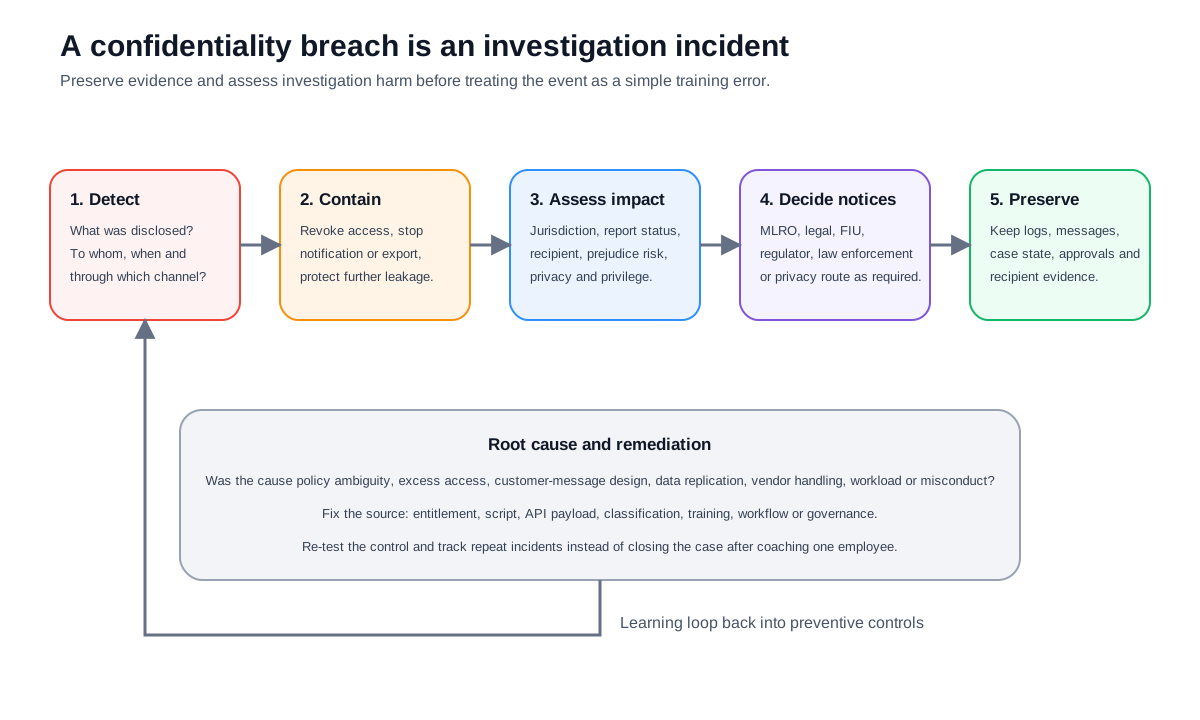
Practical case: the “helpful” relationship manager
Consider a corporate customer that has banked with the institution for six years. Transaction monitoring identifies a new pattern of rapid transfers to several overseas companies. The activity does not match the customer’s historical trade profile. An investigator opens a case and obtains invoices that do not fully explain the flows. The reporting team concludes that the threshold for an STR is met in the relevant jurisdiction and submits the report.
The customer’s relationship manager sees that several payments are being reviewed and calls the investigator. The manager says the customer is important and asks whether “an STR has gone in.” The investigator should not answer that question merely because both people work for the bank. The first question is whether the relationship manager is entitled to know that information. In many operating models the answer will be no.
The manager then calls the customer and says, “Compliance is looking closely at these international payments, so make sure everything is clean.” That statement could create tipping-off risk depending on the jurisdiction, facts and whether it reveals protected analysis or reporting. It is also operationally dangerous because it may cause the customer to alter behaviour before law enforcement or the FIU can act.
The better process is to give the relationship manager an approved customer message based on the payment state, for example that the bank requires additional documentation or that the payment is subject to review under the bank’s normal controls, if that wording is legally and factually appropriate. The manager need not know whether an STR exists. The investigator records the communication decision and the permitted information. If the customer asks directly whether the bank filed a report, the manager follows the approved escalation path rather than improvising.
This case demonstrates the central principle: confidentiality should be engineered around roles and decisions. Trust in an employee’s discretion is useful but not sufficient.
Practical case: fraud contact after a U.S. SAR
A U.S. bank detects an elderly customer sending repeated instant payments to a newly added beneficiary. Fraud operations contact the customer and learn that the customer believes the beneficiary is a government agent requesting “safe account” transfers. The bank files a SAR because the facts indicate suspected exploitation and possible mule activity.
A weak reading of SAR confidentiality might cause the bank to stop all customer contact. That would harm the customer and is not what the current U.S. framework requires. The bank can continue to warn the customer about the fraud risk, discuss suspicious transactions and explain account or payment controls, provided it does not reveal that a SAR was filed or disclose information that would reveal its existence. The September 2026 joint agency statement specifically clarifies this point.
The operational design should therefore separate fraud_warning_required from sar_exists. Customer-service tooling can permit the fraud warning while hiding SAR metadata. Fraud and AML teams can coordinate on underlying facts under approved controls without putting “SAR FILED” in a broadly visible CRM note.
Practical case: Australia’s harm-based test
An Australian reporting entity submits a suspicious matter report concerning transactions that may involve fraud and laundering. A staff member later considers telling an external adviser that an SMR has been made. Under the Australian tipping-off framework that took effect on 31 March 2025, the analysis focuses on protected information and whether the disclosure would or could reasonably be expected to prejudice an investigation, subject to applicable exceptions.
The practical lesson is not that Australian staff have freedom to disclose. It is that the rule is legally different from a blanket global prohibition. The bank’s Australian procedure needs the local test, the protected-information categories and the permitted-disclosure routes. A global policy can set a conservative baseline, but the local procedure should preserve the legal reasoning rather than silently importing the U.S. SAR rule or EU Article 39 wording.
What auditors and regulators should be able to reconstruct
A reviewer should be able to pick a sensitive case and trace the information lifecycle. Which data elements were classified? Who could see report-existence information? Did the CRM show only permitted facts? Were customer communications generated from approved templates? Did any data export or API expose restricted fields? Were exceptions approved and logged? Did the bank retain evidence of FIU submission and acknowledgement? Were privileged-user accesses reviewed?
Sampling should include ordinary cases as well as incidents. A control that works only when employees know they are being tested is weak. Reviewers should choose cases with relationship-manager involvement, complaints, account closures, law-enforcement contact, cross-border sharing and outsourced processing because those are natural disclosure pressure points.
Metrics should measure more than training completion. Useful indicators include inappropriate-access attempts, privileged-access events, use of override functions, restricted-field exports, policy exceptions, communication-template defects, confidentiality incidents, recurrence by root cause, and time to contain a breach. Metrics need context: zero incidents can mean excellent control or no detection.
BA, architecture and testing perspective
A business analyst should turn legal and policy requirements into observable behaviour. Requirements should identify the protected information class, user role, case state, customer channel, legal entity, jurisdiction, permitted action, prohibited action, override owner and audit evidence. Vague requirements such as “system must prevent tipping off” are not testable.
An architect should map every copy of sensitive data: case database, search index, analytics platform, document repository, CRM, customer-notification service, logging platform, data lake, API cache, backup and lower environment. The access model should be consistent across those copies. Token or field masking should occur before data reaches a consumer that is not entitled to see it.
A tester should build positive and negative scenarios. Positive tests prove that authorised investigators can access the material they need and that permitted customer communication still works. Negative tests prove that unauthorised users cannot infer report existence through search, exports, errors, APIs or notifications. Boundary tests cover changes in case state, role, legal entity and jurisdiction. Failure-mode tests cover unavailable policy services, stale entitlements, delayed directory updates and manual workarounds.
A production-readiness test should also inspect the human workflow. If the system blocks a field but the procedure instructs staff to copy the data into an unrestricted spreadsheet, the technical control is meaningless. The end-to-end test therefore follows the case through people, systems and communications.
Key takeaways
Tipping-off and confidentiality are not the same thing. Tipping-off is a legal prohibition whose precise scope depends on jurisdiction. SAR or STR confidentiality protects particularly sensitive reporting information. Broader investigation confidentiality also arises from privacy, security, FIU restrictions and other legal or policy duties.
A good bank control does not respond by making all financial-crime information invisible. It classifies information, limits access according to purpose, separates underlying facts from report-existence information, controls customer communication, preserves legitimate intra-group cooperation where lawful and records the reasoning behind exceptions.
The strongest implementation is one in which frontline staff do not have to guess what they may say, investigators do not have to improvise who may see a report, and technology does not leak sensitive status through APIs, notifications or analytics. Confidentiality becomes part of the operating architecture rather than a sentence at the end of a training module.
References and further reading
The detailed authoritative source list used for this chapter is maintained in the chapter references supplement. The key global baseline is FATF Recommendation 21, supported by FATF information-sharing standards. Jurisdiction examples are drawn from current official U.S., UK, EU and Australian sources and are deliberately presented as examples rather than universal rules.
Operational deep dive: where confidentiality fails in real bank processes
The base chapter established the distinction between statutory tipping-off, SAR or STR confidentiality and broader investigation confidentiality. This deep dive follows those distinctions through the operational places where banks most often create disclosure risk: customer servicing, payment investigations, relationship management, complaints, account restrictions, group intelligence sharing, third-party operations and technology support.
The purpose is not to create a longer list of “do not disclose” rules. It is to show how a bank can preserve the legal boundary while still running normal services. The strongest control is one in which the employee sees the right information for the task and receives an approved action path. The weakest is one in which everybody can see everything and is expected to remember what not to say.
Start with the information, not the employee
Many confidentiality programmes begin by defining trusted and untrusted people. That framing is too crude. A customer-service employee may be perfectly trustworthy but have no need to know that a SAR exists. A senior executive may have legitimate oversight needs but not require transaction-level report details. A specialist investigator may need the full case for one legal entity but not have authority to view FIU information supplied to another.
The better question is: what information is this, and what purpose would disclosure serve? Every important data object should have an information classification. At minimum, the bank should be able to distinguish ordinary customer facts, investigation-sensitive information, filed or draft report content, information revealing report existence, law-enforcement or FIU-restricted material, and privileged legal advice.
Those labels should be attached as close to creation as possible. If an investigator creates a draft narrative, the system should know it is report content. If an FIU sends a request, the source should be preserved. If a relationship manager provides a commercial explanation, that fact may be usable more widely than the investigator’s suspicion assessment. If a document contains mixed information, the most sensitive element may determine the default handling unless the document can be segmented.
This design reduces the temptation to solve every problem with one restricted case folder. It also supports proportionate sharing. Fraud teams can receive the underlying beneficiary and device facts they need without automatically seeing SAR metadata. Payment operations can see a customer-action request without seeing the investigation hypothesis. Senior management can receive aggregated metrics without customer-identifiable narratives.
A disclosure decision is a transaction
Banks already treat payments as transactions with initiator, beneficiary, amount, authorisation and audit trail. Sensitive information disclosure should be treated with similar discipline. A disclosure has a sender, recipient, information class, purpose, legal entity, jurisdiction, channel, time and decision basis.
For routine permitted disclosures, the policy engine may make the decision automatically. For example, an assigned AML investigator may access a case for the entity they support. A quality reviewer may open the same case under an assurance role. A customer-service agent may see a masked status and approved message. Each access is still logged.
For non-routine disclosure, the workflow should require an explicit decision. Suppose a group intelligence team asks for information from a filed STR. The investigator should not rely on “we are all one bank.” The request should identify the data needed and the purpose. The system or reviewer should determine whether the requested material can be shared, whether only underlying facts can be provided, whether report-existence information must be removed, and whether local legal or FIU approval is required.
This transaction mindset produces better evidence. Months later, a reviewer can see not only that a user opened a case, but why access was permitted and what information left the original control boundary.
Customer contact before a filing decision
Early-stage investigation is operationally difficult because the bank may genuinely need information from the customer. A new corporate payment may have no obvious commercial purpose. A large incoming transfer may conflict with the customer profile. A payment message may contain incomplete remittance data. Asking the customer for an invoice, contract or explanation can be reasonable and may resolve the alert.
The control question is how to ask without disclosing a protected analysis. A request should focus on the factual gap. “Please provide the contract supporting payment reference X” is a factual information request. “Our AML team thinks this payment looks suspicious” reveals an internal assessment and may create legal or investigation risk.
The bank should define when investigators may contact customers directly, when the relationship manager must act as the channel and when contact requires MLRO or legal approval. High-risk circumstances can include law-enforcement interest, a planned or filed report, suspected organised crime, rapidly movable funds, or a situation where the wording itself may reveal that a protected analysis is underway.
A well-designed case system can support a contact plan. It records the question to be asked, who approved it, who will contact the customer, and the response. The customer-facing employee sees only the approved questions. They do not need to see the investigation narrative.
Payment holds, delays and returns
Payment processing creates visible customer impact, which invites questions. A transaction may be delayed for sanctions screening, fraud review, AML escalation, insufficient information, scheme repair or operational outage. The external explanation should match the permissible level of detail for that state.
A dangerous design is to expose internal reason codes directly. SANCTIONS_TRUE_MATCH_REVIEW, AML_INVESTIGATION, SAR_DECISION_PENDING or similar labels should never flow automatically into customer messages. Even a less explicit phrase can be risky if it consistently maps to one protected state.
The bank should maintain a translation layer between internal status and external communication. A payment might be externally described as “under review” or “additional information required” where accurate and permitted. The wording should be approved by compliance, legal, conduct and operations as appropriate, and should be specific enough for the customer to know what they can do next.
Some processes require the bank to reject or return a payment. The external reason may be constrained by scheme rules or law. The financial-crime team should participate in the design of return codes and free-text fields so that required transparency does not inadvertently reveal a report or investigation. Where a scheme requires a reason, the bank should choose the most accurate permitted code rather than inventing a false operational explanation.
Account restriction and closure
Account restrictions are among the most sensitive situations because the customer experiences a major service impact. The bank may freeze assets under sanctions law, restrict activity for fraud prevention, impose risk controls, comply with a court order, or decide to exit a relationship for commercial or financial-crime reasons. These are legally different events.
A confidentiality control should not collapse them into one “AML closure” process. The decision record should state the authority and rationale. Customer communication should be generated from that authority. A sanctions freeze may have reporting and communication rules different from a risk-based closure. A fraud restriction may require active victim contact. A court order may contain express non-disclosure requirements.
Where a relationship exit follows suspicious activity, the bank should separate the exit decision from the SAR or STR decision. A report may be filed and the relationship retained. A relationship may be exited without a report. The existence of one should not be exposed merely to explain the other.
The U.S. September 2026 interagency statement is particularly helpful here because it rejects the assumption that SAR confidentiality prevents banks from communicating about account closures. The bank may communicate the closure according to its legal and contractual obligations while still protecting the SAR and its existence.
Complaints and data-access requests
Complaints teams often demand a complete record to investigate whether the bank treated the customer fairly. That legitimate need can collide with SAR confidentiality, law-enforcement restrictions, privilege and data-protection exemptions.
The case system should therefore support a complaint-safe view or a controlled extraction process. The complaint reviewer can receive the facts needed to assess service quality without automatically receiving protected report information. If the complaint turns on a decision that cannot be fully disclosed, a designated legal or compliance reviewer should help determine what can be shared internally and what can be explained externally.
Data-access requests create a similar challenge. A customer may seek copies of personal information held by the bank. Privacy law often contains exemptions or limitations relevant to financial-crime, law-enforcement or regulatory material, but the details vary by jurisdiction. Frontline privacy teams should not decide SAR disclosure questions from first principles each time. The bank needs a documented escalation route between privacy, legal and financial crime.
The key design principle is segmentation. If ordinary account records and protected investigation notes are stored together without classification, every access request becomes a manual forensic exercise. If the records are tagged and separated, the bank can apply the correct review.
Relationship managers and commercial pressure
Relationship managers are valuable sources of customer knowledge. They may understand the customer’s business, counterparties and commercial cycles better than investigators. That makes them important contributors to investigations, but it does not automatically entitle them to the reporting outcome.
A good workflow asks the relationship manager targeted factual questions: Does the customer normally trade with this country? Is this counterparty known? Did the customer notify the bank of a new business line? The relationship manager can provide evidence without being told that a SAR is under consideration.
Commercial pressure becomes risky when employees infer that an important customer deserves more disclosure. “Tell me what compliance is worried about so I can smooth this over” is precisely the situation where boundaries matter. Seniority and revenue should not override confidentiality rules.
The bank should also protect the relationship manager. If the system exposes a filed-report flag, the employee is placed in a difficult position during customer calls. Better access design means they do not have information they are prohibited from sharing unless they genuinely need it.
Fraud and AML collaboration
Fraud and AML teams increasingly work the same events: scams, mule networks, account takeover, exploitation and rapid payment movement. Collaboration is essential. Poor confidentiality design can either block useful collaboration or over-share SAR information.
The solution is to share the underlying evidence deliberately. Fraud teams may need device fingerprints, beneficiary history, authentication events, call notes and transaction patterns. AML teams may need the fraud narrative, victim information, linked accounts and network indicators. Those facts can often be exchanged under the bank’s lawful internal information-sharing framework.
The existence or content of a SAR should be separately controlled. A joint case view can show “AML review required” without showing “SAR filed on date X” to every fraud analyst. Where a user genuinely needs report information, a higher permission can reveal it.
This separation also improves analytics. A fraud model should not use SAR existence as an unexplained target variable if doing so would spread confidential information into broad model-development datasets. The bank can create approved labels based on underlying outcomes or typologies with governance over their derivation.
Law-enforcement requests and production orders
Law-enforcement involvement changes the confidentiality risk materially. A request may contain instructions not to notify the customer, or the surrounding law may restrict disclosure. The bank must preserve the request, validate its authority and route it through the designated legal or financial-crime process.
The customer-facing teams should not be able to infer law-enforcement interest from an unrestricted note. A CRM comment such as “police investigation - do not tell customer” is an obvious control failure. The case system should expose only the operational action needed by the frontline, such as a restriction or escalation instruction, without the sensitive source.
If a subpoena or court request seeks SAR material, U.S. rules are particularly strict. FFIEC guidance states that a bank generally must decline to produce a SAR or information revealing its existence outside permitted exceptions and should contact FinCEN and the relevant federal banking agency. Other jurisdictions have their own regimes. The bank’s legal response playbook should therefore identify SAR or STR material before producing case records.
Outsourcing and shared service centres
Banks often use shared service centres or third-party vendors for alert review, KYC operations, payment repair or customer support. Outsourcing the activity does not outsource the legal responsibility.
The contract should define confidentiality, access, permitted use, data location, onward subcontracting, incident notification and return or deletion. More importantly, the technical environment should enforce those limits. A vendor analyst should see only cases within the agreed scope. Their access should be logged and revocable. Download and local-copy capability should be minimised.
Training should reflect the jurisdiction and process the vendor supports. A generic global training package that says “never disclose anything” is not enough. The vendor needs to know the approved customer scripts, escalation routes and system restrictions relevant to its tasks.
Exit planning matters too. If a vendor relationship ends, access should cease promptly, locally held extracts should be accounted for and retention obligations should be reconciled with deletion requirements.
Email, chat and collaboration tools
Informal tools are a frequent source of leakage because they are convenient and searchable. An investigator may paste a SAR narrative into chat to ask for help. A manager may email a spreadsheet of reported customers to a broad group. A case number may appear in a meeting invitation visible to assistants.
The bank should define which tools are approved for which information classes. Highly sensitive report content may need to remain inside the case platform or a restricted document repository. Where collaboration tools are permitted, sensitivity labels, restricted channels, data-loss prevention and retention controls should be configured.
Searchability is often overlooked. A confidential message in a collaboration tool may be discoverable by eDiscovery administrators or integrated search services. The architecture review should identify these hidden audiences.
Automated meeting transcription and generative assistants create additional exposure. If a financial-crime meeting is transcribed into a broadly accessible workspace, the confidentiality boundary is defeated. The bank should decide which meetings and data classes may use such features and configure defaults accordingly.
Data lakes, analytics and model development
Investigation data is attractive for analytics because it contains rich labels. Copying the entire case dataset into a data lake can, however, widen access dramatically.
The bank should define a curated analytics product rather than a raw unrestricted replica. Fields revealing SAR or STR existence should be excluded, tokenised or separately controlled unless the use case genuinely requires them. Free-text narratives are particularly sensitive because they may contain names, law-enforcement information, legal advice and report details.
Data scientists should receive documented data-use conditions. Model features and outputs should be reviewed to ensure they do not reconstruct protected information indirectly. A model that predicts “reported to FIU” may itself create a report-existence inference if deployed broadly.
Non-production environments should use synthetic or de-identified data where feasible. Refreshing a test database from production without masking can expose confidential case data to developers, testers and vendors who were never intended to see it.
Logging without leaking
Audit logging is essential, but logs can become another copy of sensitive content. Application logs should record access events, decisions and technical errors without writing full narratives, customer documents or report content unless strictly necessary.
A good log might record that user A viewed restricted object B under role C at time D. It does not need to print the SAR narrative. If a failed API call includes a sensitive payload, the logging framework should redact it.
Security monitoring can then detect unusual behaviour: bulk case access, repeated denied searches, exports outside normal hours, privileged-user access and cross-entity browsing. These signals support insider-risk and confidentiality controls without replicating the protected data.
Joining confidentiality to role design
Role-based access control is a starting point, not an end state. Large banks often accumulate roles until thousands of users can see sensitive material. Role design should be paired with attribute-based conditions where appropriate: legal entity, geography, assigned case, purpose, case state and information class.
Joiner-mover-leaver controls are critical. An investigator moving to another business should lose access promptly. Temporary project roles should expire. Privileged access should be time-bound. Orphaned accounts and shared credentials should be prohibited.
Periodic recertification should use meaningful information. A manager should see which permissions each user holds and why, not merely approve a long list of cryptic application roles. High-risk entitlements deserve more frequent review.
Quality assurance for confidentiality
Quality assurance should sample both content and access. Content review asks whether investigators used appropriate wording, classified information correctly and followed customer-contact procedures. Access review asks whether only authorised people viewed or exported the case.
The sample should include complex events: account closure after filing, relationship-manager escalation, complaint, fraud crossover, cross-border group sharing, law-enforcement request and vendor handling. These scenarios expose boundaries that simple cases do not.
QA findings should be categorised by root cause. If several incidents involve a CRM field, the solution is a system change. If staff repeatedly choose the wrong script, the procedure or training may be unclear. If managers approve exceptions without rationale, governance needs improvement.
A controlled decision tree for customer communication
When a customer question reaches an employee, the first question is not “is this AML?” It is “what operational event am I authorised to discuss?” If the event is ordinary service information, normal communication applies. If it is linked to a sensitive investigation, the employee should use the approved message for that state.
If the customer directly asks whether a report was filed, the employee should not confirm or deny unless a jurisdiction-specific process expressly permits a response. The question should be routed to the designated team. “I cannot comment on internal reporting” may be an approved response in some organisations, but even standard wording should be vetted because local law and customer context matter.
If the customer provides new evidence, the frontline should be able to capture it without exposing the investigation. The evidence can be routed into the restricted case. This keeps the customer journey functional while protecting sensitive status.
Mini case: a payment investigation crosses three systems
A corporate customer sends a high-value cross-border payment. Transaction monitoring creates an alert. The investigator identifies unusual counterparties and opens an AML case. Payment operations separately sees a repair item because beneficiary information is incomplete. The CRM shows that the customer has already called twice.
In a weak design, the AML case writes “SAR under consideration” into a common notes table. Payment operations sees it and copies the phrase into a service ticket. The call-centre agent sees the ticket and tells the customer that “the suspicious activity team is deciding whether to report you.” No single person intended a breach; the architecture made one likely.
In a strong design, the AML case stores report-status metadata inside a restricted object. Payment operations receives only the operational instruction: obtain complete beneficiary information and route the payment back for review. The CRM shows an approved message that the transfer requires additional information. The investigator can see the customer’s response and decide whether it changes the analysis. Access logs prove that no unauthorised user saw report status.
The difference is not better employee memory. It is information segmentation and workflow design.
Mini case: group intelligence sharing
A bank’s entity in Country A files an STR about a corporate customer. The customer also banks with affiliates in Countries B and C. Group financial crime wants to know whether the pattern is broader.
The source entity first separates underlying facts from report metadata. It shares permitted customer, counterparty and transaction indicators through the group intelligence process, subject to local law and privacy controls. Country B identifies similar activity and opens its own investigation. Country C has no relevant activity.
The group does not simply upload the filed STR into a global shared folder. If report information needs to be shared, the bank applies the specific legal and policy route for that disclosure. This preserves useful group intelligence without assuming that a report filed in one jurisdiction is freely portable.
Testing catalogue
A serious UAT pack should include at least the following categories even if individual tests are implemented differently.
First, access tests: assigned investigator can see full case; unassigned investigator is denied or masked; relationship manager cannot see report status; QA reviewer can access under an assurance role; privileged support access is logged.
Second, customer-channel tests: case-state changes produce the correct external message; internal reason codes never surface; chatbot and API responses match the approved message; statements and notifications do not reveal protected status.
Third, data-movement tests: exports retain classification; analytics feeds exclude restricted fields; lower environments are masked; search indexes do not expose hidden text; backups and restores preserve permissions.
Fourth, workflow tests: customer contact requires the right approval; cross-border sharing records purpose and basis; law-enforcement material is restricted; complaint extraction removes protected content; breach workflow preserves evidence.
Fifth, failure-mode tests: policy service unavailable, directory entitlements stale, case integration delayed, notification template missing, user attempts manual workaround. The system should fail safely without making the business process impossible.
What good looks like
A mature confidentiality control is almost invisible to most employees. Frontline teams see the information they need and a truthful approved customer message. Investigators have full evidence within their scope. Compliance can control reporting information. Legal can intervene in difficult disclosure cases. Technology enforces the boundary consistently across applications and APIs. Audit can reconstruct access and decisions without obtaining unnecessary standing access.
That outcome is much stronger than a policy that simply tells everybody to be careful. It turns tipping-off and confidentiality into an engineered control with data, roles, workflow, evidence and assurance.
Advanced practice: legal scoping, architecture decisions and control assurance
This supplement turns the chapter into implementation decisions for programmes that operate across legal entities, jurisdictions and technology stacks. The most important discipline is to stop treating “tipping off” as a universal label and instead model the exact disclosure constraint that applies to the information in front of the bank.
Build a jurisdiction rule, not a folklore rule
A global bank usually begins with a conservative group principle: suspicious-report information and sensitive investigation material should be handled on a strict need-to-know basis. That is a sensible control baseline, but it should not erase local law.
The rule inventory should identify, for each relevant legal entity and jurisdiction, the reporting regime, the protected information, the prohibited recipient or disclosure, whether a prejudice or harm test applies, statutory exceptions, permitted group sharing, regulator or FIU disclosure routes, customer-communication constraints, breach obligations and the authoritative source. Each rule should have an owner and effective date.
This matters because legal wording changes. Australia’s tipping-off offence changed on 31 March 2025 from the former model to a prejudice-focused test. The United States issued fresh interagency clarification on 2 September 2026 explaining that SAR confidentiality does not prevent appropriate communication about fraud, suspicious activity or account closure. A static training slide written years earlier can therefore become an operational defect.
Rule versioning should be visible in the case record. If a reviewer later examines a disclosure made in 2024, the bank should be able to show which rule applied at that time rather than applying the 2026 rule retrospectively.
FATF Recommendation 21 as the baseline, not the local law
FATF Recommendation 21 contains the global policy architecture. It expects legal protection for financial institutions, directors, officers and employees that report suspicions in good faith, even where the underlying criminal activity was not precisely known or did not occur. It also expects a legal prohibition on disclosing that an STR or related information is being filed with the FIU.
That is a baseline for country frameworks, not a transaction-level legal opinion. A bank cannot determine a customer communication simply by citing FATF. It must apply the law and guidance governing the relevant entity.
FATF also says Recommendation 21 is not intended to inhibit information sharing under Recommendation 18. This point should appear in group policy because over-conservative implementations can damage group-wide risk management. The correct design protects report information while enabling lawful exchange of customer and transaction intelligence.
United States: protect SAR existence without disabling customer contact
The U.S. rule is unusually explicit about SAR confidentiality. The SAR itself, and information that would reveal whether a SAR exists, are confidential. Banks should also have procedures for responding to subpoenas or other requests that seek protected SAR information.
The September 2026 joint statement from FinCEN and the federal banking agencies is operationally important. It clarifies that the confidentiality rules do not prohibit banks from communicating with customers about potentially fraudulent transactions, suspicious activity or account closures. The bank must still avoid revealing the SAR or its existence.
This should change system design. A SAR_FILED attribute should never be used as the customer-facing reason for a restriction. Instead, customer actions should be driven by independent operational facts: fraud risk, transaction review, missing information, account terms or another lawful reason. The SAR metadata remains restricted.
It also changes training. Staff should not be taught that any conversation after a SAR is automatically prohibited. They should be taught the actual protected boundary and given approved scripts.
United Kingdom: focus on the regulated-sector offence and investigation prejudice
UK policy should reflect the Proceeds of Crime Act framework and current UKFIU guidance. The NCA describes tipping-off provisions in sections 333A to 333E and emphasises the risk of revealing information in a way likely to prejudice an investigation following a disclosure.
For operational teams, the practical question is not whether the phrase “SAR” appears in a conversation. The question is what is being disclosed, the source of the information, the relevant statutory provision or exception, and whether the disclosure can prejudice an investigation. Difficult cases should follow the MLRO or legal escalation path.
A UK procedure should also distinguish the separate offence of prejudicing an investigation and any law-enforcement-specific restriction. Staff should not collapse several legal concepts into a single training slogan.
European Union: current Article 39 framework and the 2027 transition
For 2026 operations, Directive (EU) 2015/849 remains a key current framework. Article 39 prohibits obliged entities and their directors and employees from disclosing to the customer or other third parties that information is being, will be or has been transmitted under Articles 33 or 34, or that money-laundering or terrorist-financing analysis is being or may be carried out, subject to the Article’s exceptions.
Article 39 also contains important permitted-sharing provisions, including defined situations within groups and certain same-profession contexts, and provides that efforts by specified professionals to dissuade a client from illegal activity do not constitute prohibited disclosure. Those details demonstrate again why “never share anything” is not the legal model.
The EU’s 2024 AML package changes the architecture substantially, but most of the new core requirements are not simply to be treated as already applicable in September 2026. A bank preparing for the 2027 transition should maintain separate “current obligation” and “future-state implementation” records. Training should not accidentally describe future rules as present law.
Australia: the 2025 prejudice-based offence
Australia’s amended tipping-off offence commenced on 31 March 2025. AUSTRAC explains that the offence focuses on disclosure of protected information where the disclosure would or could reasonably be expected to prejudice an investigation. Protected information includes specified SMR information and certain information connected with AUSTRAC notices.
This is a useful case study in legal change management. A bank that retained an older blanket description of the Australian offence could misstate the current law. The rule library should record the commencement date, protected-information categories, relevant exceptions and the current AUSTRAC guidance.
Australia’s broader AML/CTF reforms also brought newly regulated sectors into the regime from 1 July 2026. That expansion increases the number and variety of firms that need practical tipping-off controls, making accurate training and workflow design even more important.
Information-sharing architecture
A global bank should define at least four sharing products.
The first is underlying facts: customer identity, transactions, counterparties, device data, invoices and other facts that exist independently of a SAR or STR. These may be shareable under applicable law and policy even where report information is not.
The second is risk intelligence: a derived typology, network indicator, behavioural pattern or risk concern that has been reviewed for lawful sharing. This can help another entity detect related activity without revealing report existence.
The third is investigation-sensitive material: hypotheses, internal analysis, legal advice and law-enforcement context. Access is narrower and should be tied to purpose.
The fourth is report and FIU information: draft or filed SAR/STR content, report-existence indicators, submission identifiers, FIU acknowledgements and restricted FIU communications. This generally requires the strongest control and jurisdiction-specific sharing rules.
System interfaces should identify which product they carry. A generic “case export” endpoint is difficult to govern because it mixes all four.
Data model and minimum attributes
For each sensitive object, the bank should consider storing:
information_classsource_systemoriginating_legal_entityreporting_jurisdictioncase_statecontains_report_existence_informationcontains_fiu_or_law_enforcement_informationpermitted_recipient_groupsharing_restriction_codeeffective_fromeffective_topolicy_rule_versionoverride_statusoverride_approverretention_classification
Not every institution will implement these exact fields, but the underlying questions need answers. Without them, policy engines and auditors rely on inference.
The data model should avoid encoding legal conclusions into ambiguous booleans. tipping_off = false is not meaningful without knowing which jurisdiction, information and disclosure are being assessed.
Entitlement decision logic
An entitlement service can evaluate five dimensions: user identity, role, entity scope, case assignment and information class. A sixth dimension, purpose, becomes important for audit and exceptional access.
For example, a relationship manager assigned to the customer may view underlying customer facts but not report information. An AML investigator assigned to the case may view investigation-sensitive material and report drafts. A quality reviewer may view report content under a QA purpose. A platform administrator may administer infrastructure without standing access to decrypted narratives.
Where a business process needs exceptional access, the service can require step-up approval and create an expiring permission. The audit trail should record the requester, approver, reason, scope and duration.
Customer-message decision service
Banks with many channels benefit from centralising customer-message logic. The service receives the internal process state and returns an approved external message or an escalation requirement.
It should never expose restricted internal codes. A channel may send PAYMENT_REVIEW_CUSTOMER_INFO_REQUIRED and receive a message asking for documents. Another state may return NO_AUTOMATED_MESSAGE so the case is routed to a trained team.
The decision service should be versioned by jurisdiction and product. A card fraud message, a cross-border payment review and a legal account freeze can require very different communication.
Channel teams should not locally override wording because “mobile needed something shorter.” Any shortened message must preserve the same disclosure boundary.
Evidence design
Every sensitive disclosure exception should leave evidence. The evidence should answer: what was shared, with whom, for what purpose, under which rule, who approved it, and when.
For routine access, application logs may be sufficient. For cross-border sharing or customer contact during a high-risk investigation, the case should record a more explicit decision.
Evidence should be immutable enough to support later review. Editing a case note should preserve history. An approval should not disappear when the approver changes role. Time should be stored consistently, with timezone or UTC handling appropriate to the platform.
Breach severity model
Not every confidentiality mistake creates the same harm. Severity assessment can consider:
- whether report existence or report content was disclosed;
- whether FIU or law-enforcement information was involved;
- the recipient, including whether they are a subject of the investigation;
- whether the disclosure could prejudice an investigation;
- whether funds, evidence or persons may now move;
- whether personal or privileged information was exposed;
- whether the disclosure was isolated or systemic;
- which jurisdictions and notification duties apply.
The severity model should guide containment and escalation, but it should not replace legal analysis. A low-volume disclosure to the subject of a sensitive investigation can be more serious than a large internal distribution to an authorised assurance team.
Control testing and assurance
Design effectiveness asks whether the control, if operated as designed, would protect the relevant information. Operating effectiveness asks whether it actually did so.
A design test can inspect the entitlement matrix, customer-message rules, cross-border sharing procedure, vendor controls and incident playbook. An operating test can sample real cases and access logs.
Technical testing should include attempts to infer restricted information. Search for a customer from an unauthorised role. Query APIs directly rather than only through the UI. Inspect browser payloads for hidden fields. Export reports. Review data-lake tables. Test autocomplete and global search. Examine error messages and notification history. A control can look secure on screen while leaking data in the payload.
Red-team style tests can be useful within ethical and authorised boundaries. For example, can an employee without case access determine whether a SAR exists by observing a change in status code, queue, workflow timestamp or API response size? Indirect inference can undermine nominal field restrictions.
BA acceptance criteria examples
A requirement such as “relationship managers must not see SAR status” should become testable acceptance criteria:
Given a relationship manager who owns the customer relationship but has no AML investigation role, when the customer has an open or filed SAR/STR case, then the manager’s CRM and search results show no SAR/STR existence indicator, filing date, report identifier or investigation narrative.
Given a customer-service agent handling a payment under sensitive review, when the agent opens the payment, then the interface displays only the approved external status and any customer action required; internal AML reason codes are not returned to the browser or channel API.
Given an authorised investigator requesting cross-entity information sharing, when the requested package contains report-existence information, then the workflow applies the relevant jurisdiction rule and requires the configured approval before transfer.
Given a privileged administrator accessing encrypted case content under break-glass authority, then the system records the justification, approver, fields accessed and expiry, and generates an independent review event.
These criteria are more useful than statements that the system “must comply with tipping-off rules.”
Negative test catalogue
Negative tests should cover accidental as well as deliberate paths.
A user without access searches by customer name and should not receive a restricted case title. A relationship manager exports customer notes and should not receive restricted investigation fields. A mobile app requests payment status and should not receive internal reason codes in JSON. A monitoring dashboard should not expose subject names where only aggregate metrics are needed. A lower environment refresh should not contain live SAR narratives. A notification service outage should not fall back to an unapproved verbose error message. A chatbot should not answer “yes” when asked whether an account has an AML investigation.
A batch interface should also be tested because many leaks occur outside interactive screens. CSV files, reconciliation reports, queue extracts and email attachments can defeat a strong online entitlement model.
Positive test catalogue
Confidentiality should not make the system unusable. Positive tests prove that authorised work still happens.
Investigators can see enough underlying data to make a decision. Quality reviewers can access sampled cases. Legal can review a difficult disclosure. Fraud teams can receive approved underlying facts. Customer-service teams can ask for required documents. A customer can receive a fraud warning. Group intelligence can share permitted indicators. Audit can reconstruct decisions without obtaining unnecessary standing access.
If confidentiality controls cause staff to create shadow spreadsheets and email workarounds, the design has failed even if the formal system is secure.
Metrics that indicate real control health
Useful metrics include the number of restricted objects accessed outside assigned teams, denied access attempts, break-glass uses, sensitive exports, customer-message exceptions, cross-border sharing approvals, confidentiality incidents, repeat root causes, time to contain incidents and overdue entitlement recertifications.
The bank should not set “zero access denials” as a success target. Denials can prove the control is stopping inappropriate access. A sudden fall to zero may mean logging failed.
Similarly, a rise in reported incidents can initially reflect stronger detection and reporting culture rather than deteriorating behaviour. Governance should interpret trends with context.
Mini case: SAR information in a data warehouse
A bank builds a financial-crime analytics warehouse by replicating case tables. The source system restricts SAR status to investigators, but the warehouse grants broad analyst access. A data scientist discovers a field named SAR_FLAG and uses it as a target for a customer-risk model.
The immediate problem is unauthorised access to report-existence information. The secondary problem is propagation: model outputs may now allow hundreds of users to infer which customers had SARs.
Remediation should not stop at deleting the field. The bank should identify every downstream copy, model, feature store and report. It should determine whether an incident occurred, preserve evidence, review access logs and redesign the data product so approved underlying facts are separated from report metadata.
The architectural lesson is that confidentiality controls must travel with the data.
Mini case: customer asks the direct question
A customer whose account has been restricted asks a call-centre agent, “Have you filed a suspicious activity report on me?”
The agent should not improvise a yes, no or speculative answer. The system should provide an approved response and escalation path. The exact wording depends on jurisdiction and bank policy, but it should not reveal report existence.
The agent may still be able to explain an operational fact, such as that the account is under review or that specific documentation is required, where that statement is accurate and permitted. If the customer raises a complaint, the complaint process proceeds without opening the SAR record to the entire complaints team.
The control succeeds because the bank anticipated the question.
Final implementation checklist
Before a bank calls its tipping-off control effective, it should be able to demonstrate that:
- the legal rule inventory is current and jurisdiction-scoped;
- protected information classes are defined;
- SAR/STR existence is separated from underlying facts;
- case, CRM, payment, notification, API and analytics systems enforce the same boundary;
- customer scripts are truthful, approved and state-specific;
- cross-border and intra-group sharing has defined products and approvals;
- FIU and law-enforcement information has source-specific restrictions;
- vendors and shared services operate under enforced access limits;
- privileged access is controlled and reviewed;
- incidents preserve evidence and assess investigation impact;
- BA requirements and UAT include indirect disclosure paths;
- QA and audit sample real boundary cases rather than only policy documents.
The strongest sign of maturity is not that nobody ever sees sensitive information. It is that every sensitive disclosure has a legitimate purpose, an applicable rule, the minimum necessary content and an evidence trail.
References and further reading
The chapter uses the following public, authoritative sources. Jurisdiction-specific material is included as an example of how legal rules differ; it is not presented as a universal rule.
Global standards
- Financial Action Task Force (FATF), The FATF Recommendations: https://www.fatf-gafi.org/en/publications/Fatfrecommendations/Fatf-recommendations.html
- FATF, Methodology for Assessing Technical Compliance with the FATF Recommendations and the Effectiveness of AML/CFT/CPF Systems: https://www.fatf-gafi.org/en/publications/Mutualevaluations/Fatf-methodology.html
- FATF, Consolidated FATF Standards on Information Sharing: https://www.fatf-gafi.org/content/dam/fatf-gafi/recommendations/Consolidated-FATF-Standards-information-sharing.pdf
- Egmont Group, Principles for Information Exchange Between Financial Intelligence Units, revised July 2025: https://egmontgroup.org/wp-content/uploads/2022/07/EG-Principles-for-Information-Exchange-Revised-July-2025.pdf
United States
- Financial Crimes Enforcement Network (FinCEN) and the federal banking agencies, Joint Statement on Suspicious Activity Report Confidentiality Considerations Regarding Communications with Customers, 2 September 2026: https://www.fincen.gov/news/news-releases/fincen-agencies-issue-joint-statement-suspicious-activity-report-confidentiality
- Federal Financial Institutions Examination Council (FFIEC), BSA/AML Examination Manual – Suspicious Activity Reporting: https://bsaaml.ffiec.gov/manual/AssessingComplianceWithBSARegulatoryRequirements/04
- FinCEN, Cross-Border Information Sharing by Financial Institutions and SAR Confidentiality, 5 September 2025: https://www.fincen.gov/resources/statutes-regulations/guidance/cross-border-information-sharing-financial-institutions-and
United Kingdom
- UK National Crime Agency, UK Financial Intelligence Unit, Suspicious Activity Reports: https://www.nationalcrimeagency.gov.uk/what-we-do/crime-threats/money-laundering-and-illicit-finance/suspicious-activity-reports
- UK National Crime Agency, Contact the UKFIU / SAR Confidentiality Breach Line: https://www.nationalcrimeagency.gov.uk/contact-us/contact-us-sars
European Union
- EUR-Lex, Directive (EU) 2015/849, including Article 39 and the suspicious-reporting provisions: https://eur-lex.europa.eu/legal-content/EN/TXT/?uri=CELEX:32015L0849
Australia
- AUSTRAC, New tipping off offence now in effect, 31 March 2025: https://www.austrac.gov.au/news-and-media/article/new-tipping-offence-now-effect
- AUSTRAC, Tipping off: https://www.austrac.gov.au/industry-and-business/obligations-and-guidance/your-amlctf-program/reporting-us/tipping-off
These links should be checked again whenever the bank changes policy or local procedures because legislation, regulator guidance, FIU practice and permitted information-sharing arrangements can change.