Account Restriction, Freezing, Closure or Monitoring
When a financial-crime investigation reaches the point where the bank has enough concern to act, the hardest question is often not whether something looks suspicious. The harder question is what the bank should do with the customer, the account and the transactions while legal obligations, customer rights, operational risk and investigative value all pull in different directions.
The four words in this chapter title are therefore not interchangeable. Monitoring means the relationship remains usable while the bank applies a defined level of scrutiny and follow-up. Restriction means the bank deliberately limits one or more capabilities, such as outgoing payments, cash withdrawals, new beneficiaries, cards, channels or products. Freezing is a much stronger legal concept: funds or other assets cannot be transferred, converted, disposed of or moved because an applicable legal authority requires that result. Closure means the bank terminates all or part of the relationship under law, contract, policy and risk appetite, normally after considering whether the risk can be managed safely by lesser measures.
A fifth outcome matters just as much: continue without extra restriction. Financial-crime controls are not designed to punish unusual customers. The risk-based approach requires judgement. A credible explanation, satisfactory evidence and a manageable residual risk can justify continuing the relationship, even where an alert, adverse-media item or suspicious-looking payment initially created concern.
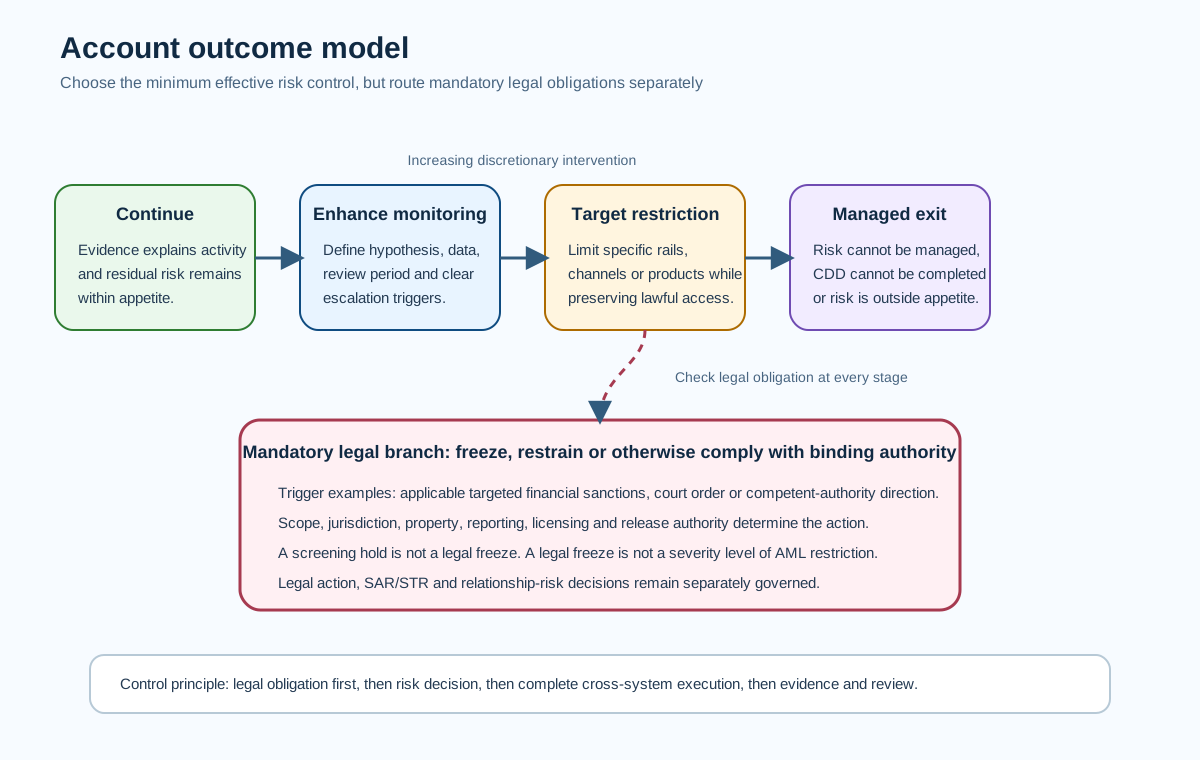
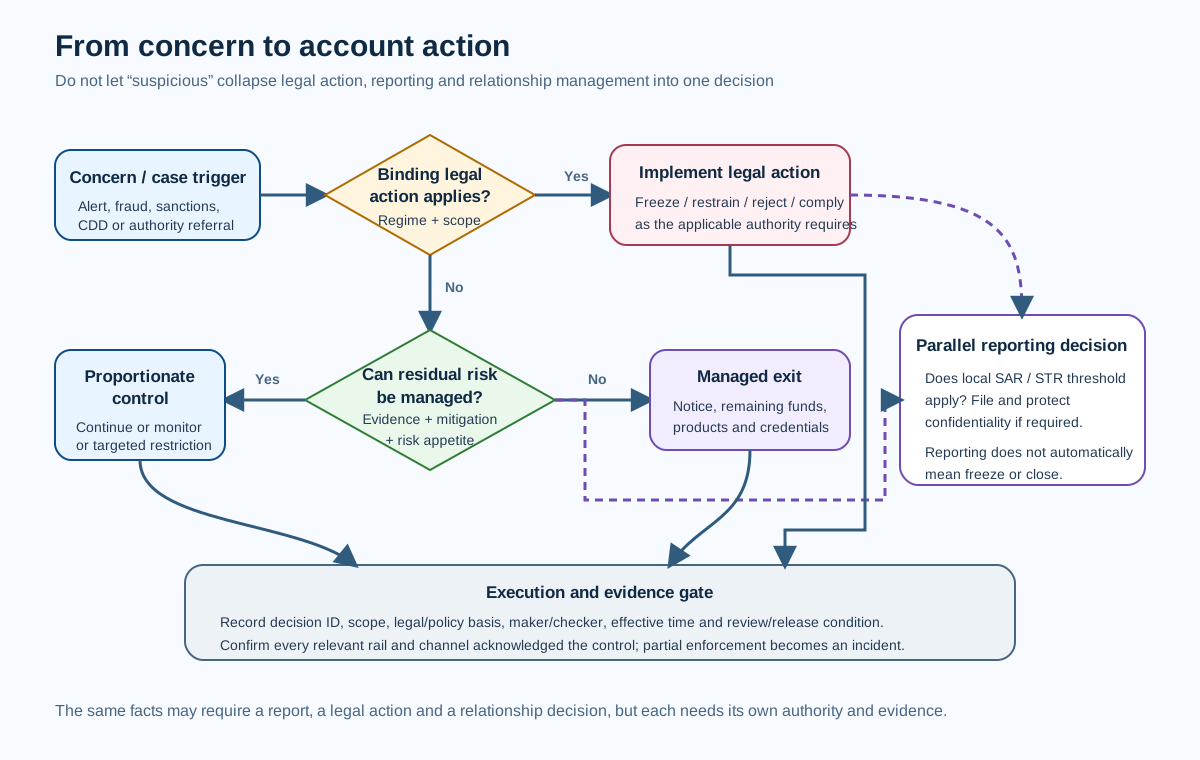
The central mental model is simple: legal obligation first, then risk decision, then operational execution, then evidence. A bank must first ask whether any law, sanctions measure, court order or competent-authority instruction imposes a mandatory action. If no mandatory action applies, the bank asks whether the residual financial-crime risk can be mitigated. It then chooses the least confusing operational control that actually implements the decision. Finally, it records enough evidence for another competent reviewer to reconstruct what happened and why.
Why banks need more than a binary open-or-close decision
Real customers rarely fit a clean yes-or-no pattern. A retail customer may have received scam proceeds but plausibly be a victim rather than a mule. A corporate customer may have a legitimate business but suddenly route payments through an unexplained high-risk corridor. A correspondent respondent may remain acceptable overall while one nested flow requires containment. A sanctions alert may be unresolved for several hours while the bank establishes identity, ownership and legal nexus. A law-enforcement agency may prefer a suspicious account to remain open for investigative reasons. A customer may also be high risk without being unacceptable risk.
If the only tools available to operations are “leave open” and “close”, teams are pushed into bad decisions. They either keep activity fully enabled when a targeted control would have reduced risk, or they exit customers simply because the bank lacks a more precise mechanism. Mature banks therefore design a graduated set of control outcomes that can be applied at relationship, account, product, channel and transaction level.
A useful control hierarchy starts with observation. The bank may increase review frequency, add event-driven triggers or place the customer into a specialist monitoring segment. It may then introduce targeted friction, for example requiring additional approval for high-risk payments or disabling a vulnerable channel while leaving essential account functionality available. More serious cases may justify broader restrictions or a managed exit. Mandatory legal freezes sit outside that discretionary hierarchy because the bank is implementing a legal prohibition, not merely choosing a conservative risk posture.
This distinction protects both the bank and the customer. It prevents an internal financial-crime concern from being described inaccurately as a legal freeze. It also prevents a genuine sanctions blocking obligation from being treated as optional risk appetite. The wording used in case notes, system statuses, customer communications and management information should preserve that difference.
The global standard does not create one universal closure rule
FATF provides the international AML/CFT standards, but account restriction and closure are implemented through national law, regulatory expectations, private contract and institution-specific risk appetite. FATF Recommendation 10 requires customer due diligence and ongoing understanding of the relationship. Recommendation 20 requires suspicious transaction reporting where the applicable suspicion threshold is met. Recommendation 21 addresses tipping-off and confidentiality. Recommendations 6 and 7 address targeted financial sanctions related to terrorism, terrorist financing and proliferation financing. The FATF Glossary also distinguishes freezing from confiscation and other asset-control concepts.
These standards do not mean that every suspicious customer must be closed. FATF has repeatedly cautioned against wholesale de-risking. Its risk-based approach expects institutions to identify and assess risk, apply proportionate measures and terminate relationships on a case-by-case basis where the risk cannot be mitigated or where law requires termination. The February 2025 amendments to the FATF Standards increased the emphasis on proportionality and financial inclusion, and the June 2026 Recommendations remain the current global reference point for this chapter.
Local law can create more specific outcomes. In the United States, for example, OFAC-administered sanctions distinguish blocking property from rejecting prohibited transactions where there is no blockable interest. U.S. financial institutions also operate under Bank Secrecy Act requirements and FinCEN guidance, including the possibility that law enforcement may ask a bank to maintain an account for a defined period while an investigation continues. In the European Union, the EBA has issued guidance on managing ML/TF risk when providing access to financial services and has warned that rejecting or terminating entire categories of customers without an individual risk assessment can amount to unwarranted de-risking. In the United Kingdom, FCA work on account access and closures has similarly highlighted financial-crime concerns as a major operational driver while scrutinising whether closure decisions are properly governed.
The professional lesson is not to memorise one jurisdiction and apply it everywhere. A global bank needs a decision framework that can attach the relevant legal entity, customer location, account booking location, product, payment route, sanctions nexus, court or authority instruction and contractual terms to the same case. Only then can the correct local action be selected.
Five different questions that must not be collapsed
A strong investigator separates five questions that weak processes often combine.
Is the activity suspicious? This is an AML or financial-intelligence judgement based on the facts, customer profile, transactions, typologies and available explanation. Suspicion may lead to an STR or SAR, but it does not automatically answer whether the account should be closed.
Is any property legally required to be frozen? This is a legal or sanctions question. A confirmed designated-person interest, court order or other binding authority may require the bank to prevent movement of assets. The legal basis, jurisdiction and exact scope matter.
Should a transaction be stopped, rejected, delayed or repaired? A payment-level decision can differ from the relationship decision. One transaction may be prohibited or insufficiently transparent even though the customer relationship continues.
Can the relationship risk be mitigated? This is a risk-management question. Enhanced due diligence, narrower products, lower limits, restricted corridors, manual approvals, enhanced monitoring or other controls may bring residual risk within appetite.
Should the relationship end? This is a customer-exit decision. It may be required because CDD cannot be completed, the customer repeatedly frustrates controls, legal obligations prohibit service, criminal misuse is evident, risk cannot be mitigated or the relationship falls outside approved risk appetite. It may also involve contractual and consumer-protection considerations beyond AML/CFT rules.
When these questions are represented by one status such as highRisk = true, the system cannot support defensible decisions. A well-designed case record therefore keeps suspicion, legal restriction, operational restriction, relationship risk and exit decision as separate but linked objects.
Monitoring as an active control, not passive observation
“Keep monitoring” is dangerous when it is used as a vague closure reason. Monitoring is only a control if the bank states what will be monitored, for how long, against which risk hypothesis, using which data, with what thresholds and with what escalation trigger.
Suppose an import-export customer begins receiving payments from new counterparties in jurisdictions outside its expected profile. The customer provides contracts and invoices that are plausible but the change is material. The bank may decide that immediate closure would be disproportionate because the business explanation is credible and no legal prohibition applies. Enhanced monitoring can still be appropriate. The case might specify a ninety-day review window, new-counterparty concentration checks, high-risk-country thresholds, sanctions rescreening, trade-document sampling and an event trigger if funds are rapidly passed to unrelated parties.
That design is very different from simply closing the alert and hoping a future rule will fire. Effective monitoring links the original concern to measurable behaviour. It also defines an owner and review date. If the concern does not recur, the customer can return to the normal control population. If the concern strengthens, the bank can escalate with a richer evidence base.
Monitoring can operate through automated scenarios, behavioural models, specialist queues, manual periodic review or combinations of these. The control must match the risk. A customer suspected of mule activity in instant payments may require near-real-time beneficiary and velocity controls. A private-banking relationship with unexplained source-of-wealth inconsistencies may require relationship-level review rather than only payment thresholds. A sanctions-sensitive corporate relationship may require event-driven ownership rescreening and transaction interdiction rather than traditional AML monitoring alone.
Restriction as a precise risk-control tool
Restriction means reducing what the customer, account or product can do without necessarily freezing the property or terminating the relationship. It can be one of the most useful controls in financial-crime operations because it buys time, limits further exposure and avoids unnecessary all-or-nothing decisions.
Restrictions may apply to outbound payments, cash withdrawals, cards, digital banking, new beneficiaries, international transfers, specific currencies, trade-finance instruments, virtual-asset counterparties, cheque facilities or newly opened products. A bank might allow salary credits and essential direct debits while preventing rapid outbound transfers from an account under mule investigation. A corporate account might continue domestic supplier payments while high-risk cross-border transfers require manual review. A vulnerable customer affected by scam risk might temporarily have online-payment limits reduced while the fraud team establishes whether the device or credentials are compromised.
However, every restriction needs a legal and policy basis. Customer terms and conditions may permit particular protective measures, but local consumer law, payment-services rules, notice requirements, discrimination rules and access-to-basic-account regimes can constrain how restrictions are applied. Financial-crime teams therefore need pre-agreed restriction types with legal review rather than improvising account controls during each case.
Restrictions should also have explicit start conditions, review dates and exit conditions. Otherwise, temporary controls become permanent through neglect. A restricted account that remains untouched for months can create customer harm, complaints, regulatory risk and inaccurate financial reporting. Case-management systems should therefore support timers, reason codes, approvers, communication rules and automated reminders for ageing restrictions.
Freezing is not a synonym for operational hold
The word “freeze” is often used casually in banking operations, but legally it can carry a specific meaning. FATF defines freezing in the context of targeted financial sanctions as prohibiting the transfer, conversion, disposition or movement of funds or other assets owned or controlled by designated persons or entities for the duration of the applicable action. National regimes then translate that concept into binding legal obligations.
A payment screening hold while an analyst investigates a possible name match is therefore not necessarily a legal freeze. The bank may simply be preventing execution while it determines whether a prohibition applies. If the match is cleared as false, the transaction may be released. If the match is confirmed and the relevant legal regime requires blocking, the asset can then move into a blocked or frozen status with the reporting, recordkeeping and release rules required by that regime.
OFAC provides a useful jurisdiction-specific example. Under U.S. sanctions, blocked property remains owned by the blocked person but cannot be transferred or otherwise dealt in without authorisation. OFAC also distinguishes blocked transactions from prohibited transactions that must be rejected because no blockable interest is present. Those U.S. rules are important for U.S. nexus cases but should not be described as the universal model for every sanctions authority.
System design should therefore separate screeningHold, riskRestriction, legalFreeze and transactionReject. The same visible customer symptom — “payment did not leave” — can arise from very different legal states. Audit evidence must show which one applied.
Closure and exit as a governed relationship decision
Closure is sometimes the correct outcome. A bank should not continue a relationship that it is legally prohibited from servicing or whose financial-crime risk it cannot manage within approved appetite. Repeated provision of false information, deliberate evasion of controls, serious mule behaviour, unexplained criminal proceeds, unacceptable sanctions exposure or persistent inability to complete required CDD can all move the decision toward exit depending on the facts and local law.
But closure is not a substitute for investigation. Closing immediately can destroy useful intelligence, displace criminal activity to another institution and in some cases conflict with a law-enforcement request. It can also create tipping-off risk if the timing or explanation reveals that an STR or criminal investigation exists. The closure decision should therefore be coordinated with the relevant financial-crime, legal, operations and, where appropriate, law-enforcement liaison functions.
A good exit record explains the problem, the mitigation considered, why mitigation was insufficient, the legal and contractual basis, the approval level, the customer communication approach, treatment of remaining funds, linked relationships, outstanding payments, cards, loans, securities or safe-custody assets, reporting obligations and post-exit monitoring needs. For a corporate group, the bank should also decide whether the concern affects subsidiaries, beneficial owners, signatories or related accounts rather than treating one account closure as the end of the analysis.
The decision must remain individualised. FATF and the EBA have both emphasised that high-risk status alone does not require wholesale termination of entire customer categories. Risk appetite can legitimately define boundaries, but it should be evidence-based and applied through governance rather than through undocumented assumptions such as “all charities”, “all MSBs” or “all customers from country X are unacceptable”.
Customer communication and the tipping-off boundary
Restriction and closure almost always create customer contact. The customer sees a declined transfer, missing card functionality, an inaccessible account or a termination notice and wants an explanation. The bank must communicate lawfully and fairly without disclosing protected information such as the existence of a suspicious transaction report where local law prohibits that disclosure.
This does not mean staff must become evasive or refuse all explanation. The United States issued a joint agency statement in September 2026 clarifying that SAR confidentiality requirements do not prevent banks from communicating with customers about potentially fraudulent or suspicious activity or account closures, provided the bank does not reveal the existence of a SAR. Other jurisdictions have their own confidentiality and tipping-off rules, so scripts and escalation guidance must be locally approved.
Operationally, this means front-line staff need reason-specific communication playbooks. A technical outage, fraud-protection hold, sanctions legal freeze, AML risk restriction and commercial closure should not all produce the same vague message. The customer-facing wording can remain appropriately limited while the internal reason code remains precise. Staff should also know when a complaint, vulnerability indicator, hardship concern or legal challenge requires specialist escalation.
The control architecture behind the decision
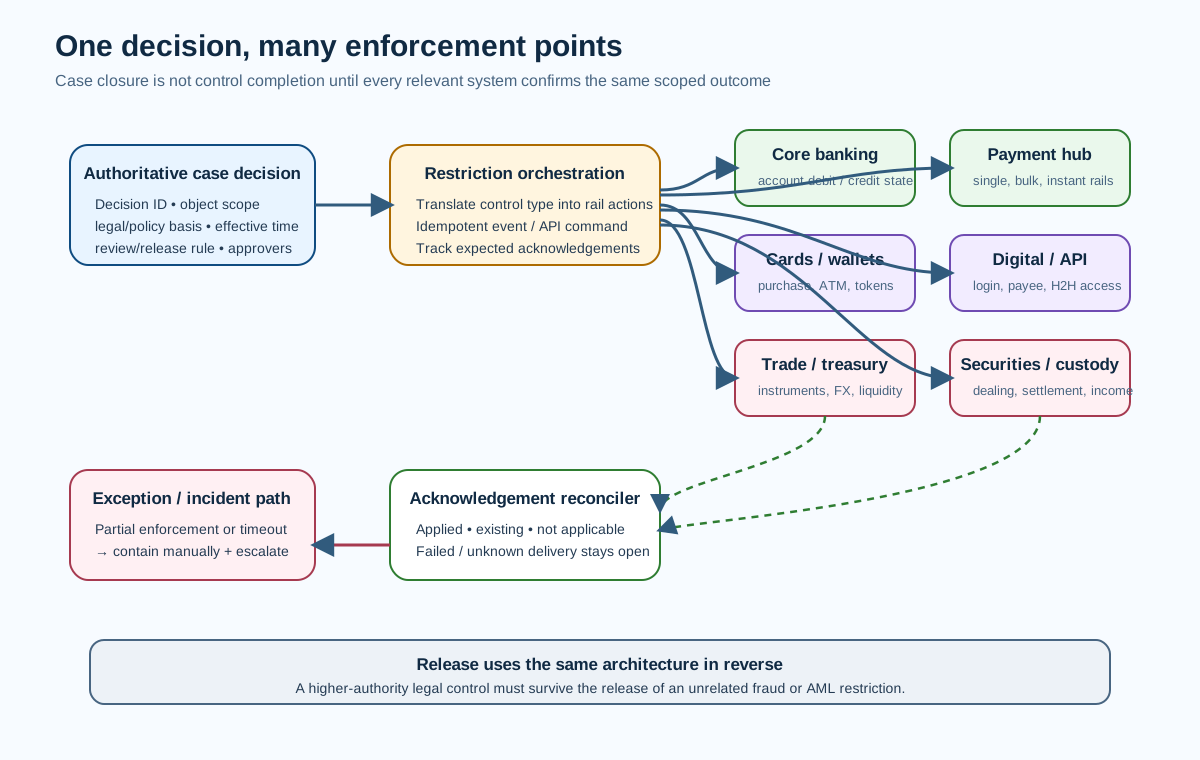
A mature bank does not rely on one case-management screen to implement these outcomes. The investigation platform may create the decision, but downstream systems must enforce it. Core banking controls account status. Payment hubs control execution. Card processors manage card permissions. Digital channels manage login and beneficiary functions. Trade systems manage instruments and document release. Securities platforms manage dealing and custody. Sanctions engines manage interdiction and blocked-property workflows. Customer master data supplies party and relationship context. Data platforms support network analysis, management information and audit reconstruction.
The central design problem is synchronisation. If the case system marks an account restricted but the instant-payment rail continues to accept outbound payments for five minutes, the control may fail exactly when criminals move fastest. If the core account is frozen but a linked card wallet still has usable value, the bank can create leakage. If a relationship is closed in the customer master but a corporate API credential remains active, operational access survives the policy decision.
Controls therefore need a consistent decision identifier, effective timestamp, scope, reason, legal basis, expiry or review date, approver, communication code and downstream acknowledgement. Each consuming platform should return success or failure so operations can see whether the restriction is fully implemented. A high-risk decision with partial technical enforcement should be treated as an incident, not as a completed case.
Data that makes the decision defensible
The investigation should bring together customer profile, beneficial ownership, products, accounts, transaction history, counterparties, device and channel information, sanctions results, fraud intelligence, adverse media, prior alerts, prior reports, law-enforcement contact, complaints and relevant external evidence. The decision record then adds what action was considered, what was chosen, why, who approved it and what happened operationally.
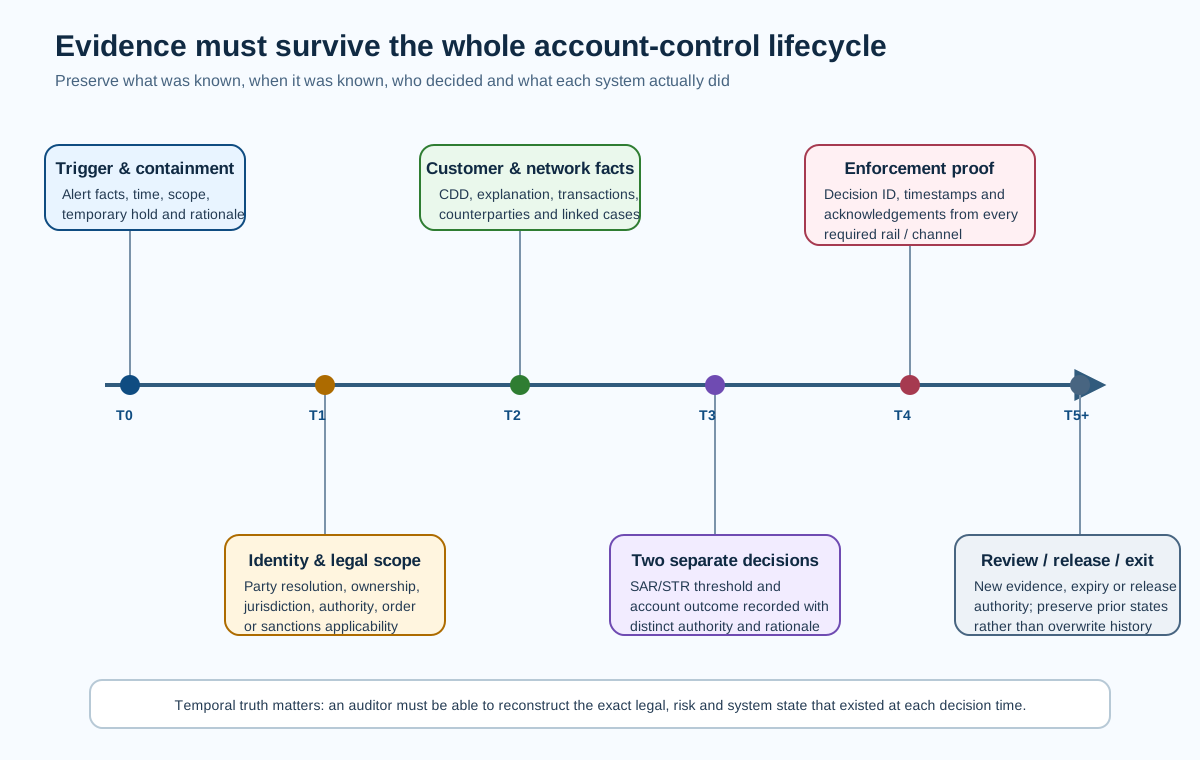
Temporal data is essential. Ownership, sanctions status, account permissions and risk ratings change. An investigator reviewing a payment from three months ago needs to know the state that existed at the time, not only today’s state. Restriction records should therefore keep effective-from and effective-to timestamps and preserve previous versions. The same principle applies to legal orders and law-enforcement requests: the bank must know when the instruction began, when it expires, which accounts it covers and whether extensions were received.
Reason codes need enough detail to support analysis without becoming a substitute for narrative. “Financial crime” is too broad. Better internal categories might distinguish confirmed sanctions block, unresolved sanctions review, suspected mule activity, CDD failure, suspected fraud victim, law-enforcement maintenance request, risk-appetite exit and contractual closure. The narrative then explains the case-specific facts.
A practical decision standard
Before restricting or exiting a relationship, a competent reviewer should be able to answer seven questions. What exactly is the risk hypothesis? Which facts support it and which facts weaken it? Is any legal action mandatory? What mitigation options are available? What customer and operational harm could each option create? Who has authority to approve the chosen action? What evidence will prove later that the decision was implemented correctly?
That standard encourages disciplined judgement rather than fear-based decisioning. It also exposes where the bank lacks capability. If the only reason for closure is “we cannot monitor this type of customer”, management should ask whether that reflects genuinely unacceptable risk or a control-design weakness that should be fixed. If the bank repeatedly restricts the same product because data arrives too late, the real issue may be architecture rather than customer behaviour.
The rest of this chapter develops these ideas into detailed operating models, testing patterns and realistic cases. The objective is not to teach one universal answer. It is to make sure that whichever answer the bank chooses — continue, monitor, restrict, freeze or close — can be connected to the correct obligation, implemented across every relevant system and defended with evidence.
Deep dive: from suspicion to a controlled account outcome
The moment a case moves from investigation into account action, the bank crosses from analysis into execution. That sounds obvious, but many control failures happen because teams continue to behave as though a case note itself changes the customer’s ability to transact. It does not. An investigator may decide at 10:03 that outbound transfers must stop, yet the account may remain fully usable until a separate operations team receives the instruction, interprets it correctly and updates the right systems. In instant-payment environments, that delay can matter more than the quality of the investigation that preceded it.
A robust operating model therefore treats the decision and the enforcement as two linked controls. The first control establishes what outcome is justified. The second proves that every relevant system implemented it. Both need evidence.
Start with the object being controlled
Banks sometimes speak about “restricting the customer” when the actual action applies only to an account or channel. That language can create unnecessary scope. A customer can own several accounts, cards, wallets and legal-entity relationships. A corporate group can have multiple subsidiaries. A beneficial owner can be connected to accounts booked in several jurisdictions. The decision should therefore identify the control object precisely.
At transaction level, the bank may hold, reject, return or refuse one payment. At payment-instrument level, it may block a card, cheque book or digital token. At channel level, it may disable online banking, APIs or telephone instructions. At account level, it may restrict debits, credits, cash access or both. At product level, it may stop trade-finance issuance or foreign-exchange dealing. At relationship level, it may prevent new products, place all linked accounts into enhanced monitoring or begin exit. At legal-person level, it may need to assess whether a sanctions or court-order scope extends beyond the named account.
This hierarchy is valuable for business analysts because requirements can then be expressed as explicit scope. “Restrict customer” is not testable. “Prevent customer-initiated outbound credit transfers and card cash withdrawals from accounts A and B, effective immediately, while allowing inbound salary credits and specified essential direct debits until legal review” is testable.
Temporary hold, operational restriction and legal freeze
These states should never share one internal code.
A temporary hold is commonly used while the bank gathers information or completes a time-sensitive control. A sanctions screening engine may hold a payment because a name resembles a listed party. A fraud engine may hold a transfer because the device is new and the beneficiary is high risk. An AML operations team may hold a manually initiated payment while reviewing an unresolved source-of-funds question where policy and local law permit that action. A hold is normally time-bound and decision-pending.
An operational restriction is an active risk decision. The bank has concluded that some capability should remain unavailable until defined conditions are met. The bank might restrict new beneficiaries for a vulnerable customer, disable international wires for a corporate customer with unexplained cross-border activity, or prevent cash withdrawals where mule activity is suspected. The restriction is not necessarily imposed by law; it may arise from contract, policy, fraud prevention, risk appetite or a combination of these.
A legal freeze exists when the applicable legal framework prohibits movement or dealing in funds or other assets. The legal trigger may come from targeted financial sanctions, a court, competent authority or other binding mechanism. The scope of the freeze must be interpreted according to that framework. A bank should not invent a general rule from a single sanctions regime. For example, OFAC’s U.S. blocking rules distinguish blocked property from prohibited transactions that must be rejected. Another jurisdiction can have different terminology, reporting deadlines, ownership tests, licensing mechanisms and release procedures.
These differences matter in data design. A temporary hold needs a target resolution time. A policy restriction needs a review date and mitigation condition. A legal freeze needs a legal basis, authority, jurisdiction, reporting status and release authority. If one status field is used for all three, operations may release property that cannot legally be released or may treat a temporary review as though the customer’s property has been formally frozen.
Relationship exit is a process, not a button
Closing a relationship safely usually requires more work than opening it. The bank must decide what happens to balances, pending payments, incoming transfers, cards, standing orders, direct debits, securities, loans, guarantees, trade instruments, safe-custody assets and digital credentials. It must also decide whether the customer may open another account, whether linked entities are affected, whether the customer remains subject to monitoring after notice is issued and how complaints or legal challenges are handled.
The exit date can itself create risk. If the bank gives thirty or sixty days’ notice, what controls apply during that period? If the relationship is suspected of laundering criminal proceeds, allowing unrestricted activity during notice may be unacceptable. If the account is the customer’s only access to essential funds, an immediate exit can create significant harm and may conflict with local requirements. The control design should therefore separate the decision to exit from the execution plan for exit.
An exit plan can include restricted functionality, enhanced monitoring, transaction pre-approval, defined permitted payments, daily case review or accelerated closure where contract and law allow. The plan should also address incoming funds after closure, because payments can continue to arrive against old account details. Returning those funds blindly can create sanctions, fraud or money-laundering problems if the bank does not know the source or legal status.
When continued monitoring is the stronger decision
Financial-crime teams can become biased toward visible action. Closing an account feels decisive, while monitoring can be criticised as indecision. That is a mistake. Monitoring can be the stronger control where the evidence is incomplete but the risk is manageable, where law enforcement has investigative interest, where closure would displace activity without reducing system-wide risk, or where the customer’s legitimate activity can be separated from the risk through targeted conditions.
The important point is that monitoring must have a hypothesis. Suppose a business customer has received several large third-party payments inconsistent with its historic profile. The customer explains that it has launched a marketplace business and provides contracts, a website and new merchant agreements. The bank still has concerns because the settlement flows include high-risk geographies and rapid onward transfers. Instead of immediate exit, it could require refreshed KYB evidence, restrict high-risk corridors, monitor third-party payment concentration and require a review after a defined period.
The monitoring outcome should specify what would cause de-escalation and what would cause escalation. De-escalation might require stable counterparties, transaction behaviour consistent with the revised business model and no new adverse information over the review period. Escalation might be triggered by unexplained beneficiary changes, use of unrelated personal accounts, repeated high-risk-country transfers or contradictory customer explanations.
Without those criteria, “enhanced monitoring” becomes a parking place for difficult cases.
CDD failure and inability to manage risk
One of the clearest reasons a bank may need to restrict or exit a relationship is persistent inability to satisfy required customer due diligence. However, the phrase “CDD failure” should be used carefully. A customer who takes longer than expected to provide a document is not automatically unacceptable. The bank should understand what information is legally required, what alternative evidence may be acceptable, whether the customer has a legitimate difficulty and whether the missing information prevents the bank from understanding the relationship sufficiently.
The 2025 FATF changes on proportionality and the EBA’s de-risking guidance reinforce the importance of avoiding mechanical exclusion where risk can be managed. This is particularly relevant for vulnerable customers, refugees, charities, customers with non-standard identification evidence and businesses operating in challenging jurisdictions.
The opposite error is also serious. If a customer repeatedly provides altered documents, refuses to explain ownership, routes activity through undisclosed counterparties or changes the account purpose whenever questioned, continued service may no longer be defensible. The issue is not merely missing paperwork; it is the bank’s inability to understand the customer and manage the risk.
A strong decision record explains that distinction. It identifies what the bank requested, why it was needed, what alternatives were considered, what the customer provided, what remained unresolved and why the residual risk could or could not be mitigated.
Sanctions blocking and transaction rejection
Sanctions operations provide one of the clearest examples of why account outcomes need legal precision. Under OFAC’s U.S. framework, blocked property must be frozen because a blocked person or other blockable interest is involved. A prohibited transaction may instead need to be rejected where the activity cannot proceed but there is no blockable interest. OFAC also requires specific reporting and recordkeeping for blocked and rejected activity.
The operational lesson is broader than U.S. sanctions. Every sanctions decision should separate identity resolution from legal applicability. First establish whether the party or asset is connected to the relevant sanctioned subject. Then determine whether the legal regime applies to the bank, legal entity, currency, transaction or property. Then apply the correct consequence. A true match does not always mean the same outcome across sanctions regimes, and an alert is not itself a legal conclusion.
The account record should therefore not merely say “sanctions”. It should capture the list or authority, legal regime, ownership or control basis where relevant, transaction or property scope, blocking or rejection decision, report status, licence or exemption if applicable and release conditions.
Law-enforcement interest can change the operational answer
An institution may conclude that a suspicious account would normally be exited, yet law enforcement may ask it to remain open for investigative reasons. FinCEN’s U.S. guidance provides a concrete example: a financial institution can receive a written request from law enforcement to maintain an account for a defined period. The decision ultimately remains with the institution under its own standards, and applicable BSA reporting and recordkeeping obligations continue.
That principle is useful globally even though the legal mechanics differ by jurisdiction. A bank should have a controlled process for validating who made the request, the legal basis or status of the request, the requested duration, the accounts and parties covered, the communication restrictions, the internal approval and the end date. The request should not sit in a relationship manager’s email inbox as an informal instruction.
Where an account remains open for investigative reasons, monitoring normally becomes more important, not less. The bank still needs to detect new suspicious activity, meet reporting obligations and manage customer harm. It also needs safeguards so staff do not accidentally reveal law-enforcement interest through customer contact or internal commentary visible outside the need-to-know group.
Fraud victim, mule or both?
Retail account restrictions often begin with a fraud signal. An account receives multiple credits from unrelated victims and quickly sends the funds onward. The pattern looks like mule activity, but the account holder claims they were deceived into receiving and forwarding money. The bank needs to distinguish intentional participation, reckless facilitation, coercion and genuine victimisation as far as the evidence allows.
The immediate control may be the same — stop further loss — but the relationship outcome can differ dramatically. A deliberate mule may warrant exit and financial-intelligence reporting. A vulnerable victim may need protective restrictions, customer support, credential reset and careful restoration of access. A young or financially vulnerable customer recruited through social media may sit between those categories and require nuanced handling.
Good systems therefore avoid using the same reason code for fraud containment and AML exit. The investigation should preserve device information, beneficiary data, incoming payer complaints, customer communications, transaction timing and prior history. The bank can then decide whether the account should be restored, restricted for longer, monitored or closed.
Customer harm belongs inside the control decision
Financial-crime decisions can cause harm even when they are justified. A frozen account can prevent rent or payroll. A closed business account can stop salaries. A restricted card can strand a traveller. A delayed payment can cause contractual default. These consequences do not override legal obligations, but they should influence how discretionary controls are designed and how mandatory controls are operationalised where exemptions or licences may exist.
The bank should therefore identify vulnerable customers, essential-payment needs, salary or benefit dependencies, business payroll, medical or humanitarian considerations and complaint escalation routes. In sanctions cases, humanitarian exemptions or licensing mechanisms may be relevant depending on the regime. FATF’s June 2026 update to Recommendation 6 explicitly strengthened alignment with UN humanitarian exemptions for specified counter-terrorism sanctions contexts.
This is another reason why “freeze everything” cannot be a generic financial-crime policy. The bank must know what law requires, what it permits and what additional risk controls are proportionate.
Timers, expiries and the danger of forgotten controls
Temporary restrictions need clocks. A bank that can place an account into restriction but cannot reliably review or remove that restriction has created a control-risk problem. Every non-permanent status should have a start time, expected review time, escalation threshold and, where appropriate, automatic expiry only if that expiry is legally and operationally safe.
The system should distinguish an expiry that ends the restriction automatically from a review date that requires human decision. Legal freezes normally should not auto-expire merely because a case-management timer ends. A fraud-protection hold might. A law-enforcement account-maintenance request may have a defined duration but could be extended. A temporary customer vulnerability restriction may need explicit confirmation before restoration.
Management information should show ageing restrictions, overdue reviews, unresolved legal holds, pending customer exits and failed downstream enforcement. These are not administrative statistics. They identify customers who may be suffering unnecessary harm and controls that may be failing to contain risk.
Releasing a restriction is also a controlled decision
Banks often focus on how to apply restrictions and pay less attention to release. Yet release can be the point of highest risk. A false-positive sanctions hold may be released after identity is resolved. A fraud restriction may be lifted after secure re-authentication. An AML restriction may end after satisfactory enhanced due diligence. A legal freeze may be released only when the relevant authority, delisting, licence, court action or other legal mechanism permits it.
The release record should therefore identify who authorised the release, what condition was satisfied, what evidence supported it and whether all downstream systems restored the correct functionality. If only one of several systems is updated, the customer can remain partially restricted or, worse, regain a capability that should remain blocked.
A useful four-eyes control is common for high-risk releases. The maker confirms the evidence and requested action; the checker verifies legal basis, scope and implementation. The system then records acknowledgements from core banking, payments, cards, channels and any other affected platform.
The control objective
The control objective is not “close risky accounts”. It is to prevent the bank from providing prohibited or unacceptably risky financial services while preserving lawful access where risk can be managed, maintaining useful financial intelligence and applying each decision consistently across systems.
That objective is demanding because it requires legal precision, operational speed, customer judgement and technical reliability at the same time. A mature institution accepts that complexity and designs for it. An immature one hides it behind a single account-status field.
Advanced practice: governance, decision rights and cross-system control design
Account action is one of the places where a bank’s financial-crime operating model becomes visible to customers, regulators and law enforcement at the same time. The quality of the underlying investigation matters, but the institution is ultimately judged on whether the right people made the right decision, whether the decision was implemented completely and whether the bank can explain the result without reconstructing it from email chains months later.
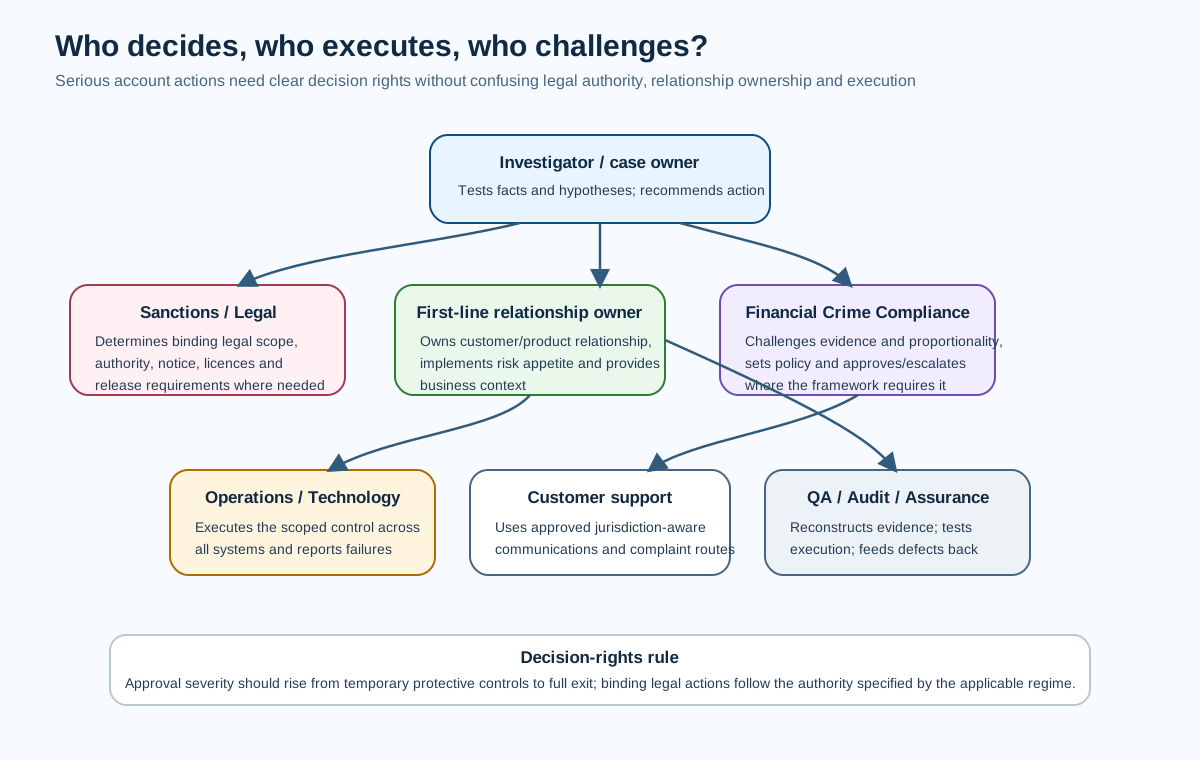
Decision rights should follow the severity of the action
Not every outcome needs the same approval. A low-risk temporary card restriction for suspected account takeover may be applied automatically under fraud rules. A targeted international-payment restriction may require operations plus financial-crime approval. A full relationship exit for AML risk may require a business owner, compliance officer or formal customer-exit forum. A legal sanctions freeze may require sanctions or legal confirmation according to the institution’s policy, while the initial interdiction may occur automatically before that confirmation. A decision to maintain a suspicious account because of law-enforcement interest may require senior financial-crime and legal involvement.
The principle is proportionality combined with separation of duties. The person who investigated the case can recommend an outcome, but serious actions should normally receive independent challenge. That challenge is not a ceremonial second signature. The approver should test whether the risk hypothesis is supported, whether mandatory legal obligations were identified correctly, whether lesser controls were considered where appropriate, whether customer harm is understood and whether implementation is feasible.
A useful decision-rights matrix defines action, severity, minimum evidence, maker role, checker role, legal involvement, business involvement, notification requirement and review frequency. Global policies can set the framework, but local appendices should capture jurisdiction-specific obligations. This avoids the dangerous assumption that one country’s sanctions, account-access or notice rules apply to every booking entity.
Business ownership and compliance ownership are different
Financial-crime compliance should not become the owner of every customer relationship. The first line remains responsible for operating within risk appetite and implementing controls. Compliance sets or interprets the financial-crime framework, challenges decisions, advises on legal and regulatory expectations where appropriate and escalates material concerns. Legal interprets legal obligations and litigation risk. Operations executes account and payment actions. Technology ensures decisions are enforced in systems. Customer-support teams manage communication and complaints under approved scripts.
This separation matters during exit. A relationship manager may argue that a profitable customer should remain. Compliance may conclude that the financial-crime risk is outside appetite. Operations may identify that closure cannot occur until an outstanding loan or trade instrument is resolved. Legal may identify a local notice requirement. None of these perspectives can simply overwrite the others without governance. The final decision needs a defined authority that can balance them while respecting non-negotiable legal obligations.
Build a control taxonomy before building workflows
Technology teams often receive a requirement such as “add an account freeze function” and then discover that different teams mean different things by freeze. Before designing workflow, the bank should define a control taxonomy.
One workable taxonomy separates: investigative hold, fraud-protection restriction, AML risk restriction, sanctions or legal freeze, court or authority restraint, customer-requested block, deceased-customer control, commercial suspension, planned relationship exit and completed closure. Each type can then have permissible sub-actions such as debit block, credit block, cash block, card block, beneficiary block, channel block, new-product block and manual-payment approval.
The taxonomy should also distinguish who can initiate, approve, modify and release each control. A branch employee should not be able to remove a sanctions block. A fraud analyst should not be able to convert a temporary protective restriction into a permanent AML exit without the appropriate case route. An automated monitoring model should not directly close accounts unless governance has explicitly approved that degree of automation and local law permits it.
One decision identifier across all systems
A cross-system restriction should be traceable through a single decision identifier. The identifier originates in the authoritative decision workflow and is propagated to every enforcement platform. Core banking, payments, cards, digital banking and other systems return acknowledgement messages containing the same identifier, status, timestamp and any error.
This design solves a common audit problem. Without a shared identifier, the bank may know that an investigator clicked “restrict” and separately see that a card was blocked, but cannot prove those events are connected. With a shared identifier, the evidence chain shows decision, approval, enforcement request, system acknowledgement, customer communication and later release.
The decision record should include customer ID, account or product IDs, control type, scope, reason code, narrative rationale, legal basis where relevant, effective time, review or expiry time, maker, checker, case ID, related STR or SAR indicator with appropriate confidentiality, law-enforcement reference if applicable, communication code and release condition. Sensitive fields should be access-controlled so general customer-service screens do not expose protected investigation information.
Event-driven enforcement beats manual propagation
Manual propagation creates latency and inconsistency. A mature architecture publishes a restriction event or calls an orchestration service that applies the decision to relevant systems. The orchestration layer knows which systems control which capabilities. A full outbound restriction on a retail current account might require core debit controls, payment-hub interdiction, card status, digital-channel limits and API restrictions. A corporate trade restriction might require trade-finance and treasury platforms in addition to the core account.
The event should be idempotent. Replaying the same restriction must not create duplicate or conflicting statuses. Systems should return deterministic results such as applied, already applied, not applicable or failed. Failures should route to an exception queue immediately.
This pattern is especially important during sanctions or confirmed mule cases, where criminals can move value rapidly. The architecture should not assume that core banking alone controls every possible value movement. Stored-value wallets, cards, securities, foreign-exchange positions and linked accounts can create alternate routes.
Reason codes need controlled transparency
Internal and external reason codes have different purposes. Internally, the bank needs enough precision for governance, analytics and audit. Externally, the bank may need to limit detail because of tipping-off, sanctions confidentiality, fraud investigation or law-enforcement sensitivity.
A safe design maps a detailed internal reason to an approved customer-facing communication category. For example, AML_MULE_SUSPECTED might map to a generic review or account-use message, while a fraud-victim restriction can support a more transparent explanation about protecting the customer. A sanctions legal freeze may have specific legally approved wording. A commercial exit unrelated to financial crime should not be disguised as an AML action.
These mappings should be versioned and jurisdiction-aware. If law or regulatory expectations change, the bank needs to know which wording was used at a particular time and why.
Restriction governance should monitor outcomes, not only volumes
Management information often counts how many accounts were restricted or closed. That is useful but incomplete. A strong dashboard asks whether the controls achieved their purpose and whether they created unintended harm.
Useful measures include time from decision to full enforcement, percentage of restrictions implemented successfully across all required systems, ageing of temporary restrictions, overdue reviews, customer complaints, wrongful-restriction findings, repeat suspicious activity after release, funds lost during implementation latency, law-enforcement maintenance requests, exits reversed on challenge, vulnerable-customer impacts, sanctions-release turnaround and root causes of failed enforcement.
Outcome measures should also examine displacement. If the bank restricts instant payments but criminals switch to card cash withdrawals, the control is incomplete. If an exited corporate customer reappears through a newly incorporated related entity, customer-exit governance needs stronger relationship detection. If repeated low-quality closures affect one nationality or customer segment disproportionately, the bank should investigate whether risk factors, data quality or staff judgement are producing unjustified exclusion.
De-risking and financial inclusion are governance issues
The 2025 FATF amendments and EBA guidance make proportionality more than a policy aspiration. Banks need evidence that higher-risk customers are assessed individually and that available mitigation is considered before broad exclusion, where law allows. This does not require an institution to accept risk outside its appetite. It does require a reasoned decision.
Governance should therefore distinguish unacceptable risk from expensive risk. Some relationships are legally prohibited or cannot be managed safely. Others are manageable but operationally costly. A bank may make commercial decisions, but it should avoid presenting every commercial exit as though AML law mandated it. That distinction improves regulatory transparency and internal accountability.
A decision forum reviewing high-risk exits can require the case owner to state which category applies: legal prohibition, inability to complete mandatory CDD, confirmed misuse, unmitigable financial-crime risk, risk-appetite boundary, commercial decision or another reason. The forum can then check whether policy and customer communications match the true basis.
Governance of law-enforcement account-maintenance requests
Law-enforcement requests to keep an account open create special control needs. The bank should verify the requesting authority, document the request, define duration and scope, restrict access to the information and establish renewal or expiry handling. The case should identify who can communicate with the agency and who can approve deviation from the bank’s normal exit decision.
The account should not become invisible to ordinary financial-crime controls. Monitoring, reporting and sanctions obligations continue according to applicable law. If new activity creates customer harm or an immediate legal concern, the bank may need to contact the agency and reconsider whether continued maintenance remains acceptable.
The system should also prevent the request from becoming permanent through forgotten extensions. A clear end date and advance reminder are essential. When the request expires, the original relationship decision should be revisited rather than automatically restored to normal service.
Cross-border groups need legal-entity awareness
A global bank can have one customer relationship distributed across multiple legal entities. One entity may be subject to a sanctions rule that does not bind another entity in the same way. One jurisdiction may permit particular customer communication while another restricts it. Data-sharing rules may also limit what investigation information can move across borders.
The group-level case can coordinate risk understanding, but each legal entity should record its own legal basis and action. A single global instruction such as “freeze customer everywhere” is unsafe unless legal analysis confirms that scope. Conversely, fragmented local actions can allow a customer to shift activity to another group entity if information sharing and group risk governance are weak.
The architecture therefore needs both group and legal-entity dimensions. The group view connects related risk; the entity view determines enforceable action.
Quality assurance should reconstruct the decision from evidence
A good QA reviewer should be able to take a completed restriction or exit case and answer: what triggered concern, what facts were reviewed, what legal questions were considered, what mitigation options existed, who made the decision, whether approvals matched policy, whether customer communication was appropriate, whether every required system enforced the action and whether review or release occurred on time.
Sampling should include not only severe cases but also false positives, released restrictions and decisions to continue service. Otherwise QA rewards aggressive action without testing proportionality. It should also sample downstream system logs, because a perfect case narrative does not prove the control actually worked.
Recurring QA findings should become control changes. If reviewers repeatedly omit linked accounts, improve entity-resolution tooling. If restrictions are applied correctly but released late, fix timer and workflow design. If customers are closed because evidence requests are unclear, improve outreach templates. If operations regularly select the wrong restriction type, simplify the taxonomy or user interface.
Architecture and policy should evolve together
A policy that says “restrict where appropriate” is too vague for a system. A system that offers ten restriction buttons without policy definitions is equally dangerous. Product, compliance, operations, legal and engineering teams should therefore design the control catalogue together.
For each action, the design pack should state business meaning, legal considerations, scope, permitted initiators, approvers, affected systems, customer communication, review cycle, release conditions, management information and testing requirements. This turns policy into executable control logic without pretending that judgement can be eliminated.
The end state is not maximum restriction. It is precision: the right scope, right duration, right legal basis, right customer treatment and right evidence for the risk actually present.
Practice close: requirements, testing and failure-mode control
The most useful way to finish this topic is to translate it into delivery artefacts. A bank can have excellent policy language and still fail if the account-control service cannot express the decision, if downstream systems interpret the same status differently, if release logic is weak or if testers verify only the happy path. Account restriction is therefore an excellent example of why financial-crime delivery needs business analysis, architecture, operations and control testing working as one discipline.
Turn policy language into observable requirements
A requirement should identify the trigger, decision authority, control object, permitted and prohibited actions, effective time, review rule, release rule, evidence and exception handling. Avoid requirements such as “the system shall freeze suspicious accounts”. That sentence hides every important question.
A better requirement might state that when an authorised sanctions decision marks an account as legally blocked, the restriction service must prevent all customer-initiated debit movements and any other dealings prohibited by the applicable policy, propagate the block to every relevant channel, record the legal basis and decision identifier, receive acknowledgements from downstream systems, route any failed acknowledgement to a high-priority exception queue and prevent release except through an authorised sanctions-release workflow.
For an AML risk restriction, the requirement may look different. It may permit incoming credits, payroll debits and essential payments while preventing new beneficiaries and outbound international transfers. The requirement should make those differences explicit.
Business analysts should capture at least the following dimensions in the functional model: customer or entity scope; account and product scope; transaction types; channel scope; currencies or corridors if relevant; debit and credit behaviour; start time; review time; end condition; maker and checker roles; legal or policy reason; customer communication; linked-case reference; management-information category; and downstream enforcement systems.
Define state transitions, not only statuses
A list of statuses is not enough. The design must define which transitions are permitted. An account may move from normal to investigative hold, from hold to released, from hold to risk restriction, from hold to legal freeze, from risk restriction to exit-pending, and from exit-pending to closed. It may not be safe to move directly from legal freeze to normal without a release authority. It may also be incorrect to move a closed account back to active through the same workflow used for lifting a temporary fraud control.
State-transition rules should record who initiated the change, why it was permitted and which validations ran before the transition. This prevents operational users from bypassing governance simply by selecting another status.
Versioning matters too. A relationship may have multiple restriction episodes. The bank should preserve each episode rather than overwriting the old reason with the newest status. Investigators and auditors need to see the sequence: restriction applied, expanded, partially released, re-applied, then closed.
Test the control at the level where money actually moves
Unit testing a case-management button proves almost nothing about financial-crime containment. End-to-end testing must follow value across the real rails available to the customer.
For a retail account, that can include internal transfers, domestic credit transfers, instant payments, cards, ATM withdrawals, direct debits, scheduled payments, digital wallets and branch cash. For a corporate customer, add host-to-host files, APIs, treasury portals, bulk payments, trade-finance drawings, foreign exchange, sweeps and liquidity structures. For wealth customers, securities dealing and custody movements may matter. For a sanctions freeze, dividends, interest, corporate actions and securities settlement can also be relevant.
Testers should create a control-to-rail matrix showing which restriction blocks which movement. A full relationship freeze should not accidentally allow value through a rail omitted from the original requirements.
Positive tests: prove the risky action is stopped
Positive testing begins with scenarios that should trigger or enforce the control. If an outbound-payment restriction is active, attempt single payments, bulk payments, scheduled payments, API instructions and retry flows. If a new-beneficiary restriction is active, attempt to create a beneficiary through every available channel. If a card control is active, test purchases, cash withdrawals, contactless and wallet-token transactions according to the intended scope.
For sanctions workflows, test a confirmed blockable party using a controlled synthetic dataset. Verify that the payment or property moves into the correct legal status, required reports or work items are created, customer-facing messaging does not expose inappropriate detail and unauthorised release attempts fail.
For exit-pending relationships, test activity during the notice period. The account may not be fully closed yet, but enhanced controls must remain active. If policy allows only specified payments, test both permitted and prohibited examples.
Negative tests: prove legitimate activity still works
A control that stops everything can appear effective while being unusable. Negative testing confirms that permitted activity continues.
If a vulnerable-customer fraud restriction allows salary credits and rent payments, verify both. If a corporate account restriction blocks one corridor but permits domestic supplier payments, test the permitted corridor at realistic volumes. If a sanctions alert is cleared as a false positive, verify that the release restores only the functions that should be restored and does not remove unrelated restrictions.
Negative testing is essential for financial inclusion and customer-outcome control. It demonstrates that the bank is applying targeted measures rather than broad friction simply because narrower control logic was harder to build.
Boundary and timing tests
Restriction controls are highly time-sensitive. Test the exact moment around application and release. Submit a payment immediately before the restriction event, during propagation and immediately after downstream acknowledgement. Determine whether in-flight transactions are cancelled, held, returned or allowed to complete according to the policy and rail rules.
For instant payments, propagation latency should be measured in the context of the scheme’s processing speed. A control that takes several minutes to reach the payment hub may be operationally ineffective even if it eventually synchronises.
Test expiry boundaries as well. If a temporary protective restriction has a twenty-four-hour review point, confirm that it does not silently disappear unless policy permits automatic release. If a law-enforcement maintenance request expires at a particular time, confirm that the case routes for review before expiry. If a legal freeze has no automatic expiry, verify that generic housekeeping jobs cannot remove it.
Concurrency and race-condition testing
Real systems receive simultaneous changes. A fraud team may apply a protective block while sanctions operations apply a legal freeze. A relationship-exit workflow may run while a customer-service agent attempts to restore digital access. A batch process may update account status at the same time as a real-time restriction event.
The architecture needs precedence rules. Legal controls normally cannot be weakened by lower-authority operational actions. A more severe restriction may supersede a less severe one without destroying the history. When one control is released, any independent control should remain.
Testers should simulate concurrent events, duplicate messages, out-of-order events and retries. The final account state must be deterministic and explainable.
Failure-mode tests
Assume something will fail. The core account accepts the restriction but the card platform is unavailable. The case system times out after sending the instruction, leaving uncertainty about whether the downstream system applied it. A message is delivered twice. A user applies the restriction to the wrong account. A customer is linked to another legal entity not included in the first request. A data-mapping defect converts “debit block” into “all block”.
Each failure needs a designed response. High-risk partial enforcement should create an incident and manual containment path. Unknown delivery status should trigger reconciliation rather than blind retry if duplicate action could cause harm. Wrong-account controls need rapid correction with evidence and customer-remediation handling. Mapping defects need preventive validation and regression testing.
The bank should maintain a reconciliation process that compares authoritative restriction decisions with downstream states. Any mismatch should be visible, aged and escalated. This is the control that catches silent failures after initial processing appears successful.
Test customer communication without exposing protected information
Communication testing should verify both accuracy and confidentiality. Generate the customer message for each restriction reason and jurisdiction. Confirm that the wording explains what the customer needs to know, identifies available support or complaint routes where appropriate and does not reveal an STR, law-enforcement investigation or internal intelligence that should remain confidential.
Test front-line screens as well. A customer-service employee should see enough information to handle the contact safely but not necessarily the detailed investigation narrative. Sensitive notes should not leak into downloadable statements, generic CRM histories or channels visible to third parties.
Where local rules permit or require more explanation, the system should use the correct regional template rather than a globally generic message.
Test vulnerable-customer and essential-service handling
Financial-crime restrictions can affect people in distress. Testing should include customers with vulnerability flags, benefit income, salary dependency and essential direct debits. The objective is not to override mandatory controls. It is to verify that the workflow identifies cases needing specialist support and applies any lawful exceptions or alternative arrangements correctly.
For business customers, equivalent scenarios include payroll, tax, utilities and employee expenses. If policy permits controlled essential payments during a managed exit or restriction, test the approval route and evidence.
Acceptance criteria for the decision service
A strong chapter-level set of acceptance criteria can be expressed plainly.
The bank can identify the exact object and capabilities subject to control. The decision records a reason, source case, effective time, approver and review or release condition. Legal freeze, policy restriction and temporary hold remain separate states. Every required downstream system receives and acknowledges the decision. Partial failures are visible immediately. Duplicate events are safe. Higher-authority controls cannot be removed by lower-authority actions. Customer messages follow the correct jurisdiction and confidentiality rules. Release requires the evidence and authority defined by policy. Historical restriction episodes remain reconstructable. Management information exposes ageing, failures and customer impact.
Those criteria are more valuable than hundreds of low-level fields if they remain traceable through design and test evidence.
Data-quality testing
Restriction accuracy depends on identity and relationship data. Test customers with multiple accounts, joint accounts, beneficial ownership, authorised signatories, duplicate customer records and cross-entity relationships. A sanctions or legal order may apply to property in which a designated person has an interest even if the account name itself is different, depending on the applicable legal regime. An AML exit may need to consider connected accounts without automatically assuming every connected person is suspicious.
The system should show the evidence behind relationship links and allow human review where entity resolution is uncertain. False relationship linkage can cause serious wrongful restriction; missed linkage can allow risk to continue through another account.
Security and privileged-access testing
Restriction controls are powerful. Users who can apply or release them need strong authentication, role-based access and logging. Test that operational roles cannot access sanctions-release functions, that customer-service roles cannot view protected SAR indicators, and that privileged administrators cannot silently change statuses without audit logs.
Break-glass access should be exceptional, time-limited and reviewed. Changes to restriction configuration, reason mappings and approval rules should pass controlled change management. A malicious insider or compromised admin account should not be able to release blocked funds or disable monitoring without detection.
Operational readiness before release
Production deployment needs more than code approval. Operations need runbooks explaining each control type, escalation route, expected system acknowledgements, customer-contact handling and failure recovery. Compliance needs evidence that legal and policy mappings are current. Service management needs alerting for failed propagation. Support teams need approved scripts. Reconciliation jobs need owners.
The bank should also define rollback behaviour. If a software release breaks restriction propagation, simply rolling back the application may not restore the correct customer states. The recovery plan should reconcile every decision created during the incident window.
Post-implementation assurance
After launch, compare expected and actual outcomes. Review a sample of restrictions from trigger through release. Measure enforcement latency, failure rates, overdue reviews and complaint outcomes. Check whether the same control works consistently across channels and customer segments. Investigate whether users rely on workarounds outside the system.
A control can pass testing and still fail in production because real data is messier, volumes are higher or operating behaviour differs. Early-life monitoring should therefore be part of the delivery plan, not an optional audit activity months later.
The BA’s final traceability question
For every requirement, ask: what evidence will prove this happened correctly for one real customer on one real day?
If the answer is “the system should do it”, the requirement is incomplete. The evidence might be a decision record, event log, downstream acknowledgement, account-state snapshot, customer message, approval record, reconciliation result or release record. When those artefacts link through the same decision identifier, the bank has a control that can be tested and defended rather than merely described.
Masterclass: one customer, four possible outcomes
The following composite case is fictional but reflects recurring control patterns seen in banking. The amounts and names are illustrative. The purpose is to practise separating suspicion, legal obligations, relationship risk and operational action instead of jumping from “alert” directly to “close”.
The customer and the trigger
Northbridge Components Ltd is a twelve-year-old engineering distributor. It has banked with Meridian Bank for six years. The company imports specialist pumps, valves and control equipment and sells to industrial customers across three countries. Its historic activity is stable: monthly turnover between the equivalent of EUR 1.2 million and EUR 1.8 million, payments mainly to established European and Asian suppliers, and receipts from a known set of commercial customers.
During one week, the transaction-monitoring system generates several alerts. Northbridge receives three incoming transfers totalling the equivalent of EUR 620,000 from newly incorporated companies in two jurisdictions not previously seen in its profile. Within hours, most of the funds are sent to a trading company in a third jurisdiction. The payment descriptions refer only to “equipment settlement”. The trading company was incorporated four months earlier and has limited public information.
At almost the same time, a sanctions-screening alert fires on the surname of one director of the beneficiary. The name resembles a listed person under one sanctions regime, but date of birth and nationality are not yet available. The bank’s fraud intelligence team also reports that one incoming payer complained to its own bank that it may have been deceived in a business-email compromise.
The first control decision is not closure. It is containment while facts are established.
Step 1: define what the bank actually knows
The investigator separates facts from inference.
The customer is established and historically consistent. The new activity is materially outside profile. The counterparties are new. Funds move rapidly onward. One payer reports possible fraud. There is a sanctions name alert, but no confirmed identity match. The beneficiary company is young and opaque. Northbridge has not yet been asked for an explanation.
Nothing in those facts proves money laundering, sanctions evasion or customer complicity. They do justify urgent review because several independent risk signals converge.
The investigator also checks linked data. Northbridge has two operating accounts, a corporate card programme, online banking, a host-to-host payment channel and a small revolving credit facility. The alert concerns one operating account, but the customer can move funds through both accounts and the host-to-host channel.
Step 2: choose the immediate restriction scope
The bank’s policy allows a temporary high-risk payment restriction while a fraud or financial-crime review is completed, subject to defined approvals and local law. Operations places the two operating accounts into a status that permits incoming credits and existing essential domestic direct debits but prevents customer-initiated outbound transfers, new beneficiaries and cash withdrawals. Corporate cards remain usable only for low-value domestic expenses because the current concern is rapid transfer of incoming funds rather than card misuse. The revolving credit facility cannot be drawn further during the review.
The decision is recorded as an investigative risk restriction, not a legal freeze. That distinction matters because the bank has not yet established any legal basis for freezing the property.
The restriction event propagates to core banking, the payment hub, host-to-host gateway and digital channel. Each system acknowledges the same decision identifier. One acknowledgement from the host-to-host gateway fails. The exception queue escalates immediately and operations disables the customer’s file-submission credential manually. The case record captures the failed automated enforcement and the manual containment.
Without that reconciliation control, the customer could have continued submitting corporate payment files despite the case system displaying “restricted”.
Step 3: resolve the sanctions question separately
Sanctions operations investigates the beneficiary director. Additional identifying information shows that the director is not the listed person. The name alert is cleared as a false positive. The bank records the identity-resolution evidence and removes the sanctions-review flag.
Crucially, this does not remove the AML/fraud restriction. The sanctions alert and the financial-crime concern are separate decision objects. A poorly designed system might have used one generic “compliance hold” status and accidentally released the account when the sanctions analyst clicked “clear”. Meridian’s control model prevents that because the sanctions hold was never the authority for the AML restriction.
Step 4: investigate the customer explanation
Northbridge explains that it has entered a new distribution arrangement with a procurement broker. The incoming companies are end buyers introduced by the broker, while the onward payment represents a bulk purchase from the new supplier. The customer provides contracts, invoices and shipping documents.
The documents are not obviously false, but the investigator finds inconsistencies. The goods description is generic despite the customer normally using detailed product codes. The invoice dates precede the incorporation date of one supposed buyer. Shipping documents name a different consignee from the customer described in the contract. The new supplier uses a virtual office and has the same contact telephone number as one of the incoming payers.
The fraud team also obtains further information through appropriate interbank channels: two incoming payments are now associated with business-email-compromise reports. Northbridge insists it was unaware of any fraud and says the broker controlled the documentation.
The investigator now considers two competing hypotheses. Northbridge could be knowingly facilitating fraud proceeds through a new shell network. Alternatively, Northbridge itself could have been recruited or deceived into providing a legitimate-looking commercial account for criminal settlement.
The evidence is not yet sufficient to distinguish those possibilities confidently.
Step 5: suspicious-activity reporting does not determine account status automatically
The case reaches Meridian’s suspicious-activity decision forum. Based on the rapid pass-through behaviour, inconsistent documents, linked payer fraud reports and unexplained relationship among counterparties, the bank reaches the local threshold for filing an STR. The report is prepared according to the jurisdiction’s requirements.
The bank does not write in the case record that “STR filed, therefore close”. Filing and account status are separate decisions. The forum now asks whether risk can be mitigated and whether law enforcement has any interest in the account remaining open.
The relationship manager argues for continuation because Northbridge has been a profitable customer for years. Compliance notes that profitability is not a risk mitigation. Legal confirms that no mandatory freeze applies and that the contractual framework permits managed exit if the risk cannot be controlled. Operations explains that a restricted continuation is technically feasible.
Step 6: a law-enforcement request changes the timing, not the bank’s obligations
After the STR is filed, the bank’s authorised law-enforcement liaison receives a formal request from the competent authority asking Meridian, where lawful and operationally acceptable, to maintain the accounts for a defined period while an investigation continues. The request specifies the accounts and duration and asks the bank not to take action that would unnecessarily reveal investigative interest.
Meridian validates the request and records it in a restricted-access case object. Senior financial-crime management and legal approve maintaining the relationship temporarily. The bank does not treat the request as an instruction to ignore suspicious activity. Monitoring and reporting obligations continue.
The existing outbound restriction is modified. Rather than a blanket stop, specified payment types can proceed through manual pre-approval so investigators can observe activity while limiting uncontrolled movement. The exact approach is based on local law, the authority request and the bank’s risk appetite; this is not presented as a universal model.
The customer is told only that certain activity remains subject to review and additional verification. Staff do not disclose the STR or law-enforcement interest.
Step 7: enhanced monitoring has a written hypothesis
For the maintenance period, Meridian defines enhanced monitoring around the suspected broker network. Alerts prioritise payments involving the new supplier, incoming payer companies, related contact details, common directors, shared addresses and rapid onward movement. The bank also monitors attempts to move activity through the second account, cards or alternative channels.
A relationship-level case owner reviews the activity daily. The case has a clear escalation rule: any attempted payment to newly identified linked entities, any evidence of document alteration or any customer attempt to evade controls triggers immediate senior review.
This is active monitoring. It is not simply leaving the account open.
Step 8: new evidence moves the decision toward exit
Two weeks later, the customer attempts to add a new beneficiary controlled by the same individual who appears behind the procurement broker. Device logs show that the beneficiary setup was initiated by a user credential that had not previously been active. Northbridge then provides a revised contract whose metadata indicates it was created after the bank requested evidence, despite carrying an earlier date.
The bank does not assume that metadata alone proves fabrication, but the cumulative evidence now undermines the customer’s explanation. The relationship forum concludes that the residual risk cannot be managed within appetite after the law-enforcement maintenance period ends.
Meridian contacts the authority through the approved liaison. The authority confirms that it does not object to the bank proceeding under its normal standards after the request expires.
Step 9: managed exit
The bank begins a managed exit rather than an uncontrolled immediate closure. New products are prohibited. Outbound payments remain subject to manual approval. Existing legitimate payroll and tax payments can be processed where policy and law permit. Trade instruments are reviewed individually. Remaining balances are handled according to the bank’s legal and contractual obligations. Linked corporate entities and beneficial owners are separately assessed rather than automatically exited by association.
The customer receives the legally approved closure notice without reference to the STR or law-enforcement investigation. Customer-service staff see a controlled communication code and escalation contact, not the confidential investigation narrative.
At the final closure date, digital credentials are revoked, cards cancelled, payment channels disabled and the customer master marked exited. A post-exit control watches for attempts to reopen through related entities according to policy and applicable data rules.
Step 10: what the audit trail should show
Months later, an internal auditor selects the case. A defensible evidence chain shows the original alerts, temporary restriction decision, system acknowledgements, host-to-host enforcement failure and manual containment, sanctions false-positive resolution, customer evidence, fraud intelligence, STR decision, law-enforcement request, enhanced-monitoring plan, subsequent escalation, exit approval, customer communication and final closure confirmations.
The auditor can also see that no legal freeze was recorded because none applied. This is important. The bank acted strongly without mischaracterising the legal basis.
Alternative outcome: what if the customer had proved the explanation?
Suppose the invoices and shipping records had been independently validated, the incoming payer fraud reports were withdrawn as errors and the customer demonstrated that the new counterparties were legitimate buyers. The correct outcome could have been release of the restriction with a period of enhanced monitoring. A bank should be willing to reach that answer when evidence supports it.
A control framework that can only escalate and never de-escalate is not genuinely risk-based.
Alternative outcome: what if the sanctions match had been true?
If sanctions analysis had confirmed that blocked property was involved under an applicable legal regime, the legal action could have overridden the discretionary AML pathway. The bank would then follow the relevant blocking, reporting, licensing and release requirements. The customer relationship decision would still need analysis, but the property could not be released merely because the AML case later concluded that suspicion was weak.
Alternative outcome: what if the customer were a vulnerable retail victim?
If the same rapid pass-through pattern involved a young retail customer recruited as a mule through deception, the immediate containment might be similar but the long-term outcome could be protective rather than punitive. The bank might reset credentials, limit transfers temporarily, provide scam support, restore access gradually and file appropriate financial-intelligence reports. Evidence of deliberate participation would change that decision.
The case teaches the central point of the chapter: the same alert can lead to monitoring, restriction, freezing or closure depending on the legal basis, evidence, customer context and ability to mitigate risk. Professional financial-crime practice is the discipline of keeping those pathways separate while making them work together.
Knowledge check and practitioner glossary
A good way to test understanding of this chapter is to remove the labels and ask what legal or risk logic actually supports the action.
A sanctions screening alert fires on a payment. Is the customer’s account legally frozen? No. An alert is a control signal, not a legal conclusion. The payment may be held while identity and legal applicability are investigated. A legal freeze arises only when the applicable law requires property to be frozen or blocked. A false positive can be released. A prohibited payment might instead need rejection under some regimes. The exact outcome depends on the jurisdiction and sanctions authority.
A bank files an STR or SAR. Must it close the account? Not as a universal rule. Suspicious activity reporting and relationship management are separate decisions. The bank must follow local law and its risk framework, consider whether risk can be mitigated, and avoid tipping off. In some circumstances law enforcement may prefer the account to remain open for investigative reasons. In other cases the bank may conclude that continued service is outside risk appetite or legally impossible.
Is enhanced monitoring a weaker action than closure? Not necessarily. Monitoring can be the correct control where the relationship remains lawful and the risk can be managed. It becomes weak only when it is undefined. Effective enhanced monitoring states the risk hypothesis, data to be watched, thresholds, review period, owner and escalation criteria.
Can a bank restrict one channel without closing the relationship? Often yes, where contract, law and policy allow. Targeted restrictions can reduce risk while preserving legitimate access. Examples include disabling international transfers, new beneficiaries, cash withdrawals or a compromised digital channel while leaving other functions available. The exact design depends on local obligations and customer circumstances.
Why is a temporary hold different from a legal freeze? A hold is typically an operational state used while a decision is pending. A legal freeze prohibits movement or dealing in assets under a binding authority. The release conditions differ. A temporary hold may be released when the investigation clears the concern. A legal freeze may require delisting, a licence, court action or another legally valid release mechanism.
What is the biggest architecture risk in account restriction? Partial enforcement. A case-management system can show “restricted” while another channel still allows value movement. Restrictions should therefore be propagated to all relevant systems and reconciled through acknowledgements linked to one decision identifier.
Why should closure reason and customer message be separate? The bank needs detailed internal evidence, but customer communication may be constrained by tipping-off, SAR confidentiality, sanctions rules, fraud investigations or law-enforcement sensitivity. A controlled mapping allows the internal reason to remain precise while the external wording stays lawful and fair.
What makes a closure decision risk-based rather than wholesale de-risking? The bank considers the individual customer’s risk, available mitigation, required CDD, legal constraints and residual risk instead of excluding an entire category merely because it is associated with higher risk. This does not require the bank to accept risk beyond its appetite; it requires a reasoned and evidence-based decision.
What should happen when a law-enforcement agency asks the bank to keep an account open? The bank should follow the applicable local process, validate the request and its scope, record duration and authority, preserve confidentiality, obtain internal approvals and continue meeting applicable reporting and monitoring obligations. The request should not become an informal exception outside governance.
Why test release as heavily as application? Releasing a control can restore access to funds or channels at the wrong time. High-risk release should verify authority, evidence and downstream state. Independent restrictions must remain in force even when one control is lifted.
Glossary
Account restriction: A bank-imposed limitation on specified account or service capabilities. It may arise from fraud prevention, AML risk management, contract, policy or other lawful grounds and is not automatically a legal freeze.
Blocking or legal freeze: A legally required prohibition on transferring, converting, disposing of or otherwise dealing in specified property or assets under the applicable framework. Terminology and consequences vary by jurisdiction.
Closure or relationship exit: Termination of an account, product or broader customer relationship according to applicable law, contract and risk governance.
Enhanced monitoring: A defined period or mode of additional scrutiny applied to a customer, account, transaction population or risk hypothesis. It should have data, triggers, ownership and review criteria.
Investigative hold: A temporary operational stop while a control team resolves uncertainty. A hold can precede release, restriction, rejection, return, legal freeze or another outcome.
Residual risk: The financial-crime risk remaining after available controls and mitigants are applied. Relationship decisions should consider whether residual risk remains within approved appetite.
De-risking: Commonly used to describe declining, restricting or terminating customer relationships to avoid risk rather than manage it through a risk-based approach. The term is often debated, so decision records should state the actual basis for exit rather than rely on the label.
Blocked property: In OFAC’s U.S. sanctions context, property in which a blocked person has an interest and which must be frozen when within U.S. jurisdiction or possession or control of a U.S. person. This is a U.S.-specific legal concept, not a universal global rule.
Rejected transaction: In OFAC’s U.S. sanctions context, a prohibited transaction that cannot proceed but does not contain a blockable interest. Other jurisdictions may use different terminology and consequences.
Decision identifier: A unique reference linking the case decision to approval, enforcement events, system acknowledgements, communications and later release or closure.
Restriction scope: The exact customer, account, product, channel, transaction type, currency, geography or capability to which a control applies.
Review date: A point when a restriction must be reassessed. A review date should not be confused with an automatic expiry.
Release condition: The evidence, legal event or approval required before a control can be removed.
Law-enforcement maintenance request: A request, where recognised by applicable local processes, for the institution to keep an account open or maintain a relationship for investigative purposes. Governance should define validation, duration, confidentiality and ongoing compliance responsibilities.
Unwarranted de-risking: Broad exclusion or termination without adequate individual risk assessment or consideration of proportionate mitigation, where such consideration is required or expected.
Customer harm: Financial, operational or personal harm caused or aggravated by control action, such as inability to pay rent or payroll. Customer harm does not override legal obligations, but it should inform discretionary decisions and the use of lawful exemptions or support arrangements.
Control reconciliation: Comparison of the authoritative decision with actual downstream system states to identify partial enforcement, failed release or other mismatches.
The strongest practitioner answer to any account-control question begins with one sentence: identify the legal basis and the exact risk before choosing the operational action. That discipline prevents both under-control and unnecessary exclusion.
References and further reading
The chapter uses international standards for the common control principles and then scopes jurisdiction-specific examples explicitly. These sources are suitable starting points for policy, legal and delivery teams; operational decisions should always be checked against the law, sanctions programme, regulator guidance and contractual framework applicable to the relevant bank entity and customer.
- Financial Action Task Force (FATF), The FATF Recommendations, current consolidated standards as amended June 2026: https://www.fatf-gafi.org/en/publications/Fatfrecommendations/Fatf-recommendations.html
- Financial Action Task Force (FATF), Risk-Based Approach and De-risking, explaining case-by-case risk management and why wholesale de-risking is inconsistent with the risk-based approach: https://www.fatf-gafi.org/en/publications/Fatfgeneral/Rba-and-de-risking.html
- Financial Action Task Force (FATF), FATF updates Standards to better support financial inclusion, 21 February 2025, strengthening the emphasis on proportionality and simplified measures where appropriate: https://www.fatf-gafi.org/en/publications/Fatfrecommendations/update-standards-promote-financial-conclusion-feb-2025.html
- Financial Action Task Force (FATF), Recommendation 6 humanitarian-assistance update, 23 June 2026, aligning counter-terrorism targeted-financial-sanctions standards with relevant UN humanitarian exemptions: https://www.fatf-gafi.org/en/publications/Fatfrecommendations/update-recommendation-6-june-2026.html
- Financial Action Task Force (FATF), FATF Glossary, including the standards' definitions of freezing and related terms: https://www.fatf-gafi.org/en/pages/fatf-glossary.html
- Wolfsberg Group, Guidance on the Risk-Based Approach, published 23 June 2026, on proportionality, prioritisation, risk appetite, controls and financial-crime programme effectiveness: https://wolfsberg-group.org/news/guidance-on-the-risk-based-approach
- European Banking Authority (EBA), Guidelines to challenge unwarranted de-risking, 31 March 2023, addressing access to financial services and proportionate ML/TF risk management: https://www.eba.europa.eu/publications-and-media/press-releases/eba-issues-guidelines-challenge-unwarranted-de-risking-and
- European Banking Authority (EBA), AML/CFT regulatory activities, including the framework for ML/TF risk factors and access-to-financial-services guidance: https://eba.europa.eu/legacy/regulation-and-policy/regulatory-activities/anti-money-laundering-and-countering-financing-6
- UK Financial Conduct Authority (FCA), FCA sets out initial findings on bank account access and closures, 19 September 2023: https://www.fca.org.uk/news/press-releases/fca-sets-out-initial-findings-bank-account-access-and-closures
- U.S. Department of the Treasury, Office of Foreign Assets Control (OFAC), FAQ 9: blocked property, explaining the U.S. blocking concept and ownership of blocked property: https://ofac.treasury.gov/faqs/9
- U.S. Department of the Treasury, Office of Foreign Assets Control (OFAC), FAQ 36: blocked versus rejected transactions, explaining the U.S.-specific distinction between blocking and rejection: https://ofac.treasury.gov/faqs/36
- U.S. Department of the Treasury, Office of Foreign Assets Control (OFAC), Filing Reports with OFAC, including reporting and recordkeeping resources for blocked and rejected transactions: https://ofac.treasury.gov/faqs/topic/1606
- Financial Crimes Enforcement Network (FinCEN), Requests by Law Enforcement for Financial Institutions to Maintain Accounts, guidance on documented law-enforcement requests and continuing BSA obligations: https://www.fincen.gov/resources/statutes-regulations/guidance/requests-law-enforcement-financial-institutions-maintain
- Financial Crimes Enforcement Network (FinCEN), Federal Reserve, FDIC, NCUA and OCC, Joint Statement on Suspicious Activity Report Confidentiality Considerations Regarding Communications with Customers, 2 September 2026: https://www.fincen.gov/news/news-releases/fincen-agencies-issue-joint-statement-suspicious-activity-report-confidentiality
- Federal Financial Institutions Examination Council (FFIEC), BSA/AML Examination Manual: Suspicious Activity Reporting, for U.S. bank SAR programme expectations and examination context: https://bsaaml.ffiec.gov/manual/AssessingComplianceWithBSARegulatoryRequirements/04
- Financial Crimes Enforcement Network (FinCEN), CDD Rule FAQs, current U.S. customer-due-diligence reference material: https://www.fincen.gov/resources/statutes-and-regulations/cdd-rule-faqs
- Financial Crimes Enforcement Network (FinCEN), Exceptive relief to streamline customer due diligence requirements, 13 February 2026, illustrating why jurisdiction-specific CDD requirements should be checked for current amendments and relief: https://www.fincen.gov/news/news-releases/fincen-issues-exceptive-relief-streamline-customer-due-diligence-requirements