SAR and STR Decisioning
A suspicious activity report is not the same thing as an alert, a case, a fraud referral or a finding that a crime occurred. It is a regulated communication to a financial intelligence unit when the facts have crossed the reporting threshold set by the law that applies to the reporting entity. That distinction sounds simple, but it is one of the most important disciplines in a financial-crime operating model. A transaction-monitoring rule can produce an alert because activity is unusual. An investigator can open a case because the alert deserves examination. A customer can look risky because the bank does not yet understand the source or purpose of funds. None of those events, by itself, proves that a suspicious-reporting obligation exists.
The opposite mistake is just as dangerous. A bank must not keep investigating indefinitely after the relevant legal threshold has already been met simply because the analyst wants a perfect explanation, a complete criminal theory or proof beyond doubt. Suspicious-transaction reporting is designed to provide financial intelligence, not to transfer the criminal burden of proof from law enforcement to the bank. The bank's job is to reach a reasoned decision from the facts available, apply the correct jurisdictional rule, file within the required timeframe where a duty exists, protect the confidentiality of the process and retain enough evidence to show why the decision was made.
A useful mental model is detect, investigate, decide, report, protect and revisit. Detect a reason to look. Investigate enough to understand the material facts. Decide whether the applicable threshold is met. Report promptly under the relevant legal and procedural framework. Protect the confidentiality of the report and the people involved in decisioning. Revisit the customer or activity if new information changes the risk picture.
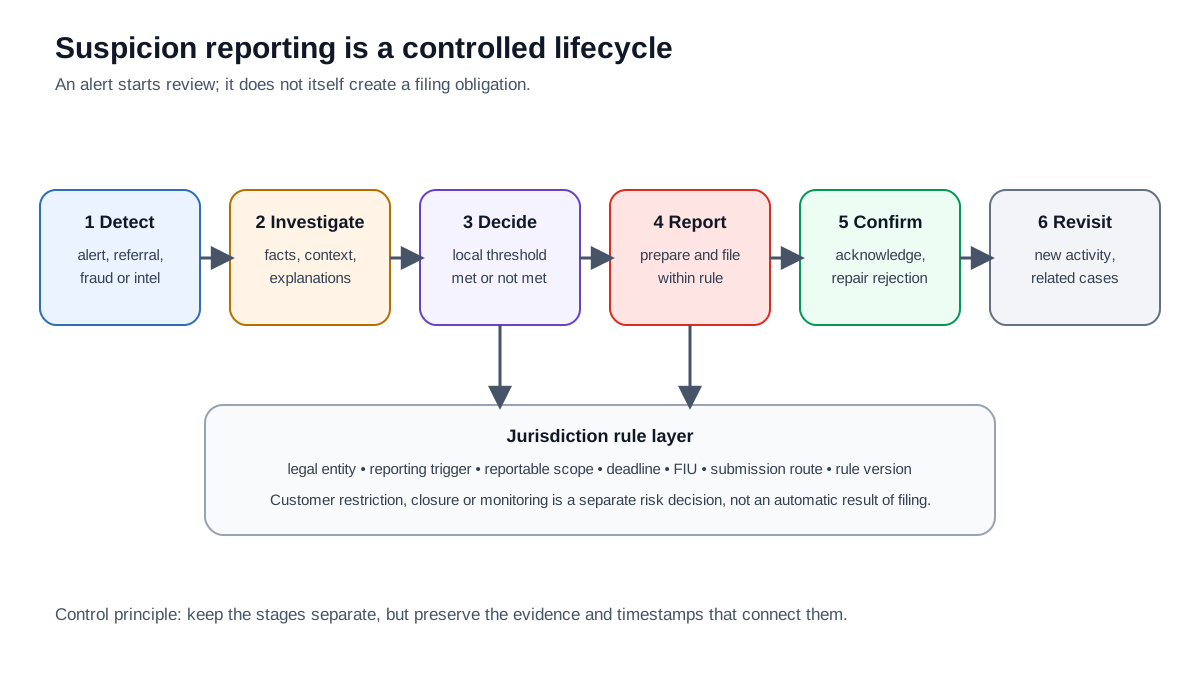
SAR, STR, SMR and the common control objective
Different jurisdictions use different names. The United States and the United Kingdom commonly use Suspicious Activity Report, or SAR. Many countries use Suspicious Transaction Report, or STR. Australia uses Suspicious Matter Report, or SMR. The label matters operationally because forms, portals, legal triggers, deadlines and confidentiality rules differ, but the broad control objective is similar: information about suspected money laundering, terrorist financing or other reportable financial-crime activity is provided to the competent financial intelligence authority so it can be analysed and, where appropriate, disseminated to law enforcement or other authorised bodies.
The global baseline comes from FATF Recommendation 20. FATF's methodology states that where a financial institution suspects or has reasonable grounds to suspect that funds are proceeds of criminal activity or are related to terrorist financing, the institution should be required to report its suspicion promptly to the FIU. FATF also expects suspicious transactions, including attempted transactions, to be reportable regardless of transaction amount. That is a global standard, not a universal operating manual. Domestic laws decide precisely who must report, what the trigger language means, whether other offences are in scope, which entity reports, what form is used, what timeframe applies and what additional steps are required.
This distinction is essential in an international bank. A policy sentence such as "file a SAR within 30 days" is not a global rule. Thirty days is associated with particular United States SAR regulations. The United Kingdom's NCA states that persons in the regulated sector who have a reporting obligation should submit a SAR as soon as practicable. AUSTRAC currently requires an SMR within 24 hours after forming a terrorism-financing suspicion and, for other suspicions, within three business days after the day the suspicion is formed, subject to the Australian framework and specific qualifications. In the European Union, Directive (EU) 2015/849 currently requires Member States to ensure obliged entities promptly inform the FIU where they know, suspect or have reasonable grounds to suspect that funds are proceeds of criminal activity or related to terrorist financing. The current Directive remains in force until the new AML package takes over according to its own application timetable.
A strong bank therefore stores the legal entity, branch or establishment, jurisdiction, reporting regime and applicable rule version alongside the decision. The institution may have a global methodology for how an investigation is performed, but the final reporting decision must be mapped to the law that applies to the relevant entity and activity.
Alert is not suspicion
An alert is a control signal. It may be produced by a threshold rule, behavioural model, sanctions engine, fraud system, employee referral, adverse-media process, law-enforcement request or another source. The alert says, in effect, "look here." It does not say, "the legal reporting threshold has been met."
That distinction protects both sides of the control. If every alert automatically became a report, the bank would flood the FIU with low-value noise and would effectively outsource its investigative judgement. If an alert were treated as mere operational noise until overwhelming proof existed, the bank could miss reporting duties and deprive the FIU of timely intelligence. The investigation sits between those extremes.
An investigator should establish what triggered the concern, identify the relevant customer and connected parties, understand the activity in context, obtain available explanations and supporting evidence, test those explanations against account behaviour and known facts, and document what remains unexplained. The investigation does not need to solve the predicate crime. It needs to determine whether the facts, taken together, meet the applicable threshold for suspicion or reasonable grounds to suspect.
This is why a case-management system should not use one ambiguous status called suspicious. Useful states separate alerted, under review, information requested, escalated for reporting decision, reporting threshold met, threshold not met, report prepared, report submitted, submission acknowledged, and post-filing monitoring or follow-up. Exact state names vary by operating model, but separating them makes ownership and timing visible.
Suspicion is a reasoned judgement, not a mathematical score
Banks often ask whether suspicion can be defined as a score. A score can help prioritise evidence, but it should not be confused with the legal judgement unless local law and policy expressly support a particular automated decision model. Suspicion usually emerges from the interaction of facts: who the customer is, what activity occurred, why it is unusual or inconsistent, what explanations exist, what evidence supports those explanations, what typologies are relevant, and what remains unresolved.
Consider a new business account that receives several large incoming credits and sends most of the money to unrelated overseas beneficiaries on the same day. The pattern can resemble layering or mule activity, but there may be legitimate explanations: a newly established trading company may collect customer payments and pay suppliers; a treasury centre may sweep balances; a property transaction may produce a large one-off movement. The investigator should not use the typology as the conclusion. The typology is a hypothesis that guides questions.
A defensible decision note separates facts, interpretation, contrary evidence, gaps and conclusion. Facts may include amounts, dates, counterparties, account age, customer profile, invoice references and device information. Interpretation explains why those facts matter. Contrary evidence records information that weakens the suspicion, such as a verified contractual relationship or independent proof of goods delivered. Gaps identify what could not be established. The conclusion then explains why, despite or because of those elements, the applicable threshold is or is not met.
The wording matters. "Customer is laundering money" states a conclusion that the bank may not be able to prove. "The activity creates suspicion of laundering because incoming third-party funds are rapidly transferred to unrelated beneficiaries, the behaviour is inconsistent with the stated business model, and the customer could not provide evidence supporting the stated purpose" is a reasoned financial-crime judgement tied to observable facts.
Suspicion is not proof
The suspicious-reporting regime would fail if banks could report only after proving an offence. Financial institutions usually have only part of the picture. They see accounts, transactions, messages, customer records and perhaps external intelligence. Law enforcement may have witness evidence, device seizures, surveillance, customs information, tax records or intelligence from other institutions that the reporting bank cannot access.
This does not mean the threshold should be trivial. A report should not be based on prejudice, nationality, occupation, sector or a vague sense that activity "looks wrong." The suspicion should be grounded in facts relevant to the customer and activity. The bank should be able to explain why those facts, after a reasonable review, create the required level of concern under its applicable rulebook.
A useful training question is: what changed the case from unusual to suspicious? If the analyst cannot answer that question, the reasoning may still be incomplete. The turning point might be an implausible customer explanation, a mismatch between business purpose and counterparties, repeated pass-through activity, an undisclosed relationship, a known scam victim payment, a documentary inconsistency or a network link to previously reported activity. The answer should be specific.
The decision clock must be linked to the legal trigger
Reporting timeliness is not just a workflow service level. It can be a legal obligation, and different regimes start the clock in different ways. The system therefore needs more than a generic caseOpenDate.
In the United States, FinCEN guidance for banks explains that the SAR filing period is generally no later than 30 calendar days from the initial detection of facts that may constitute a basis for filing. Where no suspect is identified, the rules can permit an additional 30 days, but reporting must not be delayed beyond 60 days in the circumstances described by the rule. FinCEN has also clarified that the clock is not necessarily triggered the instant a transaction is flagged for review; the institution may conduct a reasonable review to determine whether the activity meets the reporting definition. That distinction should never be used as a licence for an unmanaged backlog. A review still needs to begin and progress reasonably.
The UK approach uses different language. The NCA states that organisations in the regulated sector with a duty to report should submit a SAR as soon as practicable. Australia uses explicit SMR deadlines linked to when the suspicion is formed. The EU framework requires prompt reporting to the FIU. A global case platform therefore needs a configurable decisioning clock model, not one hard-coded number.
Australia also illustrates why an exception must be modelled explicitly. AUSTRAC's current guidance allows up to five business days after the suspicion day where the SMR includes information claimed to be protected by legal professional privilege; that extension does not apply to terrorism-financing suspicions. Where only part of the information is privileged, the entity supplies the non-privileged information in the SMR and an LPP form identifying what is withheld. A bank should route privilege claims to legal review and preserve the applicable deadline rather than treating every legal consultation as a reporting extension.
At minimum, the bank should capture the alert or referral timestamp, investigation start, material-information arrival times, date and time the reporting threshold was formed or formally confirmed where required by policy, approver decision time, report preparation start, submission timestamp, FIU acknowledgement and any rejection or correction event. Where the institution uses an MLRO or nominated officer decision step, the workflow should make clear which event starts the legal clock under the relevant regime rather than assuming the internal escalation resets it.
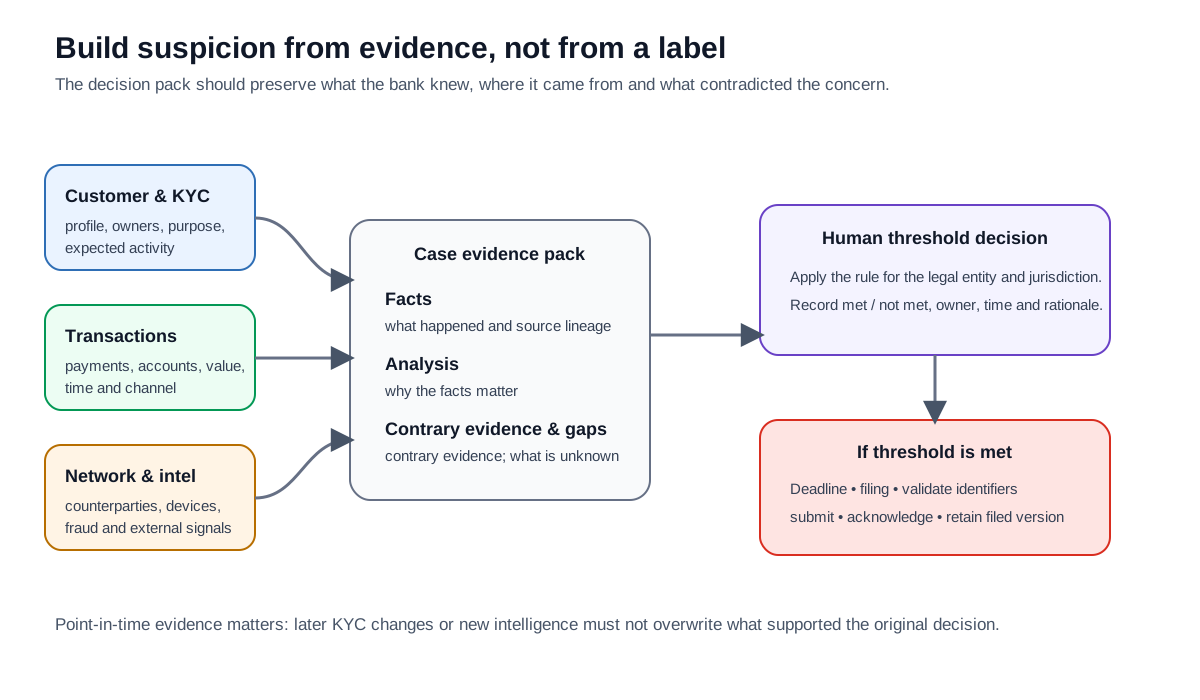
The evidence pack behind the decision
A suspicious-reporting decision should be reproducible from the case evidence. The exact evidence depends on the topic, but a bank commonly draws from customer due diligence, beneficial ownership, account and product data, transaction history, payment messages, counterparties, device or channel data, sanctions or PEP screening, adverse media, prior alerts, previous reports, fraud intelligence, relationship-manager information, trade documents and external public sources.
More evidence is not automatically better. The key question is whether the evidence is relevant to the hypothesis. An investigator reviewing rapid pass-through transfers may need a transaction chronology and counterparty map more than fifty pages of onboarding documents. A trade-based laundering concern may need invoices, bills of lading, goods descriptions and shipping parties. A potential mule case may need incoming payer information, victim reports where lawfully available, device links and onward destinations.
Evidence should also be point-in-time. If the bank later changes a customer's risk rating or a sanctions list is updated, the case should still show what information the investigator saw when the decision was made. This is especially important for historic lookbacks and regulatory examinations.
The case should preserve links to authoritative source records and, where needed, snapshots of material values. Copying data manually into free text introduces transcription risk. Good architecture uses stable identifiers for customer, account, payment, alert, screening event, case, related case and filed report so that a later reviewer can reconstruct the path from transaction to decision.
Who makes the reporting decision?
The operating model differs by jurisdiction and institution. Some banks allow trained investigators to recommend a filing but reserve the final decision for an MLRO, nominated officer or specialised reporting team. Others delegate defined categories while requiring escalation for high-risk, complex or cross-border cases. Whatever model is chosen, responsibility must be explicit.
The first-line investigator should not be pressured to reach a preferred answer because the customer is commercially important or because the backlog is high. The decision owner should have sufficient independence, competence and access to the evidence. Where there is disagreement, the system should preserve the original recommendation, the challenge, the final decision and the reason for override.
A four-eyes check can be useful for higher-risk reports, but simply adding an approver does not create quality. The approver must challenge the reasoning rather than repeat the investigator's conclusion. Useful challenge questions include: What facts created suspicion? What innocent explanation was considered? Which evidence supports or contradicts the concern? Is the reportable person or entity correctly identified? Is the correct legal entity filing? Has the applicable deadline started? Are related cases or earlier reports relevant? Has the customer-facing action been considered separately from the reporting duty?
That last question matters because filing a report does not automatically dictate whether the account should be frozen, restricted, closed or monitored. Sanctions, fraud, AML, law-enforcement instructions, contractual rights and customer-protection rules can lead to different actions. The reporting decision and the customer-treatment decision should be connected but not collapsed into one status.
A jurisdiction-aware decision map
A global bank can use a common decision architecture while keeping legal rules configurable. The sequence can be framed as follows.
First, establish whether the case belongs to a reporting entity and whether sufficient facts are available for a reasoned decision. If essential data is missing, obtain it promptly where doing so is lawful and does not create unacceptable tipping-off or operational risk.
Second, apply the jurisdiction-specific reporting trigger. Ask whether the institution knows, suspects, or has reasonable grounds to suspect the relevant criminal or terrorist-financing connection under the applicable law. Do not import a threshold phrase from one jurisdiction into another simply because the words sound similar.
Third, determine whether the matter is within the reportable scope. Relevant questions can include attempted transactions, non-transactional suspicious behaviour, predicate offences, terrorist financing, sanctions-related activity and other locally defined categories.
Fourth, decide and document. If the threshold is met, start or continue the report preparation and submission workflow within the applicable timeframe. If it is not met, record why, including the evidence that resolved or reduced the concern. A no-report outcome is still a financial-crime decision and should be reviewable.
That documentation approach is a recommended bank control, subject to applicable law and policy. The U.S. October 2025 interagency SAR FAQs expressly clarify that the BSA and its implementing regulations impose no requirement or expectation to document a decision not to file. If the bank elects to document it, a concise statement will often suffice; more complex cases may warrant more detail. Other jurisdictions can impose different assessment-record requirements, so the platform must distinguish a local legal duty from the bank's chosen control practice.
Fifth, consider connected actions separately: customer restrictions, enhanced monitoring, KYC refresh, fraud intervention, sanctions escalation, law-enforcement contact, relationship exit or other risk treatment. None should be assumed solely from the existence or absence of a suspicious report.
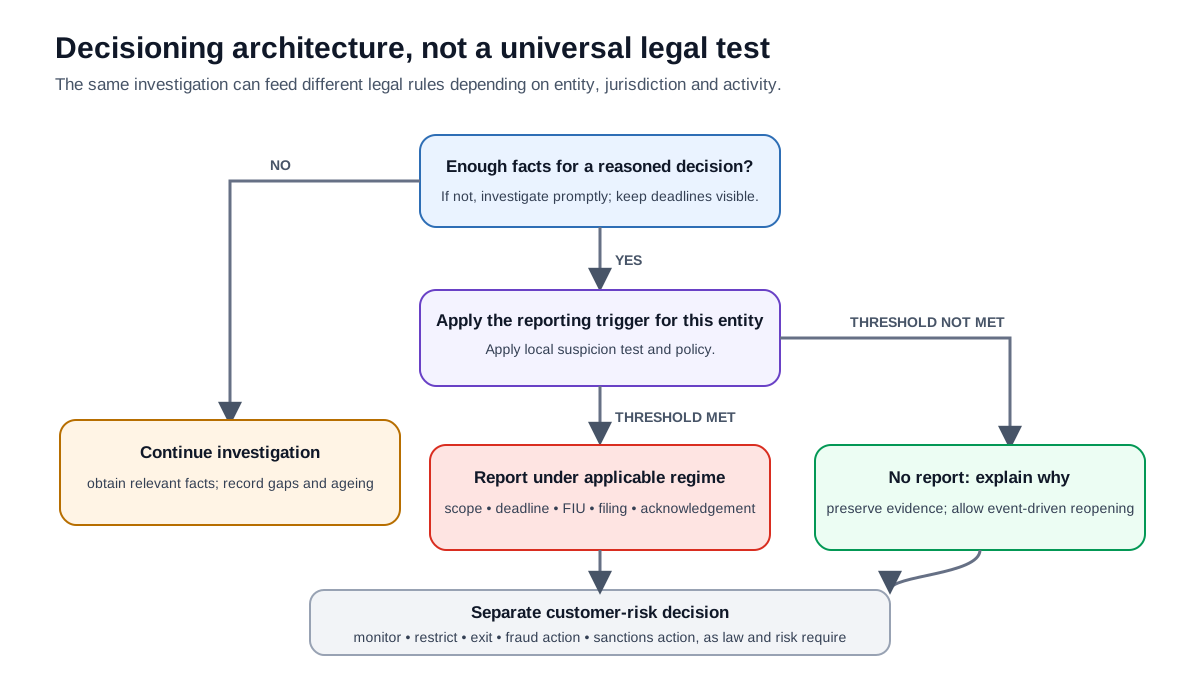
Attempted transactions and activity that never settles
A common operational error is to investigate only posted transactions. FATF's standard expressly covers attempted suspicious transactions. Domestic implementation varies, but a bank should understand whether attempted, rejected, cancelled or prevented activity is reportable under its applicable rules.
This matters in digital channels. A fraud or AML control may block a payment before settlement. A customer may abandon an onboarding journey after enhanced questions. A trade-finance request may be declined before issuance. A sanctions control may stop a transaction before funds move. The fact that the bank prevented loss or movement does not mean the underlying attempt has no intelligence value.
Systems should therefore preserve attempted-event data rather than discarding it as a technical failure. The reporting team may need the original instruction, attempted beneficiary, amount, currency, timestamps, device information, screening results and reason for rejection. A clean ledger alone can hide important attempted activity.
Reporting a customer, reporting activity, and reporting a network
A suspicious report is usually about activity and the parties involved, not simply a customer label. In complex cases, the bank may identify several customers, external counterparties, beneficial owners, devices or accounts connected through a common pattern.
The investigation should avoid two extremes. One is narrowing the report so much that related activity is lost. The other is treating every remotely connected party as suspicious without evidence. Network analysis helps show relationships, but each included subject should have a defensible connection to the reported concern.
Where several internal cases relate to the same network, the bank needs rules for consolidation, cross-reference and duplicate avoidance. Duplicate reports can burden the FIU and obscure the chronology; inappropriate consolidation can hide distinct legal entities, jurisdictions or filing obligations. The case platform should support related-case links while preserving each reporting entity's responsibilities.
The same problem appears with joint or shared customers across group entities. A parent bank may have a global view, but the legal duty to report can sit with a local entity. Data-sharing restrictions may also affect what information can move across borders. Architecture should therefore separate global intelligence correlation from local statutory filing.
Continuing suspicious activity
A report does not necessarily close the risk. The customer may continue to transact, new counterparties may appear, or the pattern may change. The bank needs a post-filing strategy based on its local rules and risk appetite.
In the United States, FinCEN has historically published continuing-activity guidance and later clarified in its current FAQ that institutions are not universally required to follow the old 90-day continuing-SAR cadence; they may file as appropriate under applicable timelines. This is a useful example of why banks should not turn old guidance into a timeless global rule.
A post-filing workflow can include enhanced monitoring, a scheduled review, relationship-risk reassessment, linkage to subsequent cases, and controls to ensure later investigators know that protected report-related information exists without exposing it broadly. Access should be restricted according to law and policy.
New information can also reverse a prior no-report decision. A case closed because activity appeared consistent with a legitimate business may need reopening if law enforcement later identifies a counterparty as part of a laundering network. Good systems preserve the earlier rationale while recording the new trigger; they do not overwrite history to make the previous decision appear wrong with hindsight.
Report quality begins with decision quality
A technically perfect filing can still be poor intelligence if the underlying suspicion is vague. Conversely, a strong investigation can lose value if the report fails to identify the key parties, transactions and reason for suspicion.
Decision quality and narrative quality are related but different. This chapter focuses on the former: whether the bank had a defensible basis to report. The report should then translate that basis into a clear, factual narrative using the FIU's required format. The narrative should identify the suspicious pattern early, provide the relevant chronology, explain why the activity is unusual, distinguish fact from inference, and include identifiers that help the FIU connect the intelligence.
Where structured fields exist, they should be populated accurately rather than relying on the narrative to repair poor data. Names, dates of birth, account numbers, legal entity identifiers, addresses, transaction dates, currencies and amounts should be sourced from authoritative systems. A typo in a key identifier can make a high-quality investigation harder to match with information from other reporters.
Confidentiality starts before submission
The confidentiality boundary is not created only when the submit button is pressed. Even before filing, the fact that the bank is considering a suspicious report can be sensitive. Customer-contact scripts, requests for information, account restrictions and internal collaboration need to be designed so staff do not disclose protected information or compromise an investigation.
The exact tipping-off and disclosure prohibitions are jurisdiction-specific and are covered in the next chapter. For SAR/STR decisioning, the practical point is that access should be need-to-know, reports should not be stored in ordinary customer notes, and customer-facing systems should use neutral operational reasons where lawful and appropriate rather than exposing the existence of an AML report decision.
Data architecture for reporting decisions
A mature reporting platform links six domains: detection, investigation, decision, filing, acknowledgement and post-filing governance.
Detection supplies the alert or referral and its source data. Investigation collects evidence and analysis. Decision records the threshold assessment and approval. Filing maps case data into the FIU's required form or schema. Acknowledgement proves the submission was received or identifies rejection. Post-filing governance manages follow-up, continuing activity, access, retention and related cases.
These domains should share identifiers but not necessarily the same database. A transaction-monitoring vendor may create the alert; a case-management tool may hold the investigation; an internal reporting service may generate the filing; the FIU portal may return an acknowledgement. The control depends on lineage across the boundaries.
For architects and developers, important design fields include reporting jurisdiction, legal entity, report type, decision timestamp, decision owner, rationale, related customer and account IDs, related case IDs, filing deadline, deadline basis, report version, submission channel, submission timestamp, acknowledgement identifier, correction or amendment status, and confidentiality classification.
The reporting service should be idempotent. A timeout after submission must not automatically create a duplicate report. The system should check whether the FIU accepted the original transmission before retrying. Where acknowledgement services are unavailable, the exception should enter a controlled queue with ownership and a deadline-aware escalation.
Business analyst requirements that make the control testable
A requirement such as "the system shall support SAR filing" is too vague to test safely. Requirements should describe the legal and operational state changes.
A stronger requirement specifies that when an authorised decision owner records that the applicable reporting threshold is met, the case must capture the decision timestamp, reporting jurisdiction, legal entity, rule version, deadline basis and report type; create a deadline task; restrict protected fields to entitled roles; assemble required structured data from authoritative sources; permit controlled narrative preparation; validate mandatory fields; submit through the approved channel; record the acknowledgement; and preserve a complete audit trail of changes.
Another requirement should cover no-report outcomes. The system should require a reasoned closure category and rationale, record reviewer identity and timestamp, preserve material evidence, and allow later event-driven reopening without changing the original decision history.
Exception requirements matter just as much. What happens if the FIU portal is unavailable? What if a mandatory identifier is missing? What if two investigators attempt to submit the same report? What if the legal entity is changed after the draft is prepared? What if a case crosses a deadline while awaiting approval? What if new suspicious activity arrives after filing? These are not edge cases in high-volume operations; they are predictable failure modes.
Testing SAR and STR decisioning
Testing should prove the judgement workflow and the technical control separately.
Functional tests can verify that cases with insufficient evidence remain under investigation, cases with a confirmed threshold enter the reporting workflow, no-report cases require a rationale, and users without the proper role cannot approve or submit. Boundary tests should include attempted transactions, multiple connected customers, multiple jurisdictions, cross-entity referrals, missing data, amended reports and continuing activity.
Deadline tests are especially important. The test should confirm that the correct clock starts from the correct event for the configured jurisdiction and that weekends, business days or calendar days are treated according to the relevant rule. A global hard-coded 30-day timer should fail the design review immediately.
Data-quality tests should reconcile report fields back to KYC, payment and account source records. Narrative tests should ensure special characters, long text, line breaks and encoding do not corrupt submissions. Integration tests should simulate portal acknowledgement, rejection, timeout and retry. Security tests should confirm that ordinary customer-service users cannot view protected SAR/STR information.
Model and automation testing should also protect human judgement. If machine learning prioritises cases or suggests likely reportability, testers should confirm that the recommendation can be challenged, the input factors are traceable, and the model does not silently become an automated legal threshold. High score should mean "review this carefully," not "a report is legally required," unless the bank has explicitly designed and validated such automation under the applicable legal framework.
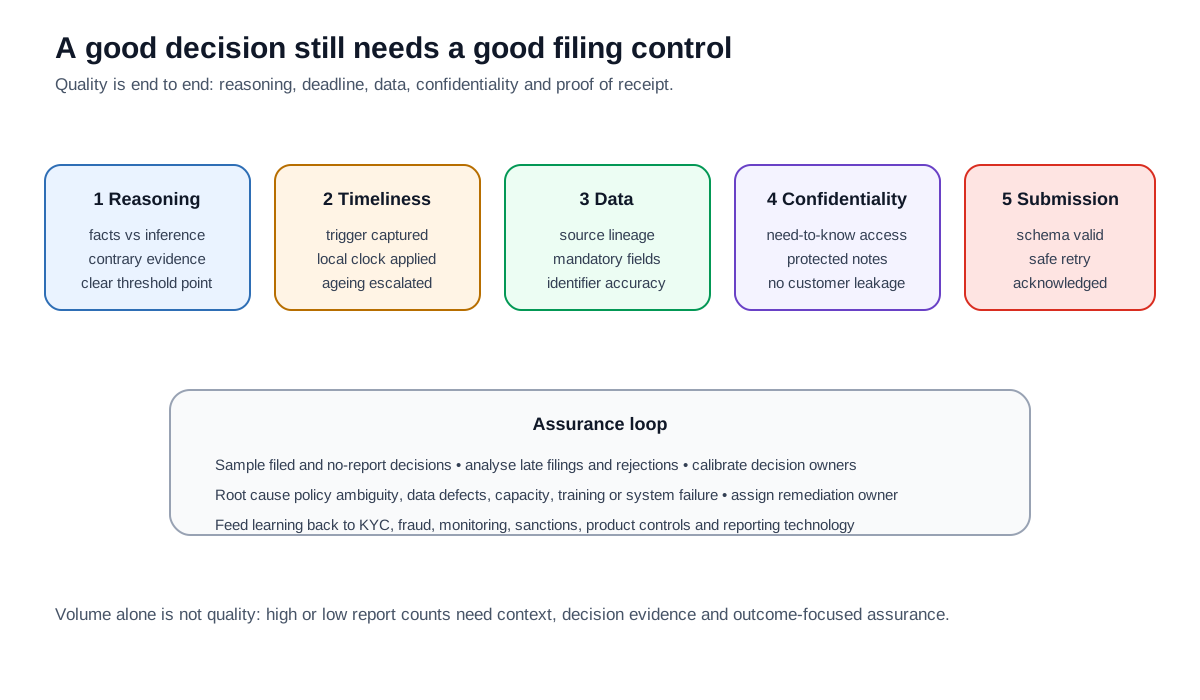
Mini case study: from mule alert to reporting decision
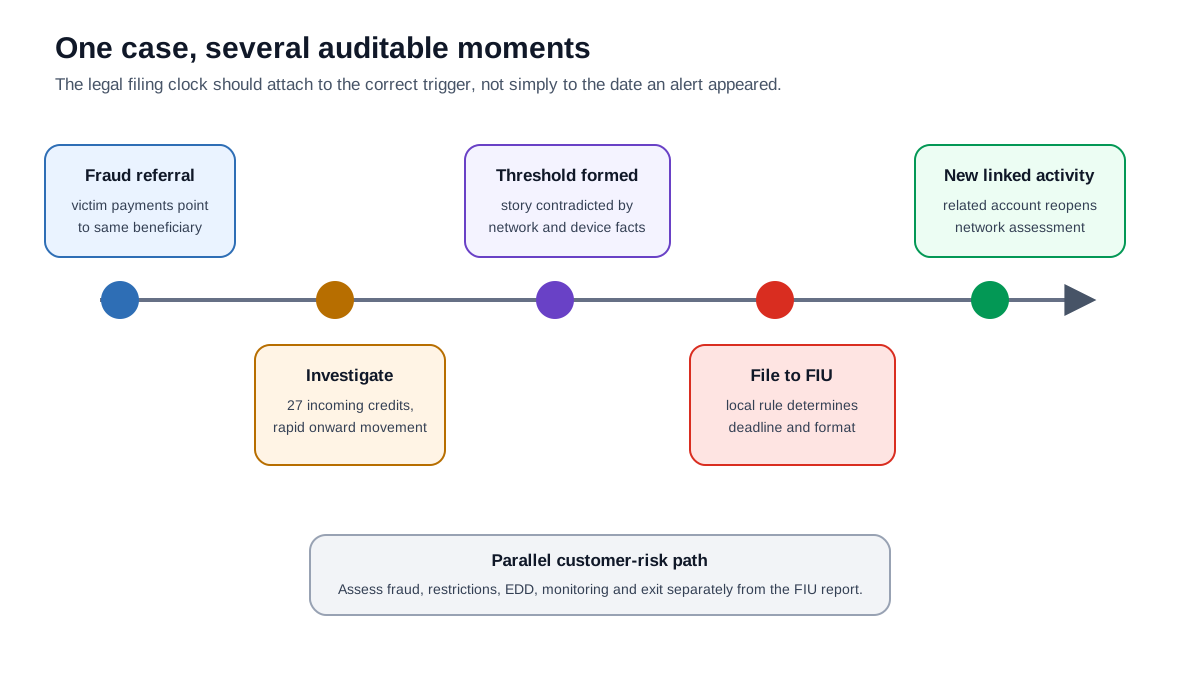
A retail bank receives a fraud referral after three unrelated customers at other institutions report payments to the same beneficiary account. The account was opened four months earlier by a 22-year-old customer who stated that it would be used for salary and everyday expenses. During the first two months, activity was low. In the last ten days, the account has received 27 credits from unrelated parties. Most incoming funds are transferred within an hour to two virtual-asset platforms and three other personal accounts.
The alert is serious, but the reporting decision still requires investigation. The analyst confirms that the incoming payers have no obvious relationship to the customer. Device data shows logins from the same device used to access another account previously restricted for suspected mule activity. The customer tells the bank that the funds are payments for online electronics sales, but cannot provide order records, invoices, marketplace history or shipping evidence. The stated occupation and expected account activity do not explain the volume or pattern.
The investigator documents both sides. The customer did provide a coherent verbal explanation, and incoming credits could theoretically be sales proceeds. Against that explanation are the unrelated payer pattern, rapid onward movement, virtual-asset exits, linked device, mismatch with expected use and absence of basic evidence for the claimed business. The case is escalated to the authorised reporting decision owner.
The decision owner concludes that the applicable local reporting threshold is met and records the facts that created the suspicion. The legal entity and jurisdiction determine the filing workflow and deadline. The reporting team prepares the FIU report using the verified customer identifiers, relevant transactions and concise reason for suspicion. Separately, the fraud and customer-risk teams decide what account restrictions are lawful and proportionate. The bank does not write "SAR filed" in a customer-facing note.
Three weeks later, another internal account is linked through the same device and onward beneficiary. The new case references the prior protected case through restricted linkage. Depending on the local regime and facts, the bank considers whether a further or continuing report is required. The earlier report is not treated as the end of the investigation lifecycle.
This case shows the essential separation: fraud intelligence triggered the review; evidence created the suspicion; an authorised owner made the reporting decision; the local rule determined filing; customer treatment followed a separate risk process; and new intelligence reopened the network view.
Common failure modes
The first failure is alert equals report. This creates defensive filing, weak narratives and poor use of investigative capacity. The repair is to define the evidence and judgement expected between detection and filing.
The second is proof before report. Investigators keep asking questions long after the applicable threshold is met. The repair is training on the difference between suspicion and proof, supported by deadline controls.
The third is one global deadline. A platform uses a single timer across countries. The repair is a jurisdictional rule engine with controlled legal ownership and versioning.
The fourth is commercial override. A senior business stakeholder discourages reporting because the customer is important. The repair is independent decision rights, immutable override history and escalation to financial-crime governance.
The fifth is poor evidence lineage. The report contains numbers or parties that cannot be traced back to source records. The repair is stable identifiers, automated field population where safe and reconciliation testing.
The sixth is submission without acknowledgement control. The bank assumes a file was received because it left an internal gateway. The repair is end-to-end acknowledgement, rejection handling and retry controls.
The seventh is confidentiality leakage. Staff expose the existence of a report in ordinary CRM notes or customer conversations. The repair is access segregation, neutral customer-facing statuses and role-based training.
The eighth is closed-case amnesia. A no-report decision is forgotten even when new evidence later changes the assessment. The repair is event-driven reopening and network linkage that preserves the original reasoning.
Governance and management information
Management information should not reward volume alone. A high number of SARs can reflect strong detection, worsening risk, duplicate reporting or weak decision discipline. A low number can reflect a low-risk business, effective preventive controls, missed detection or under-reporting. The number has meaning only in context.
Useful measures include time from detection to investigation, time from threshold decision to submission, cases approaching statutory or policy deadlines, report rejection or correction rates, percentage of reports with complete mandatory identifiers, QA findings by root cause, reopened no-report cases, repeat reporting on the same subject, related-case linkage, late filings, portal failures and unresolved acknowledgements. Where safe and lawful, FIU feedback or law-enforcement usefulness indicators can also inform improvement, but absence of feedback does not prove a report was poor.
Quality assurance should sample both report and no-report outcomes. Reviewing only filed cases can find narrative defects but will not detect systematic under-reporting. Reviewing only closures can miss defensive reporting. Sampling should include different products, customer types, jurisdictions, analysts and decision owners. Findings should distinguish individual judgement error from policy ambiguity, training gaps, data defects, tooling weaknesses and capacity pressure.
The governance forum should have authority to fix those root causes. If repeated late filing comes from a missing legal-entity field, adding investigators will not solve the problem. If reports are weak because the case view omits counterparty history, training alone will not solve it. Strong governance turns QA observations into accountable changes across policy, data, workflow, staffing and technology.
What to remember
SAR and STR decisioning is the point where an internal investigation becomes external financial intelligence. The bank should neither report mechanically nor demand criminal proof. It should make a reasoned, evidence-based judgement against the legal threshold that applies to the reporting entity, record when that threshold was reached, meet the correct filing timeframe, preserve the evidence and protect the confidentiality of the process.
For delivery teams, the most important design principle is separation with traceability: alert is separate from case, case from suspicion, suspicion from filing, filing from customer treatment, and filing from later monitoring. The links between those stages must remain visible enough that another competent reviewer can reconstruct what the bank knew, why it decided, when it acted and which rule applied.
Operational deep dive: forming and defending the reporting decision
The base chapter separated detection, investigation, suspicion and filing. This deep dive focuses on the hardest part of the process: how a bank reaches a defensible reporting decision when the evidence is incomplete, several innocent explanations remain possible, different jurisdictions use different legal language and the operational clock continues to run.
A mature decision process does not ask only, "Is this suspicious?" That question is too vague. It asks a sequence of narrower questions: What exactly happened? What was expected? Which facts are independently supported? What credible explanations exist? Which facts remain unexplained after reasonable review? What financial-crime hypothesis best fits the pattern? What legal threshold applies to this entity? When was that threshold formed? What must happen next?
The decision should start with a hypothesis, not a label
Labels such as mule, layering, corruption, fraud proceeds or trade-based laundering are useful shorthand after analysis, but they are poor substitutes for analysis. The investigator should begin with a testable hypothesis.
Suppose a corporate customer receives EUR 2.4 million from five overseas companies and transfers almost all of it within two days to unrelated third parties. Calling this "layering" is not enough. A useful hypothesis is more specific: the customer may be acting as an intermediary for third-party funds without an economic purpose consistent with its stated business. The investigator can then test the hypothesis against contracts, invoices, beneficial ownership, customer and supplier relationships, payment references, historic activity and the customer's explanation.
An innocent explanation does not have to be impossible before suspicion exists. The issue is whether the facts, after proportionate review, provide the level of suspicion required by the applicable law. An investigator who keeps searching until every conceivable innocent explanation is eliminated is applying something closer to a criminal-proof standard. An investigator who reports after seeing one unusual payment is applying too little judgement. The bank needs a middle discipline: investigate enough to make a reasoned decision, then act when the threshold is reached.
A practical evidence matrix can help without turning judgement into arithmetic. For each material fact, the case records the source, reliability, whether it supports concern, whether it supports an innocent explanation, and whether further information is reasonably available. The matrix is not a scorecard that mechanically generates a SAR. It prevents selective reasoning by forcing the reviewer to confront evidence on both sides.
The difference between unusual, unexplained and suspicious
These words are often used interchangeably in operations even though they describe different stages.
Unusual means activity differs from an expected pattern or other relevant baseline. A large international payment can be unusual for a student account but completely ordinary for an import business.
Unexplained means the bank does not yet have enough information to understand the activity. Missing information can justify investigation, but a gap is not automatically evidence of crime. A customer may fail to answer because records are unavailable, because the question was poorly framed or because the bank holds outdated contact details.
Suspicious is the regulated judgement that the facts meet the applicable reporting threshold. Suspicion can arise because an explanation is implausible, contradicted by evidence, incomplete in a material way or inconsistent with the pattern observed. It can also arise from intelligence that the customer cannot reasonably explain away, such as linked scam victim payments or a hidden relationship with a known criminal network.
Training should make analysts identify the transition explicitly. "The activity became suspicious when..." is a useful quality check. If the sentence can only be completed with "when the alert generated," the investigation may not have done enough work. If it can only be completed with "when law enforcement proved the offence," the bank may be setting the threshold too high.
Reasonable grounds are not a universal phrase with a universal meaning
FATF Recommendation 20 uses the language "suspects or has reasonable grounds to suspect." Many domestic frameworks use similar words, but teams should resist building a global legal definition from those words alone. Local statutes, case law, regulatory guidance and institutional policy determine how the standard operates.
The EU's current AML Directive, for example, requires Member States to ensure obliged entities promptly inform the FIU where they know, suspect or have reasonable grounds to suspect that funds are proceeds of criminal activity or related to terrorist financing. The United Kingdom uses its own statutory framework and NCA reporting guidance. Australia refers to forming a suspicion on reasonable grounds in its SMR framework. United States bank SAR rules describe categories of transactions that a bank knows, suspects or has reason to suspect meet defined conditions and include regulatory monetary thresholds for mandatory bank filings.
The operational response should therefore be a controlled jurisdiction mapping, not a single paragraph copied into every procedure. The mapping should identify the legal entity, governing legislation or regulation, reportable categories, threshold wording, relevant monetary thresholds where applicable, deadline, FIU, submission channel, confidentiality rules, escalation owner and source document. Legal and compliance owners should approve changes, and technology should consume a version-controlled configuration rather than hard-coded assumptions.
The global standard is intentionally broad
FATF's framework is designed so FIUs receive intelligence before investigators have complete proof. Recommendation 20 covers attempted suspicious transactions and applies regardless of transaction amount at the FATF-standard level. This global expectation helps explain why banks should retain rejected, cancelled or attempted events in investigation data.
But FATF does not decide the exact national filing form or every domestic threshold. That distinction matters in system design. A global product can have a common evidence model and common case states while local reporting adapters implement legal requirements. If the central platform forces every country into the same fields, deadline and decision reason, it will eventually misstate an obligation.
The same architecture should also record the rule version used. Financial-crime law changes. A decision made in 2026 may be reviewed in 2030. The reviewer should be able to identify which legal and policy rule applied at the time rather than applying the current configuration retrospectively.
When the customer explanation is partly credible
The most difficult cases are rarely those where the explanation is obviously false. They are cases where some facts make sense and others do not.
Imagine a small construction company that receives multiple round-number transfers from private individuals and makes frequent cash withdrawals. The customer says the incoming funds are deposits from homeowners and the cash is used to pay subcontractors. That explanation is plausible in parts of the sector. The investigator should test it, not dismiss it.
The bank may compare payer names with contracts, review invoice timing, examine whether cash withdrawals align with project locations, check payroll or supplier patterns where lawfully available, review the customer's declared business model and compare activity with earlier periods. If several homeowner payments correspond to documented projects but a separate cluster of payments comes from unrelated foreign counterparties and is immediately sent to a virtual-asset platform, the case may contain both legitimate and suspicious activity.
The report decision need not classify the entire customer relationship as criminal. It can identify the specific activity and facts that create suspicion. Precision improves intelligence quality and reduces the risk that the bank turns a nuanced investigation into a sweeping unsupported accusation.
Negative evidence is part of the decision
A good case records information that weakened the concern. This is not wasted work. It shows that the investigator tested alternatives rather than building a one-sided narrative.
Negative evidence might include verified invoices, independently confirmed employment, a clear family relationship between payer and beneficiary, a documented asset sale, a legitimate treasury-sweep structure, established merchant settlement activity or a known seasonal business pattern. The weight of the evidence depends on reliability. A customer-created invoice may be relevant but less persuasive than independent shipping or registry information if document fabrication is itself part of the concern.
A no-report decision can be high quality when the concern is resolved by reliable evidence. The case should say what resolved it. "No suspicion" is not enough. A stronger closure explains that the unusual transfer was proceeds from a verified property sale, the counterparty and ownership were confirmed independently, the funds were consistent with the customer's source-of-wealth profile, and no contradictory activity was found in the review period.
This documentation becomes important if later intelligence changes the picture. The earlier decision can then be assessed fairly based on what the bank knew at the time.
Missing information and the point at which waiting becomes unsafe
Financial-crime teams often wait for customer documents, relationship-manager responses or external information. Waiting may be reasonable while the case is genuinely unresolved, but it becomes dangerous if the reporting threshold has already been met and the bank delays filing simply to improve the narrative.
The workflow should distinguish information needed to decide from information useful to enrich an already reportable case. Once the threshold is formed, the applicable deadline must control. Additional information can sometimes be added through an amendment, supplementary report or later filing depending on the regime.
A deadline engine should therefore support a state such as threshold_formed_information_pending. That state makes clear that the bank is not entitled to stop the clock because one document is outstanding. Governance reports should highlight cases where an analyst has marked the threshold as met but no filing has followed within the expected timeline.
The reverse is also true. Teams should not start the legal reporting clock artificially at every alert merely to create a conservative internal SLA if doing so causes misleading regulatory metrics. The bank can have an internal alert-review SLA and a separate statutory filing clock. Both matter, but they measure different risks.
Decision ownership and the MLRO or nominated officer model
Many institutions route suspected cases to an MLRO, nominated officer or specialist reporting function. The exact title and legal role varies by jurisdiction. The control objective is that the person making the final decision has appropriate authority, independence and competence.
The investigator's recommendation should remain visible. If an investigator recommends reporting and the decision owner declines, the case should preserve the disagreement and reasoning. If the decision owner files against the investigator's recommendation, that should also be visible. An audit trail should show who changed what and when; it should not allow the final approver to rewrite the analyst's original notes.
Escalation should exist for difficult conflicts. Examples include a senior executive customer, a politically exposed person, a report involving the bank itself, a case involving a staff member, a major correspondent, an important government entity or a situation where local law conflicts with group expectations. Escalation should protect independence without leaking protected report information beyond the people who need it.
The bank should also decide how absences are handled. A legal filing deadline cannot stop because the designated approver is on leave. Delegation must be pre-authorised, entitlement-controlled and tested.
Cross-border groups: one intelligence picture, several legal duties
A global bank may see a customer through several entities. A corporate group may hold an account in Sweden, trade-finance facilities in Germany and a cash-management service in the United Kingdom. Central analytics may identify a suspicious network spanning all three.
The group should build a coherent intelligence picture, but it must not assume one group SAR satisfies every local reporting obligation. The relevant entity or establishment may have its own duty to report to its FIU. Local secrecy, data-protection or bank-confidentiality restrictions can also affect what information may be shared across borders.
A useful architecture separates three objects:
- the group intelligence case, which correlates network information across entities where lawful;
- the local reporting decision, which applies the law of the relevant entity or establishment; and
- the FIU report, which contains information permitted and required under that regime.
These objects can be linked without being merged. The group case might show that three local reports are related, while each filing retains its own decision owner, deadline and acknowledgement.
Reporting and customer action are different decisions
A frequent operational shortcut is to map SAR = yes to close account. That is usually too crude. Filing can coexist with continued monitoring, enhanced due diligence, temporary restrictions, fraud holds, sanctions blocking, relationship exit or no immediate customer action, depending on law, risk and product context.
Closing too quickly can create customer harm, destroy useful intelligence, frustrate law-enforcement activity or reveal that the bank suspects the customer. Continuing a relationship without risk treatment can expose the bank to further laundering or victim loss. The decision should therefore be separate and involve the appropriate AML, fraud, sanctions, legal, customer-risk and business owners.
The case platform can link the actions but should not make one mechanically determine the other. A field such as relationship_action should have its own rationale, approval and effective date.
Urgent activity and parallel escalation
Some cases require immediate action beyond routine FIU filing. FinCEN's bank rule, for example, states that situations involving violations requiring immediate attention, such as ongoing money-laundering schemes, should also be notified immediately to an appropriate law-enforcement authority while the SAR is filed timely. Other jurisdictions have their own emergency, consent, defence, restraint or law-enforcement mechanisms.
A global procedure should not invent one emergency route for all countries. It should provide a configurable urgent escalation path that points analysts to the correct local instruction. The case should record why urgency was declared, who was contacted, when contact occurred and what instruction was received.
Urgency can also be operational rather than legal. If funds linked to scam victims are being dissipated through instant payments, fraud recovery teams may need to act in seconds or minutes even though the FIU filing deadline is longer. The bank should coordinate those actions without exposing protected SAR information unnecessarily.
Continuing activity: do not fossilise old guidance
Many banks inherited continuing-SAR procedures from older guidance and then treated them as universal law. The United States is a useful example of why governance must distinguish regulation from optional or historical guidance. FinCEN's current FAQ explains that earlier guidance suggested periodic continuing-activity reporting, but financial institutions are not required to follow that specific cadence and may file as appropriate under applicable timelines.
The lesson is broader than the United States. A rulebook should store the source and status of each requirement: law, regulation, regulator rule, FIU instruction, supervisory guidance, industry practice or internal policy. Systems and procedures should not present an internal preference as a legal obligation.
Post-filing monitoring should still be deliberate. The bank needs to know whether new activity is materially different, whether the same scheme continues, whether a new subject appears, whether a prior report should be referenced, and whether the relationship risk has changed. The correct reporting response depends on the relevant regime.
Three mini decision cases
Case A: high velocity but explained
A software company that normally receives monthly subscription income receives a EUR 3 million payment and transfers EUR 2.8 million the same day to a law firm. The transaction-monitoring system flags unusual value and rapid movement. Investigation shows the company completed a documented sale of a business unit. The payer is the acquiring company named in the signed agreement; the law firm is acting as escrow agent; corporate announcements and board records corroborate the event.
The activity was unusual but the concern is resolved by coherent independent evidence. Unless other facts create suspicion, a no-report decision can be defensible. The closure should document the evidence rather than simply say "business confirmed."
Case B: plausible story, contradictory network evidence
A personal customer receives 18 payments described as "rent" and says they are income from several properties. Land-registry information confirms ownership of two properties, which makes the story partly plausible. However, twelve payers are unrelated to the known tenants, several payments originate from accounts previously linked to scam proceeds, and most funds are moved immediately to a newly opened exchange account. The customer cannot identify the extra payers or explain the exchange transfers.
The existence of legitimate rental income does not neutralise the contradictory network evidence. The decision owner may reasonably conclude that the reporting threshold is met for the unexplained cluster while accurately noting the legitimate property activity.
Case C: investigation incomplete but deadline active
A corporate investigator identifies unexplained transfers through a shell-company chain. The beneficial ownership team has requested registry documents from another country, but reliable evidence already shows that the customer concealed a controlling party and moved funds for an undisclosed third party. The local reporting threshold is met today. Waiting two weeks for additional registry documents might improve the case but is not necessary to form suspicion.
The correct control response is to record when the threshold was formed, file according to the applicable deadline and add later intelligence through the permitted follow-up mechanism if material.
Quality assurance should test both directions
A reporting programme can fail through under-reporting or over-reporting. QA should deliberately look for both.
To test under-reporting, reviewers sample no-report decisions, high-risk closures, cases with strong red flags, cases closed quickly and cases handled near capacity peaks. They ask whether relevant evidence was ignored, whether the threshold was set too high, whether commercial pressure influenced the decision and whether deadlines were manipulated through case-state changes.
To test over-reporting, reviewers sample reports generated from weak alerts, reports with little investigative work, repeated reports on the same activity and reports whose reason for suspicion is merely a typology label. They ask whether the bank formed an actual suspicion or simply transferred an unresolved alert to the FIU.
QA should also examine decision consistency. Two competent investigators do not need identical words, but materially similar facts should not produce wildly different outcomes without a reason. Calibration sessions can use anonymised cases to identify policy ambiguity and training gaps. The objective is not robotic uniformity; it is explainable judgement.
The decision record as an audit object
Years after a filing, a regulator may ask a deceptively simple question: Why did you file this report? Or: Why did you not file one?
The decision record should answer without reconstructing the case from memory. It should show the applicable rule, facts considered, material evidence, relevant contrary evidence, gaps, threshold decision, decision owner, timestamp, filing deadline basis, customer-action handoffs and later developments. If a report was submitted, it should link to the exact submitted version and acknowledgement.
This is why free-text alone is insufficient. Free text captures reasoning; structured fields capture control state. Strong systems use both. Structured data makes deadlines, legal entities and outcomes measurable. Narrative makes human judgement understandable.
A practical review standard
Before approving a report or no-report decision, a reviewer should be able to answer these questions from the case without contacting the original analyst:
- What activity or behaviour caused the investigation?
- What customer profile and expected activity were relevant?
- What facts support a financial-crime concern?
- What facts support an innocent explanation?
- What was not established, and why?
- What specifically caused the threshold to be considered met or not met?
- Which legal entity and jurisdiction own the decision?
- Which rule and version apply?
- When was the threshold formed?
- What filing deadline and submission route apply?
- Are there related cases or prior reports?
- Is any urgent parallel action required?
- What customer-risk action is being considered separately?
If those questions can be answered clearly, the bank has a decision that can survive challenge. If they cannot, more words in the narrative will not fix the underlying control gap.
Advanced practice: designing a bank-grade suspicious-reporting workflow
A well-written policy does not guarantee timely, accurate reporting. The control succeeds only when legal interpretation, case workflow, data lineage, access control, submission technology and operational governance work together. This supplement translates SAR and STR decisioning into system and delivery considerations for business analysts, architects, developers, testers, operations leaders and control owners.
The requirements below are examples of bank control design. In particular, a mandatory no-report closure rationale is a chosen policy control, not a universal statutory requirement. The October 2025 U.S. interagency FAQs state that the BSA and its implementing regulations create no requirement or expectation to document a decision not to file a SAR. Configure local legal requirements and the bank's approved policy separately.
Treat reporting as a state machine
A case platform should represent the reporting lifecycle as explicit states rather than a collection of free-text notes. A practical model might include:
investigation_open → decision_pending → threshold_met or threshold_not_met → report_drafting → report_ready → submitted → acknowledged → post_filing_review.
Additional states may be needed for rejected submissions, amendments, urgent escalation, information requests or re-opened decisions. The important point is that each transition has an owner, a timestamp, eligibility rules and an audit event.
For example, moving from decision_pending to threshold_met should require the reporting jurisdiction, legal entity, decision owner, decision time and decision rationale. Moving from report_ready to submitted should require mandatory report data to pass validation. Moving to acknowledged should require a positive response from the FIU channel or another approved confirmation method.
The state machine prevents ambiguous situations such as a report being described as "done" when a draft exists but the FIU never received it. It also makes deadline monitoring reliable because the workflow can identify which cases have crossed the legal decision point but remain unsubmitted.
Keep alert clocks, investigation SLAs and legal filing clocks separate
Banks often create unnecessary complexity by using one ageing field for every purpose. At least three clocks may exist.
The alert clock measures how quickly a detection is triaged. It is usually an internal service standard.
The investigation clock measures how long the bank takes to gather enough information for a decision. This may also be an internal risk standard, although supervisors can care deeply about excessive investigation delay.
The filing clock is linked to the applicable statutory or regulatory trigger and deadline. Its start event differs by jurisdiction.
These clocks can overlap but should not be conflated. If a case spends ten days in alert triage and the local filing period begins only when the institution has reached a defined point of initial detection or formed suspicion, the platform should still show the ten-day operational delay without falsely representing it as a statutory breach. Conversely, once the legal filing clock starts, an internal workflow should not pause it because the case changes teams.
A rule engine can hold attributes such as jurisdiction, reporting_entity, report_type, trigger_event, calendar_type, deadline_duration, urgent_path, rule_source, effective_from, effective_to and rule_owner. This lets legal and compliance teams update obligations without developers rewriting case logic for every regulatory change.
Version the rule that produced the deadline
A deadline is not just a date. It should be explainable.
If a case shows filing_due_at = 2026-10-17T17:00, the system should also show why. The supporting metadata might identify the United States bank SAR rule, the relevant trigger time, the calendar-day logic and the rule configuration version. In an Australian SMR case, the engine may apply a different trigger and business-day calculation. A UK workflow may track a policy target designed to evidence "as soon as practicable" while separately identifying the statutory basis.
Versioning is essential when rules change. A new rule should apply prospectively according to its effective date unless legal interpretation requires another approach. Historic cases should retain the version used at decision time. Otherwise an audit performed after a rule change may incorrectly mark old cases late.
Business-day engines are a control dependency
Where a jurisdiction uses business days, the calendar service becomes part of the financial-crime control. It must know the relevant jurisdiction, holidays, weekends and cutoff conventions. A global corporate calendar is not enough if local public holidays differ.
Testing should include cases created before weekends, local public holidays, year-end periods and daylight-saving changes. If the service fails, a safe fallback should exist. The bank should not discover during a regulatory examination that an upstream holiday API silently calculated deadlines incorrectly for a year.
Calendar changes should also be auditable. If a government declares an exceptional public holiday, the bank may need to update future due dates without rewriting the original trigger history.
Use authoritative data for filing fields
A suspicious-reporting form combines decision data with customer, account and transaction data. Manual re-keying creates avoidable errors. Wherever safe, structured fields should be populated from authoritative systems.
Customer names and identifiers should come from controlled KYC records. Account numbers should come from the account master. Payment values and timestamps should come from the transaction or payment record. Legal entity and branch should come from organisational reference data. The investigator can still correct or contextualise information, but the system should distinguish a sourced value from a manually entered override.
Each populated field benefits from lineage metadata: source system, source record identifier, extraction time and, where relevant, source version. If the customer changes address after filing, the bank should still be able to show which address was reported and why.
For ISO 20022 or SWIFT payments, the case may need both the customer instruction and the version screened or sent into the payment chain. A report about suspicious originator information may rely on the exact debtor, ultimate debtor, creditor, ultimate creditor, agent, remittance or address data available at the relevant point. A later enriched reporting view can be useful, but it should not silently replace the evidence used at the time.
Narrative generation should assist, not invent
Technology can help assemble a chronology, transaction summary or list of subjects. It should not invent a reason for suspicion.
A safe narrative-assistance pattern uses verified case facts to prepare a draft skeleton: who is involved, what happened, when it happened, which accounts and transactions are relevant, and what investigative findings have been recorded. The decision owner or reporting analyst then writes or approves the explanation of why the activity is suspicious.
If generative technology is used, the bank needs strong controls. The model should not have authority to add facts that are absent from the case, infer criminality from protected characteristics, fabricate external intelligence or select a legal filing threshold. Drafts should remain clearly marked as drafts until a trained human approves them. Prompt and output handling must also respect SAR confidentiality and data-protection requirements.
A useful validation step compares every material number, date, party and identifier in the narrative against structured case data. The objective is not stylistic perfection. It is factual fidelity.
Submission architecture: the last mile matters
Many reporting failures occur after the investigation is complete. A report can be correct and still fail the control if it never reaches the FIU.
The submission architecture may be an FIU web portal, secure API, batch upload, file transfer or other approved mechanism. The bank should treat the interface as a critical regulatory service. The system needs authentication, entitlement control, payload validation, encryption, retry logic, acknowledgement processing and operational monitoring.
A common failure pattern is a timeout after the bank sends a report. The application cannot tell whether the FIU received the message. Blindly retrying can create a duplicate. Simply marking the case failed can miss a valid submission. The integration should therefore use an idempotency key, submission reference or reconciliation query where the external service supports one. Where it does not, the bank needs a manual reconciliation procedure.
Submission evidence should include the payload version or immutable representation sent, timestamp, submitting user or service identity, external reference, acknowledgement, error code if rejected, and any subsequent correction. Logging should avoid exposing the full protected narrative to ordinary technical monitoring tools.
Rejection and repair are part of the control
A rejected report is not equivalent to a filed report. The case should reopen the submission task immediately and preserve the reason for rejection.
Technical rejection reasons can include invalid format, missing mandatory fields, identifier length, unsupported characters, invalid date formats or schema-version mismatch. Business validation errors may require investigation input. The platform should classify the rejection so the right team receives it.
Deadline dashboards should continue to treat the report as outstanding until accepted where the regime requires successful submission. A retry after the legal deadline should record the original attempt and the eventual successful filing so compliance can assess whether a breach occurred.
Repeated rejection patterns should feed root-cause management. If dozens of reports fail because a KYC source emits an invalid country code, fixing individual reports is not enough. The source mapping must be corrected and previously affected reports assessed.
Duplicate prevention needs more than a search box
Large banks can generate multiple cases about the same person or network. Two business units may investigate the same account, or a fraud case and an AML case may converge. Duplicate detection should occur before filing without preventing legitimate follow-up reports.
Useful matching keys include customer ID, account, tax or national identifier where permitted, case relation, prior report reference, key counterparties, transaction identifiers and defined reporting period. Matching should suggest related reports rather than automatically suppressing a filing because local obligations may differ.
The reviewer should see whether the new activity is already covered, whether it materially extends the previous report, whether a different legal entity has its own duty and whether the new information changes the financial-crime hypothesis.
The same principle applies to a corrected filing. A correction should reference the original report according to the FIU's process rather than appearing as an unrelated duplicate.
Confidentiality by design
SAR and STR data should have a stronger classification than ordinary case data where required by applicable law and policy. Access can be restricted by role, legal entity, jurisdiction and need-to-know purpose.
A customer-service user may need to know that an account has a restriction but not that a report exists. A fraud analyst may need to share underlying transaction information with AML without gaining access to the filed SAR. A developer may need production telemetry without seeing narrative content. The architecture should support those distinctions.
Search indexes, data lakes and observability platforms deserve special attention. Protected report text should not be copied automatically into enterprise-wide analytics or logs. Backups, disaster-recovery sites and test environments should maintain the same classification controls. Production SAR data should not be used casually as test data.
Access itself should be audited. Unusual viewing, downloading or exporting of protected cases may warrant security investigation.
Group intelligence and local filing adapters
A multinational bank benefits from central network analytics, but local FIU reporting should remain jurisdiction-aware. One practical architecture uses a common intelligence layer and separate reporting adapters.
The common layer stores entities, accounts, payments, relationships, alerts and cases using globally stable identifiers where lawful. Local adapters apply the reporting entity's rulebook, form schema, deadline and submission channel. A local report can reference group intelligence without assuming the group platform has authority to file on behalf of every entity.
Data minimisation matters. A local report should contain information required or relevant under that regime, not every fact available anywhere in the group. Cross-border sharing should follow legal and privacy controls.
Event-driven reopening
A no-report case should not disappear permanently. New events can change the analysis.
Reopening triggers may include a new high-risk alert, new adverse information, a sanctions or PEP status change, a law-enforcement request, a victim report, a related customer filing, a material KYC change or intelligence from another part of the bank. The system should allow the new case to reference the previous decision while preserving both timelines.
This creates an important distinction between decision finality and risk finality. The decision was final based on the facts available then; the risk remains capable of changing.
The same event model supports continuing activity after a report. A post-filing monitoring rule can generate a new review when activity crosses a defined materiality or time threshold. The rule should be grounded in the relevant jurisdiction and policy, not a universal cadence copied from another country.
Acceptance criteria for a reporting workflow
A business analyst can convert the control into testable acceptance criteria. Examples include:
- Only authorised roles can record the final report/no-report decision.
- A threshold-met decision cannot be saved without legal entity, jurisdiction, decision timestamp, decision rationale and rule version.
- The deadline engine calculates the due date using the configured jurisdictional rule and preserves the calculation inputs.
- Cases within a defined warning window appear on an escalation dashboard and cannot be hidden by reassignment.
- Filing fields populated from source systems retain source lineage.
- A submitted report is not marked acknowledged until positive acknowledgement or an approved reconciliation method confirms receipt.
- Submission retries do not create unintended duplicate reports.
- Rejected submissions remain open and retain the original attempt history.
- No-report decisions require a closure rationale and remain eligible for event-driven reopening.
- Filed-report content is not exposed to general CRM users or enterprise search.
- Related reports can be linked without merging separate legal-entity obligations.
- Audit history cannot be edited by ordinary users.
These criteria are deliberately observable. They allow testers to prove the control rather than simply verify that a page loads.
A test pack for real failure conditions
A credible UAT pack should include clean and adverse scenarios.
Scenario 1: threshold not met. An unusual payment is supported by independent evidence. The investigator records a no-report decision. The system requires rationale and closes the reporting task without creating a filing record.
Scenario 2: threshold met with complete data. The decision owner records suspicion, the filing deadline starts, fields populate correctly, the report submits and acknowledgement closes the task.
Scenario 3: missing subject identifier. The threshold is met but a mandatory external identifier is unavailable. The case follows the applicable missing-data procedure without silently stopping the deadline.
Scenario 4: portal outage. The report is ready but the FIU channel fails. The system records the outage, escalates, retries safely and preserves evidence of all attempts.
Scenario 5: ambiguous timeout. The external service times out after receiving the message. The system reconciles before retry and prevents duplicate submission.
Scenario 6: multiple jurisdictions. A group case involves customers in two legal entities. Each local decision receives its own rule, deadline and submission path while sharing permitted intelligence.
Scenario 7: continuing activity. New transactions occur after filing. The workflow creates a new review linked to the earlier report without exposing the report to unauthorised users.
Scenario 8: late new evidence after no-report. Law-enforcement intelligence arrives after closure. The previous decision remains immutable and a new review opens with the new trigger.
Scenario 9: entitlement breach attempt. A customer-service user searches for a known SAR subject. The protected record does not appear, and the access attempt is logged according to security policy.
Scenario 10: regulatory-rule change. A new rule becomes effective on a future date. Pre-effective cases retain the old configuration; new cases receive the new rule, and the change is traceable to approval.
Management information that reveals control health
A reporting dashboard should distinguish workload, timeliness, quality, data health and submission reliability.
Workload metrics include investigations awaiting decision, threshold-met cases awaiting filing, reports in draft and reopened cases. Timeliness measures include alert ageing, investigation ageing, filing-clock ageing and late filings. Quality measures include QA error rates, report correction rates, no-report reversals and root-cause categories. Data-health measures include missing mandatory fields and manual overrides. Submission reliability includes portal errors, rejection rate, acknowledgement latency and unreconciled submissions.
These metrics should be segmented by legal entity, jurisdiction, product, detection source and operating team. A global average can hide a serious local problem. If one jurisdiction has a high late-filing rate because all cases wait for a central approver in another time zone, the segmentation makes the operating-model defect visible.
Metrics also need careful interpretation. A lower SAR volume after scenario tuning may mean fewer false positives or weaker detection. A higher volume after a major scam event may reflect genuine threat movement. Governance should analyse cause, not reward a number in isolation.
Root-cause feedback into the wider financial-crime programme
SAR and STR decisioning sits near the end of the detection-and-investigation chain, which makes it a rich source of feedback.
If investigators repeatedly report cases involving the same mule pattern, transaction-monitoring scenarios may need improvement. If reports repeatedly lack beneficial-owner information, KYC data quality may be weak. If customers consistently provide plausible explanations after alerts, scenarios may be poorly calibrated. If reports identify networks spanning fraud and AML systems, intelligence sharing may be fragmented.
The reporting function should therefore feed structured lessons back into KYC, sanctions, fraud, transaction monitoring, data governance, customer risk rating and product controls. The purpose of the SAR process is not merely to send forms outward. It should also help the bank learn where its own preventive and detective controls are succeeding or failing.
Architecture principle to carry forward
The best technical design keeps the legal judgement human-readable and the operational mechanics machine-verifiable. The rationale should make sense to a competent reviewer. The workflow should prove who decided, which rule applied, when the clock started, what was filed, whether it was received and what happened afterwards.
When those two qualities are combined, the bank can scale reporting without turning the process into either unstructured manual craft or blind automation. That is the standard a bank-grade SAR and STR decisioning capability should aim for.
References and further reading
The chapter uses the FATF standard as the global baseline and then treats national and regional reporting rules as jurisdiction-specific implementations. Operational teams should always confirm the rule that applies to the relevant legal entity, establishment, activity and date rather than copying a deadline or threshold from another jurisdiction.
Global standard
- Financial Action Task Force (FATF), The FATF Recommendations. Recommendation 20 establishes the global standard for prompt reporting to the FIU where a financial institution suspects or has reasonable grounds to suspect criminal proceeds or terrorist-financing links: https://www.fatf-gafi.org/en/publications/Fatfrecommendations/Fatf-recommendations.html
- FATF, Methodology for Assessing Technical Compliance with the FATF Recommendations and the Effectiveness of AML/CFT/CPF Systems. The Recommendation 20 assessment criteria state that suspicious transactions, including attempted transactions, should be reportable regardless of amount at the FATF-standard level: https://www.fatf-gafi.org/content/dam/fatf-gafi/methodology/FATF-Assessment-Methodology-2022.pdf
United States
- Financial Crimes Enforcement Network (FinCEN), Answers to Frequently Asked Bank Secrecy Act Questions. Includes FinCEN's explanation of the bank SAR filing clock and the distinction between an alert/review and the point at which facts meet the suspicious-activity definition: https://www.fincen.gov/resources/answers-frequently-asked-bank-secrecy-act-bsa-questions
- FinCEN, Frequently Asked Questions Regarding the FinCEN Suspicious Activity Report (SAR). Current FAQ covering, among other matters, continuing suspicious activity and clarifying that the older continuing-SAR cadence is not universally mandatory: https://www.fincen.gov/resources/frequently-asked-questions-regarding-fincen-suspicious-activity-report-sar
- FinCEN and the federal banking agencies, Frequently Asked Questions Regarding Suspicious Activity Reporting Requirements, 9 October 2025, Question 4. Clarifies that the BSA and its implementing regulations impose no requirement or expectation to document a decision not to file a SAR; elective documentation should reflect risk-based internal policies and case complexity: https://www.fincen.gov/resources/statutes-regulations/guidance/frequently-asked-questions-regarding-suspicious-activity
- Federal Financial Institutions Examination Council (FFIEC), BSA/AML Examination Manual. Supervisory reference for U.S. banking organisations, including suspicious activity reporting, investigation expectations and examination practice: https://bsaaml.ffiec.gov/manual
United Kingdom
- National Crime Agency (NCA), Suspicious Activity Reports. UKFIU guidance hub covering the SAR Portal, report submission and specialist guidance including reason for suspicion and Defence Against Money Laundering material: https://www.nationalcrimeagency.gov.uk/what-we-do/crime-threats/money-laundering-and-illicit-finance/suspicious-activity-reports
- National Crime Agency, Contact us: SARs. Current NCA explanation that organisations in the regulated sector with a legal reporting obligation should submit a SAR as soon as practicable and that a SAR does not replace other crime or safeguarding reporting routes: https://www.nationalcrimeagency.gov.uk/contact-us/contact-us-sars
European Union
- EUR-Lex, Directive (EU) 2015/849, current consolidated framework before its repeal on 9 July 2027. Article 33 requires Member States to ensure obliged entities promptly inform the FIU where they know, suspect or have reasonable grounds to suspect that funds are proceeds of criminal activity or related to terrorist financing, and requires reporting of suspicious attempted transactions: https://eur-lex.europa.eu/legal-content/EN/TXT/?uri=CELEX:32015L0849
Australia
- AUSTRAC, Suspicious matter reports, last updated 9 September 2026. Current guidance on forming reasonable grounds for suspicion, SMR submission, and the Australian deadlines of 24 hours for terrorism-financing suspicion and three business days after the day the suspicion is formed for other suspicions, subject to the framework and stated qualifications: https://www.austrac.gov.au/industry-and-business/obligations-and-guidance/your-amlctf-program/reporting-us/suspicious-matter-reports
These sources are used for the legal and regulatory anchors in this chapter. Internal bank policies may impose shorter operational service levels, additional approval steps or broader investigative controls, but those internal standards should remain distinguishable from the statutory or regulatory reporting rule.