Screening Sequence Across Payment Rails and Correspondent Chains
A payment is rarely a single technical event. From the customer's instruction to final settlement, it can pass through channels, payment hubs, validation services, enrichment engines, fraud controls, sanctions filters, correspondent banks, clearing systems and ledgers. At each point the data may be represented differently, supplemented with new information, repaired after an exception, converted between formats or evaluated under a different institution's legal obligations. That makes the phrase “the payment was screened” too vague for a bank-grade control design.
The practical question is not simply whether screening happened. It is what was screened, by whom, under which rules, using which version of the payment data, before which release point, and what happened if material information changed later. A control that cannot answer those questions may appear satisfactory in a policy document while leaving real gaps in production.
Screening sequence therefore sits at the intersection of sanctions compliance, payment transparency, payment architecture, correspondent banking, ISO 20022 data quality, operational resilience and auditability. It is also highly contextual. A domestic retail credit transfer, an instant payment, a high-value RTGS payment, a serial cross-border transfer and a cover payment do not necessarily expose the same parties, have the same processing windows or involve the same institutions. A useful control framework preserves a common objective while allowing the sequence to differ legitimately by rail, role and jurisdiction.
A core principle runs through this chapter: there is no universal rule that every institution must screen every field at every hop. Legal obligations depend on the institution, jurisdiction, sanctions regime, customer relationship, payment role and applicable product or scheme rules. Banks also apply internal risk appetite and policy controls that can go beyond the legal minimum. The architecture must therefore support explicit, evidence-based decisions rather than assume one global screening pattern.
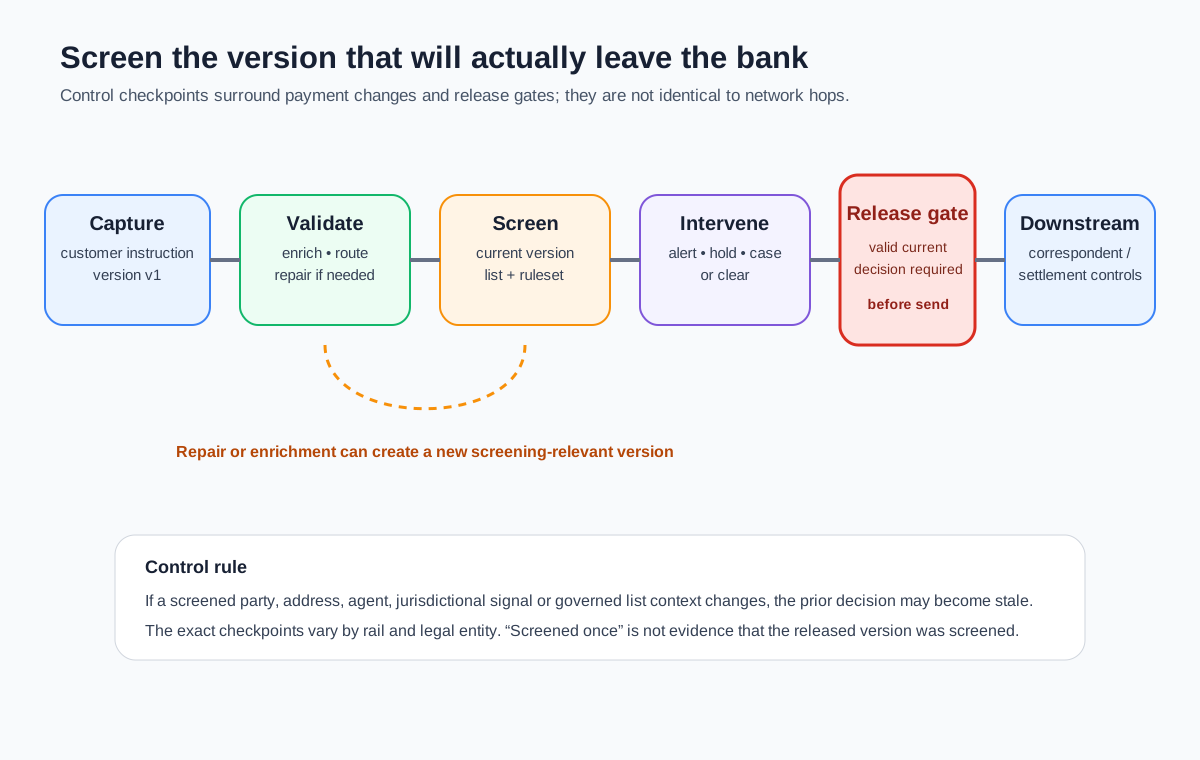
The mental model: checkpoints, versions and release gates
The simplest way to think about screening sequence is to separate three concepts: payment hops, control checkpoints and release gates.
A payment hop describes where the payment or settlement instruction moves next. A customer channel may send a payment to a payment hub. The hub may send it to a gateway. The gateway may send it to a clearing system or correspondent. In a cross-border chain there may be several financial institutions between the ordering customer and the beneficiary's bank.
A control checkpoint is where an institution evaluates the payment against a financial-crime rule. Screening may occur immediately after capture, after enrichment, before external release, after repair, or at an intermediary bank when that bank receives the instruction. Transaction monitoring may occur in real time, near real time or after posting depending on the control objective. Fraud controls may be integrated with the payment decision but are not the same as sanctions screening. The important point is that a technical hop does not automatically equal a screening checkpoint and a screening checkpoint does not automatically correspond to a new legal obligation.
A release gate is the point beyond which the institution commits the payment to a downstream step that may be difficult or impossible to reverse. For an instant payment, the gate may be measured in milliseconds or seconds. For a queued high-value payment, operations may have more time to investigate before the instruction is released. For a correspondent payment, each institution has its own release decision. Screening design is strongest when it is anchored to those gates rather than being treated as an isolated batch process.
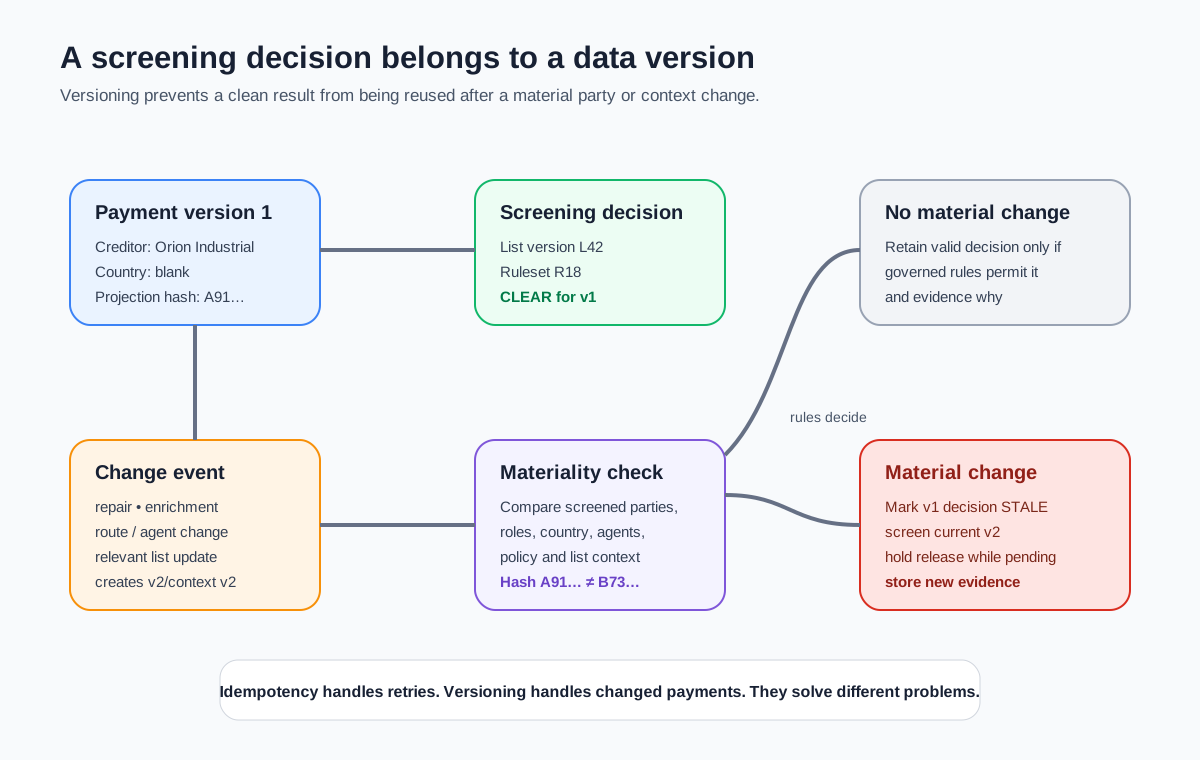
This model explains why “screen once at initiation” can be inadequate. Suppose an instruction is screened when first captured, then operations repair the creditor address, an enrichment service adds an intermediary agent, or a correspondent route is changed. If the modified data includes a screening-relevant party or jurisdictional element, the earlier pass may no longer represent the payment that will actually leave the bank. A mature platform can determine whether the change is material and, where policy requires, rescreen the relevant version before release.
The opposite mistake is also common: rescreening every technical change regardless of relevance. Recalculating a fee or changing an internal routing timestamp should not automatically create a new sanctions alert. Excessive rescreening adds latency, duplicate alerts and operational noise without improving control effectiveness. The bank needs a governed definition of material screening-relevant change.
Why the sequence matters to a bank
Payment sanctions failures can arise even when a screening engine itself is technically healthy. The weakness may be upstream or downstream. A channel may omit party information. A mapping layer may place a name in the wrong element. A repair queue may alter data after screening. A legacy conversion may truncate an address. A release component may reuse a stale screening decision. A failover route may bypass the normal filter. A correspondent may ask for information that the originating bank cannot reconstruct because the original message was not retained.
That is why effective screening is an end-to-end control rather than a vendor product. The screening engine can only evaluate the data it receives. The payment architecture decides which data reaches it, when it is called, how the result is interpreted and whether a payment can move while the result is unresolved.
There is also a customer dimension. Poor sequencing can produce unnecessary payment delays, duplicate requests for information and inconsistent decisions. If the same innocent customer payment is screened four times because internal services cannot recognise that nothing relevant changed, the bank creates avoidable friction. If a repair causes a material change but does not trigger the required control, the bank creates compliance risk. Good architecture reduces both problems by making the decision logic explicit.
For operations teams, sequencing determines queue ownership and service levels. A payment held before cutoff may need escalation because the economic consequence of missing settlement can be significant. An instant payment needs deterministic real-time handling because there may be no practical manual window before settlement. A correspondent payment may require communication with another institution while funds are held. These are different operating models even when the underlying sanctions policy is the same.
For investigators, sequence determines evidence quality. The investigator needs to know which version triggered the alert, what list entry or rule was used, what party fields were compared, what enrichment occurred, whether earlier versions passed, and which payment actions were taken while the case was open. Without that lineage, the analyst is forced to reconstruct a decision from fragmented logs.
Global standards versus institution-specific obligations
FATF Recommendation 16 is the principal global standard concerned with wire-transfer transparency. It is designed so that originator and beneficiary information accompanies transfers and remains available through the payment chain, subject to the detailed standard and national implementation. FATF revised Recommendation 16 in June 2025 and has been developing guidance to support implementation. FATF's June 2026 consultation states that countries are expected to be ready to implement the revised standards by the end of 2030. That is an important direction of travel, but it should not be represented as though every bank worldwide already operates under an identical 2030-state rulebook today.
Domestic law and regulation give the international standard legal effect. The exact fields, thresholds, exemptions, recordkeeping duties, rejection or suspension expectations and reporting obligations can differ across jurisdictions. Sanctions obligations also differ. A bank operating through several legal entities therefore needs a jurisdiction and legal-entity map that connects payment products to the requirements actually applicable to that entity.
The Wolfsberg Group's public payment-transparency and correspondent-banking materials are useful industry guidance because they emphasise the importance of complete, accurate and meaningful party information for banks further along a payment chain. Their value is practical rather than legislative: they help institutions understand how transparency supports downstream financial-crime controls and investigations.
The CPMI's work on harmonised ISO 20022 data requirements for cross-border payments similarly supports better interoperability and data quality. Its updated February 2026 report provides harmonised data guidance and transition considerations. It is not a direct sanctions law. A bank should use such material to improve implementation while keeping the distinction between technical harmonisation, industry practice and binding legal obligations clear.
This distinction prevents a common training error. A learner may read a network implementation rule, a FATF recommendation, an industry standard and a national sanctions regulation and assume they all have the same legal status. They do not. The control framework should record the source of each requirement and who owns its interpretation.
What changes across payment rails
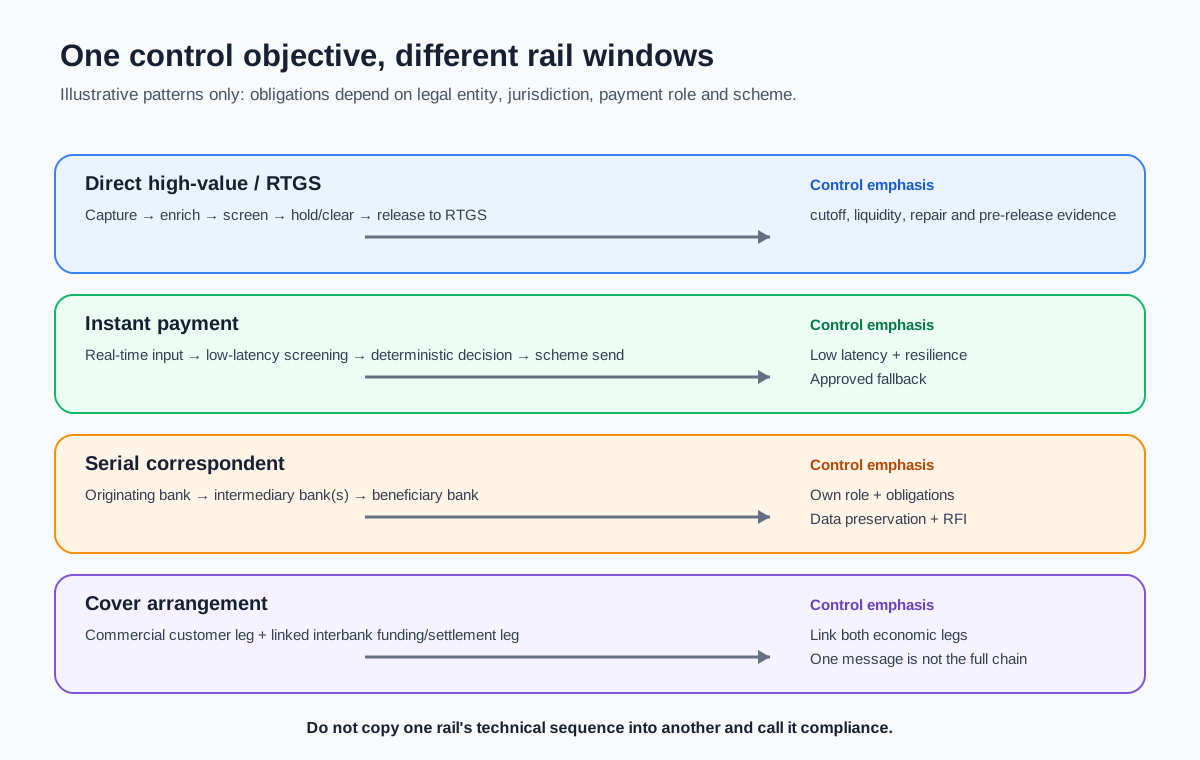
Payment rails differ in speed, participants, messaging, settlement design and reversibility. Those differences shape where controls can sit.
A domestic batch or ACH-style payment may be initiated hours before settlement and processed in files. Screening can occur at capture or pre-release, with exceptions held for investigation. The available time does not remove the need for accurate sequencing; it simply gives the bank more operational room.
A high-value RTGS payment is typically more time-sensitive and may carry significant liquidity and cutoff implications. The bank normally needs confidence that required pre-execution controls have completed before release to the settlement system. A false-positive alert close to cutoff can create both compliance and liquidity consequences, so operations need clear escalation paths.
An instant payment compresses the decision window dramatically. There may be no realistic opportunity for a traditional human sanctions analyst to investigate a new alert before the scheme timeout. The control therefore depends on fast list access, high-quality party data, calibrated matching, deterministic timeout behaviour and carefully designed fallback. Where an unresolved alert cannot legally or safely be released, the payment may need to be rejected or otherwise handled according to applicable rules. The exact scheme status or customer message depends on the rail and jurisdiction.
A serial correspondent payment can pass through multiple banks, each acting on the message it receives and applying its own obligations. The originator's bank should not assume its own pass removes the responsibilities of downstream institutions. Equally, an intermediary should not assume that a prior bank has screened exactly the same data under the same sanctions regimes. The goal of payment transparency is to preserve enough meaningful information for each institution to perform the controls relevant to its role.
A cover payment separates the customer/commercial payment information from the interbank funding movement. The exact messaging pattern depends on the network and product, but the important control lesson is that financial-crime evidence must remain linked across the commercial instruction and the cover settlement context. A funding message viewed in isolation may not contain the same customer detail as the underlying commercial payment. Controls and investigations must be designed with that relationship in mind rather than assuming one message contains the entire economic story.
Card, wallet and merchant flows introduce other patterns, but they should not be forced into a wire-transfer model. The same principle still applies: understand the actors, the data available at each checkpoint, the timing of authorisation and settlement, and the institution's legal and policy responsibilities.
ISO 20022 and the screening data model
ISO 20022 can provide richer and more structured payment data than older free-text-heavy formats, but richness only helps if the data is populated, preserved and used correctly. A bank should understand both the message model and the actual implementation guidelines for the relevant rail.
For a customer credit transfer, screening-relevant information may include the debtor, creditor, ultimate debtor, ultimate creditor, debtor agent, creditor agent, intermediary agents, accounts, addresses, organisation or private identification, remittance information, purpose and regulatory-reporting data. Not every payment will contain every element. Some party data may be absent legitimately, some may be optional under a scheme, and some may be unavailable to a particular intermediary.
The important architectural principle is to keep party roles distinct. Dbtr is not interchangeable with UltmtDbtr; CdtrAgt is not the same as Cdtr; an intermediary agent is not a beneficiary. If a platform flattens all names into an unlabeled text list, the screening engine may still generate matches, but investigators lose the business meaning needed to assess them.
Structured addresses illustrate the same issue. Better structure can improve country interpretation, matching and data quality, but it is not itself proof that a party is safe or risky. Swift's target CBPR+ address model uses structured or hybrid addresses with minimum town and country in specified contexts, subject to detailed rules and exceptions. Swift deferred the earlier 14 November 2026 enforcement plan on 27 August 2026; the replacement timetable must be confirmed separately from the 12 June 2027 deferred release announced for other message areas. That is a network/data-quality requirement, not a universal sanctions law. Banks must implement it accurately without presenting it as a legal conclusion.
Identifiers can also assist. A BIC can identify a financial institution in relevant contexts. Organisation identifiers, account identifiers and other structured IDs can help entity resolution. A UETR is useful for tracking eligible Swift cross-border payment flows but is not universal across all payment rails. EndToEndId, message IDs and internal payment IDs can help connect events, but they serve different purposes. A good internal model therefore uses a persistent payment identifier plus version identifiers and preserves external references rather than relying on one field as a universal key.
Data can change between checkpoints
A screening decision is only meaningful against the data state that was screened. Real payment processing introduces several opportunities for change.
A channel can submit incomplete information that the payment hub enriches from a customer master. An address validation service can standardise country or town information. Routing logic can select an intermediary bank. Operations can repair a rejected message. A sanctions-sensitive list may be updated between capture and release. A legacy interface may convert between ISO 20022 and another format. A correspondent may return the payment for correction and the bank may create a new version.
Each change needs classification. Some changes are not screening relevant. Others can introduce a new party, alter identity information, change a jurisdictional signal or materially affect the context used to resolve a previous match.
A practical material-change rule considers whether any field used by the screening policy has changed, whether the change affects party identity or ownership context, whether a new agent or beneficiary has been introduced, whether geographic information has changed, whether the transaction has been rerouted through a different institution or jurisdiction, whether the sanctions data set has materially changed, and whether the prior decision is still valid under the bank's configured time-to-live.
The rule should be implemented as controlled logic, not analyst folklore. The payment platform can compare the screening-relevant projection of version 1 with version 2. If the projection changes, it requests a new decision. If only irrelevant technical fields change, it retains the prior pass while recording why no rescreen was needed.
Screening before and after repair
Payment repair is a particularly important control boundary because it combines human intervention with data change. A payment might enter a repair queue because an address is malformed, an account is invalid, an agent is missing or a network validation failed. Operations may have authority to correct certain fields from trusted source information.
The bank should define which fields operations may repair, which evidence is required, which changes demand customer confirmation, and which changes force a new screening decision. Free-form editing of party names or countries without lineage is a serious weakness. It can unintentionally remove information that generated an alert or create a new party without triggering screening.
A safe repair workflow retains the original message, creates a new version rather than overwriting history, records the user or system making the change, captures the reason and source, compares the screening-relevant data, invalidates the prior decision if required, and blocks release until the new decision is complete.
This is also where segregation of duties matters. The person repairing data should not necessarily be able to override a sanctions hit. Operational efficiency is not a sufficient reason to combine data repair, match disposition and release authority in one uncontrolled role.
List updates and decision validity
Sanctions lists can change while payments are queued. Banks therefore need a policy for decision validity. The answer is not necessarily “rescreen every payment after every list update” because scale, legal requirements and processing state matter. Nor is it safe to assume a morning screening pass remains valid indefinitely.
A bank can define validity using the acting legal entity, sanctions programme, payment state, list or data version, elapsed time and release status. For high-risk or long-queued payments, policy may require rescreening before release when a relevant list update has occurred. For transactions already finally settled, the response may instead be post-event review and asset-control action where required by law. Those are different control objectives.
The screening evidence should therefore store the list-set identifier or effective version used for the decision. Without it, the bank cannot prove whether a payment was assessed against the data available at that time.
Correspondent banking: each bank sees a different slice
In a correspondent chain, no single institution necessarily sees the complete commercial relationship. The originating bank knows its customer and may have detailed KYC information. An intermediary sees the payment message and its own respondent relationship. The beneficiary bank knows the receiving customer. This distribution of knowledge is one reason payment transparency matters.
An intermediary screening a cross-border instruction should be able to identify the relevant message parties and agents within the data it receives. If originator or beneficiary information is missing or clearly inadequate, the bank's response depends on applicable requirements and policy. It may repair, request information, reject, suspend or otherwise escalate. The precise action should not be taught as universal because regulatory implementation differs.
Correspondent due diligence also complements transaction-level screening. If a respondent repeatedly sends poor-quality originator data, routes unusual high-risk traffic or fails to answer requests for information, the concern may shift from one payment to the quality of the respondent relationship. Payment operations, sanctions, AML and correspondent-banking teams need a feedback mechanism so repeated transactional weaknesses influence relationship monitoring.
A downstream bank may also produce a different screening result from an upstream bank for legitimate reasons. It may use different sanctions regimes, list providers, matching algorithms, thresholds, transliteration rules, customer information or risk appetite. That does not automatically mean one bank failed. The investigation must compare the actual obligations and data states.
Serial versus cover: preserve economic meaning
Serial and cover payments are often taught as message-flow diagrams without enough financial-crime context. The practical issue is whether customer identity and payment purpose remain understandable while the settlement mechanics move through institutions.
In a serial chain, the customer payment instruction passes through intermediaries in sequence. Each institution acts on the message it receives. Data quality and preservation are critical because truncation or stripping can weaken downstream controls.
In a cover arrangement, the commercial customer payment and the interbank funds movement are related but not identical. A bank may receive one leg without holding all information from the other leg in the same record. Architecture should maintain linkages and investigation access so analysts can connect settlement funding to the underlying customer transaction where appropriate.
The control objective is not to force every message to look the same. It is to prevent the settlement structure from obscuring who is paying whom and why, within the information and obligations relevant to each participant.
Conversion, translation and truncation risk
Cross-border payment chains can involve message transformation. Even in an ISO 20022 environment, banks may interface with domestic schemes, legacy applications or counterparties using different representations. Any conversion can create a transparency risk if data is lost, shortened or reclassified.
Names are particularly sensitive. Removing punctuation may be harmless; cutting a long legal entity name can be material. Addresses can lose country information. Ultimate-party data can be dropped because the target format has no obvious equivalent. Remittance text can be truncated. Agent roles can be collapsed.
The bank should therefore treat message mapping as part of the financial-crime control environment. Mapping specifications need field-level lineage. Test cases should include long names, multilingual characters, non-Latin scripts, multiple agents, ultimate parties and maximum-length addresses. The objective is not merely schema validity but preservation of risk-relevant meaning.
Swift has repeatedly emphasised the importance of avoiding data loss in cross-border interoperability. A technically valid transformed message can still be operationally weak if important party information has disappeared.
Screening engine integration
The screening engine needs a defined contract with the payment platform. At minimum, the request should identify the acting legal entity, payment version, product or rail, direction, parties and their roles, relevant identifiers and addresses, amount/currency if used by policy, and any context required by the matching strategy. The response should return a decision state and sufficient alert identifiers to trace unresolved matches.
A simple PASS/FAIL interface is usually inadequate. Real states can include no alert, potential match requiring review, confirmed match, technical error, timeout, unavailable service, stale decision or policy exception. The payment hub must know which states permit release and which do not.
The interface must also be idempotent. Network retries and message replay are normal in distributed systems. If the same payment version is submitted twice, the platform should not create uncontrolled duplicate cases or accidentally treat the second call as a new cleared instruction. Conversely, a genuinely new payment version must not inherit a pass from the old one merely because the business payment ID is the same.
A useful idempotency key therefore includes the payment identifier plus a version or screening-relevant-data hash. This separates “same instruction retried” from “same business payment materially changed.”
Synchronous and asynchronous controls
Some controls are synchronous: the payment waits for the screening result before moving. This is common for pre-execution sanctions screening because an unresolved result may make release unsafe or unlawful. Other controls can be asynchronous, particularly post-event monitoring or analytics that do not need to block settlement.
The architecture should not confuse the two. Sending a payment to a screening queue and allowing settlement before the result returns is not equivalent to a pre-execution control merely because screening eventually occurs.
Instant payments make this distinction especially important. The service-level window may be short, but speed does not itself remove legal obligations. The bank needs an engineered fallback: what happens if the screening service is slow, unavailable or cannot obtain current list data? The answer must be pre-approved by legal/compliance and scheme operations. It can differ by jurisdiction and product. Improvised “fail open because the scheme timer is running” is not acceptable control design.
Holds, alerts and cases
A screening alert is not the same as a confirmed sanctions match. Matching logic deliberately produces potential matches that require resolution. The payment should be associated with the alert and, where investigation is needed, with a case that preserves the full evidence chain.
The analyst needs more than a name similarity score. Useful evidence includes list identifiers and aliases, date and place of birth where relevant, nationality, addresses, organisation identifiers, ownership/control information, vessel or aircraft identifiers for specialised cases, payment counterparties, customer KYC, previous transactions and any correspondence with other banks or the customer.
The system should show the exact screened value alongside the source field and role. Seeing “ABC Trading” is less useful than knowing it came from Cdtr/Nm in payment version 3 and was enriched from a customer instruction rather than typed by an analyst.
The analyst's disposition should feed back to payment orchestration. A false positive may permit release if all other controls are satisfied. An unresolved potential match may remain held. A confirmed match may require blocking, freezing, rejection, reporting or another action depending on applicable law and the bank's role. The system must not hard-code one universal outcome for every sanctions regime.
Requests for information and correspondent investigations
Sometimes a bank cannot safely resolve an alert from the payment message alone. It may need information from the customer, another bank or internal KYC teams. An RFI process should preserve the payment state, question asked, recipient, response, evidence and decision deadline.
Correspondent RFIs can create delay and customer frustration, but poorly targeted questions create even more delay. A strong investigator asks for the missing discriminator: full legal name, ownership, address, purpose, invoice, beneficiary relationship or another specific fact. Generic requests for “more information” are inefficient and difficult to audit.
The payment platform and investigation platform should share status. Operations need to know that the payment is held for financial-crime review without being exposed to confidential suspicious-activity reasoning that policy restricts. Investigators need to know upcoming scheme or customer cutoffs. Customer-service teams need approved language that avoids tipping off where relevant.
Post-event monitoring is complementary, not a substitute
Post-event transaction monitoring can identify patterns that sanctions screening does not. It can reveal repeated payments to newly risky corridors, unusual correspondent routes, rapid fund movement or customer behaviour inconsistent with KYC expectations. It can also detect issues after new intelligence becomes available.
But post-event analytics cannot be presented as a substitute for a legally required pre-execution asset-freeze or prohibition control. Once value has been made available, the bank may have lost the opportunity to prevent the prohibited transaction. Control design must separate preventive screening from detective monitoring.
Post-event review still matters greatly. If a list update identifies a party involved in recently settled payments, the bank may need to identify historical exposure, report as required and assess related customers or counterparties. The same payment lineage that supports real-time screening should support lookbacks without rebuilding data manually.
Screening provenance: the evidence model
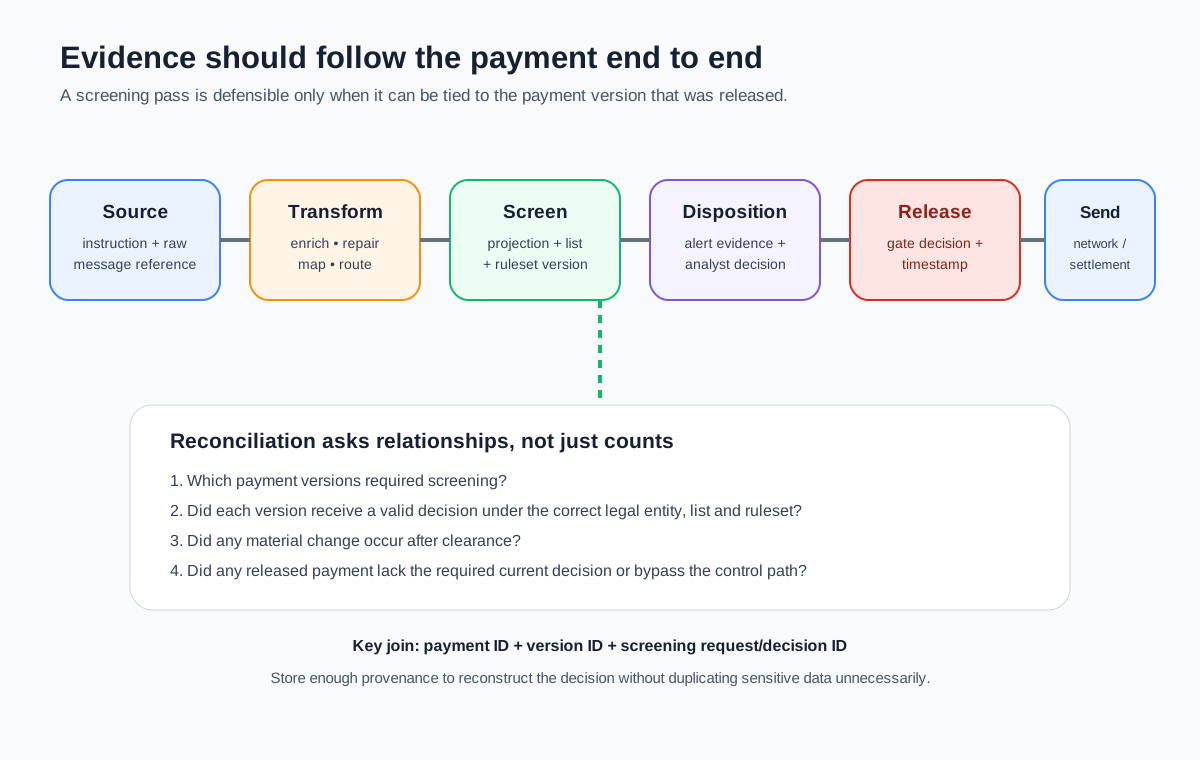
A defensible payment-screening platform should be able to reconstruct a decision years later. The evidence model should include the internal payment ID, payment version, raw source message reference, normalised party data, screening-relevant-data hash, acting legal entity, rail/product, timestamp, list-set/version, matching engine/ruleset version, decision, alerts generated, analyst disposition, override if any, release timestamp and external references such as UETR where applicable.
This is not excessive logging. It is the minimum structure needed to answer basic audit questions. Which data was screened? Was it the final version? Which list was used? Who cleared the alert? Did the payment move before clearance? Was the same decision reused after repair?
Retention must comply with applicable privacy, recordkeeping and data-governance requirements. More logging is not automatically better if sensitive data is duplicated unnecessarily. Banks should retain authoritative evidence with controlled access rather than copy whole payment payloads into every system.
Governance and ownership
Payment screening crosses organisational boundaries, so ownership must be explicit. First-line payment operations typically own execution of operational procedures and queue management. Product and payment-platform teams own implementation of payment states and release logic. Financial-crime compliance interprets policy and challenges control effectiveness. Sanctions specialists define matching and disposition expectations. Technology teams operate screening services and interfaces. Data owners maintain party and reference data. Internal audit independently assesses design and effectiveness.
A common governance failure is split accountability. Payments assumes sanctions owns everything because sanctions writes policy. Sanctions assumes technology owns the control because technology runs the engine. Technology assumes operations owns exceptions. In reality, the end-to-end control needs a named business owner with clear component ownership underneath.
Change governance is equally important. A new payment rail, ISO 20022 migration, sanctions-list source change, matching-engine upgrade, routing change or address-format transition can change control effectiveness even if nobody edits the sanctions policy. Financial-crime impact assessment should therefore be embedded into payment change management.
Operational metrics that reveal sequencing weakness
Alert volumes alone do not prove control quality. Useful metrics include percentage of payments screened before required release gates; number of material changes after initial screening; rescreen rate and reason; duplicate screening rate; technical timeout rate; screening-service availability; aged held payments; alert resolution time by rail; payments released under fallback; data-quality failures by source channel or correspondent; RFIs per respondent; and payments requiring manual repair of screening-relevant fields.
A sudden drop in alerts can be good tuning or a broken feed. A sudden rise can be a sanctions event or a mapping defect. Metrics need contextual interpretation and reconciliation to payment volumes.
Reconciliation is particularly important. The bank should be able to demonstrate that the population requiring screening was actually presented to the screening service and that all resulting blocking states were respected by the payment engine. Comparing payment-release records with screening-event records can identify bypasses that neither system sees alone.
Failure modes
Several failure patterns recur across banks.
One is screen-before-enrichment only. The channel captures a short beneficiary name, screening passes, then the hub enriches the full legal name from a beneficiary directory. If the full name would match a restricted party and there is no material-change rescreen, the architecture has a gap.
Another is repair without invalidation. Operations changes the creditor country after a validation error but the old screening pass remains attached to the payment.
A third is stale decision reuse. A payment is held overnight, sanctions lists update, but release logic uses yesterday's pass without checking validity.
A fourth is conversion loss. An ISO 20022 message contains ultimate-party data, but a legacy adapter drops it before the screening engine.
A fifth is fail-open resilience. The screening service times out and the payment platform treats timeout as pass to preserve availability. This may be unacceptable where screening must complete before release.
A sixth is unreconciled bypass. One emergency routing path or manual payment tool does not call the normal screening service. Because daily aggregate alert counts still look plausible, the issue remains invisible until audit.
A seventh is case-release disconnect. An analyst marks an alert unresolved, but a payment state is manually advanced by operations because the systems do not share a blocking token.
These are architecture and process failures, not merely analyst mistakes.
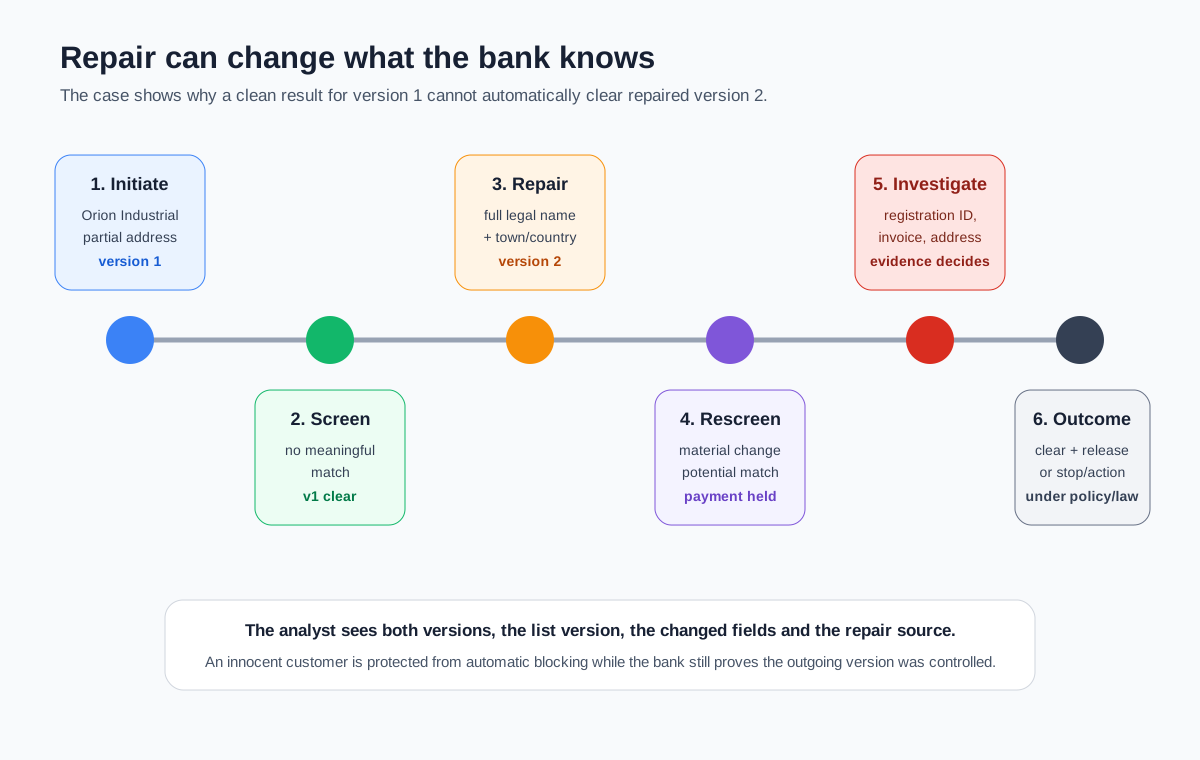
Practical case study: repair changes what the bank knows
Consider a corporate customer in Bank A initiating a EUR supplier payment to a beneficiary in another jurisdiction. The initial ISO 20022 instruction contains the creditor name “Orion Industrial Trading” and a partial address. The payment is assigned internal ID P-845210 and version 1. Bank A screens the debtor, creditor and relevant agents under its approved policy. The creditor produces no meaningful match, but network validation rejects the payment because the address data is incomplete for the intended cross-border route.
Operations does not invent an address. It retrieves beneficiary information from a customer-provided standing instruction and verifies the source permitted by policy. The repair adds the town, country and a longer legal-entity name: “Orion Industrial Trading and Engineering LLC.” The payment platform creates version 2 and records the repair source.
The material-change service compares screening-relevant data between versions. The creditor name and geographic information changed, so the previous screening pass is invalidated. Version 2 is submitted to the screening engine. This time the longer name produces a potential match to a sanctioned entity with a similar legal name.
The payment is held before external release. The alert shows the analyst both versions, the creditor role, list version, matching fields and source of the repair. The analyst checks identifiers and address information. The list entity is in a different country but has a known alias and ownership connections that require further review. The analyst requests the beneficiary registration number and invoice from the customer relationship team and checks available reliable sources.
The customer provides a company registration number that clearly identifies a different entity and an invoice consistent with the customer's established supplier activity. The analyst documents the discriminating evidence and closes the match as false positive under policy. The payment receives a new screening clearance for version 2 and is released before cutoff.
This case is intentionally ordinary. No sanctions breach occurred. The lesson is that the control worked because the bank treated repair as a versioned event, rescreened a material change, held release while the alert was unresolved, and preserved evidence. If the bank had relied on the version 1 pass, it could not have demonstrated that the actual outgoing instruction was screened. If it had treated the version 2 alert as automatic proof of a sanctions breach, it would have harmed an innocent customer.
Business analyst requirements
A business analyst working on payment screening should avoid requirements such as “the system shall screen all payments.” That sentence is too broad to test and too vague to implement.
A better requirement identifies the population, checkpoint, data, decision states and release behaviour. For example: when an outbound cross-border payment reaches pre-release state, the orchestration service must obtain a valid screening decision for the current screening-relevant payment version before external release. If any configured screening-relevant field changes after that decision, the decision must be invalidated and a new decision obtained before release, unless the change is explicitly classified as non-material by the governed ruleset.
Acceptance criteria should cover normal processing, alert holds, false-positive release, technical timeout, service outage, message repair, routing changes, list-version changes, retries, duplicate messages and cancellation. They should also identify which evidence must be available to operations and investigators.
The BA should map requirements to sources. Is a rule driven by law, regulator guidance, sanctions policy, network rule, scheme rule, operational risk or internal design standard? That traceability helps future change teams understand what can and cannot be altered casually.
Architecture considerations
Architects should design screening as an explicit service boundary with event lineage. The payment hub should not bury screening state in an unstructured comment field. A payment-state model can include CAPTURED, VALIDATED, SCREENING_REQUIRED, SCREENING_PENDING, SCREENING_HELD, SCREENING_CLEARED, READY_FOR_RELEASE, RELEASED, SETTLED, RETURNED and terminal exception states as appropriate to the platform. These names are illustrative; the important point is that screening status and payment status are separately visible but coordinated.
The event model should carry payment version and correlation identifiers. The screening service should be resilient but not able to silently lose requests. A durable queue may help in some architectures, but asynchronous transport must not accidentally permit release before a required result.
Caching requires care. Caching a negative party result can improve performance, especially for instant payments, but only if the cache is tied to the relevant list version, party identity and validity period. A global cache that says “John Smith passed” is dangerous because context and identity resolution matter.
Observability should expose latency, failures, retries, version mismatches and blocked releases. Logs must avoid unnecessary sensitive data while remaining useful for investigation.
Testing the sequence, not just the engine
Vendor match testing proves only one component. End-to-end testing must prove the sequence.
Positive tests should seed a payment with a known test-list party and verify it is held before release. Material-change tests should start with a clean version, then repair the name or country and verify that the old decision becomes invalid. Negative tests should modify irrelevant fields and confirm that the bank does not create unnecessary duplicate screening. Retry tests should replay the same version and confirm idempotency. List-update tests should change the screening-data version while a payment is queued and verify the configured validity rule.
Conversion tests should place relevant party data in maximum-length and multilingual fields, pass the message through all adapters, and compare the screening projection before and after transformation. Failover tests should disable the primary screening service and prove the approved fallback occurs rather than an uncontrolled release.
Instant-payment tests need latency measurement under peak load. A design that works for ten transactions per second but times out at production volume is not an effective control. High-value-payment tests should also include cutoff pressure, because operational workarounds often emerge when teams fear missing settlement deadlines.
Correspondent-chain simulations should verify RFIs, returns and repaired re-submissions. Cover-payment tests should confirm that related commercial and settlement evidence can be linked by investigators.
Current change horizon: 2026 and beyond
Three developments are especially relevant to teams designing payment transparency and screening in 2026.
First, FATF's revised Recommendation 16 is moving toward implementation, with FATF's June 2026 consultation indicating countries are expected to be ready by the end of 2030. Banks should perform impact assessment early, but they must distinguish future implementation work from current binding requirements in each jurisdiction.
Second, Swift deferred the earlier 14 November 2026 CBPR+ postal-address enforcement milestone on 27 August 2026 and said it would update timing and approach by December at the latest. Banks using CBPR+ need to ensure structured or hybrid addresses meet the applicable network requirements and that unstructured-address dependencies are remediated. Better structured data can improve screening and investigations, but the network validation rule must not be mislabelled as a sanctions obligation.
Third, CPMI's February 2026 update to harmonised ISO 20022 data requirements reinforces the direction toward more consistent cross-border data, with transition flexibility extending through the end of 2027 in the updated framework. Payment and financial-crime teams should align data models where appropriate while recognising that CPMI guidance is not itself domestic law.
These changes make sequence design more important, not less. Richer data creates more opportunity for accurate controls only when banks preserve the information across transformations and ensure the final released payment has a valid control decision.
What good looks like
A strong bank can take any material payment and answer a simple set of questions without a forensic project. It can show the original instruction, every material version, who changed what and why, the party roles screened, the sanctions data version used, any alerts generated, the evidence used to disposition them, whether a rescreen was required, the final release decision, the external transmission and the settlement outcome.
It can also explain why different rails use different technical sequences while remaining consistent with the same control objective. It can prove that emergency routes and failover paths are covered. It can reconcile screening populations to released payments. It can distinguish legal requirements from network standards and internal policy. And it can change its architecture when standards evolve without losing historical evidence.
That is the real meaning of screening sequence across payment rails and correspondent chains: not more screening for its own sake, but the right control, against the right data version, at the right decision point, with evidence strong enough to survive operations, investigation, audit and regulatory challenge.
Swift timetable source, checked 2 October 2026: Structured-address migration extension and 21 September release update. The deferred release includes exceptions/investigations messages on 12 June 2027; structured-address enforcement timing remains separately governed: https://www.swift.com/news-events/news/swift-accepts-community-request-extend-structured-address-migration-iso-20022-payment-messages
Operational deep dive: how the sequence changes by rail
The base chapter establishes the governing idea: screening should be attached to a controlled version of the payment and to a release decision, not treated as an isolated name-matching event. This deep dive takes that model into the day-to-day mechanics of four common environments: direct high-value payments, instant payments, serial correspondent transfers and cover arrangements. The objective is not to prescribe one global workflow. It is to show how a bank translates the same control intent into different operational architectures without losing evidence or introducing blind spots.
Direct high-value and RTGS payments
A high-value payment commonly starts in a corporate channel, treasury platform or operations interface and enters a payment hub before external release. The bank may validate account authority, format, amount, currency, cutoff, funding and route before calling financial-crime services. In some platforms the financial-crime call occurs early to avoid wasting processing effort on a payment that will be held. In others the bank enriches first so the screen sees the fullest available party and routing data. Either design can be reasonable if the bank can show that the version finally released has a valid decision and that screening-relevant changes after the decision trigger the required control.
High-value flows create a distinctive operating tension because settlement cutoffs and liquidity management matter. If a USD-equivalent large payment is held fifteen minutes before a market cutoff, operations may escalate aggressively. That pressure is legitimate from a customer and treasury perspective but must not alter the legal decision standard. The workflow should make cutoff risk visible while preserving the screening hold.
The payment platform should also avoid creating a hidden incentive to override. If a hold causes the payment to disappear from the normal operations dashboard, teams may use manual tools to recreate it. The safer design exposes the held payment in the normal lifecycle with an explicit financial-crime status and a controlled resolution path.
A high-value payment may also move through internal liquidity or settlement-account processes before external transmission. Those internal postings should not be confused with final release. The system should define the exact control gate: the point at which the bank sends the payment to the RTGS or correspondent and can no longer treat it as an internal draft.
Testing should include cutoff pressure, high queue volume, service degradation and urgent customer amendments. A late change to beneficiary details should produce a new version and, if material, a new screening decision even if the original instruction was approved hours earlier.
Instant payments: control in seconds
Instant payments expose the same compliance problem under a far tighter timing budget. A traditional queue in which analysts manually review every potential match cannot support an always-on rail with a response target measured in seconds. The architecture therefore depends on strong data quality, calibrated matching, real-time list availability and deterministic exception handling.
The payment should enter a synchronous decision path where required pre-execution checks are completed before irrevocable release. The bank must know how much of the end-to-end scheme time budget is available to financial-crime services. If the entire customer response is expected within a few seconds, the screening service may have only a fraction of that time after channel authentication, fraud checks, account validation and scheme messaging are considered.
Latency must therefore be treated as a control metric. Average response time is not enough. The bank should monitor high percentiles, timeout rates and queue depth during peak traffic. A screening service that responds in 80 milliseconds on average but takes five seconds for one percent of requests can still create unacceptable payment failures or tempt operations to weaken fallback rules.
Potential matches create another design question. Some jurisdictions or policies may require the bank to stop an unresolved payment rather than release it. The instant rail may not support an extended pending state. The bank then needs a pre-defined outcome such as rejection or another permitted scheme response. That outcome must be designed against applicable law and scheme rules rather than copied from another country.
Real-time screening also benefits from pre-computed customer information, but cached decisions need discipline. The bank may know that its own customer has been screened recently, yet transaction-level screening still needs to consider the beneficiary, agents and payment context required by policy. A cached customer pass cannot substitute for screening a newly entered beneficiary if the policy requires that party to be checked.
List updates are operationally sensitive in 24/7 processing. The bank needs a controlled method to load new list data, validate it, make it active and ensure in-flight transactions use the intended version. Blue-green or versioned deployment patterns can help: new list data is loaded into a parallel index, validated, then activated atomically. The payment evidence records which version was used. This avoids a state where half the screening cluster has one list version and half has another without traceability.
Fallback behaviour is one of the most important instant-payment controls. If the screening engine is unavailable, the platform should not invent a response at runtime. Compliance, legal, product, technology and scheme operations should approve the behaviour in advance. Depending on obligations and architecture, the bank may reject, temporarily disable initiation, use an approved secondary screening capability or take another controlled action. “Fail open” and “fail closed” are useful engineering labels but they do not replace the legal analysis behind the choice.
Serial correspondent banking
In a serial cross-border chain, Bank A may send to Bank B, which sends to Bank C before the beneficiary institution receives the payment. Each bank receives a message containing party and agent information relevant to that stage. The institutions do not share one sanctions policy, one customer file or one matching configuration.
This is why transparency and role preservation are critical. Bank A should populate the payment accurately from its customer and available records. Bank B should preserve required originator and beneficiary information as it forwards the payment and apply controls relevant to its intermediary role. Bank C may have a different legal nexus and therefore screen under different sanctions programmes.
A downstream alert is not proof that the originating bank failed. Bank B may have access to a sanctions list or national measure that does not apply to Bank A. It may use a different transliteration method. It may have proprietary information about a respondent or beneficiary bank. Conversely, repeated downstream holds can reveal an upstream data-quality weakness even if no legal breach occurred.
The originating bank should therefore capture correspondent feedback. If several payments are delayed because addresses are missing or beneficiary names are abbreviated, the issue should feed into channel data quality and respondent-management governance. Treating each RFI as an isolated operations nuisance wastes valuable control intelligence.
Intermediaries must also guard against “data cleansing” that unintentionally strips risk-relevant information. Operations sometimes receive pressure to repair a message so it can pass network validation. Repair should correct syntax or populate verified information, not remove a word because it causes screening alerts. Where a payment cannot be made compliant without changing its economic meaning, it should be returned or otherwise handled under the applicable rules rather than sanitised.
Serial chains can also create duplicate alerts within the same banking group. A global bank may have several legal entities on the route, each subject to its own obligations. Centralising the screening technology can improve consistency, but the decision record must preserve the acting legal entity and applicable policy. A group-level engine must not blur legal responsibility.
Cover payments
Cover structures require a different mental model because the customer payment and the settlement funding movement are related but can travel through different messages or paths. The receiving or intermediary bank may see the cover leg without all commercial details in the same technical object.
The financial-crime design should preserve enough linkage to reconstruct the economic transaction. Where the relevant payment standards provide related references, the bank should retain them. Internal correlation can also use account, amount, currency, date, correspondent and transaction references. The goal is not to infer a perfect link from weak data but to avoid designing systems that deliberately separate the evidence beyond recovery.
A cover screening workflow may examine the parties available on the cover message and separately use the linked underlying customer information where the institution receives it and policy requires. Teams should not assume that screening only the settlement banks addresses all customer-party risk. Nor should they assume that an intermediary has access to KYC information held by the originating bank.
Investigations in cover flows can require collaboration between payment operations and correspondent-banking teams. If the funding leg is held, the underlying customer payment may also be delayed. The customer-service team needs to understand the status without being told confidential sanctions-investigation details beyond approved communication.
Message transformations and control projections
Most large banks do not send raw channel messages directly to a screening engine. Payment data passes through a canonical model or payment hub. The screening service receives a projection: selected fields mapped into a screening request. That projection is a critical control artefact.
A bank should document the projection field by field. For an ISO 20022 credit transfer, the mapping may include debtor name, debtor address, debtor identifiers, ultimate debtor, creditor, ultimate creditor, debtor agent, creditor agent, intermediary agents and selected free-text fields. Whether each element is screened and how it is weighted depends on policy. The important point is that architecture should make the choice explicit.
The projection should preserve role and provenance. If the value “ACME SHIPPING” came from an ultimate creditor field, that role should travel with the value. If the same string appears in remittance text, the engine may treat it differently. Flattening both into one unlabeled name sacrifices context and can make analysts over-rely on similarity scores.
When a message is transformed, the bank can compare a canonical screening projection before and after the change. This provides a practical materiality test. If the projection hash is unchanged, a technical version change may not require rescreening. If a screened party or country changes, the hash changes and the existing decision is invalidated.
The hash itself should not be the only evidence. The bank must retain the underlying fields so an investigator can see what changed. The hash is useful for automation and idempotency, not for human interpretation.
A practical version-and-decision model
Consider a payment record with these internal fields:
| Field | Purpose |
|---|---|
payment_id | Persistent business identity across processing |
payment_version | Increments when payment content changes |
screening_projection_hash | Detects changes to configured screening-relevant data |
screening_request_id | Correlates the request to the screening service |
list_version | Identifies sanctions data used |
ruleset_version | Identifies matching/policy configuration |
screening_state | Pending, clear, held, error or other governed state |
alert_ids | Links to potential matches and cases |
decision_timestamp | Supports validity and audit |
release_gate_state | Shows whether external release is permitted |
This is illustrative rather than a mandated schema. Its value is the separation of business identity, data version and control decision. A retry of payment version 4 can reuse the same idempotent screening result where appropriate. A repair that creates version 5 with a changed projection cannot accidentally inherit version 4's decision.
List activation and in-flight transactions
Sanctions list changes can arrive during business hours or overnight. In a globally distributed bank, “overnight” is not meaningful because some payment market is always open. The list-management process should therefore be designed for continuous operation.
A typical controlled sequence is source acquisition, integrity check, parsing, transformation into the screening vendor format, validation, approval where required, deployment, activation and post-load verification. The bank records the effective source timestamp and the internal activation timestamp. These may differ, and that difference matters during an incident review.
In-flight payments need a defined rule. A payment already cleared but not released may be subject to rescreening if the relevant list set changes. A payment already irrevocably settled may enter a lookback population rather than a pre-release queue. The rule depends on law, policy and operational feasibility and should be documented by state.
An important test is the race condition: list version L1 clears payment version P3, then list L2 becomes active one second before the release service sends the payment. The system should have a deterministic answer. It might require a fresh decision, or the policy may define a short validity window. What matters is that the answer is intentional and auditable.
Screening service outage
Outages reveal whether control architecture is real or theoretical. The payment platform should distinguish a genuine “clear” decision from technical inability to screen. A timeout, HTTP error, corrupted response, unavailable list service or inconsistent cluster must not map to CLEAR because a developer chose a default enum value.
Operations need a dashboard showing the affected population and the approved fallback. If payments are rejected, customer communications should be truthful but need not disclose sensitive control details. If a secondary service is used, evidence should record that path and its list/ruleset version. If payments queue, the bank should know how backlog interacts with cutoff and liquidity.
Recovery also needs control. When service returns, queued payments should be screened against the current data, not a stale cache from before the outage. Duplicate requests created during retries should not create uncontrolled duplicate alerts. Reconciliation after recovery should compare all payments initiated during the outage with screening outcomes and release records.
Case management and sequence reconstruction
An analyst interface should present the payment as a timeline rather than a static message. The timeline can show capture, validation, enrichment, initial screen, repair, rescreen, alert, RFI, analyst decision and release. This prevents the investigator from looking at the latest message while unknowingly evaluating an alert generated on an earlier version.
The interface should highlight changed screening-relevant fields. If the creditor country moved from blank to AE, or the beneficiary legal name expanded, the analyst sees that change immediately. It should also show whether the payment has already been released. Investigation priorities differ dramatically between a held pre-execution payment and a post-settlement lookback.
Case notes should cite evidence rather than conclusions alone. “False positive” is not sufficient. The analyst should record which identifiers, addresses, ownership facts or other discriminators demonstrate that the payment party is not the listed entity. Quality assurance can then assess reasoning, not just closure rates.
Cross-rail consistency without false uniformity
Banks often seek one global screening platform to reduce duplication. That can be beneficial, but standardisation should focus on control principles and evidence, not force every rail into identical states.
Common principles can include: screened data has defined provenance; unresolved mandatory controls block release; material changes invalidate decisions where policy requires; technical errors are not treated as clear; decisions are versioned; overrides are controlled; screening population reconciles to payment population; and audit evidence is retained.
Rail-specific implementation can legitimately differ. An instant rail may reject an unresolved payment because it cannot remain pending. A high-value rail may hold it in a queue. A batch file may quarantine one transaction or the entire file depending on architecture. A correspondent workflow may generate an RFI. Consistency means the differences are justified and governed, not that every payment uses the same status code.
End-to-end test scenarios
A useful test pack includes more than sample sanctioned names.
Clean payment: a normal payment with complete data clears once and releases. Evidence shows the expected list and ruleset versions.
Potential match: a beneficiary produces a potential match. The payment cannot cross the release gate until disposition. A false-positive closure releases only the same version that was investigated.
Repair after clear: a clean payment is repaired with a new beneficiary address and expanded legal name. The material-change rule invalidates the old decision and rescreens.
Irrelevant edit: an internal priority field changes. The projection hash remains unchanged and the bank avoids duplicate screening.
List update race: a payment is clear under L1, L2 activates before release, and the configured decision-validity rule is applied exactly as approved.
Retry: the gateway resends the same message after a communication timeout. The screening request is idempotent and no duplicate case is created.
Transformation: long multilingual names and ultimate-party information pass through a legacy adapter. The test compares source and screening projection to prove no risk-relevant information is lost.
Service outage: screening becomes unavailable. The payment follows the approved degraded behaviour; no technical failure becomes a silent pass.
Instant peak load: production-like concurrency is applied and the bank measures latency percentiles, timeout rate and payment outcomes.
Correspondent RFI: an intermediary requests missing originator information. The bank can retrieve the original data and respond through an approved process without altering historical evidence.
Cover linkage: investigators can link the funding event to the commercial context using available references and internal correlation.
These scenarios demonstrate why screening assurance belongs in payment testing, not only in the sanctions team's vendor test pack.
Operational close
A good screening sequence is invisible to most customers and obvious to auditors. Clean payments move without unnecessary duplication. Material changes trigger the right control. Potential matches pause at an appropriate gate. Analysts see the version that generated the alert. Correspondents receive preserved party information. Outages follow pre-approved behaviour. Every released payment can be reconciled to a valid decision where policy required one.
That operating model is more durable than any particular rail or message format. Payment schemes will evolve, ISO 20022 usage will expand, sanctions programmes will change and real-time processing will become more common. A bank that models screening as a versioned, evidence-led decision around release gates can absorb those changes without rebuilding the control philosophy each time.
Advanced practice: BA, architecture, testing and assurance
Screening sequence becomes difficult when policy language meets distributed payment systems. “Screen before sending” sounds simple until the bank has multiple channels, several legal entities, dozens of payment products, parallel fraud and sanctions services, repairs, retries, 24/7 schemes and correspondent routes. Advanced practice is about converting the control objective into requirements and evidence that remain correct under those real conditions.
Start with a control contract
Before writing technical requirements, the team should define a control contract for each payment population. The contract answers six questions: which payments are in scope; which parties and fields are relevant; which policy or legal entity owns the decision; at which payment state the decision must exist; what states prevent release; and which changes invalidate an earlier decision.
This is more useful than a generic statement that “all payments are sanctions screened.” It gives developers something implementable, testers something measurable and auditors something traceable.
A bank may create a matrix such as:
| Population | Control checkpoint | Decision needed before | Key data | Material-change triggers |
|---|---|---|---|---|
| Outbound instant credit transfer | real-time pre-execution | scheme submission | debtor, creditor, relevant agents and configured context | party, country, agent or screening-list version change under policy |
| Outbound high-value payment | pre-release | RTGS/correspondent release | customer, beneficiary, agents, remittance fields where policy applies | repair, route/agent change, relevant list update |
| Inbound correspondent payment | receipt/interdiction | credit or onward release as applicable | received originator, beneficiary, agents, text | repair or additional party information |
| Batch payment file | file/transaction screening according to design | external file/transaction release | each in-scope transaction | repaired transaction or list/version change |
The entries are illustrative. The bank must populate them from its own obligations and products. The value lies in forcing teams to identify the gate and the change conditions.
Requirement decomposition
A mature requirement set separates business control rules from technical implementation. Consider this business rule:
The bank must not externally release an in-scope payment while a required sanctions-screening decision for the current screening-relevant payment version is unresolved.
That rule can be decomposed into technical requirements. The payment service creates or identifies a version. A screening projection is generated from configured fields. The screening service returns a correlated decision. The orchestration service validates that the decision belongs to the current version and required legal-entity policy. The release service checks the control token. Any material change invalidates the token. Technical error is a distinct state from clear. Override requires an authorised process. Every transition is logged.
This decomposition avoids a common defect where the screening engine works but the release service never verifies that the result is current.
The control state machine
Payment state and screening state should be related but not collapsed. A payment can be VALIDATED while screening is PENDING, or READY_FOR_RELEASE while screening is CLEAR. The release transition requires all mandatory controls to be in an allowed state.
An illustrative screening state machine might contain:
NOT_REQUIRED: the governed rules determine the payment is out of scope for this control.REQUIRED: screening must be performed for the current version.PENDING: request sent, no final result yet.ALERTED: one or more potential matches require disposition.CLEAR: the current version has a valid no-alert or false-positive resolution under policy.CONFIRMED_MATCH: a relevant match is established and the required sanctions action must follow.TECHNICAL_ERROR: the control could not complete.STALE: a prior decision exists but is invalid for the current version or list/ruleset conditions.
Exact names vary. What matters is that TECHNICAL_ERROR and STALE cannot be confused with CLEAR. The transition table should also state which roles or services may move a payment from each state.
Material-change rules as managed configuration
Material-change logic deserves the same governance as matching configuration because it determines when screening is repeated. Hard-coding it inside payment orchestration makes policy changes slow and opaque.
A configurable rule can identify fields or semantic groups. Changes to creditor name, creditor identification, ultimate creditor, debtor, ultimate debtor, relevant party address country or selected agent fields may trigger rescreening. Changes to internal timestamps or fee calculations may not. Routing changes may trigger a control when a new intermediary or sanctions nexus is introduced.
The rule should be versioned. When compliance changes the policy, the bank can prove which rule applied to historical payments. The configuration should also identify whether the trigger is unconditional or conditional. For example, changing a creditor account at the same beneficiary bank may matter for fraud but not necessarily sanctions identity; the bank should avoid treating every field as equally relevant without analysis.
A useful engineering pattern is a screening projection: a canonical object containing only the fields and context used by screening. The system normalises the object deterministically and computes a hash. If a later payment version produces a different projection hash, the screening decision is potentially stale and the ruleset decides whether a new call is mandatory.
Event-driven architecture and ordering
Many modern payment platforms use event buses. Events such as PaymentValidated, PartyEnriched, ScreeningRequested, ScreeningCompleted, PaymentRepaired and PaymentReleased may be processed asynchronously. That architecture scales well but creates ordering risks.
Suppose ScreeningCompleted(v2) arrives after PaymentRepaired(v3). A naive consumer may mark the payment clear because it sees a successful screening response. A safe consumer checks the response version and rejects it as stale for release purposes.
Event ordering can also be affected by partitioning, retry and network delay. The bank should not assume timestamps alone guarantee sequence. Version numbers, monotonic state transitions and idempotency keys are stronger controls.
The release service should be authoritative for the final gate. It should verify that all mandatory control decisions reference the current payment version. Relying on a UI flag such as “sanctions checked” is unsafe because the UI may not reflect race conditions.
Idempotency and replay
Payment systems retry by design. A timeout does not necessarily mean the first request failed; the response may simply have been lost. If the payment hub resends the same screening request, the screening layer should recognise the same idempotency key and return or reference the same logical result rather than generating uncontrolled duplicates.
Replay is different when data changes. A payment version with a new creditor name must generate a new screening identity even if the customer reference and amount remain the same. This is why the idempotency key should be tied to version or screening projection, not only the business payment ID.
Case management also benefits. Duplicate technical calls should not create five separate analyst cases for the same unchanged payment. A genuine version change that alters matching data may need a new alert but should remain linked to the same payment timeline.
Reconciliation design
A screening control is incomplete without population reconciliation. A bank needs evidence that all in-scope payments reached the control and that all blocking decisions were respected.
A daily or near-real-time reconciliation can compare:
- payment population eligible for external release;
- screening requests for those payment versions;
- final screening decisions;
- release events;
- exceptions such as cancelled or rejected payments.
The strongest control tests relationships rather than counts. Ten million payments and ten million screening requests do not prove one-to-one coverage if one payment was screened twice and another was skipped. Reconciliation should use payment and version identifiers.
Exceptions need ownership. A missing screening request is not simply a technical incident; it can be a compliance control failure. The exception record should show whether the payment was released, whether retrospective screening is required, whether an incident assessment is needed and how the defect was remediated.
Data lineage requirements
Payment data lineage should answer where each screening field came from. A beneficiary name may originate in customer input, a saved beneficiary record, a corporate file, an API payload or internal enrichment. If operations changes it, the lineage should include the old value, new value, source and reason.
This becomes especially important with external enrichment. A bank may use reference data to standardise a bank name from BIC, derive country from an IBAN or normalise an address. Such enrichment can improve controls but should not silently replace customer-provided information when the original is relevant. Both source and enriched values may need to be retained.
Architecture teams should decide which system is the authoritative source for each field and how that authority changes after repair. A canonical payment model should not become a black box that hides provenance.
Privacy and minimisation
Financial-crime controls require access to personal and commercial data, but payment screening architecture should still follow applicable privacy and data-minimisation principles. The screening request should include data justified by the control. Logs should not duplicate full customer payloads merely for developer convenience.
Access to investigation evidence should be role-based. Operations may need to know that a payment is held but not every detail of sanctions intelligence. Developers troubleshooting a timeout may need request IDs and status codes rather than unmasked party data. Test environments should avoid using live personal data unless there is a controlled and lawful basis.
FATF's revised Recommendation 16 work explicitly recognises the relationship between payment transparency and privacy/data protection. Implementation teams should therefore involve privacy specialists rather than treat transparency as unlimited data replication.
Matching-engine changes
Screening sequence assurance must include changes to the matching engine itself. A vendor upgrade can alter fuzzy matching, transliteration, tokenisation or alias treatment. A threshold change can dramatically affect alert volume and latency.
Before deployment, the bank should run a representative regression corpus containing true-match examples, false positives, multilingual names, legal-entity suffixes, vessel or specialised identifiers where relevant, and common payment-party patterns. It should measure both effectiveness and operational impact.
If the new model increases average processing time, instant-payment capacity must be reassessed. If it reduces alerts, analysts should verify that the reduction comes from better precision rather than missed matches. A technical performance improvement is not automatically a control improvement.
Cross-rail consistency review
Global banks frequently discover that the same beneficiary name behaves differently depending on the payment route. Sometimes that difference is justified; sometimes it exposes legacy inconsistency.
A cross-rail review should compare:
- which parties are screened;
- which list sets are used by legal entity;
- matching configurations;
- treatment of addresses and identifiers;
- material-change rules;
- outage behaviour;
- analyst disposition categories;
- release-gate integration;
- evidence retention.
Differences should be classified as required, risk-based, legacy or unexplained. Unexplained differences become remediation candidates. Required differences should be documented so future teams do not “standardise” them away accidentally.
Correspondent data-quality feedback loop
A respondent or correspondent relationship can generate recurring payment transparency problems. The transactional system should aggregate those signals rather than leave them in individual cases.
For example, a bank may track the percentage of inbound payments from each respondent with missing originator address, invalid beneficiary information, repeated truncation or frequent RFIs. A persistent pattern can trigger relationship review, outreach or enhanced monitoring.
This is not a rule that every data defect implies suspicious behaviour. Data quality can be poor for operational reasons. The purpose is to make recurring weakness visible and allow proportional response.
The feedback loop should work in both directions. Correspondent relationship teams may know that a respondent is migrating its message platform or has a temporary data issue. That context can help operations interpret spikes without lowering control requirements.
Testing strategy: positive, negative, evasion and failure modes
A bank-grade test strategy has four dimensions.
Positive testing proves the control catches known in-scope cases. Test parties designed to match relevant lists should produce alerts. The payment should remain behind the release gate until the configured outcome is reached.
Negative testing proves legitimate payments are not unnecessarily disrupted. Long names, common names, multinational addresses and benign high-volume customers should be tested so tuning does not create unusable false-positive rates.
Evasion-oriented testing changes spelling, word order, punctuation, transliteration, spacing, legal-entity suffixes or address presentation within realistic boundaries to evaluate matching resilience. Testing should not be framed as instructions to evade controls; it is assurance that ordinary data variation and known concealment patterns do not create obvious blind spots.
Failure-mode testing proves the architecture behaves safely when dependencies fail. The screening engine can time out, the list loader can partially fail, the message bus can duplicate events, the case system can become unavailable or the release service can restart. The bank verifies that control state survives and that recovery reconciliation identifies any exceptional population.
Mobile and operational user experience
Controls can fail because screens are poorly designed. An analyst on a laptop may see enough context, while an operations user on a constrained interface may see only “payment failed.” The Academy's diagrams are mobile-readable for learning, but production bank systems similarly need responsive clarity for real work.
A useful hold screen shows payment identity, current state, rail, amount, cutoff, financial-crime status and the team owning the next action. It should not encourage operations to edit screening-relevant fields casually. If repair is allowed, changed fields should be highlighted and the user should be told that a new control decision may be required.
Analyst screens should prioritise discriminating evidence instead of forcing users to scroll through raw XML. Raw messages remain available for evidence, but the working view should structure party roles, identifiers, addresses, list details and version changes.
Metrics and thresholds
A control owner should define metrics with thresholds and escalation. Useful measures include:
- percentage of in-scope released payments with a valid current-version screening decision;
- number of release attempts blocked because screening was pending or stale;
- material-change rescreen rate by source system;
- duplicate technical request rate;
- screening timeout rate and latency percentiles;
- list-activation delay from authoritative source receipt;
- aged sanctions holds by rail and cutoff risk;
- RFI rate by correspondent;
- payments repaired in screening-relevant fields;
- reconciliation exceptions;
- alert-to-confirmed-match and false-positive trends by party role.
Thresholds should drive investigation, not automatic conclusions. A spike in repair-driven rescreening may indicate a new address rule, a defective channel release or genuine customer behaviour. Management information should connect metrics to change events so teams can interpret them.
Assurance and audit questions
An independent reviewer can test the control with a small set of powerful questions.
Pick a released payment. Show the exact version screened. Show the list version and policy. Prove the release occurred after clearance. Show that no material data changed between clearance and release.
Pick a repaired payment. Show the old and new values. Explain why the change did or did not require rescreening. Show the rule version used.
Pick a screening-service outage. Show every affected payment and its outcome. Prove no unresolved transaction bypassed the approved fallback.
Pick a sanctions list update. Show activation evidence and how in-flight transactions were treated.
Pick an inbound correspondent payment with missing data. Show the operational response and any relationship-level feedback.
If the bank can answer these questions quickly from controlled evidence, its sequence is likely well designed. If the answers require screenshots from multiple teams and manual guesswork, the control may work operationally but remains difficult to prove and vulnerable to change.
A delivery case: adding a new instant rail
Imagine a bank launching a new instant-payment service. The product team initially proposes reusing the existing batch screening interface. That interface has an average response time of two seconds and a manual hold queue. The scheme's end-to-end payment window leaves only 500 milliseconds for all bank financial-crime services.
The BA maps the gap before development. The existing interface cannot meet the latency budget, and the manual queue cannot exist in the real-time path. Compliance confirms that required screening must still occur before release. Architecture creates a low-latency synchronous service using the same approved list source and controlled matching logic, with preloaded indexes and a separate analyst process for rejected or stopped transactions where appropriate.
The design records payment and list versions, uses idempotency keys, and applies a fail-safe outcome when the service is unavailable. Product defines customer messages that explain the payment could not be completed without exposing sensitive screening details. Testing runs production-like peak traffic, list updates during load, duplicate requests, service restarts and realistic name variation.
After launch, operations monitors latency, rejection rate, alert quality and any cases where customers retry failed payments. The bank does not declare success merely because the scheme connection is live. It shows that the control remains effective under the rail's real timing and volume.
This case demonstrates the central delivery lesson: reuse the control objective and evidence model, not necessarily the legacy technical implementation.
Advanced takeaways
The most reliable screening architecture treats a clearance as a scoped assertion: this institution, applying this policy and list/ruleset version, evaluated this screening-relevant payment version at this time and reached this decision. Anything that changes those conditions may require reconsideration.
That mindset solves several recurring problems at once. It prevents stale decisions after repair. It supports retries without duplicate cases. It makes list updates auditable. It keeps legal-entity responsibilities visible in centralised technology. It allows different rails to implement different timing without abandoning common control principles. And it gives investigators and auditors evidence that connects the screening decision to the payment that actually moved.
The technology can be sophisticated, but the control idea remains simple: know what changed, know which decision is current, and never let a payment cross a required release gate on an assumption that belongs to an older version.
References and further reading
This chapter distinguishes global standards, implementation guidance, network rules and jurisdiction-specific law. The sources below are public, authoritative materials used to support that distinction and the practical control design in the chapter. Banks should always apply the law, sanctions regimes, payment-scheme rules and approved internal policy applicable to the acting legal entity rather than treating any one document below as a universal operating rule.
Global AML and payment-transparency standards
-
Financial Action Task Force (FATF), The FATF Recommendations. Recommendation 16 is the global standard dealing with wire-transfer transparency and accompanying originator and beneficiary information. The Recommendations should be read together with the applicable interpretive notes and national implementation: https://www.fatf-gafi.org/en/publications/Fatfrecommendations/Fatf-recommendations.html
-
FATF, Public Consultation on Guidance for Revised Recommendation 16, published 24 June 2026. FATF explains implementation questions around the revised payment-transparency standard, including alignment checks, financial inclusion, newer payment methods and privacy/data-protection considerations. FATF states that countries are expected to be ready to implement the revised standards by the end of 2030: https://www.fatf-gafi.org/en/publications/Fatfrecommendations/R16-Public-Consultation-June-2026.html
-
FATF, Outcomes of the FATF Plenary, 17–19 June 2026. This provides the current FATF context for the Recommendation 16 implementation work and should be used as date-specific background rather than as a national legal rule: https://www.fatf-gafi.org/en/publications/Fatfgeneral/outcomes-fatf-plenary-june-2026.html
Correspondent banking and payment transparency
-
Wolfsberg Group, Correspondent Banking Due Diligence Questionnaire and related correspondent-banking resources. The Wolfsberg materials are industry guidance, not legislation, and are useful for understanding respondent-bank governance, payment transparency and financial-crime expectations in correspondent relationships: https://wolfsberg-group.org/resources/correspondent-banking
-
Wolfsberg Group, Payment Transparency Standards and related resource material. This material supports the practical principle that meaningful originator and beneficiary information should be preserved so downstream institutions can perform their own controls and investigations: https://wolfsberg-group.org/resources/200/91
-
Committee on Payments and Market Infrastructures (CPMI), Correspondent banking – final report, 13 July 2016. The report remains useful foundational material on correspondent-banking arrangements, transparency and the operational effects of de-risking, but its date should be kept visible when using it: https://www.bis.org/publications/correspondent-banking-final-report
ISO 20022 and cross-border data quality
-
CPMI, Harmonised ISO 20022 data requirements for enhancing cross-border payments – updated report, 26 February 2026. The report sets out updated harmonisation guidance for payment-system operators and payment service providers. It is technical and policy guidance, not direct sanctions legislation, and includes transition flexibility through the end of 2027: https://www.bis.org/publications/harmonised-iso-20022-data-requirements-enhancing-cross-border-payments-updated-report
-
CPMI, Harmonised ISO 20022 data requirements for enhancing cross-border payments – final report, 17 October 2023. This is the original final harmonisation report and provides background to the updated 2026 guidance: https://www.bis.org/publications/harmonised-iso-20022-data-requirements-enhancing-cross-border-payments-final-report
-
ISO, ISO 20022 message definitions. This is the authoritative ISO source for message-definition material. Banks must still follow the implementation guideline of the specific payment market or network they use: https://www.iso20022.org/iso-20022-message-definitions
Swift CBPR+ implementation context
-
Swift, Removal of unstructured postal addresses. Earlier migration background; the November 2026 timetable is superseded by the later release announcement: https://www.swift.com/standards/iso-20022/removal-unstructured-address
-
Swift, Structured postal address changes and validation information. Swift's implementation material explains the minimum town-name and country expectations for specified structured/hybrid address contexts and relevant exceptions. Implementation teams should use the current Swift standards release material when building or testing CBPR+ messages: https://www.swift.com/pt/node/310530
-
Swift, Cross-border interoperability and avoiding data truncation. Swift material on preserving payment information is useful when assessing conversions between richer ISO 20022 data and legacy or domestic formats. A technically successful translation should not silently remove risk-relevant party information: https://www.swift.com/es/node/310120
How to use these sources
The FATF material establishes global standards and future direction but becomes binding through national or regional implementation. The CPMI and Wolfsberg material provides harmonisation and industry-practice guidance. ISO defines the message standard. Swift establishes rules and implementation requirements for its network services. None should be substituted for the sanctions law, payment regulation or bank policy applicable to a particular legal entity and transaction.
For live implementation, teams should verify the current version and effective date of each source before changing production controls, because payment standards, network releases and sanctions obligations can change after this chapter's review date of 20 September 2026.
Swift timetable source, checked 2 October 2026: Structured-address migration extension and 21 September release update. The deferred release includes exceptions/investigations messages on 12 June 2027; structured-address enforcement timing remains separately governed: https://www.swift.com/news-events/news/swift-accepts-community-request-extend-structured-address-migration-iso-20022-payment-messages