FATF Recommendation 16 and Cross-Border Payment Transparency
A cross-border payment can move through several institutions, technical platforms and message transformations before value reaches the beneficiary. Financial-crime controls work only if the important facts about the people or organisations behind that payment remain visible throughout the chain. FATF Recommendation 16 is the global standard that addresses that transparency problem.
The simplest mental model is this: the payment should not become more anonymous merely because it travels farther. The ordering institution needs to send the required information about the originator and beneficiary. Intermediaries need to preserve the information that accompanies the transfer and deal with material gaps under risk-based procedures. The beneficiary institution needs enough information to understand who was intended to receive the money, identify incomplete transfers and, for qualifying transfers, verify a beneficiary whose identity has not already been verified. The revised standard also introduces an explicit control objective around detecting potentially misdirected payments through beneficiary-information alignment.
That sounds straightforward until it meets a real bank. A customer instruction may begin in an ERP file, mobile app or API. A payment hub may enrich it. A sanctions engine may hold it. A correspondent route may transform it. A clearing system may impose a different message profile. A repair team may change party data. A beneficiary bank may see only the final message version. An investigation weeks later may need to reconstruct all of those versions. Recommendation 16 therefore becomes a problem of regulation, data architecture, payment processing, financial-crime operations and evidence at the same time.
This chapter explains the revised FATF standard as adopted in June 2025 and reflected in the FATF Recommendations as amended through June 2026. FATF expects countries to be ready to implement the strengthened requirements by the end of 2030. FATF consulted publicly on supporting implementation guidance from 24 June to 21 August 2026. At this chapter's review date, 20 September 2026, that consultation was closed but final implementation guidance could not yet be confirmed as published. The draft guidance is therefore useful implementation context, not a final FATF rule. Banks must also map the global standard to the law, regulation, scheme rules and supervisory expectations applicable to each legal entity and payment flow.
Recommendation 16 is a transparency standard, not a universal payment-screening recipe
One of the easiest mistakes is to reduce Recommendation 16 to “screen every payment in real time.” That is not what the standard says. FATF's 2025 explanatory note expressly clarifies that Recommendation 16 itself does not require real-time sanctions screening. Targeted-financial-sanctions obligations continue to exist under other FATF Recommendations, UN Security Council resolutions and domestic law, but the exact screening modality is generally determined by national regulation, supervisory expectation, payment-system rules and the institution's control design.
That distinction matters in instant payments. A bank may have a legal or policy reason to perform sanctions screening before settlement, but it should not cite Recommendation 16 as though R.16 itself creates a single global requirement for synchronous sanctions screening on every payment. The standard's core purpose is payment transparency: required information should accompany relevant transfers, remain usable across the chain, support screening and monitoring, help financial intelligence units and law enforcement trace funds, and reduce opportunities for payment structures to conceal the true originator or beneficiary.
The same caution applies to ISO 20022. Recommendation 16 does not mandate one ISO 20022 message version, one field-mapping table or one network. ISO 20022 can make implementation materially better because it provides structured party, account, agent and address elements. But the legal standard and the messaging standard are separate layers. FATF defines what transparency outcome is required. ISO 20022 defines a data model and message language. A market infrastructure or network defines its usage rules. A bank then designs controls across all three layers.
This separation prevents three recurring errors. The first is treating a network validation rule as if it were a FATF obligation. The second is assuming a FATF data requirement will automatically be satisfied because a message is syntactically valid ISO 20022. The third is assuming sanctions or AML screening is effective merely because the required data fields exist. A payment can be technically valid yet contain poor-quality, misleading or badly mapped information.
What changed in the revised Recommendation 16
FATF revised Recommendation 16 because the payments market no longer resembles a simple bank-to-bank wire model. Payment chains now include non-bank payment service providers, e-money institutions, digital wallets, payment market infrastructures, correspondent networks, instant rails, virtual accounts and business models in which value and information may travel through different technical paths. FATF also recognised fraud as a major predicate offence and wanted the standard to support safer payments without unnecessarily undermining speed, cost, privacy or financial inclusion.
The revised structure focuses more clearly on activities and payment-chain roles rather than only on traditional institution labels. It clarifies the start and end of a payment chain, strengthens the required originator and beneficiary information, addresses virtual account numbers, clarifies treatment of net settlements and batches, adds specific treatment for cross-border cash withdrawals, and introduces beneficiary-information alignment controls intended to help detect potentially misdirected payments caused by fraud, money laundering or error.
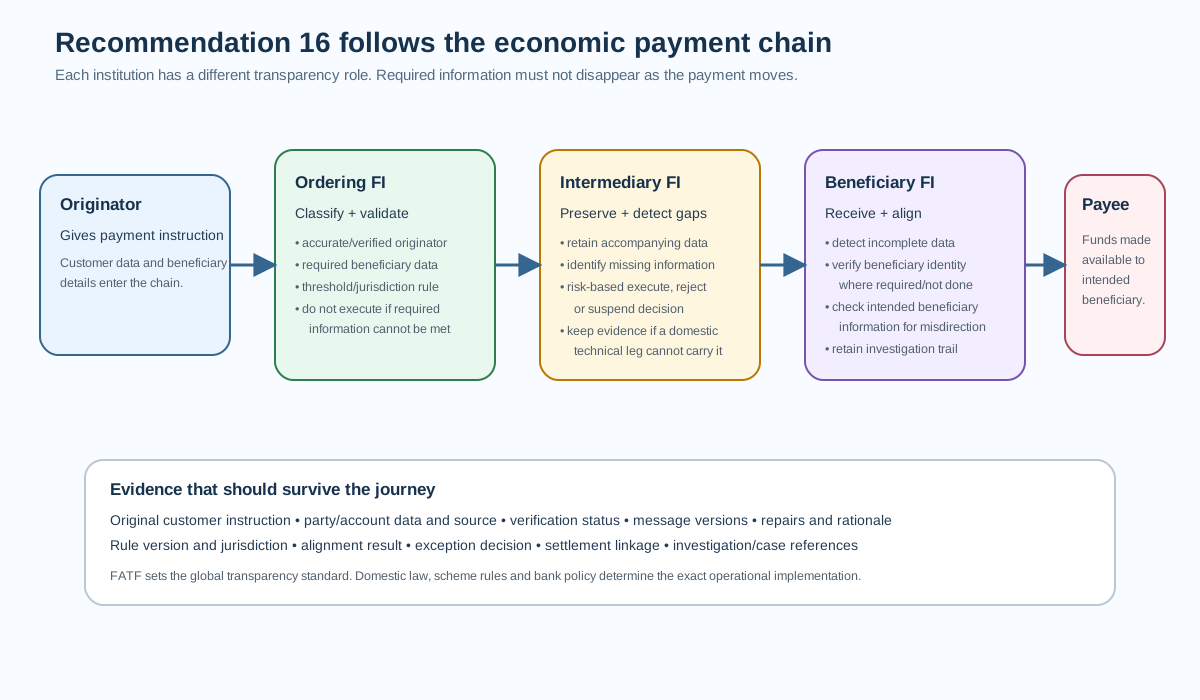
For implementation teams, the most important shift is conceptual. The control should follow the economic payment chain, not merely one technical message. FATF's explanatory material stresses that required information should travel from the start to the end of the payment or value-transfer chain. If a cross-border payment is technically broken into domestic legs, that engineering choice should not obscure the ultimate originator, ultimate beneficiary or the countries of the servicing institutions.
That is particularly relevant to payment service providers that collect money through one account and disburse through another. If the customer-facing PSP sends only its own settlement account information downstream and loses the ultimate payer or payee, downstream institutions may be unable to understand the real transaction. Recommendation 16 is intended to resist that fragmentation.
Where the payment chain starts and ends
Under the revised Interpretive Note, the payment chain starts at the financial institution that receives the originator's instruction to transfer funds to a beneficiary. The chain ends at the financial institution that services the beneficiary's account or provides cash to the beneficiary. This matters because the start and end points may be payment accounts or e-money wallets rather than traditional bank current accounts.
A bank should therefore model the roles explicitly. “Sending bank” and “receiving bank” are often too vague. A party may be the ordering financial institution for one leg, an intermediary on another, or the beneficiary institution for a different product. Modern ISO 20022 terminology such as debtor agent and creditor agent can help, but teams should map business roles rather than assume message element names alone determine regulatory responsibility.
Consider a corporate customer of Bank A paying a supplier whose account is at Bank D. Bank A may send the payment through Correspondent B and Correspondent C before Bank D credits the supplier. In a serial payment chain, the payment instruction and value travel sequentially through those institutions. In a cover payment, the customer payment message can travel directly toward the beneficiary institution while the funding or “cover” travels through correspondents. The transparency control must work in either model, although the message flows and intermediary visibility differ.
The operational question is not “How many messages exist?” It is “Can the institutions with responsibilities under the standard identify the parties and preserve the required information through the economic transfer?” That is why a payment architecture should maintain a chain identifier, a message-version history and a relationship between customer instructions, settlement legs and investigation records.
Cross-border transfers and the de minimis threshold
The revised standard allows countries to adopt a de minimis threshold for cross-border payments or value transfers, but that threshold must not be higher than USD or EUR 1,000. This is a maximum permitted threshold in the FATF standard, not a statement that every country must adopt exactly 1,000 or use the same currency conversion method. Jurisdictions may impose a lower threshold or more stringent requirements.
Below an applicable cross-border threshold, the revised Interpretive Note still expects basic traceability. The payment should include the name of the originator and beneficiary and the account number of each where an account is used, or a unique transaction reference where no account is used. FATF's text states that below-threshold information does not need to be verified for accuracy unless there is suspicion of money laundering or terrorist financing, in which case information pertaining to the institution's customer should be verified.
Above the applicable threshold, the information requirements are richer. This is where implementation teams need to be precise rather than rely on a generic “full party details” requirement.
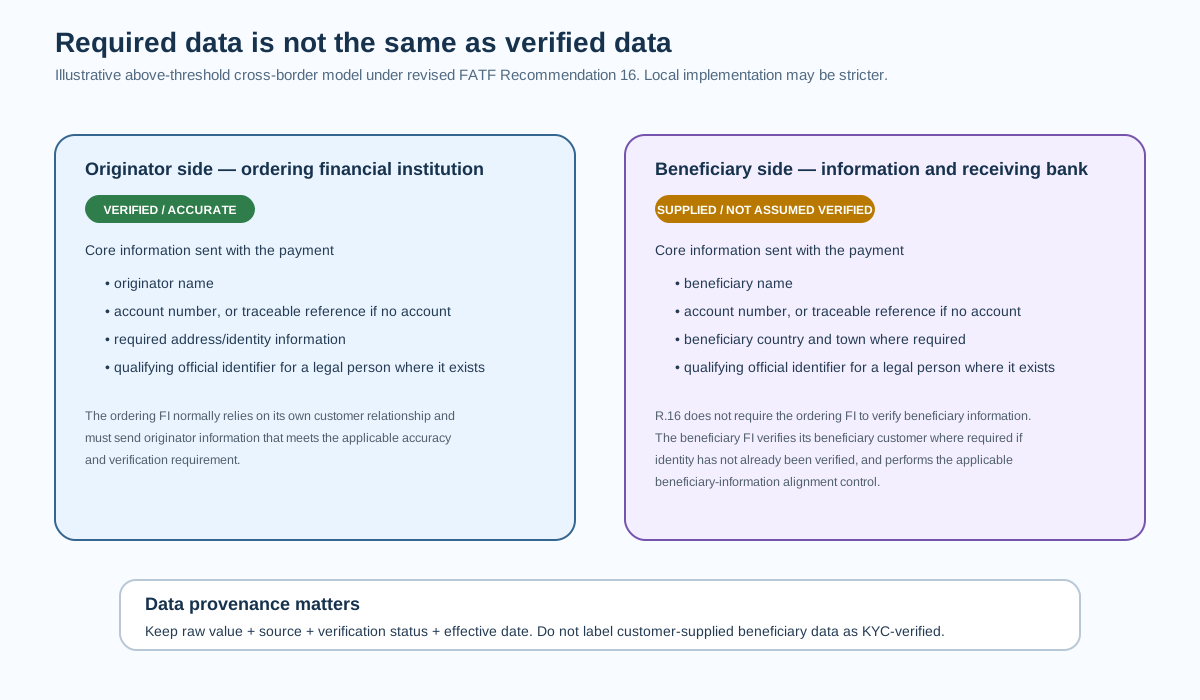
The required information includes the names of the originator and beneficiary; account numbers where accounts are used or a traceable unique transaction reference where they are not; specified address or identity information; and, where the originator and/or beneficiary is a legal person and the identifier exists, a connected BIC, LEI or unique official identifier. The exact FATF text should be translated into the bank's data dictionary and local legal rulebook, because domestic implementation may add or modify operational requirements.
For the originator's address, the revised standard uses full address as the default, while country and town name, or the nearest alternative, can suffice where standardised postal address information is unavailable. For the beneficiary, FATF deliberately chose a narrower address requirement: country and town name rather than a full address. For an originator who is a natural person, date-of-birth information is part of the available identification options in the standard, and the explanatory note clarifies that where a full date is unavailable, the year of birth can suffice. These details are designed partly to balance transparency with inclusion and data-protection concerns.
The practical lesson is that a field can be mandatory, conditional, alternative or jurisdiction-dependent. A single boolean such as partyDataComplete = true is rarely sufficient. Systems need rule version, jurisdiction, role, threshold, customer type and sometimes availability conditions to determine what completeness means for a given payment.
Verification is not symmetrical
A second common mistake is to assume the ordering institution must independently verify every detail of the beneficiary before sending a payment. FATF's explanatory note says otherwise. For above-threshold cross-border transfers, the ordering institution needs to send originator information that has been verified for accuracy. The ordering institution is not required by R.16 to verify the accuracy of beneficiary information; it must include the beneficiary information provided by the originator or otherwise conveyed to it, such as information obtained through a pull-payment or payee-verification process.
At the receiving end, if the beneficiary's identity has not previously been verified, the beneficiary financial institution should verify that identity for qualifying above-threshold transfers and maintain the information according to Recommendation 11 record-keeping expectations.
This split reflects the customer relationships. The ordering institution normally knows its own originator customer. The beneficiary institution normally knows its own beneficiary customer. Trying to force the ordering bank to perform full CDD on a remote beneficiary with whom it has no relationship would be inefficient and often unrealistic.
For delivery teams, the design consequence is important: source provenance must travel with data meaning. A system should be able to distinguish a verified customer attribute from an originator-supplied beneficiary attribute, a directory response, a payee-verification result or a correspondent-provided value. If those all collapse into one unlabelled “party record,” reviewers may assume a level of assurance that never existed.
The ordering financial institution
The ordering financial institution is the first regulatory control point in the customer payment chain. For qualifying cross-border transfers above the threshold, it should ensure the payment contains required and accurate originator information and required beneficiary information. For below-threshold cross-border transfers, it should provide the basic information required by the relevant paragraph of the standard. It should maintain the originator and beneficiary information it collects in line with Recommendation 11.
The revised Interpretive Note also states that an ordering financial institution should not execute the transfer if it cannot comply with the applicable information requirements. In a real bank this means the payment-orchestration layer must know when a missing field is a hard regulatory stop, when an alternative data element is permitted, when repair is allowed and when local law or scheme rules impose a stricter outcome.
The ordering-bank control begins before the payment message exists. If customer master data is poor, no amount of downstream message repair will create trustworthy originator information. Good design therefore separates customer data remediation from payment-specific repair. If the customer's legal name or address is incomplete, repeatedly fixing each payment is a symptom treatment. The real control issue sits in KYC data quality.
The bank should also retain what the customer actually instructed. If a payment is repaired or enriched after initiation, the original instruction and each material message version should remain reconstructable. This protects against accidental or malicious changes and enables investigators to determine whether a transparency problem came from the customer, channel, mapping logic, operations or an intermediary.
The intermediary financial institution
Intermediaries are not passive pipes. For cross-border transfers, an intermediary should ensure that originator and beneficiary information accompanying the transfer is retained with it. Where technical limitations prevent the information from remaining with a related domestic leg, the revised Interpretive Note requires the receiving intermediary to retain the information received for the applicable record-retention period stated by FATF, currently at least five years in the text.
Intermediaries should take reasonable measures to identify cross-border transfers lacking required originator or beneficiary information, in a way consistent with straight-through processing. They should also have effective risk-based policies and procedures for deciding when to execute, reject or suspend a transfer that lacks required information and what follow-up action to take.
“Consistent with straight-through processing” is important. FATF is not asking banks to convert every cross-border payment into a manual case. A mature control uses structured validation, risk rules, exception categories and selective human review. A missing beneficiary town in a flow where that element is required is different from a minor formatting variation that does not impair identity resolution. Controls should distinguish absence, invalidity, inconsistency and harmless format differences.
An intermediary should also avoid inventing party information merely to pass a format validation. If a legacy message lacks a value, inserting a generic placeholder such as “UNKNOWN” may make the XML valid while degrading the financial-crime control. Data repair should be evidence-based, attributable and auditable.
The beneficiary financial institution
The beneficiary institution receives the payment where funds will be made available to the intended recipient. It should take reasonable measures to identify cross-border transfers lacking required originator or beneficiary information. FATF permits those measures to include post-event monitoring or real-time monitoring where feasible; the appropriate design depends on the legal and operational environment.
For qualifying above-threshold transfers, the beneficiary institution should verify the beneficiary's identity if it has not already done so. It should then use the intended-beneficiary information in monitoring aimed at identifying potentially misdirected payments.
This leads to one of the most important additions to revised R.16: beneficiary-information alignment.
Alignment checks and misdirected payments
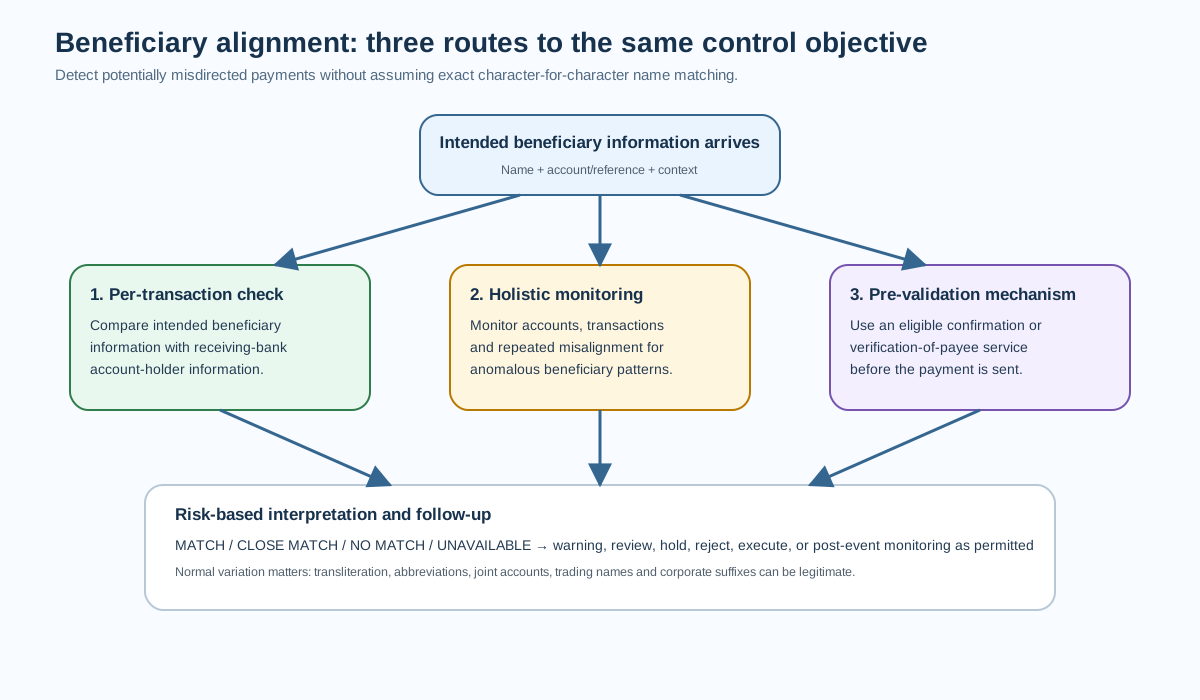
FATF introduced alignment-check obligations because payments can be diverted by fraud, error or misuse even when the account identifier is technically valid. The central question is whether the beneficiary name and account number in the payment message align sufficiently with information held by the beneficiary institution.
FATF's adopted text provides three implementation approaches. A beneficiary institution can check alignment for each transaction, including post-validation; it can perform risk-based holistic ongoing monitoring that identifies anomalous accounts, transactions and misaligned beneficiary information; or, where both ordering and beneficiary institutions participate in a pre-validation mechanism such as confirmation or verification of payee, that pre-validation mechanism can be used instead of the other approaches.
Alignment does not mean exact character-for-character matching. FATF states that the expected degree of alignment can vary with risk and context. That matters for transliteration, legal-name abbreviations, joint accounts, trading names, diacritics, corporate suffixes and normal data-quality variation. A simplistic rule that rejects every non-exact match can create enormous false-positive volume and financial exclusion without materially improving fraud prevention.
The operational outcome of an alignment issue also needs design. A mismatch can result in a warning to the payer, a request for corrected beneficiary details, enhanced review, a hold, rejection, post-event investigation or monitoring depending on the chosen implementation model, applicable law, payment rail and risk. Recommendation 16 creates an outcome objective; it does not create one universal customer journey.
The difference between alignment, screening and transaction monitoring
These controls overlap but answer different questions.
Alignment asks whether the intended beneficiary information supplied in the payment is consistent with information held for the receiving account. Sanctions screening asks whether a party or relevant data element may match a designated or restricted target under an applicable sanctions regime. AML transaction monitoring asks whether the behaviour, network, value, geography, purpose or sequence may be suspicious. Fraud controls ask whether the payment is authorised, manipulated, misdirected or part of a scam or account takeover.
A single payment may trigger all four. Suppose a business customer enters the correct account number but a beneficiary name that is materially inconsistent with the receiving bank's account holder. The payee-alignment control raises a mismatch. At the same time, the beneficiary account has received several high-value incoming payments from unrelated companies and immediately transferred funds onward. That behaviour raises a mule-account monitoring concern. The beneficiary name also resembles a sanctions target, creating a screening alert. The customer reports an invoice-email compromise, creating a fraud case.
The bank needs correlation, not conflation. Each control has different data, legal thresholds, decision owners, confidentiality rules and outcomes. An architecture that reduces all of them to one riskFlag loses the distinction investigators and auditors need.
Domestic transfers are not simply “out of scope”
Recommendation 16 also contains domestic-transfer requirements. The revised standard permits countries to adopt a domestic de minimis threshold no higher than USD/EUR 1,000. Below that threshold, basic originator information and a traceable account or transaction reference are required under the FATF standard, subject to the verification conditions described in the Interpretive Note.
For domestic transfers above the threshold, the full originator information does not necessarily have to travel in the payment message if it can be made available to the beneficiary institution and appropriate authorities through other means. In that case, a traceable account or transaction reference can accompany the payment, while the ordering institution must be able to provide the information within the period specified by FATF. Domestic law may of course require more.
This matters for cross-border transparency because a global payment can be fragmented into domestic technical legs. The architecture cannot decide “domestic = minimal data” solely because one settlement leg occurs inside one country. It must understand whether that leg is part of a wider cross-border customer payment.
The European Economic Area also has specific treatment in the FATF glossary for the definition of domestic chains, reflecting the integrated payments area. Banks must still apply applicable EU law and local regulatory requirements rather than rely on a generic global assumption.
Net settlement and financial-institution own-account transfers
Not every settlement movement should carry full customer-party data. Recommendation 16 differentiates financial-institution-to-financial-institution transfers where both originator and beneficiary are institutions acting on their own behalf. It also recognises that payment systems may settle many customer transactions through a net settlement amount.
Where a net settlement reflects underlying customer payments, the underlying customer information does not need to accompany the net settlement itself. That does not remove Recommendation 16 from the underlying customer transactions. FATF clarified that intermediaries are not required to unbundle net settlement solely to screen each underlying item, while the underlying payment chains remain subject to their relevant transparency requirements.
This is a critical architecture distinction. A treasury settlement account movement and the customer payments that generated the net position are linked but are not the same regulatory object. Reconciliation needs that linkage, while transparency controls need to operate at the correct layer.
Batch transfers
Batch or bulk payments are another area where simplistic validation can create errors. The revised standard allows several individual cross-border payments from one originator to be bundled in a batch under specified conditions. Individual items can use a traceable originator account or transaction reference while the batch file contains the required and accurate originator information and full beneficiary information traceable within the beneficiary country.
The control therefore needs two levels of integrity: batch-header context and individual payment traceability. If the batch is separated downstream, each payment must still be connectable to the originator information. If an operations team repairs a header, the bank needs to know which underlying items inherit that change.
A classic failure is to validate only the outer file. A batch can be syntactically perfect while individual beneficiaries contain missing, duplicated or corrupted identifiers. Another failure is the reverse: downstream systems may inspect each item but lose the shared originator context after file decomposition. Test cases should therefore follow a batch from customer file to message transformation, clearing and beneficiary delivery.
Card purchases, person-to-person transfers and cash withdrawals
Recommendation 16 contains differentiated requirements for card-related activity. Transfers flowing from a credit, debit or prepaid card transaction for the purchase of goods or services can fall under a different treatment where the necessary card and institution information accompanies or is available for the transaction. A card used as the mechanism for a person-to-person transfer is not automatically exempt; the relevant domestic or cross-border payment-transparency requirements apply.
The revised standard also adds targeted requirements for cross-border cash withdrawals using a card through another financial institution. This reflects the fact that cross-border ATM activity can otherwise provide limited visibility to the acquiring institution and authorities. It should not be confused with an ordinary merchant-purchase transaction.
For product owners, the lesson is to classify by economic purpose and activity, not simply by instrument label. “Card transaction” is too broad. Merchant purchase, wallet funding, cash withdrawal and person-to-person transfer can have different Recommendation 16 treatment.
Virtual accounts and hidden geography
Virtual account numbers can improve reconciliation and customer servicing, but they can also obscure where the underlying account is actually serviced. The revised Recommendation 16 reinforces the principle that payment messages should enable relevant institutions and authorities to identify the financial institutions servicing the originator's and beneficiary's accounts and the countries where those institutions are located.
FATF does not ban legitimate virtual account numbers and does not require every account-number format to embed a country code. The objective is transparency of the servicing institution and jurisdiction. A virtual IBAN or similar identifier should not make a cross-border transfer appear domestic or conceal the location of the account relationship.
This should be an explicit data-quality rule in payment architecture. The displayed account number, actual servicing account, booking entity, servicing institution and country should be separately modelled where virtual-account products are used. Investigations should be able to resolve from the virtual reference to the underlying relationship without manual detective work across unconnected systems.
Record keeping and evidence
Recommendation 16 depends on Recommendation 11 record keeping because payment transparency is useful only if it can be reconstructed. A bank should preserve enough evidence to show the customer instruction, party data and its source, verification status, payment-message versions, any repairs, the route, missing-data decisions, alignment outcomes, investigation notes and final disposition.
For intermediary institutions, the Interpretive Note expressly addresses record keeping where technical limitations prevent required data from remaining with a related domestic transfer. For all institutions, local record-retention law may be longer or otherwise more specific than FATF's minimum standard.
The evidence should be immutable enough for audit but accessible enough for investigations. Storing an XML message in an archive is not sufficient if the bank cannot retrieve it by customer, account, transaction identifier or case. Likewise, storing only the final message can hide whether data was changed between initiation and settlement.
What ISO 20022 improves, and what it does not
ISO 20022 is valuable because it provides structured roles for parties and agents, dedicated account identifiers, address components, legal-entity identifiers, purpose and remittance information, and a model that can preserve semantics across payments. The CPMI's harmonised ISO 20022 data requirements for cross-border payments are intended to reduce variation between implementations and improve interoperability. CPMI updated those requirements in February 2026 and continues to encourage adoption by the end of 2027.
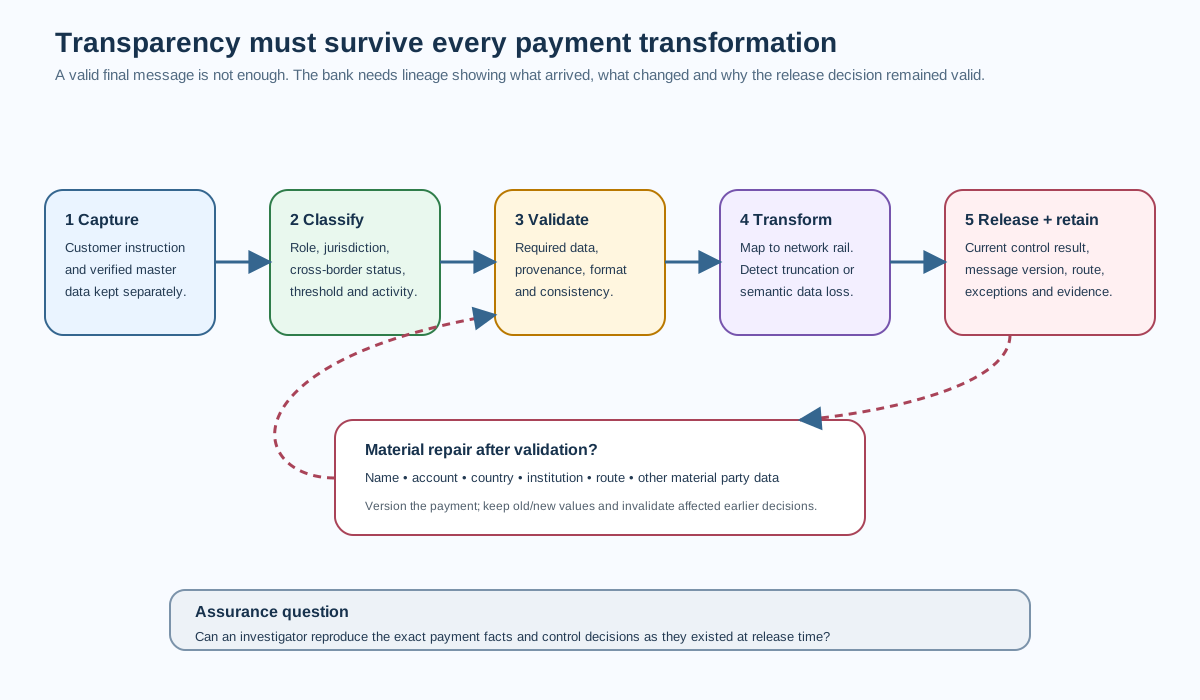
But richer syntax is not the same as accurate data. An XML element can be present but wrong. A name can be truncated upstream and placed correctly downstream. A town can be inferred incorrectly from free text. A payment hub can map an ultimate debtor into the debtor field and overwrite the actual account holder. A legacy translation can collapse structured address elements into one narrative field and then try to reconstruct them later.
Therefore a Recommendation 16 programme should treat ISO 20022 migration as a data-lineage project, not only a format-conversion project. Every required business concept should have an authoritative source, transformation rule, validation rule and downstream consumer.
Swift's CBPR+ community rules are a useful example of why current-source checking matters. Earlier 2026 material referred to 14 November 2026 as the date when fully unstructured addresses would cease to be accepted in CBPR+ payment messages. In August 2026, however, Swift announced a controlled extension of Standards Release 2026 payment changes and said it would consult the community on optimal timing for structured-address enforcement, with an update by December at the latest. A bank should therefore not hard-code an outdated public deadline into compliance policy merely because an older implementation page still contains it. Network readiness must follow the latest official Swift release governance, while FATF Recommendation 16 remains a separate global standard with its own 2030 implementation horizon.
That example also demonstrates why regulatory change records need an as-of date and source hierarchy. A policy team may have downloaded a valid Swift page in July and still be wrong in September because a later official statement superseded the implementation timing.
Control design in a payment hub
A practical payment hub can implement Recommendation 16 through a series of control gates.
At capture, the channel validates the minimum customer and beneficiary information required for the product. At enrichment, the hub resolves customer master data, servicing institution and relevant routing information. At regulatory classification, it determines whether the transfer is domestic or cross-border for the economic payment chain, which jurisdictional rule set applies, whether a threshold is relevant and which activity category applies. At transparency validation, it checks required data, source provenance and permitted alternatives. At financial-crime controls, screening, fraud and monitoring services consume the appropriate party data. At release, the hub confirms that any hard-stop transparency exceptions have been resolved or an authorised rule permits continuation.
If a payment is repaired, the system should determine whether the repair is material. Changing a formatting-only character may not require a new financial-crime decision. Changing beneficiary name, account, country, servicing institution or originator identity almost certainly changes the facts relied upon by earlier controls. The architecture should version the payment and re-run affected controls rather than let an old clearance token follow materially changed data.
A useful state model distinguishes CAPTURED, VALIDATED, TRANSPARENCY_EXCEPTION, UNDER_REPAIR, REVALIDATED, FC_REVIEW, READY_FOR_RELEASE, REJECTED, SETTLED and POST_EVENT_CASE. The exact states will differ by bank, but a single generic PENDING state hides too much.
Data quality controls
Recommendation 16 quality should be measured at several levels.
Completeness asks whether required data is present. Conformance asks whether it follows the permitted structure and code sets. Validity asks whether a value is plausible and resolvable. Consistency asks whether related fields agree, such as BIC country, account-servicing country and address country. Accuracy asks whether verified customer information reflects the real customer. Provenance asks where the value came from and whether it was verified. Persistence asks whether the information survives message transformations. Timeliness asks whether the correct current value was used when the payment was executed.
A mature dashboard should not report one blended “data quality percentage.” A 99% score can conceal a critical 1% gap in high-risk cross-border transfers. Metrics should be segmented by rail, channel, legal entity, correspondent, customer type, data element, failure reason and outcome.
Repeated missing or poor-quality data from one respondent or channel should feed relationship governance. An intermediary repeatedly repairing the same upstream weakness can create moral hazard: the originating PSP never fixes its source problem because someone else absorbs the cost. Correspondent or PSP governance should therefore use recurring transparency exceptions as due-diligence and service-quality evidence.
Investigations and suspicious-activity outcomes
A missing-data alert is not automatically suspicious activity. It may be an implementation defect, customer error, legacy mapping issue or upstream PSP weakness. The investigator should ask what the gap means in context.
Concern increases where missing or inconsistent data appears deliberate, repeated or connected to other red flags. Examples include systematic omission of ultimate originators by a payment aggregator, changing beneficiary names while preserving account numbers, virtual accounts that obscure high-risk jurisdictions, repeated use of generic originator descriptions, or repair patterns that remove rather than improve identifying data.
An investigation should reconstruct the payment chain and determine who knew what at each point. It should distinguish the customer instruction from data added by the bank, changes made by intermediaries and information observed at the beneficiary institution. If the facts support suspicion under local law, the case can proceed to the bank's SAR/STR decision process. The filing obligation and tipping-off restrictions come from the applicable jurisdiction, not directly from Recommendation 16 itself.
Payment transparency also supports law-enforcement response. When authorities provide an account number, transaction reference or party identifier, structured and retained payment data can reduce the time needed to trace linked transfers and counterparties. This is one reason FATF places emphasis on information being accessible along the chain rather than fragmented into disconnected domestic legs.
Governance and ownership
No single team owns Recommendation 16 end to end.
Compliance should interpret the global standard and local implementing obligations and define minimum control outcomes. Legal may advise on jurisdiction-specific requirements, privacy and customer communication. Payment product teams own customer journeys and scheme participation. Operations handle repair and exceptions. Technology owns data lineage, workflow and control integration. Financial-crime operations own relevant alerts and investigations. Correspondent-banking teams manage upstream and downstream institution behaviour. Data owners manage party and account data quality. Internal audit provides independent assurance.
The key governance artefact is a control matrix that maps each obligation or policy requirement to the payment populations, data elements, system controls, exception outcomes, evidence and accountable owner. Without that matrix, banks often have duplicated controls in one rail and blind spots in another.
Change governance should track FATF standards, domestic implementation, payment-market-infrastructure rules, ISO maintenance and network standards separately. A change in one layer should trigger impact analysis without automatically being treated as a legal change in every jurisdiction.
Practical case: the supplier payment with a mismatched beneficiary
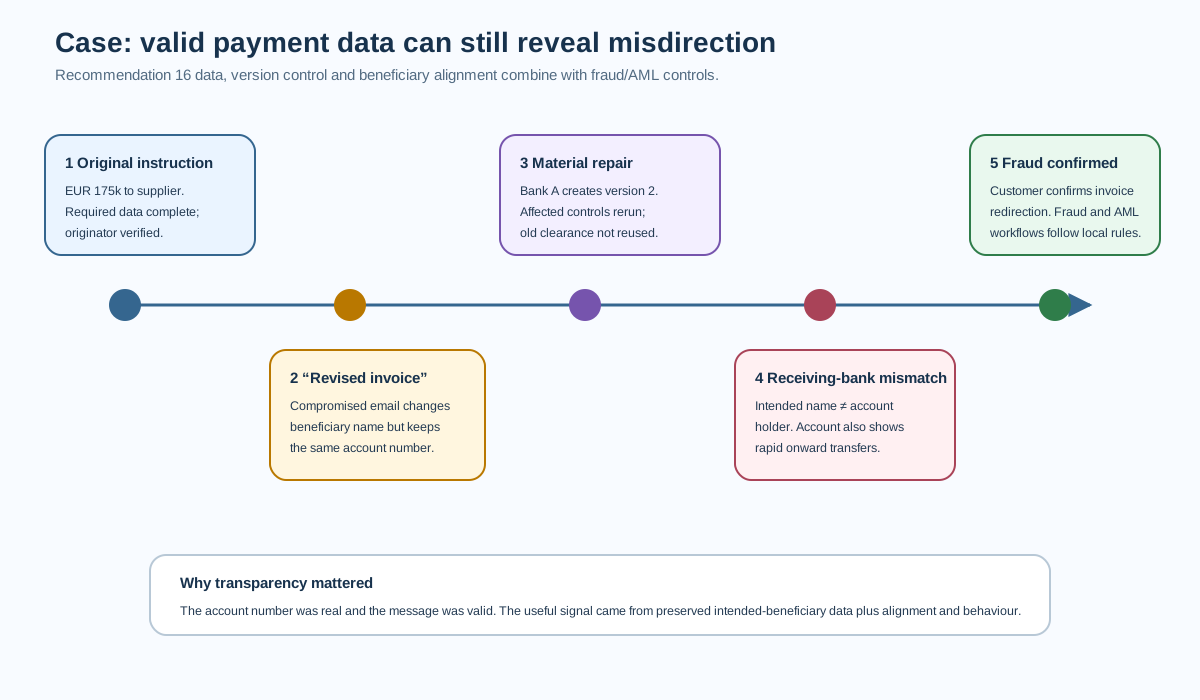
A manufacturing company in Country A instructs Bank A to pay EUR 175,000 to a new equipment supplier in Country D. The customer's ERP sends the supplier name, account number, town and country. Bank A verifies the originator from its KYC record and captures the beneficiary information as supplied by the customer. The payment is routed through an intermediary before reaching Bank D.
At capture, Bank A's transparency service classifies the transaction as an above-threshold cross-border payment under the applicable rule set. Required originator and beneficiary fields are present. Sanctions screening produces no match. The payment moves to release.
Before settlement, the customer's treasury analyst calls to say the supplier sent a revised invoice with a different beneficiary name but the same account number. Operations updates the name. That is a material change because beneficiary identity information has changed. The hub creates payment version 2, records the repair source and re-runs affected controls rather than reusing version 1 clearance.
At Bank D, the account number belongs to “Delta Trading Services Ltd,” while the payment names “Delta Industrial Systems GmbH.” The difference is too large to treat as an abbreviation or harmless spelling variation. Under Bank D's chosen R.16 alignment-control model, the transaction enters a pre-credit review. The account also has recent incoming payments from unrelated companies followed by rapid outward transfers.
The beneficiary mismatch alone does not prove fraud or money laundering. But together with the behavioural pattern, it justifies investigation. Bank D contacts the sending side through the permitted operational channel, reviews its customer relationship and considers its fraud and AML procedures. Bank A separately contacts its customer, who discovers that the supplier's mailbox had been compromised and the revised invoice was fraudulent.
The case shows why Recommendation 16 is more than a field-completeness rule. The originator was known. The payment message was valid. The account number existed. Yet the beneficiary information did not align, and that misalignment became useful only because the institutions retained structured party data, version history and clear exception routes.
What a business analyst should be able to specify
A strong BA should be able to turn Recommendation 16 into testable requirements without pretending to provide legal advice. The requirements should identify the payment populations in scope, regulatory role, jurisdiction, threshold logic, required data elements, permitted alternatives, verification status, source systems, message mappings, validation timing, exception states, repair authorities, alignment-control model, record-retention evidence and MI.
A requirement such as “System shall ensure R.16 compliance” is not testable. Better requirements say, for example, that for a qualifying cross-border customer transfer classified above the applicable threshold, the payment may not reach release state unless the rule-engine result confirms the required originator and beneficiary information for the applicable legal entity and rule version. If a material party field changes after validation, the old result must be invalidated and affected controls rerun.
The BA should also capture negative requirements. The system must not invent missing party data. It must not overwrite verified originator data with weaker transaction text. It must not treat an intermediary settlement account as the ultimate beneficiary when the underlying customer beneficiary is available. It must not reuse a transparency decision after a material repair. It must not classify a cross-border economic payment as domestic merely because one technical clearing leg is domestic.
What architects and developers should design
Architects need canonical party roles, payment-chain identifiers, immutable event history, rules that can be versioned by jurisdiction and effective date, and APIs that distinguish verified from unverified attributes. They should minimise lossy transformations and define what happens when a downstream rail cannot carry all source data.
Developers need deterministic validation and traceable decision outputs. A transparency service should return more than pass/fail. It should identify the rule version, missing or invalid fields, source values, severity, whether repair is permitted, the next state and the evidence identifier. That allows operations, monitoring and audit to understand what happened without reproducing the rules manually.
Event ordering matters. If payment enrichment arrives after screening, the platform must know whether new data requires re-screening or revalidation. Retry and replay logic must be idempotent so one customer payment does not create duplicate settlement or inconsistent compliance decisions. If the transparency service is unavailable, the fallback policy must be explicit. A bank should not silently bypass a hard regulatory gate because a microservice timed out.
What testers should prove
Testing needs more than happy-path XML samples. Positive tests should prove valid below-threshold and above-threshold transfers move correctly. Negative tests should omit one required field at a time, use malformed account references, unsupported identifiers and missing jurisdiction data. Boundary tests should cover exactly-at-threshold values and currency-conversion logic where relevant. Role tests should distinguish ordering, intermediary and beneficiary responsibilities.
Transformation tests should send the same payment through each supported channel and route, then compare the financial-crime meaning at destination. Batch tests should verify header-to-item traceability. Cover-payment tests should verify the customer payment and funding legs are linked. Repair tests should change material party information and confirm prior control results are invalidated. Alignment tests should cover exact matches, reasonable variants, close matches and clear mismatches without assuming exact string equality.
Failure-mode tests should simulate unavailable directories, screening engines, rule services and correspondent responses. Volume tests should prove the design remains safe during peak periods rather than degrading into uncontrolled manual bypass. Reconciliation should prove that all payments expected to pass the transparency gate either produced a decision or are accounted for in an approved exception state.
Operational and customer impact
Poorly designed Recommendation 16 controls can create significant customer harm. Hard validation on data customers cannot reasonably provide can block legitimate remittances. Exact-name matching can disadvantage customers whose names use different scripts or transliterations. Repeated repair requests can delay salary, medical, trade or family-support payments. Over-collection of personal data can create privacy risk.
Under-control creates a different harm: fraud losses, sanctions exposure, weak investigations and opaque money movement. The right design is therefore not “maximum friction.” It is sufficient, accurate, structured transparency with proportionate decisioning.
Customer journeys should explain why information is needed in plain language. Digital channels can validate format early, reuse verified customer data and pre-populate known information rather than forcing repeated manual entry. Corporate channels should publish data requirements far enough in advance for ERP and treasury-system changes. Exceptions should return actionable reasons rather than cryptic technical codes.
The implementation timeline should be treated as a programme, not a date
The revised Recommendation 16 was adopted in June 2025, with FATF expecting countries to be ready to implement the strengthened requirements by the end of 2030. That horizon is long enough to invite delay but short enough to create major data and infrastructure risk if banks wait for final domestic rules before analysing their architecture.
A sensible programme separates no-regret improvements from jurisdiction-dependent decisions. No-regret work includes party-data lineage, removal of destructive truncation, reliable account-servicing-country identification, beneficiary-name quality, message-version evidence, payment-chain modelling, alignment-capability assessment and consistent exception taxonomy. Jurisdiction-dependent work includes exact thresholds, effective dates, reporting duties, data-retention periods where local law differs, customer notices and supervisory-specific interpretations.
The FATF consultation on implementation guidance closed on 21 August 2026. Until final guidance is issued, banks should not present consultation examples as binding requirements. Instead, maintain a traceable assumptions log and be ready to update requirements when FATF and national authorities publish final implementation material.
Key takeaways
Recommendation 16 is best understood as end-to-end payment transparency. It is not merely a wire-format checklist and it is not a universal mandate to screen every payment in the same way. The revised standard follows the economic payment chain, strengthens originator and beneficiary information, clarifies different responsibilities for ordering, intermediary and beneficiary institutions, addresses fragmented modern payment models and introduces beneficiary-information alignment as a control against potentially misdirected payments.
For a bank, effective implementation depends on trustworthy customer data, explicit role and jurisdiction logic, preservation of payment meaning across transformations, evidence-based repair, risk-based exception handling, versioned control decisions and audit-ready lineage. ISO 20022 can materially improve those capabilities, but technical conformance alone does not create regulatory compliance.
The strongest implementation is one where an investigator can take any material cross-border payment and answer, without guesswork: who instructed it, who was intended to receive it, which institutions serviced those parties, what information travelled with the payment, what changed, which controls ran, why the payment was released or stopped, and what evidence remains. That is payment transparency in operational terms.
Operational deep dive: turning Recommendation 16 into payment data and controls
The base chapter explains what Recommendation 16 is trying to achieve. This deep dive moves into the machinery of implementation: how a bank classifies a payment chain, represents parties and agents, preserves data across ISO 20022 and legacy transformations, handles exceptions, and proves afterwards that the control worked.
A useful design principle is to separate four layers that are frequently mixed together in projects. The global-standard layer is FATF Recommendation 16 and its Interpretive Note. The legal layer is the law, regulation and supervisory expectation that implements or supplements the standard for a particular legal entity. The market-practice layer includes payment-system, correspondent and industry practices such as Wolfsberg guidance. The technical layer includes ISO 20022 schemas, usage guidelines, APIs, files and internal data models. A field can be technically optional but legally required in a particular use case; technically mandatory but irrelevant to a specific FATF rule; or present but too poor in quality to support the control objective.
Keeping those layers distinct allows change to be managed correctly. If FATF changes the standard, policy and legal teams assess implementation. If a domestic regulator changes a threshold, the jurisdiction rule changes without pretending FATF itself changed. If Swift or a domestic market infrastructure changes a usage guideline, the network mapping changes. If ISO publishes a new message version, the technical representation can evolve while the business obligation remains stable.
Build a payment-chain model before building a field rule
Many transparency defects begin because the bank validates fields before it knows what transaction it is looking at. The first control decision should therefore be classification.
The system needs to identify the legal entity processing the payment, the role that entity plays, the originator and beneficiary relationship, whether the economic transfer is domestic or cross-border under the applicable rule, the payment activity, the value and threshold treatment, the payment rail, and whether any differentiated regime applies. Those facts select the correct data requirements.
Consider three transfers that all create a pacs.008 somewhere in the architecture. The first is a domestic retail credit transfer. The second is the domestic final leg of a cross-border remittance initiated by a foreign PSP. The third is an interbank liquidity movement where both institutions act on their own behalf. The message family alone does not tell you which Recommendation 16 requirements apply. The economic chain and role do.
A canonical payment object should therefore distinguish at least:
- customer payment identity and instruction identity;
- economic originator and beneficiary;
- ordering, intermediary and beneficiary institutions;
- debtor/creditor accounts and, where relevant, ultimate parties;
- servicing institution and servicing country for each relevant account;
- customer-facing channel and originating legal entity;
- settlement legs and correspondents;
- payment-chain classification and jurisdiction rule version;
- original and current message versions;
- control decisions and evidence identifiers.
These elements do not all have to exist in one database table. What matters is that they can be joined reliably and reconstructed.
Serial payments, cover payments and why the distinction matters
In a serial payment, the customer payment and accompanying information travel sequentially from the ordering institution through any intermediaries to the beneficiary institution. Each intermediary receives and forwards the payment as part of the same chain. This makes end-to-end data preservation conceptually simple, although in practice message translation can still truncate or remap information.
A cover payment separates the customer payment message from the funding route. The ordering institution can send the customer payment instruction toward the beneficiary institution while settlement funding moves through one or more correspondent banks. The intermediary institutions on the cover route may see different data from the institutions handling the customer payment message.
This distinction matters because a control designer should not demand information from an intermediary that its role and message flow do not provide, nor should the design assume that the customer-payment message and funding message are unrelated. Reconciliation and investigations must be able to connect them.
If a sanctions or AML investigation is triggered on a cover leg, the analyst may need customer information carried in the associated payment message or available through linked records. The architecture should preserve the relationship between the cover transaction and the underlying customer payment using stable identifiers and controlled mapping, not human memory.
Wolfsberg's payment-transparency standards and roles-and-responsibilities guidance are useful industry references here because they illustrate that modern payment actors have different visibility and responsibilities. They are not law, but they provide a practical way to avoid designing controls as if every participant sees the same data.
ISO 20022 party roles: preserve meaning, not just tags
ISO 20022 provides richer structured party and agent information than older free-text formats, but richness can create its own implementation risk. A bank must understand what each party role means in the customer and payment context.
The debtor is not always the ultimate economic originator. The creditor is not always the ultimate economic beneficiary. An ultimate debtor or ultimate creditor may add useful business context, while the account holder whose funds are debited or credited remains operationally important. Debtor agent, creditor agent, intermediary agents and instructing/instructed agents describe financial-institution roles, but their precise presence depends on the message and market practice.
A mapping specification should therefore start with business definitions. “Debtor name maps to field X” is weaker than “the party that owns or is authorised on the account from which funds are drawn maps to the debtor role under this market practice; where a distinct ultimate payer exists, preserve it separately.” This prevents convenient but semantically wrong mappings.
The same applies to addresses. Address lines, town, country, post code and other structured elements should not be treated as interchangeable strings. If a source system has structured values, the bank should not flatten them into narrative and then attempt to infer structure downstream. If inference is unavoidable during migration, provenance and confidence should be retained so a derived value is not mistaken for verified customer data.
Swift structured-address timing: a live example of source governance
Structured addresses illustrate why payment-transparency programmes need active change control. Earlier Swift Standards Release 2026 material planned removal of fully unstructured postal addresses from CBPR+ payment messages from 14 November 2026, with town and country as minimum designated structured elements where address information was used.
In August 2026 Swift announced that, after community requests and consultation with payment market infrastructures, it would defer all Standards Release 2026 payments changes. For the structured-address requirement, Swift said it would consult banks, central banks, market infrastructures, market-practice groups and corporates to define the optimal timing and approach, with an update by December 2026 at the latest.
That later statement is the current implementation signal at the review date of this chapter. Some Swift pages still describe the earlier 14 November rule because documentation updates do not always occur simultaneously. A bank should therefore maintain a source hierarchy and effective-date register rather than copy one web page into policy and treat it as timeless truth.
This also demonstrates the boundary between FATF and Swift. FATF's revised Recommendation 16 has an end-2030 global implementation expectation. Swift's structured-address migration is a network standards programme. They support similar transparency objectives, but one is not the legal implementation date of the other.
The data dictionary should carry regulatory semantics
A mature payment data dictionary should capture more than element name, type and length. For transparency-critical attributes, record:
Business meaning. What does the value represent in the real payment? For example, originator legal name, beneficiary country/town, servicing-institution country or account identifier.
Source. Is the value drawn from verified KYC, customer transaction input, beneficiary directory, ERP file, correspondent message or system enrichment?
Assurance. Has the value been verified, merely supplied, algorithmically inferred or transformed?
Regulatory role. Which Recommendation 16 requirement or local implementation rule can rely on it?
Permitted alternatives. Where a standard allows account number or unique transaction reference, full address or a permitted fallback, the data model should capture which alternative was used.
Transformation. Which systems can alter, truncate, concatenate, translate or default it?
Consumers. Which screening, fraud, AML, reporting, routing and investigation services use it?
Retention and history. Can the value as seen at execution time be recovered later?
With this metadata, a bank can perform regulatory lineage rather than merely technical lineage.
Required-data validation needs a rules engine, not a static mandatory-field list
A static list of mandatory fields fails because requirements vary by payment type, threshold, party type, jurisdiction and role. The better pattern is a decision service whose inputs include the classified payment and whose output identifies the applicable rule set and any exceptions.
A simplified decision sequence can be:
- Determine whether this is a customer payment/value transfer or an FI own-account movement.
- Determine the economic start and end of the payment chain and whether it is cross-border under the applicable framework.
- Identify the bank's role: ordering, intermediary, beneficiary or a combination.
- Apply the jurisdiction and effective-date rule set.
- Determine whether a de minimis threshold applies and, if so, whether the amount is below or above it.
- Determine whether a differentiated category applies, such as qualifying batch treatment, purchase-card activity, person-to-person card transfer, cross-border cash withdrawal or net settlement.
- Resolve the required information and permitted alternatives.
- Validate presence, format, internal consistency and source/verification conditions.
- Route exceptions to reject, repair, suspend, monitor or other policy outcome.
- Record the rule version and evidence.
The output should be transparent. R16_FAIL is not enough. Operations needs to know whether the failure is BENEFICIARY_TOWN_MISSING, ORIGINATOR_ADDRESS_ALTERNATIVE_NOT_PERMITTED, SERVICING_COUNTRY_UNRESOLVED, TRACE_REFERENCE_MISSING, or another controlled reason. That enables safe repair and meaningful MI.
Threshold logic deserves dedicated testing
Thresholds are deceptively difficult in international systems. FATF allows countries to set a de minimis threshold no higher than USD/EUR 1,000, but local implementation may use local currency, no threshold, a lower threshold or stricter requirements.
A rules engine therefore needs effective-dated threshold configuration by legal entity and jurisdiction, plus an approved currency-conversion approach where relevant. The bank should define which amount is tested if fees, FX conversion or split settlement create several values. That decision should come from legal/policy interpretation, not be invented by developers.
Boundary testing should include just below, exactly at and just above the threshold; currencies with no direct quote; stale FX rates; payments amended after threshold classification; and batch items where individual amounts differ. Audit evidence should show which threshold and conversion data were used when the decision was made.
Verification state should be explicit
The revised standard's asymmetry between originator and beneficiary verification means data assurance must be modelled.
For the ordering institution, verified originator information can normally come from the bank's customer record. But transaction systems should not assume every KYC attribute is current merely because it exists. A customer record under overdue review, a legal-name change awaiting evidence or an address with known quality issues may need policy handling.
Beneficiary information supplied by the originator is different. It can be complete and useful without being independently verified by the ordering bank. If a payee-verification service returns a response, that is additional assurance, but it should not silently convert every beneficiary attribute into “verified identity.” The service may have checked only name-to-account alignment.
At the beneficiary institution, verification refers to the institution's own beneficiary customer where required. The bank should know whether identity was previously verified and under what customer lifecycle process.
One practical representation is to attach source, verification_status, verification_date, verification_method, source_system and effective_from/to metadata to regulated party attributes. That can be implemented physically or through linked lineage tables.
Alignment controls are a distinct service capability
The revised Recommendation 16 offers multiple approaches to beneficiary-information alignment. A bank should choose an operating model deliberately rather than scatter approximate name checks across payment systems.
A per-transaction check compares the intended beneficiary name and account information with records held by the beneficiary institution and informs follow-up. A pre-validation service can perform that comparison before the payment is sent, as in confirmation/verification-of-payee models. Holistic monitoring can detect anomalous or mismatched beneficiary information across ongoing activity.
Whatever approach is chosen, the bank needs a matching policy that handles normal variation. Matching can use normalisation, transliteration, alias rules, corporate suffix handling and risk-based thresholds, but it should preserve the raw values for evidence. Exact match, close match, no match and unavailable are usually more useful result categories than a binary yes/no.
The control also needs to define what the payer sees. A pre-validation mismatch warning should be understandable without revealing confidential beneficiary information. A customer may be allowed to proceed after a close-match warning under some implementations, while a clear mismatch in a high-risk scenario may cause a stronger intervention. The exact customer outcome depends on local implementation and fraud rules.
Alignment results are powerful monitoring signals. Repeated incoming payments naming unrelated beneficiaries for the same account can indicate mule activity, collection accounts, virtual-account issues or legitimate agency arrangements. The result should be correlated with customer profile and transaction behaviour rather than treated as standalone proof of wrongdoing.
Intermediary missing-data detection
An intermediary's challenge is to identify missing required information without creating unnecessary manual intervention. A useful control has three layers.
The first is deterministic validation: required fields absent, invalid identifiers, impossible country codes or malformed references. The second is semantic quality: placeholder names, repeated generic terms, meaningless addresses or inconsistent party roles. The third is behavioural analysis: one respondent repeatedly sends lower-quality information, omits ultimate parties in specific corridors or repairs messages only after challenge.
Risk-based procedures then determine whether to execute, reject, suspend or follow up. Those decisions should consider legal requirements, payment value, corridor, correspondent relationship, data deficiency, repeat behaviour, customer impact and whether additional information is obtainable in time.
The intermediary should not repair customer identity data based on guesswork. If an omission needs correction, obtain information through the permitted operational channel and preserve the source. If the payment is released under a policy-permitted exception, record the exception rationale and feed recurring defects into correspondent governance.
Beneficiary-bank missing-data and alignment workflow
A beneficiary bank can combine data completeness and alignment in a controlled workflow.
On receipt, the bank classifies the payment and validates required originator and beneficiary information. If required information is missing, it applies the relevant hold, reject, execute-with-follow-up or post-event process. If the beneficiary identity has not been previously verified and verification is required, the relationship process is invoked before funds are made available where the applicable implementation requires that outcome.
The intended beneficiary information then enters the bank's alignment approach. A clear match can proceed. A close match can proceed or be reviewed according to policy. A no-match can trigger fraud review, RFI, customer contact or other risk-based action. Holistic monitoring can supplement individual decisions with account-level patterns.
The system should preserve the intended name supplied by the originator even if the bank knows a different legal name for its customer. Overwriting the incoming name destroys the evidence needed to assess alignment.
Repairs, enrichment and payment versions
Payment transparency controls can be invalidated after they run. The most dangerous architecture assumes a payment that was compliant at 10:00 remains compliant after an operations user changes it at 10:05.
Every repair should create an auditable event containing the old value, new value, reason, user or system, source evidence and timestamp. A materiality service or rule should identify which prior controls relied on the changed field.
Changes to originator or beneficiary name, account, country, town, servicing institution, legal-entity identifier, payment purpose or route may require revalidation, re-screening or re-monitoring. A harmless formatting change may not. The decision must be policy-driven and testable.
The safest pattern is a payment-version model. Control results reference a version hash or version number. A material change increments the version and automatically invalidates relevant earlier results. Release is permitted only when all required controls are current for the release version.
This design also prevents stale sanctions clearance from following a changed beneficiary and stale alignment results from following a changed account number.
Message translation and truncation
Legacy-to-ISO and ISO-to-legacy translation remains a major source of data loss. A rich source message can contain structured parties, addresses and identifiers that do not fit a downstream format. A bank should know exactly which fields are truncated, concatenated, dropped or moved to narrative.
Translation should follow controlled market practice rather than local convenience. If a downstream rail cannot carry a required element, the bank needs a documented way to satisfy the legal and operational requirement, which may include alternate channels, record retention, transaction restriction or other approved handling.
Testing should compare the business meaning before and after transformation. A byte-for-byte comparison is not useful when formats differ. The question is whether the downstream institution can still identify the required parties, accounts and servicing institutions and whether screening-relevant data remains usable.
A data-loss heat map can rank transformations by regulatory impact. High-risk items include party-name truncation, loss of ultimate-party data, country removal, account substitution, unstructured-to-structured address inference and remittance text that contains hidden party information.
Batch processing and lineage
For a qualifying batch, the system needs a relationship between batch-level originator information and each underlying beneficiary payment. If one file contains 5,000 salary or supplier payments, an investigator should be able to select one item and retrieve the relevant shared originator information without reconstructing the entire file manually.
The batch identifier should survive decomposition into individual payment objects. Repairs to shared header data should trigger impact analysis across all affected items. Rejecting one item should not necessarily reject the whole batch unless scheme or policy rules require it, but the control should prevent incomplete items from inheriting a “batch passed” status solely because the header was valid.
Reconciliation should compare the number of input items, items validated, items released, items rejected and items pending repair. A gap of one payment is not a rounding error in a regulatory control population.
Net settlement and reconciliation
Net settlement creates the opposite problem: many customer payments produce one or a few settlement movements. Transparency controls belong on the underlying customer payment chain, while the settlement movement needs to be linked for operational and financial reconciliation.
A bank should maintain mapping from customer payment IDs to clearing positions and settlement IDs. Investigators can then move from a suspicious customer transfer to its settlement evidence without mistaking the settlement bank or net account for the customer beneficiary.
Controls should also avoid duplicating alerts. If a customer payment was screened at the appropriate point, screening the associated net settlement as though it were another customer payment can generate noise and misleading analytics. Treasury or sanctions rules may still apply to the institutions involved in settlement, but that is a different control purpose.
Virtual-account resolution
Virtual accounts require a resolution service or reliable reference table. The payment message may contain a virtual account used for collection or reconciliation, while the actual funds are held in an underlying account. The bank must be able to identify the servicing institution, legal entity and country and connect the virtual reference to the customer relationship.
A transparency control should detect situations where the virtual identifier suggests one geography but the servicing institution is elsewhere, especially if that difference changes cross-border classification. This does not make virtual accounts suspicious; it simply prevents the product design from obscuring the payment's true geography.
Testing should include virtual accounts issued across branches or legal entities, reassigned virtual numbers, closed virtual accounts, nested PSP structures and payments where the virtual reference is copied into remittance instead of the account field.
Privacy and data minimisation
Payment transparency requires data to travel, but privacy laws require appropriate processing and protection. These objectives are not inherently contradictory. The bank should collect and transmit what the applicable rule requires, protect it, avoid unnecessary duplication and define lawful retention and access.
Role-based access is important because payment messages can contain date-of-birth or address information that ordinary operations users do not always need to see in full. Masking can protect data in front-end screens while preserving the regulated record. Test environments should use synthetic or properly controlled data rather than copied production payments.
Cross-border data transfers, cloud processing and screening vendors may introduce additional privacy requirements. These should be assessed by jurisdiction rather than treated as reasons to strip required data from the payment.
The FATF 2026 draft guidance consultation explicitly sought feedback on implementing Recommendation 16 alongside data-protection and privacy requirements. Because that guidance was still draft at this review date, banks should use it as implementation context and continue to rely on applicable privacy law and final official guidance when published.
Exception taxonomy and queues
A good operations queue tells the reviewer what problem exists. Suggested categories include:
- required data absent;
- invalid or malformed data;
- servicing institution/country unresolved;
- originator verification status issue;
- beneficiary identity verification required;
- beneficiary alignment mismatch;
- suspected placeholder or poor-quality data;
- upstream respondent recurring defect;
- transformation/truncation defect;
- regulatory-rule service unavailable;
- conflicting jurisdiction classification;
- evidence or source unavailable.
Each category should have an owner, SLA or time sensitivity, permitted actions, escalation path, customer communication rule and final disposition codes.
Backlog ageing can itself become a risk. Cross-border payments often have customer cut-offs, FX implications and liquidity consequences. A compliance hold that lasts hours can create customer complaints or financial loss. The operating model should therefore prioritise by both financial-crime risk and payment time sensitivity without allowing commercial urgency to override a mandatory stop.
RFI is a control, not a substitute for good source data
A request for information can repair a payment or support an investigation, but it should not become the normal way to complete every transfer from a weak correspondent. Repeated RFIs indicate a source-quality or relationship problem.
RFI workflows should capture the question, recipient, payment reference, response deadline, response content, evidence attachments and decision impact. Responses should be stored with the payment/case rather than in personal email folders. If the information changes a material party field, the payment-version and revalidation rules should apply.
Correspondent MI should show RFI rates and recurring reasons by respondent. Relationship managers and financial-crime governance can then require remediation rather than continuing indefinite manual repair.
Control population reconciliation
One of the strongest assurance controls is simple in concept: prove that every payment that should have passed through the Recommendation 16 control did so.
The bank should calculate an expected population from authoritative payment-processing data and reconcile it to transparency-control decisions. Differences should be explained by controlled exclusions such as FI own-account transfers, differentiated card activity or approved system scope, each tied to a rule version.
This catches silent failures that alert sampling misses: an interface that stopped publishing events, a new channel not connected to the control, a product misclassified as domestic or a retry path that bypassed validation.
A control can have excellent accuracy on the 99% of payments it sees and still be ineffective if the missing 1% systematically contains the highest-risk corridor.
Management information that matters
Useful Recommendation 16 MI includes population coverage, data-completeness defects, alignment outcomes, exception ageing, manual-repair rates, recurring respondent issues, transformation failures, post-release defects, customer-impact measures and quality-assurance results.
Metrics should be broken down by legal entity, rail, channel, corridor, correspondent/PSP, customer segment and defect type. Trend matters more than a single month. A sudden fall in exceptions can mean quality improved, but it can also mean a control stopped receiving data.
Management should see both effectiveness and friction. A rule that reduces missing data but triples false holds may need redesign. A payee-alignment control that produces many close matches but rarely identifies confirmed misdirection may need tuning. Conversely, low alert volume is not a success if fraud losses or post-event corrections rise.
Assurance and independent testing
First-line control owners should perform routine control-health checks. Second-line compliance should challenge rule interpretation, population coverage, exception handling and risk acceptance. Internal audit should test whether the control framework is designed and operating effectively, including data lineage and evidence.
An audit sample should start from the original customer instruction and trace forward to settlement, then start from the final payment message and trace backward to source. This two-way approach catches both data loss and unjustified enrichment.
Auditors should also test change governance. Select a regulatory or network change, such as the August 2026 Swift structured-address deferral, and ask when the bank detected it, who assessed it, which requirements changed, which did not, and whether systems and communications were updated consistently. That proves the control can remain correct when external rules move.
Mini architecture case: cross-border payment through a hub and two correspondents
A corporate API sends a USD payment to Bank A. The debtor is a customer whose KYC record includes verified legal name, registered address and customer identifier. The beneficiary is supplied by the corporate and holds an account at Bank D. Bank A's hub determines that the payment is cross-border and above the applicable local threshold.
The hub constructs canonical party data and records originator attributes as verified_from_KYC, while beneficiary attributes are customer_supplied. A rule service returns the applicable Recommendation 16 data set and verifies completeness. The payment passes sanctions and fraud checks and is routed through Correspondents B and C.
At Correspondent B, a legacy transformation would ordinarily truncate the beneficiary legal name. The translation service identifies the loss as transparency-critical and uses the approved structured mapping instead. The before/after semantic comparison is recorded.
Correspondent C receives the payment and identifies that the beneficiary town is present but the country conflicts with the creditor agent's servicing country. The payment enters a transparency exception queue. An RFI confirms that the customer used the supplier's head-office address while the account is serviced in another country. Under the applicable rule and risk policy, the data is corrected with evidence, a new payment version is created, affected screening is re-run and the transaction proceeds.
Bank D receives the final instruction. Its beneficiary-alignment control finds a close but acceptable name variation caused by a corporate suffix. The payment is credited. All institutions retain the information needed for their roles, and the event history shows why each decision was made.
The case demonstrates what “end-to-end transparency” really means: not that every bank knows everything, but that required information remains available, role-appropriate controls operate, changes are attributable and no technical hand-off makes the economic parties disappear.
Deep-dive close
Recommendation 16 implementation is a systems problem because the rule follows the payment through technology that was often designed for speed and settlement rather than regulatory lineage. The control becomes reliable when payment classification, party semantics, verification status, threshold logic, message mapping, exception handling, alignment and evidence are designed as one chain.
The next advanced-practice section converts that architecture into delivery artefacts: acceptance criteria, test packs, change controls, governance scenarios and a practical assurance model for teams building or reviewing a bank implementation.
Advanced practice: delivery, testing and assurance for Recommendation 16
A mature Recommendation 16 programme is not complete when policy has been written or when an ISO 20022 message validates successfully. It is complete only when the bank can prove that the right payments enter the control, the right information is preserved, the right decision happens at the right stage, exceptions are governed, and changes in regulation or payment architecture cannot silently bypass the design.
This section is written for delivery teams who need to turn the standard into requirements, architecture, acceptance criteria, test cases, operations controls and assurance evidence.
Start with a regulatory control contract
A useful control contract sits between policy and technology. It defines what the control promises to do without locking the bank into one implementation.
For each payment population, the contract should state:
- the legal entity and jurisdiction;
- the bank's Recommendation 16 role;
- how cross-border versus domestic classification is determined;
- the applicable threshold logic and effective dates;
- the required originator and beneficiary information and permitted alternatives;
- which information must be accurate or verified and by whom;
- the control point before which the payment cannot progress;
- the permitted exception outcomes;
- which changes invalidate a prior decision;
- what evidence must be retained;
- which downstream controls consume the data;
- what monitoring and reconciliation prove control coverage.
This is more useful than a long policy quotation because developers and testers can derive observable behaviour from it. It also lets compliance change an interpretation without rewriting unrelated payment logic.
A control contract should include explicit non-goals. For example, the Recommendation 16 validation service does not decide whether a sanctions hit is true, does not perform customer CDD, and does not determine whether activity is suspicious. Those decisions belong to adjacent controls. Clear boundaries prevent duplication and “compliance by accident.”
Example acceptance criteria for an ordering institution
A high-level user story might say: “As an ordering financial institution, I need qualifying cross-border payments to contain the required originator and beneficiary information so the payment can be traced and downstream institutions can perform their controls.” That is still too broad for testing.
Better acceptance criteria would include the following behaviours.
When a customer payment is classified as cross-border and above the applicable threshold, the system selects the effective-dated rule set for the processing legal entity. It retrieves the originator information from an approved customer-data source, confirms that attributes relied upon as accurate have the required verification status, and preserves the source identifiers used.
The system captures beneficiary information from the customer instruction or another permitted source without falsely labelling it as independently verified by the ordering bank. If an approved payee-verification service provides a result, the service response is stored separately from the raw customer-supplied values.
The payment cannot enter release state while a hard-stop Recommendation 16 requirement remains unresolved. If policy permits repair, the payment enters a controlled repair state. Any repair to a material transparency field creates a new version and invalidates affected control results.
The decision record contains the payment version, rule version, legal entity, role, classification, threshold result, data-quality result, exception reasons and timestamp. The bank can reproduce the decision later even if the current rule configuration has changed.
These criteria are specific enough for engineers to build and testers to challenge, while leaving legal interpretation in the controlled rule set.
Example acceptance criteria for an intermediary institution
An intermediary design should prove that information accompanying a cross-border payment remains with it through processing and onward transmission to the extent required by the applicable rule and technical architecture.
The system should detect missing required originator or beneficiary information using automated measures consistent with straight-through processing. Exceptions should be categorised and routed through risk-based policy. A reviewer should be able to execute, reject, suspend, request information or take another approved action without editing regulated party data outside a controlled repair function.
If a technical limitation means data cannot remain with a related domestic leg, the required received information should be retained and linked to that leg for the applicable period. The design should be tested from both directions: retrieve the domestic leg and find the retained cross-border data; retrieve the original cross-border payment and find the downstream leg.
The intermediary should also identify recurring upstream defects by respondent. A correspondent that repeatedly omits beneficiary information should appear in governance MI even if operations successfully repairs every individual payment.
Example acceptance criteria for a beneficiary institution
The beneficiary bank should identify qualifying incoming payments and determine whether required originator and beneficiary information is present. Where beneficiary identity verification is required and has not previously occurred, the customer or account lifecycle must prevent funds from being made available contrary to the applicable implementation rule.
The intended beneficiary information must remain available as received. The bank must not overwrite it with customer-master data before the alignment process, because the difference between the two is the control signal.
The selected alignment approach should produce an auditable result. For per-transaction matching, record raw intended data, normalised data, account-holder data, matching method, result and follow-up. For holistic monitoring, record the features and alert logic used to identify anomalous misalignment. For pre-validation, retain the confirmation/verification-of-payee response and link it to the subsequent payment so the bank knows the payment sent is the one that was checked.
Where a no-match or material misalignment occurs, the downstream outcome should follow risk-based policy rather than a hidden hard-coded rule. The case should be able to show why the payment was executed, rejected, suspended, returned or investigated.
Positive test pack
Positive testing proves the bank can process legitimate payments without unnecessary friction.
Create a verified retail customer sending an above-threshold cross-border payment to a correctly identified beneficiary. Populate all required originator and beneficiary information and confirm the payment passes transparency validation, adjacent screening and release controls.
Repeat the case with a legal-person originator and available LEI or connected BIC where the applicable requirement expects that identifier. Confirm the identifier is preserved through the message chain and not replaced by an internal bank code.
Create a below-threshold cross-border payment under a jurisdiction that adopts the de minimis option. Confirm the lighter information requirement is applied without accidentally demanding the above-threshold data set.
Create a domestic payment whose full originator information is available through the bank's approved retrieval mechanism rather than carried in the message, where local implementation permits that model. Confirm the transaction reference resolves to the information within the required operational process.
Create a valid batch from one originator to several beneficiaries. Confirm batch-level originator data and item-level beneficiary data remain traceable after decomposition.
Create a legitimate virtual-account payment. Confirm the virtual reference resolves to the actual servicing institution and country and does not cause false domestic classification.
Negative and boundary test pack
Negative testing should remove one critical fact at a time so the defect is diagnosable.
Remove the originator name, beneficiary name, required account reference, required country/town element or other mandatory information under the selected rule. Confirm the correct reason code appears and the payment cannot bypass the intended control point.
Supply an invalid country code, malformed LEI, impossible BIC syntax, empty string disguised as data, repeated punctuation, generic placeholders such as “N/A,” and whitespace-only values. Presence is not completeness.
Test the threshold boundary. For a rule configured at 1,000 equivalent, run payments at 999.99, 1,000.00 and 1,000.01 using the policy-approved interpretation of “above” or “at/above.” The expected behaviour must come from the implementing rule, not developer intuition. Test FX conversion at rate cutover and confirm replay later does not recalculate the historical decision using a new rate.
Create a payment initially below threshold and then increase the amount during repair. Confirm the payment is reclassified and the richer data requirements are applied before release.
Create a customer whose verification status expires or is downgraded between payment capture and release. Confirm policy handling is consistent and auditable.
Alignment test pack
Alignment testing needs realistic names rather than simplistic exact strings.
Use an exact individual match, a match with middle name omitted, diacritics normalised, transliteration from another script, surname/given-name order reversed and a legitimate joint-account variation. Determine which should be accepted, close match or reviewed under the bank's approved matching policy.
For corporate beneficiaries, test legal suffix variation, common abbreviation, trading name, branch descriptor and punctuation changes. Then test materially different entities sharing similar words, such as “Delta Industrial Systems Ltd” versus “Delta Trading Services Ltd.” The matching service should not accept a common token as identity proof.
Test account number correct/name wrong, name correct/account wrong, both wrong, account closed, account transferred and beneficiary record unavailable. The outcome UNAVAILABLE should not be treated as MATCH.
Where pre-validation is used, change the beneficiary account after a successful payee check and confirm the old result cannot be reused. Change only a remittance field and confirm unnecessary revalidation does not occur.
For holistic monitoring, generate several payments to the same account under unrelated beneficiary names. Confirm the pattern can become a monitoring signal without requiring every individual payment to be stopped.
Transformation and interoperability testing
A payment should be tested across every material transformation path, not only at system boundaries owned by the project team.
Start with a customer pain.001 or API instruction and trace through the bank's canonical payment model, sanctions interface, payment hub, pacs.008 or other network message, correspondent mapping and archive. Compare the business party information at each point.
Where MT/legacy translation remains, verify that no transparency-critical information is silently truncated or moved into an element that downstream controls do not consume. If a value must be shortened due to target-format constraints, confirm the approved prioritisation logic and retained source data.
Test structured and hybrid address input. Test legacy unstructured input under the bank's current network migration rules, recognising that Swift announced an August 2026 deferral of Standards Release 2026 payment changes. Do not assert the earlier 14 November enforcement date as current without checking the latest Swift governance update.
Test payments passing through domestic market infrastructures after a cross-border origin. Confirm the economic payment chain remains identifiable even if the domestic leg has a different message identifier.
Event-ordering and concurrency tests
Modern payment systems are asynchronous. That creates subtle control failures.
Send a payment to transparency validation while customer enrichment is still pending. The release gate must not treat “no result yet” as “pass.” Send a late beneficiary-data update after validation and confirm the affected result is invalidated.
Deliver duplicate events and confirm idempotency. A retry should not create two transparency decisions with conflicting outcomes or two payments. Deliver events out of order and confirm a stale earlier message version cannot overwrite a later repaired version.
Simulate parallel operations repair and customer cancellation. The final state should be deterministic and evidence should show which action won. Simulate list or rule-version changes while a payment is held and define whether policy requires re-evaluation before release.
These are not theoretical edge cases. Asynchronous microservices routinely produce delayed, repeated and reordered events. Regulatory controls must be designed for that reality.
Failure-mode tests
Every external dependency should have an explicit failure state.
If the Recommendation 16 rule service is unavailable, does the payment fail closed, queue, use a locally cached rule set or route to a controlled contingency? The answer can differ by rail and risk, but silent bypass is not acceptable.
If a payee-alignment service is unavailable, the system should distinguish technical unavailability from a no-match. If policy allows the payment to continue, the decision and later monitoring should reflect the degraded state.
If the customer-data service is unavailable, the bank should not substitute stale or incomplete values without policy. If an intermediary RFI channel is unavailable, time-sensitive escalation rules should be clear.
Simulate database write failure after a payment is released but before evidence is stored. The system must reconcile release events to decision records and recover missing evidence rather than assuming the control operated because no error was visible to the customer.
Population-reconciliation acceptance criteria
A control owner's strongest daily or intraday question is: “How many payments should have received this control, and how many actually did?”
Define an authoritative source population. For example, all customer cross-border payments released by the payment hub for covered entities and rails. Subtract only documented, rule-backed exclusions. Compare the resulting expected population with Recommendation 16 decision records.
Every difference needs a reason. A new product may not have been connected. A file may have failed before the control. A technical replay may have duplicated a decision. An exclusion may be incorrectly broad. Reconciliation turns those silent coverage problems into visible exceptions.
The reconciliation should be independent enough that failure of the control service does not also remove the evidence needed to detect that failure. If both expected and actual counts come from the same event topic, a publishing outage can make them agree at zero.
Quality-assurance sampling
QA should sample both passed and failed payments. Sampling only alerts proves case handling but not whether clean payments were correctly classified.
A passed-payment sample should confirm role, cross-border classification, threshold, source data, verification state, message mapping, alignment handling and release evidence. A failed-payment sample should confirm the defect was genuine, the reason code was correct, repair did not invent data, and final disposition followed policy.
Risk-based sampling should oversample high-risk corridors, high-value payments, new channels, new correspondents, manual repairs and payments near thresholds. Random sampling remains useful for discovering unknown issues.
QA findings should be coded by root cause: customer data, channel validation, mapping, rule configuration, operations handling, matching logic, vendor dependency, policy ambiguity or training. This allows remediation to target the source.
Change-management scenario: FATF guidance publication
Assume FATF publishes final Recommendation 16 implementation guidance after this chapter's review date. A mature bank does not simply send the PDF to compliance staff.
Horizon scanning creates a change record with source, publication date and affected standard. Policy compares final guidance with the 2026 consultation draft and the bank's current assumptions. Legal identifies jurisdictions likely to implement or clarify requirements. The programme maps each change to data, rules, products, procedures and customer journeys.
If final guidance changes the expected treatment of alignment checks, the bank updates the control contract and matching-policy requirements. If it clarifies digital-wallet or mobile-money treatment, the product inventory is reviewed for gaps. If it clarifies privacy, data-protection impact assessments and retention rules are reassessed.
Technology changes are versioned with an effective date. Regression tests prove existing rails remain stable. Training and operations procedures are updated. The bank records why no change was needed where the final guidance merely confirms current design.
This is how regulatory change becomes controlled implementation rather than a document-reading exercise.
Change-management scenario: network rule moves but FATF does not
Now consider Swift's August 2026 decision to defer Standards Release 2026 payment changes, including the planned structured-address enforcement timing. The underlying FATF Recommendation 16 standard did not move because of that Swift decision.
The impact assessment should therefore distinguish:
- network validation timing changed;
- the bank's strategic need for structured, high-quality party data remains;
- CPMI harmonisation work continues on its own timeline;
- revised FATF R.16 retains its end-2030 implementation expectation;
- domestic regulators may set their own dates.
A bank may choose to continue internal structured-address remediation despite the network deferral because data quality improves screening and future readiness. But it should not tell customers that 14 November remains a mandatory Swift network rejection date after the later official deferral without verifying an updated Swift decision.
BA deliverable: obligation-to-data matrix
A practical BA artefact maps every requirement to data and control evidence. A row might read:
Above-threshold cross-border ordering-bank transfer | Required accurate originator name | Customer KYC legal name | CDD platform -> party service -> payment hub -> outgoing message | Verification status required | Hard stop if absent | Decision record + source ID + outgoing message archive.
Another row might capture beneficiary country/town, trace reference, legal-person identifier or intermediary preservation. Another set captures the beneficiary-bank alignment control.
The matrix exposes gaps quickly. If a required value has no authoritative source, the programme has a customer-data problem. If it has a source but no outgoing mapping, it has a messaging problem. If it is in the message but no control consumes it, it has a detection problem. If the control acts but no evidence is retained, it has an auditability problem.
Architecture deliverable: control-state model
The architecture should define states and transitions explicitly. One workable model is:
CAPTURED -> CLASSIFIED -> R16_VALIDATED -> FC_CONTROLS_COMPLETE -> RELEASED for the clean path.
Exception paths can include R16_EXCEPTION, REPAIR_PENDING, RFI_PENDING, ALIGNMENT_REVIEW, REJECTED, CANCELLED and POST_EVENT_INVESTIGATION.
Each transition should state who or what can trigger it, which evidence is required and whether the transition is reversible. A payment that reaches RELEASED should not return to a pre-release state; post-event findings create a separate case rather than rewriting history.
This prevents an operations user from manually changing a status field to “ready” without satisfying the controls that normally create that state.
Testing deliverable: traceability matrix
For each regulatory requirement and acceptance criterion, identify test cases and evidence. The traceability matrix links policy to user story, rule, code/configuration, test and production monitoring.
A single requirement can need several tests: one positive, one missing-data, one threshold boundary, one transformation, one repair and one failure mode. This is appropriate for high-impact controls because each test proves a different failure mechanism.
Automated tests should be used for deterministic rules and regression. Human review is still needed for semantic quality, matching reasonableness and case evidence. The strongest test pack combines both.
Red-team and evasion-oriented testing
Ordinary QA asks whether the system behaves as designed. Evasion testing asks how a bad actor or weak upstream PSP could satisfy the format while defeating the purpose.
Try generic but syntactically valid party names. Use beneficiary names that differ materially but share one token. Put a high-risk location in narrative while structured country fields show a low-risk country. Use virtual accounts to make the servicing country ambiguous. Split payments to remain below a threshold where local rules differ. Alternate between several originator names connected to one account. Send repeated batches where the header is complete but item-level beneficiary data is poor.
The objective is not to criminalise these patterns automatically. It is to test whether monitoring and data-quality controls can see behaviour that pure schema validation misses.
Evasion testing should be governed and performed with synthetic data. Findings should become control enhancements, not undocumented analyst tips.
Operational resilience and capacity
Recommendation 16 exceptions can create queues large enough to become a control failure themselves. A new field rule, correspondent defect or matching-tuning change can suddenly increase volumes.
Capacity planning should model expected exception rates and stress scenarios. Queue monitoring should show age, value, risk, corridor and customer cut-off. Auto-prioritisation should protect high-risk and time-sensitive cases without allowing low-risk items to disappear indefinitely.
The bank needs surge procedures for rule changes and external incidents. If a payment network changes validation unexpectedly, additional operations capacity may be required. If a rule service fails, contingency decisions should be recorded consistently so later review can identify every payment processed under degraded mode.
Business continuity tests should include financial-crime services, not only settlement availability. A payment platform that remains technically “up” while bypassing transparency controls is not resilient.
Customer experience and inclusion testing
FATF explicitly sought to avoid unnecessary harm to financial inclusion. Banks should therefore test whether data and alignment requirements disproportionately fail for customers with non-Latin names, rural or non-standard addresses, limited formal identity data, joint accounts or legitimate remittance patterns.
A high false-mismatch rate for one script or country can indicate a matching-model defect rather than higher customer risk. Address rules should use permitted alternatives where the applicable standard allows them. Customer prompts should explain what is wrong and how to correct it.
Accessibility also matters. A payee-verification warning that relies only on colour or dense legal text may fail vulnerable customers. Corporate channels need machine-readable error codes so treasury systems can correct data at source.
Inclusion testing is not a reason to weaken controls. It is a way to make them accurate enough that legitimate customers are not punished for data-model assumptions.
Management decision pack
A quarterly Recommendation 16 governance pack should help leaders answer concrete questions.
Are all covered products and rails in the control population? Which data defects are increasing? Which correspondents or PSPs generate repeated missing information? How often do alignment controls identify confirmed misdirection or fraud? What is the false-hold rate? Which manual repairs recur because source systems remain unfixed? Are threshold and jurisdiction rules current? Have external standards changed? Are any control services operating under temporary risk acceptance? What customer harm is visible? What remediation is overdue?
The pack should not celebrate raw alert volume. Effective controls reduce opaque payments and improve useful detection. A fall in manual repairs because upstream data improved is a success. A fall because the validation service stopped receiving one channel is a failure. Coverage reconciliation and outcome evidence distinguish the two.
Audit questions that expose weak implementations
An auditor can quickly test the control by asking:
“Show me one cross-border payment from the original customer instruction to the final beneficiary message, including every material change.”
“Which exact rule version decided what information was required, and why?”
“Which originator values were verified, and where is that verification evidence?”
“How do you know every in-scope payment passed through the control yesterday?”
“What happens if an operations user changes the beneficiary after screening?”
“How do you detect a respondent that repeatedly sends incomplete data?”
“How does your beneficiary alignment control handle transliteration and corporate suffixes?”
“What did you change after Swift's August 2026 structured-address deferral, and what did you deliberately not change?”
“When FATF final guidance is published, how will you know which requirements and tests it affects?”
A bank that can answer these with system evidence has a real control. A bank that answers only with policy documents has more work to do.
Advanced case: payment-service-provider aggregation obscures ultimate parties
A non-bank PSP holds an account with Bank A. Hundreds of end users fund the PSP, which then sends aggregated cross-border transfers through Bank A to partners overseas. The payment messages identify the PSP as originator but do not consistently carry the ultimate customer information required for the underlying economic payments.
Operations initially treats the payments as ordinary corporate transfers because the account holder is the PSP. The data is syntactically complete, screening passes and no manual exceptions are generated. Yet the downstream institutions cannot identify the ultimate originators and beneficiaries of the individual transfers.
The problem is discovered through population and product review rather than an alert. The bank's payment-transparency team maps the PSP flow and determines that the technical corporate payment masks a customer payment chain. Compliance and legal assess the relevant Recommendation 16 and local requirements. The bank requires the PSP to provide structured underlying payment information, updates the channel and mapping, and creates monitoring for future data-quality failures.
The remediation also changes relationship governance. Repeated transparency failures become part of PSP due diligence and service review. The bank does not solve the problem by stuffing all end-user data into an arbitrary narrative field; it chooses a structured implementation that downstream controls can consume.
This case shows why product inventory is as important as field validation. A perfectly valid message can still represent the wrong regulatory model if the bank misclassifies the business activity.
Advanced case: a material repair reuses stale clearance
A payment is captured with beneficiary account A and passes sanctions, fraud, Recommendation 16 completeness and payee alignment. Before release, operations receives a customer correction and changes the beneficiary to account B. A legacy workflow updates the payment record but leaves the control status as “cleared.”
The payment is released without running alignment or sanctions on account B. Later, an investigation shows account B belonged to a mule network.
The root cause is not simply “operations error.” The system allowed a material change to coexist with a stale control result. Corrective action therefore includes payment-version binding, automatic invalidation of affected decisions, access control over repairs, regression tests and population monitoring for post-clearance changes.
The bank also reviews whether similar stale-clearance paths exist in amount, country, originator and routing repairs. One incident becomes an architecture-wide control improvement rather than a training reminder.
Advanced case: outdated public implementation date enters policy
A programme team builds requirements from a Swift page describing 14 November 2026 as the structured-address enforcement date. In August 2026 Swift later announces a controlled deferral of SR2026 payment changes, but the policy and customer communications are not updated because horizon scanning watches only regulators, not payment-network standards.
The bank starts rejecting customer files against a deadline that no longer reflects the latest network decision. Customer payments are unnecessarily disrupted, while the team incorrectly describes the rejection as a regulatory requirement.
A review fixes the immediate rule and introduces source classification: FATF standard, domestic law, regulator guidance, market-infrastructure rule, network standard and industry guidance are tracked separately. Each source has owner, publication date, supersession status and effective date. Communications must cite the correct layer.
This is a payment-transparency lesson too: accuracy applies to regulatory metadata as much as to customer data.
Practice close
Recommendation 16 is a strong example of why modern financial-crime delivery must join compliance, payments and technology. The standard is understandable in principle, but implementation crosses customer data, message standards, payment routing, correspondent relationships, matching, investigations, fraud, sanctions, privacy and operational resilience.
The best implementations make those dependencies explicit. They classify the economic payment correctly, preserve regulated party meaning, use verified information where the standard requires it, keep unverified beneficiary input honest, validate at a controlled gate, monitor alignment and data quality, version material changes, reconcile the control population and retain evidence that survives staff and system change.
For a BA, architect, developer or tester, the goal is not to memorise paragraph numbers. It is to build a payment process where transparency cannot disappear unnoticed. If the bank can show who paid whom, through which institutions, with what information, under which rule, with which control results and why the final outcome was allowed, the implementation is doing the job Recommendation 16 was designed to support.
References and further reading
The chapter was reviewed against the public sources below on 20 September 2026. FATF Recommendation 16 is a global standard that countries implement through their own legal and regulatory frameworks, so learners should always check the rules applicable to the bank, legal entity, payment rail and jurisdiction involved.
FATF standard and current implementation work
- FATF, The FATF Recommendations, as amended June 2026: https://www.fatf-gafi.org/en/publications/Fatfrecommendations/Fatf-recommendations.html
- FATF, Explanatory note for revised Recommendation 16, explaining the June 2025 adopted changes and policy intent: https://www.fatf-gafi.org/content/dam/fatf-gafi/recommendations/Explanatory%20Note%20for%20Revised%20R.16.pdf.coredownload.pdf
- FATF, Public consultation on guidance to support strengthened Recommendation 16, published 24 June 2026; consultation closed 21 August 2026: https://www.fatf-gafi.org/en/publications/Fatfrecommendations/R16-Public-Consultation-June-2026.html
- FATF, Outcomes FATF Plenary, 17–19 June 2026, including approval of the Recommendation 16 guidance consultation: https://www.fatf-gafi.org/en/publications/Fatfgeneral/outcomes-fatf-plenary-june-2026.html
At the review date, the June 2026 consultation page was the latest FATF implementation-guidance publication that could be confirmed. The consultation draft should therefore not be presented as final FATF guidance. FATF's 2025 explanatory note indicated that final guidance was expected later in 2026.
Cross-border payment data and ISO 20022
- BIS Committee on Payments and Market Infrastructures, Harmonised ISO 20022 data requirements for enhancing cross-border payments – updated report, 26 February 2026: https://www.bis.org/publications/harmonised-iso-20022-data-requirements-enhancing-cross-border-payments-updated-report
- BIS CPMI, Further steps to promote ISO 20022 harmonisation for enhanced cross-border payments, 7 January 2025: https://www.bis.org/media-releases/20250107-bis-cpmi-takes-further-steps-promote-iso-20022-harmonisation-enhanced-cross-border-payments
- ISO 20022, official message definitions and standards resources: https://www.iso20022.org/iso-20022-message-definitions
Swift network implementation context
- Swift, Structured address deadline extended / SR2026 payments changes deferred, August 2026: https://www.swift.com/de/node/310679
- Swift, Unstructured address data is being removed – migration background and structured/hybrid address model: https://www.swift.com/standards/iso-20022/removal-unstructured-address
The August 2026 Swift statement is important because it superseded the earlier plan to enforce the SR2026 payments changes in November 2026. Swift said it would consult the community on timing for structured-address requirements and provide an update by December 2026 at the latest. Swift network timing is separate from FATF's Recommendation 16 implementation horizon.
Industry payment-transparency practice
- Wolfsberg Group, Payment Transparency Standards 2023: https://wolfsberg-group.org/resources/legacy/136
- Wolfsberg Group, Guidance on Payment Transparency – Roles and Responsibilities, 2024: https://wolfsberg-group.org/resources/general/200
- Wolfsberg Group, Correspondent Banking and Payments resources: https://wolfsberg-group.org/resources/correspondent-banking
- Wolfsberg Group, Guidance on the Provision of Banking Services to non-bank Payment Service Providers, 2026: https://wolfsberg-group.org/resources/correspondent-banking/206
These Wolfsberg materials are industry guidance rather than law. They are useful for understanding practical payment-chain roles, visibility and responsibility alongside the binding rules applicable to a particular institution.